Mitigating Urban Pollution Stress in Trees: Biochar Effects on Norway Spruce (Picea abies (L.) H. Karst.) and Norway Maple (Acer platanoides L.) Seedlings

 , , ,
, , ,
Abstract
1. Introduction
2. Materials and Methods
2.1. Experimental Layout and Treatments
2.2. Measurements and Analysis
2.3. Statistical Analysis
3. Results
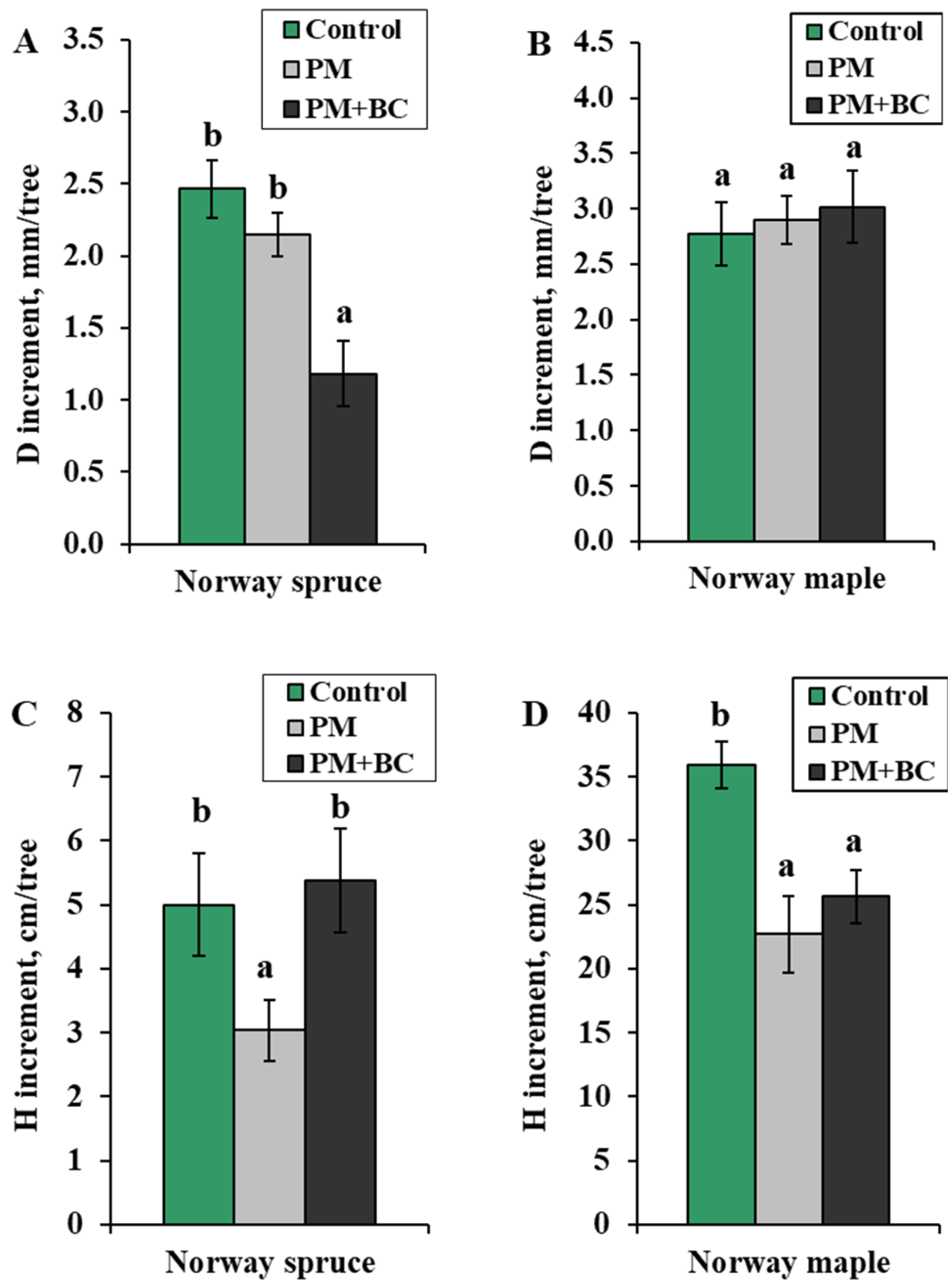
3.1. Stem Growth Responses
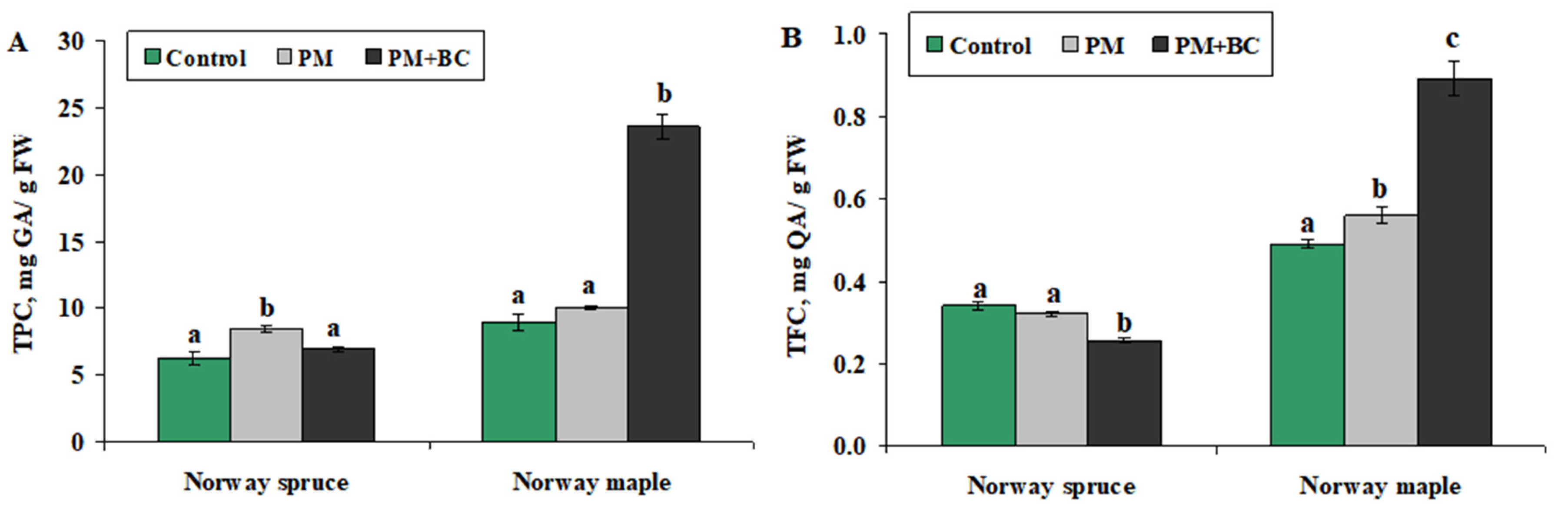
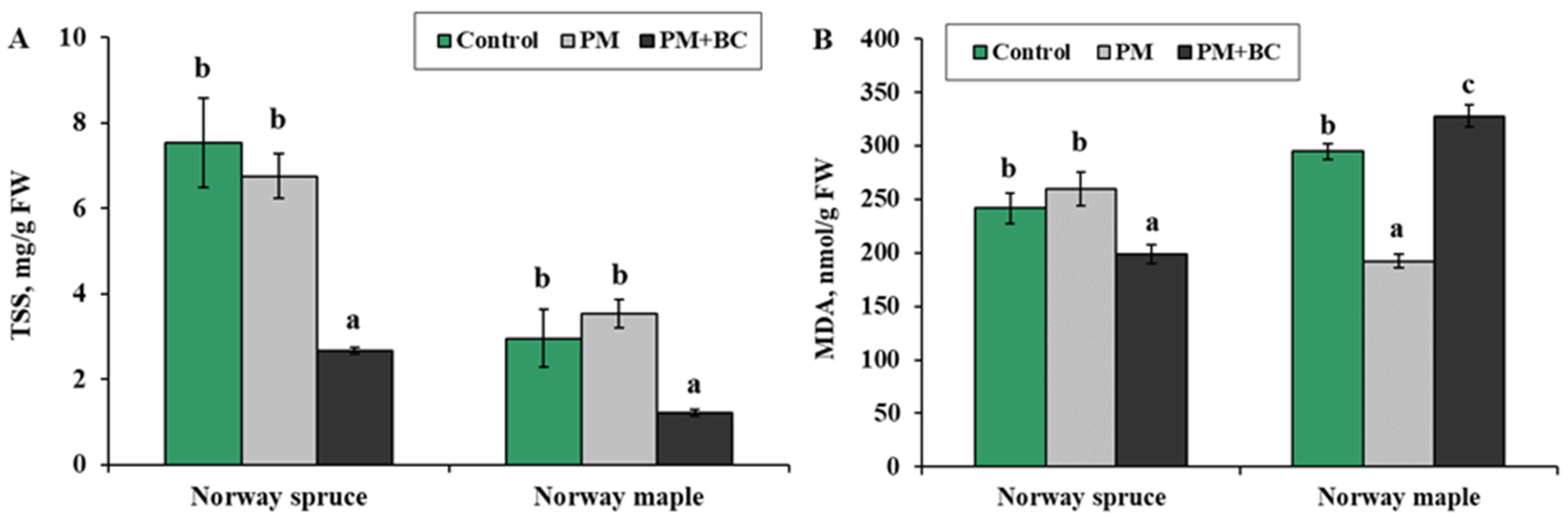
3.2. Biochemical Responses
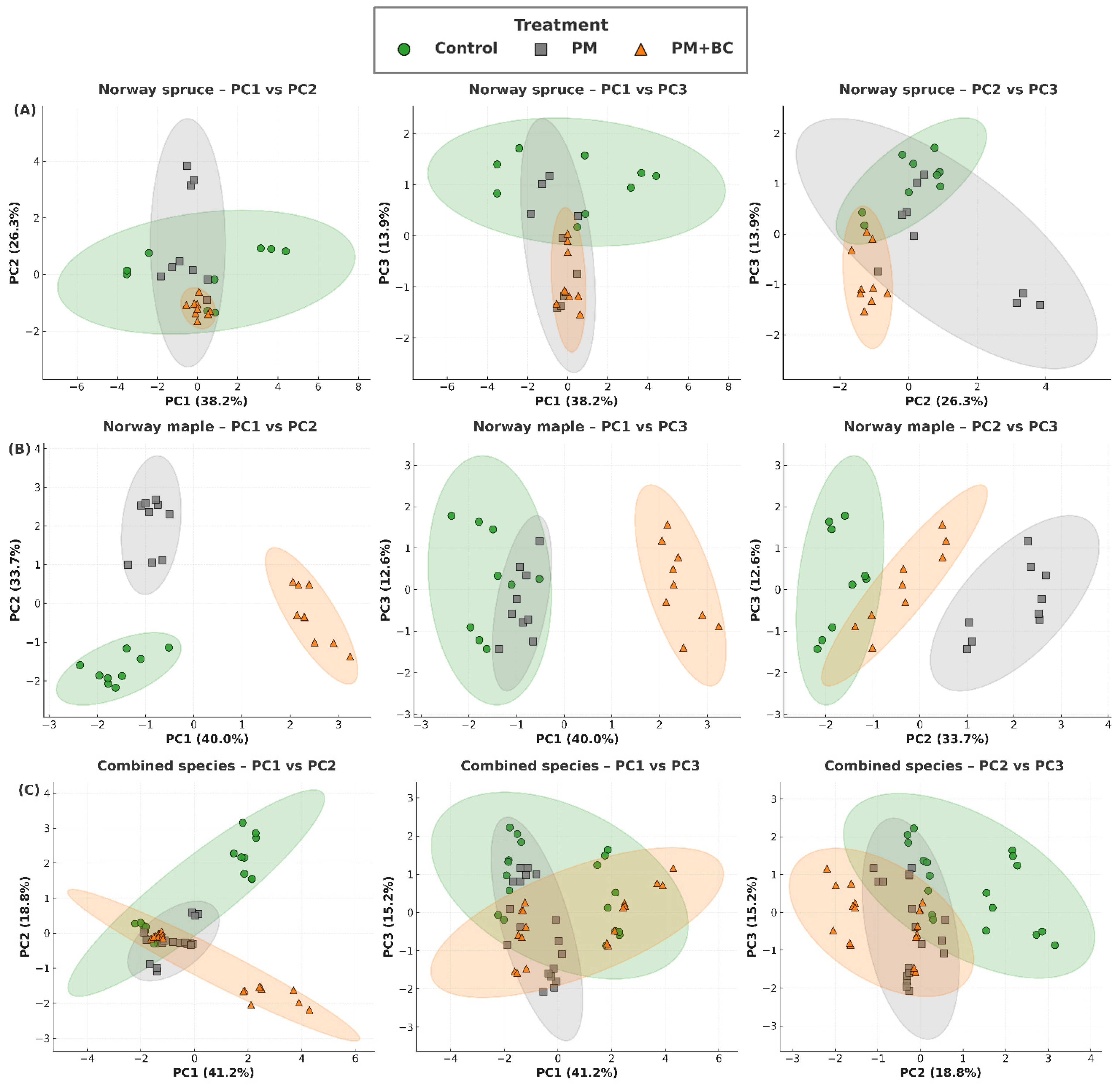
3.3. Multivariate Biochemical Responses to Treatments
4. Discussion
5. Conclusions
Supplementary Materials
Author Contributions
Funding
Institutional Review Board Statement
Informed Consent Statement
Data Availability Statement
Acknowledgments
Conflicts of Interest
References
- World Health Organization. WHO Global Air Quality Guidelines: Particulate Matter (PM2.5 and PM10), Ozone, Nitrogen Dioxide, Sulfur Dioxide and Carbon Monoxide; World Health Organization: Geneva, Switzerland, 2021; p. 273. Available online: https://www.who.int/publications/i/item/9789240034228 (accessed on 25 September 2025).
- Nowak, J.M.; Cantrell, K.B.; Watts, D.W.; Busscher, W.J.; Johnson, M.G. Designing relevant biochars as soil amendments using lignocellulosic-based and manure-based feedstocks. J. Soils Sediments 2014, 14, 330–343. [Google Scholar]
- Paull, N.J.; Krix, D.; Irga, P.J.; Torpy, F.R. Green wall plant tolerance to ambient urban air pollution. Urban For. Urban Green 2021, 63, 127201. [Google Scholar] [CrossRef]
- Popek, R.; Gawrońska, H.; Wrochna, M.; Gawroński, S.W.; Sæbø, A. Particulate matter on foliage of 13 woody species: Deposition on surfaces and phytostabilisation in waxes—A 3-year study. Int. J. Phytoremediat. 2013, 15, 245–256. [Google Scholar] [CrossRef] [PubMed]
- Przybysz, A.; Sæbø, A.; Hanslin, H.M.; Gawroński, S.W. Accumulation of particulate matter and trace elements on vegetation as affected by pollution level, rainfall and the passage of time. Sci. Total Environ. 2014, 481, 360–369. [Google Scholar] [CrossRef]
- Rai, P.K. Impacts of particulate matter pollution on plants: Implications for environmental biomonitoring. Ecotoxicol. Environ. Saf. 2016, 129, 120–136. [Google Scholar] [CrossRef]
- Piccolo, E.L.; Becagli, M.; Lauria, G.; Cantini, V.; Ceccanti, C.; Cardelli, R.; Massai, R.; Remorini, D.; Guidi, L.; Landi, M. Biochar as a soil amendment in the tree establishment phase: What are the consequences for tree physiology, soil quality and carbon sequestration? Sci. Total Environ. 2022, 844, 157175. [Google Scholar] [CrossRef]
- Huber, G.W.; Iborra, S.; Corma, A. Synthesis of transportation fuels from biomass: Chemistry, catalysts, and engineering. Chem. Rev. 2006, 106, 4044–4098. [Google Scholar] [CrossRef]
- Biederman, L.A.; Harpole, W.S. Biochar and its effects on plant productivity and nutrient cycling: A meta-analysis. GCB Bioenergy 2013, 5, 202–214. [Google Scholar] [CrossRef]
- Yadav, S.P.S.; Bhandari, S.; Bhatta, D.; Poudel, A.; Bhattarai, S.; Yadav, P.; Ghimire, N.; Paudel, P.; Paudel, P.; Shrestha, J.; et al. Biochar application: A sustainable approach to improve soil health. J. Agric. Food Res. 2023, 11, 100498. [Google Scholar] [CrossRef]
- Kozioł, A.; Paliwoda, D.; Mikiciuk, G.; Benhadji, N. Biochar as a multi-action substance used to improve soil properties in horticultural and agricultural crops—A review. Agriculture 2024, 14, 2165. [Google Scholar] [CrossRef]
- Blanco-Canqui, H. Biochar and soil physical properties. Soil Sci. Soc. Am. J. 2017, 81, 687–711. [Google Scholar] [CrossRef]
- Scharenbroch, B.C.; Meza, E.N.; Catania, M.; Fite, K. Biochar and biosolids increase tree growth and improve soil quality for urban landscapes. J. Environ. Qual. 2013, 42, 1372–1385. [Google Scholar] [CrossRef] [PubMed]
- Bong, C.P.C.; Lim, L.Y.; Lee, C.T.; Ong, P.Y.; VanFan, Y.; Klemeš, J.J. Integrating compost and biochar towards sustainable soil management. Chem. Eng. Trans. 2021, 86, 1345–1350. [Google Scholar] [CrossRef]
- Schaffert, E.; Lukac, M.; Percival, G.; Rose, G. The influence of biochar soil amendment on tree growth and soil quality: A review for the arboricultural industry. Arboric. Urban For. 2022, 48, 176–202. [Google Scholar] [CrossRef]
- Somerville, P.D.; Farrell, C.; May, P.B.; Livesley, S.J. Biochar and compost equally improve urban soil physical and biological properties and tree growth, with no added benefit in combination. Sci. Total Environ. 2020, 706, 135736. [Google Scholar] [CrossRef]
- Dumroese, R.K.; Heiskanen, J.; Englund, K.; Tervahauta, A. Pelleted biochar: Chemical and physical properties show potential use as a substrate in container nurseries. Biomass Bioenergy 2011, 35, 2018–2027. [Google Scholar] [CrossRef]
- Nemati, M.R.; Simard, F.; Fortin, J.P.; Beaudoin, J. Potential use of biochar in growing media. Vadose Zone J. 2015, 14, 1–8. [Google Scholar] [CrossRef]
- Kim, Y.J.; Hyun, J.; Yoo, S.Y.; Yoo, G. The role of biochar in alleviating soil drought stress in urban roadside greenery. Geoderma 2021, 404, 115223. [Google Scholar] [CrossRef]
- Smith, I.A.; Dearborn, V.K.; Hutyra, L.R. Live fast, die young: Accelerated growth, mortality, and turnover in street trees. PLoS ONE 2019, 14, e0215846. [Google Scholar] [CrossRef]
- Ennis, C.J.; Evans, A.G.; Islam, M.; Ralebitso-Senior, T.K.; Senior, E. Biochar: Carbon sequestration, land remediation, and impacts on soil microbiology. Crit. Rev. Environ. Sci. Technol. 2012, 42, 2311–2364. [Google Scholar] [CrossRef]
- Krzyżaniak, M.; Świerk, D.; Walerzak, M.; Urbański, P. The impact of urban conditions on different tree species in public green areas in the city of Poznan. Folia Hortic. 2015, 27, 89–97. [Google Scholar] [CrossRef]
- Krzyżaniak, M.; Świerk, D.; Szczepańska, M.; Urbański, P. Changes in the area of urban green space in cities of western Poland. Bulletin of Geography. Socio-Econ. Ser. 2018, 39, 65–77. [Google Scholar]
- Sæbø, A.; Popek, R.; Nawrot, B.; Hanslin, H.M.; Gawronska, H.; Gawronski, S.W. Plant species differences in particulate matter accumulation on leaf surfaces. Sci. Total Environ. 2012, 427, 347–354. [Google Scholar] [CrossRef] [PubMed]
- Fedorchak, E.R.; Savosko, V.M.; Krasova, O.O.; Komarova, I.O.; Yevtushenko, E.O. Ecological adaptations among spruce species along an environmental gradient in urban areas. IOP Conf. Ser. Earth Environ. Sci. 2023, 1254, 012114. [Google Scholar] [CrossRef]
- ISO 13322-1; The Standard for Particle Size Analysis. Image Analysis Methods—Static Image Analysis Methods. ISO: Geneva, Switzerland, 2014; p. 24.
- Aung, A.; Han, S.H.; Youn, W.B.; Meng, L.; Cho, M.S.; Park, B.B. Biochar effects on the seedling quality of Quercus serrata and Prunus sargentii in a containerized production system. For. Sci. Technol. 2018, 14, 112–118. [Google Scholar] [CrossRef]
- Köster, E.; Pumpanen, J.; Palviainen, M.; Zhou, X.; Köster, K. Effect of biochar amendment on the properties of growing media and growth of containerized Norway spruce, Scots pine, and silver birch seedlings. Can. J. For. Res. 2021, 51, 31–40. [Google Scholar] [CrossRef]
- Beniušytė, E.; Čėsnienė, I.; Sirgedaitė-Šėžienė, V.; Vaitiekūnaitė, D. Genotype-dependent jasmonic acid effect on Pinus sylvestris L. growth and induced systemic resistance indicators. Plants 2023, 12, 255. [Google Scholar] [CrossRef]
- Černiauskas, V.; Varnagirytė-Kabašinskienė, I.; Čėsnienė, I.; Armoška, E.; Araminienė, V. Response of tree seedlings to a combined treatment of particulate matter, ground-level ozone, and carbon dioxide: Primary effects. Plants 2025, 14, 6. [Google Scholar] [CrossRef]
- Sirgedaitė-Šėžienė, V.; Vaitiekūnaitė, D.; Šilanskienė, M.; Čėsnienė, I.; Striganavičiūtė, G.; Jaeger, A. Assessing the phytotoxic effects of class A foam application on northern Europe tree species: A short-term study on implications for wildfire management and ecosystem health. Ecol. Indic. 2024, 166, 112393. [Google Scholar] [CrossRef]
- Grantz, D.A.; Garner, J.H.B.; Johnson, D.W. Ecological effects of particulate matter. Environ. Int. 2003, 29, 213–239. [Google Scholar] [CrossRef]
- He, Y.; Yao, Y.; Ji, Y.; Deng, J.; Zhou, G.; Liu, R.; Shao, J.; Zhou, L.; Li, N.; Zhou, X.; et al. Biochar amendment boosts photosynthesis and biomass in C3 but not C4 plants: A global synthesis. GCB Bioenergy 2020, 12, 605–617. [Google Scholar] [CrossRef]
- Wang, Y.; Pana, F.; Wang, G.; Zhang, G.; Wang, Y.; Chena, X.; Mao, Z. Effects of biochar on photosynthesis and antioxidative system of Malus hupehensis Rehd. seedlings under replant conditions. Sci. Hortic. 2014, 175, 9–15. [Google Scholar] [CrossRef]
- Kováts, N.; Hubai, K.; Diósi, D.; Sainnokhoi, T.A.; Hoffer, A.; Tóth, Á.; Teke, G. Sensitivity of typical European roadside plants to atmospheric particulate matter. Ecol. Indic. 2021, 124, 107428. [Google Scholar] [CrossRef]
- Speratti, A.B.; Johnson, M.S.; Sousa, H.M.; Dalmagro, H.J.; Couto, E.G. Biochars from local agricultural waste residues contribute to soil quality and plant growth in a Cerrado region (Brazil) Arenosol. Glob. Change Biol. Bioenergy 2018, 10, 272–286. [Google Scholar] [CrossRef]
- Javanmard, Z.; Tabari Kouchaksaraei, M.; Bahrami, H.A.; Hosseini, S.M.; Modarres Sanavi, S.A.M.; Struve, D.; Ammere, C. Soil dust effects on morphological, physiological and biochemical responses of four tree species of semiarid regions. Eur. J. For. Res. 2020, 139, 333–348. [Google Scholar] [CrossRef]
- Chaturvedi, R.K.; Prasad, S.; Rana, S.; Obaidullah, S.M.; Pandey, V.; Singh, H. Effect of dust load on the leaf attributes of the tree species growing along the roadside. Environ. Monit. Assess. 2013, 185, 383–391. [Google Scholar] [CrossRef]
- Antonangelo, J.A.; Sun, X.; Eufrade-Junior, H.D.J. Biochar impact on soil health and tree-based crops: A review. Biochar 2025, 7, 51. [Google Scholar] [CrossRef]
- Hariram, M.; Sahu, R.; Elumalai, S.P. Impact assessment of atmospheric dust on foliage pigments and pollution resistances of plants grown nearby coal based thermal power plants. Arch. Environ. Contam. Toxicol. 2018, 74, 56–70. [Google Scholar] [CrossRef]
- Maletsika, P.A.; Nanos, G.D.; Stavroulakis, G.G. Peach leaf responses to soil and cement dust pollution. Environ. Sci. Pollut. Res. 2015, 22, 15952–15960. [Google Scholar] [CrossRef]
- Chen, K.; Li, T.; Yang, M.; Zhou, X.; Peng, C. The effects of environmental factors and plant diversity on forest carbon sequestration vary between eastern and western regions of China. J. Clean. Prod. 2024, 437, 140371. [Google Scholar] [CrossRef]
- Ayaz, M.; Feizienė, D.; Tilvikienė, V.; Akhtar, K.; Stulpinaitė, U.; Iqbal, R. Biochar role in the sustainability of agriculture and environment. Sustainability 2021, 13, 1330. [Google Scholar] [CrossRef]
- Somerville, P.D.; Farrell, C.; May, P.B.; Livesley, S.J. Tree water use strategies and soil type determine growth responses to biochar and compost organic amendments. Soil Tillage Res. 2019, 192, 12–21. [Google Scholar] [CrossRef]
- Blok, C.; Regelink, I.C.; Hofland-Zijlstra, J.D.; Streminska, M.A.; Eveleens-Clark, B.A.; Bolhuis, P.R. Perspectives for the Use of Biochar in Horticulture; Wageningen UR Greenhouse Horticulture: Bleiswijk, The Netherlands, 2016; Report GTB-1388; Available online: https://edepot.wur.nl/370956 (accessed on 25 September 2025).
- Singh, H.; Singh, P.; Agrawal, S.B.; Agrawal, M. Implications of foliar particulate matter deposition on the physiology and nutrient allocation of dominant perennial species of the Indo-Gangetic Plains. Front. Plant Sci. 2022, 13, 939950. [Google Scholar] [CrossRef] [PubMed]
- Schmidt, H.P.; Kammann, C.; Hagemann, N.; Leifeld, J.; Bucheli, T.D.; Sánchez Monedero, M.A.; Cayuela, M.L. Biochar in agriculture—A systematic review of 26 global meta-analyses. GCB Bioenergy 2021, 13, 1708–1730. [Google Scholar] [CrossRef]
- Xu, L.; Wu, K.C.; Deng, Z.N.; Huang, C.M.; Verma, K.K.; Pang, T.; Huang, H.R. Biochar and its impact on soil profile and plant development. J. Plant Interact. 2024, 19, 2401356. [Google Scholar] [CrossRef]
- Sgrigna, G.; Baldacchini, C.; Dreveck, S.; Cheng, Z.; Calfapietra, C. Relationships between air particulate matter capture efficiency and leaf traits in twelve tree species from an Italian urban-industrial environment. Sci. Total Environ. 2020, 718, 137310. [Google Scholar] [CrossRef]
- Li, H.; Tang, M.; Huang, X.; Wang, L.; Liu, Q.; Lu, S. An efficient biochar adsorbent for CO2 capture: Combined experimental and theoretical study on the promotion mechanism of N-doping. Chem. Eng. J. 2023, 466, 143095. [Google Scholar] [CrossRef]
- Singh, N.K.; Sachan, K.; Ranjitha, G.; Chandana, S.; Manoj, B.P.; Panotra, N.; Katiyar, D. Building soil health and fertility through organic amendments and practices: A review. Asian J. Soil Sci. Plant Nutr. 2024, 10, 175–197. [Google Scholar] [CrossRef]
- Laird, D.A.; Fleming, P.; Davis, D.D.; Horton, R.; Wang, B.; Karlen, D.L. Impact of biochar amendments on the quality of a typical Midwestern agricultural soil. Geoderma 2010, 158, 443–449. [Google Scholar] [CrossRef]
- Lehmann, J.; Joseph, S. Biochar for environmental management: An introduction. In Biochar for Environmental Management; Lehmann, J., Joseph, S., Eds.; Earthscan: London, UK, 2015; pp. 1–12. [Google Scholar]
- Keiluweit, M.; Nico, P.S.; Johnson, M.G.; Kleber, M. Dynamic molecular structure of plant biomass-derived black carbon (biochar). Environ. Sci. Technol. 2010, 44, 1247–1253. [Google Scholar] [CrossRef]



| Species | Treatment * | Chl a | Chl b | Chl a/b |
|---|---|---|---|---|
| Norway spruce | Control | 160.1 ± 8.6 a | 138.4 ± 5.6 a | 1.15 ± 0.02 a |
| PM | 167.0 ± 5.3 a | 139.4 ± 3.0 a | 1.20 ± 0.02 a b | |
| PM + BC | 175.6 ± 2.2 a | 143.7 ± 1.7 a | 1.22 ± 0.01 b | |
| Norway maple | Control | 548.0 ± 18.4 b | 354.0 ± 10.1 b | 1.55 ± 0.04 b |
| PM | 279.3 ± 12.8 a | 201.2 ± 5.7 a | 1.38 ± 0.03 a | |
| PM + BC | 307.7 ± 18.4 a | 191.9 ± 8.9 a | 1.60 ± 0.02 b |
Disclaimer/Publisher’s Note: The statements, opinions and data contained in all publications are solely those of the individual author(s) and contributor(s) and not of MDPI and/or the editor(s). MDPI and/or the editor(s) disclaim responsibility for any injury to people or property resulting from any ideas, methods, instructions or products referred to in the content. |
© 2025 by the authors. Licensee MDPI, Basel, Switzerland. This article is an open access article distributed under the terms and conditions of the Creative Commons Attribution (CC BY) license (https://creativecommons.org/licenses/by/4.0/).
Share and Cite
Varnagirytė-Kabašinskienė, I.; Muraškienė, M.; Černiauskas, V.; Suchockas, V.; Vaičiukynė, M.; Čekstere-Muižniece, G.; Osvalde, A. Mitigating Urban Pollution Stress in Trees: Biochar Effects on Norway Spruce (Picea abies (L.) H. Karst.) and Norway Maple (Acer platanoides L.) Seedlings. Sustainability 2025, 17, 10697. https://doi.org/10.3390/su172310697
Varnagirytė-Kabašinskienė I, Muraškienė M, Černiauskas V, Suchockas V, Vaičiukynė M, Čekstere-Muižniece G, Osvalde A. Mitigating Urban Pollution Stress in Trees: Biochar Effects on Norway Spruce (Picea abies (L.) H. Karst.) and Norway Maple (Acer platanoides L.) Seedlings. Sustainability. 2025; 17(23):10697. https://doi.org/10.3390/su172310697
Chicago/Turabian StyleVarnagirytė-Kabašinskienė, Iveta, Milda Muraškienė, Valentinas Černiauskas, Vytautas Suchockas, Miglė Vaičiukynė, Gunta Čekstere-Muižniece, and Anita Osvalde. 2025. "Mitigating Urban Pollution Stress in Trees: Biochar Effects on Norway Spruce (Picea abies (L.) H. Karst.) and Norway Maple (Acer platanoides L.) Seedlings" Sustainability 17, no. 23: 10697. https://doi.org/10.3390/su172310697
APA StyleVarnagirytė-Kabašinskienė, I., Muraškienė, M., Černiauskas, V., Suchockas, V., Vaičiukynė, M., Čekstere-Muižniece, G., & Osvalde, A. (2025). Mitigating Urban Pollution Stress in Trees: Biochar Effects on Norway Spruce (Picea abies (L.) H. Karst.) and Norway Maple (Acer platanoides L.) Seedlings. Sustainability, 17(23), 10697. https://doi.org/10.3390/su172310697