


Abstract
Blue-green space patterns and meteorological conditions jointly influence PM2.5 concentrations. However, the nonlinear mechanisms and interactions among these key drivers remain insufficiently studied. To address this gap, this study applied an interpretable machine learning approach (XGBoost-SHAP) to detect seasonal nonlinearities, thresholds, and interaction effects of meteorological and landscape metrics on PM2.5 distribution in Jiangsu Province, China. Structural Equation Model was further employed to quantify the direct and indirect effect pathways among these factors. Model explanatory power showed distinct seasonal variations, with the highest performance in summer (R2 = 0.615) and the lowest in winter (R2 = 0.316). Meteorological factors exerted stronger influences than blue-green space pattern metrics, with wind speed being the most critical meteorological factor across all seasons. Among landscape metrics, the proportion of green space and water body (G_PLAND and W_PLAND) was the key driver of PM2.5 concentrations in spring, autumn, and winter, while its influence became insignificant in summer, replaced by the number and shape complexity of green space patches. This study further revealed that in spring, autumn, and winter, G_PLAND and W_PLAND not only exerted direct effects on PM2.5 but also significantly influenced it indirectly by modulating land surface temperature. Additionally, green space shape complexity and land surface temperature were found to interact with other meteorological and landscape factors during these seasons; once exceeding specific thresholds, they reversed the direction of other factors’ effects on PM2.5. No significant interactions were detected in summer, indicating that dominant factors primarily exerted independent effects during this season. Collectively, our findings provide important insights for formulating seasonally adaptive planning strategies to advance sustainable urban development and long-term air quality management.
1. Introduction
Since the early 21st century, rapid urbanization and industrialization in China have significantly increased energy consumption, leading to severe atmospheric particulate matter pollution [1]. Among various pollutants, fine particulate matter (PM2.5) poses the most critical threat to public health. PM2.5 refers to fine particles measuring 2.5 μm or less in diameter, which are capable of prolonged suspension in the air and deep penetration into the respiratory tract [2]. Epidemiological studies confirm that exposure to high-concentration PM2.5 substantially elevates risks of cardiovascular diseases, respiratory disorders, and premature mortality [3,4,5]. Globally, ambient PM2.5 pollution caused approximately 4.2 million premature deaths in 2016, with East and South Asia accounting for 7.6% of these deaths [3,6]. Thus, identifying effective PM2.5 mitigation measures is vital to improving residential environmental quality and ensuring public health. Blue-Green Space (BGS)—an integrative concept encompassing natural and semi-natural landscapes with water bodies (“blue”) and vegetation (“green”), such as parks, forests, grasslands, lakes, and rivers—is increasingly recognized as a crucial factor in regulating urban air quality [7,8].
The regulatory effects of BGS on PM2.5 operate through both direct and indirect pathways. While deposition to vegetation is always a positive sink for PM2.5, the aerodynamic impact of vegetation’s porous structure can be complex and even counterproductive. Dense planting may inhibit air exchange, reducing the dispersion of particulates and potentially increasing local pollution levels [9,10]. Similarly, water bodies regulate PM2.5 through direct pathways, primarily via the deposition and retention of particles upon contact with the water surface, as well as through indirect microclimatic modification. This direct cleansing effect is most pronounced in warm seasons. However, in winter, their microclimatic effects can stabilize the atmospheric boundary layer, suppress pollutant dispersion, and under specific meteorological conditions such as stagnant air and high humidity, lead to localized PM2.5 accumulation [11,12]. This means that the regulation of PM2.5 by BGS is subject to meteorological and climatic factors [13,14], while BGS can also reconfigure local microclimatic variables, thereby shaping particulate dispersion pathways [15,16]. Meanwhile, meteorological factors such as wind patterns and atmospheric moisture fundamentally govern the advection, transformation, and removal of airborne particles [13,17]. Therefore, these atmospheric and landscape-based drivers must be conceptualized as a complex, interactive system rather than operating in isolation [18,19,20].
During urbanization, urban area undergo significant landscape transformations, including areal loss, patch fragmentation, and diminished connectivity of BGS [21]. These changes significantly impair their ecosystem services, including the removal of PM2.5 [22]. To inform spatial optimization for improved air quality, numerous studies have attempted to quantify the complex relationships between urban form and PM2.5 concentrations [23,24,25]. It has been confirmed that spatial patterns of green spaces, such as their coverage rate, fragmentation degree, and shape complexity, exert significant influences on regional PM2.5 concentrations [26,27,28]. However, existing studies have predominantly focused on green spaces in isolation, with limited simultaneous consideration of their combined effects with water bodies. Growing evidence suggests that these two landscape components may exhibit synergistic effects in microclimate regulation and pollutant removal [29,30]. For instance, a lake breeze can elevate humidity levels in adjacent green spaces [16], which in turn can enhance the PM2.5 capture capacity of vegetation [31,32]. This interplay underscores the necessity of considering BGS as an integrated system when assessing their role in PM2.5.
Previous studies have primarily relied on correlation analyses and linear models to explore the relationships between urban form and PM2.5 concentrations [26,33,34]. However, growing evidence indicates that the influences of meteorological and landscape factors on PM2.5 concentration are nonlinear and involve complex interactions. For instance, a larger water body does not always correspond to a stronger PM2.5 removal capacity [35]; its impact is significantly mediated by meteorological conditions such as wind speed, humidity, and temperature [36,37]. Moreover, prior studies have confirmed that low wind speeds combined with near-surface cold, dry conditions lead to the accumulation of high PM2.5 levels, indicating interactive effects among these factors [38,39]. Nevertheless, traditional linear models, including multiple linear regression and its extended form, geographically weighted regression, are unable to capture the nonlinear responses and threshold effects of explanatory variables [40,41]. They also fail to effectively identify interactions among driving factors and their corresponding thresholds. Furthermore, a more fundamental limitation lies in the unclear causal mechanisms. It remains uncertain to what extent the purification of PM2.5 by BGS stems from direct removal (e.g., particle deposition) versus indirect microclimatic mediation—such as through the reduction of land surface temperature (LST), which may suppress the formation of secondary aerosols. Disentangling these direct and indirect pathways is crucial for developing targeted strategies to mitigate PM2.5 pollution.
To address these research gaps, this study focuses on Jiangsu Province—a core component of the Yangtze River Delta (YRD) with pronounced PM2.5 pollution and regional heterogeneity—to systematically investigate the underlying driving mechanisms. We develop an integrated analytical framework combining the eXtreme Gradient Boosting (XGBoost) model with SHapley Additive exPlanations (SHAP) for interpreting nonlinear relationships and threshold effects, alongside structural equation model (SEM) to quantify direct, indirect, and total effects among key variables. On a seasonal time scale (spring, summer, autumn, winter), this study is designed to achieve the following three research objectives: (1) to identify the nonlinear influence mechanisms and critical thresholds of meteorological factors, BGS patterns, and LST on PM2.5 concentrations; (2) to examine the interactive effects between meteorological conditions and landscape configuration in modulating PM2.5 levels; and (3) to disentangle the direct, indirect, and total effects of meteorological and BGS pattern factors on PM2.5, particularly those mediated through LST and microclimatic pathways. Through this multifaceted approach, we aim to provide a seasonally resolved, mechanism-based understanding of PM2.5 pollution, thereby supporting targeted and temporally adaptive air quality management strategies in highly urbanized regions.
2. Methodology
2.1. Study Area
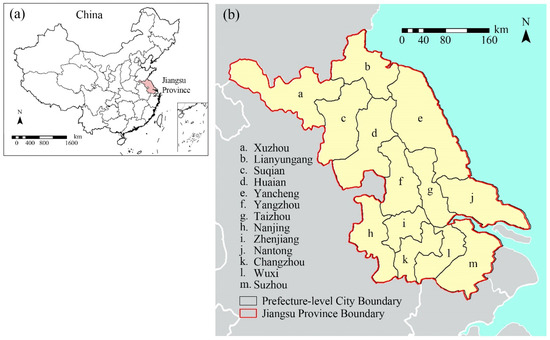
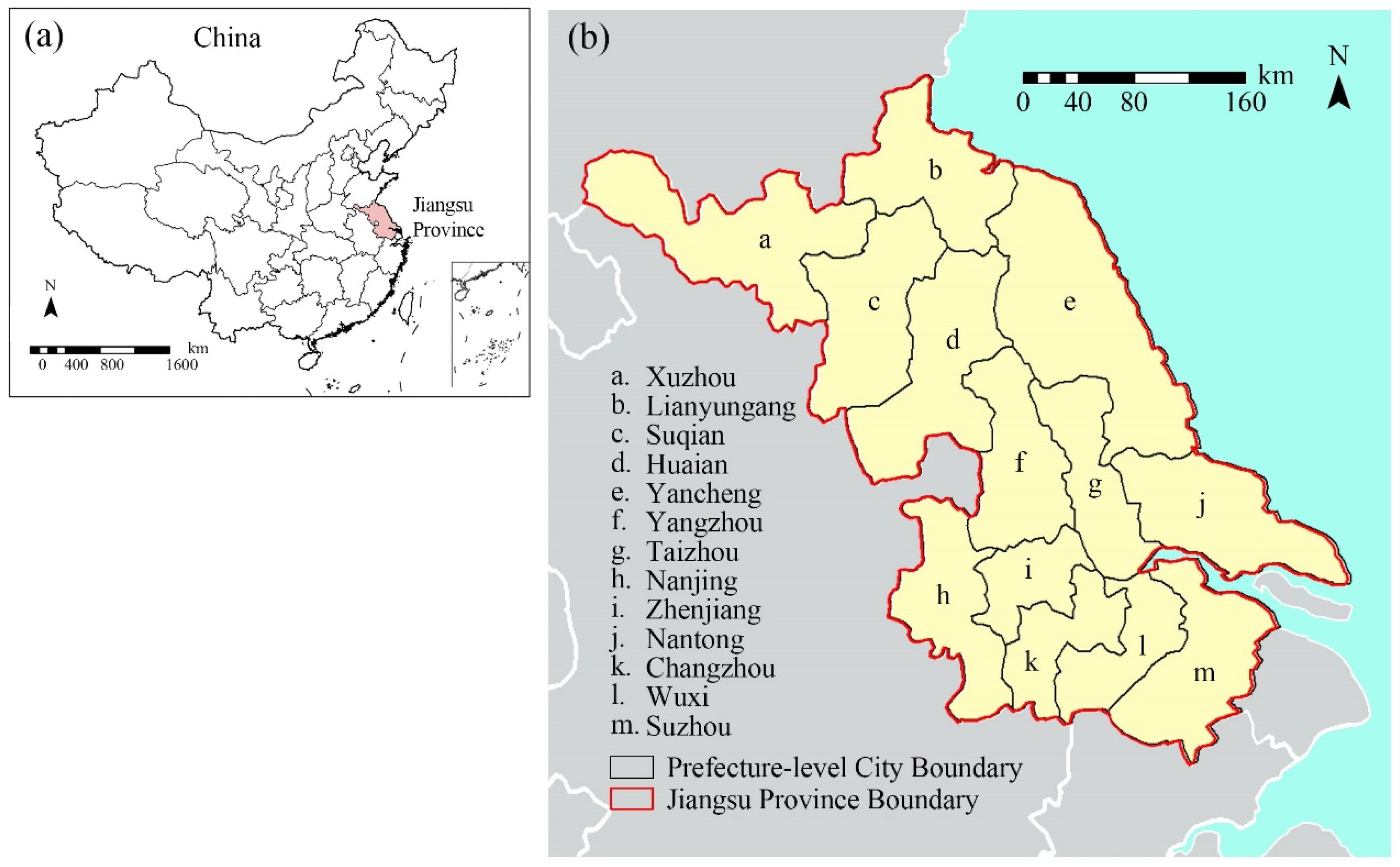
This study focuses on Jiangsu Province, located in eastern China and serving as a core region of the YRD urban agglomeration (Figure 1a). The annual average PM2.5 concentration of YRD region in 2023 was 55 μg/m3, a year-on-year increase of 7.8% [42], significantly exceeding the World Health Organization air quality guideline level of 5 μg/m3 [43]. Jiangsu is a densely populated and economically dynamic Chinese province, with a total area of approximately 107,200 km2. It has a permanent population of over 85.26 million [44] and comprises 13 prefecture-level cities, including Nanjing, Wuxi, Xuzhou, and Suzhou (Figure 1b). The province features a humid northern subtropical monsoon climate and four distinct seasons. Characterized by a high level of industrialization and urbanization, Jiangsu Province is a pivotal region in China’s economy. This very development, driven by a dense population and an advanced industrial sector with high energy demands, also renders it a prominent emitter of atmospheric pollutants. As a result, Jiangsu confronts complex air pollution issues stemming from both local emissions and cross-border transport within the YRD region.
Figure 1.
Maps of the study area: (a) The location of Jiangsu Province in China; (b) The administrative divisions of Jiangsu, showing its prefecture-level cities.
2.2. Data Sources
This study utilized gridded meteorological factors from the China Meteorological Forcing Dataset (CMFD) v2.0, including wind speed at 10 m height (WIND), precipitation (PREC), and atmospheric pressure at 2 m height (PRES). It is a fusion product that integrates ground observations from multiple sources with reanalysis and remote sensing data. Additionally, PM2.5 concentration data was derived from the ChinaHighPM2.5 dataset, a high-resolution and high-quality ground-level PM2.5 dataset for China (2000–2023), with a spatial resolution of 1 km and units of µg/m3 [45]. This study employed daily average data. LST data is obtained from the Thermal and Reanalysis Integrating Moderate-resolution Spatial-seamless (TRIMS) dataset, a daily 1 km all-weather LST dataset for China and its surrounding areas [46]. This dataset has a temporal resolution of four times per day and a spatial resolution of 1 km. Considering that most data have a spatial resolution of 1 km, we adopt a 1 km × 1 km grid as the analysis unit in this study. The aforementioned indices all use same-day data for subsequent analysis, specifically from 17 April 2023, 7 July 2023, 21 October 2023, and 22 December 2023, representing spring, summer, autumn, and winter, respectively. The calculation of BGS pattern indices is based on the European Space Agency (ESA) WorldCover 10 m land cover dataset [47]. This dataset is a global land cover classification product, produced using Sentinel-1 and Sentinel-2 data. Based on the original classification scheme of the dataset and aligned with the objectives of this study, we reclassified “Tree cover”, “Shrubland”, and “Grassland” into a consolidated “green space” category, while “Water bodies” and “Wetland” were merged into a single water features category. Elevation data was obtained from the Resource and Environment Science and Data Center. Detailed information on the data sources is provided in Table 1.
Table 1.
Data sources used in the study.
2.3. Quantification of BGS Spatial Patterns and Selection of Analytical Units
To quantify the spatial patterns of BGS, this study selected five widely used class-level metrics, including PLAND, PD, SHAPEam, COHESION, and AI (see Table 2 for detailed definitions). Among these, PLAND serves as a landscape composition metric, measuring the proportion of the total study area covered by a specific land cover type. The other four metrics are spatial configuration indicators, characterizing the spatial morphology, connectivity, and distribution patterns of patches from different perspectives. Given the focus of this research on the potential influence of green space and water body spatial patterns on PM2.5 concentration, the following naming convention was adopted: W_PLAND denotes the percentage of water bodies, G_PLAND represents the percentage of green space patches. All other landscape metrics follow this same naming principle. The calculation of BGS metrics was performed using the FRAGSTATS (version 4.0) software.
Table 2.
Definitions of landscape metrics.
Since the calculation of BGS metrics is based on the land cover map, the accuracy of the classification result is crucial. We first conducted an accuracy assessment of the land cover type to ensure data usability. To validate the land cover classification, we generated a confusion matrix from an independent set of 1150 sample points that were randomly and uniformly distributed. The actual land cover type for each point was manually determined by visually interpreting high-resolution Google Earth imagery, providing a reliable ground-truth dataset. This validation process yielded an overall accuracy of 85.13%, confirming that the classification result is satisfactory for subsequent analysis.
Outside urban built-up areas, the landscape is dominated by single types such as cropland and natural vegetation, resulting in a large number of homogeneous grids (e.g., G_PLAND = 100%, PLAND of cropland = 100%). The landscape pattern indices (e.g., shape index, fragmentation index) of these grids have single and invariant values. Retaining them would lead to data redundancy, interfere with correlation identification, and affect model fitting performance. Therefore, to focus on the actual impact of landscape pattern heterogeneity on PM2.5 concentrations, this study excluded such homogeneous grids outside built-up areas in subsequent analyses, retaining 8200 grid units for further research, resulting in a robust feature-to-sample ratio of 0.0018 (with 15 predictors).
2.4. XGBoost-SHAP Interpretable Machine Learning Framework
This study applied an interpretable machine learning framework integrating XGBoost with SHAP analysis to quantify nonlinear effects of meteorological factors, Elevation, and blue-green spatial patterns on PM2.5 concentrations. XGBoost effectively models complex relationships through boosted tree ensembles with regularization [48], while SHAP provides mathematically grounded explanations for predictions based on cooperative game theory [49]. This approach overcomes the “black-box” limitation of standalone machine learning models, enabling both accurate PM2.5 prediction and mechanistic interpretation of driving factors. SHAP values quantify each feature’s contribution to individual predictions, identify key pollution drivers, and reveal their effect directions. Notably, the tree-based structure of XGBoost is inherently robust to multicollinearity among predictors, as it prioritizes the identification of strong predictive relationships over the orthogonality of features.
For model development, the data were split randomly, allocating 80% for training and reserving 20% as a hold-out test set for unbiased final assessment. Model hyperparameters were optimized utilizing the Optuna package, which applied a Bayesian search strategy guided by five-fold cross-validation on the training data. Consistency across cross-validation folds was maintained by fixing the random number generator seed. Tuned hyperparameters comprised the number of trees, maximum tree depth, L2 regularization term, minimum child weight, instance sampling rate, and the learning rate. After identifying the best configuration, the final model was fitted on all training data. Its predictive generalization was then assessed on the untouched test partition using performance measures: Mean Squared Error (MSE), Root Mean Squared Error (RMSE), Mean Absolute Error (MAE), and the R-squared statistic (R2).
Evaluation metrics demonstrated clear seasonality in model performance (Table 3). Predictive performance was highest in summer, with an R2 of 0.615 on the training data and 0.609 on the testing set, supported by strong cross-validation consistency (R2 = 0.543 ± 0.026). Performance was intermediate during spring (testing R2 = 0.439) and was lowest in autumn and winter, where testing R2 values fell to 0.324 and 0.307, respectively. All error measurements (MSE, RMSE, MAE) aligned with this pattern, registering maximum values in summer and minimum values in cooler months. This seasonal performance gradient, consistent in cross-validation, confirms that the identified relationships are most stable and dependable for summer conditions.
Table 3.
Overall model accuracy.
Subsequently, SHAP values were computed from the finalized model to measure the localized and overall influence of each predictor on PM2.5. These values distribute the predictive contribution among features for singular instances, pinpointing major factors behind specific pollution levels and whether they increase or decrease PM2.5. Additionally, SHAP delivers a reliable global ranking of feature significance and quantifies interactive effects, clarifying potential cooperative or opposing relationships between different environmental variables. The joint use of XGBoost and SHAP fully exploits their combined capacity for managing complex nonlinearity and supplying clear causal understanding, thereby laying a robust quantitative groundwork for unraveling the intrinsic mechanistic pathways through which multiple factors govern PM2.5 pollution. This analytical procedure was executed in Python 3.12.7 using the XGBoost and Optuna libraries.
2.5. Structural Equation Model
To disentangle the complex interrelationships among meteorological conditions, topography, and BGS patterns in affecting seasonal PM2.5 concentrations, we applied structural equation modeling (SEM) [50]. This approach allows for the simultaneous estimation of the direct influences of predictors on PM2.5 and their indirect effects mediated by LST. Our conceptual path model explicitly defined LST as a mediator and tested three core relationships: the direct pathways from predictors (WIND, PREC, PRES, Elevation, G_PLAND, W_PLAND, G_PD) to PM2.5; the indirect pathways from these predictors to PM2.5 via LST; and the direct effect of LST on PM2.5. The total effect for each variable was derived from the summation of its direct and indirect effect coefficients. The model’s adequacy in representing the data was verified against standard thresholds for multiple goodness-of-fit indices: the Root Mean Square Error of Approximation (RMSEA < 0.06), Tucker–Lewis Index (TLI > 0.90), Comparative Fit Index (CFI > 0.90), and Adjusted Goodness of Fit Index (AGFI > 0.90) [51]. All analyses were performed using the “lavaan” package within the R statistical environment, with separate models fitted for each season.
3. Results
3.1. Identification of Dominant Drivers and Nonlinear Threshold Effect
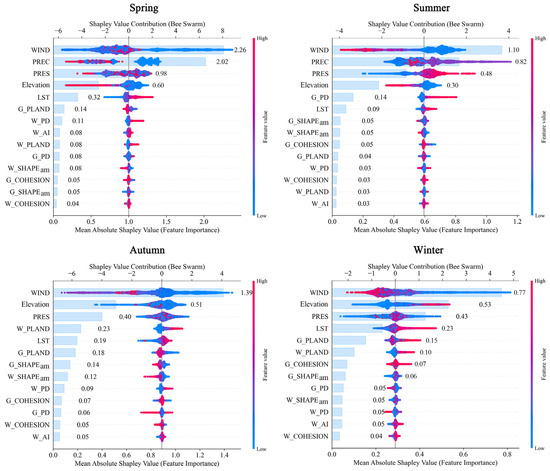
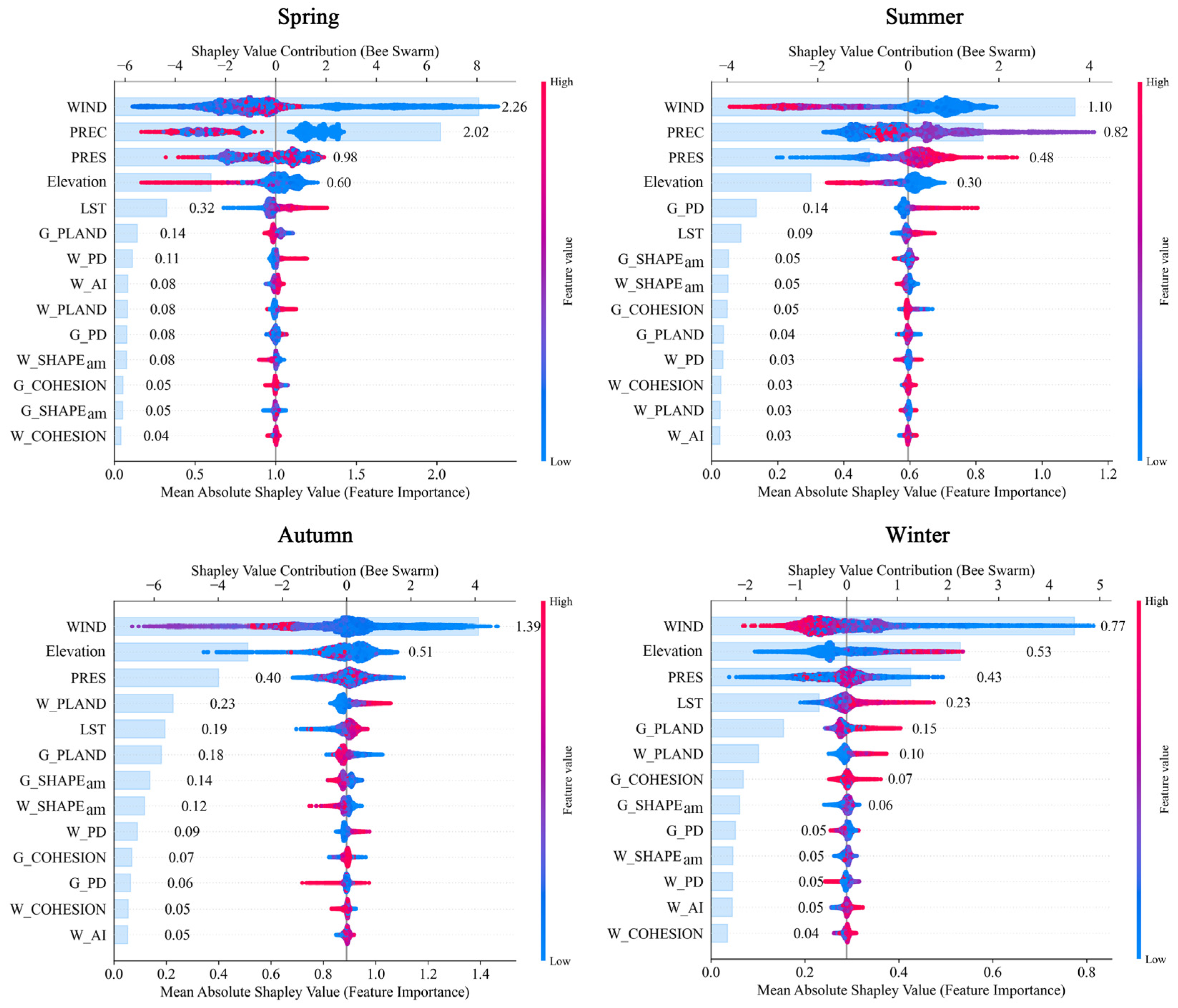
As shown in Figure 2, the key drivers of PM2.5 and their directional influences exhibited significant seasonal variations. In spring, WIND (negative), PREC (negative), and PRES (negative) were the dominant factors, followed by Elevation (negative), LST (positive), and G_PLAND (negative). During summer, WIND (negative) remained the primary factor, while PREC and PRES both shifted to positive influences, accompanied by Elevation (negative), G_PD (positive), and LST (positive). In autumn, WIND (negative) and Elevation (negative) were the primary predictors, with PRES (positive), W_PLAND (positive), LST (positive), and G_PLAND (negative) also contributing. The winter pattern was characterized by WIND (negative), Elevation (positive), PRES (negative), LST (positive), and positive effects from both G_PLAND and W_PLAND.
Figure 2.
Seasonal predictor importance and its directional effects on the PM2.5 concentration.
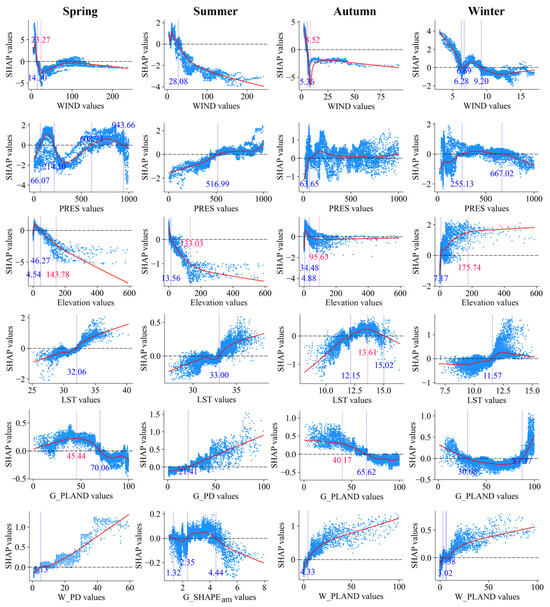
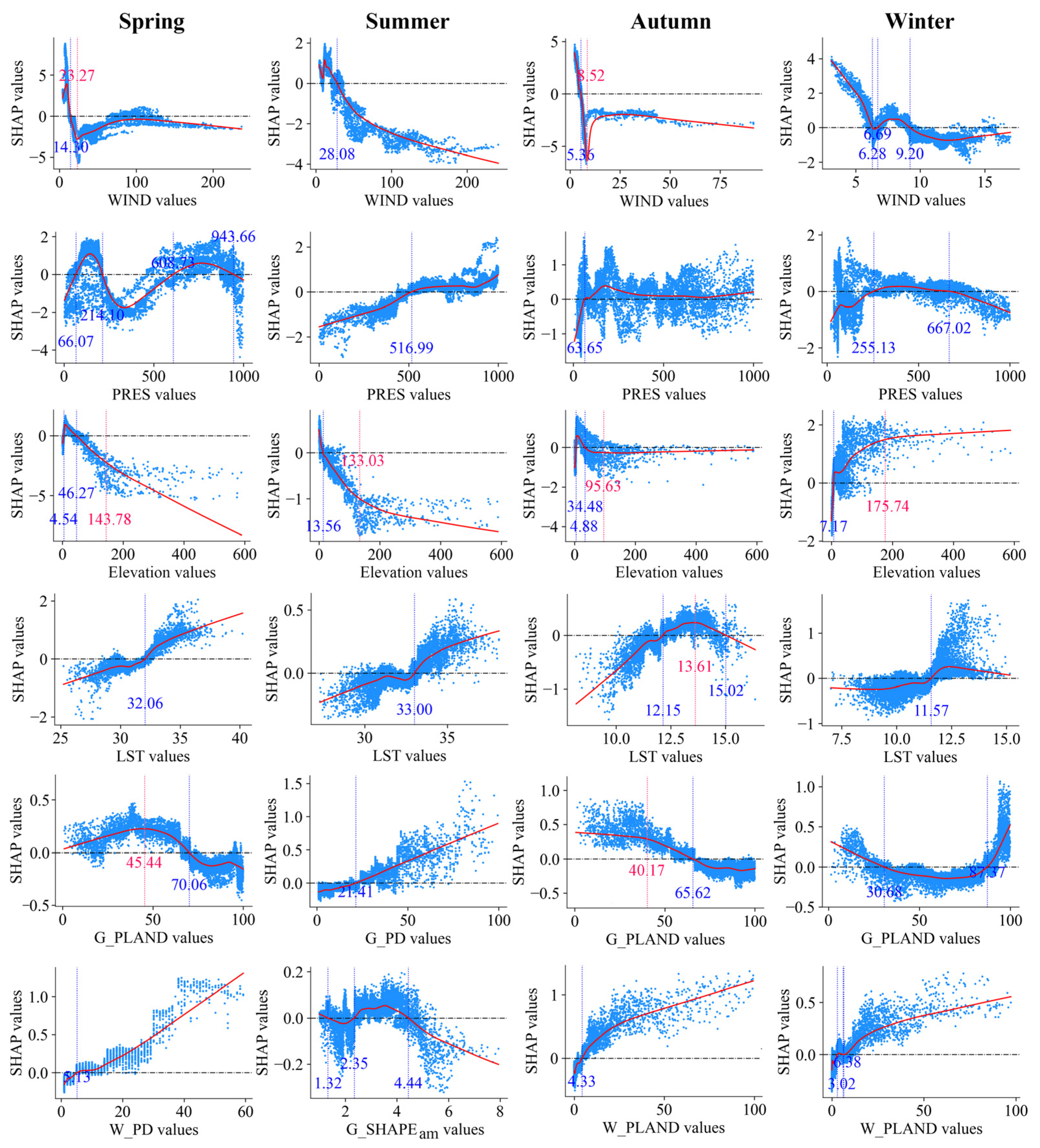
Based on the analysis of SHAP dependence plots (Figure 3), the influence of meteorological factors on PM2.5 concentrations exhibits significant nonlinear characteristics and seasonal variations. For WIND, a globally negative association with PM2.5 was observed across all four seasons, which was statistically significant before reaching certain seasonal thresholds (Spring: 14.3, Summer: 28.08, Autumn: 5.36, Winter: 9.20). Within specific ranges (Spring: <23.27, Autumn: <8.52, Winter: <6.28), PM2.5 concentrations decreased rapidly with increasing wind speed. Once these thresholds were exceeded, the influence of WIND generally stabilized. Only in summer did WIND exhibit a consistent and globally negative effect throughout its observed range. PRES showed a distinct seasonal pattern, exhibiting a significant positive effect only in summer, which became apparent when pressure values exceeded 516.99. Elevation demonstrated a consistent negative correlation with PM2.5 in spring, summer, and autumn, indicating lower concentrations at higher altitudes. This effect became significant beyond seasonal thresholds (4.54 m in spring, 13.56 m in summer, and 4.88 m in autumn) and stabilized after reaching higher altitude values (143.78 m in spring, 133.03 m in summer, and 95.63 m autumn). In winter, however, Elevation exhibited a positive relationship with PM2.5, with a negative effect observed only below 7.17 m; the relationship then stabilized around 175 m. LST had a stable positive influence in spring, summer, and winter, with significant effects observed beyond thresholds of 32.06 °C, 33.00 °C, and 11.57 °C, respectively. In autumn, LST displayed a more complex pattern, where PM2.5 increased with rising temperatures up to 13.61 °C, beyond which the trend reversed and concentrations began to decline.
Figure 3.
Seasonal SHAP dependence plots showing the relationship between meteorological and BGS pattern indicators with PM2.5 concentration. Note: The blue vertical line and value denote the point where the trend line crosses SHAP = 0, indicating the baseline influence. The red dashed line and value mark the identified inflection point where the relationship’s direction or rate of change notably shifts.
The influence of BGS pattern metrics on PM2.5 exhibits notable seasonal variations. G_PLAND shows distinct seasonal effects, exerting a generally negative influence on PM2.5 in spring and autumn, while its impact in summer is not significant. Specifically in spring, PM2.5 decreases as G_PLAND increases beyond 45.44%, with a significant negative effect (SHAP < 0) observed after exceeding 70.06%. In autumn, a significant negative effect emerges once G_PLAND surpasses 65.62%. In winter, G_PLAND negatively influences PM2.5 within the range of 30.86–87.37%, but beyond 87.37%, further increases lead to rising PM2.5 levels. W_PLAND exhibits a similar pattern in autumn and winter, showing an overall positive relationship where PM2.5 increases with rising W_PLAND, becoming significant beyond thresholds of 4.33% in autumn and 6.38% in winter. In contrast, no significant impact is observed in spring or summer. W_PD shows a significant positive effect only in spring, becoming pronounced above a threshold of 5.13. Unlike other seasons, the spatial configuration metrics of BGS (i.e., G_PD and G_SHAPEam), play a more critical role than their area proportion (PLAND) in summer. An increase in G_PD leads to higher PM2.5 concentrations, with a significant positive effect above 21.41, while G_SHAPEam values exceeding 4.44 are associated with a reduction in PM2.5.
3.2. Interaction and Interaction Thresholds of Meteorological and BGS Pattern Indicators
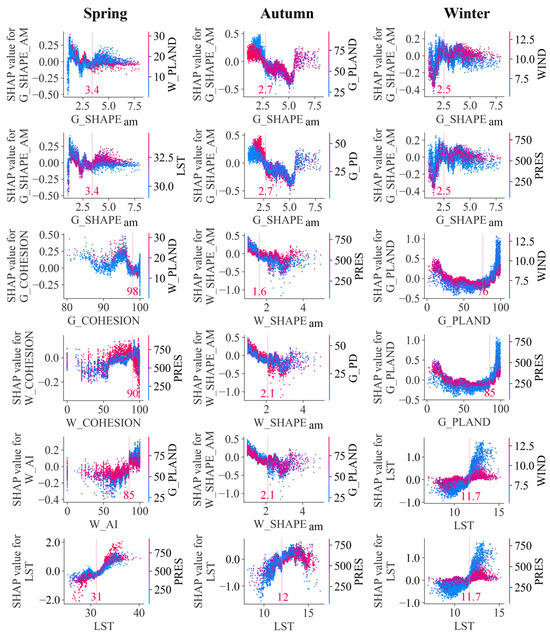
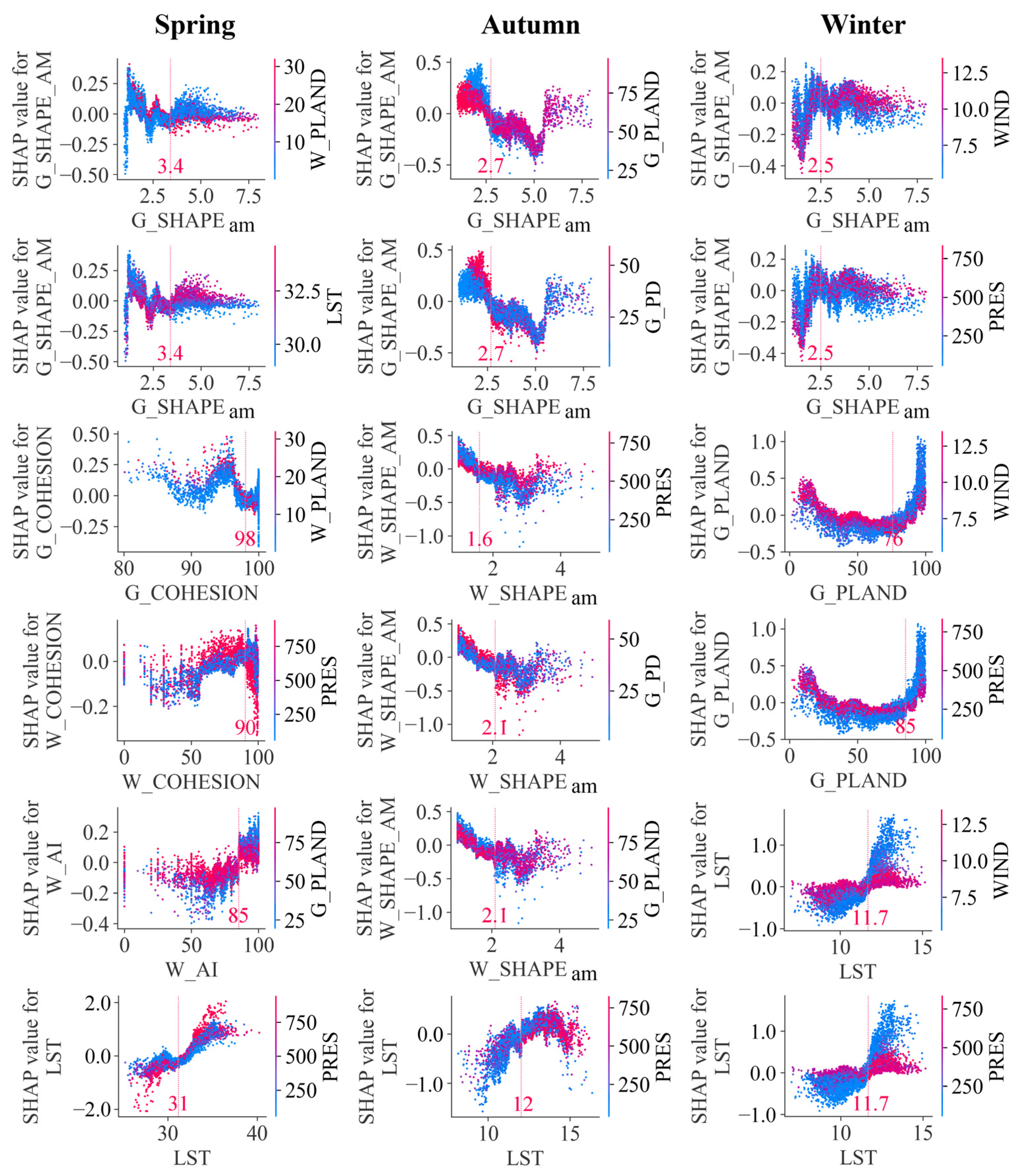
This study further reveals significant interactive effects between meteorological and landscape factors on PM2.5 in spring, autumn, and winter (Figure 4 and Table 4), whereas such clear threshold-based interactions were less pronounced in summer. Specifically, in spring, G_SHAPEam regulates the effects of W_PLAND and LST. When G_SHAPEam ≤ 3.4, W_PLAND exhibits a positive effect (enhancing PM2.5) and LST a negative effect (reducing PM2.5). Conversely, when G_SHAPEam > 3.4, the effect of W_PLAND turns negative, while that of LST becomes positive. Additionally, G_COHESION, W_COHESION, and W_AI regulate the effect directions of W_PLAND, PRES, and G_PLAND, respectively. When G_COHESION ≤ 98, W_PLAND shows a positive effect, which turns negative beyond this threshold. When W_COHESION ≤ 90, PRES shows a positive effect, turning negative beyond it. When W_AI ≤ 85, G_PLAND shows a positive effect, turning negative beyond this value. When LST ≤ 31 °C, PRES has a negative effect, turning positive above this temperature.
Figure 4.
Interactions between pairwise meteorological and BGS pattern indicators and their impact on PM2.5 concentration. The red dashed lines and adjacent numerical values indicate the interaction thresholds.
Table 4.
Summary of critical interactive thresholds and effect reversals for meteorology and BGS metrics across seasons.
In autumn, G_SHAPEam regulates the effects of G_PLAND and G_PD. When G_SHAPEam ≤ 2.7, G_PLAND shows a negative effect and G_PD a positive effect; when G_SHAPEam > 2.7, G_PLAND turns positive and G_PD turns negative. Furthermore, W_SHAPEam acts as another key regulator, influencing the effect directions of PRES, G_PD, and G_PLAND. When W_SHAPEam ≤ 1.6, PRES exerts a negative effect, turning positive beyond this point. When W_SHAPEam ≤ 2.1, G_PD shows a positive effect and G_PLAND a negative effect; beyond this threshold, G_PD turns negative and G_PLAND turns positive. When LST ≤ 12 °C, PRES shows a positive effect, which becomes negative above this threshold.
In winter, G_SHAPEam regulates the effects of WIND and PRES. When G_SHAPEam ≤ 2.5, both exert negative effects, switching to positive effects when G_SHAPEam > 2.5. Simultaneously, G_PLAND regulates the effect directions of WIND and PRES. When G_PLAND ≤ 76%, WIND shows a positive effect, turning negative beyond this coverage. When G_PLAND ≤ 85%, PRES shows a positive effect, turning negative beyond it. Additionally, LST regulates the effects of WIND and PRES. When LST ≤ 11.7 °C, WIND and PRES show positive effects, turning negative above this value.
3.3. Direct, Indirect, and Overall Effects of Meteorological and BGS Pattern Indicators on PM2.5
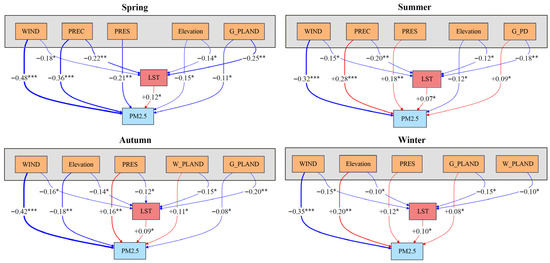
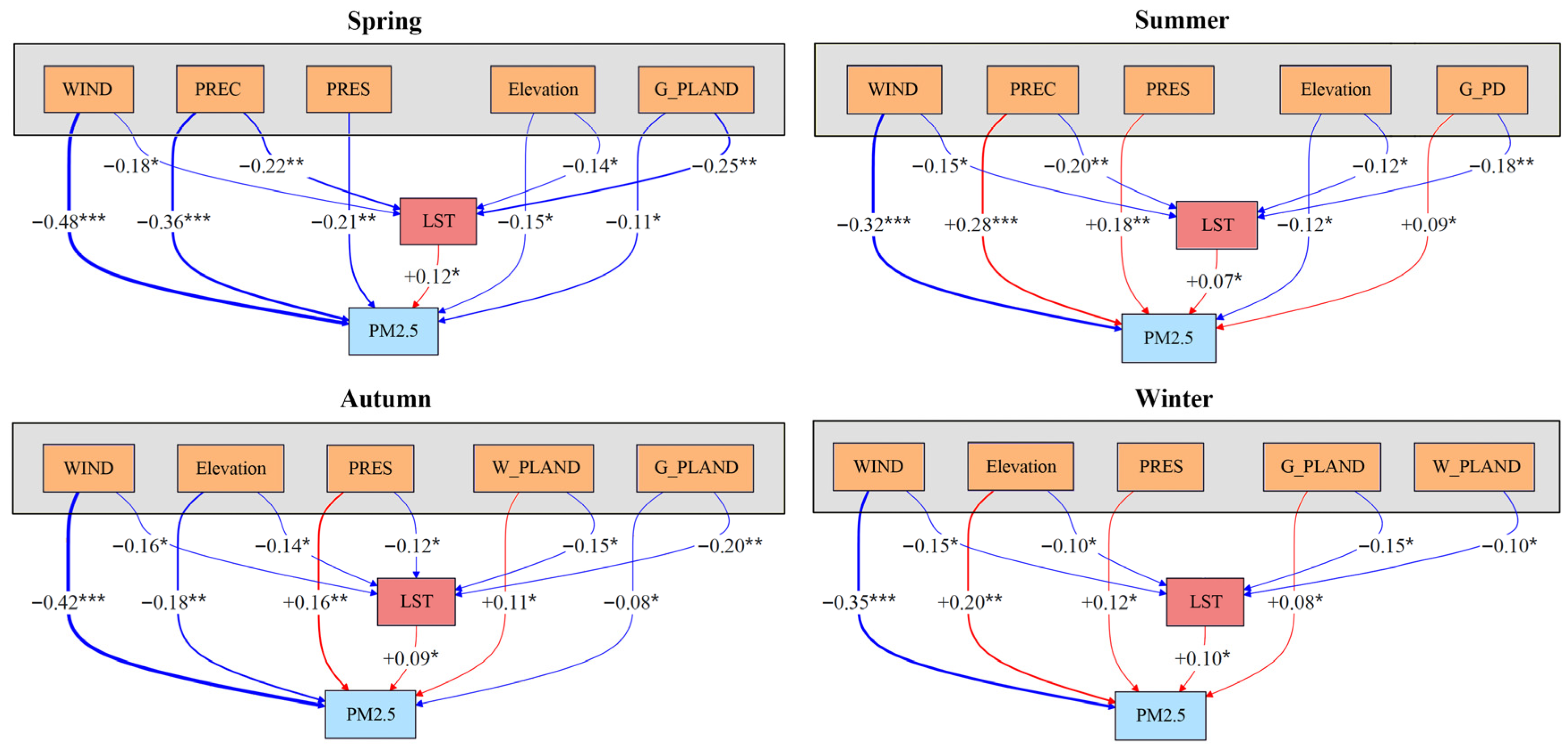
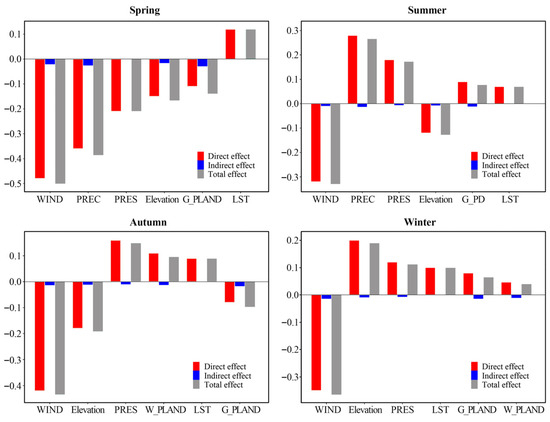
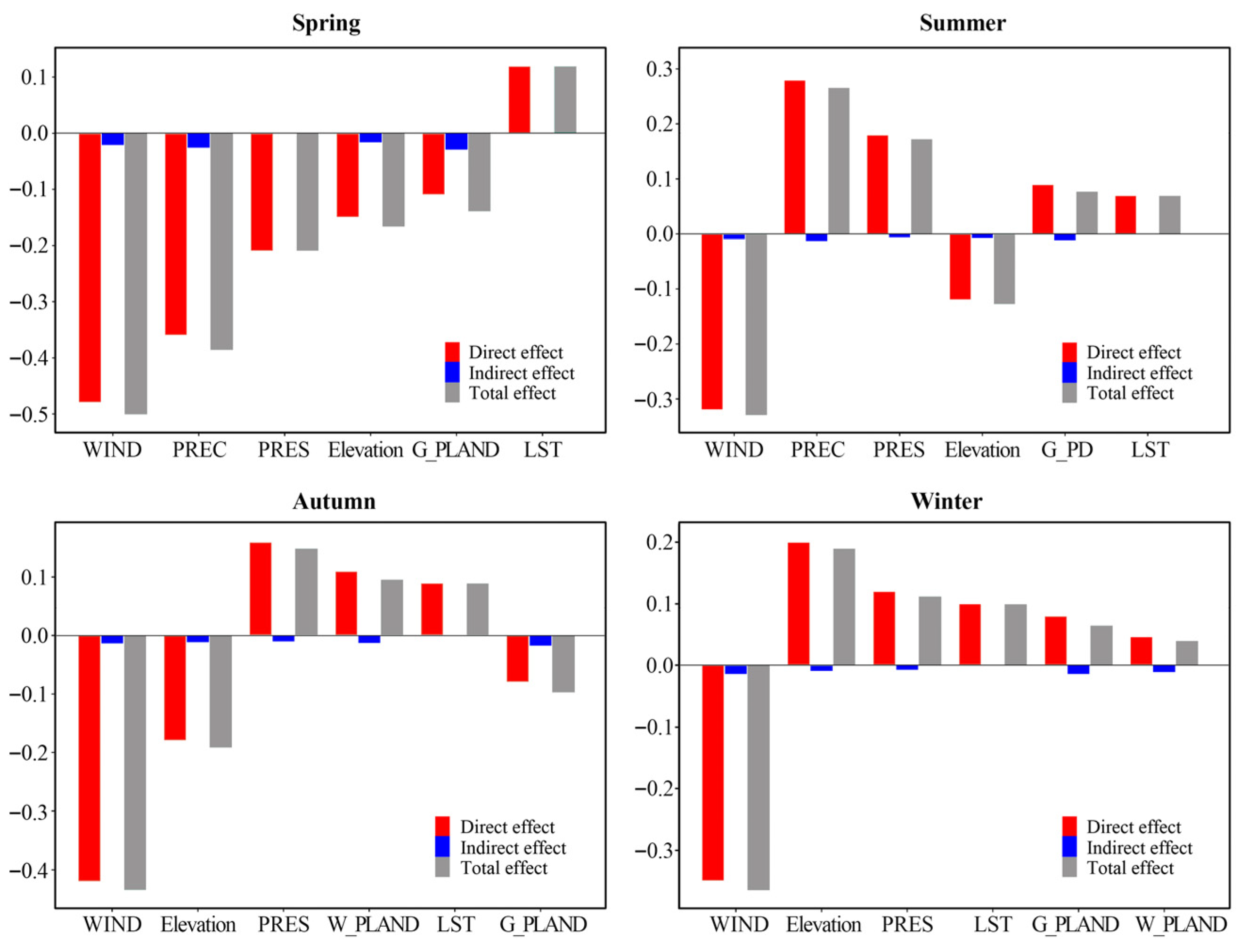
From the perspective of the pathways of meteorological factors (Figure 5 and Figure 6), the four-season SEM results indicate that WIND consistently dominates the removal process of PM2.5 through significant direct negative effects, with a minor supplementary contribution from its indirect effect of lowering LST. The highest direct effect coefficients of WIND are observed in spring and autumn. The effects of PREC and PRES exhibit complex seasonal variations, primarily mediated by their direct pathways. In spring, both exert significant direct negative effects on PM2.5. In summer, however, they shift to direct positive effects. Although there are weak indirect negative effects through LST, these are insufficient to offset their direct promoting effects. By autumn, PREC ceases to be a main variable, while PRES exerts a positive effect mainly directly, with a minor indirect contribution. By winter, the direct positive effect of PRES significantly weakens. Across spring, summer, and autumn, Elevation exerts a dominant direct negative effect on PM2.5, supplemented by a minor indirect effect via LST. In winter, this pattern reverses to a dominant direct positive effect, also with a minor LST-mediated indirect influence.
Figure 5.
Pathways through which meteorological and BGS landscape factors influence PM2.5 in four seasons. Note: Arrows represent hypothesized direct effects. Red arrows indicate positive effects, and blue arrows indicate negative effects, as determined by the sign of the standardized path coefficients (values shown adjacent to arrows). The width of each arrow is scaled according to the absolute magnitude of its standardized coefficient. For clarity, only statistically significant paths are displayed. Significance levels are denoted as follows: *** p < 0.001, ** p < 0.01, * p < 0.05.
Figure 6.
Standardized direct, indirect, and total effects of different variables on PM2.5 derived from the SEM analysis.
From the perspective of the comprehensive effects of BGS metrics, their environmental benefits show distinct seasonal characteristics. G_PLAND exerts significant direct negative effects in spring and autumn, playing a purifying role, while also generating additional indirect negative effects by reducing LST. However, in winter, its direct effect shifts to positive, and although it still produces indirect negative effects through cooling, the overall effect becomes slightly positive. W_PLAND emerges as an important variable in autumn and winter, but its dominant effect pathway differed seasonally. In autumn, it influenced PM2.5 predominantly through a stable direct positive effect, with only a minor supplementary role played by its indirect cooling effect (mediated by LST). In winter, however, the pattern shifted, and its influence on PM2.5 was primarily mediated indirectly through LST.
4. Discussion
Distinct from the traditional linear modeling framework, this study, utilizing XGBoost and SHAP analysis, reveals the highly nonlinear and complex influences of meteorological and landscape factors on PM2.5 concentrations. Across all four seasons, meteorological factors exert a significantly stronger influence on PM2.5 concentrations than the configuration of BGS. Wind speed emerges as the predominant factor, followed by air pressure and precipitation, which aligns with previous findings [30,38]. During spring, these three drivers collectively govern PM2.5 variations, while green space proportion also demonstrates a significant negative effect. Notably, this purifying effect exhibits a significant nonlinear characteristic. In both spring and autumn, the influence of the green space proportion only shifts from positive to significantly negative after exceeding high thresholds (70.06% and 65.62%, respectively) (Figure 3). This indicates that only when green space becomes the dominant landscape in the region can the “cool island effect” and enhanced dry deposition capacity it generates sufficiently alter the local microclimate and dominate air quality.
This study identified a reversal in the driving mechanisms during summer, characterized by air pressure and precipitation both shifting to significant positive influences. This phenomenon is primarily driven by the typical summer weather systems in the YRD. Specifically, the persistently high humidity and stable conditions during the Meiyu period are highly conducive to the formation of secondary aerosols and their hygroscopic growth [52,53]. Subsequently, the stable atmospheric conditions associated with the subtropical high during the post-Meiyu period, characterized by subsiding airflows and reduced ventilation, are widely recognized as a key meteorological driver for pollution accumulation. During this stage, the dominant role of green space gives way to its spatial configuration, with G_PD becoming a key positive driver, which is consistent with previous study [54]. This suggests that under unfavorable dispersion conditions, a fragmented green space distribution may fail to effectively mitigate pollution, and may even locally hinder pollutant diffusion by synergizing with the high humidity environment. This is because the porous structure of forests can influence wind flow and create local inversions, an aerodynamic effect that inhibits dispersion [9]. Entering autumn and winter, against the backdrop of generally poorer diffusion conditions, the stable positive effect of the water body proportion (SHAP: 0.23 in autumn and 0.10 in winter) becomes prominent, revealing the potential environmental risk posed by the dense river network in the YRD during the cold season. By increasing ambient humidity and potentially promoting temperature inversion formation, it exacerbates pollution accumulation [52].
The influences of meteorological factors and BGS patterns on PM2.5 involve complex interactions, where the magnitude and direction of their effects strongly depend on specific thresholds (Figure 4 and Table 4). This indicates that the environmental effect of one cannot be assessed in isolation from the other. G_SHAPEam acts as a key regulating factor across seasons, indicating that its spatial morphology influences local airflow and microclimate. For instance, in spring, when the shape complexity exceeds a threshold of 3.4, the direction of influence of W_PLAND and LST reverses. This implies that once green space shapes reach a sufficient level of complexity, their impact on the local environment may transition from a state dominated by physical removal to one more conducive to pollutant retention and chemical formation. Similarly, in autumn, the concurrent reversal in the effects of G_PLAND (from negative to positive) and G_PD (from positive to negative), regulated by G_SHAPEam around the threshold of 2.7, underscores that the benefits of green space coverage are highly dependent on its morphological configuration. Excessively complex green space morphology can promote the accumulation of PM2.5. The underlying mechanism likely involves aerodynamic effects where intricate shapes create more sheltered areas and weaken air circulation, thereby reducing pollutant dispersion capacity [10]. The impact of this ventilation effect driven by landscape patterns on net deposition efficiency has been emphasized in modeling studies and illustrates the inherent trade-offs in using urban greenery for air quality improvement [9].
Furthermore, the regulating roles of green space connectivity, water body connectivity, and water body aggregation in spring collectively emphasize that the importance of spatial configuration surpasses composition itself. High connectivity may promote the formation of a more stable microclimate within the blue-green spaces, which can either accumulate pollutants or promote dispersion depending on specific meteorological conditions. This was in accord with previous studies that the proximity and continuity of green spaces can substantially mitigate wind speed infiltration into localities [55,56]. The regulating effect of LST on air pressure exhibits opposite patterns in different seasons. In spring, as temperature rises, the effect of pressure shifts from negative to positive, possibly reflecting a transition towards conditions favoring atmospheric stability and secondary aerosol formation under the coupling of higher temperature and pressure. In winter, LST regulates the effects of both wind speed and air pressure on PM2.5, with the interactions reversing around a threshold of 11.7 °C. The combined conditions of low temperature, low wind speed, and stable pressure favor the accumulation of PM2.5, a pattern consistent with findings from Tran et al. (2011) [39]. Ultimately, these interactions and nonlinear effects reveal that the net impact of any single landscape or meteorological factor on PM2.5 is not fixed but is determined by the environmental thresholds set collectively by other factors in the system.
SEM path analysis further quantified the direct and indirect effects of different factors on PM2.5, revealing the seasonal divergence of their influence pathways. Wind speed exhibited a stable direct negative effect across all seasons, serving as the most reliable dynamic pathway for pollutant removal, which aligns with findings from previous studies [57,58]. The environmental benefit of the green space proportion shows significant seasonal trade-offs: it demonstrates significant direct purifying effects in spring and autumn, but its direct effect turns positive in winter, constituting a potential risk of “inhibiting diffusion in winter”. This implies that under the stable winter weather conditions, large areas of densely structured, poorly ventilated green spaces may exacerbate pollution by hindering dispersion [9,10]. Unlike green space, the water body proportion exhibits a stable pollution-increasing pathway in autumn and winter, profoundly exposing the environmental risks of the dense river network in the YRD during the cold season. The latent heat and water vapor released by water bodies may strengthen the thermally stable stratification of the near-surface layer, superimposing with regional temperature inversions to form more persistent and severe pollution events. The formation mechanism of summer pollution is particularly unique. The dominant pathways originate not from the areal proportions of green or water spaces, but from the synergistic push of the direct positive effects of meteorological conditions (air pressure, precipitation) and green space fragmentation. This highlights that during the stable and humid summer, the importance of the spatial configuration of the landscape surpasses its composition.
This study has several limitations that should be considered. First, the analysis was confined to the two-dimensional spatial characteristics of BGS. Three-dimensional structural attributes, such as vegetation height, volume, and sky view factor, critically influence airflow and pollutant dispersion. Future studies should incorporate these 3D features, potentially using LiDAR data, to achieve a more realistic assessment. Second, the temporal representation was limited, as selecting a single day for each month may not capture daily variations or interannual climate cycles. Subsequent research should employ long-term, high-frequency monitoring data to better understand these dynamics across different time scales.
5. Conclusions
Using Jiangsu Province as a case study, this research employed an interpretable machine learning framework (XGBoost-SHAP) and structural equation modeling (SEM) to systematically identify the driving factors and delineate their effect pathways on regional PM2.5. Our analysis has revealed a complex system where the influences of these factors were predominantly nonlinear and characterized by threshold effects. While meteorological conditions, particularly wind speed, were confirmed as the dominant drivers, a key finding is that BGS patterns function as critical regulators. Notably, the shape complexity of green spaces was identified as a key regulator, capable of reversing the effects of other factors once it exceeds certain seasonal thresholds (3.4 in spring, 2.7 in autumn, and 2.5 in winter). Similarly, green space coverage was found to modulate the cleansing effect of wind on PM2.5; specifically, wind’s diffusion capacity is significantly inhibited once the coverage exceeds 76% in winter. These concrete cases of regulation and reversal underscore that the influences of these factors are tightly coupled and cannot be assessed in isolation. The SEM results further quantified these effect pathways. They confirmed wind speed as the most stable direct removal mechanism and also revealed a seasonal trade-off in the role of green space coverage, which shifts from a direct purifying effect to a potential dispersion-inhibiting effect under stable winter conditions. These insights offer critical implications for urban environmental management, suggesting that future air pollution control and ecological planning must abandon simplistic and static approaches. Instead, a dynamic and scenario-based systemic perspective is essential to fully account for nonlinear interactions and threshold effects, thereby enabling the development of more proactive and targeted mitigation strategies.
Author Contributions
Conceptualization, W.Z.; methodology, W.Z. and Y.L.; software, Y.L., Y.Y. and S.C.; validation, Y.L. and Y.Y.; formal analysis, Y.Y.; resources, W.Z.; data curation, Y.Y.; writing—original draft preparation, W.Z.; writing—review and editing, Y.L., Y.Y. and S.C.; visualization, Y.Y.; supervision, W.Z.; funding acquisition, W.Z. All authors have read and agreed to the published version of the manuscript.
Funding
This research was funded by the National Natural Science Foundation of China (grant number 32101577) and Yangzhou University (grant number 137012167).
Data Availability Statement
The datasets used and analyzed during the current study are available from the corresponding author on reasonable request.
Conflicts of Interest
The authors declare no conflicts of interest.
References
- Chan, C.K.; Yao, X. Air pollution in mega cities in China. Atmos. Environ. 2008, 42, 1–42. [Google Scholar] [CrossRef] [Scilit]
- Wesely, M.L. Parameterization of surface resistances to gaseous dry deposition in regional-scale numerical models. Atmos. Environ. 1989, 23, 1293–1304. [Google Scholar] [CrossRef] [Scilit]
- Cohen, A.J.; Brauer, M.; Burnett, R.; Anderson, H.R.; Frostad, J.; Estep, K. Estimates and 25-year trends of the global burden of disease attributable to ambient air pollution: An analysis of data from the Global Burden of Diseases Study 2015. Lancet 2017, 389, 1907–1918. [Google Scholar] [CrossRef] [Scilit] [PubMed]
- Jaafari, S.; Shabani, A.A.; Moeinaddini, M.; Danehkar, A.; Sakieh, Y. Applying landscape metrics and structural equation modeling to predict the effect of urban green space on air pollution and respiratory mortality in Tehran. Environ. Monit. Assess. 2020, 192, 412. [Google Scholar] [CrossRef] [Scilit] [PubMed]
- Lu, F.; Xu, D.; Cheng, Y.; Dong, S.; Guo, C.; Jiang, X.; Zheng, X. Systematic review and meta-analysis of the adverse health effects of ambient PM2.5 and PM10 pollution in the Chinese population. Environ. Res. 2015, 136, 196–204. [Google Scholar] [CrossRef] [Scilit] [PubMed]
- Song, Y.; Huang, B.; He, Q.; Chen, B.; Wei, J.; Mahmood, R. Dynamic assessment of PM2.5 exposure and health risk using remote sensing and geo-spatial big data. Environ. Pollut. 2019, 253, 288–296. [Google Scholar] [CrossRef] [Scilit]
- Chen, L.; Liu, C.; Zou, R.; Yang, M.; Zhang, Z. Experimental examination of effectiveness of vegetation as bio-filter of particulate matters in the urban environment. Environ. Pollut. 2016, 208, 198–208. [Google Scholar] [CrossRef] [Scilit]
- Zhou, X.; Ooka, R.; Chen, H.; Kawamoto, Y.; Kikumoto, H. Impacts of inland water area changes on the local climate of Wuhan, China. Indoor Built Environ. 2016, 25, 296–313. [Google Scholar] [CrossRef] [Scilit]
- Buccolieri, R.; Santiago, J.-L.; Rivas, E.; Sanchez, B. Review on urban tree modelling in CFD simulations: Aerodynamic, deposition and thermal effects. Urban For. Urban Green. 2018, 31, 212–220. [Google Scholar] [CrossRef] [Scilit]
- Miao, C.; Yu, S.; Hu, Y.; Liu, M.; Yao, J.; Chen, Y.Z. Seasonal effects of street trees on particulate matter concentration in an urban street canyon. Sustain. Cities Soc. 2021, 73, 103095. [Google Scholar] [CrossRef] [Scilit]
- Lou, C.; Liu, H.; Li, Y.; Peng, Y.; Wang, J.; Dai, L. Relationships of relative humidity with PM2.5 and PM10 in the Yangtze River Delta, China. Environ. Monit. Assess. 2017, 189, 582. [Google Scholar] [CrossRef] [Scilit] [PubMed]
- Davis, Z.Y.W.; Sills, D.M.; McLaren, R. Enhanced NO2 and aerosol extinction observed in the tropospheric column behind lake-breeze fronts using MAX-DOAS. Atmos. Environ. 2020, 5, 100066. [Google Scholar] [CrossRef] [Scilit]
- Abhijith, K.V.; Kumar, P.; Gallagher, J.; McNabola, A.; Baldauf, R.; Pilla, F. Air pollution abatement performances of green infrastructure in open road and built-up street canyon environments—A review. Atmos. Environ. 2017, 162, 71–86. [Google Scholar] [CrossRef] [Scilit]
- Fan, S.; Li, X.; Han, J.; Cao, Y.; Dong, L. Field assessment of the impacts of landscape structure on different-sized airborne particles in residential areas of Beijing, China. Atmos. Environ. 2017, 166, 192–203. [Google Scholar] [CrossRef] [Scilit]
- Ryu, J.; Kim, J.J.; Byeon, H.; Go, T.; Lee, S.J. Removal of fine particulate matter (PM2.5) via atmospheric humidity caused by evapotranspiration. Environ. Pollut. 2019, 245, 253–259. [Google Scholar] [CrossRef] [Scilit]
- Zhao, L.; Li, T.; Przybysz, A.; Liu, H.; Zhang, B.; An, W.; Zhu, C. Effects of urban lakes and neighbouring green spaces on air temperature and humidity and seasonal variabilities. Sustain. Cities Soc. 2023, 91, 104438. [Google Scholar] [CrossRef] [Scilit]
- Santiago, J.-L.; Rivas, E. Advances on the influence of vegetation and forest on urban air quality and thermal comfort. Forests 2021, 12, 1133. [Google Scholar] [CrossRef] [Scilit]
- Pasch, A.N.; MacDonald, C.P.; Gilliam, R.C.; Knoderer, C.A.; Roberts, P.T. Meteorological characteristics associated with PM2.5 air pollution in Cleveland, Ohio, during the 2009–2010 Cleveland Multiple Air Pollutants Study. Atmos. Environ. 2011, 45, 7026–7035. [Google Scholar] [CrossRef] [Scilit]
- Zhu, Y.; Bai, Y.; Xiong, J.; Zhao, T.; Xu, J.; Zhou, Y.; Hu, W. Mitigation effect of dense “water network” on heavy PM2.5 pollution: A case model of the Twain-Hu Basin, Central China. Toxics 2023, 11, 169. [Google Scholar] [CrossRef] [Scilit]
- Lei, Y.; Davies, G.M.; Jin, H.; Tian, G.; Kim, G. Scale-dependent effects of urban greenspace on particulate matter air pollution. Urban For. Urban Green. 2021, 61, 127089. [Google Scholar] [CrossRef] [Scilit]
- Wu, Z.; Chen, R.; Meadows, M.E.; Sengupta, D.; Xu, D. Changing urban green spaces in Shanghai: Trends, drivers and policy implications. Land Use Policy 2019, 87, 104080. [Google Scholar] [CrossRef] [Scilit]
- Meerow, S.; Newell, J.P. Spatial planning for multifunctional green infrastructure: Growing resilience in Detroit. Landsc. Urban Plan. 2017, 159, 62–75. [Google Scholar] [CrossRef] [Scilit]
- Huang, Q.; Xu, C.; Jiang, W.; Yue, W.; Rong, Q.; Gu, Z.; Su, M. Urban compactness and patch complexity influence PM2.5 concentrations in contrasting ways: Evidence from the Guangdong-Hong Kong-Macao Greater Bay Area of China. Ecol. Indic. 2021, 133, 108407. [Google Scholar] [CrossRef] [Scilit]
- Ouyang, X.; Wei, X.; Li, Y.; Wang, X.C.; Klemeš, J.J. Impacts of urban land morphology on PM2.5 concentration in the urban agglomerations of China. J. Environ. Manag. 2021, 283, 112000. [Google Scholar] [CrossRef] [Scilit] [PubMed]
- Zhu, W.; Wang, M.; Zhang, B. The effects of urbanization on PM2.5 concentrations in China’s Yangtze River Economic Belt: New evidence from spatial econometric analysis. J. Clean. Prod. 2019, 239, 118065. [Google Scholar] [CrossRef] [Scilit]
- Bi, S.; Dai, F.; Chen, M.; Xu, S. A new framework for analysis of the morphological spatial patterns of urban green space to reduce PM2.5 pollution: A case study in Wuhan, China. Sustain. Cities Soc. 2022, 82, 103900. [Google Scholar] [CrossRef] [Scilit]
- Cai, L.; Zhuang, M.; Ren, Y. A landscape scale study in Southeast China investigating the effects of varied green space types on atmospheric PM2.5 in mid-winter. Urban For. Urban Green. 2020, 49, 126607. [Google Scholar] [CrossRef] [Scilit]
- Chen, M.; Dai, F.; Yang, B.; Zhu, S. Effects of neighborhood green space on PM2.5 mitigation: Evidence from five megacities in China. Build. Environ. 2019, 156, 33–45. [Google Scholar] [CrossRef] [Scilit]
- Zhou, W.; Cao, W.; Wu, T.; Zhang, T. The win-win interaction between integrated blue and green space on urban cooling. Sci. Total Environ. 2023, 863, 160712. [Google Scholar] [CrossRef] [Scilit]
- Cao, W.; Wang, L.; Li, R.; Zhou, W.; Zhang, D. Unveiling the nonlinear relationships and co-mitigation effects of green and blue space landscapes on PM2.5 exposure through explainable machine learning. Sustain. Cities Soc. 2025, 122, 106234. [Google Scholar] [CrossRef] [Scilit]
- Janhäll, S. Review on urban vegetation and particle air pollution-Deposition and dispersion. Atmos. Environ. 2015, 105, 130–137. [Google Scholar] [CrossRef] [Scilit]
- Petroff, A.; Mailliat, A.; Amielh, M.; Anselmet, F. Aerosol dry deposition on vegetative canopies. Part I: Review of present knowledge. Atmos. Environ. 2008, 42, 3625–3653. [Google Scholar] [CrossRef] [Scilit]
- Lei, Y.; Duan, Y.; He, D.; Zhang, X.; Chen, L.; Li, Y.; Gao, Y.G.; Tian, G.; Zheng, J. Effects of urban greenspace patterns on particulate matter pollution in metropolitan Zhengzhou in Henan, China. Atmosphere 2018, 9, 199. [Google Scholar] [CrossRef] [Scilit]
- Li, K.; Li, C.; Liu, M.; Hu, Y.; Wang, H.; Wu, W. Multiscale analysis of the effects of urban green infrastructure landscape patterns on PM2.5 concentrations in an area of rapid urbanization. J. Clean. Prod. 2021, 325, 129324. [Google Scholar] [CrossRef] [Scilit]
- Zhu, C.; Zeng, Y. Effects of urban lake wetlands on the spatial and temporal distribution of air PM10 and PM2.5 in the spring in Wuhan. Urban For. Urban Green. 2018, 31, 142–156. [Google Scholar] [CrossRef] [Scilit]
- Liu, Y.; Zeng, P.; Shi, D.; Wang, K. Spatiotemporal effects of lake-land breezes on the microclimate of lakefront trees. Sustain. Cities Soc. 2025, 119, 106127. [Google Scholar] [CrossRef] [Scilit]
- Liu, J.; Zhu, L.; Wang, H.; Yang, Y.; Zhang, Z.; Liu, J. Dry deposition of particulate matter at an urban forest, wetland and lake surface in Beijing. Atmos. Environ. 2016, 125, 178–187. [Google Scholar] [CrossRef] [Scilit]
- Hsu, C.-H.; Cheng, F.E.-Y. Classification of weather patterns to study the influence of meteorological characteristics on PM2.5 concentrations in Yunlin County, Taiwan. Atmos. Environ. 2016, 144, 397–408. [Google Scholar] [CrossRef] [Scilit]
- Tran, H.; Moelders, N. Investigations on meteoro logical conditions for elevated PM2.5 in Fairbanks, Alaska. Atmos. Res. 2011, 99, 39–49. [Google Scholar] [CrossRef] [Scilit]
- Li, K.; Li, C.; Hu, Y.; Xiong, Z.; Wang, Y. Quantitative estimation of the PM2.5 removal capacity and influencing factors of urban green infrastructure. Sci. Total Environ. 2023, 867, 161476. [Google Scholar] [CrossRef] [Scilit]
- Lu, D.; Mao, W.; Yang, D.; Zhao, J.; Xu, J. Effects of land use and landscape pattern on PM2.5 in Yangtze River Delta, China. Atmos. Pollut. Res. 2018, 9, 705–713. [Google Scholar] [CrossRef] [Scilit]
- Ministry of Ecology and Environment of the People’s Republic of China. The Ministry of Ecology and Environment Released the National Ambient Air Quality Status for December 2023 and the January-December Period. Available online: https://www.mee.gov.cn/ywdt/xwfb/202401/t20240125_1064784.shtml (accessed on 20 March 2025). (In Chinese)
- World Health Organization. WHO Global Air Quality Guidelines: Particulate Matter (PM2.5 and PM10), Ozone, Nitrogen Dioxide, Sulfur Dioxide and Carbon Monoxide; World Health Organization: Geneva, Switzerland; Bonn, Germany, 2021. [Google Scholar]
- National Bureau of Statistics of China. China Statistical Yearbook 2023. Available online: https://www.stats.gov.cn/sj/ndsj/index.html (accessed on 20 March 2025).
- Wei, J.; Li, Z.; Lyapustin, A.; Sun, L.; Peng, Y.; Xue, W.; Su, T.; Cribb, M. Reconstructing 1-km-resolution high-quality PM2.5 data records from 2000 to 2018 in China: Spatiotemporal variations and policy implications. Remote Sens. Environ. 2021, 252, 112136. [Google Scholar] [CrossRef] [Scilit]
- Zhou, J.; Zhang, X.; Tang, W.; Ding, L.; Ma, J.; Zhang, X. Daily 1-km All-Weather Land Surface Temperature Dataset for the China’s Landmass and Its Surrounding Areas (TRIMS LST; 2000–2024); National Tibetan Plateau/Third Pole Environment Data Center: Beijing, China, 2021; Available online: https://cstr.cn/18406.11.Meteoro.tpdc.271252 (accessed on 2 February 2025).
- Zanaga, D.; Van De Kerchove, R.; Daems, D.; De Keersmaecker, W.; Brockmann, C.; Kirches, G.; Wevers, J.; Cartus, O.; Santoro, M.; Fritz, S.; et al. ESA WorldCover 10 m 2021 v200. Available online: https://pure.iiasa.ac.at/18478 (accessed on 2 February 2025).
- Chen, T.; Guestrin, C. XGBoost: A scalable tree boosting system. In Proceedings of the ACM SIGKDD International Conference on Knowledge Discovery and Data Mining, San Francisco, CA, USA, 13–17 August 2016; pp. 785–794. [Google Scholar]
- Lundberg, S.M.; Lee, S.-I. A unified approach to interpreting model predictions. In Proceedings of the Neural Information Processing Systems (NeurIPS), Long Beach, CA, USA, 4–9 December 2017; pp. 4765–4774. [Google Scholar]
- Fan, Y.; Chen, J.; Shirkey, G.; John, R.; Wu, S.R.; Park, H.; Shao, C. Applications of structural equation modeling (SEM) in ecological studies: An updated review. Ecol. Process. 2016, 5, 19. [Google Scholar] [CrossRef] [Scilit]
- Xia, Y.; Yang, Y. RMSEA, CFI, and TLI in structural equation modeling with ordered categorical data: The story they tell depends on the estimation methods. Behav. Res. Methods 2019, 51, 409–428. [Google Scholar] [CrossRef] [Scilit]
- Wang, Y.; Yao, L.; Wang, L.; Liu, Z.; Ji, D.; Tang, G.; Zhang, J.; Sun, Y.; Hu, B.; Xin, J. Mechanism for the formation of the January 2013 heavy haze pollution episode over central and eastern China. Sci. China Earth Sci. 2014, 57, 14–25. [Google Scholar] [CrossRef] [Scilit]
- Huang, R.-J.; Zhang, Y.; Bozzetti, C.; Ho, K.-F.; Cao, J.-J. High secondary aerosol contribution to particulate pollution during haze events in China. Nature 2014, 514, 218–222. [Google Scholar] [CrossRef] [Scilit]
- Zhao, L.; Li, T.; Przybysz, A.; Guan, Y.; Ji, P.; Ren, B.; Zhu, C. Effect of urban lake wetlands and neighboring urban greenery on air PM10 and PM2.5 mitigation. Build. Environ. 2021, 206, 108291. [Google Scholar] [CrossRef] [Scilit]
- Tallis, M.; Taylor, G.; Sinnett, D.; Freer-Smith, P. Estimating the removal of atmospheric particulate pollution by the urban tree canopy of London, under current and future environments. Landsc. Urban Plan. 2011, 103, 129–138. [Google Scholar] [CrossRef] [Scilit]
- Nguyen, T.; Yu, X.; Zhang, Z.; Liu, M.; Liu, X. Relationship between types of urban forest and PM2.5 capture at three growth stages of leaves. J. Environ. Sci. 2015, 27, 33–41. [Google Scholar] [CrossRef] [Scilit]
- Chen, W.; Zhang, F.; Zhu, Y.; Yang, L.; Bi, P. Analysis of the impact of multiscale green landscape on urban PM2.5. Air Qual. Atmos. Health 2022, 15, 1319–1332. [Google Scholar] [CrossRef] [Scilit]
- Pohjola, M.A.; Kousa, A.; Kukkonen, J.; Härkönen, J.; Karppinen, A. The Spatial and Temporal Variation of Measured Urban PM10 and PM2.5 in the Helsinki Metropolitan Area. Water Air Soil Pollut. Focus 2022, 2, 189–201. [Google Scholar] [CrossRef] [Scilit]

Disclaimer/Publisher’s Note: The statements, opinions and data contained in all publications are solely those of the individual author(s) and contributor(s) and not of MDPI and/or the editor(s). MDPI and/or the editor(s) disclaim responsibility for any injury to people or property resulting from any ideas, methods, instructions or products referred to in the content. |
© 2025 by the authors. Licensee MDPI, Basel, Switzerland. This article is an open access article distributed under the terms and conditions of the Creative Commons Attribution (CC BY) license (https://creativecommons.org/licenses/by/4.0/).