Article

Unpacking the Linkages Between Industrial Position in Global Value Chains and Sustainable Economic Growth


by
Josephine Wuri
1,*,
Lukas Purwoto
2,
Yuliana Rini Hardanti
1,
Laurentius Bambang Harnoto
1 and
Maria Griselda Delwella Papur
1
1
Department of Economics, Faculty of Economics, Sanata Dharma University, Yogyakarta 55281, Indonesia
2
Department of Management, Faculty of Economics, Sanata Dharma University; Yogyakarta 55281, Indonesia
*
Author to whom correspondence should be addressed.
Sustainability 2025, 17(23), 10629; https://doi.org/10.3390/su172310629
Submission received: 20 October 2025 / Revised: 22 November 2025 / Accepted: 25 November 2025 / Published: 27 November 2025

Abstract

Global economic developments are currently facing economic fluctuations and the climate change crisis, which demand a development approach that integrates growth with environmental sustainability. Although participation in Global Value Chains (GVCs) has become the backbone of the global economy, many countries, including Indonesia and most ASEAN countries, are still in upstream positions with high carbon intensity and low added value. This condition hinders sustainable economic growth and contributes to increased global emissions. This study aims to analyze how the position of the industrial sector in the GVCs can drive sustainable green economic growth. Using data from five ASEAN countries for the 2010–2023 period, this study employed the Generalized Method of Moments (GMMs) dynamic panel model to address the issues of endogeneity and individual heterogeneity. The results show that movements to upstream positions in GVCs, FDI, and political stability have a significant and positive impact on green economic growth. These findings highlight the need for tailored policies to encourage the development of green industries and improve global competitiveness.

1. Introduction

The dynamics of the global economy cannot be separated from two crucial challenges, namely the search for new sources of inclusive economic growth and the urgent need to mitigate the climate crisis. This synergy between economic and environmental goals has given birth to the concept of green economic growth, a development paradigm that integrates resource efficiency, low-carbon technological innovation, and ecological sustainability to achieve long-term prosperity [1,2]. This paradigm rejects traditional growth models that often prioritize capital accumulation over environmental sustainability, and instead views sustainability as a driving force for innovation and new competitiveness [3].
Today, the global trade and production landscape has undergone profound structural shifts. Global economic integration is now realized through Global Value Chains (GVCs), where the production of a product is spread across various countries [4,5,6]. Participation in the GVCs offers a significant opportunity for developing countries to accelerate industrialization and modernization through technology transfer, knowledge sharing, and access to international markets [4,7,8]. However, the benefits of this participation are uneven. The position of a country or sector in GVCs, whether in the upstream or downstream segments, is the main determining factor in determining the amount of economic added value [9,10].
The link between GVCs and green economic growth remains an underexplored area, particularly in the context of developing countries in Southeast Asia. Although participation in GVCs has the potential to facilitate the adoption of environmentally friendly technologies, many developing countries, including Indonesia and ASEAN countries, remain entrenched in the upstream segment. This position is typically characterized by energy-intensive and resource-intensive activities that produce low-value-added products with high carbon intensity [11]. The industrial sector needs to move to low-carbon, high-value-added activities in the upstream segment, including research and development and product design, to promote green economic growth.
This study aims to bridge this gap by empirically analyzing how the position of the industrial sector in GVCs and FDI affects sustainable green economic growth by considering government effectiveness and political stability as control variables. The focus on five ASEAN countries (Indonesia, Malaysia, the Philippines, Singapore, and Thailand) allows for analysis that is relevant to the regional context. In contrast to previous studies, which often employ qualitative research and a static approach, this study adopts the Generalized Method of Moments (GMM) dynamic panel model methodology. This approach was strategically chosen to comprehensively address the issue of endogeneity and capture the dynamics of unobserved inter-time adjustments, thereby providing more consistent and unbiased estimates. Thus, this research is expected to offer new insights for policy formulation to optimize the participation of GVCs as a catalyst for a greener and more sustainable economy.
The remainder of this article is structured as follows: A literature review is introduced in Section 2. The methodology is explained in detail in Section 3, while the Results and Discussion are presented in Section 4. The final section concludes with significant findings and policy recommendations.

2. Literature Review

The theory of GVCs views production as a complex network that spans state borders, allowing for specialization at specific stages. This model is changing the traditional understandings of comparative advantage, from the product level to the task level or production segment [6]. The position of a country in this network can be measured using the upstreamness index developed by Baldwin & Ito [9]. This index measures the distance between the average output of a sector and its ultimate use.
Intuitively, a high upstreamness index indicates that the output of one sector becomes an input for many other industries, thereby placing it in an upstream position. On the other hand, a low index (close to 1) indicates a downstream position, where the sector’s output is consumed directly or through a few stages of production [10,12]. Studies show that sectors in upstream positions, such as research and development (R&D) or design, tend to have higher added value, in accordance with the concept of the smile curve [9]. Transitioning to an upstream position is key to increasing value added and competitiveness [10,13].
Green economic growth is a multifaceted concept that encompasses economic, social, and environmental objectives [1,14]. Green growth is defined as driving economic growth and development while ensuring that natural assets continue to provide sustainable environmental resources and services. This concept emphasizes investment in natural capital, environmentally friendly technological innovations, and policies that promote decarbonization [3,15]. This index includes four dimensions of green growth, namely (1) efficient and sustainable use of resources, (2) protection of natural capital, (3) green economic opportunities, and (4) social inclusion.
The upstream movement can be interpreted as the adoption of low-carbon technology or innovation practices, which effectively achieve positional upgrading (higher UI) through functional upgrading (high-value innovation) for green economic growth.

3. Methodology

3.1. Data

This study employs a quantitative approach, utilizing a dynamic panel model, to analyze in depth the relationships between the position of industrial sectors in Global Value Chains (GVCs), foreign direct investment (FDI), and green economic growth. This design enables robust analysis by tracking the behavior of each country over time while controlling government effectiveness, political stability, and the country-specific characteristics of unobserved individual heterogeneity that influence the results. The research sample comprises five ASEAN countries (Indonesia, Malaysia, the Philippines, Singapore, and Thailand) spanning the period from 2010 to 2023, providing sufficient data for comparative and dynamic analysis. Descriptions of variables and data sources are presented in Table 1 below:

3.2. Index Upstreamness Measurement

The theoretical basis for examining the evolution of a country’s position in the GVCs is grounded in a multiregional input–output analysis. A measure of upstreamness provides information about the extent to which industries in a country produce goods that are sold directly to the end consumer. An economic sector is considered relatively upstream if its output undergoes several stages of processing before reaching its end use. The calculation of the upstreamness index begins by using the following equation [16]:
Y i r = s = 1 S j = 1 J Z i j r s + j = 1 J F i j r = s = 1 S j = 1 J Z i j r s + F i r  
where
  • Y i r = total gross output of sector r from country i;
  • Z i j r s = purchase of intermediate goods by sector s in country j from sector r in country i;
  • F i j r s = final use expenditure in each in country j for goods originating from sector r in country i.
If defined, a i j r s =   Z i j r s / Y j s as the dollar amount of the r sector output of country i required to produce one dollar worth of industrial sector s output in country j education. The above equation is rewritten as follows:
Y i r = s = 1 S i = 1 J a i j r s Y j s + F i r  
Y i r = F i r + s = 1 S j = 1 J a i j r s F j s + s = 1 S j = 1 J t = 1 S k = 1 J a i j r s a j k s t F k t + . . .
Moreover, Antràs & Chor [16] calculate the upstreamness index ( U i r ) using the average (weighted) position of a country’s industrial output in the Global Value Chain. Each term in the above equation is multiplied by the distance of each production stage from final use plus one, which is then divided by Y i r , or as follows:
U i r =   F i r Y i r   + 2 s = 1 S j = 1 J a i j r s F j s Y i r + 3 s = 1 S j = 1 J t = 1 S k = 1 J a i j r s a j k s t F k t Y i r + . . .
U i r is the average distance from the final industrial use r. If U i r ≥ 1, this indicates that the higher the output upstreamness index of the r sector in country i, the more stages of production the output will undergo before reaching end use. On the other hand, if the value of   U i r is a relatively low value, this indicates that the output position of the r sector in country i will appear relatively downstream, as the sector sells a higher proportion of its output to the end consumer [16]. The upstreamness index value at the country level is obtained by averaging the sector-level upstreamness index values for a country. All sectors in the MRIO data are used to calculate the country’s aggregate upstreamness index.

3.3. Dynamic Panel Models Approach

To analyze the relationship between research variables, a dynamic panel model is the most suitable choice. This model explicitly includes the value of a dependent variable in the past as a predictor, which allows us to understand the inertia or persistence of a phenomenon over time [5,16]. Static estimation methods will result in biased and inconsistent estimates. This is where the GMM becomes a superior methodology [16]. GMM corrects endogeneity using instrument variables derived from the observed values of both the dependent and exogenous variables [16]. The use of GMM also allows for control of unobserved heterogeneity between countries, making it particularly suitable for macroeconomic panel data. GMM is an ideal tool for testing the hypothesis that a country’s GVC position not only influences current green economic growth but also has long-term effects through economic adjustment dynamics. Here is the standard model of System-GMM [5,14,17,18]:
y i t =   α + j = 1 p β j y i , t j +   δ X i t + μ i +   v i t
This model was further developed into the following model and will continue to evolve in accordance with the research objectives.
G G i t = α + j = 1 p β j G G i , t j + δ 1   U I i , t + + δ p   U I i , t p + φ 1   F D I i , t + + φ p   F D I i , t p + ρ 1   G O V i , t + + ρ p   G O V i , t p + ω 1   P O L I T I C A L i , t + + ω p   P O L I T I C A L i , t p + μ i + v i t
where subscripts i and t denote the country and time index, respectively; μ i is an unobserved time-invariant; and v i t represents idiosyncratic error. p is the amount of lag of the variable of interest included in the model. Variables μ i and v i t are assumed   ~ I I D ( 0 , σ v 2 ) . Moreover, G G i t is the green growth index of country i during period t, U I i t is the upstreamness index, and F D I i t is the Foreign Direct Investment. Our control variables were government effectiveness ( G O V i t ) and political stability ( P O L I T I C A L i t ) . The variable α   is constant, while β , δ ,   φ , ρ , and ω are the estimated coefficients.
We determined the lag structure by minimizing the non-significant result for Government Effectiveness (GOV) in the primary model is due and then validating the selected specification in the GMM system through AR (2) tests, Sargan tests, and instrument number control. The final specification includes one lag of dependent variables, and at most one lag of independent variables, to maintain parsimony without sacrificing diagnostic performance; the results are robust to the chosen alternative. In addition, Sargan and Arellano–Bond tests (AB tests) were carried out to ensure that the estimators obtained were unbiased and consistent [5,17].

3.4. Diagnostic Tests

To validate the GMM model, two main diagnostic tests will be carried out, one of which is the Sargan test, which assesses the validity of the instruments used in the model. An insignificant p-value (above 0.05) indicates that the instrument is valid. In addition, the Arellano–Bond (AB) test examines autocorrelation in the first-differenced error term. The desired result is the presence of significant first-order autocorrelation (AR (1)) but no significant second-order autocorrelation (AR (2)), confirming that the model has been correctly specified.

4. Results and Discussion

4.1. Descriptive Statistics

Descriptive statistical analysis provides an overview of the basic characteristics of the variables used in the study, including measures of central tendency, standard deviation, and the minimum and maximum values of each variable. Based on Table 2, the descriptive statistics of the variables green growth (GG), upstreamness index (UI), Foreign Direct Investment (FDI), Government Effectiveness (GOV), and Political Stability (POLITICAL) can be described as follows:
The average Green Growth Index (GG) is 56.61 with a standard deviation of 5.37. This value indicates that the average green economic growth in five ASEAN countries during the research period (2010–2023) was at a reasonably stable level, with relatively small variations between countries and over time. The range of values from 44.79 to 69.38 indicates a difference in green growth performance among ASEAN countries [18].
The average Upstreamness Index (UI) was recorded at 2.26, with a standard deviation of 0.29. This value indicates that, on average, the industrial sector in ASEAN countries occupies an upstream position in the GVCs, as evidenced by a value greater than 1. This aligns with the findings that the mining and quarrying sector in Indonesia has a high UI index, indicating its position as three to four stages away from the end use [9]. The maximum value of UI is 2.81, while the minimum value is 1.01.
The average Foreign Direct Investment (FDI) is 6.71% of GDP, with a considerable standard deviation of 9.12. This high dispersion shows significant variation in FDI flows between ASEAN countries and also from year to year. The maximum value of FDI is 33.30% and the minimum value is −0.86%, reinforcing the existence of significant heterogeneity. This variation reflects differences in investment attractiveness, economic stability, and investment policies in each ASEAN country.
The average Government Effectiveness (GOV) score is 0.72, with a standard deviation of 0.84. This value, which ranges from −0.27 to 2.34, indicates a significant variation in the quality of governance among the observed countries. The average positive value indicates that, in general, the effectiveness of governments in ASEAN countries is quite good.
The average value of Political Stability and Absence of Violence/Terrorism (POLITICAL) is −0.18 with a standard deviation of 0.92. This negative average value indicates that, in general, political stability and the absence of violence and terrorism remain challenges in the ASEAN region. The values vary significantly, ranging from −1.65 to 1.62, confirming the substantial differences in the level of political stability among ASEAN countries.
Based on the average descriptive statistical data (mean) for the period 2010–2023, there is significant heterogeneity among ASEAN countries. Thailand has the highest average Green Growth (GG) of 61.49, followed by Malaysia at 59.65, while Singapore has the lowest GG of 46.99. In terms of the position of the Global Value Chain, Malaysia occupies the highest position with the highest UI of 2.48, followed by Thailand (2.46), while the Philippines has the lowest UI of 1.96, indicating the lowest position of the downstream. In terms of governance, Singapore far outperforms other countries, with the highest Government Effectiveness (GOV) of 2.21 and the highest Political Stability (POLITICAL) (1.39), which is also supported by very high Foreign Direct Investment (24.29% of GDP); in contrast, the Philippines faces the biggest challenge with the lowest POLITICAL of −1.03.

4.2. The Position of Indonesia’s Industrial Sector in the GVCs

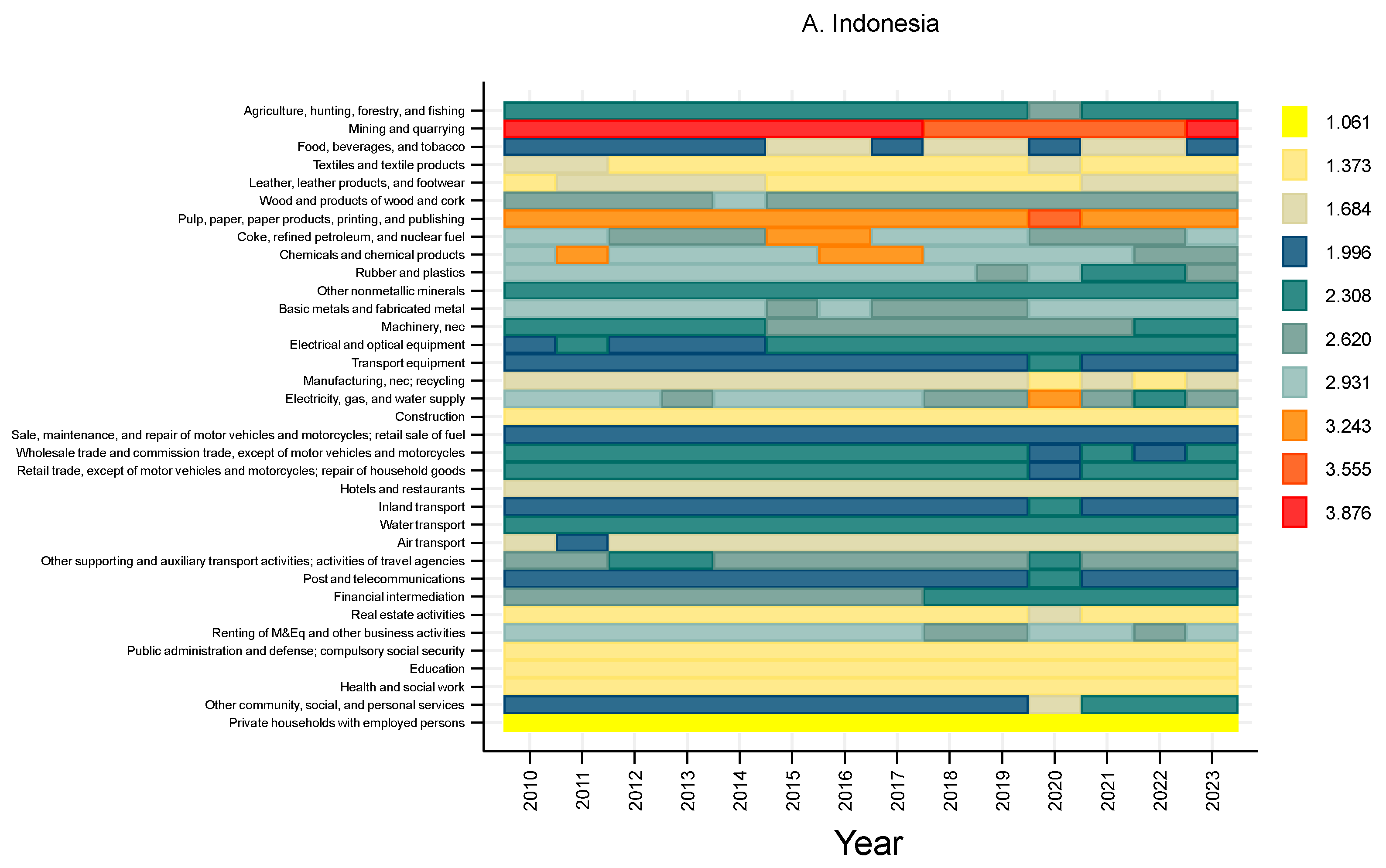
Based on the attached diagram, the position of Indonesia’s industrial sector in the GVCs varies significantly between upstream and downstream from 2010 to 2023 (Figure 1). The diagram displays the upstreamness index values for various industry sectors, characterized by color gradations. Yellow indicates a downstream position (UI value close to 1), while dark red indicates an upstream position.
Sectors with high upstreamness index values (above 2.620) are indicated by dark blue, orange, and red. The Mining and Quarrying sector has consistently held a dominant upstream position throughout the period, reaching its highest index of 3.876. This indicates that the output from the mining and quarrying sector is primarily used as raw materials for other industries, rather than for final consumption [9,19].
Sectors that tend to be in the downstream position are marked with yellow to beige colours. The agriculture, hunting, forestry, and fishing sectors, as well as the Household Services (private households with employed persons) and Community Services (other community, social, and personal services) sectors, are consistently in downstream positions. This means that the output of these sectors is mostly directly consumed by the end user.
The majority of other industrial sectors, such as manufacturing, transportation, and specific service sectors, exhibit varying upstreamness values, ranging from 1.684 to 2.620 (represented by colors ranging from beige to blue). This indicates that these sectors occupy a central position in the Global Value Chain, neither entirely upstream nor downstream. Some sectors, such as manufacturing, recycling, and electricity, gas, and water supply, show slight shifts from year to year, reflecting efforts or dynamics in the value chain [20,21].

4.3. Position of Malaysia’s Industrial Sector in GVCs

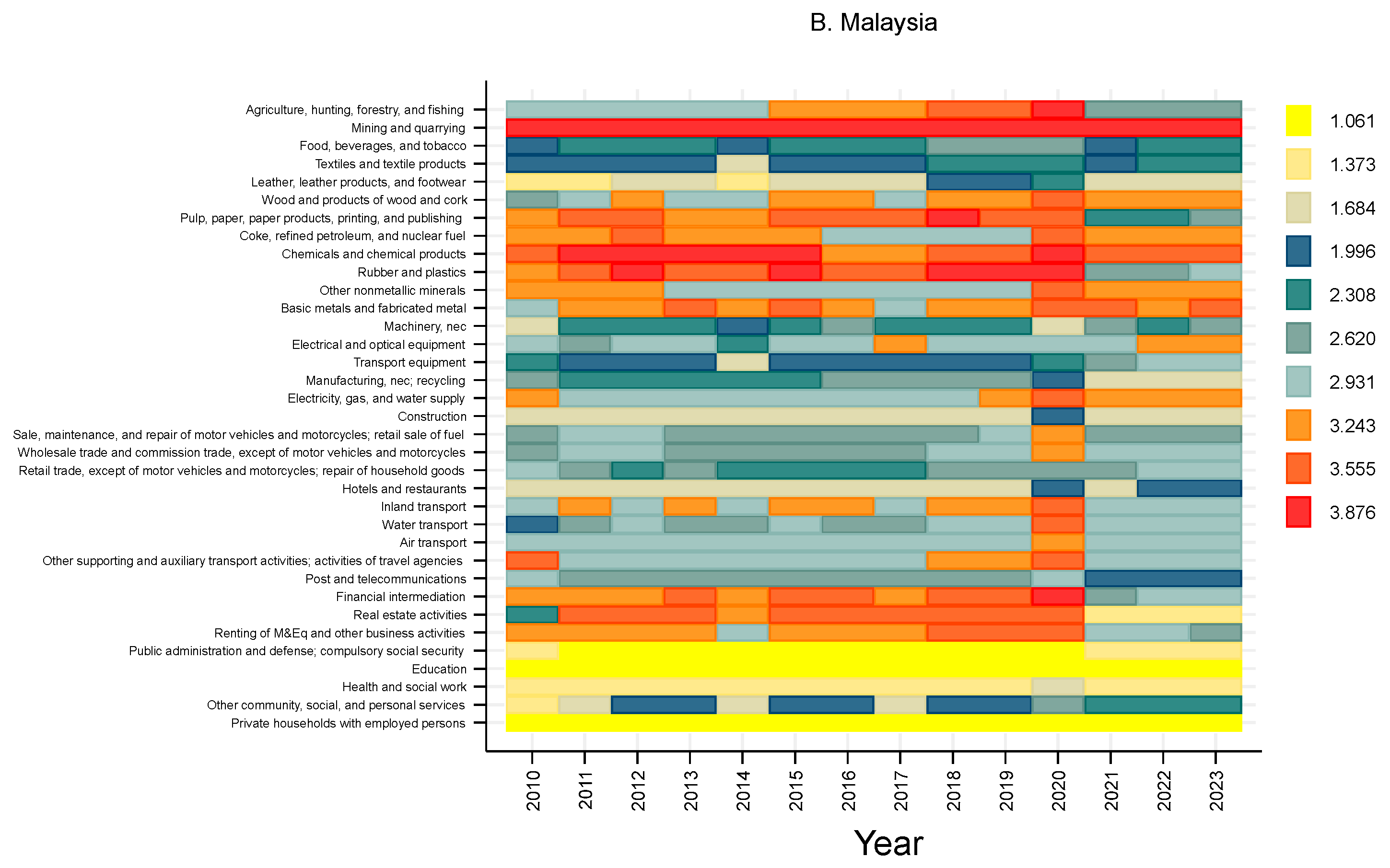
Based on the attached diagram, the position of Malaysia’s industrial sectors in the GVCs reveals significant variation among its sectors, with some sectors occupying a dominant upstream position, while most others are positioned in the middle to downstream positions (Figure 2). The value of the upstreamness index is depicted by color gradation, where yellow indicates a downstream position and dark red indicates an upstream position.
Sectors that are in the upstream position are marked with dark red and orange. The Mining and Quarrying, Coke, Refined Petroleum, and Nuclear Fuel sectors have consistently held a powerful upstream position throughout the 2010–2023 period. This indicates that the outputs from these sectors are primarily used as raw materials or fuel for other industries within the global supply chain, rather than for direct final consumption. These sectors are most likely to be an early part of the global production chain [19].
Sectors that are in a downstream position (upstreamness index value close to 1) are marked in yellow. The Household Services (private households with employed persons), Community Services (other community, social, and personal services), and Education sectors stably occupy downstream positions. This indicates that the output from these sectors is mostly directly consumed by final users or households. The Financial Services (Financial Intermediation) and Real Estate (Real Estate Activities) sectors also tend to be in downstream positions.
The majority of other industrial sectors exhibit varying upstreamness values, characterized by color gradations ranging from beige to blue. Some sectors, such as basic metals, fabricated metals and Machinery and Equipment, show interesting fluctuations. These sectors are shifting from a more downstream position to a more upstream position year by year, reflecting an increase or change in their role within the GVCs. These dynamics show that Malaysia is actively participating in various stages of production, not just in one particular position [9].

4.4. Position of the Philippines’ Industrial Sector in the GVCs

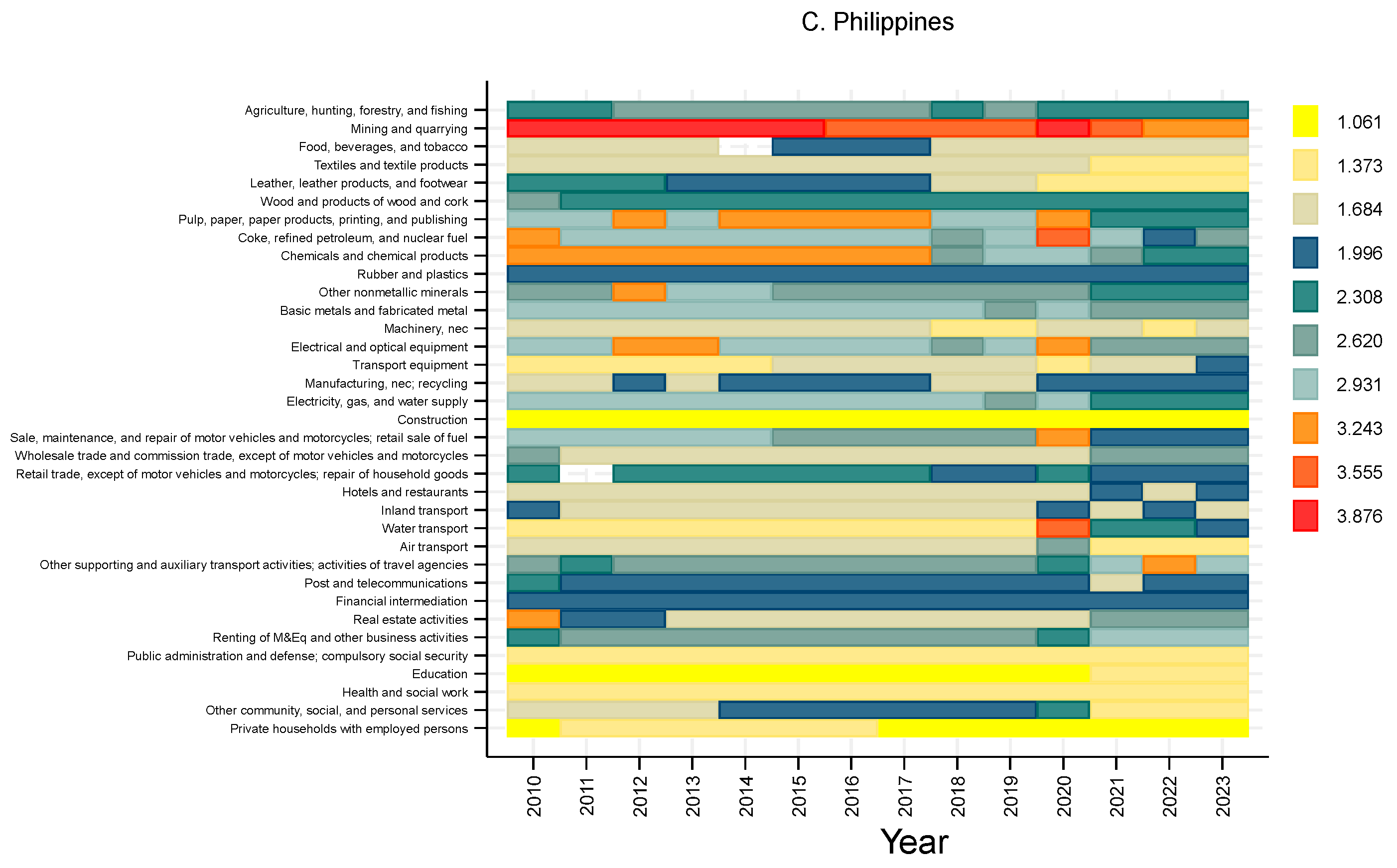
Based on the attached diagram, the position of the Philippines’ industrial sector in the GVCs shows significant variation among its sectors. The value of the upstreamness index is depicted by color gradation, where yellow indicates the downstream position and dark red indicates the upstream position (Figure 3).
The sectors in the upstream position are marked by dark red, orange, and dark blue. The agriculture, hunting, forestry, and fishing, and food, beverages, and tobacco sectors were consistently in the dominant upstream position for most of the observed period. This indicates that the output from these sectors is primarily used as raw materials for other industries within the global supply chain.
Sectors that are in a downstream position (upstreamness index value close to 1) are marked in yellow. The construction, other community, social, and personal services, Education, and Household Services (private households with employed persons) sectors stably occupy downstream positions. This indicates that the output from these sectors is mostly directly consumed by end-users or households [22].
The majority of other industrial sectors exhibit varying upstreamness values, characterized by color gradations ranging from beige to blue. The Basic Metals and Fabricated Metals, as well as Machinery and Equipment (Machinery, NEC), sectors showed fluctuations, shifting from downstream to upstream positions year on year. This reflects the efforts to increase or change roles in the GVCs, indicating that the Philippines is participating in various stages of production [21].

4.5. Position of Singapore’s Industrial Sector in GVCs

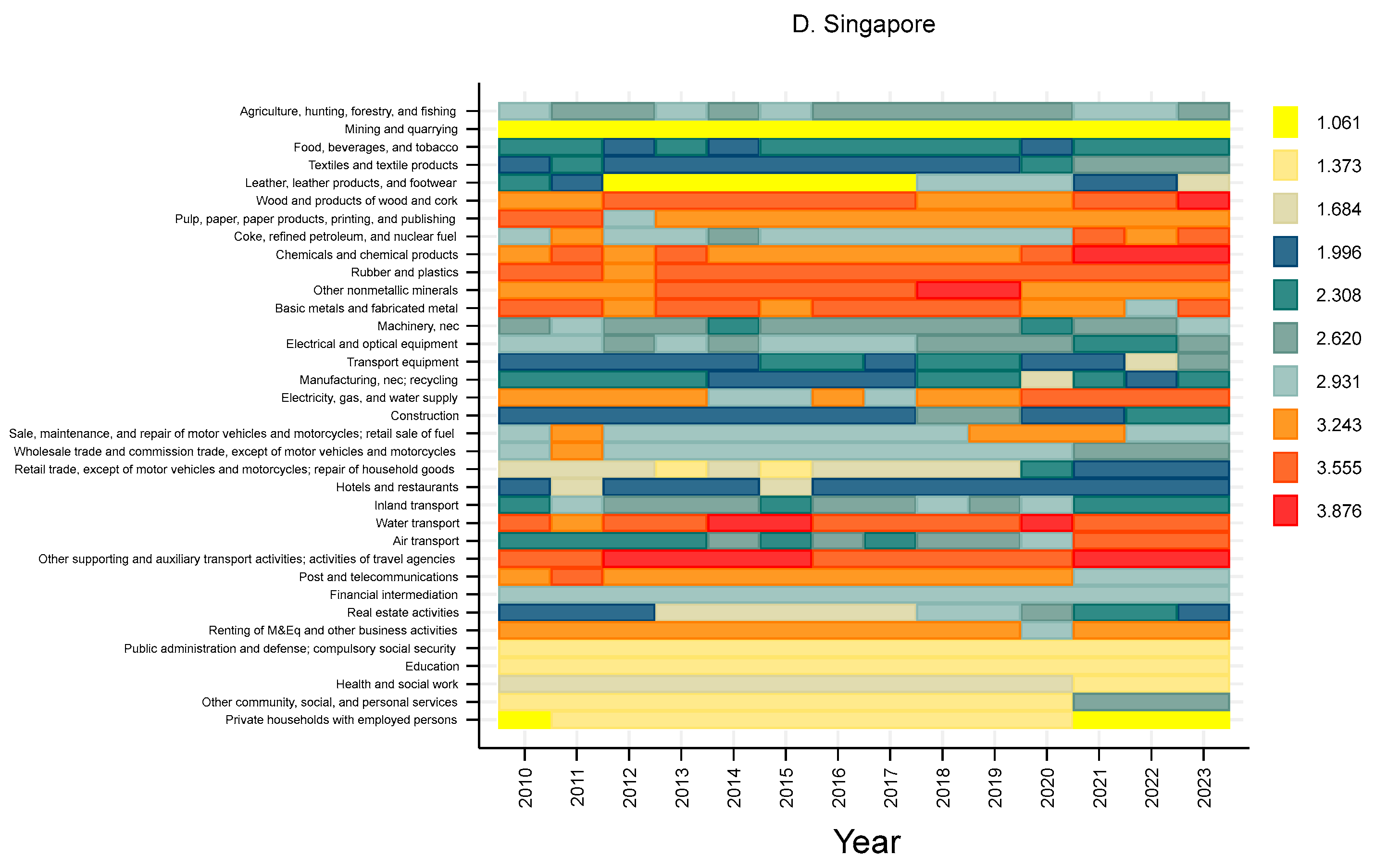
Based on Figure 4, the position of Singapore’s industrial sector in the Global Value Chains exhibits a distinct and interesting pattern compared to other ASEAN countries. This figure indicates that most manufacturing and service sectors in Singapore tend to occupy an upstream or mid-range position in the value chain, rather than a downstream position.
Sectors such as chemicals and chemical products, electrical and optical equipment, and basic metals and fabricated metals are consistently in the upstream position (shown in orange and red). This indicates that their output is used as a crucial input for other downstream industries worldwide.
The service sector, including financial intermediation, renting of M&E equipment, and other business activities, as well as transport and communications, also showed a powerful upstream position. This reflects Singapore’s role as a global financial, logistics and business services hub, where its services are crucial inputs for multinational companies across the GVCs [23].
Only a few sectors are consistently downstream (shown in yellow). These sectors are Household Services (private households with employed persons), Community Services (other community, social, and personal services), and Education. This is natural, as the output of these sectors is mostly directly consumed by the end user.
Other sectors, such as food, beverages, and tobacco and transport equipment, show intermediate positions or fluctuations between upstream and downstream from year to year. These fluctuations can reflect a change in strategy or a shift in the global supply chain.
Overall, this image highlights the characteristics of Singapore’s economy as a major player in the upstream part of the GVCs, particularly in the high-tech and high-value-added services sectors.

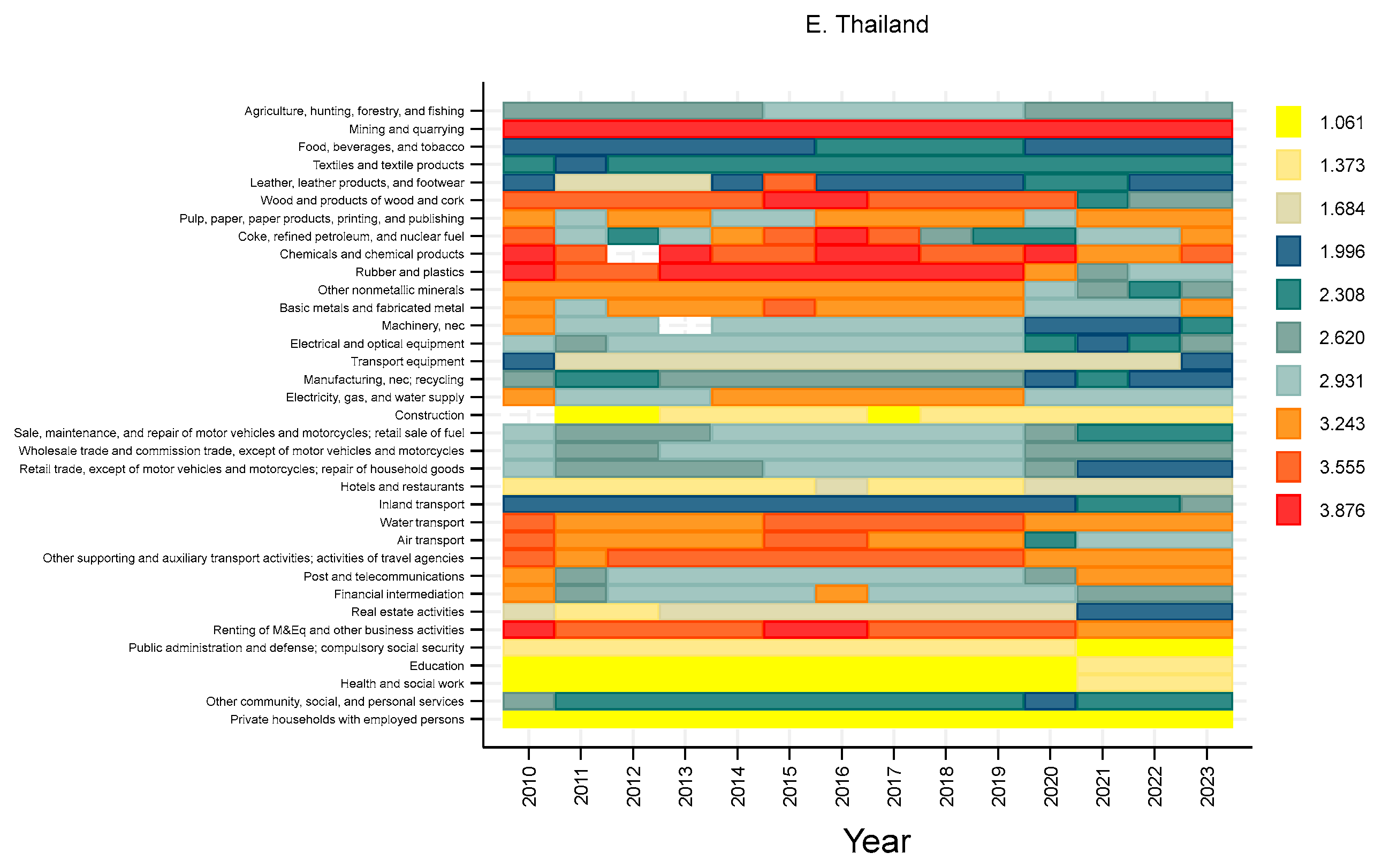
4.6. The Position of Thailand’s Industrial Sector in the GVCs

Based on the attached diagram, which shows the position of Thailand’s industrial sectors in the Global Value Chain from 2010 to 2023, it can be concluded that the position of the GVCs of Thai industries is as follows:
The image shows the backward and forward positions of an industry in the GVCs. Backward participation indicates dependence on input imports, while forward participation indicates the role of an intermediate input supplier for other countries. In this context, a position further to the right indicates more downstream participation, while a position on the left side indicates more upstream participation [9].
Based on the figure, most of the manufacturing sector in Thailand is in a downstream position or at the end of the GVCs (Figure 5). This indicates that many industries in Thailand act as final assemblers, relying on intermediate input imports to produce finished goods that are then exported [24].
The Main Manufacturing Sector, including sectors such as transport equipment, electrical and optical equipment, and machinery (machinery, NEC), tends to be located on the far right side of the diagram. This indicates that these sectors hold a strong position in forward GVC participation, serving as key suppliers to the global production network. This aligns with Thailand’s status as a major manufacturer and exporter in the automotive and electronics industries.
The service sector, such as wholesale and retail trade, as well as transportation, generally exhibits diverse GVCs positions, but often has strong connections in the value chain. Meanwhile, sectors such as agriculture, forestry, and fisheries, as well as mining, tend to have more upstream GVCs positions, which implies that these sectors often provide raw materials or intermediate products for other industries both domestically and abroad [24].
This image clearly illustrates Thailand’s dependence on foreign input imports to produce its export goods. This participation encourages a higher volume of economic activity, increasing both total exports and overall output. Nonetheless, this also raises concerns due to high concentrations in specific industries, such as the automotive sector, which could hinder productivity growth and innovation across the economy.

4.7. Dynamic Panel Analysis Results

4.7.1. Unit Root Test

The results of the root test for the panel unit, using the Augmented Dickey–Fuller (ADF) and Levin–Lin–Chu (LLC) methods, showed that all the variables studied in the model were stationary [5,25]. This can be seen from the p-values for each variable, which are consistently smaller than 0.05, the standard level of significance (Table 3).
Overall, these findings are significant because they indicate that the data used in the regression model do not exhibit a unit root problem [26,27]. This stationarity ensures that the regression results obtained will not be spurious and can be interpreted validly, providing a solid basis for the conclusions drawn from the study.

4.7.2. GMM System Results

The results of the dynamic panel regression estimation using the System GMM method provide essential insights into the factors that influence the dependent variables, while addressing the problems of endogeny and data heterogeneity [25,28].
From the table above, it can be seen that the p-value of the Sargan test is 0.248, which is much greater than the significance level of 0.05; therefore, we cannot reject the null hypothesis that the instrument used is valid. The Sargan test is used to test the validity of the instruments used in the model. This confirms that the chosen instrument does not correlate with the error term and is suitable for estimation. The number of observations is reduced compared to the model that incorporates the lag of dependent variables.
The AR (2) test confirms the absence of second-order autocorrelation in residuals. Based on Table 4, it can be seen that the p-value of 0.586, which is also greater than 0.05, shows that we cannot reject the null hypothesis. This assures that the model has been well constructed and that there are no undesirable correlations among its residuals. Since these two diagnostic tests show valid results, we can interpret the regression coefficient validly [28].
The dependent lag variable of 0.955 with a significance level of 1% indicates a very high persistence in the dependent variable (Table 4). This means that the value of the dependent variable in the previous period has a powerful and positive influence on its value in the current period, indicating the existence of an inertial effect [21,29].
The coefficient of the upstreamness index variable is 0.259, which is significant at a 5% level, indicating a positive and significant relationship. These findings suggest that the further upstream an industry is in the value chain, the more positive its impact on sustainable green economic growth [30]. The upstreamness index has a significant, positive influence on green economic growth after controlling for endogeneity. Government policies are expected to encourage investment into upstream functions such as R&D and design, which are knowledge-intensive and low-carbon sectors.
The variable coefficient of Foreign Direct Investment is 0.243, which is significant at the 5% level, indicating a positive and significant relationship. This suggests that the inflow of Foreign Direct Investment has a significant positive impact on sustainable green economic growth. The Government Effectiveness control variable showed a coefficient of −0.839 that was not statistically significant. With a p-value of 0.153, there is not enough evidence to conclude that there is a statistical relationship between the Government Effectiveness variable and the dependent variable. This is because Government Effectiveness varies greatly across ASEAN countries.
Meanwhile, the political stability variable has a significant coefficient of 0.711 at a 10% significance level, indicating a positive and statistically significant relationship. This implies that political stability plays a significant role in influencing the dependent variables.

4.7.3. Robustness Test

The Robustness Test analysis, conducted over a short period (2021–2023), demonstrates that the model is valid and reliable, reinforcing some of the findings from previous analyses while highlighting some significant differences [21,31].
From the results of the validity test using the Sargan test, it can be seen that the p-value is 0.170, which is greater than 0.05; therefore, we do not reject the null hypothesis that the instrument used is valid (Table 5). This indicates that the instruments in this model do not correlate with the error term, so the estimates are reliable. The result of the AR (2) p-value autocorrelation test from the AR (2) test was 0.772, which is well above 0.05. This confirms that there are no second-order autocorrelation issues in the residual model [30]. Both diagnostic tests indicate that the System GMM model is stable and valid for analyzing the relationships between variables over a shorter time period.
This study aims to bridge the gap in the literature by examining the impact of the industrial sector’s position in the GVCs on sustainable green economic growth. Using the System GMM dynamic panel model approach, the empirical findings provide strong support for the research hypothesis and offer significant policy implications.
The results of the main estimation of the System GMM model indicate that the lag of the dependent variable has a positive and highly significant coefficient, which is 0.955 with a p-value of less than 0.05. This shows a strong persistence in the green economic growth variable. This means that the growth achievements greatly influence current growth in the previous period. These findings are consistent with the growth economics literature, which emphasizes the dynamic nature of growth processes and the effects of inertia [1].
We determined the lag structure by minimizing the BIC, with AIC, with a p-value less than 0.05, indicating that the higher a country’s position in the GVCs, the greater its impact on green economic growth. This result aligns with the positional upgrading theory (Smile Curve) proposed by Gereffi & Lee [32], which suggests that a shift to high-value-added production activities at the upstream part of the supply chain, such as R&D and design, can increase added value and competitiveness. Although the article states that ASEAN countries, including Indonesia, are dominated by low-value-added activity, these results suggest that efforts to move to more upstream positions can be an effective strategy to encourage green economic growth [12,23].
The positive and significant Foreign Direct Investment coefficient of 0.243, with a p-value of less than 0.05, strengthens the argument that Foreign Direct Investment plays a vital role in encouraging green economic growth. FDI can facilitate green technology transfer, innovation, and better management practices, which are in line with green industry policy objectives [18].
On the other hand, the government effectiveness variable did not show a significant impact on the main model. The value of the government effectiveness coefficient is −0.839, with a p-value greater than 0.05. This may indicate that, in the research period of 2010–2023, it is due to the prolonged duration required for government effectiveness to manifest a statistically meaningful influence. Government effectiveness includes the quality of public services, the efficiency of bureaucracy, and the design of policies. Over a prolonged period, there was significant disparity in the quality of governance among the examined ASEAN nations.
The political stability variable has a positive and significant coefficient of 0.711, with a p-value of less than 0.05. This confirms that a stable political environment is essential to create the investment certainty and long-term policies necessary for the transition to a green economy.
Based on these findings, effective policies to encourage green economic growth in ASEAN countries should focus on several aspects [3,18]. The government needs to promote the industry to move to a more upstream position in the GVCs, which are high-value-added. This can be achieved through investment incentives in areas such as R&D and innovation, enhancing the quality of human resources, and developing supporting infrastructure that facilitates the production of high-value-added products [6].
Although the impact of FDI is declining in the short term, its long-term positive role is crucial. Policies should be geared towards attracting more foreign investment focused on green technology, renewable energy, and low-carbon industries.
The results of the robustness test highlight the significance of government effectiveness as a determinant of green growth, particularly in the short term. Bureaucratic reform, transparency, and efficiency in the implementation of green industry policies are urgently needed [3].
The robustness test (Table 5) indicates a reversal in the sign of the POLITICAL variable, which now appears negative and significant. This is due to the government’s emphasis on swift economic recovery and the preservation of social cohesiveness in the post-pandemic era, exemplified by the continuation of fossil fuel subsidies. Prolonged political stability during this period may lead to a slow response to the climate problem, indicating a potential policy trade-off in times of emergency. Political stability, despite the complex relationship, remains a prerequisite for long-term green economic growth. Policies must ensure a conducive political environment to support bold economic and environmental reforms.
An explanation of the difference in the results of the Government Effectiveness (GG) in ASEAN countries exhibits powerful persistence, underscoring that current success is highly dependent on past policy momentum, thus requiring long-term policy commitments that extend beyond political cycles. This short-term model offers tentative insights into shifts in policy responses in periods of global shock. The crucial findings show that the industry’s movement towards a more upstream and low-carbon GVC position is an effective strategy to encourage GG, in accordance with the positional upgrading theory. In addition, the significant positive Foreign Direct Investment (FDI) proves its role as a vital facilitator for GG, especially in technology transfer. Furthermore, political stability is crucial in the long term, and the effectiveness of the government is a positive and significant determinant in the short term. This suggests that a competent and responsive bureaucracy is urgently needed to accelerate the implementation of the green transition, thereby requiring the government to capitalize on the existing stability to implement structural reforms that encourage green economic growth.
As a policy implication, the government needs to emphasize long-term policy commitments that extend beyond the annual political and budget cycles, such as the Climate Act and the Renewable Energy Long-Term Master Plan. In addition, the national industrial strategy must shift from being a mere supplier of raw materials to one that engages in positional upgrading through high-value-added activities, i.e., “green upstreaming” (e.g., R&D in renewable energy technology, not just raw material extraction). FDI should be selective and explicitly oriented towards the transfer of green technology and sustainable management practices. Furthermore, the government needs to create political stability and bureaucratic competence.

5. Conclusions

The results indicate that participation in the Global Value Chains (GVCs) can serve as a significant catalyst for driving sustainable green economic growth. The results of the System GMM dynamic panel model estimate confirm that green economic growth exhibits strong persistence over time, indicating that current success is highly dependent on past achievements, which emphasizes the need for consistent, long-term policies.
These findings also underscore the significant role of the Upstreamness Index in promoting green economic growth. This supports the argument that the industry’s move towards high-value-added activities, such as R&D and design, is an effective strategy. In addition, Foreign Direct Investment (FDI) and Political Stability have proven to have a positive and significant influence, demonstrating that foreign investment and a stable political environment are crucial for facilitating green technology transfer and creating certainty for economic transition.
Overall, the study confirms that to fully harness the potential of GVCs in driving green economic growth, the government needs to focus on an integrated strategy. This includes the driving upstream of the industry, attracting greater green investment, improving the effectiveness of governments, and ensuring political stability. This study’s limitations include a small sample size (five countries), which undermines the generalizability of the findings, resulting in unstable robustness test results and an aggregate country-level analysis that may obscure significant sectoral heterogeneity. For future research, it is recommended to conduct a more detailed sectoral analysis to understand the differences in GVC dynamics and green growth across different industries. In addition, it is necessary to include other variables that may affect green growth, such as energy mix, carbon intensity, trade openness, and environmental policies.

Author Contributions

Conceptualization, J.W., Y.R.H. and L.B.H.; methodology, J.W. and L.P.; software, J.W.; validation, J.W., L.P., Y.R.H. and L.B.H.; formal analysis, J.W., Y.R.H. and L.B.H.; investigation, J.W. and L.P.; resources, J.W. and L.P.; data curation, J.W., Y.R.H. and M.G.D.P.; writing—original draft preparation, J.W., L.P. and Y.R.H.; writing—review and editing, J.W., L.P., Y.R.H., L.B.H. and M.G.D.P.; visualization, J.W. and M.G.D.P.; supervision, L.P. and L.B.H.; project administration, Y.R.H.; funding acquisition, J.W. and L.P. All authors have read and agreed to the published version of the manuscript.

Funding

This research was funded by The Directorate of Research and Community Service, “DPPM 2025 Project”, under grant no. 126/C3/DT.05.00/PL/2025.

Data Availability Statement

The data presented in this study are available upon request from the corresponding authors.

Acknowledgments

The authors are thankful to the Directorate of Research and Community Service. The authors would like to thank those who have contributed to this research sincerely. We also would like to thank the anonymous reviewers for their valuable comments and suggestions.

Conflicts of Interest

The authors declare no conflicts of interest.

References

  1. Urban, P.; Hametner, M. The Economy–Environment Nexus: Sustainable Development Goals Interlinkages in Austria. Sustainability 2022, 14, 12281. [Google Scholar] [CrossRef]
  2. Sarkodie, S.A.; Owusu, P.A.; Taden, J. Comprehensive green growth indicators across countries and territories. Sci. Data 2023, 10, 413. [Google Scholar] [CrossRef]
  3. Zhironkin, S.; Cehlár, M. Green Economy and Sustainable Development: The Outlook. Energies 2022, 15, 1167. [Google Scholar] [CrossRef]
  4. Li, C.; He, Q.; Ji, H.; Yu, S.; Wang, J. Reexamining the Impact of Global Value Chain Participation on Regional Economic Growth: New Evidence Based on a Nonlinear Model and Spatial Spillover Effects with Panel Data from Chinese Cities. Sustainability 2023, 15, 13835. [Google Scholar] [CrossRef]
  5. Wuri, J.; Widodo, T.; Hardi, A.S. Speed of Convergence in Global Value Chains: Forward or Backward Linkage. Heliyon 2023, 9, e18070. [Google Scholar] [CrossRef]
  6. Kano, L.; Tsang, E.W.K.; Yeung, H.W. chung Global value chains: A review of the multi-disciplinary literature. J. Int. Bus. Stud. 2020, 51, 577–622. [Google Scholar] [CrossRef]
  7. Rigo, D. Global value chains and technology transfer: New evidence from developing countries. Rev. World Econ. 2021, 157, 271–294. [Google Scholar] [CrossRef]
  8. Wuri, J. The Role of Comparative Advantage in Enhancing Trade in Value-Added Using a Dynamic GMM Model. Economies 2024, 12, 187. [Google Scholar] [CrossRef]
  9. Baldwin, R.; Ito, T. The smile curve: Evolving sources of value added in manufacturing. Can. J. Econ. 2021, 54, 1842–1880. [Google Scholar] [CrossRef]
  10. Zhan, J.X. GVC transformation and a new investment landscape in the 2020s: Driving forces, directions, and a forward-looking research and policy agenda. J. Int. Bus. Policy 2021, 4, 206–220. [Google Scholar] [CrossRef]
  11. Zhang, M.; Song, G.; Ma, N. A mechanism for upgrading the global value chain of China’s wood industries based on sustainable green growth. J. Clean. Prod. 2024, 449, 141717. [Google Scholar] [CrossRef]
  12. Adwiyah, R.; Syaukat, Y.; Indrawan, D.; Mulyati, H. Examining Sustainable Supply Chain Management (SSCM) Performance in the Palm Oil Industry with the Triple Bottom Line Approach Rabiatul. Sustainability 2023, 15, 13362. [Google Scholar] [CrossRef]
  13. Pahl, S.; Timmer, M.P. Do Global Value Chains Enhance Economic Upgrading? A Long View. J. Dev. Stud. 2020, 56, 1683–1705. [Google Scholar] [CrossRef]
  14. Zhu, J.J.; Zhang, R.; Kanhalikham, K.; Liu, Z.; Shen, X. Green economy studies amongst the global climate change challenge between 2016 and 2022: A bibliometric review. Front. Ecol. Evol. 2023, 11, 1168437. [Google Scholar] [CrossRef]
  15. Wuri, J.; Rahayu, C.W.E.; Hardanti, Y.R.; Kristianti, N.K.A. Assessing the Emission Reduction Policies on Global Value Chains: The Renewable Energy Policy Framework. Energies 2024, 17, 6031. [Google Scholar] [CrossRef]
  16. Antràs, P.; Chor, D. On the measurement of upstreamness and downstreamness in global value chains. In World Trade Evolution; Routledge: London, UK, 2018; pp. 126–194. ISBN 9781351061537. [Google Scholar]
  17. Khan, M.; Ozturk, I. Examining the direct and indirect effects of financial development on CO2 emissions for 88 developing countries. J. Environ. Manag. 2021, 293, 112812. [Google Scholar] [CrossRef]
  18. Phan, T.C. Impact of green investments, green economic growth and renewable energy consumption on environmental, social, and governance practices to achieve the sustainable development goals: A sectoral analysis in the ASEAN economies. Int. J. Eng. Bus. Manag. 2024, 16, 18479790241231725. [Google Scholar] [CrossRef]
  19. Meng, B.; Ye, M.; Wei, S.J. Measuring Smile Curves in Global Value Chains. Oxf. Bull. Econ. Stat. 2020, 82, 988–1016. [Google Scholar] [CrossRef]
  20. Escaith, H.; Inomata, S.; Miroudot, S. Evolution of Production Networks in the Asia-Pacific Region: A Vision in Value-Added and Employment Dimensions; ESCAP: Bangkok, Thailand, 2018; Available online: https://papers.ssrn.com/sol3/papers.cfm?abstract_id=3105290 (accessed on 28 October 2025).
  21. Wuri, J.; Widodo, T.; Hardi, A.S. Global Value Chains Participation during the COVID-19 Pandemic: A Dynamic Panel Approach. Economies 2022, 10, 121. [Google Scholar] [CrossRef]
  22. Araza, J. Social, Environmental and Political dimensions of Roots Crop Value Chain Analysis: The Case of Samar, Philippines. East Asian J. Multidiscip. Res. 2023, 2, 1143–1162. [Google Scholar] [CrossRef]
  23. Blázquez, L.; Díaz-Mora, C.; González-Díaz, B. Slowbalisation or a “New” type of GVC participation? The role of digital services. J. Ind. Bus. Econ. 2023, 50, 121–147. [Google Scholar] [CrossRef]
  24. Durongkaveroj, W. Emphasis on domestic value added in export in the era of global value chain: Evidence from Thailand. J. Ind. Bus. Econ. 2023, 50, 703–729. [Google Scholar] [CrossRef]
  25. Panigrahi, S.K.; Azizan, N.A.B.; Kumaraswamy, S. Investigating dynamic effect of energy consumption, foreign direct investments and economic growth on CO2 emissions between Oman and United Arab Emirates: Evidence from Co integration and causality tests. Int. J. Energy Econ. Policy 2020, 10, 288–298. [Google Scholar] [CrossRef]
  26. Insukindro, I. The effect of twin shock on fiscal sustainability in Indonesia. Econ. Sociol. 2018, 11, 75–84. [Google Scholar] [CrossRef]
  27. Ventosa-Santaulària, D.; Vera-Valdés, J.E.; Łasak, K.; Ramírez-Vargas, R. Spurious multivariate regressions under fractionally integrated processes. Commun. Stat.-Theory Methods 2022, 51, 2034–2056. [Google Scholar] [CrossRef]
  28. Sebki, W. Education and Economic Growth in Developing Countries: Empirical Evidence from GMM Estimators for Dynamic Panel Data. Econ. Bus. 2021, 35, 14–29. [Google Scholar] [CrossRef]
  29. Miao, M.; Borojo, D.G.; Yushi, J.; Desalegn, T.A. The impacts of Chinese FDI on domestic investment and economic growth for Africa. Cogent Bus. Manag. 2021, 8, 1886472. [Google Scholar] [CrossRef]
  30. Lawal, A.I. Determinants of Renewable Energy Consumption in Africa: Evidence from System GMM. Energies 2023, 16, 2136. [Google Scholar] [CrossRef]
  31. Li, Y.; Gao, K. The impact of green urbanization on carbon emissions: The case of new urbanization in China. Front. Environ. Sci. 2022, 10, 1070652. [Google Scholar] [CrossRef]
  32. Gereffi, G.; Lee, J. Economic and Social Upgrading in Global Value Chains and Industrial Clusters: Why Governance Matters. J. Bus. Ethics 2016, 133, 25–38. [Google Scholar] [CrossRef]
Figure 1. Indonesia Upstreamness Index. Source: MRIO Database.
Sustainability 17 10629 g001
Figure 2. Malaysia Upstreamness Index. Source: MRIO Database.
Sustainability 17 10629 g002
Figure 3. Philippines Upstreamness Index. Source: MRIO Database.
Sustainability 17 10629 g003
Figure 4. Singapore Upstreamness Index. Source: MRIO Database.
Sustainability 17 10629 g004
Figure 5. Thailand Upstreamness Index. Source: MRIO Database.
Sustainability 17 10629 g005
Table 1. Data and data sources.
VariableNotesDescriptionSource
GGGreen Growth IndexEconomic growth that pays attention to environmental performance in the long term Global Green Growth Institution (GGGI)
UIUptreamness Index A country’s position in the GVCs measures the level of downstream industryMultiregional Input–Output Database (MRIO) Asian Development Bank
FDIFDIForeign Direct Investment (net inflows, % of GDP) Worldwide Development Indicators (World Bank)
GOVGovernment EffectivenessThe level of government effectiveness (bureaucratic competence and quality of public services)Worldwide Governance Indicators (World Bank)
POLITICALPolitical Stability and Absence of Violence/TerrorismA measure of perceptions of possible political instability and/or politically motivated violenceWorldwide Governance Indicators (World Bank)
Table 2. Descriptive statistics.
CountriesVariableMeanSDMaximumMinimum
ASEANGG56.615.3769.3844.79
UI2.260.292.811.01
FDI6.719.1233.30−0.86
GOV0.720.842.34−0.27
POLITICAL−0.180.921.62−1.65
IndonesiaGG56.540.8257.7555.32
UI2.050.042.101.96
FDI1.990.552.820.49
GOV0.070.290.58−0.27
POLITICAL−0.550.13−0.37−0.85
MalaysiaGG59.65−0.7160.5358.29
UI2.48−0.132.812.31
FDI3.331.185.421.20
GOV0.980.091.120.83
POLITICAL0.140.080.27−0.01
PhilippinesGG58.400.8859.4356.65
UI1.960.052.091.88
FDI1.970.793.120.51
GOV0.070.070.19−0.05
POLITICAL−1.031.31−0.57−1.65
SingaporeGG46.992.6950.5444.79
UI2.350.392.571.01
FDI24.294.3833.3017.60
GOV2.210.072.342.09
POLITICAL1.390.141.621.17
ThailandGG61.492.3469.3860.13
UI2.460.132.642.27
FDI1.961.404.32−0.86
GOV0.270.080.380.13
POLITICAL−0.850.35−0.28−1.44
Note: GG, Green Growth Index; UI, Upstreamness Index; FDI, Foreign Direct Investment; GOV, government effectiveness; POLITICAL, Political Stability and Absence of Violence/Terrorism; SD, standard deviation.
Table 3. Augmented Dicky–Fuller and Levin–Lin–Cu panel unit root test results.
VariablesADF TestLLC Test
GG−1.9871−25.7120
(0.0235)(0.0000)
UI−2.8784−2.6199
(0.0020)(0.0044)
FDI−3.4390−3.1369
(0.0003)(0.0009)
GOV−2.1274−1.7134
(0.0167)(0.0433)
POLITICAL−2.8059−4.6674
(0.0025)(0.0000)
Note: The values in parentheses are p-values. GG, Green Growth Index; UI, Upstreamness Index; FDI, Foreign Direct Investment; GOV, Government Effectiveness; POLITICAL, Political Stability and Absence of Violence/Terrorism. Source: Calculated by the authors using Stata 17.
Table 4. The SYS-GMM dynamic panel estimation results.
VariablesT Test
Lagged Dep Var 0.955 ***
(0.000)
UI0.259 **
(0.009)
FDI0.243 **
(0.006)
GOV−0.839
(0.153)
POLITICAL0.711 *
(0.089)
No. of observations 59
No. of ids5
No. of instrument51
Sargan test, p-value48.90; 0.248
AB–AR (1); p-value−2.40; 0.016
AB–AR (2); p-value0.53; 0.586
Note: The values in parentheses are p-values, * p < 0.1, ** p < 0.05, *** p < 0.01. GG, Green Growth Index; UI, upstreamness index; FDI, Foreign Direct Investment; GOV, Government Effectiveness; POLITICAL, Political Stability and Absence of Violence/Terrorism. Source: Calculated by the authors using Stata 17.
Table 5. The SYS-GMM results for robustness tests, 2021–2023.
VariablesT Test
Lagged Dep Var 0.923 ***
(0.000)
UI0.078 **
(0.005)
FDI0.029 *
(0.075)
GOV0.142 ***
(0.005)
POLITICAL−0.120 **
(0.028)
No. of observations 15
No. of ids5
No. of instrument21
Sargan test, p-value17.69; 0.170
AB–AR (1); p-value0.73; 0.467
AB–AR (2); p-value−0.29; 0.772
Note: The values in parentheses are p-values, * p < 0.1, ** p < 0.05, *** p < 0.01. GG, Green Growth Index; UI, Upstreamness Index; FDI, Foreign Direct Investment; GOV, government effectiveness; POLITICAL, Political Stability and Absence of Violence/Terrorism. Source: Calculated by the authors using Stata 17.
Disclaimer/Publisher’s Note: The statements, opinions and data contained in all publications are solely those of the individual author(s) and contributor(s) and not of MDPI and/or the editor(s). MDPI and/or the editor(s) disclaim responsibility for any injury to people or property resulting from any ideas, methods, instructions or products referred to in the content.