Developing Sustainable Chef Competency Indicators: An Application of the Fuzzy Delphi Method


Abstract
1. Introduction
2. Literature Review
2.1. Sustainability in Food Systems and Culinary Practice
2.2. Chef Competencies
2.3. Sustainable Chefs and Competency Domains
- Ecosystem awareness: Literacy in biodiversity, planetary boundaries, and production impacts that informs upstream sourcing decisions.
- Environmental impact: Routine behaviors that reduce waste, energy use, and carbon intensity in operations.
- Local food: Procurement practices that prioritize seasonality, provenance, and fair, resilient regional value chains.
- Cultural interaction: Stewardship of foodways and guest education that supports nutrition, safety, and anti-waste norms.
- Innovation and governance: Menu analytics, inventory and cold-chain discipline, surplus valorization, and fair work as organizational enablers of sustainability.
- Culinary skills: Adaptive, safety-first craft that maintains quality while conserving resources and using what is available.
3. Research Method
3.1. Research Procedures and Samples
3.2. FDM and Evaluation Index Development
- Ecosystem Awareness focused on chefs’ understanding of biodiversity, responsible sourcing, and natural resource conservation. The original 49 items were refined to 10.
- Environmental Impact emphasized practical abilities such as waste reduction, energy efficiency, and carbon footprint mitigation. This domain was reduced from 15 to 8 items.
- Local Food included indicators related to seasonal sourcing, low-carbon ingredients, and support for local producers. After revision, 9 items were retained.
- Cultural Interaction addressed chefs’ sensitivity to culinary heritage and cross-cultural integration. This domain was streamlined from 6 to 5 items.
- Innovation and Governance reflected chefs’ competencies in process optimization, sustainable leadership, and decision-making. Expert feedback expanded the original 17 items to 19.
- Culinary Skills defined core technical abilities, including ingredient handling, cooking techniques, food safety, and sustainable meal preparation. This domain retained 10 items.
3.3. Fuzzy Delphi Computation and Consensus Evaluation
3.3.1. Expert Questionnaire and Fuzzification
3.3.2. Fuzzy Number Computation
- Conservative fuzzy set:
- Optimistic fuzzy set:
3.3.3. Consensus Evaluation Criteria
- Gray Zone Index : Measures the extent of overlap between fuzzy sets.
- Convergence Index : Indicates the degree of convergence between central (mean) values.
- Type 1: No Gray Zone (Full Consensus)
- 2.
- Type 2: Gray Zone with Minor Divergence
- 3.
- Type 3: Gray Zone with Major Disagreement
3.3.4. Indicator Validation and Thresholding
4. Results and Discussion
4.1. First-Round Delphi Results
4.2. Second-Round Delphi Results
- Ecosystem Awareness (EA1–EA11): Eight indicators were retained (EA1, EA2, EA4, EA5, EA6, EA8, EA9, EA10), while EA3, EA7, and EA11 were excluded due to lower consensus.
- Environmental Impact (EI1–EI9): Five indicators were retained (EI1, EI2, EI4, EI6, EI8), while EI3, EI5, EI7, and EI9 were removed.
- Local Food (LF1–LF9): Six indicators were retained (LF2, LF3, LF4, LF5, LF6, LF7), while LF1, LF8, and LF9 were excluded.
- Cultural Interaction (CI1–CI7): Four indicators were retained (CI2, CI4, CI5, CI7), while CI1, CI3, and CI6 were excluded.
- Innovation and Governance (IG1–IG19): Nine indicators were retained (IG6, IG11, IG13, IG14, IG15, IG16, IG17, IG18, IG19); the remaining indicators were excluded.
- Culinary skills (CS1–CS11): Six indicators were retained (CS1, CS3, CS4, CS5, CS6, CS10), while CS2, CS7, CS8, CS9, and CS11 were excluded.
4.3. Importance Ranking of Sustainable Chef Competency Indicators
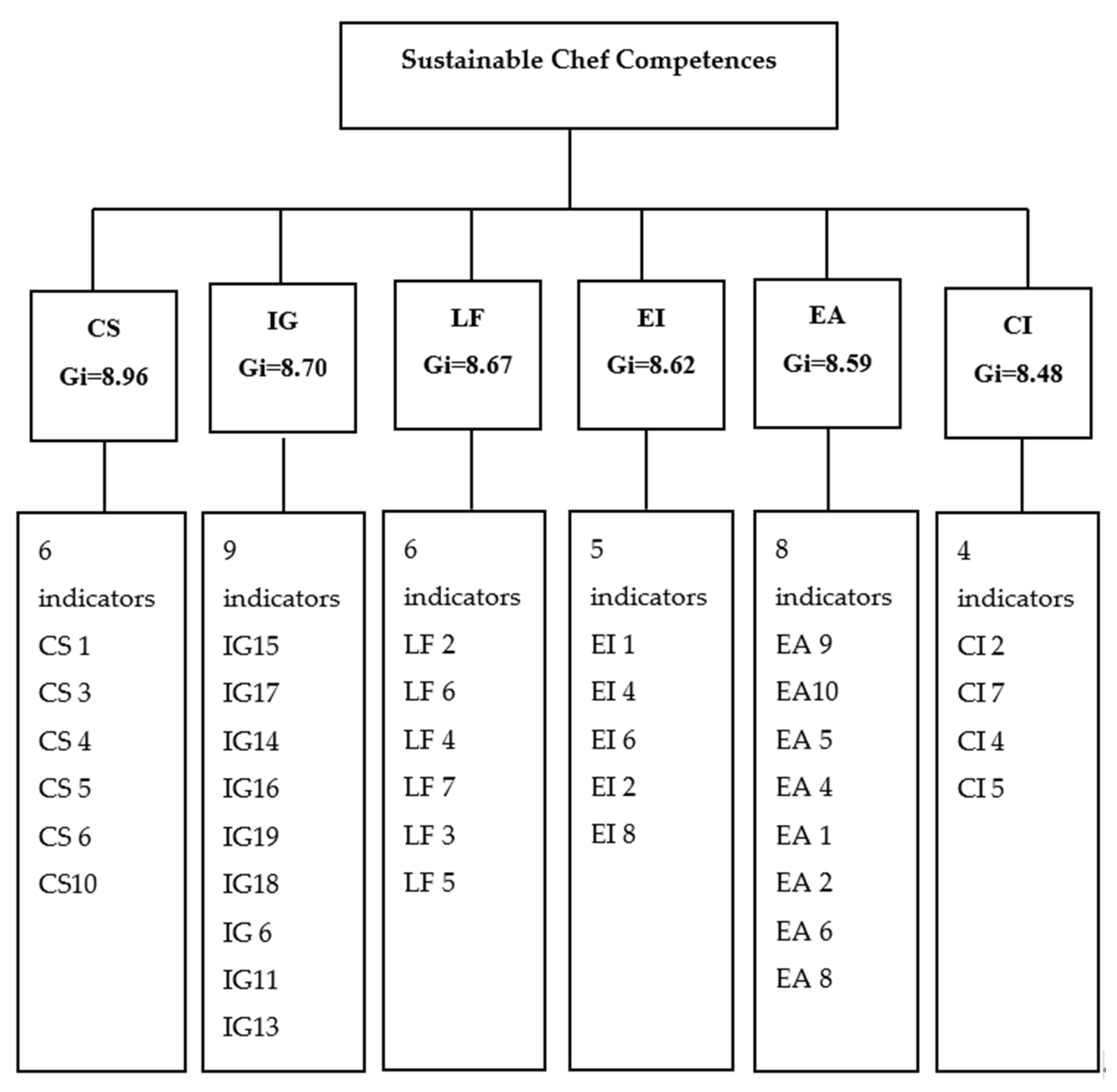
- Culinary Skills (Gi = 8.96): Highest-ranked, affirming that technical proficiency remains foundational to sustainable culinary practice.
- Innovation and Governance (Gi = 8.70): Emphasizes the chef’s role in driving sustainable innovation and decision-making.
- Local Food (Gi = 8.67): Highlights the importance of supporting regional food systems and sourcing practices.
- Environmental Impact (Gi = 8.62): Reflects the need for awareness and mitigation of environmental externalities.
- Ecosystem Awareness (Gi = 8.59): Underlines the role of chefs in resource conservation and ecological responsibility.
- Cultural Interaction (Gi = 8.48): Emphasizes cultural literacy and heritage preservation within sustainability discourse.
- Culinary skills: CS1, CS3, CS4, CS5, CS6, CS10.
- Innovation and Governance: IG15, IG17, IG14, IG16, IG19, IG18, IG6, IG11, IG13.
- Local Food: LF2, LF6, LF4, LF7, LF3, LF5.
- Environmental Impact: EI1, EI4, EI6, EI2, EI8.
- Ecosystem Awareness: EA9, EA10, EA5, EA4, EA1, EA2, EA6, EA8.
- Cultural Interaction: CI2, CI7, CI4, CI5.
4.4. Interpreting the Findings Relative to Prior Research
- Ecosystem awareness: Experts prioritized upstream control (origin checks, production methods, plant-forward choices), which is consistent with studies positioning chefs as system actors who shape biodiversity and dietary impacts through procurement and menu design [8,9]. This alignment supports the view that ecological literacy translates into sourcing decisions before ingredients enter the kitchen [32].
- Environmental impact: High rankings for 3R routines, low-carbon purchasing and energy-aware workflows mirror findings that chef-led operational behaviors drive measurable reductions in waste and emissions in professional kitchens [11,12]. The result reinforces arguments that day-to-day practices—not only equipment upgrades—are the main levers for decarbonization in foodservice settings [34].
- Local food: Convergence on seasonality, certifications, origin verification, native varieties, and livelihoods support reframes “local” from simple proximity to value chain quality and justice, echoing sustainable gastronomy research and sector guidance [13,17]. This strengthens the rationale for procurement policies that embed kitchens within resilient regional supply networks [35].
- Cultural interaction: Items emphasizing education, such as food safety, nutrition, and anti-waste norms, are congruent with the K→A→P (Knowledge, Attitude, and Practice) logic linking literacy to behavior in hospitality contexts [15,18]. This supports the role of chefs as cultural intermediaries who transmit sustainability norms through menus and guest communication, rather than treating communication as peripheral to craft [32].
- Innovation and governance: The salience of menu analytics, inventory and cold-chain discipline, surplus valorization, and fair work practices integrates creativity with controls, aligning with contemporary competency models that connect performance, safety, and sustainability outcomes [14]. The pattern suggests that governance mechanisms such as SOPs, data capture, and incentives are integral to making “green intent” reliable in service.
- Culinary skills: Endorsed items emphasize adaptive, nutrition-aware and safety-first craftsmanship, such as using what is available and improvisation with leftovers, that embeds sustainability within core technique, consistent with recent extensions of chef competency frameworks [18].
5. Conclusions and Suggestions
5.1. Conclusions
5.2. Suggestions
- For industry practitioners
- For educational Institutions
- For government and policymakers
5.3. Limitations
Author Contributions
Funding
Institutional Review Board Statement
Informed Consent Statement
Data Availability Statement
Conflicts of Interest
Appendix A
Appendix A.1

| Ecosystem Awareness (EA): Dimension (Code): Indicator | Source |
| EA1 Know how to control eco-friendly food from the source. EA2 Have good food characteristics knowledge for kitchen staff. EA3 Have the ability to quantitatively use ingredients and raw materials. EA4 Choose suitable eco-friendly raw materials and reliable providers. EA5 Know the procedures for using eco-friendly ingredients to avoid repeated thawing. | [11] |
| EA6 Avoid using genetically modified ingredients to maintain ecological balance. EA7 Find information about food production, such as the “animal welfare” certification for meat and eggs. | [14] |
| EA8 Prioritize plant-based ingredients to reduce reliance on livestock farming. EA9 Choose nutritious food that is accessible and affordable for everyone. | [31] |
| EA10 Understand that “sustainable food” benefits personal health, ecology, and the environment. | [13] |
| Environmental Impact (EI): Dimension (Code): Indicator | Source |
| EI1 Use kitchen tools effectively to avoid ingredient waste. EI2 Prevent food spoilage caused by environmental contamination. EI3 Understand food sterilization methods to reduce contamination. EI4 Understand regulations related to food and surplus management. | [11] |
| EI5 Understand how different food transportation methods impact the environment and society. EI6 Prioritize low-carbon local ingredients to reduce food miles. | [14] |
| EI7 Apply the 3R principles (reduce, reuse, recycle) to lower carbon footprint. | [32] |
| EI8 Understand how dietary choices affect environmental sustainability. | [13] |
| Local Food (LF): Dimension (Code): Indicator | Source |
| LF1 Understand the seasons and prices of various ingredients. | [11] |
| LF2 Check for agricultural food certification labels (organic, pesticide-free, etc.). LF3 Check the country of origin of ingredients. LF4 Prioritize local ingredients to reduce food miles. | [14] |
| LF5 Choose producers who practice animal-friendly farming LF6 Invest in improving the livelihoods of farmers, upstream suppliers, and employees. LF7 Purchase local seasonal ingredients and make use of native varieties. | [31] |
| LF8 Support local farmers and fishers by sourcing their sustainable products. LF9 Provide more plant-based products to reduce meat consumption and lower environmental impact. | [32] |
| Cultural Interaction (CI): Dimension (Code): Indicator | Source |
| CI1 Personal morals tell me not to waste food. CI2 Use education to convey the idea of reducing food waste. | [11] |
| CI3 Analyze the characteristics and impacts of different food cultures. | [14] |
| CI4 Promote cooking education on food safety, healthy diets, and nutrition. | [31] |
| CI5 Understand the meaning of “animal welfare”. | [13] |
| Innovation and Governance (IG): Dimension (Code): Indicator | Source |
| IG1 Include sustainable dining concepts such as portion control, health, and environmental protection in menu design. IG2 Use ingredient characteristics to design innovative dishes. IG3 Accurately calculate ingredient purchase quantities. IG4 Follow ingredient storage standards and procedures. IG5 Know the correct packaging or sub-packaging sizes for ingredients. IG6 Efficiently plan refrigeration and freezer storage space. IG7 Establish monitoring systems to optimize ingredient inventory management. IG8 Classify ingredient storage based on characteristics to extend shelf life. IG9 Store ingredients at different times and in separate areas after cleaning to avoid cross-contamination. IG10 Proactively learn to use new tools for ingredient processing. IG11 Make full and careful use of each ingredient to maximize its value. IG12 Use data analysis to optimize menu design and reduce ingredient waste. IG13 Incorporate food surplus education or concepts into daily kitchen operations. IG14 Innovatively use surplus ingredients to create new dishes and increase resource value. IG15 Observe kitchen waste patterns to identify menu shortcomings and make timely adjustments. IG16 Dispose of kitchen waste according to waste classification guidelines. | [11] |
| IG17 Choose ingredients based on nutrition labels. | [14] |
| IG18 Select reliable ingredient suppliers with a commitment to sustainability. | [31] |
| IG19 Provide employees with fair wages and a reasonable working environment. | [32] |
| Culinary Skills (CSs): Code/Indicator | Source |
| CS1 Ability to follow cooking and energy-saving principles. CS2 Be familiar with ingredient characteristics and appropriate cooking methods to reduce waste. CS3 Flexibly adjust menus using seasonal alternative ingredients to reduce waste. | [11] |
| CS4 Cook and store food carefully to avoid foodborne illness. CS5 Assess food hygiene by observing preparation and cooking processes. CS6 Prepare nutritionally balanced meals. CS7 Judge ingredient quality based on taste, freshness, and other factors. | [14] |
| CS8 Flexibly adjust ingredients and menus. CS9 Adapt recipes based on available ingredients CS10 Improvise meals using available ingredients, including leftovers. | [13] |
Appendix A.2
| Culinary Skills (CSs): Dimension (Code): Indicator |
| CS1 Ability to follow cooking and energy-saving principles. CS3 Flexibly adjust menus using seasonal alternative ingredients to reduce waste. CS4 Cook and store food carefully to avoid foodborne illness. CS5 Assess food hygiene by observing preparation and cooking processes. CS6 Prepare nutritionally balanced meals. CS10 Improvise meals using available ingredients, including leftovers. |
| Innovation and Governance (IG): Dimension (Code): Indicator |
| IG6 Efficiently plan refrigeration and freezer storage space. IG11 Make full and careful use of each ingredient to maximize its value. IG13 Incorporate food surplus education or concepts into daily kitchen operations. IG14 Innovatively use surplus ingredients to create new dishes and increase resource value. IG15 Observe kitchen waste patterns to identify menu shortcomings and make timely adjustments. IG16 Dispose of kitchen waste according to waste classification guidelines. IG17 Choose ingredients based on nutrition labels. IG18 Select reliable ingredient suppliers with a commitment to sustainability. IG19 Provide employees with fair wages and a reasonable working environment. |
| Local Food (LF): Dimension (Code): Indicator |
| LF2 Check for agricultural food certification labels (organic, pesticide-free, etc.). LF3 Check the country of origin of ingredients. LF4 Prioritize local ingredients to reduce food miles. LF5 Choose producers who practice animal-friendly farming. LF6 Invest in improving the livelihoods of farmers, upstream suppliers, and employees. LF7 Purchase local seasonal ingredients and make use of native varieties. |
| Environmental Impact (EI): Dimension (Code): Indicator |
| EI1 Use kitchen tools effectively to avoid ingredient waste. EI2 Prevent food spoilage caused by environmental contamination. EI4 Understand regulations related to food and surplus management. EI6 Prioritize low-carbon local ingredients to reduce food miles. EI8 Understand how dietary choices affect environmental sustainability. |
| Ecosystem Awareness (EA): Dimension (Code): Indicator |
| EA1 Know how to control eco-friendly food from the source. EA2 Have good food characteristics knowledge for kitchen staff. EA4 Choose suitable eco-friendly raw materials and reliable providers. EA5 Know the procedures for using eco-friendly ingredients to avoid repeated thawing. EA6 Avoid using genetically modified ingredients to maintain ecological balance. EA8 Prioritize plant-based ingredients to reduce reliance on livestock farming. EA9 Choose nutritious food that is accessible and affordable for everyone EA10 Understand that “sustainable food” benefits personal health, ecology, and the environment. |
| Cultural Interaction (CI): Dimension (Code): Indicator |
| CI2 Use education to convey the idea of reducing food waste. CI4 Promote cooking education on food safety, healthy diets, and nutrition. CI5 Understand the meaning of “animal welfare”. CI7 Respect the local food culture and reflect it through dish design |
References
- Scott, D.; Gössling, S. From Djerba to Glasgow: Have declarations on tourism and climate change brought us any closer to meaningful climate action? J. Sustain. Tour. 2021, 30, 199–222. [Google Scholar] [CrossRef]
- World Bank Group. Social Dimensions of Climate Change. 2025. Available online: https://www.worldbank.org/en/topic/social-dimensions-of-climate-change (accessed on 18 August 2025).
- Metternicht, G. Initial progress in implementing the Sustainable Development Goals (SDGs): A review of evidence from countries. Sustain. Sci. 2018, 13, 1453–1467. [Google Scholar] [CrossRef]
- Jones, P.; Comfort, D. Sustainable development goals and the world’s leading hotel groups. Athens J. Tour. 2019, 6, 1–14. [Google Scholar] [CrossRef]
- Afroz, N.; Ilham, Z. Assessment of knowledge, attitude and practice of university students towards sustainable development goals (SDGs). J. Indones. Sustain. Dev. Plan. 2020, 1, 31–44. [Google Scholar] [CrossRef]
- Raub, S.P.; Martin-Rios, C. “Think sustainable, act local”—A stakeholder-filter-model for translating SDGs into sustainability initiatives with local impact. Int. J. Contemp. Hosp. Manag. 2019, 31, 2428–2447. [Google Scholar] [CrossRef]
- Hoek, A.C.; Pearson, D.; James, S.W.; Lawrence, M.A. Healthy and environmentally sustainable food choices: Consumer responses to point-of-purchase actions. Food Qual. Prefer. 2020, 79, 103758. [Google Scholar] [CrossRef]
- Richardson, L.; Fernqvist, E. Transforming the food system through sustainable gastronomy—How chefs engage with food democracy. J. Hunger Environ. Nutr. 2022, 19, 260–276. [Google Scholar] [CrossRef]
- Lynch, T. Understanding the future of carbon neutrality in the culinary arts through non-representational theory, practice theory, and design. Front. Sustain. 2024, 5, 1383137. [Google Scholar] [CrossRef]
- Hsu, M.-J. Exploring green competencies for chefs using the Delphi method. J. Tour. Leis. Stud. 2010, 16, 67–88. [Google Scholar] [CrossRef]
- Ko, W.-H.; Lu, M.-Y. Evaluation of the professional competence of kitchen staff to avoid food waste using the modified Delphi method. Sustainability 2020, 12, 8078. [Google Scholar] [CrossRef]
- Lu, M.-Y.; Ko, W.-H. Sustainable preparation behavior for kitchen staff in order to limit food waste. Foods 2023, 12, 3028. [Google Scholar] [CrossRef]
- Teng, C.-C.; Chih, C. Sustainable food literacy: A measure to promote sustainable diet practices. Sustain. Prod. Consum. 2022, 30, 776–786. [Google Scholar] [CrossRef]
- Filimonau, V.; Sezerel, H.; Ashton, M.; Kubal-Czerwińska, M.; Bhaskara, G.I.; Ermolaev, V.A. How chefs develop the practice to manage food waste in professional kitchens. Int. J. Hosp. Manag. 2024, 119, 103712. [Google Scholar] [CrossRef]
- Bhaskara, G.I.; Filimonau, V.; Kusumawardhana, I.; Putra, I.N.D.; Yanthy, P.S.; Hakim, N.H. Environmental habitus of chefs and food waste management in hospitality operations. J. Sustain. Hosp. 2024; in press. [Google Scholar] [CrossRef]
- Pereira, L.M.; Calderón-Contreras, R.; Norström, A.V.; Espinosa, D.; Willis, J.; Lara, L.G.; Amaya, O.P. Chefs as change-makers from the kitchen: Indigenous knowledge and traditional food as sustainability innovations. Glob. Sustain. 2019, 2, e16. [Google Scholar] [CrossRef]
- Park, D.; Park, Y.K.; Park, C.Y.; Choi, M.-K.; Shin, M.-J. Development of a comprehensive food literacy measurement tool integrating the food system and sustainability. Nutrients 2020, 12, 3300. [Google Scholar] [CrossRef]
- Troncoso-Pantoja, C.; Cáceres-Rodríguez, P.; Amaya-Placencia, A.; Lataste-Quintana, C.; Valenzuela, R. Exploring the meanings of food sustainability: An interpretive phenomenological analysis. Sustainability 2023, 15, 13548. [Google Scholar] [CrossRef]
- Elkington, J. Cannibals with Forks: Triple Bottom Line of 21st Century Business; New Society Publishers: Stoney Creek, BC, Canada, 1997. [Google Scholar]
- Mowforth, M.; Munt, I. Tourism and Sustainability: Development and New Tourism in the Third World, 2nd ed.; Routledge: London, UK, 2003. [Google Scholar]
- Gussow, J.D.; Clancy, K.L. Dietary guidelines for sustainability. J. Nutr. Educ. 1986, 18, 1–5. [Google Scholar] [CrossRef]
- Ericksen, P.J. Conceptualizing food systems for global environmental change research. Glob. Environ. Change 2008, 18, 234–245. [Google Scholar] [CrossRef]
- United Nations. The SDGs in Action. Available online: https://www.undp.org/sustainable-development-goals (accessed on 18 August 2025).
- Willett, W.; Rockström, J.; Loken, B.; Springmann, M.; Lang, T.; Vermeulen, S.; Garnett, T.; Tilman, D.; DeClerck, F.; Wood, A. Food in the Anthropocene: The EAT–Lancet Commission on healthy diets from sustainable food systems. Lancet 2019, 393, 447–492. [Google Scholar] [CrossRef] [PubMed]
- Colatruglio, F.D.; Slater, J. Food literacy: Bridging the gap between food, nutrition and well-being. In Sustainable Well-Being: Concepts, Issues, and Educational Practices; McMillan, F.B., Sims, L., Eds.; BSWB Press: Winnipeg, MB, Canada, 2014; pp. 37–55. Available online: http://www.ESWB-Press.org (accessed on 13 October 2025).
- Lester, S.E.; Stevens, J.M.; Gentry, R.R.; Kappel, C.V.; Bell, T.W.; Costello, C.J.; White, C. Marine spatial planning makes room for offshore aquaculture in crowded coastal waters. Nat. Commun. 2018, 9, 945. [Google Scholar] [CrossRef] [PubMed]
- Mahfud, T.; Pardjono, P.; Lastariwati, B. Chef’s competency as a key element in food tourism success: A literature review. GeoJ. Tour. Geosites 2019, 26, 1057–1071. [Google Scholar] [CrossRef]
- Mahfud, T.; Nugraheni, M.; Pardjono; Lastariwati, B. Validation of chef’s key competencies questionnaire: A culinary student perspective. J. Tech. Educ. Train. 2020, 12, 27–38. [Google Scholar] [CrossRef]
- McClelland, D.C. Testing for competence rather than for “intelligence”. Am. Psychol. 1973, 28, 1–14. [Google Scholar] [CrossRef] [PubMed]
- Boyatzis, R.E. The Competent Manager: A Model for Effective Performance; John Wiley & Sons: New York, NY, USA, 1982. [Google Scholar]
- Spencer, L.M.; Spencer, S.M. Competence at Work: Models for Superior Performance; John Wiley & Sons: New York, NY, USA, 1993. [Google Scholar]
- Marinakou, E.; Giousmpasoglou, C. Chefs’ competencies: A stakeholders’ perspective. J. Hosp. Tour. Insights 2022, 5, 205–229. [Google Scholar] [CrossRef]
- Mrisek, N.; Ottenbacher, M.C.; Harrington, R.J. The impact of sustainability and leadership on the innovation management of Michelin-starred chefs. Sustainability 2022, 14, 330. [Google Scholar] [CrossRef]
- SDG2 Advocacy Hub. Food Is Life—The Chefs’ Manifesto. 2018. Available online: https://sdg2advocacyhub.org/chefs-manifesto/ (accessed on 18 August 2025).
- Green Media. Green Dining Pledge. 2019. Available online: https://greenmedia.today/article_detail.php?cid=7&mid=18 (accessed on 18 August 2025).
- Klir, G.J.; Folger, T.A. Fuzzy Sets, Uncertainty, and Information; Prentice Hall: Englewood Cliffs, NJ, USA, 1988. [Google Scholar]
- Zartha Sossa, J.W.; Halal, W.; Hernandez Zarta, R. Delphi method: Analysis of rounds, stakeholder and statistical indicators. Foresight 2019, 21, 525–544. [Google Scholar] [CrossRef]
- Kaufmann, A.; Gupta, M.M. Fuzzy Mathematical Models in Engineering and Management Science; Elsevier Science Publishers: Amsterdam, The Netherlands, 1988. [Google Scholar]
- Blasco-Blasco, O.; Pinto-Delacadena, P.A.; Vinueza-Cabezas, A.; Liern, V. Crafting a competency-based questionnaire based on Fuzzy Delphi: A proposal for enhanced hiring process. Qual. Quant. 2025, 59, 3245–3269. [Google Scholar] [CrossRef]
- Ishikawa, A.; Amagasa, M.; Shiga, T.; Tomizawa, G.; Tatsuta, R.; Mieno, H. The max–min Delphi method and fuzzy Delphi method via fuzzy integration. Fuzzy Sets Syst. 1993, 55, 241–253. [Google Scholar] [CrossRef]
- Gil-Lafuente, A.M.; Merigó, J.M.; Vizuete, E. Analysis of luxury resort hotels by using the Fuzzy Analytic Hierarchy Process and the Fuzzy Delphi Method. Econ. Res.–Ekon. Istraž. 2014, 27, 244–266. [Google Scholar] [CrossRef][Green Version]
- Wynn, J.L.; Polin, R.A. Progress in the management of neonatal sepsis: The importance of a consensus definition. Pediatr. Res. 2018, 83, 13–15. [Google Scholar] [CrossRef]
- FAO. Sustainable Food Systems: Concept and Framework; Food and Agriculture Organization of the United Nations: Rome, Italy, 2018; Available online: https://www.fao.org/3/ca2079en/CA2079EN.pdf (accessed on 8 November 2025).
- HLPE. Food Losses and Waste in the Context of Sustainable Food Systems; High Level Panel of Experts on Food Security and Nutrition, Committee on World Food Security: Rome, Italy, 2014; Available online: http://www.fao.org/3/i3901e/i3901e.pdf (accessed on 8 November 2025).

| Category | Affiliate | Job Title | Working Years | Education |
|---|---|---|---|---|
| Academic Expert | University | President and Chair | 40 years | Ph.D. |
| University | Professor | 26 years | Ph.D. | |
| University | Associate Professor | 18 years | Ph.D. | |
| Industry Expert | Kempinski Hotels | GM and Chief Risk Officer | 36 years | M.A. |
| Bakery & Kitchen | Owner–Chef | 22 years | B.A. | |
| Green Restaurant | Executive Chef | 26 years | B.A. | |
| LDC Hotels & Resorts | Sustainability Consultant | 6 years | M.A. | |
| Dexin Bistro | Head Chef | 5 years | B.A. | |
| Public/Non-Profit Expert | Green Harmony Co. | CEO and Secretary General | 8 years | M.A. |
| Green Dining Guide Assoc | Founder and Chairperson | 8 years | M.A |
| Indicator | (Min) | (Max) | Zi | Mi | Converged | Type * | Gi |
|---|---|---|---|---|---|---|---|
| EA1 | 7.89 | 9.46 | 1 | 1.57 | Yes | 2 | 8.570 |
| EA2 | 7.89 | 9.46 | 1 | 1.57 | Yes | 2 | 8.570 |
| EA3 | 7.15 | 8.73 | 3 | 1.58 | No | 3 | 7.789 |
| EA4 | 7.98 | 9.52 | 1 | 1.54 | Yes | 2 | 8.598 |
| EA5 | 8.10 | 9.62 | 1 | 1.53 | Yes | 2 | 8.642 |
| EA6 | 7.89 | 9.46 | 1 | 1.57 | Yes | 2 | 8.570 |
| EA7 | 6.46 | 8.11 | 3 | 1.65 | No | 3 | 7.363 |
| EA8 | 5.73 | 7.51 | 3 | 1.78 | No | 3 | 6.948 |
| EA9 | 8.27 | 9.78 | 1 | 1.50 | Yes | 2 | 8.710 |
| EA10 | 8.33 | 9.90 | 0 | 1.56 | Yes | 1 | 9.114 |
| EI1 | 8.33 | 9.90 | 0 | 1.56 | Yes | 1 | 9.114 |
| EI2 | 7.60 | 9.29 | 3 | 1.69 | No | 3 | 8.106 |
| EI3 | 7.65 | 9.16 | 1 | 1.51 | Yes | 2 | 8.462 |
| EI4 | 7.81 | 9.34 | 2 | 1.54 | No | 3 | 8.324 |
| EI5 | 7.81 | 9.34 | 2 | 1.54 | No | 3 | 8.324 |
| EI6 | 7.97 | 9.49 | 2 | 1.52 | No | 3 | 8.416 |
| EI7 | 7.31 | 8.82 | 3 | 1.51 | No | 3 | 7.876 |
| EI8 | 7.89 | 9.41 | 1 | 1.51 | Yes | 2 | 8.560 |
| LF1 | 8.02 | 9.47 | 1 | 1.45 | Yes | 2 | 8.599 |
| LF2 | 8.49 | 10.00 | −1 | 1.51 | Yes | 1 | 9.243 |
| LF3 | 8.22 | 9.62 | 1 | 1.40 | Yes | 2 | 8.676 |
| LF4 | 8.27 | 9.78 | 1 | 1.50 | Yes | 2 | 8.710 |
| LF5 | 7.98 | 9.52 | 1 | 1.54 | Yes | 2 | 8.598 |
| LF6 | 8.49 | 10.00 | −1 | 1.51 | Yes | 1 | 9.243 |
| LF7 | 8.33 | 9.84 | 0.5 | 1.51 | Yes | 2 | 8.834 |
| LF8 | 5.50 | 7.46 | 2 | 1.96 | No | 3 | 6.737 |
| LF9 | 7.70 | 9.31 | 1 | 1.61 | Yes | 2 | 8.502 |
| CI1 | 6.26 | 7.90 | 2 | 1.64 | No | 3 | 7.044 |
| CI2 | 8.16 | 9.76 | 1 | 1.59 | Yes | 2 | 8.678 |
| CI3 | 7.41 | 8.81 | 1 | 1.40 | Yes | 2 | 8.339 |
| CI4 | 8.33 | 9.90 | 0 | 1.56 | Yes | 1 | 9.114 |
| CI5 | 7.89 | 9.46 | 1 | 1.57 | Yes | 2 | 8.570 |
| IG1 | 7.10 | 8.67 | 3 | 1.56 | No | 3 | 7.752 |
| IG2 | 7.57 | 9.05 | 1 | 1.48 | Yes | 2 | 8.424 |
| IG3 | 7.93 | 9.41 | 1 | 1.48 | Yes | 2 | 8.569 |
| IG4 | 7.99 | 9.47 | 1 | 1.48 | Yes | 2 | 8.592 |
| IG5 | 7.62 | 9.14 | 3 | 1.52 | No | 3 | 8.084 |
| IG6 | 8.10 | 9.62 | 1 | 1.53 | Yes | 2 | 8.642 |
| IG7 | 7.30 | 8.67 | 2.5 | 1.37 | No | 3 | 7.902 |
| IG8 | 7.89 | 9.41 | 1 | 1.51 | Yes | 2 | 8.560 |
| IG9 | 7.93 | 9.41 | 1 | 1.48 | Yes | 2 | 8.569 |
| IG10 | 7.79 | 9.26 | 1 | 1.47 | Yes | 2 | 8.510 |
| IG11 | 8.22 | 9.68 | 0.5 | 1.46 | Yes | 2 | 8.801 |
| IG12 | 7.30 | 8.72 | 2.5 | 1.42 | No | 3 | 7.916 |
| IG13 | 8.22 | 9.68 | 0.5 | 1.46 | Yes | 2 | 8.801 |
| IG14 | 8.22 | 9.74 | 0.5 | 1.51 | Yes | 2 | 8.807 |
| IG15 | 8.37 | 9.84 | 0.5 | 1.47 | Yes | 2 | 8.840 |
| IG16 | 8.07 | 9.58 | 0.5 | 1.51 | Yes | 2 | 8.769 |
| IG17 | 8.37 | 9.84 | 0.5 | 1.47 | Yes | 2 | 8.840 |
| IG18 | 7.69 | 9.05 | 1 | 1.37 | Yes | 2 | 8.445 |
| IG19 | 7.93 | 9.37 | 1 | 1.44 | Yes | 2 | 8.560 |
| CS1 | 8.49 | 10.00 | −1 | 1.51 | Yes | 1 | 9.243 |
| CS2 | 8.22 | 9.62 | 1 | 1.40 | Yes | 2 | 8.676 |
| CS3 | 8.49 | 10.00 | −1 | 1.51 | Yes | 1 | 9.243 |
| CS4 | 8.27 | 9.78 | 1 | 1.50 | Yes | 2 | 8.710 |
| CS5 | 8.27 | 9.78 | 1 | 1.50 | Yes | 2 | 8.710 |
| CS6 | 8.27 | 9.78 | 1 | 1.50 | Yes | 2 | 8.710 |
| CS7 | 7.91 | 9.26 | 1 | 1.35 | Yes | 2 | 8.536 |
| CS8 | 8.07 | 9.47 | 1 | 1.39 | Yes | 2 | 8.613 |
| CS9 | 8.13 | 9.62 | 1 | 1.50 | Yes | 2 | 8.650 |
| CS10 | 8.27 | 9.78 | 1 | 1.50 | Yes | 2 | 8.710 |
| Indicator | (Min) | (Max) | Zi | Mi | Converged | Type * | Gi | Threshold/Decision | |
|---|---|---|---|---|---|---|---|---|---|
| EA1 | 8.14 | 9.46 | 1 | 1.32 | Yes | 2 | 8.630 | 8.59 | Retain |
| EA2 | 8.14 | 9.46 | 1 | 1.32 | Yes | 2 | 8.630 | Retain | |
| EA3 | 7.54 | 9.46 | 1 | 1.92 | Yes | 2 | 8.501 | Remove | |
| EA4 | 7.98 | 9.71 | 0.5 | 1.73 | Yes | 2 | 8.771 | Retain | |
| EA5 | 8.37 | 9.82 | 0.5 | 1.45 | Yes | 2 | 8.838 | Retain | |
| EA6 | 8.14 | 9.46 | 1 | 1.32 | Yes | 2 | 8.630 | Retain | |
| EA7 | 6.30 | 8.15 | 0 | 1.85 | Yes | 1 | 7.221 | Remove | |
| EA8 | 7.77 | 9.46 | 0 | 1.70 | Yes | 1 | 8.615 | Retain | |
| EA9 | 8.43 | 10.00 | −1 | 1.57 | Yes | 1 | 9.215 | Retain | |
| EA10 | 8.33 | 10.00 | −1 | 1.67 | Yes | 1 | 9.166 | Retain | |
| EA11 | 7.53 | 9.31 | 1 | 1.78 | Yes | 2 | 8.471 | Remove | |
| EI1 | 8.33 | 10.00 | −1 | 1.67 | Yes | 1 | 9.166 | 8.62 | Retain |
| EI2 | 8.16 | 9.76 | 1 | 1.59 | Yes | 2 | 8.678 | Retain | |
| EI3 | 7.65 | 9.16 | 1 | 1.51 | Yes | 2 | 8.462 | Remove | |
| EI4 | 8.09 | 9.88 | 0 | 1.79 | Yes | 1 | 8.987 | Retain | |
| EI5 | 7.51 | 9.35 | 1 | 1.84 | Yes | 2 | 8.476 | Remove | |
| EI6 | 7.56 | 9.59 | 0.5 | 2.04 | Yes | 2 | 8.716 | Retain | |
| EI7 | 7.43 | 9.12 | 0 | 1.69 | Yes | 1 | 8.272 | Remove | |
| EI8 | 8.14 | 9.41 | 1 | 1.27 | Yes | 2 | 8.621 | Retain | |
| EI9 | 6.45 | 10.00 | −2 | 3.55 | Yes | 1 | 8.225 | Remove | |
| LF1 | 8.02 | 9.47 | 1 | 1.45 | Yes | 2 | 8.599 | 8.67 | Remove |
| LF2 | 8.49 | 10.00 | −1 | 1.51 | Yes | 1 | 9.243 | Retain | |
| LF3 | 8.22 | 9.82 | 0.5 | 1.60 | Yes | 2 | 8.815 | Retain | |
| LF4 | 8.43 | 10.00 | −1 | 1.57 | Yes | 1 | 9.215 | Retain | |
| LF5 | 7.98 | 9.71 | 0.5 | 1.73 | Yes | 2 | 8.771 | Retain | |
| LF6 | 8.49 | 10.00 | −1 | 1.51 | Yes | 1 | 9.243 | Retain | |
| LF7 | 8.33 | 10.00 | −1 | 1.67 | Yes | 1 | 9.166 | Retain | |
| LF8 | 5.60 | 7.92 | 0 | 2.32 | Yes | 1 | 6.762 | Remove | |
| LF9 | 7.92 | 9.31 | 1 | 1.40 | Yes | 2 | 8.547 | Remove | |
| CI1 | 7.13 | 8.90 | 1 | 1.77 | Yes | 2 | 8.326 | 8.48 | Remove |
| CI2 | 8.49 | 10.00 | −1 | 1.51 | Yes | 1 | 9.243 | Retain | |
| CI3 | 7.25 | 8.81 | 0 | 1.56 | Yes | 1 | 8.034 | Remove | |
| CI4 | 8.33 | 10.00 | −1 | 1.67 | Yes | 1 | 8.666 | Retain | |
| CI5 | 8.14 | 9.46 | 1 | 1.32 | Yes | 2 | 8.630 | Retain | |
| CI6 | 6.86 | 8.72 | 0 | 1.85 | Yes | 1 | 7.792 | Remove | |
| CI7 | 7.87 | 9.71 | 0.5 | 1.84 | Yes | 2 | 8.758 | Retain | |
| IG1 | 7.06 | 8.92 | 0 | 1.85 | Yes | 1 | 7.990 | 8.70 | Remove |
| IG2 | 7.57 | 9.05 | 1 | 1.48 | Yes | 2 | 8.424 | Remove | |
| IG3 | 7.93 | 9.41 | 1 | 1.48 | Yes | 2 | 8.569 | Remove | |
| IG4 | 8.25 | 9.47 | 1 | 1.22 | Yes | 2 | 8.661 | Remove | |
| IG5 | 7.99 | 9.56 | 1 | 1.58 | Yes | 2 | 8.607 | Remove | |
| IG6 | 8.37 | 9.82 | 0.5 | 1.45 | Yes | 2 | 8.838 | Retain | |
| IG7 | 7.58 | 9.59 | −0.5 | 2.01 | Yes | 1 | 8.589 | Remove | |
| IG8 | 8.14 | 9.41 | 1 | 1.27 | Yes | 2 | 8.621 | Remove | |
| IG9 | 7.93 | 9.41 | 1 | 1.48 | Yes | 2 | 8.569 | Remove | |
| IG10 | 7.79 | 9.26 | 1 | 1.47 | Yes | 2 | 8.510 | Remove | |
| IG11 | 8.22 | 9.68 | 0.5 | 1.46 | Yes | 2 | 8.801 | Retain | |
| IG12 | 7.16 | 9.01 | 0 | 1.85 | Yes | 1 | 8.085 | Remove | |
| IG13 | 8.22 | 9.68 | 0.5 | 1.46 | Yes | 2 | 8.801 | Retain | |
| IG14 | 8.22 | 9.88 | 0 | 1.66 | Yes | 1 | 9.053 | Retain | |
| IG15 | 8.54 | 10.00 | −1 | 1.46 | Yes | 1 | 9.270 | Retain | |
| IG16 | 8.07 | 10.00 | −1 | 1.93 | Yes | 1 | 9.036 | Retain | |
| IG17 | 8.54 | 10.00 | −1 | 1.46 | Yes | 1 | 9.270 | Retain | |
| IG18 | 7.69 | 10.00 | −1 | 2.31 | Yes | 1 | 8.843 | Retain | |
| IG19 | 7.93 | 10.00 | −1 | 2.07 | Yes | 1 | 8.964 | Retain | |
| CS1 | 8.49 | 10.00 | −1 | 1.51 | Yes | 1 | 9.243 | 8.96 | Retain |
| CS2 | 8.22 | 9.82 | 0.5 | 1.60 | Yes | 2 | 8.815 | Remove | |
| CS3 | 8.49 | 10.00 | −1 | 1.51 | Yes | 1 | 9.243 | Retain | |
| CS4 | 8.43 | 10.00 | −1 | 1.57 | Yes | 1 | 9.215 | Retain | |
| CS5 | 8.43 | 10.00 | −1 | 1.57 | Yes | 1 | 9.215 | Retain | |
| CS6 | 8.43 | 10.00 | −1 | 1.57 | Yes | 1 | 9.215 | Retain | |
| CS7 | 7.91 | 9.26 | 1 | 1.35 | Yes | 2 | 8.536 | Remove | |
| CS8 | 8.07 | 9.47 | 1 | 1.39 | Yes | 2 | 8.613 | Remove | |
| CS9 | 8.13 | 9.82 | 0.5 | 1.70 | Yes | 2 | 8.801 | Remove | |
| CS10 | 8.43 | 10.00 | −1 | 1.57 | Yes | 1 | 9.215 | Retain | |
| CS11 | 7.73 | 9.56 | 1 | 1.83 | Yes | 2 | 8.552 | Remove | |
Disclaimer/Publisher’s Note: The statements, opinions and data contained in all publications are solely those of the individual author(s) and contributor(s) and not of MDPI and/or the editor(s). MDPI and/or the editor(s) disclaim responsibility for any injury to people or property resulting from any ideas, methods, instructions or products referred to in the content. |
© 2025 by the authors. Licensee MDPI, Basel, Switzerland. This article is an open access article distributed under the terms and conditions of the Creative Commons Attribution (CC BY) license (https://creativecommons.org/licenses/by/4.0/).
Share and Cite
Yang, T.C.; Ho, Y.C. Developing Sustainable Chef Competency Indicators: An Application of the Fuzzy Delphi Method. Sustainability 2025, 17, 10411. https://doi.org/10.3390/su172210411
Yang TC, Ho YC. Developing Sustainable Chef Competency Indicators: An Application of the Fuzzy Delphi Method. Sustainability. 2025; 17(22):10411. https://doi.org/10.3390/su172210411
Chicago/Turabian StyleYang, Ting Chi, and Yuan Chia Ho. 2025. "Developing Sustainable Chef Competency Indicators: An Application of the Fuzzy Delphi Method" Sustainability 17, no. 22: 10411. https://doi.org/10.3390/su172210411
APA StyleYang, T. C., & Ho, Y. C. (2025). Developing Sustainable Chef Competency Indicators: An Application of the Fuzzy Delphi Method. Sustainability, 17(22), 10411. https://doi.org/10.3390/su172210411