1. Introduction
Corporate environmental misconduct poses serious environmental and social threats. It not only directly disrupts ecological stability and resource sustainability, jeopardizing public health and social order [
1,
2], but also hinders high-quality economic growth and industrial upgrading, thereby impairing national reputation and global competitiveness [
3,
4]. In response to this pressing global issue, countries around the world are actively enhancing their environmental governance frameworks to strengthen oversight and incentives for corporate environmental behavior [
5]. As the largest developing economy, China faces particularly acute challenges related to corporate environmental misconduct. According to statistics from China’s Ministry of Ecology and Environment, in 2024 alone, environmental authorities at various levels issued 55,900 administrative penalty decisions, with total fines amounting to RMB 4.612 billion, underscoring the severity of corporate environmental violations in the country. While extant research has examined the roles of governments [
6,
7], media [
8,
9], the public [
10,
11], financial institutions [
12], and executives [
1,
13,
14] in influencing corporate environmental violations, the function of investors has received limited attention. To address this gap, this study introduces the perspective of green institutional investors and investigates their impact on corporate environmental violations, aiming to elucidate the significant yet underexplored role that investors play in mitigating corporate environmental misconduct.
Although governments, media, the public, financial institutions, and executives all serve as governance actors in curbing corporate environmental violations, each is constrained by significant limitations. Governments have enacted stringent environmental regulations to standardize corporate behavior; however, their reliance on ex-post punitive measures falls short of securing comprehensive oversight across the full spectrum of operational activities [
6,
15]. The media plays an external supervisory role, yet its effectiveness is undermined by limited expertise and selective coverage [
9,
16]. The public enhances reputational risks for violators, but its impact is weakened by inadequate investigative resources and inconsistent attention [
7,
17]. Financial institutions, employing policy tools including green credit, aim to promote sustainable innovation and reduce emissions; nevertheless, widespread information asymmetry weakens the efficacy of these financial incentives [
12]. While executives are crucial in enforcing environmental compliance, agency problems and cognitive biases often result in short-termism and insufficient constraint of violations [
18]. Thus, sole dependence on these actors does not suffice for robust environmental governance. Green institutional investors, leveraging their dual capacity for monitoring and incentive alignment, can help bridge these governance gaps and more effectively curb corporate environmental misconduct.
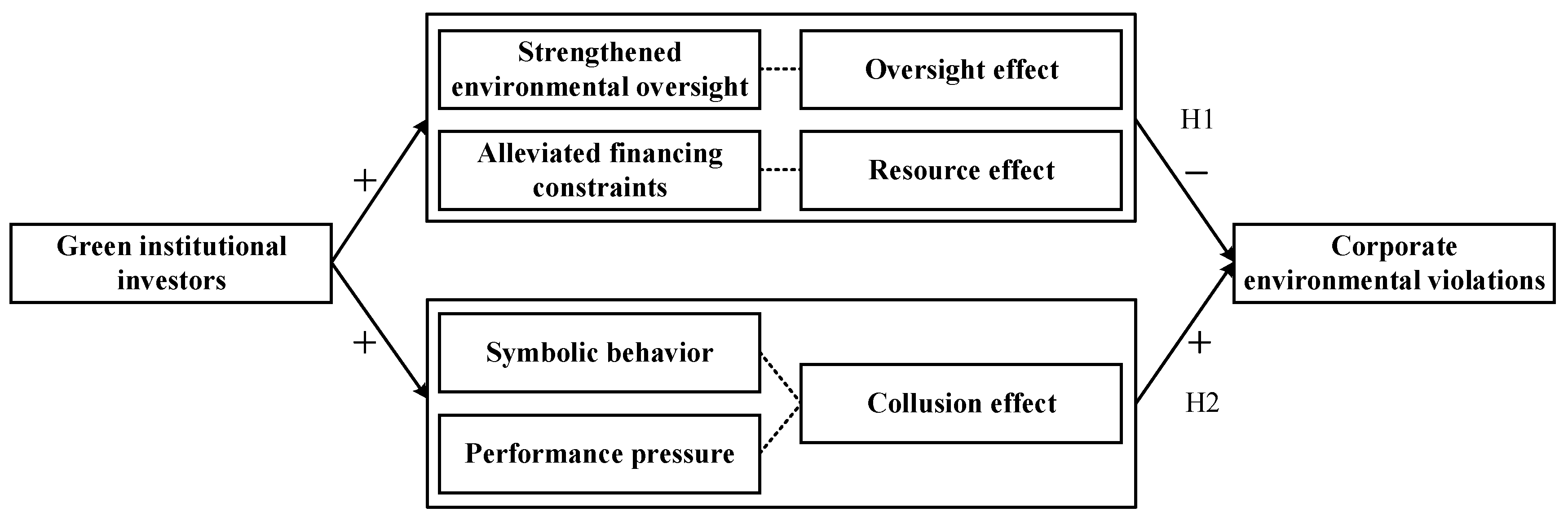
Green institutional investors may not only inhibit but also exacerbate corporate environmental violations, reflecting their dual pursuit of environmental and economic objectives. They can suppress environmental violations through oversight and resource effects: their strong informational capabilities allow them to identify environmental risks early and exercise shareholder activism to improve oversight [
19], while their substantial capital and influence provide critical financial support for environmental projects, easing financing constraints and reducing incentives for non-compliance [
20,
21]. Conversely, green institutional investors may also enable environmental violations through collusion effects. Some engage in symbolic environmental practices, cooperating with management to sustain a facade of compliance without meaningful improvement [
22]. Furthermore, pressures to achieve short-term financial targets may lead them to prioritize economic returns over environmental goals, tacitly permitting or concealing managerial opportunism [
23]. As a result, the overall influence of green institutional investors on corporate environmental violations continues to be unclear and calls for additional empirical study.
This study focuses on China to examine the influence of green institutional investors on corporate environmental violations, driven by two key factors. First, China represents a critical setting for environmental governance challenges. Decades of rapid economic expansion have resulted in widespread environmental deterioration [
24,
25]. As indicated by the 2024 Environmental Performance Index (EPI) released by the Yale Center for Environmental Law & Policy, China ranks 156th out of 180 countries, highlighting severe environmental strain. Curbing corporate environmental violations is therefore crucial to easing resource and pollution pressures and promoting high-quality economic development. Lessons from China may thus offer insights for other economies confronting similar sustainability issues. Second, China’s green investment sector has experienced rapid but uneven growth. According to the 2024 China Sustainable Investment Review jointly issued by the China Responsible Investment Forum and SynTao Green Finance, the number of green funds rose dramatically from 33 in 2014 to 848 in 2024, reflecting substantial market development. However, this expansion remains predominantly policy-led and institutionally underdeveloped, characterized by inconsistent green standards, insufficient regulatory frameworks, and shortages in specialized expertise and governance mechanisms. These institutional weaknesses raise doubts regarding the actual effectiveness of green institutional investors in enhancing corporate environmental accountability. Studying China’s context thus provides valuable implications for building stronger and more effective green investment systems worldwide.
This study utilizes data from heavily polluting firms listed on China’s Shanghai and Shenzhen A-share markets to assess how green institutional investors affect corporate environmental violations. The results demonstrate that green institutional investors significantly inhibit corporate environmental violations. Mechanism analyses indicate that these investors leverage their informational edge to strengthen environmental oversight and employ their resource capacity to alleviate financing constraints, thereby reducing corporate environmental misconduct. Cross-sectional tests reveal that the inhibitory effect is more pronounced in settings with weaker government, media, and public environmental attention, underdeveloped green credit systems, and limited executive green experience. Furthermore, analysis of economic consequences shows that these investors help mitigate both operational and financial risks by curbing environmental violations. Finally, examination of spillover effects confirms that the inhibitory effect generates positive externalities at the industry and regional levels. Overall, the evidence underscores the critical and multifaceted part played by investors in limiting corporate environmental wrongdoing.
This study provides a number of significant additions to the existing literature. First, it extends the theoretical framework concerning governance determinants of corporate environmental violations by incorporating a distinctive analytical perspective focused on investor influence. Although scholarly attention has largely concentrated on the roles of governments [
6,
7], media [
8,
9], the public [
10,
11], financial institutions [
12], and executives [
1,
13,
14], the role of investors has been relatively understudied. These conventional actors typically function through either supervisory and corrective mechanisms, as seen with governments, media, the public, and executives, or credit-linked incentives, in the case of financial institutions. Yet, dependence on a single type of mechanism has shown to be inadequate in effectively curbing environmental misconduct. By focusing on green institutional investors, which combine oversight with resource effects, this research not only enlarges the range of recognized governance actors, but also illustrates how collaborative interactions among diverse stakeholders constitute an effective response to corporate environmental misconduct.
Second, this article deepens insights into investor-led environmental governance effects by systematically investigating the link between green institutional investors and corporate environmental violations. While earlier studies have documented their beneficial role in corporate environmental engagement, as reflected in promoted green innovation [
19,
26], higher ESG performance [
20,
21,
27], and enhanced environmental performance [
28,
29], their connection with environmental compliance has not been sufficiently examined. It is essential to recognize that greater environmental involvement does not necessarily lead to improved compliance, for two main reasons: environmental measures may fall short of rising regulatory requirements, and firms might adopt symbolic measures or partial disclosure without meaningful improvement, thereby failing to avert violations. By examining how green institutional investors affect corporate environmental violations, this study not only evaluates whether investor-driven environmental practices conform with compliance standards, but also yields important theoretical and practical implications for the efficacy of investor-led governance.
Third, this paper clarifies the connections among governments, media, the public, financial institutions, executives, and investors in governing corporate environmental violations. While the existing literature has separately analyzed the influences of governments [
6,
7], media [
8,
9], the public [
10,
11], financial institutions [
12], and executives [
1,
13,
14] on corporate environmental violations, the interactions between these actors and investors have been largely neglected. This study reveals that the inhibitory effect of green institutional investors on corporate environmental violations is more evident in situations characterized by lower government, media, and public environmental attention, less developed green credit systems, and limited green experience among executives. This outcome not only sheds light on the interactions among these key stakeholders, but also offers a foundation in theory and practice for leveraging their synergistic effects in reducing environmental misconduct.
Fourth, this research identifies broader ripple effects of green institutional investors in mitigating corporate environmental violations. While previous research has mainly focused on how such investors directly influence their portfolio firms [
19,
26,
27], possible spillover effects have been generally ignored. The evidence shows that green institutional investors not only reduce environmental violations in their invested firms, but also produce a restraining influence on industry and regional peers. This implies that peer firms observe and adopt the environmental behaviors of firms held by green institutional investors, thereby refining their own environmental decision-making and reducing violations. Through such observational and learning mechanisms, green institutional investors support the broader sustainability of entire industries and regions. These findings provide a fresh theoretical perspective on the governance effectiveness of green institutional investors.
8. Discussion and Conclusions
8.1. Conclusions
Prior research has predominantly examined the effects of governments, media, the public, financial institutions, and executives on corporate environmental violations, yet has largely neglected the role of investors. This study introduces the perspective of green institutional investors to explore how investors influence corporate environmental violations. The results show that green institutional investors significantly inhibit corporate environmental violations. Mechanism analyses suggest that green institutional investors leverage informational advantages to strengthen environmental oversight and utilize resource advantages to alleviate financing constraints, thereby reducing corporate environmental violations. Cross-sectional tests reveal that this inhibitory effect is stronger in contexts characterized by lower government, media, and public environmental attention, underdeveloped green credit systems, and absence of green experience among executives. Furthermore, economic consequence analysis indicates that green institutional investors help mitigate both operational and financial risks through the reduction in environmental violations. Finally, spillover effect analysis confirms that this inhibitory effect exhibits positive externalities at both industry and regional levels.
8.2. Contributions and Implications
This study offers several key theoretical advances. First, it integrates green institutional investors—characterized by their dual capacity for oversight and resource provision—into the analytical framework of corporate environmental violation governance, thereby broadening the scope of actors considered in such governance. Second, it illuminates the interconnections among governments, media, the public, financial institutions, executives, and investors in addressing corporate environmental violations, thereby enriching the understanding of the factors shaping corporate environmental misconduct. Third, by focusing on corporate environmental violations, it enhances understanding of the environmental governance effects of green institutional investors and supplies further empirical evidence for evaluating the effectiveness of investor-driven governance. Fourth, it uncovers the spillover effects of green institutional investors in mitigating corporate environmental violations. Specifically, such investors not only reduce environmental violations in their invested firms but also deter violations among peer firms within the same industry and region through learning and competitive mechanisms. Together, these theoretical contributions help advance and refine the literature on green institutional investors and corporate environmental violations.
The research findings also yield practical implications for enhancing corporate environmental compliance:
First, governments ought to focus on building an incentive-compatible green investment system. The more pronounced inhibitory effect observed in regions with lower government environmental attention and underdeveloped green credit systems suggests that policymakers should promote market-oriented environmental governance mechanisms. This could involve implementing preferential tax policies, green credit incentives, and simplified environmental approval procedures to encourage increased institutional investment in sustainability. Additionally, enhancing the transparency of corporate environmental disclosure and fostering inter-agency coordination will facilitate more effective monitoring by green institutional investors, creating synergy between public regulation and market-based supervision.
Second, investors should embrace a comprehensive green investment philosophy that goes beyond a narrow focus on financial returns. Green institutional investors are encouraged to incorporate environmental performance systematically into their investment evaluation and decision-making processes. By capitalizing on their informational and resource advantages, they can participate actively in corporate governance through private communications, shareholder proposals, and voting rights to enhance environmental management and innovation in portfolio companies. Moreover, developing in-house expertise in environmental issues will improve the assessment of environmental risks and opportunities.
Third, enterprises are advised to take initiative to reduce environmentally irresponsible behavior. Firms should consider introducing green institutional investors into their ownership structure to benefit from external monitoring and improved governance. Management ought to acknowledge that environmental responsibility is not limited to regulatory compliance but constitutes a strategic asset for mitigating operational and financial risks. Companies can implement clear environmental accountability mechanisms at the board and executive levels, boost investments in pollution prevention and green technology innovation, and regularly publish environmental performance reports to increase transparency. These measures will not only help prevent violations but also promote sustainable development and strengthen corporate reputation.
Fourth, developed countries should capitalize on their advanced markets and regulatory expertise to take a leading role in global sustainable finance. Benefiting from well-established financial systems and robust regulatory frameworks, these nations are well-placed to pioneer the integration of sustainability into global investment practices. They can design more sophisticated environmental risk-assessment models and disclosure standards to establish benchmarks for emerging markets. In light of the demonstrated role of green institutional investors in reducing violations and associated risks, regulators and institutional investors in advanced economies ought to advocate for widespread mandatory environmental disclosure, ensuring environmental criteria are embedded in investment evaluations. Furthermore, developed countries can support knowledge transfer and capacity-building programs to encourage global alignment in monitoring and reducing corporate environmental violations. By disseminating innovative tools and governance best practices, developed nations can amplify the positive spillover effects created by green institutional investors and help build a global economy oriented toward greater sustainability.
8.3. Limitations and Future Research Directions
This study investigates the influence of green institutional investors on corporate environmental violations, underscoring the pivotal role of investors in mitigating corporate environmental misconduct. Nevertheless, several limitations persist due to constraints in research context and data availability, which merit further exploration and refinement in future studies. First, the reliance on China as the empirical setting may constrain the broader applicability of the findings. China’s distinctive institutional environment, evolving financial market infrastructure, and distinctive patterns of investor behavior may restrict the transferability of conclusions to countries with differing institutional frameworks. Future research could undertake cross-national comparative analyses to explore how varying institutional settings shape the mechanisms and efficacy of such influences. Second, the measurement of corporate environmental violations may be subject to potential measurement error. This study relies on administrative penalties issued by environmental authorities as the primary indicator of corporate environmental violations. However, this metric may be affected by external factors such as regional enforcement intensity, reporting delays, and local protectionism, possibly introducing systematic bias. Subsequent studies could integrate third-party pollutant monitoring data and adopt multidimensional assessment strategies to evaluate corporate environmental violations, thereby yielding more robust and complementary evidence.