
Towards Sustainable Air Quality in Coal-Heated Cities: A Case Study from Astana, Kazakhstan


 ,
,  ,
,  and
and 
Abstract
1. Introduction
2. Materials and Methods
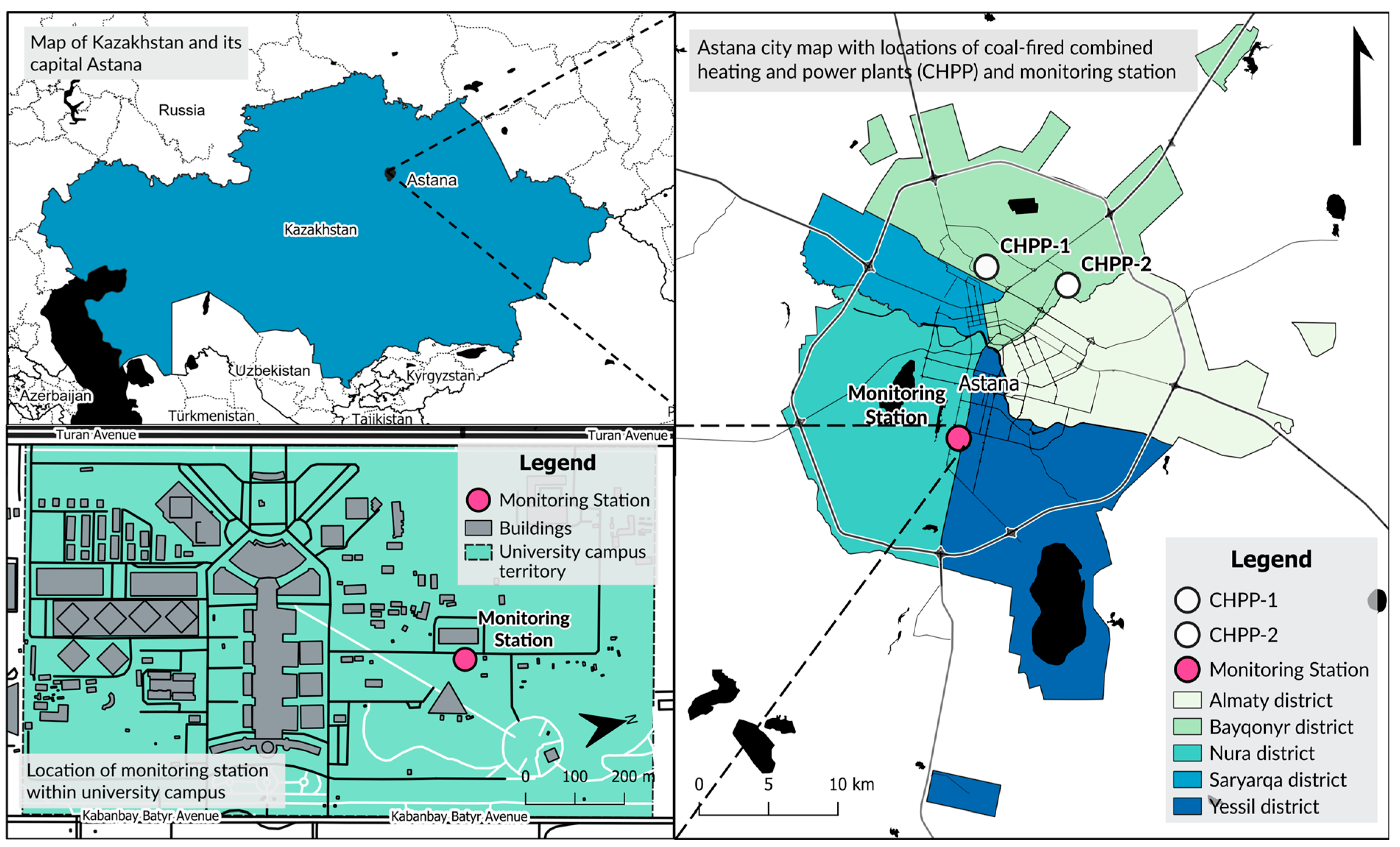
2.1. Site Description and PM Sampling
2.2. Morphological Characterization of PM
2.3. Sampling of Atmospheric Precipitation and Its Chemical Characterization
2.4. In Vitro Lung Bioaccessibility Tests
2.5. Human Health Risk Assessment (HHRA)
2.6. Positive Matrix Factorization (PMF)
3. Results and Discussion
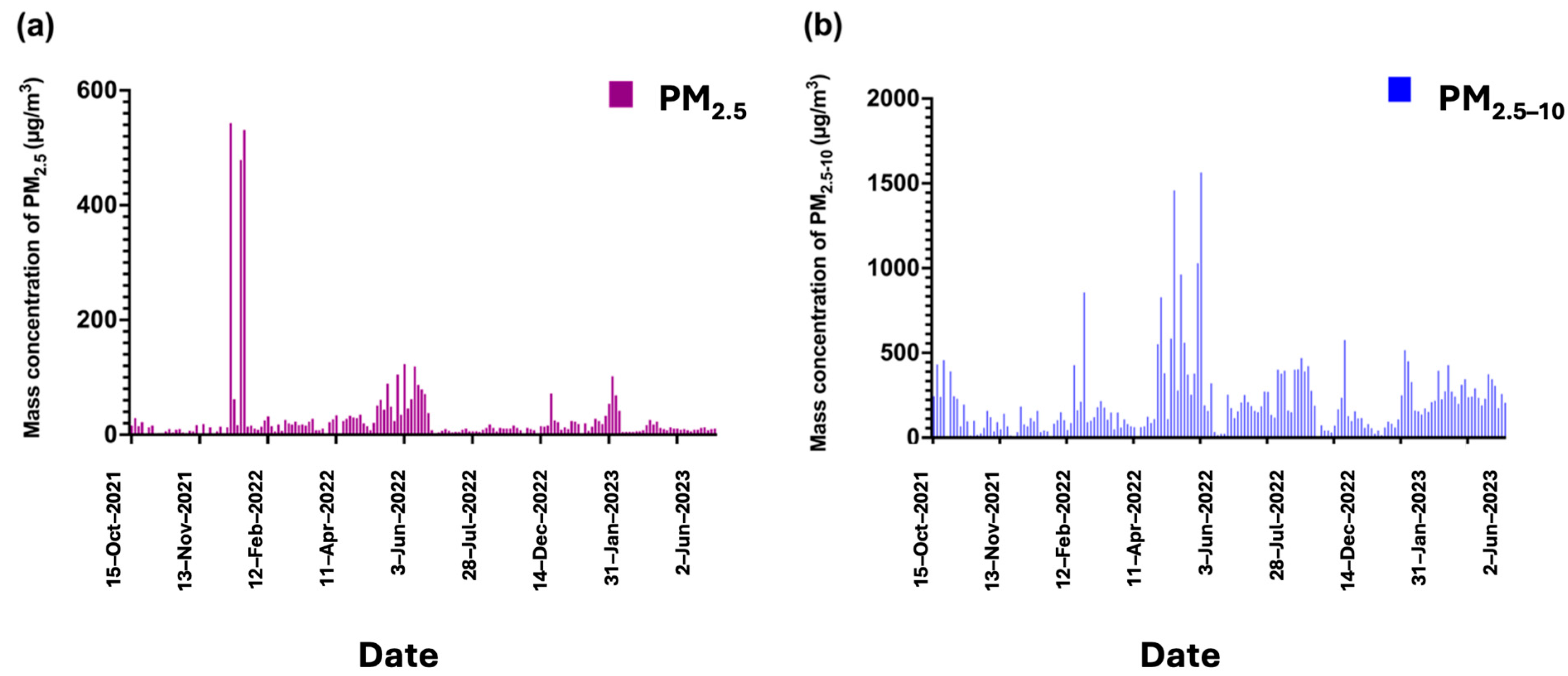
3.1. Total PM Mass Concentration
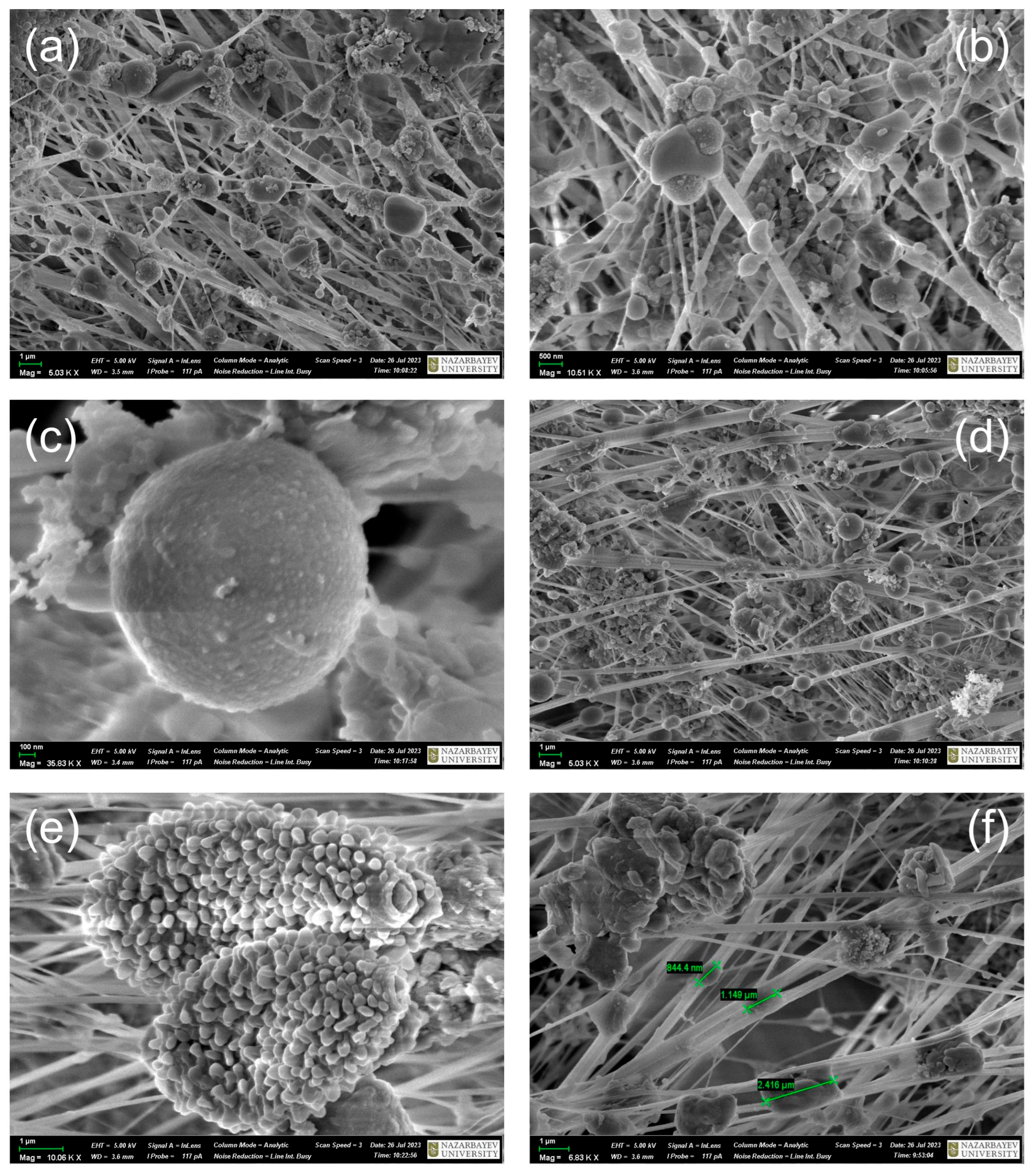
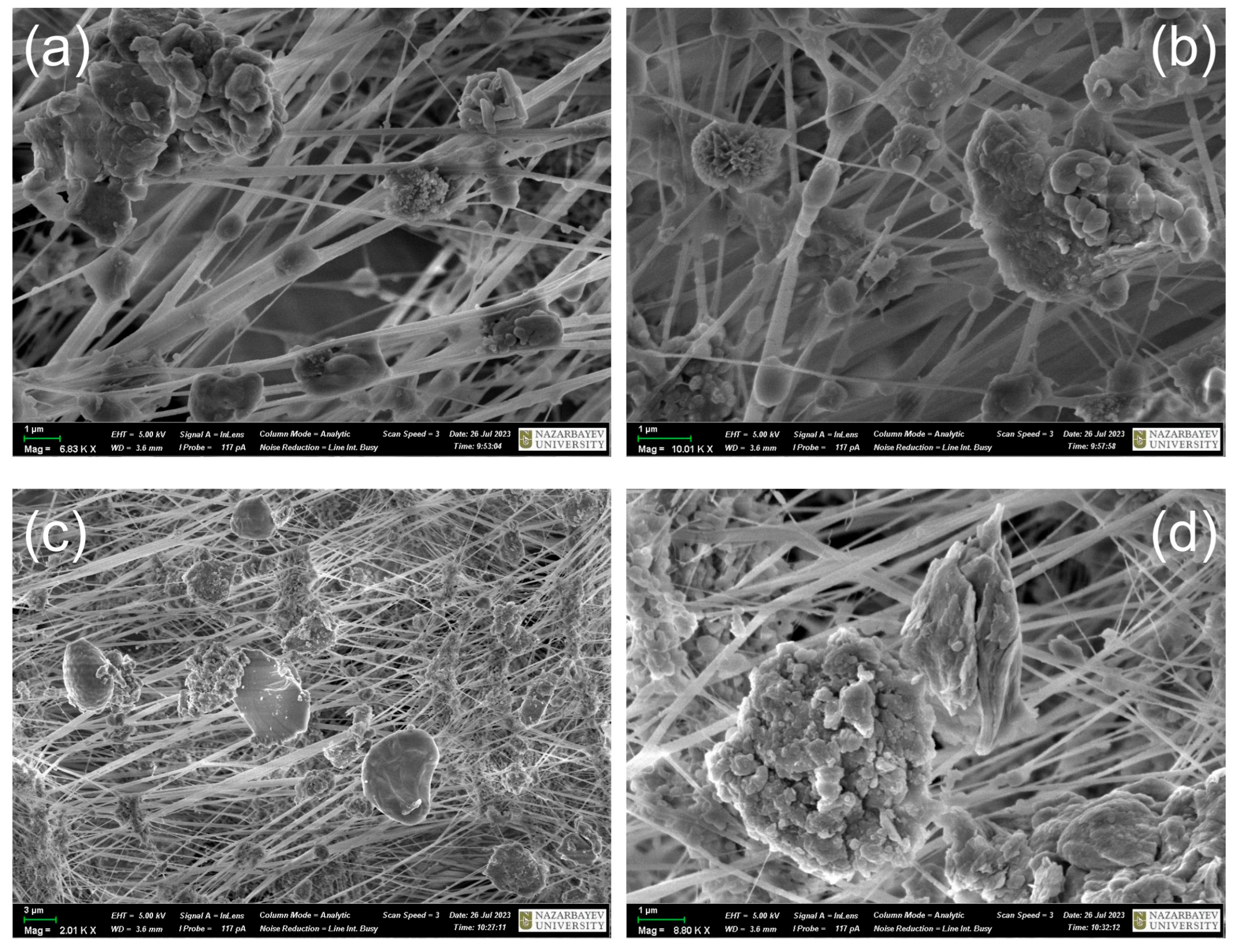
3.2. Morphological Characterization of PM Particles from Different Emission Sources
3.3. Characterization of Snow and Rainwater
3.3.1. Volume, pH and Ionic Conductivity

| Range (Min–Max) | Mean | SD | Median | WHO Limits 1 | EU Environmental Guidelines 2 | |
|---|---|---|---|---|---|---|
| pH | (6.48–8.51) | 7.15 | 0.46 | 7.09 | no health-based guidelines; optimal range for treatment and distribution: 6.5–8.5 | N/A |
| EC | (20.1–492) | 142 | 110 | 116 | N/A | N/A |
| Precipitation | (0.20–14.0) | 4.09 | 3.80 | 3.15 | N/A | N/A |
| F− | (0.01–1.82) | 0.31 | 0.39 | 0.14 | 1.5 | N/A |
| Cl− | (0.01–55.5) | 14.3 | 12.8 | 8.15 | no health-based guidelines; taste: 200–300 for NaCl, KCl, CaCl | N/A |
| NO2− | (0.02–3.97) | 1.47 | 1.02 | 1.23 | 3.0 | N/A |
| NO3− | (0.01–32.6) | 6.01 | 8.30 | 3.61 | 50 | groundwater: 50 |
| SO42− | (0.02–77.5) | 17.8 | 20.6 | 10.1 | no health-based guidelines; taste: 250 | N/A |
| PO43− | (0.03–1.27) | 0.39 | 0.41 | 0.27 | N/A | N/A |
| Br− | <DL | <DL | <DL | <DL | N/A | N/A |
| Li+ | <DL | <DL | <DL | <DL | N/A | N/A |
| K+ | (0.01–45.6) | 11.9 | 11.1 | 8.16 | N/A | N/A |
| Na+ | (0.01–16.3) | 3.46 | 4.86 | 1.97 | no health-based guidelines; taste: 200 | N/A |
| NH4+ | (0.0–16.4) | 3.46 | 4.68 | 1.55 | no health-based guidelines; odor: 1.5; taste: 35 | N/A |
| Ca2+ | (0.02–50.8) | 14.9 | 13.8 | 10.3 | N/A | N/A |
| Mg2+ | (0.00–3.87) | 0.84 | 0.89 | 0.52 | N/A | N/A |
| ∑anions | (0.06–3.36) | 1.10 | 0.97 | 0.80 | N/A | N/A |
| ∑cations | (0.00–4.49) | 1.43 | 1.24 | 0.96 | N/A | N/A |
3.3.2. Ion Concentrations
3.3.3. Concentrations of PTEs
| PTEs | Range (Min–Max) | Mean | SD | Median | WHO Limits 1 | AA-EQS Inland Surface Water Limits 2 | MAC-EQS Inland Surface Water Limits 3 |
|---|---|---|---|---|---|---|---|
| Cd | (0.04–0.36) | 0.15 | 0.07 | 0.13 | 3.00 | ≤0.08 (Class 1) | ≤0.45 (Class 1) |
| Co | (0.10–6.90) | 1.70 | 1.65 | 1.20 | N/A | N/A | N/A |
| Cr | (4.20–77.4) | 16.7 | 14.1 | 13.8 | 30.0 | N/A | N/A |
| Cu | (2.57–41.3) | 10.2 | 9.06 | 7.17 | 2000 | N/A | N/A |
| Mn | (0.50–212) | 63.2 | 57.1 | 55.9 | 80.0 | N/A | N/A |
| Ni | (5.20–612) | 84.0 | 134 | 30.2 | 70.0 | 2.0 | 8.2 |
| Pb | (0.10–14.1) | 2.39 | 3.72 | 0.62 | 9.00 | 1.2 | 14 |
| Sb | (0.38–3.00) | 1.39 | 0.99 | 1.86 | 20.0 | N/A | N/A |
| V | (63.1–159) | 108 | 24.6 | 106 | N/A | N/A | N/A |
3.4. In Vitro Lung Bioaccessibility of PTEs
3.5. Inhalation Risk Assessment Using Bioaccessible Concentrations of PTEs
3.6. Source Identification of PM2.5 via PMF
3.7. Potential Health and Environmental Impacts and Recommendations
| Analyzed Parameter | Public Health Concern | Environmental Concern | Reference |
|---|---|---|---|
| PM mass concentration | Major concern: Chronic exposure to high PM2.5 levels Minor concern: PM concentration spikes | Major concern: PM levels’ impact on vegetation and soil Minor concern: Particulate pollution can reduce visibility | [106,107] |
| PM morphology and emission sources | Major concern: CFA, bioaerosols Minor concern: Particle morphological feature | Minor concern: Soot particles | [25,108] |
| In vitro lung bioaccessibility | Major concern: High BA concentration of carcinogenic PTEs Minor concern: High BA concentration of Fe, V, Cu | Major concern: Deposition of PTEs onto soil, ground water, surface water, and natural ecosystems Minor concern: Accumulation of PTEs in urban environment | [7,87,109] |
| Health risk assessment | Major concern: The maximum cancer risk for adults Minor concern: The January Cr-related cancer risk | Major concern: Elevated Cr levels Minor concern: Lack of Cr speciation(Cr(III) and Cr(VI)) | [26,27,110,111] |
| Rainwater/snow chemistry | Major concern: Average Ni concentration Minor concern: Maximum concentrations of Cr, Mn, Pb, F−, and NO2− | Major concern: Average concentration of Cd and Ni Minor concern: Maximum Cd, Ni, and Pb concentrations | [112,113,114] |
3.8. Study Limitations and Future Research
4. Conclusions
Supplementary Materials
Author Contributions
Funding
Institutional Review Board Statement
Informed Consent Statement
Data Availability Statement
Conflicts of Interest
References
- Michael, S.; Montag, M.; Dott, W. Pro-inflammatory effects and oxidative stress in lung macrophages and epithelial cells induced by ambient particulate matter. Environ. Pollut. 2013, 183, 19–29. [Google Scholar] [CrossRef]
- Xiao, Z.; Shao, L.; Zhang, N.; Wang, J.; Chuang, H.; Deng, Z.; Wang, Z.; BéruBé, K. A toxicological study of inhalable particulates in an industrial region of Lanzhou City, northwestern China: Results from plasmid scission assay. Aeolian Res. 2014, 14, 25–34. [Google Scholar] [CrossRef]
- Wu, D.; Li, Q.; Ding, X.; Sun, J.; Li, D.; Fu, H.; Teich, M.; Ye, X.; Chen, J. Primary Particulate Matter Emitted from Heavy Fuel and Diesel Oil Combustion in a Typical Container Ship: Characteristics and Toxicity. Environ. Sci. Technol. 2018, 52, 12943–12951. [Google Scholar] [CrossRef]
- Yang, J.; Huo, T.; Zhang, X.; Ma, J.; Wang, Y.; Dong, F.; Deng, J. Oxidative stress and cell cycle arrest induced by short-term exposure to dustfall PM2.5 in A549 cells. Environ. Sci. Pollut. Res. 2018, 25, 22408–22419. [Google Scholar] [CrossRef]
- Niu, X.; Ho, K.F.; Hu, T.; Sun, J.; Duan, J.; Huang, Y.; Lui, K.; Cao, J. Characterization of chemical components and cytotoxicity effects of indoor and outdoor fine particulate matter (PM2.5) in Xi’an, China. Environ. Sci. Pollut. Res. 2019, 26, 31913–31923. [Google Scholar] [CrossRef]
- Feng, X.; Shao, L.; Xi, C.; Jones, T.; Zhang, D.; BéruBé, K. Particle-induced oxidative damage by indoor size-segregated particulate matter from coal-burning homes in the Xuanwei lung cancer epidemic area, Yunnan Province, China. Chemosphere 2020, 256, 127058. [Google Scholar] [CrossRef]
- Figliuzzi, M.; Tironi, M.; Longaretti, L.; Mancini, A.; Teoldi, F.; Sangalli, F.; Remuzzi, A. Copper-dependent biological effects of particulate matter produced by brake systems on lung alveolar cells. Arch. Toxicol. 2020, 94, 2965–2979. [Google Scholar] [CrossRef]
- Li, Y.; Shao, L.; Wang, W.; Zhang, M.; Feng, X.; Li, W.; Zhang, D. Airborne fiber particles: Types, size and concentration observed in Beijing. Sci. Total Environ. 2020, 705, 135967. [Google Scholar] [CrossRef]
- Pardo, M.; Qiu, X.; Zimmermann, R.; Rudich, Y. Particulate matter toxicity is nrf2 and mitochondria-dependent: The roles of metals and polycyclic aromatic hydrocarbons. Chem. Res. Toxicol. 2020, 33, 1110–1120. [Google Scholar] [CrossRef]
- Ren, H.; Yu, Y.; An, T. Bioaccessibilities of metal(loid)s and organic contaminants in particulates measured in simulated human lung fluids: A critical review. Environ. Pollut. 2020, 265, 115070. [Google Scholar] [CrossRef]
- Vargas Buonfiglio, L.; Comellas, A. Mechanism of ambient particulate matter and respiratory infections. J. Thorac. Dis. 2020, 12, 134–136. [Google Scholar] [CrossRef]
- DeFlorio-Barker, S.; Crooks, J.; Reyes, J.; Rappold, A. Cardiopulmonary effects of fine particulate matter exposure among older adults, during wildfire and Non-Wildfire periods, in the United States 2008–2010. Environ. Health Perspect. 2019, 127, 37006. [Google Scholar] [CrossRef] [PubMed]
- Kyung, S.; Jeong, S. Particulate-matter related respiratory diseases. Tuberc. Respir. Dis. 2020, 83, 116–121. [Google Scholar] [CrossRef]
- Liang, L.; Liu, N.; Landis, M.; Xu, X.; Feng, X.; Chen, Z.; Shang, L.; Qiu, G. Chemical characterization and sources of PM2.5 at 12-h resolution in Guiyang, China. Acta Geochim. 2018, 37, 334–345. [Google Scholar] [CrossRef] [PubMed]
- Farina, F.; Sancini, G.; Mantecca, P.; Gallinotti, D.; Camatini, M.; Palestini, P. The acute toxic effects of particulate matter in mouse lung are related to size and season of collection. Toxicol. Lett. 2011, 202, 209–217. [Google Scholar] [CrossRef]
- Kelly, F.; Fussell, J. Size, source and chemical composition as determinants of toxicity attributable to ambient particulate matter. Atmos. Environ. 2012, 60, 504–526. [Google Scholar] [CrossRef]
- Cassee, F.; Héroux, M.-E.; Gerlofs-Nijland, M.; Kelly, F. Particulate matter beyond mass: Recent health evidence on the role of fractions, chemical constituents and sources of emission. Inhal. Toxicol. 2013, 25, 802–812. [Google Scholar] [CrossRef]
- Mack, S.; Madl, A.; Pinkerton, K. Respiratory Health Effects of Exposure to Ambient Particulate Matter and Bioaerosols. Compr. Physiol. 2019, 10, 1–20. [Google Scholar] [CrossRef]
- Fubini, B.; Fenoglio, I. Toxic potential of mineral dusts. Elements 2007, 3, 407–414. [Google Scholar] [CrossRef]
- Wang, X.; Wang, Y.; Guo, F.; Wang, D.; Bai, Y. Physicochemical characteristics of particulate matter emitted by diesel blending with various aromatics. Fuel 2020, 275, 117928. [Google Scholar] [CrossRef]
- Akhtar, U.; Rastogi, N.; McWhinney, R.; Urch, B.; Chow, C.; Evans, G.; Scott, J. The combined effects of physicochemical properties of size-fractionated ambient particulate matter on in vitro toxicity in human A549 lung epithelial cells. Toxicol. Rep. 2014, 1, 145–156. [Google Scholar] [CrossRef]
- Thangavel, P.; Park, D.; Lee, Y. Recent insights into particulate matter (PM2.5)-mediated toxicity in humans: An overview. Int. J. Environ. Res. Public Health 2022, 19, 7511. [Google Scholar] [CrossRef]
- Vithanage, M.; Bandara, P.C.; Novo, L.A.B.; Kumar, A.; Ambade, B.; Naveendrakumar, G.; Ranagalage, M.; Magana-Arachchi, D. Deposition of trace metals associated with atmospheric particulate matter: Environmental fate and Health Risk Assessment. Chemosphere 2022, 303, 135051. [Google Scholar] [CrossRef]
- Goyer, R.; Golu, M.; Choudhury, H.; Hughe, M.; Kenyon, E.; Stifelman, M. Issue Paper on the Human Health Effects of Metals. U.S. Environmental Protection Agency Risk Assessment Forum 2004, 1200 Pennsylvania Avenue, NW Washington, DC 20460. Available online: https://www.epa.gov/sites/default/files/2014-11/documents/human_health_effects.pdf (accessed on 23 January 2024).
- Agibayeva, A.; Guney, M.; Karaca, F.; Kumisbek, A.; Kim, J.; Avcu, E. Analytical methods for physicochemical characterization and toxicity assessment of atmospheric particulate matter: A Review. Sustainability 2022, 14, 13481. [Google Scholar] [CrossRef]
- Guney, M.; Bourges, C.; Chapuis, R.; Zagury, G. Lung bioaccessibility of As, Cu, Fe, Mn, Ni, Pb, and Zn in fine fraction (<20 μm) from contaminated soils and mine tailings. Sci. Total Environ. 2017, 579, 378–386. [Google Scholar] [CrossRef]
- Liu, X.; Ouyang, W.; Shu, Y.; Tian, Y.; Feng, Y.; Zhang, T.; Chen, W. Incorporating bioaccessibility into health risk assessment of heavy metals in particulate matter originated from different sources of atmospheric pollution. Environ. Pollut. 2019, 254, 113113. [Google Scholar] [CrossRef]
- Luo, X.; Zhao, Z.; Xie, J.; Luo, J.; Chen, Y.; Li, H.; Jin, L. Pulmonary bioaccessibility of trace metals in PM2.5 from different megacities simulated by lung fluid extraction and DGT method. Chemosphere 2019, 218, 915–921. [Google Scholar] [CrossRef] [PubMed]
- Sánchez-Piñero, J.; Moreda-Piñeiro, J.; Concha-Graña, E.; Fernández-Amado, M.; Muniategui-Lorenzo, S.; López-Mahía, P. Inhalation bioaccessibility estimation of polycyclic aromatic hydrocarbons from atmospheric particulate matter (PM10): Influence of PM10 composition and Health Risk Assessment. Chemosphere 2021, 263, 127847. [Google Scholar] [CrossRef] [PubMed]
- Han, D.; Shen, H.; Duan, W.; Chen, L. A review on Particulate Matter Removal Capacity by urban forests at different scales. Urban For. Urban Green. 2020, 48, 126565. [Google Scholar] [CrossRef]
- Chughtai, M.; Mustafa, S.; Mumtaz, M. Study of Physicochemical Parameters of Rainwater: A Case Study of Karachi, Pakistan. Am. J. Anal. Chem. 2014, 5, 235–242. [Google Scholar] [CrossRef]
- Wang, B.; Luo, X.; Liu, D.; Su, Y.; Wu, Z. The effect of construction dust and agricultural fertilization on the precipitation chemical composition during summer in the Yangtze River Delta area, China. Atmos. Pollut. Res. 2021, 12, 101121. [Google Scholar] [CrossRef]
- USEPA. Effects of Acid Rain. Available online: https://www.epa.gov/acidrain/effects-acid-rain?utm_source=chatgpt.com (accessed on 23 January 2024).
- Assanov, D.; Zapasnyi, V.; Kerimray, A. Air quality and industrial emissions in the cities of Kazakhstan. Atmosphere 2021, 12, 314. [Google Scholar] [CrossRef]
- Ogbuabia, T.; Guney, M.; Baimatova, N.; Ulusoy, I.; Karaca, F. Assessing the impact of combined heat and power plants (chpps) in Central Asia: A case study in Almaty for PM2.5 simulations using WRF-AERMOD and ground level verification. Atmosphere 2023, 14, 1554. [Google Scholar] [CrossRef]
- Agibayeva, A.; Karaca, F.; Guney, M.; Bex, T.; Avcu, E. Annual and periodic variations of particulates and selected gaseous pollutants in Astana, Kazakhstan: Source identification via conditional bivariate probability function. Aerosol Sci. Eng. 2023, 7, 502–516. [Google Scholar] [CrossRef]
- Karaca, F.; Guney, M.; Agibayeva, A.; Otesh, N.; Kulimbet, M.; Glushkova, N.; Chang, Y.; Sekikawa, A.; Davletov, K. Indoor air quality in Kazakh households: Evaluating PM2.5 levels generated by cooking activities. Eng. Rep. 2024, 6, e12845. [Google Scholar] [CrossRef]
- Kerimray, A.; Assanov, D.; Kenessov, B.; Karaca, F. Trends and health impacts of major urban air pollutants in Kazakhstan. J. Air Waste Manag. Assoc. 2020, 70, 1148–1164. [Google Scholar] [CrossRef]
- Agibayeva, A.; Khalikhan, R.; Guney, M.; Karaca, F.; Torezhan, A.; Avcu, E. An air quality modeling and disability-adjusted life years (DALY) risk assessment case study: Comparing statistical and machine learning approaches for PM2.5 forecasting. Sustainability 2022, 14, 16641. [Google Scholar] [CrossRef]
- Jafari, A.; Charkhloo, E.; Pasalari, H. Urban Air Pollution Control Policies and strategies: A systematic review. J. Environ. Health Sci. Eng. 2021, 19, 1911–1940. [Google Scholar] [CrossRef]
- Mead, M.I.; Okello, G.; Mbandi, A.M.; Pope, F.D. Spotlight on air pollution in Africa. Nat. Geosci. 2023, 16, 930–931. [Google Scholar] [CrossRef]
- Kim, J.T.; Lee, C.W.; Jung, H.J.; Choi, H.J.; Salman, A.; Sasikala, S.P.; Kim, S.O. Application of 2D Materials for Adsorptive Removal of Air Pollutants. ACS Nano 2022, 16, 17687–17707. [Google Scholar] [CrossRef] [PubMed]
- Zhang, S.; Liu, H.; Tang, N.; Zhou, S.; Yu, J.; Ding, B. Spider-Web-Inspired PM0.3 Filters Based on Self-Sustained Electrostatic Nanostructured Networks. Adv. Mater. 2020, 32, 2002361. [Google Scholar] [CrossRef]
- Climate Data. Data and Graphs for Weather and Climate in Astana. Astana Climate: Weather Astana Temperature by Month 2023. Available online: https://en.climate-data.org/asia/kazakhstan/astana/astana-491/ (accessed on 23 January 2024).
- Colombo, C.; Monhemius, A.; Plant, J. Platinum, palladium and rhodium release from vehicle exhaust catalysts and road dust exposed to simulated lung fluids. Ecotoxicol. Environ. Saf. 2008, 71, 722–730. [Google Scholar] [CrossRef]
- USEPA. Volume I: Human Health Evaluation Manual (Part F, Supplemental Guidance for Inhalation Risk Assessment). In Risk Assessment Guidance for Superfund; Office of Superfund Remediation and Technology Innovation: Washington, DC, USA, 2009. [Google Scholar]
- Novo-Quiza, N.; Sanromán-Hermida, S.; Sánchez-Piñero, J.; Moreda-Piñeiro, J.; Muniategui-Lorenzo, S.; López-Mahía, P. In-vitro inhalation bioavailability estimation of metal(oid)s in atmospheric particulate matter (PM2.5) using simulated alveolar lysosomal fluid: A dialyzability approach. Environ. Pollut. 2023, 317, 120761. [Google Scholar] [CrossRef]
- USEPA. Regional Screening Levels (RSLs)-Generic Tables. National Center for Environmental Assessment c/o-Risk Website. 2019. Available online: https://www.epa.gov/risk/regional-screening-levels-rsls-users-guide#special (accessed on 15 December 2023).
- Kebe, M.; Traore, A.; Manousakas, M.; Vasilatou, V.; Ndao, A.; Wague, A.; Eleftheriadis, K. Source apportionment and assessment of Air Quality Index of PM2.5–10 and PM2.5 in at two different sites in urban background area in Senegal. Atmosphere 2021, 12, 182. [Google Scholar] [CrossRef]
- Xie, J.; Jin, L.; Cui, J.; Luo, X.; Li, J.; Zhang, G.; Li, X. Health risk-oriented source apportionment of PM2.5-associated trace metals. Environ. Pollut. 2020, 262, 114655. [Google Scholar] [CrossRef]
- HSE. Methods for the Determination of Hazardous Substances (MDHS) Guidance. 2000. Available online: https://www.hse.gov.uk/pubns/mdhs/ (accessed on 7 November 2023).
- WHO. WHO Global Air Quality Guidelines: Particulate Matter (PM2.5 and PM10), Ozone, Nitrogen Dioxide, Sulfur Dioxide and Carbon Monoxide. World Health Organization. 2021. Available online: https://www.who.int/publications/i/item/9789240034228 (accessed on 23 January 2024).
- Beisenova, R.; Zhumashev, B.; Tazitdinova, R.; Rakhymzhan, Z.; Tulegenova, S.; Zhaznayeva, Z. Assessment and forecast of atmospheric air quality at the regional level. J. Environ. Manag. Tour. 2023, 14, 2904–2914. [Google Scholar] [CrossRef] [PubMed]
- The World Bank. Clean Air and Cool Planet, Cost-Effective Air Quality Management in Kazakhstan and Its Impact on Greenhouse Gas Emissions. Open Knowledge Repository, Report No. AUS0002588. 2021. Available online: https://openknowledge.worldbank.org/server/api/core/bitstreams/55373041-6993-571e-8aa3-5e48ed5fc541/content (accessed on 5 November 2025).
- Chen, Y.; Shah, N.; Huggins, F.; Huffman, G.; Linak, W.; Miller, C. Investigation of primary fine particulate matter from coal combustion by computer-controlled scanning electron microscopy. Fuel Process. Technol. 2004, 85, 743–761. [Google Scholar] [CrossRef]
- Brown, P.; Jones, T.; BéruBé, K. The internal microstructure and fibrous mineralogy of fly ash from coal-burning power stations. Environ. Pollut. 2011, 159, 3324–3333. [Google Scholar] [CrossRef] [PubMed]
- Zierold, K.; Odoh, C. A review on fly ash from coal-fired power plants: Chemical Composition, regulations, and Health Evidence. Rev. Environ. Health 2020, 35, 401–418. [Google Scholar] [CrossRef]
- China, S.; Salvadori, N.; Mazzoleni, C. Effect of traffic and driving characteristics on morphology of atmospheric soot particles at freeway on-ramps. Environ. Sci. Technol. 2014, 48, 3128–3135. [Google Scholar] [CrossRef]
- Bora, J.; Deka, P.; Bhuyan, P.; Sarma, K.; Hoque, R. Morphology and mineralogy of ambient particulate matter over mid-Brahmaputra valley: Application of SEM–EDX, XRD, and FTIR Techniques. SN Appl. Sci. 2021, 3, 137. [Google Scholar] [CrossRef]
- Adamiec, E.; Jarosz-Krzemińska, E.; Wieszała, R. Heavy metals from non-exhaust vehicle emissions in urban and Motorway Road dust. Environ. Monit. Assess. 2016, 188, 369. [Google Scholar] [CrossRef]
- Bensch, K.; Braun, U.; Groenewald, J.; Crous, P. The genus Cladosporium. Stud. Mycol. 2012, 72, 1–401. [Google Scholar] [CrossRef] [PubMed]
- Sairanen, M.; Rinne, M. Dust emission from crushing of hard rock aggregates. Atmos. Pollut. Res. 2019, 10, 656–664. [Google Scholar] [CrossRef]
- Katra, I. Soil erosion by wind and dust emission in semi-arid soils due to agricultural activities. Agronomy 2020, 10, 89. [Google Scholar] [CrossRef]
- Iordanidis, A.; Buckman, J.; Triantafyllou, A.; Asvesta, A. Fly ash–airborne particles from Ptolemais–Kozani area, northern Greece, as determined by ESEM-EDX. Int. J. Coal Geol. 2008, 73, 63–73. [Google Scholar] [CrossRef]
- Könczöl, M.; Ebeling, S.; Goldenberg, E.; Treude, F.; Gminski, R.; Gieré, R.; Grobéty, B.; Rothen-Rutishauser, B.; Merfort, I.; Mersch-Sundermann, V. Cytotoxicity and genotoxicity of size-fractionated iron oxide (magnetite) in A549 human lung epithelial cells: Role of Ros, JNK, and NF-ΚB. Chem. Res. Toxicol. 2011, 24, 1460–1475. [Google Scholar] [CrossRef] [PubMed]
- Fatima, S.; Mishra, S.; Kumar, U.; Ahlawat, A.; Dabodiya, T.; Khosla, D. Role of morphology and chemical composition of PM for particle deposition in human respiratory system: A case study over megacity-Delhi. Urban Clim. 2023, 47, 101344. [Google Scholar] [CrossRef]
- Han, Y.; Xu, H.; Bi, X.; Lin, F.; Jiao, L.; Zhang, Y.; Feng, Y. The effect of atmospheric particulates on the rainwater chemistry in the Yangtze River Delta, China. J. Air Waste Manag. Assoc. 2019, 69, 1452–1466. [Google Scholar] [CrossRef]
- González, C.; Aristizábal, B. Acid rain and particulate matter dynamics in a mid-sized Andean city: The effect of rain intensity on Ion Scavenging. Atmos. Environ. 2012, 60, 164–171. [Google Scholar] [CrossRef]
- Zeng, J.; Ge, X.; Wu, Q.; Zhang, S. Three-year variations in criteria atmospheric pollutants and their relationship with rainwater chemistry in karst urban region, Southwest China. Atmosphere 2021, 12, 1073. [Google Scholar] [CrossRef]
- Payus, C.; Jikilim, C.; Sentian, J. Rainwater chemistry of acid precipitation occurrences due to long-range transboundary haze pollution and prolonged drought events during Southwest Monsoon season: Climate change driven. Heliyon 2020, 6, e04997. [Google Scholar] [CrossRef]
- Zhong, Q.; Tong, D.; Crosson, C.; Zhang, Y. A GIS-based approach to assessing the capacity of rainwater harvesting for addressing outdoor irrigation. Landsc. Urban Plan. 2022, 223, 104416. [Google Scholar] [CrossRef]
- Omogbehin, M.; Oluwatimilehin, I. Changes of water chemistry from rainfall to stream flow in Obagbile catchment, Southwest Nigeria. Reg. Sustain. 2022, 3, 170–181. [Google Scholar] [CrossRef]
- WHO. Guidelines for Drinking-Water Quality; WHO: Geneva, Switzerland, 2022; ISBN 978-92-4-004506-4. (Electronic Version); Available online: https://iris.who.int/bitstream/handle/10665/352532/9789240045064-eng.pdf?sequence=1 (accessed on 1 November 2025).
- European Union. Proposal for a Directive (EU) 2022/0344 of the European Parliament and of the Council Amending Directive 2000/60/EC Establishing a Framework for Community Action in the Field of Water Policy, Directive 2006/118/EC on the Protection of Groundwater Against Pollution and Deterioration and Directive 2008/105/EC on Environmental Quality Standards in the Field of Water Policy; Official Journal of the European Union, L 150; European Union: Brussels, Belgium, 2022; pp. 1–35. Available online: https://environment.ec.europa.eu/publications/proposal-amending-water-directives_en (accessed on 1 November 2025).
- Mihajlidi-Zelić, A.; Deršek-Timotić, I.; Relić, D.; Popović, A.; Đorđević, D. Contribution of marine and continental aerosols to the content of major ions in the precipitation of the Central Mediterranean. Sci. Total Environ. 2006, 370, 441–451. [Google Scholar] [CrossRef]
- Gioda, A.; Reyes-Rodríguez, G.; Santos-Figueroa, G.; Collett, J.; Decesari, S.; Ramos, M.; Bezerra Netto, H.; de Aquino Neto, F.; Mayol-Bracero, O. Speciation of water-soluble inorganic, organic, and total nitrogen in a background marine environment: Cloud water, rainwater, and aerosol particles. J. Geophys. Res. 2011, 116, D05203. [Google Scholar] [CrossRef]
- Majumdar, A.; Satpathy, J.; Kayee, J.; Das, R. Trace metal composition of rainwater and aerosol from Kolkata, a megacity in eastern India. SN Appl. Sci. 2020, 2, 2122. [Google Scholar] [CrossRef]
- Pacyna, J.M.; Pacyna, E.G.; Aas, W. Changes of emissions and atmospheric deposition of Mercury, lead, and Cadmium. Atmos. Environ. 2009, 43, 117–127. [Google Scholar] [CrossRef]
- Xiong, X.; Wang, Z.; Cheng, C.; Li, M.; Yun, L.; Liu, S.; Mao, L.; Zhou, Z. Long-term observation of mixing states and sources of vanadium-containing single particles from 2020 to 2021 in Guangzhou, China. Toxics 2023, 11, 339. [Google Scholar] [CrossRef] [PubMed]
- Tian, H.; Lu, L.; Cheng, K.; Hao, J.; Zhao, D.; Wang, Y.; Jia, W.; Qiu, P. Anthropogenic atmospheric nickel emissions and its distribution characteristics in China. Sci. Total Environ. 2012, 417–418, 148–157. [Google Scholar] [CrossRef] [PubMed]
- Račić, N.; Malvić, T. Relation between air and soil pollution based on statistical analysis and interpolation of nickel (ni) and lead (Pb): Case study of zagreb, Croatia. Min. Miner. Depos. 2023, 17, 112–120. [Google Scholar] [CrossRef]
- Nurpeisova, M.; Estemesov, Z.; Gabbasov, S.; Ashimova, A.; Bek, A. Studying the properties of ash and slag waste for use in the manufacture of construction products. Min. Miner. Depos. 2023, 17, 102–109. [Google Scholar] [CrossRef]
- Sun, S.; Zheng, N.; Wang, S.; Li, Y.; Hou, S.; An, Q.; Chen, C.; Li, X.; Ji, Y.; Li, P. Inhalation bioaccessibility and risk assessment of metals in PM2.5 based on a multiple-path particle dosimetry model in the Smelting District of northeast china. Int. J. Environ. Res. Public Health 2022, 19, 8915. [Google Scholar] [CrossRef] [PubMed]
- Peltier, R.; Cromar, K.; Ma, Y.; Fan, Z.; Lippmann, M. Spatial and seasonal distribution of aerosol chemical components in New York City: (2) road dust and other tracers of traffic-generated air pollution. J. Expo. Sci. Environ. Epidemiol. 2011, 21, 484–494. [Google Scholar] [CrossRef] [PubMed]
- Pulles, T.; Denier van der Gon, H.; Appelman, W.; Verheul, M. Emission factors for heavy metals from diesel and petrol used in European vehicles. Atmos. Environ. 2012, 61, 641–651. [Google Scholar] [CrossRef]
- Sharma, S.; Mandal, T. Chemical composition of fine mode particulate matter (PM2.5) in an urban area of Delhi, India and its source apportionment. Urban Clim. 2017, 21, 106–122. [Google Scholar] [CrossRef]
- Geiger, A.; Cooper, J. Overview of Airborne Metals Regulations, Exposure Limits, Health Effects, and Contemporary Research. Environ. Prot. Agency Portland 2010, 9, 1–56. [Google Scholar]
- Landis, M.; Patrick Pancras, J.; Graney, J.; White, E.; Edgerton, E.; Legge, A.; Percy, K. Source apportionment of ambient fine and coarse particulate matter at the Fort McKay community site, in the Athabasca Oil Sands Region, Alberta, Canada. Sci. Total Environ. 2017, 584–585, 105–117. [Google Scholar] [CrossRef]
- Soleimani, M.; Amini, N.; Sadeghian, B.; Wang, D.; Fang, L. Heavy metals and their source identification in particulate matter (PM2.5) in Isfahan City, Iran. J. Environ. Sci. 2018, 72, 166–175. [Google Scholar] [CrossRef]
- Zhu, Y.; Costa, M. Metals and molecular carcinogenesis. Carcinogenesis 2020, 41, 1161–1172. [Google Scholar] [CrossRef]
- USEPA. Copper (CASRN 7440-50-8). Integrated Risk Information System (IRIS). Chemical Assessment Summary. 1988. Available online: https://iris.epa.gov/static/pdfs/0368_summary.pdf (accessed on 23 January 2024).
- USEPA. Zinc and Compounds; CASRN 7440-66-6. Integrated Risk Information System (IRIS). Chemical Assessment Summary. 2005. Available online: https://iris.epa.gov/static/pdfs/0426_summary.pdf (accessed on 23 January 2024).
- Wang, S.; Hu, G.; Yu, R.; Shen, H.; Yan, Y. Bioaccessibility and source-specific health risk of heavy metals in PM2.5 in a coastal city in China. Environ. Adv. 2021, 4, 100047. [Google Scholar] [CrossRef]
- Agibayeva, A.; Guney, M.; Merekeyeva, A.; Karaca, F.; Avcu, E. (2025). Effect of cholesterol and other selected physiological parameters on in vitro lung bioaccessibility of particle-bound potentially toxic elements. Air Qual. Atmos. Health 2025, 18, 2895–2909. [Google Scholar] [CrossRef]
- USEPA. Exposure Factors Handbook: Chapter 2—Variability and Uncertainty. In EPA/600/R-09/052F September 2011 Exposure Factors Handbook, 2011st ed.; National Center for Environmental Assessment Office of Research and Development: Washington, DC, USA, 2011. Available online: https://www.epa.gov/sites/default/files/2015-09/documents/efh-chapter02.pdf (accessed on 1 November 2025).
- Chen, H.; Wu, D.; Wang, Q.; Fang, L.; Wang, Y.; Zhan, C.; Zhang, J.; Zhang, S.; Cao, J.; Qi, S.; et al. The predominant sources of heavy metals in different types of fugitive dust determined by principal component analysis (PCA) and positive matrix factorization (PMF) modeling in southeast Hubei: A typical mining and metallurgy area in Central China. Int. J. Environ. Res. Public Health 2022, 19, 13227. [Google Scholar] [CrossRef] [PubMed]
- Liu, L.; Liu, Q.; Ma, J.; Wu, H.; Qu, Y.; Gong, Y.; Yang, S.; An, Y.; Zhou, Y. Heavy metal(loid)s in the topsoil of urban parks in Beijing, China: Concentrations, potential sources, and risk assessment. Environ. Pollut. 2020, 260, 114083. [Google Scholar] [CrossRef]
- Du, X.; Zhu, Y.; Han, Q.; Yu, Z. The influence of traffic density on heavy metals distribution in urban road runoff in Beijing, China. Environ. Sci. Pollut. Res. 2018, 26, 886–895. [Google Scholar] [CrossRef] [PubMed]
- Guo, F.; Tang, M.; Wang, X.; Yu, Z.; Wei, F.; Zhang, X.; Jin, M.; Wang, J.; Xu, D.; Chen, Z.; et al. Characteristics, sources, and health risks of trace metals in PM2.5. Atmos. Environ. 2022, 289, 119314. [Google Scholar] [CrossRef]
- Manousakas, M.; Furger, M.; Daellenbach, K.; Canonaco, F.; Chen, G.; Tobler, A.; Rai, P.; Qi, L.; Tremper, A.; Green, D.; et al. Source identification of the elemental fraction of particulate matter using size segregated, highly time-resolved data and an optimized source apportionment approach. Atmos. Environ. X 2022, 14, 100165. [Google Scholar] [CrossRef]
- Rodrigues Teixeira, A.; Borges, R.; Machado, P.; Mouette, D.; Dutra Ribeiro, F. PM emissions from heavy-duty trucks and their impacts on human health. Atmos. Environ. 2020, 241, 117814. [Google Scholar] [CrossRef]
- Anwar, S.; Shameer, M.; Alawadhi, H.; Hamdan, N. Source apportionment of PM2.5 and PM10 pollutants near an urban roadside site using positive matrix factorization. Environ. Adv. 2024, 17, 100573. [Google Scholar] [CrossRef]
- Corbin, J.; Mensah, A.; Pieber, S.; Orasche, J.; Michalke, B.; Zanatta, M.; Czech, H.; Massabò, D.; Buatier de Mongeot, F.; Mennucci, C.; et al. Trace metals in soot and PM2.5 from heavy-fuel-oil combustion in a marine engine. Environ. Sci. Technol. 2018, 52, 6714–6722. [Google Scholar] [CrossRef]
- Fussell, J.; Franklin, M.; Green, D.; Gustafsson, M.; Harrison, R.; Hicks, W.; Kelly, F.; Kishta, F.; Miller, M.; Mudway, I.; et al. A review of road traffic-derived Non-Exhaust particles: Emissions, physicochemical characteristics, health risks, and mitigation measures. Environ. Sci. Technol. 2022, 56, 6813–6835. [Google Scholar] [CrossRef]
- Esmaeilirad, S.; Lai, A.; Abbaszade, G.; Schnelle-Kreis, J.; Zimmermann, R.; Uzu, G.; Daellenbach, K.; Canonaco, F.; Hassankhany, H.; Arhami, M.; et al. Source apportionment of fine particulate matter in a Middle Eastern Metropolis, Tehran-Iran, using PMF with organic and inorganic markers. Sci. Total Environ. 2020, 705, 135330. [Google Scholar] [CrossRef] [PubMed]
- Mukhtarov, R.; Ibragimova, O.; Omarova, A.; Tursumbayeva, M.; Tursun, K.; Muratuly, A.; Karaca, F.; Baimatova, N. An episode-based assessment for the adverse effects of air mass trajectories on PM2.5 levels in Astana and Almaty, Kazakhstan. Urban Clim. 2023, 49, 101541. [Google Scholar] [CrossRef]
- Agibayeva, A.; Tleuken, A.; Karaca, F.; Avcu, E.; Guney, M. Understanding public perception of air quality in the urban environment of Central Asia: An empirical assessment using structural equation modelling. Environ. Urban. ASIA 2024, 15, 39–58. [Google Scholar] [CrossRef]
- Tiwari, A.; Pandey, M.; Tirkey, A.; Tiwari, A.; Dubey, R.; Pandey, S.K. Image based analytical approaches for study of Particulate matter (PM) in Air. Front. Environ. Sci. 2024, 12, 1362422. [Google Scholar] [CrossRef]
- Ahmad, W.; Alharthy, R.; Zubair, M.; Ahmed, M.; Hameed, A.; Rafique, S. Toxic and heavy metals contamination assessment in soil and water to evaluate human health risk. Sci. Rep. 2021, 11, 17006. [Google Scholar] [CrossRef]
- Hossini, H.; Shafie, B.; Niri, A.; Nazari, M.; Esfahlan, A.; Ahmadpour, M.; Nazmara, Z.; Ahmadimanesh, M.; Makhdoumi, P.; Mirzaei, N.; et al. A comprehensive review on human health effects of chromium: Insights on induced toxicity. Environ. Sci. Pollut. Res. 2022, 29, 70686–70705. [Google Scholar] [CrossRef]
- Prasad, S.; Yadav, K.K.; Kumar, S.; Gupta, N.; Cabral-Pinto, M.; Rezania, S.; Radwan, N.; Alam, J. Chromium contamination and effect on environmental health and its remediation: A sustainable approaches. J. Environ. Manag. 2021, 285, 112174. [Google Scholar] [CrossRef]
- de Sá, S.; Tavella, R.; Santos, J.; Aick, C.; de Oliveira Silveira, G.; Machado, P.; Martin, M.; Ramires, P.; Mirlean, N.; Baisch, P.; et al. The Hidden Dangers in the Rain: Human Health Risk Assessment of Fluoride and Nitrate in Rainwater from a Medium-Sized Industrial City. Water Conserv. Sci. Eng. 2024, 9, 51. [Google Scholar] [CrossRef]
- Faurat, A.; Azhayev, G.; Shupshibayev, K.; Akhmetov, K.; Boribay, E.; Abylkhassanov, T. Assessment of Heavy Metal Contamination and Health Risks in “Snow Cover–Soil Cover–Vegetation System” of Urban and Rural Gardens of an Industrial City in Kazakhstan. Int. J. Environ. Res. Public Health 2024, 21, 1002. [Google Scholar] [CrossRef]
- Keresztesi, Á.; Nita, I.; Birsan, M.; Bodor, Z.; Szép, R. The risk of cross-border pollution and the influence of regional climate on the rainwater chemistry in the Southern Carpathians, Romania. Environ. Sci. Pollut. Res. 2020, 27, 9382–9402. [Google Scholar] [CrossRef] [PubMed]
- Andrade-Oliva, M.; Barbosa-Sánchez, A.; Márquez-Herrera, C.; Aztatzi-Aguilar, O.G.; Debray-García, Y.; Sierra-Vargas, M. Bioaccessibility of metal (loid)s from fine particulate matter (PM2.5) varies by artificial lung fluid type, season, and location in Mexico City. Environ. Sci. Pollut. Res. 2025, 32, 15232–15242. [Google Scholar] [CrossRef] [PubMed]
- Weggeberg, H.; Benden, T.; Steinnes, E.; Flaten, T. Element analysis and bioaccessibility assessment of Ultrafine Airborne Particulate Matter (PM0.1) using simulated lung fluid extraction (artificial lysosomal fluid and Gamble’s solution). Environ. Chem. Ecotoxicol. 2019, 1, 26–35. [Google Scholar] [CrossRef]


| Adults | Children | |||||||
|---|---|---|---|---|---|---|---|---|
| HQ | CR | HQ | CR | |||||
| PTE | Mean | Max | Mean | Max | Mean | Max | Mean | Max |
| Cd | 2.93 × 10⁻² | 1.50 × 10⁻¹ | 5.29 × 10⁻⁷ | 2.70 × 10⁻⁶ | 8.39 × 10⁻³ | 4.50 × 10⁻² | 1.59 × 10⁻⁷ | 8.10 × 10⁻⁷ |
| Cr | 2.24 × 10⁻² | 4.17 × 10⁻¹ | 2.01 × 10⁻³ | 3.05 × 10⁻³ | 7.19 × 10⁻² | 1.25 × 10⁻¹ | 6.04 × 10⁻⁴ | 1.05 × 10⁻³ |
| Co | 3.25 × 10⁻² | 7.52 × 10⁻² | 1.75 × 10⁻⁶ | 4.06 × 10⁻⁶ | 9.73 × 10⁻³ | 2.25 × 10⁻² | 5.26 × 10⁻⁷ | 1.22 × 10⁻⁶ |
| Mn | 7.25 × 10⁻² | 2.72 × 10⁻¹ | N/A | N/A | 2.18 × 10⁻² | 8.17 × 10⁻² | N/A | N/A |
| Ni | 1.73 | 5.04 | 6.32 × 10⁻⁶ | 1.84 × 10⁻⁵ | 5.21 × 10⁻¹ | 1.51 | 1.90 × 10⁻⁶ | 5.51 × 10⁻⁶ |
| V | 3.49 | 6.07 | N/A | N/A | 1.05 | 1.82 | N/A | N/A |
Disclaimer/Publisher’s Note: The statements, opinions and data contained in all publications are solely those of the individual author(s) and contributor(s) and not of MDPI and/or the editor(s). MDPI and/or the editor(s) disclaim responsibility for any injury to people or property resulting from any ideas, methods, instructions or products referred to in the content. |
© 2025 by the authors. Licensee MDPI, Basel, Switzerland. This article is an open access article distributed under the terms and conditions of the Creative Commons Attribution (CC BY) license (https://creativecommons.org/licenses/by/4.0/).
Share and Cite
Agibayeva, A.; Kumisbek, A.; Nauyryzbay, A.; Avcu, E.; Zhalgasbayev, K.; Karaca, F.; Guney, M. Towards Sustainable Air Quality in Coal-Heated Cities: A Case Study from Astana, Kazakhstan. Sustainability 2025, 17, 10214. https://doi.org/10.3390/su172210214
Agibayeva A, Kumisbek A, Nauyryzbay A, Avcu E, Zhalgasbayev K, Karaca F, Guney M. Towards Sustainable Air Quality in Coal-Heated Cities: A Case Study from Astana, Kazakhstan. Sustainability. 2025; 17(22):10214. https://doi.org/10.3390/su172210214
Chicago/Turabian StyleAgibayeva, Akmaral, Aiganym Kumisbek, Aslan Nauyryzbay, Egemen Avcu, Kuanysh Zhalgasbayev, Ferhat Karaca, and Mert Guney. 2025. "Towards Sustainable Air Quality in Coal-Heated Cities: A Case Study from Astana, Kazakhstan" Sustainability 17, no. 22: 10214. https://doi.org/10.3390/su172210214
APA StyleAgibayeva, A., Kumisbek, A., Nauyryzbay, A., Avcu, E., Zhalgasbayev, K., Karaca, F., & Guney, M. (2025). Towards Sustainable Air Quality in Coal-Heated Cities: A Case Study from Astana, Kazakhstan. Sustainability, 17(22), 10214. https://doi.org/10.3390/su172210214