_Li.png)
Developing a Research Ontology of the Digital Servitization of Industry Within the Sustainable Economic Development Context



Abstract
1. Introduction
2. Materials and Methods
3. Results
3.1. Characteristics of Publications in the Research Domain
3.2. Content Analysis
3.2.1. The Essence of Digital Servitization in Industry
3.2.2. Business Models of Digital Servitization
3.2.3. Factors of Digital Servitization in Industrial Companies
3.2.4. The Interrelationship Between Digital Servitization, Circularization, and Sustainable Development
4. Discussion
- Servitized PSS business models, where the manufacturer retains responsibility for the product throughout its entire lifecycle, thereby incentivizing design for durability, repairability, and recyclability.
- Digital platforms and digital services for closed-loop value chains, which facilitate collaboration among chain participants.
- Green innovations and finance, acting as catalysts for the digital transformation of industry.
5. Conclusions
Author Contributions
Funding
Institutional Review Board Statement
Informed Consent Statement
Data Availability Statement
Conflicts of Interest
References
- Mugizi, W. Constructing a Conceptual Framework for Quantitative Data Analysis in Social Science Research. Interdiscip. J. Educ. 2019, 2, 75–88. [Google Scholar] [CrossRef]
- Pasque, P.; Gilbert, C. Theoretical and Conceptual Frameworks. Understanding the Role of Theory in Congruent Research Designs. In A Practical Guide to Teaching Research Methods in Education; Routledge: London, UK, 2023. [Google Scholar] [CrossRef]
- Adom, D.; Hussein, E.K.; Agyem, J.A. A Theoretical and Conceptual Framework: Mandatory Ingredients of a Quality Research. Int. J. Sci. Res. 2018, 7, 6–9. Available online: https://www.worldwidejournals.com/international-journal-of-scientific-research-(IJSR)/recent_issues_pdf/2018/January/January_2018_1514812002__202.pdf (accessed on 11 July 2025).
- William, F. Unveiling the Significance and Influence of Theoretical and Conceptual Frameworks in Social Science Research. Int. J. Res. Publ. 2024, 142, 137–142. [Google Scholar] [CrossRef]
- Dolgova, O.I.; Nikitaeva, A.Y. Evaluation of the potential for the development of the circular industry in the region: A new approach. Recycling 2025, 10, 38. [Google Scholar] [CrossRef]
- Han, Y.; Shevchenko, T.; Yannou, B.; Ranjbari, M.; Shams, E.; Saidani, M.; Bouillass, G.; Bliumska-Danko, K.; Li, G. Exploring How Digital Technologies Enable a Circular Economy of Products. Sustainability 2023, 15, 2067. [Google Scholar] [CrossRef]
- Chauhan, C.; Parida, V.; Dhir, A. Linking circular economy and digitalisation technologies: A systematic literature review of past achievements and future promises. Technol. Forecast. Soc. Change 2022, 177, 121508. [Google Scholar] [CrossRef]
- Martín-Peña, M.L.; Sánchez-López, J.M. Servitization in Manufacturing. Int. Encycl. Bus. Manag. 2026, 3, 915–920. [Google Scholar] [CrossRef]
- Burton, J.; Story, V.; Zolkiewski, J.; Nisha, N. Digital service innovation challenges faced during servitization: A multi-level perspective. J. Serv. Manag. 2024, 35, 202–226. [Google Scholar] [CrossRef]
- Ochoa, W.; Cuenca, J.; Larrinaga, F.; Pérez, A. I40GO: A global ontology for industry 4.0. Expert Syst. Appl. 2025, 294, 128792. [Google Scholar] [CrossRef]
- Marín-Miranda, M.J.; Fra Paleo, U.; Redweik, P.; Gómez-Gutiérrez, Á. An ontology to describe the damage process to built cultural heritage triggered by earthquakes: The CHEDO model. J. Cult. Herit. 2025, 71, 114–126. [Google Scholar] [CrossRef]
- Amara, O.; De Nicola, A.; Kamissoko, D.; Bénaben, F.; Fijalkow, Y. Ontological framework for horizon scanning of business continuity of essential services. Int. J. Disaster Risk Reduct. 2025, 124, 105526. [Google Scholar] [CrossRef]
- Zarco, C.G. Towards a New Conception of Value Creation: Servitization and Digitalization in Project Based Firms. Ph.D. Thesis, Universidad de Granada, Granada, Spain, 2016. Available online: https://dialnet.unirioja.es/servlet/tesis?codigo=56569 (accessed on 15 July 2025).
- Georgievsky, A.B. Servitization of the company: Prerequisites and advantages. Vestn. St. Petersbg. Univ. Manag. 2022, 21, 74–104. [Google Scholar] [CrossRef]
- Georgievsky, A.B. The company’s transition from selling goods to selling solutions. Vestn. St. Petersbg. Univ. Manag. 2021, 20, 216–241. [Google Scholar] [CrossRef]
- Sharko, E.R.; Rebiazina, V.A. Servitization in the digital age: A systematic review. Vestn. St. Petersbg. Univ. Manag. 2023, 22, 476–493. [Google Scholar] [CrossRef]
- Ciasullo, M.; Douglas, A.; Romeo, E.; Ferrara, M. What about digital servitization? Insights from a bibliometric-interpretative review. In Proceedings of the 26th Excellence in Services International Conference EISIC, Paisley, UK, 31 August–1 September 2023; Available online: https://sites.les.univr.it/eisic/wp-content/uploads/2023/11/CIASULLO-DOUGLAS-ROMEO-FERRARA.pdf (accessed on 17 July 2025).
- Shen, L.; Sun, W.; Parida, V. Consolidating digital servitization research: A systematic review, integrative framework, and future research directions. Technol. Forecast. Soc. Change 2023, 191, 122478. [Google Scholar] [CrossRef]
- Minaya, P.; Avella, L.; Trespalacios, J. Synthesizing three decades of digital servitization: A systematic literature review and conceptual framework proposal. Serv. Bus. 2024, 18, 193–222. [Google Scholar] [CrossRef]
- Turgel, I.D.; Chernova, O.A. Open Science Alternatives to Scopus and the Web of Science: A Case Study in Regional Resilience. Publications 2024, 12, 43. [Google Scholar] [CrossRef]
- Page, M.; Mckenzie, J.E.; Bossuyt, P.M.; Boutron, I.; Hoffmann, T.C.; Mulrow, C.D.; Shamseer, L.; Tetzlaff, J.M.; Akl, E.A.; Brennan, S.E.; et al. The PRISMA 2020 statement: An updated guideline for reporting systematic reviews. BMJ 2021, 372, 71. [Google Scholar] [CrossRef]
- Altay, E.; Balım, A.G. VOSviewer application within the scope of bibliometric analysis: Literature review on the use of virtual laboratories in education. Educ. Mind 2024, 3, 214–228. [Google Scholar] [CrossRef]
- Soellner, S.; Helm, R.; Klee, P.; Endres, H. Industrial service innovation: Exploring the transformation process to digital servitization in industrial goods companies. Ind. Mark. Manag. 2024, 117, 288–303. [Google Scholar] [CrossRef]
- Coreynen, W.; Matthyssens, P.; Vanderstraeten, J.; Witteloostuijn, A.V. Unravelling the internal and external drivers of digital servitization: A dynamic capabilities and contingency perspective on firm strategy. Ind. Mark. Manag. 2020, 89, 265–277. [Google Scholar] [CrossRef]
- Paiola, M.; Grandinetti, R.; Kowalkowski, C.; Rapaccini, M. Digital servitization strategies and business model innovation: The role of knowledge-intensive business services. J. Eng. Technol. Manag. 2024, 74, 101846. [Google Scholar] [CrossRef]
- Minaya, P.E.; Avella, L.; Trespalacios, J.A. The effects of digital servitization on business competitiveness: A case study of Spanish manufacturers. J. Int. Entrep. 2023, 21, 180–213. [Google Scholar] [CrossRef]
- Vilkas, M.; Bikfalvi, A.; Rauleckas, R.; Marcinkevicius, G. The interplay between product innovation and servitization: The mediating role of digitalization. J. Bus. Ind. Mark. 2021, 37, 2169–2184. [Google Scholar] [CrossRef]
- Baines, T.; Ziaee Bigdeli, A.; Rabetino, R.; Shi, V.G.; Baldwin, J.; Ridgway, K. Servitization: Revisiting the state-of-the-art and research priorities. Int. J. Oper. Prod. Manag. 2017, 37, 256–278. [Google Scholar] [CrossRef]
- Shahzad, K.; Imran, F.; Butt, A. Digital Transformation and Changes in Organizational Structure. Res.-Technol. Manag. 2025, 68, 25–40. [Google Scholar] [CrossRef]
- Peltier, J.W.; Dahl, A.J.; Swan, E.L. Digital information flows across a B2C/C2C continuum and technological innovations in service ecosystems: A service-dominant logic perspective. J. Bus. Res. 2020, 121, 724–734. [Google Scholar] [CrossRef]
- Savytska, N.; Babenko, V.; Chmil, H.; Priadko, O.; Bubenets, I. Digitalization of Business Development Marketing Tools in the B2C Market. J. Inf. Technol. Manag. 2023, 15, 124–134. [Google Scholar] [CrossRef]
- Herrero, F.V.; Rabetino, R.; Parry, G.; Georgantzis, N. Servitization, digitization and supply chain interdependency. Ind. Mark. Manag. 2017, 60, 69–81. [Google Scholar] [CrossRef]
- Kamalaldin, A.; Linde, L.; Sjödin, D.R.; Parida, V. Transforming provider-customer relationships in digital servitization: A relational view on digitalization. Ind. Mark. Manag. 2020, 89, 306–325. [Google Scholar] [CrossRef]
- Sklyar, A.; Kowalkowski, C.; Tronvoll, B.; Sörhammar, D. Organizing for digital servitization: A service ecosystem perspective. J. Bus. Res. 2019, 104, 450–460. [Google Scholar] [CrossRef]
- Kolagar, M.; Parida, V.; Sjödin, D. Ecosystem transformation for digital servitization: A systematic review, integrative framework, and future research agenda. J. Bus. Res. 2022, 146, 176–200. [Google Scholar] [CrossRef]
- Gebauer, H.; Paiola, M.; Saccani, N.; Rapaccini, M. Digital servitization: Crossing the perspectives of digitization and servitization. Ind. Mark. Manag. 2021, 93, 382–388. [Google Scholar] [CrossRef]
- Paschou, T.; Rapaccini, M.; Adrodegari, F.; Saccani, N. Digital servitization in manufacturing: A systematic literature review and research agenda. Ind. Mark. Manag. 2020, 89, 278–292. [Google Scholar] [CrossRef]
- Pirola, F.; Boucher, X.; Wiesner, S.; Pezzotta, G. Digital technologies in product-service systems: A literature review and a research agenda. Comput. Ind. 2020, 123, 103301. [Google Scholar] [CrossRef]
- Tukker, A. Eight types of product-service system: Eight ways to sustainability? Experiences from SusProNet. Bus. Strategy Environ. 2004, 13, 246–260. [Google Scholar] [CrossRef]
- Kuipers, M.; Stoll, O. Monetization Roadmap for Digital Services in Product-Service Systems: Insights and Challenges from a Case Study. In Smart Services Summit, Proceedings of the SMSESU 2023, Zürich, Switzerland, 27 October 2023; West, S., Meierhofer, J., Buecheler, T., Eds.; Progress in IS; Springer: Cham, Switzerland, 2024; pp. 179–191. [Google Scholar] [CrossRef]
- Tronvoll, B.; Sklyar, A.; Sörhammar, D.; Kowalkowski, C. Transformational shifts through digital servitization. Ind. Mark. Manag. 2020, 89, 293–305. [Google Scholar] [CrossRef]
- Zhang, H.; Ma, L.; Sun, J.; Lin, H.; Thürer, M. Digital Twin in Services and Industrial Product Service Systems. Procedia CIRP 2019, 83, 57–60. [Google Scholar] [CrossRef]
- Langley, D.J. Digital Product-Service Systems: The Role of Data in the Transition to Servitization Business Models. Sustainability 2022, 14, 1303. [Google Scholar] [CrossRef]
- Ruffoni, E.P.; Reichert, F.M. Exploring configurations of digital servitization capabilities for value creation: An fsQCA approach. Ind. Mark. Manag. 2024, 122, 131–144. [Google Scholar] [CrossRef]
- Adrodegari, F.; Saccani, N. A maturity model for the servitization of product-centric companies. J. Manuf. Technol. Manag. 2020, 31, 775–797. [Google Scholar] [CrossRef]
- Rajala, R.; Brax, S.; Virtanem, A.; Salonen, A. The next phase in servitization: Transforming integrated solutions into modular solutions. Int. J. Oper. Prod. Manag. 2019, 39, 630–657. [Google Scholar] [CrossRef]
- Opazo-Basáez, M.; Vendrell-Herrero, F.; Bustinza, O. Digital service innovation: A paradigm shift in technological innovation. J. Serv. Manag. 2021, 33, 97–120. [Google Scholar] [CrossRef]
- Zhan, J.; Zhang, Z.; Zhang, S.; Zhao, J.; Wang, F. Manufacturing servitization in the digital economy: A configurational analysis from dynamic capabilities and lifecycle perspective. Ind. Manag. Data Syst. 2023, 123, 79–111. [Google Scholar] [CrossRef]
- Meng, T.; Li, Q.; He, C.; Dong, Z. Research on the configuration path of manufacturing enterprises’ digital servitization transformation. Int. Rev. Econ. Financ. 2025, 98, 103952. [Google Scholar] [CrossRef]
- Teece, D. Explicating dynamic capabilities: The nature and micro foundations of sustainable enterprise performance. Strateg. Manag. J. 2007, 28, 1319–1350. [Google Scholar] [CrossRef]
- Shen, L.; Sun, C.; Ali, M. Role of Servitization, Digitalization, and Innovation Performance in Manufacturing Enterprises. Sustainability 2021, 13, 9878. [Google Scholar] [CrossRef]
- Arioli, V.; Pezzotta, G.; Romero, D.; Adrodegari, F.; Sala, R.; Rapaccini, M.; Saccani, N.; Marjanovic, U.; Rakic, S.; West, S.; et al. Digital Servitization Business Typologies in the Manufacturing Sector. Int. J. Ind. Eng. Manag. 2025, 16, 1–23. [Google Scholar] [CrossRef]
- Sjödin, D.; Parida, V.; Kohtamäki, M. Artificial intelligence enabling circular business model innovation in digital servitization: Conceptualizing dynamic capabilities, AI capacities, business models and effects. Technol. Forecast. Soc. Change 2023, 197, 122903. [Google Scholar] [CrossRef]
- Ayala, N.F.; da Silva, J.R.; Tinoco, M.A.C.; Saccani, N.; Frank, A.G. Artificial Intelligence capabilities in Digital Servitization: Identifying digital opportunities for different service types. Int. J. Prod. Econ. 2025, 284, 109604. [Google Scholar] [CrossRef]
- Hanski, J.; Kortelainen, H.; Uusitalo, T. The Impact of Digitalization on Product-Service System Development in the Manufacturing Industry. In Engineering Assets and Public Infrastructures in the Age of Digitalization; Liyanage, J., Amadi-Echendu, J., Mathew, J., Eds.; Lecture Notes in Mechanical Engineering; Springer: Cham, Switzerland, 2020. [Google Scholar] [CrossRef]
- Ardolino, M.; Saccani, N.; Adrodegari, F.; Perona, M. A Business Model Framework to Characterize Digital Multisided Platforms. J. Open Innov. Technol. Mark. Complex. 2020, 6, 10. [Google Scholar] [CrossRef]
- Wirth, J.; Neller, D.; Bauernhansl, T. The Servitization Ecosystem Canvas (SEC): Towards a framework for developing service-oriented and data-driven business models in ecosystems. Procedia CIRP 2025, 134, 360–365. [Google Scholar] [CrossRef]
- Paiola, M.; Gebauer, H. Internet of things technologies, digital servitization and business model innovation in BtoB manufacturing firms. Ind. Mark. Manag. 2020, 89, 245–264. [Google Scholar] [CrossRef]
- Kosolapova, N.; Matveeva, L.; Nikitaeva, A.; Chernova, O. The drivers of the circular economy: Theory vs practice. Terra Econ. 2023, 21, 68–83. [Google Scholar] [CrossRef]
- Chernova, O.A.; Dolgova, O.I. Digital servitization for innovative agricultural development in northern regions. North Mark. Form. Econ. Order 2025, 3, 179–194. [Google Scholar] [CrossRef]
- Zemlyak, S.; Gusarova, O.; Khromenkova, G. Tools for Correlation and Regression Analyses in Estimating a Functional Relationship of Digitalization Factors. Mathematics 2022, 10, 429. [Google Scholar] [CrossRef]
- Naik, P.; Schroeder, A.C.; Kapoor, K.K.; Bigdeli, A.Z.; Baines, T. Behind the scenes of digital servitization: Actualising IoT-enabled affordances. Ind. Mark. Manag. 2020, 89, 232–244. [Google Scholar] [CrossRef]
- Chirumalla, K.; Leoni, L.; Oghazi, P. Moving from servitization to digital servitization: Identifying the required dynamic capabilities and related microfoundations to facilitate the transition. J. Bus. Res. 2023, 158, 113668. [Google Scholar] [CrossRef]
- Haryanti, T.; Rakhmawati, N.; Subriadi, A. Assessing the Digital Transformation Landscapes of Organization: The Digital Transformation Self-Assessment Maturity Model (DX-SAMM). Procedia Comput. Sci. 2024, 234, 1561–1569. [Google Scholar] [CrossRef]
- Hamidi, S.; Hoseini, S.; Gholami, H.; Kananizadeh-Bahmani, M. A three-stage digital maturity model to assess readiness for blockchain implementation in the maritime logistics industry. J. Ind. Inf. Integr. 2024, 41, 100643. [Google Scholar] [CrossRef]
- Tagscherer, F.; Carbon, C.-C. Digital servitization and leadership: A holistic view on required leadership traits and skill. J. Entrep. Manag. Innov. 2024, 20, 104–129. [Google Scholar] [CrossRef]
- Paschou, T.; Rapaccini, M.; Peters, C.; Adrodegari, F.; Saccani, N. Developing a Maturity Model for Digital Servitization in Manufacturing Firms. In Proceedings of the 25th International Joint Conference on Industrial Engineering and Operations Management—IJCIEOM, IJCIEOM 2019, Vienna, Austria, 23–25 July 2019; Anisic, Z., Lalic, B., Gracanin, D., Eds.; Lecture Notes on Multidisciplinary Industrial Engineering. Springer: Cham, Switzerland, 2020. [Google Scholar] [CrossRef]
- Chernova, O.A.; Knyazev, V.R. Application of the concept of technological maturity in regional industrial development strategy-making. R-Economics 2024, 10, 444–454. [Google Scholar] [CrossRef]
- Tagscherer, F.; Carbon, C.-C. The role of transformational leadership in navigating digital servitization. Sustain. Technol. Entrep. 2025, 4, 100098. [Google Scholar] [CrossRef]
- Ginting, H.; Nayati Utami, H.; Riyadi, R.; Hutahayan, B. Exploring the landscape of digital servitization: A systematic review. F1000Research 2024, 13, 813. [Google Scholar] [CrossRef]
- Marjanovic, U.; Rakić, S.; Lalic, B. Digital Servitization: The Next “Big Thing” in Manufacturing Industries. In Advances in Production Management Systems. Production Management for the Factory of the Future, Proceedings of the IFIP WG 5.7 International Conference, APMS 2019, Austin, TX, USA, 1–5 September 2019; IFIP Advances in Information and Communication Technology; Springer: Cham, Switzerland, 2019. [Google Scholar] [CrossRef]
- Kohtamäki, M.; Parida, V.; Patel, P.C.; Gebauer, H. The relationship between digitalization and servitization: The role of servitization in capturing the financial potential of digitalization. Technol. Forecast. Soc. Change 2020, 151, 119804. [Google Scholar] [CrossRef]
- Behl, A.; Sampat, B.; Gaur, J.; Pereira, V.; Laker, B.; Shankar, A.; Shi, Y.; Roohanifar, M. Can gamification help green supply chain management firms achieve sustainable results in servitized ecosystem? An empirical investigation. Technovation 2024, 129, 102915. [Google Scholar] [CrossRef]
- Zhou, Z.; Yuan, Z.; He, C. Can digital transformation promote firms’ sustainable development? Evidence based on ESG performance. Int. Rev. Financ. Anal. 2025, 105, 104434. [Google Scholar] [CrossRef]
- Li, G.; Du, K.; Liu, L.; Su, F. Digital transformation and organizational resilience: Unveiling the path to sustainable performance in adversity and crisis. Int. J. Inf. Manag. 2025, 84, 102934. [Google Scholar] [CrossRef]
- Sun, Y.; Mou, S.; Zhu, M.; Jeyaraj, A. Impact of digital technology affordance on organizational resilience: An ambidextrous innovation perspective using a mixed-methods approach. J. Bus. Res. 2025, 197, 115450. [Google Scholar] [CrossRef]
- Gebauer, H.; Fleisch, E.; Lamprecht, C.; Wortmann, F. Growth paths for overcoming the digitalization paradox. Bus. Horiz. 2020, 63, 313–323. [Google Scholar] [CrossRef]
- Wu, D.; Pi, Y. Digital technologies and product-service systems: A synergistic approach for manufacturing firms under a circular economy. J. Digit. Econ. 2023, 2, 37–49. [Google Scholar] [CrossRef]
- Bressanelli, G.; Saccani, N.; Perona, M. Are digital servitization-based Circular Economy business models sustainable? A systemic what-if simulation model. J. Clean. Prod. 2024, 458, 142512. [Google Scholar] [CrossRef]
- Mitake, Y.; Kishita, Y.; Umeda, Y. Exploring Smart Circular Systems: Intersection of Servitization, Digitalization, and Circularity. Procedia CIRP 2025, 135, 738–743. [Google Scholar] [CrossRef]
- Zhou, D.; Shao, Z. Digital transformation, manufacturing servitization and enterprises’ Carbon emissions. J. Clean. Prod. 2025, 520, 146026. [Google Scholar] [CrossRef]
- Wang, J.; Wang, W.; Wu, H.; Liu, Y. Exploring the effects of manufacturing servitization on enterprise energy conservation and emissions reduction moderated by digital transformation. Energy Econ. 2023, 122, 106706. [Google Scholar] [CrossRef]
- Beducci, E.; Acerbi, F.; De Carolis, A.; Taisch, M. Exploring the role of digital servitization for sustainability: A framework for environmental and social impact. Clean. Environ. Syst. 2025, 17, 100269. [Google Scholar] [CrossRef]
- Nguyen, A. Digital Inclusion. In Handbook of Social Inclusion; Liamputtong, P., Ed.; Springer: Cham, Switzerland, 2021. [Google Scholar]
- Nikitaeva, A.Y.; Chernova, O.A.; Molapisi, L. Smart territories as a driver for the transition to sustainable regional development and green economy. R-Economics 2022, 8, 120–134. [Google Scholar] [CrossRef]
- Noroño, S.J.G. How Entrepreneurs Perceive Technology in the Digital Era: From Aversion to Adoption. Ceniiac 2025, 1, e0002. [Google Scholar] [CrossRef]
- Espina, E.M. Gaps in the Digital Transformation of Public Health in Latin America. Ceniiac 2025, 1, e0004. [Google Scholar] [CrossRef]
- Ciano, M.P.; Peron, M.; Panza, L.; Pozzi, R. Industry 4.0 technologies in support of circular Economy: A 10R-based integration framework. Comput. Ind. Eng. 2025, 201, 110867. [Google Scholar] [CrossRef]
- Gróf, C.; Kamtsiuris, A. Ontology-based Process Reengineering to Support Digitalization of MRO Operations: Application to an Aviation Industry Case. Procedia CIRP 2021, 104, 1322–1327. [Google Scholar] [CrossRef]



| Field of Study | Servitization | Field of Study | Circularization | Field of Study | Sustainability |
|---|---|---|---|---|---|
| Industrial organization | 28,482 | Industrial organization | 5587 | Industrial organization | 90,929 |
| Business | 26,889 | Business | 5117 | Business | 83,853 |
| Computer science | 14,857 | Circular economy | 3999 | Economics | 41,614 |
| Economics | 12,749 | Biology | 3230 | Computer science | 30,639 |
| Marketing | 10,805 | Ecology | 3160 | Marketing | 28,124 |
| Political science | 6691 | Economics | 3083 | Political science | 21,930 |
| World Wide Web | 6568 | Computer science | 2155 | Law | 20,846 |
| Law | 6405 | Marketing | 2139 | Finance | 19,003 |
| Finance | 6108 | Engineering | 1609 | Biology | 17,233 |
| Biology | 5391 | Sustainability | 1413 | Engineering | 15,667 |
| Research Directions | Substantive–Constitutive Concepts | Mediating–Implementing Concepts |
|---|---|---|
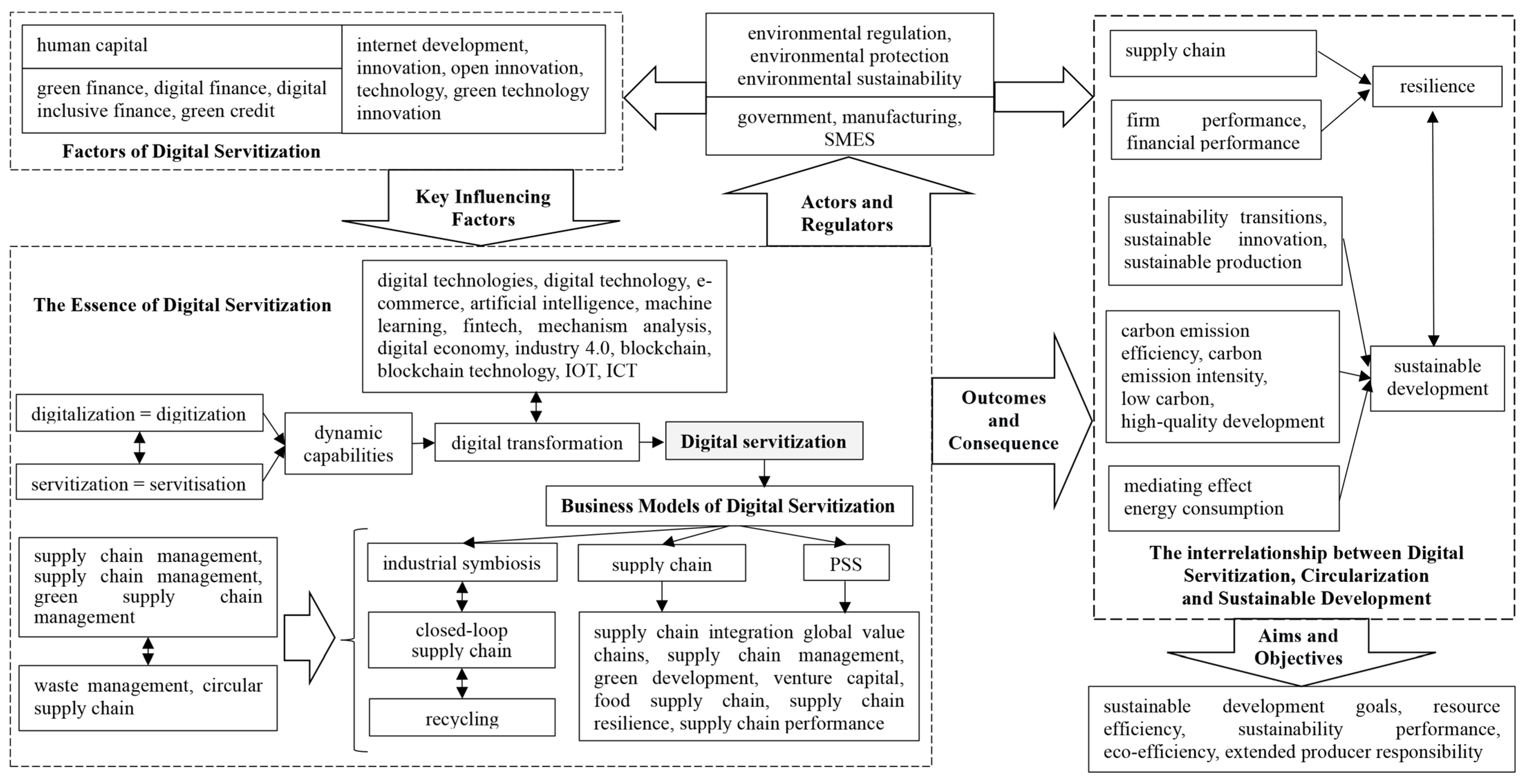
| The Essence of Digital Servitization | digitalization, digitization, servitization, servitisation, digital transformation, industrial symbiosis, waste management | sustainability, environmental sustainability, circular economy, digital economy, Industry 4.0, blockchain, blockchain technology, iot, ict, green innovation, green total factor productivity, internationalization, circular supply chains, sustainable development goals, resource efficiency, sustainability performance |
| Business Models of Digital Servitization | business model innovation, global value chains, dynamic capabilities, smes, PSS, closed-loop supply chain, supply chain management, supply chain integration, recycling, | supply chain management, green development, venture capital, food supply chain, supply chain resilience, supply chain performance, complex network, optimization, performance, remanufacturing, supply chain management, green supply chain management |
| Factors of Digital Servitization | human capital, internet development, innovation, open innovation, technology, green finance, digital finance, digital inclusive finance, green credit, green technology innovation, barriers | digital technologies, digital technology, e-commerce, artificial intelligence, machine learning, fintech, mechanism analysis, innovation performance, corporate green innovation, financing constraints, circular supply chain, eco-efficiency, extended producer responsibility, stakeholder engagement |
| The Interrelationship Between Digital Servitization, Circularization, and Sustainable Development | technological innovation, green technological innovation, manufacturing, manufacturing industry | carbon emission efficiency, carbon emission intensity, supply chain, resilience, firm performance, financial performance, sustainable development, environmental regulation, mediating effect, high-quality development, environmental protection, energy consumption, low carbon, sustainability transitions, sustainable innovation, sustainable production |
Disclaimer/Publisher’s Note: The statements, opinions and data contained in all publications are solely those of the individual author(s) and contributor(s) and not of MDPI and/or the editor(s). MDPI and/or the editor(s) disclaim responsibility for any injury to people or property resulting from any ideas, methods, instructions or products referred to in the content. |
© 2025 by the authors. Licensee MDPI, Basel, Switzerland. This article is an open access article distributed under the terms and conditions of the Creative Commons Attribution (CC BY) license (https://creativecommons.org/licenses/by/4.0/).
Share and Cite
Chernova, O.A.; Nikitaeva, A.Y.; Dolgova, O.I. Developing a Research Ontology of the Digital Servitization of Industry Within the Sustainable Economic Development Context. Sustainability 2025, 17, 10207. https://doi.org/10.3390/su172210207
Chernova OA, Nikitaeva AY, Dolgova OI. Developing a Research Ontology of the Digital Servitization of Industry Within the Sustainable Economic Development Context. Sustainability. 2025; 17(22):10207. https://doi.org/10.3390/su172210207
Chicago/Turabian StyleChernova, Olga A., Anastasia Y. Nikitaeva, and Olga I. Dolgova. 2025. "Developing a Research Ontology of the Digital Servitization of Industry Within the Sustainable Economic Development Context" Sustainability 17, no. 22: 10207. https://doi.org/10.3390/su172210207
APA StyleChernova, O. A., Nikitaeva, A. Y., & Dolgova, O. I. (2025). Developing a Research Ontology of the Digital Servitization of Industry Within the Sustainable Economic Development Context. Sustainability, 17(22), 10207. https://doi.org/10.3390/su172210207