Identification and Assessment of Risk Factors in Green Building Projects: A Multi-Dimensional Approach for Sustainable Infrastructure

 ,
, 
 and
and
Abstract
1. Introduction
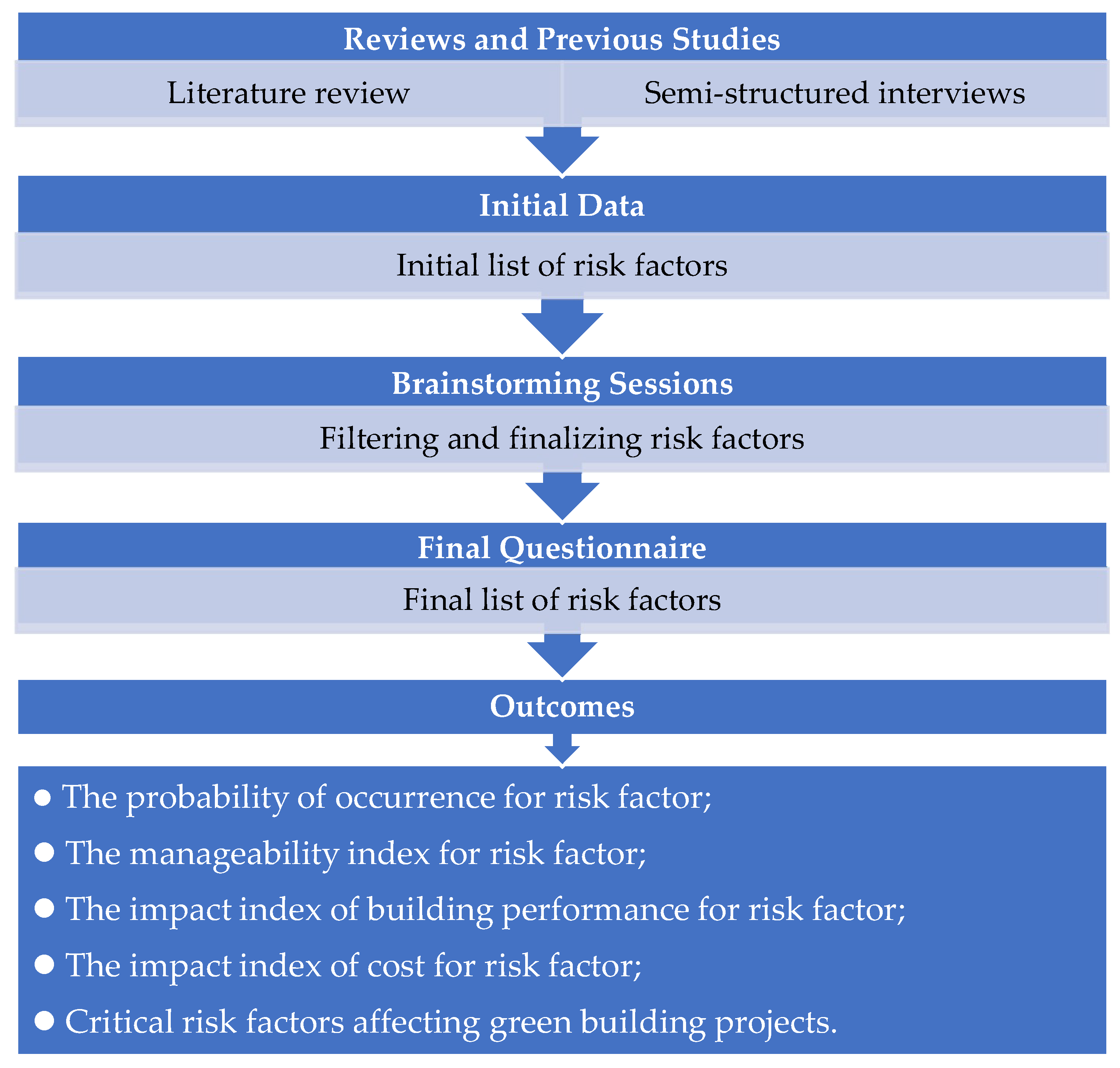
- To determine and classify risk factors in green building projects through an extensive literature review and semi-structured interviews;
- To assess and analyze the identified risk factors in terms of probability of occurrence, manageability, impact on building performance, and impact on cost through field surveys;
- To conduct a qualitative analysis of risk groups and highlight the critical risk factors in each group.
2. Methodology
2.1. Risk Factors Affecting Green Buildings
2.2. Design of Questionnaire Structure
2.3. Circulation of Questionnaire and Response Rates
2.4. Experience of Respondents
2.5. Agreement Analysis
3. Results and Discussion
3.1. Qualitative Analysis for Risk Factors
3.2. Correlation Among Risk Indices
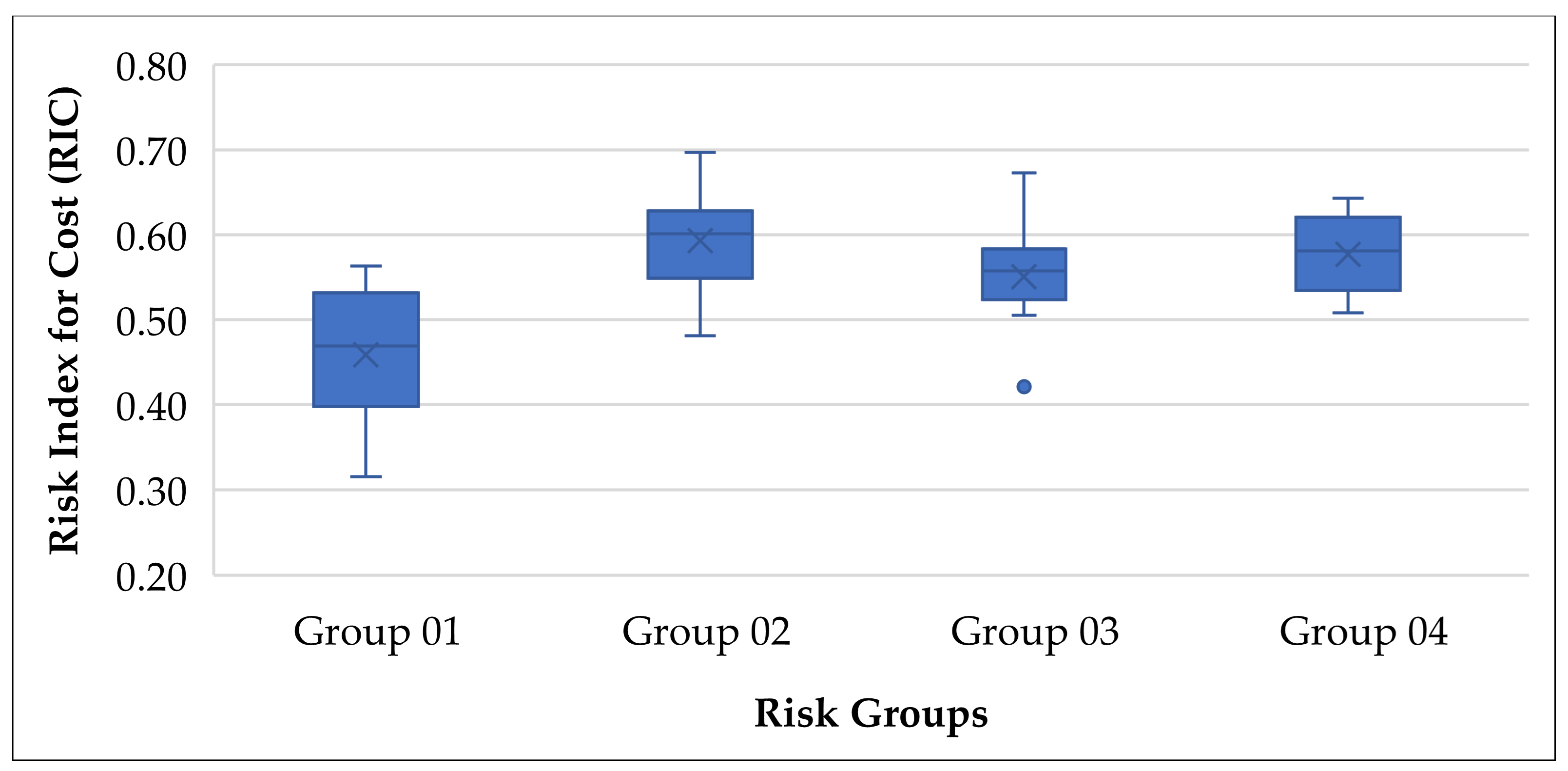
3.3. Boxplot Analysis Based on RIC
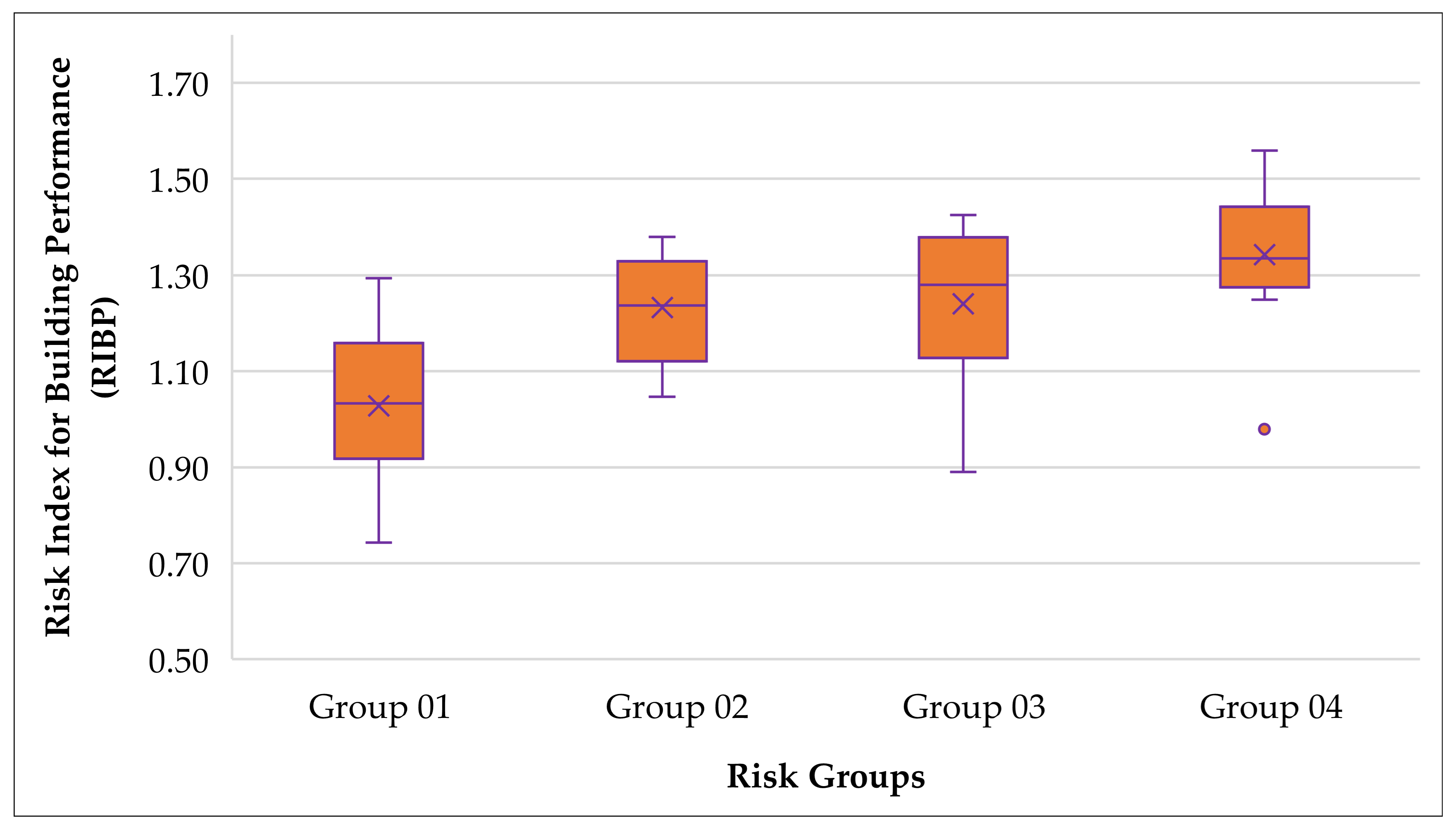
3.4. Boxplot Analysis Based on RIBP
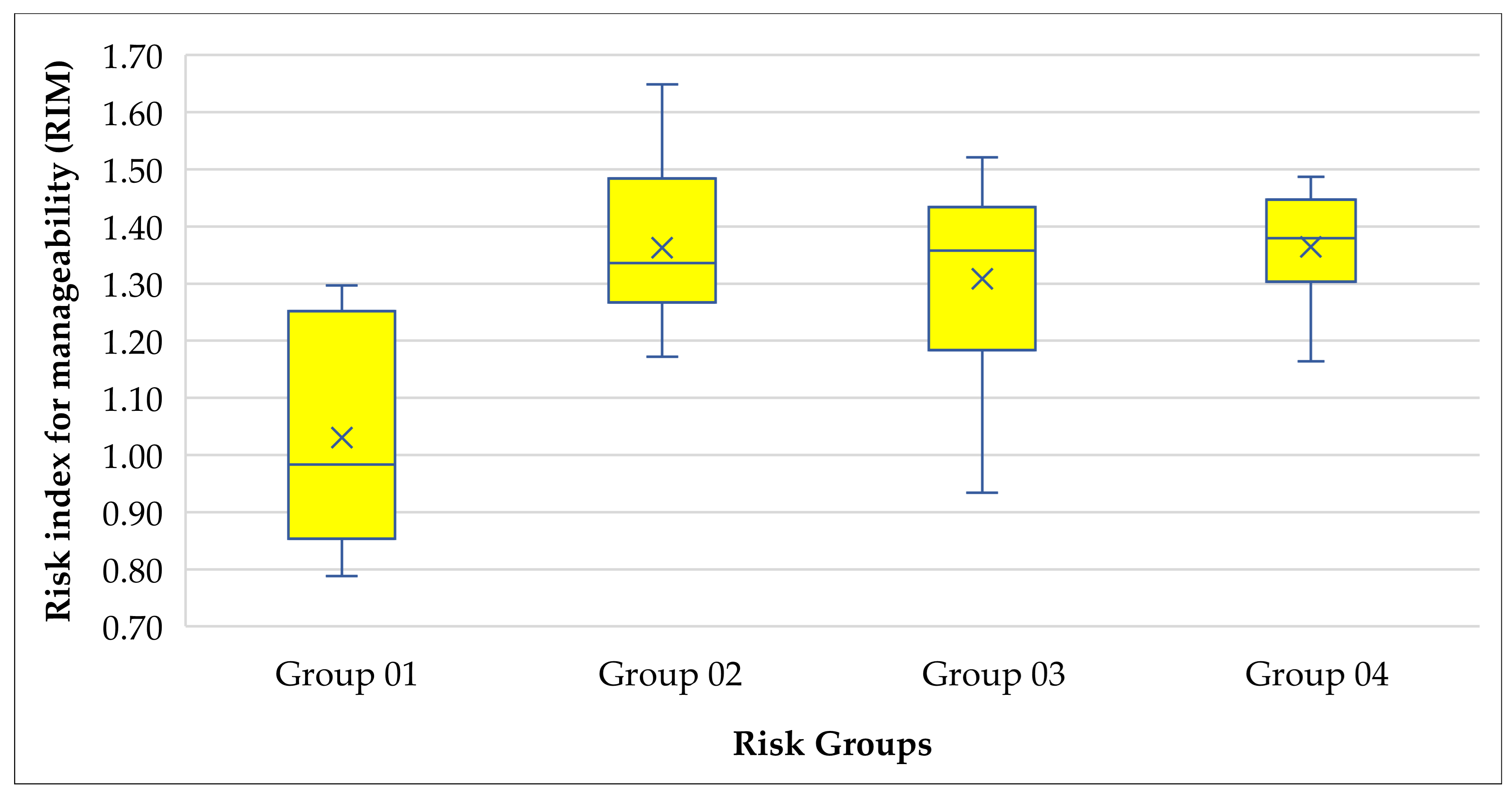
3.5. Boxplot Analysis Based on RIM
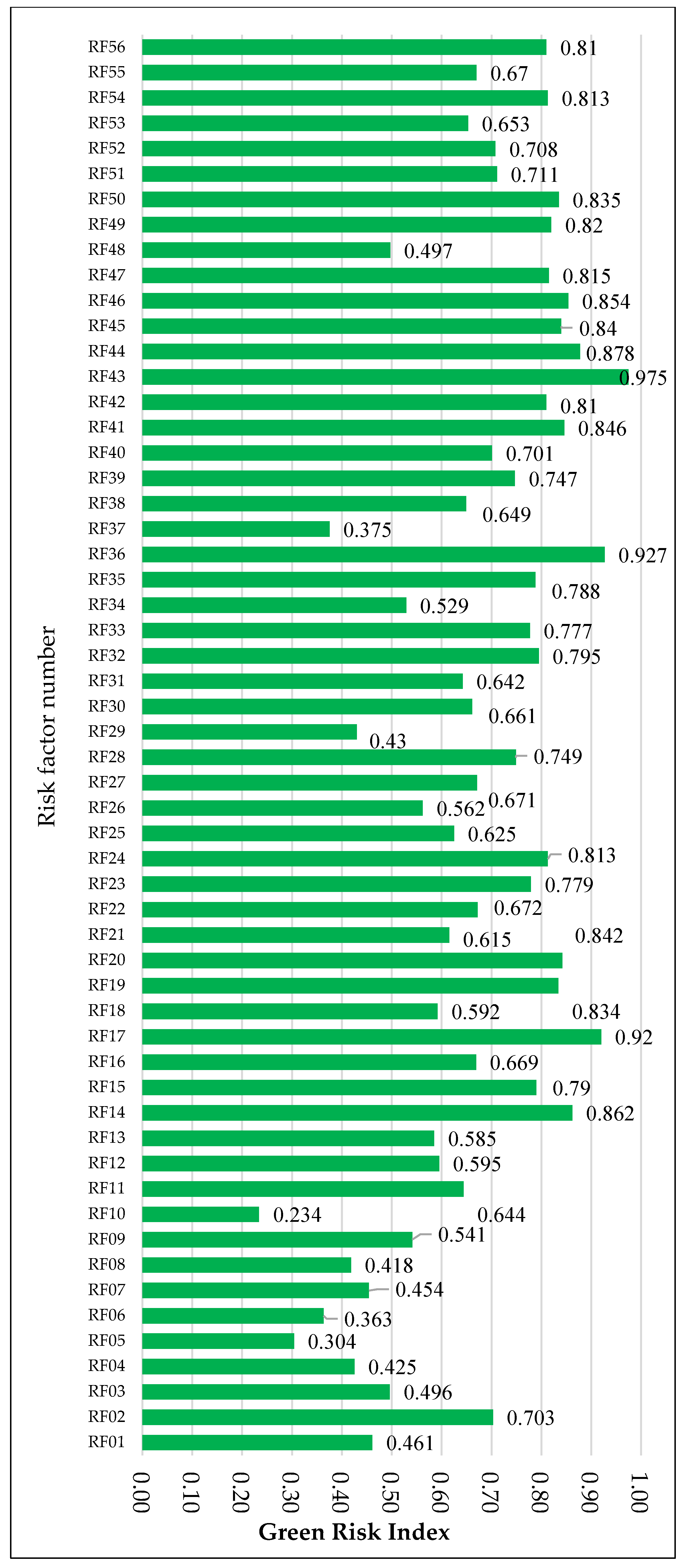
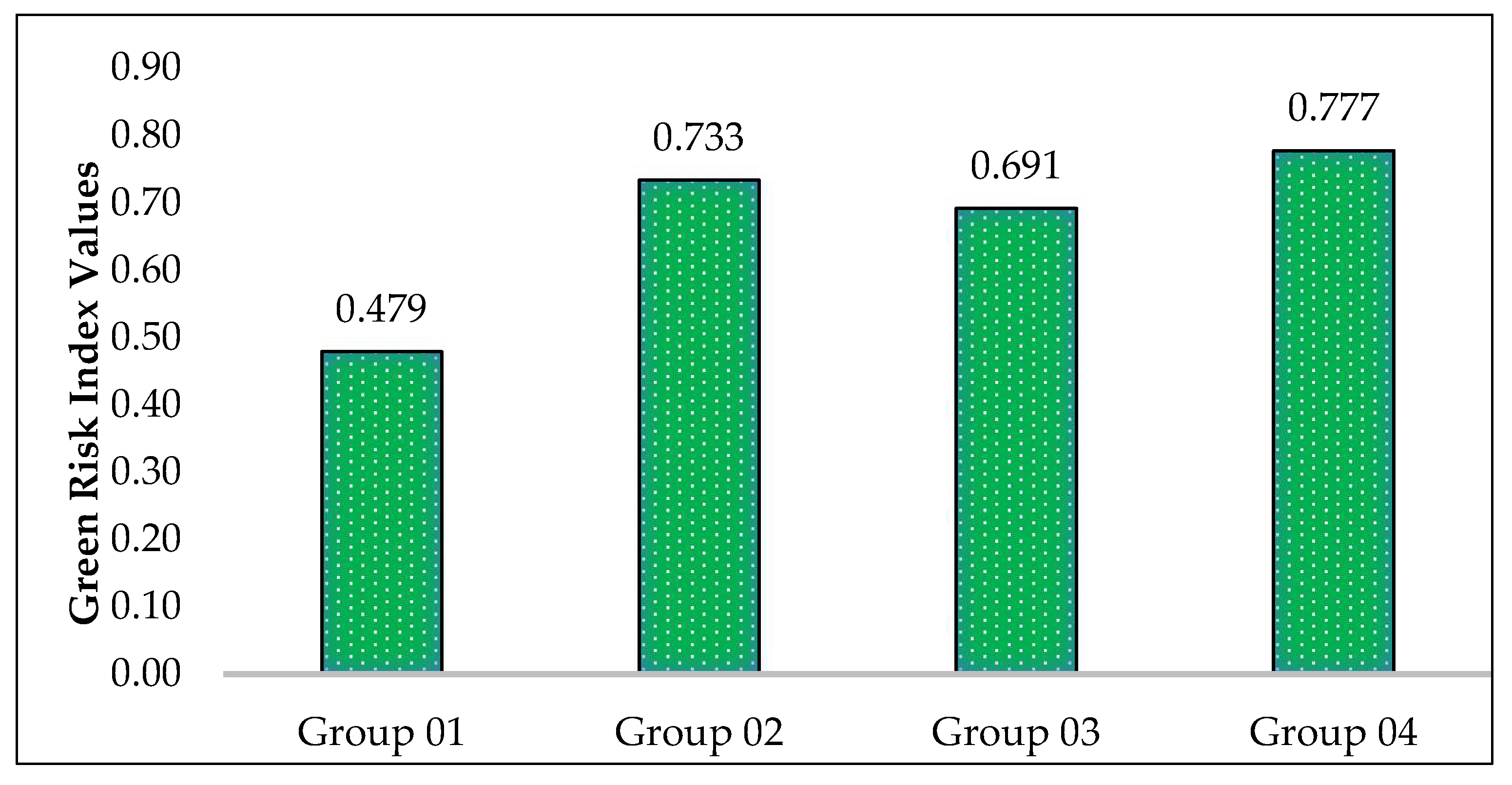
3.6. Analysis Based on Green Risk Index
3.7. Key Risk Factors Affecting Green Building Projects
4. Future Research Directions
5. Conclusions
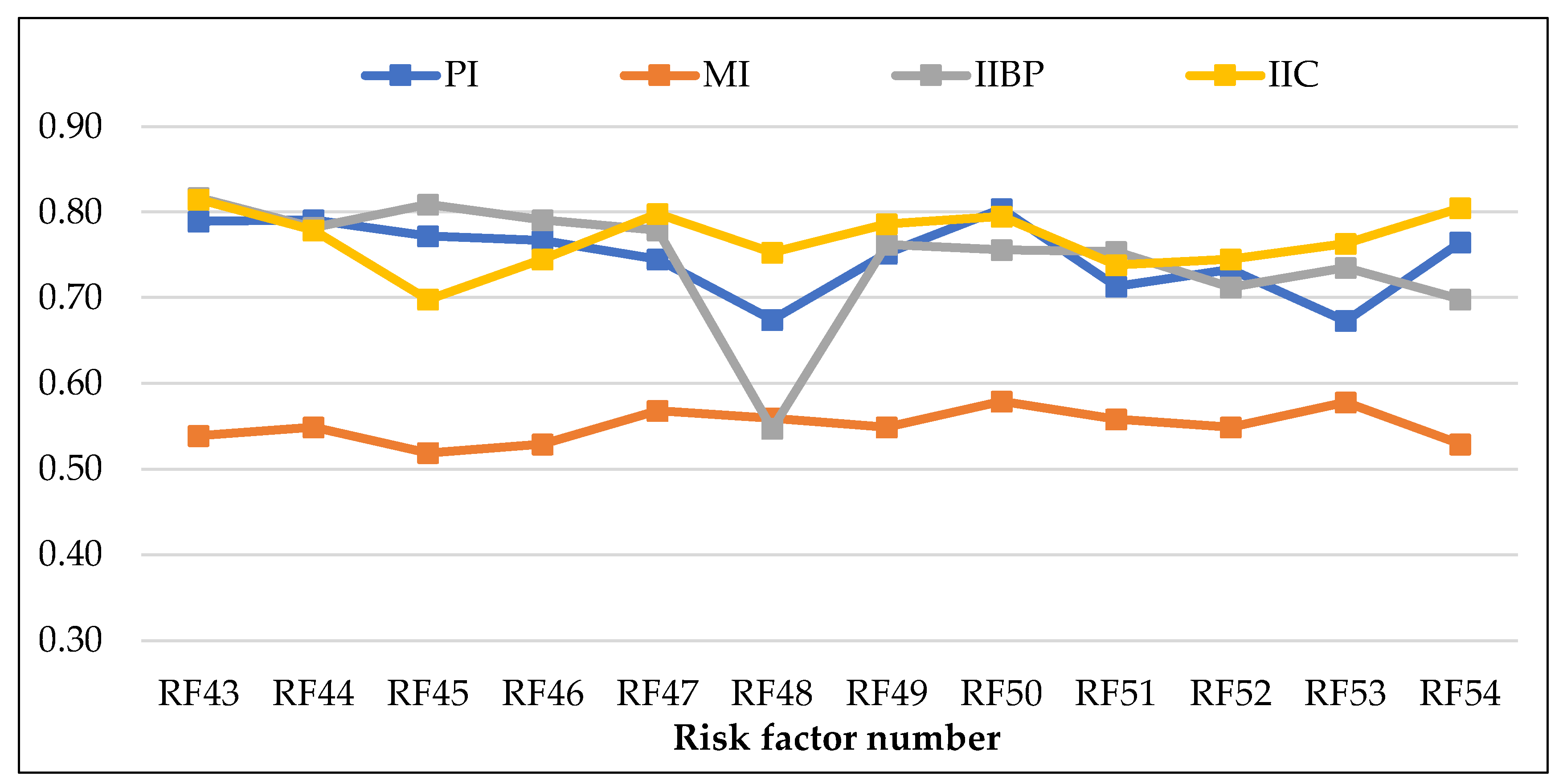
- RF43 “Lack of knowledge about energy-saving procedures and environmental concerns during the design phase”, which belongs to group 04, is considered the most significant risk factor due to it having the highest Green Risk Index and its high risk index values. Additionally, Rf 36 is regarded as a critical risk factor as it occupies the third rank in terms of Risk Index for Cost, and is fourth in terms of Risk Index for Manageability.
- Group 02 (Financial and Economic Risks) and Group 04 (Process and Regulatory Risks) have the maximum number of key risk factors (seven key factors), as well as the highest average weight in terms of Green Risk Index, which signifies that they are considered the most significant group. Group 01 has no factors in the top ten risk factors.
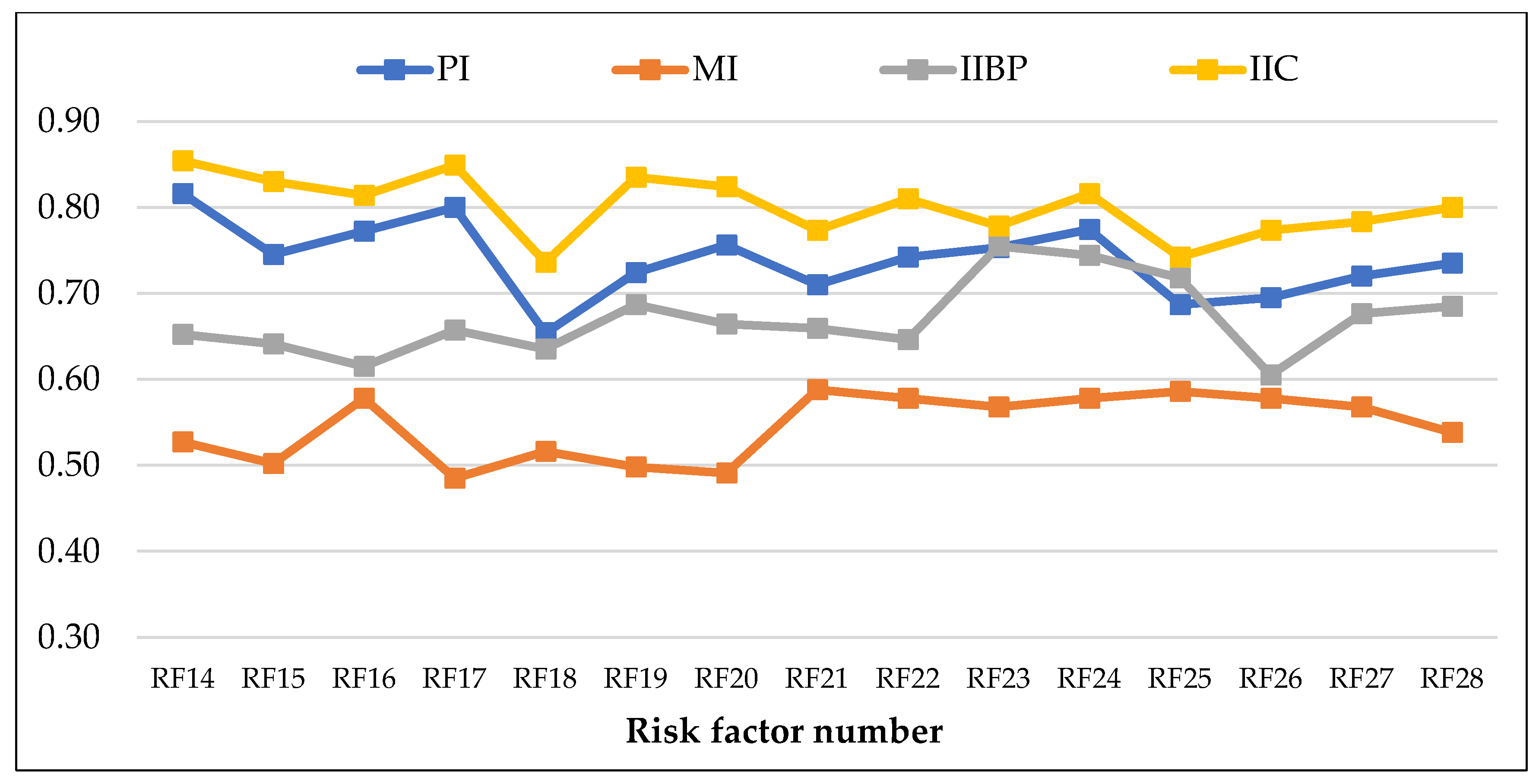
- RF45 “Non-compliance with environmental standards in project design” is considered a critical risk factor, as it has a high impact on building performance but is also difficult to manage. RF14 “High costs of sustainable materials and equipment” has the highest impact on cost and a high probability index. Also, it has been observed that RF17 “Unstable funds from investors” has a high probability, but its manageability is minor.
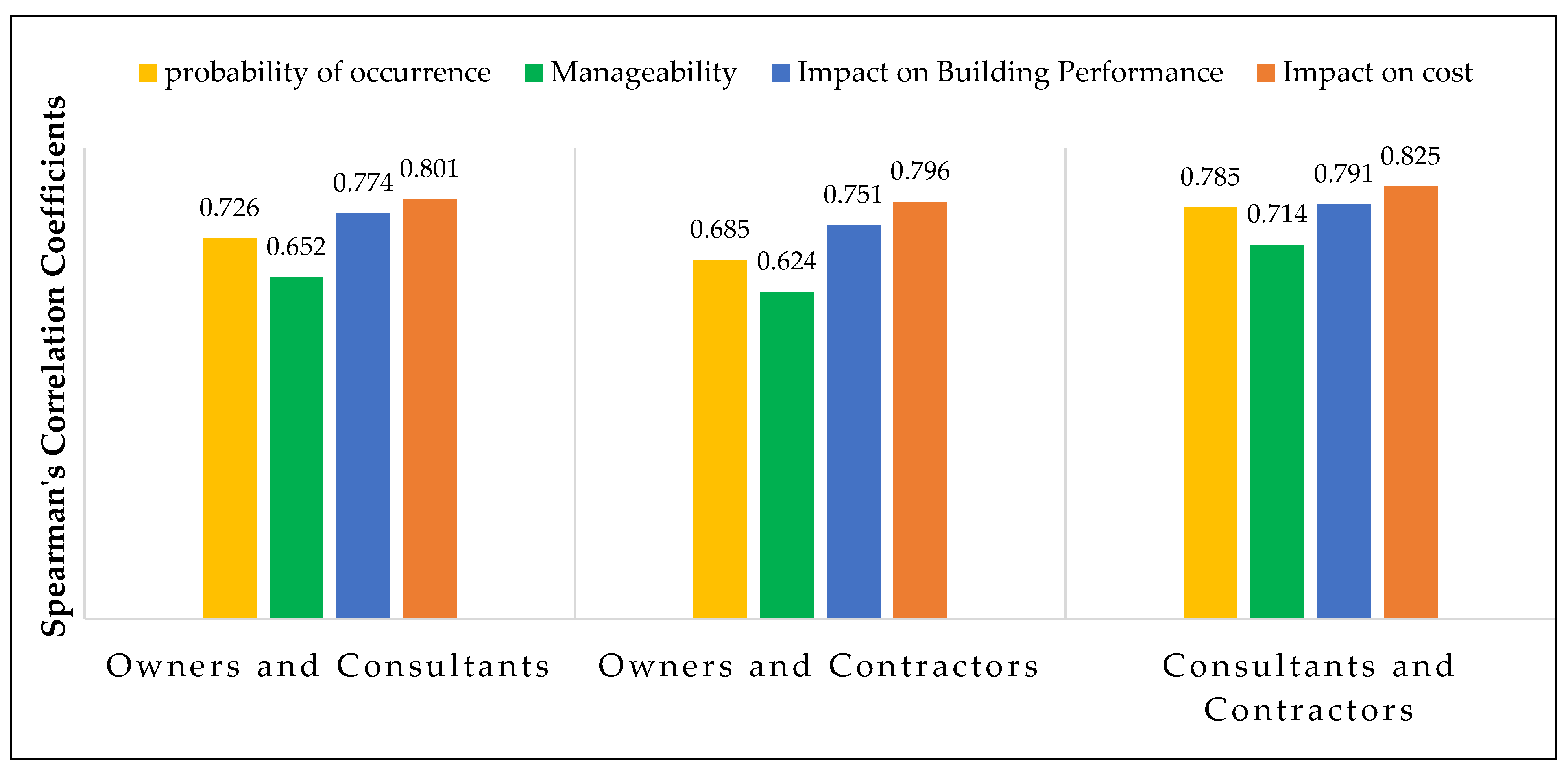
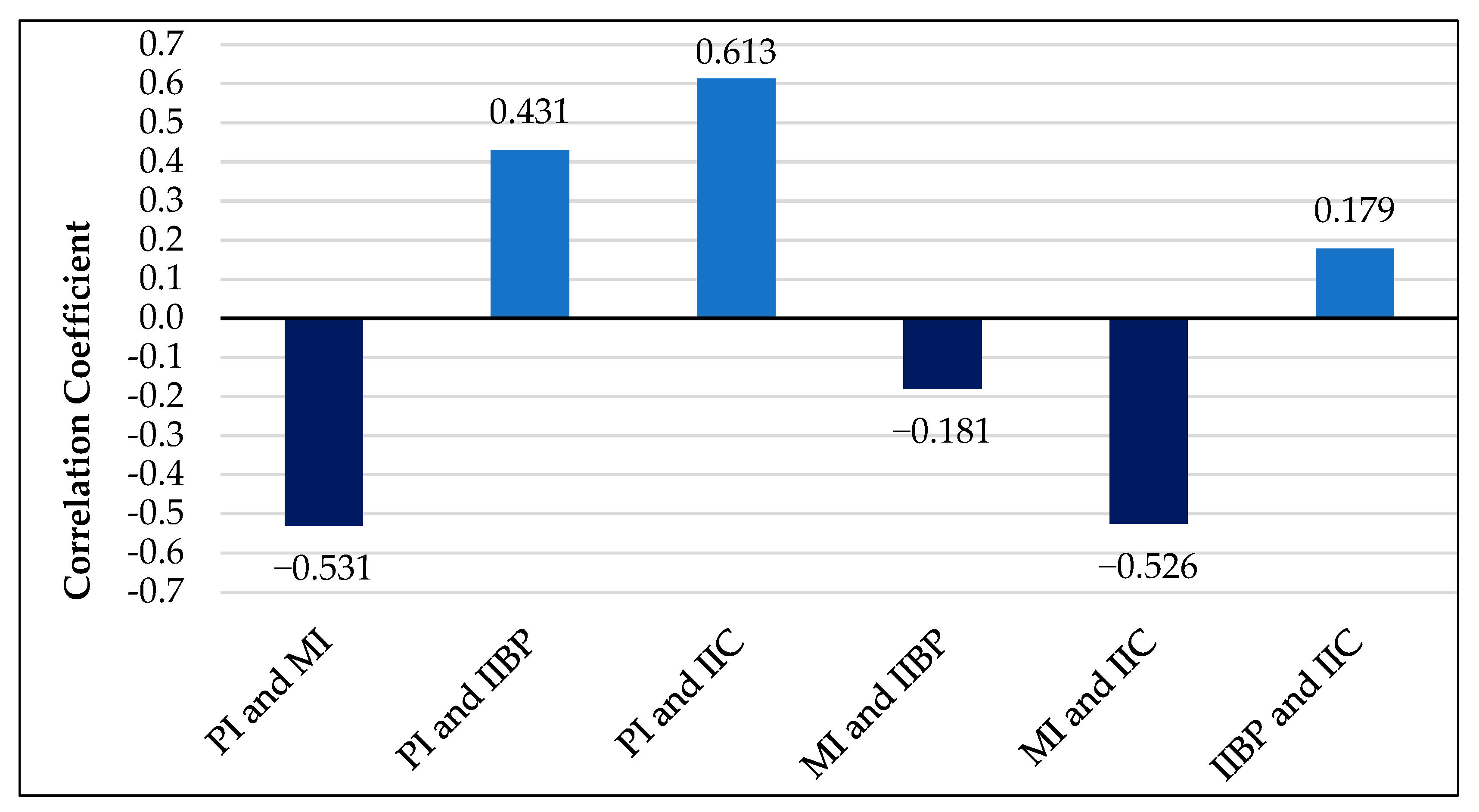
- High correlations between consultants and contractors across the risk indices are observed. The highest correlation is found between the probability and the impact index for cost. There is an adverse relationship between the manageability index and the probability index, followed by the impact index for cost. This research helps project managers, designers, and decision-makers fulfill the accreditation standards of different green building rating systems, enhance sustainable infrastructure resilience, and provide a baseline for embedding risk-aware approaches within broader frameworks, such as NBS.
Author Contributions
Funding
Institutional Review Board Statement
Informed Consent Statement
Data Availability Statement
Acknowledgments
Conflicts of Interest
List of Abbreviations
| GB | green building |
| NBS | nature-based solutions |
| PI | the probability index for a certain risk factor |
| MI | the manageability index for a certain risk factor |
| IIBP | the impact index for building performance for a certain risk factor |
| IIC | the impact index for cost on a certain risk factor |
| RIC | the Risk Index for Cost |
| RIBP | the Risk Index for Building Performance |
| RIM | the Risk Index for Manageability |
| GRI | the Green Risk Index |
References
- Castro-Lacouture, D.; Sefair, J.A.; Flórez, L.; Medaglia, A.L. Optimization model for the selection of materials using a LEED-based green building rating system in Colombia. Build. Environ. 2009, 44, 1162–1170. [Google Scholar] [CrossRef]
- Sandanayake, M.S. Environmental Impacts of Construction in Building Industry—A Review of Knowledge Advances, Gaps and Future Directions. Knowledge 2022, 2, 139–156. [Google Scholar] [CrossRef]
- Kabir, N.; Ali, R.; Islam, A.; Mathin, T.T.; Sarker, M.; Ahmed, M.; Sayeed, M.A. Necessity of green construction for building sustainable environment. World J. Adv. Eng. Technol. Sci. 2024, 13, 372–382. [Google Scholar] [CrossRef]
- Polat, G.; Turkoglu, H.; Gurgun, A.P. Identification of Material-related Risks in Green Buildings. Procedia Eng. 2017, 196, 956–963. [Google Scholar] [CrossRef]
- Wang, C.; Che, Y.; Xia, M.; Lin, C.; Chen, Y.; Li, X.; Chen, H.; Luo, J.; Fan, G. The Evolution and Future Directions of Green Buildings Research: A Scientometric Analysis. Buildings 2024, 14, 345. [Google Scholar] [CrossRef]
- Issa, U.H.; AbdelHaffez, A.G.; Abdel-Hafez, A.A.; Assaf, K.A. Identifying and evaluating causes of waste effect in green building projects. J. Eng. Appl. Sci. 2025, 72, 9. [Google Scholar] [CrossRef]
- Li, F.; Yan, T.; Liu, J.; Lai, Y.; Uthes, S.; Lu, Y.; Long, Y. Research on social and humanistic needs in planning and construction of green buildings. Sustain. Cities Soc. 2014, 12, 102–109. [Google Scholar] [CrossRef]
- Alwisy, A.; BuHamdan, S.; Gül, M. Evidence-based ranking of green building design factors according to leading energy modelling tools. Sustain. Cities Soc. 2019, 47, 101491. [Google Scholar] [CrossRef]
- Liu, T.; Chen, L.; Yang, M.; Sandanayake, M.; Miao, P.; Shi, Y.; Yap, P.-S. Sustainability Considerations of Green Buildings: A Detailed Overview on Current Advancements and Future Considerations. Sustainability 2022, 14, 14393. [Google Scholar] [CrossRef]
- Addy, M.; Adinyira, E.; Danku, J.C.; Dadzoe, F. Impediments to the development of the green building market in sub-Saharan Africa: The case of Ghana. Smart Sustain. Built Environ. 2021, 10, 193–207. [Google Scholar] [CrossRef]
- Balaban, O.; Puppim de Oliveira, J.A. Sustainable buildings for healthier cities: Assessing the co-benefits of green buildings in Japan. J. Clean. Prod. 2017, 163, S68–S78. [Google Scholar] [CrossRef]
- Komurlu, R.; Kalkan Ceceloglu, D.; Arditi, D. Exploring the Barriers to Managing Green Building Construction Projects and Proposed Solutions. Sustainability 2024, 16, 5374. [Google Scholar] [CrossRef]
- Rebelatto, B.G.; Salvia, A.L.; Brandli, L.L.; Leal Filho, W. Examining Energy Efficiency Practices in Office Buildings through the Lens of LEED, BREEAM, and DGNB Certifications. Sustainability 2024, 16, 4345. [Google Scholar] [CrossRef]
- Chantry, W.; Turcu, C. Sustainability power to the people: BREEAM Communities certification and public participation in England. Discov. Sustain. 2024, 5, 371. [Google Scholar] [CrossRef]
- Alves Tenório de Morais, G.; R. S. de M. S. Nascimento, C.; dos Santos, E.B.; M. N. de Souza, K.; Fernandes, B.S.; Palha, R.P. Integration potential between REVIT and LEED: A review. Archit. Eng. Des. Manag. 2024, 20, 510–525. [Google Scholar] [CrossRef]
- El-Sayegh, S.M.; Mansour, M.H. Risk Assessment and Allocation in Highway Construction Projects in the UAE. J. Manag. Eng. 2015, 31, 04015004. [Google Scholar] [CrossRef]
- Cerezo-Narváez, A.; Pastor-Fernández, A.; Otero-Mateo, M.; Ballesteros-Pérez, P. The Influence of Knowledge on Managing Risk for the Success in Complex Construction Projects: The IPMA Approach. Sustainability 2022, 14, 9711. [Google Scholar] [CrossRef]
- Alawneh, R.; Jannoud, I.; Rabayah, H.; Asaad, S.; Almasaeid, H.; Imam, R.; Ghazali, F.E.M. Development of a New Method for Assessing Project Risks in Sustainable Building Construction Projects in Developing Countries: The Case of Jordan. Buildings 2024, 14, 1573. [Google Scholar] [CrossRef]
- Ariska, T.Y.; Mubarak, M.; Husin, S.; Maulina, F.; Mahmuddin, M. Analysis of the risk impact of internal factors on time in building construction projects in Aceh Province. AIP Conf. Proc. 2024, 3082, 030017. [Google Scholar] [CrossRef]
- Monzer, N.; Fayek, A.R.; Lourenzutti, R.; Siraj, N.B. Aggregation-Based Framework for Construction Risk Assessment with Heterogeneous Groups of Experts. J. Constr. Eng. Manag. 2019, 145, 04019003. [Google Scholar] [CrossRef]
- Siraj, N.B.; Fayek, A.R. Risk Identification and Common Risks in Construction: Literature Review and Content Analysis. J. Constr. Eng. Manag. 2019, 145, 03119004. [Google Scholar] [CrossRef]
- Taroun, A. Towards a better modelling and assessment of construction risk: Insights from a literature review. Int. J. Proj. Manag. 2014, 32, 101–115. [Google Scholar] [CrossRef]
- Zou, P.X.W.; Zhang, G.; Wang, J. Understanding the key risks in construction projects in China. Int. J. Proj. Manag. 2007, 25, 601–614. [Google Scholar] [CrossRef]
- Zayed, T.; Amer, M.; Pan, J. Assessing risk and uncertainty inherent in Chinese highway projects using AHP. Int. J. Proj. Manag. 2008, 26, 408–419. [Google Scholar] [CrossRef]
- Koc, K.; Kunkcu, H.; Gurgun, A.P. A Life Cycle Risk Management Framework for Green Building Project Stakeholders. J. Manag. Eng. 2023, 39, 04023022. [Google Scholar] [CrossRef]
- Ma, L.; Wang, L.; Wu, K.-J.; Tseng, M.-L.; Chiu, A.S.F. Exploring the Decisive Risks of Green Development Projects by Adopting Social Network Analysis under Stakeholder Theory. Sustainability 2018, 10, 2104. [Google Scholar] [CrossRef]
- Tawfik Mohamed, N.; Fathi Eid, A.; Mohamed Khodeir, L. Assessing The Impact of Stakeholders’ Interaction on The Efficiency of Managing Risk in Construction Projects A Literature Review. Eng. Res. J. 2022, 173, 299–315. [Google Scholar] [CrossRef]
- Wuni, I.Y.; Bao, Z.; Yevu, S.K.; Tetteh, M.O. Theorizing the path dependencies and hierarchical structure of the multidimensional risks in green building projects. J. Build. Eng. 2023, 68, 106069. [Google Scholar] [CrossRef]
- Gurgun, A.P.; Polat, G.; Bayhan, H.G.; Damci, A. Financial and Economical Risks Impacting Cost of Leed Certified Projects. Proc. Int. Struct. Eng. Constr. 2017, 4. [Google Scholar] [CrossRef]
- Afiq, M.; Nurdiana, A. Analisis Manajemen Risiko pada Pelaksanaan Pembangunan Bangunan Hijau di Kota Semarang. J. Syntax. Admiration 2024, 5, 2322–2329. [Google Scholar] [CrossRef]
- Issa, U.; Sharaky, I.; Alwetaishi, M.; Balabel, A.; Shamseldin, A.; Abdelhafiz, A.; Al-Surf, M.; Al-Harthi, M.; Osman, M.M.A. Developing and applying a model for evaluating risks affecting greening existing buildings. Sustainability 2021, 13, 6403. [Google Scholar] [CrossRef]
- Alshamrani, O.S.D.; Saleem, M.; AlYousif, I.K.; Alluqmani, A. Development of a pre-qualification and selection framework for construction projects’ contractors in Saudi Arabia. J. Asian Archit. Build. Eng. 2023, 22, 1545–1563. [Google Scholar] [CrossRef]
- Sodangi, M.; Salman, A.F.; Saleem, M. Building Information Modeling: Awareness Across the Subcontracting Sector of Saudi Arabian Construction Industry. Arab. J. Sci. Eng. 2018, 43, 1807–1816. [Google Scholar] [CrossRef]
- Zhao, X.; Hwang, B.-G.; Gao, Y. A fuzzy synthetic evaluation approach for risk assessment: A case of Singapore’s green projects. J. Clean. Prod. 2016, 115, 203–213. [Google Scholar] [CrossRef]
- Darko, A.; Chan, A.P.C.; Owusu-Manu, D.-G.; Ameyaw, E.E. Drivers for implementing green building technologies: An international survey of experts. J. Clean. Prod. 2017, 145, 386–394. [Google Scholar] [CrossRef]
- Zhu, Y.; Chen, H.; Ma, J.; Pan, F. Risk Management of Green Building Development: An Application of a Hybrid Machine Learning Approach Towards Sustainability. Sustainability 2025, 17, 6373. [Google Scholar] [CrossRef]
- Nguyen, H.D.; Macchion, L. Risk management in green building: A review of the current state of research and future directions. Environ. Dev. Sustain. 2023, 25, 2136–2172. [Google Scholar] [CrossRef]
- Wang, L.; Chan, D.W.M.; Darko, A.; Oluleye, B.I. A-state-of-the-art review of risk management process of green building projects. J. Build. Eng. 2024, 86, 108738. [Google Scholar] [CrossRef]
- Marzouk, M. Fuzzy Monte Carlo Simulation Optimization Selecting Materials in Green Bulidings. J. Environ. Eng. Landsc. Manag. 2020, 28, 95–104. [Google Scholar] [CrossRef]
- Serrano-Gomez, L.; Munoz-Hernandez, J.I. Monte Carlo approach to fuzzy AHP risk analysis in renewable energy construction projects. PLoS ONE 2019, 14, e0215943. [Google Scholar] [CrossRef] [PubMed]
- Yang, R.J.; Zou, P.X.W.; Wang, J. Modelling stakeholder-associated risk networks in green building projects. Int. J. Proj. Manag. 2016, 34, 66–81. [Google Scholar] [CrossRef]
- Zhang, X.; Shen, L.; Wu, Y. Green strategy for gaining competitive advantage in housing development: A China study. J. Clean. Prod. 2011, 19, 157–167. [Google Scholar] [CrossRef]
- Herath, N.; Vaz-Serra, P.; Hui, F.K.P.; Mendis, P.; Aye, L. Risk Mitigation Measures in Green Building Projects: An Investigation. In ICSBE 2022; Springer: Singapore, 2023; pp. 277–289. [Google Scholar] [CrossRef]
- Darko, A.; Zhang, C.; Chan, A.P.C. Drivers for green building: A review of empirical studies. Habitat. Int. 2017, 60, 34–49. [Google Scholar] [CrossRef]
- Simpeh, E.K.; Smallwood, J.J.; Ahadzie, D.K.; Mensah, H. Analytical taxonomy of challenges to the implementation of green building projects in South Africa. Int. J. Constr. Manag. 2023, 23, 286–296. [Google Scholar] [CrossRef]
- Issa, U.H.; Marouf, K.G.; Faheem, H. Analysis of risk factors affecting the main execution activities of roadways construction projects. J. King Saud. Univ. —Eng. Sci. 2023, 35, 372–383. [Google Scholar] [CrossRef]
- Issa, U.H.; Mosaad, S.A.A.; Salah Hassan, M. Evaluation and selection of construction projects based on risk analysis. Structures 2020, 27, 361–370. [Google Scholar] [CrossRef]
- Hauke, J.; Kossowski, T. Comparison of values of pearson’s and spearman’s correlation coefficients on the same sets of data. Quaest. Geogr. 2011, 30, 87–93. [Google Scholar] [CrossRef]
- Eskander, R.F.A. Risk assessment influencing factors for Arabian construction projects using analytic hierarchy process. Alex. Eng. J. 2018, 57, 4207–4218. [Google Scholar] [CrossRef]
- Thompson, D.L. Data Analysis. Conducting Undergraduate Research in Education; Routledge: New York, NY, USA, 2022; pp. 94–108. [Google Scholar] [CrossRef]
- Ahmed, B.; Das, P.; Banerjee, R.; Singh, S.; Bharti. Data Analytics Methods: Artificial Intelligence for Precision Agriculture; Auerbach Publications: Boca Raton, FL, USA, 2024; pp. 259–269. [Google Scholar] [CrossRef]
- Eid, M.A.; Hu, J.W.; Issa, U. Developing a Model for Analyzing Risks Affecting Machinery Tunnel Execution. Buildings 2023, 13, 1757. [Google Scholar] [CrossRef]
- Xu, S.; Shirowzhan, S.; Sepasgozar, S.M.E. Urban Waste Management and Prediction through Socio-Economic Values and Visualizing the Spatiotemporal Relationship on an Advanced GIS-Based Dashboard. Sustainability 2023, 15, 12208. [Google Scholar] [CrossRef]



| Risk Factors in Green Buildings | |
|---|---|
| NO. | (G01) Stakeholder and Management Risks |
| RF01 | Conflicts of interest among project stakeholders, affecting the implementation of green building projects. |
| RF02 | Lack of green building management experience among stakeholders. |
| RF03 | Miscommunication among stakeholders leads to delays. |
| RF04 | Lack of commitment by project stakeholders to adopt sustainable waste management. |
| RF05 | Misunderstanding of owners’ requirements by the design engineer. |
| RF06 | Poor communication ability of the design team. |
| RF07 | Late involvement of GB consultants in the design process. |
| RF08 | Inappropriate interventions from owners in adopting green ideas. |
| RF09 | Poor communication and coordination among contractors and other parties. |
| RF10 | Differences in cultures and nationalities of workers cause communication problems. |
| RF11 | Insufficient number of workers according to existing work activities. |
| RF12 | Low productivity level of labor. |
| RF13 | Lack of experience among workers in handling materials. |
| (G02) Financial and Economic Risks | |
| RF14 | High costs of sustainable materials and equipment. |
| RF15 | Fluctuation in exchange rates by the import of green materials. |
| RF16 | Lags in cash flow during construction. |
| RF17 | Unstable funds from investors. |
| RF18 | Lack of facilities from the government in the development of green building technology. |
| RF19 | Unforeseen changes in market conditions affecting project costs. |
| RF20 | Lack of financial incentives for adopting green technologies. |
| RF21 | Poor budget allocation for maintenance and operations post-construction. |
| RF22 | Delays due to disputes over payment terms among stakeholders. |
| RF23 | Insufficient funds allocated for training staff on green building technologies. |
| RF24 | Costs incurred due to rework and defects during construction. |
| RF25 | Losses due to damaged or wasted materials. |
| RF26 | Increased insurance premiums for green building projects. |
| RF27 | Over-reliance on high-cost imported materials. |
| RF28 | Sudden increases in energy costs affecting operational budgets. |
| (G03) Technological and Resource Risks | |
| RF29 | Lack of reliable and available GBT research and education. |
| RF30 | Complexity and rigid requirements involved in adopting GBTs. |
| RF31 | Insufficient construction experience in new technologies, materials, and equipment. |
| RF32 | Risks and uncertainties involved in implementing new technologies. |
| RF33 | Unstable performance of new green materials/equipment. |
| RF34 | Lack of procedures for safely handling construction materials. |
| RF35 | Green materials cannot be supplied to the site on time, especially for those not easily available locally. |
| RF36 | Green material wastes due to poor design or execution. |
| RF37 | Misuse of modern equipment by workers. |
| RF38 | Low productivity or efficiency of equipment due to improper operation. |
| RF39 | Lack of training on the use of advanced technologies. |
| RF40 | Unreliable suppliers for advanced materials and technologies. |
| RF41 | Equipment malfunctions leading to delays. |
| RF42 | Difficulty integrating new technologies with traditional methods. |
| (G04) Process and Regulatory Risks | |
| RF43 | Lack of knowledge about energy-saving procedures and environmental concerns during the design phase. |
| RF44 | Lack of systematic planning toward the application of green buildings. |
| RF45 | Non-compliance with environmental standards in project design. |
| RF46 | Slow approval processes due to sustainable specifications. |
| RF47 | Insufficient site investigation leading to design flaws. |
| RF48 | Lack of clear and adequate project documentation. |
| RF49 | Ineffective quality management procedures. |
| RF50 | Inadequate information in drawings and project documents. |
| RF51 | Poor identification of the logical relationship between project activities. |
| RF52 | Lack of reliable simulation tools to support decision-making. |
| RF53 | Delays due to accidents during material transportation. |
| RF54 | Lack of adequate regulatory frameworks for green buildings. |
| RF55 | Delays caused by unclear roles in process implementation. |
| RF56 | Frequent design changes requested by regulatory bodies. |
| Linguistic Variables | Very Low | Low | Medium | High | Very High |
|---|---|---|---|---|---|
| Percentage | 0% to 10% | 10% to 30% | 30% to 50% | 50% to 70% | 70% to 90% |
| Assigned Weight | 0.10 | 0.30 | 0.50 | 0.70 | 0.90 |
| Participants | Owner | Consultant | Contractor | Total |
|---|---|---|---|---|
| Questionnaire Distributed | 39 | 45 | 53 | 137 |
| Responses Received | 27 | 33 | 42 | 102 |
| Response Rate | 69.23% | 73.33% | 79.24% | 74.5% |
| Percentage | 26.47% | 32.35% | 41.18% | 100% |
| NO. | RIC | RIBP | RIM | Rank Due to RIC | Rank Due to RIBP | Rank Due to RIM |
|---|---|---|---|---|---|---|
| RF01 | 0.469 | 0.984 | 0.856 | 48 | 50 | 53 |
| RF02 | 0.544 | 1.294 | 1.280 | 33 | 21 | 33 |
| RF03 | 0.494 | 1.004 | 0.983 | 46 | 47 | 49 |
| RF04 | 0.391 | 1.087 | 0.850 | 54 | 43 | 54 |
| RF05 | 0.346 | 0.876 | 0.850 | 55 | 54 | 55 |
| RF06 | 0.455 | 0.798 | 0.975 | 49 | 55 | 50 |
| RF07 | 0.415 | 1.093 | 0.935 | 52 | 42 | 51 |
| RF08 | 0.405 | 1.033 | 1.007 | 53 | 46 | 48 |
| RF09 | 0.563 | 0.960 | 1.064 | 26 | 52 | 47 |
| RF10 | 0.315 | 0.743 | 0.788 | 56 | 56 | 56 |
| RF11 | 0.550 | 1.171 | 1.292 | 29 | 38 | 31 |
| RF12 | 0.519 | 1.147 | 1.297 | 40 | 39 | 30 |
| RF13 | 0.499 | 1.173 | 1.223 | 45 | 36 | 37 |
| RF14 | 0.697 | 1.237 | 1.548 | 1 | 32 | 2 |
| RF15 | 0.618 | 1.277 | 1.484 | 11 | 24 | 7 |
| RF16 | 0.628 | 1.064 | 1.336 | 9 | 44 | 24 |
| RF17 | 0.679 | 1.355 | 1.649 | 2 | 12 | 1 |
| RF18 | 0.481 | 1.231 | 1.267 | 47 | 33 | 36 |
| RF19 | 0.605 | 1.380 | 1.454 | 15 | 9 | 10 |
| RF20 | 0.623 | 1.352 | 1.540 | 10 | 13 | 3 |
| RF21 | 0.549 | 1.121 | 1.207 | 30 | 40 | 38 |
| RF22 | 0.601 | 1.118 | 1.284 | 16 | 41 | 32 |
| RF23 | 0.586 | 1.329 | 1.326 | 20 | 16 | 26 |
| RF24 | 0.632 | 1.287 | 1.339 | 7 | 23 | 23 |
| RF25 | 0.510 | 1.225 | 1.172 | 42 | 34 | 43 |
| RF26 | 0.537 | 1.047 | 1.202 | 35 | 45 | 40 |
| RF27 | 0.564 | 1.190 | 1.268 | 25 | 35 | 35 |
| RF28 | 0.588 | 1.273 | 1.366 | 19 | 26 | 20 |
| RF29 | 0.434 | 0.991 | 1.188 | 50 | 49 | 42 |
| RF30 | 0.531 | 1.244 | 1.353 | 37 | 31 | 22 |
| RF31 | 0.505 | 1.272 | 1.132 | 44 | 27 | 46 |
| RF32 | 0.574 | 1.385 | 1.378 | 21 | 8 | 18 |
| RF33 | 0.548 | 1.417 | 1.299 | 31 | 6 | 29 |
| RF34 | 0.530 | 0.998 | 1.171 | 38 | 48 | 44 |
| RF35 | 0.612 | 1.288 | 1.456 | 14 | 22 | 9 |
| RF36 | 0.673 | 1.377 | 1.521 | 3 | 10 | 4 |
| RF37 | 0.421 | 0.890 | 0.934 | 51 | 53 | 52 |
| RF38 | 0.555 | 1.171 | 1.192 | 28 | 37 | 41 |
| RF39 | 0.570 | 1.312 | 1.363 | 23 | 18 | 21 |
| RF40 | 0.560 | 1.250 | 1.395 | 27 | 29 | 16 |
| RF41 | 0.629 | 1.346 | 1.511 | 8 | 15 | 5 |
| RF42 | 0.569 | 1.425 | 1.427 | 24 | 4 | 15 |
| RF43 | 0.643 | 1.516 | 1.464 | 4 | 2 | 8 |
| RF44 | 0.616 | 1.424 | 1.441 | 12 | 5 | 13 |
| RF45 | 0.539 | 1.559 | 1.487 | 34 | 1 | 6 |
| RF46 | 0.571 | 1.495 | 1.450 | 22 | 3 | 11 |
| RF47 | 0.595 | 1.371 | 1.312 | 17 | 11 | 28 |
| RF48 | 0.508 | 0.979 | 1.206 | 43 | 51 | 39 |
| RF49 | 0.591 | 1.388 | 1.370 | 18 | 7 | 19 |
| RF50 | 0.639 | 1.306 | 1.389 | 5 | 19 | 17 |
| RF51 | 0.526 | 1.351 | 1.278 | 39 | 14 | 34 |
| RF52 | 0.546 | 1.297 | 1.335 | 32 | 20 | 25 |
| RF53 | 0.513 | 1.272 | 1.164 | 41 | 28 | 45 |
| RF54 | 0.616 | 1.319 | 1.446 | 13 | 17 | 12 |
| RF55 | 0.537 | 1.249 | 1.321 | 36 | 30 | 27 |
| RF56 | 0.635 | 1.276 | 1.438 | 6 | 25 | 14 |
| Rank | RIC | RF No. | Group | RIBP | RF No. | Group | RIM | RF No. | Group |
|---|---|---|---|---|---|---|---|---|---|
| 1 | 0.697 | RF14 | Group02 | 1.559 | RF45 | Group04 | 1.649 | RF17 | Group02 |
| 2 | 0.679 | RF17 | Group02 | 1.516 | RF43 | Group04 | 1.548 | RF14 | Group02 |
| 3 | 0.673 | RF36 | Group03 | 1.495 | RF46 | Group04 | 1.54 | RF20 | Group02 |
| 4 | 0.643 | RF43 | Group04 | 1.425 | RF42 | Group03 | 1.521 | RF36 | Group03 |
| 5 | 0.639 | RF50 | Group04 | 1.424 | RF44 | Group04 | 1.511 | RF41 | Group03 |
| 6 | 0.635 | RF56 | Group04 | 1.417 | RF33 | Group03 | 1.487 | RF45 | Group04 |
| 7 | 0.632 | RF24 | Group02 | 1.388 | RF49 | Group04 | 1.484 | RF15 | Group02 |
| 8 | 0.629 | RF41 | Group03 | 1.385 | RF32 | Group03 | 1.464 | RF43 | Group04 |
| 9 | 0.628 | RF16 | Group02 | 1.38 | RF19 | Group02 | 1.456 | RF35 | Group03 |
| 10 | 0.623 | RF20 | Group02 | 1.377 | RF36 | Group03 | 1.454 | RF19 | Group02 |
Disclaimer/Publisher’s Note: The statements, opinions and data contained in all publications are solely those of the individual author(s) and contributor(s) and not of MDPI and/or the editor(s). MDPI and/or the editor(s) disclaim responsibility for any injury to people or property resulting from any ideas, methods, instructions or products referred to in the content. |
© 2025 by the authors. Licensee MDPI, Basel, Switzerland. This article is an open access article distributed under the terms and conditions of the Creative Commons Attribution (CC BY) license (https://creativecommons.org/licenses/by/4.0/).
Share and Cite
AbdelHaffez, A.G.; Kaloop, M.R.; Eldessouki, M.; Issa, U.H. Identification and Assessment of Risk Factors in Green Building Projects: A Multi-Dimensional Approach for Sustainable Infrastructure. Sustainability 2025, 17, 10178. https://doi.org/10.3390/su172210178
AbdelHaffez AG, Kaloop MR, Eldessouki M, Issa UH. Identification and Assessment of Risk Factors in Green Building Projects: A Multi-Dimensional Approach for Sustainable Infrastructure. Sustainability. 2025; 17(22):10178. https://doi.org/10.3390/su172210178
Chicago/Turabian StyleAbdelHaffez, Ahmed Gamal, Mosbeh R. Kaloop, Mohamed Eldessouki, and Usama Hamed Issa. 2025. "Identification and Assessment of Risk Factors in Green Building Projects: A Multi-Dimensional Approach for Sustainable Infrastructure" Sustainability 17, no. 22: 10178. https://doi.org/10.3390/su172210178
APA StyleAbdelHaffez, A. G., Kaloop, M. R., Eldessouki, M., & Issa, U. H. (2025). Identification and Assessment of Risk Factors in Green Building Projects: A Multi-Dimensional Approach for Sustainable Infrastructure. Sustainability, 17(22), 10178. https://doi.org/10.3390/su172210178