




Is the Concept of a 15-Minute City Feasible in a Medium-Sized City? Spatial Analysis of the Accessibility of Municipal Services in Koszalin (Poland) Using Gis Modelling

 ,
,  ,
,  , , , ,
  ,
,  , and
, and
Abstract
1. Introduction
2. Literature Review
2.1. The 15 min City Concept
- the type and severity of impairment (including the need to use crutches, canes, wheelchairs, or walkers); route continuity and step-free design (ramps instead of stairs, lowered curbs, absence of level changes) [22];
- permissible longitudinal and cross slopes of sidewalks; surface quality and evenness; the minimum effective clear width free of obstacles (bollards, signage, parked vehicles) [23];
- the presence of tactile and visual wayfinding elements (e.g., attention fields, guiding strips, high-contrast markings) [24];
- the parameters of pedestrian crossings (green time calibrated to lower walking speeds, acoustic signals, and refuge islands).
- is based on the principle of proximity to key destinations,
- takes advantage of appropriate urban density,
- promotes both social (software diversity) and functional (hardware diversity) diversity,
- incorporates digital technologies into the management and functioning of the city,
- is designed on a human scale, which means creating public spaces focused on people’s needs rather than cars,
- ensures cohesive connectivity between neighbourhoods to avoid their isolation and fragmentation,
- introduces spatial flexibility, understood as the ability of spaces to change their functions over time, depending on residents’ needs [10].
2.2. Spatial Accessibility Models in Urban Planning
- Opportunity or cumulative-opportunity models: These measure the number of available destinations (e.g., schools, parks) within a defined travel cost (time or distance), such as a 15 min walking time isochrone. They are easy to implement in GIS, but are sensitive to the arbitrary selection of spatial thresholds [44];
- Space syntax and spatial network models: These focus on topological connectivity, analysing street integration (including pedestrian paths) and spatial visibility (isovists, axial lines). Such models support the analysis of pedestrian flow potential and social interaction [45];
- Hybrid and multilevel models: Accessibility models vary in complexity, accuracy, and purpose, ranging from simple isochrone maps to gravity-based hybrid models and multi-criteria analyses of spatial structures.
3. Methodology
3.1. Case Study Overview
3.2. Methodological Approach
- Geocoding addresses UUG GUGiK—the plugin geocodes a CSV file of addresses for Poland. It uses the UUG GUGiK web service.
- GeoCoding—it allows the user to search for an address and obtain its coordinates (geocoding) using GeoCoding using Nominatim (version: 5.1.0) and Google web services.
- mmqgis—plugins for manipulating vector map layers: CSV input/output/join, geocoding, geometry conversion, buffering, hub analysis, simplification, column modification, and simple animation.
- BDOT10k_GML_SHP—imports BDOT10k shapefiles or GML files.
- QuickOSM—download OSM data owing to the Overpass API.
- Processing—spatial data processing framework for QGIS.
4. Results
4.1. Identification of Service-Deficient Areas in Koszalin
4.2. Accessibility as a Defining Element of Mobility Space on the Example of Koszalin
5. Conclusions and Discussion
- Improved air quality and reduced greenhouse gas emissions;
- Lower noise levels and reduced burden on road infrastructure;
- Increased traffic safety;
- Higher levels of physical activity and improved public health;
- Revitalisation of public spaces and support for the local economy;
- The development of more cohesive, accessible, and inclusive communities and urban structures.
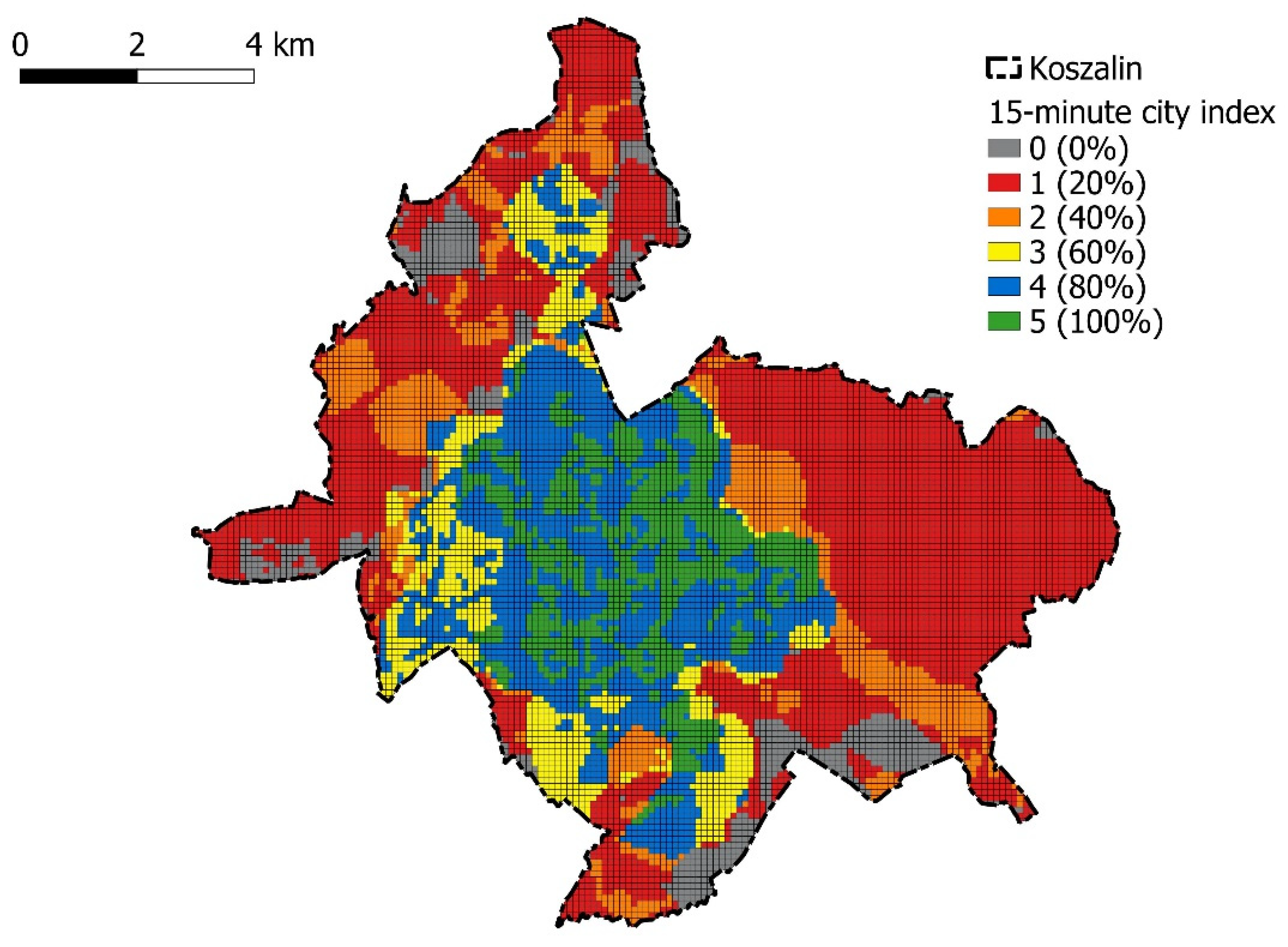
- Peripheral areas that, despite access to individual services, do not offer a complete set of urban functions, (primarily areas marked in grey and red in Figure 3).
- Zones with limited access to complementary services, such as, e.g., healthcare and education, which restrict residents’ ability to meet daily needs locally (mainly areas marked in orange and yellow in Figure 3).
- Areas with dispersed development, where the lack of service concentration and insufficient pedestrian-oriented infrastructure reduces the effective catchment of 15 min walking access around service locations.
- Mixed-use development and infill within existing neighbourhoods identified as having low walkable access to basic services, co-locating housing, retail, and public services.
- Adaptive reuse of underutilised buildings for essential community functions (e.g., health centres, dental clinics, childcare, grocery stores), thereby increasing service availability in underserved areas while reducing costs and advancing circular-economy objectives.
- Development of continuous pedestrian and cycling corridors linking residential clusters with key local destinations (schools, shops, parks); improvements in network quality will expand the effective 15 min walking and cycling catchments.
- Establishment of local service hubs in areas with the lowest accessibility to ensure equitable access to everyday amenities within a single walking trip.
- Strengthening public–private partnerships to deliver community-oriented services where public provision is limited, particularly in education and healthcare.
Author Contributions
Funding
Institutional Review Board Statement
Informed Consent Statement
Data Availability Statement
Conflicts of Interest
Abbreviations
| GIS | Geographic Information System |
| MaaS | Mobility as a Service |
References
- Creutzig, F.; Niamir, L.; Bai, X.; Callaghan, M.; Cullen, J.; Díaz-José, J.; Figueroa, M.; Grubler, A.; Lamb, W.F.; Leip, A.; et al. Demand-Side Solutions to Climate Change Mitigation Consistent with High Levels of Well-Being. Nat. Clim. Change 2022, 12, 36–46. [Google Scholar] [CrossRef]
- Aboagye, P.D.; Sharifi, A. Urban Climate Adaptation and Mitigation Action Plans: A Critical Review. Renew. Sustain. Energy Rev. 2024, 189, 113886. [Google Scholar] [CrossRef]
- Purvis, B.; Mao, Y.; Robinson, D. Three Pillars of Sustainability: In Search of Conceptual Origins. Sustain. Sci. 2019, 14, 681–695. [Google Scholar] [CrossRef]
- Peterson, K.O. Sustainability and Sustainable Development Research around the World. Manag. Glob. Transit. 2022, 20, 1–29. [Google Scholar]
- Ruggerio, C.A. Sustainability and Sustainable Development: A Review of Principles and Definitions. Sci. Total Environ. 2021, 786, 147481. [Google Scholar] [CrossRef]
- Weng, M.; Ding, N.; Li, J.; Jin, X.; Xiao, H.; He, Z.; Su, S. The 15-Minute Walkable Neighborhoods: Measurement, Social Inequalities and Implications for Building Healthy Communities in Urban China. J. Transp. Health 2019, 13, 259–273. [Google Scholar] [CrossRef]
- Teixeira, J.F.; Silva, C.; Seisenberger, S.; Büttner, B.; McCormick, B.; Papa, E.; Cao, M. Classifying 15-Minute Cities: A Review of Worldwide Practices. Transp. Res. Part A Policy Pract. 2024, 189, 104234. [Google Scholar] [CrossRef]
- Abdelfattah, L.; Deponte, D.; Fossa, G. The 15-Minute City: Interpreting the Model to Bring out Urban Resiliencies. Transp. Res. Procedia 2022, 60, 330–337. [Google Scholar] [CrossRef]
- Kierzka, A. Strategia Rozwoju Koszalina, #Koszalin2030; Urząd Miejski w Koszalinie: Koszalin, Poland, 2021.
- Gmina Miasto Koszalin. Strategii Rozwoju Ponadlokalnego dla Koszalińsko-Kołobrzesko-Białogardzkiego Obszaru Funkcjonalnego na lata 2021–2030; Gmina Miasto Koszalin: Koszalin, Poland, 2023.
- Annunziata, A.; Beniamino, M. Unveiling the 15 Minute Anti-City: Exploring Spatial Injustice in the Context of Urban E-Planning. In Recent Advances and Prospects in Urban E-Planning; Silva, C.N., Ed.; IGI Global Scientific Publishing: Hershey, PA, USA, 2025; pp. 323–348. [Google Scholar]
- Giannoulaki, M.; Christoforou, Z. Pedestrian Walking Speed Analysis: A Systematic Review. Sustainability 2024, 16, 4813. [Google Scholar] [CrossRef]
- Eggenberger, P.; Tomovic, S.; Münzer, T.; De Bruin, E.D. Older Adults Must Hurry at Pedestrian Lights! A Cross-Sectional Analysis of Preferred and Fast Walking Speed under Single- and Dual-Task Conditions. PLoS ONE 2017, 12, e0182180. [Google Scholar] [CrossRef]
- Finnis, K.K.; Walton, D. Field Observations of Factors Influencing Walking Speeds. In Proceedings of the 2nd International Conference on Sustainability Engineering and Science, Auckland, New Zealand, 21–23 February 2007; 13p. [Google Scholar]
- Franěk, M.; Režný, L. Environmental Features Influence Walking Speed: The Effect of Urban Greenery. Land 2021, 10, 459. [Google Scholar] [CrossRef]
- Khavarian-Garmsir, A.R.; Sharifi, A.; Sadeghi, A. The 15-Minute City: Urban Planning and Design Efforts toward Creating Sustainable Neighborhoods. Cities 2023, 132, 104101. [Google Scholar] [CrossRef]
- Allam, Z.; Khavarian-Garmsir, A.R.; Lassaube, U.; Chabaud, D.; Moreno, C. Mapping the Implementation Practices of the 15-Minute City. Smart Cities 2024, 7, 2094–2109. [Google Scholar] [CrossRef]
- Papadopoulos, E.; Sdoukopoulos, A.; Politis, I. Measuring Compliance with the 15-Minute City Concept: State-of-the-Art, Major Components and Further Requirements. Sustain. Cities Soc. 2023, 99, 104875. [Google Scholar] [CrossRef]
- Papas, T.; Basbas, S.; Campisi, T. Urban Mobility Evolution and the 15-Minute City Model: From Holistic to Bottom-up Approach. Transp. Res. Procedia 2023, 69, 544–551. [Google Scholar] [CrossRef]
- Risser, R.; Haindl, G.; Ståhl, A. Barriers to Senior Citizens’ Outdoor Mobility in Europe. Eur. J. Ageing 2010, 7, 69–80. [Google Scholar] [CrossRef] [PubMed]
- Aigner-Walder, B.; Döring, T. Reduced Consumption for Transport Due to Population Ageing? An Analysis of Expenditures of Private Households in the European Union and Potential Implications for the Public Sector. Cent. Eur. Public Adm. Rev. 2017, 15, 167–190. [Google Scholar] [CrossRef]
- Eisenberg, Y.; Hofstra, A.; Berquist, S.; Gould, R.; Jones, R. Barrier-Removal Plans and Pedestrian Infrastructure Equity for People with Disabilities. Transp. Res. D Transp. Environ. 2022, 109, 103356. [Google Scholar] [CrossRef]
- Gamache, S.; Routhier, F.; Morales, E.; Vandersmissen, M.H.; Boucher, N. Mapping Review of Accessible Pedestrian Infrastructures for Individuals with Physical Disabilities. Disabil. Rehabil. Assist. Technol. 2019, 14, 410–422. [Google Scholar] [CrossRef]
- Bentzen, B.L.; Scott, A.C.; Barlow, J.M.; Emerson, R.W.; Graham, J. Guidance Surface to Help Vision-Disabled Pedestrians Locate Crosswalks and Align to Cross. Transp. Res. Rec. 2022, 2676, 645–655. [Google Scholar] [CrossRef]
- Moreno, C.; Allam, Z.; Chabaud, D.; Gall, C.; Pratlong, F. Introducing the “15-Minute City”: Sustainability, Resilience and Place Identity in Future Post-Pandemic Cities. Smart Cities 2021, 4, 93–111. [Google Scholar] [CrossRef]
- Mobaraki, O. The 15-Minute City: A Paradigm for Urban Planning and Policy. Sustain. Earth Rev. 2023, 2, 2022–2031. [Google Scholar]
- Balletto, G.; Ladu, M.; Milesi, A.; Borruso, G. A Methodological Approach on Disused Public Properties in the 15-Minute City Perspective. Sustainability 2021, 13, 593. [Google Scholar] [CrossRef]
- Sodiq, A.; Baloch, A.A.B.; Khan, S.A.; Sezer, N.; Mahmoud, S.; Jama, M.; Abdelaal, A. Towards Modern Sustainable Cities: Review of Sustainability Principles and Trends. J. Clean. Prod. 2019, 227, 972–1001. [Google Scholar] [CrossRef]
- Ziafati Bafarasat, A.; Sharifi, A. How to Achieve a Healthy City: A Scoping Review with Ten City Examples. J. Urban Health 2024, 101, 120–140. [Google Scholar] [CrossRef]
- Burton, E. The Compact City: Just or Just Compact? A Preliminary Analysis. Urban Stud. 2000, 37, 1969–2001. [Google Scholar] [CrossRef]
- Yari, A.; Mashallahi, A.; Aghababaeian, H.; Nouri, M.; Yadav, N.; Mousavi, A.; Salehi, S.; Ostadtaghizadeh, A. Definition and Characteristics of Climate-Adaptive Cities: A Systematic Review. BMC Public Health 2024, 24, 1200. [Google Scholar] [CrossRef]
- Breuste, J. The Green City: General Concept BT. In Making Green Cities: Concepts, Challenges and Practice; Breuste, J., Artmann, M., Ioja, C., Qureshi, S., Eds.; Springer International Publishing: Cham, Switzerland, 2023; pp. 3–18. ISBN 978-3-030-73089-5. [Google Scholar]
- Camero, A.; Alba, E. Smart City and Information Technology: A Review. Cities 2019, 93, 84–94. [Google Scholar] [CrossRef]
- Patel, R.; Nosal, L. Defining the Resilient City; United Nations University Centre for Policy Research: New York, NY, USA, 2016. [Google Scholar]
- Gehl, J. Cities for People; Island Press: Washington, DC, USA, 2010. [Google Scholar]
- Southworth, M. Designing the Walkable City. J. Urban Plan. Dev. 2005, 131, 246–257. [Google Scholar] [CrossRef]
- Elldér, E. Exploring Socio-Economic Inequalities in Access to the 15-Minute City across 200 Swedish Built-up Areas. J. Transp. Geogr. 2025, 122, 104060. [Google Scholar] [CrossRef]
- Casarin, G.; MacLeavy, J.; Manley, D. Rethinking Urban Utopianism: The Fallacy of Social Mix in the 15-Minute City. Urban Stud. 2023, 60, 3167–3186. [Google Scholar] [CrossRef]
- Mouratidis, K. Time to Challenge the 15-Minute City: Seven Pitfalls for Sustainability, Equity, Livability, and Spatial Analysis. Cities 2024, 153, 105274. [Google Scholar] [CrossRef]
- Zan, C.; Bhatia, R.; Samant, S. Reimagining the High-Density, Vertical 15-Minute City. Buildings 2025, 15, 1629. [Google Scholar] [CrossRef]
- Guzman, L.A.; Oviedo, D.; Cantillo-Garcia, V.A. Is Proximity Enough? A Critical Analysis of a 15-Minute City Considering Individual Perceptions. Cities 2024, 148, 104882. [Google Scholar] [CrossRef]
- Pozoukidou, G.; Chatziyiannaki, Z. 15-Minute City: Decomposing the New Urban Planning Eutopia. Sustainability 2021, 13, 928. [Google Scholar] [CrossRef]
- Rode, P.; da Cruz, N.F. Governing Urban Accessibility: Moving beyond Transport and Mobility. Appl. Mobilities 2018, 3, 8–33. [Google Scholar] [CrossRef]
- Fotheringham, A.S. Some Theoretical Aspects of Destination Choice and Their Relevance to Production-Constrained Gravity Models. Environ. Plan. A 1983, 15, 1121–1132. [Google Scholar] [CrossRef]
- van Nes, A.; Yamu, C. Introduction to Space Syntax in Urban Studies; Springer Nature: London, UK, 2021; ISBN 9783030591403. [Google Scholar]
- Lee, J.; Miller, H.J. Analyzing Collective Accessibility Using Average Space-Time Prisms. Transp. Res. D Transp. Environ. 2019, 69, 250–264. [Google Scholar] [CrossRef]
- Baja, Z. Problem Izochron Polski. Przegląd Komun. 1948, 2, 55–63. [Google Scholar]
- Urząd Miejski w Koszalinie. Raport o Stanie Miasta Koszalina Za 2024 Rok. Available online: https://bip.koszalin.pl/artykul/169/15005/raport-o-stanie-miasta-koszalina-za-2024-rok (accessed on 7 May 2025).
- Urząd Miejski w Koszalinie. Studium Uwarunkowań i Kierunków Zagospodarowania Przestrzennego Miasta Koszalina Ze Zmianami; Koszalin Centrum Pomorza: Koszalin, Poland, 2014.
- Central Statistical Office of Poland. Local Data Bank—Central Statistical Office of Poland. Available online: https://bdl.stat.gov.pl/bdl (accessed on 5 February 2025).
- Birch, C.P.D.; Oom, S.P.; Beecham, J.A. Rectangular and Hexagonal Grids Used for Observation, Experiment and Simulation in Ecology. Ecol. Model. 2007, 206, 347–359. [Google Scholar] [CrossRef]
- Indradjati, P.N. Walking Choice in Medium-Sized and Small Cities: The Case of Bandung and Yogyakarta, Indonesia. Int. Rev. Spat. Plan. Sustain. Dev. 2024, 12, 139–160. [Google Scholar] [CrossRef]
- Pinto, B.G.; Chamusca, P. The 15-Minute City in Portugal: Reality, Aspiration, or Utopia? Urban Sci. 2025, 9, 330. [Google Scholar] [CrossRef]
- Graells-Garrido, E.; Serra-Burriel, F.; Rowe, F.; Cucchietti, F.M.; Reyes, P. A City of Cities: Measuring How 15-Minutes Urban Accessibility Shapes Human Mobility in Barcelona. PLoS ONE 2021, 16, e0250080. [Google Scholar] [CrossRef] [PubMed]
- Aristizábal, J.E.; Sarache, W.; Escobar, D.A. Spatial Regression Model of Urban Walkability Under the 15-Minute City Approach. Geoj. Tour. Geosites 2023, 49, 1037–1045. [Google Scholar] [CrossRef]
- Ferrer-Ortiz, C.; Marquet, O.; Mojica, L.; Vich, G. Barcelona under the 15-Minute City Lens: Mapping the Accessibility and Proximity Potential Based on Pedestrian Travel Times. Smart Cities 2022, 5, 146–161. [Google Scholar] [CrossRef]
- Bartzokas-Tsiompras, A.; Bakogiannis, E. Quantifying and Visualizing the 15-Minute Walkable City Concept across Europe: A Multicriteria Approach. J. Maps 2023, 19, 2141143. [Google Scholar] [CrossRef]
- Barbieri, L.; D’Autilia, R.; Marrone, P.; Montella, I. Graph Representation of the 15-Minute City: A Comparison between Rome, London, and Paris. Sustainability 2023, 15, 3772. [Google Scholar] [CrossRef]
- Wang, J.; Kwan, M.P.; Xiu, G.; Deng, F. A Robust Method for Evaluating the Potentials of 15-Minute Cities: Implications for Sustainable Urban Futures. Geogr. Sustain. 2024, 5, 597–606. [Google Scholar] [CrossRef]
- Elldér, E. Built Environment and the Evolution of the “15-Minute City”: A 25-Year Longitudinal Study of 200 Swedish Cities. Cities 2024, 149, 104942. [Google Scholar] [CrossRef]
- Zymek, M.; Korczak, J.; Janiszewska, D. Economic Perspective of Transport Accessibility: A Qualitative Analysis of Koszalin, Poland. In Proceedings of the 39th International Business Information Management Association Conference [IBIMA Conference] (39th IBIMA), Granada, Spain, 30–31 May 2022. [Google Scholar]
- Bosch-Checa, C.; Lorenzo-Sáez, E.; de la Haza, M.J.P.; Lerma-Arce, V.; Coll-Aliaga, E. Evaluation of the Accessibility to Urban Mobility Services with High Spatial Resolution—Case Study: Valencia (Spain). Appl. Sci. 2025, 15, 1382. [Google Scholar] [CrossRef]
- Soldatke, N.; Sydorów, M.; Żukowska, S. Assessment of the Accessibility of Public Transport in the Tricity (Poland): Analytical Use of Geographical Information Systems (GIS) in the Context of Selected Public Transport Measures. Int. J. Digit. Earth 2024, 17, 2344586. [Google Scholar] [CrossRef]
- Soni, N.; Soni, N. Benefits of Pedestrianization and Warrants to Pedestrianize an Area. Land Use Policy 2016, 57, 139–150. [Google Scholar] [CrossRef]
- Dhanani, A.; Tarkhanyan, L.; Vaughan, L. Estimating Pedestrian Demand for Active Transport Evaluation and Planning. Transp. Res. Part A Policy Pract. 2017, 103, 54–69. [Google Scholar] [CrossRef]
- Hahm, Y.; Yoon, H.; Choi, Y. The Effect of Built Environments on the Walking and Shopping Behaviors of Pedestrians; A Study with GPS Experiment in Sinchon Retail District in Seoul, South Korea. Cities 2019, 89, 1–13. [Google Scholar] [CrossRef]
- Arellana, J.; Saltarin, M.; Larranaga, A.M.; Alvarez, V.; Botero, C.A.H. Urban Walkability Considering Pedestrians’ Perceptions of the Built Environment: A 10-Year Review and a Case Study in a Medium-Sized City in Latin America. Transp. Rev. 2020, 40, 183–203. [Google Scholar] [CrossRef]
- Wolek, M.; Suchanek, M.; Czuba, T. Factors Influencing Walking Trips. Evidence from Gdynia, Poland. PLoS ONE 2021, 16, e0254949. [Google Scholar] [CrossRef]
- Korzeniewski, W. Normatyw Urbanistyczny i Mieszkaniowy; Centralny Ośrodek Informacji Budownictwa: Warszawa, Poland, 1974. [Google Scholar]
- Sejm Rzeczypospolitej Polskiej. Ustawa z Dnia 7 Lipca 1994 r. o Zagospodarowaniu Przestrzennym (Dz.U. 1994 Nr 89, Poz. 415); SEJM: Warszawa, Poland, 1994.

| Concept | Connection with the 15 min City |
|---|---|
| Sustainable city | The 15 min city proposes a spatial organisation in which all essential services are accessible within a short walk or bike ride. This supports emissions reduction and promotes sustainable mobility. In doing so, it aligns with the idea of a sustainable city that emphasises ecological urban solutions, social integration, and efficient resource use [28]. |
| Healthy city | The 15 min city promotes proximity to services, green areas, and recreational spaces, which fosters daily physical activity, reduces emissions, and strengthens social bonds [29]. These are also key components of the healthy city model, which focuses on creating environments that support physical, mental, and social well-being. |
| Compact city | Both concepts promote the concentration of urban functions, mixed land use, and multifunctional urban spaces [30]. They aim to allow residents to meet daily needs within proximity to their homes, minimising the need for long commutes and reliance on private cars. |
| Climate adaptive city | Both concepts share a vision of creating urban environments that are human-centred and responsive to climate challenges [31]. Through local accessibility, greenery, and emissions reduction, the 15 min city enhances not only the quality of life but also resilience to extreme weather events, such as heatwaves and heavy rainfall, which is crucial for climate adaptation. |
| Green city | Both approaches envision cities that are people-friendly and environmentally responsive. The 15 min city, through its emphasis on local services, green areas, and emissions reduction, contributes to climate resilience and aligns well with the idea of a green city focused on nature, low emissions, and sustainable development [32]. |
| Smart city | The two concepts are connected by a shared goal of creating healthy, inclusive, and sustainable urban spaces. The 15 min city encourages proximity-based living and reduced emissions, which supports the smart city vision of integrating technology, ecological lifestyles, and efficient urban systems [33]. |
| Resilient city | Both concepts are closely aligned in their pursuit of sustainable, flexible, and self-sufficient urban structures. They focus on locality, functional diversity, and the proximity of essential services, all of which enhance a city’s capacity to adapt to and recover from crises [34]. The presence of short travel distances, well-developed pedestrian and cycling infrastructure, and strong local communities contributes to making the city both more resilient and more “15-min”. |
| Liveable city | Both concepts underline easy access to essential services (education, healthcare, retail, recreation), safe and inclusive public spaces, active mobility, a healthy urban environment (clean air, green areas), and a balance between residential, service, and recreational functions [35]. |
| Walkable city | The 15 min city and the walkable city share the fundamental principle that daily life should take place within close reach and in an environment designed for pedestrians [36]. By ensuring proximity to services, high-quality public spaces, and limiting car traffic, the 15 min city effectively implements the walkable city idea in practice. |
| Feature | Unit | Year | Value |
|---|---|---|---|
| Population density | Inhabitants/km2 | 2024 | 1069 |
| Share of population in the post-labour age | % | 2024 | 28 |
| Rate of unemployment | % | 2024 | 4.7 |
| Supply of public transport per capita | Vehicle-kilometres per inhabitant | 2024 | 30.3 |
| Individual motorisation rate | Cars/1000 inhabitants | 2024 | 620 |
| Share of green areas and forests | % | 2024 | 44.5 |
| Density of cycling lanes | kms/km2 | 2023 | 1.14 |
| Source | Description |
|---|---|
| https://www.koszalin.pl (accessed on 2 April 2025) | Official website of the City of Koszalin; source for addresses and metadata on municipal public facilities. |
| https://okazjum.pl (accessed on 2 April 2025) | Retail store-locator aggregator; used to verify the presence and addresses of grocery outlets. |
| https://www.kuratorium.szczecin.pl (accessed on 2 April 2025) | Regional Board of Education (West Pomeranian Voivodeship); directory of schools and their addresses. |
| https://mzk.koszalin.pl (accessed on 2 April 2025) | Municipal public transportation operator; source for locating transit stops. |
| Google Maps, https://maps.google.com/ (accessed on 7 May 2025) | Used for geocoding and checking facility locations. |
| Database of Topographic Objects (BDOT10k) | Poland’s national 1:10,000 topographic database provides administrative boundaries, points of interest, and green areas. |
| OpenStreetMap, https://www.openstreetmap.org/ (accessed on 9 April 2025) | Community-maintained geospatial database; used for points of interest, the communication network (roads and pedestrian), the green areas. |
| Type of Service | Number of Facilities | Area [km2] | City Area [%] | City Area (Excl. Forests) [%] | |
|---|---|---|---|---|---|
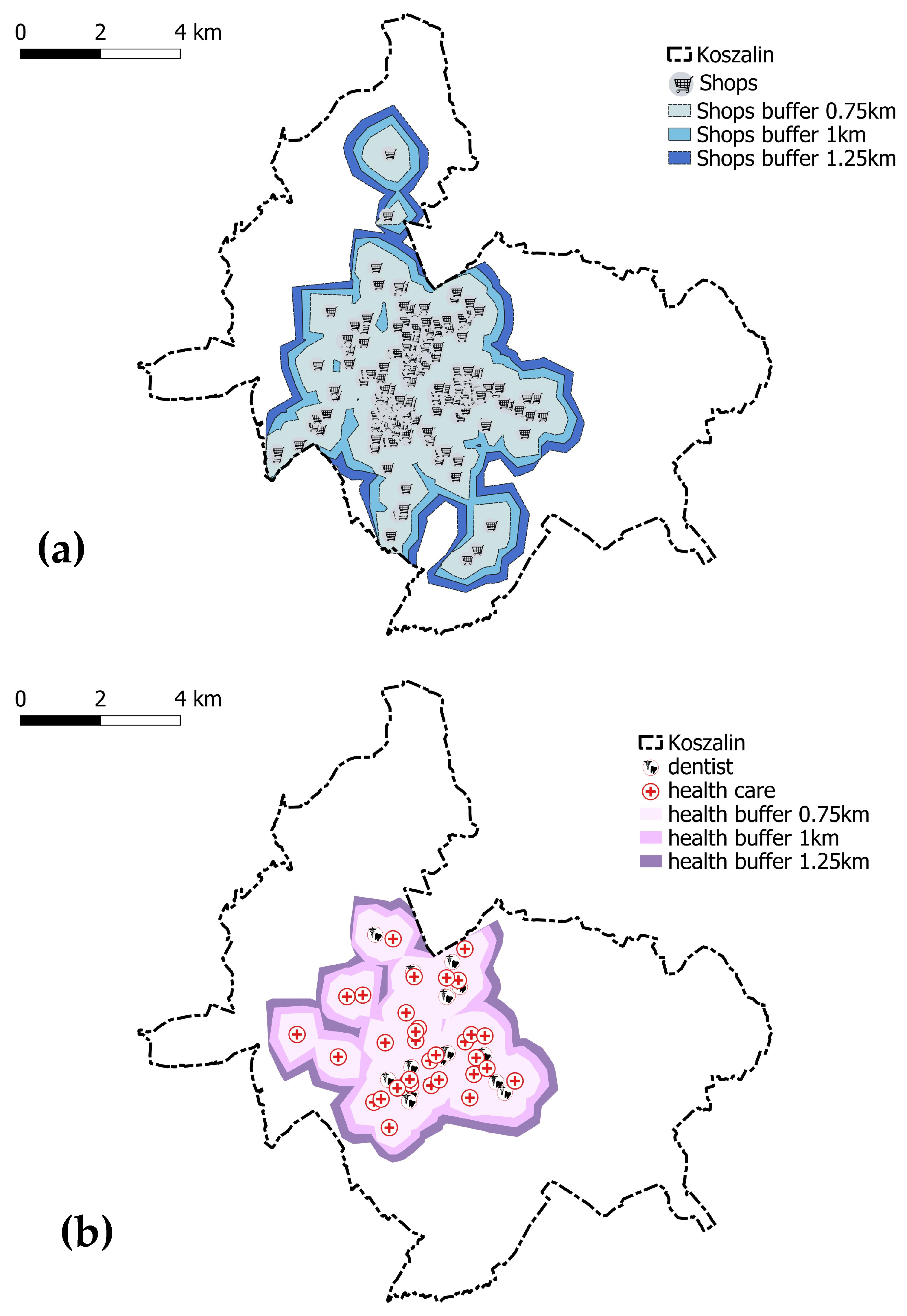
| Retail | Grocery stores | 256 | 38.51 | 36% | 49% |
| Healthcare | Total | - | 18.74 | 18% | 24% |
| Health centers | 36 | 23.21 | 22% | 30% | |
| Dental clinics | 26 | 19.83 | 19% | 25% | |
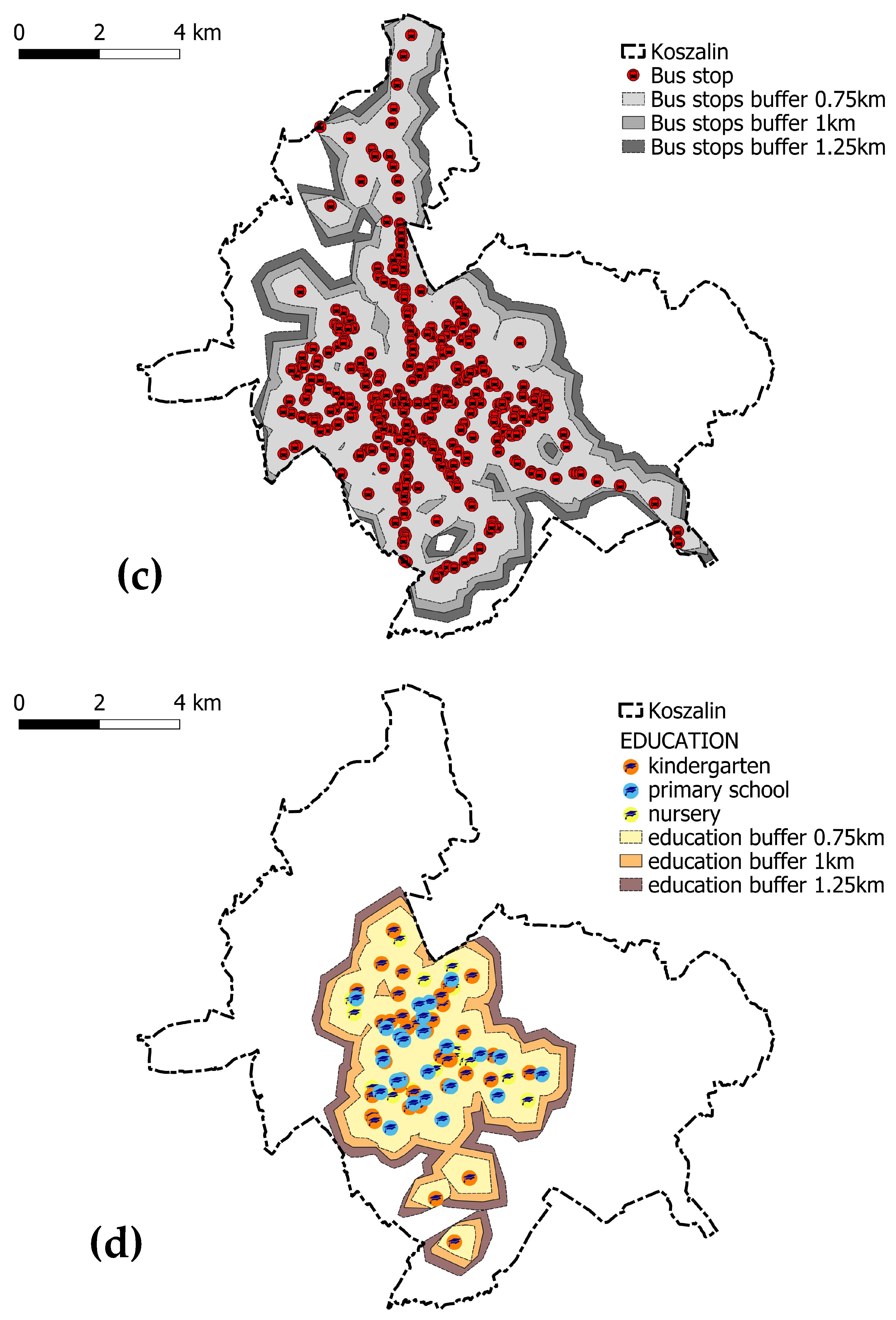
| Public transport | Bus stop | 376 | 59.45 | 56% | 76% |
| Education | Total | - | 14.71 | 14% | 35% |
| Public primary schools | 24 | 18.44 | 17% | 24% | |
| Kindergartens | 42 | 25.15 | 24% | 32% | |
| Nurseries | 24 | 18.81 | 18% | 24% | |
| Accessibility Index (Sum of Available Services) | Adaptation to the 15 min City Concept [%] | Area [km2] | City Area [%] | City Area (Excl. Forests) [%] |
|---|---|---|---|---|
| At least 1 | 20% | 101.20 | 92% | 100% |
| At least 2 | 40% | 55.05 | 50% | 67% |
| At least 3 | 60% | 42.47 | 39% | 51% |
| At least 4 | 80% | 31.97 | 29% | 39% |
| At least 5 | 100% | 11.93 | 11% | 14% |
| Type of Service | City Area Share (Excluding Forests) Under Different Assumed Walking Speeds | |||||
|---|---|---|---|---|---|---|
| 3 km/h [%] | 4 km/h [%] | 5 km/h [%] | Δ (5–3) [pp] | Relative Change [%] | ||
| Retail | Grocery stores | 39 | 49 | 59 | 20 | 50% |
| Healthcare | Total | 16 | 24 | 32 | 16 | 102% |
| Health centers | 22 | 30 | 36 | 14 | 66% | |
| Dental clinics | 18 | 25 | 33 | 15 | 86% | |
| Public transport | Bus stop | 64 | 76 | 86 | 23 | 35% |
| Education | Total | 13 | 19 | 32 | 19 | 146% |
| Public primary schools | 18 | 24 | 29 | 11 | 59% | |
| Kindergartens | 25 | 32 | 40 | 15 | 63% | |
| Nurseries | 17 | 24 | 29 | 12 | 72% | |
Disclaimer/Publisher’s Note: The statements, opinions and data contained in all publications are solely those of the individual author(s) and contributor(s) and not of MDPI and/or the editor(s). MDPI and/or the editor(s) disclaim responsibility for any injury to people or property resulting from any ideas, methods, instructions or products referred to in the content. |
© 2025 by the authors. Licensee MDPI, Basel, Switzerland. This article is an open access article distributed under the terms and conditions of the Creative Commons Attribution (CC BY) license (https://creativecommons.org/licenses/by/4.0/).
Share and Cite
Szkoda, M.; Michnej, M.; Baziak, B.; Bodziony, M.; Hrehorowicz-Nowak, A.; Hrehorowicz-Gaber, H.; Wołek, M.; Jagiełło, A.; Żukowska, S.; Szott, R. Is the Concept of a 15-Minute City Feasible in a Medium-Sized City? Spatial Analysis of the Accessibility of Municipal Services in Koszalin (Poland) Using Gis Modelling. Sustainability 2025, 17, 10157. https://doi.org/10.3390/su172210157
Szkoda M, Michnej M, Baziak B, Bodziony M, Hrehorowicz-Nowak A, Hrehorowicz-Gaber H, Wołek M, Jagiełło A, Żukowska S, Szott R. Is the Concept of a 15-Minute City Feasible in a Medium-Sized City? Spatial Analysis of the Accessibility of Municipal Services in Koszalin (Poland) Using Gis Modelling. Sustainability. 2025; 17(22):10157. https://doi.org/10.3390/su172210157
Chicago/Turabian StyleSzkoda, Maciej, Maciej Michnej, Beata Baziak, Marek Bodziony, Alicja Hrehorowicz-Nowak, Hanna Hrehorowicz-Gaber, Marcin Wołek, Aleksander Jagiełło, Sandra Żukowska, and Renata Szott. 2025. "Is the Concept of a 15-Minute City Feasible in a Medium-Sized City? Spatial Analysis of the Accessibility of Municipal Services in Koszalin (Poland) Using Gis Modelling" Sustainability 17, no. 22: 10157. https://doi.org/10.3390/su172210157
APA StyleSzkoda, M., Michnej, M., Baziak, B., Bodziony, M., Hrehorowicz-Nowak, A., Hrehorowicz-Gaber, H., Wołek, M., Jagiełło, A., Żukowska, S., & Szott, R. (2025). Is the Concept of a 15-Minute City Feasible in a Medium-Sized City? Spatial Analysis of the Accessibility of Municipal Services in Koszalin (Poland) Using Gis Modelling. Sustainability, 17(22), 10157. https://doi.org/10.3390/su172210157

