Article

Is the Concept of a 15-Minute City Feasible in a Medium-Sized City? Spatial Analysis of the Accessibility of Municipal Services in Koszalin (Poland) Using Gis Modelling


1
Faculty of Mechanical Engineering, Cracow University of Technology, Warszawska 24 Street, 31-155 Kraków, Poland
2
Faculty of Environmental Engineering and Energy, Cracow University of Technology, Warszawska 24 Street, 31-155 Kraków, Poland
3
Faculty of Architecture, Cracow University of Technology, Warszawska 24 Street, 31-155 Kraków, Poland
4
Faculty of Economics, University of Gdańsk, ul. Armii Krajowej 119/121, 81-824 Sopot, Poland
5
Faculty of Social Sciences, University of Gdańsk, Jana Bażyńskiego 8, 80-309 Gdańsk, Poland
6
Section of the Integrated Territorial Investments, Koszalin City Office, Zwycięstwa 42, 75-007 Koszalin, Poland
*
Author to whom correspondence should be addressed.
Sustainability 2025, 17(22), 10157; https://doi.org/10.3390/su172210157
Submission received: 23 August 2025 / Revised: 3 November 2025 / Accepted: 6 November 2025 / Published: 13 November 2025

Abstract

Currently, an active debate is underway among the academic community, urban planners, and policymakers regarding optimal models of urban development, given that the majority of the population now resides in cities. One concept under discussion is the 15 min city, which posits that all urban residents should be able to reach key, frequently used services within a 15 min walk or cycle. Although the literature suggests numerous potential benefits, debate persists about whether such cities would be optimal from the standpoint of sustainable development objectives and residents’ quality of life. The ongoing discussion also concerns the extent to which existing cities are capable of aligning with this concept. This is directly linked to the actual spatial distribution of individual services within the city. The literature indicates a research gap arising from a shortage of robust case studies that would enable a credible assessment of the practical implementation of this idea across diverse cities, countries, and regions. This issue pertains to Poland as well as to other countries. A desirable future scenario would involve comprehensive mapping of all cities, with respect to both the spatial distribution of specific services and related domains such as the quality and coherence of linear infrastructure. This article presents an analysis of the spatial accessibility of basic urban services in the context of implementing the 15 min city concept, using the city of Koszalin (Poland) as a case study. This city was selected due to its representative character as a medium-sized urban centre, both in terms of population and area, as well as its subregional functions within Poland’s settlement structure. Koszalin also exhibits a typical spatial and functional layout characteristic of many Polish cities. In light of growing challenges related to urbanisation, climate change, and the need to promote sustainable mobility, this study focuses on evaluating access to services such as education, healthcare, retail, public transport, and green spaces. The use of Geographic Information System (GIS) tools enabled the identification of spatial variations in service accessibility across the city. The results indicate that only 11% of Koszalin’s area fully meets the assumptions of the 15 min city concept, providing pedestrians with convenient access to all key services. At the same time, 92% of the city’s area offers access to at least one essential service within a 15 min walk. Excluding forested areas not intended for development increases these values to 14% and 100%, respectively. This highlights the extent to which methodological choices in assessing pedestrian accessibility can shape analytical outcomes and the interpretations drawn from them. Moreover, given this article’s objective and the adopted analytical procedure, the assumed pedestrian walking speed is the key parameter. Accordingly, a sensitivity analysis was conducted, comparing the reference scenario (4 km/h) with alternative variants (3 and 5 km/h). This approach demonstrates the extent to which a change in a single parameter affects estimates of urban-area coverage by access to individual services reachable on foot within 15 min. The analysis reveals limited integration of urban functions at the local scale, highlighting areas in need of planning intervention. This article proposes directions for action to improve pedestrian accessibility within the city.

1. Introduction

Currently, human development processes are increasingly concentrated in urban areas, leading to a range of negative phenomena including uncontrolled suburbanisation, increased environmental pollution, deteriorating mobility conditions within cities, and a decline in the quality of basic public services. Urban areas are estimated to be responsible for approximately 70 percent of global GHG emissions [1,2]. The rising awareness of the environmental impact of human activity and the challenges posed by climate change have initiated the search for solutions based on the principles of sustainable development [3,4,5]. Alongside the development and transformation of urban structures, interest has grown in the concept of the 15 min city. This idea aims to provide more convenient living spaces for all residents and improve access to basic services within a short walking or cycling distance. Other essential aspects of the concept include reducing human pressure on the environment as well as climate change mitigation and adaptation [6,7,8]. In recent decades, climate-related challenges have become a priority for European cities. Some of them have adopted ambitious targets in this area, including defined timelines for achieving climate neutrality. Despite these goals and various actions, the extent to which current urban structures are suitable for supporting preferred forms of active mobility, mainly walking, remains poorly understood. Although there is broad agreement that walking, cycling, and public transport, alongside other forms of travel, should play a dominant role in urban modal splits, the actual feasibility of these forms of travel is still insufficiently studied and examined. Therefore, a key question arises: Is access to basic urban services high enough to allow residents to give up motorised transport in favour of alternative modes, including walking?
On the one hand, the strategic documents of the city under study consistently emphasize the need to increase the share of pedestrian travel. The Koszalin Development Strategy, “#Koszalin 2030,” identifies, among its objectives, the development of attractive public spaces, the creation of an internally and externally integrated transport system, and the promotion of healthy lifestyles and physical activity among residents [9]. Similarly, the Local Development Strategy for the Koszalin–Kołobrzeg–Białogard Functional Area (KKBOF), 2021–2030, prioritizes enhanced spatial integration while preserving the area’s natural assets and cultural heritage [10]. In both documents, pedestrian mobility is framed around improving accessibility and safety, ordering spatial development, enhancing the attractiveness and user-friendliness of public spaces, and increasing the accessibility and quality of social services, healthcare, and social infrastructure.
On the other hand, there is a clear research gap stemming from the absence of a rigorous diagnosis of the current situation, specifically, a systematic inventory of service locations and an analysis of the feasibility of reaching them on foot within a reasonable time. This deficit characterizes not only Koszalin but also the majority of small and medium-sized cities. It results in part from the limited analytical capacity of smaller local governments, the lack of integrated and up-to-date databases on public and commercial services, and the fragmentation of responsibilities across departments responsible for transport, spatial planning, and social policy. Moreover, standardized indicators for monitoring pedestrian mobility and methods based on spatial data (GIS) and time-based accessibility analyses are still rarely applied. Planning practice remains frequently dominated by a road-centric perspective and metrics of vehicular throughput, with insufficient focus on pedestrian movement, particularly in terms of data collection and analysis. This study addresses the identified gap by employing a coherent methodological framework for assessing pedestrian accessibility to key urban functions.
This article aims to assess the spatial accessibility of basic urban services in the city of Koszalin in the context of the 15 min city concept. This study seeks to identify areas with varying levels of access to essential services, including shops, healthcare facilities, education, public transport, and green spaces. This analysis serves as a basis for diagnosing the city’s potential to support the creation of a sustainable, inclusive, and functionally coherent urban environment that aligns with the principles of the 15 min city. Koszalin was selected as the study area due to its classification as a medium-sized city, a category that dominates Poland’s settlement structure. Medium-sized cities are considered more conducive to realising the 15 min city concept, owing to their smaller spatial scale, relatively shorter daily travel distances, more compact urban form, and lower congestion levels. These conditions facilitate lower-cost, faster interventions to improve pedestrian accessibility while also enabling the coordination of sectoral policies (transport, public services, urban greenery) within a single jurisdiction without the need for complex metropolitan agreements. Conversely, limited financial and institutional resources, as well as a less diversified service base, may create access gaps, particularly in peripheral areas, underscoring the need for an in-depth assessment.
To address the research problem precisely, the analytical and synthetic method was applied. It enabled the integration of Geographic Information Systems (GIS) tools with the analysis of the relationship between urban functions and their transport accessibility.
To operationalise the research objective, the following research questions were formulated:
RQ1: What is the spatial distribution of accessibility to individual categories of services (shops, healthcare, education, public transport, green spaces) in Koszalin within a 15 min walk?
RQ2: Which areas of Koszalin demonstrate the highest and lowest cumulative accessibility to basic urban services?
RQ3: What share of the city’s area falls into zones with high, medium, and low values of the cumulative service accessibility index?
RQ4: To what extent does Koszalin’s functional and spatial structure support the implementation of the 15 min city concept, and which areas require planning intervention?
RQ5: To what extent does the assumed walking speed of urban residents affect the outcomes of spatial accessibility analyses to individual services?
The answers to these questions provide a comprehensive assessment of the spatial potential of the medium-sized city of Koszalin for implementing the assumptions of the 15 min city model. In contemporary cities, spatial injustice constitutes a critical facet of social, economic, and environmental issues [11]. This study also enabled the identification of areas with deficits in access to essential urban services. The analysis points to priority directions for planning interventions that can strengthen the functional cohesion of the city, improve residents’ quality of life, and promote sustainable mobility. The findings have an applied character and may serve as a foundation for local spatial policies and revitalisation strategies that support the development of cities in line with the 15 min city concept.
In addressing the fifth research question, this article demonstrates the extent to which the assumed walking speed of urban residents shapes the outcomes of pedestrian accessibility analyses for individual services. In practice, walking speeds vary substantially across residents as a function of age, health status, physical capacity, and trip purpose, and are further influenced by environmental conditions (e.g., terrain, the quality of pedestrian infrastructure, and weather) [12,13,14,15]. This heterogeneity translates into differences in walking times and catchment extents, and thus into divergent levels of spatial accessibility. The conducted sensitivity analysis illustrates the magnitude of deviations across three scenarios: a reference case assuming an average speed of 4 km/h and two alternative variants at 3 and 5 km/h.
The presented results are part of the project with the acronym JiM No. DUT/2022/15/JiM/2024 “Social and environmental justice in 15 min—toolkit development for transition to urban sustainable neighborhoods” financed by the National Center for Research and Development and the European Commission (EC) under the Horizon Europe framework program DUT Call 2022.

2. Literature Review

2.1. The 15 min City Concept

The concept of the 15 min city lies at the intersection of urban planning and transport. It is increasingly becoming a starting point for sustainable urban mobility planning in cities of various sizes and functional–spatial structures [7,16,17,18]. The 15 min city model centers on proximity, with neighborhoods functioning as “micro-cities” [19]. The primary objective of implementing this concept is to ensure an acceptable level of accessibility for residents and all users of urban space, with particular attention to vulnerable groups, such as older adults and people with disabilities, who are most at risk of transport exclusion in spatial, social, and economic dimensions. The need to ensure convenient pedestrian access for older adults follows from their distinct mobility patterns. Compared with the general population, they undertake a larger share of trips on foot and make less frequent use of private cars [20]. They are also characterised by lower average walking speeds [12], and heightened sensitivity to infrastructural barriers [20] (e.g., surface irregularities and gradients, stairs, long segments without resting places) and to limited pedestrian green time at signalised crossings [13]. These factors reduce the effective walking catchment to services within a 15 min threshold. In addition, older adults typically have lower budgets for meeting transport needs, which makes the option of cost-free travel (i.e., walking) particularly important from a household budget perspective [21].
For individuals with disabilities in the context of pedestrian travel, relevant factors also include:
  • the type and severity of impairment (including the need to use crutches, canes, wheelchairs, or walkers); route continuity and step-free design (ramps instead of stairs, lowered curbs, absence of level changes) [22];
  • permissible longitudinal and cross slopes of sidewalks; surface quality and evenness; the minimum effective clear width free of obstacles (bollards, signage, parked vehicles) [23];
  • the presence of tactile and visual wayfinding elements (e.g., attention fields, guiding strips, high-contrast markings) [24];
  • the parameters of pedestrian crossings (green time calibrated to lower walking speeds, acoustic signals, and refuge islands).
Elements of street furniture and pedestrian amenities that affect the comfort and safety of walking are also important, including lighting, opportunities to rest (benches at regular intervals), shelter from adverse weather, and clear signage/wayfinding. Seasonal factors (snow, ice, and leaf fall) and maintenance responses (snow removal, de-icing, and surface repairs) significantly impact the practical feasibility of walking for all residents, particularly for older adults and individuals with disabilities.
The core idea of the 15 min city is to avoid strict functional segregation of urban space. The most critical destinations should be accessible within a 15 min travel radius. The transport dimension of the 15 min city relies on efficient public transportation, as well as on pedestrian and cycling mobility, supported by the integration of various transportation subsystems.
The literature and strategic planning documents also emphasise complementary elements that affect the success of implementing the 15 min city model. These include energy efficiency in construction, reduction in environmental impact, high levels of travel safety, limiting parking spaces, lowering transport-related costs, increasing social engagement, reducing traffic accidents, shortening the average distance between home and workplace, enhancing collaboration among residents, and improving access to ecosystem services [16,25]. These aspects illustrate how deeply the 15 min city idea is rooted in the broader framework of sustainable development.
Some authors argue that the 15 min city, despite its complexity and multidimensionality, can be defined by seven core components: proximity, density, diversity, digitalisation, human-scale urban design, connectivity, and flexibility [16]. Other authors propose a 10-element framework, adding three further components to this list: mixed-use, modularity, and adaptability [26]. According to this perspective, a 15 min city is a city that [16,25,27]:
  • is based on the principle of proximity to key destinations,
  • takes advantage of appropriate urban density,
  • promotes both social (software diversity) and functional (hardware diversity) diversity,
  • incorporates digital technologies into the management and functioning of the city,
  • is designed on a human scale, which means creating public spaces focused on people’s needs rather than cars,
  • ensures cohesive connectivity between neighbourhoods to avoid their isolation and fragmentation,
  • introduces spatial flexibility, understood as the ability of spaces to change their functions over time, depending on residents’ needs [10].
The 15 min city concept also incorporates elements of other urban development models (Table 1). The data presented in the table indicate that these various urban development approaches should not be seen as mutually exclusive or substitutive. Instead, they represent complementary strategies whose simultaneous implementation can generate a synergistic effect, mutually reinforcing their positive impact on the quality of life in urban areas.
The literature highlights not only the merits and potential benefits for urban residents associated with implementing the 15 min city concept but also the difficulties and challenges inherent in its implementation. It is noted, among others, that improvements in pedestrian access to services in a given urban area may increase the attractiveness of living there and, consequently, raise housing demand in the absence of a commensurate increase in supply [37,38,39]. This process can lead to higher housing prices and rents in areas with high levels of service accessibility. As a result, implementing the 15 min city in specific districts may contribute to the exclusion of lower-income groups [37,38,40] and thereby further exacerbate inequalities, as these residents may be forced to relocate to areas with poorer access to services and incur higher financial and time burdens to meet their transport needs. It is also emphasised that in peripheral areas and those with dispersed development (e.g., single-family housing estates), achieving 15 min pedestrian or cycling access to basic services is often unrealistic and, in many cases, unsustainable, as it would require the construction and maintenance of an overly extensive network of facilities [39].
The literature also highlights shortcomings in the methodologies commonly employed in 15 min city analyses. Among other issues, it underlines the challenge of choosing a facility aggregation level that is neither too coarse nor too fine-grained to support generalizable conclusions [39,41]. For example, different types of healthcare facilities are sometimes combined into a single “health services” category despite their markedly different abilities to meet residents’ actual needs for consultations with specific specialists (e.g., dentists, cardiologists, surgeons) [41]. However, analysing access to each specialist individually would require constructing vast datasets, and the resulting conclusions could be ambiguous.
Moreover, qualitative aspects of pedestrian travel are often overlooked or addressed only marginally in discussions of the 15 min city [39,41]. Thus, even where services are nominally available within a 15 min walking radius, actual utilisation may not occur due to, for example, a lack of perceived personal safety arising from insufficient lighting, absence of passive surveillance or foot traffic, or limited police presence [41]. Accordingly, it is argued that less emphasis should be placed on walking time per se and greater attention should be devoted to factors such as the quality of infrastructure affecting walking comfort; safety in interactions with motorized and micromobility traffic; personal security (risk of theft or assault); and the overall quality of the public realm, including visual amenity, urban greenery, and street cleanliness [41].
Another frequently noted weakness of the 15 min city concept is the neglect of individual differences among residents in walking speed and ability to overcome barriers and difficulties when walking or cycling [39]. The concept is therefore criticised for failing to account adequately for variation in feasible reach and the actual capability of different residents to undertake a 15 min active trip. It is also often argued that the concept lacks novelty: some authors maintain that its connections with other urban development models (as briefly outlined in Table 1) are so strong that relatively little unique content remains within the 15 min city idea itself [39,40,42].

2.2. Spatial Accessibility Models in Urban Planning

When referring to accessibility models, we focus on spatial accessibility, which is understood as a set of analytical tools and conceptual approaches used to determine how easily basic services can be accessed. However, spatial accessibility is not solely a matter of metric distance; it also involves travel time, the quality of connections and their alignment with users’ needs, as well as the absence of both physical and infrastructural barriers.
From the perspective of urban planners and stakeholders involved in shaping urban space, accessibility takes on different meanings depending on the context. In urban design, accessibility modelling can be seen as a tool for shaping elements that influence quality of life and sustainable development by ensuring an equitable distribution of services within the urban structure, particularly in compact city forms.
In planning practice, accessibility models are used to evaluate the suitability of new areas for designated functions. This helps minimise transport exclusion, which may otherwise lead to social exclusion. Accessibility models demonstrate how infrastructure and transportation systems impact access efficiency and underscore their role in urban planning. They also assess the impact of policy on equity and efficiency, particularly regarding public services and transport investments across regions [43]. In fields such as public health, spatial accessibility models are interpreted in terms of the time and ability required to access healthcare services, as well as access to environments that support healthy living. These models are used to identify areas that are service-deficient. In the context of environmental protection and urban ecology, spatial models are applied to assess environmental well-being in accordance with the principles of sustainable development. They are used to analyse the distribution and accessibility of green infrastructure and to evaluate cities’ capacity to adapt to climate change. Examples include:
  • Opportunity or cumulative-opportunity models: These measure the number of available destinations (e.g., schools, parks) within a defined travel cost (time or distance), such as a 15 min walking time isochrone. They are easy to implement in GIS, but are sensitive to the arbitrary selection of spatial thresholds [44];
  • Space syntax and spatial network models: These focus on topological connectivity, analysing street integration (including pedestrian paths) and spatial visibility (isovists, axial lines). Such models support the analysis of pedestrian flow potential and social interaction [45];
  • Hybrid and multilevel models: Accessibility models vary in complexity, accuracy, and purpose, ranging from simple isochrone maps to gravity-based hybrid models and multi-criteria analyses of spatial structures.
When the goal extends beyond merely estimating service coverage, model selection can be guided by socially sensitive time–space approaches. One example is dynamic accessibility models, which are spatiotemporal models that consider traffic fluctuations, schedules, and travel modes. These models analyse how space is used within defined time frames [46].
In the Polish context, isochrone-based models are most commonly used due to the ease of obtaining spatial data from public institutions, ease of implementation, and a long-standing tradition of use [47].
Among newer and more advanced models is the Two-Step Floating Catchment Area (2SFCA) model, which first assesses the number of service locations available to people, living in a given area, and then analyses how many such services are within reach of an individual. This allows for the verification of whether a given urban area has adequate service provision or where so-called “white spots” occur—zones with insufficient service coverage. Due to its complexity and ability to account for service saturation and competition, the 2SFCA model is now considered a widely accepted analytical standard.

3. Methodology

3.1. Case Study Overview

Koszalin is a city with district rights located in north-western Poland, approximately 11 km from the Baltic Sea coast (Figure 1). As of 2024, Koszalin had a population of 105,400, with a population density of 1069 inhabitants/km2. Every year, the city experiences a small but steady outflow of residents. The average age of a resident of Koszalin was 44.8 years, higher than the national average in Poland (42.7). The ageing of the urban population is currently one of the most significant development challenges for Koszalin [48]. Education and upbringing account for the largest share of the city’s expenditure (44%), followed by social care (15%), municipal management (approximately 9%), and roads (9%).
Table 2 presents the basic data on Koszalin in 2024. A clear concentration of greenery is visible in the south-eastern part of the city, where a large forest complex is located. Situated on the so-called Recovered Territories after World War II, Koszalin was intended to serve as a model medium-sized city, designed with a rational monocentric structure composed of housing estates and a functionally hierarchical service layout. The spatial structure was based on a clearly defined grid of transport axes. To this day, modernist functionalism remains visible in the city’s spatial organisation, particularly in the separation of residential, educational, industrial, and recreational zones.

3.2. Methodological Approach

The 15 min city concept is based on ensuring that residents have access to essential services, including grocery stores, public healthcare facilities, nurseries, kindergartens, public primary schools, and public transportation. This involves identifying areas from which specific services can be reached on foot within a 15 min walk. These services are interpreted as point features on a map with particular coordinates. In the case of buildings, their locations were determined based on address data. A Geographic Information System (GIS) was used to determine the location of all services and to interpret spatial data. The analysis also included the location of public green areas, defined as spaces dedicated to outdoor recreation and leisure (physical activity).
Accessibility represents a multifaceted concept encompassing a wide range of research perspectives, including potential, cumulative opportunity, and gravity-based measures. In this study, accessibility is defined in a functional and spatial sense, as the ability of residents to reach key urban services within a 15 min walking distance, in line with the assumptions of the 15 min city model. Accordingly, the analysis focuses on pedestrian accessibility and applies a proximity-based approach operationalised through network-based service area analysis using GIS tools. This method enables the identification of service catchment areas based on realistic walking routes along the street network, rather than simple Euclidean buffers, providing a more accurate representation of residents’ daily mobility conditions.
The study area for this investigation was the city of Koszalin, situated in the West Pomeranian Voivodeship in Poland (Figure 1). This study was conducted using QGIS (version: 3.38). This free and open-source software enables comprehensive management of spatial data in various formats (vector, raster, and text-based databases). The program also allows for spatial analysis and visualisation of results.
Spatial data on the location of basic services were sourced from publicly available text and vector datasets, which are briefly described in Table 3.
The following QGIS tools and plugins (https://qgis.org) were used to determine the locations and process the data:
  • Geocoding addresses UUG GUGiK—the plugin geocodes a CSV file of addresses for Poland. It uses the UUG GUGiK web service.
  • GeoCoding—it allows the user to search for an address and obtain its coordinates (geocoding) using GeoCoding using Nominatim (version: 5.1.0) and Google web services.
  • mmqgis—plugins for manipulating vector map layers: CSV input/output/join, geocoding, geometry conversion, buffering, hub analysis, simplification, column modification, and simple animation.
  • BDOT10k_GML_SHP—imports BDOT10k shapefiles or GML files.
  • QuickOSM—download OSM data owing to the Overpass API.
  • Processing—spatial data processing framework for QGIS.
The delineation of areas with 15 min accessibility to services comprised several stages:
Stage 1—Service location. Services were represented as point features specified by postal addresses. To convert address records (text files) into spatial coordinates, the QGIS plug-ins Geocoding addresses UUG GUGiK and GeoCoding were used. Service locations were then verified and supplemented using data from Google Maps and OpenStreetMap (OSM).
Stage 2—Pedestrian network reach. Around each service point, pedestrian-permissible network segments (e.g., streets, sidewalks) were extracted such that the path length did not exceed 1 km. The 1 km threshold is based on an average walking speed of approximately 4 km/h, which corresponds to a travel time of 15 min. The pedestrian network was derived from BDOT10k and OSM, and network analysis tools in QGIS were employed to compute path-length–based service areas.
Stage 3—Service-area polygons. For each service point, polygons were generated around the reachable pedestrian network segments to obtain 15 min service-area envelopes. Polygons for individual points within the same service category were then dissolved into a single contiguous area. These operations were implemented using the Processing Toolbox in QGIS.
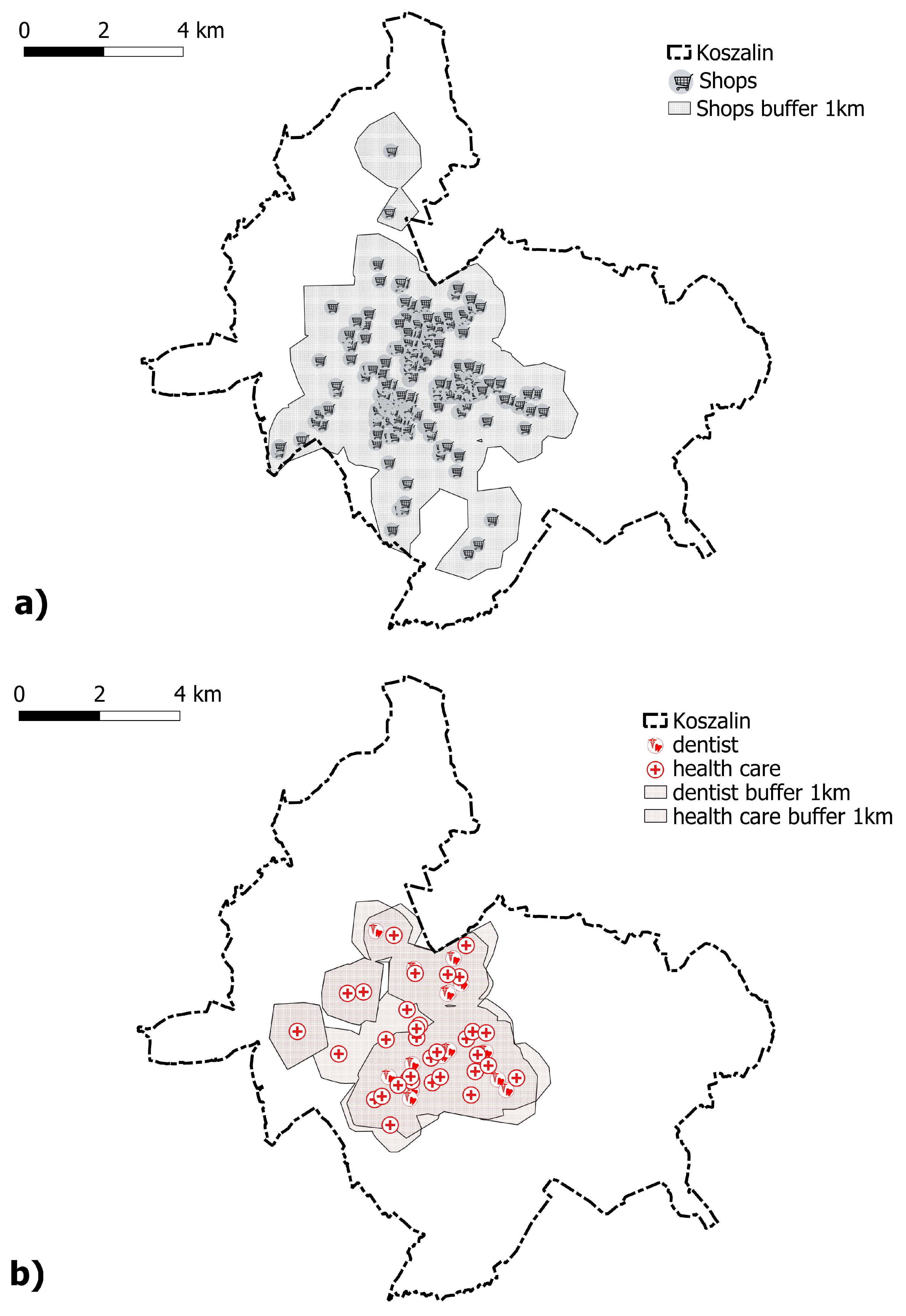
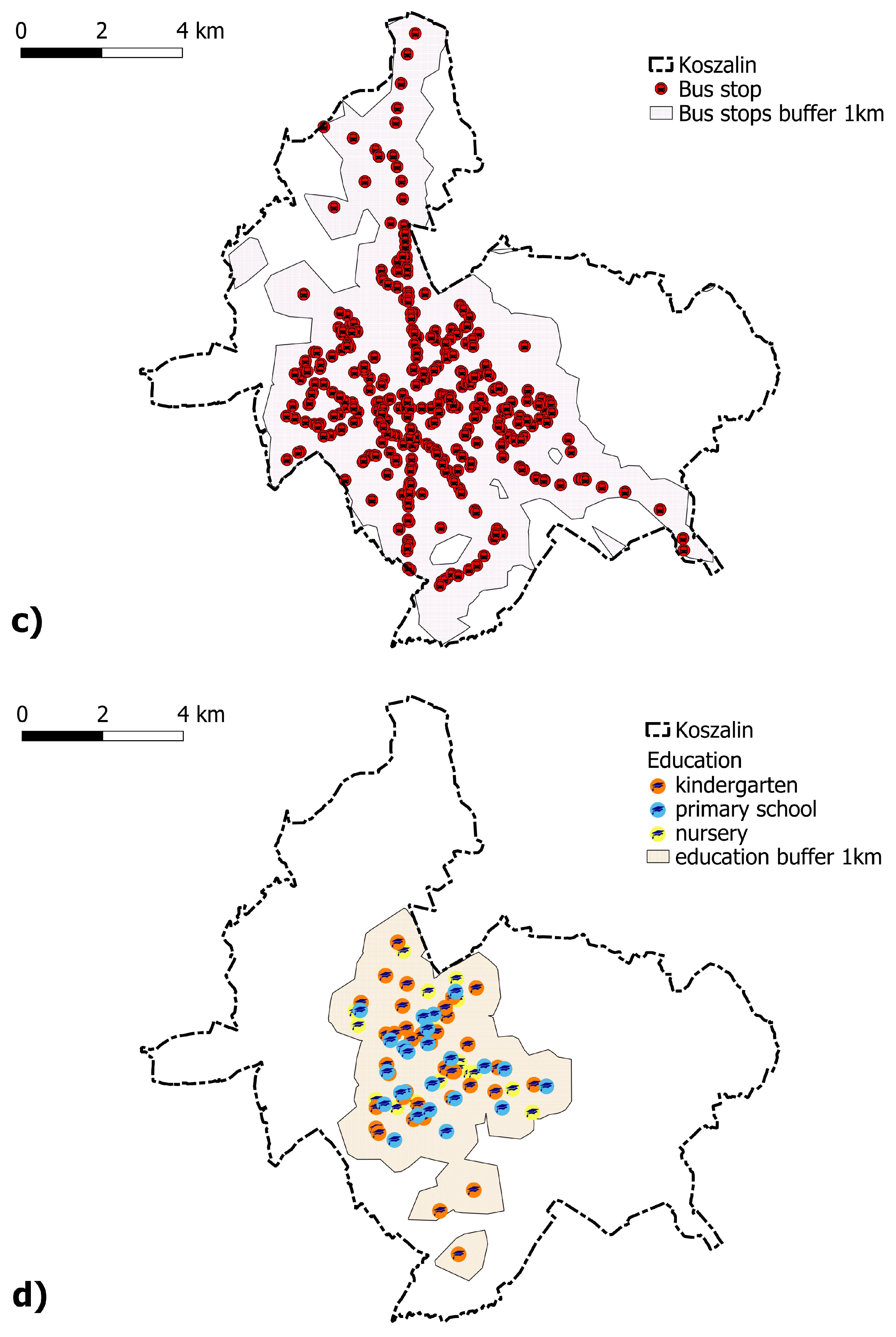
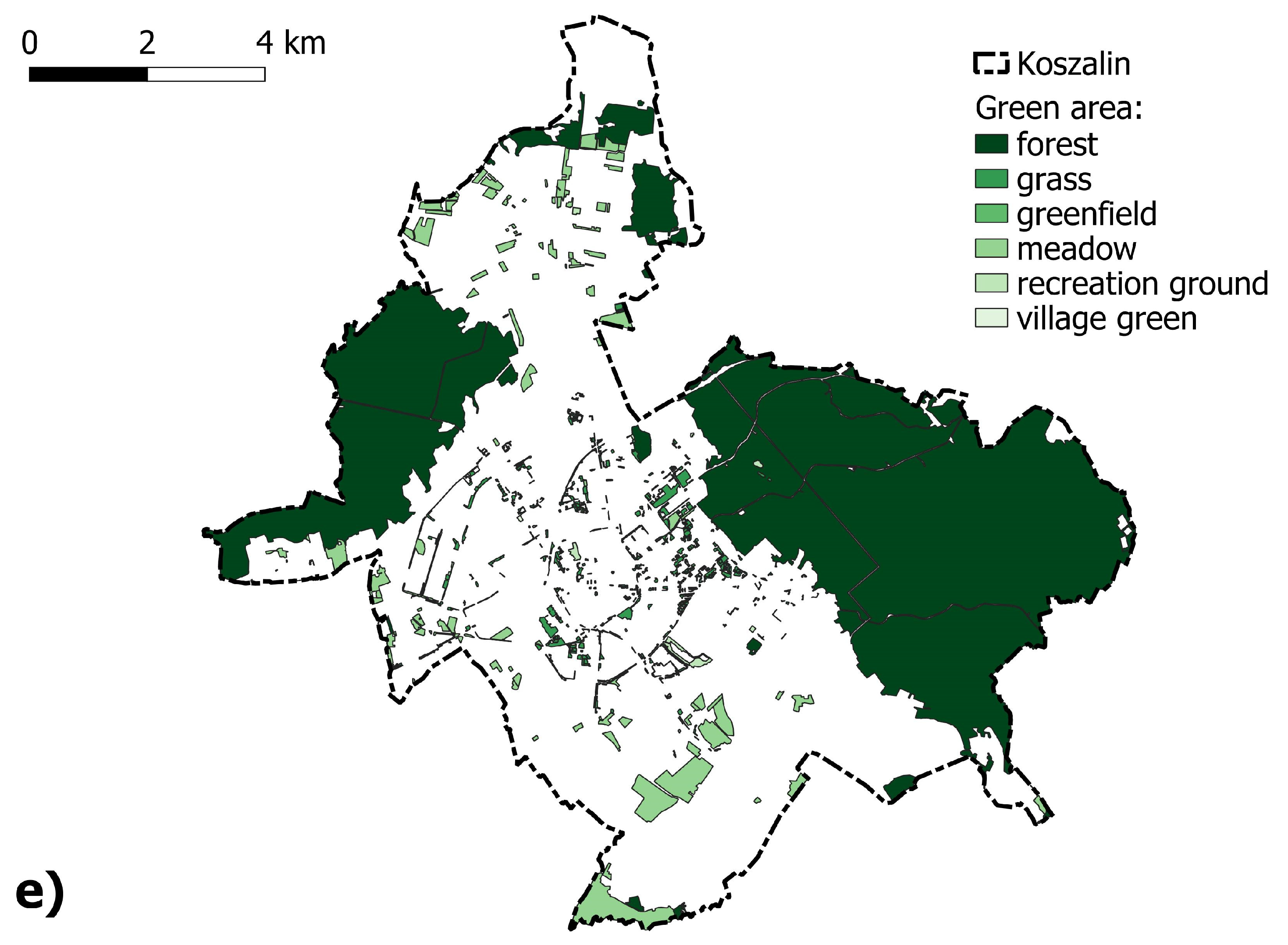
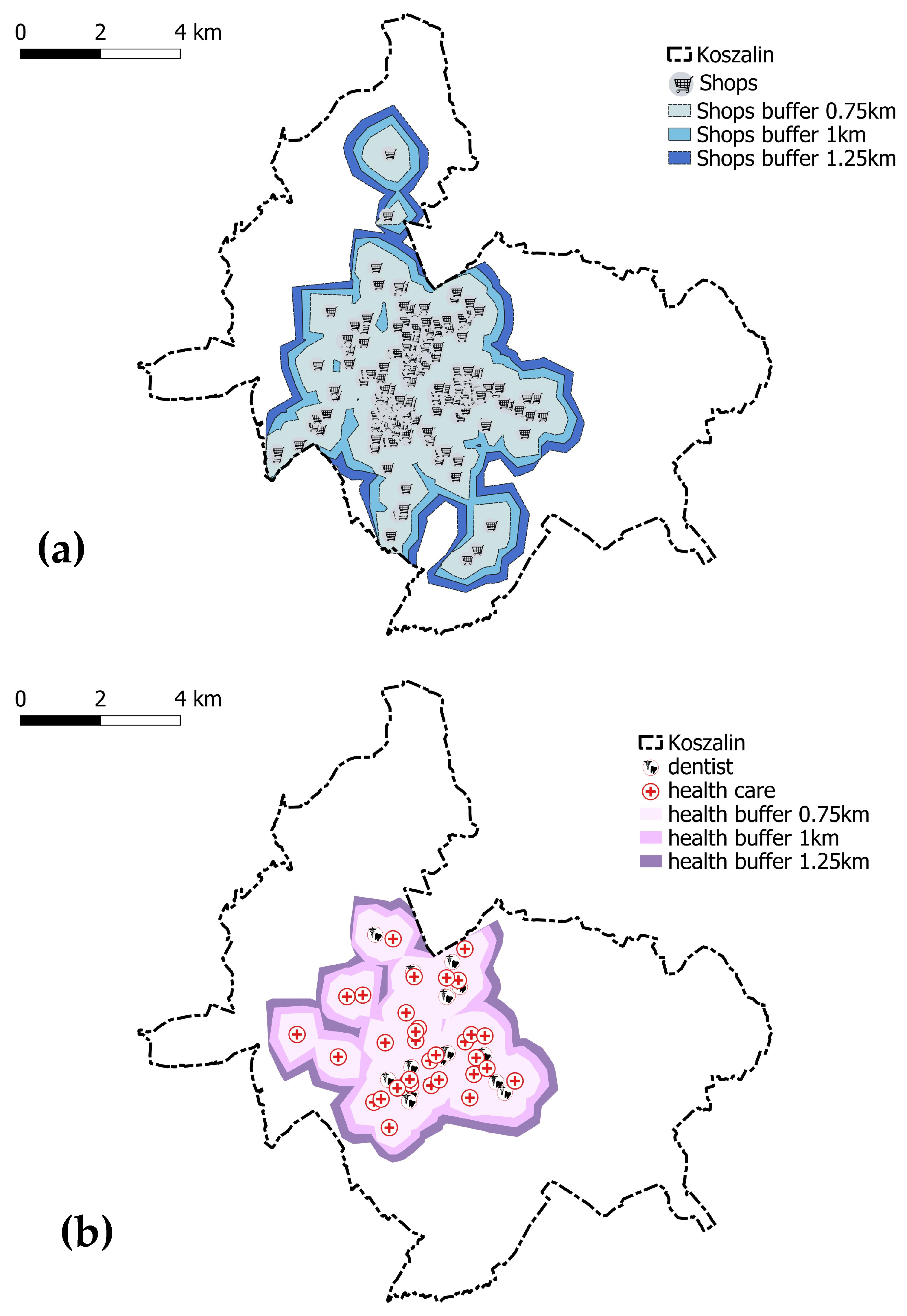
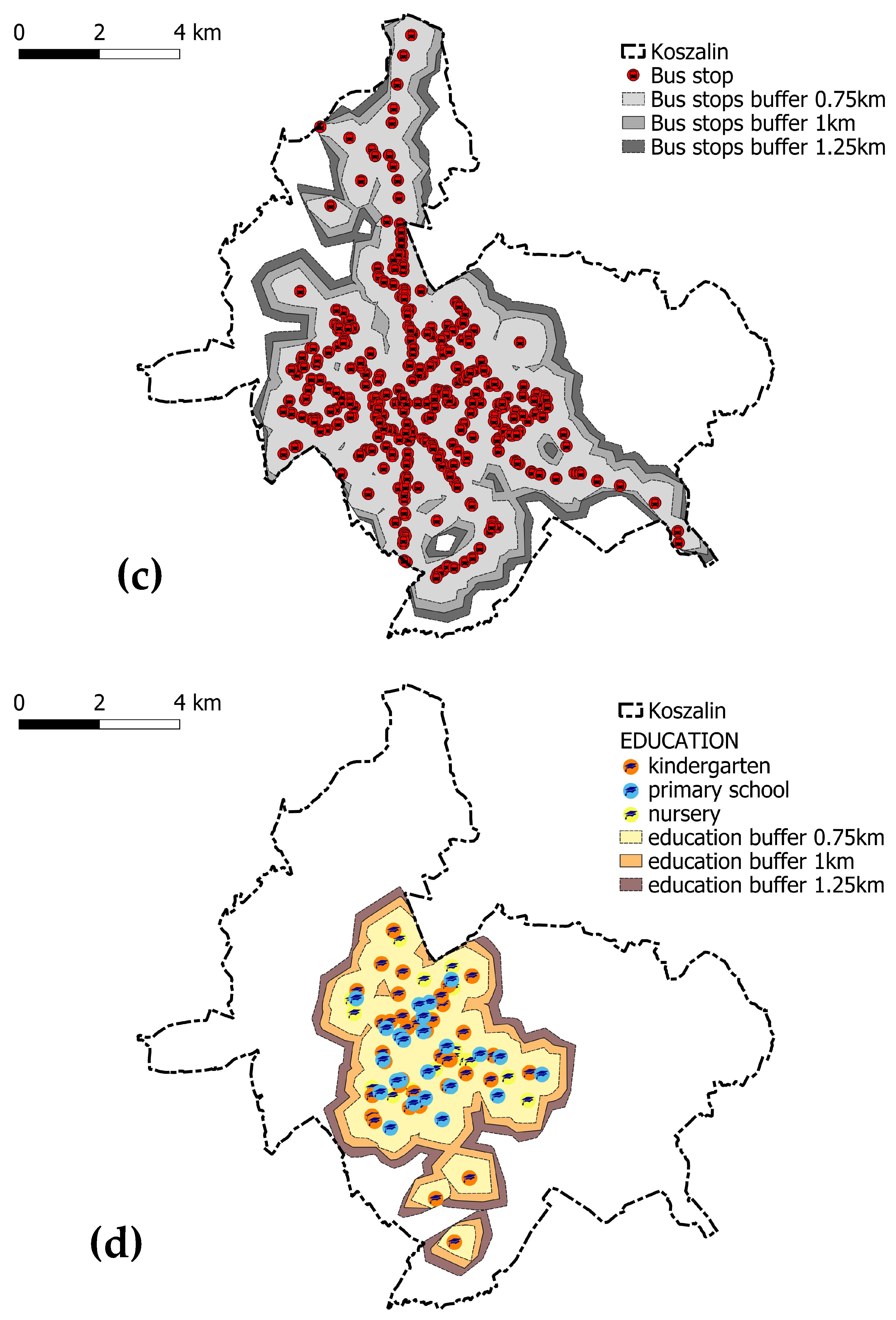
Additional step—Public green areas. Fifteen-minute pedestrian service areas were also delineated for publicly accessible, mapped green spaces, which cover a total of 44 km2, accounting for approximately 44.5 percent. For each service point, road segments were identified using QGIS network analysis tools. These segments were then used to generate service area outlines, which were aggregated to delineate zones of accessibility to each type of service (Figure 2, Table 3). In addition, the analysis included public green areas, which cover a total of 44 km2, accounting for approximately 44.5 percent of the city’s total area (Figure 2).
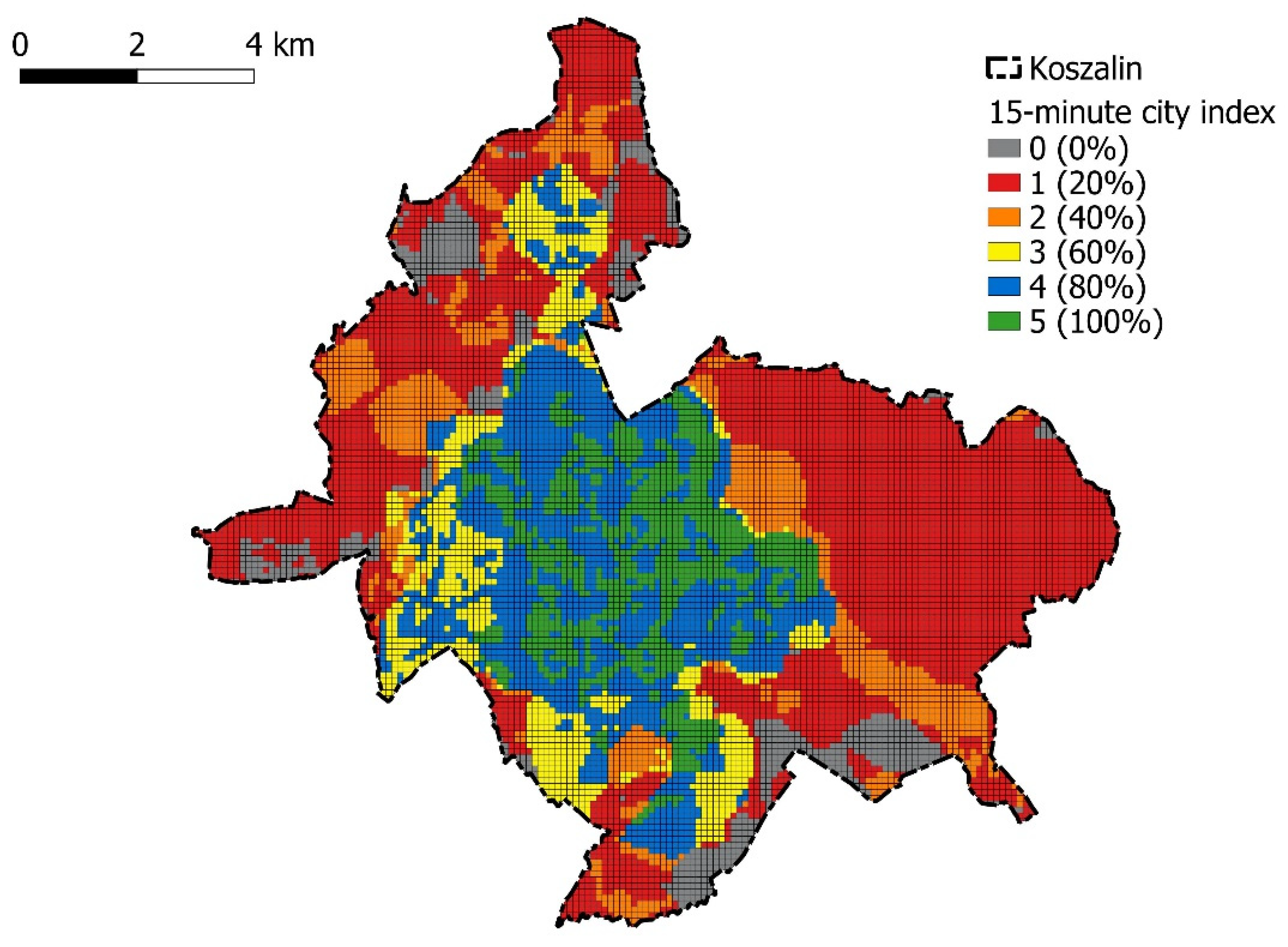
To assess the extent to which the city is adapted to the 15 min city concept, analyses were conducted for all essential services (Table 4) together with the identification of public green areas. To determine the spatial distribution of the data, the Rectangular Binning method was used. This approach combines square-grid analysis with point-counting techniques [51]. The area of the city of Koszalin was divided into 100 × 100 m grid cells. This grid served as the analytical basis for examining the number of services accessible within each cell. For each grid cell, values representing service availability were assigned: 1 for the presence of a given service and 0 for its absence. The assessment metric is the sum of services available per cell. An index value of 0 indicates no access to services; 1 indicates access to one service; 2 indicates access to two out of the five selected services; 3 indicates access to three out of five services; 4 indicates access to four out of five services; and 5 indicates access to all services. This method enables the identification of areas with values ranging from 0% to 100% alignment with the 15 min city concept. It enables the identification of service-deficient areas and the mapping of areas characterised by a given degree of alignment (or misalignment) with the 15 min city framework. The analysis did not account for the relative importance of services, nor did it distinguish among the types of services available in specific areas of Koszalin. A direction for future research would be to assign differentiated weights to individual services, based on residents’ stated priorities, usage frequency, and perceived contribution to quality of life.

4. Results

4.1. Identification of Service-Deficient Areas in Koszalin

To assess the potential for implementing the 15 min city concept in a medium-sized city like Koszalin, an identification of areas with varying levels of accessibility to essential services within a 15 min walking distance was conducted. Special attention was given to so-called deficit areas, meaning zones where pedestrian access to all or some services is not possible within the specified time frame.
To identify these deficit areas, the locations of individual services were analysed in conjunction with their corresponding accessibility zones (Figure 3) and the accessibility index values assigned to grid cells. Based on these index values, a map showing their spatial distribution across the city of Koszalin was generated (Figure 4).
The next stage of assessing Koszalin in terms of its potential and effectiveness in encouraging residents to meet their daily needs through pedestrian mobility involved calculating the total area of zones sharing the same cumulative accessibility index values and determining their share in the city’s overall area. The results of this analysis are presented in Table 5.
Based on these data, an analysis of service accessibility deficits was conducted. The findings indicate that the infrastructure and availability of essential services in the central part of Koszalin are well-developed and broadly consistent with the principles of the 15 min city. Other areas, particularly those located on the periphery, require further infrastructure development and the addition of basic service points that are currently lacking. In accordance with the city’s development strategy, which restricts expansion toward the southeast, this area—comprising mainly forest land (approximately 27.75 km2)—will remain without urban infrastructure.
The conducted analysis also shows that the city has a well-developed transport network, except for the northwestern part, which requires further investment. This area is also lacking access to educational facilities and retail services.
At the citywide scale, the most significant service accessibility deficit in Koszalin concerns healthcare. Outside the central part of the city, there is a lack of pedestrian access to healthcare facilities. This means that a significant share of the population, particularly those living in peripheral areas, cannot reach medical services within a 15 min walking distance. This situation may lead to limited access to healthcare, increased social inequality in service provision, and greater dependence on private transport, which runs counter to the principles of the 15 min city.
The analysis of Koszalin’s spatial adaptation to the 15 min city concept demonstrates that only 11% of the city’s area (14% when forest areas are excluded from the analysis) fully meets the model’s assumptions regarding access to essential services and green spaces. This relatively limited extent of full compliance is largely attributable to the insufficient provision of accessible green areas within the central districts, where urban density and land-use patterns constrain the availability of open public spaces. At the same time, the findings indicate that nearly 30% of the city’s territory (40% when forest zones are excluded) provides access to at least four key services within walking distance. While this figure does not equate to full implementation of the 15 min city model, it may nonetheless serve as a meaningful indicator of Koszalin’s spatial potential and readiness for incremental adaptation. Such a level of partial accessibility suggests that, although the city currently falls short of the comprehensive 15 min framework, it possesses the structural foundation upon which targeted interventions (such as improved green infrastructure, mixed-use development, and service clustering) could be effectively built. Access to a majority of essential services within a short walk significantly enhances the functionality and resilience of urban space, reduces dependence on private car travel, and promotes the emergence of more self-sufficient and sustainable neighborhoods. On one hand, the lack of access to a single essential service may not pose a significant problem if the remaining services are easily available and the missing one can be accessed in adjacent areas. On the other hand, such deficits may disrupt the functional coherence of an area, increase the need for daily travel, and reduce the overall quality of life, particularly for people with limited mobility, including the elderly, persons with disabilities, and children.
When forest areas excluded from urban development (as defined in the city’s strategic planning documents) are not considered in the analysis, the share of land lacking access to transport infrastructure decreases from 40 percent to 20 percent of the city’s area. In the case of access to shops and healthcare services, this deficit is reduced from 60 percent to 50 percent. The extent of differences in the results of pedestrian accessibility analyses, depending on whether this study covers the entire administrative area of Koszalin or only the land designated for development, is illustrated in Table 4 and Table 5. The results presented therein demonstrate the substantial impact of the adopted methodological approach on the outcomes of accessibility studies. This influence stems from whether the analysis incorporates the actual development potential of urban land and the land-use functions assigned in planning documents, or relies solely on the administrative boundaries of the cities under study. These findings further emphasise the importance of interpreting pedestrian accessibility results not only in geometric or quantitative terms but also in relation to spatial and planning constraints, which delineate areas excluded from the urbanisation process and thus preclude residential development or the establishment of service facilities within those zones.
In pedestrian accessibility analyses, the assumed walking speed is the principal determinant of outcomes. To validate the obtained results and the conclusions derived from them, we conducted additional analyses to assess the extent to which outcomes change for individuals who walk faster or slower than the reference speed of 4 km/h. Accordingly, we performed sensitivity analyses of the original results using a lower walking speed (3 km/h) and a higher one (5 km/h). A graphical presentation of these findings is provided in Figure 4. It shows that changes in walking speed exert the greatest influence on peripheral areas of the city, outside the very centre. This is because, in the central zone, the density of facilities offering individual services is sufficiently high that 15 min walking isochrones around these points overlap. In practical terms, the concentration of service locations (e.g., grocery stores) in the city centre is such that even individuals walking at 3 km/h can reach more than one facility of a given category within the assumed 15 min threshold.
The degree to which walking speed affects access to specific services is quantified in Table 6. For example, for basic healthcare access (understood as concurrent access to both a dentist and a health centre) the share of the city’s land area from which needs can be met within 15 min is twice as high for those walking fastest (5 km/h) compared to those walking slowest (3 km/h): 32% versus 16% of the city’s area (excluding forests areas). Absolute pedestrian accessibility, when different walking speeds are considered, changes most markedly for public transport stops: the land coverage by areas ensuring a 15 min walking access ranges from 64% to 86%, i.e., a difference of 22 percentage points. This is particularly important given that public transport is used to a high extent by older adults and children, groups less likely to drive and, on average, walking more slowly than physically able adults.
It is also worth noting that the pedestrian catchment area for all basic educational services (nursery, kindergarten, and primary school) is nearly 2.5 times larger at a walking speed of 5 km/h than at an average speed of 3 km/h.
A comparison of the findings obtained in this study with similar analyses conducted in other cities reveals several vital insights. First, significant disparities in 15 min pedestrian access to individual services appear to be a widespread phenomenon [41,52,53,54,55]. This suggests that, currently, most cities fail to ensure equitable pedestrian accessibility to essential services. Consequently, it may be inferred that the majority of cities, including those in Europe, cannot yet be regarded as fully realised 15 min cities [52,53,56,57,58].
Second, there is still no universally accepted consensus on which services should be considered essential from the perspective of urban residents. As a result, different scholars assess pedestrian accessibility using diverse sets of services, leading to methodological inconsistencies and challenges in conducting meaningful cross-city comparisons [8,52,53,54,55,56,57,59,60].
Third, the feasibility of implementing the 15 min city concept varies considerably across cities and regions worldwide. In some contexts, barriers such as informal settlements, economic inequalities, and infrastructure deficits are so substantial that alternative approaches, extending beyond the conventional 15 min city framework, may be required [41]. Such approaches should be context-sensitive and tailored to the specific needs and development trajectories of each city.
Fourth, research consistently shows that areas characterised by high pedestrian accessibility tend to include central districts, historic cores, and revitalised zones [52,53,56,58]. This is primarily due to their compact urban form, mixed land-use patterns, and long-term decentralisation policies. In contrast, peripheral and newly developed areas often display lower service coverage, gaps in accessibility, and deficiencies in pedestrian infrastructure.

4.2. Accessibility as a Defining Element of Mobility Space on the Example of Koszalin

Accessibility lies at the heart of defining the spatial logic of mobility in cities. In Koszalin, studies show that the availability and quality of transportation options primarily shape mobility patterns. A qualitative survey reveals that the average resident perceives public transport as only “average”, citing insufficient lines, low frequency, and limited interconnections [61]. As a result, many rely on private cars, which exacerbates congestion and hinders sustainable development.
Mapping the spatial distribution of bus stops and transit nodes in Koszalin using GIS demonstrates a clear central-periphery divide. The network comprises approximately 375 bus stops, including seven interchanges; however, peripheral neighbourhoods remain poorly served compared to the central districts. Isochrone analysis reveals that a significant portion of the population cannot reach a public transport stop within a 10- to 15-min walk, underscoring spatial inequities. Applying a GIS-based accessibility assessment—akin to methodologies employed in Valencia (Spain) and Tricity metropolitan area (Poland) contexts—Koszalin can be analysed over multiple thresholds (e.g., 5, 10, 15 min) using network buffer zones along pedestrian and cycling networks [62,63]. This produces high-resolution maps that display catchment areas around stops and expose areas that lack adequate public transit service. Such deficiencies in the spatial coverage of public transport services lead to spatial fragmentation and diminished freedom of mobility among residents, particularly those without access to private cars, young people, and older adults.
Crucially, these insights enable planners to identify priority zones for intervention. Through buffer-based population analysis, one can quantify the number of inhabitants residing within or outside acceptable walking distances to transport nodes and stratify them by age or socio-economic groups to ensure equity. Incorporating emerging GIS tools also enables the assessment of walkability, bikeability, and active mobility suitability, thereby forming a comprehensive picture of micro-scale mobility environments.
Beyond public transport, Koszalin’s accessibility landscape reveals notable disparities in access to everyday services. GIS-based calculations show that only 17% of the city’s total area (or 24% when forested zones are excluded) lies within 1 km of a public primary school, while 36% (49% excluding forested areas) is within walking distance to a grocery store. Even more critically, just 18% of the urban area (24% when forested land is excluded) falls within this proximity range for healthcare services (health centers and dental clinics). Despite the city having a high share of green areas (44.5% of total surface), functional access to these spaces varies, as definitions of parks and public recreation zones differ. These deficits significantly impact the daily lives of residents and underscore the need to redistribute infrastructure in a manner that aligns with the 15 min city vision, where no citizen is more than a short walk or cycle away from essential services.
Such spatially explicit accessibility analysis supports several key planning outcomes. First, it informs the densification of transit networks in peripheral districts to foster inclusivity. Second, it enables optimisation of bus routes, stop locations, and service frequency to expand coverage efficiently. Third, it supports the implementation of integrated Mobility-as-a-Service (MaaS) platforms that bundle public transport, bike-sharing, and on-demand services, filling the first- and last-mile gaps. Ultimately, when embedded within the 15 min city framework, accessibility mapping informs the design of mixed-use developments and the allocation of essential services (e.g., healthcare, education, recreation) in proximity zones. In Koszalin, spatial accessibility assessments using GIS not only define the mobility landscape, they actively shape it. By revealing where transport and basic service provision fail and directing targeted interventions, GIS-based accessibility becomes a strategic tool for achieving equity, resilience, and liveability.

5. Conclusions and Discussion

The academic literature emphasises the crucial role of pedestrian mobility in achieving the goals of sustainable cities. Increasing the share of walking while simultaneously reducing private car use brings numerous positive effects, including [64,65,66,67,68]:
  • Improved air quality and reduced greenhouse gas emissions;
  • Lower noise levels and reduced burden on road infrastructure;
  • Increased traffic safety;
  • Higher levels of physical activity and improved public health;
  • Revitalisation of public spaces and support for the local economy;
  • The development of more cohesive, accessible, and inclusive communities and urban structures.
The goal of increasing the share of pedestrian trips is also reflected in strategic documents that guide the development of urban mobility systems. These include, among others, the National Urban Policy, regional development strategies, Sustainable Urban Mobility Plans (SUMPs), local transport strategies, and planning documents such as spatial development studies. These documents promote the development of pedestrian infrastructure, the integration of walking with public transport, and improvements in safety and comfort for users of public spaces.
Despite the numerous benefits of pedestrian mobility, there is a consensus that it cannot fully replace other forms of urban travel. This is due to the spatial and temporal limitations of walking, which means not all mobility needs can be met through walking alone. This is particularly applicable to long-distance trips, goods transport, or the mobility needs of people with disabilities.
On the other hand, it is reasonable for cities to aim to create a functional–spatial structure that supports the 15 min city model as much as possible, thereby promoting pedestrian mobility as the dominant mode in the urban modal split. Increasing the share of walking is particularly difficult in areas with low accessibility to basic services.
The authors of this article contend that, in debates on enhancing the sustainability of urban transport systems, conducted among academics, planners, policymakers, and residents, the central point of reference should be the factual, up-to-date spatial distribution of services within the city. The key question, therefore, is whether everyday needs can be met within walking distance. Only on this foundation should further measures to improve pedestrian mobility be designed. Specifically, once destinations enabling the fulfilment of particular needs are present, the priority should be to create convenient and inviting conditions for walking to those destinations, for example by: improving the continuity and capacity of the pedestrian network (widening sidewalks, creating new links and crossings, raised intersections); introducing 30 km/h zones and other forms of traffic calming; granting priority to pedestrians at intersections and crosswalks; removing architectural barriers (ramps, elevators, lowered curbs); improving lighting and the legibility of wayfinding; and enhancing walking comfort through street greenery, resting places (benches, leaning rails), and small-scale stormwater retention. In parallel, planning and supply-side interventions are required, including filling gaps in the location of essential services, relocating them closer to residential clusters, supporting active ground-floor uses, and applying incentive and regulatory mechanisms to encourage the emergence of services in areas currently lacking them.
Consequently, the debate on the “15-min city” should be grounded in objective assessments of spatial accessibility and only thereafter translated into infrastructural and functional interventions. The following sequence: (1) identifying the distribution of services; (2) auditing infrastructure and other environmental elements, including the identification of problem locations; (3) improving the quality and coherence of linear infrastructure; and (4) purposefully closing service gaps, constitutes a processual, evidence-based approach to implementing the 15 min city.
As demonstrated by the analysis conducted for Koszalin, a representative medium-sized city in Poland, various areas within the city display differing levels of access to essential services. Some areas provide residents with access to all basic services within a 15 min walking distance, while in others, none of the services can be reached within that time. The broadest spatial coverage is observed in the “at least one service” category, which applies to 92% of the city’s area (101.2 km2) or 100% when forested zones are excluded from the analysis. This indicates that all residents have pedestrian access, within a 15 min walk, to at least one essential service. However, as the number of services available within walking distance increases, coverage decreases significantly. Access to at least two services is available across 50% of the city’s area (67% when forested areas are excluded). In comparison three services are accessible within walking distance in 39% of the territory (51% excluding forested zones). Only 29% of the city provides access to four services (39% when forested areas are omitted). This result should be understood as the potential spatial reach of accessibility derived from the GIS model, not as the actual level of accessibility experienced by residents, which may be constrained by social, functional, and behavioral factors. Nor does this result reflect the quality of services provided at individual facilities. Just 11% of Koszalin area (14% excluding forested zones) fully satisfies the principles of the 15 min city model, offering residents access to all five key services within a short walking distance. This trend demonstrates that while individual services are relatively well dispersed across the city, their full concentration within a single area is rare and mainly limited to small, highly urbanised zones. As a result, only a small proportion of Koszalin’s residents can meet all their daily needs within a 15 min walk.
In postsocialist cities, including Koszalin, the processes of privatization and fragmentation of formerly monofunctional areas continue. When supported by an effective planning authority, these dynamics can be leveraged as an asset, providing a basis for the emergence of new local centers of activity. The postsocialist urban fabric of Koszalin has also facilitated the preservation of extensive public green spaces, which contributes to more equitable access to leisure and recreation areas.
The distribution of services shaped by the urban standards (normatyw) in force during the 1960s–1990s in postsocialist cities remains consistent with the premises of the 15 min city. These standards emphasized local access to everyday services and introduced a hierarchy of first- and second-order centers, separating local from peri-urban functions [69]. The Spatial Planning Act of 1994 abolished centrally imposed planning standards and transferred the relevant competences to local governments [70].
The results suggest that the functional–spatial structure of Koszalin supports only limited implementation of the 15 min city model. Although individual services are relatively well distributed, there is a lack of integration at the local level, which is a key condition for fully realising this concept. Since only 39% of the city’s area provides access to at least three services, many residents remain dependent on motorised transport, most commonly private cars, to meet everyday needs. The following zones have been identified as areas requiring targeted planning interventions:
  • Peripheral areas that, despite access to individual services, do not offer a complete set of urban functions, (primarily areas marked in grey and red in Figure 3).
  • Zones with limited access to complementary services, such as, e.g., healthcare and education, which restrict residents’ ability to meet daily needs locally (mainly areas marked in orange and yellow in Figure 3).
  • Areas with dispersed development, where the lack of service concentration and insufficient pedestrian-oriented infrastructure reduces the effective catchment of 15 min walking access around service locations.
To effectively implement the 15 min city model, future planning activities should focus on context-specific strategies, including:
  • Mixed-use development and infill within existing neighbourhoods identified as having low walkable access to basic services, co-locating housing, retail, and public services.
  • Adaptive reuse of underutilised buildings for essential community functions (e.g., health centres, dental clinics, childcare, grocery stores), thereby increasing service availability in underserved areas while reducing costs and advancing circular-economy objectives.
  • Development of continuous pedestrian and cycling corridors linking residential clusters with key local destinations (schools, shops, parks); improvements in network quality will expand the effective 15 min walking and cycling catchments.
  • Establishment of local service hubs in areas with the lowest accessibility to ensure equitable access to everyday amenities within a single walking trip.
  • Strengthening public–private partnerships to deliver community-oriented services where public provision is limited, particularly in education and healthcare.
Developing precise policy recommendations for a medium-sized city such as Koszalin to implement the 15 min city concept requires extending the analyses presented in this article (area-based) to an approach that accounts for population distribution, as well as the quality, capacity, and comprehensiveness of services offered at specific locations, and the diverse needs of resident groups, especially people with limited mobility.
Against this backdrop, decisions regarding the location of key services often involve trade-offs. A clear example is school planning. On one hand, cities should aim to provide a dense network of educational facilities to allow as many students as possible to walk to school. On the other hand, building larger schools capable of accommodating more students within existing infrastructure is often more cost-effective, especially in times of budgetary restrictions. While this system may reduce operating costs, it also limits walking access for both students and staff. This example illustrates that planning decisions in the context of the 15 min city often require balancing economic efficiency with functional accessibility, which renders the process of shaping urban space particularly complex. This complexity makes it challenging to develop and articulate clear, precise, and universally applicable recommendations for all cities regarding the organisation of service networks from the perspective of walkable access. Each case, therefore, necessitates thorough analytical work aimed at understanding not only the appropriate direction for planning policy in a given city, but also the underlying reasons why the existing planning approach has evolved in its current form. In this context, it is also crucial that the recommended strategies and actions take into account the current configuration of the service network in a given city, as well as all the factors shaping both its present state and future development.
Moreover, numerous interventions may influence, for instance, the necessity of constructing new schools. These include, among others, the introduction of hybrid and remote learning models, the reorganisation of the educational network (e.g., through school mergers or the establishment of integrated school–preschool complexes), adjustments to catchment area systems, the expansion and adaptation of existing school buildings, as well as the utilisation of non-school infrastructure for educational purposes. Urban planning measures may also play a vital role, such as improving the transport accessibility of existing facilities, promoting the shared use of educational infrastructure with other public institutions, or creating satellite educational units in newly developing urban areas. All these solutions can substantially reduce the need to construct new schools while simultaneously contributing to a more sustainable use of spatial and financial resources. Consequently, planning in the spirit of the 15 min city should be conceived as a flexible process, grounded in the analysis of local conditions and focused on identifying synergies across different sectors of urban policy. Such an approach emphasises the importance of context-sensitive and evidence-based urban planning, which can adapt general concepts, such as the 15 min city, to diverse local realities.
The considerations presented in this article are subject to several limitations, the most important of which is the absence of data on the spatial distribution of the population in Koszalin. A considerably larger share of residents likely lives in central areas, where pedestrian accessibility to services is highest, than the land area alone would imply. Consequently, the accessibility actually experienced by residents is probably higher than that suggested by a spatial analysis based solely on land surface. A further limitation is the omission of topography, which can reduce walking speed and thus constrain the extent of 15 min pedestrian travel in areas with, for example, steep uphill segments.
Within the framework of the 15 min city, ensuring high accessibility of public services for all population groups is paramount. This study assumes a uniform average walking speed of 4 km/h for the entire population. While this assumption streamlines the presentation of results and facilitates comparison, it does not capture the experience of slower walkers (e.g., older adults, individuals in poor health, and persons with mobility impairments). Consequently, the estimated levels of pedestrian accessibility may be overstated for these groups. This limitation is non-trivial given the growing share of residents with reduced mobility in an ageing population and, concomitantly, policy commitments in sustainable urban transport and social policy to guarantee equitable access to services.
Sensitivity analyses using alternative speeds (3 and 5 km/h) confirm the material impact of the walking-speed parameter on conclusions. At 3 km/h, the share of Koszalin’s urban area from which the analysed services are reachable within 15 min was, on average across all service categories, 24% lower relative to the 4 km/h scenario. In turn, the comparison between the 5 km/h and 3 km/h scenarios indicates a 38% difference in the extent of areas ensuring 15 min pedestrian access. These findings underscore the need to account for heterogeneity in walking speeds and the needs of residents with reduced mobility in both spatial analyses of service provision and deliberations on the feasibility of meeting everyday needs through walking.
Another limitation concerns data sources. Although the authors made every effort (described in the Section 3.2) to identify service locations comprehensively, some may have been missed, particularly small, local shops not captured in the available datasets.
These limitations delineate avenues for future research. Authors plan to refine and extend the averaged picture of pedestrian accessibility in a medium-sized city by conducting sensitivity analyses with differentiated walking speeds (primarily reflecting the capabilities of less mobile groups with special needs, such as older adults and people with disabilities) and by incorporating additional factors that impede pedestrian movement, including topography, surface condition and slope, waiting times at pedestrian crossings, and identified architectural barriers. Furthermore, future analyses should explicitly incorporate the spatial distribution of the population to avoid underestimating service accessibility by treating densely populated central areas and the less densely inhabited urban periphery as equivalent.
An additional issue concerns the potential replicability of the results obtained and of the methodology employed. It should be emphasised that the outcomes of analyses of pedestrian accessibility to basic public services within the 15 min city framework are substantially shaped by local and national conditions. Key factors include legal and planning regulations in force at both the national and local levels, which define the framework for spatial governance, urban design standards, the quality of public services, and transport policy. From the standpoint of drawing conclusions and formulating recommendations based on pedestrian accessibility analyses, cross-national differences in the organisation of public services are also salient. These differences encompass, among others, the number of educational tiers and stages, the age at which schooling begins, the duration of individual educational stages, as well as the scope and availability of services within primary healthcare. Another factor that differentiates results obtained with the same methodology across countries is, for example, the typical profile and breadth of the retail assortment, including the widespread availability of fresh vegetables, fruit, and meat. In many regions, this is not standard, resulting in varying possibilities for urban residents to meet their basic shopping needs at the nearest store. In cities and countries where convenience-store chains with a limited food assortment are prevalent, accessibility indicators that treat all food outlets as equivalent may overestimate the actual level of access to a full-range grocery offer. Under such circumstances, it may be necessary to distinguish among types of retail establishments (e.g., by creating separate categories for supermarkets, discount stores, convenience stores, and speciality stores) and to refine minimum assortment standards within the definition of a “basic service.” In future work, it would also be advisable to incorporate weights reflecting the breadth and quality of store assortments, the availability of fresh products, opening hours, and other attributes that affect the actual capacity of urban residents to satisfy their shopping needs.

Author Contributions

Conceptualization, M.S., M.M., B.B., M.B., A.H.-N., H.H.-G., M.W., A.J., S.Ż. and R.S.; methodology, B.B. and M.B.; software, B.B. and M.B.; validation, B.B. and M.B.; formal analysis, B.B., M.B., A.H.-N. and H.H.-G.; investigation, B.B., M.B., A.H.-N. and H.H.-G.; resources, B.B. and M.B.; data curation, B.B. and M.B.; writing—original draft preparation, M.S., M.M., B.B., M.B., A.H.-N., H.H.-G., M.W., A.J., S.Ż. and R.S.; writing—review and editing, M.S., M.M., B.B., M.B., A.H.-N., H.H.-G., M.W., A.J., S.Ż. and R.S.; visualization, B.B., M.B. and S.Ż.; supervision, M.S. and M.M.; project administration, M.S.; funding acquisition, M.S. and M.M. All authors have read and agreed to the published version of the manuscript.

Funding

The research presented in this paper was funded within a project with the acronym JiM no. DUT/2022/15/JiM/2024 “Social and environmental justice in 15 min—toolkit development for transition to urban sustainable neighborhoods” financed by the National Center for Research and Development and the European Commission (EC) under the Horizon Europe framework program DUT Call 2022.

Institutional Review Board Statement

Not applicable.

Informed Consent Statement

Not applicable.

Data Availability Statement

The data that support the findings of this study are available from the corresponding author, upon reasonable request.

Conflicts of Interest

The authors declare no conflicts of interest. The funders had no role in the design of this study; in the collection, analyses, or interpretation of data; in the writing of the manuscript; or in the decision to publish the results.

Abbreviations

The following abbreviations are used in this manuscript:
GISGeographic Information System
MaaSMobility as a Service

References

  1. Creutzig, F.; Niamir, L.; Bai, X.; Callaghan, M.; Cullen, J.; Díaz-José, J.; Figueroa, M.; Grubler, A.; Lamb, W.F.; Leip, A.; et al. Demand-Side Solutions to Climate Change Mitigation Consistent with High Levels of Well-Being. Nat. Clim. Change 2022, 12, 36–46. [Google Scholar] [CrossRef]
  2. Aboagye, P.D.; Sharifi, A. Urban Climate Adaptation and Mitigation Action Plans: A Critical Review. Renew. Sustain. Energy Rev. 2024, 189, 113886. [Google Scholar] [CrossRef]
  3. Purvis, B.; Mao, Y.; Robinson, D. Three Pillars of Sustainability: In Search of Conceptual Origins. Sustain. Sci. 2019, 14, 681–695. [Google Scholar] [CrossRef]
  4. Peterson, K.O. Sustainability and Sustainable Development Research around the World. Manag. Glob. Transit. 2022, 20, 1–29. [Google Scholar]
  5. Ruggerio, C.A. Sustainability and Sustainable Development: A Review of Principles and Definitions. Sci. Total Environ. 2021, 786, 147481. [Google Scholar] [CrossRef]
  6. Weng, M.; Ding, N.; Li, J.; Jin, X.; Xiao, H.; He, Z.; Su, S. The 15-Minute Walkable Neighborhoods: Measurement, Social Inequalities and Implications for Building Healthy Communities in Urban China. J. Transp. Health 2019, 13, 259–273. [Google Scholar] [CrossRef]
  7. Teixeira, J.F.; Silva, C.; Seisenberger, S.; Büttner, B.; McCormick, B.; Papa, E.; Cao, M. Classifying 15-Minute Cities: A Review of Worldwide Practices. Transp. Res. Part A Policy Pract. 2024, 189, 104234. [Google Scholar] [CrossRef]
  8. Abdelfattah, L.; Deponte, D.; Fossa, G. The 15-Minute City: Interpreting the Model to Bring out Urban Resiliencies. Transp. Res. Procedia 2022, 60, 330–337. [Google Scholar] [CrossRef]
  9. Kierzka, A. Strategia Rozwoju Koszalina, #Koszalin2030; Urząd Miejski w Koszalinie: Koszalin, Poland, 2021.
  10. Gmina Miasto Koszalin. Strategii Rozwoju Ponadlokalnego dla Koszalińsko-Kołobrzesko-Białogardzkiego Obszaru Funkcjonalnego na lata 2021–2030; Gmina Miasto Koszalin: Koszalin, Poland, 2023.
  11. Annunziata, A.; Beniamino, M. Unveiling the 15 Minute Anti-City: Exploring Spatial Injustice in the Context of Urban E-Planning. In Recent Advances and Prospects in Urban E-Planning; Silva, C.N., Ed.; IGI Global Scientific Publishing: Hershey, PA, USA, 2025; pp. 323–348. [Google Scholar]
  12. Giannoulaki, M.; Christoforou, Z. Pedestrian Walking Speed Analysis: A Systematic Review. Sustainability 2024, 16, 4813. [Google Scholar] [CrossRef]
  13. Eggenberger, P.; Tomovic, S.; Münzer, T.; De Bruin, E.D. Older Adults Must Hurry at Pedestrian Lights! A Cross-Sectional Analysis of Preferred and Fast Walking Speed under Single- and Dual-Task Conditions. PLoS ONE 2017, 12, e0182180. [Google Scholar] [CrossRef]
  14. Finnis, K.K.; Walton, D. Field Observations of Factors Influencing Walking Speeds. In Proceedings of the 2nd International Conference on Sustainability Engineering and Science, Auckland, New Zealand, 21–23 February 2007; 13p. [Google Scholar]
  15. Franěk, M.; Režný, L. Environmental Features Influence Walking Speed: The Effect of Urban Greenery. Land 2021, 10, 459. [Google Scholar] [CrossRef]
  16. Khavarian-Garmsir, A.R.; Sharifi, A.; Sadeghi, A. The 15-Minute City: Urban Planning and Design Efforts toward Creating Sustainable Neighborhoods. Cities 2023, 132, 104101. [Google Scholar] [CrossRef]
  17. Allam, Z.; Khavarian-Garmsir, A.R.; Lassaube, U.; Chabaud, D.; Moreno, C. Mapping the Implementation Practices of the 15-Minute City. Smart Cities 2024, 7, 2094–2109. [Google Scholar] [CrossRef]
  18. Papadopoulos, E.; Sdoukopoulos, A.; Politis, I. Measuring Compliance with the 15-Minute City Concept: State-of-the-Art, Major Components and Further Requirements. Sustain. Cities Soc. 2023, 99, 104875. [Google Scholar] [CrossRef]
  19. Papas, T.; Basbas, S.; Campisi, T. Urban Mobility Evolution and the 15-Minute City Model: From Holistic to Bottom-up Approach. Transp. Res. Procedia 2023, 69, 544–551. [Google Scholar] [CrossRef]
  20. Risser, R.; Haindl, G.; Ståhl, A. Barriers to Senior Citizens’ Outdoor Mobility in Europe. Eur. J. Ageing 2010, 7, 69–80. [Google Scholar] [CrossRef] [PubMed]
  21. Aigner-Walder, B.; Döring, T. Reduced Consumption for Transport Due to Population Ageing? An Analysis of Expenditures of Private Households in the European Union and Potential Implications for the Public Sector. Cent. Eur. Public Adm. Rev. 2017, 15, 167–190. [Google Scholar] [CrossRef]
  22. Eisenberg, Y.; Hofstra, A.; Berquist, S.; Gould, R.; Jones, R. Barrier-Removal Plans and Pedestrian Infrastructure Equity for People with Disabilities. Transp. Res. D Transp. Environ. 2022, 109, 103356. [Google Scholar] [CrossRef]
  23. Gamache, S.; Routhier, F.; Morales, E.; Vandersmissen, M.H.; Boucher, N. Mapping Review of Accessible Pedestrian Infrastructures for Individuals with Physical Disabilities. Disabil. Rehabil. Assist. Technol. 2019, 14, 410–422. [Google Scholar] [CrossRef]
  24. Bentzen, B.L.; Scott, A.C.; Barlow, J.M.; Emerson, R.W.; Graham, J. Guidance Surface to Help Vision-Disabled Pedestrians Locate Crosswalks and Align to Cross. Transp. Res. Rec. 2022, 2676, 645–655. [Google Scholar] [CrossRef]
  25. Moreno, C.; Allam, Z.; Chabaud, D.; Gall, C.; Pratlong, F. Introducing the “15-Minute City”: Sustainability, Resilience and Place Identity in Future Post-Pandemic Cities. Smart Cities 2021, 4, 93–111. [Google Scholar] [CrossRef]
  26. Mobaraki, O. The 15-Minute City: A Paradigm for Urban Planning and Policy. Sustain. Earth Rev. 2023, 2, 2022–2031. [Google Scholar]
  27. Balletto, G.; Ladu, M.; Milesi, A.; Borruso, G. A Methodological Approach on Disused Public Properties in the 15-Minute City Perspective. Sustainability 2021, 13, 593. [Google Scholar] [CrossRef]
  28. Sodiq, A.; Baloch, A.A.B.; Khan, S.A.; Sezer, N.; Mahmoud, S.; Jama, M.; Abdelaal, A. Towards Modern Sustainable Cities: Review of Sustainability Principles and Trends. J. Clean. Prod. 2019, 227, 972–1001. [Google Scholar] [CrossRef]
  29. Ziafati Bafarasat, A.; Sharifi, A. How to Achieve a Healthy City: A Scoping Review with Ten City Examples. J. Urban Health 2024, 101, 120–140. [Google Scholar] [CrossRef]
  30. Burton, E. The Compact City: Just or Just Compact? A Preliminary Analysis. Urban Stud. 2000, 37, 1969–2001. [Google Scholar] [CrossRef]
  31. Yari, A.; Mashallahi, A.; Aghababaeian, H.; Nouri, M.; Yadav, N.; Mousavi, A.; Salehi, S.; Ostadtaghizadeh, A. Definition and Characteristics of Climate-Adaptive Cities: A Systematic Review. BMC Public Health 2024, 24, 1200. [Google Scholar] [CrossRef]
  32. Breuste, J. The Green City: General Concept BT. In Making Green Cities: Concepts, Challenges and Practice; Breuste, J., Artmann, M., Ioja, C., Qureshi, S., Eds.; Springer International Publishing: Cham, Switzerland, 2023; pp. 3–18. ISBN 978-3-030-73089-5. [Google Scholar]
  33. Camero, A.; Alba, E. Smart City and Information Technology: A Review. Cities 2019, 93, 84–94. [Google Scholar] [CrossRef]
  34. Patel, R.; Nosal, L. Defining the Resilient City; United Nations University Centre for Policy Research: New York, NY, USA, 2016. [Google Scholar]
  35. Gehl, J. Cities for People; Island Press: Washington, DC, USA, 2010. [Google Scholar]
  36. Southworth, M. Designing the Walkable City. J. Urban Plan. Dev. 2005, 131, 246–257. [Google Scholar] [CrossRef]
  37. Elldér, E. Exploring Socio-Economic Inequalities in Access to the 15-Minute City across 200 Swedish Built-up Areas. J. Transp. Geogr. 2025, 122, 104060. [Google Scholar] [CrossRef]
  38. Casarin, G.; MacLeavy, J.; Manley, D. Rethinking Urban Utopianism: The Fallacy of Social Mix in the 15-Minute City. Urban Stud. 2023, 60, 3167–3186. [Google Scholar] [CrossRef]
  39. Mouratidis, K. Time to Challenge the 15-Minute City: Seven Pitfalls for Sustainability, Equity, Livability, and Spatial Analysis. Cities 2024, 153, 105274. [Google Scholar] [CrossRef]
  40. Zan, C.; Bhatia, R.; Samant, S. Reimagining the High-Density, Vertical 15-Minute City. Buildings 2025, 15, 1629. [Google Scholar] [CrossRef]
  41. Guzman, L.A.; Oviedo, D.; Cantillo-Garcia, V.A. Is Proximity Enough? A Critical Analysis of a 15-Minute City Considering Individual Perceptions. Cities 2024, 148, 104882. [Google Scholar] [CrossRef]
  42. Pozoukidou, G.; Chatziyiannaki, Z. 15-Minute City: Decomposing the New Urban Planning Eutopia. Sustainability 2021, 13, 928. [Google Scholar] [CrossRef]
  43. Rode, P.; da Cruz, N.F. Governing Urban Accessibility: Moving beyond Transport and Mobility. Appl. Mobilities 2018, 3, 8–33. [Google Scholar] [CrossRef]
  44. Fotheringham, A.S. Some Theoretical Aspects of Destination Choice and Their Relevance to Production-Constrained Gravity Models. Environ. Plan. A 1983, 15, 1121–1132. [Google Scholar] [CrossRef]
  45. van Nes, A.; Yamu, C. Introduction to Space Syntax in Urban Studies; Springer Nature: London, UK, 2021; ISBN 9783030591403. [Google Scholar]
  46. Lee, J.; Miller, H.J. Analyzing Collective Accessibility Using Average Space-Time Prisms. Transp. Res. D Transp. Environ. 2019, 69, 250–264. [Google Scholar] [CrossRef]
  47. Baja, Z. Problem Izochron Polski. Przegląd Komun. 1948, 2, 55–63. [Google Scholar]
  48. Urząd Miejski w Koszalinie. Raport o Stanie Miasta Koszalina Za 2024 Rok. Available online: https://bip.koszalin.pl/artykul/169/15005/raport-o-stanie-miasta-koszalina-za-2024-rok (accessed on 7 May 2025).
  49. Urząd Miejski w Koszalinie. Studium Uwarunkowań i Kierunków Zagospodarowania Przestrzennego Miasta Koszalina Ze Zmianami; Koszalin Centrum Pomorza: Koszalin, Poland, 2014.
  50. Central Statistical Office of Poland. Local Data Bank—Central Statistical Office of Poland. Available online: https://bdl.stat.gov.pl/bdl (accessed on 5 February 2025).
  51. Birch, C.P.D.; Oom, S.P.; Beecham, J.A. Rectangular and Hexagonal Grids Used for Observation, Experiment and Simulation in Ecology. Ecol. Model. 2007, 206, 347–359. [Google Scholar] [CrossRef]
  52. Indradjati, P.N. Walking Choice in Medium-Sized and Small Cities: The Case of Bandung and Yogyakarta, Indonesia. Int. Rev. Spat. Plan. Sustain. Dev. 2024, 12, 139–160. [Google Scholar] [CrossRef]
  53. Pinto, B.G.; Chamusca, P. The 15-Minute City in Portugal: Reality, Aspiration, or Utopia? Urban Sci. 2025, 9, 330. [Google Scholar] [CrossRef]
  54. Graells-Garrido, E.; Serra-Burriel, F.; Rowe, F.; Cucchietti, F.M.; Reyes, P. A City of Cities: Measuring How 15-Minutes Urban Accessibility Shapes Human Mobility in Barcelona. PLoS ONE 2021, 16, e0250080. [Google Scholar] [CrossRef] [PubMed]
  55. Aristizábal, J.E.; Sarache, W.; Escobar, D.A. Spatial Regression Model of Urban Walkability Under the 15-Minute City Approach. Geoj. Tour. Geosites 2023, 49, 1037–1045. [Google Scholar] [CrossRef]
  56. Ferrer-Ortiz, C.; Marquet, O.; Mojica, L.; Vich, G. Barcelona under the 15-Minute City Lens: Mapping the Accessibility and Proximity Potential Based on Pedestrian Travel Times. Smart Cities 2022, 5, 146–161. [Google Scholar] [CrossRef]
  57. Bartzokas-Tsiompras, A.; Bakogiannis, E. Quantifying and Visualizing the 15-Minute Walkable City Concept across Europe: A Multicriteria Approach. J. Maps 2023, 19, 2141143. [Google Scholar] [CrossRef]
  58. Barbieri, L.; D’Autilia, R.; Marrone, P.; Montella, I. Graph Representation of the 15-Minute City: A Comparison between Rome, London, and Paris. Sustainability 2023, 15, 3772. [Google Scholar] [CrossRef]
  59. Wang, J.; Kwan, M.P.; Xiu, G.; Deng, F. A Robust Method for Evaluating the Potentials of 15-Minute Cities: Implications for Sustainable Urban Futures. Geogr. Sustain. 2024, 5, 597–606. [Google Scholar] [CrossRef]
  60. Elldér, E. Built Environment and the Evolution of the “15-Minute City”: A 25-Year Longitudinal Study of 200 Swedish Cities. Cities 2024, 149, 104942. [Google Scholar] [CrossRef]
  61. Zymek, M.; Korczak, J.; Janiszewska, D. Economic Perspective of Transport Accessibility: A Qualitative Analysis of Koszalin, Poland. In Proceedings of the 39th International Business Information Management Association Conference [IBIMA Conference] (39th IBIMA), Granada, Spain, 30–31 May 2022. [Google Scholar]
  62. Bosch-Checa, C.; Lorenzo-Sáez, E.; de la Haza, M.J.P.; Lerma-Arce, V.; Coll-Aliaga, E. Evaluation of the Accessibility to Urban Mobility Services with High Spatial Resolution—Case Study: Valencia (Spain). Appl. Sci. 2025, 15, 1382. [Google Scholar] [CrossRef]
  63. Soldatke, N.; Sydorów, M.; Żukowska, S. Assessment of the Accessibility of Public Transport in the Tricity (Poland): Analytical Use of Geographical Information Systems (GIS) in the Context of Selected Public Transport Measures. Int. J. Digit. Earth 2024, 17, 2344586. [Google Scholar] [CrossRef]
  64. Soni, N.; Soni, N. Benefits of Pedestrianization and Warrants to Pedestrianize an Area. Land Use Policy 2016, 57, 139–150. [Google Scholar] [CrossRef]
  65. Dhanani, A.; Tarkhanyan, L.; Vaughan, L. Estimating Pedestrian Demand for Active Transport Evaluation and Planning. Transp. Res. Part A Policy Pract. 2017, 103, 54–69. [Google Scholar] [CrossRef]
  66. Hahm, Y.; Yoon, H.; Choi, Y. The Effect of Built Environments on the Walking and Shopping Behaviors of Pedestrians; A Study with GPS Experiment in Sinchon Retail District in Seoul, South Korea. Cities 2019, 89, 1–13. [Google Scholar] [CrossRef]
  67. Arellana, J.; Saltarin, M.; Larranaga, A.M.; Alvarez, V.; Botero, C.A.H. Urban Walkability Considering Pedestrians’ Perceptions of the Built Environment: A 10-Year Review and a Case Study in a Medium-Sized City in Latin America. Transp. Rev. 2020, 40, 183–203. [Google Scholar] [CrossRef]
  68. Wolek, M.; Suchanek, M.; Czuba, T. Factors Influencing Walking Trips. Evidence from Gdynia, Poland. PLoS ONE 2021, 16, e0254949. [Google Scholar] [CrossRef]
  69. Korzeniewski, W. Normatyw Urbanistyczny i Mieszkaniowy; Centralny Ośrodek Informacji Budownictwa: Warszawa, Poland, 1974. [Google Scholar]
  70. Sejm Rzeczypospolitej Polskiej. Ustawa z Dnia 7 Lipca 1994 r. o Zagospodarowaniu Przestrzennym (Dz.U. 1994 Nr 89, Poz. 415); SEJM: Warszawa, Poland, 1994.
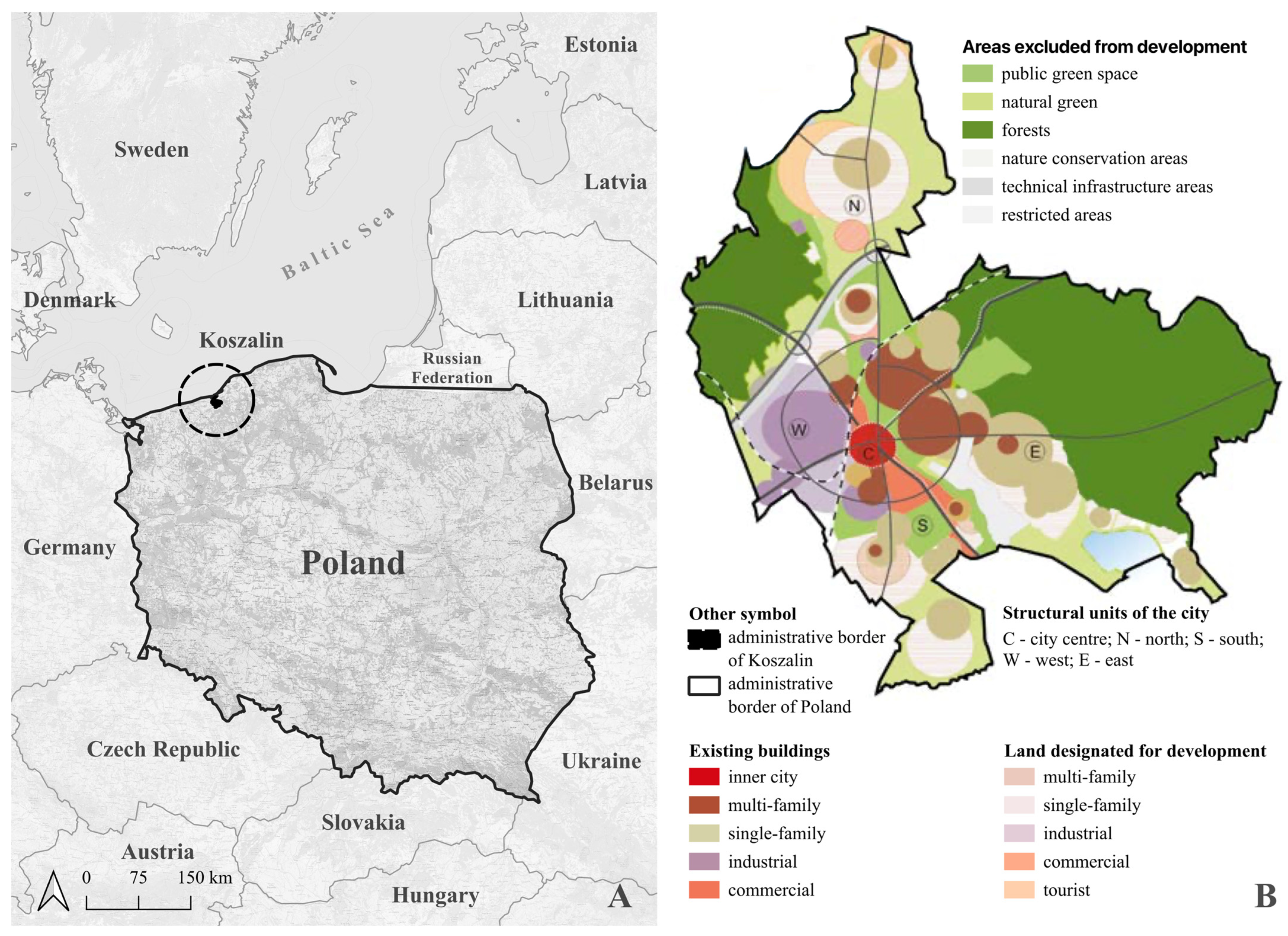
Figure 1. The geographical location of Koszalin and its functional and spatial structure ((A)—Geographical location; (B)—Functional and spatial structure). Source: Authors’ own elaboration based on the Openstreet Map resources and [9].
Sustainability 17 10157 g001
Figure 2. Spatial distribution of services with defined 15 min accessibility areas in the city of Koszalin: (a) grocery stores, (b) healthcare facilities, (c) public transport, (d) education, (e) green areas. Source: Authors’ own elaboration based on data sources listed in Table 3.
Sustainability 17 10157 g002aSustainability 17 10157 g002bSustainability 17 10157 g002c
Figure 3. Service accessibility index values across grid cells in Koszalin. Source: Authors’ own elaboration based on data sources listed in Table 3.
Sustainability 17 10157 g003
Figure 4. Spatial distribution of services and 15 min accessibility areas in Koszalin under varying assumptions of pedestrian walking speed (ranges: 0.75 km, 1.00 km, 1.25 km): (a) grocery stores, (b) healthcare facilities, (c) public transport, (d) education.
Sustainability 17 10157 g004aSustainability 17 10157 g004b
Table 1. Connections between the 15 min city concept and other urban development models.
ConceptConnection with the 15 min City
Sustainable cityThe 15 min city proposes a spatial organisation in which all essential services are accessible within a short walk or bike ride. This supports emissions reduction and promotes sustainable mobility. In doing so, it aligns with the idea of a sustainable city that emphasises ecological urban solutions, social integration, and efficient resource use [28].
Healthy cityThe 15 min city promotes proximity to services, green areas, and recreational spaces, which fosters daily physical activity, reduces emissions, and strengthens social bonds [29]. These are also key components of the healthy city model, which focuses on creating environments that support physical, mental, and social well-being.
Compact cityBoth concepts promote the concentration of urban functions, mixed land use, and multifunctional urban spaces [30]. They aim to allow residents to meet daily needs within proximity to their homes, minimising the need for long commutes and reliance on private cars.
Climate adaptive cityBoth concepts share a vision of creating urban environments that are human-centred and responsive to climate challenges [31]. Through local accessibility, greenery, and emissions reduction, the 15 min city enhances not only the quality of life but also resilience to extreme weather events, such as heatwaves and heavy rainfall, which is crucial for climate adaptation.
Green cityBoth approaches envision cities that are people-friendly and environmentally responsive. The 15 min city, through its emphasis on local services, green areas, and emissions reduction, contributes to climate resilience and aligns well with the idea of a green city focused on nature, low emissions, and sustainable development [32].
Smart cityThe two concepts are connected by a shared goal of creating healthy, inclusive, and sustainable urban spaces. The 15 min city encourages proximity-based living and reduced emissions, which supports the smart city vision of integrating technology, ecological lifestyles, and efficient urban systems [33].
Resilient cityBoth concepts are closely aligned in their pursuit of sustainable, flexible, and self-sufficient urban structures. They focus on locality, functional diversity, and the proximity of essential services, all of which enhance a city’s capacity to adapt to and recover from crises [34]. The presence of short travel distances, well-developed pedestrian and cycling infrastructure, and strong local communities contributes to making the city both more resilient and more “15-min”.
Liveable cityBoth concepts underline easy access to essential services (education, healthcare, retail, recreation), safe and inclusive public spaces, active mobility, a healthy urban environment (clean air, green areas), and a balance between residential, service, and recreational functions [35].
Walkable cityThe 15 min city and the walkable city share the fundamental principle that daily life should take place within close reach and in an environment designed for pedestrians [36]. By ensuring proximity to services, high-quality public spaces, and limiting car traffic, the 15 min city effectively implements the walkable city idea in practice.
Source: Authors’ compilation based on: [28,29,30,31,32,33,34,35,36].
Table 2. Key Characteristics of Koszalin.
FeatureUnitYearValue
Population densityInhabitants/km220241069
Share of population in the post-labour age%202428
Rate of unemployment%20244.7
Supply of public transport per capitaVehicle-kilometres per inhabitant202430.3
Individual motorisation rateCars/1000 inhabitants2024620
Share of green areas and forests%202444.5
Density of cycling laneskms/km220231.14
Source: Authors’ compilation based on: [48,49,50].
Table 3. Data Sources for Mapping Services in Koszalin.
SourceDescription
https://www.koszalin.pl (accessed on 2 April 2025)Official website of the City of Koszalin; source for addresses and metadata on municipal public facilities.
https://okazjum.pl (accessed on 2 April 2025)Retail store-locator aggregator; used to verify the presence and addresses of grocery outlets.
https://www.kuratorium.szczecin.pl (accessed on 2 April 2025)Regional Board of Education (West Pomeranian Voivodeship); directory of schools and their addresses.
https://mzk.koszalin.pl (accessed on 2 April 2025)Municipal public transportation operator; source for locating transit stops.
Google Maps, https://maps.google.com/ (accessed on 7 May 2025)Used for geocoding and checking facility locations.
Database of Topographic Objects (BDOT10k)Poland’s national 1:10,000 topographic database provides administrative boundaries, points of interest, and green areas.
OpenStreetMap, https://www.openstreetmap.org/ (accessed on 9 April 2025)Community-maintained geospatial database; used for points of interest, the communication network (roads and pedestrian), the green areas.
Source: Authors’ own elaboration.
Table 4. Accessibility and spatial coverage of selected urban services in Koszalin.
Type of ServiceNumber of FacilitiesArea [km2]City Area [%]City Area (Excl. Forests) [%]
RetailGrocery stores25638.5136%49%
HealthcareTotal-18.7418%24%
Health centers3623.2122%30%
Dental clinics2619.8319%25%
Public transportBus stop37659.4556%76%
EducationTotal-14.7114%35%
Public primary schools2418.4417%24%
Kindergartens4225.1524%32%
Nurseries2418.8118%24%
Source: Authors’ own elaboration based on data sources listed in Table 3.
Table 5. Area of zones by cumulative service accessibility index and their share in Koszalin’s total area.
Accessibility Index
(Sum of Available Services)
Adaptation to the
15 min City Concept [%]
Area
[km2]
City Area
[%]
City Area
(Excl. Forests) [%]
At least 120%101.2092%100%
At least 240%55.0550%67%
At least 360%42.4739%51%
At least 480%31.9729%39%
At least 5100%11.9311%14%
Source: Authors’ own elaboration based on data sources listed in Table 3.
Table 6. Accessibility and spatial coverage of selected urban services in Koszalin by assumed walking speed (3, 4 and 5 km/h).
Type of ServiceCity Area Share (Excluding Forests) Under Different Assumed Walking Speeds
3 km/h [%]4 km/h [%]5 km/h [%]Δ (5–3) [pp]Relative Change [%]
RetailGrocery stores3949592050%
HealthcareTotal16243216102%
Health centers2230361466%
Dental clinics1825331586%
Public transportBus stop6476862335%
EducationTotal13193219146%
Public primary schools1824291159%
Kindergartens2532401563%
Nurseries1724291272%
Source: Authors’ own elaboration based on data sources listed in Table 3.
Disclaimer/Publisher’s Note: The statements, opinions and data contained in all publications are solely those of the individual author(s) and contributor(s) and not of MDPI and/or the editor(s). MDPI and/or the editor(s) disclaim responsibility for any injury to people or property resulting from any ideas, methods, instructions or products referred to in the content.