
Port Transformation and Community Decline in a Fishing Neighborhood: The Case of El Varadero in the Port of Motril (Spain)


Abstract
1. Introduction
1.1. Sense of Belonging to the Neighborhood
1.2. The Present Study
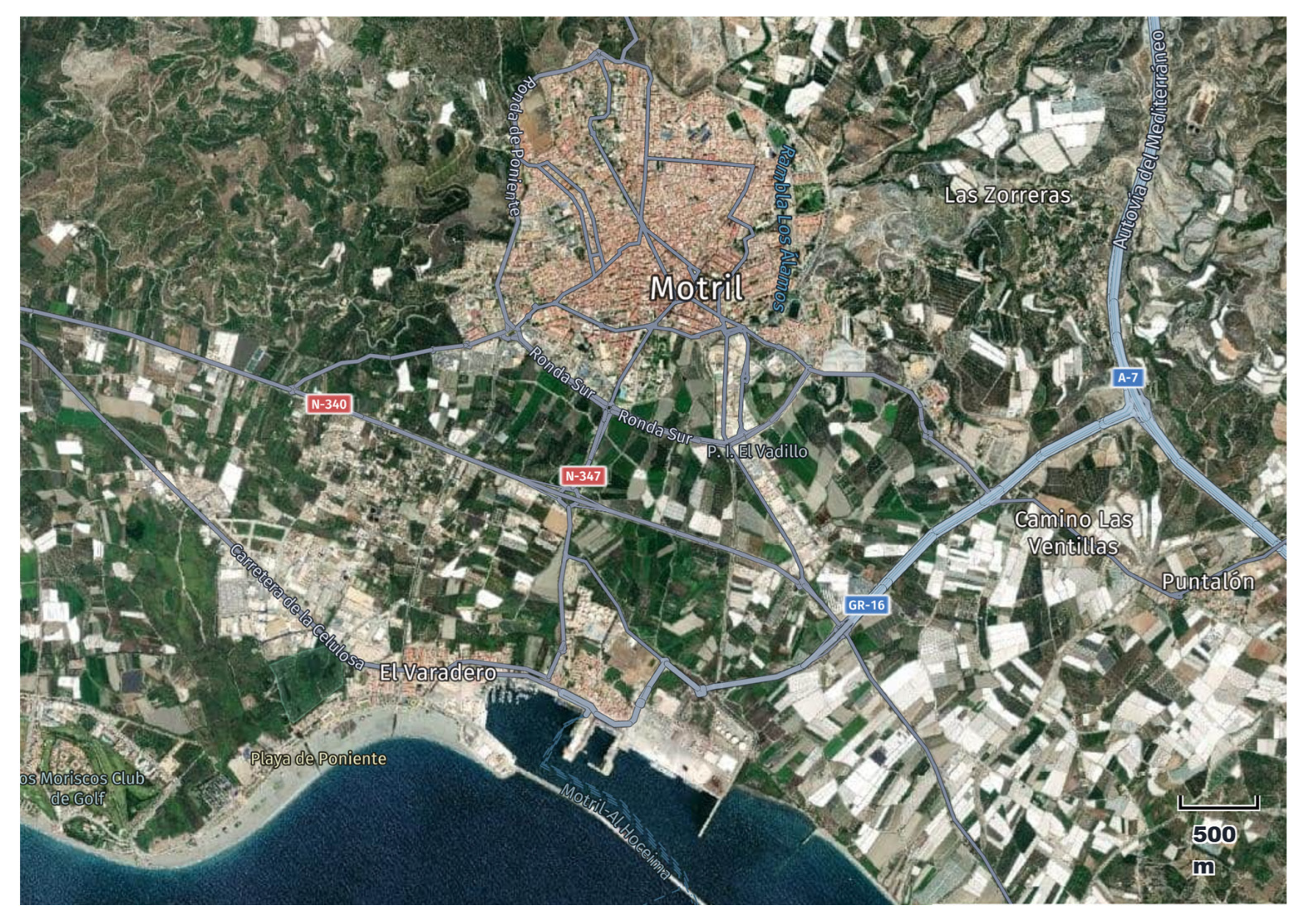
2. Study Area
3. Methods
3.1. Survey Participants
3.2. Key Informants
3.3. Survey Instruments
4. Results
4.1. Perceived Problems and Collective Self-Efficacy
4.2. Sense of Community and Community Assets
4.3. Thematic Analysis of Perceived Problems
4.4. Key Informant Analysis
“Granada was not a maritime province. It belonged to Almeria. The technicians came from there. At that time, we were dedicated almost exclusively to fishing. Our income was from fishing. At school, it was clear to us that we were going to be fishermen. In 2005, the Port Authority of Granada was created. Technicians arrived from Granada and from abroad. Cargo traffic began to develop. Between 2008 and 2014, 60 percent of the fishing vessels were lost. Now, we have become a nuisance. The port authority keeps pushing us further and further away. If we disappear, we’ll be doing them a favor…”.(E1, head of the Fishermen’s Guild)
“The port has grown without considering its people. The port has always relied on fishing, but there came a point when it changed, and goods began to have greater relevance”.(E1, head of the Fishermen’s Guild)
“This has always been a fishing port. But now the merchant sector is dominant and there are fewer and fewer fishing boats left. They will renovate the port in a few years, and the fishing port will be moved from here (…). This could take a lot of life out of the neighborhood, which will be completely surrounded by the infrastructure of the commercial port”.(E3, president of the Neighborhood Association)
“Here, the most important thing for the people of El Varadero was that the La Azucena beach was there, but with the construction and expansion of the port, they lost direct access”.(E3, president of the Neighborhood Association)
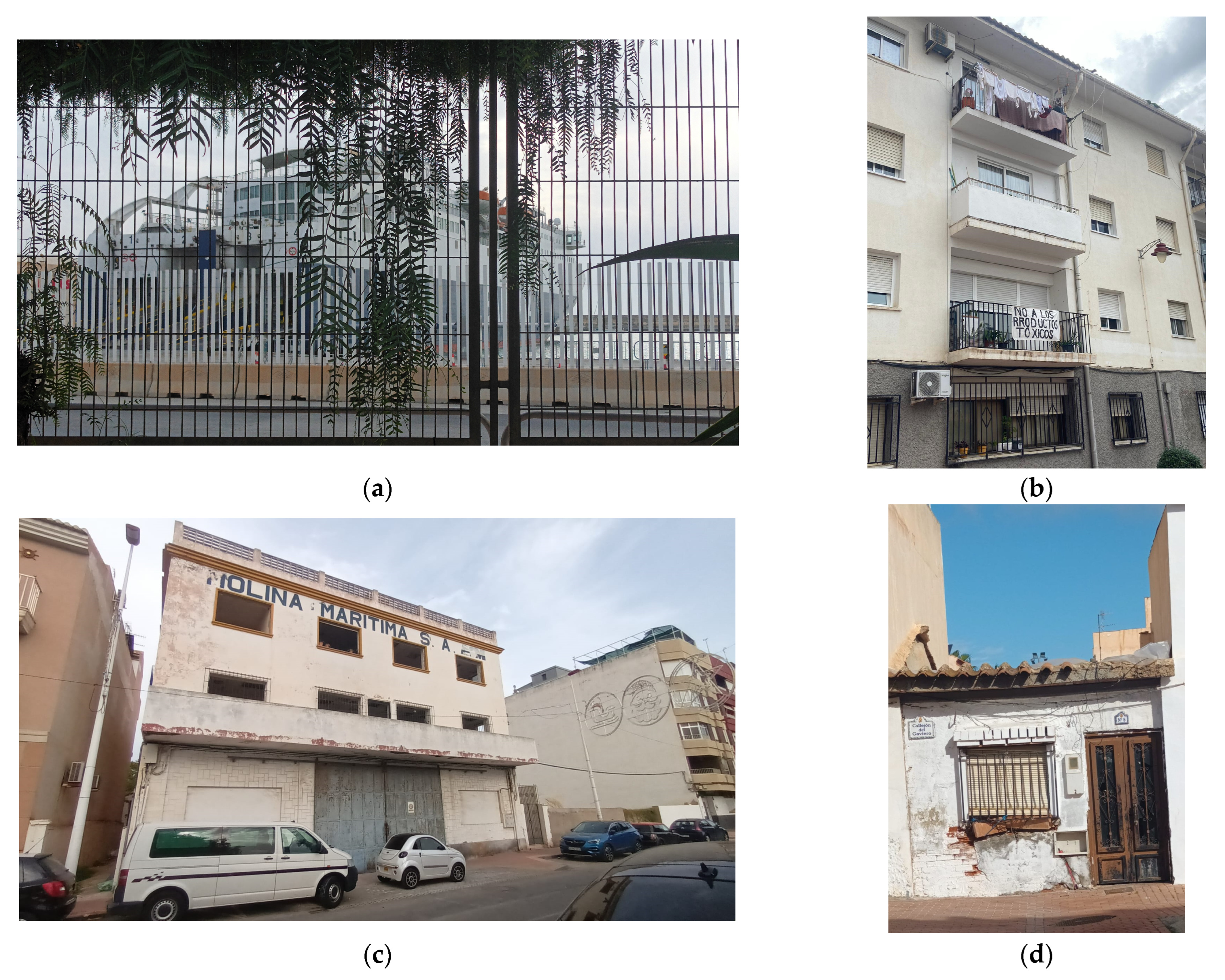
“When the entrance to the neighborhood was cut off, it took away its life because that was like putting a wall or a roof on what was the port… and then the neighborhood was left isolated”.(E4, fishing sector entrepreneur)
“They have taken the beach, they are going to take the fishing port, and they are going to leave us surrounded by the port platform. The only thing left would be for them to buy all the houses and take over the whole neighborhood. I wouldn’t be surprised if that happened one day, as the port is getting bigger and bigger and needs logistics areas”.(E3, president of the Neighborhood Association)
“El Varadero was a fishing neighborhood before it was a port… Now, the opportunities generated by the port benefit outsiders—the technicians. Those of us from the neighborhood only have the option of fishing, and that’s it. That’s why when I hear the port authority claim they are an “open port,” it’s something I can’t understand; it bothers me…”.(E1, head of the Fishermen’s Guild)
“El Varadero has a great history: a seafaring history because it is a seafaring neighborhood. Here, we call someone a ‘Marengo’ if they live, grow up, and have always lived by the sea. This culture is not found in other neighborhoods. What sets it apart from other neighborhoods is precisely the link between the sea and the people here”.(E2, administrator of a Facebook group about fishing communities)
“My identity is Marenga (That is, Mediterranean maritime identity); it comes from the people of the sea, and all my family or those around us have lived, in one way or another, through fishing (…). I remember going to the fish market with my father, who was a fisherman, and then we had a business, a fish restaurant. I was 5 or 6 years old; I would walk around the fish market; the fish was in the boxes, on the floor. So, of course, I have walked in that water, in those boxes… that smell, every day on my body, in my nose, in my senses…”.(E5, former fisheries councilor)
“And we must not forget that many people returned to fishing, seeking refuge during the construction crisis”.(E1, head of the Fishermen’s Guild)
“In El Varadero, there were a lot of bars, businesses, stores. It was a hive of activity, there was a lot of life, and the neighborhood port, the port of El Varadero, was very important”.(E2, Administrator of a Facebook group about fishing neighborhoods)
“Varadero used to have more life because we were more involved in the port. We were all people from the town. My parents came from Malaga. I arrived on 25 January 1947, when I was 10 years old, and we came to sell fish, to work at the fish market (…). Now, they treat it as a neighborhood that is a little bit abandoned. However, in the 50s and 60s, there was a fabulous festival here, the Virgen del Carmen, which was celebrated with so much glory, so much joy”.(E4, fishing industry entrepreneur)
“The neighbors here feel excluded; they believe, in their minds, that everything happens in Playa Granada or Motril center, that attention is directed to other more prominent neighborhoods”.(E2, administrator of a Facebook group about fishing neighborhoods)
“Over time, it has deteriorated a bit… Those who could leave have left, and those who couldn’t are stuck here in a place that is no longer truly a fishing community”.(E1, head of the Fisherman’s Guild)
“…that Motril looks towards the sea, that Motril does not turn its back on the sea, because the most precious treasure that Motril has is its fishing port; we are the only fishing port in the province of Granada”.(E5, former fisheries councilor)
5. Discussion
5.1. The Transformation of the Fishing Port into a Maritime Transport Hub
5.2. Relegation and Decline of the Fishing District
5.3. Implications for Sustainable Development
6. Conclusions
Author Contributions
Funding
Institutional Review Board Statement
Informed Consent Statement
Data Availability Statement
Acknowledgments
Conflicts of Interest
References
- Thompson, C.; Johnson, T.; Hanes, S. Vulnerability of fishing communities undergoing gentrification. J. Rural Stud. 2016, 45, 165–174. [Google Scholar] [CrossRef]
- Khakzad, S.; Griffith, D. The role of fishing material culture in communities’ sense of place as an added-value in management of coastal areas. J. Mar. Isl. Cult. 2016, 5, 95–117. [Google Scholar] [CrossRef]
- Brakel, J.T. A Maritime Sense of Place: Southeast Alaska Fishermen and Mainstream Nature Ideologies; University of Alaska Fairbanks: Fairbanks, AK, USA, 1999. [Google Scholar]
- Delgado-Ramírez, C.E.; Ota, Y.; Cisneros-Montemayor, A.M. Fishing as a livelihood, a way of life, or just a job: Considering the complexity of “fishing communities” in research and policy. Rev. Fish Biol. Fish. 2023, 33, 265–280. [Google Scholar] [CrossRef]
- Alexander, S.M.; Bodin, Ö.; Barnes, M.L. Untangling the drivers of community cohesion in small-scale fisheries. Int. J. Commons 2018, 12, 519–547. [Google Scholar] [CrossRef]
- St Martin, K.; Hall-Arber, M. Creating a place for” Community” in New England fisheries. Hum. Ecol. Rev. 2008, 15, 161–170. [Google Scholar]
- Sarason, S.B. The Psychological Sense of Community: Prospects for a Community Psychology; Jossey-Bass: San Francisco, CA, USA, 1974. [Google Scholar]
- McMillan, D.W.; Chavis, D.M. Sense of community: A definition and theory. J. Community Psychol. 1986, 14, 6–23. [Google Scholar] [CrossRef]
- Jason, L.A.; Stevens, E.; Ram, D. Development of a three-factor psychological sense of community scale. J. Community Psychol. 2015, 43, 973–985. [Google Scholar] [CrossRef]
- Fisher, A.T.; Sonn, C.C.; Bishop, B.J. (Eds.) Psychological Sense of Community: Research, Applications, and Implications; Springer Science & Business Media: Berlin/Heidelberg, Germany, 2002. [Google Scholar]
- Hill, J.L. Psychological sense of community: Suggestions for future research. J. Community Psychol. 1996, 24, 431–438. [Google Scholar] [CrossRef]
- Wood, L.; Frank, L.D.; Giles-Corti, B. Sense of community and its relationship with walking and neighborhood design. Soc. Sci. Med. 2010, 70, 1381–1390. [Google Scholar] [CrossRef]
- Toohey, A.M.; McCormack, G.R.; Doyle-Baker, P.K.; Adams, C.L.; Rock, M.J. Dog-walking and sense of community in neighborhoods: Implications for promoting regular physical activity in adults 50 years and older. Health Place 2013, 22, 75–81. [Google Scholar] [CrossRef] [PubMed]
- Dipeolu, A.A.; Ibem, E.O.; Fadamiro, J.A. Influence of green infrastructure on sense of community in residents of Lagos Metropolis, Nigeria. J. Hum. Behav. Soc. Environ. 2020, 30, 743–759. [Google Scholar] [CrossRef]
- Small, M.L.; Calarco, J.M. Qualitative Literacy. A Guide to Evaluating Ethnographic and Interview Research; University of California Press: Oakland, CA, USA, 2022. [Google Scholar]
- Jakes, S.; Shannon, L. Community Assets Survey; The University of Arizona: Tucson, AZ, USA, 2002. [Google Scholar]
- Hombrados-Mendieta, I.; López-Espigares, T. Dimensiones del sentido de comunidad que predicen la calidad de vida residencial en barrios con diferentes posiciones socioeconómicas. Psychosoc. Interv. 2014, 23, 159–167. [Google Scholar] [CrossRef]
- Sampson, R.J. Great American City: Chicago and the Enduring Neighborhood Effect; University of Chicago Press: Chicago, IL, USA, 2012. [Google Scholar]
- Cope, M.R.; Ward, C.; Jackson, J.E.; Muirbrook, K.A.; Andre, A.N. Taking another look at the sense of community index: Six confirmatory factor analyses. J. Community Psychol. 2020, 48, 1410–1423. [Google Scholar] [CrossRef] [PubMed]
- Wellman, B.; Leighton, B. Networks, neighborhoods, and communities: Approaches to the study of the community question. Urban Aff. Q. 1979, 14, 363–390. [Google Scholar] [CrossRef]
- Claesson, S.; Robertson, R.A.; Hall-Arber, M. Fishing heritage festivals, tourism, and community development in the Gulf of Maine. In Proceedings of the 2005 Northeastern Recreation Research Symposium, Bolton Landing, NY, USA, 10–12 April 2005; Volume 341, pp. 420–428. [Google Scholar]
- Jacob, S.; Witman, J. Human ecological sources of fishing heritage and its use in and impact on coastal tourism. In Proceedings of the 2006 Northeastern Recreation Research Symposium, New York, NY, USA, 9–11 April 2006; Burns, R., Robinson, K., Eds.; U.S. Department of Agriculture: Washington, DC, USA, 2006; pp. 394–402. [Google Scholar]
- de Madariaga, C.J.; del Hoyo, J.C. Enhancing of the cultural fishing heritage and the development of tourism: A case study in Isla Cristina (Spain). Ocean Coast. Manag. 2019, 168, 1–11. [Google Scholar] [CrossRef]
- Martindale, T. Heritage, skills and livelihood: Reconstruction and regeneration in a Cornish fishing port. In Social Issues in Sustainable Fisheries Management; Springer: Dordrecht, The Netherlands, 2014; pp. 279–299. [Google Scholar]
- Tommarchi, E.; Jonas, A.E.G. Culture-led regeneration and the contestation of local discourses and meanings: The case of European maritime port cities. Urban Geogr. 2024, 46, 632–652. [Google Scholar] [CrossRef]
- Enthoven, L. How do local communities perceive marine protected area governance, management, surrounding development, and outcomes? A systematic review. J. Environ. Manag. 2025, 391, 126570. [Google Scholar] [CrossRef]
- González, R.C.L.; Piñeiro Antelo, M.Á. Fishing Tourism as an Opportunity for Sustainable Rural Development—The Case of Galicia, Spain. Land 2020, 9, 437. [Google Scholar] [CrossRef]
- Kuo, C.C. A Study on Strategic Planning of Fishery Port Transformation for Tourism and Recreational Development. Master’s Thesis, National Sun Yat-sen University, Taiwan, China, 2006. [Google Scholar]
- Lange, I.S.G.; Ounanian, K. From fishing port to transport hub?: Local voices on the identity of places and flows. PORTUSplus 2020, 10, 22. [Google Scholar]
- Gripaios, P.; Gripaios, R. The impact of a port on its local economy: The case of Plymouth. Marit. Policy Manag. 1995, 22, 13–23. [Google Scholar] [CrossRef]
- Ou, Z.; Ma, G. Marginalisation of the Dan fishing community and relocation of Sanya fishing port, Hainan Island, China. Isl. Stud. J. 2017, 12, 143–158. [Google Scholar] [CrossRef]
- Wilewska-Bien, M.; Anderberg, S. Reception of sewage in the Baltic Sea–The port’s role is in the sustainable management of ship wastes. Mar. Policy 2018, 93, 207–213. [Google Scholar] [CrossRef]
- Tichavska, M.; Tovar, B. Port-city exhaust emission model: An application to cruise and ferry operations in Las Palmas Port. Transp. Res. Part A Policy Pract. 2015, 78, 347–360. [Google Scholar] [CrossRef]
- Richmond, L.; Dumouchel, R.; Pontarelli, H.; Casali, L.; Smith, W.; Gillick, K.; Godde, P.; Dowling, M.; Suarez, A. Fishing community sustainability planning: A roadmap and examples from the California coast. Sustainability 2019, 11, 1904. [Google Scholar] [CrossRef]
- Richmond, L.; Casali, L. The role of social capital in fishing community sustainability: Spiraling down and up in a rural California port. Mar. Policy 2022, 137, 104934. [Google Scholar] [CrossRef]
- Anguís-Climent, D. Puertos, Arquitectura, Patrimonio. Los Puertos Autonómicos en Andalucía. Ph.D. Thesis, Universidad de Sevilla, Seville, Spain, 2008. [Google Scholar]
- Ruiz Seisdedos, M. Puerto de Motril (Granada): Transformación de un puerto al servicio del tráfico de pasajeros. In XIV Jornadas Españolas de Ingeniería de Costas y Puertos; Gómez-Martín, E.E., Ed.; Universitat Politècnica de València: Valencia, Spain, 2018; pp. 623–632. [Google Scholar]
- Bajurec, P. Ficha Análisis Puertos Estatales Andalucía; Asociación Paisaje Limpio: Madrid, Spain, 2022; 419p, Available online: https://www.programapleamar.es/sites/default/files/archivos/proyectos/2023/ficha_analisis_puertos_pesqueros_estatales.pdf (accessed on 11 November 2024).
- Ghate, A.D.; Roy, J. Local Community Participation based Ecotourism Management for Sustainable Development of Marine Protected Areas. Nat. Eng. Sci. 2024, 9, 222–232. [Google Scholar] [CrossRef]
- Hussain, R.; Bakar, N.A.A.; Zairul, M.; D’Silva, J.L. Exploration of Fisheries Tourism as an Alternative to Diversify the Livelihoods of the Fishing Communities in Kampung Kuala Muda. Int. J. Acad. Res. Bus. Soc. Sci. 2024, 14, 1598–1619. [Google Scholar] [CrossRef]
- Cayuela, P. Estudio Sobre el Emprendimiento Femenino en las Zonas de Pesca de Andalucía. Fomento de la Cultura Emprendedora y de las Actividades Empresariales Ligadas a la Pesca Realizadas Por Mujeres. [Study on Female Entrepreneurship in the Fishing Areas of Andalusia. Promoting an Entrepreneurial Culture and Fishing-Related Business Activities Undertaken by Women.] Grupos de Desarrollo Pesquero Andaluces. 2017. Available online: https://www.pescamalaga.org/wp-content/uploads/2017/02/4.-Emprendedoras-en-las-Zonas-de-Pesca.-Casos-pr%C3%A1cticos..pdf (accessed on 8 August 2025).
- Harper, S.; Grubb, C.; Stiles, M.; Sumaila, U.R. Contributions by Women to Fisheries Economies: Insights from Five Maritime Countries. Coast. Manag. 2017, 45, 91–106. [Google Scholar] [CrossRef]
- Calhoun, S.; Conway, F.; Rusell, S. Acknowledging the voice of women: Implications for fisheries management and policy. Mar. Policy 2016, 74, 292–299. [Google Scholar] [CrossRef]
- Penca, J.; Ertör, I.; Ballesteros, M.; Briguglio, M.; Kowalewski, M.; Pauksztat, B.; Cepic, D.; Piñeiro-Corbeira, C.; Vaidianu, N.; Pascual-Fernández, J.J.; et al. Rethinking the Blue Economy: Integrating social science for sustainability and justice. npj Ocean Sustain. 2025, 4, 40. [Google Scholar] [CrossRef]
- Fernando, A.M.E.; Lopes, D.A.; Mateus, L.; Penha, J.; Súarez, Y.R.; Catella, A.C.; Nunes, A.V.; Arenhart, N.; Chiaravalloti, R.M. The economic displacement of thousands of fishers in the Pantanal, Brazil: A telling story of small-scale fisheries marginalization worldwide. Fish Fish. 2024, 25, 951–958. [Google Scholar] [CrossRef]
- Debrie, J.; Raimbault, N. The port–city relationships in two European inland ports: A geographical perspective on urban governance. Cities 2016, 50, 180–187. [Google Scholar] [CrossRef]
- Di Maso, A.; Capo, F.; Sancino, A.; Gerli, P.; Mora, L. Because we love our place: The role of emotions in place-based leadership. Reg. Stud. 2025, 59, 2529953. [Google Scholar] [CrossRef]


| El Varadero | Urban Center | |||||
|---|---|---|---|---|---|---|
| M | SD | M | SD | t | P | |
| Unemployment | 3.34 | 1.2 | 2.45 | 1.2 | 2.913 | ** |
| Poor sanitation and waste management | 3.37 | 1.1 | 2.48 | 1.1 | 3.150 | *** |
| Crime | 3.40 | 1.2 | 2 | 1 | 4.859 | *** |
| Noise | 3.90 | 1.2 | 2.69 | 1.4 | 3.694 | *** |
| Disputes among neighbors | 2.65 | 1.2 | 1.48 | 0.5 | 4.780 | *** |
| Drug trafficking and consumption | 3.75 | 1.3 | 2 | 1.2 | 5.338 | *** |
| Immigrant integration problems | 2.87 | 1.4 | 2.18 | 1.3 | 1.988 | * |
| Excessive tourism | 1.75 | 0.9 | 1.24 | 0.5 | 2.632 | ** |
| Poverty | 2.96 | 1.2 | 2.03 | 0.9 | 3.358 | *** |
| House prices | 3.06 | 1.3 | 3.36 | 1.2 | −0.929 | |
| Poor quality of public services | 3.15 | 1.2 | 2.18 | 1 | 3.419 | *** |
| Reduced number of fishing vessels | 4.12 | 0.9 | 2.18 | 1.4 | 6.398 | *** |
| El Varadero | Urban Center | |||||
|---|---|---|---|---|---|---|
| Scenario | M | SD | M | SD | t | P |
| Witnessing a fight in the Street | 2.68 | 1.3 | 2.69 | 1.2 | −0.030 | |
| Believing it is necessary to improve the cleanliness of streets and public spaces. | 2.90 | 1.2 | 2.72 | 1 | 0.635 | |
| Experiencing a reduced number of healthcare staff at the nearest health center | 2.68 | 1.4 | 2.81 | 1.3 | −0.373 | |
| Perceiving problems related to port activity | 3.18 | 0.9 | 1.78 | 0.9 | 5.860 | *** |
| Witnessing an adult using drugs in public | 2.06 | 1.4 | 2.33 | 1.5 | −0.724 | |
| Seeing someone attempting to steal a girl’s cell phone. | 3.43 | 1.3 | 3.24 | 1.1 | 0.637 | |
| Experiencing traffic and parking problems | 1.93 | 1.1 | 2.33 | 1.2 | −1.32 | |
| Detecting environmental pollution and noise problems | 3.21 | 1.1 | 2.57 | 1.1 | 2.251 | * |
| El Varadero | Urban Center | |||||
|---|---|---|---|---|---|---|
| M | SD | M | SD | t | P | |
| I think this is a good neighborhood | 3.62 | 1.6 | 5.30 | 0.7 | −5.4 | |
| I have no plans to leave this neighborhood | 3.90 | 1.9 | 4.81 | 1.6 | −2 | * |
| This neighborhood is a good place for me | 3.90 | 1.8 | 5.30 | 1 | −3.8 | *** |
| There is reciprocity among the residents in this neighborhood. | 4.46 | 1.3 | 4.75 | 1.1 | −0.9 | |
| Neighbors can get help from one another if needed. | 4.46 | 1.3 | 4.93 | 1.2 | −1.4 | |
| Neighbors feel safe when sharing opinions or asking for advice | 3.53 | 1.4 | 4.33 | 0.9 | −2.6 | ** |
| This neighborhood is important to me | 4.71 | 1.8 | 5.18 | 1 | −1.2 | |
| I have friends in this neighborhood | 5.12 | 1.5 | 4.69 | 1.7 | 1.06 | |
| I feel good helping the neighborhood and its residents. | 4.87 | 1.3 | 5.21 | 0.7 | −1.2 | |
| Entity | 3.81 | 1.4 | 5.14 | 0.9 | −4.31 | *** |
| Membership | 4.15 | 0.9 | 4.67 | 0.9 | −2.19 | * |
| Self | 4.90 | 1.3 | 5.03 | 0.8 | −0.44 | |
| PSOC | 4.29 | 1.08 | 4.94 | 0.5 | −3.12 | *** |
| El Varadero | Urban Center | |||||
|---|---|---|---|---|---|---|
| Factors | M | SD | M | SD | t | P |
| Residential support | 2.906 | 0.57 | 2.978 | 0.76 | −0.436 | |
| Physical factors | 2.656 | 0.70 | 3.327 | 0.91 | −3.307 | *** |
| Financial support | 2.462 | 0.46 | 2.733 | 0.58 | −2.051 | * |
| Motivation | 2.993 | 1.10 | 3.103 | 1.19 | −0.382 | |
| Participation | 3.046 | 1.01 | 2.848 | 1.20 | 0.718 | |
| Empowerment | 3.097 | 0.72 | 3.023 | 0.73 | 0.407 | |
| Institutional support | 2.537 | 0.95 | 3.036 | 0.92 | 0.757 | * |
| Collective self-efficacy | 2.937 | 0.54 | 2.915 | 0.70 | 0.066 | |
| Assets scale | 2.850 | 0.43 | 3.001 | 0.54 | −1.227 | |
Disclaimer/Publisher’s Note: The statements, opinions and data contained in all publications are solely those of the individual author(s) and contributor(s) and not of MDPI and/or the editor(s). MDPI and/or the editor(s) disclaim responsibility for any injury to people or property resulting from any ideas, methods, instructions or products referred to in the content. |
© 2025 by the authors. Licensee MDPI, Basel, Switzerland. This article is an open access article distributed under the terms and conditions of the Creative Commons Attribution (CC BY) license (https://creativecommons.org/licenses/by/4.0/).
Share and Cite
Maya-Jariego, I.; Florido-del-Corral, D.; Uchoa-Dantas, M.R. Port Transformation and Community Decline in a Fishing Neighborhood: The Case of El Varadero in the Port of Motril (Spain). Sustainability 2025, 17, 10140. https://doi.org/10.3390/su172210140
Maya-Jariego I, Florido-del-Corral D, Uchoa-Dantas MR. Port Transformation and Community Decline in a Fishing Neighborhood: The Case of El Varadero in the Port of Motril (Spain). Sustainability. 2025; 17(22):10140. https://doi.org/10.3390/su172210140
Chicago/Turabian StyleMaya-Jariego, Isidro, David Florido-del-Corral, and Mateus Rafael Uchoa-Dantas. 2025. "Port Transformation and Community Decline in a Fishing Neighborhood: The Case of El Varadero in the Port of Motril (Spain)" Sustainability 17, no. 22: 10140. https://doi.org/10.3390/su172210140
APA StyleMaya-Jariego, I., Florido-del-Corral, D., & Uchoa-Dantas, M. R. (2025). Port Transformation and Community Decline in a Fishing Neighborhood: The Case of El Varadero in the Port of Motril (Spain). Sustainability, 17(22), 10140. https://doi.org/10.3390/su172210140