1. Introduction
Innovation is a cornerstone of long-term corporate sustainability, enhancing firm competitiveness and contributing to broader economic development [
1,
2]. However, innovation activities are typically characterized by high sunk costs, uncertain outcomes, and limited access to external financing, and thus require stable and substantial internal financial support [
3,
4]. In this context, tax incentives, such as research and development (R&D) credits and corporate tax reductions, have been regarded as important policy tools for alleviating firms’ financial constraints and promoting innovation [
5,
6,
7,
8].
Empirical evidence generally supports the positive impact of these government-led tax policies on innovation outcomes [
9,
10,
11]. However, this policy-centric focus often overshadows the potential influence of firm-level tax strategies [
12,
13]. Although the macroeconomic effects of tax incentives have been studied extensively, relatively little is known about how corporate-level tax strategies affect innovation. This research gap is particularly salient considering increasing global scrutiny of corporate tax practices, as reflected in international initiatives, such as the OECD’s Base Erosion and Profit Shifting project.
Taxes are a major cost component in corporate decision-making, and strategic tax planning can increase the amount of internal funds that firms have available for long-term investments. From a financing perspective, tax avoidance is considered a legitimate approach to minimizing tax liabilities, thereby enabling firms to retain more earnings and reinvest them into innovation-related activities [
14,
15,
16]. However, agency theory offers a more skeptical perspective. Tax avoidance can reduce transparency and increase information asymmetry, thus undermining internal governance mechanisms and leading to inefficient resource allocation, ultimately discouraging value-enhancing investments [
17,
18]. Moreover, tax avoidance often entails regulatory scrutiny, litigation exposure, and reputational risk, all of which are more closely aligned with short-term financial incentives than long-term sustainability goals [
19,
20].
These competing perspectives suggest that although tax avoidance may offer financing benefits by increasing internal funds, it can simultaneously discourage innovation by weakening governance structures and promoting myopic managerial behavior. However, the net effect of tax avoidance on innovation remains theoretically contested and empirically underexplored. This study addresses this gap by examining the relationship between corporate tax avoidance strategies and innovation, thus contributing to the broader discourse on whether firm-level tax policies facilitate or hinder innovation in the context of sustainable corporate development.
This study investigates the moderating role of a firm’s broader strategic orientation, specifically its commitment to responsible business conduct, such as environmental, social, and governance (ESG) practices, to better understand the mechanisms underlying the relationship between corporate tax avoidance and innovation. ESG-engaged firms are more likely to implement robust governance structures and strengthen internal accountability, which can help mitigate managerial opportunism and ensure that internal resources, including tax savings, are allocated to productive innovation-related investments [
21,
22]. Furthermore, ESG-engaged firms tend to be embedded in broader stakeholder networks that promote trust-building, knowledge exchange, and absorptive capacity, which are essential capabilities for sustained innovation [
23,
24,
25]. These ESG-related mechanisms help align financial strategies with long-term sustainability goals, thereby enabling firms to leverage tax planning to support rather than undermine innovation efforts. Accordingly, this study empirically examines the moderating role of ESG practices in the relationship between tax avoidance and innovation. This approach provides a more comprehensive understanding of how the interaction between corporate tax strategies and responsible business conduct shapes innovation outcomes.
The empirical analysis in this study is conducted using a panel dataset of 12,408 firm-year observations of South Korean listed companies from 2014 to 2023. South Korea offers a particularly relevant institutional setting because of its well-established tax compliance infrastructure, increasing emphasis on ESG, and innovation-driven economy [
26,
27,
28]. Intellectual capital (IC) values, determined using Stewart’s [
29] calculated intangible value (CIV) method, are used as a proxy for innovation. A Tobit regression model is used, considering the non-negative and left-censored nature of IC values [
30]. Furthermore, pooled and random effects (RE) Tobit specifications are estimated and compared to enhance robustness and address potential bias from unobserved firm-specific heterogeneity [
31].
The analysis reveals a significant negative association between corporate tax avoidance and innovation, suggesting that the governance-related costs and short-term strategic orientation associated with tax avoidance may outweigh its financing benefits. However, this negative relationship is less pronounced in ESG-engaged firms and weakens as ESG performance strengthens, underscoring the moderating role of ESG practices in aligning tax strategies with long-term innovation goals. Notably, this moderating effect is primarily driven by the social and governance domains, indicating that integrating ESG principles helps offset the detrimental effects of tax avoidance by reinforcing governance structures and enhancing stakeholder alignment.
This study makes several contributions to the corporate strategy and innovation literature. First, it shifts the analytical focus from macro-level government-led tax policies to the micro-level effects of firm-specific tax strategies. The novelty of this perspective lies in its attention to corporate-level behavior, as prior research has primarily examined the impact of government tax policies on innovation. This study addresses a critical gap in the literature by extending the discussion of tax-policy implications beyond public policy instruments to include corporate tax strategies in the innovation context.
Second, by introducing ESG as a moderating factor, this study investigates its role in the relationship between corporate tax strategy and innovation. Although ESG considerations have gained prominence in corporate strategy, their moderating role in this context remains underexplored. Incorporating ESG into this framework fills this research gap and offers new theoretical insights into how corporations can pursue sustainable development through ESG practices. In particular, emphasizing the role of ESG in mitigating the negative effects of tax avoidance provides a more comprehensive understanding of how tax strategies can align with long-term value creation and sustainability objectives.
Third, this study offers valuable context-specific empirical evidence using data from South Korean listed firms in an institutional environment characterized by strict tax enforcement, an increasing emphasis on ESG, and a national focus on innovation-led growth. These contextual characteristics enhance the relevance of the findings and offer practical implications for corporate managers, investors, and policymakers committed to aligning business strategies with sustainable corporate development and long-term value creation.
The remainder of this paper is structured as follows.
Section 2 reviews the relevant literature and develops the research hypotheses.
Section 3 details the data and methodology used for the empirical analysis.
Section 4 presents the main empirical results, followed by additional analyses in
Section 5.
Section 6 discusses the theoretical and practical implications of the findings, and
Section 7 concludes the study.
2. Literature Review and Hypothesis Development
2.1. Literature Review
2.1.1. Corporate Innovation
Corporate innovation is widely recognized as a fundamental driver of competitive advantage and long-term economic growth [
2,
32]. However, innovation activities are often constrained by high sunk costs, uncertain returns, and limited access to external capital [
4,
33]. Consequently, stable and substantial internal financing is essential for supporting innovation. Policymakers and researchers have attempted to foster firm-level innovation by increasingly emphasizing the role of tax incentives, such as R&D tax credits or corporate tax reductions, as policy instruments aimed at alleviating financial constraints [
5,
6].
A substantial body of research has examined the effectiveness of tax incentives in fostering innovation, with empirical evidence generally supporting their positive influence on innovative activities [
10]. Atanassov and Liu [
11] found that corporate tax cuts in the US enhance innovation by easing financial constraints and increasing firms’ internal funds. Similarly, Mukherjee et al. [
7] analyzed staggered corporate income tax changes across the US, demonstrating that higher corporate tax rates are associated with reduced innovation. Bloom et al. [
9] reported that tax incentives significantly increase R&D intensity, based on data from nine OECD countries, while Czarnitzki et al. [
34] found that R&D tax credits significantly enhance innovation output among Canadian manufacturing firms.
However, an alternative perspective suggests that tax incentives may have limited or even negative effects on innovation. According to Tassey [
35], the US research and experimentation tax credit has historically been ineffective, with a negative relative impact in terms of stimulating domestic R&D activity. Furthermore, Atanassov and Liu [
11] noted that tax reductions can lead to higher state budget deficits or reduced government spending on public goods, such as research, education, and infrastructure, thereby diminishing positive spillover effects and constraining firm-level innovation. Despite the extensive literature on tax incentive policy and innovation, the role of firm-level tax policy in shaping innovation has received relatively little attention [
13].
2.1.2. Tax Strategy
Firm-level tax policy, often referred to as tax planning or tax avoidance, can be defined as the strategic minimization of tax liabilities [
14,
15]. The literature on tax strategies is primarily grounded in financing and agency theories, which offer contrasting perspectives on their implications for innovation. From the perspective of financing theory, tax avoidance serves as an internal financing mechanism that complements government-led tax incentives. By retaining a greater portion of after-tax earnings, firms may allocate these savings more efficiently—to productive investments such as R&D and technological development—than governments could through redistributed revenues [
16]. In contrast, agency theory posits that tax avoidance can intensify information asymmetry and create opportunities for managerial opportunism. Such opacity may weaken corporate governance, leading to inefficient investment decisions and the diversion of financial resources from long-term innovation initiatives toward short-term financial gains [
36,
37].
Overall, while tax avoidance can generate both beneficial and adverse effects on innovation, these mechanisms remain insufficiently understood and empirically underexplored. A more comprehensive examination of this relationship is essential for understanding the broader implications of tax policy, not only as a public policy instrument but also as a firm-level strategic choice that influences innovation performance and long-term sustainability.
2.1.3. ESG and Innovation
The integration of ESG factors into corporate strategy has gained increasing attention as firms seek to balance financial performance with long-term sustainability objectives [
38,
39]. Prior research suggests that ESG practices can improve governance quality, reduce information asymmetry, enhance stakeholder trust, and better align managerial incentives with long-term strategic goals [
22,
40,
41,
42].
From the perspectives of stakeholder and social network theories, ESG engagement promotes collaboration, information sharing, and legitimacy among diverse stakeholder groups, thereby fostering innovation and knowledge creation [
23,
43]. ESG-oriented firms tend to exhibit stronger risk management, greater transparency, and more efficient resource allocation, all of which enhance innovation performance [
24,
25,
44,
45,
46]. Despite the growing body of literature on ESG and innovation, few studies have examined the role of ESG within the tax strategy–innovation relationship. This omission leaves an important theoretical and empirical gap in understanding how ESG practices interact with corporate tax behavior to influence innovation outcomes.
2.1.4. Literature Gaps and Research Objectives
Although previous studies have extensively examined the effects of government tax policies on innovation, there remains a lack of micro-level evidence regarding how corporate tax strategies affect innovation performance. Furthermore, the moderating role of ESG practices in this relationship has received limited empirical and theoretical attention, despite growing interest in sustainable corporate strategy. This study addresses these gaps by employing panel data from South Korean listed firms to investigate the relationships among corporate tax avoidance, innovation, and ESG practices. Specifically, by introducing ESG as a moderating factor, this study explores whether and how ESG engagement and performance influence the relationship between tax avoidance and innovation. This analysis provides new insights into the complex interactions among sustainable business practices, corporate tax strategies, and innovation.
2.2. Hypothesis Development
Tax avoidance is a legitimate corporate strategy that allows firms to minimize their tax liability, thus enabling them to retain a greater share of their earnings and increase the availability of internal funds [
14,
15]. Innovation projects often involve substantial sunk costs, uncertain returns, and limited access to external financing, making internal funding particularly important for sustaining such activities [
3,
4,
47]. From a financing theory perspective, tax avoidance can serve as an effective financing tool that allows firms to invest in innovation and pursue long-term growth opportunities [
16].
However, agency theory offers a more critical perspective. Tax avoidance can facilitate managerial opportunism by allowing executives to prioritize their personal interests over shareholder value [
17]. Tax avoidance can reduce transparency and increase information asymmetry, thereby undermining governance mechanisms and leading to inefficient resource allocation [
18,
36,
37]. Moreover, tax avoidance is often associated with a short-term orientation because it can heighten regulatory scrutiny, litigation risk, and reputational damage when uncovered [
19,
20,
48]. This short-term focus can discourage investment in long-term strategic initiatives such as innovation [
49].
Considering these competing theoretical perspectives, the relationship between corporate tax avoidance and innovation remains ambiguous. Financing theory suggests that tax avoidance increases internal funds that can support innovation, whereas agency theory posits that it may hinder innovation through weakened governance and misaligned managerial incentives. Although tax avoidance may enhance a firm’s internal financing capacity, this study posits that governance-related drawbacks and short-term orientation are likely to outweigh the potential benefits for innovation. Accordingly, this study proposes the following hypotheses:
Hypothesis 1. There is a negative relationship between corporate tax avoidance and innovation.
The relationship between corporate tax avoidance and innovation likely depends on a firm’s broader strategic orientation, particularly its commitment to responsible business. Thus, this study examines the role of ESG practices as a moderating factor that may mitigate the adverse effects of tax avoidance on innovation. ESG engagement has become integral to corporate strategy, reflecting the growing recognition that sustainable business conduct contributes to long-term value creation [
43]. A firm’s adherence to ESG principles, encompassing environmental stewardship, social responsibility, and strong governance, can enhance stakeholder trust and reduce information asymmetry [
40,
41]. ESG-engaged firms are more likely to adopt governance structures and accountability mechanisms that constrain managerial opportunism and prevent inefficient resource allocation [
22,
42].
Drawing on stakeholder and social network theories, ESG engagement promotes active relationships and collaboration among various stakeholders. These interactions foster trust, facilitate knowledge sharing, and enhance a firm’s absorptive capacity, all of which are critical for sustaining innovation capacity [
23,
44,
45,
46]. Through these mechanisms, ESG-engaged firms are more likely to align their financial strategies with long-term innovation objectives, thereby ensuring that internally generated resources, including those derived from tax avoidance, are channeled toward innovation investments rather than short-term or opportunistic uses. In contrast, firms without ESG engagement may lack the governance controls and long-term strategic orientation necessary to discipline the use of tax savings, making them more vulnerable to the innovation-deterring effects of tax avoidance.
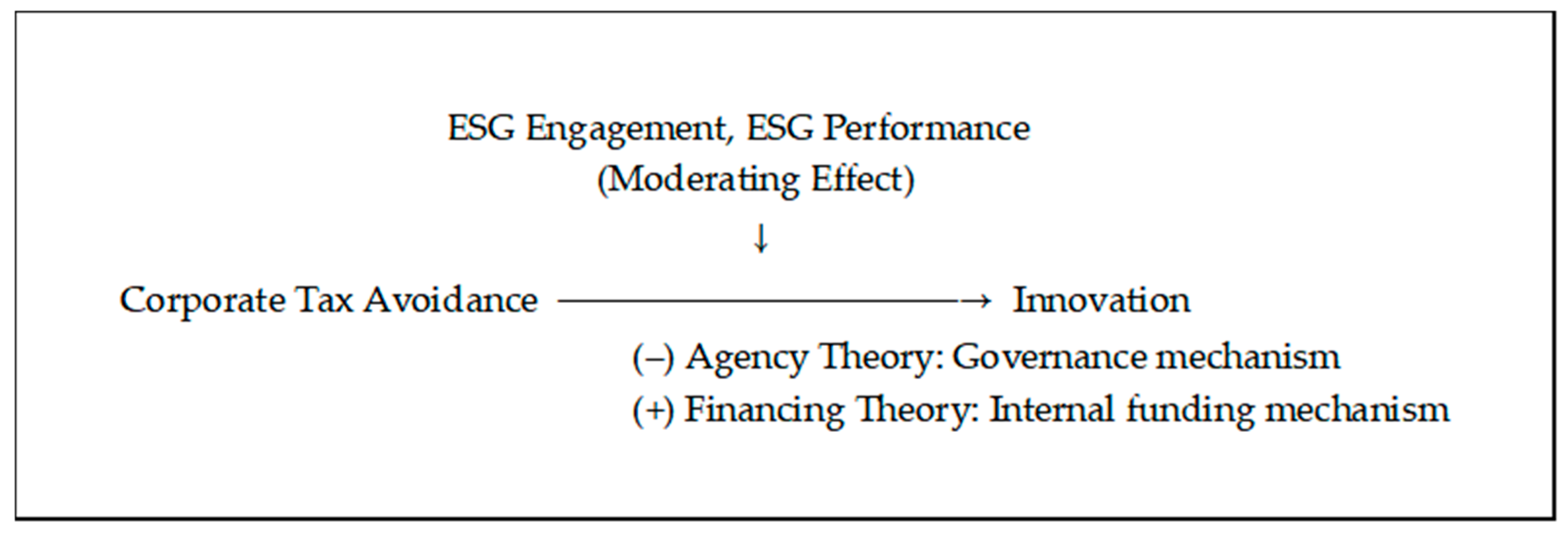
Therefore, ESG factors are expected to moderate the relationship between corporate tax strategy and innovation, as ESG practices strengthen governance, reduce information asymmetry, and reinforce long-term strategic alignment. Specifically, the negative effects of tax avoidance on innovation are expected to be alleviated when firms engage in ESG initiatives. Moreover, this moderating effect is anticipated to be stronger for firms with higher ESG performance, reflecting a deeper and more substantive commitment to ESG principles beyond mere engagement. The conceptual framework of this study is illustrated in
Figure 1. Based on this reasoning, the study proposes the following additional hypotheses:
Hypothesis 2-1. ESG engagement moderates the negative relationship between corporate tax avoidance and innovation.
Hypothesis 2-2. ESG performance moderates the negative relationship between corporate tax avoidance and innovation.
3. Data and Methodology
This study utilizes panel data from Korean listed companies spanning 2014 to 2023, obtained from authoritative sources, including FnGuide, TS2000, and the Korea Corporate Governance Service (KCGS). These databases are highly reliable and provide accurate reflections of firms’ financial conditions and ESG performance. The study employs Tobit regression analysis, which is appropriate for handling left-censored data and mitigating estimation bias when the dependent variable is non-negative. Using this method enables more precise estimation of the relationship between corporate tax strategy and innovation, thereby enhancing the robustness of the findings.
3.1. Data Selection Process
The initial dataset comprises 18,916 firm-year observations of companies listed on the KOSPI and KOSDAQ from 2014 to 2023. Financial data are from the FnGuide and TS2000 databases, and ESG ratings are from the KCGS. Several exclusion criteria are applied to ensure the reliability and consistency of the data. First, 1778 firm-year observations are removed because the financial data required to construct the key variables, including innovation and tax avoidance, are missing. Additionally, 586 firm-year observations from firms with impaired capital are excluded because financially distressed firms could bias the results. Furthermore, 4144 firm-year observations from firms with negative taxable income are excluded because these firms have no incentive to engage in tax avoidance. After these exclusions, the full sample comprises 12,408 firm-year observations, including firms with and without ESG ratings. This sample is used to examine whether ESG engagement moderates the relationship between corporate tax avoidance and innovation.
A subsample of firms with available ESG ratings is constructed to investigate the moderating effect of ESG performance. After excluding 6167 firm-year observations without ESG ratings, the final ESG-engaged subsample comprises 6241 firm-year observations.
Table 1 summarizes the sample selection process.
3.2. Measurement of Variables
3.2.1. Tax Avoidance
This study measures corporate tax avoidance using the model proposed by Desai and Dharmapala [
17], which decomposes the total book–tax difference (
BTD) into earnings management and tax avoidance components. This approach isolates the discretionary portion of tax behavior by controlling for earnings management. In the model,
BTD is regressed on total accruals (
TAC), a proxy for earnings management that captures managerial discretion in financial reporting. The residual from this regression represents the unexplained portion of
BTD, interpreted as the firm’s level of tax avoidance [
18]. This method provides a more precise and theoretically grounded estimate of tax avoidance than simpler metrics such as effective tax rates. The model is specified as follows:
where
BTD is the difference between book income and taxable income;
A reflects the total assets;
TAC is the total accruals, calculated as net income minus operating cash flow; and
ε is the residual term used as a proxy for tax avoidance (
TAX).
3.2.2. Innovation
This study measures firm-level innovation using IC values derived from the CIV method developed by Stewart [
29]. Conventional measures, such as R&D expenditures or patent counts, often overlook intangible dimensions, such as organizational knowledge, human expertise, internal processes, and stakeholder relationships, which enhance innovation potential but may not result directly in patentable outputs [
50,
51,
52]. In contrast, the IC approach captures the overall value-creating capacity of a firm’s intangible assets, reflecting its ability to generate sustained innovation-driven performance.
The CIV method isolates the portion of firm value attributable to innovation-related activities. It assumes that tangible assets generate returns consistent with industry averages; any excess return beyond this benchmark represents the value created by intangible resources. The procedure involves:
First, a firm’s average pre-tax earnings and average tangible assets over the previous three years are computed to derive its return on assets (ROA). Second, this ROA is compared with the industry average for the corresponding period. Third, excess returns are estimated by applying the industry-average ROA to the firm’s tangible assets. Although the CIV method can yield negative values when a firm’s actual return falls below the industry benchmark, such values are censored at zero. This treatment reflects that firms with non-positive intangible returns effectively have no measurable innovation-related value. Fourth, the excess return is adjusted on an after-tax basis, using the firm’s average income tax rate. Finally, the present value of this after-tax excess return is calculated using the firm’s cost of capital as the discount rate. The resulting value is an absolute measure that does not account for firm size and is therefore standardized by dividing it by total assets, which facilitates meaningful comparisons across firms.
3.2.3. ESG Engagement and Performance
ESG engagement is captured using a binary indicator variable assigned a value of 1 if a firm has a publicly disclosed ESG rating and 0 otherwise. This measure reflects a firm’s decision to adopt ESG principles, indicating a strategic commitment to environmental stewardship, social responsibility, and robust governance. While the variable identifies whether a firm engages with ESG initiatives, it may not fully capture the depth or quality of ESG practices.
To address this limitation, the analysis also incorporates an ESG performance variable based on the firm’s assigned ESG ratings, providing a more detailed assessment of actual ESG outcomes. ESG performance ratings are obtained from the KCGS, an independent institution that has evaluated South Korean firms’ ESG practices since 2011. The KCGS framework aligns with internationally recognized standards, including the OECD Principles of Corporate Governance and ISO 26000 [
53], as well as incorporates the legal, regulatory, and managerial contexts specific to South Korea. Firms are assessed across three key domains—environmental, social, and governance—and receive individual domain scores and an overall composite ESG rating.
The ratings are based on absolute performance criteria and reported on a seven-point ordinal scale, ranging from “S” (highest) to “D” (lowest). The standardized nature of KCGS ratings ensures consistency and comparability across firms, thereby enabling a robust analysis of the moderating effects of ESG engagement and performance on the relationship between tax avoidance and innovation.
3.3. Model Specification
The relationship between corporate tax avoidance and innovation is investigated using an empirical model (2). The dependent variable (
INV) represents a firm’s innovation level and is proxied by IC values calculated using the CIV model [
29]. Because IC values are censored at zero, ordinary least squares estimation may yield biased results. This study, therefore, employs a Tobit regression model, appropriate for analyzing censored dependent variables [
54].
The key independent variable,
TAX, captures a firm’s level of tax avoidance and is measured following Desai and Dharmapala [
17]. The model also includes a set of control variables that may influence innovation: firm size (
SIZE), available slack (
ASLK), potential slack (
PSLK), operating cash flow (
OCF), sales growth (
GRW), R&D intensity (
RND), firm age (
AGE), ownership concentration (
OWN), and market listing status (
MRK).
SIZE controls for resource availability, as larger firms generally possess greater R&D capacity, while smaller firms are typically more flexible and adaptive [
55].
ASLK and
PSLK capture internal and external resource flexibility, respectively [
56,
57].
OCF and
GRW reflect financial liquidity that supports innovation [
58], whereas
RND indicates direct investment in innovation activities [
59].
AGE accounts for heterogeneity in innovation behavior, as younger firms tend to be more agile and risk-taking, whereas older firms benefit from accumulated experience and resources [
55].
OWN and
MRK reflect governance environments and listing standards that may influence innovation strategies. Finally, year (
YR) and industry (
IND) indicators are included to control for time- and sector-specific heterogeneity.
The model specification is as follows:
where
INV is innovation, as proxied by IC values calculated using the CIV model [
29] and scaled by total assets;
TAX refers to tax avoidance, measured based on the model developed by Desai and Dharmapala [
17];
SIZE is firm size, measured as the natural logarithm of total assets;
ASLK refers to available slack, calculated as the ratio of net income to total assets;
PSLK refers to potential slack, measured by the debt-to-equity ratio;
OCF is operating cash flow, scaled by total assets;
GRW reflects sales growth rate, calculated as the change in sales relative to those in the previous year;
RND is R&D expenditure, divided by total assets;
AGE refers to firm age, measured as the natural logarithm of the number of years a firm has been in operation;
OWN reflects ownership concentration, calculated by the ownership share held by the largest shareholder; and
MRK is a market dummy variable that equals to 1 if the firm is listed on the KOSPI and 0 if it is listed on the KOSDAQ.
Model (3) is estimated to examine whether ESG engagement moderates the relationship between corporate tax avoidance. In this model,
EGM is a dummy variable equal to 1 if a firm has a publicly disclosed ESG rating and 0 otherwise. The interaction term (
TAX ×
EGM) captures whether the effect of corporate tax avoidance on innovation differs between firms that engage in ESG practices and those that do not.
where
EGM is ESG engagement and is equal to 1 if a firm has a publicly disclosed ESG rating and 0 otherwise.
Model (4) is estimated to test the moderating effect of ESG performance. ESG represents a firm’s overall ESG score on a seven-point ordinal scale ranging from 1 (D, lowest) to 7 (S, highest). The interaction term (
TAX ×
ESG) examines whether ESG performance moderates the relationship between corporate tax avoidance and innovation.
where
ESG is ESG performance, determined based on a firm’s overall ESG score measured on a 7-point ordinal scale ranging from 1 (D, lowest) to 7 (S, highest).
Model (5) is estimated separately for each dimension—environmental (
ENV), social (
SOC), and governance (
GOV)—to further examine the moderating role of ESG subcomponent performance. Each subcomponent score ranges from 1 to 7, with higher values reflecting better performance in that dimension. This model is used to investigate the specific ESG dimensions that significantly moderate the relationship between corporate tax avoidance and innovation.
where
ENV,
SOC, and
GOV refer to the “environmental,” “social,” and “governance” subcomponent scores, respectively, with each ranging from 1 to 7. The definitions of all variables are presented in
Table 2.
All models are estimated using two Tobit specifications: pooled effects and RE. The pooled Tobit model assumes independence across firm-year observations and does not account for unobserved firm-specific characteristics. Although the estimation is straightforward, this approach may underestimate standard errors and lead to biased inferences if firm-level heterogeneity is present [
60]. This limitation is addressed using the RE Tobit model, which incorporates unobserved firm-level heterogeneity [
31,
61]. This specification is particularly appropriate when unobservable firm-specific characteristics may influence both corporate tax avoidance and innovation. Both model specifications are compared, and likelihood ratio (LR) tests are conducted to determine which model is more appropriate for the data and ensure the robustness of the empirical results.
4. Results
4.1. Descriptive Statistics
Table 3 presents the descriptive statistics for the main variables used in the analysis. Panel A reports the statistics for the full sample, which comprises 12,408 firm-year observations from firms, regardless of their ESG engagement status. Panel B presents the statistics for the subsample of ESG-engaged firms, which consists of 6241 firm-year observations.
In Panel A, the innovation variable (INV) has a mean of 0.609 and a median of 0.382, with values ranging from 0 (due to censoring) to a maximum of 3.512. The corporate tax avoidance measure (TAX) has a mean of 0.004 and a median of 0.009, ranging from −0.247 to 0.172. The ESG engagement dummy (EGM) has a mean of 0.503, indicating that approximately half of the firms in the full sample engage in ESG practices and disclose their ratings.
Panel B reports the descriptive statistics for the ESG-engaged subsample. The mean overall ESG score (ESG) is 2.868, with a median of 3.000, and scores ranging from 1 (lowest rating, D) to 6 (highest rating, A+). The environmental score (ENV) has a mean of 2.621 and a median of 3.000, whereas the social (SOC) and governance (GOV) scores have slightly higher means of 3.106 and 3.021, respectively, with a median of 3.000 and identical ranges from 1 to 6. These results suggest relatively stronger performance in the social and governance dimensions than in the environmental dimension.
4.2. Correlation Analysis
Table 4 presents the Pearson correlation matrix for the variables used in the full sample analysis. Innovation (
INV) is positively and significantly correlated with tax avoidance (
TAX), suggesting a link between corporate tax strategy and innovation. Innovation (
INV) is positively associated with several control variables, including firm size (
SIZE), available slack (
ASLK), operating cash flow (
OCF), R&D intensity (
RND), and ownership concentration (
OWN). However, it is negatively associated with potential slack (
PSLK), firm age (
AGE), and market listing status (MRK).
Table 5 presents the Pearson correlation matrix for the variables in the ESG-engaged subsample analysis. Innovation (
INV) is positively and significantly correlated with tax avoidance (
TAX). Furthermore, innovation (
INV) shows positive correlations with the overall ESG score (
ESG), as well as the social (
SOC) and governance (
GOV) components, whereas it exhibits a negative correlation with the environmental (
ENV) subcomponent score. Regarding the control variables, innovation (
INV) is positively associated with available slack (
ASLK), operating cash flow (
OCF), R&D intensity (
RND), and ownership concentration (
OWN) but negatively associated with potential slack (
PSLK), firm age (
AGE), and market listing status (
MRK).
However, these correlations provide only preliminary insights into the relationships between variables. Therefore, multivariate analyses are conducted to examine the association between tax avoidance and innovation, as well as the moderating effects of ESG, while controlling for firm-specific characteristics.
4.3. Regression Analysis
Table 6 presents the results of the Tobit regression analyses examining the relationship between corporate tax avoidance and innovation using both the pooled and RE Tobit models for the full sample. The RE Tobit model exhibits superior fit relative to the pooled Tobit model, as reflected by a higher log-likelihood value and significant LR test statistic of 1715.49 (
p < 0.01). These findings suggest that the RE Tobit model accounts for unobserved firm-specific heterogeneity more effectively, thereby providing more robust and reliable estimates.
In both specifications, the coefficient of tax avoidance (
TAX) is negative and significant at the 1% level, indicating that firms that engage in higher levels of tax avoidance tend to exhibit lower innovation levels. Although the correlation analysis in
Table 4 and
Table 5 shows a positive relationship between tax avoidance (
TAX) and innovation (
INV), this reflects an uncontrolled bivariate association. After accounting for firm-specific characteristics and control variables, the relationship becomes negative, suggesting that the simple correlation is likely driven by confounding factors, such as
SIZE and other controls. This finding supports Hypothesis 1, which, consistent with the agency theory perspective, posits that tax avoidance can exacerbate managerial opportunism and reduce transparency, thereby hindering a firm’s innovation capacity.
Table 7 presents the results of the Tobit regression analyses examining whether ESG engagement moderates the relationship between corporate tax avoidance and innovation. The pooled and RE Tobit models are both estimated using the full sample. The RE Tobit model demonstrates superior model fit compared to the pooled Tobit model, as evidenced by a higher log-likelihood value and a significant LR test statistic. These findings support the robustness of the results after accounting for unobserved firm-specific heterogeneity.
In both models, the coefficient of TAX remains negative and significant at the 1% level, reaffirming the negative association between corporate tax avoidance and innovation. The coefficient of EGM, a binary variable equal to 1 if the firm is ESG-engaged and 0 otherwise, is positive and significant, indicating that ESG-engaged firms tend to exhibit higher levels of innovation than their non-ESG-engaged counterparts.
Moreover, the interaction term TAX × EGM is positive and significant at the 1% level in both specifications, providing strong support for Hypothesis 2-1. These findings indicate that ESG engagement significantly weakens the negative impact of tax avoidance on innovation. Thus, firms engaged in ESG practices are better positioned to enhance their innovation capacity by alleviating agency conflicts and discouraging short-term managerial behavior. This is likely because ESG engagement reinforces governance mechanisms and promotes strategic alignment toward long-term value creation.
Table 8 presents the results of the Tobit regression analyses assessing whether ESG performance moderates the relationship between corporate tax avoidance and innovation using pooled and RE Tobit models estimated with the ESG-engaged subsample. In both models, the coefficient of
TAX remains negative and significant at the 1% level, reaffirming that firms with higher levels of tax avoidance are generally associated with lower levels of innovation. The coefficient of
ESG, representing a firm’s overall ESG performance, is positive but not significant.
Moreover, the interaction term TAX × ESG is positive and significant at the 5% level in the pooled Tobit model and at the 10% level in the RE Tobit model, thus providing empirical support for Hypothesis 2-2. These findings suggest that ESG performance moderates the negative relationship between tax avoidance and innovation. Furthermore, these results imply that among ESG-engaged firms, those with stronger ESG performance, as reflected in higher ESG ratings, are better positioned to mitigate the adverse impact of tax avoidance on innovation. Firms with higher ESG ratings typically demonstrate greater stakeholder engagement, long-term strategic orientation, and more robust internal governance frameworks. These characteristics help curb managerial opportunism and reduce the misallocation of tax savings to short-term or self-interested objectives, thereby weakening the negative association between tax avoidance and innovation.
Table 9 presents the results of the Tobit regression analyses examining the moderating effects of the three ESG subcomponents—
ENV,
SOC, and
GOV—on the relationship between tax avoidance and innovation. These analyses were conducted using both pooled and RE Tobit models based on the ESG-engaged subsample.
For the environmental performance dimension (Panel A), the interaction term between tax avoidance and environmental score (TAX × ENV) is positive and significant at the 10% level in the pooled Tobit model. However, this significance disappears in the RE Tobit model. Considering the superior fit of the RE Tobit model, these results suggest that environmental performance does not consistently moderate the negative relationship between tax avoidance and innovation.
In contrast, the social performance dimension (Panel B) shows a robust moderating effect. The interaction term (TAX × SOC) is positive and significant at the 5% level in the pooled Tobit model and at the 1% level in the RE Tobit model. These results consistently support the conclusion that stronger social performance mitigates the adverse impact of tax avoidance on innovation.
Panel C reports the results for the governance performance dimension. The interaction term (TAX × GOV) is positive and significant at the 5% level in the pooled Tobit model and at the 10% level in the RE Tobit model. These findings indicate that firms with stronger governance practices can better counteract the negative impact of tax avoidance on innovation.
Overall, the findings in
Table 8 reveal that among the three ESG domains, only social and governance performance demonstrate consistent and significant moderating effects. The results related to governance performance align with agency theory, which posits that strong governance mechanisms help mitigate managerial opportunism, including the potential misallocation of tax savings. Meanwhile, the findings related to social performance support stakeholder and social network theories, which highlight the importance of broad stakeholder engagement and collaborative networks in fostering trust, collaboration, and knowledge exchange. In turn, these mechanisms enhance a firm’s capacity for innovation and reduce the likelihood that tax savings will be diverted toward short-term or opportunistic uses.
5. Additional Analysis
A fixed effects (FE) Tobit model is not employed because applying FE methods to non-linear models, such as the Tobit model, produces inconsistent estimates due to the incidental parameter problem [
31,
60]. To further validate the appropriateness of the RE Tobit model, a correlated random effects (CRE) Tobit specification, following Wooldridge [
59], is estimated to address potential correlations between firm-specific unobserved effects and the explanatory variables. Consistent with Wooldridge [
61], the model incorporates the time averages of all time-varying regressors, thereby approximating a FE specification while maintaining consistency in a non-linear setting.
Table 10 presents the results of the CRE Tobit regression. The estimates align in both sign and significance with those obtained from the main RE Tobit models. Specifically, the negative and significant association between tax avoidance (
TAX) and innovation remains robust, and the moderating effects of ESG engagement (
TAX × EGM) and ESG performance (
TAX × ESG) persist. These consistent results reinforce that the main findings are not sensitive to model specification, confirming the appropriateness of the RE Tobit approach and addressing concerns regarding omitted heterogeneity and potential misspecification.
To address concerns regarding persistence and endogeneity, a dynamic RE Tobit model is also estimated. This specification includes the lagged dependent variable to capture potential path dependence in firm-level innovation, reflecting the persistence and autocorrelation inherent in the data.
The results of the dynamic RE Tobit estimation are reported in
Table 11. The lagged innovation variable (
PINV) is positive and statistically significant, confirming the persistence of innovation behavior. Importantly, including the lagged term does not alter the main findings: the negative association between tax avoidance (
TAX) and innovation remains robust, and the moderating effects of ESG engagement (
TAX ×
EGM) and ESG performance (
TAX ×
ESG) continue to hold. These results indicate that the study’s conclusions are not driven by omitted dynamic effects or endogeneity bias, reinforcing the robustness and reliability of the main analysis.
Additionally, the study excludes firm-years with negative taxable income from the main sample to focus on firms with incentives for tax avoidance and to ensure that the measure accurately reflects discretionary tax planning [
17,
18]. To address potential sample selection bias, the models were re-estimated using a broader sample that included firms reporting losses. The results, not tabulated for brevity, were qualitatively consistent with the main findings, indicating that the exclusion of firms with negative taxable income does not alter the study’s conclusions.
6. Discussion
This study examined whether corporate tax avoidance influences firm-level innovation and how ESG practices moderate this relationship. The key findings and theoretical contributions of this study are as follows. First, the theoretical frameworks of financing and agency theories are used to examine how firm-level tax strategies affect innovation capacity. Although previous research has primarily emphasized government-led tax incentives as external drivers of innovation, this study shifts the focus to internal corporate tax practices. This broadens the understanding of how firms may strategically engage in tax avoidance as a potential source of internal financing while also highlighting the accompanying risks of managerial opportunism that can undermine innovation efforts.
Second, this study provides robust empirical evidence of a negative association between corporate tax avoidance and innovation. This finding challenges the financing perspective, which suggests that tax savings can serve as an internal source for fostering innovation. In contrast, the results support the agency theory perspective, which posits that tax avoidance increases information asymmetry and agency conflicts, thereby enabling managers to divert resources toward short-term or self-serving objectives rather than long-term, uncertain innovation projects.
Third, this study contributes to the sustainability literature by examining the moderating role of ESG engagement in the relationship between tax avoidance and innovation. The findings show that ESG-engaged firms are better able to offset the negative effects of tax avoidance on innovation. This insight reinforces the perspective that ESG practices are not only symbolic or compliance-oriented but also function as strategic mechanisms that promote long-term value creation by strengthening accountability, stakeholder trust, and resource alignment.
Fourth, by disaggregating ESG into its three dimensions, this study identifies the specific components that play meaningful moderating roles in the relationship between tax avoidance and innovation. The findings show that social and governance factors, rather than environmental ones, are primarily responsible for mitigating the negative effects of tax avoidance. This granularity advances a deeper understanding of the influence of ESG performance on corporate behavior and strengthens the theoretical integration of agency, stakeholder, and social network theories. Specifically, the results support agency theory by showing that robust governance mechanisms reduce the likelihood of managerial opportunism, such as the misallocation of tax savings. The findings also align with stakeholder and social network theories by demonstrating that strong social performance enhances trust, broadens stakeholder engagement, and facilitates participation in collaborative networks, thus helping sustain innovation by mitigating the risks associated with tax avoidance.
The limited significance of the environmental dimension likely reflects the compliance-oriented nature of environmental initiatives among South Korean firms, which often aim to fulfill regulatory obligations rather than drive innovation. Moreover, the high costs and uncertain returns of green innovation may discourage firms from using tax-related financial flexibility for environmental R&D in the short term. Consequently, environmental factors may influence innovation more indirectly and over a longer horizon, whereas social and governance factors have more immediate effects through organizational culture, stakeholder engagement, and decision-making transparency.
Collectively, this study moves beyond treating agency, stakeholder, and social network theories as parallel frameworks and instead demonstrates their complementarity by integrating these theoretical perspectives. Agency theory explains how tax avoidance can undermine innovation by weakening governance and increasing information asymmetry, whereas stakeholder and social network theories illustrate how ESG practices counterbalance these effects by fostering transparency, trust, and collaborative legitimacy both within and beyond the firm.
These findings have practical implications for various stakeholders. For corporate managers, these results underscore the risk that a tax avoidance strategy may undermine a firm’s innovative capacity. They highlight the strategic value of integrating ESG principles into corporate decision-making to mitigate this risk and support long-term innovation. For policymakers and regulators, the evidence suggests that promoting ESG adoption can play a crucial role in preserving firms’ innovative capacity, even when firms pursue tax avoidance strategies. For investors, the results indicate that firms with a stronger commitment to ESG practices are more resilient to the adverse innovation effects of tax avoidance. Thus, ESG factors may serve as useful indicators for investment screening, portfolio risk management, and long-term value assessment.
7. Conclusions
This study investigates the relationship between corporate tax avoidance and firm-level innovation while focusing on the moderating role of ESG practices. Using a panel dataset of 12,408 firm-year observations of South Korean listed companies between 2013 and 2023, this study applies pooled and RE Tobit models to account for unobserved firm-specific heterogeneity.
The results reveal a significantly negative relationship between tax avoidance and innovation, suggesting that tax avoidance can weaken internal governance and constrain firm-level innovation. Moreover, the moderating effects of ESG engagement and performance indicate that ESG practices enhance governance quality, strengthen stakeholder relationships, and redirect tax-related financial flexibility toward innovation activities. Disaggregated analyses further indicate that social and governance performance drive these moderating effects, whereas environmental factors exert negligible influence, reflecting their relatively compliance-oriented nature. These findings highlight ESG practices as a strategic moderator that fosters innovation within corporate strategy. By demonstrating that ESG can mitigate the innovation-deterring effects of tax avoidance, this study contributes to a more integrated theoretical understanding of how corporate financial and sustainability decisions interact to shape long-term innovation outcomes.
Despite these contributions, this study has several limitations. First, it captures the short-term effects of tax avoidance on innovation. Future research could extend this analysis by examining the long-term effects of tax avoidance on innovation performance. Second, although this study employs empirically validated measures of innovation and tax avoidance consistent with prior research, these constructs are inherently multidimensional and cannot be fully captured by a single indicator. The residual-based tax avoidance proxy derived from Desai and Dharmapala [
17] may still be influenced by differences in accounting and tax standards or by earnings management practices, while the innovation measure based on the CIV method primarily reflects the financial valuation of IC rather than non-financial or breakthrough innovation outputs. These proxies provide analytical clarity and facilitate comparability across studies but inevitably simplify complex underlying phenomena. Future research could adopt multidimensional or latent-variable approaches, such as patent-based innovation indicators or comprehensive tax avoidance indices, to achieve a deeper understanding of the structural complexity of innovation and tax strategies.
Third, as the empirical analysis focuses on South Korean firms, the findings should be interpreted cautiously when applied to other institutional or regulatory contexts. South Korea’s unique corporate landscape, characterized by the chaebol system, concentrated ownership, and specific tax and governance frameworks, may shape firms’ strategic behavior differently than in other countries. Therefore, the external validity of the results may be limited. Comparative studies across countries could provide valuable insights into how variations in governance structures, tax regimes, and ESG frameworks affect the relationship between corporate tax strategy and innovation.
Finally, although this study examines ESG practices as a moderating factor, it does not empirically test the underlying mechanisms, such as improvements in governance structures or stakeholder relationships, through which ESG may mitigate the adverse effects of tax avoidance on innovation. Data limitations prevented a direct analysis of these channels. Future research could extend this framework by incorporating governance-related indicators, such as board independence, audit committee effectiveness, or stakeholder engagement indices, to empirically validate these mechanisms. Additionally, other contextual factors, including managerial characteristics, ownership structures, and financial constraints, may influence how tax strategies affect innovation. Incorporating these variables would contribute to a more comprehensive framework.
Addressing these limitations would improve our understanding of how firms can align their financial decisions with innovation activities for sustainable corporate development. This remains a crucial research area considering the United Nations 2030 Agenda for Sustainable Development, which highlights innovation as key to solving complex global challenges.