Article

Sustainable Production of Added-Value Metabolic Compounds Under Adverse Culture Conditions by Microorganisms: A Case Study of Yarrowia lipolytica Strain Cultivated on Agro-Industrial Residues


by
Danai Ioanna Koukoumaki
1,
Seraphim Papanikolaou
2,*,
Christina Rogka
2 and
Dimitris Sarris
1,*
1
Laboratory of Physico-Chemical and Biotechnological Valorization of Food By-Products, Department of Food Science & Nutrition, School of the Environment, University of the Aegean, Leoforos Dimokratias 66, Lemnos, 81400 Myrina, Greece
2
Department of Food Science and Human Nutrition, Agricultural University of Athens, 75 Iera Odos, 11855 Athens, Greece
*
Authors to whom correspondence should be addressed.
Sustainability 2025, 17(22), 10082; https://doi.org/10.3390/su172210082
Submission received: 24 March 2025 / Revised: 22 August 2025 / Accepted: 7 November 2025 / Published: 11 November 2025

Abstract

Within the framework of sustainability, the parallel valorization of two challenging industrial (crude glycerol) and agricultural (olive mill wastewaters—OMWs) residues by the yeast Yarrowia lipolytica was examined. The rationale of this study was to evaluate the potential of the Y. lipolytica strain ACA-YC 5031 to produce valuable metabolites under a wide range of pH values and increasing NaCl concentrations in agro-industrial blends. OMWs were used as both microbial substrate and process water, and despite high levels of phenolic compounds in the medium and the simultaneously high initial concentrations of NaCl, appreciable quantities of dry cell weight (DCW) and metabolites were synthesized. Moreover, the growth of the strain under non-aseptic conditions was examined. The simultaneous effect of low pH (3.0) and the presence of OMWs (~2.0 g/L) notably increased the extracellular production of erythritol and the accumulation of cellular lipids (reaching Erymax = 18.3 g/L and DCW = 38.6% w/w, respectively). In media with low pH (3.0) and high NaCl concentration (5.0% w/v), a metabolic shift towards erythritol secretion was observed (Erymax = 27.2 g/L, with YEry/Glol = 0.46 g/g). Oleic acid accumulation was enhanced by OMW presence in the medium.

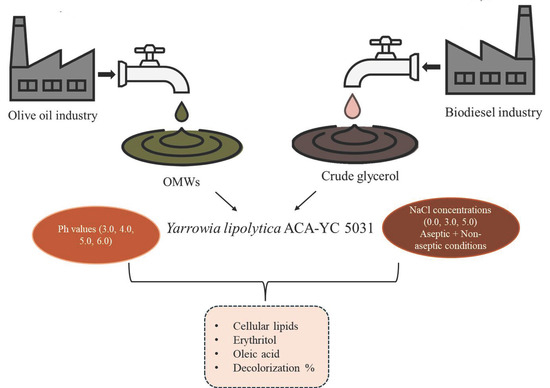
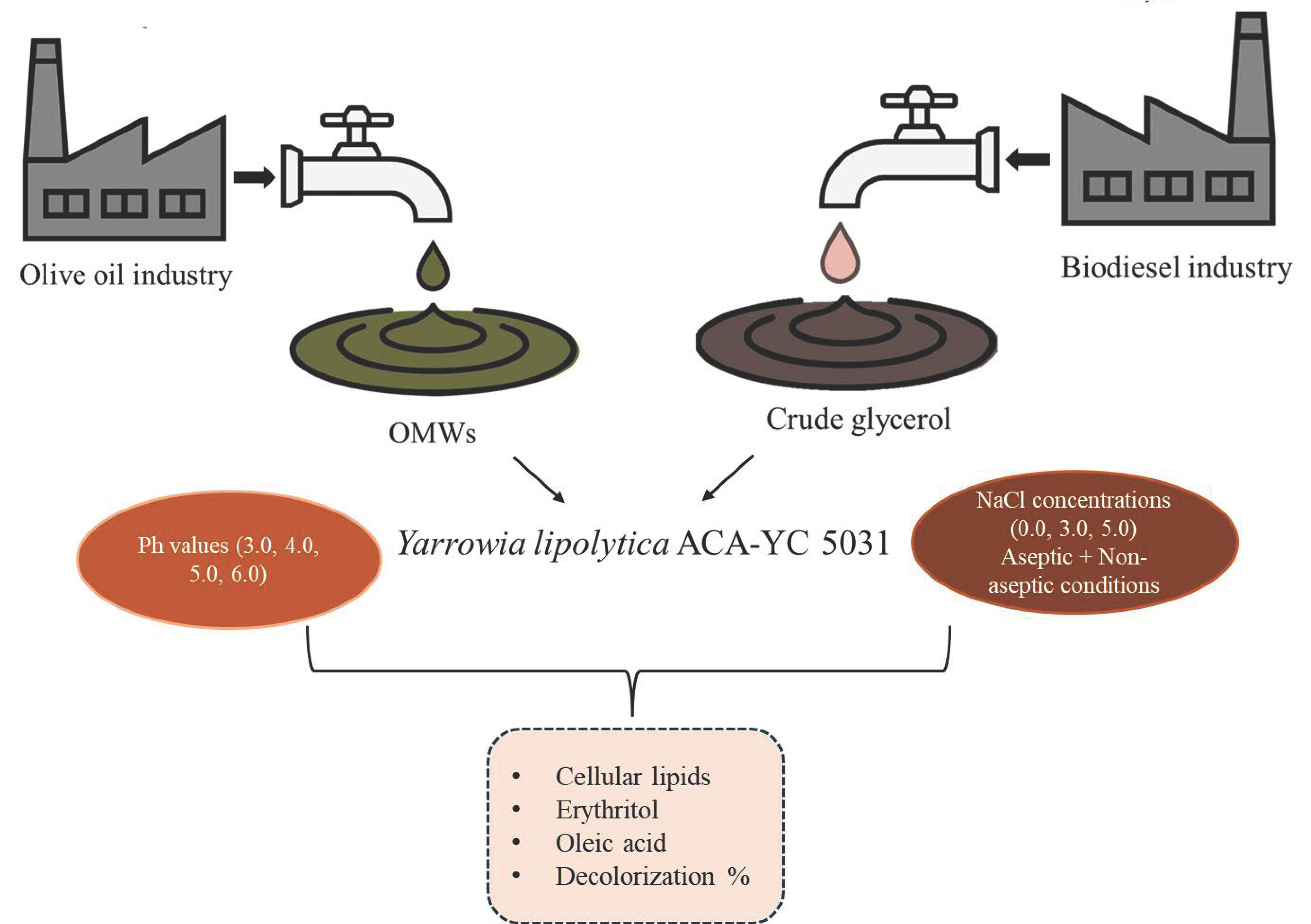
Graphical Abstract

1. Introduction

Olive mill wastewater (OMW) constitutes the principal by-product of olive oil processing. It is characterized by a large diversity depending on seasonal and geographical parameters, olive maturity, processing techniques, and oil extraction procedure [1]. Environmental issues have emerged in olive oil-producing countries due to the lack of efficient methods for managing OMWs [2]. In 2022/2023, olive oil production in Europe was approximately 1.7 thousand tons [3], while OMW production reaches approximately a volume of 3 × 10⁷ m3 per year [4], which indicates that for such vast quantities, an eco-friendly treatment is mandatory. OMW is a brown-colored liquid with pH values ranging from 3.0 to 6.0, made up of water added during processing, olive fruit, oil leftovers, and olive pulp fragments [5,6]. It is regarded as one of the most difficult agro-industrial wastes to manage due to its biochemical profile, comprising phenolic compounds including gallic acid, hydroxytyrosol, vanillin, quercetin, and catechol [6]; high N, P, K, Mg, and Fe concentrations [7]; and relatively high BOD and COD levels [8]. Furthermore, OMW contains sugars, organic acids, and residual oil [9], presenting a low-cost substrate for valorization through bioprocesses. OMW media have been used for the sustainable production of valuable compounds including biomass [10,11]; cellular lipids [12,13,14]; citric acid [15,16]; polyols such as erythritol, mannitol, and arabitol [17,18]; bioethanol [19,20]; exopolysaccharides [11]; and enzymes [21], while in some recent investigations, in various microbial fermentations, OMWs have been considered alongside microbial substrates that are also process waters for their potential to replace tap water in several types of bioprocesses, specifically by diluting “dense” residues and renewable resources [16,17,19,20].
Crude glycerol, an aqueous solution containing up to 85.0% w/w glycerol [22], is the main by-product of biodiesel production. During the transesterification of various oils and fats, approximately 1 kg of glycerol is produced for every 10 kg of biodiesel [17,18,22]. In contemporary studies, there has been a shift toward the biotechnological valorization of crude glycerol as a sole microbial carbon source [23,24] and as a co-substrate in blended media [25] for the production of added value metabolites using yeasts [26,27], algae [28], bacteria [29], and fungi [30], with these conversions belonging to the cutting edge of the current research in both the industrial and the food biotechnology sectors.
Generally, yeasts and fungi are examined for their ability to utilize low-cost substrates [31,32,33,34] and simultaneously to produce high-value metabolites (i.e., single-cell protein, bioethanol) [35] or even alternative types of packaging [36], enhancing circular economy and sustainability. Specifically, strains of the non-conventional yeast Yarrowia lipolytica are ideal candidates for the valorization of industrial, i.e., crude glycerol [9], and agricultural wastes and residues such as cheese whey [37]. Strains of this species have also been considered as very important candidates amenable to be utilized for the production of various metabolites of industrial and biotechnological interest [14,16,31], to a large extent due to the ability of these microorganisms to valorize a wide variety of substrates and grow in “adverse” mediums, such as under high NaCl concentrations [17,38] or low incubation temperatures [39]. Previous studies have investigated the ability of the yeast Y. lipolytica to use glycerol-enriched OMW-based media to produce added-value compounds, like SCOs [14], citric acid [9], and polyols [39]. Moreover, the production of metabolic compounds by Y. lipolytica is of interest for investigation under non-aseptic conditions [16]. The rationale of the present study was initially the investigation of the pH range at which Y. lipolytica renders high yields of cellular lipids, in order to combine optimal pH and high NaCl concentrations for the production of microbial lipids, as well as whether these conditions affect the productivity of the microorganism under non-aseptic conditions. The aim to use a mixture of crude glycerol and OMWs as substrate leans on the fact that OMWs could simultaneously be used as substrate and process water, replacing tap water as a diluent in terms of sustainability. Technological considerations were critically assessed.

2. Materials and Methods

2.1. Microorganism, Growth Media, and Raw Materials

The yeast strain Yarrowia lipolytica ACA-YC 5031 was provided by the Laboratory of Dairy Science (AUA, Athens, Greece) and was maintained in YPDA medium at T = 4.0 ± 1.0 °C. The activation of the yeast strain was carried out in YPDA medium at T = 28.0 ± 1.0 °C for 2–3 days. OMW originated from a facility utilizing a three-phase decanter system (Kiato, Korinthia, Greece) and was kept frozen until further use. The removal of solids from the OMW and its phenolic content expression were conducted as described in Sarris et al. [9], while the reducing sugars content was lower than 3.0 ± 1.0 g/L. In all experiments that were carried out with the presence of OMWs in the culture medium, the quantity of reducing sugars was considered negligible and was not considered. All experiments utilized crude glycerol as the carbon substrate, starting at a concentration of 70.0 ± 5.0 g/L. OMW served as a substitute for process tap water in the dilution of glycerol. To achieve an initial phenolic compound concentration of 2.0 ± 0.2 g/L in the blended media, OMW and tap water were added. A blank experiment, without OMW addition, was also conducted. Mineral salts were supplemented in the medium at specified concentrations (g/L), as detailed by Sarris et al. [9]. Nitrogen-limited conditions were achieved in all trials using peptone and yeast extract (1.0 g/L, respectively) as nitrogen sources.

2.2. Culture Conditions

Trials were performed evaluating the effect of variant pH values (3.0, 4.0, 5.0, and 6.0) in the culture medium, under aseptic conditions (T = 121 °C, 20 min). Following the evaluation of the optimum pH value, experiments were carried out at various NaCl concentrations (0.0, 3.0, and 5.0% w/v) at pH = 3.0 ± 0.1, under aseptic and non-aseptic conditions. In non-aseptic conditions, there was no thermal process or sterilization step. In trials in non-aseptic conditions, flasks were examined microscopically every 8 h, while there was no use of any other antimicrobial factor. The selection of the strain was based on a previous study [17], in which its growth under adverse conditions demonstrated satisfactory production of metabolic products (i.e., cellular lipids, polyols). To the best of the authors’ knowledge, no bibliographic data is available regarding the behavior of the strain under simultaneously adverse culture conditions and non-sterile environments.
In all trials, the pH value has been standardized before inoculation. The trials were carried out in 250 mL Erlenmeyer flasks filled to one-fifth of their total volume. The inoculum volume was 2% v/v (OD of approximately 0.50 g/mL), consisting of a 24 h synthetic pre-culture. The pre-culture medium consisted of 10 g/L of glucose, peptone, and yeast extract, respectively, while growth conditions were set at T = 28.0 ± 1 °C, a rotation speed of 180 ± 5 rpm, and pH = 5.5–6.0. Experiments were conducted under strict aerobic conditions, following the protocol outlined by Koukoumaki et al. [35], at 180 ± 5 rpm (T = 28.0 ± 1 °C). Maintenance of pH value was achieved in accordance with the method of Sarris et al. [9]. Each experiment was conducted in duplicate, with every kinetic data point representing the mean of two independent measurements (SE < 10%).

2.3. Biomass Determination

Yeast cells were harvested by centrifugation (9000 rpm, 10 min, T = 4.0 °C). After centrifugation, the supernatant was stored at −20.0 °C until further use, while the yeast cells were subjected to two additional rounds of centrifugation and washing with distilled water. Biomass concentration (g/L) was determined according to constant dry weight (after drying at ~85.0 °C).

2.4. Quantification of Cellular Lipids and Characterization of Fatty Acid Profile

Cellular lipid concentration was determined according to Sarris et al. [14], with a composite of chloroform/methanol 2/1 (v/v) as the extracting solvent. Following the lipid conversion to fatty acid methyl esters (FAMEs), qualitative analysis was performed using gas chromatography (GC ULTRA TRIPLUS, Thermo Scientific, Waltham, MA, USA), as described in the work of Makri et al. [40]. The identification of FAMEs was achieved through comparison with known standards.

2.5. Analysis of Substrate Consumption and Product Formation

Substrate consumption and the production of citric acid and polyols (erythritol, mannitol, arabitol) were analyzed using HPLC. The HPLC system was equipped with a Rezex ROA column (300 × 7.8 mm, Phenomenex, Torrance, CA, USA), and the analytical parameters followed the method described by Sarris et al. [9].

2.6. Quantification of Cumulative Phenolic Content

Total phenol compounds (pHØ) in the medium were quantified using a photometric method adapted from Tsioulpas et al. [41] at 750 nm. The blank sample consisted of distilled water. Results were expressed as gallic acid equivalents.

2.7. Decolorization

Determination of color removal was conducted by adjusting pH at a range of 6.0 to 6.3, in 30-fold-diluted samples. The absorbance was measured at 395 nm and the decolorization percentage was calculated according to the following equation:
%D = [(D0 − Dx)/D0] × 100
where D0 is the absorbance at initial fermentation time (0 h) and Dx is the absorbance monitored at each time point during the trial.

3. Results

Initially, the metabolic activity of the Yarrowia lipolytica strain ACA-YC 5031 using media composed of OMW and crude glycerol was examined at different pH values, including 3.0, 4.0, 5.0, and 6.0. In all cases and for all fermentation steps, the pH value was maintained constant (±0.3 units to each pH value tested), as previously demonstrated [9]. The initial concentration of glycerol was set at a value of ~70.0 g/L, while diluted OMW was incorporated into the medium, at pHØ of 2.0 ± 0.2 g/L. Blank trials (no OMW addition) were also performed at pH = 6.0. Since a higher accumulation of cellular lipids was achieved by the addition of OMWs while pH was maintained at 3.0, the kinetic behavior of Y. lipolytica strain ACA-YC 5031, grown on the same media described above, was also studied under different NaCl concentrations (0.0, 3.0, and 5.0% w/v) at a medium pH adjusted to that value (=3.0). Blank trials (no OMW addition) were also performed at pH = 3.0. In this set of experiments, trials at 5.0% w/v NaCl and pH = 3.0 under non-aseptic conditions were also conducted (no thermal process was applied). The capability of the examined strain to utilize these mixtures and sustainably synthesize added-value metabolic compounds was evaluated under nitrogen-limited conditions.

3.1. Influence of Different pH Values in Growth of Yarrowia lipolytica Strain ACA-YC 5031 Cultivated on Blends of OMWS and Crude Glycerol (70.0 ± 5.0 g/L)

3.1.1. Biomass and IPS Accumulation

The examined strain was able to grow in blank and blended media. In all cases, the applied carbon source (viz., glycerol) was totally assimilated. Overall, maximum biomass production was observed in blank experiments, reaching 10.8 g/L (YX/Glol = 0.14 g/g) at 260 h, while with the addition of OMWs and maintenance of pH at 6.0 ± 0.3, the production of biomass appeared to be reduced, reaching 8.7 g/L (YX/Glol = 0.14 g/g). A comparable pattern was observed regarding the growth of the strain at pH = 5.0, while maximum biomass production had not exceeded 9.1 g/L (Table 1). Reduction of the pH value to 4.0 did not seem to affect the strain’s growth, since total assimilation of substrate was observed at 280 h. Regarding the production of biomass, a reduction of pH led to a decrease since the highest biomass value did not exceed 7.0 g/L (YX/Glol = 0.10 g/g). Surprisingly, in the blended media at the lowest pH value (3.0), despite the adverse culture conditions imposed (i.e., combined low pH value and significant presence of phenolic compounds into the medium), the highest biomass value was reached (=10.6 g/L with simultaneous yield YX/Glol = 0.14 g/g), providing, once more, evidence of the robustness of the implicated strain towards its utilization in “hostile” and “stressful” growth environments.
Regarding the production of IPS, the addition of OMWs had a favorable effect on IPS production since the maximum production reached 1.5 g/L at pH = 6.0. A decrease in pH value to 5.0 increased the accumulation of IPS, which reached the highest value of 2.9 g/L with polysaccharides in dry cell weight (DCW) reaching a value of 32.9%, w/w. Further reduction in pH values to 4.0 and 3.0 led to a decrease in IPS production, since maximum production did not exceed 17.5 and 9.2%, w/w, respectively.

3.1.2. Biosynthesis of Extracellular Products

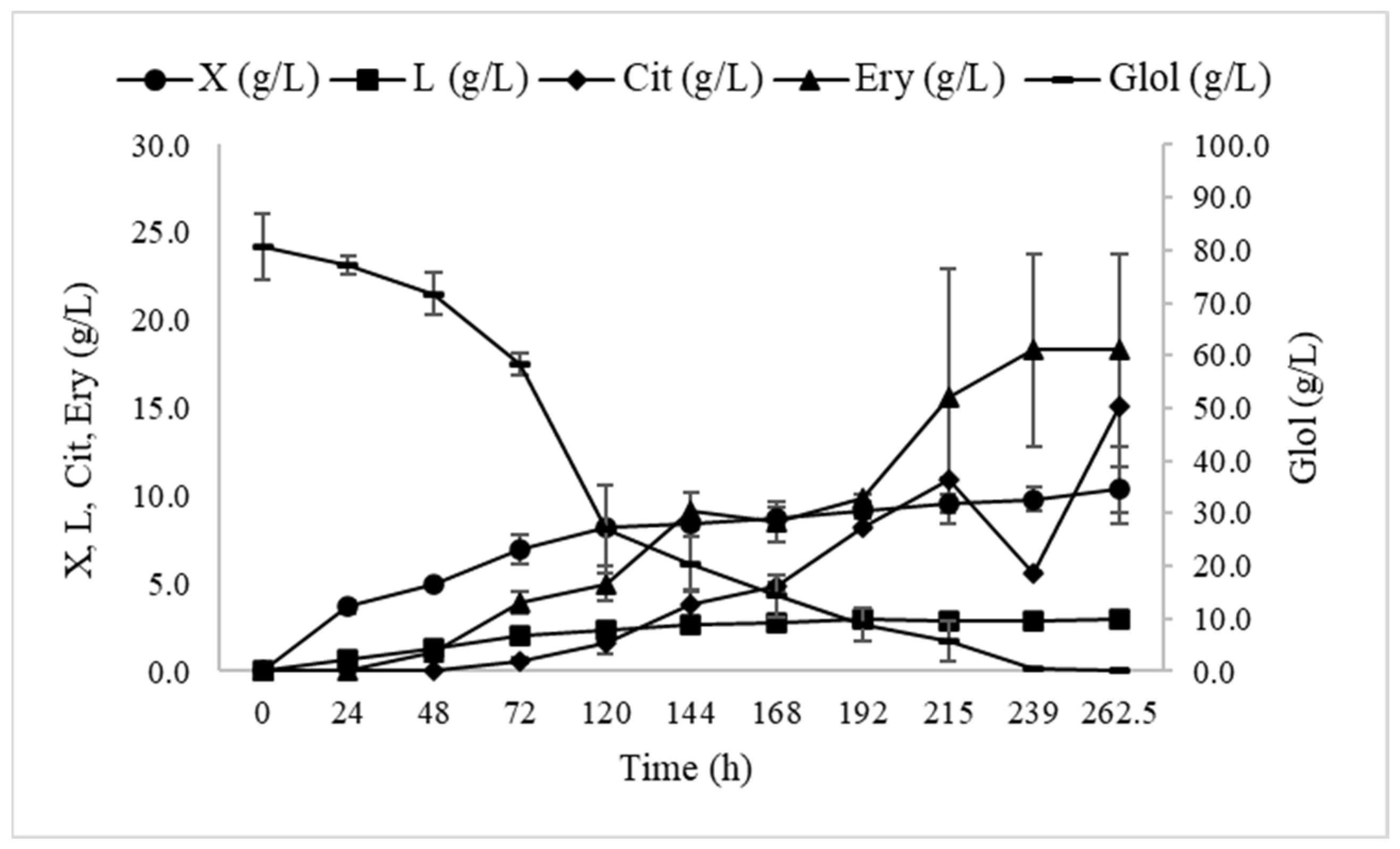
Citric acid production reached a peak value of 10.5 g/L in the blank trial (absence of OMW, pH 6.0). The addition of OMW positively affected the production of citric acid, compared to blank experiments, aligning with previously reported findings in the literature, in which the addition of OMWs into the growth medium positively affected the production of citric acid by other wild-type Y. lipolytica yeasts in cultures where all other parameters were identical except that of the addition of OMWs [16,42,43], since the highest production of citric acid was observed at 140 h, reaching 28.6 g/L, with YCit/Glol of 0.56 g/g. Reduction in pH value to 5.0 did not significantly affect citric acid production, since the production of this organic acid always remained at high levels (=30.5 g/L; YCit/Glol = 0.53 g/g), corroborating findings/considerations in the literature [9,18,24,39] that have indicated the crucial role of the maintenance of pH values that are slightly acidic (i.e., between 4.5 and 6.0) in order to maximize this production. On the contrary, further reduction in pH value to 4.0 or even to a lower value (=3.0) led to a decrease in citric acid, in accordance with the literature [18,24]. Specifically, the highest accumulation was observed at 210 h of fermentation and was 17.8 g/L with a respective yield of YCit/Glol = 0.27 g/g. Likewise, the citric acid accumulation did not exceed 5.6 g/L at pH = 3.0 with a yield of YCit/Glol = 0.10 g/g. It appears that the reduction in pH to values < 4.0 shifted the cellular metabolism towards the synthesis of polyols at the expense of citric acid production, in accordance with reports from the international literature [24,39,44]. In the present study, the production of polyols erythritol, arabitol, and mannitol was observed when crude glycerol was used as substrate, regardless of the addition of OMWs in the medium. The production of erythritol was considered satisfactory, with maximum concentrations ranging from 4.9 g/L to 18.3 g/L and corresponding yields between 0.10 g/g and 0.25 g/g (Table 1). In comparison with blank trials, the presence of OMW slightly affected erythritol production, as maximum concentrations did not exceed 4.9 g/L. On the contrary, the maintenance of pH at 5.0 increased the accumulation of erythritol, reaching 15.1 g/L with YEry/Glol = 0.26 g/g. The further reduction in pH to 3.0 favored the accumulation of erythritol into the culture medium in accordance with the literature [24], with maximum production reaching 18.3 g/L and a respective yield YEry/Glol = 0.25 g/g (Figure 1).
The range of maximum values of produced mannitol was between 4.5 g/L and 19.4 g/L. In the blank trial, maximum production of mannitol reached 13.4 g/L, and mannitol’s corresponding yield reached 0.20 g/g. The addition of OMWs negatively affected the assimilation of mannitol, since the maximum production did not exceed 8.0 g/L, with YMan/Glol = 0.16 g/g. In trials with blended media at pH = 5.0, mannitol production was favored compared to blank trials. Specifically, the maximum production of mannitol was observed at 192 h and reached 16.7 g/L, while the reduction in pH value in the medium shifted the metabolism towards the synthesis of erythritol at the expense of mannitol production (Table 1). Finally, both the addition of OMWs into the medium and the reduction in pH values did not have a favorable effect on the production of arabitol.

3.1.3. Determination of Cellular Lipids and Fatty Acid Profile

In blank trials, Lmax reached 2.4 g/L with YL/X = 23.9% (w/w), while the presence of OMWs did not affect production of cellular lipids but slightly increased the lipid in DCW value up to 28.3% (w/w), corroborating previous investigations and providing, again, evidence that OMW seems to be a “lipogenic” medium [13,14,16]. Similarly, the reduction in pH values to 5.0 and 4.0 did not seem to affect overall intracellular lipid accumulation. On the contrary, in trials where the pH value was maintained at 3.0, the production of SCOs was favored, since Lmax reached 4.1 g/L with YL/X = 38.6% (w/w). The principal unsaturated FAs were ∆9C18:1, ∆9C18:2, and ∆9C16:1, while saturated FAs such as C16:0 and C18:0 were detected. In blank trials, the value of ∆9C18:1 reached 66.0%, while the presence of OMW slightly decreased the concentration of ∆9C18:1, reaching 63.0%. The addition of OMW increased the concentration of ∆9C18:2 in trials compared to blank conditions (except trials at pH = 3.0), with a maximum concentration of 12.2% at pH = 5.0 (Table 2). In all trials, the UI of FAs was monitored. It seems that the maintenance of culture conditions at neutral pH values (i.e., 5.0–6.0) and the addition of OMW maintained UI values at a high rate. On the contrary, further reduction in pH values decreased the UI factor of FAs (Table 2).

3.1.4. Decolorization—Reduction in Phenolic Content

The Y. lipolytica strain ACA-YC 5031 demonstrated the capacity to decolorize the medium by up to ~25.0%. Regarding the removal of phenolic compounds, the decrease in pH values did not favor the process compared to trials at pH = 6.0. Decolorization of the media did not exceed 17.8% in trials where pH values were maintained at 5.0 and 6.0. On the contrary, when pH values were decreased to 3.0 and 4.0, color removal noted an increase of up to 25.0 and 21.4%, respectively.

3.2. Effect of Increasing NaCl Concentrations in Growth of Yarrowia lipolytica Strain ACA-YC 5031 Cultivated on Blends of OMWS and Crude Glycerol (70.0 ± 5.0 g/L) at pH = 3.0 in Aseptic and Non-Aseptic Conditions

3.2.1. Biomass and IPS Accumulation

In all trials, strain ACA-YC 5031 was able to assimilate crude glycerol completely (Table 3). In blank trials, the strain represented satisfactory growth, reaching a maximum biomass (Xmax) of 9.8 g/L, with YX/Glol being = 0.13 g/g, while the addition of OMWs in the medium interestingly slightly affected the maximum total biomass production of the strain (11.3 against 9.8 g/L—see Table 3). The addition of 3.0% w/v NaCl slightly increased biomass production compared with the control trial experiment as Xmax reached 10.6 g/L, with corresponding yield of 0.14 g/g. Further increase of NaCl concentration up to 5.0% w/v did not seem to affect biomass accumulation, while the maximum value reached 10.2 g/L. Therefore, once more, the imposition of indeed “hostile” and “stressful” conditions (i.e., simultaneous presence of significant quantities of phenolic compounds and other xenobiotic substances like tannins, conferred by the added OMWs, low pH value and significant presence of NaCl) did not affect the total dry weight and the assimilation of glycerol. Finally, the maximum value of biomass achieved in media containing OMWs and added NaCl at 5.0% w/v under completely non-aseptic conditions, was 11.2 g/L with corresponding yield YX/Glol = 0.18 g/g.
Regarding the accumulation of IPS, in all trials, maximum production did not exceed 0.8 g/L, indicating that low pH value and increasing concentrations of NaCl in parallel, did not favor IPS production.
In all trials strain ACA-YC 5031 was able to assimilate crude glycerol completely (Table 3). In blank trials, the strain represented satisfactory growth reaching maximum biomass (Xmax) of 9.8 g/L with YX/Glol being = 0.13 g/g, while the addition of OMWs in the medium, interestingly slightly affected the maximum total biomass production of the strain (11.3 against 9.8 g/L—see Table 3). Increase of NaCl up to 3.0% w/v slightly increased biomass production as Xmax reached 10.6 g/L, with corresponding yield up to 0.14 g/g. Further increase of NaCl concentration up to 5.0% w/v did not seem to affect biomass accumulation, while the maximum value reached 10.2 g/L. Therefore, once more, the imposition of indeed “hostile” and “stressful” conditions (i.e., simultaneous presence of significant quantities of phenolic compounds and other xenobiotic substances like tannins, conferred by the added OMWs, low pH value, and significant presence of NaCl) did not affect the total dry weight and the assimilation of glycerol. Finally, the maximum value of biomass achieved in media containing OMWs and NaCl added at 5.0% w/v under completely non-aseptic conditions was 11.2 g/L, with a corresponding yield YX/Glol = 0.18 g/g.
Regarding the accumulation of IPS, in all trials, maximum production did not exceed 0.8 g/L, indicating that a low pH value and increasing concentrations of NaCl, in parallel, did not favor IPS production.

3.2.2. Biosynthesis of Extracellular Products

The maximum secretion of citric acid in blank trials (no OMWs addition, pH = 3.0) reached 6.5 g/L with YCit/Glol of 0.08 g/g. In previous blank experiments (no OMWs addition, pH = 6.0), maximum production was 10.5 g/L. This was expected since, as mentioned in the previous paragraphs, the production of citric acid favors slightly acidic pH values of around 4.5–6.0 [24,39,44]. In the meantime, maximum production of erythritol reached 7.8 g/L, while the maximum production of arabitol and mannitol did not exceed 3.0 and 5.1 g/L, respectively. Again, in this set of experiments, the presence of OMWs increased production of citric acid up to 15.1 g/L, with respective yield up to 0.20 g/g. However, the addition of OMWs in the medium at pH = 3.0 also favored the production of erythritol and mannitol, possibly due to the fact that polyol production favors lower pH values. The addition of 3.0% w/v NaCl concentration led to a decrease in citric acid production, while the maximum value did not exceed 5.6 g/L with YCit/Glol = 0.07 g/g. Contrary to this, the increase in NaCl concentration was favorable for erythritol production, reaching 18.3 g/L with YEry/Glol = 0.24 g/g. Further addition of NaCl concentration up to 5.0% w/v led to a double increase in erythritol production, with maximum production reaching 27.2 g/L with YEry/Glol = 0.46 g/g, while the production of citric acid was null. Likewise, the addition of NaCl drastically decreased the synthesis of mannitol, shifting, as previously mentioned, the metabolic network towards the pathway glycerol → erythritol, in accordance with reports presented in the international literature [24,39]. Finally, under completely non-aseptic conditions, the production of erythritol was slightly decreased compared to the equivalent trial in which previous sterilization occurred to 24.4 g/L (against 27.2 g/L). Finally, the addition of NaCl into the medium seemed to decrease the production of arabitol, but did not have the same effect on the production of mannitol (see Table 3).

3.2.3. Determination of Cellular Lipids and Fatty Acid Profile

In blank trials, maximum cellular lipid accumulation (Lmax) reached 2.8 g/L (YL/X = 28.5% w/w), while the addition of OMW did not affect the lipid accumulation process. It could be proposed that the increasing addition of NaCl into the substrate shifts the cellular metabolism from citric acid production towards erythritol secretion as well as lipid production (Table 3). Lmax values ranged between 4.1 and 4.3 g/L, with maximum values of YL/X clearly increasing from 28.5% w/w (blank experiment, no OMWs and no NaCl addition) to 41.3% w/w (experiment with presence of OMWs and NaCl adjusted at 5.0% w/v) (see Table 3). Similar stimulatory effects on the lipid accumulation of NaCl added into the medium have been reported for the oleaginous non-conventional yeast Rhodosporidium toruloides during growth on glucose-based nitrogen-limited media, with NaCl being added in increasing concentrations [45]. The biochemical mechanism of this stimulatory effect has not yet been elucidated. Moreover, in trials under non-aseptic conditions, the maximum lipid production was achieved and reached 4.3 g/L with YL/X = 38.3% w/w. As mentioned above, the FA profile was monitored at different experimental points (Table 4). Likewise, in previous trials (see Section 3.1.3), the principal unsaturated FAs were ∆9C18:1, ∆9C18:2, and ∆9C16:1. As expected, the addition of OMWs slightly increased oleic acid (Δ9C18:1) concentration, while the maximum value reached up to 66.2%. The addition of NaCl increased C18:0 concentration, while slightly decreasing oleic acid concentration. In all trials, the UI of FA represented slight changes within culture phases, while under non-aseptic conditions, there was a reduction as a result of the decrease in Δ9C18:1.

3.2.4. Decolorization—Reduction in Phenolic Content

Again, in this set of experiments, the examined strain demonstrated the capability of color and phenolic content reduction. The maximum reduction in phenolic content was achieved in trials with no addition of NaCl and reached ~36.0% while under the presence of increasing NaCl concentrations, ranging between 9.9 and 23.8%. However, the addition of NaCl was favorable to the decolorization of the medium, which, from 39.4%, reached up to 46.7 (3.0% w/v) and 44.2% (5.0% w/v). In addition, strain ACA-YC 5031, under non-aseptic conditions, represented the maximum color removal of the medium, reaching 58.9% (Table 5).

4. Discussion

Under the framework of sustainability and circular economy, the valorization of two challenging agro-industrial residues under a wide range of pH values (3.0, 4.0, 5.0, and 6.0) to produce cellular lipids, polyols, and citric acid was studied. Additionally, decolorization of the medium and reduction in phenolic compound concentration were analyzed. Furthermore, the strain’s ability to produce in appreciable quantities added-value metabolic compounds under low pH and increasing NaCl concentrations (0.0, 3.0, and 5.0% w/v) in blended media of OMWs and crude glycerol in aseptic and non-aseptic conditions was studied.
In trials examining the range of pH values, the highest biomass production occurred in blank experiments, reaching 10.8 g/L, while the addition of OMWs slightly decreased biomass production. Regarding biomass production, the results are in line with those of Sarris et al. [9], although the addition of OMWs (pHØ = 2.0 g/L) did not decrease biomass production. It seems that the influence on biomass production due to the addition of OMWs or reduction in pH value depends on each strain, since when Dourou et al. [20] studied the addition of 1.9 g/L OMWs on glycerol-based media at pH ~ 2.8, biomass production of the Y. lipolytica A6 strain did not exceed ~5.6 g/L.
Evaluation of the strain’s ability to produce citric acid and polyols under various pH values showed a significant shift in cell metabolism towards the production of citric acid (when pH > 5.0) and erythritol (when pH < 4.0). These findings are in agreement with previous studies [14]. Specifically, when strain Y. lipolytica ACA-YC 5033 was cultivated in glycose-based media (in shake-flasks, pH 5.0–6.0), the addition of OMWs (pHØ = 2.0 g/L ~ 2.0 g/L) led to the production of citric acid up to 18.2 ± 1.5 g/L with YCit/Glc = 0.77 g/g, which was the main metabolic compound. In a recent study, the efficiency of Y. lipolytica LMBF Y-46 and Y. lipolytica ACA-YC 5033 cultivated on blends of OMWs and crude glycerol under nitrogen-limited conditions in shake-flask fermentations was evaluated [43]. Results showed an overproduction of citric acid up to 60.3 ± 3.1 and 63.6 ± 4.1 g/L by Y. lipolytica LMBF Y-46 and Y. lipolytica ACA-YC 5033, respectively (pH ranged between 5.0 and 6.0), while the production of erythritol was null. On the contrary, in glycerol-based media during flask-cultivation of strains Y. lipolytica ACA-YC 5029 and ACA-YC 5030, the major metabolic compounds were erythritol and mannitol, although the pH value was >4.8 [26].
The adjustment of pH to an acidic level in the growth medium not only enhanced the production of polyols at the expense of citric acid production but also seemed to favor the process of lipid production. Zhang et al. [46] studied Y. lipolytica W29 performance under neutral and acid pH values and reported that at pH = 2.0, impaired citrate efflux results in its accumulation within the cell, stimulating lipid biosynthesis. It needs to be stressed here that in terms of intra-cellular production of lipids, citric acid itself is the substrate for the action of the complex of ATP-citrate lyase [24,47,48]; therefore, poor regulation of ATP-citrate lyase towards could potentially explain the fact of the non-cleavage into the intra-cellular level of citric acid, and its subsequent secretion into the medium and the maintenance of high levels of intra-cellular citric acid due to the low extracellular pH imposed could potentially partially explain the phenomenon of the increased lipid accumulation of Y. lipolytica ACA-YC 5031 under the low pH values imposed. Indeed, in this study, lipid accumulation gradually increased while pH values were lower, while citric acid production was favored at higher pH values maintained in the growth medium, a result that has been observed previously [16,24]. Moreover, the addition of OMWs resulted in an increase in cellular lipids in dry biomass, which is in agreement with the literature [9,16]. Τhe main FA accumulated was C18 aliphatic chain, while oleic (∆9C18:1) acid was the predominant FA. This is in agreement with previous studies where Y. lipolytica strain [9] and strains of Zygomecetes [13] were grown on OMW-based media. Except for Y. lipolytica yeast strains, this feature has also been observed in other yeast species (i.e., strains of the conventional yeast Saccharomyces cerevisiae) [19].
In this study, satisfactory color and phenolic compound removal of the media was observed. The ability of Y. lipolytica strains to remove color and phenolic compounds has been reported previously [20,42]. Generally, the ability of fungal species to remove phenolic compounds depends on the presence of enzymes that yeasts do not have genes for the expression of, such as extracellular oxidases, laccases, lignin peroxidases, and manganese-dependent (or independent) peroxidases [41]. For this reason, it could be proposed that the removal of color and phenolic compounds is a result of their absorption into the yeast’s cell wall or even their partial usage as a carbon source [41].
In blank trials, the Xmax reached 9.8 g/L, while the addition of OMWs and NaCl concentrations slightly increased cell growth, which is not in line with the findings of a previous study examining various NaCl concentrations at pH = 6.0 [17]. Additionally, in another study where the strain Y.lipolytica ACA-DC 5029 was used, the satisfactory growth of the yeast was shown in a mixture of crude glycerol and OMWs was observed, while the increase in the concentration of phenolic compounds up to ~2.0 g/L did not decrease biomass production [9].
Under increasing NaCl concentrations, the strain Y. lipolytica ACA-YC 5031 presented the ability to produce citric acid and polyols (erythritol, mannitol, and arabitol). Low pH and the addition of increasing NaCl concentrations shift cell metabolism towards the production of erythritol (Erymax = 27.2 g/L; YEry/Glol = 0.46 g/g) while decreasing the production of mannitol and arabitol. In parallel, the production of citric acid after the addition of NaCl was null. It has been previously reported that low pH values and high saline concentrations favor the production of polyols and especially erythritol as a response to osmotic stress [49]. Specifically, when Tomaszewska et al. [50] studied three Y. lipolytica strains (Wratislavia 1.31, Wratislavia AWG7 and Wratislavia K1) in glycerol media (bioreactor scale), they reported that at low pH (3.0), the production of citric acid did not exceed 2.6 g/L, while the addition of 3.25% NaCl in medium with crude glycerol led to the maximum production of erythritol (62.0 ± 5.0 g/L) in comparison to citric acid, mannitol, and arabitol, which had been produced in traces. Similarly, the maintenance of pH at highly acidic conditions (pH = 2.0 ± 0.3) favored the production of polyols to the detriment of the synthesis of citric acid for several wild-type Y. lipolytica strains, when compared to the growth on a medium pH, near neutral (pH = 6.0 ± 0.3) [39]. On the contrary, when Tzirita et al. [17] studied the performance of Y. lipolytica ACA-YC 5031 in media containing crude glycerol and OMWs, they reported that the gradual addition of NaCl (up to 5.0% w/v) increased citric acid production (Citmax = 54.0 g/L), while mannitol and erythritol production ranged between 2.5 and 4.9 and 3.1–6.0 g/L, respectively. Considering the above, it could be proposed that yeast’s metabolism regarding the production of citric acid and polyols is mainly influenced by pH value as well as the presence of salinity.
In this study, an increase in osmotic pressure due to high salinity indicated a shift towards cellular lipid accumulation with maximum lipid yield in dry biomass (YL/X) reaching 38.6 and 41.3% w/w under 3.0 and 5.0% w/v NaCl, respectively. These findings are in agreement with results obtained by Tzirita et al. [17], since the addition of sodium chloride in blended media, consisting of crude glycerol and OMWs, increased lipid yield in dry biomass up to 29.9, 31.5, and 35.1% w/v (in 1.0, 3.0, and 5.0% w/v NaCl, respectively). The addition of OMWs slightly increased oleic acid concentration in this study, which is in agreement with the findings of another study where OMWs (pHØ ~ 2.0 g/L) were added into a medium containing ~70.0 g/L crude glycerol and increased ∆9C18:1 concentration of Y. lipolytica strain ACA-DC 5029 [9]. However, the addition of different NaCl concentrations led to a decrease in the mentioned FA, which is in line with the findings of a previously mentioned study [17]. Generally, under saline conditions, Yarrowia lipolytica strains tend to exhibit a relatively modest adjustment in lipid composition. Although changes in the relative proportions of specific fatty acids are observed under elevated NaCl concentrations, these do not significantly alter the overall unsaturation index of membrane lipids [51]. This suggests that Y. lipolytica may not rely primarily on desaturase-mediated modifications for osmoregulation but employs alternative strategies to preserve membrane integrity and cellular homeostasis under saline conditions (i.e., elongation of fatty acid chains, adjustments in sterol content, or the accumulation of compatible solutes such as polyols, which act as osmoprotectants).
In this study, the strain’s ability to remove phenolic compounds was affected differently under aseptic and non-aseptic conditions (5.0% w/v NaCl), since aseptic conditions favored the process. This could be explained since sterilization can cause significant physicochemical changes in several compounds, such as oxidation of phenolics. Due to oxidation, the phenolic constituents precipitate (about 25% of the phenolics are precipitated, while the COD levels decrease after sterilization), and consequently, the use of unsterilized OMWs has been found to lead to less removal of phenolic compounds [41]. Similar results were reported in other studies, where oleaginous fungi were studied under non-aseptic conditions [52,53]. Regarding color removal, in this study, the addition of higher NaCl concentrations was favorable to the process. On the contrary, when Tzirita et al. [17] studied the addition of 3.0 and 5.0% w/v NaCl, a lower decolorization rate was observed.

5. Conclusions

The Yarrowia lipolytica strain ACA-YC 5031 has been extensively studied for its ability to produce value-added metabolites under a combination of adverse culture conditions (high NaCl concentrations and low pH). Moreover, the strain’s robust performance under non-sterile conditions—demonstrated by satisfactory growth and high yields of cellular lipids and erythritol—indicates its potential as a promising candidate for large-scale fermentations. This characteristic could enable the omission of energy-intensive thermal treatment steps (e.g., sterilization, pasteurization), thereby significantly reducing overall production costs. Additionally, the results revealed that the combination of adverse conditions promotes erythritol production, a polyol of interest for food-related applications. These findings highlight the need for further investigation to achieve optimization under a biorefinery concept.

Author Contributions

Conceptualization, D.S. and S.P.; methodology, D.S. and S.P.; investigation, D.I.K. and C.R.; resources, S.P.; writing—original draft preparation, D.I.K.; writing—review and editing, D.S. and S.P.; visualization, D.S. and S.P.; supervision, D.S. and S.P. All authors have read and agreed to the published version of the manuscript.

Funding

This research received no external funding.

Institutional Review Board Statement

Not applicable.

Informed Consent Statement

Not applicable.

Data Availability Statement

The original contributions presented in this study are included in the article. Further inquiries can be directed to the corresponding authors.

Conflicts of Interest

The authors declare no conflicts of interest.

Abbreviations

The following abbreviations are used in this manuscript:
OMWOlive mill wastewater
SCOsSingle-cell oils
BODBiological oxygen demand
CODChemical oxygen demand
FAMEsFatty acid methyl esters
pHØTotal phenol compounds
XDry biomass (g/L)
LCellular lipids (g/L)
GlolconsConsumed glycerol (g/L)
CitCitric acid (g/L)
Man Mannitol (g/L)
EryErythritol (g/L)
AraArabitol (g/L)
YL/X %Yield lipid in biomass (w/w)
YX/GlolYield of biomass on glycerol consumed (g/g)
YCit/GlolYield of citric acid on glycerol consumed (g/g)
YMan/GlolYield of mannitol on glycerol consumed (g/g)
YAra/GlolYield of arabitol on glycerol consumed (g/g)
YEry/GlolYield of erythritol on glycerol consumed (g/g)

References

  1. Al-Qodah, Z.; Al-Zoubi, H.; Hudaib, B.; Omar, W.; Soleimani, M.; Abu-Romman, S.; Frontistis, Z. Sustainable vs. conventional approach for olive oil wastewater management: A review of the state of the art. Water 2022, 14, 1695. [Google Scholar] [CrossRef]
  2. Khalil, J.; Habib, H.; Alabboud, M.; Mohammed, S. Olive mill wastewater effects on durum wheat crop attributes and soil microbial activities: A pilot study in Syria. Energy Ecol. Environ. 2021, 6, 469–477. [Google Scholar] [CrossRef]
  3. Europa. 2023. Available online: https://agridata.ec.europa.eu/extensions/DashboardSTO/STO_Oliveoil.html (accessed on 4 February 2025).
  4. Nikolaou, A.; Kourkoutas, Y. Exploitation of olive oil mill wastewaters and molasses for ethanol production using immobilized cells of Saccharomyces cerevisiae. Environ. Sci. Pollut. Res. 2018, 25, 7401–7408. [Google Scholar] [CrossRef]
  5. Shabir, S.; Ilyas, N.; Saeed, M.; Bibi, F.; Sayyed, R.Z.; Almalki, W.H. Treatment technologies for olive mill wastewater with impacts on plants. Environ. Res. 2023, 216, 114399. [Google Scholar] [CrossRef]
  6. Shabir, S.; Ilyas, N.; Mashwani, Z.-u.-R.; Ahmad, M.S.; Al-Ansari, M.M.; Al-Humaid, L.; Reddy, M.S. Designing of pretreatment filter technique for reduction of phenolic constituents from olive-mill wastewater and testing its impact on wheat germination. Chemosphere 2022, 299, 134438. [Google Scholar] [CrossRef] [PubMed]
  7. Chatzistathis, T.; Koutsos, T. Olive mill wastewater as a source of organic matter, water and nutrients for restoration of degraded soils and for crops managed with sustainable systems. Agric. Water Manag. 2017, 190, 55–64. [Google Scholar] [CrossRef]
  8. Mantzavinos, D.; Kalogerakis, N. Treatment of olive mill effluents: Part, I. Organic matter degradation by chemical and biological processes—An overview. Environ. Intern. 2005, 31, 289–295. [Google Scholar] [CrossRef] [PubMed]
  9. Sarris, D.; Rapti, A.; Papafotis, N.; Koutinas, A.A.; Papanikolaou, S. Production of added-value chemical compounds through bioconversions of olive-mill wastewaters blended with Crude glycerol by a Yarrowia lipolytica strain. Molecules 2019, 24, 222. [Google Scholar] [CrossRef]
  10. Lenzuni, M.; D’Agostino, G.; Perego, P.; Converti, A.; Casazza, A.A. Insights into the effects of phenolic compounds on the growth of Chlorella vulgaris: The case of olive mill wastewater. Sci. Total Environ. 2025, 958, 177944. [Google Scholar] [CrossRef]
  11. Crognale, S.; Federici, F.; Petruccioli, M. β-Glucan production by Botryosphaeria rhodina on undiluted olive-mill waste waters. Biotechnol. Lett. 2003, 25, 2013–2015. [Google Scholar] [CrossRef]
  12. Keskin, A.; Ünlü, A.E.; Takac, S. Utilization of olive mill wastewater for selective production of lipids and carotenoids by Rhodotorula glutinis. Appl. Microbiol. Biotechnol. 2023, 107, 4973–4985. [Google Scholar] [CrossRef]
  13. Kothri, M.; Mavrommati, M.; Elazzazy, A.M.; Baeshen, M.N.; Moussa, T.A.A.; Aggelis, G. Microbial sources of polyunsaturated fatty acids (PUFAs) and the prospect of organic residues and wastes as growth media for PUFA-producing microorganisms. FEMS Microbiol. Lett. 2020, 367, fnaa028. [Google Scholar] [CrossRef]
  14. Sarris, D.; Galiotou-Panayotou, M.; Koutinas, A.A.; Komaitis, M.; Papanikolaou, S. Citric acid, biomass and cellular lipid production by Yarrowia lipolytica strains cultivated on olive mill wastewater-based media. J. Chem. Technol. Biotechnol. 2011, 86, 1439–1448. [Google Scholar] [CrossRef]
  15. Massadeh, M.I.; Fandi, K.; Al-Abeid, H.; Alsharafat, O.; Abu-Elteen, K. Production of citric acid by Aspergillus niger cultivated in olive mill wastewater using a two-stage packed column bioreactor. Fermentation 2022, 8, 153. [Google Scholar] [CrossRef]
  16. Sarris, D.; Stoforos, N.G.; Mallouchos, A.; Kookos, I.K.; Koutinas, A.A.; Aggelis, G.; Papanikolaou, S. Production of added-value metabolites by Yarrowia lipolytica growing in olive mill wastewater-based media under aseptic and non-aseptic conditions. Eng. Life Sci. 2017, 17, 695–709. [Google Scholar] [CrossRef] [PubMed]
  17. Tzirita, M.; Kremmyda, M.; Sarris, D.; Koutinas, A.A.; Papanikolaou, S. Effect of salt addition upon the production of metabolic compounds by Yarrowia lipolytica cultivated on biodiesel-derived glycerol diluted with olive-mill wastewaters. Energies 2019, 12, 3649. [Google Scholar] [CrossRef]
  18. Rywińska, A.; Marcinkiewicz, M.; Cibis, E.; Rymowicz, W. Optimization of medium composition for erythritol production from glycerol by Yarrowia lipolytica using response surface methodology. Prep. Biochem. Biotechnol. 2015, 45, 515–529. [Google Scholar] [CrossRef] [PubMed]
  19. Ayadi, K.; Meziane, M.; Rouam, D.; Bouziane, M.N.; El-Miloudi, K. Olive mill wastewater for bioethanol production using immobilised cells. Kem. Ind. 2022, 71, 21–28. [Google Scholar] [CrossRef]
  20. Roukas, T.; Kotzekidou, P. From food industry wastes to second generation bioethanol: A review. Rev. Environ. Sci. Biotechnol. 2022, 21, 299–329. [Google Scholar] [CrossRef]
  21. Zerva, A.; Zervakis, G.I.; Christakopoulos, P.; Topakas, E. Degradation of olive mill wastewater by the induced extracellular ligninolytic enzymes of two wood-rot fungi. J. Environ. Manag. 2017, 203, 791–798. [Google Scholar] [CrossRef]
  22. Rywińska, A.; Juszczyk, P.; Wojtatowicz, M.; Robak, M.; Lazar, Z.; Tomaszewska, L.; Rymowicz, W. Glycerol as a promising substrate for Yarrowia lipolytica biotechnological applications. Biomass Bioenergy 2013, 48, 148–166. [Google Scholar] [CrossRef]
  23. Russmayer, H.; Egermeier, M.; Kalemasi, D. Spotlight on biodiversity of microbial cell factories for glycerol conversion. Biotechnol. Adv. 2019, 37, 107395. [Google Scholar] [CrossRef]
  24. Kamzolova, S.V.; Fatykhova, A.R.; Dedyukhina, E.G.; Anastassiadis, S.G.; Golovchenko, N.P.; Morgunov, I.G. Citric acid production by yeast grown on glycerol-containing waste from biodiesel industry. Food Technol. Biotechnol. 2011, 49, 65–74. [Google Scholar]
  25. Liu, Y.; Wang, Y.; Tang, M.; Zhao, M.; Yang, X.; Li, L.; Liu, Y.; Zhou, W.; Gong, Z. Combined utilization of the blend of low-cost substrates facilitates mutual achievement for overproducing biodiesel feedstock by the oleaginous yeast Cutaneotrichosporon oleaginosum. Ind. Crop. Prod. 2022, 189, 115759. [Google Scholar] [CrossRef]
  26. Morgunov, I.G.; Kamzolova, S.V.; Lunina, J.N. The citric acid production from raw glycerol by Yarrowia lipolytica yeast and its regulation. Appl. Microbiol. Biotechnol. 2013, 97, 7387–7397. [Google Scholar] [CrossRef]
  27. Magdouli, S.; Guedri, T.; Tarek, R.; Brar, S.K.; Blais, J.F. Valorization of raw glycerol and crustacean waste into value added products by Yarrowia lipolytica. Bioresour. Technol. 2017, 243, 57–68. [Google Scholar] [CrossRef]
  28. Korozi, E.; Tsagou, V.; Kefalogianni, I.; Markou, G.; Antonopoulos, D.; Chakalis, L.; Kotzamanis, Y.; Chatzipavlidis, I. Continuous culture of Auxenochlorella protothecoides on biodiesel derived glycerol under mixotrophic and heterotrophic conditions: Growth parameters and biochemical composition. Microorganisms 2022, 10, 541. [Google Scholar] [CrossRef]
  29. Sittijunda, S.; Reungsang, A. Valorization of crude glycerol into hydrogen, 1,3-propanediol, and ethanol in an up-flow anaerobic sludge blanket (UASB) reactor under thermophilic conditions. Renew. Energy 2020, 161, 361–372. [Google Scholar] [CrossRef]
  30. Zambanini, T.; Hosseinpour Tehrani, H.; Geiser, E.; Merker, D.; Schleese, S.; Krabbe, J.; Buescher, J.M.; Meurer, G.; Wierckx, N.; Blank, L.M. Efficient itaconic acid production from glycerol with Ustilago vetiveriae TZ1. Biotechnol. Biofuels 2017, 10, 131. [Google Scholar] [CrossRef]
  31. Bouchedja, D.N.; Danthine, S.; Kar, T.; Fickers, P.; Boudjellal, A.; Delvigne, F. Online flow cytometry, an interesting investigation process for monitoring lipid accumulation, dimorphism, and cells’ growth in the oleaginous yeast Yarrowia lipolytica JMY 775. Bioresour. Bioprocess. 2017, 4, 3. [Google Scholar] [CrossRef] [PubMed]
  32. Cuamatzi-Flores, J.; Nava-Galicia, S.; Esquivel-Naranjo, E.U.; Munguia, A.L.; Arroyo-Becerra, A.; Villalobos-López, M.A.; Bibbins-Martínez, M. Regulation of dye-decolorizing peroxidase gene expression in Pleurotus ostreatus grown on glycerol as the carbon source. PeerJ 2024, 12, e17467. [Google Scholar] [CrossRef]
  33. Dahiya, S.; Rapoport, A.; Singh, B. Biotechnological potential of lignocellulosic biomass as substrates for fungal xylanases and its bioconversion into useful products: A review. Fermentation 2024, 10, 82. [Google Scholar] [CrossRef]
  34. Dedousi, M.; Melanouri, E.M.; Diamantis, I.; Papanikolaou, S.; Diamantopoulou, P. Biochemical, functional and antioxidant potential of higher fungi cultivated on agro-industrial residues. Part II: Cultures on mixtures of spent mushroom substrates and mushroom cropping by-products. Resour. Chem. Mater. 2024, 3, 175–187. [Google Scholar] [CrossRef]
  35. Koukoumaki, D.I.; Papanikolaou, S.; Ioannou, Z.; Mourtzinos, I.; Sarris, D. Single-cell protein and ethanol production of a newly isolated Kluyveromyces marxianus strain through cheese whey valorization. Foods 2024, 13, 1892. [Google Scholar] [CrossRef]
  36. Singha, S.; Mahmutovic, M.; Zamalloa, C.; Stragier, L.; Verstraete, W.; Svagan, A.J.; Das, O.; Hedenqvist, M.S. Novel bioplastic from single cell protein as a potential packaging material. ACS Sustain. Chem. Eng. 2021, 9, 6337–6346. [Google Scholar] [CrossRef]
  37. Gottardi, D.; Siroli, L.; Braschi, G.; Rossi, S.; Bains, N.; Vannini, L.; Patrignani, F.; Lanciotti, R. Selection of Yarrowia lipolytica strains as possible solution to valorize untreated cheese whey. Fermentation 2023, 9, 51. [Google Scholar] [CrossRef]
  38. Hamimed, S.; Gamraoui, A.; Landoulsi, A.; Chatti, A. Bio-nanocrystallization of NaCl using saline wastewaters through biological treatment by Yarrowia lipolytica. Environ. Technol. Innov. 2022, 26, 102338. [Google Scholar] [CrossRef]
  39. Kamzolova, S. A review on citric acid production by Yarrowia lipolytica yeast: Past and present challenges and developments. Processes 2023, 11, 3435. [Google Scholar] [CrossRef]
  40. Makri, A.; Fakas, S.; Aggelis, G. Metabolic activities of biotechnological interest in Yarrowia lipolytica grown on glycerol in repeated batch cultures. Bioresour. Technol. 2010, 101, 2351–2358. [Google Scholar] [CrossRef]
  41. Tsioulpas, A.; Dimou, D.; Iconomou, D.; Aggelis, G. Phenolic removal in olive oil mill wastewater by strains of Pleurotus spp. in respect to their phenol oxidase (laccase) activity. Bioresour. Technol. 2002, 84, 251–257. [Google Scholar] [CrossRef]
  42. Laribi, A.; Zieniuk, B.; Bouchedja, D.N.; Hafid, K.; Elmechta, L.; Becila, S. Valorization of olive mill wastewater via Yarrowia lipolytica: Sustainable production of high-value metabolites and biocompounds—A review. Fermentation 2025, 11, 326. [Google Scholar] [CrossRef]
  43. Sarris, D.; Tsouko, E.; Kothri, M.; Anagnostou, M.; Karageorgiou, E.; Papanikolaou, S. Upgrading major waste streams derived from the biodiesel industry and olive mills via microbial bioprocessing with non-conventional Yarrowia lipolytica strains. Fermentation 2023, 9, 251. [Google Scholar] [CrossRef]
  44. Kamzolova, S.V. Continuous cultivation of Yarrowia lipolytica: Potential, challenges, and case studies. Fermentation 2024, 10, 619. [Google Scholar] [CrossRef]
  45. Tchakouteu, S.; Kopsahelis, N.; Chatzifragkou, A.; Kalantzi, O.; Stoforos, N.G.; Koutinas, A.A.; Aggelis, G.; Papanikolaou, S. Rhodosporidium toruloides cultivated in NaCl-enriched glucose-based media: Adaptation dynamics and lipid production. Eng. Life Sci. 2017, 17, 237–248. [Google Scholar] [CrossRef] [PubMed]
  46. Zhang, S.; Jagtap, S.S.; Deewan, A.; Rao, C.V. pH selectively regulates citric acid and lipid production in Yarrowia lipolytica W29 during nitrogen-limited growth on glucose. J. Biotechnol. 2019, 290, 10–15. [Google Scholar] [CrossRef] [PubMed]
  47. Ratledge, C.; Wynn, J.P. The biochemistry and molecular biology of lipid accumulation in oleaginous microorganisms. Adv. Appl. Microbiol. 2002, 51, 1–52. [Google Scholar]
  48. Valdés, G.; Mendonça, R.T.; Aggelis, G. Lignocellulosic biomass as a substrate for oleaginous microorganisms: A review. Appl. Sci. 2020, 10, 7698. [Google Scholar] [CrossRef]
  49. Jagtap, S.S.; Bedekar, A.A.; Singh, V.; Jin, Y.S.; Rao, C.V. Metabolic engineering of the oleaginous yeast Yarrowia lipolytica PO1f for production of erythritol from glycerol. Biotechnol. Biofuels 2021, 14, 188. [Google Scholar] [CrossRef]
  50. Tomaszewska, L.; Rakicka, M.; Rymowicz, W.; Rywińska, A. A comparative study on glycerol metabolism to erythritol and citric acid in Yarrowia Lipolytica yeast cells. FEMS Yeast Res. 2014, 14, 966–976. [Google Scholar] [CrossRef]
  51. Andreishcheva, E.N.; Isakova, E.P.; Sidorov, N.N.; Abramova, N.B.; Ushakova, N.A.; Shaposhnikov, G.L.; Soares, M.I.M.; Zvyagilskaya, R.A. Adaptation to salt stress in a salt-tolerant strain of the yeast Yarrowia lipolytica. Biochemistry 1999, 64, 1061–1067. [Google Scholar]
  52. Kissi, M.; Mountadar, M.; Assobhei, O.; Gargiulo, E.; Palmieri, G.; Giardina, P.; Sannia, G. Roles of two white-rot basidiomycete fungi in decolorisation and detoxification of olive mill waste water. Appl. Microbiol. Biotechnol. 2001, 57, 221–226. [Google Scholar] [CrossRef] [PubMed]
  53. Fountoulakis, M.S.; Dokianakis, S.N.; Kornaros, M.E.; Aggelis, G.G.; Lyberatos, G. Removal of phenolics in olive mill wastewaters using the white-rot fungus Pleurotus ostreatus. Water Res. 2002, 36, 4735–4744. [Google Scholar] [CrossRef] [PubMed]
Figure 1. Concentrations (in g/L) of biomass (X), cellular lipids (L), citric acid (Cit), erythritol (Ery), and glycerol (Glol). Experimental parameters are presented in Table 1, at pH = 3.0. Each measurement point corresponds to the mean value of two separate experiments.
Sustainability 17 10082 g001
Table 1. Influence of different pH values on product formation and substrate consumption by Y. lipolytica strain ACA-YC 5031 cultivated in mixtures of agro-industrial residues.
pHpHØ (g/L)Time (h)X L IPS Glolcons Cit Man Ara Ery YX/GlolYL/X YCit/Glol YMan/Glol YAra/Glol YEry/Glol
6.0 (blank)0.0164 e,f10.22.10.367.78.711.62.88.80.1520.50.130.170.040.13
188 b,c,d10.02.40.568.710.513.42.45.60.1523.90.150.200.030.08
260 a,g10.82.30.975.56.27.50.93.70.1421.60.080.100.010.05
6.02.0 ± 0.2140 c,d,f6.91.71.450.728.68.01.14.90.1424.50.560.160.020.10
188 a,b8.72.51.567.523.74.52.43.70.1328.30.360.070.020.06
5.02.0 ± 0.2192 a,c,d,e,f9.12.62.158.130.516.70.015.10.1628.00.530.290.00.26
242 b8.82.92.966.629.815.90.013.80.1329.70.450.240.00.21
4.02.0 ± 0.2187 a6.71.61.153.910.313.20.36.00.1224.40.190.240.010.11
210 b,c,d,e,f6.21.70.857.517.819.41.917.10.1128.10.310.340.030.30
3.02.0 ± 0.2239 d,e,g10.33.90.672.65.63.81.918.30.1437.80.100.050.030.25
262.5 a,b,e10.64.10.674.85.63.71.918.30.1438.60.070.050.020.24
a = maximum biomass; b = maximum cellular Lipids; c = maximum citric acid; d = maximum mannitol; e = maximum arabitol; f = maximum erythritol; g = maximum intra-cellular polysaccharides. pHØ = total phenol compounds (In g/L): X = biomass; L = cellular lipid; IPS = intra-cellular polysaccharides (IPS); Glolcons = consumed glycerol; Cit = citric acid; Man = mannitol; Ara = arabitol; Ery = erythritol. YL/X = Lipid accumulation within biomass % (w/w). (In g/g): YX/Glol = biomass produced per unit of carbon source utilized; YCit/Glol = citric acid produced per unit of carbon source utilized; YMan/Glol = mannitol produced per unit of carbon source utilized; YAra/Glol = arabitol produced per unit of carbon source utilized; YEry/Glol = erythritol produced per unit of carbon source utilized. Culture conditions: initial glycerol concentration = 70.0 ± 5.0 g/L; pH = 3.0–6.0; T = 28 ± 1 °C at 180 ± 5 rpm under aseptic conditions. Each measurement point corresponds to the mean value of two separate experiments.
Table 2. Influence of different pH values on the fatty acid profile of Y. lipolytica strain ACA-YC 5031 grown on agro-industrial residues.
pHpHØ (g/L)HoursC16:0∆9C16:1C18:0∆9C18:1∆9,12C18:2UI
6.0 (blank)0.011610.410.46.566.46.30.894
2129.211.66.366.56.40.909
6.02.0 ± 0.25013.03.56.665.411.60.921
21211.710.66.562.98.60.907
5.02.0 ± 0.24813.03.57.763.612.20.915
1929.510.46.167.86.10.904
26012.83.36.565.811.50.921
4.02.0 ± 0.24714.55.110.759.210.60.855
3.02.0 ± 0.27212.43.117.457.67.00.747
14311.46.912.562.64.40.783
19210.86.514.162.24.60.779
23910.47.611.364.34.70.813
C16:0 = palmitic acid; ∆9C16:1 = palmitoleic acid; C18:0 = stearic acid; ∆9C18:1 = oleic acid; ∆9,12C18:2 = linoleic acid. pHØ = total phenol compounds. UI = [% monoene + 2 (% diene) + 3 (% triene)]/100. Each measurement point corresponds to the mean value of two separate experiments.
Table 3. Influence of different NaCl concentrations on product formation and substrate consumption by Y. lipolytica strain ACA-YC 5031 cultivated in mixtures of agro-industrial residues in aseptic and non-aseptic conditions.
NaCl (% w/v)pHØ (g/L)Time (h)X L IPSGlolconsCit Man Ara EryYX/GlolYL/X YCit/Glol YMan/Glol YAra/Glol YEry/Glol
0.0 (blank)0.0120 g9.42.40.754.15.04.42.46.20.1725.50.090.080.040.11
144 a,b,c,d,e,f9.82.80.677.46.515.53.07.80.1328.50.080.200.040.10
0.02.0 ± 0.2192 b,g9.52.90.869.78.29.53.09.70.1430.50.120.140.040.14
262.5 a,c,d,e,f11.32.70.876.315.110.73.110.50.1524.00.200.140.040.14
3.02.0 ± 0.2239 d,e,g10.33.90.672.65.63.81.918.30.1437.80.100.050.030.25
262.5 a,b,e10.64.10.674.85.63.71.918.30.1438.60.070.050.020.24
5.02.0 ± 0.2164 d7.53.10.341.90.03.40.813.10.1841.30.000.080.020.31
259 e,g10.14.10.456.70.03.31.424.20.1840.60.000.060.020.43
283 a,b,f10.24.20.359.30.03.21.227.20.1741.20.000.050.020.46
5.0 (non-aseptic)2.0 ± 0.2164 d10.83.80.441.80.02.71.313.70.2635.20.000.060.030.33
212 e9.73.50.454.80.02.51.620.10.1736.10.000.050.030.37
283 a,b,f,g11.24.30.562.10.02.60.524.40.1838.40.000.040.010.39
a = maximum biomass; b = maximum cellular lipids; c = maximum citric acid; d = maximum mannitol; e = maximum arabitol; f = maximum erythritol; g = maximum intra-cellular polysaccharides. Abbreviations as described in Table 1. Culture parameters: initial glycerol concentration = 70.0 ± 5.0 g/L; pH: 3.0; T = 28 ± 1 °C at 180 ± 5 rpm under aseptic and non-aseptic conditions with increasing concentrations of NaCl (0.0, 3.0, and 5.0% w/v). Each measurement point corresponds to the mean value of two separate experiments.
Table 4. Influence of different NaCl concentrations in fatty acid profile of Y. lipolytica strain ACA-YC 5031 grown on agro-industrial residues under aseptic and non-aseptic conditions.
NaCl (% w/v)pHØ (g/L)HoursC16:0Δ9C16:1C18:0Δ9C18:1Δ9,12C18:2UI
0.0 (blank)0.04812.16.09.062.45.30.790
7311.38.07.959.85.10.783
12011.29.57.565.05.30.851
14411.59.17.862.85.10.821
0.02.0 ± 0.27212.33.911.162.68.00.825
14311.66.69.064.05.80.822
19212.37.78.263.76.40.842
23910.77.17.866.27.40.883
3.02.0 ± 0.27212.43.117.457.67.00.747
14311.46.912.562.64.40.784
19210.86.514.162.24.60.779
23910.47.611.364.34.70.813
5.02.0 ± 0.26812.44.913.661.27.80.817
14110.77.711.863.25.00.810
21211.07.812.463.44.40.800
2839.08.010.462.74.50.798
5.0 (Non-aseptic)2.0 ± 0.26811.65.615.857.96.30.761
11611.65.915.760.14.10.743
16411.65.915.760.14.10.745
25910.47.713.262.93.30.772
C16:0 = palmitic acid; ∆9C16:1 = palmitoleic acid; C18:0 = stearic acid; ∆9C18:1 = oleic acid; ∆9,12C18:2 = linoleic acid. pHØ = total phenol compounds. UI = [% monoene + 2 (% diene) + 3 (% triene)]/100. Each measurement point corresponds to the mean value of two separate experiments.
Table 5. Decolorization and reduction in phenolic content of agro-industrial residues by Y. lipolytica strain ACA-YC.
NaCl % w/vTime (h)Phenolic Content Before Fermentation (g/L)Phenolic Content During/After Fermentation Phenolic Content Removal % (w/w)Decolorization %
5.0240.5 a2.0 ± 0.21.2923.837.9
236 b 1.4017.844.2
5.0 (non-aseptic)164 b2.0 ± 0.21.842.158.9
236 a 1.747.444.5
a = maximum phenol compounds removal; b = maximum decolorization. Each measurement point corresponds to the mean value of two separate experiments.
Disclaimer/Publisher’s Note: The statements, opinions and data contained in all publications are solely those of the individual author(s) and contributor(s) and not of MDPI and/or the editor(s). MDPI and/or the editor(s) disclaim responsibility for any injury to people or property resulting from any ideas, methods, instructions or products referred to in the content.