1. Introduction
Habitat quality represents the dynamic capacity of an ecosystem to sustain species populations [
1]. Serving as a key measure of ecosystem health and biodiversity [
2], it is not static but evolves through the complex interplay of natural factors and human activities under prevailing resource use regimes [
3,
4,
5,
6]. Habitat degradation is characterized by human- or naturally induced damage to ecosystem structure and function, resulting in diminished habitat quality and deteriorated living conditions for species, though not a complete loss of the habitat’s fundamental capacity [
7]. The core of habitat degradation entails a deterioration in habitat quality and ecosystem services, including biodiversity loss, diminished resource availability and disrupted ecological connectivity [
8]. Therefore, the study of the spatial and temporal evolution of regional habitat quality and habitat degradation is of great significance for the sustainable management of habitats and the rational use and protection of land resources.
International scholars have carried out research on habitat quality and habitat degradation related to land use from the perspective of habitat quality [
9,
10], habitat degradation [
11,
12], ecological risk [
13,
14,
15,
16], ecological early warning [
17,
18], and ecological service function [
19,
20], centering on the relationship between the habitat environment and anthropogenic activities in terms of the temporal dynamics and phased evolution of habitat quality and habitat degradation, the analysis of core drivers, the framework of governance and recommendations [
21,
22,
23,
24]. Existing habitat quality and habitat degradation research scales mostly focus on spatial scales such as provinces [
25], urban agglomerations [
26], nature reserves [
27] and watersheds [
28]. For example, Liu et al. [
29] used the InVEST model to assess changes in the level of habitat quality in Lanzhou; Sun et al. [
24] used the InVEST model in watershed habitat quality assessment to explore the changes in habitat quality in Nansihu Lake basin and spatial distribution characteristics. With regard to the changes in habitat quality and habitat degradation in historical and future periods, research can be carried out by combining the InVEST model and land use change simulation. For example, in the study of Zhongwei [
30], the joint application of the InVEST and PLUS models revealed the impacts of urban land use changes on habitat quality. Quantification methods of habitat quality and habitat degradation have evolved from single indicators to models and multi-model coupling. Models such as the InVEST model [
31], SolVES [
22] and MAXENT [
22] have become the mainstream tools for quantitative assessment of habitat quality and habitat degradation at multiple scales, the InVEST model is widely used in international studies for dynamic simulation of habitat quality and habitat degradation [
2,
8,
10,
32,
33]. Habitat risk under different scenarios can be accurately assessed by integrating land use data with key ecological threat factors, including urbanization and agricultural expansion [
34,
35]. Renowned for its spatial expressiveness and operational simplicity, the InVEST model integrates anthropogenic threats and habitat sensitivities to efficiently assess biodiversity and habitat conditions across various scales, resulting in its widespread academic use [
35,
36,
37,
38,
39,
40].
Habitat quality and habitat degradation research has formed some models of “assessment–mechanism–governance” [
7,
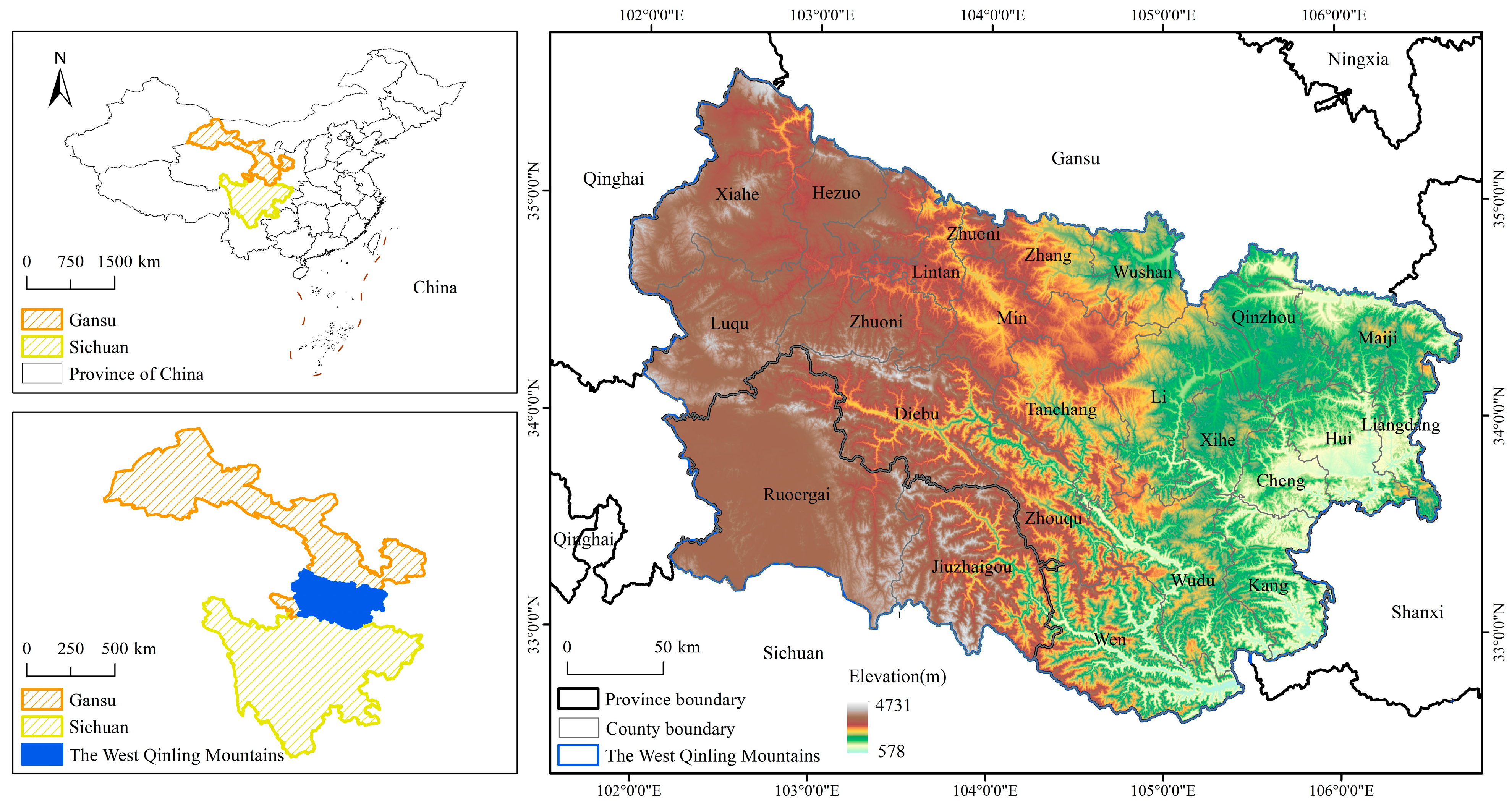
25], but there is still a need to strengthen interdisciplinary collaboration and technology transfer. In the future, we need to build a resilient ecosystem through the dual drive of intelligent modeling and policy innovation to provide scientific support for the realization of the global sustainable development goals. Currently, habitat quality and habitat degradation research face the challenge of insufficient integration of multi-scale data. For example, global-scale models are difficult to capture the nonlinear feedbacks of local ecological processes, which can be remedied by high-resolution remote sensing at the scale of a specific area. Despite the widespread application of the InVEST model, significant research gaps remain concerning the West Qinling Mountains. As an ecological transition zone spanning multiple scales and geomorphic units, a systematic investigation into the multi-scale driving mechanisms and polarization effects of habitat quality evolution in this area is still lacking.
In the past 30 years, the West Qinling Mountains area has been the core area for economic development and livelihood improvement in Gansu Province, and has great economic development value. However, driven by agricultural and tourism development, the contradiction between humanistic development and ecological protection has become a prominent problem in the West Qinling Mountains, with unbalanced spatial allocation of population, resources and environment, prominent human–land conflicts, urban expansion and other status quo causing ecological damage to a certain extent, degradation of ecological land such as water and grassland, decline in ecological environment quality. Consequently, conducting research on land use evolution, habitat quality, and degradation is essential to address critical territorial spatial problems in this region. The ultimate goal is to provide scientifically grounded recommendations for mitigating ecosystem degradation, spatial imbalance, and the unsustainable use of natural resources. This study examines the period from 1990 to 2020, a pivotal era of socioeconomic transformation in China. Three benchmark years—1990 (initiation of reform and opening-up), 2005 (deepening of the Western Development Strategy), 2020 (new era of ecological civilization construction)—were selected as landmark junctures. The use of 15-year intervals helps capture significant, policy-driven changes in land use and ecological impacts, thereby filtering out short-term interannual fluctuations and revealing underlying long-term trends. In this study, we investigated the land use pattern and degree of change in the West Qinling Mountains from 1990 to 2020, simulated and evaluated the habitat quality and habitat degradation of the West Qinling Mountains in the past 30 years with the help of InVEST model and spatial autocorrelation. This study aims to provide scientific references for the improvement of the habitat quality of the West Qinling Mountains, the protection of land resources and the direction of regional land use, as well as to provide a basis for decision-making on the optimization of regional land space, ecological protection and restoration, and the coordinated development of human–land systems, so as to promote the coordinated development of the population, resources and environment in the region.
3. Results
3.1. Land Use Change
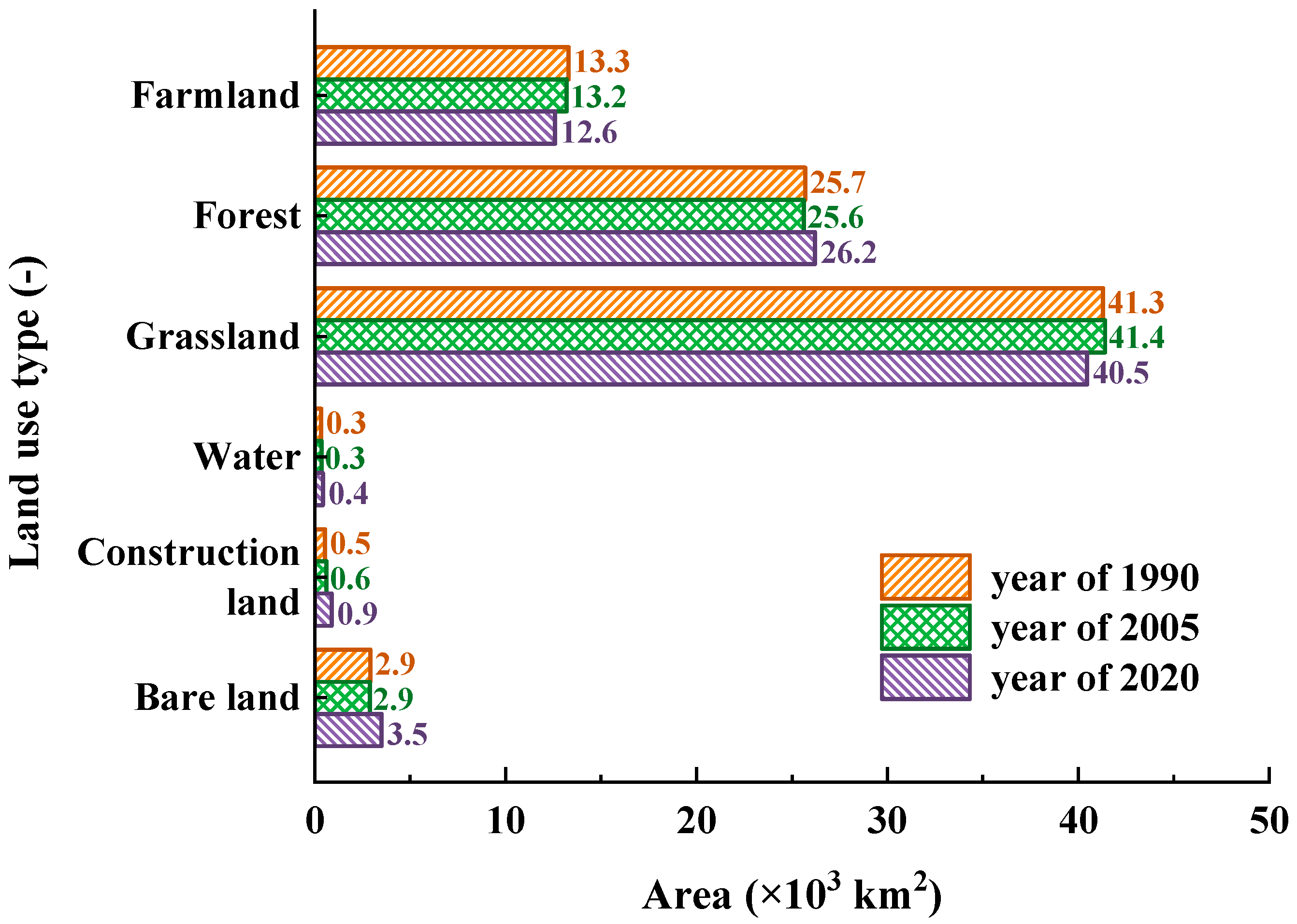
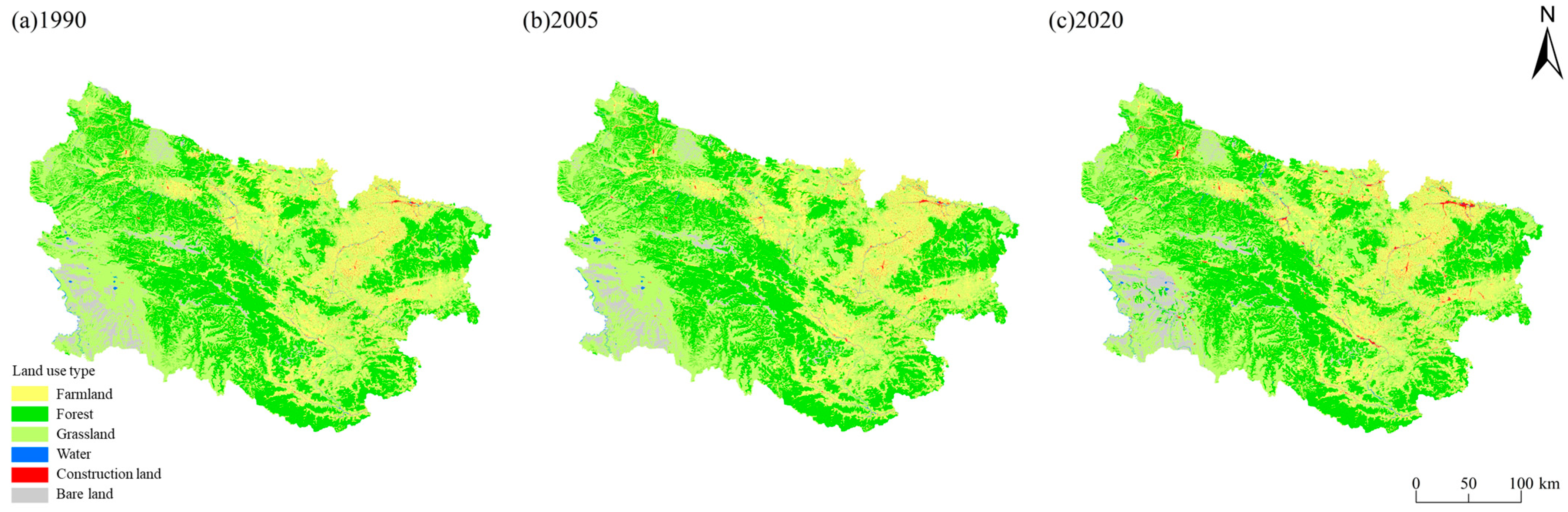
From the point of view of land use status and change (
Figure 2 and
Figure 3), between 1990 and 2005, farmland in the West Qinling Mountains decreased by 105.14 km
2, while grassland increased by 119.90 km
2. Other land use types showed no significant changes. This shift was primarily driven by the national Grain-for-Green policy, which facilitated the conversion of farmland to grassland. During the period of 2005–2020, it is mainly the decrease in farmland and grassland, which decreased, respectively, by 601.96 and 942.60 km
2; the land use types with more area increase are forest, construction land, and bare land, with the increase values of 590.26, 270.89 and 609.36 km
2 respectively. Over all from 1990 to 2020, the area of farmland and grassland in the West Qinling Mountains decreased, respectively, by 707.10 km
2 and 822.70 km
2, and the area of construction land increased by 336.50 km
2.
The northern and western parts of the West Qinling Mountains are dominated by the conversion of farmland to construction land and forest; the southern part is dominated by the conversion of grassland to farmland, forest, construction land, and water; the western part is also dominated by the conversion of grassland and bare land to farmland, water, forest, and construction land. The increase in the area of construction land in the West Qinling Mountains region from 1990 to 2020 is mainly due to the transformation of farmland and grassland, while the opposite changes exhibited by grassland and forest, to some extent, due to their mutual transformation that occurred over a period of 30 years.
The extensive loss of grassland in the West Qinling Mountains poses a severe threat to the regional ecological environment. The disappearance of grassland cover directly exposes topsoil, accelerating the erosion of fertile surface soil and thereby intensifying desertification and erosion. This transformation also disrupts the regional water cycle balance, manifested in weakened groundwater recharge capacity, leading to siltation and pollution in downstream rivers and lakes. Biodiversity is consequently significantly impacted. Excessive grassland reduction directly causes the decline or even extinction of obligate species populations. The remaining grasslands become highly fragmented, severely hindering species migration and gene exchange. Grassland destruction also eliminates its function as a vital carbon sink. Particularly when grasslands are converted for cultivation, vast amounts of carbon stored in the soil are released as carbon dioxide, accelerating global climate change. Ultimately, the service functions of grassland ecosystems decline significantly, further intensifying the vicious cycle between ecological and agricultural systems.
The ecological impact of farmland loss in the West Qinling Mountains depends on the type of land lost and its location. Losing marginal farmland (characterized by low and unstable yields, high ecological costs) in ecologically sensitive areas—such as steep slopes, riparian buffer zones, or arid/semi-arid regions—and restoring it to natural habitat through ecological engineering may yield more benefits than drawbacks. Conversely, the loss of high-yield, stable basic farmland—especially high-quality arable land near urban peripheries with convenient transportation—permanently converted into construction land (e.g., cities, factories, roads) for urban expansion represents an undeniable ecological and resource catastrophe. Thus, farmland loss is a complex signal. It may serve as an alarm for further ecological deterioration or as an opportunity for scientifically planned ecosystem restoration. Our objective should not be merely to maintain the total amount of farmland, but to pursue the maximization and sustainability of the overall ecological function of the national territory.
3.2. Habitat Quality Change
3.2.1. Change in Habitat Quality over Time
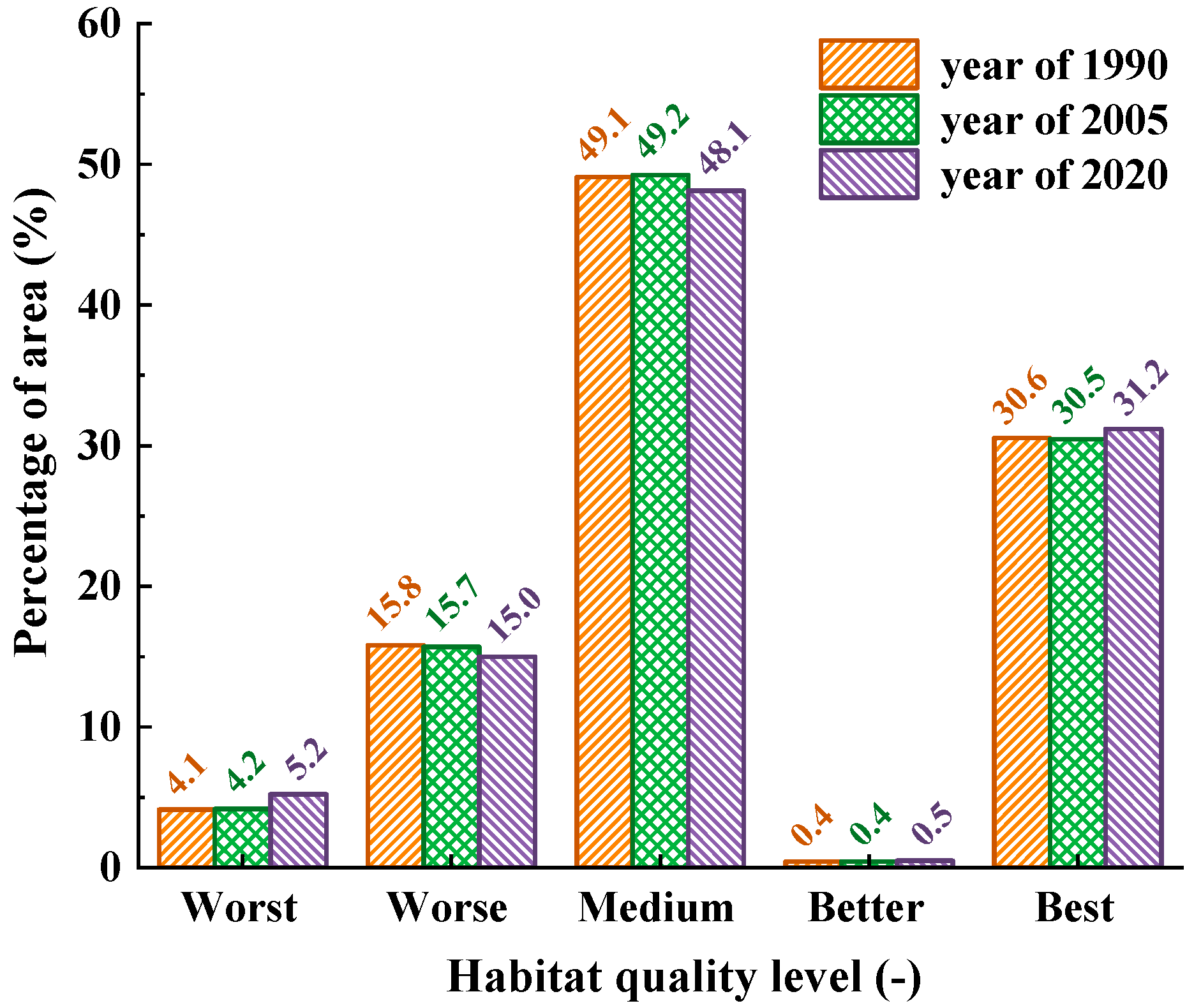
From the perspective of temporal change (
Figure 4), the proportion of the worst habitat in the West Qinling Mountains showed a consistent increase from 1990 to 2020, with a more substantial rise occurring in the latter 15-year period; despite a general 30-year decreasing trend in the proportion of worse habitat, the southern West Qinling Mountains experienced an increase, which followed a pattern of a minor rise followed by a more substantial one. The proportion of medium habitat showed an overall shrinking trend, with the exception of a steady increase in the western West Qinling Mountains, which lies on the eastern edge of the Tibetan Plateau. The proportion of higher habitat decreased in most areas, with a substantial reduction observed in the western part of the West Qinling Mountains, which is situated on the eastern margin of the Tibetan Plateau. The proportion of best habitat tended to increase slightly, with the latter 15 years increasing slightly more than the first 15 years. In general, the habitat quality change in the West Qinling Mountains exhibited a polarization trend, transitioning from better habitat to best, from medium and worse habitat to worst. An exception was observed in the western part of the region—located on the eastern edge of the Tibetan Plateau—where the dominant transition pathways were from better to medium and from worse to worst habitat.
In terms of the average value of habitat quality (
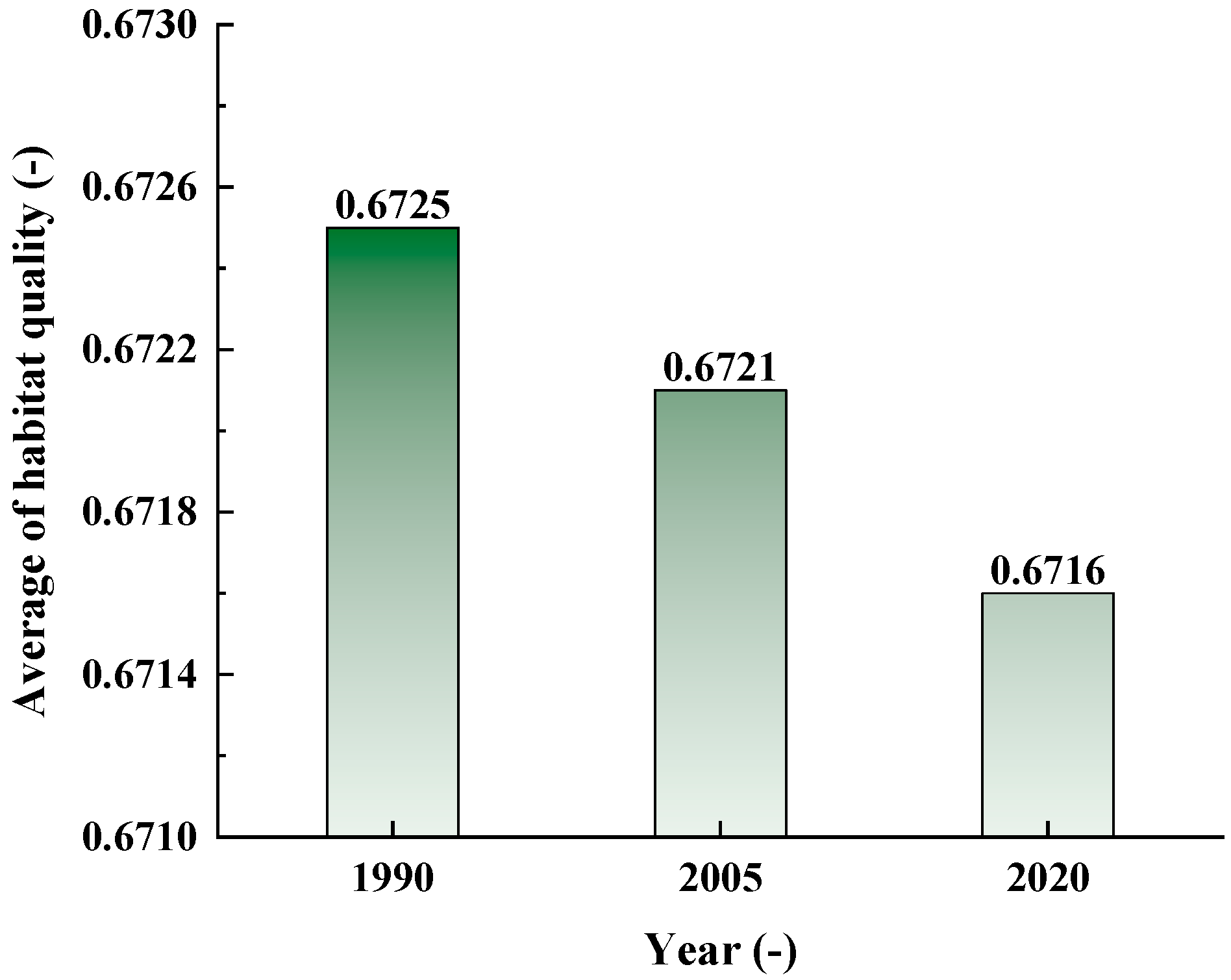
Table 4), the changing characteristic of habitat quality in the West Qinling Mountains show an overall decreasing trend, as shown in
Figure 5. From 1990 to 2020, the West Qinling Mountains exhibited a general increase in the proportion of both the worst and best habitat. This polarization trend appears closely linked to the region’s economic development activities and the implementation of ecological protection measures over this thirty-year period. Over the past three decades, the rising urbanization rate in the West Qinling Mountains has contributed to ecological deterioration in areas affected by township expansion, leading to declines in habitat quality and increased habitat degradation. Conversely, the area of best habitat also increased in the West Qinling Mountains. This increase is primarily attributed to ecological protection measures, including water conservation, ecological restoration, the Grain-for-Green Program, and land reclamation projects. The implementation of various ecological projects and policies has successfully contributed to an increase in the area of high habitat and a long-term improvement in habitat quality.
3.2.2. Spatial Variation in Habitat Quality
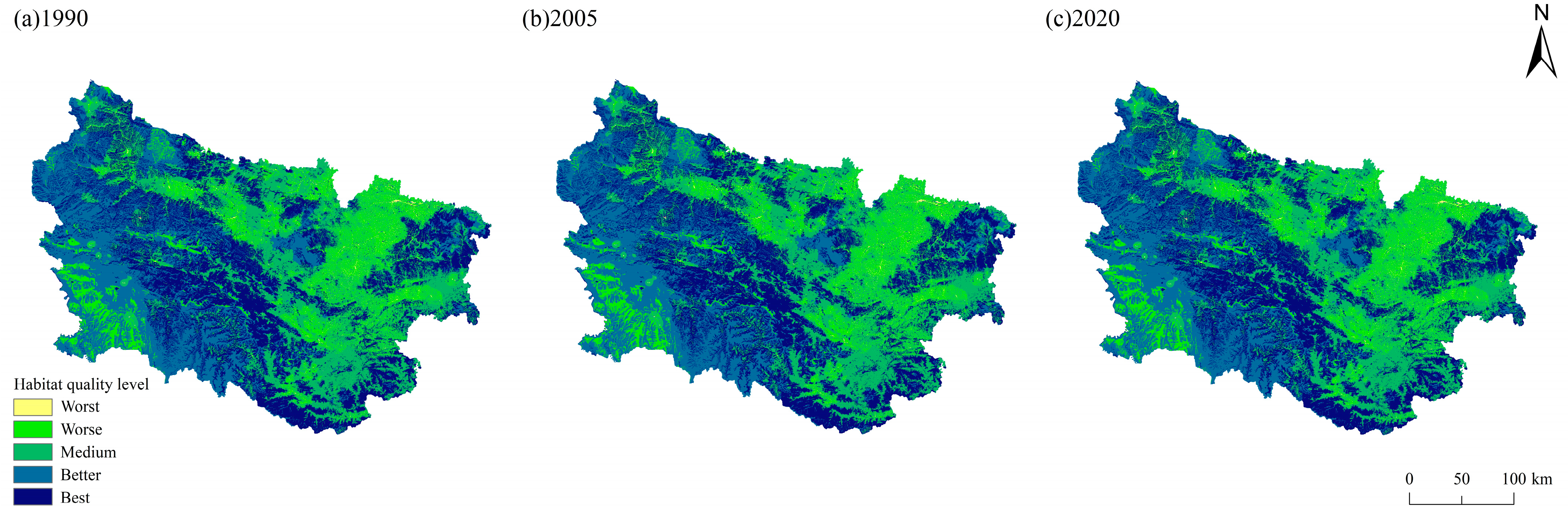
As can be seen from the distribution map of habitat quality in the West Qinling Mountains (
Figure 6), the spatial distribution of habitat quality in the West Qinling Mountains (Tibetan Plateau portion) exhibits a gradual decline from the interior of the Loess Plateau and Qinling Mountains toward areas with dense construction land and farmland. This decline is particularly pronounced in zones where construction land and farmland—bounded by the Loess Plateau and the basin—are concentrated, indicating that the expansion of construction land and the fragmentation of farmland distribution are major drivers of habitat quality degradation in the region.
In addition, forest, grassland and adjacent water bodies in the western and eastern urban fringes of the West Qinling Mountains demonstrated high habitat quality, with values ranging from 0.6 to 1.
Spatial analysis reveals a distinct zonation in habitat quality across the Western Qinling Mountains. The eastern and northern sections show a relatively low proportion of best-grade habitat, whereas the western part contains a larger proportion of such high-quality areas. These best habitats are predominantly distributed in zones characterized by minimal anthropogenic activity, denser vegetation cover, and higher biodiversity. Habitat quality is generally high in the forest-dominated, biodiverse, and less-disturbed Qinling Mountains. Conversely, it is poorest in economically prosperous urban centers, characterized by extensive construction land expansion and frequent human activities. The Loess Plateau region exhibits extensive areas of poor habitat quality, primarily associated with farmland and rural settlements. Overall, the spatial distribution of habitat quality in the West Qinling Mountains from 1990 to 2020 shows higher values in the western, northwestern, and southern parts, while lower values are observed in the northern, eastern, and southeastern regions. In the western Tibetan Plateau geomorphic zone, land use patterns and intensity are strongly constrained by topography. The coupling of these factors has resulted in distinctly different habitat characteristics in the western section compared to the Qinling Mountains-dominated east and south and the Loess Plateau-influenced north, underscoring the profound role of geomorphic influence on habitat differentiation.
3.3. Spatial Autocorrelation of Habitat Quality
3.3.1. Global Spatial Autocorrelation Analysis
By analyzing the global spatial autocorrelation of habitat quality in the West Qinling Mountains in 1990, 2005 and 2020, we found that its global Moran’s I values were 0.2517, 0.2503 and 0.2750 (p < 0.01). This suggests that there is an obvious spatial positive correlation in the distribution of habitat quality in the West Qinling Mountains and a spatial clustering trend. In particular, the values of Moran’s I first decreased and then increased during the period from 1990 to 2020, which revealed that the spatial clustering of habitat quality in the West Qinling Mountains first weakened and then gradually increased.
3.3.2. Local Spatial Autocorrelation Analysis
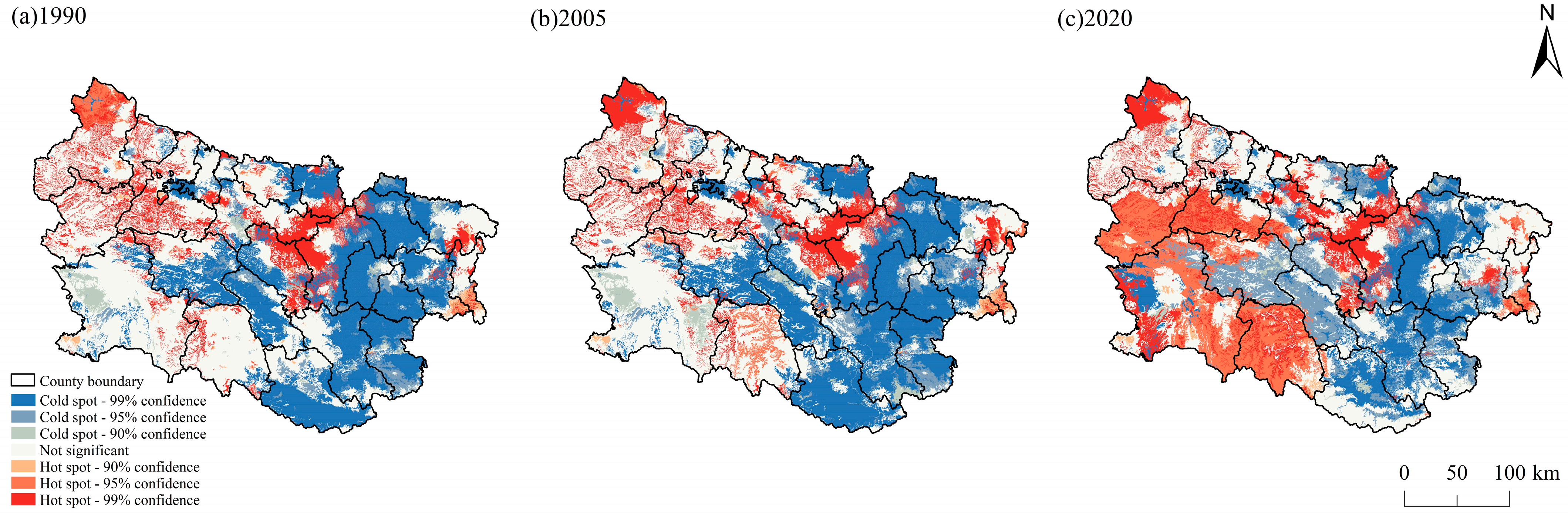
From the analysis of habitat quality hotspots (
Figure 7), the spatial distribution of habitat quality hot and cold spots in the West Qinling Mountains exhibits a distinct “hot in the west and south, cold in the center and east” pattern. The 99% confidence hot spots in the western Qinling Mountains are predominantly located in the western region, characterized by forest and grassland dominance. In contrast, the 99% confidence cold spots are primarily concentrated in the eastern urbanized areas. Both 99% and 95% confidence hot spots are mainly distributed across the western and central parts of the region, areas typified by high vegetation coverage and generally favorable habitat conditions, with average habitat quality values exceeding 0.6. The 99% and 95% confidence cold spots are predominantly concentrated in the central and eastern parts of the West Qinling Mountains. These areas are characterized by extensive townland and farmland, resulting in generally poorer habitat quality with an average value below 0.4. In contrast, the western part contains several 95% confidence hot spots, largely consisting of vast grassland areas with relatively favorable habitat conditions. These zones are further surrounded by forests exhibiting high habitat quality values, collectively forming 90% confidence hot spots in the region.
From a temporal perspective, between 1990 and 2005, the 95% confidence hot spot in Xiahe County (northwest West Qinling Mountains) strengthened to a 99% confidence level. Concurrently, hot spot distributions expanded spatially in Jiuzhaigou County in the south and Maiji District in the northeast, showing a gradual increase in areal coverage. Between 2005 and 2020, the hotspot distribution in southern Tanchang County decreased, while other areas remained largely unchanged. During this period, statistically non-significant areas were reduced. Specifically, in the West Qinling Mountains, the 99% confidence hotspot in Luqu County weakened to a 95% confidence level, and the hotspot in Zhuoni County gradually decreased in spatial extent. Hotspots in the southern part of the region remained stable. Between 1990 and 2020, the 95% confidence hot spots in the West Qinling Mountains expanded primarily in the western and southern regions, mainly encompassing grassland and forest areas. In contrast, the spatial distribution and area of 90% confidence cold spots remained largely unchanged throughout this period. Cold spots were primarily located in the southern West Qinling Mountains, particularly in the area where Tanchang County, Zhouqu County, and Wudu District converge. Within this junction zone, cold spots exhibited spatial expansion, while cold spots in other regions showed minimal change. The 95% confidence cold spot area located in Hui County in the eastern West Qinling Mountains decreased in significance and was reclassified as a 90% confidence cold spot. Between 2005 and 2020, significant changes occurred in the cold spot patterns of the West Qinling Mountains. The 99% confidence cold spot in the central region weakened to a 95% confidence level, while the 99% confidence cold spot in southern Wen County (southern West Qinling) became statistically insignificant. Additionally, 90% confidence cold spots in the eastern mountains decreased, primarily transitioning to non-significant areas—particularly in the forested Qinling ranges, indicating a trend of habitat restoration. Other cold spots remained largely unchanged in spatial extent.
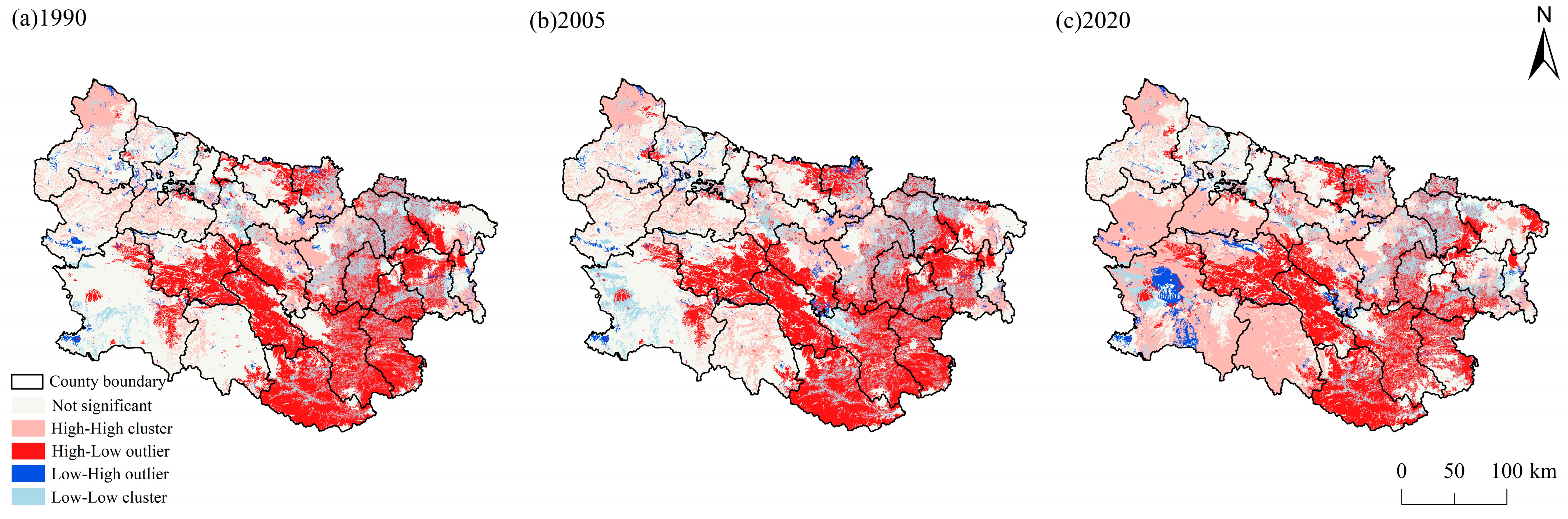
Based on the spatial clustering patterns of habitat quality in the West Qinling Mountains for 1990, 2005, and 2020 (
Figure 8), the following distribution characteristics are observed: (1) High–High clustering areas were primarily concentrated in the western and northwestern regions in 1990 and 2005. By 2020, these clusters expanded significantly toward the south, corresponding largely to forested zones with higher elevations and favorable ecological conditions. (2) Low–Low clusters were mainly distributed across the southwestern, eastern, and east–central urbanized zones. The area west of Ruoergai County showed an increase in Low–Low clustering in both 2005 and 2020. (3) High–Low outliers were predominantly located in the southeastern and central areas, typically where forest patches are adjacent to construction land. (4) Low–High outliers were relatively limited and scattered, appearing mainly in northern Wushan County and western Ruoergai County. In 2005, a small cluster emerged in southern Tanchang County, and by 2020, an additional area was observed in central Ruoergai County. These outlier areas often consist of farmland, grassland, or forest situated near zones with contrasting habitat quality levels.
From a temporal perspective, the areas of both High–High and Low–Low clusters expanded over the study period, while High–Low outliers decreased and Low–High outliers increased slightly. This pattern indicates a growing polarization in habitat quality since 1990, with values increasingly converging toward high and low extremes.
Human social activities are inherently shaped by natural conditions. In the study area, the combined effects of natural and anthropogenic factors have produced distinct spatial patterns in habitat quality. The central, eastern, and southeastern urban zones possess more favorable natural conditions and are more suitable for human settlement and economic activity compared to the western regions. Consequently, these areas experience stronger anthropogenic pressure, resulting in lower habitat quality and the formation of clustered spatial patterns. Habitat quality high–high clusters not only possess ecological value but also align closely with the “ecological protection red line” delineated at both the provincial and national levels in Gansu. Therefore, the findings of this study provide empirical support for the scientific basis and necessity of ecological protection redlines. It is recommended that the low–low cluster anomalies (i.e., habitat quality depressions) within the redline boundaries be prioritized for ecological restoration through targeted initiatives such as “returning farmland to forests and grasslands” or “enclosing mountains for afforestation.”
3.4. Habitat Degradation Analysis
3.4.1. Analysis of Temporal Changes in Habitat Degradation
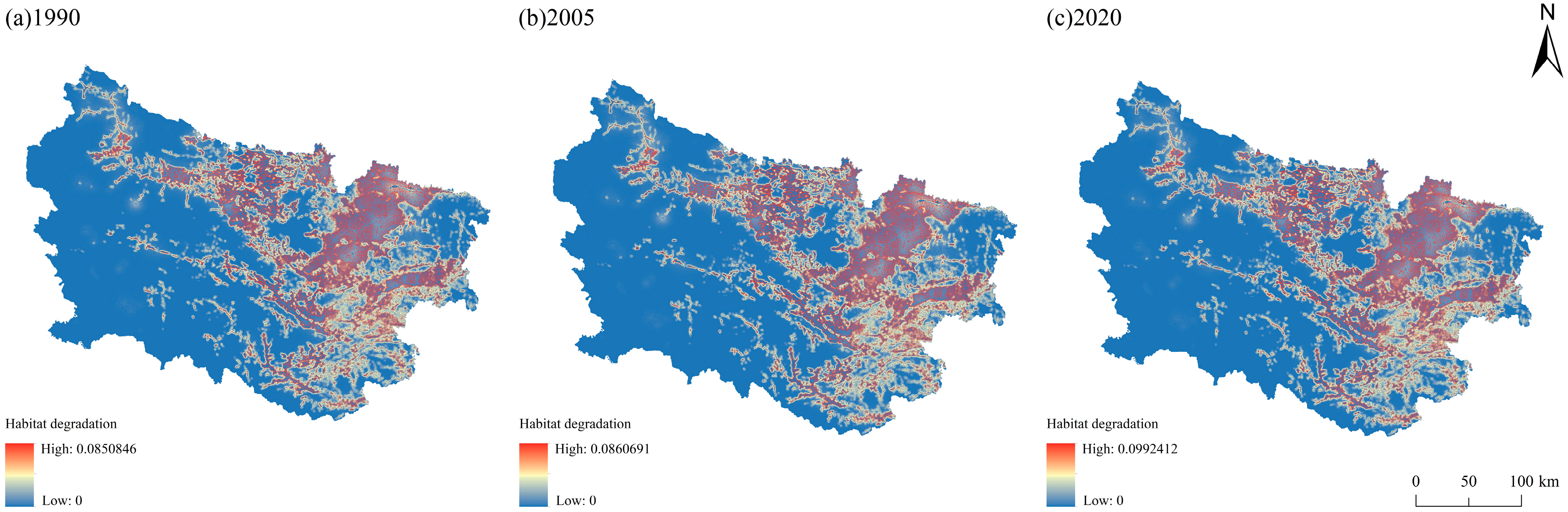
The spatial distribution of the degree of habitat degradation in the West Qinling Mountains in 1990, 2005 and 2020 was calculated by the InVEST model, as shown in
Figure 9. The value of habitat degradation reflects the degree of habitat degradation in the West Qinling Mountains in different periods. Habitat degradation in the West Qinling region ranges from 0 to 0.1, and higher values of habitat degradation degree imply that the habitat quality of the region is facing a great potential risk of degradation.
Over all for the 30 years from 1990 to 2020, the degree of habitat degradation in the study area has been on an upward trend, the average values of habitat degradation in the West Qinling Mountains in 1990, 2005 and 2020 were 0.004771, 0.004790 and 0.005052, with the maximum values of 0.0851, 0.0861 and 0.0992, respectively, which can be seen as follows. It can be seen that there was a small increase in habitat degradation degree from 1990 to 2005, indicating that the probability of increasing habitat degradation in the study area was small. 2005–2020 saw a larger increase in habitat degradation degree compared with the previous 15 years, indicating that the probability of increasing habitat degradation in the West Qinling Mountains had increased.
3.4.2. Analysis of Spatial Variation in Habitat Degradation
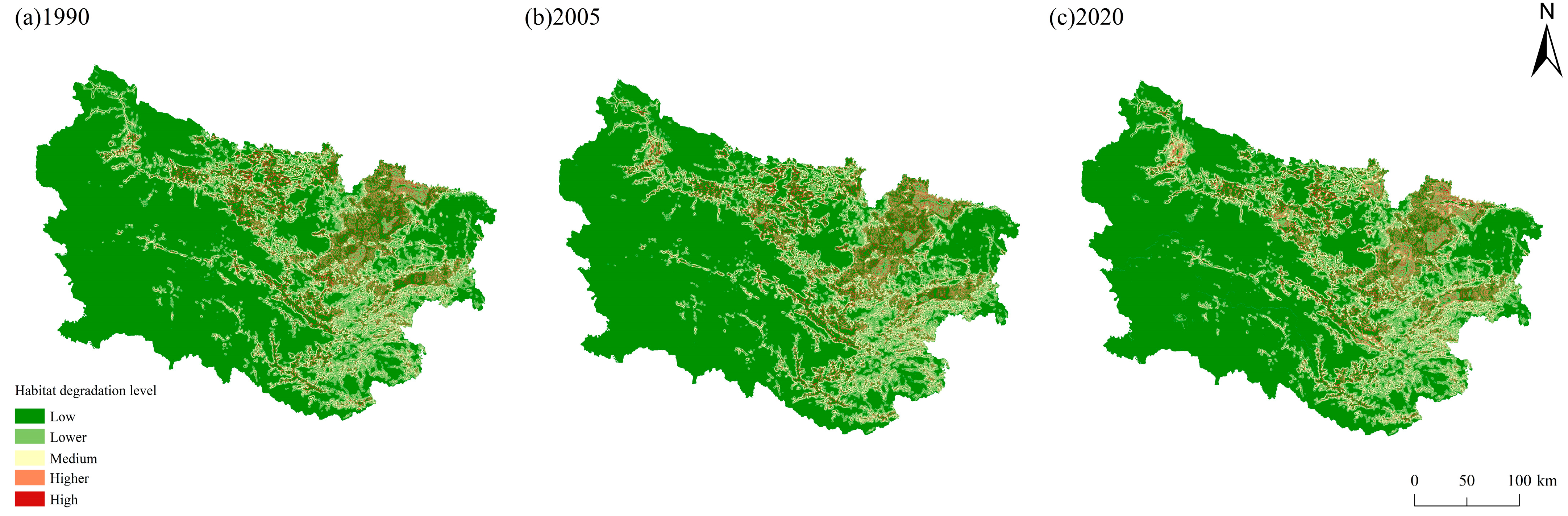
The spatial distribution of habitat degradation level in the West Qinling Mountains shows high degradation level in the northeastern, eastern and southern parts of the research area and low degradation levels in the western and southwestern parts of the research area, as shown in
Figure 10. The reasons for this can be viewed from the following two perspectives:
In the areas with higher habitat degradation index, the population density is usually higher, the distribution of urban residential land and cultivated land is more concentrated, and the disturbance of human activities is relatively more, so the possibility of habitat degradation is also greater; in the eastern edge of the western Tibetan Plateau, the grassland occupies a dominant position, where the population concentration is relatively low, and the disturbance of human activities is also not much, so the chance of ecological environment degradation is also relatively low. This reveals the high sensitivity of activities such as agriculture, industry and human settlement to ecological environment degradation.
With the increasing scope of urban and rural construction land, we observe that the habitat degradation index is also gradually increasing, and the degraded area also shows an expanding trend in spatial distribution. In the economic growth of the West Qinling, the continuous expansion of urban and arable land has led to a series of ecological and environmental problems. These problems mainly focus on land degradation and land alkalization and sanding. With the acceleration of urbanization, the population has risen sharply. In order to meet the growing demand for food and the continued expansion of cities, a large amount of grassland has been converted into arable land, which in turn has been used for urban construction. Excessive use of pesticides and chemical fertilizers has led to the negative ecological impacts of arable land, while large amounts of pesticide and fertilizer residues have further exacerbated the problem of land degradation.
4. Discussion
4.1. Trends and Spatial Patterns of Habitat Quality
From 1990 to 2020, the average habitat quality in the West Qinling Mountains exhibited a declining trend. Habitat quality in the West Qinling Mountains exhibited a clear trend of polarization. While a limited proportion of medium and better habitats transitioned to best-grade, most medium and worse habitats degraded to worst. This pattern aligns with global observations: in highly urbanized regions such as Ghent, Belgium, habitat quality declined due to construction expansion and loss of forests and grasslands [
50], whereas in ecologically protected areas like those near Budapest, Hungary, conservation policies significantly improved habitat quality through farmland afforestation [
51]. Similarly, Vancouver, Canada, achieved annual habitat quality growth of 1.2% via wetland restoration [
52], in contrast to the Amazon Basin, where illegal logging and agricultural expansion led to a 15% decline [
53]. These examples underscore the dual role of human activity and policy intervention in shaping habitat trajectories.
Spatially, habitat quality in the West Qinling Mountains displayed significant heterogeneity. High-quality habitats were concentrated in the western, northwestern, and southern regions—areas characterized by dense forest cover, complex topography, and limited human disturbance. In contrast, low-quality habitats dominated the northern, eastern, and southeastern zones, where urbanization and agricultural expansion have intensified. The Loess Plateau region, in particular, showed widespread poor habitat quality, largely due to farmland and rural settlement expansion. Notably, habitat quality in the western Tibetan Plateau geomorphic unit differed significantly from other subregions, highlighting the constraining role of landforms on land use intensity and ecological outcomes.
These spatial and temporal variations were primarily driven by two competing forces: economic development pressure and ecological restoration initiatives. Urban and agricultural expansion degraded habitats in economically active areas, while policies such as farmland-to-forest conversion, land reclamation, and water conservation improved habitat conditions in ecologically prioritized zones.
Suggestions and countermeasures to improve the habitat quality of the West Qinling Mountains are as follows: (1) Worse and worst habitats: urbanization and agricultural expansion should not occupy high-quality farmland, forest, grassland and water unless it is necessary; environmental assessments should be carried out; the approval process for development should be rigorously controlled; and protection zones at the edge of the city should be delineated. Focus on the ecological protection of the watershed, and arrange reasonable ecological restoration measures, such as returning farmland to forests, land reclamation and other programs in areas with low habitat. For areas where agricultural activities have degraded habitat quality, these should be incorporated into high-standard farmland construction or comprehensive land improvement projects. The focus should be on promoting ecological agricultural techniques and establishing ecological buffer zones in farmland to balance grain production with biodiversity conservation functions. (2) Medium habitats: nutrient management and renewal of crop varieties (cold and drought tolerant varieties, etc.) can be practiced on arable land, and rational crop rotation can be promoted. (3) Better and best habitats: the destruction of habitat structures by sudden-onset disasters such as earthquakes and tsunamis requires rapid assessment and technological innovation. Increased enforcement of protected areas on habitats (frequency of anti-poaching patrols, rate of fine enforcement) translates into parameters of effectiveness of legal protection, and the rate of decline in habitat quality slows down in areas with high law enforcement intensity ref [
54]. At the same time, combined with ecological restoration planning, the West Qinling Mountains habitats can be managed sustainably. (4) The habitat quality degradation hotspots identified in this study such as counties in the northern and southeastern regions, provide scientific basis for establishing a horizontal ecological compensation mechanism. It is recommended that habitat quality beneficiary areas such as downstream cities in the water conservation zones of the western region, provide support to habitat quality contributor areas or key degradation management zones through financial compensation and industrial collaboration. For instance, improvements in habitat quality and degradation indices could serve as core indicators for evaluating the effectiveness of compensation fund utilization, facilitating a shift from “blood transfusion-style” compensation to “blood production-style” incentives.
4.2. Patterns and Risks of Habitat Degradation
Overall habitat degradation in the West Qinling Mountains remains low, but the average degradation value showed an upward trend from 1990 to 2020. Degradation transitions indicate a shift toward medium-risk aggregation, with changes mainly from low to lower and high to medium grades. Spatially, degradation is concentrated in the north, east, and southeast, centered on eastern construction zones, while the west remains less affected.
This trend is consistent with degradation mechanisms observed globally. In Southeast Asia, peat swamp forests are rapidly converted to industrial plantations, leading to significant carbon emissions [
55]. In the West Qinling Mountains, farmland degradation results from over-fertilization, irrigation-induced salinization, and climate change-driven water scarcity. Forest degradation has shifted from clear-cutting to hidden fragmentation; similar patterns are observed in the Amazon, where although deforestation rates may slow, the increase in small-scale loss patches raises fragmentation indices—indicating “perforated” fragmentation that undermines ecological function [
56].
Suggestions and countermeasures to reduce the risk of habitat degradation in the West Qinling Mountains are as follows: (1) Areas at high risk of habitat degradation can be reforested to enhance community resilience, with the core focus on integrating ecological restoration with sustainable habitat. These high-risk areas are primarily distributed along the peripheries of urban expansion and major transportation corridors, precisely where the “urban development boundary” and “ecological control line” in national spatial planning intersect. It is recommended that local-level national spatial plans designate these zones as “key ecological restoration areas,” strictly limit new construction encroachment and explore implementing a “land use reduction” strategy. (2) Multi-scale monitoring integration can be used in monitoring the risk of degradation: integrating land cover data, landscape indices, and fragmentation modeling, to construct more detailed restoration programs and real-time monitoring. (3) Interdisciplinary innovations in habitat degradation risk reduction methods can be used: for example, combining vegetation surveys in ecology with microbial enzyme activity measurements in biology to reveal the deeper impacts of degradation on ecosystem cycles and other aspects. (4) Habitat degradation can be curbed not only by technological innovation, but also by shifting from “island protection” to “network governance”, and integrating social dimensions into ecological restoration practices. (5) In terms of policy and social participation mechanisms, a compensation mechanism for ecological restoration can be developed to encourage public participation in sustainable habitat management and raise awareness of ecological environmental protection.
4.3. Innovation and Inspiration
Methodologically: Coupling the InVEST model with spatial autocorrelation analysis systematically reveals habitat quality “polarization” and spatial dependency patterns.
Theoretical level: Introducing “landscape resilience” and landscape recovery theory into habitat degradation analysis in the West Qinling Mountains emphasizes the response mechanisms of geographic units to human disturbances, expanding the interpretive dimensions of habitat change mechanisms.
Policy level: Proposing a sustainable habitat governance pathway for the West Qinling Mountains based on “zoning–classification–grading” provides a reference model for the management and restoration of similar ecological transition zones.
4.4. Limitations and Future Research
This study applied the InVEST model and spatial autocorrelation analysis to assess habitat quality and degradation in the West Qinling Mountains, providing a scientific basis for regional ecological management. However, the reliance on a single modeling framework limits the ability to fully disentangle complex drivers. Future studies should incorporate multi-model comparisons, land use change scenarios, and high-resolution data on climate, population, and economic activity. Techniques such as structural equation modeling or machine learning could help quantify the contributions of different factors—both natural and anthropogenic—to habitat changes. Further analysis at finer spatial scales will also be essential for designing targeted conservation strategies.
The 15-year data interval used in this study, while useful for revealing long-term macro trends, may fail to capture critical turning points or detailed fluctuations in habitat quality and degradation occurring on shorter timescales (e.g., 5 years). Future research will focus on acquiring higher-resolution remote sensing data (e.g., five-year intervals) to more precisely characterize the dynamic processes of habitat change and accurately identify their response relationships to specific policy events and extreme climate events.
5. Conclusions
Between 1990 and 2020, land use in the West Qinling Mountains underwent significant changes, characterized primarily by a decrease in grassland and farmland areas and an increase in construction land, bare land and forest land. These land use changes served as the primary driver of habitat quality variation, with regional geomorphology exerting a secondary influence.
Although the overall habitat quality remained relatively high, the regional average exhibited a declining trend. The habitat transition process displayed a distinct polarization pattern: a small proportion of medium and high habitats improved, while the majority of medium and low habitats further degraded. Spatially, habitat quality demonstrated a clear pattern of being higher in the west and lower in the north and southeast. This spatial heterogeneity was further reflected in the clustering of hotspots (primarily in the forest- and grassland-dominated west and south) and cold spots (concentrated in the urbanized areas of the central and eastern regions). The spatial agglomeration of habitat quality intensified over time, with the areas of high–high and low–low clusters expanding.
Meanwhile, the overall degree of habitat degradation was relatively low, yet the average degradation value showed an upward trend. Habitat degradation manifested as a shift toward medium-risk accumulation. Spatially, degradation levels were low in the west and high in the north and southeast, with the most severely degraded areas focused on construction land in the eastern part of the region.