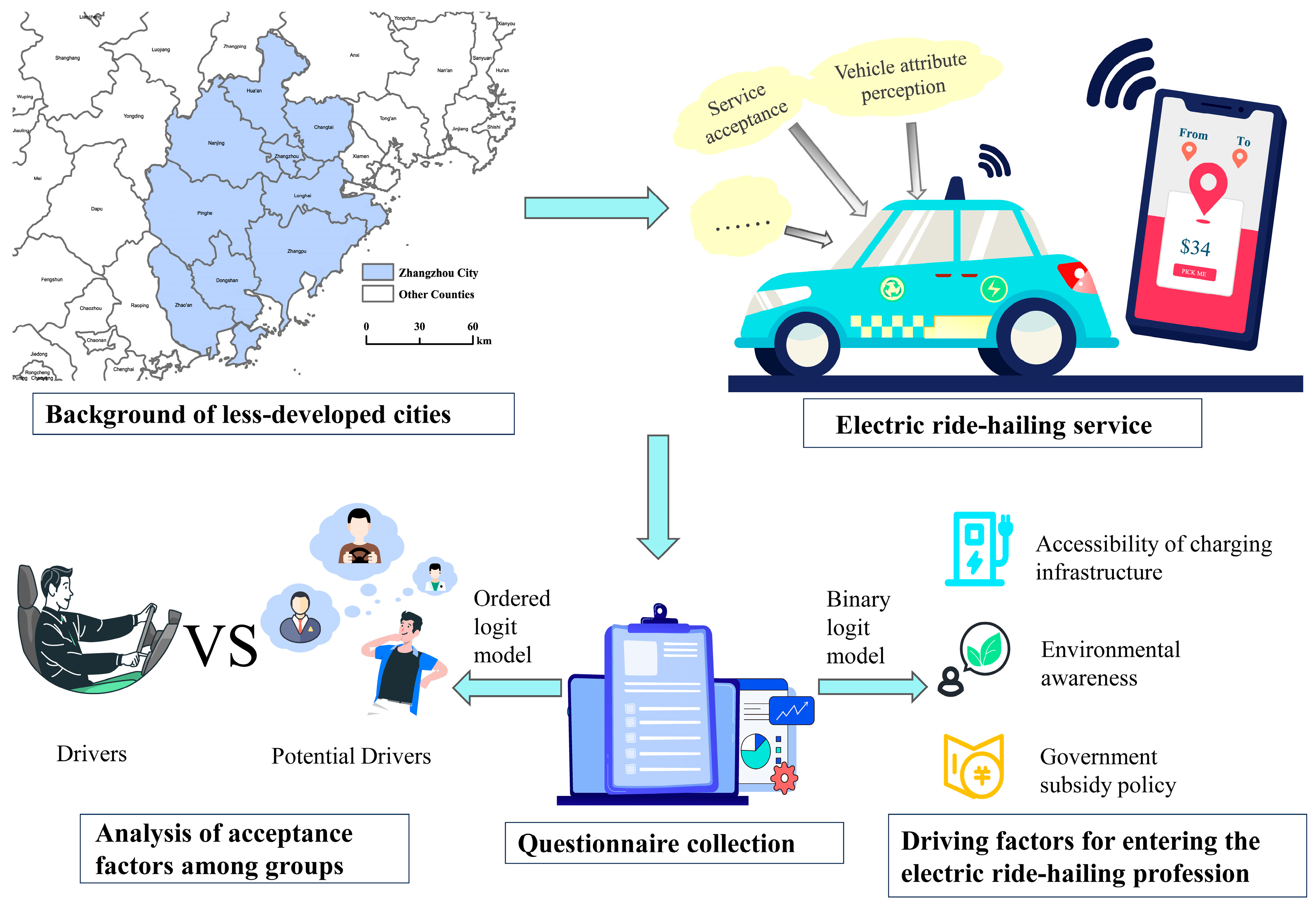
5.1. Factors Influencing the Acceptance of ERHS
The ordered logit model results for the factors influencing the acceptance of ERHS by driver groups and potential driver groups are presented in
Table 3 and
Table 4, respectively. The significance (
p-value) determines whether the influence of a factor is real or may be caused only by random contingency. In the logit model results, when the significance value of a variable is less than 0.05, we believe that its impact is statistically significant. This means that we have at least 95% confidence that this factor does have an impact on the dependent variable. When 0.05 ≤
p < 0.1, this variable is marginally significant and will be interpreted as indicating a trend. For the statistically significant independent variables, their coefficient estimates reveal the direction and relative strength of their influence on the dependent variable. In the logit model, when the estimated value of the coefficient is positive, the higher the value, the more likely the dependent variable is to enter a higher level. When the estimated value is negative, the greater the absolute value, the more likely the dependent variable is to fall into a lower level. The significance of the parallel line test was 1.000 (greater than 0.05), which proves the validity of the models. The pseudo-R-square is used to measure the degree to which the independent variables of the model explain the variation of the dependent variable. We examined three of the most commonly used pseudo-R-squares. Cox and Snell values reflect the proportion of improvement in the goodness of fit of our model compared with the zero model, and the higher the value, the better. The values obtained by our two models are 0.703 and 0.512, respectively, which are at a high level. Nagelkerke is the modified R-square of Cox and Snell. The higher the value, the better the fitting effect. The Nagelkerke values obtained by the two models are 0.739 and 0.564, respectively. McFadden generally believes that when its value is between 0.2 and 0.4, it represents a very good fit of the model. The values obtained by our two models are 0.402 and 0.3, respectively. The chi-square test is used to evaluate the statistical significance of the entire model. The chi-square values of the two models are 524.673 and 142.064, respectively; the
p-values are far less than the significance level of 0.05, which indicates that the selected variables have a significant impact on the model results at the 95% confidence level. The −2*log-likelihood value reflects the amount of information that the model fails to explain. The −2*log-likelihood values of the two models are 779.434 and 331.159, which are much smaller than their respective zero models (1304.107 and 473.224), indicating that the independent variables we included greatly improve the fitting effect of the model.
As for the model results of the factors influencing the acceptance of ERHS by driver groups, as shown in
Table 3, in the dimension of environmental awareness, the variable of the importance of new energy vehicles in promoting green travel has a significantly positive impact on the acceptance of ERHS by drivers (estimated value 0.575, significance 0.000). It is indicated that, with all other factors held constant, for every unit increase in the recognition of this variable, the ordered logarithmic occurrence ratio of the dependent variable with a higher level of acceptance increased by 0.575. Similarly, the variables of drivers’ recognition of the positive role of EVs in urban public transportation systems and their support for the popularization of shared electric bicycles in cities also show significant positive effects. These variables all reflect the environmental awareness of the driver group to some extent, and the results further prove that the improvement of environmental awareness plays an important role in promoting the acceptance of ERHS. This is consistent with the conclusions of broader research on shared mobility. For instance, Tang et al. [
31] also found in their study that environmental awareness, as a perceived social return, can significantly enhance users’ willingness to adopt Mobility as a Service (MaaS). This indicates that, whether as passengers or service providers, a sense of responsibility towards the environment is a key psychological driving force for the development of sustainable transportation models.
The variable of the drivers’ satisfaction with intelligent attributes of ERHVs, such as autonomous driving, shows a marginally significant positive impact on the acceptance of ERHS by drivers. This may be because the intelligent function is often regarded as the manifestation of the advanced technology of modern EVs. As Song et al. [
32] demonstrated, L2-level autonomous driving on highways can reduce the driver’s operation frequency by 34%. Drivers who are satisfied with these intelligent functions tend to view electric ride-hailing vehicles as a more convenient and comfortable working device to operate, thereby increasing their acceptance.
Regarding health concerns, drivers who are not worried about the potential health impacts of EV radiation are more likely to adopt ERHS (estimated value 0.358, significance 0.001,
p < 0.01). This means that for professional drivers who use EVs as their main workplace, the concerns over the health impacts of electromagnetic radiation will significantly reduce their willingness to accept them. Similarly, Materia et al. [
33] found that public concern over the possible negative health effects of exposure to electromagnetic waves is a key obstacle hindering the adoption of new technologies. Therefore, in the process of promoting the electrification transformation of transportation vehicles, eliminating the health perception risks of high-intensity practitioners can accelerate the market acceptance.
Surprisingly, the variable of drivers who perceive the commission rules of their platform as reasonable has a significant negative impact on the acceptance of ERHS by drivers (estimated value −0.259, significance 0.033,
p < 0.05). This phenomenon may be explained as market inertia based on economic rationality. The research of Zha et al. [
34] pointed out that the operational purpose of the platform and its drivers is to maximize the common profit. The commission rules regarded as reasonable imply that the current market has reached a stable balance in this profit-sharing arrangement. In less-developed cities, some drivers have deeply adapted to the operation mode and commission rules of online ride-hailing services. Their reliance on the existing balance and their aversion to the risk of disrupting it make them reluctant to transition to ERHS. Another explanation is that drivers who consider it reasonable are very likely to be those who have successfully mastered the operational model of gasoline-powered ride-hailing. They know about the cheapest gas stations and other knowledge, but a large-scale shift to ERHS will require them to spend time learning again.
At the policy and driver characteristic level, drivers who perceive the acquisition of ride-hailing licenses as relatively easy are more inclined to accept ERHS (estimated value 0.281, significance 0.009, p < 0.01). This finding suggests that in less-developed cities, the simplification of administrative procedures and the reduction in entry barriers may contribute to a higher level of participation in the electric ride-hailing industry, which could improve overall market acceptance. Moreover, sufficient support for retraining and career transitions provided by society and the government has a significant positive impact on the acceptance of ERHS by drivers (estimated value 0.415, significance 0.001, p < 0.01). The importance of government support policies, particularly those related to career transition training, is thus underscored in the development of the electric ride-hailing market.
From the perspective of driver identity, compared with taxi drivers (the reference group), both full-time ride-hailing drivers (estimated value 1.162, significance 0.031,
p < 0.05) and part-time ride-hailing drivers (estimated value 1.853, significance 0.001,
p < 0.01) exhibit significantly higher acceptance of ERHS, and part-time drivers demonstrate an even stronger preference. This is because part-time ride-hailing drivers, who generally treat this work as a supplementary income source with flexible hours and lower intensity, tend to focus more on immediate financial benefits. As the charging price is lower than that of the fuel, the operating cost per trip for EVs is lower, which aligns with their short-term profit demands. This distinct operational pattern of part-time drivers has been empirically verified. Ma et al. [
35] analyzed the distribution of drivers’ working hours, and showed that there are two peaks of less than 5 h and 10–15 h for online car-hailing drivers, while traditional taxi drivers have only one peak of long-term work. At the same time, they point out that the reason why part-time drivers are efficient is that they tend to enter the market at the peak of market demand to supplement the capacity. In contrast, full-time ride-hailing drivers, with longer daily operating hours, place greater emphasis on the stability of long-term income and cost balance. GOH et al. [
36] analyzed Malaysian ride-hailing drivers and found that, after considering all operating expenses, the net profit of full-time drivers might be lower than the national minimum wage. Furthermore, the full life cycle costs and potential risks of EVs, such as the loss of operation duration due to the charging, to some extent offset the benefits brought by low electricity prices and undermine full-time drivers’ long-term income and cost balance. Consequently, they tend to be slightly more cautious about adopting ERHS than part-time ride-hailing drivers.
Regarding subsidy policies, compared with the charging subsidies, drivers who receive operational subsidies from the government are more inclined to accept ERHS (estimated value 0.793, significance 0.011,
p < 0.05). This is because the effectiveness of charging subsidies is constrained by the insufficient coverage of charging infrastructure in less-developed cities, which limits the potential to significantly reduce operational costs. In contrast, operational subsidies allow these costs to be directly lowered, which effectively compensates for the relatively high initial investment and possibly low expected returns of ERHS. As a result, drivers’ confidence in the long-term economic benefits of ERHS is strengthened. The appeal of this policy is particularly pronounced in less-developed cities. This discovery is consistent with the study by Liu et al. [
37], in which operational subsidies were found to have a stronger effect on improving drivers’ willingness to adopt EVs than non-monetary incentives.
Drivers who intend to participate in the electric ride-hailing profession show a marginally significant higher acceptance of ERHS (estimated value 0.518, significance 0.086, p < 0.1). This trend might suggest that after weighing the various benefits and challenges, drivers who decide to enter the industry may psychologically embrace this matter more positively. This also reflects the consistency of behavioral intention and the attitude to a certain extent.
To further quantify the actual effects of each influential factor, we calculated the marginal effect of the ordered logit model. The results (see
Table A1 in
Appendix A) provide more in-depth evidence for the findings in the model, and clearly reveal the specific probability influence of key variables on drivers’ choices of different acceptance levels. In terms of key factors, the results are highly consistent with our previous discussion. For example, when the recognition of the environmental importance of new energy vehicles increases by one unit, the probability of choosing “relatively accept” and “strongly accept” increases by 9.6% and 4.3%, respectively. Similarly, when the variable of not being concerned about EV radiation increases by one unit, the probability of choosing “relatively accept” and “strongly accept” increases by 6.0% and 2.7%, respectively. The influence of occupation type is particularly significant. When the probability of occupation being a part-time ride-hailing driver increases by one unit, the probability of choosing “strongly accept” increases by 11.1%, while, when the probability of occupation being a full-time ride-hailing driver increases by one unit, the probability of choosing “strongly accept” increases by 4.8%, which quantitatively confirms that part-time drivers have the strongest acceptance. Conversely, when the variable of the belief that the platform’s commission is reasonable increases by one unit, the probability of choosing “relatively accept” and “strongly accept” decreases by 4.3% and 2.0%, respectively. In conclusion, the marginal effect analysis not only verifies the directional conclusion of the model, but also reveals the actual intensity of the influence of each factor through specific probability changes, which provides strong quantitative evidence for us to understand the decision-making mechanism of drivers’ acceptance of ERHS.
As for the model results of the factors influencing the acceptance of ERHS by potential driver groups, as shown in
Table 4, in terms of environmental awareness, the potential drivers’ recognition of the importance of new energy vehicles in promoting environmentally friendly travel, as well as their support for the popularization of shared electric bicycles in cities, show significant positive effects on their acceptance of ERHS. This finding is similar to the conclusion of Du et al. [
38] that environmental awareness is positively associated with the growth in new energy vehicles.
The driving range and driving experience of ERHVs appear to be factors that influence the acceptance of ERHS by potential drivers. The satisfaction with the driving range of ERHVs has a marginally significant positive impact on potential drivers’ adoption (estimated value 0.511, significance 0.085,
p < 0.1). In less-developed cities, where charging infrastructure is relatively weak, the driving range is regarded as a key factor that influences potential drivers’ decisions on whether to participate in the electric ride-hailing profession, as suggested by the findings of Timmons et al. [
39] in developing countries. Furthermore, there is suggestive evidence indicating that the satisfaction with the driving experience of ERHVs positively affects adoption (estimated value 0.546, significance 0.072,
p < 0.1). The results of Tarei et al. [
40] are similar: consumers’ perceptions of EV performance significantly influence their adoption.
In terms of economic and market factors, potential drivers who consider that the platform’s commission rules are reasonable are more likely to accept ERHS (estimated value 0.494, significance 0.018,
p < 0.05). This result also confirms the findings of dynamic labor supply models [
41]: a lower commission rate effectively attracts potential drivers to register and join. Interestingly, this variable was found to have a significant negative impact on driver acceptance in the study of the previous model. This is because the driver group is an insider in the passenger transport market. They believe that the reasonable commission rules reinforce their inertia to remain in the current ride-hailing market that is not yet fully electrified, thereby reducing their acceptance of ERHS. Potential drivers, on the other hand, are outsiders to the passenger transport market. What they perceive is the overall commission rules in the transformation of the ride-hailing market. Reasonable commission rules are a positive market access signal for potential drivers, which encourages them to adopt more cost-effective new tools, such as ERHVs, to enter the attractive electric ride-hailing market, thereby enhancing the acceptance of ERHS. However, for potential drivers who believe that fuel price fluctuations have no impact on the ride-hailing business, the acceptance of ERHS is reduced (estimated value −0.493, significance 0.010,
p < 0.01). This suggests that in less-developed cities, the fuel-saving advantages of ERHVs in the context of fuel price fluctuations may not be fully recognized by potential drivers, and their low sensitivity to fuel price changes results in a decreased willingness to accept ERHS.
Optimism about the future development of the ride-hailing industry with the popularization of autonomous driving technology has a significant positive impact on potential drivers’ adoption of ERHS (estimated value 0.471, significance 0.035, p < 0.05). Autonomous driving technology is expected to effectively improve the work efficiency of ride-hailing drivers, which will stimulate potential drivers to accept ERHS to a certain extent.
From a demographic perspective, the acceptance of ERHS is significantly influenced by gender and age. In this study, the results show that male potential drivers, compared with females, exhibit lower acceptance of ERHS (estimated value −1.286, significance 0.003,
p < 0.01). It indicates the substantial role that gender plays in the acceptance of ERHS. This contrasts with some studies on passengers. For instance, Vivoda et al. [
42] found that men are more likely than women to understand and use ride-hailing services, which is to some extent attributed to higher technological acceptance. The opposite trend we observed among potential drivers may indicate that when the role shifts from passenger to professional provider, and the technology shifts from familiar gasoline vehicles to new electric vehicles, the acceptance results also change. For potential male drivers in our sample, adopting a new technology as a major income-generating tool could make them perceive unknown risks and responsibilities, leading them to be more cautious. Regarding the age, there is a marginally significant trend indicating potential drivers between the ages of 36 and 45 have lower acceptance of ERHS (estimated value −0.835, significance 0.065,
p < 0.1). This is likely because this group was at the peak of the development of gasoline vehicles when they got to know the vehicles, and they have a strong brand loyalty to certain car brands. Moreover, the economic levels and technological acceptance in less-developed cities are generally lower, which may further reduce their acceptance of ERHS.
In addition, there is suggestive evidence indicating that potential drivers with 7–9 years of driving experience have a higher acceptance of ERHS. The current potential drivers of EVs or hybrid vehicles have a relatively low acceptance of ERHS, which may be due to the fact that the existing driving experiences of current car owners have to some extent affected their willingness.
Marginal effect analysis for potential drivers also illustrates the impact of key factors. The analysis results are shown in
Table A2 in
Appendix A. When the variable of support for the popularization of shared electric bikes increases by one unit, the probability of a potential driver choosing “strongly accept” increases by 11.3%. Conversely, demographic factors present significant barriers to acceptance. When the probability of gender being male increases by one unit, the probability of a potential driver choosing “strongly accept” decreases by 20.3%. Similarly, when the probability of age falling within the 36–45 age group increases by one unit, the probability of a potential driver choosing “strongly accept” decreases by 11.7%. These data clearly quantify the significant psychological barriers existing in specific male and middle-aged groups when accepting ERHS, which is completely consistent with our model results. In conclusion, marginal effect analysis provides crucial quantitative insights for the study of potential driver groups.
5.2. Factors Influencing the Willingness of Potential Drivers to Enter the Electric Ride-Hailing Profession
Through the analysis of potential driver sample data, as shown in
Table 5, only 1.52% and 1.01% of potential drivers exhibit low acceptance levels toward ERHS (“strongly reject” and “relatively reject”). A total of 29.29% of potential drivers hold a neutral attitude. In contrast, 39.39% and 28.79% of potential drivers demonstrate positive acceptance (“relatively accept” and “strongly accept”). Regarding occupational decision-making, 28.28% of potential drivers have the intention to join the electric ride-hailing market, while 71.72% currently have no such plan.
Among the potential drivers whose acceptance levels toward ERHS are “strongly reject” or “relatively reject”, the decision to participate in the electric ride-hailing profession is 0%. For potential drivers whose acceptance levels toward ERHS are “relatively accept” and “strongly accept”, their occupational decision rate to participate in the electric ride-hailing profession significantly increases. Among the potential drivers whose acceptance levels toward ERHS are “relatively accept”, 28.21% of them choose to enter the electric ride-hailing profession. Among those whose acceptance levels toward ERHS are “strongly accept”, although 52.63% of the drivers have decided not to enter the profession, 47.37% of them still show a willingness to do it.
The binary logit model results of the factors that influence the willingness of potential drivers to participate in the electric ride-hailing profession are shown in
Table 6. Cox and Snell values reflect the proportion of improvement in the goodness of fit of our model compared with the zero model. Nagelkerke is the modified R-square of Cox and Snell. The Cox and Snell value is 0.379 and the Nagelkerke value is 0.545 (greater than 0.5). They show that the model has a strong explanatory power. The Hosmer–Lemeshow test evaluates the calibration of the model by comparing the observed results with the predicted probabilities. The significance of the Hosmer–Lemeshow test is 0.899 (greater than 0.05), which means that the fit is good. The prediction accuracy rate of the regression model is 84.3%. The higher the percentage, the better the prediction ability of the model. Furthermore, the significance level of the final model is less than 0.05, indicating that at the 95% confidence level, the selected variables have a significant impact on the model results.
The potential drivers with the high acceptance of ERHS show a significantly higher willingness to enter the market (estimated value 1.219, significance 0.001,
p < 0.01). A high level of acceptance deeply reflects the potential drivers’ high recognition of the multiple advantages of ERHS, which will promote them to join the electric ride-hailing industry to a certain extent. This shift from a positive attitude to behavioral intention is consistent with the research of Breschi et al. [
43], who found that individuals with a high initial propensity for EVs (similar to our concept of high acceptance) have a lower adoption threshold.
Female potential drivers are significantly less willing to join the electric ride-hailing market (estimated value −2.549, significance 0.017,
p < 0.05). This also confirms the objective reality that the proportion of female drivers in the ride-hailing market is relatively small (23.61%). In less-developed cities, women’s travel demands often have more stringent requirements for stability and safety. As an emerging means of transportation, ERHVs may not have successfully established a foundation that can make them feel sufficiently trusted in these key aspects [
44].
Driving experience has a significant negative effect on the employment decision of potential drivers. Specifically, compared with the novice drivers with a driving experience of 0–3 years, potential drivers with a driving experience of 4–6 years and 7–9 years are significantly less inclined to enter the electric ride-hailing profession.
Potential drivers who currently do not drive EVs (including hybrid vehicles) are less inclined to join the electric ride-hailing market compared with those who drive EVs (estimated value −0.953, significance 0.045,
p < 0.05). This is mainly because potential drivers who currently drive fuel vehicles are generally unfamiliar with the use of ERHVs. At the same time, they may have concerns about the long-term economic benefits and practical issues such as the charging of ERHS. This is consistent with the research findings of Budiman et al. [
45]: drivers who are unfamiliar with EVs and charging infrastructure tend to be more resistant to switching to ERHS.
There is suggestive evidence indicating that potential drivers aged 26–35 are more inclined to join the electric ride-hailing market compared with the group aged 18–25 (estimated value 2.703, significance 0.084, p < 0.1). A possible explanation is that drivers in this age group are in the crucial step of their career development and have a more urgent need for stable income and long-term economic benefits. ERHVs, with their relatively low operating costs, can meet the core demands of drivers in this age group.
The results also provide suggestive evidence that potential drivers with a bachelor’s degree are less inclined to enter the electric ride-hailing profession (estimated value −1.423, significance 0.060,
p < 0.1) compared with those with a lower educational level (junior high school and below). A study of Iranian taxi drivers by Rad et al. [
46] found that drivers with a bachelor’s degree are more likely to experience mental stress from job dissatisfaction, which stems from their expectations for higher positions. Moreover, in less-developed cities, the number of drivers with a bachelor’s degree is relatively small. Under the pressure of social expectations, potential drivers with a bachelor’s degree often tend to pursue occupations with high social prestige to avoid career dissatisfaction in advance, which may reduce their willingness to enter the electric ride-hailing profession.
The recycling subsidy policy provided by the government can significantly increase the willingness of potential drivers to enter the electric ride-hailing profession (estimated value 2.018, significance 0.036,
p < 0.05) compared with the operation subsidy policy. The recycling subsidy policy provides practical economic compensation for the recycling of old fuel vehicles, effectively reducing the financial pressure faced by drivers when switching to ERHS. This policy precisely meets the actual situation in less-developed cities, as drivers in these areas generally rely heavily on traditional fuel vehicles and are particularly concerned about the possible economic burden during the transition process. As the study of Simoiu et al. [
47] showed, economic incentives foster driver behavior change towards sustainable energy use.
Potential drivers who are optimistic about the development of the ride-hailing industry after the popularization of autonomous driving technology have a significantly increased willingness to enter the electric ride-hailing profession (estimated value 0.865, significance 0.004, p < 0.01). Autonomous driving technology can greatly assist in reducing the operational pressure and occupational fatigue of drivers, and improve work efficiency and safety. Potential drivers who are confident in this technological progress are more inclined to join the electric ride-hailing market.
The interactive analysis of gender and driving experience presents thought-provoking results. Female potential drivers with a driving experience of 7–9 years are more likely to enter the electric ride-hailing profession compared with male potential drivers with a driving experience of 0–3 years (estimated value 6.283, significance 0.001, p < 0.01). Male novice drivers may show more hesitation and uncertainty when facing ERHS due to their lack of sufficient driving experience. However, female drivers with long-term driving experience in less-developed cities, with their sensitivity to local market changes, can be more actively involved in this market with great potential.