Article

Sustaining Consumer Excitement: The Role of Online Customer Experience and Engagement in Shaping Behavioural Intentions in Food Social Commerce


by
Hesty Nurul Utami
1,*,
Muhammad Okiba Jauhari Elfa
2,
Sulistyodewi Nur Wiyono
1,
Dwi Novanda Sari
3 and
Tomy Perdana
1
1
Department of Agricultural Social Economics, Universitas Padjadjaran, Sumedang 45360, Indonesia
2
Agricultural Economics Study Program, Universitas Padjadjaran, Sumedang 45360, Indonesia
3
Agrotechnopreneur Study Program, Universitas Padjadjaran, Sumedang 45360, Indonesia
*
Author to whom correspondence should be addressed.
Sustainability 2025, 17(17), 8061; https://doi.org/10.3390/su17178061
Submission received: 7 July 2025 / Revised: 22 August 2025 / Accepted: 25 August 2025 / Published: 7 September 2025

Abstract

This study examines the determinants of online customer engagement (OCE) and its role in influencing the repurchase intention of healthy food through social commerce (s-commerce) platforms. Using the Stimulus-Organism-Response (S-O-R) framework, 300 Indonesian urban shoppers were surveyed to explore the impact of customer internal and external buying stimuli through online content quality (OCQ) and customer experiences, encompassing hedonic and social value. PLS-SEM analysis highlights the significance of OCQ in enhancing customer trust and engagement while underscoring the importance of emotional gratification and perceived social benefits mediating customer engagement in building repurchase intentions. The analysis also reveals the insignificant direct effect between social value and repurchase intention, suggesting a more nuanced mechanism in consumer behavioural response. The findings provide theoretical insights into s-commerce research and practical implications for designing online food services to retain customers, emphasising the need for integrative strategies incorporating emotional, social, and informational elements. This research contributes to a deeper understanding of consumer behaviour in using social media for healthy food marketing. It offers sustainable and actionable recommendations for the digital era.

1. Introduction

In the present digital era, particularly in Web 2.0, technology allows people to connect with others anywhere in the world through the invention of social networking sites (SNSs), which have now evolved into various applications of social media and messaging platforms. Social networking sites (SNSs) continue to advance digital application developers by developing more interactive features on SNS platforms such as Instagram (Ver 395.0.0), X (Ver 11.17), TikTok (Ver 41.4.0), Facebook (Ver 528.0.0), WhatsApp (Ver 25.23.3), and WeChat (Ver 8.0.62). These are the reasons behind the development of social commerce (s-commerce) [1,2]. Social commerce is a form of internet-based commercial activity that integrates Web 2.0 technologies and social media features into e-commerce [3]. It facilitates social interaction and user-generated content to enhance consumers’ decision-making processes and purchasing experiences. Unlike traditional e-commerce, which emphasises efficiency, personalisation, and direct transactions, social commerce fosters a more collaborative and community-driven environment where users actively engage, share, and influence one another’s purchase decisions [3]. In the global market, s-commerce revenues are forecasted to increase sharply from USD 570 billion in 2023 to USD one trillion by 2028. Surprisingly, the Asian market is the most enthusiastic about shopping using social media and participating as social buyers [4], including the potential s-commerce market in Indonesia, which is used as the case in this study [5]. In the Asian market, including Indonesia, healthy food lifestyle awareness continues to increase, showing consumer willingness to increase spending related to health and make healthier food choices [6]. Demand for food has also shifted to more nutritious food categories (i.e., ready-to-eat, ready-to-cook) [7].
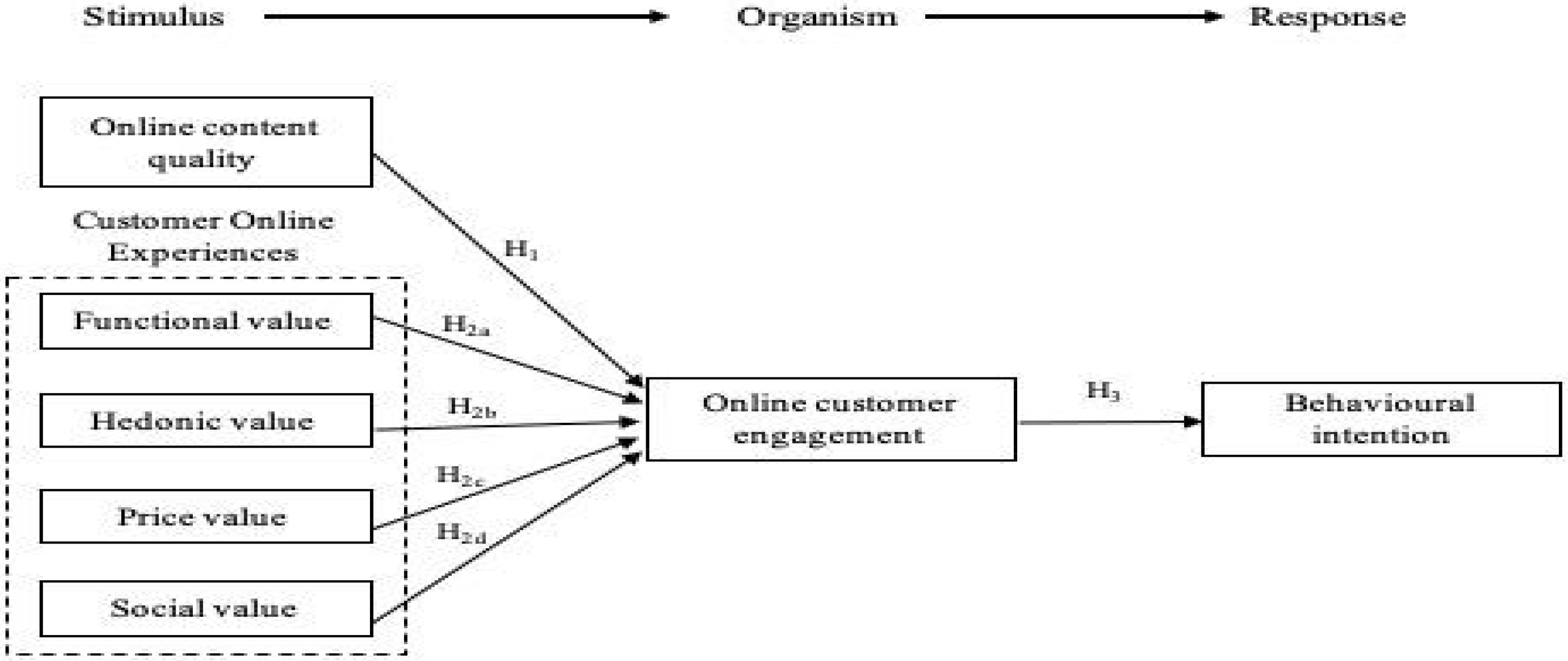
We framed the study using the stimulus-organism-response (S-O-R) theory [8,9]. The model considers customer online experiences and s-commerce online content as stimulus factors. At the same time, OCE is the organism, and behavioural intentions related to repurchase intention are the response. Based on this theory, the core proposition (see Figure 1) is that the formation of online customer engagement begins with the input of stimulus of customer internal factors related to customer online experience and customer external factors about promotional online content quality, followed by the process of OCE organism indicated by online customer experiences, and finally results in the output of customer repurchase intention response, in a specific context of healthy food s-commerce.
Researchers have begun investigating consumer behaviour in this context, given the increasing popularity of s-commerce for purchasing food products. In online consumption communities, such as among Indonesian consumers, food purchases using s-commerce have created new customer experiences by trying new shopping channels that increase satisfaction and emotional benefits [10]. In the context of s-commerce, when consumers are absorbed in their shopping experiences for healthy food, they are more likely to develop positive attitudes towards the platform and its offerings [11]. Thus, the overall online customer experiences involve the customer’s internal situation, such as the perceived benefits of performing s-commerce shopping that comprise the functional value regarding the perceived usefulness or functionality of a product or service [12]. Price value that affects purchasing decisions to buy online [13]. Hedonic value is described as emotional or experiential gratification that consumers experience when fulfilling psychological desires [14,15]. Social value is the social situation of customers that can be a critical stimulus for customer choice [16]. Participating in online activities, such as shopping, could create different experiences for each consumer [17,18,19]. Strengthening customer interaction, connection and participation in post-purchase activities [20].
Customers’ external environment can be identified through the information they receive online, such as social media. It is developing and disseminating valuable, pertinent, consistent content to capture and retain specific audiences to stimulate viewers’ perceptions [21]. Customer engagement content may have significant hidden dimensions and deeper emotions that affect consumer behaviour [22]. Customer online engagement plays a pivotal role in driving behavioural outcomes, such as behavioural intentions related to word-of-mouth intentions, continuance usage intentions, and brand advocacy. Engaged customers, who interact meaningfully with content, share reviews, and participate in brand-related discussions, tend to develop stronger emotional connections and trust with the brand. Brand advocacy refers to how much social media users endorse, recommend, or defend a brand. Research suggests that co-creation positively influences brand advocacy when the brand offers tangible products rather than intangible ones [23,24,25]. Whereas regarding platform continuance intentions, emphasising customer engagement as the critical issue that dominates business development has continued to be explored in the literature, as fostering customer repurchase intention [19,26].
However, the sustainability of online food businesses in retaining consumers in a specific market context, such as Indonesia, remains underexplored, despite the country being one of the world’s largest and fastest-growing digital marketplaces [5]. Previous research on s-commerce has predominantly focused on developed economies, such as the United States, the UK, Europe, South Korea, and China, where digital infrastructures and consumer digital literacy are more advanced [2,27,28,29,30,31]. Studies in these contexts often emphasise fashion, beauty, and electronics as the primary s-commerce categories [32,33,34,35,36,37], where consumer decisions are largely hedonic or status-driven, while the food sector, particularly healthy food, remains comparatively overlooked. Meanwhile, food s-commerce carries distinctive features because it involves high-involvement decisions, health-related trust, and experiential consumption, which differ substantially from hedonic or status-driven product categories [38,39]. These product character differences suggest that the mechanisms driving online customer engagement (OCE) in food s-commerce may diverge substantially from other product categories, which remains underexplored.
Moreover, empirical studies of OCE and repurchase intention have been conducted in developed economies with advanced digital ecosystems and high consumer digital literacy [31,40,41]. By contrast, emerging economies such as Indonesia, one of the largest digital marketplaces and home to a strongly collectivist culture, remain understudied. Indonesia’s collectivist orientation emphasises social value, community belonging, and social inclusion in shaping consumer decisions [42,43]. This cultural dimension is critical in understanding engagement in food s-commerce, as consumers’ behaviours are strongly influenced by peer validation, social influence, and shared consumption norms. Reflecting on the Indonesian consumers experiencing an early stage of digital transformation applied to food retail businesses [10] means retaining customers to maintain the business continuation of healthy food s-commerce in the marketplace requires further exploration. However, few studies explicitly integrate these cultural dynamics into s-commerce research.
Conceptual gaps also occur beyond contextual limitations related to understanding how customer value experiences and content quality stimulate online engagement in social commerce (s-commerce). Previous studies highlight OCQ as a driver of consumer trust, purchase decisions, and behavioural intentions, specifically in food business content, but often limit its role to informational accuracy and credibility [44,45,46]. This overlooks the broader dual influence of OCQ through both cognitive evaluations (e.g., trust, relevance, credibility) and emotional stimulation (e.g., enjoyment, interest), which are fundamental to fostering deeper online customer engagement [47,48].
Similarly, research on customer value experiences has primarily centred on hedonic and social value in industries such as tourism, fashion, and entertainment [49,50,51,52], while price value and functional value, critical drivers of food-related purchase behaviours, have been comparatively underexplored in s-commerce contexts. Price value reflects the trade-off between perceived benefits and monetary costs, while functional value captures the utilitarian benefits such as convenience, quality, and time efficiency [53,54]. These values are particularly salient in the healthy food business, where consumers weigh enjoyment, social approval, affordability, and functionality, especially in emerging markets.
Prior studies on food s-commerce have also not largely examined healthy food consumption in emerging economies. One emerging segment in Indonesia’s food e-commerce is the ready-to-cook (RTC) meal kits and healthy ready-to-eat (RTE) catering. These creative culinary services have gained popularity among busy urban consumers. A DBS consumer survey supports this trend, finding that 69% of respondents prefer cooking at home rather than dining out [55]. However, in Indonesia, where healthy lifestyle awareness is growing, little is known about how internal factors (functional, price, hedonic, and social values) and external factors (online content quality) jointly influence online customer engagement and repurchase intention in healthy food s-commerce. While a few studies have explicitly integrated OCQ and the four dimensions of customer value experiences (functional, price, hedonic, and social) as stimuli within the Stimulus–Organism–Response (S-O-R) framework to explain how they drive OCE and subsequently influence repurchase intentions.
Thus, the present study fills the research gap by taking into account the urban customer environment both internally (i.e., the online interactive experience based on the perceived value of using healthy food s-commerce) and externally (i.e., the online content quality (OCQ)) provided by the s-commerce page with various information needed to encourage consumers to continue using food s-commerce services, influence the perceived value experience in a particular situation that engages customers with the s-commerce, and then affect the business relationship continuity with customers. This study aims to examine the role of digital content quality and online experiences on online engagement that can be turned into future behavioural intentions that address a critical gap in s-commerce research by focusing on the healthy food business sector in Indonesia, an emerging market with high social media penetration but limited scholarly investigation. The novelty of this study lies in examining how online content quality and customer value experiences influence online customer engagement and subsequent repurchase intention within the specific context of healthy food s-commerce in Indonesia. Using the Stimulus–Organism–Response (S-O-R) framework, this study extends prior research beyond the dominant categories and geographies. It highlights the nuanced cultural mechanisms shaping consumer engagement in an emerging market. It offers theoretical advancements to the s-commerce literature and provides actionable insights for food businesses seeking sustainable strategies in the digital marketplace. By incorporating utilitarian, emotional, and social aspects of consumer experience and content quality, this research advances a more holistic understanding of consumer engagement mechanisms, particularly in an emerging economy and collectivist cultural setting.
By leveraging the S-O-R framework, this study is expected to make several contributions. Theoretically, it extends the application of the S-O-R model to the healthy food s-commerce context in an emerging economy, integrating both internal customer factors (hedonic and social value) and external factors (online content quality) to explain engagement and behavioural intention. It also advances understanding of the relative influence of different value dimensions, highlighting that not all factors contribute equally to online engagement. Practically, the findings will provide actionable insights for food marketers and s-commerce platforms managers on how to design emotionally appealing, socially rewarding, and content-rich online experiences that strengthen customer engagement and foster long-term relationships, ultimately supporting the sustainability of health food businesses in competitive digital markets.

2. Research Framework and Hypothesis Development

2.1. The Stimulus-Organism-Response (S-O-R) Framework in the S-Commerce Food Sector

The research framework, grounded in the Stimulus-Organism-Response (S-O-R) framework as applied to the social commerce (s-commerce) food sector, is the primary theoretical lens which identifies key stimuli, online content quality and customer online experiences as critical drivers of engagement [9]. According to the S-O-R framework, external environmental cues act as stimuli (S) that shape individuals’ cognitive and affective states as organisms (O), which in turn influence their responses (R) in the form of behavioural intentions [9].
The research framework explains the factors influencing online customer engagement and its subsequent impact on behavioural intentions. This research posits that the content quality of healthy food s-commerce platforms and online shopping experiences could affect customer engagement and customers’ behavioural intention to purchase. This model has been widely applied in previous studies regarding online consumer behaviour research, including in e-commerce and s-commerce [9]. By mapping each hypothesis explicitly to these components, this study advances the precision of S–O–R applications in digital commerce research. Hence, it is suitable to examine how digital consumers respond to dynamic and interactive digital environments, such as the s-commerce platforms used for food businesses [29,56,57,58,59], which are increasingly influential in an emerging market such as Indonesia [10,60,61].
The model highlights the role of online content quality, the multidimensional nature of customer experiences, and the central role of customer engagement in fostering meaningful interactions, ultimately driving purchase intentions in an online context. This comprehensive approach underscores the importance of high-quality content and diverse customer value dimensions in enhancing engagement and achieving desired behavioural outcomes. Figure 1 depicts the research framework.
(1)
Stimuli (S): In the context of healthy food s-commerce, the stimuli are represented by online content quality (OCQ) and customer value experiences (functional, hedonic, price, and social). OCQ represents the key stimulus for companies to provide more valuable information, enabling users to leverage social tools to obtain and share information and control the flow of information [29]. Content quality in digital commerce significantly influences user perceptions, especially in s-commerce, where decisions are highly context-driven [27,62]. Then, customer online experiences with value-based concepts are also considered the integral stimulus component reflecting the perceived value derived from online platforms. Previous research proposed that value perceptions formed during digital transactions, such as convenience (functional value), enjoyment (hedonic value), affordability (price value), and connection with others (social value). Functional and hedonic values address utilitarian and emotional aspects, respectively, while price and social values represent cost–benefit perceptions and social interactions. This interpretation is aligned with recent digital commerce literature that defines value perception as the critical stimuli that shape consumer judgments, and each significantly contributes to shaping online customer engagement [63,64,65]. These elements are expected to motivate consumers to process information and evaluate the platform positively
(2)
Organism (O): In the S-O-R model, the organism captures the individual’s cognitive or affective response to stimuli, which is represented by online customer engagement, which comprises cognitive and emotional reactions to stimuli. Customer engagement is a multidimensional construct of users’ psychological involvement, consisting of attention, enthusiasm, and interaction with the platform [66,67]. Previous studies have consistently conceptualised engagement as an organismic response to online stimuli, thereby supporting its role in mediating stimulus and behavioural response [68,69]. This concept has also further emphasised its relevance in emerging markets, where online engagement is essential for behavioural change [69,70] that can easily be observed with the increasing use of social media [22]. Online Customer Engagement (OCE) serves as the central mediator in this model, consistent with the study’s aim to identify how stimuli influence internal states that drive behavioural outcomes.
(3)
Response (R): The response component captures the consumer’s subsequent action or behavioural intentions due to their internal state. In this study, behavioural intentions are argued as the outcome of the S-O-R model encompassing actions such as usage continuity, purchase or repurchase intentions, or word-of-mouth, which logically follow from intense engagement. Several studies show that the relationship between customer involvement and outcome includes purchase intention, electronic word-of-mouth, repurchase, customer referrals, and co-production, with significant effects in s-commerce [45,46,71]. This is also consistent with the current literature that links behavioural intentions as the key consequences of customer engagement within the S-O-R framework [72,73,74].

2.2. Content Quality and Online Customer Engagement (OCE)

Customer engagement is essential across various domains, such as marketing, branding, information systems and customer experiences [22]. Customer engagement consists of three dimensions: cognitive, emotional, and behavioural. The three dimensions are presented as four proposed dimensions [11,68]: absorption, dedication and vigour. Engagement depends on the situation and can affect consumers’ engagement with objects like brands, products, or content [11]. In this digital era, inundated with a plethora of information and promotional content, businesses are continually searching for effective methods to attract and maintain the attention of their customer base [75]. Content marketing means developing and disseminating valuable, pertinent, consistent content to capture and retain a specific audience, aiming to stimulate profitable customer engagement [21]. Content marketing has become a potent strategy to captivate customers by delivering valuable, pertinent, and captivating content [76]. Consumers’ perception of an e-commerce platform plays a vital role in their purchasing selection, and it serves as a primary reference point for companies in devising competitive strategies [21,77]. Therefore, gaining a thorough understanding of digital trust regarding the platform, especially from the quality of content, will influence customer engagement.
Moreover, digital trust is a crucial factor in online food consumption, particularly in the context of healthy food s-commerce. It reduces uncertainty about product safety and encourages consumers to continue using the platform. Trust in digital platforms, supported by the quality of information provided, can lead to greater customer loyalty and repeated purchases. Consumers are more likely to repurchase from platforms they trust [39]. Furthermore, trust arising from high-quality information significantly influences consumers’ behavioural intentions, including their willingness to engage with online food delivery services and their intention to purchase healthy and sustainable food products [39,44].
In line with the S-O-R framework, online content quality (OCQ) as a stimulus is expected to positively influence customer engagement as the organism. Previous studies have shown that high-quality online content enhances engagement by strengthening digital trust, fostering emotional connection, and increasing consumers’ willingness to interact with food-related platforms [45,46]. The influence of OCQ on engagement can be explained across multiple dimensions. From a cognitive perspective, high-quality content provides reliable nutritional information and transparent product details, which reduce uncertainty and strengthen digital trust in the platform [46]. From an emotional perspective, visually appealing and health-related narratives evoke reassurance, enjoyment, and a sense of alignment with consumers’ lifestyle goals, thereby deepening their affective connection to the platform. From a behavioural perspective, engaging content stimulates active consumer participation, such as sharing reviews, recommending products, or interacting with online communities. Thus, content quality shapes online customer engagement not only through information processing but also by fostering trust, generating positive emotions, and motivating participatory behaviours [45,78].
Online content quality refers to the perceived accuracy, relevance, and richness of digital information provided by a brand [79]. In the healthy food s-commerce context, high-quality content, including visually appealing visuals, credible nutritional details, and engaging narratives, builds trust and drives engagement [80]. Customer consumption of online content of a product in social media, which could refer to the s-commerce context, could likely increase engagement with the brand [81]. The mechanisms by which content quality influences OCE are multidimensional. From a cognitive perspective, informative and credible content fosters trust by reducing uncertainty in purchase decisions [82]. From an emotional perspective, engaging visuals and narratives evoke enjoyment and a sense of social connection, stimulating affective involvement [83]. Then, from a behavioural perspective, high-quality content encourages consumers to interact with posts, share experiences, and remain active within the platform community [69], including in the food e-commerce business [82]. Thus, the effect occurs through cognitive evaluation (central processing). emotional arousal (peripheral processing), and behavioural intentions, which are also explained in the Elaboration Likelihood Model [83].
Hypothesis 1:
The online content quality of healthy food e-commerce has a positive effect on online customer engagement.

2.3. Customer Online Experience (Value Dimension) and Online Customer Engagement

The literature review indicates that consumers’ purchasing intentions are influenced by their experiences, preferences, and external environmental cues, which aid in gathering information, assessing alternatives, and ultimately making purchasing decisions [75,84]. Moreover, beyond tangible attributes such as quality, durability, and functionality, purchasing intention is also shaped by intangible factors such as perceived image and prestige, reflecting consumers’ shopping experiences [85]. Shopping can be viewed as a multifaceted process that fulfils both functional and hedonic needs, with these values representing pivotal motivators for engaging in shopping activities [86]. Some researchers have suggested that customer experience impacts awareness, loyalty and brand equity [87]. Previous studies have found that consumer experience positively influences customer commitment and engagement behaviours [77,88], which indicates customer online experience related to the value dimensions could stimulate customer engagement.
The functional value within e-commerce pertains to the perceived usefulness or functionality that a product or service offers consumers. This can encompass convenience, efficiency, and the capacity to meet specific needs or objectives in the digital marketplace. Previous studies have underscored the importance of functional value in shaping consumer perceptions and behaviours online [12,89]. The trend towards health and wellness has prompted consumers to utilise e-commerce platforms to increasingly procure healthy food alternatives, as well as consumer motivations and behaviours concerning the online purchase of health-oriented food items. Customer engagement denotes the depth of the connection between consumers and a brand or retailer. Engaged consumers are more likely to interact with the brand, make repeat purchases, and advocate for it [77]. Previous studies have also explored diverse facets of customer engagement and its ramifications on business outcomes [84,90]. Consumers perceive price value rather than functional value while shopping for healthy food via e-commerce platforms; it enhances their engagement with the platform or retailer. This engagement may manifest in an increased frequency of visits, higher levels of interaction with the website or app, and, ultimately, greater loyalty to the platform.
Hypothesis 2a:
The functional value of shopping for healthy food via s-commerce positively affects online customer engagement.
Hedonic value denotes the emotional or experiential gratification consumers derive from a product or service. The significant role of hedonic shopping values in influencing customer loyalty affects customer experiences, eventually affecting customer satisfaction. Within the digital marketplace, this encompasses aspects like enjoyment, sensory delight, and fulfilling psychological desires [14]. Others highlight the significance of hedonic value in guiding consumer behaviours and fostering positive online shopping experiences [86]. As health-conscious consumers increasingly prioritise well-being, their e-commerce shopping habits have adapted accordingly to this influence. The impact of the hedonic value dimension was stronger for high-involvement product categories (i.e., mobile phones, healthy food and lifestyle). Similar values were examined regarding motivations for participating in innovation and product development communities, including the need for product, enjoyment, desire to create and improve, reputation and status within the community, affiliation, identity, values, ideology, learning, reputation outside the community, and career concerns [78,86,89].
Hypothesis 2b:
The hedonic value of shopping for healthy food via s-commerce positively affects online customer engagement.
Price value means how much consumers think they are obtaining for the cost of a product or service. Online shopping includes things like how affordable something is and whether it feels worth the money. Price value affects what people buy online [13]. Consumers often weigh perceived value against the cost of a product when making purchasing decisions [14]. Others have also explored consumer factors such as price sensitivity and product preferences in the context of online healthy food shopping [13]. They are more likely to engage with a brand or retailer if they perceive they are receiving good value for their money. Customers’ perceptions of a given price can directly relate to their decision to buy a product. Customers will pay attention to the prices paid by their peers, and no one wants to spend more money than their peers do. The fairness of a price can affect consumers’ perception of the product and, ultimately, their desire to become a consumer.
Hypothesis 2c:
The price value of shopping for healthy food via s-commerce has a positive effect on online customer engagement.
Social value captures the perceived social benefits of engaging with a product or platform, such as aligning with societal trends or gaining peer approval [91]. Health-conscious consumers may engage more deeply with e-commerce platforms that promote sustainability or align with their social values. For instance, platforms emphasising environmental consciousness, such as green value, promoting eco-friendly packaging or supporting local farmers, tend to resonate with consumers who prioritise ethical consumption [92]. The social value derived from participating in community-based activities, such as recipe-sharing forums or wellness challenges hosted by e-commerce platforms, can further enhance engagement [93].
Hypothesis 2d:
The social value of shopping for healthy food via s-commerce positively affects online customer engagement.

2.4. Online Customer Engagement (OCE) and Behavioural Intentions

With the increasing popularity of e-commerce for purchasing healthy food, researchers have begun to investigate how consumers behave in this context. Factors like price sensitivity, product preferences, and purchase intentions are related to online shopping for healthy food products. Behavioural intentions refer to the likelihood or inclination of individuals to perform specific actions. In e-commerce, this could include intentions to make repeat purchases, recommend the platform to others, or engage in positive word-of-mouth communication. Previous studies have explained how customer engagement, such as absorption, people’s dedication and vigour, influences behavioural intentions [84]. Absorption leads to deep involvement and concentration, enhancing individuals’ immersion in an activity [94]. In e-commerce, when consumers are absorbed in their shopping experiences for healthy food, they are more likely to develop positive attitudes towards the platform and its offerings [11]. Dedication reflects the commitment and loyalty individuals feel towards a brand or platform. In the e-commerce realm, dedicated consumers who purchase healthy food products are more likely to demonstrate intentions aligned with their loyalty, such as advocating for the platform and remaining loyal [77,90,95]. Vigour denotes individuals’ energy and enthusiasm to interact with a brand or platform. Studies indicate that it correlates with positive emotions and proactive behaviours. In e-commerce, consumers who approach their healthy food shopping experiences with vigour will likely engage in proactive behaviours such as exploring new products and actively seeking information, thereby supporting their intentions and contributing to the platform’s success [88,96]. Therefore:
Hypothesis 3:
OCE, when shopping for healthy food via s-commerce, has a positive effect on behavioural intentions.

3. Methodology

3.1. Measurement and Data Collection

The data was collected using an online survey. Before the data collection, a pilot test of 30 respondents was conducted, and the online questionnaire was tested to check the validity and reliability of the instrument, including clarifications and corrections. This initial stage ensures that each item effectively captures the underlying theoretical construct designed to measure and strengthen the overall reliability and validity of the observed data in the final PLS-SEM analysis. The study employed Pearson’s bivariate correlation to assess item-to-construct relationships and test the validity using Cronbach’s Alpha, with a threshold of 0.60 that was considered acceptable for exploratory research, to evaluate the reliability. The results indicate that all items used were valid, and each construct demonstrated satisfactory internal consistency.
This study adopted a quantitative research approach to enable statistical testing of hypothesised relationships. The quantitative approach is well-suited for empirically validating theoretical models in consumer behaviour and digital commerce research, as it enables the collection of structured data from a large respondent base and the application of statistical modelling techniques such as PLS-SEM [97]. The quantitative approach also allows for objective measurement of latent constructs, hypothesis validation, and the identification of causal pathways using structural equation modelling. Furthermore, survey-based methods are particularly effective in capturing self-reported perceptions, attitudes, and behavioural intentions in online shopping and social commerce contexts [98]. This research design is appropriate for the present study’s objective to examine the drivers of online engagement and behavioural responses in the healthy food s-commerce sector.
A structured questionnaire measured the key constructs relevant to the research framework. The questionnaire consisted of ten sections with all constructs measured using a 7-point Likert scale (1 = strongly disagree; 7 = strongly agree) [99,100,101]. The questionnaire comprises ten sections, and the complete questionnaire and item wording are provided in Appendix A for transparency. The first section was the introduction, including respondents’ consent to participate in the survey; the second section consisted of the screening questions to ensure the participating respondents were qualified for the study, and the third section questioned the respondents’ profiles. The following seven sections were measured using established scales adopted from prior literature examining similar constructs and then adapted to this study. These seven sections contain questions about online content quality [41], online experiences (i.e., functional value, hedonic value, price value, social value) [102], online engagement [103], and repurchase intention [21]. For the data collection, the questionnaire was initially developed in English and then translated into Bahasa Indonesia so that respondents could understand and interpret it effectively. The survey results were translated back into English. We situate the theoretical framework within urban Indonesia’s s-commerce users to purchase healthy food products, particularly ready-to-cook food and ready-to-eat food catering. Two major urban areas were selected for the survey: Bandung and the Jakarta Metropolitan Area. These two urban areas are the two centres for economic activities in Indonesia, and they have grown the potential of food service businesses, including digital commerce such as s-commerce and e-commerce. A pilot test with 30 food s-commerce participants was conducted before the main survey to assess its validity and reliability, and minor revisions were made to enhance item validity and clarity based on their feedback. Validity was examined using Pearson’s bivariate correlation, appropriate for instruments with many items. Items were considered valid if the correlation coefficient exceeded the critical value (r-count) [104].
The main survey of the data collection was conducted from June to August 2024. Respondents provided informed consent at the beginning of the questionnaire before participation. Ethical approval was obtained from the Universitas Padjadjaran Research Ethics Committee, and all procedures complied with Indonesian data protection regulations. Also, no monetary incentives were provided to avoid response bias.

3.2. Sampling and Respondent Demographics

The homogenous convenience sampling technique [105] was employed in this study by narrowing the target population into a specific socio-demographic subgroup. This sampling method was deemed appropriate because the study’s sampling frame was unavailable. The sampling technique involves selecting individuals who are both easily accessible and share similar socio-demographic characteristics. This approach was deemed more suitable than conventional convenience sampling, as it allows for greater control over respondent homogeneity [105], enhancing the reliability of the insights drawn from the data. Thus, the target population is explicitly narrowed based on the following criteria. Whether the respondent should ever use the healthy food s-commerce at least twice within six months for their personal need, live in either the Bandung or Jakarta Metropolitan Area, and be above 17 years old. These criteria were established to ensure participants recall their shopping experiences accurately, thereby minimising memory bias [106]. The minimum age of 17 was chosen by justifying this age as the beginning of legal and psychological maturity [107].
The study targeted Instagram-based food commerce platforms due to their dominance in Indonesia’s digital marketplace, including for the food business [108]. Some also argued that effective online business strategies among food MSMEs involve using social media and instant messaging applications such as WhatsApp, Facebook, and Instagram [109]. This is consistent with the Indonesian national survey, which reported that 93.89% of enterprises engage in online sales through instant messaging platforms like WhatsApp (Ver 25.23.3), Line (Ver 15.14.0), and Instagram (Ver 395.0.0) [110].
A broadcast message with a brief introduction and a link to the online survey was sent to eligible research participants using the Google Form. This online survey tool was selected as the platform for administering the online questionnaire due to its accessibility, efficiency, and suitability for large-scale survey research. Online survey tools such as Google Forms reduce geographical and time constraints, enabling researchers to reach a wider pool of respondents cost-effectively [111]. For this study, which targeted active users of food s-commerce in Indonesia, an online platform was particularly appropriate given that the target population is digitally engaged and accustomed to interacting in online environments. The online survey platform, such as Google Forms, also ensures anonymity and convenience for participants, which has been shown to improve response rates and reduce social desirability bias in self-reported data [112]. Its user-friendly interface and mobile compatibility were essential for engaging younger respondents, who constitute the dominant demographic of s-commerce users. Of the 350 potential respondents invited, 300 valid responses were completed in the questionnaire, giving a response rate of approximately 85.7%. While PLS-SEM offers a solution with small sample sizes when the model consists of many constructs and a large number of items [113]. It should be noted that with moderate effect sizes, the power reaches acceptable levels at sample sizes of 100 or more for alpha levels of 0.05 and 0.01 [114].
The respondents’ characteristics (see Table 1) who participated in the survey were 89% female (n = 267), 50% in the age range 21–30 years (n = 150), and 35% in their 30s (n = 105). The respondent profile reveals a predominantly female sample, with a strong representation of younger adults aged 21–30, aligning with demographic groups most active in online s-commerce. While predominantly male respondents may appear unusual, it reflects Indonesia’s food provisioning culture related to women’s household management role [115,116]. This portrays food s-commerce usage patterns in particular Indonesian digital subcultures, where female s-commerce users actively discover and order food online for convenience and family consumption. The respondent’s profile diverges slightly from Global North markets, where males and females are more likely to utilise online platforms for food-related purchases [117], highlighting the importance of cultural speciality in interpreting user profiles. Moreover, the large proportion of respondents categorised as young adults aligns with previous studies that millennials and Gen Z are the most active online buyers in the Asia Pacific, including Indonesia [118]. These online users are digitally savvy, responsive to online engagement mechanisms, and more likely to interact and share online content with food sellers through social media [119,120], a demographic representative actively shaping food e-commerce trends.
The respondents have various professions, with 36% being private company employees (n = 109) and about 19% being entrepreneurs (n = 57) and housewives (n = 56). The dominance of private employees and entrepreneurs suggests a user base familiar with digital platforms and transactional environments. However, about 48% of the respondents earn a monthly income of less than USD 350 (n = 143) and 28% above USD 650 (n = 85). This shows the significant proportion of low-income respondents (under USD 350), which may indicate that affordability and value-driven incentives are critical motivators in this segment’s online food purchasing behaviour. This heterogeneity may represent a multi-segment perspective on online customer behaviour within Indonesia’s digital economy, particularly for an emerging market where social class, access, and digital preferences vary across groups. Moreover, half of the respondents (53%) were regular customers for more than nine months (n = 159), while 21% of them had only used this food online shopping platform for less than three months (n = 62). Notably, long-term users (over nine months) add depth to the findings on sustained engagement. In contrast, including newer users offers a comparative lens on emerging behavioural patterns.

4. Analysis and Results

The data was analysed using the partial least squares method of structural equation modelling (PLS-SEM), which is considered an ideal choice because the study aims to identify the ‘key driver’ construct and predict the ‘key target’ construct [97]. The SmartPLS 3.2.9 software facilitated data analysis. The chosen analysis was considered an appropriate statistical tool for this study because of s-commerce’s emerging and less-explored nature for this particular healthy food business. The use of s-commerce that provides nutritious food products is not yet widely recognised and used among broader consumers in the Indonesian context, which becomes a limitation of this study to acquire a large sample size to analyse the data using covariance-based (CB-SEM) [97]. The PLS-SEM was applied by validating the research model in two phases: (1) the evaluation of the measurement model and (2) the examination of the structural model.

4.1. Measurement Model Analysis

The results from the measurement model analysis confirmed the discriminant validity assessed using the Fornell–Larcker Criterion, the convergent validity, and the reliability of the research model of the present study. The Fornell–Larcker Criterion is used to confirm discriminant validity. The result of the discriminant validity of the measurement model shows that all the observed constructs provided the average variance extracted (AVE) values greater than their respective squared correlations, which confirms discriminant validity (see Table 2). Another analysis to evaluate discriminant validity was the variance inflation factor (VIF) to confirm the absence of multicollinearity. The analysis shows the highest VIF value was 4.24 (less than 0.5 as the cutoff), indicating no multicollinearity issues in the data.
The model’s credibility was also tested by evaluating the quality of the measurement model presented through the factor loadings. Table 3 presents the constructs, scale wordings, and references used to develop the measurement scales in this study. The convergent validity results (see Table 3) confirmed that all items’ factor loadings were more than 0.5, and all the AVEs were more significant than 0.7 [97]. The Cronbach’s alpha and composite reliability (CR) values were also within the recommended value [97]. This study also evaluated the overall model, and the model fit estimates were as follows: χ2 was 974.249, the normed fit index (NFI) was 0.845, and the standardised root mean square residual (SRMR) was 0.076. Based on these results, the NFI value was lower than the threshold of 0.9, and the SMSR value was below the limit of 0.08 [121], which is considered acceptable. Based on the above test results, a good model credibility and strong construct reliability support robust model estimation.

4.2. Structural Model Analysis

The structural model analysis tested the hypotheses using bootstrapping with 5000 subsamples to estimate the significance of path coefficients and to achieve stable standard error estimates and confidence intervals for hypothesis testing. The bootstrap was applied particularly when data distribution assumptions are unmet [48], such as in this study, to accurately reflect estimated significance in non-normal or small-to-moderate sample data. Another reference suggests that bootstrapping is standard practice in PLS-SEM, even with samples of 200–500 [121]. While this study uses a sample size of 300, bootstrapping is appropriate and statistically robust, as PLS-SEM is well-suited for complex models even with moderate sample sizes [113].
The SEM results and details are presented in Table 4. The findings show that four proposed hypotheses were confirmed and summarised as follows. First, the online content quality had a significant and positive effect on online customer engagement (β = 0.390, p < 0.001), supporting H1 that OCQ is associated with a rise in online engagement. Second, among the experience value dimensions, hedonic value (H2b: β = 0.351, p < 0.001) and social value (H2d: β = 0.225, p < 0.001) emerged as significant drivers of engagement, suggesting that emotional gratification and perceived social relevance are key motivators in food s-commerce, and indicated that these two-value experiences would positively influence online customer engagement. This supports the gratification concept that post-digital consumers actively seek pleasurable experiences to fulfil emotional and psychological needs [122,123]. Social value experience also confirms its effect on online engagement, which includes social approval, connectedness, and identity expression in fostering engagement.
The effect size (f2) and predictive relevance (Q2) analyses were also conducted to assess the practical significance of the findings. According to Hair et al. [97]. The effect size (f2) is used to evaluate the practical relevance of the hypothesised relationships. Among these three antecedents of online customer engagement, online content quality emerged as the strongest predictor (β = 0.390, t = 6.453, f2 = 0.196), followed by hedonic value (β = 0.351, t = 4.329, f2 = 0.114) and social value (β = 0.225, t = 4.949, f2 = 0.107), all with moderate effect size indicating that online content quality and hedonic value experiences are practically meaningful predictors of OCE and suggesting their relative importance in driving engagement outcomes. The result for the H1 indicates that high-quality online content, which includes clear product information, visually appealing images, and reliable communication, is a significant antecedent of online engagement. This aligns with media richness and information quality, which proposes that content relevance, clarity, and richness significantly shape user responses in digital content [123,124]. In the food s-commerce context, where trust is critical related to food product characteristics related to perishability and consumption risk, compelling content informs the product attractiveness, assuring and emotionally connecting with consumers. Content strategies should also present aesthetics and narratives about product origins, health benefits, and ethical sourcing. By contrast, functional value (H2a: β = 0.036, p = 0.531) and price value (H2c: β = −0.018, p = 0.794) did not significantly influence engagement, highlighting that rational factors such as utilitarian benefits, price considerations or cost savings may be less influential in stimulating digital engagement for marketing health-related food products. These findings also reveal that visually appealing, emotionally engaging, and socially resonant content is more effective in fostering customer engagement than merely functional or price-focused content. Meanwhile, predictive relevance (Q2) indicates the relevance of a path model to the construct [108]. The model demonstrates good predictive power across all key constructs (Q2 > 0), including online customer engagement (Q2 = 0.413) and behavioural intention (Q2 = 0.373), confirming the robustness of the proposed relationships.
Notably, online customer engagement had a direct and significant impact on repurchase intention (H3: β = 0.731, p < 0.001), also a key predictor of repurchase intention in the food s-commerce context, with a t-value of 20.009, and a large effect size (f2 = 1.151). This reflects that OCE is statistically and practically crucial in shaping repurchase intentions, and validating the role of engagement as a key behavioural predictor. This confirms that online engagement is prevailing in influencing digital food consumers’ repeated purchase behaviours, and reinforces the central role of sustained engagement in influencing behavioural outcomes in the food s-commerce ecosystem.

5. Discussion

This study applied the Stimulus–Organism–Response (S–O–R) framework to examine how online content quality, hedonic value, and social value (stimuli) influence trust and online customer engagement (organism), ultimately shaping repurchase intentions (Response) in healthy food social commerce (s-commerce) in Indonesia. The results confirm that online content quality is pivotal in fostering trust and engagement, consistent with research showing that credible, visually appealing, and informative content triggers cognitive and emotional engagement. Hedonic value also significantly drives engagement, highlighting the importance of enjoyment and sensory appeal in shaping consumers’ willingness to interact with healthy food brands online. Notably, social value emerged as a strong predictor of engagement, reflecting Indonesia’s collectivist culture, where social recognition, community belonging, and peer approval significantly influence online behaviour.
Based on the findings, this study contributes to a deeper understanding of how much online customer engagement (OCE) influences behavioural intentions in food s-commerce that are still underexplored in emerging digital markets, such as Indonesia, where digital transformation is rising. OCE is a pivotal factor shaping behavioural intentions in the food s-commerce sector, suggesting that customer engagement is not merely a peripheral factor but a primary driver of online consumer behaviour in this context, which directly responds to the call for stronger empirical insights into the extent of online engagement’s influence, moving beyond surface-level association. While some hypotheses may appear intuitive (e.g., quality content positively affecting engagement), this study operationalises and empirically validates the online content quality as the customer’s external situation and the customer’s online experiences as the customer’s internal factors within the specific context of healthy food s-commerce in Indonesia, a niche yet growing market with unique consumer behaviours.
The role of online content quality (OCQ) as an external stimulus cannot be understated. High-quality online content enhances customer trust and drives engagement by providing valuable and relevant information. High-quality online content can enhance the positive brand impact, customer involvement, satisfaction, and shopping intentions [125]. This finding supports previous research that most customers interact with a brand when searching for brand-related information, such as brand attributes, feedback, and benefits [126]. The result also aligns with earlier findings that suggest consumers engage more deeply with platforms offering clear, consistent, and pertinent content [21]. For instance, Indonesian consumers’ preference for healthy food products is influenced by the quality and reliability of information presented on s-commerce platforms. This supports their decision-making process and fosters long-term loyalty.
Meanwhile, the internal situation of the customer, related to hedonic and social values, emerged as a significant predictor of OCE. Hedonic value, associated with emotional and experiential gratification, motivates consumers to use s-commerce platforms that repeatedly offer healthy food options. This is particularly relevant in high-involvement product categories, as consumers derive satisfaction not just from product functionality but from the enjoyment of the shopping experience itself [14,127]. The impact of the hedonic value dimension was more substantial than other value categories for high-involvement product categories (i.e., mobile phones, healthy food, and lifestyle). The finding supports previous research that argues that hedonic value may enhance a positive online shopping experience using online shopping platforms [89], including the need for products, enjoyment, desire to create and improve, reputation and status, affiliation, identity, values, ideology, learning, and reputation outside the community [78]. The finding posits that digital consumers actively seek pleasurable experiences to fulfil emotional and psychological needs [122,128]. In the context of Indonesian consumers, who are highly active on social platforms and culturally inclined toward expressive and communal activities, hedonic value becomes a key motivator of engagement. This could explain why aesthetic presentation, interactive features (e.g., comments, reviews, reactions), and gamified experiences are increasingly embedded in successful food commerce platforms. In this research context, the hedonic value of using s-commerce could foster positive online shopping experiences to support consumer diet plans and healthy lifestyle preferences. As health-conscious consumers increasingly prioritise well-being, their s-commerce shopping habits have adapted accordingly to this influence.
The finding can also be linked to the following result of the study regarding social value as the predictor of online customer experience that influences online customer engagement. This study argues that social value derived from interpersonal interactions and perceived community benefits within food s-commerce directly aligns with prior work linking social exchange and collectivist orientations to engagement [31,69]. Digital platforms emphasising sustainability and ethical consumption resonate deeply with Indonesian consumers, reflecting the cultural importance of social inclusion and collective well-being [77,129]. As a collectivist society [43], Indonesian culture tends to transition towards autocracy, while individualist countries transition towards democracy [130]. The cultural context of Indonesia, characterised by its collectivist tendencies, indicates that individuals in Indonesia’s society strongly emphasise group affiliation, community harmony, and interdependence. In such cultural contexts, consumption decisions, including those made online, are primarily influenced by the desire to gain social acceptance, build identity within groups, and share common values with peers. This amplifies the effect of the social value of such platforms, wherein consumers seek both individual and communal benefits through their interactions.
Cultural adaptation has produced changes in Indonesia’s collectivistic culture [129], which also applies to technology adoption in using social media for food purchases. Indonesia, one of the biggest social networking site (SNS) users worldwide, such as Instagram and Facebook, presents a unique digital ecosystem where collectivist cultural norms and s-commerce intersect. As confirmed by Jiang et al. [131] Indonesia exhibits high rates of digital social interaction, with social networking platforms serving as communication tools and transactional spaces in which users seek social recognition, value co-creation, and community validation. Their study empirically demonstrated that social value strongly predicts customer engagement, especially when users perceive their interactions as contributing to a broader social or ethical cause, such as sustainable consumption or health-related goals.
Furthermore, in collectivist societies like Indonesia, social validation and peer influence are fundamental in driving engagement with digital platforms. This is particularly evident in food s-commerce, where customers share dietary choices, product reviews, or even lifestyle narratives through Instagram Stories or Facebook or WhatsApp Groups. In this context of food s-commerce, social approval (e.g., likes, comments), endorsements from influencers or community members and shared consumption experiences often offer product-related benefits and opportunities for social identity reinforcement and emotional validation. These behaviour patterns reflect the concept of a digital collectivism society, in which the sense of being socially connected and the influence of peer involvement play a pivotal role in enhancing consumers’ intentions to act within online environments [131]. The online platforms functioned as digital communal spaces; food is consumed, communicated, celebrated, and co-experienced as the activities embedded in collectivist societies.
Being socially inclusive and accepted in the community is perceived as an essential social state among Indonesians, as a collectivist society. The term ‘fear of missing out (FOMO)’ refers to the apprehension individuals experience when they feel excluded from beneficial experiences that can also be considered a form of ‘viral anxiety’. In digital commerce, FOMO manifests as a heightened emotional state driven by the rapid diffusion of trends, primarily through social media [132,133]. For instance, following health trends to consume healthy food because more and more people follow this food consumption lifestyle that spreads through social influence via social media, which can drive customer engagement and purchasing decisions. When health trends around sustainable and nutritious food are widely shared and celebrated on digital platforms, users may feel compelled to participate in these behaviours to remain socially relevant. As one of the largest social networking site users globally, Indonesian society amplifies the Thai effect. The need to be socially accepted as ‘health enthusiasts’ or ‘health-conscious’ becomes a strong motivator for food consumption choices for personal well-being and reinforcing the community’s identity.
However, functional value is defined as the perceived usefulness and practicality of the platform, which has been shown to drive engagement in various e-commerce contexts [58,65]. The findings of this study show no significant effect of functional value on OCE in food s-commerce. This could be for several reasons related to cultural, platform-specific and functional expectations. In Indonesia’s food s-commerce environment, specifically in informal or community-based platforms (e.g., Instagram sellers, WhatsApp Groups), consumers may not prioritise efficiency or system reliability as they would in more formal e-commerce platforms. Instead, the emotional and social connection with the online food seller may outweigh the functional value [134,135]. This also aligns with previous research arguing that emotional and relational factors are more essential in collectivist cultures, where engagement is more socially constructed than functionally value-driven [68,69]. Many food s-commerce in Indonesia emphasise visual storytelling, influencer-based reviews, and social proof mechanisms, enhancing hedonic and social value experiences.
In contrast, functional features (e.g., product specifications, logistical features) are often secondary and standardised, limiting customer-perceived variability and engagement potential. Related to functional expectation, in mature digital environments, basic functional expectations (i.e., ease of ordering, delivery options, e-commerce payment solutions) are often assumed as a given and therefore may no longer be a differentiating factor in driving engagement [74]. In such cases, consumers may focus on emotional or affective value (e.g., enjoyment, trust, excitement) as the online engagement triggers. Therefore, the fact supports the hypothesis that the functional value’s effect on online customer engagement may indicate a shift in consumer expectations from functionality to emotional and social resonance in food-related s-commerce.
The analysis also reveals the absence of a significant effect between price value and engagement. In contrast with a previous study that indicates the importance of affordability and price assessment when buying goods online, and to engage in online shopping [65]. This study may reflect context-specific behaviour among a specific societal context, such as Indonesian consumers in the s-commerce setting. In the food e-commerce sector, experiences may be overpriced, and consumers often purchase products not only for utility but also for the novelty, experience, or social trend associated with specific food products [3,136]. Particularly among young adults and urban consumers in Indonesia, which is also reflected in this study, who form a significant portion, purchasing decisions may be more emotionally or socially driven than price-sensitive. There is also the possibility that perceived trust and authenticity override price sensitivity, which was also discovered in previous studies in emerging markets, and that trust and product authenticity in food commerce often outweigh price concerns [134,135,137]. The respondents of our study may perceive higher-priced food products as more trustworthy if recommended by peers or online influencers, reflecting a value co-creation process beyond only cost–benefit analysis. Thus, while inconsistent with some prior studies, the findings may contribute to a nuanced understanding of online engagement in food s-commerce by emphasising the contextual interplay between cultural values, platform characteristics, and consumer expectations. This study’s results support the emerging literature advocating for cultural and platform-specific theorisation, explained by consumers’ online flow experience in digital consumer research [91,138].
Moreover, the study also highlights the effect of online customer engagement (OCE) on repurchase intention to use food s-commerce. The finding enriches the digital marketing literature concerning the customer engagement model in digital commerce as a measurable and high-impact construct that reflects emotional attachment and cognitive involvement, particularly in health-conscious and value-driven consumer segments.

6. Implications

6.1. Theoretical Implications

As per our results, this study provides several theoretical and managerial implications. From the theoretical perspective, drawing on the Stimulus-Organism-Response (S-O-R) theory highlights the intricate interplay between content quality and customer online experiences as stimuli that enhance customer online engagement, which, in turn, influences repurchase intentions. This study emphasises the role of promotional online content and customer environmental stimulus related to attracting and maintaining customer attention and customer online experiences associated with the hedonic and social benefit experiences on online customer engagement and behavioural intentions in food services. This study provides a different perspective on s-commerce that previously focused less on the customer environment (i.e., internal and external factors). Grounding this in the S-O-R framework extends the framework by integrating engagement as the central mediating organismic state, translating digital stimuli, such as online content quality, hedonic value (emotional), and social value, into an actionable behavioural response. This corresponds to the S-O-R model by empirically demonstrating the pathways through which different types of customer experience (emotional, cognitive, informational) convert into intention and behaviour in a digital food marketing situation. The findings align with prior research that underscores the role of engaging online experiences in cultivating customer satisfaction and emotional connectivity, which are crucial for driving loyalty in s-commerce platforms [22,125].
This study extends the conceptualisation of online engagement as a multidimensional and culturally embedded phenomenon by demonstrating the differentiated effects of value experiences on engagement and the critical mediating role of engagement in driving repurchase intention. In food marketing that sells almost all tangible products and is often limited in the online environment, the findings underline the importance of creating immersive, vivid, informative, and socially resonant content to incentivise real-life product engagement and build customer trust and assurance. The finding confirmed that previous research about customer behavioural intention in the form of repetitive purchases is influenced by customer engagement, which is the primary foundation of social media marketing relationships [36,139]. In online communities, discussions often involve highly specialised language, requiring members to have deep brand knowledge to understand internal jargon [140]. The results also reinforce the positive role of social capital in fostering brand passion, particularly the impact of cognitive capital (such as a shared vision) and relational capital (like reciprocity). These factors significantly contribute to outcomes such as brand passion and engagement, including behaviours related to advocating for the brand online [141].
Customer engagement can improve sustainable use, strengthen emotional commitment, increase customer confidence, and shape customer loyalty [66]. In agribusiness, this study argues that digitally enabled platforms can bridge the gap between local food producers and consumers, specifically by promoting customer engagement through transparent and culturally adaptive communication, sustainable narratives, and value orientation. More and more digital-based marketing is being applied for agribusiness products to market perishable [142] and health-oriented food products, indicating the impact of online engagement endeavours for agribusiness and food producers to build customer trust, long-term relationships, and loyalty in competitive online business ecosystems. A broader implication is also shown related to business sustainability in food systems, which is predicted by customer purchase intentions by highlighting a behavioural mechanism for promoting sustainable consumption. Applying digital platforms that enable communication with ethical sourcing, health benefits, and community-oriented values could resonate more with consumers and inspire behaviour aligned with the principle of sustainable food systems.

6.2. Practical Implications

From a practical perspective, these findings provide actionable insights for marketers in the s-commerce domain, particularly service providers operating in the agribusiness and food sectors. Companies should focus on crafting content strategies emphasising hedonic and social values, as these elements contribute to creating immersive online experiences while ensuring content reliability and relevance. By leveraging targeted online content strategies, healthy food s-commerce providers can create effective digital marketing engagement programmes to enhance consumer interaction and strengthen customer retention and loyalty. Contextually, the findings may also demonstrate platform design and communication practices. Many food s-commerce platforms rely on visual and influencer-based content that emphasises emotional storytelling, rather than detailed functional features or competitive pricing. In an emerging market such as Indonesia, pricing structures for foodstuff-related products are often perceived as homogenous across sellers, reducing the salience of price comparison. This suggests a marketing strategy changed from discount-driven promotions toward experience and value co-creation strategies, aiming to promote sustainable engagement and loyalty to the platform usage.
Furthermore, given Indonesia’s cultural diversity and its extensive use of social media, marketers could tailor their marketing approach to align with consumer digital behaviour, local preferences, and social norms. Customised marketing strategies for creating a personalised online customer experience, community-driven campaigns based on inclusivity, and social media influencer collaborations can be particularly effective in shaping consumer perceptions and encouraging potential target customers to adopt s-commerce for healthy food purchase channels. In this context, leveraging Indonesia’s growing health-conscious consumer base and cultural collectivism could enhance engagement and drive behavioural intentions. By integrating these elements into their marketing frameworks, s-commerce platforms can create a sustainable competitive advantage, foster customer loyalty and improve market growth in this dynamic sector. Additionally, policymakers can play a role in facilitating a supportive regulatory framework and digital infrastructures that support the opportunities for consumer access to online purchases, digital services, and food s-commerce transactions, including more opportunities for food service business development and in the long term can contribute to the sustainability of healthy food businesses.

7. Conclusions

This study addresses a critical gap in the existing body of s-commerce research by focusing specifically on the food business sector. It explores the pivotal role of customer environmental factors, online content quality, hedonic, and social value in shaping advantageous online experiences. These factors significantly drive customer online engagement, which strongly predicts behavioural intentions, particularly the likelihood of customers maintaining and enduring relationships with s-commerce platforms selling healthy food. The findings highlight the transformative potential of online content marketing as a strategic tool for consumer relationship management within social media platforms tailored to food services. The study highlights engaging content and enjoyable and socially rewarding experiences that foster meaningful customer interactions. This online engagement is a critical antecedent of repurchase intentions, strengthening its status as a cornerstone of sustainable s-commerce strategies in the food sector. Additionally, this research contributes theoretically by extending the stimulus–organism–response (S–O–R) framework into the food social commerce domain, offering a robust explanation of how environmental cues trigger customer engagement and future behaviour. Notably, the study also reveals that not all value dimensions have equal influence; functional value, for instance, showed no significant impact on online engagement, suggesting that utilitarian appeals alone may be insufficient to drive consumer involvement.
Furthermore, by examining behavioural responses within Indonesia’s collectivist culture, this study provides culturally grounded insights that may inform future cross-cultural comparisons in consumer digital behaviour. As such, the results offer practical implications for food marketers seeking to leverage s-commerce to build lasting customer relationships, particularly by emphasising emotional and social values over purely functional ones. This study provides a foundational framework for understanding customer engagement in s-commerce for food businesses and points to the potential for further innovation and adoption of food services promoted by social media in the rapidly evolving digital landscape.

8. Limitations and Further Research

This study makes a substantial contribution to the evolving literature on s-commerce, particularly within the context of the food industry. It examines the pivotal role of customer environmental factors–namely functional attributes, pricing, hedonic value, and social value–in shaping positive online experiences. These dimensions significantly influence online customer engagement, strongly predicting behavioural intentions, particularly the propensity to establish and maintain long-term relationships with s-commerce platforms offering healthy food products. While the study provides valuable insights, several limitations exist, and future research can be built upon.
Firstly, the research is confined to a specific segment of the s-commerce ecosystem—food businesses—which may limit the generalisability of findings to other sectors. The scope of this study is limited to food s-commerce. At the same time, this context provides a significant empirical setting; the findings may not be directly transferable to other countries or product categories without considering variations in cultural expectations, digital platform infrastructures, and consumer behaviour. Expanding the scope to include diverse s-commerce industries of various types of food businesses would enhance the applicability and robustness of the findings, including cross-country comparative studies or cross-sectional research to enhance understanding of engagement dynamics in the s-commerce environment. Secondly, while the sample demographic profile aligned with the dominant users of food s-commerce in Indonesia, this study is not fully representative of the broader population. Building upon this study, we used a homogenous convenience sample to ensure participants shared a similar experience with healthy food social commerce. While this approach helped maintain consistency in responses, it also means the findings reflect a specific group rather than the broader population. Most of our participants were young women, reflecting the profile of active, healthy food commerce users in Indonesia, but limiting generalisability. Thus, their perspectives may differ from those of men, older consumers, or people from other backgrounds. This concentration should be kept in mind when interpreting the results. Future studies should consider using more diverse demographic and representative sampling methods, such as stratified or quota-based sampling, to capture a wider range of views and explore online consumer behavioural differences across genders, age groups, income levels, and geographic locations. Another limitation concerns the demographic composition of the sample, which was dominated by more educated respondents with relatively higher digital literacy. The absence of those with lower education or income levels, whose behaviours and adoption patterns may vary, restricts the representativeness of the findings. Therefore, the results of this study should be interpreted as primarily applicable to this demographic group. Future research should aim to include a broader sample to capture potential variations in online engagement and repurchase behaviours across different education and income segments.
Thirdly, while the study identifies key engagement drivers, it does not extensively explore the potential moderating effects of cultural, demographic, or technological variables on these relationships. Future research could address this limitation by investigating the moderating effects of cultural, demographic, and technological variables on the identified engagement drivers. Such studies would provide deeper insights into how these factors influence engagement dynamics, offering valuable contributions to developing more tailored strategies for the agri-food digital business sector. Next, the study predominantly relies on cross-sectional data, which may constrain the ability to infer causal relationships comprehensively. Future research is also encouraged to investigate how customer engagement and behavioural intentions evolve, particularly as food s-commerce matures in response to customer food-related lifestyle dynamics and in response to different online experiences, offering a more robust and comprehensive understanding of the causal relationships among the observed variables.
Moreover, researching specific areas regarding the emotional and social motivation that may override the rational consideration of these customer segments or cluster analysis of different customer segments, such as middle- to high-income categories. Behavioural segmentation differences by platform used, for example, TikTok (Ver 41.4.0) vs. WhatsApp (Ver 25.23.3), TikTok (Ver 41.4.0) vs. Instagram (Ver 395.0.0). The study only focuses on s-commerce in Indonesia, while the findings are contextually reached and aligned with emerging Southeast Asian trends. Therefore, future research could extend to other markets or product categories, considering local platform dynamics, consumer trust, and cultural consumer patterns. While efforts were made to collect a diverse sample, sample bias consideration may also occur, as it is possible that our data over-represented digitally literate, middle-class consumers, who may be less price-sensitive and more driven by hedonic or social value. Future studies could examine different income segments or geographic locations to assess whether price value and other dimensions of value experience become more significant in other consumer profiles.
The findings underscore the transformative potential of online content marketing as a strategic instrument for consumer relationship management across food-focused social media platforms. Engaging content, pleasurable interactions, and socially rewarding experiences collectively foster meaningful consumer relationships, positioning online engagement as a fundamental driver of repurchase intention and a cornerstone of sustainable business strategies in food-related s-commerce. The future agenda should be broadened with online customer engagement by examining brand advocacy, community participation, and co-creation constructs. These increasingly act as buyers, community contributors, and innovation partners. Finally, exploring the interplay between sustainability-oriented practices in food businesses and customer engagement in agri-food s-commerce could provide insights into building eco-conscious and socially responsible online business ecosystems.

Author Contributions

Conceptualisation, H.N.U.; methodology, H.N.U.; software, M.O.J.E.; validation, D.N.S.; formal analysis, M.O.J.E.; investigation, S.N.W.; resources, S.N.W.; data curation, M.O.J.E.; writing—original draft preparation, H.N.U.; writing—review and editing, D.N.S.; visualisation, T.P.; supervision, T.P.; project administration, S.N.W. All authors have read and agreed to the published version of the manuscript.

Funding

This research was funded by the Universitas Padjadjaran Internal Research Grant Number 1504/UN6.3.1/PT.00/2024.

Institutional Review Board Statement

This study was conducted in accordance with the Declaration of Helsinki and approved by the Research Ethics Committee of Universitas Padjadjaran (Approval Code 698/UN6.KEP/EC/2024, Approval Date 19 June 2024). Ethical review and approval were waived for this study, as it involved minimal risk and data were collected anonymously through an online survey.

Informed Consent Statement

Informed consent was obtained from all subjects. Consent information was provided on the first page of the questionnaire, and participation implied acknowledgement of the study’s purpose, confidentiality, and voluntary nature.

Data Availability Statement

All data supporting the findings of this study are contained within the article. Further enquiries are available from the corresponding author upon request.

Conflicts of Interest

The authors declare no conflicts of interest.

Appendix A

  • Online content quality (OCQ)
Table A1. Online content quality (OCQ).
CodeQuestionAnswer
KKT1I find the information on this healthy food social commerce to be valuable1234567
KKT2I think this healthy food social commerce page is a helpful resource1234567
KKT3There is helpful information on this healthy food social commerce page1234567
  • Customer online experience
Table A2. Functional value experience (FVE).
CodeQuestionAnswer
NF1The healthy food social commerce has a consistent quality1234567
NF2The healthy food social commerce is well-made1234567
NF3The healthy food social commerce has an acceptable standard of quality1234567
Table A3. Hedonic value experience (HVE).
CodeQuestionAnswer
NE1The healthy food social commerce is one that I would enjoy1234567
NE2The healthy food social commerce would make me want to use it1234567
NE3The healthy food social commerce would make me feel good1234567
Table A4. Price value experience (PVE).
CodeQuestionAnswer
NH1The healthy food social commerce is reasonably priced1234567
NH2The healthy food social commerce offers value for money1234567
NH3The healthy food social commerce is a good product for the price1234567
Table A5. Social value experience (SVE).
CodeQuestionAnswer
NS1The healthy food social commerce would help me to feel acceptable1234567
NS2The healthy food social commerce would improve the way I am perceived1234567
NS3The healthy food social commerce would make a good impression on other people1234567
  • Online customer engagement (OCE)
Table A6. Online customer engagement (OCE).
CodeQuestionAnswer
EM1I am enthusiastic about this healthy food social commerce platform1234567
EM2This healthy food social commerce platform inspires me1234567
EM3found this healthy food social commerce full of meaning and purpose1234567
EM4I am excited when using this healthy food social commerce platform1234567
EM5I am interested in this healthy food social commerce platform1234567
  • Repurchase intention (RI)
Table A7. Repurchase intention (RI).
CodeQuestionAnswer
RT1I think it is a pleasure to buy healthy food from social commerce1234567
RT2I won’t hesitate to refer others to buy healthy food from this social commerce platform1234567
RT3I think I will continue to buy healthy food from this social commerce platform1234567
RT4I feel the quality of products and services offered by this healthy food social commerce influences me to continue to buy1234567

References

  1. Hajli, M.N. A study of the impact of social media on consumers. Int. J. Mark. Res. 2014, 56, 387–404. [Google Scholar] [CrossRef]
  2. Kim, S.; Park, H. Effects of various characteristics of social commerce (s-commerce) on consumers’ trust and trust performance. Int. J. Inf. Manag. 2013, 33, 318–332. [Google Scholar] [CrossRef]
  3. Alalwan, A.A. Mobile food ordering apps: An empirical study of the factors affecting customer e-satisfaction and continued intention to reuse. Int. J. Inf. Manag. 2020, 50, 28–44. [Google Scholar] [CrossRef]
  4. Statista. Social Commerce—Statistics & Facts; Statista Research Department: Hamburg, Germany, 2024. [Google Scholar]
  5. Statista. Number of Social Commerce Users in Indonesia from 2020 to 2028; Statista Research Department: Hamburg, Germany, 2024; Available online: https://www.statista.com/forecasts/1450115/indonesia-social-commerce-users (accessed on 15 June 2025).
  6. Herbalife. Survey: Changing Health Priorities in Asia Pacific. New Survey Reveals Changing Health Priorities Among Asia Pacific Con-sumers [Internet]. Asia Pacific Health Priority Survey 2023. 2024. Available online: https://www.herbalife.com/en-th/about-herbalife/press-room/press-releases/2023-asia-pacific-health-priority-survey (accessed on 15 June 2025).
  7. Suryana, A.; Ariani, M.; Lokollo, E.M. the Role of Modern Markets in Influencing Lifestyles in Indonesia. J. Litbang Pertan. 2008, 27, 10–15. [Google Scholar]
  8. Jacoby, J. Stimulus-organism-response reconsidered: An evolutionary step in modeling (consumer) behavior. J. Consum. Psychol. 2002, 12, 51–57. [Google Scholar] [CrossRef]
  9. Mehrabian, A.; Russell, J.A. An Approach to Environmental Psychology; The MIT Press: Cambridge, MA, USA, 1974. [Google Scholar]
  10. Utami, H.N.; Alamanos, E.; Kuznesof, S. ‘A social justice logic’: How digital commerce enables value co-creation at the bottom of the pyramid. J. Mark. Manag. 2021, 37, 816–855. [Google Scholar] [CrossRef]
  11. Kuvykaitė, R.; Tarutė, A. A Critical Analysis of Consumer Engagement Dimensionality. Procedia-Soc. Behav. Sci. 2015, 213, 654–658. [Google Scholar] [CrossRef]
  12. O’Mahony, L.; O’Shea, E.; O’Connor, E.M.; Tierney, A.; Harkin, M.; Harrington, J.; Kennelly, S.; Arendt, E.; O’Toole, P.W.; Timmons, S. A qualitative study of older adults’ and healthcare professionals’ perspectives on the potential of functional food products to support healthy ageing. J. Funct. Foods 2023, 107, 105689. [Google Scholar] [CrossRef]
  13. Zhao, H.; Yao, X.; Liu, Z.; Yang, Q. Impact of Pricing and Product Information on Consumer Buying Behavior With Customer Satisfaction in a Mediating Role. Front. Psychol. 2021, 12, 720151. [Google Scholar] [CrossRef]
  14. Babin, B.J.; Darden, W.R.; Griffin, M. Work and/or Fun: Measuring Hedonic and Utilitarian Shopping Value. J. Consum. Res. 1994, 20, 644–656. [Google Scholar] [CrossRef]
  15. Gallarza, M.G.; Saura, I.G. Value dimensions, perceived value, satisfaction and loyalty: An investigation of university students’ travel behaviour. Tour. Manag. 2006, 27, 437–452. [Google Scholar] [CrossRef]
  16. Sheth, J.N.; Newman, B.I.; Gross, B.L. Why We Buy What We Buy: A Theory of Consumption Values. J. Bus. Res. 1991, 22, 159–170. [Google Scholar] [CrossRef]
  17. Guo, Y.M.; Poole, M.S. Antecedents of flow in online shopping: A test of alternative models. Inf. Syst. J. 2009, 19, 369–390. [Google Scholar] [CrossRef]
  18. Nusair, K.; Parsa, H.G. Introducing flow theory to explain the interactive online shopping experience in a travel context. Int. J. Hosp. Tour. Adm. 2011, 12, 1–20. [Google Scholar] [CrossRef]
  19. Thakur, R. The moderating role of customer engagement experiences in customer satisfaction–loyalty relationship. Eur. J. Mark. 2019, 53, 1278–1310. [Google Scholar] [CrossRef]
  20. Arora, L.; Singh, P.; Bhatt, V.; Sharma, B. Understanding and managing customer engagement through social customer relationship management. J. Decis. Syst. 2021, 30, 215–234. [Google Scholar] [CrossRef]
  21. Savitha, D.R.; Phil, M. A Study on Effect of Content Marketing on Customer Engagement with Respect NIKE. J. Surv. Fish. Sci. 2023, 10, 1806–1816. [Google Scholar]
  22. Agrawal, S.R.; Mittal, D. Optimizing customer engagement content strategy in retail and E-tail: Available on online product review videos. J. Retail. Consum. Serv. 2022, 67, 102966. [Google Scholar] [CrossRef]
  23. Choi, Y.; Kroff, M.W.; Kim, J. Developing brand advocacy through brand activities on Facebook. J. Consum. Mark. 2021, 38, 328–338. [Google Scholar] [CrossRef]
  24. Schepers, J.; Nijssen, E.J. Brand advocacy in the frontline: How does it affect customer satisfaction? J. Serv. Manag. 2018, 29, 230–252. [Google Scholar] [CrossRef]
  25. Wilk, V.; Harrigan, P.; Soutar, G.N. NAVIGATING ONLINE BRAND ADVOCACY (OBA): AN EXPLORATORY ANALYSIS. J. Mark. Theory Pract. 2018, 26, 99–116. [Google Scholar] [CrossRef]
  26. Kenny, D.A.; Kaniskan, B.; Mccoach, D.B. The Performance of RMSEA in Models With Small Degrees of Freedom. Sociol Methods Res. 2015, 44, 486–507. [Google Scholar] [CrossRef]
  27. Busalim, A.; Hollebeek, L.D.; Lynn, T. The effect of social commerce attributes on customer engagement: An empirical investigation. Internet Res. 2023, 34, 187–214. [Google Scholar] [CrossRef]
  28. Attar, R.W.; Shanmugam, M.; Hajli, N. Investigating the antecedents of e-commerce satisfaction in social commerce context. Br. Food J. 2021, 123, 849–868. [Google Scholar] [CrossRef]
  29. Herrando, C.; Jimenez-Martinez, J.; Martin-De Hoyos, M.J. Tell me your age and I tell you what you trust: The moderating effect of generations. Internet Res. 2019, 29, 799–817. [Google Scholar] [CrossRef]
  30. Shirazi, F.; Hajli, N.; Sims, J.; Lemke, F. The role of social factors in purchase journey in the social commerce era. Technol. Forecast. Soc. Change 2022, 183, 121861. [Google Scholar] [CrossRef]
  31. Zhang, H.; Lu, Y.; Gupta, S.; Zhao, L. What motivates customers to participate in social commerce? the impact of technological environments and virtual customer experiences. Inf. Manag. 2014, 51, 1017–1030. [Google Scholar] [CrossRef]
  32. Revilla-Camacho, M.Á.; Vega-Vázquez, M.; Cossío-Silva, F.J. Customer participation and citizenship behavior effects on turnover intention. J. Bus. Res. 2015, 68, 1607–1611. [Google Scholar] [CrossRef]
  33. Zhang, M.; Hu, M.; Guo, L.; Liu, W. Understanding relationships among customer experience, engagement, and word-of-mouth intention on online brand communities. Internet Res. 2017, 27, 839–857. [Google Scholar] [CrossRef]
  34. Wongkitrungrueng, A.; Assarut, N. The role of live streaming in building consumer trust and engagement with social commerce sellers. J. Bus. Res. 2020, 117, 543–556. [Google Scholar] [CrossRef]
  35. Marriott, J.; Bektaş, T.; Leung, E.K.H.; Lyons, A. The billion-pound question in fashion E-commerce: Investigating the anatomy of returns. Transp. Res. E Logist. Transp. Rev. 2025, 194, 103904. [Google Scholar] [CrossRef]
  36. Vinerean, S.; Opreana, A. Measuring customer engagement in social media marketing: A higher-order model. J. Theor. Appl. Electron. Commer. Res. 2021, 16, 2633–2654. [Google Scholar] [CrossRef]
  37. Han, K.; Jo, H. What Drives Consumer Engagement and Purchase Intentions in Fashion Live Commerce? Sustainability 2025, 17, 5734. [Google Scholar] [CrossRef]
  38. Nguyen, T.T.H.; Nguyen, N.; Nguyen, T.B.L.; Phan, T.T.H.; Bui, L.P.; Moon, H.C. Investigating consumer attitude and intention towards online food purchasing in an emerging economy: An extended TAM approach. Foods 2019, 8, 576. [Google Scholar] [CrossRef]
  39. Mouloudj, K.; Aprile, M.C.; Bouarar, A.C.; Njoku, A.; Evans, M.A.; Oanh, L.V.L.; Asanza, D.M.; Mouloudj, S. Investigating Antecedents of Intention to Use Green Agri-Food Delivery Apps: Merging TPB with Trust and Electronic Word of Mouth. Sustainability 2025, 17, 1–23. [Google Scholar] [CrossRef]
  40. Hajli, N. Social commerce constructs and consumer’s intention to buy. Int. J. Inf. Manag. 2015, 35, 183–191. [Google Scholar] [CrossRef]
  41. Carlson, J.; Rahman, M.; Voola, R.; De Vries, N. Customer engagement behaviours in social media: Capturing innovation opportunities. J. Serv. Mark. 2018, 32, 83–94. [Google Scholar] [CrossRef]
  42. Zhang, H.; Zheng, S.; Zhu, P. Why are Indonesian consumers buying on live streaming platforms? Research on consumer perceived value theory. Heliyon 2024, 10, e33518. [Google Scholar] [CrossRef]
  43. Hofstede, G. Dimensionalizing Cultures: The Hofstede Model in Context. Online Read. Psychol. Cult. 2011, 2, 8. [Google Scholar] [CrossRef]
  44. Macready, A.L.; Hieke, S.; Klimczuk-Kochańska, M.; Szumiał, S.; Wachter, K.; Arnoult, M.H.; Vranken, L.; Grunert, K.G. Why trust is crucial—The moderating role of trust in the relationship between motivation and intention to buy healthy, sustainable and novel foods. Food Qual. Prefer. 2025, 126, 105386. [Google Scholar] [CrossRef]
  45. Meilatinova, N. Social commerce: Factors affecting customer repurchase and word-of-mouth intentions. Int. J. Inf. Manag. 2021, 57, 102300. [Google Scholar] [CrossRef]
  46. Sarkis, N.; Jabbour Al Maalouf, N.; Al Geitany, S. The Power of Digital Engagement: Unveiling How Social Media Shapes Customer Responsiveness in the Food and Beverage Industry. Adm. Sci. 2025, 15, 278. [Google Scholar] [CrossRef]
  47. Ashley, C.; Tuten, T. Creative Strategies in Social Media Marketing: An Exploratory Study of Branded Social Content and Consumer Engagement. Psychol. Mark. 2015, 32, 15–27. [Google Scholar] [CrossRef]
  48. Chen, Y.; Yan, X.; Fan, W.; Gordon, M. The joint moderating role of trust propensity and gender on consumers’ online shopping behavior. Comput. Hum. Behav. 2015, 43, 272–283. [Google Scholar] [CrossRef]
  49. Shareef, M.A.; Mukerji, B.; Dwivedi, Y.K.; Rana, N.P.; Islam, R. Social media marketing: Comparative effect of advertisement sources. J. Retail. Consum. Serv. 2019, 46, 58–69. [Google Scholar] [CrossRef]
  50. Tariyal, A.; Bisht, S.; Rana, V.; Roy, S.; Pratap, S. Utilitarian and Hedonic Values of eWOM Media and Online Booking Decisions for Tourist Destinations in India. J. Open Innov. Technol. Mark. Complex. 2022, 8, 137. [Google Scholar] [CrossRef]
  51. Barrett, J.A.M.; Jaakkola, E.; Heller, J.; Brüggen, E.C. Customer Engagement in Utilitarian vs. Hedonic Service Contexts. J. Serv. Res. 2024, 1–20. [Google Scholar] [CrossRef]
  52. Akdim, K.; Casaló, L.V.; Flavián, C. The role of utilitarian and hedonic aspects in the continuance intention to use social mobile apps. J. Retail. Consum. Serv. 2022, 66, 102888. [Google Scholar] [CrossRef]
  53. Sweeney, J.C.; Soutar, G.N. Consumer perceived value: The development of a multiple item scale. J. Retail. 2001, 77, 203–220. [Google Scholar] [CrossRef]
  54. Ryu, K.; Han, H.; Jang, S. Relationships among hedonic and utilitarian values, satisfaction and behavioral intentions in the fast-casual restaurant industry. Int. J. Contemp. Hosp. Manag. 2010, 22, 416–432. [Google Scholar] [CrossRef]
  55. DBS. 5 Emerging Opportunities for Indonesia’s Consumer Market [Internet]. DBS Asian Insights. 2022; p. 1–5. Available online: https://www.dbs.id/id/corporate/research-and-insights/business-insights/5-emerging-opportunities-for-indonesia-s-consumer-market (accessed on 17 August 2025).
  56. Eroglu, S.A.; Machleit, K.A.; Davis, L.M. Atmospheric qualities of online retailing. J. Bus. Res. 2001, 2, 177–184. [Google Scholar] [CrossRef]
  57. Huang, Z.; Benyoucef, M. From e-commerce to social commerce: A close look at design features. Electron. Commer. Res. Appl. 2013, 12, 246–259. [Google Scholar] [CrossRef]
  58. Lim, W.M.; Rasul, T. Customer engagement and social media: Revisiting the past to inform the future. J. Bus. Res. 2022, 148, 325–342. [Google Scholar] [CrossRef]
  59. Sturiale, L.; Timpanaro, G.; La Via, G. THE ONLINE SALES MODELS OF FRESH FRUIT AND VEGETABLES: OPPORTUNITIES AND LIMITS FOR TYPICAL ITALIAN PRODUCTS. Qual.-Access Success. 2017, 18, 444–451. Available online: https://research.ebsco.com/linkprocessor/plink?id=d1b73e6d-9cc2-3e41-931a-4def210a614e (accessed on 17 August 2025).
  60. Permani, R.; Sahara, S.; Satria, D.; Suprehatin, S.; Nuryartono, N. The impacts of food certificate adoption on e-commerce income among small online agri-food sellers. J. Agribus. Dev. Emerg. Econ. 2025, 15, 579–600. [Google Scholar] [CrossRef]
  61. Sari, D.A.P.; Musyaffi, A.M.; Bahfen, N.; Simangunsong, E.S.; Cahyani, D.I. Determinant Of Purchase Intention on Online Menu Restaurant Through Organism Response (SOR) Model. Qual.-Access Success. 2022, 23, 359–363. [Google Scholar]
  62. Islam, J.U.; Rahman, Z. The impact of online brand community characteristics on customer engagement: An application of Stimulus-Organism-Response paradigm. Telemat. Inform. 2017, 4, 96–109. [Google Scholar] [CrossRef]
  63. Chen, T.; Yang, S.O.; Leo, C. The beginning of value co-creation: Understanding dynamics, efforts and betterment. J. Serv. Theory Pract. 2017, 27, 1145–1166. [Google Scholar] [CrossRef]
  64. Lee, A.R.; Kim, K.K. Customer benefits and value co-creation activities in corporate social networking services. Behav. Inf. Technol. 2018, 37, 675–692. [Google Scholar] [CrossRef]
  65. Li, X.; Zhao, X.; Xu, W.; Pu, W. Measuring ease of use of mobile applications in e-commerce retailing from the perspective of consumer online shopping behaviour patterns. J. Retail. Consum. Serv. 2020, 55, 102093. [Google Scholar] [CrossRef]
  66. Brodie, R.J.; Hollebeek, L.D.; Jurić, B.; Ilić, A. Customer Engagement: Conceptual Domain, Fundamental Propositions, and Implications for Research. J. Serv. Res. 2011, 14, 252–271. [Google Scholar] [CrossRef]
  67. Lei, S.I.; Ye, S.; Wang, D.; Law, R. Engaging Customers in Value Co-Creation Through Mobile Instant Messaging in the Tourism and Hospitality Industry. J. Hosp. Tour. Res. 2020, 44, 229–251. [Google Scholar] [CrossRef]
  68. Brodie, R.J.; Ilic, A.; Juric, B.; Hollebeek, L. Consumer engagement in a virtual brand community: An exploratory analysis. J. Bus. Res. 2013, 1, 105–114. [Google Scholar] [CrossRef]
  69. Islam, J.U.; Rahman, Z. Linking Customer Engagement to Trust and Word-of-Mouth on Facebook Brand Communities: An Empirical Study. J. Internet Commer. 2016, 15, 40–58. [Google Scholar] [CrossRef]
  70. Firdaus, M.I.; Utama, C.A.; Gayatri, G.; Rofianto, W. Co-creation experience in Indonesian mobile commerce: A self-determination theory perspective. Innov. Mark. 2023, 19, 145–158. [Google Scholar] [CrossRef]
  71. Abbasi, A.Z.; Qummar, H.; Bashir, S.; Aziz, S.; Ting, D.H. Customer engagement in Saudi food delivery apps through social media marketing: Examining the antecedents and consequences using PLS-SEM and NCA. J. Retail. Consum. Serv. 2024, 81, 104001. [Google Scholar] [CrossRef]
  72. Hollebeek, L.D.; Srivastava, R.K.; Chen, T. S-D logic–informed customer engagement: Integrative framework, revised fundamental propositions, and application to CRM. J. Acad. Mark. Sci. 2019, 47, 161–185. [Google Scholar] [CrossRef]
  73. Hollebeek, L.D.; Glynn, M.S.; Brodie, R.J. Consumer Brand Engagement in Social Media: Conceptualization, Scale Development and Validation. J. Interact. Mark. 2014, 28, 149–165. [Google Scholar] [CrossRef]
  74. Pansari, A.; Kumar, V. Customer engagement: The construct, antecedents, and consequences. J. Acad. Mark. Sci. 2017, 45, 294–311. [Google Scholar] [CrossRef]
  75. Liang, T.P.; Turban, E. Introduction to the special issue social commerce: A research framework for social commerce. Int. J. Electron. Commer. 2011, 16, 5–13. [Google Scholar] [CrossRef]
  76. Tueanrat, Y.; Papagiannidis, S.; Alamanos, E. Going on a journey: A review of the customer journey literature. J. Bus. Res. 2021, 125, 336–353. [Google Scholar] [CrossRef]
  77. Luo, N.; Gao, Y.; Chen, X.; Wang, M.; Niu, X.; Li, G.; An, T. A critical review of environmental exposure, metabolic transformation, and the human health risks of synthetic musks. Crit. Rev. Env. Sci. Technol. 2023, 53, 2132–2149. [Google Scholar] [CrossRef]
  78. Żyminkowska, K. Hedonic and Utilitarian Drivers of Customer Engagement. Cent. Eur. Bus. Rev. 2018, 7, 15–33. [Google Scholar] [CrossRef]
  79. Zhang, T.; Kandampully, J.; Bilgihan, A. Motivations for customer engagement in online co-innovation communities (OCCs): A conceptual framework. J. Hosp. Tour. Technol. 2015, 6, 311–328. [Google Scholar]
  80. Banik, S.; Giri, A.; Chatterjee, S. Antecedents and Consequences of Viewers’ Engagement Toward Vlogging. J. Consum. Behav. Int. Res. Rev. 2025, 24, 1249–1274. [Google Scholar] [CrossRef]
  81. Bento, M.; Martinez, L.M.; Martinez, L.F. Brand engagement and search for brands on social media: Comparing Generations X and Y in Portugal. J. Retail. Consum. Serv. 2018, 43, 234–241. [Google Scholar] [CrossRef]
  82. Hasanov, J.; Khalid, H. The Impact of Website Quality on Online Purchase Intention of Organic Food in Malaysia: A WebQual Model Approach. Procedia Comput. Sci. 2015, 72, 382–389. [Google Scholar] [CrossRef]
  83. He, P.; Zhang, J. Dual-Pathway Effects of Product and Technological Attributes on Consumer Engagement in Augmented Reality Advertising. J. Theor. Appl. Electron. Commer. Res. 2025, 20, 196. [Google Scholar] [CrossRef]
  84. Rubera, G.; Kirca, A.H. Firm innovativeness and its performance outcomes: A meta-analytic review and theoretical integration. J. Mark. 2012, 76, 130–147. [Google Scholar] [CrossRef]
  85. Alrawad, M.; Lutfi, A.; Alyatama, S.; Al Khattab, A.; Alsoboa, S.S.; Almaiah, M.A.; Ramadan, M.H.; Arafa, H.M.; Ahmed, N.A.; Alsyouf, A.; et al. Assessing customers perception of online shopping risks: A structural equation modeling–based multigroup analysis. J. Retail. Consum. Serv. 2023, 71, 103188. [Google Scholar] [CrossRef]
  86. Carù, A.; Cova, B. Revisiting consumption experience: A more humble but complete view of the concept. Mark. Theory 2003, 3, 267–286. [Google Scholar] [CrossRef]
  87. Banik, S.; Gao, Y. Exploring the hedonic factors affecting customer experiences in phygital retailing. J. Retail. Consum. Serv. 2023, 70, 103147. [Google Scholar] [CrossRef]
  88. Prakash, P.; Munilkumar, S.; Narsale, S.A.; Marbaniang, B.J.; Devi, G.A.; Kadam, R.; Malik, M.A.; Sheikh, S.; Mohanta, K.N.; Baidya, S.; et al. An improved recirculatory system model for culture of sludge worm: A cleaner innovative choice. Environ. Technol. Innov. 2024, 36, 103889. [Google Scholar] [CrossRef]
  89. Ong, A.K.S.; Prasetyo, Y.T.; Vallespin, B.E.; Persada, S.F.; Nadlifatin, R. Evaluating the influence of service quality, hedonic, and utilitarian value on shopper’s behavioral intentions in urban shopping malls during the COVID-19 pandemic. Heliyon 2022, 12, e12542. [Google Scholar] [CrossRef]
  90. Ke, J.; Wang, Y.; Fan, M.; Chen, X.; Zhang, W.; Gou, J. Discovering e-commerce user groups from online comments: An emotional correlation analysis-based clustering method. Comput. Electr. Eng. 2024, 113, 109035. [Google Scholar] [CrossRef]
  91. Wu, Y.; Huang, H. Influence of Perceived Value on Consumers’ Continuous Purchase Intention in Live-Streaming E-Commerce—Mediated by Consumer Trust. Sustainability 2023, 15, 4432. [Google Scholar] [CrossRef]
  92. Yang, X. Consumers’ purchase intentions in social commerce: The role of social psychological distance, perceived value, and perceived cognitive effort. Inf. Technol. People 2022, 35, 330–348. [Google Scholar] [CrossRef]
  93. Chen, W.K.; Chen, C.W.; Silalahi, A.D.K. Understanding Consumers’ Purchase Intention and Gift-Giving in Live Streaming Commerce: Findings from SEM and fsQCA. Emerg. Sci. J. 2022, 6, 460–481. [Google Scholar] [CrossRef]
  94. Lee, S.Y.; Kim, S.M.; Lee, R.S.; Park, I.R. Effect of Participation Motivation in Sports Climbing on Leisure Satisfaction and Physical Self-Efficacy. Behav. Sci. 2024, 14, 76. [Google Scholar] [CrossRef]
  95. Zeithaml, V.A.; Berry, L.L. The Nature and Determinant of Customer Expectation of Service Cost-Effective Service. J. Acad. Mark. Sci. 1993, 21, 1–12. [Google Scholar] [CrossRef]
  96. Davlembayeva, D.; Papagiannidis, S.; Alamanos, E. Sharing economy: Studying the social and psychological factors and the outcomes of social exchange. Technol. Forecast. Soc. Change 2020, 158, 120143. [Google Scholar] [CrossRef]
  97. Hair, J.F., Jr.; Black, W.C.; Babin, B.J.; Anderson, R.E. Multivariate Data Analysis, 8th ed.; Cengage Learning: Hampshire, UK, 2019; 813p. [Google Scholar]
  98. Creswell, J.W.; Creswell, J.D. Research Design: Qualitative, Quantitative, and Mixed Methods Approaches, 5th ed.; SAGE Publications, Inc.: New York, NY, USA, 2018. [Google Scholar]
  99. Taherdoost, H. What Is the Best Response Scale for Survey and Questionnaire Design; Review of Different Lengths of Rating Scale/Attitude Scale/Likert Scale. Int. J. Acad. Res. Manag. (IJARM) 2019, 8, hal-02557308. [Google Scholar]
  100. Finstad, K. Response interpolation and scale sensitivity: Evidence against 5-point scales. J. Usability Stud. 2010, 5, 104–110. [Google Scholar]
  101. Munshi, J. A Method for Constructing Likert Scales. SSRN Electron. J. 2014, 1–12. [Google Scholar] [CrossRef]
  102. Xie, L.; Guan, X.; He, Y.; Huan, T.C. Wellness tourism: Customer-perceived value on customer engagement. Tour. Rev. 2022, 77, 859–876. [Google Scholar] [CrossRef]
  103. Cheung, C.M.K.; Zheng, X.; Lee, M.K.O. Customer loyalty to C2C online shopping platforms: An exploration of the role of customer engagement. In Proceedings of the Annual Hawaii International Conference on System Sciences, Waikoloa, HI, USA, 6–9 January 2014; pp. 3065–3072. [Google Scholar]
  104. Hair, J.F., Jr.; Black, W.C.; Babin, B.J.; Babin, R.J.; Anderson, R.E. Multivariate Data Analysis, 7th ed.; Prentice Hall: London, UK, 2010; 785p. [Google Scholar]
  105. Jager, J.; Putnick, D.L.; Bornstein, M.H. More than Just Convenient: The Scientific Merits of Homogeneous Convenience Samples. Monogr. Soc. Res. Child. Dev. 2017, 82, 13–30. [Google Scholar] [CrossRef]
  106. Dharmesti, M.D.D.; Nugroho, S.S. The Antecedents of online customer satisfaction and customer loyalty Maria Delarosa Dipta Dharmesti and Sahid Susilo Nugroho. J. Bus. Retail. Manag. Res. 2013, 7, 1–12. [Google Scholar]
  107. Hurlock, E.B. Developmental Psychology, 4th ed.; McGraw-Hill, Inc.: New York, NY, USA, 1976; p. 420. [Google Scholar]
  108. APJII (Association of Indonesian Internet Service Providers). Laporan Survei Internet APJII 2022 [Internet]. Survei ISP Market Profile 2024. 2023. Available online: https://survei.apjii.or.id/survei?emailSent=1 (accessed on 17 August 2025).
  109. Zafirah, D.T.; Tandos, R. Strategi Bisnis Online Para Pelaku UMKM Industri Makanan Selama Masa Pandemi COVID-19 di Jalan Jatayu. Dakwah J. Kaji. Dakwah Kemasyarakatan 2021, 25, 174–193. [Google Scholar] [CrossRef]
  110. Badan Pusat Statistik. Statistik E-Commerce 2022; Badan Pusat Statistik: Jakarta, Indonesia, 2022. [Google Scholar]
  111. Wright, K.B. Researching internet-based populations: Advantages and disadvantages of online survey research, online questionnaire authoring software packages, and web survey services. J. Comput.-Mediat. Commun. 2017, 10, 1–31. [Google Scholar] [CrossRef]
  112. Evans, J.R.; Mathur, A. The value of online surveys: A look back and a look ahead. Internet Res. 2018, 28, 854–887. [Google Scholar] [CrossRef]
  113. Hair, J.F.; Black, W.C.; Babin, B.J.; Anderson, R.E. Multivariate Data Analysis, 7th ed.; Pearson: Harlow, UK, 2014. [Google Scholar]
  114. Hair, J.F.; Risher, J.J.; Sarstedt, M.; Ringle, C.M. When to use and how to report the results of PLS-SEM. Eur. Bus. Rev. 2019, 31, 2–24. [Google Scholar] [CrossRef]
  115. Deliana, Y. Market Segmentation for Organic Products in Bandung West Java, Indonesia [Internet]. Res. J. Recent Sci. 2012, 1, 48–56. [Google Scholar]
  116. Hadiningrat, G. Women’s Role in Food Waste Management in Indonesia (Study Case in Bandung). In Proceedings of the 1st International Scientific Meeting on Public Health and Sports (ISMOPHS 2019) Malang, Paris, France, 22 August 2020; Atlantis Press: Paris, France, 2020. [Google Scholar]
  117. Glazebrook, T.; Noll, S.; Opoku, E. Gender Matters: Climate Change, Gender Bias, and Women’s Farming in the Global South and North. Agriculture 2020, 10, 267. [Google Scholar] [CrossRef]
  118. Kim, A.; Mcinerney, P.; Smith, T.R.; Yamakawa, N. What makes Asia-Pacific’s Generation Z different? McKinsey & Company: Tokyo, Japan, 2020. [Google Scholar]
  119. Asti, W.P.; Handayani, P.W.; Azzahro, F. Influence of Trust, Perceived Value, and Attitude on Customers’ Repurchase Intention for E-Grocery. J. Food Prod. Mark. 2021, 27, 157–171. [Google Scholar] [CrossRef]
  120. Poureisa, A.; Aziz, Y.A.; Ng, S.I. Swipe to Sustain: Exploring Consumer Behaviors in Organic Food Purchasing via Instagram Social Commerce. Sustainability 2024, 16, 2338. [Google Scholar] [CrossRef]
  121. Sarstedt, M.; Mooi, E. A Concise Guide to Market Research; Springer: Berlin/Heidelberg, Germany, 2019. [Google Scholar]
  122. Habib, A.; Irfan, M.; Shahzad, M. Modeling the enablers of online consumer engagement and platform preference in online food delivery platforms during COVID-19. Future Bus. J. 2022, 8, 6. [Google Scholar] [CrossRef]
  123. Ma, Y. To shop or not: Understanding Chinese consumers’ live-stream shopping intentions from the perspectives of uses and gratifications, perceived network size, perceptions of digital celebrities, and shopping orientations. Telemat. Inform. 2021, 59, 101562. [Google Scholar] [CrossRef]
  124. Korschun, D.; Du, S. How virtual corporate social responsibility dialogs generate value: A framework and propositions. J. Bus. Res. 2013, 9, 1494–1504. [Google Scholar] [CrossRef]
  125. Dessart, L.; Veloutsou, C.; Morgan-Thomas, A. Consumer engagement in online brand communities: A social media perspective. J. Prod. Brand. Manag. 2015, 24, 28–42. [Google Scholar] [CrossRef]
  126. Ho, C.; Wang, Y. Re-purchase intentions and virtual customer relationships on social media brand community. Hum. -Centric Comput. Inf. Sci. 2015, 5, 18. [Google Scholar] [CrossRef]
  127. Filieri, R.; McLeay, F. E-WOM and Accommodation: An Analysis of the Factors That Influence Travelers’ Adoption of Information from Online Reviews. J. Travel. Res. 2013, 53, 44–57. [Google Scholar] [CrossRef]
  128. Bao, Z.; Zhu, Y. Why customers have the intention to reuse food delivery apps: Evidence from China. Br. Food J. 2022, 124, 179–196. [Google Scholar] [CrossRef]
  129. Kurniati, N.M.T.; Worthington, E.L.; Widyarini, N.; Citra, A.F.; Dwiwardani, C. Does forgiving in a collectivistic culture affect only decisions to forgive and not emotions? REACH forgiveness collectivistic in Indonesia. Int. J. Psychol. 2020, 55, 861–870. [Google Scholar] [CrossRef]
  130. Gorodnichenko, Y.; Roland, G. Culture, institutions and democratization. Public. Choice 2021, 187, 165–195. [Google Scholar] [CrossRef] [PubMed]
  131. Jiang, S.; Zhang, Z.; Xu, H.; Pan, Y. What Influences Users’ Continuous Behavioral Intention in Cultural Heritage Virtual Tourism: Integrating Experience Economy Theory and Stimulus–Organism–Response (SOR) Model. Sustainability 2024, 16, 10231. [Google Scholar] [CrossRef]
  132. Fioravanti, G.; Casale, S.; Benucci, S.B.; Prostamo, A.; Falone, A.; Ricca, V.; Rotella, F. Fear of missing out and social networking sites use and abuse: A meta-analysis. Comput. Hum. Behav. 2021, 122, 106839. [Google Scholar] [CrossRef]
  133. Roberts, J.A.; David, M.E. The Social Media Party: Fear of Missing Out (FoMO), Social Media Intensity, Connection, and Well-Being. Int. J. Hum. Comput. Interact. 2020, 36, 386–392. [Google Scholar] [CrossRef]
  134. Jun, K.; Yoon, B.; Lee, S.; Lee, D.S. Factors Influencing Customer Decisions to Use Online Food Delivery Service during the COVID-19 Pandemic. Foods 2021, 11, 64. [Google Scholar] [CrossRef] [PubMed]
  135. Poon, W.C.; Tung, S.E.H. The rise of online food delivery culture during the COVID-19 pandemic: An analysis of intention and its associated risk. Eur. J. Manag. Bus. Econ. 2024, 33, 54–73. [Google Scholar] [CrossRef]
  136. Yu, J.; Xuan, Z.; Wang, H.; Wang, S. Business Model of Social Commerce Platform from the Perspective of Value Co-Creation: Based on a Case Research of Wechat Ecology. In Proceedings of the 2021 5th International Conference on Economics, Management Engineering and Education Technology (ICEMEET 2021), Berlin, Germany, 17–19 December 2021; Francis Academic Press: London, UK, 2021. [Google Scholar]
  137. Sohn, J.W.; Kim, J.K. Factors that influence purchase intentions in social commerce. Technol. Soc. 2020, 63, 101365. [Google Scholar] [CrossRef]
  138. van Noort, G.; Voorveld, H.A.M.; van Reijmersdal, E.A. Interactivity in Brand Web Sites: Cognitive, Affective, and Behavioral Responses Explained by Consumers’ Online Flow Experience. J. Interact. Mark. 2012, 26, 223–234. [Google Scholar] [CrossRef]
  139. Mattila, A.S. The impact of service failures on customer loyalty: The moderating role of affective commitment. Int. J. Serv. Ind. Manag. 2004, 15, 134–149. [Google Scholar] [CrossRef]
  140. Sloan, S.; Bodey, K.; Gyrd-Jones, R. Knowledge sharing in online brand communities. Qual. Mark. Res. Int. J. 2015, 18, 320–345. [Google Scholar] [CrossRef]
  141. Wong, A. How social capital builds online brand advocacy in luxury social media brand communities. J. Retail. Consum. Serv. 2023, 70, 103143. [Google Scholar] [CrossRef]
  142. Utami, H.N.; Sari, D.N.; Wiyono, S.N. Value co-creation through digital technology and business relations: A case study in an agribusiness cooperative company Islamic’ education-based. BIO Web Conf. 2024, 123, 03006. [Google Scholar] [CrossRef]
Figure 1. Research framework.
Sustainability 17 08061 g001
Table 1. Demographic profile of respondents.
ProfileSubject (N = 300)
FrequencyPercentage
Gender
Female 3311
Male26789
Age
<21 years31
21–30 years15050
31–40 years10535
>40 years 4214
Occupation
Student186
Entrepreneur5719
Government employee 175.7
Private company employee 10936.3
Professional217
Housewife 5618.7
Others227.3
Income per month
<USD 35014347.7
USD 350–4503411.3
USD 450–6003812.7
>USD 6008528.3
Length of subscription
<3 months6220.7
3–6 months5117
6–9 months289.3
>9 months15953
Table 2. Discriminant validity (Fornell–Larcker Criterion).
Construct 1234567
1. Repurchase intention0.847
2. Online content quality0.5960.939
3. Online customer engagement0.7310.6480.864
4. Functional value experience0.6050.6150.5690.905
5. Hedonic value experience0.6480.5950.6360.7210.925
6. Price value experience0.5550.5190.4870.5920.6250.900
7. Social value experience0.2910.1620.3510.2270.1710.2790.914
Table 3. Scales and items.
VariablesFormative DimensionItemsLoadings
(t-Value)
Online content quality (OCQ) [113] α: 0.93, CR: 0.96, AVE: 0.89
I find the information on this healthy food social commerce to be valuable0.941
I think this healthy food social commerce page is a helpful resource0.933
There is helpful information on this healthy food social commerce page0.944
Customer online experience [114]Functional value experience (FVE)
“The healthy food social commerce…
α: 0.89, CR: 0.93, AVE: 0.82
… has consistent quality0.868
… is well made0.936
… has an acceptable standard of quality0.910
Hedonic value experience (HVE)
“The healthy food social commerce…
α: 0.92, CR: 0.95, AVE: 0.86
… is one that I would enjoy0.926
… would make me want to use it0.927
… would make me feel good0.923
Price value experience (PVE)
“The healthy food social commerce…
α: 0.89, CR: 0.93, AVE: 0.81
… is reasonably priced0.873
… offers value for money0.929
… is a good product for the price0.896
Social value experience (SVE)
“The healthy food social commerce…
α: 0.90, CR: 0.94, AVE: 0.84
… would help me to feel acceptable0.881
… would improve the way I am perceived0.942
… would make a good impression on other people0.918
Online customer engagement (OCE) [115] α: 0.92, CR: 0.94, AVE: 0.75
I am enthusiastic about this healthy food social commerce platform0.846
This healthy food social commerce platform inspires me0.862
found this healthy food social commerce full of meaning and purpose0.836
I am excited when using this healthy food social commerce platform0.884
I am interested in this healthy food social commerce platform0.889
Repurchase intention (RI)
[20]
α: 0.88, CR: 0.91, AVE: 0.72
I think it is a pleasure to buy healthy food from social commerce0.879
I won’t hesitate to refer others to buy healthy food from this social commerce platform0.875
I think I will continue to buy healthy food from this social commerce platform0.877
I feel the quality of products and services offered by this healthy food social commerce influences me to continue to buy0.752
Table 4. PLS analysis results.
Hypothesis Cause Effect Coef. T-Valuep-Valuef2Effect SizeDecision
H1OCQOCE0.3906.4530.000 ***0.196ModerateSupported
H2aFVEOCE0.0360.6050.5310.001SmallNot supported
H2bHVEOCE0.3514.3290.000 ***0.114ModerateSupported
H2cPVEOCE−0.0180.2740.7940.000SmallNot supported
H2dSVEOCE0.2254.9490.000 ***0.107ModerateSupported
H3OCERI0.73120.0090.000 ***1.151LargeSupported
p-values = 0.000 demonstrate significance level ***. OCQ: online content quality, FVE: functional value experience, HVE: hedonic value experience, PVE: price value experience, SVE: social value experience, OCE: online customer engagement, RI: repurchase intention.
Disclaimer/Publisher’s Note: The statements, opinions and data contained in all publications are solely those of the individual author(s) and contributor(s) and not of MDPI and/or the editor(s). MDPI and/or the editor(s) disclaim responsibility for any injury to people or property resulting from any ideas, methods, instructions or products referred to in the content.