Article

A Deep Learning Approach on Traffic States Prediction of Freeway Weaving Sections Under Adverse Weather Conditions

1
School of Electronics and Control Engineering, Chang’an University, Xi’an 710064, China
2
School of Transportation Engineering, Chang’an University, Xi’an 710064, China
3
Hunan Planning Institute of Land and Resources, Changsha 410119, China
4
Fujian Provincial Transportation Research Institute Co., Ltd., Fuzhou 350004, China
5
School of Transportation, Southeast University, Nanjing 211189, China
*
Author to whom correspondence should be addressed.
Sustainability 2025, 17(17), 7970; https://doi.org/10.3390/su17177970
Submission received: 27 July 2025 / Revised: 27 August 2025 / Accepted: 31 August 2025 / Published: 4 September 2025

Abstract

Freeway weaving sections’ states under adverse weather exhibit characteristics of randomness, vulnerability, and abruption. A deep learning-based model is proposed for traffic state identification and prediction, which can be used to formulate proactive management strategies. According to traffic characteristics under adverse weather, a hybrid model combining Random Forest and an improved k-prototypes algorithm is established to redefine traffic states. Traffic state prediction is accomplished using the Weather Spatiotemporal Graph Convolution Network (WSTGCN) model. WSTGCN decomposes flows into spatiotemporal correlation and temporal variation features, which are learned using spectral graph convolutional networks (GCNs). A Time Squeeze-and-Excitation Network (TSENet) is constructed to extract the influence of weather by incorporating the weather feature matrix. The traffic states are then predicted using Gated Recurrent Unit (GRU). The proposed models were tested using data under rain, fog, and strong wind conditions from 201 weaving sections on China’s G5 and G55 freeway, and U.S. I-5 and I-80 freeway. The results indicated that the freeway weaving sections’ states under adverse weather can be classified into seven categories. Compared with other baseline models, WSTGCN achieved a 3.8–8.0% reduction in Root Mean Square Error, a 1.0–3.2% increase in Equilibrium Coefficient, and a 1.4–3.1% improvement in Accuracy Rate.

1. Introduction

1.1. Background

The traffic management measures of a sustainable transportation system should be effective under various environmental conditions. However, adverse weather conditions such as rain, fog, and strong winds can affect drivers’ visibility and vehicle performance to varying degrees, which will reduce the effectiveness of conventional control measures, or even lead to counterproductive outcomes. This issue is particularly severe in freeway weaving areas, where vehicle speeds are high and lane changes are frequent. Due to the combined impact of conflicting traffic flows in weaving areas and adverse weather on both drivers and vehicles, drivers face a significantly higher workload under such conditions, making them more prone to operational errors. In this way, the operational status of freeway weaving areas becomes more vulnerable during adverse weather, where the incidents occur more randomly. Once an incident occurs, traffic deterioration tends to be more severe, which results in greater impacts on traffic flow operation. If the traffic conditions of the most vulnerable freeway facility, the weaving sections, can be reliably predicted, the states of other facilities are unlikely to be more severe than the weaving section. Therefore, there is an urgent need to develop traffic state prediction models that account for the effects of adverse weather, to better understand the dynamic changes in freeway weaving areas and provide a foundation for sustainable proactive traffic management strategies.
The operational state of freeway traffic flow tends to deteriorate earlier than under normal conditions under adverse weather conditions, which will make the transition point of traffic states different from the normal conditions. As a result, the traffic state classification criteria designed for typical freeway base conditions are no longer appropriate in such scenarios. Therefore, it is necessary to redefine the traffic state classification standards based on the clustered traffic characteristics and critical transition points of traffic flow in freeway weaving areas under adverse weather, so as to better respond to the impacts from adverse weather.
Since the drivers are already under high cognitive load while traveling at freeway weaving sections, the additional impact brought by adverse weather may easily push them beyond the driver’s information processing threshold. When the driving tasks are accomplished under the conditions that exceed the driver’s workload, it increases the likelihood of overlooking critical information and creates potential safety risks. However, the mechanisms of adverse weather affect the traffic states remain insufficiently understood, which makes traditional prediction methods prone to large errors under such conditions. To address this issue, predictive models must be capable of jointly considering traffic flow characteristics and the impacts of adverse weather.
The traffic operational states within freeway weaving sections also vary significantly across their different segments. Under different levels of service, each lane is subject to varying degrees of vehicle interactions and ramp influences, which will cause markedly different impacts of adverse weather. For example, traffic flow along the segment around the ramps express several segments with significantly lower level of service than other segments, which are approximately 160 m upstream to 100 m downstream of the merging ramp, and between 180 and 270 m downstream of the merging ramp. Traditional traffic state prediction models often neglect the spatial distribution and correlation characteristics of traffic flow, which may lead to oversimplified results. These models may even distribute predictions evenly across all segments, thereby overlooking the segments with the high safety risk. Therefore, it is also essential to incorporate the spatial variability of traffic flow in the proposed prediction model to achieve more accurate forecasts of traffic states across the entire weaving area and its influence area.

1.2. Literature Review

1.2.1. Traffic States Characteristics Under Adverse Weather

Drivers’ behavior exhibits significant changes under adverse weather conditions, which affects traffic operation states, and results in traffic states that differ from those under normal conditions [1]. Theofilatos and Yannis (2014) [2] conducted a systematic analysis of the impact of rain and snow on freeway speed and flow using linear regression and correlation tests. However, linear regression and similar methods cannot accurately capture the dynamic changes in traffic flow caused by weather conditions. Meantime, the dynamic coupling between weather and traffic flow can be revealed by incorporating weather variables into time series prediction models. Yao, K. [3] integrated temperature and rainfall as exogenous variables into an Autoregressive Integrated Moving Average (ARIMA) model to forecast urban network speed. Ye, B.L. [4] used Long Short-Term Memory (LSTM) to predict travel time under rainy and snowy conditions, with features including visibility and precipitation intensity. The deep learning methods are more effective at capturing the features of traffic flow data. When we incorporate weather factors into deep learning models, they can enhance the accuracy of traffic state prediction. For example, spectral analysis and statistical volatility models integrated with weather features [5] have been used to predict traffic demand, which quantifies the nonlinear impact of precipitation intensity on traffic flow. By designing weather-sensitive loss functions, the model emphasizes samples from adverse weather during training. Compared to traditional Support Vector Regression (SVR) and ARIMA models, the Mean Absolute Error (MAE) under rainy conditions was reduced by an average of 19.3%, and prediction accuracy improved by more than 30% during extreme rainfall events., some scholars have A hybrid deep learning model concerning adverse weather (DLW-Net) was also developed to predict traffic flow under adverse weather conditions [6]. DLW-Net utilizes Convolutional Neural Networks (CNN), Long Short-Term Memory (LSTM), and Gated Recurrent Unit (GRU) neural networks to analyze the spatial-temporal characteristics of traffic flow data, and employs an LSTM model to extract the changing patterns of both traffic flow and weather data. The model’s Root Mean Square Error (RMSE) was 21.2% lower than that of conventional KNN models.
Although the existing methods have recognized the impacts of various adverse weather conditions on traffic states, only limited research has been conducted on how traffic operations under such conditions differ from those under normal weather. Therefore, it is advisable to redefine traffic states based on adverse weather conditions when conducting traffic state predictions.

1.2.2. Traffic States Prediction

The development of traffic state prediction methods can be broadly divided into three stages, which are the statistical modeling stage, the machine learning stage, and the deep learning stage.
In the traditional statistical modeling stage, methods primarily relied on linear assumptions and stationary time series analysis. The autoregressive (AR) models were first introduced for traffic state prediction, which mainly used historical data for linear extrapolation [7]. To account for the periodicity in traffic data, Seasonal Autoregressive Integrated Moving Average (SARIMA) models were proposed, incorporating seasonal features to better capture traffic flow patterns [8]. Kalman filtering, which updates predictions recursively, can avoid repeated fitting required by ARIMA and improves model robustness. It performs better than AR models in scenarios with high-quality data and stable traffic flow [9]. These parametric methods assume that data follow a specific probability distribution described by a limited number of parameters. Spatiotemporal correlation models [10] developed a prediction framework based on the mining of spatiotemporal causal dependencies, extracting causal relationships from large-scale road network data and building robust graph-based models to capture the dynamic interactions of traffic flows. Although parametric methods are simple and computationally efficient, they struggle to handle nonlinear traffic flow disruptions and the complex correlations present in large-scale road networks.
With the development of machine learning, researchers began to realize its superior performance in handling nonlinear data and thus started using it to predict the dynamic changes in traffic data. The Support Vector Machines (SVM) [11] utilizes kernel functions to map data into high-dimensional space to handle the nonlinear relationship between traffic volume and speed. Compared to SARIMA, SVM reduced peak-hour RMSE by 30%. Random Forests [12], which use multiple decision trees to fit complex boundaries, are effective in handling abrupt changes in traffic flow caused by accidents and have been shown to reduce prediction volatility by 50% compared to Kalman filtering models. The K-Nearest Neighbors algorithm (KNN) [13] searches historical data for the K records most similar to the current time segment and calculates the prediction value through weighted averaging. KNN is intuitive and easy to implement, and the average prediction error is below 5%. Multiple KNN models can be combined to form a multivariate nonparametric regression model [14], which uses multi-dimensional pattern matching to achieve short-term traffic forecasting. For occupancy prediction, this method reduced the prediction error by 50% compared to traditional models. The hybrid methods that combine different machine learning models to predict traffic states. For instance, the combination of wavelet denoising and BP neural networks [15] can effectively improve the accuracy and stability of short-term traffic flow prediction.
Machine learning is well-suited for scenarios with limited data and clearly defined features. However, it lacks generalization ability when facing large-scale data. In contrast, deep learning can capture complex nonlinear relationships through multiple layers of nonlinear transformations, which provide more accurate descriptions of the dynamic changes in traffic flow and efficiently handling large volumes of data. Deep neural network models have gained attention for their ability to effectively capture the dynamic features of traffic data and deliver state-of-the-art performance. The Spatio-Temporal Graph Convolutional Network (ST-GCN) [16] combines Graph Convolutional Networks (GCNs) and Temporal Convolutional Networks (TCNs) to model spatial topological relationships and temporal dynamics, respectively. It enables end-to-end learning of spatiotemporal features without manual intervention and offers stronger adaptability to complex road networks. The Long Short-Term Memory (LSTM) network [17] can capture long-term dependencies in traffic flow sequences to predict traffic volumes for one or more future time steps. Compared with SVR, LSTM reduces RMSE by 15.7%, MAE by 18.2%, and MAPE by 24.3%. The Heterogeneous Graph Attention Network (HetGAT) [18] model significantly enhances the accuracy, robustness, and generalization capability of traffic flow prediction by leveraging a heterogeneous graph neural networks (HetGNN), virtual links, an adaptive attention mechanism, and a physics-informed loss function, ultimately addressing the traffic assignment problem. Multi-view Heterogeneous Graph Attention Network (M-HetGAT) [19] is the first to introduce a multi-view GNN into the field of traffic assignment, capturing the interactions and dependencies among different vehicle classes on shared links, while incorporating physical constraints. Its prediction error (MAE) is reduced by approximately 30–40% on average compared to the best baseline model.
In summary, the parametric and nonparametric methods underperform compared to hybrid approaches in forecasting freeway traffic states under adverse weather conditions. However, most existing hybrid methods focus on a single factor and still lack comprehensive consideration of weather influences and the periodicity and neighborhood dependence of traffic flow across multiple lanes in freeway weaving sections.

1.2.3. Traffic Flow Patterns of Freeway Weaving Sections

The traffic operational characteristics of each lane and segment along freeway weaving sections differ from each other. Lanes near the merging ramps of the mainline experience more frequent merging and lane-changing behaviors, which result in a significantly higher frequency of traffic conflicts and lower safety levels compared to other lanes. Principal Component Analysis (PCA) [20] has been used to examine the influence of 12 indicators, which include conflict severity, speed volatility, and lane-change frequency, on each lane within the freeway weaving sections, revealing clear differences in segment characteristics across lanes. Under adverse weather conditions, the degree to which each lane is affected also varies. The weather factors and an improved clustering method are introduced to classify rainfall [21], visibility, and wind speed into different levels, which enables the analysis of how various weather conditions affect each lane in the weaving sections. The findings revealed that inner lanes are less affected by weather, while outer lanes are more significantly impacted. In particular, the decrease in speed was more pronounced, with free-flow speed decreasing by 3.60–7.82%, capacity dropping by 11.23–30.00%, and critical speed decreasing by 8.41–26.64%. Due to the existence of multiple lanes in weaving sections, traffic operational states vary between lanes. Research has observed and quantified the impact of adverse weather on traffic, such as reduced speed, but the mechanisms leading to this specific pattern still require further investigation. Thus, we analyze the effects of adverse weather through the proposed modeling approaches.

1.3. Research Gap

Although hybrid models (deep learning integrated with weather factors) have improved prediction accuracy, most approaches still focus on single weather factors (such as precipitation or visibility) and lack comprehensive modeling of the joint effects of multiple meteorological conditions (wind, temperature, visibility, and precipitation intensity). Existing methods often overlook the periodicity of traffic flow and the interdependencies between lanes, particularly in complex scenarios such as freeway weaving sections.
While existing studies recognize the impact of adverse weather on traffic conditions, there is a lack of systematic comparison between traffic operational states under adverse versus normal weather conditions. Most models fail to redefine traffic states to adapt to adverse weather scenarios, resulting in limited generalization capability of prediction models under extreme weather events.

1.4. Objective and Contributions

The objective of this research is to establish a deep learning-based traffic state classification and prediction model for the freeway weaving sections under adverse weather conditions, which may become the fundamentals of sustainable proactive traffic management. Main contributions of this research include:
(1)
In response to the characteristics of traffic flow in freeway weaving areas under adverse weather conditions, a traffic state classification algorithm was proposed, by which the traffic states can be reclassified;
(2)
The proposed WSTGCN deep learning model deeply integrates the periodicity and Spatio-temporal correlation of traffic flow, which enables more accurate identification of lane-level traffic operational states;
(3)
The WSTGCN model also incorporates weather factors, which makes its predictions more responsive to weather variations and significantly improving forecasting accuracy.
The rest of this paper is organized as follows: Section 2 presents the proposed model framework and relationship between the contents. Section 3 introduces the method on classifying the traffic states of freeway weaving sections under adverse weathers. The components of the WSTGCN model are represented sequentially in Section 4. Section 5 validates the framework through case studies of China and U.S., followed by conclusions and recommendations in the final Section 6.

2. Framework

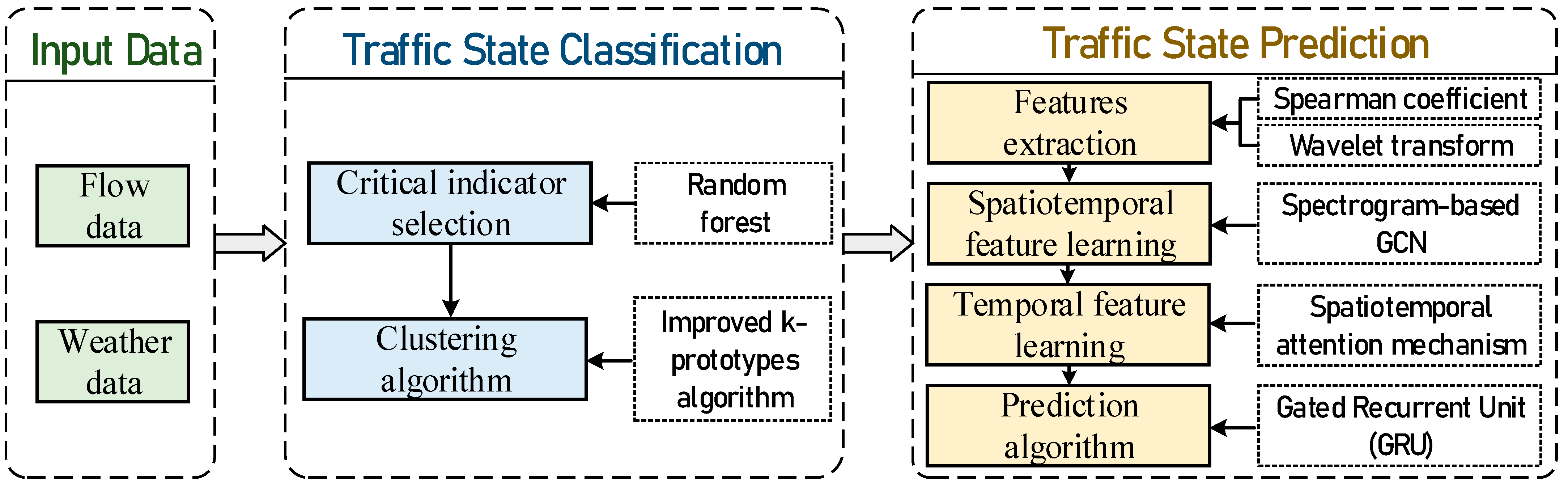
Since freeway traffic operational states under adverse weather conditions differ from those under normal conditions, accurately predicting traffic states in freeway weaving areas during such weather requires redefining the traffic states. Once the appropriate traffic states for adverse weather weaving sections have been identified, the historical data can be utilized to develop a deep learning approach that considers the spatiotemporal correlations and temporal dynamics characteristics of traffic flow. The proposed model thus is able to effectively capture the evolving patterns of traffic states and enable accurate prediction of traffic states in freeway weaving sections under adverse weather based on observed traffic and weather data.
Traditional traffic state classification relies on fundamental flow parameters (flow, density, and speed) as the indicators. However, the impact of adverse weather on different lanes within freeway weaving sections varies, which makes it necessary to perform lane-level traffic state classification. This approach treats each lane as an object, which considers the distinct traffic characteristics of each lane within the weaving sections and incorporates the influence of adverse weather conditions. The Random Forest (RF) is chosen for selecting the critical factors influencing traffic operations in weaving sections, due to its good ability to avoid the impact of multicollinearity among variables and the impact of redundant variables. The clustering methods can classify the traffic states based on the distribution characteristics of the inputs. Since the input data consists of a mix of numerical and categorical variables, an improved k-prototypes algorithm will be proposed, which is enhanced by adding a dissimilarity measure to ensure accurate classification of traffic states. This dissimilarity measure is designed using a generalized mechanism that combines Rényi entropy and complementary entropy.
There are two main challenges affecting the prediction of traffic states in freeway weaving sections under adverse weather, which are the unclear spatiotemporal correlation characteristics of traffic flow and the temporal variation of weather impacts on traffic flow. To address these issues, the variations characteristics of traffic flow are decomposed into two components: spatiotemporal correlation features and periodic variation features. A spectrogram-based graph convolutional neural network is designed to capture the spatiotemporal correlation features of both components, while a Time Squeeze-and-Excitation Networks (TSENet) is proposed to identify the temporal dynamics of weather impacts. Since weather factors primarily affect the spatiotemporal correlation features, the model integrates weather features specifically into the spatiotemporal component. Spatiotemporal attention mechanisms are then applied to both components to better capture the temporal variation characteristics. Finally, the two feature components are fused and fed into a GRU network to predict traffic states.
In summary, the prediction method of traffic states in freeway weaving sections under adverse weather can be divided into two modules: traffic state classification and traffic state prediction. The traffic state classification module includes two components: the selection of inputs and the design of a clustering algorithm. The state prediction stage consists of four components: feature decomposition, spatiotemporal correlation feature learning, temporal impact feature learning, and traffic state prediction. The overall framework of the proposed method is illustrated in Figure 1.

3. Classification of Traffic States at Freeway Weaving Sections

Traditional traffic state classification is mainly based on the fundamental traffic flow parameters, such as the flow, density, and speed. However, the traffic state represents different aggregation characteristics on these parameters under adverse weather conditions, which make the common criteria no longer suitable for identification and judgment. Therefore, it is necessary to reselect feature variables based on actual measured traffic flow performance under severe weather and redefine critical states. By incorporating weather factors as categorical data alongside numerical traffic flow data, a hybrid dataset combining traffic flow and weather information is formed, which can provide a more comprehensive reflection of the actual driving environment.

3.1. Performance Indicators Selection

The Random Forest (RF) algorithm is selected to locate the critical indicators for describing the operating conditions of freeway weaving sections. The RF algorithm first calculates the contribution (or importance) of each potential variable to the model, then ranks them based on their importance, which will be utilized to identify the variables that significantly affect traffic flow stability. As shown in Equation (1), the Out-of-Bag (OOB) estimation is used as the evaluation metric for feature importance in the random forest (RF) algorithm, which refers to all sample data that are not selected during the bootstrap sampling process and is used to estimate the generalization ability of the RF model.
O O B = 1 h j = 1 h R j R j 2
where R j is the accuracy of each classification tree that evaluated based on its performance on the corresponding O O B data, R j is the new dataset that generated by adding random noise to the O O B data, which is used to assess the accuracy of each classification tree using this modified dataset. h denotes the number of classification trees.

3.2. Traffic Status Classification Method for Freeway Weaving Sections

3.2.1. Information Entropy

The operating state data of freeway weaving areas under adverse weather conditions include both numerical and categorical attributes. A generalized mechanism based on information entropy is proposed to directly handle mixed-type datasets (MDT). Assume the mixed data are represented as M D T = U , A , V , f , where U is a non-empty set of objects, referred to as the universe; A is a non-empty set of attributes, consisting of a numerical attribute A γ and a categorical attribute subset A c , such that A = A γ A c ; V is the union of attribute domains V = α A V a , where V a is the value domain of attribute α ; f : U × A V is an information function, such that for any α A and x U , we have f x , a V a .
As shown in Equation (2), numerical data can be described using Rényi entropy, which transforms the numerical distribution into a computable entropy value through kernel density estimation. The Rényi entropy method was first proposed by the Hungarian mathematician Alfred Rényi [22]. This transform can provide a measure of compactness and separability in the numerical dimension for clustering.
H R ( x ) = 1 1 α log + ( f ( x ) ) 2 d x , α > 0 , α 1
where α is the order of entropy, f ( x ) is the probability density function of the random variable x , H R ( x ) is the value of Rényi.
The categorical data can be processed using complementary entropy. For P A c and U / I N D P = X 1 , X 2 , , X m , the complementary entropy of P is defined and calculated as shown in Equation (3). Currently, complementary entropy is often employed to measure the information uncertainty in categorical data. Unlike the logarithmic computation of Shannon entropy, complementary entropy can effectively quantify both uncertainty and fuzziness and has gained widespread usage in the analysis of categorical data. This value reflects the uncertainty or expected error rate when performing classification based on p.
E ( P ) = i = 1 m X i U X i c U = i = 1 m X i U 1 X i U
where X i c denotes the complement of X i , the term X i / U represent the represents the proportion of X i in the universe U ; while X i c / U denotes the proportion of its complement X i c within U .

3.2.2. Clustering Utility Measure

A Clustering Utility Measure (CUM) indicator is proposed to assess the effectiveness of clustering results for mixed-type data, which integrates the Clustering Utility for Numerical attributes (CUN) and Clustering Utility for Categorical attributes (CUC). The CUM can be calculated by adding weights to each attribute type based on their proportion. Higher CUM values correspond to better clustering quality. Then, the clustering utility function for clustering results of categorical data can be represented by Equation (4).
C U C ( C k ) = 1 k a A c X U / I N D a i = 1 k C i U X C i C i 2 2 X 2 U 2
MDT partitioned into k classes (k > 2), C k = C 1 , C 1 , , C k .
The numerical data can also be clustered by the clustering utility function that is shown in Equation (5).
C U N ( C k ) = 1 k l = 1 A γ δ l 2 j = 1 k p j δ j l 2
δ l 2 = x U f x , a l m l 2 / U and δ j l 2 = x C j f x , a l m j l 2 / C j represents the variance and the within-class variance of a l . m l and m j l represents the mean and the within-class mean of a l . p j = C j / U .
Thus, the CUM indicator for mixed dataset can be calculated by Equation (6), which comprehensively consider the CUN and CUC.
C U M ( C k ) = A γ A C U N ( C k ) + A c A C U C ( C k )

3.2.3. Traffic States Classification Algorithm

The K-prototypes algorithm, by integrating the dissimilarity measures of K-means and K-modes, can avoid information loss caused by data transformation. The CUM (Ck) is selected as the dissimilarity measure for the K-prototypes algorithm to handle mixed-type data, which can avoid the inaccuracies caused by the direct weighted summation and manual specification of the number of clusters. Details of the proposed improved algorithm is listed below.
Input: MDT = (U, A, V, f), minimum and maximum number of clusters kmin and kmax.
Loop k i k min , k max .
Step 1 Randomly select kmax distinct samples from the mixed dataset as the initial cluster centers.
Step 2 Using the dissimilarity measure defined in Equation (6), assign each data point to the cluster whose initial center is closest to it. After each assignment, update the cluster centers accordingly.
Step 3 After completing the assignment for all data points, recalculate the dissimilarity between each sample and the current cluster centers. If a sample’s nearest cluster center belongs to a different cluster than its current assignment, reassign the sample to the closest cluster and update the corresponding cluster centers.
Step 4 Repeat Step 3 until no sample changes its cluster assignment or until the maximum number of iterations is reached.
End loop.
Output: The optimal number of clusters k = a r g m a x i = k m i n , , k m a x   C U M C i and the clustering results.

4. Weather Spatiotemporal Graph Convolution Network

This section introduces the overall design of the Weather Spatiotemporal Graph Convolution Network (WSTGCN) for the freeway weaving section’s traffic state prediction under the adverse weather conditions, along with the specific implementation of each submodule.

4.1. Network Design

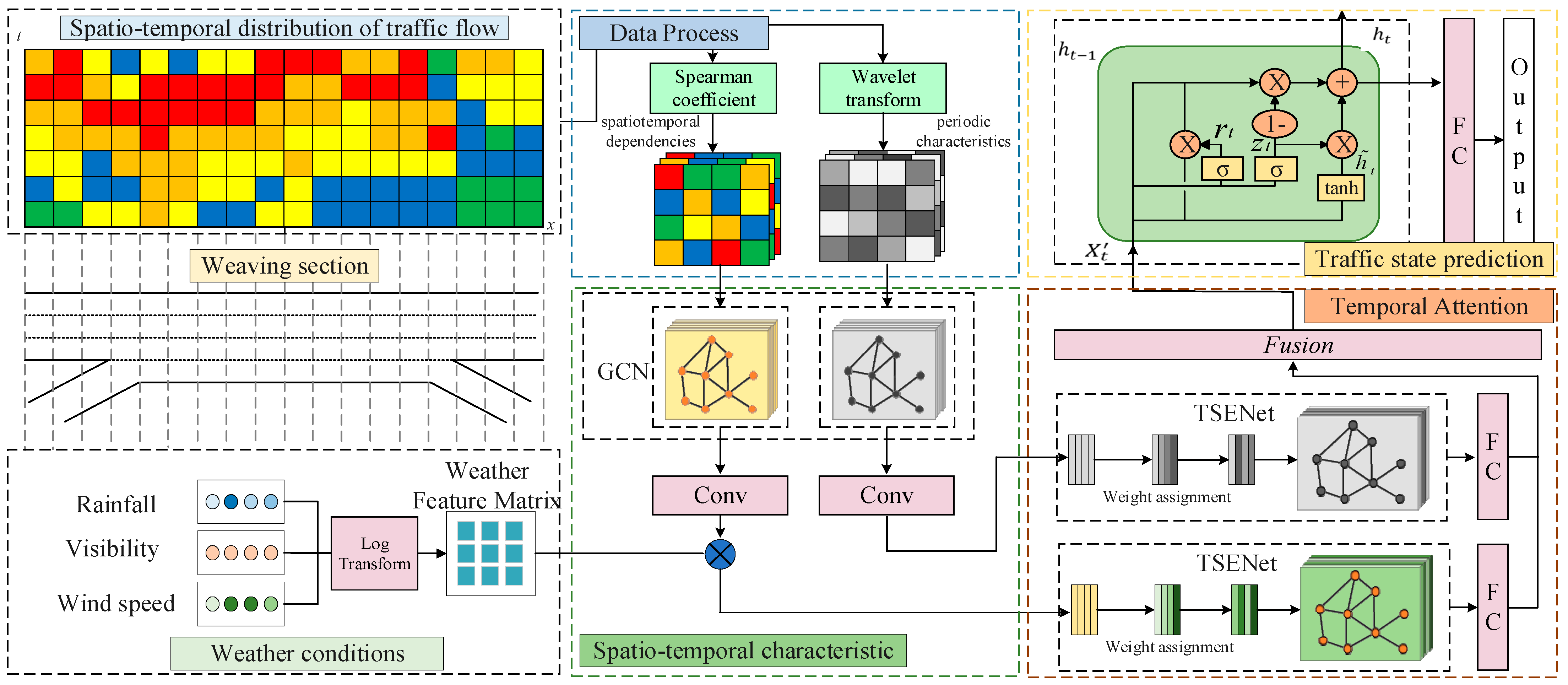
As introduced in Section 2, the traffic state prediction module for freeway weaving areas is implemented using a deep learning model, WSTGCN. This model comprises four main components: feature decomposition, spatiotemporal correlation feature learning, temporal impact feature learning, and traffic state prediction. The overall framework of the selected model is shown in Figure 2.
It has been proven that traffic flow attributes, such as flow and speed, exhibit strong temporal and spatial correlations. Therefore, traffic states identified based on these fundamental traffic parameters also represent significant spatiotemporal correlation. To more accurately capture the spatiotemporal correlation characteristics of traffic states and the time-varying impact by the adverse weather, the inputs, which include various traffic flow parameters, are decomposed into two components: spatiotemporal correlation characteristics and periodic variation characteristics. Each component is then analyzed using dedicated deep learning models to better predict traffic states. The spatiotemporal correlation characteristics can be represented by constructing a matrix of traffic parameters across time and space, which are processed by applying the Spearman rank correlation method to measure the correlations in traffic states. The periodic variation characteristics can be extracted by applying wavelet transform to decompose the traffic parameters at specified frequency bands, thereby identifying their periodic patterns. The decomposition results are then used as representative variables for capturing periodic variation characteristics.
The freeway weaving section features a complex spatial network topology, where lane-changing and merging behaviors introduce non-Euclidean dependencies between road segments. Although the degree to which adverse weather impacts traffic flow varies across lanes, the underlying spatial dependencies remain consistent. Segments that are originally more vulnerable to risk will become even more so under adverse weather, but the spatial distribution of risk points will remain largely unchanged. Therefore, the model should first learn the spatial dependency features of traffic flow within the weaving section right after obtaining the spatiotemporal correlation and periodic variation characteristics of traffic flow. Subsequently, a Time Squeeze-and-Excitation Networks (TSENet) can be specifically designed to capture the temporal dynamics of traffic states under different levels of service in adverse weather conditions, which enable the identification of both long-term regularities and short-term fluctuations in the data. The Graph Convolutional Networks (GCNs) are capable of modeling the topological structure and dynamic interactions of traffic networks, thereby addressing the challenge of capturing complex spatiotemporal dependencies that traditional methods struggle with. Thus, an improved spectral graph convolution is proposed to extract the spatial dependency features within the freeway weaving sections.
Since adverse weather conditions can be approximately considered constant within the observed spatiotemporal range, their impact on traffic states is primarily reflected in the spatiotemporal correlation characteristics. In this way, the weather features can be integrated only with the spatiotemporal correlation characteristics of traffic states, which will be treated separately from the periodic variation characteristics as inputs to the TSENets. The selected adverse weather features include rainfall, visibility, and average wind speed. These variables are first converted into categorical levels and then transformed using a Log transform function to form the weather feature matrix, which is combined with spatiotemporal correlation characteristics using the Hadamard product.
The TSENet can identify differences in the correlation between traffic state information across various time intervals and capture the influence of features from different historical time points on the prediction results. Therefore, it is adopted to extract critical time points where significant changes in traffic flow features occur and assign corresponding attention weights, thereby enabling a more accurate assessment of the relationships among information from different time periods.
Accurate prediction of traffic states across lanes in freeway weaving sections under adverse weather requires models that can simultaneously handle both long-term and short-term temporal patterns as well as spatial characteristics. Deep learning approaches such as Gated Recurrent Units (GRU), Long Short-Term Memory networks (LSTM), and Transformers are all capable of processing such data. Since the preceding submodules have already captured the spatiotemporal variation characteristics of the traffic states, the prediction stage should focus on effectively utilizing these features while maintaining high computational efficiency. The GRU, with its unique gating mechanism and computational efficiency, demonstrates strong suitability and advantages for this task. Therefore, GRU is selected as the prediction model to ultimately forecast traffic states in freeway weaving sections under adverse weather conditions.

4.2. Extractions of Traffic Flow Characteristics

4.2.1. Spatiotemporal Correlation Characteristics

Spearman correlation can more effectively handle ordinal data or any data that can be ranked, which yields high correlation values as long as the two variables share a consistent trend direction. Thus, as expressed in Equation (7), the Spearman correlation coefficient is adopted to measure the correlation of traffic states, which can effectively capture the spatiotemporal correlation characteristics of traffic flow in weaving sections
r s = 1 6 i = 1 n d i 2 n n 2 1
where n is the sample size, di represents the difference in ranks of the sample data Xi and Yi within their respective datasets. The Spearman correlation coefficient r s 1 , 1 , with a larger absolute value indicating a stronger correlation between the two variables. When r 0.8 , the two samples are considered to have a very strong correlation; when 0.8 > r 0.6 , they are considered to have a strong correlation.

4.2.2. Periodic Variation Characteristics

The wavelet decomposition decomposes a signal into sub-bands of various frequencies, thereby providing both temporal and frequency information with better frequency resolution. In this way, the periodic variation characteristics of traffic flow parameters can be captured using wavelet transform. When the traffic flow data is considered as a time-varying signal, the wavelet transform can be applied to extract specific variation features of the traffic signal at different frequencies by selecting different scales and translations. In this context, the decomposed signal corresponding to a specific frequency represents the variation feature at a particular period. If ψ t is the wavelet function, the wavelet transform of the traffic signal f t at scale a and translation τ is given by:
W f α , τ = 1 a + f t ψ t τ α d t
where α is the scale factor; t is time; W f α , τ represents the continuous wavelet transform of the traffic signal f t .

4.3. Spatiotemporal Correlation Analysis

The spatiotemporal correlation characteristics of traffic states in the weaving sections are extracted using a spectral graph convolutional neural network, which incorporates the spectral graph (see Equation (9)) to the traditional graph convolutional neural network. As shown in Equation (10), a K-order Chebyshev polynomial is applied to approximate the convolution kernel, which can reduce the computational cost of spectral convolution. The K-order Chebyshev polynomial aggregates local neighbor information to avoid global feature decomposition, thereby reducing computational complexity. A first-order approximation of the graph convolution is further utilized to simplify the computation, which focus on local spatial dependencies and enhance stability. Thus, the result can be simplified by adopting a first-order approximation graph convolution, as expressed in Equation (11).
g θ x = U g θ U T x
where U is the spectral matrix, i.e., the matrix of eigenvectors obtained by performing eigendecomposition on the normalized graph Laplacian L = I N D 1 2 A D 1 2 = U Λ U T ; I N is the identity matrix. D denotes the degree matrix; A represents the adjacency matrix; Λ is the identity matrix; gθ is regarded as a function of Λ , i.e., g θ Λ ; U T x represents the discrete Fourier transform of x.
g θ x k = 0 K θ k T k L ˜ x
where g θ is a function of gθ that has been processed through a convolution kernel using K-th order Chebyshev polynomials. θ k is the coefficient of the Chebyshev polynomial; T k x = 2 x T k 1 x T k 2 x is the recursive expression of the Chebyshev polynomial; T 1 = x , T 0 = 1 , L ˜ = 2 L λ max I N , λ max is the maximum eigenvalue of L.
X ˜ t = α D ˜ 1 2 A ˜ D ˜ 1 2 X t W
where X t R N × 1 represents the traffic status at a specific time; D ˜ is the degree matrix of A ˜ ; W R 1 × F represents learnable parameters; A ˜ = A + I N ; α is the activation function Relu; N is the number of graph nodes, which corresponds to the number of data collection points used; A represents the connectivity status between nodes; X ˜ = X ˜ 1 , X ˜ 2 , , X ˜ T R T × N × F is spatial features of traffic states extracted over T time steps.

4.4. Weather Feature Extraction

Adverse weather significantly affects traffic flow operation. In this way, weather considerations must be incorporated into traffic state prediction. Accordingly, a Weather Feature Extraction Module (WFM) is established to enhance the spatiotemporal correlation characteristics learned from the spectral graph convolutional network. The process of generating the weather feature matrix in WFM is as follows:
(1)
The weather inputs mainly include rainfall, visibility, and wind speed. These three weather time series are converted into risk level data based on classification thresholds.
(2)
The risk level data are processed and integrated using a log transform to form the weather feature matrix.
(3)
Finally, the output of the spatiotemporal correlation component from the GCN is fused with the weather feature matrix via the Hadamard product.

4.5. Time Squeeze-and-Excitation Networks

Two TSENets integrate the revised Spatiotemporal correlation characteristics and decomposed periodic variation characteristics, respectively, to better capture the dynamic evolution of traffic flow and assign higher weights to spatiotemporal nodes exhibiting sudden abnormal features. In TSENet, the spatial features at all time points extracted by the spectral GCN are first aggregated, then the state information of all time points is cross-combined to measure the relationships between different temporal information from a global perspective. This process yields attention weights, which are then assigned to the features corresponding to each time point.
As shown in Equations (12)–(14), TSENet applies a global average pooling method to cluster the spatial features at each time point. Subsequently, fully connected operations are performed separately on the cross-aggregated feature O and the generated attention weights O ˜ for each time point. Finally, the attention weights O ˜ are assigned to the corresponding features X ˜ along the temporal dimension.
O t = 1 N × C n = 1 N c = 1 C X ˜ t , n , f
O ˜ = σ W 2 W 1 O
X t = O ˜ t × X ˜ t
where O t is the compressed feature vector at the t -th time step, N is the number of nodes in the graph, C is the feature dimensionality of each node, σ is the Sigmoid activation function, X t is the feature at the t -th time step after applying the weight. W 1 R T × C and W 2 R C × T refer to the learnable weight parameters in the fully connected operation.

4.6. Traffic State Prediction Models

The spatiotemporal correlation features and periodic variation features processed by two separate TSENets can be fused and used as inputs to the GRU network to predict traffic states in freeway weaving sections under adverse weather conditions. The GRU controls the evolution of temporal features through a reset gate and an update gate, with the gating structures computed as shown in Equations (15) and (16).
r t = σ W r X t + U r h t 1 + b r
z t = σ W z X t + U z h t 1 + b z
where W r , U r , W z , U z are learnable weight parameters, h t 1 refers the hidden state at time t − 1; b r and b z are bias terms. The Z t is used to determine retention level of the previous state h t 1 in the current candidate state h ˜ t ; r t is selected to control the proportion of previous state h t 1 and current h ˜ t in the current state h t , which can be calculated by Equations (17) and (18).
h ˜ t = tanh W h X t + U h r t h t 1 + b h
h t = 1 z t h t 1 + z t h ˜ t
where b h is the bias term, U h and W h are weighting matrixes.
The GRU model performs recurrent processing on the traffic state information over T time steps, which will enable the prediction of traffic conditions for each lane in freeway weaving sections under specified adverse weather conditions.

5. Experiment Setup

5.1. Data Description

5.1.1. Flow Data

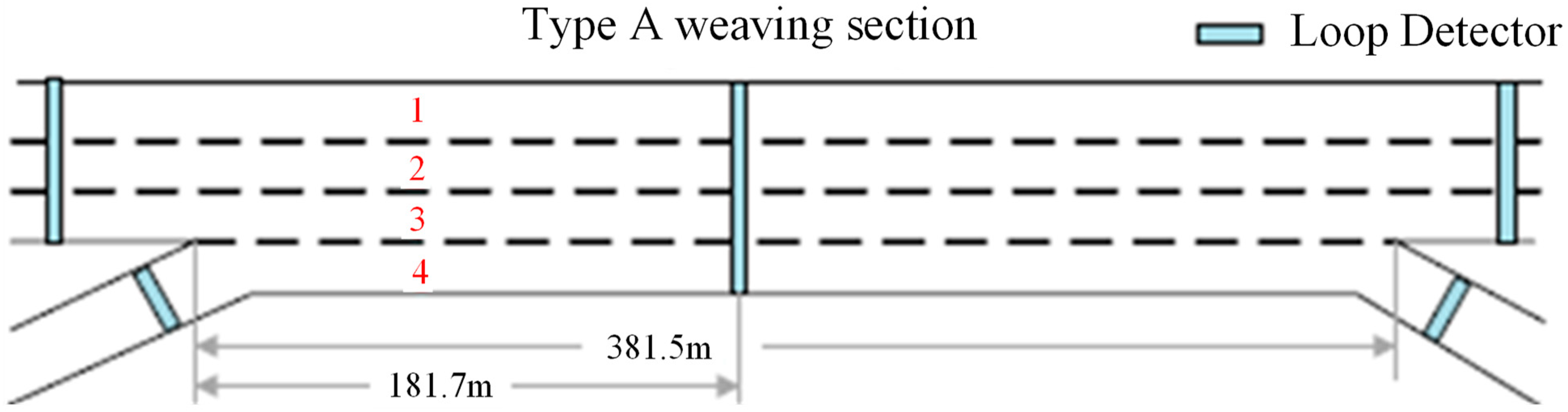
A total dataset of 201 weaving section facilities from four Chinese and American freeway (Beijing–Kunming Freeway (G5), Erenhot–Guangzhou Freeway (G55) of China and Interstate 80 (I80) and Interstate 5 (I5) of USA) is selected to assess the performance of the proposed method. These performance data is obtained from the operational platform of the freeway network at Shanxi Province, China and Performance Measurement System (PeMS) from the Caltrans at California, USA, respectively. The selected dataset includes loop detector data from 172 Type A weaving sections, 18 Type B weaving sections, and 11 Type C weaving sections. Because the Type A weaving section is the most commonly used facility type in the freeway, traffic flow data from 83 Type A weaving sections with the geometrical design scenario shown in Figure 3 is selected to test the proposed method. In this geometrical design, the lanes numbered from the median to the right shoulder in order from 1 to n, which means the auxiliary lane in Figure 3 will be designated as Lane 4 and the innermost fast lane is designated as Lane 1.
All the data are aggregated into 5 min flow data to minimize the differences between these two datasets. A total of 518,400 5 min interval aggregated loop data is collected to train and test the proposed model. The indicators selected in this research are listed in Table 1.
The Kolmogorov–Smirnov (K-S) test is chosen to avoid significant discrepancies on the traveling speed of the weaving section between Chinese and American freeways, whose results are summarized in Table 2. The test results indicate that the average speeds under different levels of service all pass the K-S test, which means the null hypothesis is accepted. Thus, it suggests no significant difference in speed data between Chinese and U.S. weaving segments of the same type, which indicates they have similar traffic characteristics.
This research also filters out erroneous data using threshold values and interrelationships among traffic flow, speed, and occupancy to ensure data accuracy problems that may be caused by issues like equipment malfunction. Then, we match the traffic flow data with corresponding weather data, which may also be excluded when the weather data is missed.

5.1.2. Weather Data

The weather data used in this research is obtained from the official open-source data of China and U.S., which are China Meteorological Administration (CMA), China Weather Network, and National Oceanic and Atmospheric Administration (NOAA), respectively. Attributes in the weather dataset include rainfall, visibility, wind speed, and wind direction, with the sampling intervals ranging from 15 to 60 min. All the weather data utilized in this research are all located within 5 km of the corresponding freeway weaving section. To ensure the effectiveness of model learning, the study only applied datasets with complete weather data.
The level of adverse weather is classified based on the potential impacts on the operation of traffic flow (Grade of weather conditions for freeway transportation, QX/T 111-2010), whose threshold values are listed in Table 3. The adverse weather studied in this research include rainfall, fog and strong wind, whose impact on traffic flow is measured by the rain strength, visibility and average wind speed.

5.2. Model Design and Assessment

The experiments were conducted using a desktop with the following configurations: CPU: Intel Core i7-7700K 4.2 GHz, Operating system: Windows 10, RAM: 16GB DDR4, GPU: NVIDIA GeForce 1070, Programming language: Python 3.10 with libraries of Scikit-learn and PyTorch 1.10.
We employed the Adam optimizer to train the model with a learning rate of 0.001 and a batch size of 64. The parameters in the WSTGCN were determined based on the performance of lost function Smooth L1, which have a composite estimation on both mean absolute error and root mean square error (see Equation (19)). The number of convolutional kernels, temporal scaling rate, and number of hidden units were then determined after 50 runs using the selected dataset. According to optimization results, both TESNets in the WSTGCN have the same settings, which have 32 convolutional kernels with the size of 3 × 3; the temporal scaling rate of the SENet is set as 2. The number of hidden units in the corresponding GRU is 128.
L β Y , Y ˜ = 1 2 Y Y ˜ 2 , i f Y Y ˜ β β Y Y ˜ 1 2 β 2 , o t h e r s
where Y is the predicted value, Y ˜ is the true value, and β is a threshold hyperparameter that controls the point at which the loss function switches from a quadratic function to a linear one.

6. Results and Discussion

6.1. Traffic States Classification Results

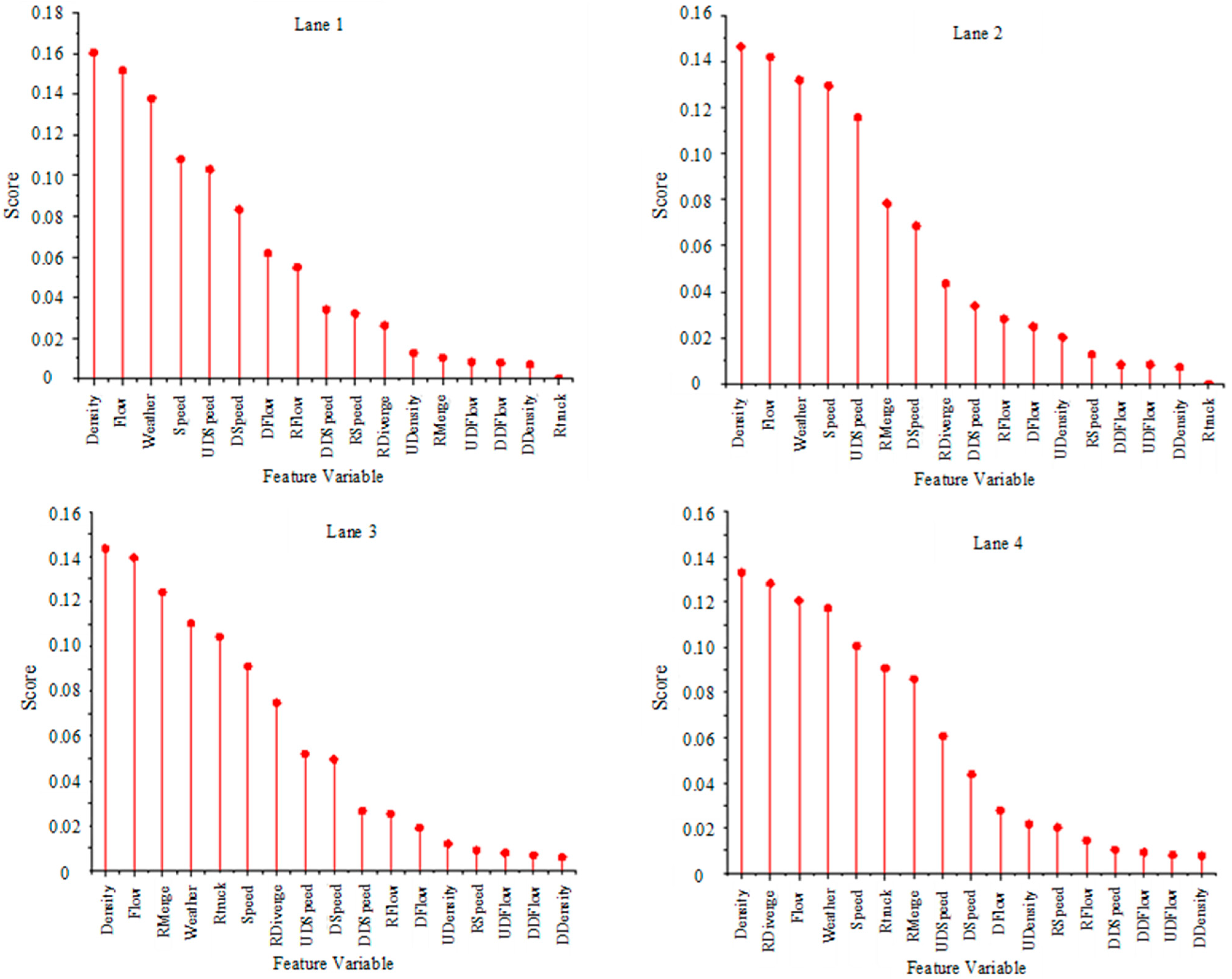
The RF algorithm is used to directly rank the importance of various parameters that characterize the traffic operation status in freeway weaving sections. Based on the ranking results, the most important variables are selected and used in training and analysis process of the subsequent models. The number of trees in the forest is set to 100, and the minimum number of samples required to split an internal node is 2. The ranking results of the relative importance of variables representing the traffic flow stability of each lane in the freeway weaving sections are shown in Figure 4. A higher score indicates a greater influence of the corresponding feature variable on traffic flow stability.
According to the results of the RF, 5 min flow, average speed, density, and weather conditions are four common influencing factors among the top six factors for all the lanes within the freeway weaving sections. For Lane 1, which is the farthest lane from the weaving lanes, the main additional influencing factors are the speed differences in spatially associated areas. For Lane 2, the merging ratio also exerts a notable influence. Lane 3, as the outermost lane of the basic freeway segments, where primarily serves heavy vehicles. Thus, one critical influencing factor shifts from speed differences to the proportion of heavy vehicles. Lane 4 is an auxiliary lane at the weaving area, whose traffic conditions are more affected by the proportion of heavy vehicles and the diverging ratio.
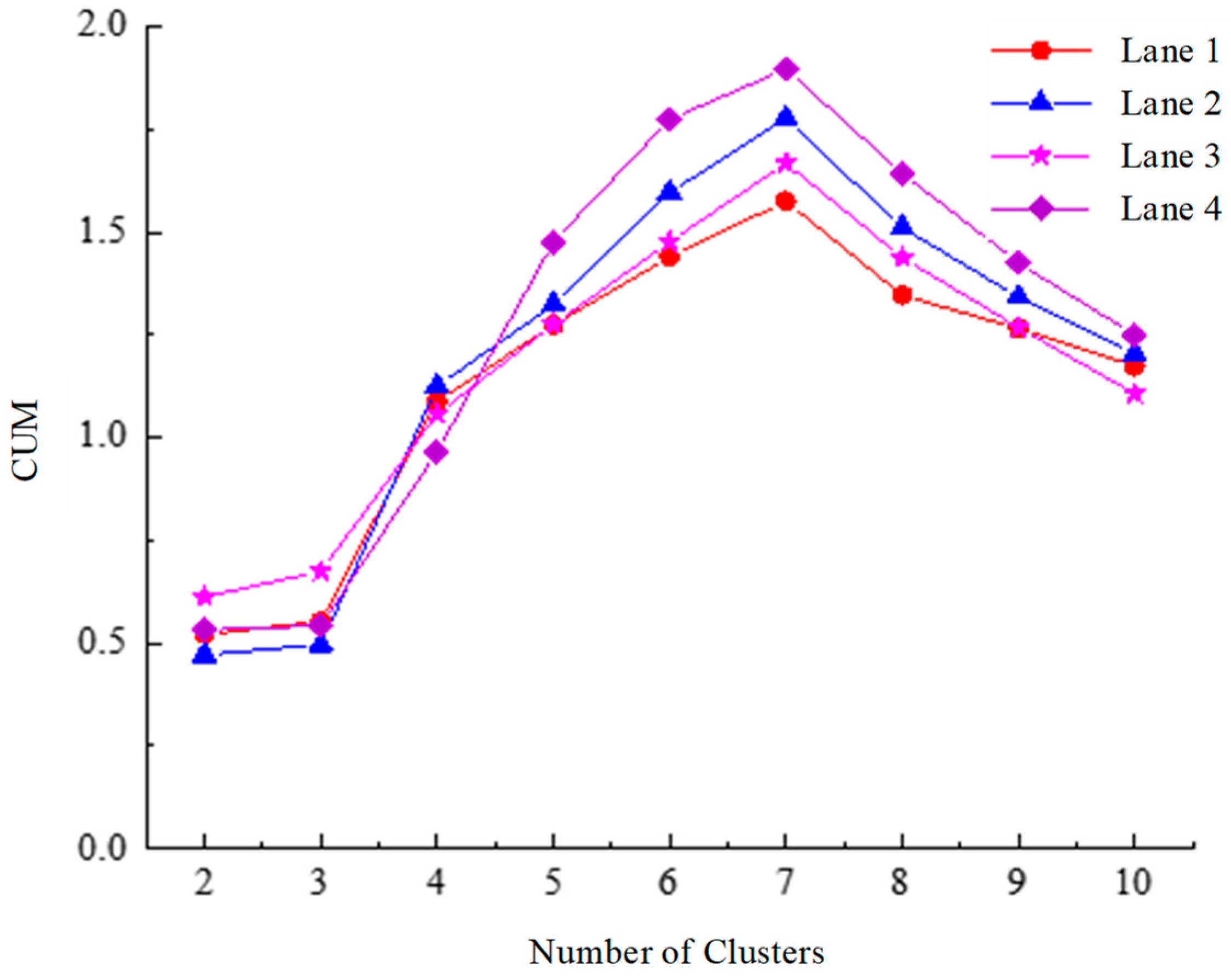
The improved k-prototypes algorithm is applied to reclassify the traffic states of freeway weaving sections under adverse weather conditions using the selected the feature parameters from RF. A multi-round clustering approach is adopted to search for the optimal number of clusters, which is set from 2 to 10. The results of CUM for each cluster are summarized in Table 4 and Figure 5. The comparison of CUM values indicates that when the number of clusters is 7, the proposed improved k-prototypes algorithm yields the most effective clustering results across all lanes. Therefore, the traffic states of each lane in the freeway weaving sections should be divided into seven categories.
The clustering results of each lane using the improved k-prototypes algorithm are shown in Table 5. By analyzing the distribution of cluster centers across the different categories for each lane, it can be observed that Category 3 consistently represents the free-flow conditions, with favorable weather and other indicators also reflecting high operational stability and minimal disturbance. This category can thus be considered the optimal traffic state. The dissimilarity distances between cluster centers are then used to quantify the proximity of each category to Category 3, which can convert the seven clusters into a seven-level classification of traffic states for freeway weaving sections.

6.2. Traffic State Prediction Results

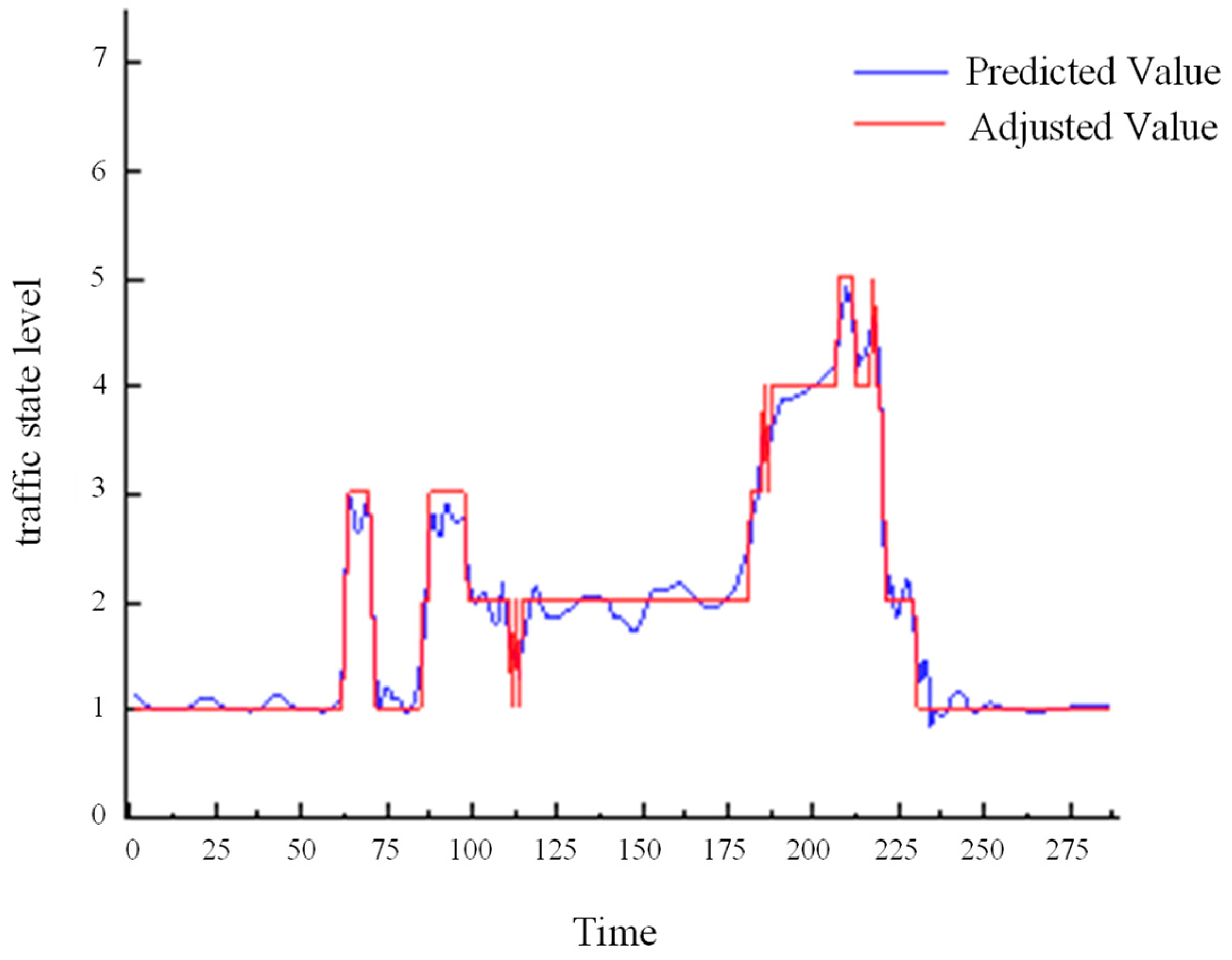
The 518,400 5 min datasets were selected to train the proposed WSTGCN model, and the data from 27 December 2019, which was not included in the training set, is used to test the proposed model. It should be noticed that the output of deep learning model is continuous data. According to the comparative analysis of our results, the rounding processing method is preferred primarily due to its lower computational resource requirements and the fact that it does not require parameter tuning like a classifier. Thus, the predicted results are rounded to the nearest integer to obtain the final predicted traffic state level. We select the prediction results and rounded results of traffic states for Lane 3, the lane affected most by the weaving flow, to verify the effectiveness of this correction, which are represented in Figure 6. The results indicate that the rounding correction values are highly consistent with the variation trend of the predicted continuous values, which have limited impact on the result analysis.
In order to assess the effectiveness of the proposed method, we compared proposed WSTGCN model with several widely used benchmark models to validate the performance in traffic flow state prediction under the adverse weather. The specific models are as follows:
(1)
RNN (Recurrent Neural Network): A commonly used architecture for predicting the temporal patterns of traffic flow data.
(2)
LSTM (Long Short-Term Memory): Compared with RNN, it is more suitable for handling data with long temporal dependencies and can effectively avoid issues such as gradient vanishing and explosion.
(3)
GRU (Gated Recurrent Unit): A variant of LSTM that requires fewer parameters, less data, and shorter training time.
(4)
TSE-GC-GRU: An architecture that adds a temporal attention mechanism to the combination of GCN and GRU, which enables the model to effectively identify how data at different time steps influence the prediction results.
(5)
DT-GC-GRU: A dual-stream model consisting of two TSE-GC-GRU modules that, respectively, extract features from periodic sequences and recent time windows, thereby enhancing the model’s ability to capture the periodicity of traffic states.
(6)
WSTGCN: An optimized version of the DT-GC-GRU model that incorporates a weather feature extraction module to further improve prediction performance.
The Root Mean Square Error (RMSE), Equalization Coefficient (EC), and Accuracy Rate (AR) are selected to evaluate the average deviation between predicted and actual values, the degree of spatiotemporal alignment between predicted results and actual traffic states, and the classification accuracy of the model for traffic states of the freeway weaving section under adverse weather conditions, respectively. Because the prediction output is ordinal data (the discrete traffic states), the prediction accuracy rate (AR) can be obtained by directly comparing the rounded predicted values with the actual traffic states.
R M S E = 1 N i = 1 N y ˜ i y i 2
E C = 1 i = 1 N y i y ˜ i 2 i = 1 N y i 2 + i = 1 N y ˜ i 2
N is the total number of samples, i is the sample index, y ˜ i is the true value of the i -th sample, y i is the predicted value of the i -th sample.
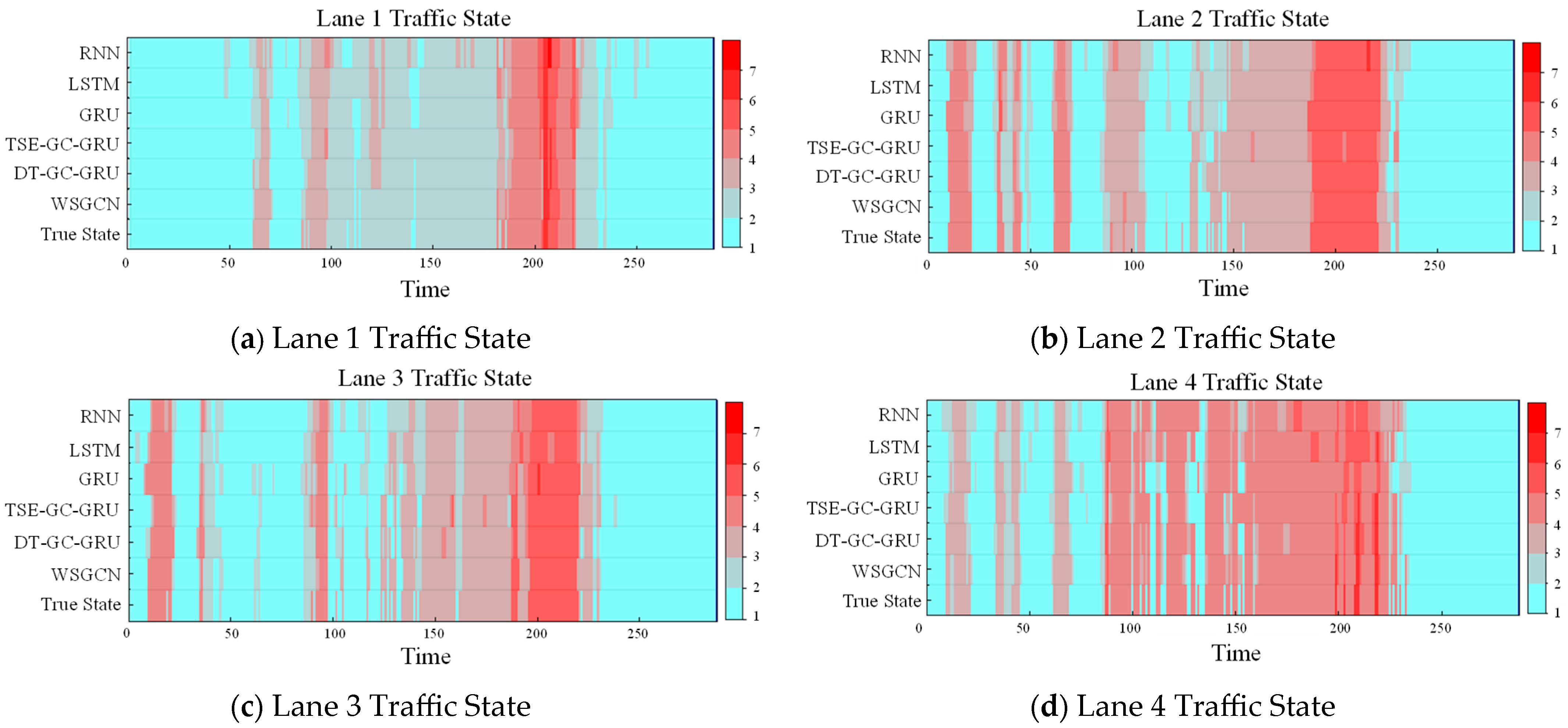
The performance of the selected models on the prediction of traffic states for all the lanes at freeway sections are listed and compared in Table 6 and Figure 7. Based on the performance comparison results, the WSTGCN traffic state prediction model developed in this study achieves the best predictive performance across all lanes. The goodness-of-fit (coefficient of determination) exceeds 0.9 for all lanes, and the prediction accuracy is above 90% for all lanes except lane 4, where it is very close to 90%. This demonstrates the high practical value of the proposed model.
Among the models, the RNN prediction model exhibits the poorest performance. Compared with LSTM, the GRU model, with fewer parameters, achieves better prediction results for all lanes. The TSE-GC-GRU model integrates graph convolutional networks to enhance spatial feature extraction, leading to significant improvements over GRU and LSTM. Specifically, relative to the GRU model, the TSE-GC-GRU reduces RMSE by 5.0–12.7%, increases the explained coefficient (EC) by 1.7–3.8%, and improves accuracy by 2.0–3.1% across lanes. The DT-GC-GRU model, which employs two layers of TSE-GC-GRU to incorporate periodic features of traffic state changes, further improves prediction performance. Its RMSE decreases by 4.5–13.0%, EC increases by 1.6–4.8%, and accuracy improves by 1.8–3.3% in lane-wise applications.
After incorporating weather features, the WSTGCN model achieves optimal prediction performance. Compared to the DT-GC-GRU model, WSTGCN reduces RMSE by 3.8–8.0%, increases EC by 1.0–3.2%, and improves accuracy by 1.4–3.1%, which indicates that the consideration of weather factors effectively enhances model performance.
Figure 7 presents a detailed comparison of the prediction results from the selected models for the traffic operation state time series data of four lanes in the freeway weaving sections. In this figure, the traffic operation states progressively worsen from State 1 to State 7, where State 1 represents the optimal operating condition, characterized by free-flow traffic and favorable weather conditions, and State 7 corresponds to the traffic state with the poorest operational stability, often occurring under congested flow and adverse weather conditions. The results in Figure 7 further confirm that the WSTGCN model’s predictions are the closest to the actual states and achieve the highest prediction accuracy.

6.3. Influence on the Type of Weaving Section

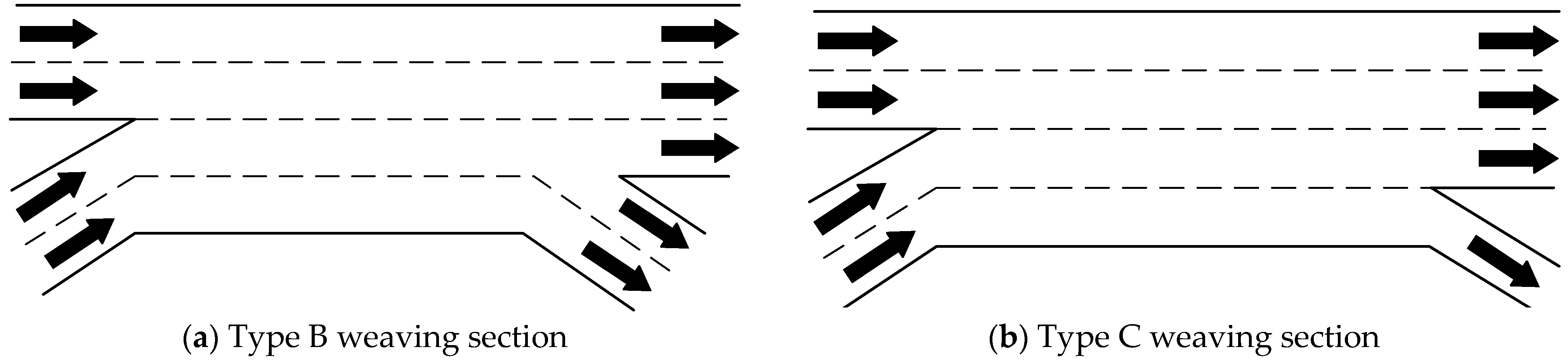
Besides the type A weaving sections, the freeway also has type B weaving sections, where one weaving traffic stream can complete its maneuver without lane changes and the other stream requires at most one lane change, and type C weaving sections, where at least one weaving stream must make two or more lane changes to complete the maneuver. Typical examples of Type B and Type C weaving sections are shown in Figure 8. Compared with Type A weaving sections, the Type B and C ones are more suitable when one weaving stream is significantly heavier than the other, which results in certain differences in traffic operation characteristics.
The primary influencing factors in Type B and Type C weaving sections can also be processed using RF model, whose results indicate that traffic volume, density, speed, and weather conditions remain the major influencing factors across all lanes. For lanes which are less affected by heavy vehicles and weaving flows, such as Lane 1, the critical additional influencing factors continue to be speed differential ones. Meanwhile, for weaving lanes and auxiliary lanes, heavy vehicle proportion and diverging ratios or merging ratios remain as critical additional factors. Overall, the influencing factor patterns are similar to those in Type A weaving sections. However, in practical applications, the proposed method in this study should be applied in conjunction with actual detection data for validation and analysis.
When applying the proposed WSTGCN model to predict the traffic state at freeway weaving sections, it was found that the proposed model can also effectively predict the traffic states of Type B and Type C weaving sections when they are trained with sufficient data. The Type B and Type C weaving segments shown in Figure 8 were selected for validating the proposed WSTGCN model. The prediction results of Lane 1 (with limited influence by weaving traffic stream) and Lane 3 (weaving lane) were tested and are presented in Table 7. Compared with the prediction results of Type A weaving section (see Table 6), the WSTGCN model achieves comparable performance in predicting the traffic states of Type B and C weaving sections. For Lane 1, the prediction results remain unchanged. However, for Lane 3, due to more complex lane-changing behaviors, the prediction metrics (RMSE, EC, and AR) are approximately 3–5% lower than those for Type A. These results demonstrate that although the configuration of the weaving sections changes, the proposed WSTGCN model is still capable of effectively extracting weather features and capturing the spatiotemporal dynamics of traffic flow, thus achieving accurate traffic state prediction.


7. Conclusions

(1)
A spatiotemporal graph convolutional neural network-based model, WSTGCN, is proposed to predict traffic states in highway weaving areas under adverse weather conditions, which integrates temporal, spatial, and weather features. Based on operational data from 83 weaving areas in China and the U.S., the results show that the proposed method can effectively classify the traffic states of freeway weaving sections during adverse weather. Based on the reclassified traffic states, the proposed WSTGCN model demonstrates strong capability in accurately predicting the traffic states of freeway weaving areas under such conditions.
(2)
In traffic state classification, the proposed method determines an optimal cluster number of seven by removing the worst-performing cluster and performing iterative optimization. The corresponding CUM values for each lane were 1.5754, 1.777, 1.6683, and 1.8977, respectively. The proposed WSTGCN model achieved Accuracy Rates (AR) of 93.5%, 91.7%, 90.6%, and 89.4% on lanes 1, 2, 3, and 4, respectively, demonstrating higher accuracy and correctness than other comparison models in the traffic state prediction process using data from China and U.S. Compared to traditional models such as RNN, LSTM, and GRU, the proposed model achieved a 22.5–42.1% reduction in Root Mean Square Error (RMSE), an improvement of 7.6–21.5% in Equilibrium Coefficient (EC), and an improvement of 9.8–25.1% in the Accuracy Rate (AR).
(3)
Due to limitations of the available data, this research only verifies the effects of adverse weather conditions such as rain, fog, and strong winds. Future work will include validation under other adverse conditions such as snow, sandstorms, and extreme heat. In addition, the traffic data used in this research is obtained from loop detectors. In the future, more data sources, such as video data, could be considered to more accurately capture the operational state of weaving sections, thereby providing a more solid foundation for the prediction model.

Author Contributions

Conceptualization, J.M. (Jing Ma) and Y.L.; methodology, M.Z. and X.Z.; validation, J.M. (Jiahao Ma), Q.L. and Y.Z.; formal analysis, M.Z. and Y.Z.; investigation, J.M. (Jiahao Ma) and Y.Z.; resources, X.Z. and Q.L.; data curation, J.M. (Jing Ma) and X.Z.; writing—original draft preparation, J.M. (Jing Ma), J.M. (Jiahao Ma) and Y.L.; writing—review and editing, J.M. (Jing Ma), J.M. (Jiahao Ma) and Y.L.; visualization, M.Z. and Q.L.; supervision, J.M. (Jing Ma) and Y.L.; funding acquisition, J.M. (Jing Ma), M.Z. and Y.L. All authors have read and agreed to the published version of the manuscript.

Funding

The research described in this paper is jointly supported by the Natural Science Basic Research Plan in Shaanxi Province of China (Grant No.: 2025JC-YBMS-367, and 2025JC-YBQN-524), Hunan Provincial Natural Science Foundation of China (Grant No.: 2024JJ8349), the Key Science and Technology Projects of Transportation Science and Technology Plan in Fujian Province (Grant No.: ZD202405, and YB202431) and the Scientific Research Project of the Department of Transport in Shaanxi Province of China (Grant No.: 21-31X).

Institutional Review Board Statement

Not applicable.

Informed Consent Statement

Not applicable.

Data Availability Statement

The raw data are available on request.

Conflicts of Interest

Authors Xiaobin Zou and Qiuyuan Luo were employed by the company Fujian Provincial Transportation Research Institute Co., Ltd. The remaining authors declare that the research was conducted in the absence of any commercial or financial relationships that could be construed as a potential conflict of interest.

References

  1. Druta, C.; Kassing, A.; Gibbons, R.; Alden, V.A. Assessing driver behavior using shrp2 adverse weather data. J. Saf. Res. 2020, 73, 283–295. [Google Scholar] [CrossRef] [PubMed]
  2. Theofilatos, A.; Yannis, G. A review of the effect of traffic and weather characteristics on road safety. Accid. Anal. Prev. 2014, 72, 244–256. [Google Scholar] [CrossRef] [PubMed]
  3. Yao, K.; Chen, L.; Chen, S. Time-evolving traffic resilience performance forecasting during hazardous weather toward proactive intervention. Reliab. Eng. Syst. Saf. 2025, 253, 110521. [Google Scholar] [CrossRef]
  4. Ye, B.L.; Zhang, M.; Li, L.; Liu, C.; Wu, W. A survey of traffic flow prediction methods based on long short-term memory networks. IEEE Intell. Transp. Syst. Mag. 2024, 16, 87–112. [Google Scholar] [CrossRef]
  5. Zhang, Y.; Zhang, Y.; Haghani, A. A hybrid short-term traffic flow forecasting method based on spectral analysis and statistical volatility model. Transp. Res. Part C Emerg. Technol. 2014, 43, 65–78. [Google Scholar] [CrossRef]
  6. Yao, R.; Zhang, W.; Long, M. DLW-Net model for traffic flow prediction under adverse weather. Transp. B Transp. Dyn. 2022, 10, 499–524. [Google Scholar] [CrossRef]
  7. Xu, X.; Jin, X.; Xiao, D.; Ma, C.; Wong, S.C. A hybrid autoregressive fractionally integrated moving average and nonlinear autoregressive neural network model for short-term traffic flow prediction. J. Intell. Transp. Syst. 2023, 27, 1–18. [Google Scholar] [CrossRef]
  8. Carianni, A.; Gemma, A. Overview of Traffic Flow Forecasting Techniques. IEEE Open J. Intell. Transp. Syst. 2025, 6, 848–882. [Google Scholar] [CrossRef]
  9. Guo, J.; Huang, W.; Williams, B.M. Adaptive Kalman filter approach for stochastic short-term traffic flow rate prediction and uncertainty quantification. Transp. Res. Part C Emerg. Technol. 2014, 43, 50–64. [Google Scholar] [CrossRef]
  10. Li, Y.; Xu, J.; Li, Y.; Xue, Y.; Yao, Z. Estimation and prediction of freeway traffic congestion propagation using tagged vehicle positioning data. Transp. B Transp. Dyn. 2024, 12, 2297143. [Google Scholar] [CrossRef]
  11. Wang, J.; Shi, Q. Short-term traffic speed forecasting hybrid model based on chaos–wavelet analysis-support vector machine theory. Transp. Res. Part C Emerg. Technol. 2013, 27, 219–232. [Google Scholar] [CrossRef]
  12. Liu, S.; Lin, W.; Wang, Y.; Yu, D.Z.; Peng, Y.; Ma, X. Convolutional neural network-based bidirectional gated recurrent unit–additive attention mechanism hybrid deep neural networks for short-term traffic flow prediction. Sustainability 2024, 16, 1986. [Google Scholar] [CrossRef]
  13. Xu, D.; Wang, Y.; Peng, P.; Beilun, S.; Deng, Z.; Guo, H. Real-time road traffic state prediction based on ker-nel-KNN. Transp. A Transp. Sci. 2020, 16, 104–118. [Google Scholar]
  14. Cheng, Q.; Dai, G.; Ru, B.; Liu, Z.; Ma, W.; Liu, H.; Gu, Z. Traffic flow outlier detection for smart mobility using gaussian process regression assisted stochastic differential equations. Transp. Res. Part E Logist. Transp. Rev. 2025, 193, 103840. [Google Scholar] [CrossRef]
  15. Cui, T.; Lu, Y.; Dong, D.; Ren, C.; Qu, Z.; Li, P. A Wavelet Disentanglement and topological semantic neural net-work for traffic flow forecasting. Eng. Appl. Artif. Intell. 2025, 156, 111367. [Google Scholar] [CrossRef]
  16. Guo, S.; Lin, Y.; Feng, N.; Song, C.; Wan, H. Attention based spatial-temporal graph convolutional networks for traffic flow forecasting. In Proceedings of the AAAI Conference on Artificial Intelligence, Honolulu, HI, USA, 27 January–1 February 2019; Volume 33, pp. 922–929. [Google Scholar]
  17. Ounoughi, C.; Yahia, S.B. Sequence to sequence hybrid Bi-LSTM model for traffic speed prediction. Expert Syst. Appl. 2024, 236, 121325. [Google Scholar] [CrossRef]
  18. Liu, T.; Meidani, H. End-to-end heterogeneous graph neural networks for traffic assignment. Transp. Res. Part C Emerg. Technol. 2024, 165, 104695. [Google Scholar] [CrossRef]
  19. Liu, T.; Meidani, H. Multi-class traffic assignment using multi-view heterogeneous graph attention networks. Expert Syst. Appl. 2025, 286, 128072. [Google Scholar] [CrossRef]
  20. Yuan, R.; Abdel-Aty, M.; Xiang, Q. A study on diversion behavior in weaving segments: Individualized traffic conflict prediction and causal mechanism analysis. Accid. Anal. Prev. 2024, 205, 107681. [Google Scholar] [CrossRef] [PubMed]
  21. Li, Y.; Chen, J.; Zeng, M.; Xu, J.; Wang, F. Identification of traffic operation states in freeway weaving areas considering weather impacts. J. Transp. Syst. Eng. Inf. Technol. 2023, 23, 111–119+152. [Google Scholar]
  22. Rényi, A. On measures of entropy and information. In Proceedings of the Fourth Berkeley Symposium on Mathematical Statistics and Probability, Volume 1: Contributions to the Theory of Statistics; University of California Press: Oakland, CA, USA, 1961; Volume 4, pp. 547–562. [Google Scholar]
Figure 1. Research framework.
Sustainability 17 07970 g001
Figure 2. Framework of traffic state prediction model.
Sustainability 17 07970 g002
Figure 3. The geometrical design of a typical Type A weaving section.
Sustainability 17 07970 g003
Figure 4. Ranking Results of Feature Variable Importance for Each Lane in Type A Weaving Areas Based on the RF Algorithm.
Sustainability 17 07970 g004
Figure 5. Variation in Clustering Validity.
Sustainability 17 07970 g005
Figure 6. Schematic diagram of lane 1 prediction corrections.
Sustainability 17 07970 g006
Figure 7. Comparison of traffic state prediction results in the freeway weaving sections.
Sustainability 17 07970 g007
Figure 8. Illustrations of Typical Type B and Type C weaving section.
Sustainability 17 07970 g008
Table 1. Description of Traffic Flow and Weather Feature Variables.
IDVariablesDescriptions
1Speed5 min average speed in the weaving area (mph)
2Flow5 min traffic volume in the weaving area (veh/5 min)
3Density5 min density in the weaving area (veh/mi/ln)
4RMerge5 min merging ratio in the weaving area
5RDiverge5 min diverging ratio in the weaving area
6DSpeedSpeed difference between the weaving lane and adjacent lane (mph)
7DFlowFlow difference between the weaving lane and adjacent lane (veh/5 min)
8RSpeedRatio of the 5 min average speed of the weaving lane to the overall weaving area speed
9RFlowRatio of the 5 min flow of the weaving lane to the overall weaving area flow
10RTruckRatio of 5 min truck volume to total traffic volume per lane
11UDSpeedSpeed difference between the weaving area detector and upstream detector (mph)
12UDFlowFlow difference between the weaving area detector and upstream detector (veh/5 min)
13UDensityDensity difference between the weaving area detector and upstream detector (veh/mi/ln)
14DDSpeedSpeed difference between the weaving area detector and downstream detector (mph)
15DDFlowFlow difference between the weaving area detector and downstream detector (veh/5 min)
16DDensityDensity difference between the weaving area detector and downstream detector (veh/mi/ln)
17Weather0 = Clear,1 = Mild weather, 2 = Moderate weather, 3 = Significant impact weather, 4 = Extreme weather
Table 2. The K-S test results of traveling speed distribution between Chinese and American Type-A weaving sections.
p-Values of Kolmogorov–Smirnov Test for Each Level of Service
Lane IDABCDEF
10.1160.1240.1510.1430.1390.107
20.1340.1250.1170.1670.1490.131
30.0970.1130.1070.1370.1260.119
40.1060.1350.1270.1170.1080.124
Note: Null hypothesis—the data distributions of the two samples are identical.
Table 3. Classification of adverse weather.
Grade of Weather ConditionsRain Strength (mm/h)Visibility (Meter)Average Wind Speed (m/s)
1 (slight impact)[10.0, 14.9](200, 500][8.0, 13.8]
2 (moderate impact)[15.0, 29.9](100, 200][13.9, 17.1]
3 (significant impact)[30.0, 49.9](50, 100][17.2, 20.7]
4 (severe impact)≥50.0≤50≥20.8
Table 4. Comparison of Clustering numbers.
Cluster NumberCUMs
Lane 1Lane 2Lane 3Lane 4
20.52130.47130.61220.5315
30.55330.49750.67530.5433
41.08881.12471.05760.9654
51.27381.32411.27561.4773
61.44091.59711.47651.7749
71.57541.7771.66831.8977
81.04671.21121.13781.4431
90.96571.04220.96831.1258
100.87350.93550.76810.9024
Note: The bolded row has the most effective clustering results.
Table 5. Dissimilarity Distance Calculation Results and Traffic Operational Status Ranking.
CategoriesSimilarity
Lane 1State LevelLane 2State LevelLane 3State LevelLane 4State Level
10.293560.281760.310960.33366
20.486840.764320.624740.61473
311111111
40.260670.212870.281670.29437
50.413050.479950.493250.46774
60.637120.613730.712630.40285
70.619730.533140.786520.78082
Table 6. Comparison of the performance of different models for predicting the operating state of each lane in the interweaving zone.
IndicatorsPrediction Model
RNNLSTMGRUTSE-GC-GRUDT-GC-GRUWSTGCN
Lane 1RMSE0.7610.6770.6570.5810.5140.473
EC0.8070.8460.8710.9040.9470.954
AR76.2%83.1%85.4%88.4%91.4%93.5%
Lane 2RMSE0.8130.7020.6670.6330.5510.503
EC0.7790.8650.8770.8920.9060.935
AR73.7%78.7%83.1%85.1%88.4%91.7%
Lane 3RMSE0.9540.8820.8340.7150.6820.633
EC0.7810.8170.8610.8770.9110.924
AR72.4%79.1%83.6%86.4%89.2%90.6%
Lane 4RMSE1.27131.0370.9860.8610.8220.791
EC0.7560.8220.8440.8720.9010.917
AR70.2%77.6%81.4%84.5%86.3%89.4%
Note: The bolded column has the best performance of the predictions.
Table 7. The prediction results of Lane 1 and Lane 3.
Type B Freeway Weaving SectionType C Freeway Weaving Section
Lane 1Lane 3Lane 1Lane 3
RMSE0.4610.5850.4850.621
EC0.9390.9300.9670.906
AR94.6%88.4%91.1%87.6%
Disclaimer/Publisher’s Note: The statements, opinions and data contained in all publications are solely those of the individual author(s) and contributor(s) and not of MDPI and/or the editor(s). MDPI and/or the editor(s) disclaim responsibility for any injury to people or property resulting from any ideas, methods, instructions or products referred to in the content.