A Multi-Model Coupling Approach to Biodiversity Conservation Strategies for Nationally Important Agricultural Heritage Systems in the Beijing–Tianjin–Hebei Region

Abstract
1. Introduction
2. Materials and Methods
2.1. Overview of the Study Area
2.2. Data Sources
2.3. Methodology
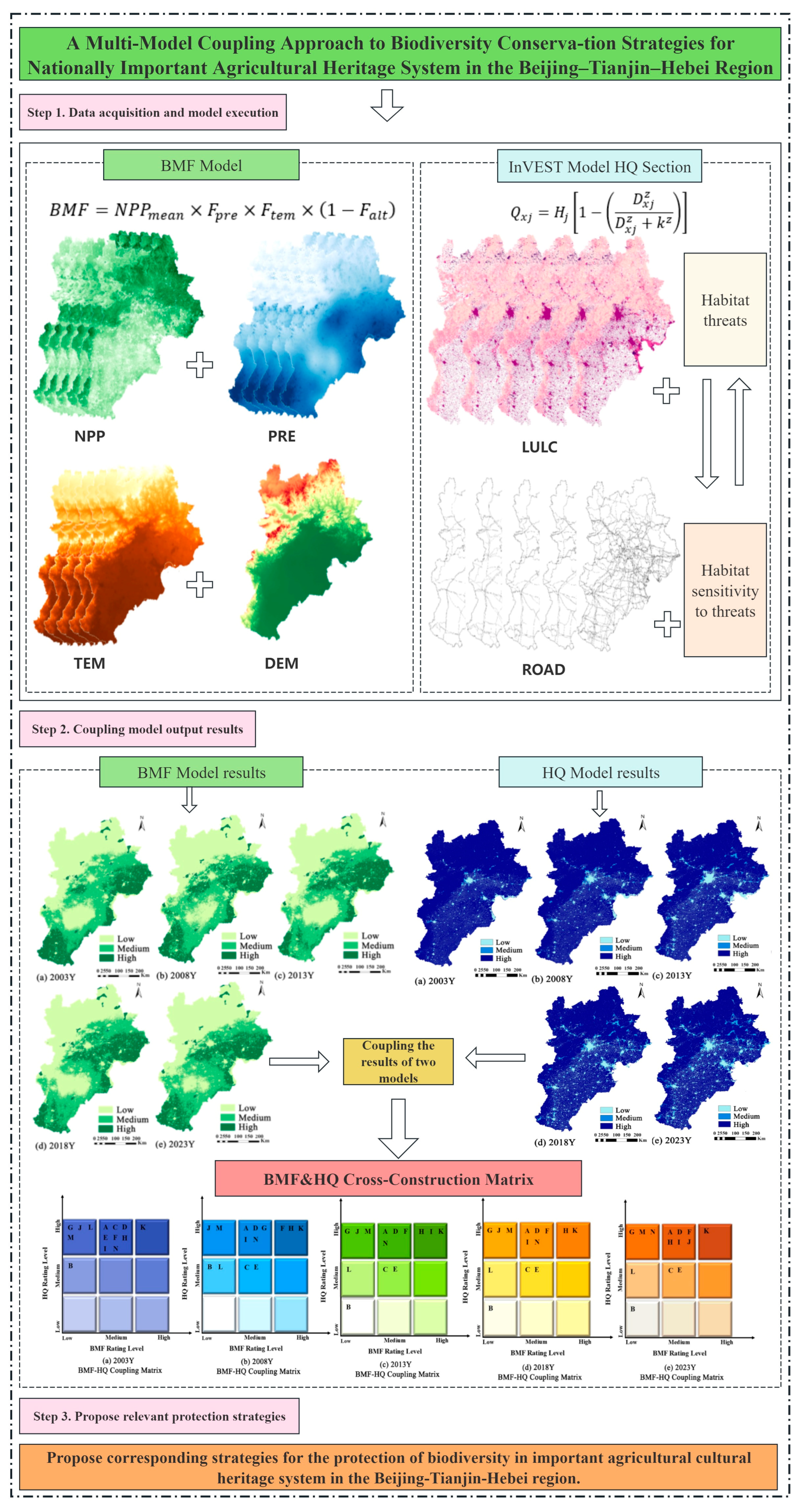
2.3.1. Biodiversity Maintenance Function (BMF) Index Model
2.3.2. InVEST Habitat Quality (HQ) Model
2.3.3. Coefficient of Variation (CV)
2.3.4. Chi-Square Test
3. Results
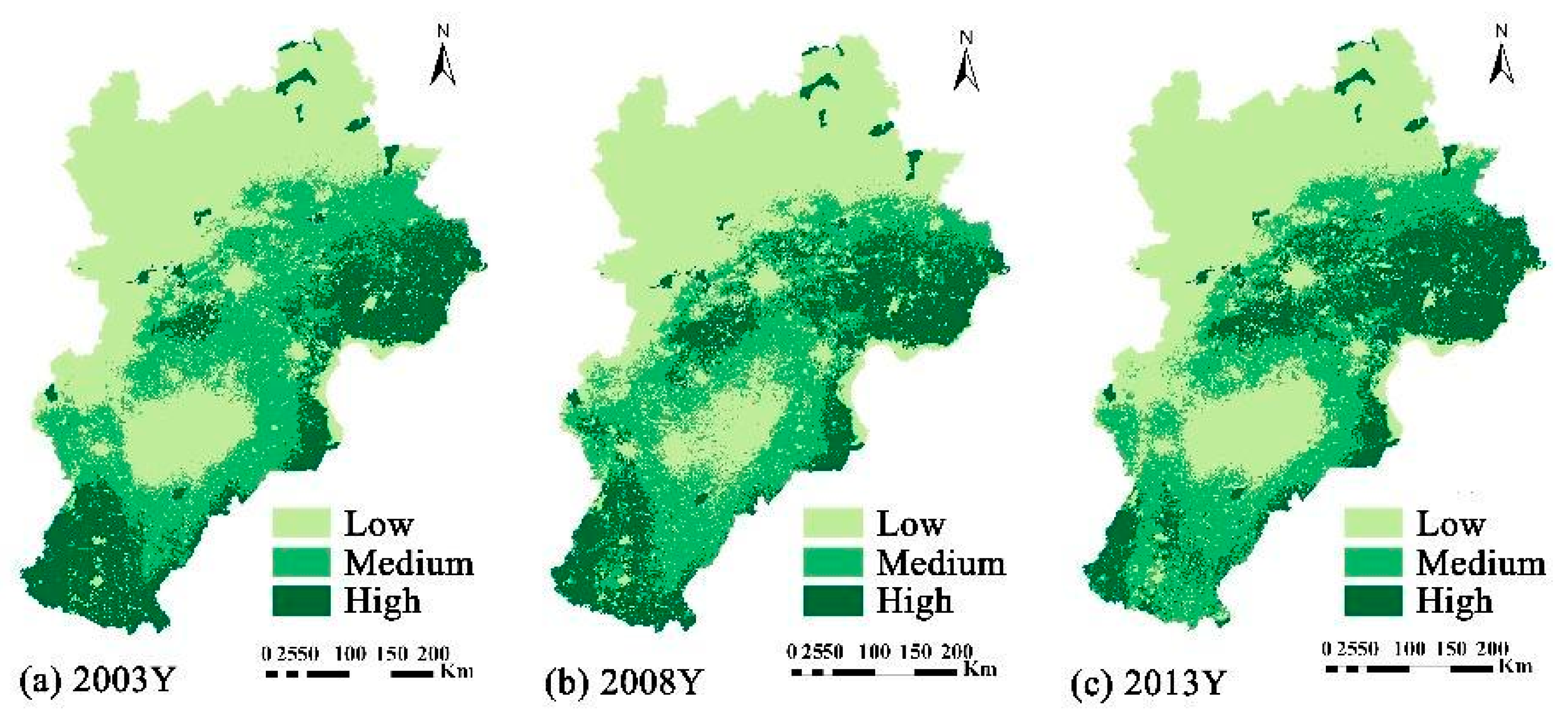
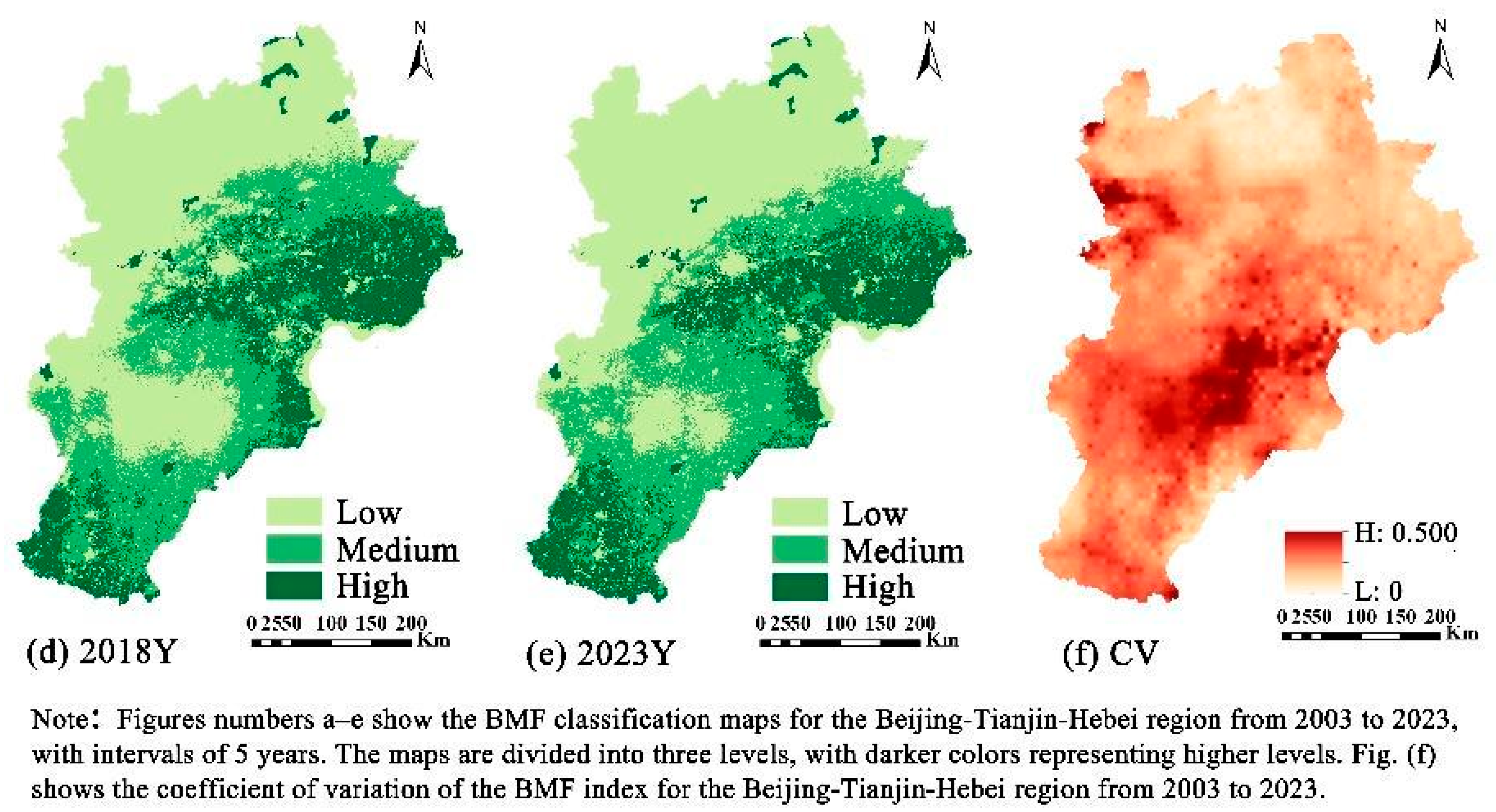
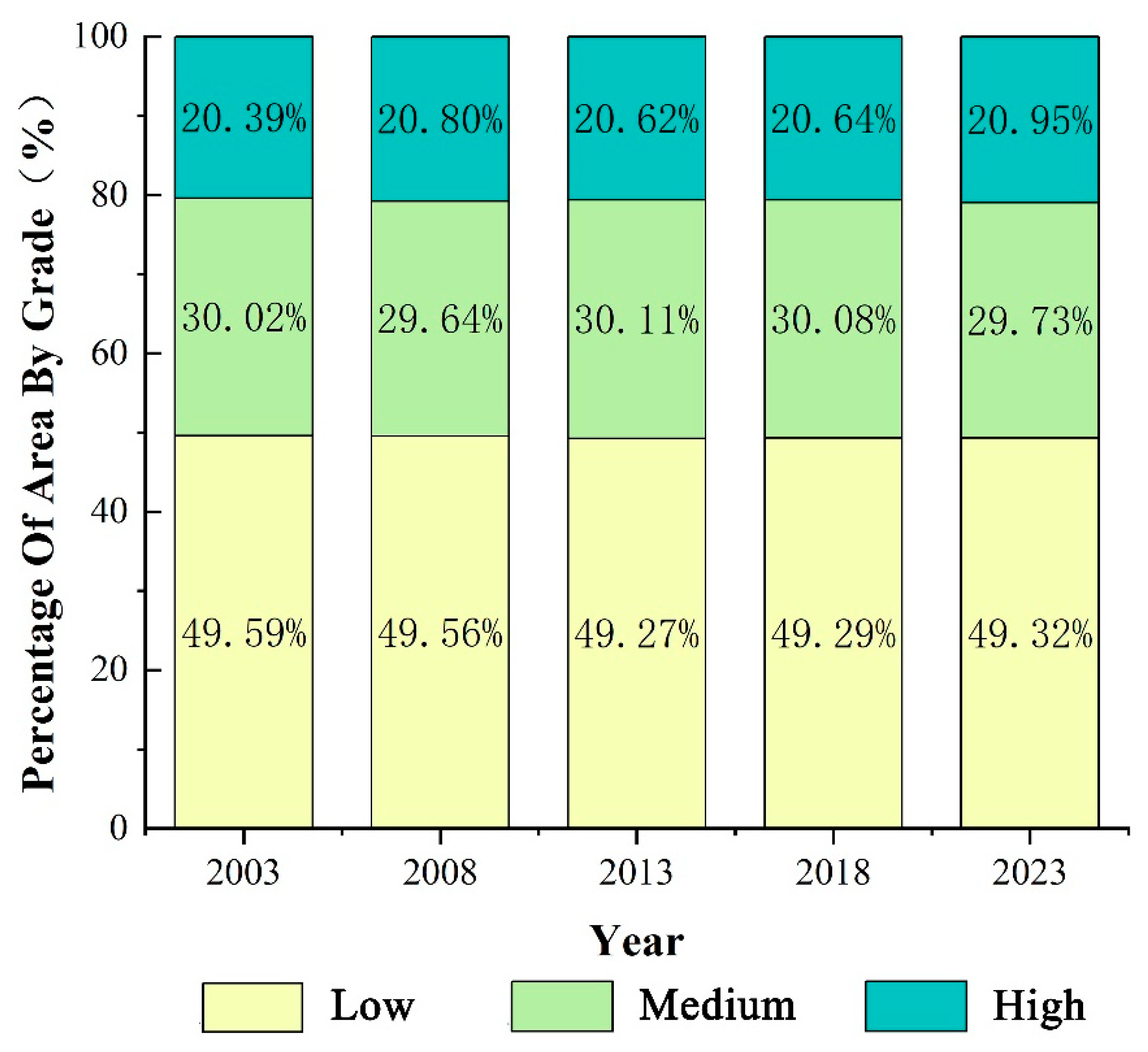
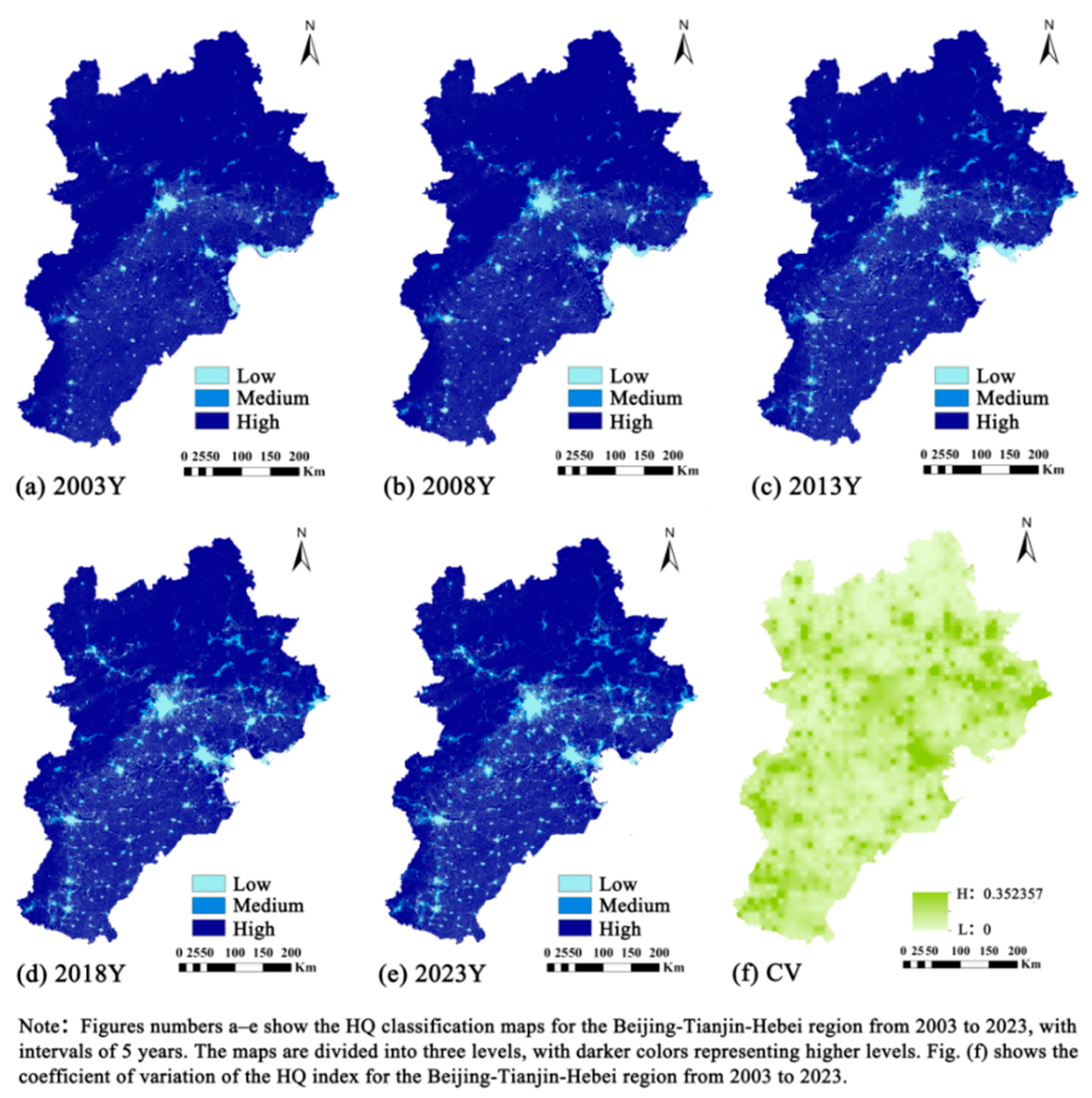
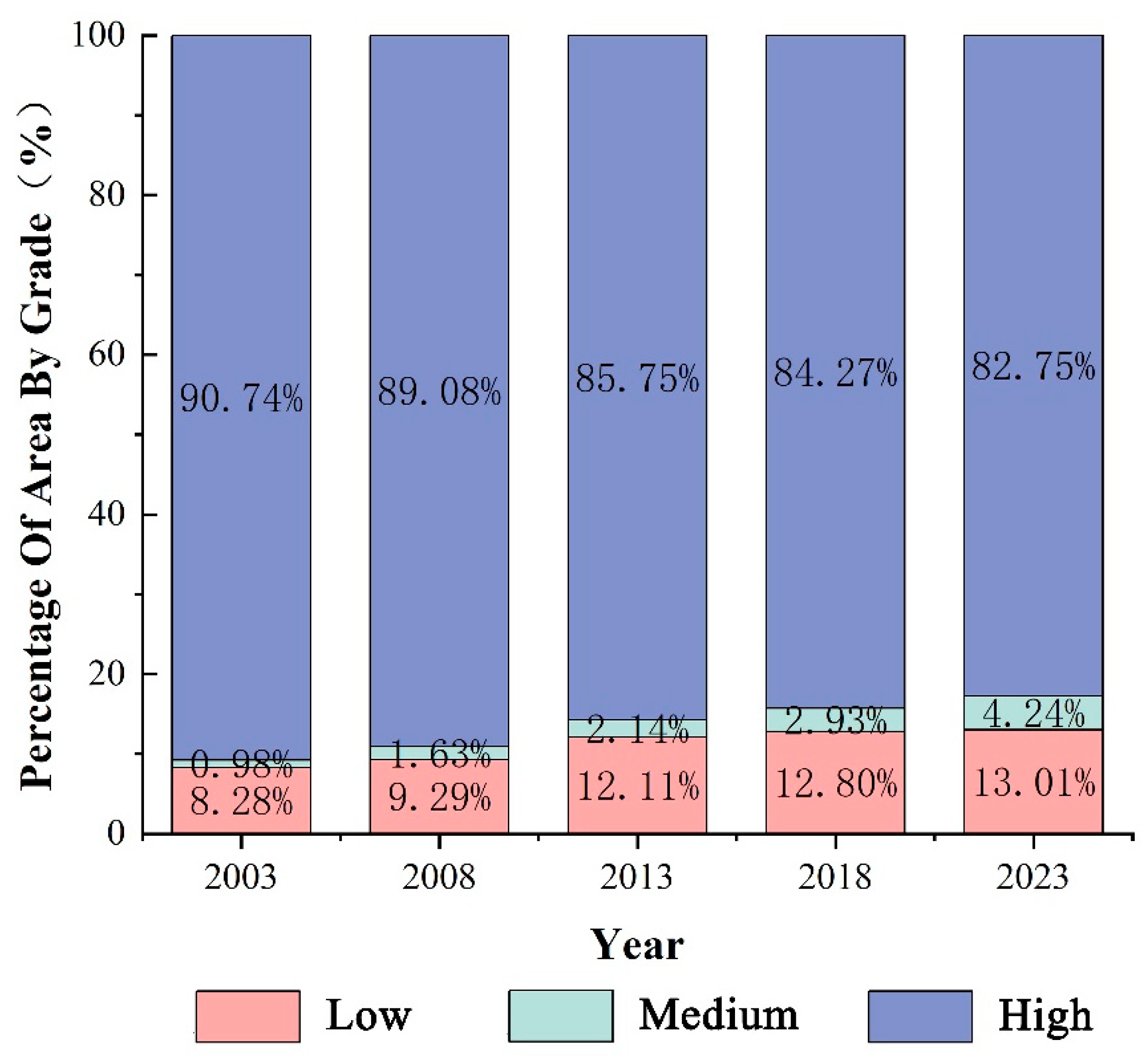
3.1. Spatial Distribution and Temporal Dynamics of Biodiversity Maintenance Function (BMF) and Habitat Quality (HQ) in the Beijing–Tianjin–Hebei (BTH) Region
3.2. Spatial and Temporal Dynamics of Biodiversity Maintenance Function (BMF) and Habitat Quality (HQ) in the 14 Heritage Systems of the Beijing–Tianjin–Hebei (BTH) Region
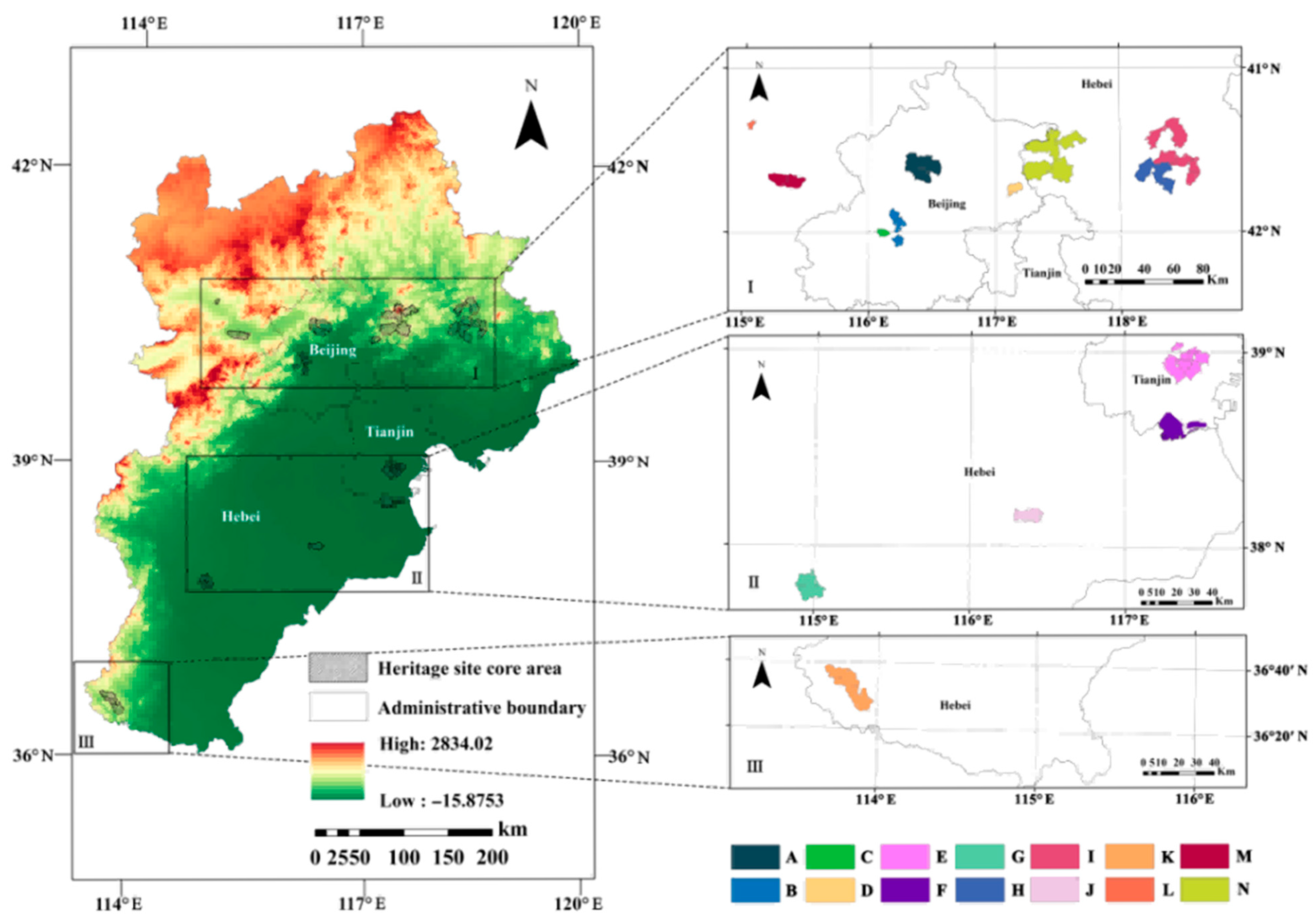
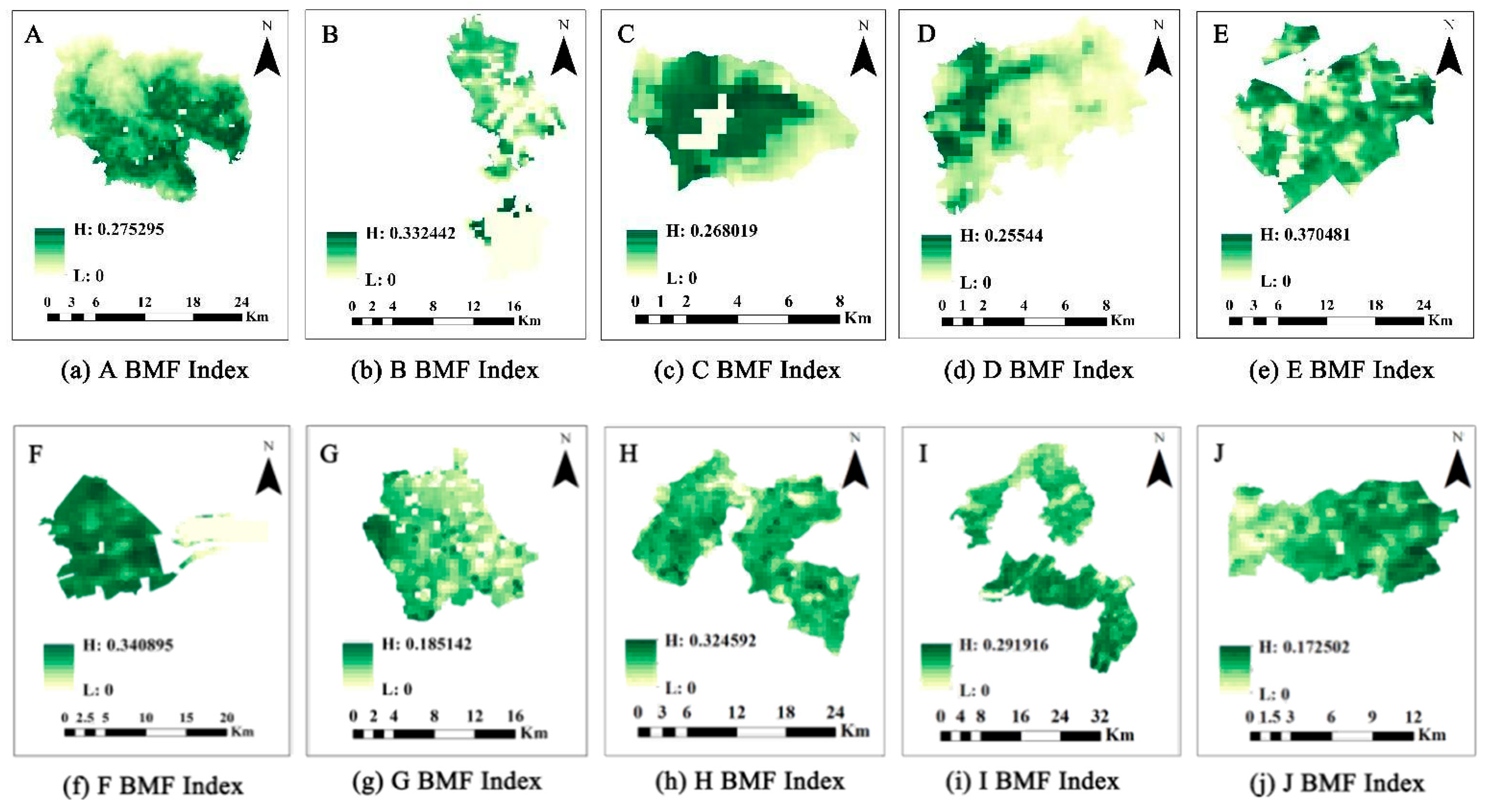
3.2.1. Spatial Distribution Characteristics of Agricultural Heritage Systems
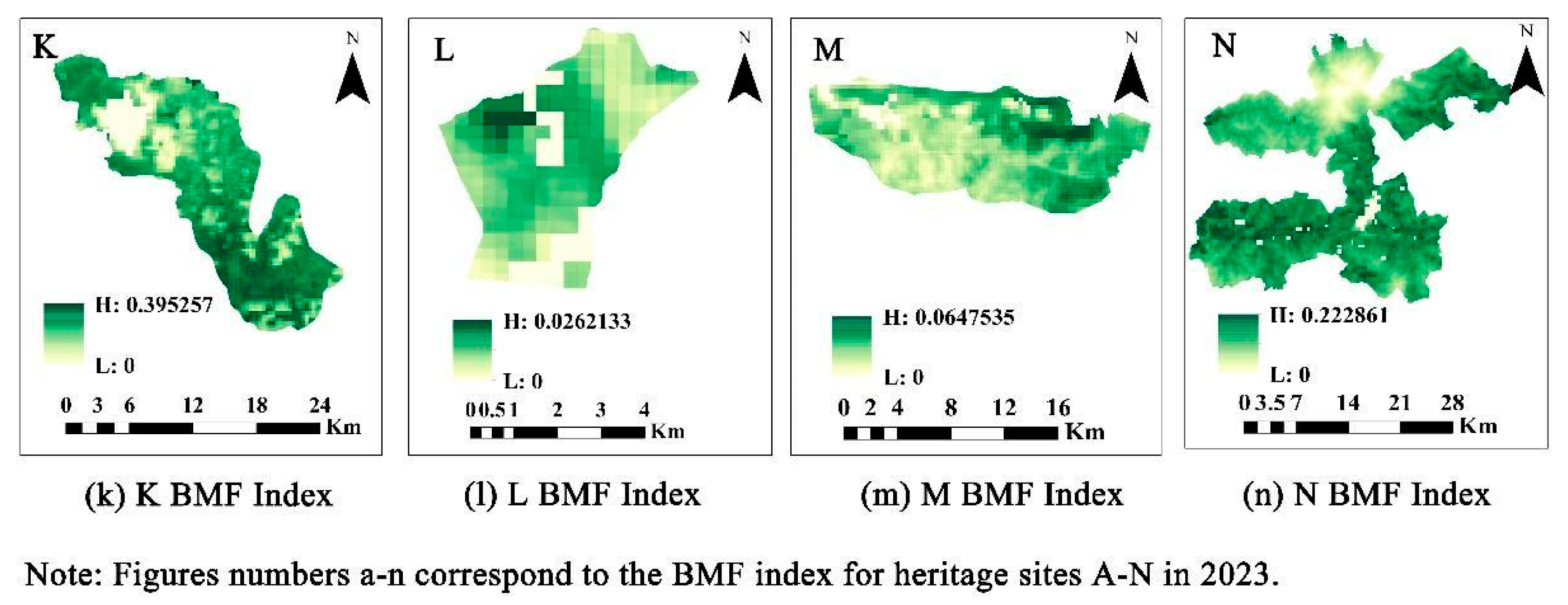
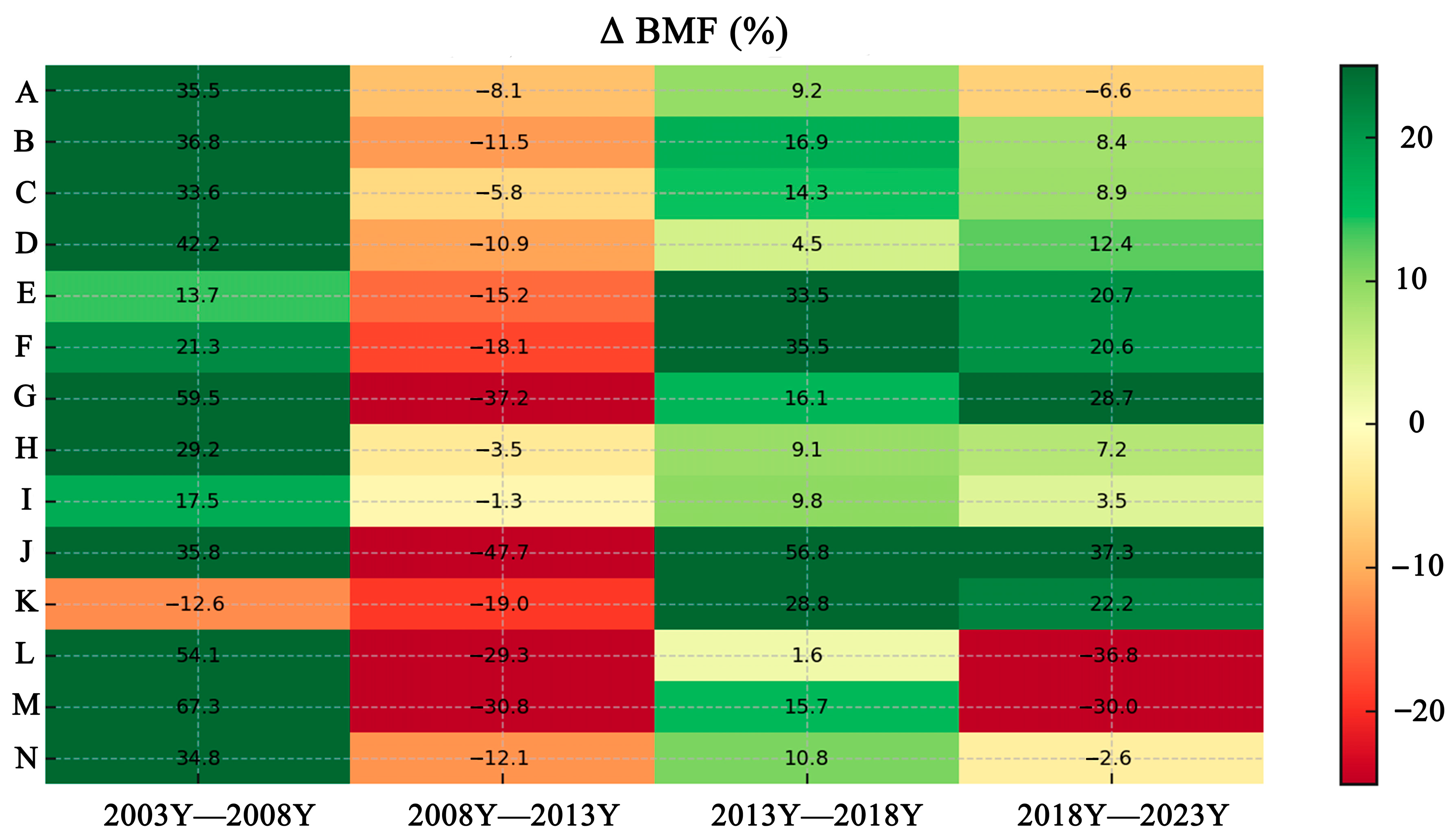
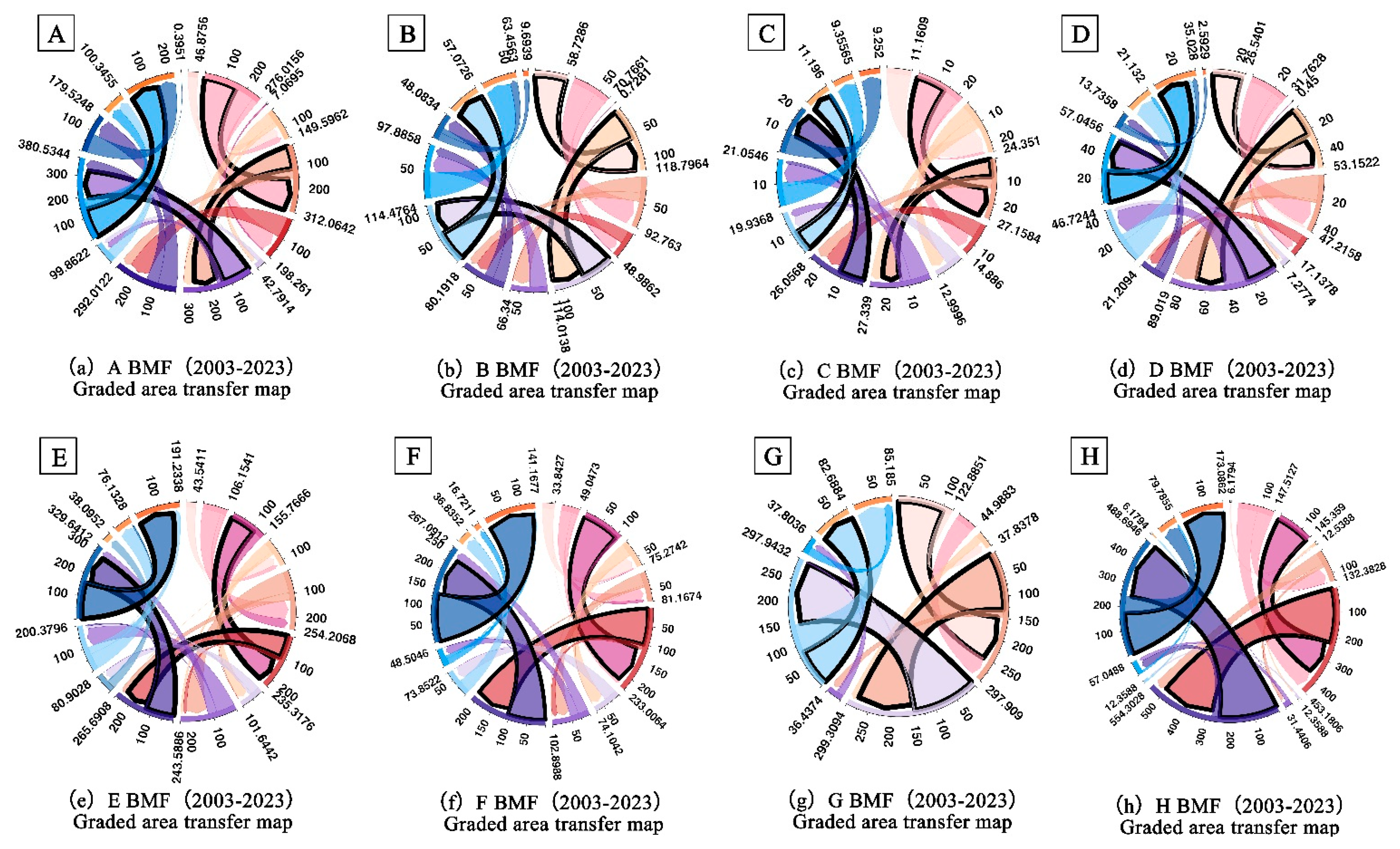
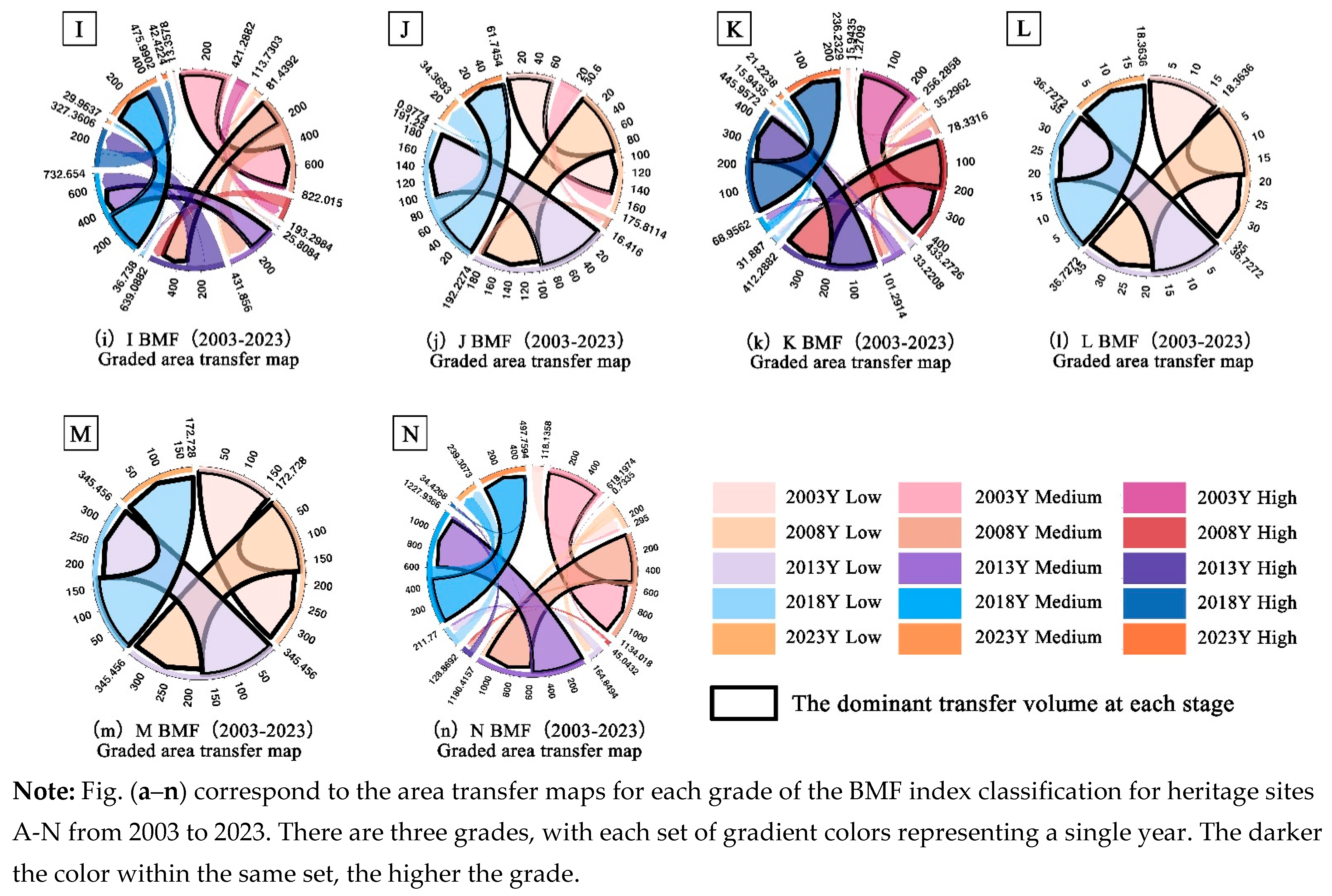
3.2.2. Temporal Changes in BMF of the 14 Agricultural Heritage Systems
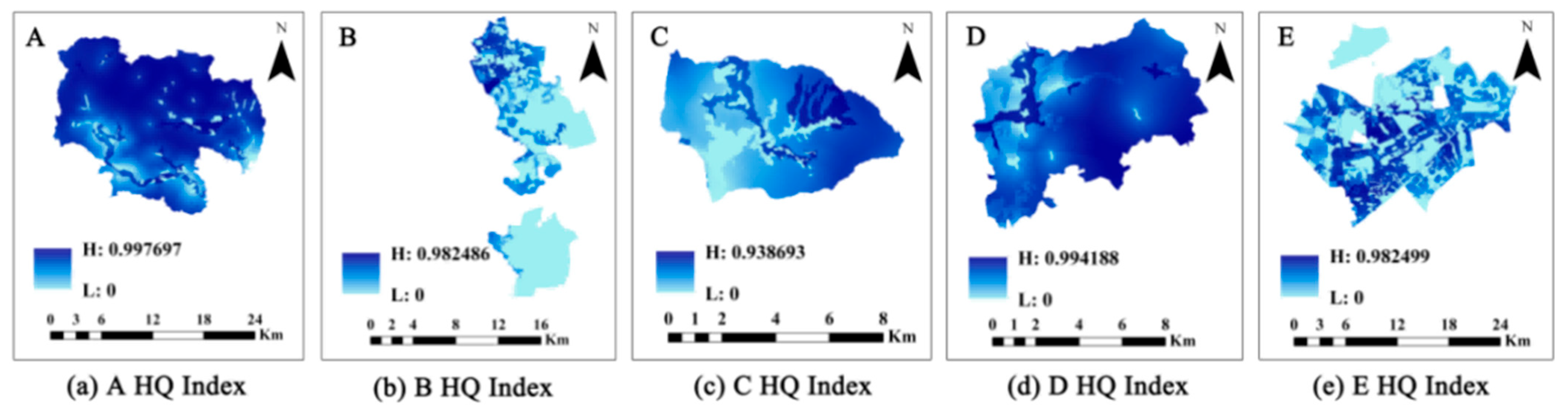
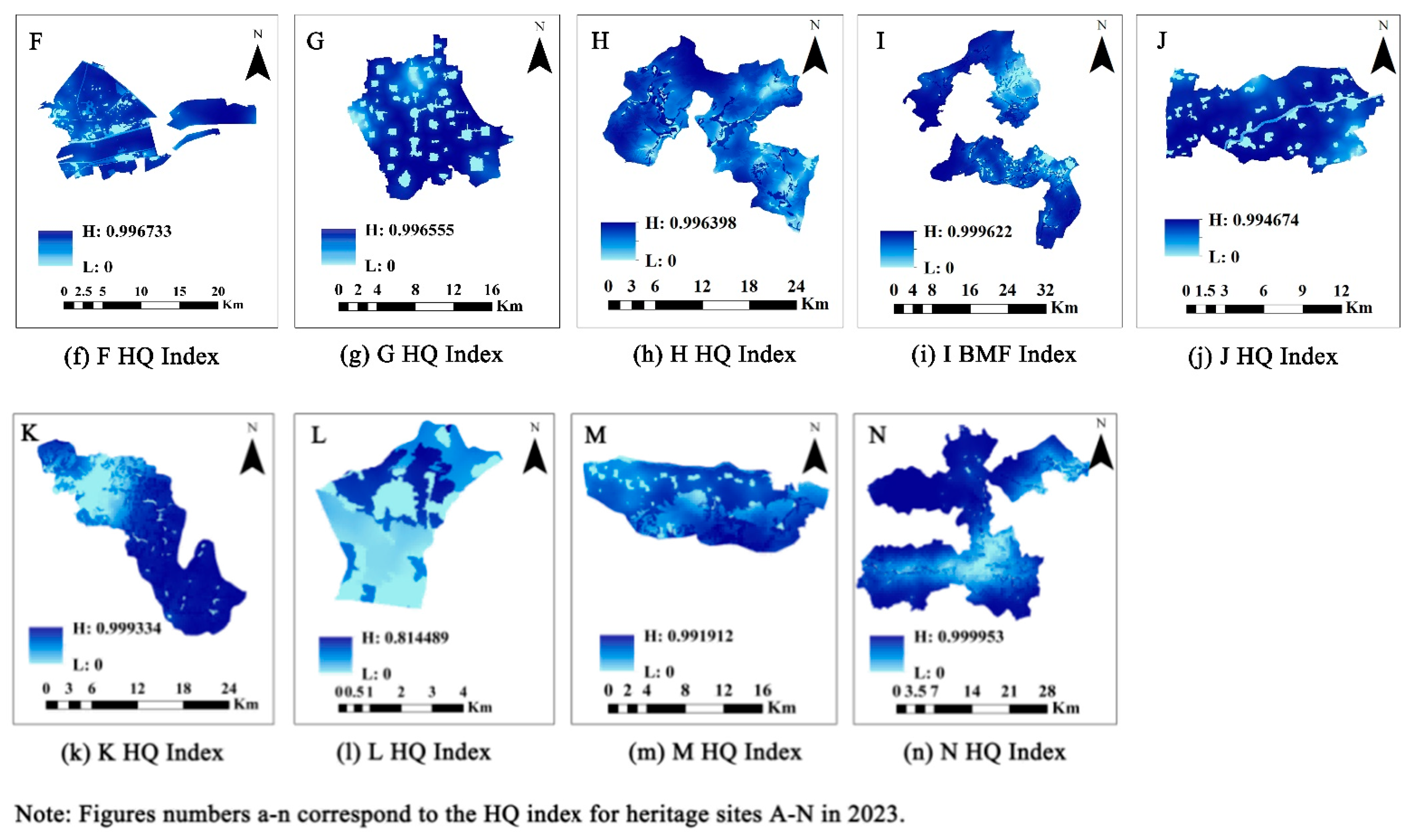
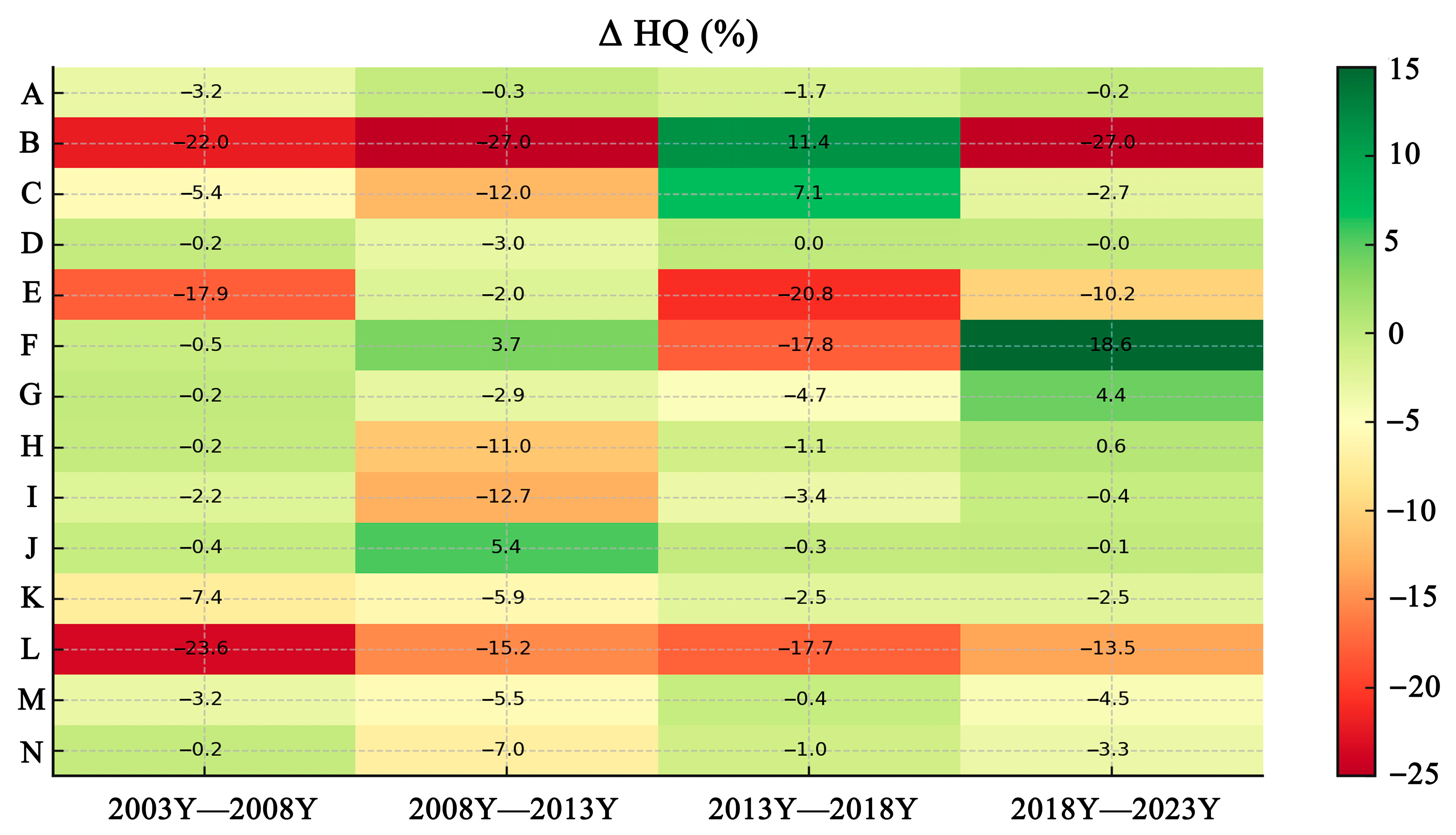
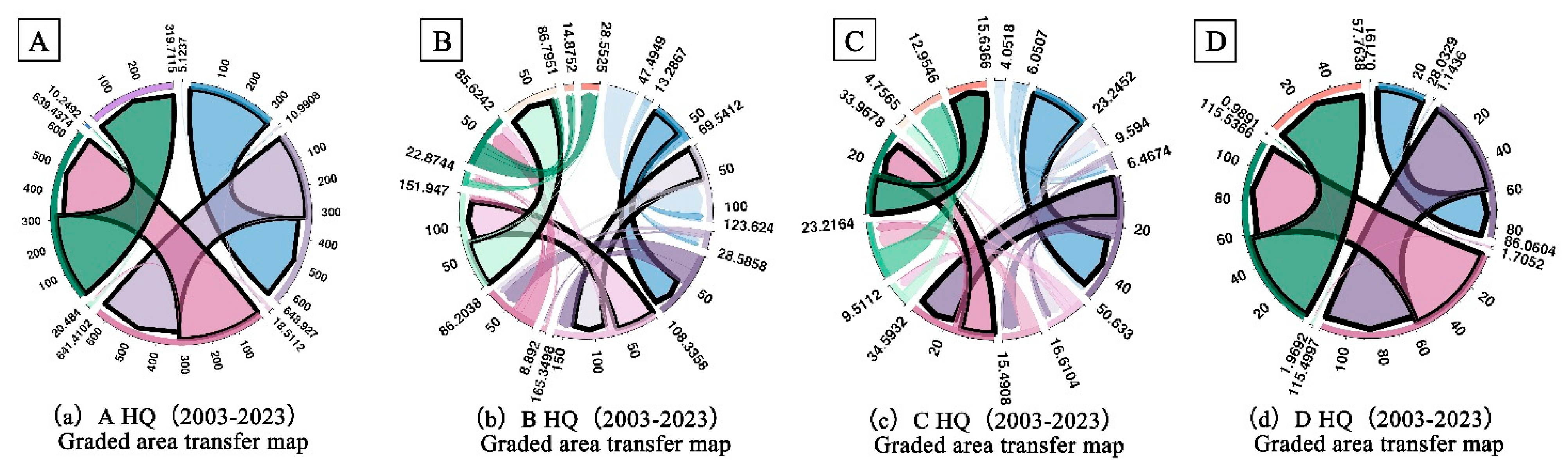
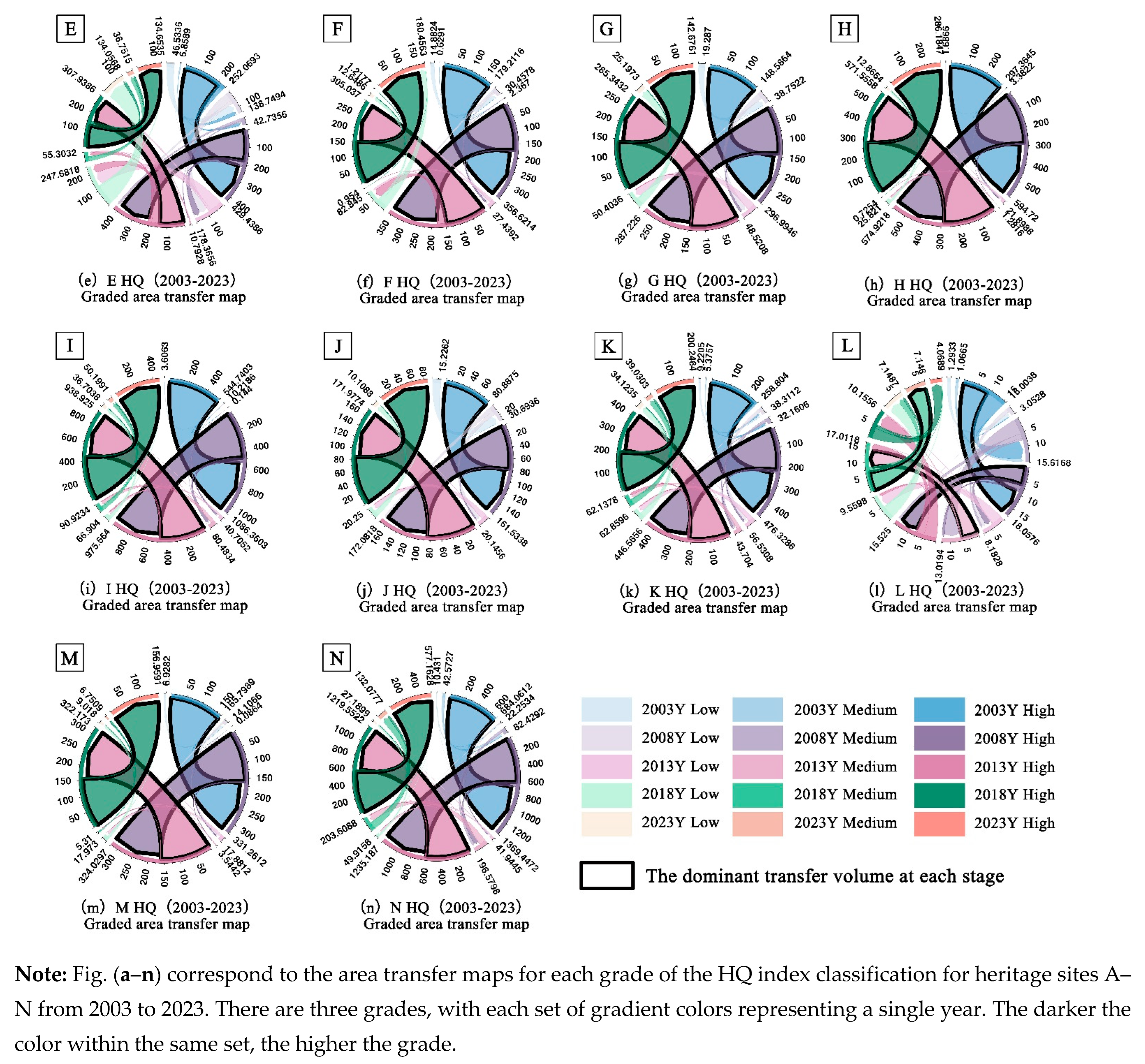
3.2.3. Temporal Changes in HQ of the 14 Agricultural Heritage Systems
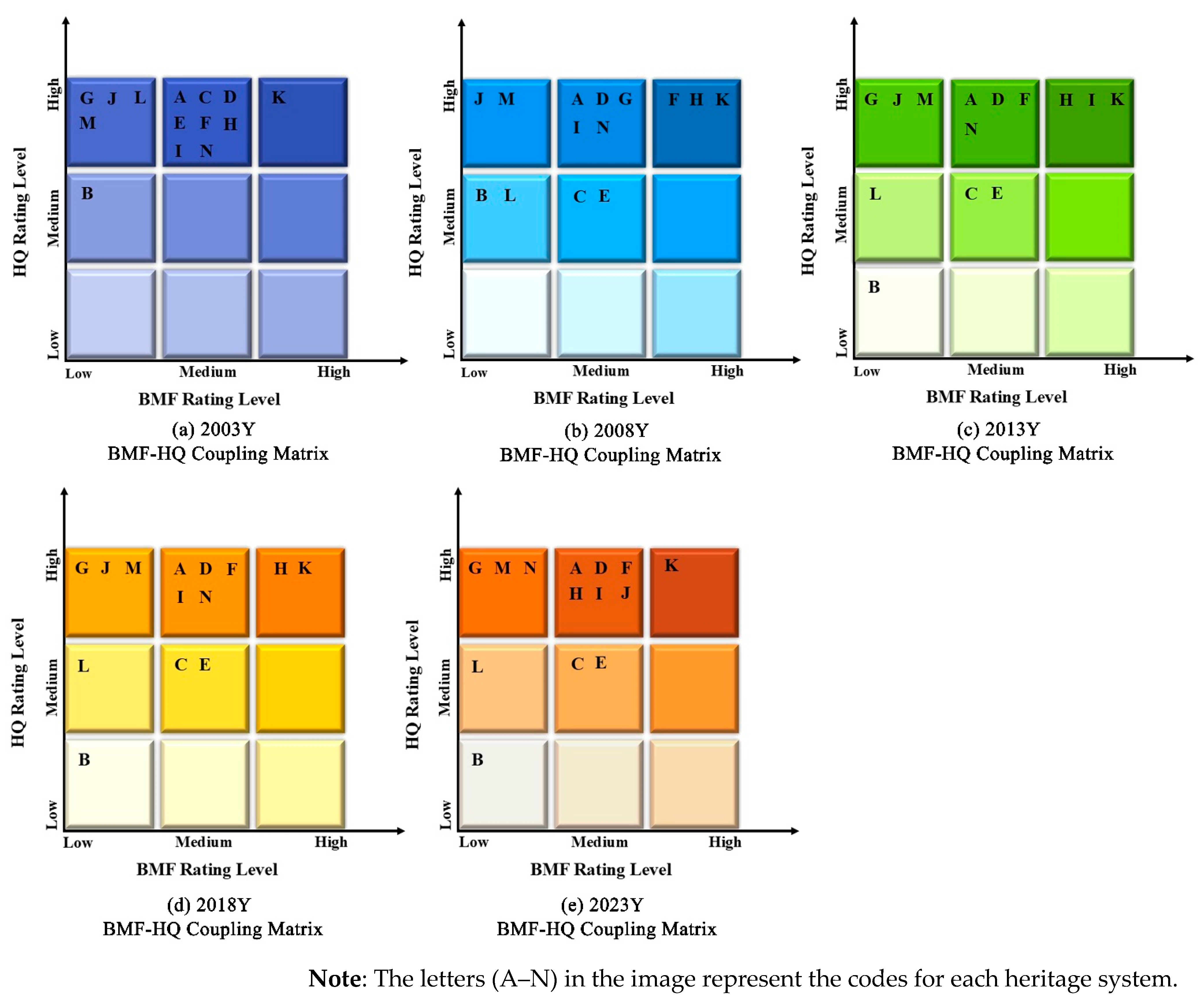
3.3. BMF–HQ Coupling Analysis of the 14 Agricultural Heritage Systems
4. Discussion
- Dual-high zones (high HQ–high BMF): The focus should be on keeping current ecological advantages. Long-term conservation and monitoring mechanisms are needed to protect against external disturbances.
- Dual-low zones (low HQ–low BMF): These systems are most affected by human activities. They should be placed in strict protection areas with tightly controlled development intensity. Ecological compensation and pilot restoration programs should be prioritized to prevent further loss of core agricultural and cultural values.
- Other zones: The main drivers of degradation must be clarified. If human disturbances dominate, measures should include land-use optimization and restrictions on development. If natural factors dominate, restoration should focus on creating microhabitats, recovering native vegetation, and revitalizing traditional agro-technical systems. These steps can strengthen ecological carrying capacity and biodiversity.
5. Conclusions
Author Contributions
Funding
Data Availability Statement
Conflicts of Interest
Abbreviations
| BMF | Biodiversity Maintenance Function models |
| HQ | InVEST Habitat Quality models |
| Hq | High-quality region |
| Mq | Medium -quality region |
| Lq | Low-quality region |
References
- Dai, L.; Li, S.; Lewis, B.J.; Wu, J.; Yu, D.; Zhou, W.; Zhou, L.; Wu, S. The influence of land use change on the spatial–temporal variability of habitat quality between 1990 and 2010 in Northeast China. J. For. Res. 2019, 30, 2227–2236. [Google Scholar] [CrossRef]
- Wu, Y.; Tao, Y.; Yang, G.; Ou, W.; Pueppke, S.; Sun, X.; Chen, G.; Tao, Q. Impact of land use change on multiple ecosystem services in the rapidly urbanizing Kunshan City of China: Past trajectories and future projections. Land Use Policy 2019, 85, 419–427. [Google Scholar] [CrossRef]
- Khosravi Mashizi, A.; Escobedo, F.J. Socio-ecological assessment of threats to semi-arid rangeland habitat in Iran using spatial models and actor group opinions. J. Arid Environ. 2020, 177, 104136. [Google Scholar] [CrossRef]
- Terrado, M.; Sabater, S.; Chaplin-Kramer, B.; Mandle, L.; Ziv, G.; Acuña, V. Model development for the assessment of terrestrial and aquatic habitat quality in conservation planning. Sci. Total Environ. 2016, 540, 63–70. [Google Scholar] [CrossRef] [PubMed]
- Chang, Y.; Sun, Y.; Yang, H.; Cheng, J.; Wang, B. Pathways for realizing the tourism value of ecological products in agricultural cultural heritage sites from the perspective of farmers: A case study of the Single-Clone Tea Cultural System in Chaozhou, Guangdong Province. Resour. Sci. 2023, 45, 428–440. [Google Scholar] [CrossRef]
- Ge, B.; Song, Y.; Wang, J.; Wang, Y.; Yuan, X. Spatio-temporal pattern and entropy variation of agricultural heritage in China. Herit. Sci. 2024, 12, 415. [Google Scholar] [CrossRef]
- Song, H.; Sheng, J.; Chen, P.; Chen, Y.; Wang, S. Exploring the value creation mechanism of agricultural heritage creative tourism based on SEM and fsQCA. Npj Herit. Sci. 2025, 13, 147. [Google Scholar] [CrossRef]
- Guo, X.; He, S.; Min, Q. Ideas and ways for agricultural sectors to implement the Convention on Biological Diversity: Insights from the management of Important Agricultural Heritage Systems. Biodivers. Sci. 2025, 33, 24527. [Google Scholar] [CrossRef]
- Yang, Y.; Zhu, Y. Agricultural cultural heritage in the Yellow River Basin: Reassessing value, classifying types, and identifying practical pathways. Chin. Agric. Hist. 2025, 44, 117–128. [Google Scholar]
- Xiao, Y. Agricultural cultural heritage protection as social intervention: The Zhejiang experience. J. China Agric. Univ. (Soc. Sci. Ed.) 2025, 42, 140–154. [Google Scholar] [CrossRef]
- Jiao, W.; Min, Q. Reviewing the progress in the identification, conservation and management of China-Nationally Important Agricultural Heritage Systems (China-NIAHS). Sustainability 2017, 9, 1698. [Google Scholar] [CrossRef]
- Agnoletti, M.; Santoro, A. Agricultural heritage systems and agrobiodiversity. Biodivers. Conserv. 2022, 31, 2231–2241. [Google Scholar] [CrossRef]
- Zhang, Y.; Li, X. Protecting traditional agricultural landscapes by promoting industrial integration development: Practices from Important Agricultural Heritage Systems (IAHS) sites in China. Land 2022, 11, 1286. [Google Scholar] [CrossRef]
- Kahane, R.; Hodgkin, T.; Jaenicke, H.; Hoogendoorn, C.; Hermann, M.; Keatinge, J.D.H.; Hughes, J.D.A.; Padulosi, S.; Looney, N. Agrobiodiversity for food security, health and income. Agron. Sustain. Dev. 2013, 33, 671–693. [Google Scholar] [CrossRef]
- Thrupp, L.A. Linking Biodiversity and Agriculture: Challenges and Opportunities for Sustainable Food Security; World Resources Institute: Washington, DC, USA, 1997. [Google Scholar]
- Liao, M.; Zhang, Z.; Yan, R.; Bai, K. Using the socio-ecological production landscapes and seascapes framework to assess the resilience of agroecosystems in three distinct agricultural production systems in China. Environ. Sustain. Indic. 2025, 27, 100814. [Google Scholar] [CrossRef]
- McKinney, M.L. Urbanization, biodiversity, and conservation: The impacts of urbanization on native species are poorly studied, but educating a highly urbanized human population about these impacts can greatly improve species conservation in all ecosystems. Bioscience 2002, 52, 883–890. [Google Scholar] [CrossRef]
- Forman, R.; Sperling, D.; Bissonette, J.; Clevenger, A. Road Ecology: Science and Solutions; University of Chicago Press: Chicago, IL, USA, 2003. [Google Scholar]
- Postek, P.; Leń, P.; Stręk, Ż. The proposed indicator of fragmentation of agricultural land. Ecol. Indic. 2019, 103, 581–588. [Google Scholar] [CrossRef]
- Aneseyee, A.B.; Noszczyk, T.; Soromessa, T.; Elias, E. The InVEST habitat quality model associated with land use/cover changes: A qualitative case study of the Winike Watershed in the Omo-Gibe Basin, Southwest Ethiopia. Remote Sens. 2020, 12, 1103. [Google Scholar] [CrossRef]
- Costanza, R.; Fisher, B.; Mulder, K.; Liu, S.; Christopher, T. Biodiversity and ecosystem services: A multi-scale empirical study of the relationship between species richness and net primary production. Ecol. Econ. 2007, 61, 478–491. [Google Scholar] [CrossRef]
- Siche, R.; Ortega, E. Emergy and value of the net primary production (NPP) above ground in natural areas. Ecol. Quest. 2008, 10, 99–101. [Google Scholar] [CrossRef][Green Version]
- Fu, Y.; Lu, X.; Zhao, Y.; Zeng, X.; Xia, L. Assessment impacts of weather and land use/land cover (LULC) change on urban vegetation net primary productivity (NPP): A case study in Guangzhou, China. Remote Sens. 2013, 5, 4125–4144. [Google Scholar] [CrossRef]
- Aznarez, C.; Svenning, J.; Taveira, G.; Baró, F.; Pascual, U. Wildness and habitat quality drive spatial patterns of urban biodiversity. Landsc. Urban Plan. 2022, 228, 104570. [Google Scholar] [CrossRef]
- Di Pirro, E.; Sallustio, L.; Capotorti, G.; Marchetti, M.; Lasserre, B. A scenario-based approach to tackle trade-offs between biodiversity conservation and land use pressure in Central Italy. Ecol. Model. 2021, 448, 109533. [Google Scholar] [CrossRef]
- Zheng, S.; Qiao, Z.; Liu, X. Dynamic simulation of land use change and habitat quality in the Three Rivers Source Region based on the PLUS-InVEST model. Arid Zone Res. 2025, 42, 1080–1092. [Google Scholar] [CrossRef]
- Liao, M.; Zhang, Z.; Bai, K.; Bao, B. Situation and prospects of biodiversity of agricultural ecosystem conservation and utilization in China. Biodivers. Sci. 2023, 31, 23017. [Google Scholar] [CrossRef]
- Ai, J.; Song, Y.; Yang, Y. Evaluation and analysis of the ecological environment in the Beijing–Tianjin–Hebei region based on multi-source data. J. Tianjin Norm. Univ. Nat. Sci. Ed. 2025, 45, 58–67. [Google Scholar] [CrossRef]
- Min, Q. Research priorities, problems and countermeasures of Important Agricultural Heritage Systems and their conservation. Chin. J. Eco-Agric. 2020, 28, 1285–1293. [Google Scholar] [CrossRef]
- Jiao, W.; Cui, W.; Min, Q.; Zhang, Y. A Review of Research on Agricultural Heritage Systems and Their Conservation. Resour. Sci. 2021, 43, 823–837. Available online: https://www.resci.cn/EN/10.18402/resci.2021.04.16. (accessed on 22 August 2025).
- Zhang, Y.; Su, T.; Ma, Y.; Wang, Y.; Wang, W.; Zha, N.; Shao, M. Forest ecosystem service functions and their associations with landscape patterns in Renqiu City. PLoS ONE 2022, 17, e0265015. [Google Scholar] [CrossRef]
- Ministry of Environmental Protection. National Development and Reform Commission of China. Technical Guide for Delimiting the Ecological Conservation Redline; National Development and Reform Commission: Beijing, China, 2017. (In Chinese)
- Sharp, R.; Chaplin-Kramer, R.; Wood, S.; Guerry, A.; Tallis, H.; Ricketts, T. InVEST 3.14.2 User’s Guide: Integrated Valuation of Ecosystem Services and Tradeoffs; The Natural Capital Project; Stanford University: Stanford, CA, USA; University of Minnesota: Minneapolis, MN, USA; Saint Paul, MN, USA; The Nature Conservancy: Arlington, VA, USA; World Wildlife Fund: Washington, DC, USA, 2023. [Google Scholar]
- Wu, J.; Cao, Q.; Shi, S.; Huang, X.; Lu, Z. Spatiotemporal evolution of habitat quality in the Beijing–Tianjin–Hebei region based on land use change. Chin. J. Appl. Ecol. 2015, 26, 3457–3466. [Google Scholar] [CrossRef]
- Yan, Y.; Yang, Y.; Wang, Y.; Yan, J. Spatiotemporal trends and attribution analysis of habitat quality change over the past 40 years in the Beijing–Tianjin–Hebei region. Remote Sens. Technol. Appl. 2023, 38, 251–263. Available online: https://www.geores.com.cn/ygjsyyy/EN/10.11873/j.issn.1004-0323.2023.2.0251 (accessed on 22 August 2025).
- Zhang, X.; Zhou, J.; Li, M. Spatiotemporal variation of regional habitat quality based on reconstruction of land use patterns. Acta Geogr. Sin. 2020, 75, 160–178. [Google Scholar] [CrossRef]
- Chen, Y.; Qiao, F.; Jiang, L. Impact of land use pattern change on habitat quality at regional scale based on InVEST model: A case study of Beijing. Acta Sci. Nat. Univ. Pekin. 2016, 52, 553–562. [Google Scholar] [CrossRef]
- Chang, Y.; Gao, Y.; Xie, Z.; Zhang, T.; Yu, X. Habitat quality and landscape pattern evolution in the Beijing–Tianjin–Hebei region and their correlation. China Environ. Sci. 2021, 41, 848–859. [Google Scholar] [CrossRef]
- Feng, S.; Sun, R.; Chen, L. Spatiotemporal evolution of habitat quality in Beijing based on land use pattern changes. Acta Ecol. Sin. 2018, 38, 4167–4179. [Google Scholar] [CrossRef]
- Gao, Z.; Wang, X.; Sui, X.; Wang, X.; Fan, Y.; Zhu, Q.; Lü, L. Multi-scenario prediction of habitat quality in Nanjing based on FLUS and InVEST models. J. Agric. Resour. Environ. 2022, 39, 1001–1013. [Google Scholar] [CrossRef]
- Gallardo, A. Spatial variability of soil properties in a floodplain forest in Northwest Spain. Ecosystems 2003, 6, 564–576. [Google Scholar] [CrossRef]
- Alharbi, S.; Raun, W.R.; Arnall, D.B.; Zhang, H. Prediction of maize (Zea mays L.) population using normalized-difference vegetative index (NDVI) and coefficient of variation (CV). J. Plant Nutr. 2019, 42, 673–679. [Google Scholar] [CrossRef]
- Zhang, Y.; Yang, J.; Wu, W.; Tang, D. Integrating multi-model coupling to assess habitat quality dynamics: Spatiotemporal evolution and scenario-based projections in the Yangtze River Basin, China. Sustainability 2025, 17, 4699. [Google Scholar] [CrossRef]
- Cheng, C.; Zhang, S.; Zhou, M.; Du, Y.; Ge, C.; Wang, J. Identifying important ecosystem service areas based on distributions of ecosystem services in the Beijing–Tianjin–Hebei region, China. Peerj 2022, 10, e13881. [Google Scholar] [CrossRef]
- Tan, M.; Li, X.; Xie, H.; Lu, C. Urban land expansion and arable land loss in China—A case study of Beijing–Tianjin–Hebei region. Land Use Policy 2005, 22, 187–196. [Google Scholar] [CrossRef]
- Zhang, Z.; Li, N.; Wang, X.; Liu, F.; Yang, L. A Comparative Study of Urban Expansion in Beijing, Tianjin and Tangshan from the 1970s to 2013. Remote Sens. 2016, 8, 496. [Google Scholar] [CrossRef]
- Li, Z.; Su, M.; Wang, X.; Li, X.; Chang, X.; Zhang, P. Spatial–Temporal Evolution and Prediction of Habitat Quality in Beijing–Tianjin–Hebei Region Based on Land Use Change. Land 2023, 12, 667. [Google Scholar] [CrossRef]
- Deng, Y.; Jiang, W.; Wang, W.; Lü, J.; Chen, K. Urban expansion leads to habitat quality degradation in the Beijing–Tianjin–Hebei region. Acta Ecol. Sin. 2018, 38, 4516–4525. [Google Scholar] [CrossRef]
- Li, C.; Tong, T.; Huang, X. Sustainable farming genes: Spatial distribution and influencing factors of Chinese Agricultural Heritage Sites (CAHSs). Front. Sustain. Food Syst. 2023, 7, 1141986. [Google Scholar] [CrossRef]
- Gan, H.; Feng, J.; Zhao, Z.; Ma, L.; Di, S.; Wen, Y. Identifying the response of ecological well-being to ecosystem services of urban green space using the coupling coordination degree model: A case study of Beijing, China, 2015–2023. Forests 2024, 15, 1494. [Google Scholar] [CrossRef]
- Beijing Municipal Commission of Development and Reform. Report on the Implementation of the 2013 National Economic and Social Development Plan of Beijing Municipality and the Draft of the 2014 National Economic and Social Development Plan—Plan Report. Available online: https://fgw.beijing.gov.cn/fgwzwgk/ghjh/gzjh/jhbg/202111/t20211129_2547420.htm (accessed on 22 August 2025).
- Beijing Municipal Bureau of Landscape and Forestry (Capital Green Space Committee Office). 2013 Beijing Urban Green Space Resources—Statistical Information. Available online: https://yllhj.beijing.gov.cn/zwgk/tjxx/201510/t20151012_531222.html (accessed on 22 August 2025).
- Volpato, A.; Buckley, C.; Moran, J. Assessing and mapping habitat quantity and quality in High Nature Value (HNV) agri-cultural landscapes. J. Nat. Conserv. 2024, 78, 126568. [Google Scholar] [CrossRef]
- Brancalion, P.H.S.; Melo, F.P.L.; Tabarelli, M.; Rodrigues, R.R. Biodiversity Persistence in Highly Human-Modified Tropical Landscapes Depends on Ecological Restoration. Trop. Conserv. Sci. 2013, 6, 705–710. [Google Scholar] [CrossRef]
- Assandri, G.; Bogliani, G.; Pedrini, P.; Brambilla, M. Beautiful agricultural landscapes promote cultural ecosystem services and biodiversity conservation. Agric. Ecosyst. Environ. 2018, 256, 200–210. [Google Scholar] [CrossRef]
- Jiang, Y.; Timpe, A.; Lohrberg, F. Identifying Urban Agriculture as Heritage: Traditional Urban Grape Gardens in the Ancient City of Xuanhua, China. J. Urban Hist. 2022, 49, 1199–1218. [Google Scholar] [CrossRef]
- Zhang, H.; Gao, Y.; Yi, C.; Que, W. Protection path of agricultural cultural heritage from the perspective of world heritage: A case study of Jingxi Rice. Chin. Landsc. Archit. 2021, 37, 81–86. [Google Scholar] [CrossRef]
- Zhao, F.; Zhu, C.; Zhang, J.E.; Luo, S.; Feng, Y.; Xiang, H.; Jiang, Y.; Lu, X.; Tian, Y. Is Land Expropriation to Keep Agricultural Use an Effective Strategy for the Conservation of an Urban Agricultural Heritage System? Evidence from China. Land 2023, 12, 363. [Google Scholar] [CrossRef]
- Su, M.; Dong, Y.; Wall, G.; Sun, Y. A value-based analysis of the tourism use of agricultural heritage systems: Duotian Agro-system, Jiangsu Province, China. J. Sustain. Tour. 2020, 28, 2136–2155. [Google Scholar] [CrossRef]



| Codename | Name of Heritage System | Main Areas | Area (km2) |
|---|---|---|---|
| A | Beijing Huairou Chestnut Cultivation System | Jiudu River Town, Bohai Town | 329.98 |
| B | Beijing Jingxi Rice Cultivation Culture System | Shangzhuang Town, Xibeiwang Town, Sijiqing Town | 130.232 |
| C | Beijing Mentougou Jingbai Pear Cultivation System | Junzhuang Town | 33.346 |
| D | Beijing Pinggu Sizhu Lou Walnut Production System | Xiong’erzhai Township | 58.744 |
| E | Tianjin Jinnan Xiaozhan Rice Cultivation System | Xiaozhan Town, Beizhakou Town, Bailitai Town, Gegu Town, Xinzhuang Town, Shuangqiaohe Town, Xianshuigu Town | 305.484 |
| F | Tianjin Binhai Cui Zhuang Ancient Winter Jujube Garden | Taiping Town | 194.712 |
| G | Ancient Pear Garden in Zhao County, Hebei Province | Xie Zhuang Township, Fan Zhuang Town | 167.892 |
| H | Hebei Qianxi Chestnut Composystem Cultivation System | Han’erzhuang Town, Luanyang Town, Yuhu Zhai Township | 299.052 |
| I | Traditional Chestnut Cultivation System in Kuangcheng, Hebei Province | Nanziyu Town, Songling Town, Huajian Town, Boluotai Town, Kuancheng Town, Tashan Township | 548.376 |
| J | Ancient Mulberry Forest in Botou, Hebei Province | Yingzi Town | 96.108 |
| K | Shixian County Dry Farming Terraced Field System, Hebei Province | Jingdian Town, Gengle Town, Guanfang Township | 273.386 |
| L | Xuanhua City Traditional Vineyard | Chunguang Township | 18.35 |
| M | Hebei Zhuolu Longyan Grape Cultivation System | Wenquan Town, Wubao Town | 172.713 |
| N | Traditional Hawthorn Cultivation System in Xinglong, Hebei Province | Liudaohe Town, Xinglong Town, Beiyingfang Town, Wuling Mountain Town | 737.122 |
| Threat | Max_Dist | Weight | Decay |
|---|---|---|---|
| Urban construction Land | 10 | 1 | exponential |
| Rural Residents’ Construction Land | 6 | 0.7 | exponential |
| Other Construction Land | 8 | 0.8 | exponential |
| Railway | 6 | 0.5 | linear |
| National Highway | 4 | 0.6 | linear |
| LULC Code | LULC Type | Habitat Suitability | Relative Sensitivity to Threat Sources | ||||
|---|---|---|---|---|---|---|---|
| Urban Construction Land | Rural Residents’ Construction Land | Other Construction Land | Railway | National Highway | |||
| 1 | Cultivated Land | 1 | 0.8 | 0.5 | 0.7 | 0.5 | 0.4 |
| 2 | Forest | 1 | 1 | 0.7 | 1 | 0.7 | 0.7 |
| 3 | Grassland | 1 | 1 | 0.7 | 1 | 0.8 | 0.7 |
| 4 | Water | 1 | 0.8 | 0.7 | 0.8 | 0.5 | 0.5 |
| 5 | Urban construction Land | 0 | 0 | 0 | 0 | 0 | 0 |
| 6 | Rural Residents’ Construction Land | 0 | 0 | 0 | 0 | 0 | 0 |
| 7 | Other Construction Land | 0 | 0 | 0 | 0 | 0 | 0 |
| 8 | Unused Land | 1 | 0.3 | 0.2 | 0.3 | 0.2 | 0.1 |
| 9 | Ocean | 1 | 0.2 | 0.1 | 0.1 | 0.1 | 0.1 |
| Proportion of Each Terrain Type | The Heritage System Is Located at Different Altitudes | Total Area of Heritage System (km2) | Expected Value (km2) | Actual Value (km2) | |
|---|---|---|---|---|---|
| low altitude area | 48.4% | 29.9% | 162,887 | 100,505 | |
| Medium-altitude area | 9.9% | 27.1% | 336,543 | 33,318 | 91,233 |
| High altitude area | 41.7% | 43.0% | 140,339 | 144,806 |
| Year | 2003 | 2008 | 2013 | 2018 | 2023 | ||||||
|---|---|---|---|---|---|---|---|---|---|---|---|
| Code | Average | CV | Average | CV | Average | CV | Average | CV | Average | CV | |
| A | 0.1228 | 0.2340 | 0.1664 | 0.2638 | 0.1530 | 0.2494 | 0.1670 | 0.2816 | 0.1559 | 0.2773 | |
| B | 0.0759 | 0.8956 | 0.1038 | 0.8966 | 0.0919 | 0.8991 | 0.1074 | 0.9002 | 0.1164 | 0.9028 | |
| C | 0.1077 | 0.3918 | 0.1439 | 0.4213 | 0.1355 | 0.3798 | 0.1549 | 0.4304 | 0.1687 | 0.4315 | |
| D | 0.1043 | 0.2406 | 0.1483 | 0.2548 | 0.1321 | 0.2627 | 0.1381 | 0.2974 | 0.1552 | 0.2554 | |
| E | 0.1432 | 0.4092 | 0.1628 | 0.4110 | 0.1381 | 0.4168 | 0.1843 | 0.4107 | 0.2225 | 0.4065 | |
| F | 0.1410 | 0.4636 | 0.1710 | 0.4677 | 0.1400 | 0.4770 | 0.1897 | 0.4775 | 0.2287 | 0.4757 | |
| G | 0.0830 | 0.3125 | 0.1324 | 0.3095 | 0.0831 | 0.3162 | 0.0965 | 0.3246 | 0.1243 | 0.3181 | |
| H | 0.1593 | 0.1739 | 0.2058 | 0.1736 | 0.1987 | 0.1828 | 0.2169 | 0.1748 | 0.2325 | 0.1743 | |
| I | 0.1441 | 0.1925 | 0.1692 | 0.2047 | 0.1670 | 0.2143 | 0.1833 | 0.2122 | 0.1898 | 0.2144 | |
| J | 0.0893 | 0.1154 | 0.1213 | 0.1060 | 0.0634 | 0.1505 | 0.0995 | 0.1274 | 0.1366 | 0.1164 | |
| K | 0.2452 | 0.2757 | 0.2143 | 0.2843 | 0.1735 | 0.2828 | 0.2235 | 0.2788 | 0.2731 | 0.2819 | |
| L | 0.0245 | 0.4111 | 0.0377 | 0.4126 | 0.0267 | 0.4187 | 0.0271 | 0.4104 | 0.0171 | 0.4092 | |
| M | 0.0501 | 0.2130 | 0.0839 | 0.2401 | 0.0580 | 0.2075 | 0.0671 | 0.2021 | 0.0470 | 0.1991 | |
| N | 0.1104 | 0.2310 | 0.1489 | 0.2367 | 0.1309 | 0.2378 | 0.1451 | 0.2493 | 0.1413 | 0.2563 | |
| Year | 2003 | 2008 | 2013 | 2018 | 2023 | ||||||
|---|---|---|---|---|---|---|---|---|---|---|---|
| Code | Average | CV | Average | CV | Average | CV | Average | CV | Average | CV | |
| A | 0.9656 | 0.1268 | 0.9349 | 0.1397 | 0.9323 | 0.1750 | 0.9169 | 0.1862 | 0.9154 | 0.1867 | |
| B | 0.5094 | 0.7829 | 0.3972 | 0.9817 | 0.2898 | 1.3318 | 0.3229 | 1.2180 | 0.2356 | 1.4480 | |
| C | 0.6691 | 0.3990 | 0.6330 | 0.4218 | 0.5568 | 0.6136 | 0.5965 | 0.4458 | 0.5802 | 0.4624 | |
| D | 0.9701 | 0.1124 | 0.9685 | 0.1128 | 0.9397 | 0.1347 | 0.9401 | 0.1335 | 0.9400 | 0.1339 | |
| E | 0.7276 | 0.4361 | 0.5975 | 0.5579 | 0.5853 | 0.6513 | 0.4634 | 0.8454 | 0.4163 | 0.9042 | |
| F | 0.8480 | 0.2954 | 0.8434 | 0.2999 | 0.8747 | 0.2791 | 0.7186 | 0.5253 | 0.8523 | 0.2721 | |
| G | 0.8629 | 0.3608 | 0.8616 | 0.3617 | 0.8363 | 0.4114 | 0.7966 | 0.4220 | 0.8313 | 0.4206 | |
| H | 0.9799 | 0.0767 | 0.9774 | 0.0773 | 0.8696 | 0.2099 | 0.8602 | 0.2249 | 0.8658 | 0.2219 | |
| I | 0.9679 | 0.0936 | 0.9466 | 0.1146 | 0.8268 | 0.2405 | 0.7985 | 0.2933 | 0.7953 | 0.3071 | |
| J | 0.8305 | 0.4342 | 0.8273 | 0.4362 | 0.8720 | 0.3430 | 0.8693 | 0.3442 | 0.8680 | 0.3438 | |
| K | 0.9023 | 0.2069 | 0.8358 | 0.3099 | 0.7863 | 0.3769 | 0.7666 | 0.4023 | 0.7476 | 0.4231 | |
| L | 0.7879 | 0.3083 | 0.6022 | 0.3982 | 0.5106 | 0.5989 | 0.4203 | 0.6681 | 0.3637 | 0.7691 | |
| M | 0.9066 | 0.2101 | 0.8776 | 0.2173 | 0.8294 | 0.2490 | 0.8261 | 0.2510 | 0.7890 | 0.2613 | |
| N | 0.8990 | 0.1766 | 0.8974 | 0.1772 | 0.8347 | 0.2517 | 0.8262 | 0.2628 | 0.7988 | 0.2826 | |
Disclaimer/Publisher’s Note: The statements, opinions and data contained in all publications are solely those of the individual author(s) and contributor(s) and not of MDPI and/or the editor(s). MDPI and/or the editor(s) disclaim responsibility for any injury to people or property resulting from any ideas, methods, instructions or products referred to in the content. |
© 2025 by the authors. Licensee MDPI, Basel, Switzerland. This article is an open access article distributed under the terms and conditions of the Creative Commons Attribution (CC BY) license (https://creativecommons.org/licenses/by/4.0/).
Share and Cite
Wei, J.; Ji, Y.; Yang, D.; Liang, F. A Multi-Model Coupling Approach to Biodiversity Conservation Strategies for Nationally Important Agricultural Heritage Systems in the Beijing–Tianjin–Hebei Region. Sustainability 2025, 17, 7959. https://doi.org/10.3390/su17177959
Wei J, Ji Y, Yang D, Liang F. A Multi-Model Coupling Approach to Biodiversity Conservation Strategies for Nationally Important Agricultural Heritage Systems in the Beijing–Tianjin–Hebei Region. Sustainability. 2025; 17(17):7959. https://doi.org/10.3390/su17177959
Chicago/Turabian StyleWei, Jiachen, Yuanyuan Ji, Dongdong Yang, and Fahui Liang. 2025. "A Multi-Model Coupling Approach to Biodiversity Conservation Strategies for Nationally Important Agricultural Heritage Systems in the Beijing–Tianjin–Hebei Region" Sustainability 17, no. 17: 7959. https://doi.org/10.3390/su17177959
APA StyleWei, J., Ji, Y., Yang, D., & Liang, F. (2025). A Multi-Model Coupling Approach to Biodiversity Conservation Strategies for Nationally Important Agricultural Heritage Systems in the Beijing–Tianjin–Hebei Region. Sustainability, 17(17), 7959. https://doi.org/10.3390/su17177959