


Abstract
The unsuitable performance of or deficit in basic sanitation infrastructure, especially in sparsely populated rural communities, remains critical, particularly in many developing regions, and demands sustainable, cost-effective, and easily operated solutions. Thus, the objective of this Review is to analyze design parameters for evapotranspiration tanks (EvapTs), adopted as nature-based solutions for zero-discharge domestic sewage treatment. The literature search was conducted using the Scopus and Web of Science databases, complemented by backward citation tracking. From 4434 records, 29 studies were selected based on specific criteria, such as the availability of design data and their application in urban or rural contexts. The main findings indicated required areas per inhabitant ranging from 0.5 to 7.7 m2, primarily influenced by climate conditions and the type of plant used. Statistical analysis showed a negative correlation between the area of the evaporation tanks and the mean annual temperature, with a Pearson correlation coefficient (r of −0.74). For mean annual temperatures between 19 and 27 degrees Celsius, linear regression showed a variation between 4.7 and 0.6 m2/inhabitant with a reduction coefficient of −0.51 per degree Celsius, suggesting that warmer climates require smaller system areas per capita. Most studies were conducted at full scale, with Brazil accounting for the highest number of publications. EvapT is identified as a promising ecological technology that is particularly suitable for rural settings. However, it still requires technical standardization, cost–benefit analysis, and research on social acceptance. The adoption of clear design criteria may enhance system replicability, support public policy development, and contribute to SDG 6—Clean Water and Sanitation for All.
1. Introduction
The portrait of Brazilian society in the mid-19th century, as narrated by Aluísio Azevedo in O Cortiço, highlights social inequality and vulnerability [1]—a reality that still reflects in current sanitary conditions, especially among populations lacking access to priority public policies. In this context, it is urgent to recognize disparities in access to basic sanitation, not only in Brazil but also on a global scale. According to the United Nations, 2.3 billion people worldwide lack this essential infrastructure [2], and 1.8 billion use water with no protection against fecal pathogens [3].
The discharge of 80% of the world’s wastewater without treatment [4] exacerbates the crisis, with direct impacts on both human health and the environment. In developing countries such as Brazil, the challenge of achieving universal sanitation by 2033 [5] is even greater, especially in remote rural communities, where the lack of safe drinking water and adequate sanitation remains a pressing issue [6]. The absence of technical support for the disposal of domestic wastewater in these regions exposes the population to avoidable health risks and deepens social inequalities.
The absence or inadequacy of basic sanitation contributes to the spread of waterborne diseases, including those transmitted by insects [7]. In this context, social technologies for the treatment of domestic wastewater using natural processes and efficient approaches—as proposed by nature-based solutions (NbSs)—can be considered to expand basic sanitation through decentralized systems [8,9], thereby ensuring service delivery to dispersed populations.
NbSs such as evapotranspiration tanks [10,11,12], constructed wetlands [13,14], and evapotranspirative willow beds [15,16,17] represent viable alternatives to wastewater management, particularly in the current context of climate change adaptation, which demands greater efforts toward environmental resource preservation.
In the design of a social technology for the final disposal of domestic sewage, such as an evapotranspiration tank (EvapT), proper sizing is essential to ensure that the system operates with zero discharge. Unlike rudimentary solutions that direct domestic wastewater to soil infiltration or result in the production of a final effluent, zero-discharge systems promote the complete reuse of the liquid load received, preventing any external release [12,18].
Design parameters can influence the performance of zero-discharge evapotranspiration systems. Key factors include the per capita contribution of blackwater—pCC [19], related to the population in the area where the EvapT system is to be implemented; the void ratio of the filling materials, which can affect the system’s volumetric capacity [20]; the thickness of the soil layer [21]; the system area based on the number of household residents [18]; the area required per plant unit [22]; and the types of cultivated plant species [23]. Proper consideration of these parameters is essential to prevent operational failures and ensure the effectiveness of the solution. In addition, monitoring system performance—especially during the rainy season—is crucial to assess proper operation and long-term viability [12]. In this sense, reliable data can help prevent contamination issues resulting from system failures, such as overflows or leaks in septic tanks, which may contaminate groundwater and surface water bodies [24,25].
Therefore, the aim of this study is to conduct a technical analysis of the literature that presents design parameters for evapotranspiration systems. A special emphasis is given to EvapT units implemented in Brazil that operate under a zero-discharge approach. Additionally, the study examines whether the solutions have been applied as a social technology in rural communities, considering three key dimensions of sustainability—environmental, social, and economic.
2. Materials and Methods
A literature review of studies related to evapotranspiration tanks for wastewater treatment was conducted using the Web of Science (Clarivate) and Scopus (Elsevier) databases. These databases were chosen due to their broad coverage of peer-reviewed scientific journal articles. To expand the number of articles within this research theme, the technique of backward citation tracking was applied [26], involving the retrieval of articles from the reference lists of the studies selected for this review.
The research was conducted in five stages. The first stage involved the identification and tabulation of scientific articles, using keywords relevant to the research subject. The following search equation was applied: ((“natural systems” OR “nature-based”) AND “treatment”) OR “ecological ditch” OR “Evapotranspiration tank” OR “Treatment ecological” OR “Evapotranspiration bed” OR “ecological bed” OR “Green pit” OR “Evapotranspiration willow” OR “evapotranspirative system” OR “evapotranspiration constructed wetland” OR “evapotranspirative willow” OR (“zero discharge” AND “wetland”) OR “willow bed” OR “willow wetland” OR “zero-discharge” OR “zero discharge” AND (“sewage” OR “sewer” OR “wastewater” OR “black” OR “grey” OR “raw sewage”).
The selection of keywords aimed to retrieve the largest possible number of studies involving wastewater treatment by evapotranspiration with zero discharge. The search was not restricted by time period, country, or language. The studies were tabulated and analyzed both qualitatively and quantitatively in terms of their relevance, based on the following inclusion and exclusion criteria:
- Inclusion: Articles on evapotranspiration tanks; zero-discharge systems; project parameters and design criteria, such as area per capita, depth, etc.; analysis of operational data—estimated or measured; proposed or tested application in rural or urban communities.
- Exclusion: Duplicate studies; non-peer-reviewed documents (theses, dissertations, undergraduate works, reports, conference papers, etc.); lack of design parameter data for evapotranspiration tanks.
In step 2, the studies were analyzed based on their title and abstract in order to exclude those that were unsuitable for the topic, as well as duplicates or overlapping works.
In the third step, the resulting studies underwent a quick reading across all sections. For this purpose, searches were conducted using key terms from the inclusion criteria, such as “natural systems” or “nature-based”; “evapotranspiration tanks” or “evapotranspiration; “zero discharge”, “zero disposal”, or simply “zero”; and “rural” to identify the context in which each article applied to this theme.
In the fourth step, a full reading of the articles selected in the previous step was conducted to identify evidence that met the pre-established inclusion criteria. In the fifth step, the references of the eligible studies were analyzed.
For the selected studies that addressed evapotranspiration tanks (EvapTs) in Brazil, multiple regression, simple linear regression, and Pearson correlation analyses were performed between the design parameter area per inhabitant (m2/inh) and several chosen climatic variables, namely, annual average temperature; annual relative humidity; annual average solar radiation; and annual accumulated precipitation.
The climatological data used in the correlation and regression were extracted from the Brazilian National Institute of Meteorology [27] for the period between 1931 and 2020, considering the historical monthly data series of the meteorological station closest to the EvapT implementation site.
3. Results and Discussion
3.1. Article Selection
The literature search resulted in 4434 publications in the Scopus and Web of Science databases. After removing duplicate, overlapping, and non-peer-reviewed works, 2552 articles remained. In the following step, a full reading and the application of inclusion and exclusion criteria to the remaining 2552 studies, along with verification of references from eligible articles, resulted in 29 studies (Figure 1).
Figure 1.
Flowchart of article selection in the present literature review on evapotranspiration beds for domestic wastewater treatment, based on searches in the Scopus and Web of Science databases, in 2025.
3.2. Designations and Historical Evolution
The studies presented twelve different designations for evapotranspiration systems (Table 1). In publications prior to the year 2000, the term evapotranspiration bed (ET bed) was commonly used. The term evapotranspiration tank (EvapT) was used in 41% of the studies (12/29), sometimes referred to as an evapotranspiration basin (ETB) or as a green pit, agroecological pit, or banana pit, due to the common use of Musa spp. cultivation.
Table 1.
Designations used for evapotranspiration systems applied to wastewater treatment, published between 1995 and 2024, and their respective countries.
The studies were distributed across twelve countries, with the largest number of studies conducted in Brazil (45%).
The selected articles were published between 1995 and 2024, reflecting the evolution of research on the present topic. Before the 2000s, there were already studies in the literature highlighting the importance of the proper design of evapotranspiration systems.
Since each region can present very different climatic conditions, the design details of the evapotranspiration systems may depend on local conditions. According to Balley and Dakers [29], in regions where precipitation exceeds the evapotranspiration rate, the feasibility of applying this technology may be questionable. In these systems, drainage, precipitation, wastewater inflow rate, and evapotranspiration are engineering parameters that must be considered [48] according to the local conditions. Satisfactory operation can be influenced by factors such as seasonal climatic variations, bed construction, material capillarity, and sewage flow [49], as well as the choice of the installation site [50].
Regarding evapotranspiration, studies generally use simplified approaches, such as the simple mass balance (SMB), in modeling the evapotranspiration process in the system bed. However, the literature highlights the importance of considering the complex dynamics of the soil–water–plant system. In New Mexico, USA, an evapotranspiration bed designed to serve 38 households was redesigned by King et al. [28]. The authors found that the minimum system area was three times smaller than the area reported by the simulation that used Richards’ equation [51]. This approach, unlike the SMB, provides a more realistic representation of the system’s behavior, as it reduces the risk of undersizing and project failure [28]. Thus, greater accuracy in modeling the evapotranspiration process can lead to more reliable and efficient designs, resulting in zero discharge, optimized use of resources and labor, as well as reduced environmental risks.
The zero-discharge approach in nature-based solutions for in situ domestic sewage treatment has been discussed in the literature, driven by the need to rethink environmentally inappropriate pollutant disposal, especially in the current context of climate change.
In this regard, Curneen and Gill [15,36,37] evaluated the zero discharge of evapotranspiration systems in willow beds for the disposal of domestic sewage from single-family units in Ireland. They found that the solution was capable of evapotranspiring the entire hydraulic load of effluent and precipitation. Among the evapotranspiration systems presented in Table 1, evapotranspiration tanks (EvapTs) stand out, as they are designed to operate with zero liquid discharge. This characteristic is closely related to the design criteria considered.
In the implementation of EvapTs aiming for zero discharge, design equations are presented in the literature, such as the one proposed by Coelho et al. [18] for regions of the Brazilian semi-arid zone, and that proposed by Paulo et al. [11] for the climatic conditions of Campo Grande (MS) in the Central-West region of Brazil. Both studies use variables such as the number of users, blackwater volume, and evapotranspiration based on the cultivar to determine the system’s surface area. However, there is no clear recommendation of the values to be used for design in other regions, since each locality may present different characteristics.
3.3. Design Parameters of Evapotranspiration Systems
Table 2 presents the design parameters of various types of evapotranspiration systems for sewage treatment, such as surface area; depth (D); toilet discharge volume (TDV); per capita blackwater contribution (pCC); average sewage flow (ASF); and type of cultivar. Of the 29 reported studies, 4 were at bench scale, 4 at pilot scale, 20 were at full scale, and 1 was a modeling study.
Table 2.
Design parameters based on surface area found in the literature for the different designations of evapotranspiration systems.
For evapotranspiration systems using willow (Salix spp.) at full scale, the studies reported surface areas ranging from 22 m2 [39] to 1750 m2 [38], with an estimated value of 125 m2/inh [36] and a minimum of 1.0 m2/inh [35].
The differences are related to the number of users, system efficiency, and local climatic conditions. The latter variable is a limiting factor for the development of Salix spp., which is associated with temperate climates of the Northern Hemisphere. These systems were developed in Sweden [39], Denmark [40], Canada [38], and Ireland [15,35,36,37] at full scale; in Slovenia [31,32] and Finland [17] at pilot scale; and in Ireland [15,35,36,37] at bench scale. Furthermore, in the Andean regions of South America, Colombia, for example, a bench-scale experiment using willow for wastewater treatment as an evapotranspirative system was reported [16].
In this regard, the bed depth as a design parameter ranged from 0.8 m [39] to 1.8 m [32,36,37], resulting in an average value of 1.5 m (coefficient of variation CV = 0.2), which is consistent with the rooting depth of Salix spp. [52], as well as with the hydraulic retention and evaporative capacity of the system [34]. This cultivar has a high water demand, with Curneen and Gill [15] reporting an average value of 3.7 mm/day for Salix viminalis (varieties: Tordis, Sven, Inger, Torhild).
Bench-scale studies [15,16,22,23,30] presented relevant design parameters for the sizing of full-scale units. According to [15], experiments have shown that the effect of different effluents on the evapotranspiration rate was used to design on-site treatment systems.
Experimental units with willows, with surface areas ranging from 0.9 m2 [15] to 1.1 m2 [16], had a bed depth of 1.0 m, which falls within the range of values used in both full-scale and pilot-scale systems.
Studies that used willow plants in evapotranspirative systems developed in temperate climate countries reported an average surface area of 330 m2 (CV = 0.8). Although these systems are linked to the Northern Hemisphere context, there are also records in South America [16], demonstrating the potential for adaptation to other regions with similar climatic conditions. In Northern Europe, Balley and Dakers [29] designed an evapotranspiration bed of 1.5 m2/inh and a depth of 1.0 m, built to serve a household of four people on a dairy farm in the United Kingdom. This system is similar to the evapotranspiration tanks (EvapTs) constructed in Brazil, where the main cultivated plant is banana (Musa spp.). However, the authors used the grass “Grassland Maru” phalaris (Phalaris aquatica L.) because it is native to temperate wet zones [53], unlike banana plants, which are more adapted to hot tropical regions [54].
For EvapT systems, the largest areas per inhabitant were found in the work of Reis et al. [23], who estimated 5.7 m2/inh for the use of Cynodon spp. grass, and 7.7 m2/inh for Pennisetum spp. grass, considering a toilet demand of 28 L/day. At full scale, Paulo et al. [11] described an EvapT system using an area of 2.0 m2/inh for a two-person residence, considering a toilet demand of 8 L per flush. Although designed for zero discharge, overflow occurred.
The volume of water used per flush can result in a higher or lower blackwater contribution. Generally, conventional toilets have a capacity between 6 and 12 L per flush [55]. Additionally, there is the contribution of feces and urine. A healthy individual excretes, on average, 128 g of feces and approximately 1.5 L of urine per day [56], which represents about 9% of the total daily volume of blackwater produced by an adult.
Thus, households in rural communities that use conventional toilets and assume an average of two flushes per person a day will generate a per capita blackwater contribution of approximately 13.1 (=2 × 6 × 1.09) to 26.2 (=2 × 12 × 1.09) L/inh·day, which is within the range of values reported in the literature [19].
In practical conditions, the contribution of blackwater entering the EvapT can be measured indirectly. For this purpose, a water meter (volumetric, velocity, or ultrasonic) is installed on the pipe feeding the household toilet to record the daily flushing volume. The obtained value is then divided by the number of inhabitants and by the monitoring period [12]. The calculation can be further refined using literature data on feces and urine production. This measurement is important for the proper sizing of the system.
The system dimensions, such as area and depth, to be considered in the sizing of the EvapT, are influenced by the volume of sewage to be treated. Additionally, during operation, monitoring the sewage level is important for verifying whether the system ensures zero discharge.
The startup of an EvapT system receiving exclusively blackwater, implemented in a rural quilombola community in the Central-West region of Brazil, was reported by Silva et al. [12], demonstrating the system’s balance, variation in sewage volume, as well as the growth of different Musa spp. species cultivated. According to the authors, in addition to blackwater contribution, climatic variables such as temperature and precipitation can influence the system’s zero-discharge performance, making medium- to long-term monitoring recommended.
EvapTs can be integrated with other technologies, such as constructed wetlands, aiming for the complete treatment and reuse of domestic sewage generated at the household level, with source separation. This integration promotes the recovery of water resources and nutrients [21]. In this approach, not only is sanitary sewage (feces and urine) directed to an environmentally appropriate solution, but greywater—generated from plumbing installations such as kitchen sinks, washbasins, laundry tubs, washing machines, and showers—is managed as well. For example, greywater can be directed to banana circles [57], while the EvapT system receives exclusively blackwater [12]. Magalhães Filho et al. [22] combined constructed wetlands with evapotranspiration tanks and treatment (CEvaT) into a configuration called EvaTAC for greywater reuse, and found that during periods of higher evapotranspiration rates, there was an approximate 32% reduction in influent volume.
The integration of different technologies with evapotranspiration systems requires further consideration, since all sewage directed to the system should be reused by the system itself. The integration of multiple modules, anaerobic tanks, soil zones, and constructed wetlands can increase the resistance to variable loads and improve pollutant removal [58].
Comprehensive evaluations of the systems, whether applied individually or in combination, are essential to compare environmental performance in wastewater treatment. Source-separation systems with resource recovery may have lower environmental impacts than conventional basic sanitation systems [59].
3.4. EvapT in Brazil and Influence of Climatic Conditions
In Brazil, the rural sanitation program includes EvapT in its technological portfolio [60]. It is part of the catalog of sustainable resource-focused sanitation solutions [43], and the Brazilian Association of Technical Standards recommends it for the final disposal of treated liquid effluent, indicating its application for single-family residences with up to five occupants and sludge removal every two years [61]. However, the results of the present literature review indicate that EvapTs have also been applied directly to the treatment of blackwater, functioning as both primary and final treatment solutions, especially in rural contexts and in the absence or precariousness of conventional systems. This divergence between the practice reported in the literature and the Brazilian normative recommendation highlights the need for more in-depth studies on their sanitary efficiency, environmental risks, and technical design criteria, in order to support potential regulatory revisions and advancements.
From this perspective, there are several examples of practical studies on this ecological sanitation technique, especially in areas far from urban centers, such as rural zones [62], where decentralized basic sanitation solutions are necessary [63]. However, unlike these references, most existing communications refer to unpublished works, such as manuals, booklets, projects, and technical notes.
The dissemination of EvapT for household blackwater treatment in urban and rural areas is attributed to permaculturists of different nationalities. The system is commonly known as an evapotranspiration tank or basin (EvapT/ETB), or simply a banana pit. In 2003, Timmermann and Ortiz [42] published a course on alternative constructions for sewage treatment through the Austro-Brazilian Permaculture Institute (IPAB), presenting a synthesis of the system under the name “evapotranspiration basin”.
At the technical–scientific publication level, the first in the country was by permaculturists Pamplona and Venturi [10], who described the system as a bioconstruction for blackwater disposal. This dissemination by the authors motivated large-scale implementation, such as the 973 units built in Fortaleza (Ceará) through a project focused on water resource management, especially the promotion of sustainable water use practices, called De Olho na Água [46]. However, the results are not presented in the scientific literature, leaving the environmental, social, or economic benefits (or lack thereof) of the technology’s use unclear.
Paulo et al. [21] published a scientific article detailing the system’s construction and highlighting its value as a replacement for conventional septic tanks. Five years later, Coelho et al. [18] published a study evaluating the performance of 70 units installed in the semi-arid region of Brazil, including sanitary quality tests of cultivated vegetables, indicating the need to remove sludge from the system every five years and three months. This type of social technology has already been installed in several other Brazilian regions, such as the Southeast [23,41,47]; the Northeast [45]; the North [44]; and the Central-West [11].
These advances reveal that EvapT is a promising solution, mainly due to its simple construction and ease of operation. However, essential challenges remain, such as specific regulations for its application as an anaerobic treatment unit; requirements for operational, sanitary, and phytosanitary measures, including inspections and testing in order to protect the local communities, public health, and the environment; and the lack of data on community acceptance in different sociocultural contexts.
The involvement of the local community through participatory methodologies is essential for promoting rural sanitation [64]. According to Machado et al. [65], “the ideas of decentralization and participation empower and strengthen the citizenship of the served population, further driving the universalization of sanitation.” In experiences with rural settlement communities [18], the participatory model of rural sanitation was crucial in selecting EvapT as a social technology for the environmentally appropriate disposal of domestic wastewater, reinforcing both the sense of belonging and ownership of the solution. However, such processes require continuous technical support so that community participation also contributes to the long-term management and maintenance of the technology.
Therefore, the expansion of EvapT requires deeper theoretical understanding, institutional support, and coordination with rural sanitation public policies.
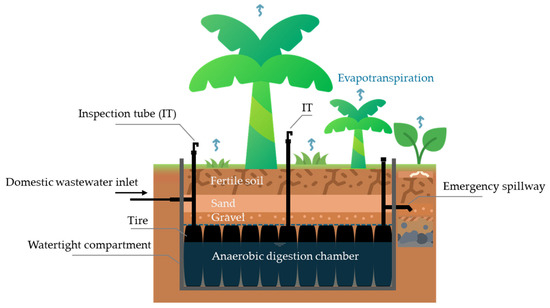
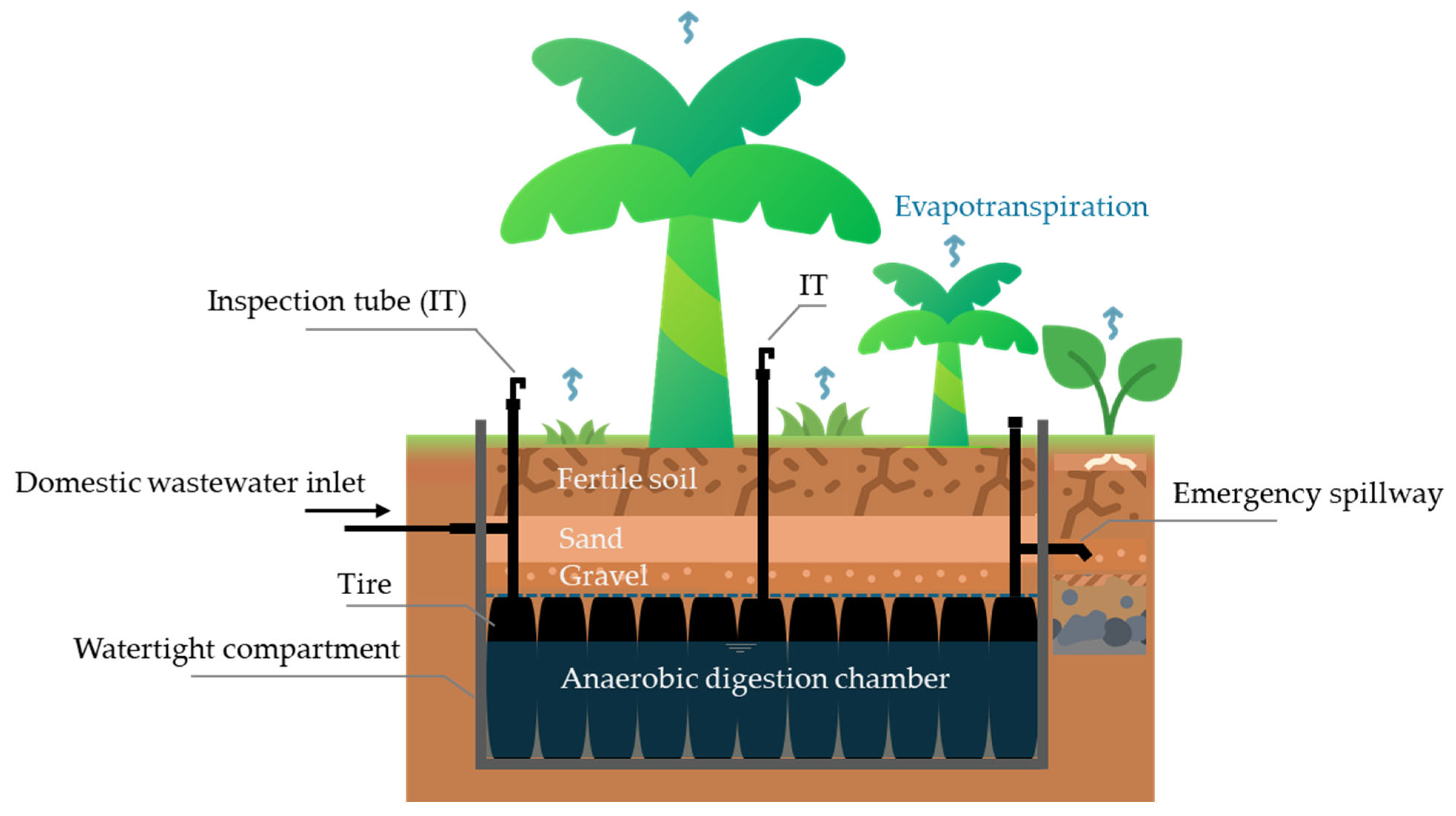
Figure 2 presents an illustration of an EvapT using commonly employed materials, generally constructed with low-cost or no-added-value materials such as used tires and construction and demolition waste. The choice of reused materials aims to make the system economically viable and more easily replicable. The construction costs can be minimized or mitigated with the use of recycled materials in the construction from a perspective of a circular economy. Reports on the implementation of this alternative technology in Brazil indicate construction costs of around USD 700 per single-family unit [10], potentially reduced by about USD 320 (BRL 600 in 2012) compared to a conventional septic tank [18]—a value that would be higher when adjusted for inflation. In addition, EvapT stands out for requiring minimal maintenance. In the study by Paulo et al. [21], after 400 days of monitoring, only occasional plant pruning was necessary. However, in the longer term, other corrective interventions may be required, such as the removal of excess sludge.
Figure 2.
Representation of a zero-discharge evapotranspiration tank (EvapT) for blackwater treatment, containing an anaerobic digestion chamber made of used tires, filled with gravel, sand, and a cultivation bed planted with banana trees (Musa spp.). Adapted from [12].
There are several EvapT configurations implemented in Brazil. One of the most common, described by authors in refs. [10,11,12,18,21], is built below ground level, with a depth of approximately 1.0 m, and includes a 0.10 m protective curb to prevent stormwater inflow. The walls and bottom of the system are waterproofed, ensuring the compartment is watertight and that wastewater is predominantly consumed by plants through the process of evapotranspiration.
The tank is filled with layers of materials of different grain sizes. The first layer consists of coarser material (e.g., brick or tile fragments) and houses the horizontal anaerobic chamber, where wastewater is received and sludge accumulates (using, for example, juxtaposed tires or a partially perforated concrete pipe). The subsequent layers are of progressively finer granulometry—a second layer of gravel, followed by a third layer of sand. Finally, the top layer is soil, where the plants are cultivated.
Inspection pipes with caps, shaped like an inverted “J” to prevent the entry of rainwater, are installed at the inlet and in the middle of the system. These allow access to and inspection of the anaerobic chamber, and consequently, the release of gases. In addition, an emergency drain is installed on the opposite side of the inlet, at a lower level, to ensure unidirectional flow. This safety device is activated only in the event of overflow, directing excess wastewater to a secondary filtering medium.
Odor emission is an important factor for the acceptance of EvapT. Authors such as Pamplona & Venturi [10] and Paulo et al. [21] did not report the presence of unpleasant odors in their studies, with the latter noting that during 13 months of operation, the system was well accepted by residents. On the other hand, Coelho et al. [18] observed foul odors, clogging, and overflow in EvapTs that had been operating for 38 and 44 months.
These contrasting results suggest that the presence of odor emissions is directly related to operational failures, such as extreme overloading or lack of maintenance, which result in the undesirable overflow of wastewater to the surface. Under ideal operating conditions, where wastewater discharge is zero and the entire volume is absorbed, the generation of foul odors is minimal. This is because the wastewater is distributed below the soil surface, where the soil and vegetation act as a natural biofilter.
Table 3 presents surface area per inhabitant values used for EvapT sizing in some regions of Brazil, namely Southeast, Central-West, Northeast, North, and South, in systems with configurations equal or similar to those shown in Figure 2. The areas range from 0.5 to 7.7 m2/inh, with a coefficient of variation of 0.8. The table also presents some corresponding average annual climatological data, specifically, temperature, relative humidity, solar radiation, and accumulated precipitation, as well as the Pearson correlation coefficients and the results of the regression analysis between these variables and the area per inhabitant.
Table 3.
Surface area per inhabitant used in EvapT systems in Brazil and climatological data, with respective Pearson correlation coefficients.
Since the statistical analysis presented in this study is restricted to EvapT systems implemented in Brazil, it does not encompass other global climatic zones (e.g., temperate and arid climates).
The climatological data from the regions where the analyzed studies were conducted—distributed across four biomes (Atlantic Forest, Cerrado, Caatinga, and Amazon), which together represent 96% of the country’s territory [66]—indicate average annual temperatures of 23.2 °C, relative humidity of 75.2%, 2344.7 h/year of sunshine, and an average annual precipitation of 1424.2 mm. Notably, there is a lack of studies on the remaining two biomes—Pantanal (Brazilian seasonal wetland) and Pampa (Brazilian subtropical grassland)—which present climatic conditions contrasting with the other regions.
The statistical analysis between the assumed EvapT surface area per inhabitant and the selected four climatological variables (Table 3) suggests Pearson correlation coefficients (r) ranging from weak to moderate (−0.60 < r < 0.60) and slightly strong (|r| > 0.6) [67]. Surface area was found to be inversely proportional to annual average temperature (r = −0.74) and to annual average solar radiation (r = −0.68), indicating that the higher the values of these variables, the smaller the considered EvapT surface area per inhabitant.
The multivariate regression analysis showed that 48.59% of the variability in area per capita can be explained by the set of climatological data, with a mean error of 1.51 m2/person. When evaluating the explanatory power of the variables individually through simple linear regression, it was found that temperature alone explained more than 50% of the variance, suggesting that for each one-degree increase, the area per capita in EvapT sizing decreases by 0.51 m2. Similarly, solar radiation proved to be an influential factor in this design parameter, resulting in an adjusted R2 of 40.4% (p-value < 0.05) and a regression coefficient of −0.004. This indicates that local climatic conditions may influence the design and the performance of EvapT systems.
In contrast, positive correlations were found between surface area and relative humidity (r = 0.38), as well as between surface area and precipitation (r = 0.18), suggesting that higher precipitation and relative humidity levels are associated with larger system areas. However, in the regression analysis, these specific climatological variables were not able to significantly predict the area per capita, possibly due to the limited number of observations (n = 12). Moreover, most of the reviewed studies did not report relevant confounding variables, such as the system’s effective volume, wastewater flow based on household water use habits, and soil type. The absence of this information compromises the robustness of the results and limits the scope for broader generalizations.
In addition to climatic conditions, the choice of plants to be cultivated in EvapT systems can influence their performance. In general, studies use fast-growing plants with high water demand, aiming to increase the evapotranspiration rate through broad leaf coverage and high biomass production. Beyond technical performance, plants with these characteristics may offer additional advantages, such as potential for animal feed production, biomass for energy generation, or aesthetic contribution through the landscape enhancement of the surrounding area.
Other systems utilize plants that produce fruits, such as banana trees (Musa spp.), non-conventional plantations like taioba (Xanthosoma sagittifolium), or ornamental species like Canna—commonly known as Beri [21]. Forage grasses such as Cynodon spp. (Tifton) and Pennisetum spp. (BRS Capiaçu) were tested by Reis et al. [23] in experimental EvapT systems due to their high water demand, with evapotranspiration rates of 3.66 mm/day and 4.95 mm/day identified by the authors, respectively.
This high ET capacity required an average area of 6.7 m2/inh for proper system performance, suggesting that these forage plants could be a viable option in regions where conditions are not suitable for other cultivars.
The influence of plant species on sizing is clearly demonstrated in a full-scale EvapT system designed by Paulo et al. [11] in the Central-West region of Brazil. The system, planted with banana trees, Beri, and taioba, required an area of 3.2 m2 per person to function without overflow—60% more than the typical value of 2.0 m2/inh. This increase is directly linked to the high evapotranspiration capacity of the cultivated species. Therefore, it is essential to consider the amount of water required to meet the plant’s evapotranspiration needs under local climatic conditions. For example, Coelho et al. [18] identified an average evapotranspiration rate of 5.1 mm/day for Musa spp., which may vary depending on the species. According to Embrapa [54], the water demand of the banana plant varies throughout its phenological cycle, which may require 45% of the potential ET in the first 70 days, increasing to 85% at 210 days during fruit formation and reaching a maximum of 110% at 300 days.
Although EvapT systems are primarily designed for the complete reuse of blackwater through plant uptake and surface evaporation, the first filling layer of the system includes an anaerobic digestion and sludge deposition chamber (Figure 2). This configuration functions similarly to primary treatment units and, therefore, the hydraulic retention time (HRT) is considered a relevant design parameter. In the EvapT system analyzed by Paulo et al. [11], with a useful volumetric capacity of 1195 L (21.3 L/cm) in the compartment that includes the anaerobic chamber, the HRT was 18 days. Most studies on EvapT systems did not report HRT values, which hinders a comprehensive comparative analysis. However, in conventional septic tanks receiving both blackwater and greywater, HRT typically ranges from 12 to 24 h [61].
In wastewater treatment, HRT is an important environmental factor in the anaerobic digestion process [68]. The prolonged retention time in EvapT may represent an advantage over conventional septic tanks, as a higher HRT promotes more complete digestion of the solid fraction, reduces sludge accumulation rates, and contributes to greater operational stability of the system over time. However, the lack of systematic data across different EvapT case studies still limits the establishment of reference HRT values.
EvapT generally does not produce an effluent—which limits the application of the efficiency concept—yet comparison with other technologies in terms of pollutant removal allows for a better understanding of its performance [21]. For example, the 77% COD removal reported by Paulo et al. [11] was compared to the 78% achieved in a UASB reactor operating with an HRT of 8.7 days.
4. Research Gaps and Recommendations
Despite the advances identified in this review, research gaps remain that limit the widespread adoption of evapotranspiration tanks (EvapTs).
There is a lack of consolidated design criteria, which may result in undersized or oversized systems, compromising both performance and user safety. This technical gap is reflected in regulatory frameworks; for example, NBR 17076 [61] indicates that EvapT should only receive pretreated effluents, whereas case studies show direct application to blackwater.
Therefore, we propose that decentralized sanitation policies recommend (i) that EvapTs be recognized as a feasible solution for directly treating blackwater, provided that specific design, sanitary, phytosanitary and monitoring conditions are met; (ii) that they incorporate ranges of design parameters as references, such as surface area per capita (0.5 to 2.0 m2/person, according to most full-scale studies), HRT, and porosity of the filling materials; and (iii) that monitoring indicators go beyond the water balance, including sludge accumulation rate, plant development, and odor control, to ensure operational safety. This alignment between science and regulation can provide a more realistic and technically robust basis for the implementation of EvapT in rural sanitation.
Few studies provide long-term monitoring data under different climatic conditions. The influence of rainfall seasonality, prolonged droughts, and extreme events on system stability remains poorly documented. Continuous monitoring of full-scale units is essential to ensure operational reliability and to refine sizing equations according to local climate.
Integration with other ecological technologies is still limited. Combining EvapT with constructed wetlands, greywater reuse systems, or complementary modules could enhance resilience to variations in hydraulic load and improve nutrient recovery.
There is a gap in economic analyses. Studies generally emphasize technical feasibility but do not assess costs, life-cycle performance, or cost–benefit relationships compared to decentralized sanitation alternatives. Economic viability is a decisive factor for public managers and communities.
Social acceptance and community participation are rarely investigated in studies on this topic. Since EvapT is primarily intended for rural or vulnerable communities, it is necessary for researchers to consider user perceptions, cultural aspects, and willingness to adopt and maintain the system. Social engagement is crucial for long-term sustainability.
We recommend that future studies incorporate these research priorities so that EvapT can evolve from local or experimental solutions into a technically standardized, socially accepted, and economically viable technology, capable of contributing to the universalization of basic sanitation and the achievement of SDG 6 (Clean Water and Sanitation for All).
5. Conclusions
The use of natural systems for wastewater treatment is already well established in various contexts and offers benefits such as resource reuse and minimization of environmental impacts. Evapotranspiration systems receive different names depending on the type of plant used (such as willow beds), the regional context, and the technical design of the system.
The literature shows a scarcity of indexed scientific articles in the Web of Science and Scopus databases addressing design parameters associated with zero-discharge operation, which reinforces the need for further research in this area. The analyzed data indicate that the surface area per inhabitant for sizing EvapT systems may be influenced by climatic factors—such as precipitation, temperature, solar radiation, and relative humidity—and by the type of cultivated plant. These variables should be considered in future studies to improve the accuracy and operational efficiency of the technology.
EvapT proves to be especially promising in semi-arid regions when sized based on local data. It is an ecological, low-cost, and potentially replicable technological solution for rural communities lacking basic sanitation, directly aligned with Sustainable Development Goal (SDG) 6—Clean Water and Sanitation for All—and indirectly with SDGs 1, 2, 8, 11, and 12. However, its consolidation as public policy may require technical standardization, phytosanitary and performance analysis, cost–benefit evaluation, measurement of real design and operational parameters, and analysis of social acceptance. Advances in these areas are essential to expand its applicability and enable sustainable and safe solutions for domestic wastewater treatment in highly vulnerable areas.
Author Contributions
Conceptualization, A.C.d.S. and P.S.S.; methodology, A.C.d.S., A.D.D.-C. and P.S.S.; software, A.C.d.S.; validation, A.C.d.S., P.S.S. and A.D.D.-C.; formal analysis, A.C.d.S., A.D.D.-C., P.S.S. and A.F.D.; investigation, A.C.d.S., P.S.S. and A.D.D.-C.; resources, A.C.d.S. and P.S.S.; data curation, A.C.d.S.; writing—original draft preparation, A.C.d.S.; writing—review and editing, A.C.d.S., P.S.S., A.D.D.-C. and A.F.D.; visualization, A.C.d.S. and A.F.D.; supervision, P.S.S.; funding acquisition, P.S.S. All authors have read and agreed to the published version of the manuscript.
Funding
This research was supported by the National Council for Scientific and Technological Development (CNPq) for the scholarship granted to the first author of this work (Process n° 140690/2024-7); by PAEC Brazil Scholarship Program of the Organization of American States—Coimbra Group (OAS-GCUB); and by Foundation for Research Support of the State of Goiás (FAPEG) for the scholarship granted to the second author (Administrative Process SEI! n° 202510267001077).
Institutional Review Board Statement
Not applicable.
Informed Consent Statement
Not applicable.
Data Availability Statement
The data on precipitation, temperature, hours of sunshine, and relative humidity used are freely accessible and can be consulted at the link: https://portal.inmet.gov.br/ (accessed on 29 August 2025).
Conflicts of Interest
The authors declare no conflicts of interest.
References
- Azevedo, A. O Cortiço, 2nd ed.; Câmara dos Deputados-Coordenação, Edições Câmara: Brasília, Brazil, 2021; ISBN 978-85-402-0791-2. Available online: https://camara-leg-br.usrfiles.com/ugd/5ca0e9_4bd76b96516a40fba87370e6bcec72f8.pdf (accessed on 14 July 2025). (In Portuguese)
- United Nations. Water. 2024. Available online: https://www.un.org/en/global-issues/water (accessed on 14 July 2025).
- World Health Organization; United Nations Children’s Fund. Progress on Household Drinking Water, Sanitation and Hygiene 2000–2020: Five Years into the SDGs, 1st ed.; World Health Organization: Geneva, Switzerland, 2021; ISBN 978-92-4-003084-8. [Google Scholar]
- UNESCO. The United Nations World Water Development Report 2017: Wastewater: The Untapped Resource; Facts and Figures. 2017. Available online: https://unesdoc.unesco.org/ark:/48223/pf0000247553 (accessed on 15 July 2025).
- Brasil. Law No. 14.026, of July 15, 2020. Available online: https://www.planalto.gov.br/ccivil_03/_ato2019-2022/2020/lei/l14026.htm (accessed on 15 July 2025). (In Portuguese)
- Vale, G.B.D.; Ruggeri Junior, H.C.; Scalize, P.S. Service and Precariousness of Sanitary Sewage in Rural Communities in the State of Goiás, Brazil. Eng. Sanit. Ambient. 2022, 27, 1067–1075. [Google Scholar] [CrossRef] [Scilit]
- Silva, A.C.; Scalize, P.S. Environmental Variables Related to Aedes Aegypti Breeding Spots and the Occurrence of Arbovirus Diseases. Sustainability 2023, 15, 8148. [Google Scholar] [CrossRef] [Scilit]
- Magalhães Filho, F.J.C.; De Queiroz, A.A.F.S.L.; Machado, B.S.; Paulo, P.L. Sustainable Sanitation Management Tool for Decision Making in Isolated Areas in Brazil. Int. J. Environ. Res. Public Health 2019, 16, 1118. [Google Scholar] [CrossRef] [Scilit]
- Cross, K.; Tondera, K.; Rizzo, A.; Andrews, L.; Pucher, B.; Istenič, D.; Karres, N.; McDonald, R. Nature-Based Solutions for Wastewater Treatment: A Series of Factsheets and Case Studies; IWA Publishing: London, UK, 2021; ISBN 978-1-78906-226-7. [Google Scholar]
- Pamplona, S.; Venturi, M.; Esgoto à flor da terra-Sistema de evapotranspiração é solução simples, acessível e sustentável. Perma Bras. 2004, pp. 18–19. Available online: https://fazenda.paginas.ufsc.br/files/2017/02/Pamplona-Venturi-Permacultura-Brasil-2004-n16.pdf (accessed on 28 July 2025). (In Portuguese)
- Paulo, P.L.; Galbiati, A.F.; Magalhães Filho, F.J.C.; Bernardes, F.S.; Carvalho, G.A.; Boncz, M.Á. Evapotranspiration Tank for the Treatment, Disposal and Resource Recovery of Blackwater. Resour. Conserv. Recycl. 2019, 147, 61–66. [Google Scholar] [CrossRef] [Scilit]
- Da Silva, A.C.; Carrillo, A.D.D.; Scalize, P.S. Operation of a Zero-Discharge Evapotranspiration Tank for Blackwater Disposal in a Rural Quilombola Household, Brazil. Water 2025, 17, 2098. [Google Scholar] [CrossRef] [Scilit]
- Hube, S.; Zaqout, T.; Ögmundarson, Ó.; Andradóttir, H.Ó.; Wu, B. Constructed Wetlands with Recycled Concrete for Wastewater Treatment in Cold Climate: Performance and Life Cycle Assessment. Sci. Total Environ. 2023, 904, 166778. [Google Scholar] [CrossRef] [Scilit]
- Miwornunyuie, N.; Mao, G.; Benani, N.; Ampah, J.D.; Hunter, J. Investigating the Research and Development Status and Trends of Constructed Wetlands: A Bibliometric and Patent Analysis. J. Water Process Eng. 2024, 63, 105430. [Google Scholar] [CrossRef] [Scilit]
- Curneen, S.J.; Gill, L.W. A Comparison of the Suitability of Different Willow Varieties to Treat On-Site Wastewater Effluent in an Irish Climate. J. Environ. Manag. 2014, 133, 153–161. [Google Scholar] [CrossRef] [Scilit]
- Moreno, F.; Lara-Borrero, J.; Rojas, L.; Vera-Puerto, I. Analysis of Salix humboldtiana to Be Used as the Plant Species in Evapotranspirative Willow Systems in Latin American Highland Climate Conditions. J. Environ. Sci. Health Part A 2019, 54, 1302–1310. [Google Scholar] [CrossRef] [Scilit]
- Postila, H.; Heiderscheidt, E. Function and Biomass Production of Willow Wetlands Applied in the Polishing Phase of Sewage Treatment in Cold Climate Conditions. Sci. Total Environ. 2020, 727, 138620. [Google Scholar] [CrossRef] [Scilit] [PubMed]
- Coelho, C.F.; Reinhardt, H.; Araújo, J.C.D. Fossa Verde Como Componente de Saneamento Rural Para a Região Semiárida Do Brasil. Eng. Sanit. Ambient. 2018, 23, 801–810. [Google Scholar] [CrossRef] [Scilit]
- Da Silva, A.C.; Scalize, P.S.; Albuquerque, A. Assessment of per Capita Contribution to Fecal Sewage in Rural Residences of Quilombola Communities. Water 2025, 17, 1350. [Google Scholar] [CrossRef] [Scilit]
- Silva, A.C.; Carrillo, A.D.D.; Scalize, V.B.; Lamarre, K.; Ruggeri Junior, H.C.; Albuquerque, A.; Scalize, P.S. Variação do Volume útil em Bacia de Evapotranspiração para Tratamento de Esgoto Fecal. 2024. Available online: https://iceubi2024.pt/wp-content/uploads/2025/01/LIVRO-DE-ATAS_FINAL-07_01_2025-1.pdf (accessed on 12 June 2025).
- Paulo, P.L.; Azevedo, C.; Begosso, L.; Galbiati, A.F.; Boncz, M.A. Natural Systems Treating Greywater and Blackwater On-Site: Integrating Treatment, Reuse and Landscaping. Ecol. Eng. 2013, 50, 95–100. [Google Scholar] [CrossRef] [Scilit]
- Filho, F.J.C.M.; Sobrinho, T.A.; Steffen, J.L.; Arias, C.A.; Paulo, P.L. Hydraulic and Hydrological Aspects of an Evapotranspiration-Constructed Wetland Combined System for Household Greywater Treatment. J. Environ. Sci. Health Part A 2018, 53, 493–500. [Google Scholar] [CrossRef] [Scilit] [PubMed]
- Reis, M.C.G.; Borges, A.C.; Ferreira, F.S.; Cunha, F.F.D.; Da Silva, R.R. A Preliminary Experimental Study Simulating Evapotranspiration Process in TEvap Tanks Cultivated with Different Forages. Environ. Technol. 2024, 45, 3129–3140. [Google Scholar] [CrossRef] [Scilit]
- Kihila, J.M.; Balengayabo, J.G. Adaptable Improved Onsite Wastewater Treatment Systems for Urban Settlements in Developing Countries. Cogent Environ. Sci. 2020, 6, 1823633. [Google Scholar] [CrossRef] [Scilit]
- Karunanidhi, D.; Aravinthasamy, P.; Subramani, T.; Kumar, M. Human Health Risks Associated with Multipath Exposure of Groundwater Nitrate and Environmental Friendly Actions for Quality Improvement and Sustainable Management: A Case Study from Texvalley (Tiruppur Region) of India. Chemosphere 2021, 265, 129083. [Google Scholar] [CrossRef] [Scilit]
- Haddaway, N.R.; Grainger, M.J.; Gray, C.T. Citationchaser: A Tool for Transparent and Efficient Forward and Backward Citation Chasing in Systematic Searching. Res. Synth. Methods 2022, 13, 533–545. [Google Scholar] [CrossRef] [Scilit]
- INMET. Normais Climatológicas–Gráficos. 2025. Available online: https://clima.inmet.gov.br/GraficosClimatologicos/DF/83377 (accessed on 14 July 2025). (In Portuguese)
- King, J.P.; Jones, T.L.; Fahmy, H.S.; Seton, J.A. Seton Richards Equation Approach to the Design of Evapotranspiration Beds. Trans. ASAE 1995, 38, 1025–1030. [Google Scholar] [CrossRef] [Scilit]
- Balley, P.; Dakers, A.J. Non-Discharging Evapotranspiration Bed System for Wastewater Disposal at Lincoln. Environ. Monit. Assess. 1996, 43, 65–72. [Google Scholar] [CrossRef] [Scilit]
- Mangkoedihardjo, S.; April, S. Compost on evapotranspiration bed planted with yellow flag for treatment of wastewater containing anionic surfactant. J. Appl. Sci. Res. 2012, 8, 1630–1633. Available online: https://www.scopus.com/pages/publications/84865987076?inward (accessed on 15 July 2025).
- Istenič, D.; Božič, G.; Arias, C.A.; Bulc, T.G. Growth Dynamic of Three Different White Willow Clones Used in a Zero-Discharge Wastewater Treatment System in the Sub-Mediterranean Region—An Early Evaluation. Desalination Water Treat. 2017, 91, 260–267. [Google Scholar] [CrossRef] [Scilit]
- Istenič, D.; Božič, G. Short-Rotation Willows as a Wastewater Treatment Plant: Biomass Production and the Fate of Macronutrients and Metals. Forests 2021, 12, 554. [Google Scholar] [CrossRef] [Scilit]
- Mariappan, P. Wastewater management in a dwelling house—A case study. Indian J. Environ. Prot. 2012, 32, 539–545. Available online: https://www.scopus.com/pages/publications/84873419582?inward (accessed on 15 July 2025).
- Frédette, C.; Labrecque, M.; Comeau, Y.; Brisson, J. Willows for Environmental Projects: A Literature Review of Results on Evapotranspiration Rate and Its Driving Factors across the Genus Salix. J. Environ. Manag. 2019, 246, 526–537. [Google Scholar] [CrossRef] [Scilit]
- O’Hogain, S.; McCarton, L.; Reid, A.; Turner, J.; Fox, S. A Review of Zero Discharge Wastewater Treatment Systems Using Reed Willow Bed Combinations in Ireland. Water Pract. Technol. 2011, 6, wpt2011048. [Google Scholar] [CrossRef] [Scilit]
- Curneen, S.; Gill, L. Upflow Evapotranspiration System for the Treatment of On-Site Wastewater Effluent. Water 2015, 7, 2037–2059. [Google Scholar] [CrossRef] [Scilit]
- Curneen, S.; Gill, L.W. Willow-Based Evapotranspiration Systems for on-Site Wastewater Effluent in Areas of Low Permeability Subsoils. Ecol. Eng. 2016, 92, 199–209. [Google Scholar] [CrossRef] [Scilit]
- Frédette, C.; Comeau, Y.; Brisson, J. Design of a Zero Liquid Discharge Leachate Treatment System Using an Evapotranspiration Willow Bed. Water Res. 2022, 209, 117950. [Google Scholar] [CrossRef] [Scilit]
- Rastas Amofah, L.; Mattsson, J.; Hedström, A. Willow Bed Fertigated with Domestic Wastewater to Recover Nutrients in Subarctic Climates. Ecol. Eng. 2012, 47, 174–181. [Google Scholar] [CrossRef] [Scilit]
- Gregersen, P.; Brix, H. Zero-discharge of nutrients and water in a willowdominated constructed wetland. Water Sci. Technol. 2001, 44, 407–412. [Google Scholar] [CrossRef] [Scilit]
- Emater. Incentivo a Instalação de Fossas Ecológicas Leva Tratamento de Esgoto Especialmente para o Meio Rural. 2016. Available online: https://www.emater.mg.gov.br/portal.do/site-noticias/projeto-da-emater-mg-evita-que-mais-220-milhoes-de-litros-de-esgoto-sejam-lancados-no-ambiente-a-cada-ano/?flagweb=novosite_pagina_interna_noticia&id=28408 (accessed on 15 July 2025).
- Timmermann, J.; Ortiz, P.M. Curso de Construções Alternativas—Construção da Zona 1. 2003. Available online: https://cead.ufop.br/professores/dulce/Livros/Curso%20de%20constru%C3%A7%C3%A3o%20alternativa.pdf (accessed on 13 July 2025). (In Portuguese)
- Paulo, P.L. Catalosan: Catálogo de Soluções Sustentáveis de Saneamento Gestão de Efluentes Domésticos; Gráfica Editora Espaço: Campo Grande, Brazil, 2018; ISBN 978-85-63202-07-9. (In Portuguese) [Google Scholar]
- Brasil. Professor Concorre a Prêmio por Projeto Ambiental no Amazonas. 2015. Available online: https://portal.mec.gov.br/component/tags/tag/agua-potavel-trilhas-da-educacao (accessed on 15 July 2025). (In Portuguese)
- CBHSF. Comunidade em Penedo (AL) é Beneficiada com a Construção de Fossas Agroecológicas. 2020. Available online: https://cbhsaofrancisco.org.br/noticias/novidades/comunidade-em-penedo-al-sera-beneficiada-com-a-construcao-de-fossas-agroecologicas/ (accessed on 15 July 2025). (In Portuguese)
- Soares, A.L.J. Tecnologias de Baixo Impacto: A práxis da Sustentabilidade; Fundação Brasil Cidadão: Fortaleza, Brazil, 2009; ISBN 978-85-98564-04-3. [Google Scholar]
- Machado, G.C.X.M.P.; Roale, C.; Sobrinho, F.X.; Ruprecht, T.; Oliveira, F.J.d.R. Caminhos e Cuidados Com as Águas: Faça Você Mesmo Seu Sistema de Saneamento Ecológico, 23rd ed.; Fiocruz: Rio de Janeiro, Brazil, 2019; ISBN 978-85-8110-070-8. [Google Scholar]
- Frank, W.L. Engineering parameters in the design of evapotranspiration beds. Water Eng. Manag. 1996, 143, 31–37. Available online: https://www.scopus.com/pages/publications/0030430176?inward (accessed on 10 July 2025).
- Salvato, J.A. Rational Design of Evapotranspiration Bed. J. Environ. Eng. 1983, 109, 646–660. [Google Scholar] [CrossRef] [Scilit]
- Weigand, R.G. Performance of alternative on-site sewage systems in Wood County, West Virginia. J. Environ. Health 1979, 42, 133–138. Available online: https://www.scopus.com/pages/publications/0018597383?inward (accessed on 15 July 2025).
- Richards, L.A. Capillary Conduction of Liquids Through Porous Mediums. Physics 1931, 1, 318–333. [Google Scholar] [CrossRef] [Scilit]
- Kuzovkina, Y.A.; Volk, T.A. The Characterization of Willow (Salix L.) Varieties for Use in Ecological Engineering Applications: Co-Ordination of Structure, Function and Autecology. Ecol. Eng. 2009, 35, 1178–1189. [Google Scholar] [CrossRef] [Scilit]
- Oram, R.N.; Ferreira, V.; Culvenor, R.A.; Hopkins, A.A.; Stewart, A. The First Century of Phalaris aquatica L. Cultivation and Genetic Improvement: A Review. Crop Pasture Sci. 2009, 60, 1. [Google Scholar] [CrossRef] [Scilit]
- Embrapa. Sistema de Produção da Bananeira Irrigada; Embrapa Semiárido: Petrolina, Brazil, 2009. (In Portuguese) [Google Scholar]
- Kujawa-Roeleveld, K.; Zeeman, G. Anaerobic Treatment in Decentralised and Source-Separation-Based Sanitation Concepts. Rev. Environ. Sci. Biotechnol. 2006, 5, 115–139. [Google Scholar] [CrossRef] [Scilit]
- Rose, C.; Parker, A.; Jefferson, B.; Cartmell, E. The Characterization of Feces and Urine: A Review of the Literature to Inform Advanced Treatment Technology. Crit. Rev. Environ. Sci. Technol. 2015, 45, 1827–1879. [Google Scholar] [CrossRef] [Scilit]
- Rezende Mudadu Silva, J.; Carraro Borges, A.; Lüthi, C.; Spuhler, D.; Fernandes, R.B.A. The Banana Tree Circle as a Nature-Based Solution for Sustainable Greywater Management: A New Design Model. Water Sci. Technol. 2024, 89, 2240–2253. [Google Scholar] [CrossRef] [Scilit]
- Zhang, P.; Huang, G.; An, C.; Fu, H.; Gao, P.; Yao, Y.; Chen, X. An Integrated Gravity-Driven Ecological Bed for Wastewater Treatment in Subtropical Regions: Process Design, Performance Analysis, and Greenhouse Gas Emissions Assessment. J. Clean. Prod. 2019, 212, 1143–1153. [Google Scholar] [CrossRef] [Scilit]
- De Simone Souza, H.H.; De Morais Lima, P.; Medeiros, D.L.; Vieira, J.; Filho, F.J.C.M.; Paulo, P.L.; Fullana-i-Palmer, P.; Boncz, M.Á. Environmental Assessment of On-Site Source-Separated Wastewater Treatment and Reuse Systems for Resource Recovery in a Sustainable Sanitation View. Sci. Total Environ. 2023, 895, 165122. [Google Scholar] [CrossRef] [Scilit] [PubMed]
- Brasil. Eixos Estratégicos—Matrizes Tecnológicas, 1st ed.; Funasa: Brasília, Brazil, 2021; ISBN 978-65-5603-018-0. Available online: https://www.funasa.gov.br/biblioteca-eletronica/publicacoes/engenharia-de-saude-publica/-/asset_publisher/ZM23z1KP6s6q/content/aspectos-conceituais-da-ruralidade-no-brasil-e-interfaces-com-o-saneamento-basico?inheritRedirect=false (accessed on 15 July 2025). (In Portuguese)
- ABNT NBR 17076:2024. Projeto de Sistema de Tratamento de Esgoto de Menor Porte—Requisitos. 2024. Available online: https://abnt.org.br/ (accessed on 15 July 2025). (In Portuguese)
- dos Santos Junior, E.L. Tecnologia Alternativa para Tratamento Seletivo dos Resíduos Provenientes da Bacia Sanitária em Comunidades Rurais. 2019. Available online: https://tede.unioeste.br/handle/tede/4203 (accessed on 12 July 2025). (In Portuguese)
- Ferreira, M.M.; Fiore, F.A.; Saron, A.; Da Silva, G.H.R. Systematic Review of the Last 20 Years of Research on Decentralized Domestic Wastewater Treatment in Brazil: State of the Art and Potentials. Water Sci. Technol. 2021, 84, 3469–3488. [Google Scholar] [CrossRef] [Scilit] [PubMed]
- Rosa, M.N.; Teixeira, D.; Hora, K.E.R. Ações Participativas Em Saneamento Rural: Bases Conceituais e Diretrizes Metodológicas. Saude Soc. 2023, 32, e201040pt. [Google Scholar] [CrossRef] [Scilit]
- Machado, G.C.X.M.P.; Haguenauer, C.J.; Ruprecht, T.; Sobrinho, F.X.; Gallo, E. Ecological Sanitation: A Territorialized Agenda for Strengthening Traditional Communities Facing Climate Change. In Climate Change Adaptation in Latin America; Climate Change Management; Leal Filho, W., Esteves De Freitas, L., Eds.; Springer International Publishing: Cham, Switzerland, 2018; pp. 103–129. ISBN 978-3-319-56945-1. [Google Scholar]
- IBGE. Biomas. 2004. Available online: https://geoftp.ibge.gov.br/informacoes_ambientais/estudos_ambientais/biomas/ (accessed on 19 July 2025).
- Callegari-Jacques, S.M. Bioestatística: Princípios e Aplicações; Artmed: Porto Alegre, Brazil, 2021; ISBN 978-85-363-0092-4. [Google Scholar]
- Metcalf & Eddy. Wastewater Engineering: Treatment and Resource Recovery, 5th ed.; McGraw Hill Higher Education: New York, NY, USA, 2014; ISBN 978-0-07-340118-8. [Google Scholar]



Disclaimer/Publisher’s Note: The statements, opinions and data contained in all publications are solely those of the individual author(s) and contributor(s) and not of MDPI and/or the editor(s). MDPI and/or the editor(s) disclaim responsibility for any injury to people or property resulting from any ideas, methods, instructions or products referred to in the content. |
© 2025 by the authors. Licensee MDPI, Basel, Switzerland. This article is an open access article distributed under the terms and conditions of the Creative Commons Attribution (CC BY) license (https://creativecommons.org/licenses/by/4.0/).