Article

Selective and Closed-Loop Recycling of Different Metals from Spent Lithium-Ion Batteries Through Phosphoric Acid Leaching: Parameter Optimization and Regulation of Reaction Kinetics

1
College of Chemistry and Chemical Engineering, Hunan Normal University, Changsha 410081, China
2
National & Local Joint Engineering Laboratory for New Petro-Chemical Materials and Fine Utilization of Resources, Hunan Normal University, Changsha 410081, China
*
Author to whom correspondence should be addressed.
Sustainability 2025, 17(17), 7862; https://doi.org/10.3390/su17177862
Submission received: 21 July 2025 / Revised: 26 August 2025 / Accepted: 29 August 2025 / Published: 1 September 2025
(This article belongs to the Section Waste and Recycling)

Abstract

The sustainable recycling of valuable metals from spent lithium-ion batteries (LIBs) is critical for resource conservation and environmental protection but remains challenging due to the complex coexistence of target and impurity metals. This study systematically investigates the selective leaching behaviors of metals (Co, Li, Cu, Fe, Al) in phosphoric acid media, revealing that lithium could be preferentially extracted in mild acidic conditions (0.8 mol/L H3PO4), while complete dissolution of both Li and Co was achieved in concentrated acid (2.0 mol/L H3PO4). Kinetic analysis demonstrated that metal leaching followed a chemically controlled mechanism, with distinct extraction sequences: Li > Cu~Co > Fe > Al in dilute acid and Cu > Al~Li > Fe > Co in concentrated acid. Furthermore, we developed a closed-loop process wherein oxalic acid simultaneously precipitates Co/Li while regenerating H3PO4, enabling acid reuse with minimal efficiency loss during cyclic leaching. These findings establish a single-step phosphoric acid leaching strategy for selective metal recovery, governed by tunable acid concentration and reaction kinetics, offering a sustainable pathway for LIBs recycling.

1. Introduction

In the 1990s, Sony corporation pioneered and developed the first commercial lithium-ion batteries (LIBs) with potential widespread application in mobile devices [1], electronic equipment, and electric/hybrid electric vehicles (EVs/HEVs) because of their preferable electrochemical performances in terms of high operating voltage and specific capacity, modest size and weight, long service life, and high energy density [2,3]. However, a huge quantity of spent LIBs will inevitably flow into waste stream with the increasing numbers of end-of-life batteries generated annually [4,5,6]. Predictions indicate that by 2027, the global market size for spent LIBs recycling will reach 11.07 billion US dollars [7]. In addition, potential risks towards ecosystem and public health may be caused by heavy metals or organic hazardous wastes contained in spent LIBs [8]. Thus, it is necessary to recycle them LIBs an environmentally sound way. Generally, a typical LIB is made up of cathode, anode, metallic shell, separator, electrolyte, and other appurtenances. The most valuable part is the cathode [5], which contains a large proportion of valuable metals like cobalt (Co), lithium (Li), copper (Cu), aluminum (Al), and iron (Fe). Therefore, sustainable and effective recovery of value-added metals from spent LIBs will be of great importance in terms of preserving metal resources and environmental protection [9].
Currently, attention and effort are put into the recovery of valuable metals from spent LIBs using pyro-metallurgical [10,11,12] and hydro-metallurgical [13,14,15] techniques, also including bio-leaching and mechanical methods [16,17,18,19]. Chen et al. [20] developed an effective pyrometallurgical process which can recover cobalt, nickel, copper (99%), and concentrating lithium (Li2O 7.28 wt.%) from high-manganese artificial β-spodumene slags. Though highly efficient, pyro-metallurgical methods may be discouraged by high additional investments in terms of alloy smelting at high temperature and the disposal of dangerous gases [8]. Harshit Mahandra et al. [19] used Thiobacillus thioparus to selectively leach lithium at near-neutral pH, which was able to recover 65–98% lithium with insignificant iron. Although the bio-hydrometallurgical method involves a mild processing environment, it can be frustrated by the extremely low leaching efficiency required compared to chemical-based leaching, due to the long leaching period [8]. Qi et al. [10] proposed a process based on phosphate chemistry for recovering valuable metals from spent LIBs. Under optimized conditions (0.7 mol/L H3PO4, 7 vol.% of H2O2, residence time of 40 min, reaction temperature of 40 °C, and liquid–solid ratio of 30 mL/g), the lithium leaching rate can reach 98.7%. As a traditional method for effectively separating and recovering valuable metals from spent LIBs, although it involves the use of acid and brings certain processing burdens, the hydro-metallurgical technique is a popular choice due to its lower cost, less secondary pollution, and higher recovery efficiency compared with pyro-metallurgical and bio-leaching [21,22].
The literature has reported that sulfuric acid leaching liquor can be used for the hydro-metallurgical method [23]. Table 1 summarizes different leaching systems for recovering valuable metals from spent LIBs using different acids. It can be concluded that both mineral and organic acids may demonstrate similar leaching performance [24]. Nevertheless, the mineral acids adopted may result in severe corrosion of equipment and secondary noxious gases like SO2 and Cl2 [25], and organic acids will inevitably enhance the costs during industrialized application. Furthermore, the separation and recovery of valuable metals from leaching solutions of mineral and organic acids may be challenging due to the tedious metal separation processes, and only relatively low leaching efficiencies can be achieved in some organic acid leaching systems, like 60% for Co and Li using aspartic acid [26]. In that case, for the selective recovery of different metals from waste LIBs, the hydro-metallurgical method is widely used in industry [27]. Therefore, it is necessary to simulate the acid leaching process of spent LIBs in the actual production of multi-metal ion systems.
Phosphoric acid, as a weak acid, is milder than strong acids such as sulfuric acid and hydrochloric acid in terms of both environmental pollution and the corrosion resistance of reactor materials. In our previous work, low concentration of phosphoric acid (0.7 mol/L) has been innovatively used as both leaching and precipitating reagent under mild leaching conditions, and about 99% Co and Li can be separated and recovered in a single leaching step [31]. Moreover, it can be efficiently recycled [40]. However, lack of clarity persists with regard to the leaching behaviors of valuable metals and impurity metals from spent LIBs under different phosphoric acid media (low and high concentrations), such as leaching kinetics and the leaching order of different metals. The present work was designed to uncover detailed leaching and recovery phenomena and their essence from both experimental and theoretical aspects, using different concentrations of phosphoric acid as leaching reagent. It is expected that a sustainable and efficient recovery route can be established based on the leaching behaviors of different metals and provide a technical and theoretical foundation for metal recovery in different acidic media.

2. Experimental Section

2.1. Materials and Reagents

Spent cathode materials (waste LiCoO2, LCO) obtained after pretreatment through discharging, dismantling, peeling off Al foil, roasting, and grinding were used as feed materials. The waste LiCoO2 powders were then completely dissolved in concentrated hydrochloric acid (10 mol/L HCl). Inductively coupled plasma–optical emission spectroscopy (ICP-OES)/inductively coupled plasma–mass spectrometry (ICP-MS) was used to determine the metal elements in the sample, in which the mass contents of valuable Co and Li metals was 58.74% and 6.02%, respectively, and the mass content for impure Cu, Al, and Fe metals was 0.028%, 2.026%, and 0.031%, respectively. The main chemical reagents used in this study included concentrated phosphoric acid (H3PO4, 85%, AR, Tianli Chemical Reagent Co., Ltd., Tianjin, China), hydrogen peroxide (H2O2, 30 v/v%, AR, Tianli Chemical Reagent Co., Ltd.), sodium sulfate (Na2SO4·10H2O, 99%, AR, Tianli Chemical Reagent Co., Ltd.), ammonium hydroxide (NH3·H2O, 25–28%, AR, Tianli Chemical Reagent Co., Ltd.), oxalic acid (H2C2O4, AR, Sinopharm Group Chemical Reagent Co., Ltd., Shanghai, China), sodium dihydrogen phosphate (NaH2PO4, 99% purity, AR, Fuchen Chemical Reagent Co., Ltd., Tianjin, China), cobaltous sulfate (CoSO4, 99% purity, AR, Fuchen Chemical Reagent Co., Ltd.), N-methyl-2-pyrrolidone (NMP, 99% purity, AR, Tianjin Kemio Chemical Reagent Co., Ltd., Tianjin, China), and aluminum powders, iron powders, and copper powders (Al, Fe, and Cu, 99% purity, Aladdin Reagents Co., Ltd., Shanghai, China). All other reagents used were of analytical grade and deionized water was used for the preparation and dilution of different solutions during the whole experiment.

2.2. Leaching Experiments

All of the leaching experiments were conducted in a three-necked and round-bottom flask, which served as a reactor. The specific experimental steps are listed as follows. (a) A precisely weighed quantity of waste LiCoO2 powder was introduced into the reactor. A leaching solution containing a specific concentration of H3PO4 was subsequently added, while H2O2 was introduced dropwise. The leaching reaction was then conducted for a predetermined duration. (b) Upon the reaction’s completion, vacuum filtration was employed to achieve solid–liquid phase separation. (c) The filtered residues were then dried and ground for material characterization, while the filtrate was diluted for subsequent ICP-OES analysis. In addition, the filtrate obtained in the circulating leaching test without dilution was reused as leaching reagent for the leaching of waste LiCoO2 powders.
The reaction described above was a liquid–solid non-catalytic reaction. Previous studies have shown that solid particles in the liquid–solid non-catalytic reaction are unreacted cores, abbreviated as the “shrinking core model” [41]. Therefore, the shrinking-core model was adopted for the investigation of leaching kinetics mechanism for relevant leaching reactions in different acidic media with different reaction temperatures and retention times [42]. According to this model, when the leaching of Li, Co, Al, Cu, and Fe from spent LIBs is controlled by chemical reaction or diffusion-controlled process through inner layer diffusion, the leaching process can be described by Equations (1) and (2), respectively:
1 − (1 − X)1/3 = kct
1 − 2/3X − (1 − X)2/3 = kdt
where X is the reaction fraction (i.e., leaching efficiency), kc and kd are the reaction rate constants (min−1), and t is the leaching time (min).
In addition, the Arrhenius equation was applied for the determination of apparent activation energy (Ea) and pre-exponential factor (lnA) under fixed leaching conditions in different acidic media in a retention time range of 10–60 min and a temperature range of 30–70 °C. The Arrhenius equation can reveal the dependence of the rate of chemical reaction on the temperature, and it can be described as Equation (3) or Equation (4):
k = AeEa/RT
ln(k) = ln(A) − Ea/RT
where k and A are the rate constant and frequency factor of relevant reaction (mol/(L·h)), Ea is the apparent activation energy (kJ/mol) of corresponding reaction, R is the gas constant 8.314 J/(mol·K), and T is the temperature (K).
To explore the leaching kinetics mechanism, single-factor experiments were conducted focusing on residence time and acid concentration. In the cyclic leaching experiments, identical leaching conditions were applied as those used for the leaching of different metals. During the leaching process, 2 mL leachate was withdrawn every 10 min, with an equal 2 mL volume of fresh acid solution added to maintain the reaction conditions. The concentrations of Li, Co, Al, Cu, and Fe in all leachate samples were subsequently analyzed by ICP-OES or ICP/MS.

2.3. Analytical Methods

The concentrations of all metals in leaching solutions were determined by inductively coupled plasma–optical emission spectroscopy or inductively coupled plasma source–mass spectrometry (ICP-OES or ICP/MS, Therm, Waltham, MA, USA). The morphology of solid components before and after leaching can be characterized by environmental scanning electron microscopy (SEM, FEI Q45, Hillsboro, OR, USA), and surface element content was detected with an Energy Dispersive Spectrometer (EDS, EDAX Octane Prime, Mahwah, NJ, USA). In addition, an X-ray Diffractometer (XRD, D8 Advance, Bruker Company, Karlsruhe, Germany) was used for the identification of solid materials before and after leaching. Finally, Fourier-transform infrared spectrometry (FT-IR, VECTOR-22, Bruker Company, Germany) and X-ray photoelectron spectroscopy (XPS, Thermo) were used for characterization of waste LiCoO2 powders, leaching product, and pure Co3(PO4)2 powders. Detailed information of above characterization equipment can be found in the Supporting Materials (Table S1). Leaching efficiencies of different metals were calculated according to following equation:
y = m l m s × 100 %
where y is leaching efficiencies of different metals, ml is mass content of metal in leaching solution (g), ms is the total metal content in waste LiCoO2 powders or mixtures (g).

3. Results and Discussion

3.1. Selective Leaching of Valuable Metals

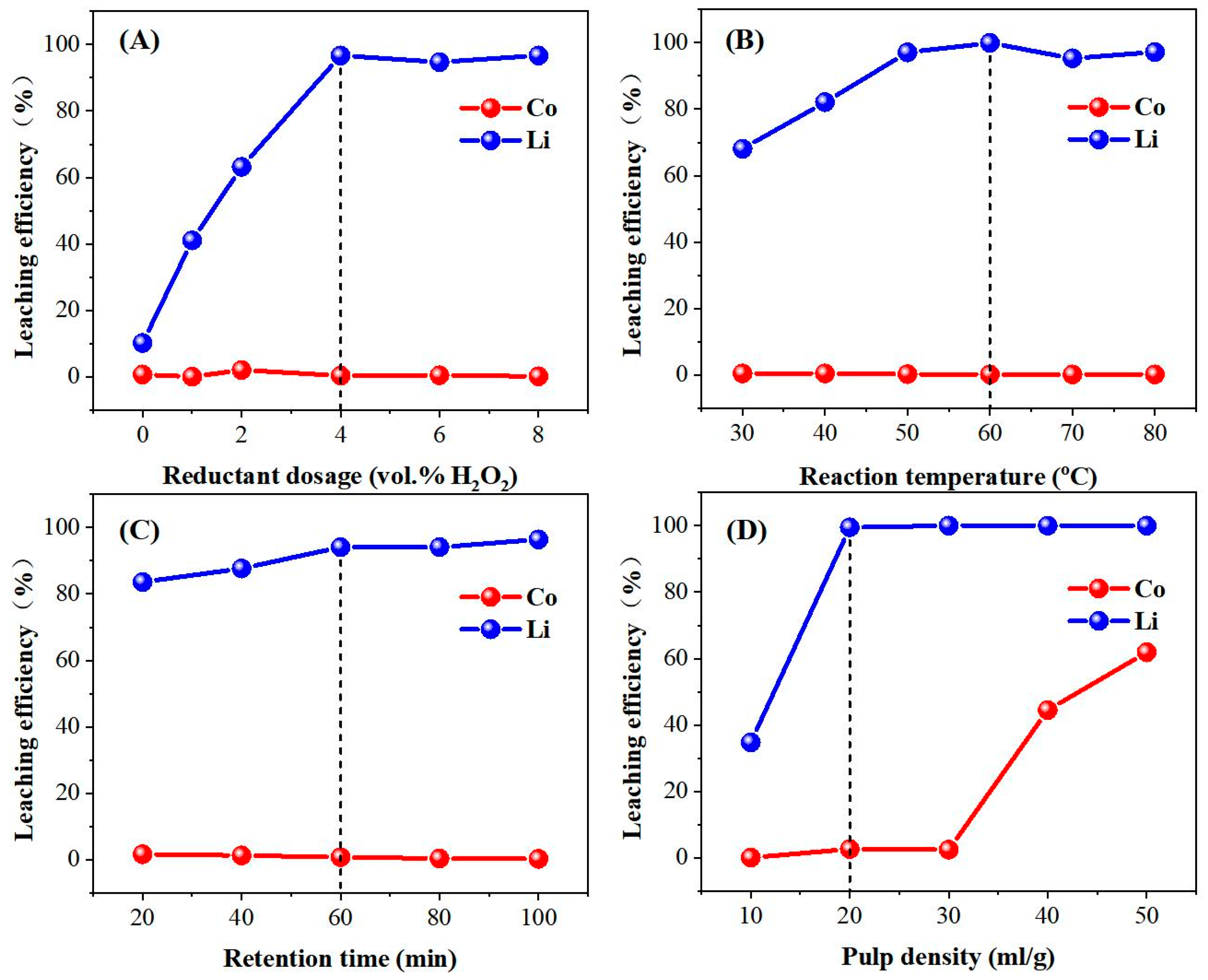
To investigate the kinetic mechanism under suitable reaction conditions, we first optimized the leaching conditions. Under a constant concentration of 0.8 mol/L phosphoric acid, the effects of H2O2 volume fraction, leaching temperature, leaching time, and solid-to-liquid ratio on the leaching efficiency were explored. As shown in Figure 1A, with fixed conditions of 20 mL/g pulp density, 60 min retention time and 60 °C, the volume fraction of H2O2 was varied in the range of 0–8 vol.%. The leaching efficiency of Li gradually increased within the range of 0–4 vol.% and remained nearly constant after adding 4 vol.% H2O2. However, the volume fraction of H2O2 had no significant effect on the leaching of Co. Based on these observations, the optimal H2O2 addition was determined to be 4 vol.%. The optimization of temperature, retention time, and pulp density are shown in Figure 1B–D, respectively. The final optimized leaching conditions were 4 vol.% H2O2 addition, a leaching temperature of 60 °C, a retention time of 60 min, and a solid-to-liquid ratio of 20 mL/g.
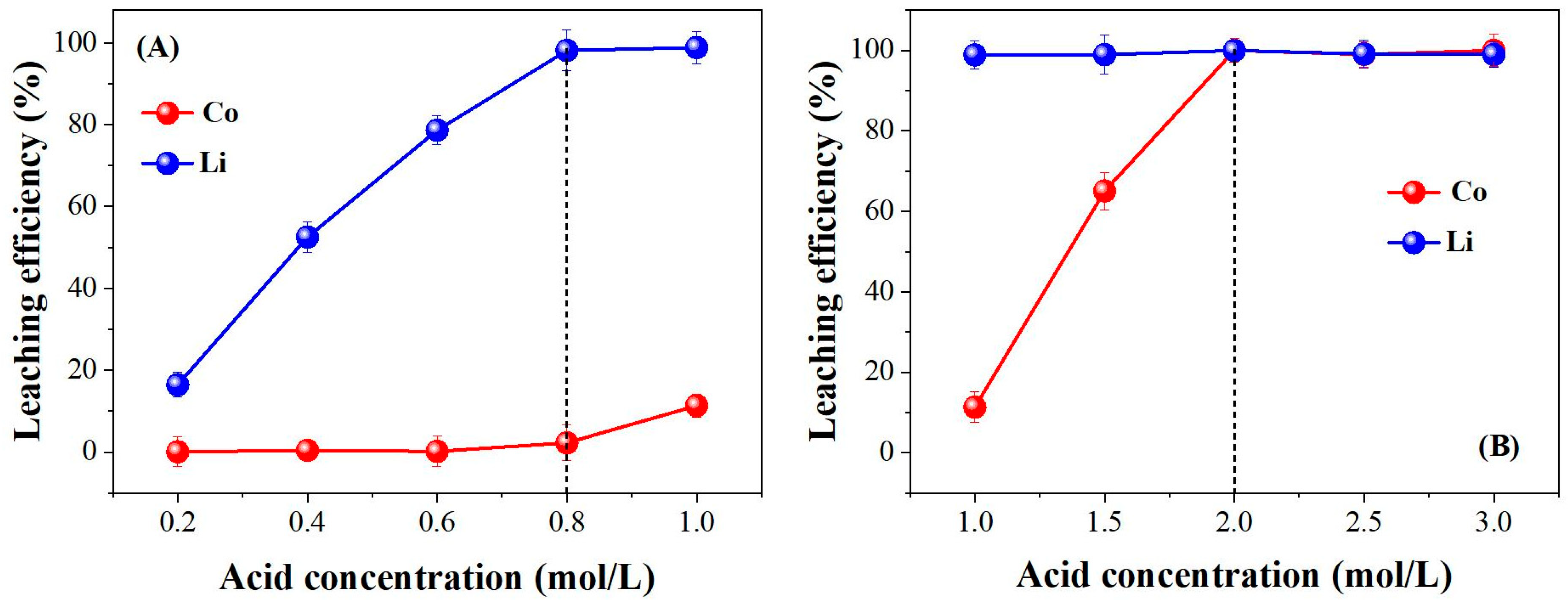
Relatively pure waste cathode materials (waste LiCoO2) were obtained after the pretreatment procedure. Figure 2 shows that the leaching of Li and Co involved different leaching behaviors with the variation of phosphoric acid concentration (under the optimized leaching conditions of reductant dosage 4 vol.% H2O2, leaching temperature 60 °C, retention time 60 min, and pulp density 20 mL/g, see Table S2 in Supplementary Materials). Under mild phosphoric acid concentrations (i.e., 0.2–1.0 mol/L, Figure 2A), the leaching efficiency of Li underwent a continuous increase from 16% to 98%. Co could hardly be dissolved in mild phosphoric acidic solutions with the increase of acid concentration from 0.2 mol/L to 0.8 mol/L. Afterwards, the leaching efficiency of Li almost remained at the same level and the leaching efficiency of Co experienced a slight rise from 1% to 12% with the increase in acid concentration from 0.8 mol/L to 1.0 mol/L. This indicates that Co and Li can be effectively separated and recovered in a single leaching step under mild acidic medium.
The leaching behavior of Co and Li, however, indicates a quite different mode according to leaching results illustrated in Figure 2B. The leaching efficiency of Co underwent a steady enhancement from 12% to 99% and the leaching efficiency of Li remained unchanged with the increase in acid concentration from 1.0 mol/L to 2.0 mol/L, indicating that Co can be gradually dissolved in phosphoric acid solution under higher acid concentrations. Afterwards, the leaching efficiencies of Co and Li remained unchanged with further increases in acid concentration from 2.0 mol/L to 3.0 mol/L, which may be attributed to complete dissolving of waste LiCoO2 under 2.0 mol/L phosphoric acid solution.
In conclusion, 0.8 mol/L and 2.0 mol/L were identified as optimized acid concentrations for the selective separation and recovery of valuable metals from waste LiCoO2. It was also observed that the leaching behaviors of Co and Li were determined by acid concentration. Therefore, it is necessary to explore the reaction mechanism during the leaching process. Phosphoric acid (H3PO4) is a tribasic acid which can be ionized to H2PO4, HPO42−, PO43−, and H+ with ionization constants of 2.12 (pKa1), 7.21 (pKa2), and 12.67 (pKa3) (see Equations (6)–(8)) [43]. Salts of Li+/Co2+ with HPO42−/PO43− present low solubility while salts of Li+/Co2+ with H2PO4 can be dissolved in aqueous solution. Thus, the selective leaching of Li and Co may be attributed to characteristics of H3PO4 and chemical reactions under different concentrations of acidic media (Equations (9)–(11)). Leaching reactions of Li and Co can be controlled based on dosage and concentration of phosphoric acid. Waste LiCoO2 can react with H3PO4 in the presence of H2O2, and Co3(PO4)2 and Li3PO4 precipitates are initially generated with a low molar ratio of n(H3PO4):n(LiCoO2) = 1:1 (0.52 mol/L H3PO4 required, Equation (9)). Then, Li3PO4 precipitate is converted to soluble LiH2PO4 with further addition of H3PO4 at a molar ratio of n(H3PO4):n(LiCoO2) = 1.67:1 (0.86 mol/L H3PO4 required, Equation (10)). Finally, Co3(PO4)2 precipitate is dissolved with a molar ratio of n(H3PO4):n(LiCoO2) = 3:1 (1.56 mol/L H3PO4 required, Equation (11)). It can be concluded that the above theoretical results are consistent with the experimental results demonstrating that Li can be selectively extracted under low acid concentration of 0.8 mol/L, and the further promotion of acid concentration from 0.8 to 2.0 mol/L results in the further dissolution of Co3(PO4)2 precipitate to soluble Co(H2PO4)2.
H3PO4 (l) = H2PO4 (aq) + H+ (aq)   pKa1 = 2.12
H2PO4 (aq) = HPO42− (aq) + H+ (aq)   pKa2 = 7.21
HPO42− (aq) = PO43− (aq) + H+ (aq)   pKa3 = 12.67
LiCoO2 (s) + H3PO4 (aq) + H2O2 (l) = 1/3Co3(PO4)2 (s) + 1/3Li3PO4 (s) + 3/2H2O (l) + 5/4O2 (g)
Li3PO4 (s) + 2H3PO4 (aq) = 3LiH2PO4 (aq)
Co3(PO4)2 (s) + 4H3PO4 (aq) = 3Co(H2PO4)2
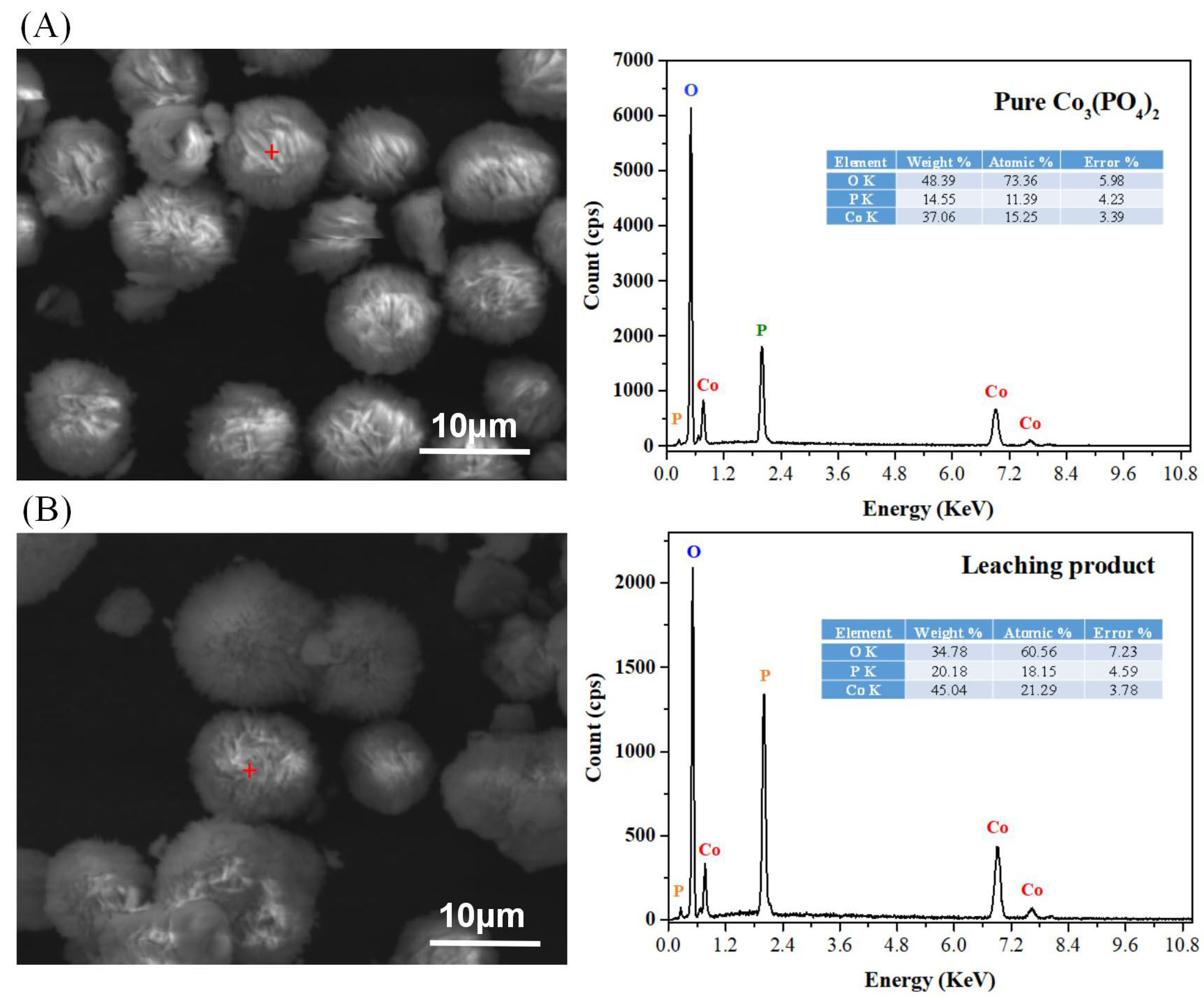
In order to further determine the leaching product, SEM-EDS was employed for the analysis of leaching product compared with pure Co3(PO4)2 prepared (detailed preparation can be found in Supplementary Materials). Figure 3 shows that both leaching the product and pure Co3(PO4)2 present similar morphologies to a regular sphere. In addition, the atomic percentages (Atomic%) of O, P, and Co in pure Co3(PO4)2 are 73.36%, 11.39%, and 15.25%. This indicates that the atom ratio of Co and P is 15.25:11.39 (close to the stoichiometric ratio of 3:2), while the atom ratio of P and O is 11.39:73.36 (lower than the stoichiometric ratio of 1:4), which may be caused by bound or free water. However, the atomic percentages of O, P and Co in the leaching product are 60.56%, 18.15%, and 21.29%, which means that the atom ratio of Co and P is 21.29:18.15 (close to the stoichiometric ratio of 3:2) and the atom ratio of P and O is 18.15:60.56 (close to the stoichiometric ratio of 1:4). According to the above analytical results, it can preliminarily be stated that the leaching product obtained was relatively pure Co3(PO4)2.
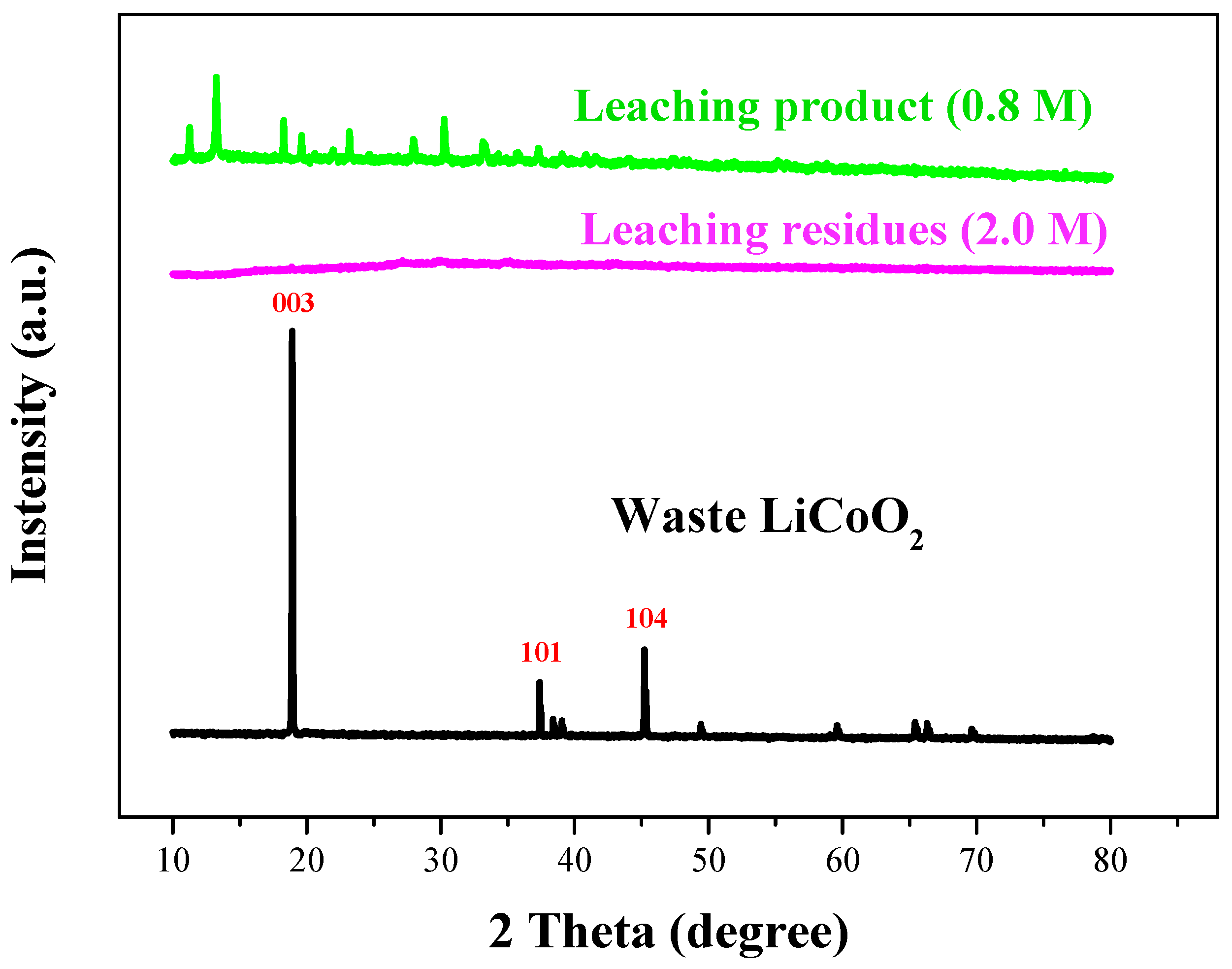
To further confirm the leaching products obtained after leaching reactions from different concentrations of phosphoric acid, XRD was employed for the exploration and analysis of crystal structure and chemical phase of waste LiCoO2, leaching residues (2.0 mol/L H3PO4) and leaching product (0.8 mol/L H3PO4) (see Figure 4). It was discovered that intensive characteristic peaks around 003, 101, and 104 were obtained for the waste LiCoO2 powders. However, the intensity of these characteristic peaks was hardly detected after leaching in 2.0 mol/L phosphoric acid, indicating a complete dissolution of waste LiCoO2. Under acid concentration of 0.8 mol/L, the characteristic peaks around 003, 101, and 104 for LiCoO2 powders almost disappeared, while new characteristic peaks with less intensity appeared after leaching, which may have been caused by the generation of new chemical compounds. In addition, different peaks with relatively weak intensities may be attributed to the amorphous crystal of the leaching product. Therefore, further characterization methods are still required for the determination of the obtained leaching product.
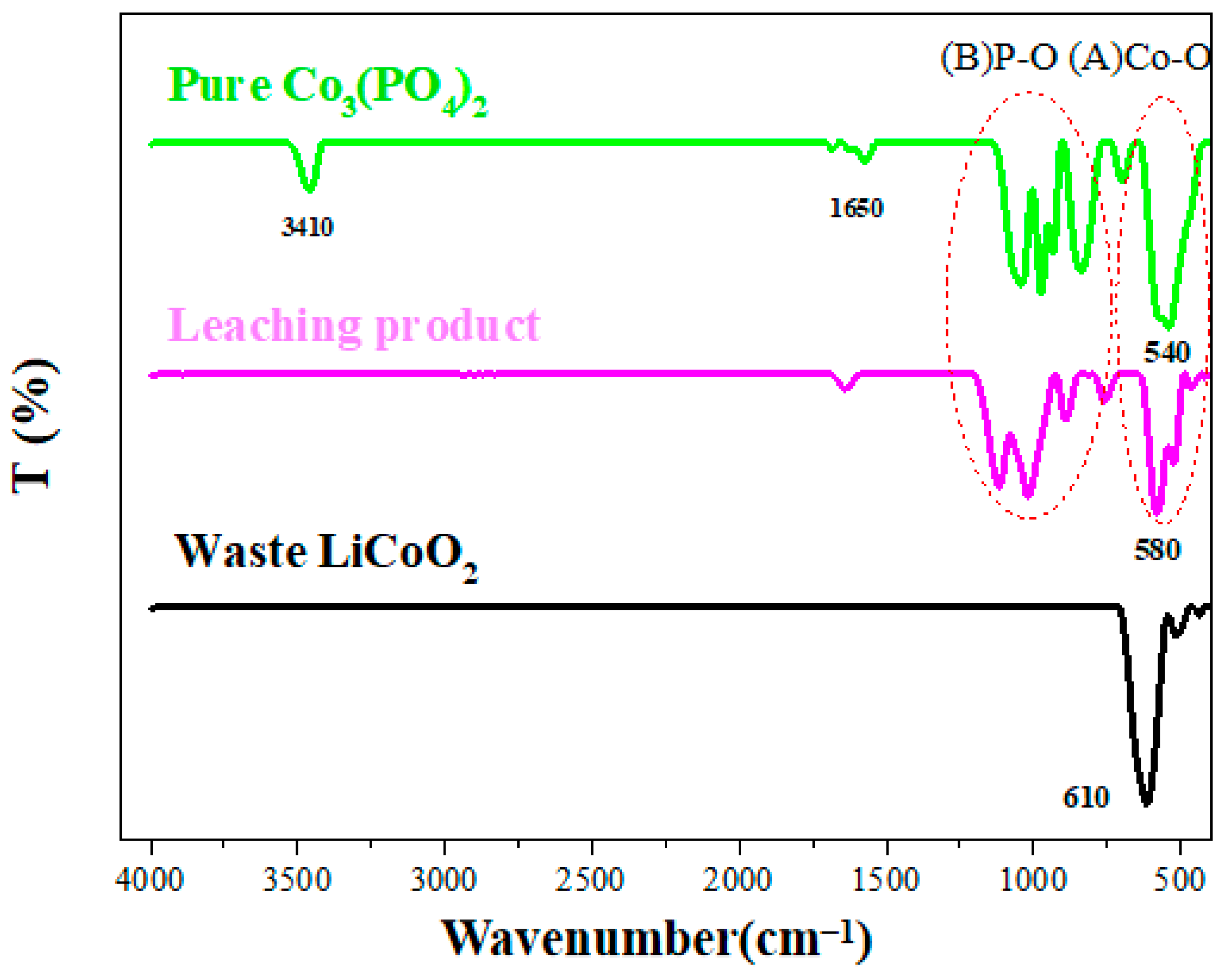
Pink leaching product was obtained after leaching in 0.8 mol/L acidic medium, and this precipitate was similar to pure cobaltous phosphate (Co3(PO4)2). Thus, FT-IR was then applied for the final confirmation of obtained leaching product. According to Figure 5, two characteristic absorption peaks around 610 cm−1 and 510 cm−1 were obtained for waste LiCoO2, indicating the bonds of Co-O and Li-O, respectively. It was discovered that new characteristic absorption peak zones around 580 cm−1 (zone A) and 1040 cm−1 (zone B) appeared after leaching, characteristic peaks of Co-O bond (blue shift phenomenon) and P-O bonds (four different characteristic absorption peaks). This indicates the generation of Co3(PO4)2 and a complete dissolution of Li. In addition, it can be also confirmed from above characterization results that the leaching product and pure Co3(PO4)2 display similar characteristic peaks, which further supports the assumption that the obtained pink precipitate was pure Co3(PO4)2.
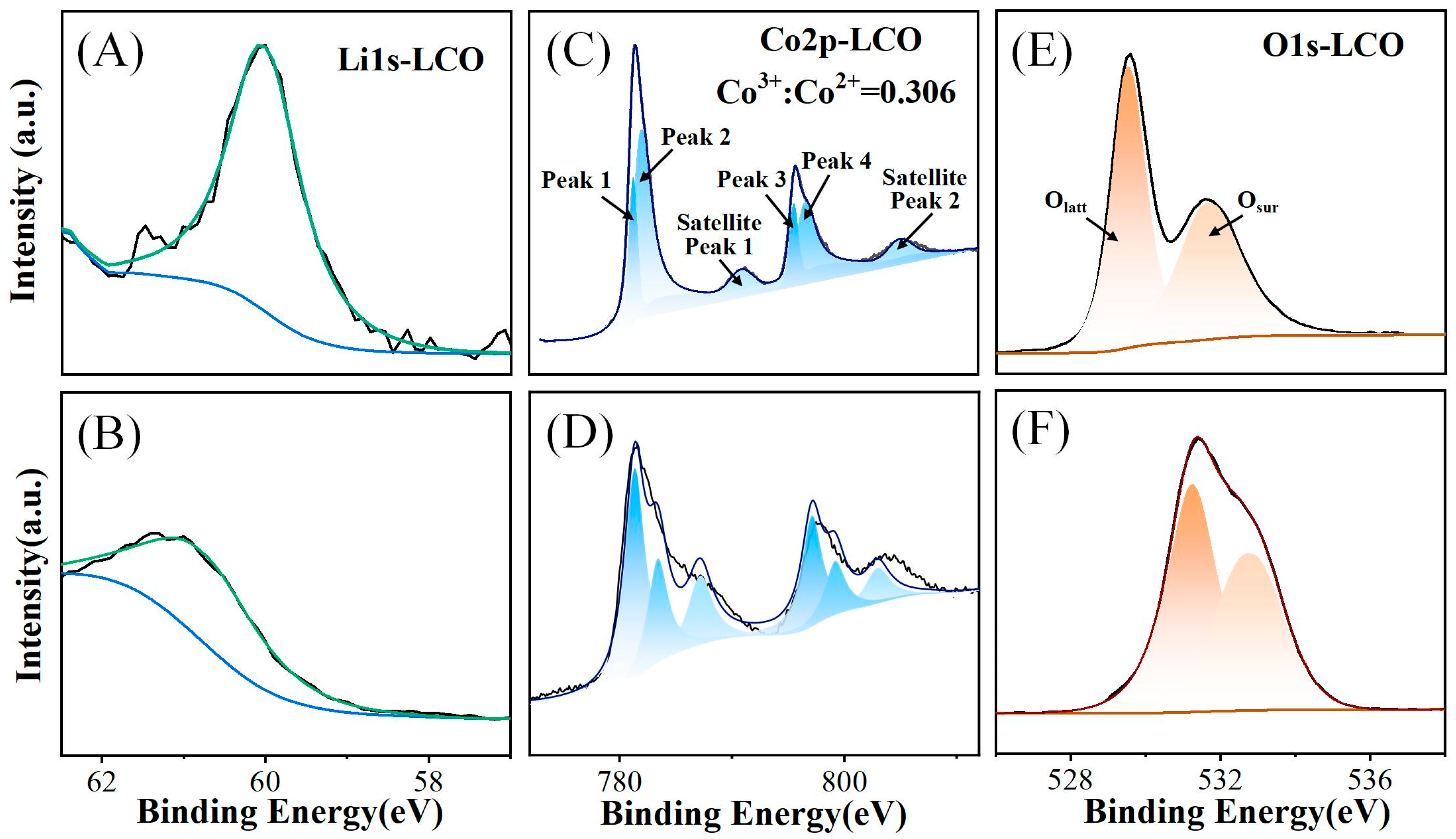
Based on the XPS analysis, the changes in the surface elements of the leach residue were determined. Figure 6A,B show the XPS high-resolution spectra and peak fittings of Li 1s in the LiCoO2 leach residue before and after leaching. The binding energy of the Li 1s main peak shifts significantly towards higher energy after leaching, indicating that during the leaching process, the valence electrons of lithium undergo electrochemical displacement, and the bonding interactions change. Lithium in the leachate reacts with H3PO4, forming LiH2PO4, resulting in a gradual reduction of Li content in the leach residue until it disappears. Figure 6C,D display the high-resolution XPS spectra of Co 2p before and after leaching. It can be observed that the Co 2p spectrum consists of two major parts: the main peaks 1/2 and the satellite peak 1, as well as the main peaks 3/4 and satellite peak 2. The half-peak width of the Co2+ characteristic peak is greater than that of Co3+, so according to the diagram, peaks 1 and 3 correspond to Co3+, while peaks 2 and 4 correspond to Co2+. The satellite peaks S1 and S2 are associated with the Co2+ characteristic peaks. Before leaching, the Co3+:Co2+ ratio in the waste LiCoO2 was 0.306, and after leaching, this ratio increased to 0.705. This indicates that the Co3+/Co2+ ratio in the leach residue increased after leaching, and Co in the LiCoO2 was better retained in the solid phase. Thus, during the leaching process with a low concentration of H3PO4, selective leaching of Li from the LiCoO2 can be achieved. The oxygen species on the surface of the LiCoO2 crystal mainly consisted of lattice oxygen (Olatt) and surface hydroxyl oxygen (Osur). Lattice oxygen originates from the internal structure of the LiCoO2 crystal, while surface hydroxyl oxygen is introduced during the hydrothermal synthesis of LiCoO2. As can be seen from the diagram, when LiCoO2 participates in the leaching reaction, the oxygen species on the surface of the leach residue crystal undergo a change. The lattice oxygen peak shifts to the right and transforms into surface hydroxyl oxygen. The decrease in lattice oxygen indicates an increase in oxygen vacancies within the lattice, leading to the destruction of the crystal structure. The increase in surface hydroxyl oxygen enhances the reactivity of LiCoO2, accelerating the leaching process of the sample in the phosphoric acid solution.

3.2. Metal Recovery from Real Waste Streams

Impurity metal ions (i.e., Cu, Al, and Fe) will inevitably flow into the waste stream during industrialization recovery process, and it is necessary to explore leaching behaviors of different metals in phosphoric acidic media. In this study, fixed amounts of Cu, Al, and Fe powders were mixed with waste LiCoO2 powders to simulate real waste after mechanical crushing and screening. Detailed leaching results are listed in the Supplementary Materials (Table S2 and Figure S3), illustrating the leaching rates of metals under optimized experimental conditions in different acidic media. It can be observed that different metals demonstrated different leaching behaviors in different acid concentrations. Under mild acidic medium (0.8 mol/L), 98.8% Li and most of the Cu (76.7%) were leached and only small proportions of Al (38.2%), Co (3.6%), and Fe (9.1%) could be dissolved, which may indicate that Li in waste LiCoO2 powders can be selectively extracted, followed by Cu, Al, Fe, and Co. However, these metals presented a complete dissolution phenomenon in a higher concentration of 2.0 mol/L phosphoric acid, indicating that different metals can be gradually leached with an increase in concentration. To achieve deeper understanding of these leaching reactions, the reaction kinetics were investigated for different metals.
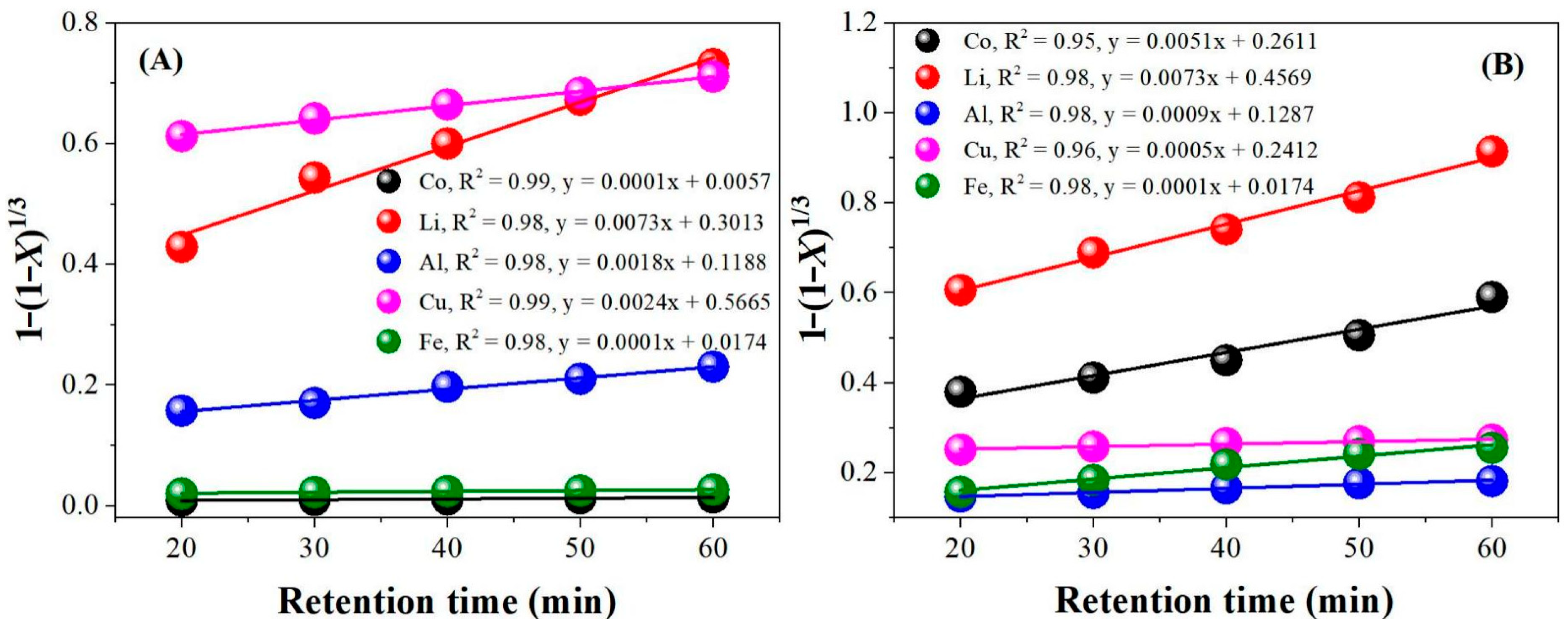
Reaction kinetics: Leaching kinetics were investigated to explore the leaching behaviors of Co, Li, Al, Cu, and Fe from real waste at different retention times (20–60 min) and reaction temperatures (30–70 °C) under conditions of reductant dosage 4 vol.%, liquid-to-solid ratio 20 mL/g, and acid concentration 0.8 mol/L or 2.0 mol/L. It can be observed from Figure 7 that the correlation coefficients for chemical reaction controlled model (R2) for the leaching of Co, Li, Al, Cu, and Fe were over 0.9 in both a high concentration of acidic medium (2.0 mol/L) and a low concentration of acidic medium (0.8 mol/L), indicating that the leaching of different metals in phosphoric acid media is controlled by chemical reactions and both reactants and products can be rapidly diffused during the leaching process.
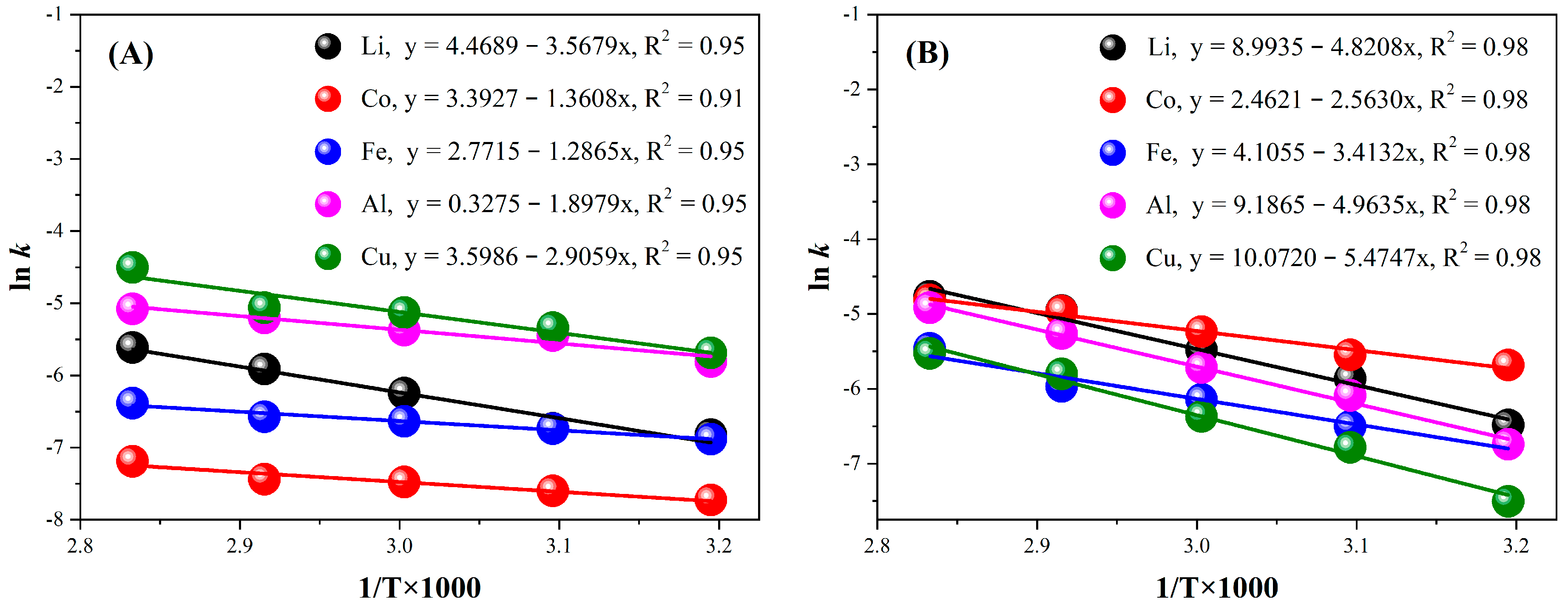
Apparent activation energies (Ea) were calculated based on the slope of the lnk vs. 1/T curve (based on the Arrhenius equations) in specific leaching conditions, which can be also adopted to evaluate difficulties of relevant leaching reactions in a low acid concentration of 0.8 mol/L (see Figure 8A). Frequency factors (lnA), and apparent activation energies (Ea) were calculated according to the Arrhenius equations (Equations (3) and (4)), and the following results were obtained: Li: lnA = 4.4689, Ea = 29.66 kJ/mol; Co: lnA = 3.3927, Ea = 11.31 kJ/mol; Fe: lnA = 2.7715, Ea = 10.69 kJ/mol; Al: lnA = 0.3275, Ea = 15.78 kJ/mol and Cu: lnA = 3.5981, Ea = 24.16 kJ/mol. The Ea values for different metals were over 10 kJ/mol, which indicates that the reactions were controlled by chemical reactions; this is in accordance with the leaching kinetics results. In addition, the lnk vs. 1/T curve also presents an excellent fit (R2 > 0.98) for different metals in a high acid concentration of 2.0 mol/L according to Figure 8B. The following fitting results were obtained: Li: lnA = 8.9935, Ea = 40.08 kJ/mol. Co: lnA = 2.4621, Ea = 21.31 kJ/mol. Fe: lnA = 4.1055, Ea = 28.38 kJ/mol. Al: lnA = 9.1865, Ea = 41.27 kJ/mol. Cu: lnA = 10.0721, Ea = 45.52 kJ/mol.
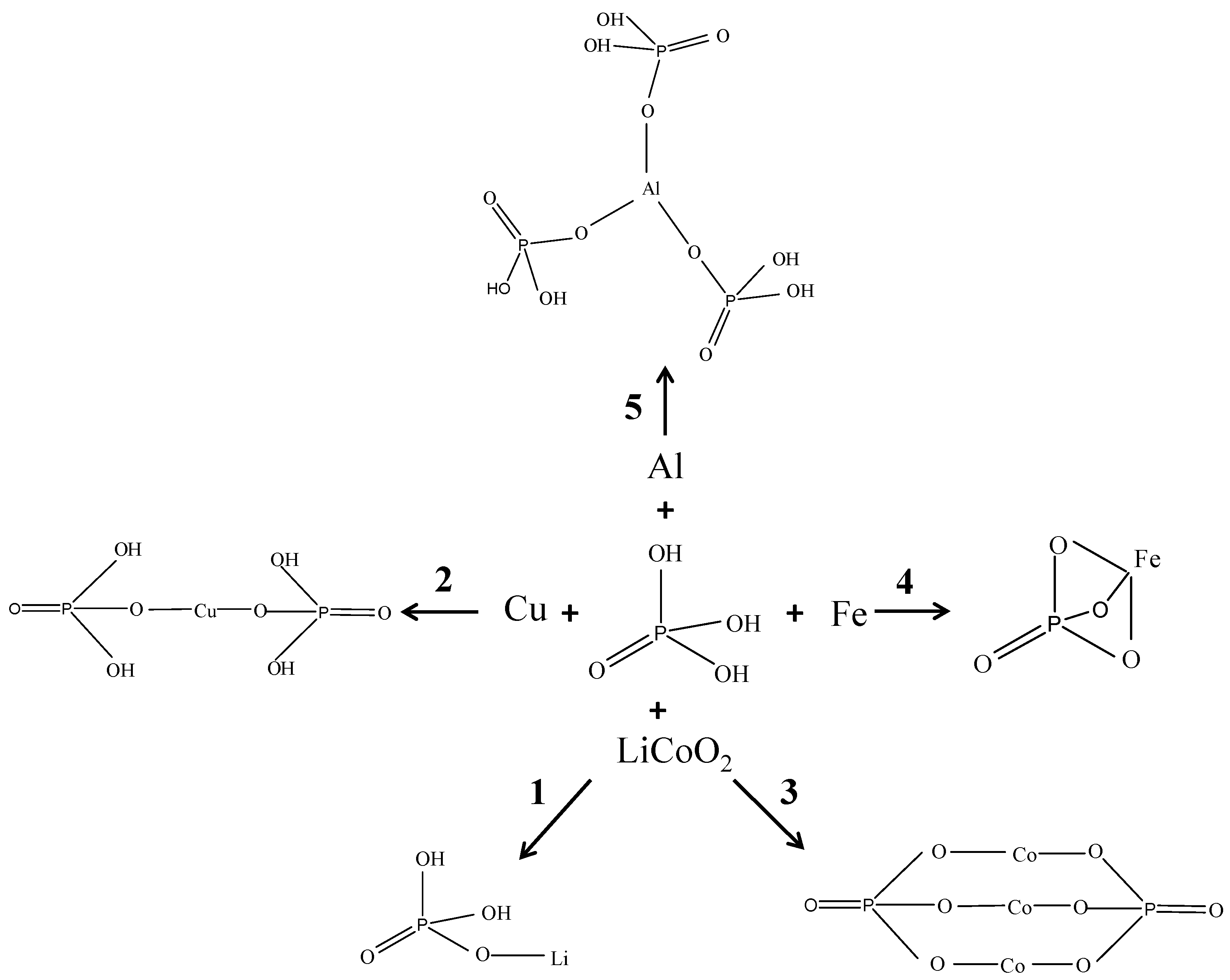
As illustrated in Figure 9, the leaching reactivity followed the order Li > Cu~Co > Fe > Al, with corresponding final products identified as LiH2PO4, Cu(H2PO4)2, Co3(PO4)2, FePO4 and Al(H2PO4)3. The remarkably high lnA value for Li+ indicates superior reaction frequency, while its small ionic radius (0.76 Å) and substantial hydration energy (−515 kJ/mol) facilitate efficient lattice detachment and subsequent formation of soluble LiH2PO4. Notably, Cu2+ (0.73 Å, −2100 kJ/mol) and Co2+ (0.74 Å, −2050 kJ/mol) exhibit comparable leaching behaviors due to their nearly identical ionic radii and hydration energies. In contrast, the high hydration energy and strong electrostatic interaction by Fe3+ (0.64 Å, −4430 kJ/mol) and Al3+ (0.54 Å, −4690 kJ/mol) make it difficult for them to break away from the lattice, and insoluble phosphate (FePO4, Al(H2PO4)3) easily forms, as reflected by their low lnA and high Ea values. Li+ rapid leaching from its high lnA value; Cu2+/Co2+ leaching was modulated by both lnA and redox pathways (particularly Co3+ reduction), while Fe3+/Al3+ retardation arose from synergistic hydration energy and precipitation effects. Therefore, through sequential leaching control enables precise lithium-selective extraction in 0.8 mol/L H3PO4 mild acid medium.
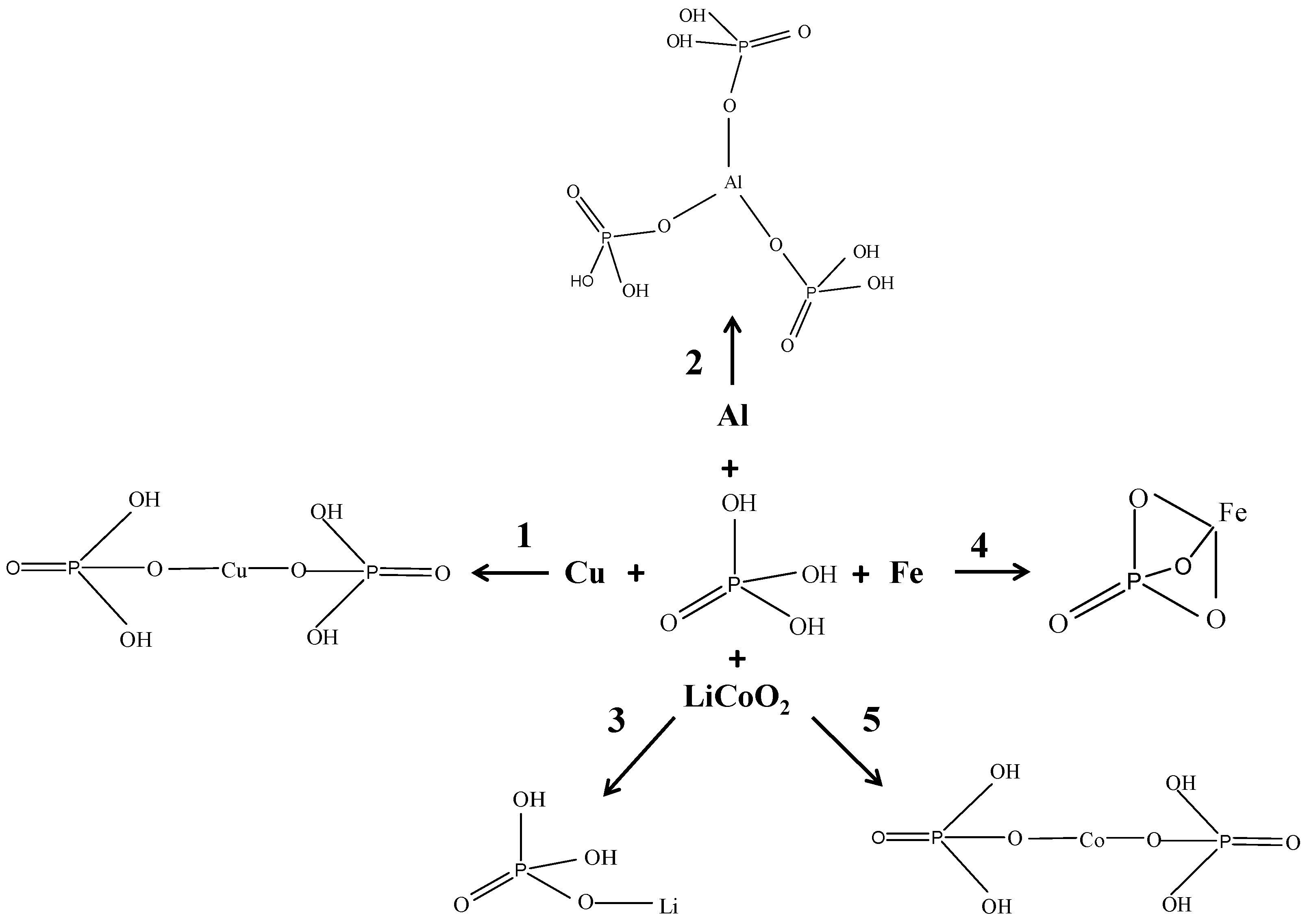
In the 2.0 mol/L strong acid medium, the leaching sequence of metal ions followed the order Cu > Al~Li > Fe > Co (Figure 10), collectively determined by Ea, lnA, ionic properties (hydration energy, radius), and product characteristics. Although Cu2+ exhibited the highest Ea, it leached first due to its exceptionally high lnA, indicating an extremely effective collision frequency in phosphoric acid medium. The similar leaching rates of Al3+ and Li+ resulted from their comparable Ea and lnA values. Notably, despite its higher charge, Al3+ demonstrated considerable mobility in phosphoric acid owing to its smaller ionic radius. The relatively low Ea values for Fe3+ and Co2+ correlate with their formation of insoluble phosphates (FePO4 and Co3(PO4)2), which create dense passivation layers on particle surfaces. These layers introduce significant diffusion resistance, ultimately limiting leaching rates despite the lower activation energies. Our findings reveal a critical structure–activity relationship: metal ions forming soluble phosphate salts exhibit rapid leaching kinetics because the soluble products can readily depart from the reaction interface, thereby preventing passivation and maintaining high interfacial reaction driving forces. However, Li+ does not demonstrate priority leaching in this strongly acidic system, necessitating pre-removal of impurity ions to enhance Li+ selectivity in practical applications.

3.3. Proposed Recovery Process

After leaching, both leaching solution and leaching residues/products were obtained, and the Li+ enriched leaching solution and Li+ and Co2+ enriched solution were obtained in mild acidic medium (0.8 mol/L) and higher acid concentration medium (2.0 mol/L), respectively. Then, oxalic acid (H2C2O4) was added to above leaching solutions for the precipitation of valuable metals and regeneration of phosphoric acid. As a typical organic acid, H2C2O4 can be ionized into H+, HC2O4, and C2O42− with stronger acidity than H3PO4 in aqueous. Therefore, H3PO4 can be simultaneously regenerated during the precipitating of Li+ and Co2+ as Li2C2O4 and CoC2O4. Relevant chemical reactions are listed as follows:
H2C2O4 (aq) = H+ (aq) + HC2O4 (aq)  pKa1 = 1.27
HC2O4 (aq) = H+(aq) + C2O42− (aq)  pKa2 = 4.27
2LiH2PO4 (aq) + H2C2O4 (aq) = Li2C2O4 (s) + 2H3PO4 (aq)
Co(H2PO4)2 (aq) + H2C2O4 (aq) = CoC2O4 (s) + 2H3PO4 (aq)
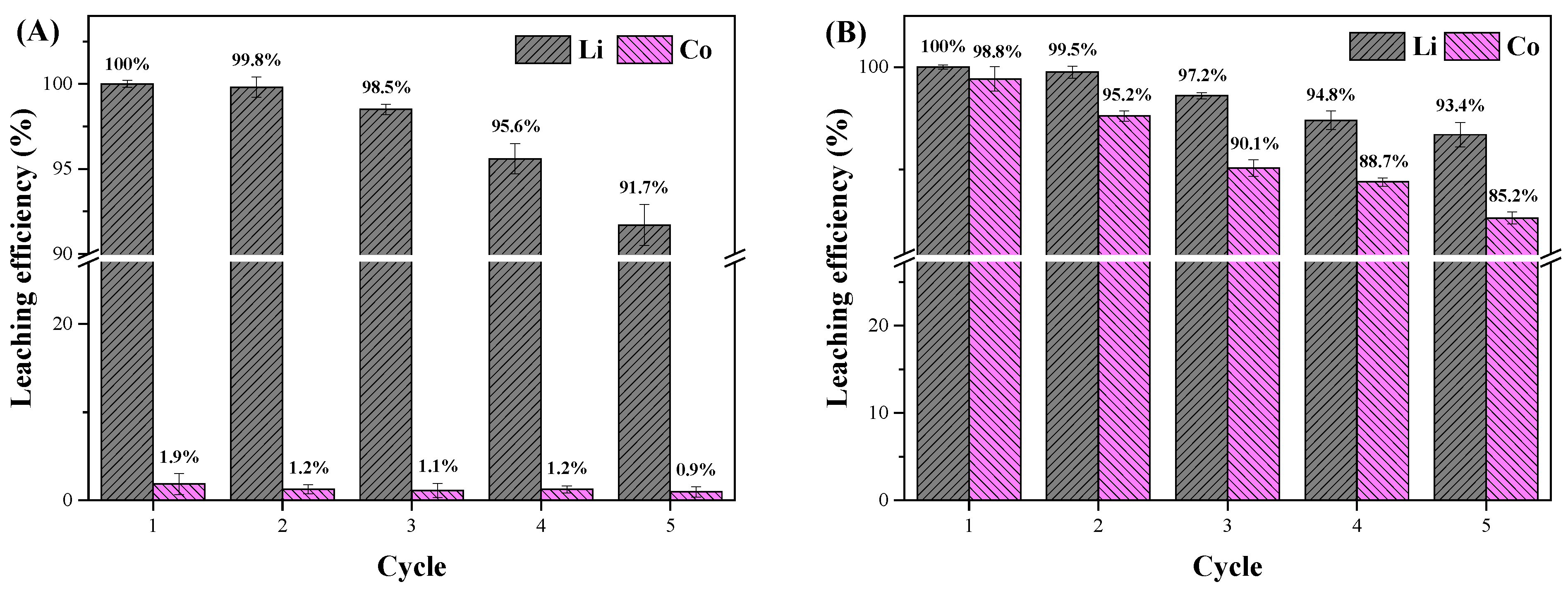
After precipitating, Li+ and Co2+ were recovered as their precipitates formed, and regenerated H3PO4 was used as leaching reagent for circulating leaching of waste LiCoO2 powders under the optimized leaching conditions (4 vol.% H2O2, 60 °C, 60 min, 20 mL/g, and acid concentration 0.8 mol/L or 2.0 mol/L). According to the circulatory leaching results illustrated in Figure 11A, the leaching ability of regenerated phosphoric acid demonstrated a gradual attenuation from Cycle 1 to Cycle 5, and leaching efficiencies for Li and Co were 91.7% and 0.9% in Cycle 5. Despite the leaching efficiency of Li experiencing a gradual reduction across the leaching cycle, which may have been caused by the loss of phosphoric acid during the formation of Co3(PO4)2 in mild acidic medium, the leaching efficiency of Co always stayed at a fairly low level. This indicates that regenerated phosphoric acid can still be treated as a leaching reagent for the selective leaching of Li from waste LiCoO2. Calculating the pH and phosphate ion concentration, we found that supplementing with 2% fresh acid can counteract the decline in leaching ability of the recycled acid, allowing the used leaching reagent to still be considered effective. In Figure 11B, the leaching efficiencies of Co and Li show a gradual decline with the proceeded leaching cycle. Almost 100% Co and Li was leached in Cycle 1 and the leaching rates for Co and Li fell to 93.4% and 85.2% in Cycle 5. The declined leaching efficiencies of Li and Co may be attributed to incomplete precipitating of Li+ and Co2+, and insufficient leaching ability of LiH2PO4 and Co(H2PO4)2. Therefore, further investigation for the optimization of leaching replacement reactions may be required to achieve optimal leaching efficiencies for Co and Li.

3.4. Environmental Impact and Economic Evaluation

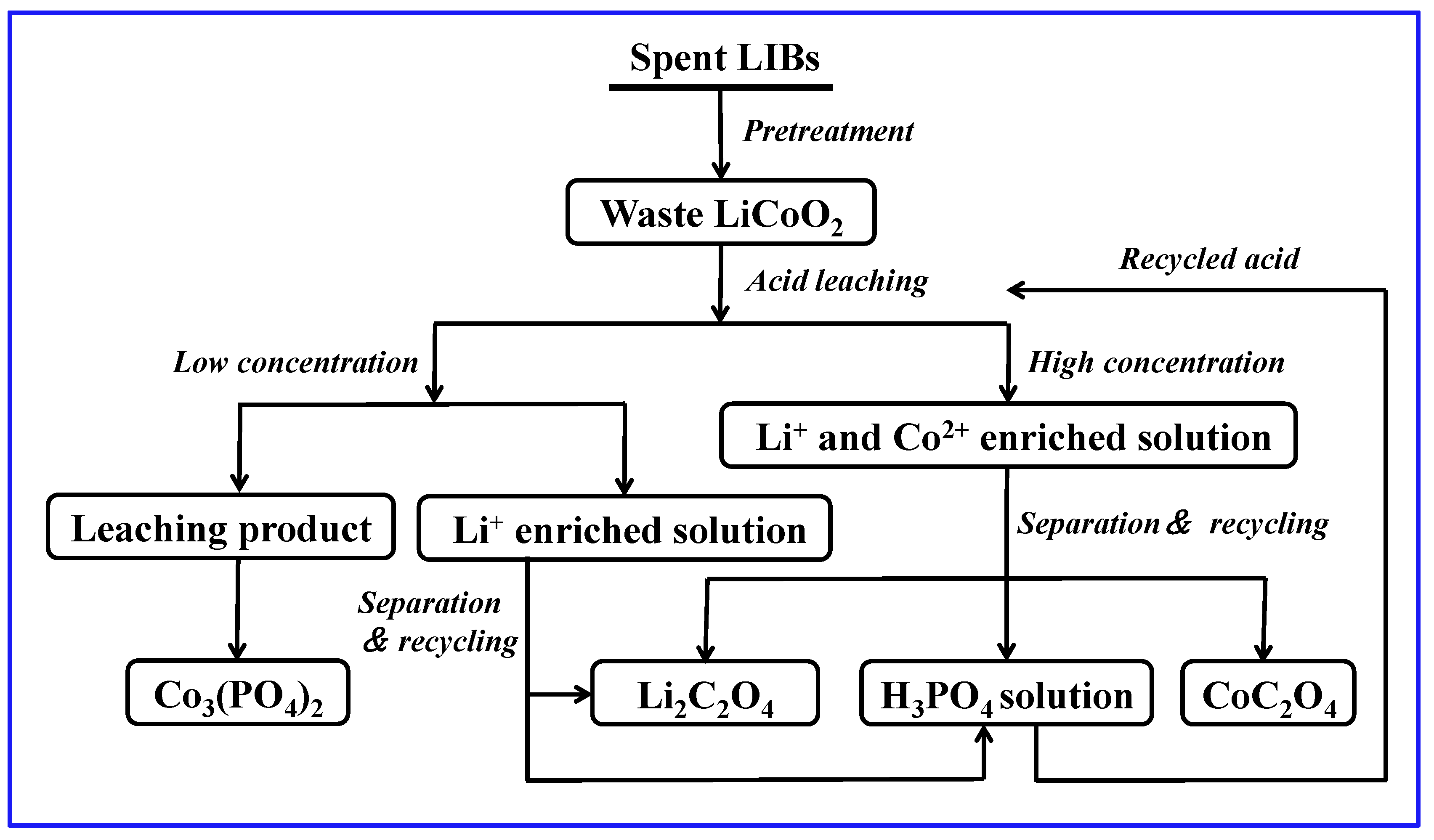
In this work, a hydrometallurgical process for the recovery of Co and Li from spent LIBs under different acidic media (see Figure 12) is proposed. To assess the environmental impact of different recycling processes, we compared the proposed method with reported technologies for recycling LIBs (Table S4). It was observed that, compared to heat treatment (700 °C, 600 min) and organic solvent dissolution (70 °C, 90 min), this method requires a lower reaction temperature (60 °C) and a shorter retention time (60 min), which greatly reduces energy consumption. In addition, phosphoric acid is regenerated during the recovery of Li and can be reused in circulating leaching process. However, valuable metals can be completely dissolved in higher concentrations of phosphoric acid, and Co and Li can be selectively and sequentially precipitated as CoC2O4 and Li2C2O4. Simultaneously, phosphoric acid is regenerated during the precipitating reactions and the regenerated acid can be reused as leaching reagent.
Furthermore, reagent costs in this study were evaluated and compared with other processes to confirm feasibility and potential recycling profits (Table S5). A treatment sample of 1.0 kg of spent LIBs was selected, and the types, dosages, and prices of chemicals were discussed. It was found that the costs of reagents using ionic liquid (USD 402.3), organic solvents (USD 10.37), and molten salts were much higher than that in this study (USD 4.56). It can be concluded from the whole recovery process that valuable metals can be recovered as a shortcut or efficient way with high recovery efficiencies, as well as fitting the requirement of atomic economy and circular economy.

4. Conclusions

In this study, a hydrometallurgical process is proposed for the selective recovery of metals from spent LIBs. Comprehensive work in terms of selective leaching of valuable metals, recovery of different metals from real waste stream, leaching kinetics, and circulating leaching was conducted to explore the leaching behaviors of different metals. Based on the above experimental and theoretical results, the following conclusions can be obtained:
(a) For the recovery of valuable metals, 100% Li can be selectively extracted from waste LiCoO2 of spent LIBs in a short-cut way under mild acidic medium (0.8 mol/L H3PO4), while Li and Co illustrate a complete dissolution in high acid concentration of 2.0 mol/L H3PO4 under optimized leaching conditions. Different leaching behaviors of Co and Li in different acidic media indicate that they can be selectively recovered based on the concentration of phosphoric acid;
(b) It can be concluded from leaching results and reaction kinetics of different metals that Li, Co, Cu, Al, and Fe demonstrate different leaching behaviors during the leaching reactions in different acidic media, and the leaching of different metals is controlled by chemical reaction. The leaching reactions for different metals indicated an order of Li > Cu~Co > Fe > Al and Cu > Al~Li > Fe > Co in 0.8 mol/L H3PO4 and 2.0 mol/L H3PO4, respectively.
(c) The circulating leaching results reveal that valuable metals and phosphoric acid can be simultaneously precipitated and regenerated by the addition of oxalic acid to leaching solutions; 91.7% Li and 0.9% Co were leached in mild acidic medium, and 93.4% Li and 85.2% Co were dissolved in 2.0 mol/L H3PO4 after five leaching cycles, indicating that Li and Co in different acidic media can be selectively precipitated as oxalate while the regenerated acid may be used as leaching reagent.

Supplementary Materials

The following supporting information can be downloaded at: https://www.mdpi.com/article/10.3390/su17177862/s1. The chart information of the supplementary materials is as follows: Table S1: The main detecting instruments and measure methods in this work. Table S2: Leaching results for Co and Li from waste LiCoO2. Table S3: Leaching results for different metals from waste LiCoO2. Table S4: Environmental benefits assessment of separation process in different studies. Table S5: Economic assessment of separation process in different studies. Figure S1: Manual dismantling steps of spent LIBs (A: The spent LIBs after discharged; B: Remove the plastic shell; C: Release electrolyte; D, E, F: Mechanical peeling of positive and negative; G: Positive and negative current collector; H: The film between the positive and negative components). Figure S2: Peeling off the Al and Cu foils from the cathode and anode active materials (A: Positive and negative current collector; B: The cathode active material substance after peeling; C: Cu-foil; D: Al-foil). Figure S3: Optimized leaching results for Co, Li, Fe, Al and Cu under their optimized experimental conditions.

Author Contributions

L.G.: Writing—original draft, Visualization, Validation, Methodology, Investigation, Formal Analysis, Data Curation, Conceptualization. Z.C.: Writing—original draft, Visualization, Validation, Methodology, Investigation, Formal Analysis, Data Curation. Y.G.: Visualization, Validation, Conceptualization, Investigation, Formal Analysis. C.C.: Visualization, Validation, Software. Y.W.: Visualization, Validation. X.C.: Writing—review and editing, Visualization, Validation, Supervision, Software, Resources, Project Administration, Methodology, Funding acquisition, Formal Analysis, Data Curation, Conceptualization. All authors have read and agreed to the published version of the manuscript.

Funding

This work was financially supported by the National Natural Science Foundation of China (52074177), Science and Technology Innovation Program of Hunan Province (2023RC3129), Natural Science Foundation of Hunan Province (2023JJ20031), National Students’ Platform for Innovation and Entrepreneurship Training Program(S20241054204). All the authors also appreciate editor(s) and anonymous reviewer(s) with gratitude for their professional comments and constructive suggestions.

Institutional Review Board Statement

Not applicable.

Informed Consent Statement

Not applicable.

Data Availability Statement

The original contributions presented in this study are included in the article. Further inquiries can be directed to the corresponding author.

Conflicts of Interest

The authors declare no conflict of interest.

References

  1. Yu, L.; Bai, Y.; Polzin, B.; Belharouak, I. Unlocking the Value of Recycling Scrap from Li-Ion Battery Manufacturing: Challenges and Outlook. J. Power Sources 2024, 593, 233955. [Google Scholar] [CrossRef]
  2. El Kharbachi, A.; Zavorotynska, O.; Latroche, M.; Cuevas, F.; Yartys, V.; Fichtner, M. Exploits, Advances and Challenges Benefiting beyond Li-Ion Battery Technologies. J. Alloys Compd. 2020, 817, 153261. [Google Scholar] [CrossRef]
  3. Zhu, Z.; Jiang, T.; Ali, M.; Meng, Y.; Jin, Y.; Cui, Y.; Chen, W. Rechargeable Batteries for Grid Scale Energy Storage. Chem. Rev. 2022, 122, 16610–16751. [Google Scholar] [CrossRef]
  4. Qiao, W.; Zhang, R.; Wen, Y.; Wang, X.; Wang, Z.; Tang, G.; Liu, M.; Kang, H.; Said, Z.; Hwang, J.-Y.; et al. Green Solvents in Battery Recycling: Status and Challenges. J. Mater. Chem. A 2024, 12, 11235–11265. [Google Scholar] [CrossRef]
  5. Sederholm, J.G.; Li, L.; Liu, Z.; Lan, K.-W.; Cho, E.J.; Gurumukhi, Y.; Dipto, M.J.; Ahmari, A.; Yu, J.; Haynes, M.; et al. Emerging Trends and Future Opportunities for Battery Recycling. ACS Energy Lett. 2025, 10, 107–119. [Google Scholar] [CrossRef]
  6. Tran, M.K.; Rodrigues, M.-T.F.; Kato, K.; Babu, G.; Ajayan, P.M. Deep Eutectic Solvents for Cathode Recycling of Li-Ion Batteries. Nat. Energy 2019, 4, 339–345. [Google Scholar] [CrossRef]
  7. Mao, J.; Ye, C.; Zhang, S.; Xie, F.; Zeng, R.; Davey, K.; Guo, Z.; Qiao, S. Toward Practical Lithium-Ion Battery Recycling: Adding Value, Tackling Circularity and Recycling-Oriented Design. Energy Environ. Sci. 2022, 15, 2732–2752. [Google Scholar] [CrossRef]
  8. Chen, Q.; Lai, X.; Hou, Y.; Gu, H.; Lu, L.; Liu, X.; Ren, D.; Guo, Y.; Zheng, Y. Investigating the Environmental Impacts of Different Direct Material Recycling and Battery Remanufacturing Technologies on Two Types of Retired Lithium-Ion Batteries from Electric Vehicles in China. Sep. Purif. Technol. 2023, 308, 122966. [Google Scholar] [CrossRef]
  9. Ciez, R.E.; Whitacre, J.F. Examining Different Recycling Processes for Lithium-Ion Batteries. Nat. Sustain. 2019, 2, 148–156. [Google Scholar] [CrossRef]
  10. Chen, X.; Wang, Y.; Yuan, L.; Wang, S.; Yan, S.; Liu, H.; Xu, J. Microthermal Catalytic Aerogenesis of Renewable Biomass Waste Using Cathode Materials from Spent Lithium-Ion Batteries towards Reversed Regulated Conversion and Recycling of Valuable Metals. Green Chem. 2023, 25, 1559–1570. [Google Scholar] [CrossRef]
  11. Chang, D.; Yang, S.; Shi, P.; Jie, Y.; Hu, F.; Fang, G.; Chen, Y. Selective Recovery of Lithium and Efficient Leaching of Transition Metals from Spent LiNixCoyMnzO2 Batteries Based on a Synergistic Roasting Process. Chem. Eng. J. 2022, 449, 137752. [Google Scholar] [CrossRef]
  12. Zhu, X.; Li, Y.; Gong, M.; Mo, R.; Luo, S.; Yan, X.; Yang, S. Recycling Valuable Metals from Spent Lithium-Ion Batteries Using Carbothermal Shock Method. Angew. Chem. Int. Ed. 2023, 62, e202300074. [Google Scholar] [CrossRef]
  13. Zhou, Y.; Chen, Z.; Chen, A.; Zhang, J.; Wu, X.; Xu, J. Comprehensive Recovery of NCM Cathode Materials for Spent Lithium-Ion Batteries by Microfluidic Device. Sep. Purif. Technol. 2022, 294, 121185. [Google Scholar] [CrossRef]
  14. Luo, Y.; Ou, L.; Yin, C. Extraction of Precious Metals from Used Lithium-Ion Batteries by a Natural Deep Eutectic Solvent with Synergistic Effects. Waste Manag. 2023, 164, 1–8. [Google Scholar] [CrossRef]
  15. Shin, J.; Jeong, J.-M.; Lee, J.B.; Heo, N.S.; Kwon, H.; Kim, Y.H.; Ryu, T. Recovery of Lithium from LiAlO2 in Waste Box Sagger through Sulfation to Produce Li2SO4 and Sequential Wet Conversion to Li3PO4, LiCl and Li2CO3. Hydrometallurgy 2023, 215, 105988. [Google Scholar] [CrossRef]
  16. Lin, T.; Liang, J.; Jin, S.; Mu, D.; Sun, S.; Liu, C.; Ning, Y.; Song, J.; Zhao, L.; Dai, C. A High-Efficiency and Low-Carbon Strategy for Selective Lithium Recovery from Spent Lithium-Ion Batteries: Combining Mechanochemical Activation with Biomass Reduction Roasting. Sep. Purif. Technol. 2024, 338, 126458. [Google Scholar] [CrossRef]
  17. Wang, M.-M. Recycling of Spent Lithium-Ion Battery with Polyvinyl Chloride by Mechanochemical Process. Waste Manag. 2017, 67, 232–239. [Google Scholar] [CrossRef]
  18. Yu, Y.; Jiang, S.; Yao, Y.; Zhang, X.; Zhang, L.; Li, J.; Wang, F.; Liu, X.; Huang, W.; Chen, D. Mechanochemical Ball Milling Achieves Green and Ultrahighly Efficient Recycling of Lithium-Ion Batteries. Environ. Sci. Technol. 2025, 59, 12352–12363. [Google Scholar] [CrossRef]
  19. Mahandra, H.; Hein, G.; Faraji, F.; Ghahreman, A. A Novel Neutrophilic Bacteria Based Process for Selective LiFePO4 Cathode Recycling. Resour. Conserv. Recycl. 2023, 195, 107015. [Google Scholar] [CrossRef]
  20. Chen, S.; Wang, X.; Li, H.; Xiutao, G.; Fan, Y.; Yan, Y.; Guo, Z.; He, H.; Long, H. Optimizing Lithium Recovery from Artificial β-Spodumene Slags: A Breakthrough in Pyrometallurgical Processing of Spent Lithium-Ion Batteries. J. Environ. Chem. Eng. 2025, 13, 117291. [Google Scholar] [CrossRef]
  21. Pagliaro, M.; Meneguzzo, F. Lithium Battery Reusing and Recycling: A Circular Economy Insight. Heliyon 2019, 5, e01866. [Google Scholar] [CrossRef]
  22. Liu, M.; Pan, X.; Sun, X.; Kim, H.C.; Shen, W.; De Castro Gomez, D.; Wu, Y.; Zhang, S. Lithium-Ion Battery Recycling: Bridging Regulation Implementation and Technological Innovations for Better Battery Sustainability. Environ. Sci. Technol. 2024, 58, 21385–21388. [Google Scholar] [CrossRef]
  23. Chen, X.; Chen, Y.; Zhou, T.; Liu, D.; Hu, H.; Fan, S. Hydrometallurgical Recovery of Metal Values from Sulfuric Acid Leaching Liquor of Spent Lithium-Ion Batteries. Waste Manag. 2015, 38, 349–356. [Google Scholar] [CrossRef]
  24. Svetkina, O.Y.; Koveria, A.S.; Ovcharenko, A.O.; Tarasova, H.V.; Panteleieva, O.S. Development of a Scheme for the Utilisation of Spent Lithium-Ion Batteries by Bioleaching. J. Chem. Technol. 2023, 31, 590–600. [Google Scholar] [CrossRef]
  25. Li, H.; Chen, Y.; Cui, Z.; Su, Y.; Liu, Z.; Dong, X.; Wang, Z.L.; Tang, W. One-Step Green Hydrometallurgical Recycling of Spent Lithium-Ion Batteries’ Cathode. J. Hazard. Mater. 2025, 484, 136769. [Google Scholar] [CrossRef]
  26. Refly, S.; Floweri, O.; Mayangsari, T.R.; Sumboja, A.; Santosa, S.P.; Ogi, T.; Iskandar, F. Regeneration of LiNi1/3Co1/3Mn1/3O2 Cathode Active Materials from End-of-Life Lithium-Ion Batteries through Ascorbic Acid Leaching and Oxalic Acid Coprecipitation Processes. ACS Sustain. Chem. Eng. 2020, 8, 16104–16114. [Google Scholar] [CrossRef]
  27. Paul, S.; Shrotriya, P. Efficient Recycling Processes for Lithium-Ion Batteries. Materials 2025, 18, 613. [Google Scholar] [CrossRef]
  28. Granata, G.; Moscardini, E.; Pagnanelli, F.; Trabucco, F.; Toro, L. Product Recovery from Li-Ion Battery Wastes Coming from an Industrial Pre-Treatment Plant: Lab Scale Tests and Process Simulations. J. Power Sources 2012, 206, 393–401. [Google Scholar] [CrossRef]
  29. Li, L.; Chen, R.; Sun, F.; Wu, F.; Liu, J. Preparation of LiCoO2 Films from Spent Lithium-Ion Batteries by a Combined Recycling Process. Hydrometallurgy 2011, 108, 220–225. [Google Scholar] [CrossRef]
  30. Li, J.; Li, X.; Hu, Q.; Wang, Z.; Zheng, J.; Wu, L.; Zhang, L. Study of Extraction and Purification of Ni, Co and Mn from Spent Battery Material. Hydrometallurgy 2009, 99, 7–12. [Google Scholar] [CrossRef]
  31. Chen, X.; Ma, H.; Luo, C.; Zhou, T. Recovery of Valuable Metals from Waste Cathode Materials of Spent Lithium-Ion Batteries Using Mild Phosphoric Acid. J. Hazard. Mater. 2017, 326, 77–86. [Google Scholar] [CrossRef] [PubMed]
  32. Chen, X.; Fan, B.; Xu, L.; Zhou, T.; Kong, J. An Atom-Economic Process for the Recovery of High Value-Added Metals from Spent Lithium-Ion Batteries. J. Clean. Prod. 2016, 112, 3562–3570. [Google Scholar] [CrossRef]
  33. Li, L.; Lu, J.; Ren, Y.; Zhang, X.X.; Chen, R.J.; Wu, F.; Amine, K. Ascorbic-Acid-Assisted Recovery of Cobalt and Lithium from Spent Li-Ion Batteries. J. Power Sources 2012, 218, 21–27. [Google Scholar] [CrossRef]
  34. Li, L.; Ge, J.; Chen, R.; Wu, F.; Chen, S.; Zhang, X. Environmental Friendly Leaching Reagent for Cobalt and Lithium Recovery from Spent Lithium-Ion Batteries. Waste Manag. 2010, 30, 2615–2621. [Google Scholar] [CrossRef]
  35. Li, L.; Qu, W.; Zhang, X.; Lu, J.; Chen, R.; Wu, F.; Amine, K. Succinic Acid-Based Leaching System: A Sustainable Process for Recovery of Valuable Metals from Spent Li-Ion Batteries. J. Power Sources 2015, 282, 544–551. [Google Scholar] [CrossRef]
  36. Zeng, X.; Li, J.; Shen, B. Novel Approach to Recover Cobalt and Lithium from Spent Lithium-Ion Battery Using Oxalic Acid. J. Hazard. Mater. 2015, 295, 112–118. [Google Scholar] [CrossRef]
  37. Li, L.; Dunn, J.B.; Zhang, X.X.; Gaines, L.; Chen, R.J.; Wu, F.; Amine, K. Recovery of Metals from Spent Lithium-Ion Batteries with Organic Acids as Leaching Reagents and Environmental Assessment. J. Power Sources 2013, 233, 180–189. [Google Scholar] [CrossRef]
  38. Nayaka, G.P.; Pai, K.V.; Santhosh, G.; Manjanna, J. Recovery of Cobalt as Cobalt Oxalate from Spent Lithium Ion Batteries by Using Glycine as Leaching Agent. J. Environ. Chem. Eng. 2016, 4, 2378–2383. [Google Scholar] [CrossRef]
  39. He, L.P.; Sun, S.Y.; Mu, Y.Y.; Song, X.F.; Yu, J.G. Recovery of Lithium, Nickel, Cobalt, and Manganese from Spent Lithium-Ion Batteries Using l-Tartaric Acid as a Leachant. ACS Sustain. Chem. Eng. 2017, 5, 714–721. [Google Scholar] [CrossRef]
  40. Chen, X.; Li, J.; Kang, D.; Zhou, T.; Ma, H. A Novel Closed-Loop Process for the Simultaneous Recovery of Valuable Metals and Iron from a Mixed Type of Spent Lithium-Ion Batteries. Green Chem. 2019, 21, 6342–6352. [Google Scholar] [CrossRef]
  41. Li, L.; Bian, Y.; Zhang, X.; Guan, Y.; Fan, E.; Wu, F.; Chen, R. Process for Recycling Mixed-Cathode Materials from Spent Lithium-Ion Batteries and Kinetics of Leaching. Waste Manag. 2018, 71, 362–371. [Google Scholar] [CrossRef] [PubMed]
  42. Xue, J.; Zhong, H.; Wang, S.; Li, C.; Li, J.; Wu, F. Kinetics of Reduction Leaching of Manganese Dioxide Ore with Phytolacca Americana in Sulfuric Acid Solution. J. Saudi Chem. Soc. 2016, 20, 437–442. [Google Scholar] [CrossRef]
  43. Zhou, X. One-Step Selective Separation and Efficient Recovery of Valuable Metals from Mixed Spent Lithium Batteries in the Phosphoric Acid System. Waste Manag. 2023, 155, 53–64. [Google Scholar] [CrossRef] [PubMed]
Figure 1. Optimization of leaching conditions for cobalt and lithium: (A) amount of reductant hydrogen peroxide, (B) leaching temperature, (C) residence time, (D) slurry density.
Sustainability 17 07862 g001
Figure 2. Effect of acid concentration on leaching of Co and Li in acidic media of (A) 0.8 mol/L and (B) 2.0 mol/L phosphoric acid (reductant dosage 4 vol.% H2O2, leaching temperature 60 °C, retention time 60 min, and pulp density 20 mL/g).
Sustainability 17 07862 g002
Figure 3. Analytical results of SEM-EDS for pure Co3(PO4)2 (A) and leaching product (B).
Sustainability 17 07862 g003
Figure 4. XRD patterns of waste LiCoO2, leaching residues, and leaching product.
Sustainability 17 07862 g004
Figure 5. FT-IR spectra of waste LiCoO2, leaching product, and pure Co3(PO4)2 powders.
Sustainability 17 07862 g005
Figure 6. XPS spectra of waste LiCoO2 (A) Li 1s, (C) Co 2p, (E) O 1s, XPS spectra of leaching product (Acidic media 0.8 mol/L H3PO4, reductant dosage 4 vol.% H2O2, leaching temperature 60 °C, retention time 60 min, pulp density 20 mL/g). (B) Li 1s, (D) Co 2p, (F) O 1s.
Sustainability 17 07862 g006
Figure 7. Leaching kinetics for Co, Li, Al, Cu, and Fe in different leaching concentrations (reductant dosage 4 vol.% H2O2, liquid-to-solid ratio 20 mL/g, 60 °C, and acid concentration 0.8 mol/L (A) and 2.0 mol/L (B)).
Sustainability 17 07862 g007
Figure 8. Arrhenius plots for the leaching of different metals (reductant dosage 4 vol.% H2O2, liquid-to-solid ratio 20 mL/g, and acid concentration 0.8 mol/L (A) and 2.0 mol/L (B)).
Sustainability 17 07862 g008
Figure 9. Leaching reaction order of different metals from real spent LIBs in mild acid medium (0.8 mol/L).
Sustainability 17 07862 g009
Figure 10. Leaching reaction order of different metals from real spent LIBs in acid concentration of 2.0 mol/L.
Sustainability 17 07862 g010
Figure 11. Circulatory leaching results for Co and Li under conditions of reductant dosage—4 vol.% H2O2, leaching temperature—60 °C, retention time—60 min, pulp density—20 mL/g and acid concentration 0.8 mol/L (A) or 2.0 mol/L (B).
Sustainability 17 07862 g011
Figure 12. Flow chart of proposed hydrometallurgical recovery process for the selective recovery of valuable metals from spent lithium-ion batteries.
Sustainability 17 07862 g012
Table 1. A brief summary of different leaching systems.
Type of AcidLeaching ReagentLeaching ConditionLeaching RateRef.
Mineral acid Sulfuric acid (1 mol/L)95 °C, 20 g/L, 240 min96% Li, 91% Co, 96% Ni, and 88% Mn[28]
Nitric acid (1 mol/L)75 °C, 20 g/L, 60 min95% Li and 95% Co[29]
Hydrochloric acid (6 mol/L)60 °C, 8 g/L, 120 min95% Ni, Co, and Mn[30]
Phosphoric acid (0.7 mol/L)40 °C, 50 g/L, 60 min99% Co and Li[31]
Organic acidCitric acid (1.5 mol/L)80 °C, 20 g/L, 120 min99% Li, 92% Co, 91% Ni, and 94% Mn[32]
Ascorbic acid (1.25 mol/L)70 °C, 25 g/L, 20 min98% Li and 94% Co[33]
Malic acid (1.5 mol/L)90 °C, 20 g/L, 40 min100% Li and 90% Co[34]
Succinic acid (1.5 mol/L)70 °C, 15 g/L, 40 min96% Li and 100% Co[35]
Oxalic acid (1 mol/L)95 °C, 15 g/L, 150 min98% Li and 97% Co[36]
Aspartic acid (1.5 mol/L)90 °C, 20 g/L,120 min60% Li and 60% Co[37]
Glycine (0.5 mol/L)80 °C, 20 g/L, 360 min95% Co[38]
L-Tartaric acid (2 mol/L)70 °C, 17 g/L, 30 min99% Mn, 99% Li, 98% Co, and 99% Ni[39]
Disclaimer/Publisher’s Note: The statements, opinions and data contained in all publications are solely those of the individual author(s) and contributor(s) and not of MDPI and/or the editor(s). MDPI and/or the editor(s) disclaim responsibility for any injury to people or property resulting from any ideas, methods, instructions or products referred to in the content.