Article

Forest Biomass Estimation of Linpan in Western Sichuan Using Multi-Source Remote Sensing

by
Jiaming Lai
1,2,
Yuxuan Lin
1,
Yan Lu
1,
Mingdi Yue
3 and
Gang Chen
1,4,*
1
College of Forestry, Sichuan Agricultural University, Chengdu 611130, China
2
Forest Ecology and Conservation in the Upper Reaches of the Yangtze River Key Laboratory of Sichuan Province, Chengdu 611130, China
3
Sichuan Forestry and Grassland Survey and Planning Institute (Sichuan Forestry and Grassland Ecological Environment Monitoring Center), Chengdu 610084, China
4
Sichuan Mt. Emei Forest Ecosystem National Observation and Research Station, Chengdu 611130, China
*
Author to whom correspondence should be addressed.
Sustainability 2025, 17(17), 7855; https://doi.org/10.3390/su17177855
Submission received: 13 May 2025 / Revised: 12 August 2025 / Accepted: 26 August 2025 / Published: 31 August 2025

Abstract

Linpan ecosystems, distinct to western Sichuan, China, are integral to regional biodiversity and carbon cycling. However, comprehensive biomass estimation for these systems has not been thoroughly investigated. This study seeks to fill this gap by enhancing the accuracy and precision of biomass estimation in these ecologically vital landscapes through the application of multi-source remote sensing techniques, specifically by integrating the strengths of optical and radar remote sensing data. The focus of this research is on the forest biomass of Linpan, encompassing the tree layer, which includes the trunk, branches, leaves, and underground roots. Specifically, the research focused on the Linpan ecosystems in the Wenjiang District of western Sichuan, utilizing an integration of Sentinel-1 SAR, Sentinel-2 multispectral, and GF-2 high-resolution data for multi-source remote sensing-based biomass estimation. Through the preprocessing of these data, Pearson correlation analysis was conducted to identify variables significantly correlated with the forest biomass as determined by field surveys. Ultimately, 19 key modeling factors were selected, including band information, vegetation indices, texture features, and phenological characteristics. Subsequently, three algorithms—multiple stepwise regression (MSR), support vector machine (SVM), and random forest (RF)—were employed to model biomass across mixed-type, deciduous broadleaved, evergreen broadleaved, and bamboo Linpan. The key findings include the following: (1) Sentinel-2 spectral data and Sentinel-1 VH backscatter coefficients during the summer, combined with vegetation indices and texture features, were critical predictors, while phenological indices exhibited unique correlations with biomass. (2) Biomass displayed a marked north–south gradient, characterized by higher values in the south and lower values in the north, with a mean value of 161.97 t ha−1, driven by dominant tree species distribution and management intensity. (3) The RF model demonstrated optimal performance in mixed-type Linpan (R2 = 0.768), whereas the SVM was more suitable for bamboo Linpan (R2 = 0.892). The research suggests that integrating multi-source remote sensing data significantly enhances Linpan biomass estimation accuracy, offering a robust framework to improve estimation precision.

1. Introduction

Forests represent one of the most essential ecosystems on Earth, playing a pivotal role in global material and energy cycles [1]. Located in the upper reaches of the Yangtze and Yellow Rivers, Sichuan Province functions as a critical water conservation area and hydrological recharge zone [2]. The ecosystem services provided by forests in this region are of strategic importance for maintaining national ecological security. The rapid urbanization occurring in the Chengdu Plain has compromised ecosystem stability, thereby highlighting the enhancement of ecological resilience as a crucial issue for regional sustainable development. Serving as the primary repository of forest resources in this area, Linpan (traditional agroforestry systems), characterized as agricultural or cultural landscapes dispersed from peri-urban to rural areas, possesses significant biomass potential [3]. Forest biomass encompasses the total dry matter produced by a forest plant community throughout its lifespan [4]. It includes three primary components: the biomass of the tree layer, the biomass of the living groundcover layer (comprising the shrub, herb, moss, and lichen layers), and the biomass of animals and microorganisms. As a critical indicator for assessing the productivity and ecological functions of forest ecosystems [4], forest biomass reflects the aggregate quantity of organisms and their energy storage within a specific forest area. This metric not only elucidates the dynamic processes of forest ecosystems, such as energy balance, nutrient cycling, and productivity, but it also indicates the robustness of ecosystem functioning. This is particularly pertinent in the context of global climate change and carbon emission reduction, where forests serve as significant carbon sinks. The biomass quantity directly influences carbon storage and release processes. Accurate estimation of forest biomass and its temporal changes is essential for enhancing our understanding of the global carbon cycle and for mitigating the uncertainties in carbon emission estimations resulting from anthropogenic activities or natural disturbances [5]. Therefore, it not only serves as a vital parameter for evaluating integrated ecosystems but also acts as an indispensable “source” and “sink” in the pursuit of Sichuan’s carbon neutrality objectives.
Over the past two decades, research on the values associated with Linpan has predominantly concentrated on its ecological and landscape significance, as well as its protection and development, pattern characteristics, evolution, and driving forces. Nonetheless, there is a notable paucity of studies addressing the assessment and quantification of Linpan’s carbon storage capabilities. To date, only Liu et al. [6] have employed the sample plot estimation method to investigate the carbon sequestration benefits of Linpan within Pidu County, Sichuan, China. While the plot inventory method is renowned for its precision in biomass calculation, it is hindered by lengthy inventory cycles, challenges in large-scale application, and potential ecological disruption. The combined impacts of urbanization and natural disasters have led to a “hollowing-out” phenomenon in the Linpan settlements of western Sichuan. The resultant landscape fragmentation has rendered traditional forest biomass surveys exceedingly challenging, thereby necessitating the development of more rapid, accurate, and efficient biomass estimation techniques. The remote sensing data estimation method offers several advantages, including its capacity to cover large spatial scales, provide real-time updates, maintain long time series, and operate non-destructively. This method presents a novel approach for achieving large-scale and long-term dynamic biomass monitoring. Synthetic Aperture Radar (SAR) data is particularly valuable as it can capture vertical structural information of forest stands and remains unaffected by cloud cover and weather conditions. In contrast, optical remote sensing data provides extensive time series and rich multispectral information. Nevertheless, both methods have limitations. Open-source SAR data is constrained by a short time series and is prone to radar factor oversaturation. Conversely, optical remote sensing data is characterized by mixed types and a lack of datasets that simultaneously offer high resolution, long time series, and comprehensive multispectral characteristics. Consequently, the exploration of biomass inversion through the interaction, integration, and complementarity of multi-source remote sensing data has emerged as a prominent research focus in contemporary forestry biomass estimation. For instance, Banskota et al. [7] compared the effects of single-source remote sensing data and multi-source remote sensing data on forest biomass in the Appomattox-Buckingham State Forest, VA, USA. The results showed that the forest biomass estimation model obtained by combining Synthetic Aperture Radar data and lidar data had the highest accuracy, while the accuracy of forest biomass models constructed using single data sources was relatively low. Amini et al. [8] integrated JERS-1/SAR, AVNIR-2, and PRISM data to estimate forest aboveground biomass in northern Iran, achieving a significant improvement in accuracy.
This study focused on Linpan in western Sichuan with the aim of developing biomass quantitative inversion models that are adaptable to complex terrains. Biomass models were constructed by integrating Sentinel-1 SAR data, Sentinel-2 multispectral data, GF-2 panchromatic and multispectral data, and field sample measurements. By synergistically combining the spectral information from optical remote sensing with the penetration capabilities of radar remote sensing, the issue of information saturation can be effectively mitigated, thereby enhancing estimation accuracy. Methodologically, we conducted a comparative analysis of the applicability differences between linear and nonlinear modeling approaches and assessed the predictive efficiencies of various algorithms in heterogeneous forest landscapes. By examining the intrinsic correlations between Linpan biomass and multi-source remote sensing data, this research elucidated the spatiotemporal distribution patterns and spatiotemporal dynamics of biomass. Consequently, it provides theoretical support for the scientific formulation of protective development strategies. The findings bear practical significance for maintaining the ecological barrier integrity in the Upper Yangtze River Basin.

2. Materials and Methods

2.1. Study Area Description

The study area is located in Wenjiang District, Chengdu City, Sichuan Province (103°41′–103°55′ E, 30°36′–30°52′ N), covering a total area of 277 km2. It exhibits a distinct broom-shaped spatial pattern characterized by an elongated north–south axis and a narrow east–west span. Situated within the Minjiang River Alluvial Plain, Wenjiang District features flat terrain with no mountains or hills, and an elevation ranging from 511.3 m to 647.4 m. This district is classified within a subtropical humid climate zone, experiencing an average annual temperature of 16 °C, an average annual precipitation of 865.9 mm, and an average annual sunshine duration of 991.1 h. Furthermore, Wenjiang District serves as a central demonstration zone for the ecological restoration of Linpan landscapes in western Sichuan and is a pioneering area for the development of the initial series of new Linpan systems. The vegetation in the study area is predominantly artificial, including species such as Ginkgo biloba, Osmanthus fragrans, Phoebe zhennan, Cinnamomum camphora, Cinnamomum japonicum, Phoebe hui, Lagerstroemia indica, Platanus orientalis, Koelreuteria paniculata, Pterocarya stenoptera, and Neosinocalamus affinis.

2.2. Data Sources and Processing

2.2.1. Multi-Source Remote Sensing Data

(1) Sentinel-1 Synthetic Aperture Radar (SAR) data: Specifically, Ground Range Detected (GRD) level products in VV/VH polarization modes were utilized. The preprocessing of these images was conducted using SNAP software (version 9.0, European·Space·Agency, Frascati, Italy). Initially, radiometric calibration was performed employing the “Calibrate” module, utilizing the default “sigma0” settings. To ensure the accuracy of the experimental results, orbit correction was conducted by updating the orbit status information of the Sentinel-1 satellite in the metadata files using precise orbit files. Subsequently, thermal noise, which refers to the inherent noise of the SAR satellite system, was removed. To mitigate speckle noise, the Refined Lee filter with a window size of 7 × 7 was applied. Terrain correction was executed using the range–Doppler terrain correction method based on SRTM DEM data. Given the extensive transmission distance, the radar backscatter received by the receiver is typically a very small positive value. For ease of data analysis, this backscatter is converted to decibels (dB). Following the conversion to decibels, the study area is extracted. The formula for decibel conversion is as follows:
σ 0 d B = 10 × log 10 σ 0
(2) Multi-temporal Sentinel-2 Multispectral Data: The Sentinel-2 Level-2A multispectral data have been subjected to radiometric calibration and atmospheric correction. The primary processing of these images was conducted using ENVI software (version 5.6, L3Harris·Geospatial, Broomfield, CO, USA). Given that the dataset comprises 13 spectral bands with varying resolutions, specific bands were selected for resampling based on experimental requirements. Specifically, bands B2, B3, B4, and B8 with a 10 m resolution, along with bands B5, B6, B7, B8a, B11, and B12 with a 20 m resolution, were resampled using cubic convolution interpolation to achieve a consistent 10-band, 10 m resolution dataset. Due to the study area’s coverage of multiple scenes, all data were resampled to this uniform resolution and subsequently mosaicked. In this experiment, surface reflectance was employed to derive vegetation characteristics, which were obtained through the calibration of digital number (DN) values. The apparent reflectance data were converted to surface reflectance following atmospheric correction.
(3) GF-2 Panchromatic/Multispectral Data: The GF-2 satellite, recognized as China’s first independently developed civil optical remote sensing satellite with a spatial resolution exceeding 1 m, was utilized in this study. Image processing was predominantly conducted using the ENVI 5.6 software suite. Radiometric calibration of the GF-2 images was achieved through the radiometric calibration tool available in ENVI 5.6. Furthermore, atmospheric correction was performed using the FLAASH module within ENVI 5.6 to enhance the precision of vegetation information identification. Orthorectification was executed using the ENVI Control Point Free Rectification module to address terrain and systematic geometric distortions, resulting in the production of orthoimages. Geometric correction was accomplished by referencing the coordinates of ground control points collected within the study area. Pixel-level image fusion was conducted to integrate multispectral and panchromatic images of the GF-2 using ENVI 5.6. Subsequently, the three fused GF-2 images were mosaicked, and the resulting mosaic was clipped according to the administrative boundary vector data of the study area.

2.2.2. Field Survey Data and Processing

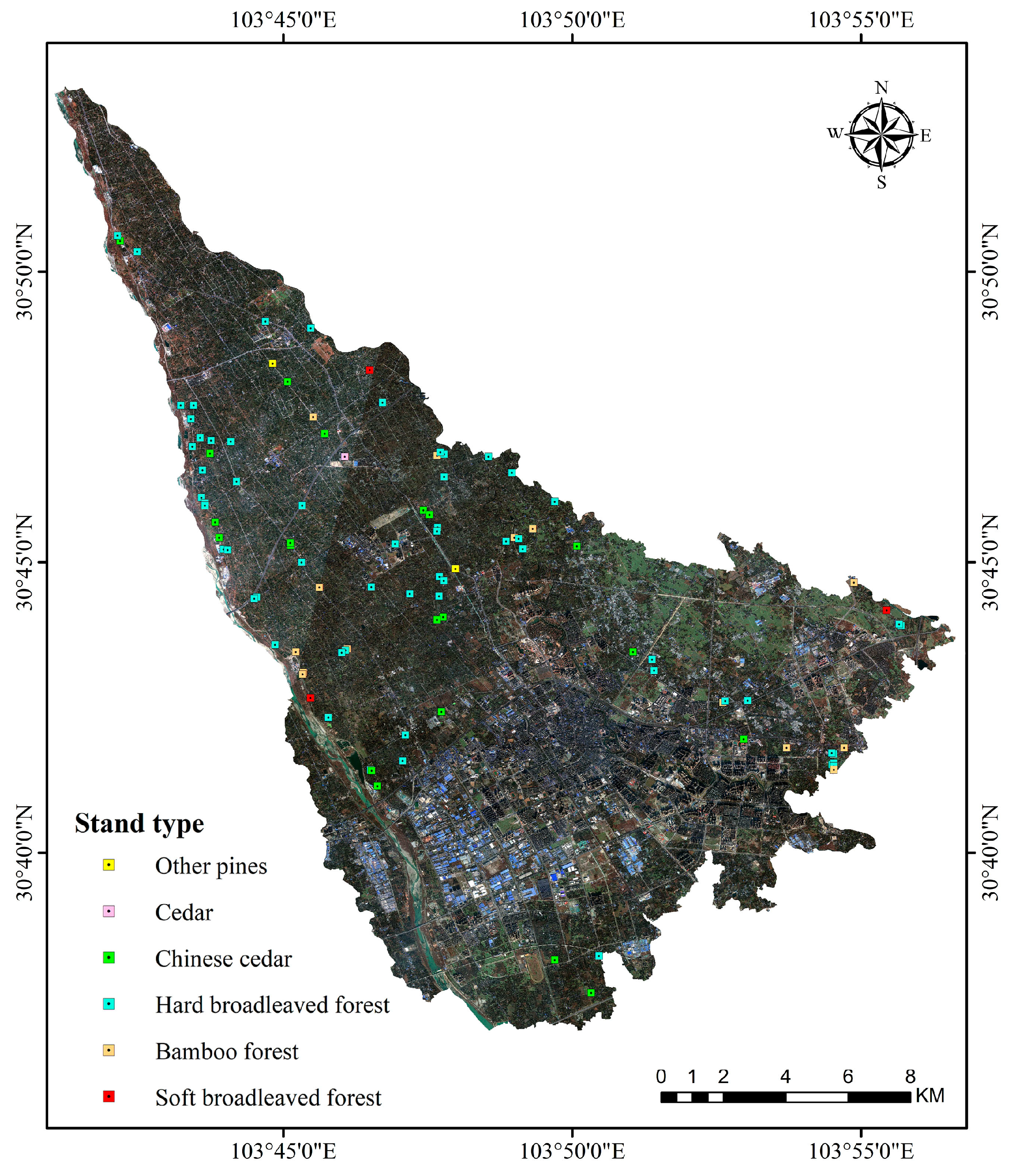
Guided by remote sensing imagery, field surveys were conducted in late March 2023 to systematically collect forest community structural parameters and spatial distribution characteristics of Linpan types. The survey identified dominant tree species in the study area, including Osmanthus fragrans, Phoebe zhennan, Phoebe hui, Cinnamomum camphora, Ginkgo biloba, and Nyssa affinis, while Metasequoia glyptostroboides and Podocarpus macrophyllus occurred rarely. Sample plots (20 m × 20 m) were systematically designed according to the ecological characteristics of the dominant species, resulting in a total of 101 plots categorized into six stand types: Chinese cedar, soft broadleaved forest, hard broadleaved forest, bamboo forest, cedar, and other pines (Figure 1). In alignment with the characteristics of Linpan [6], these stands were further classified into three Linpan types: deciduous broadleaf Linpan, evergreen broadleaf Linpan, and bamboo Linpan. The center coordinates of each plot were recorded using Real-Time Kinematic (RTK) GPS technology. Within each plot, measurements of diameter at breast height (DBH) and tree height were conducted for all individual trees with a DBH of at least 5 cm and a height of at least 5 m, as well as for bamboo Linpan with a DBH of at least 2 cm.

2.2.3. Biomass Data Processing

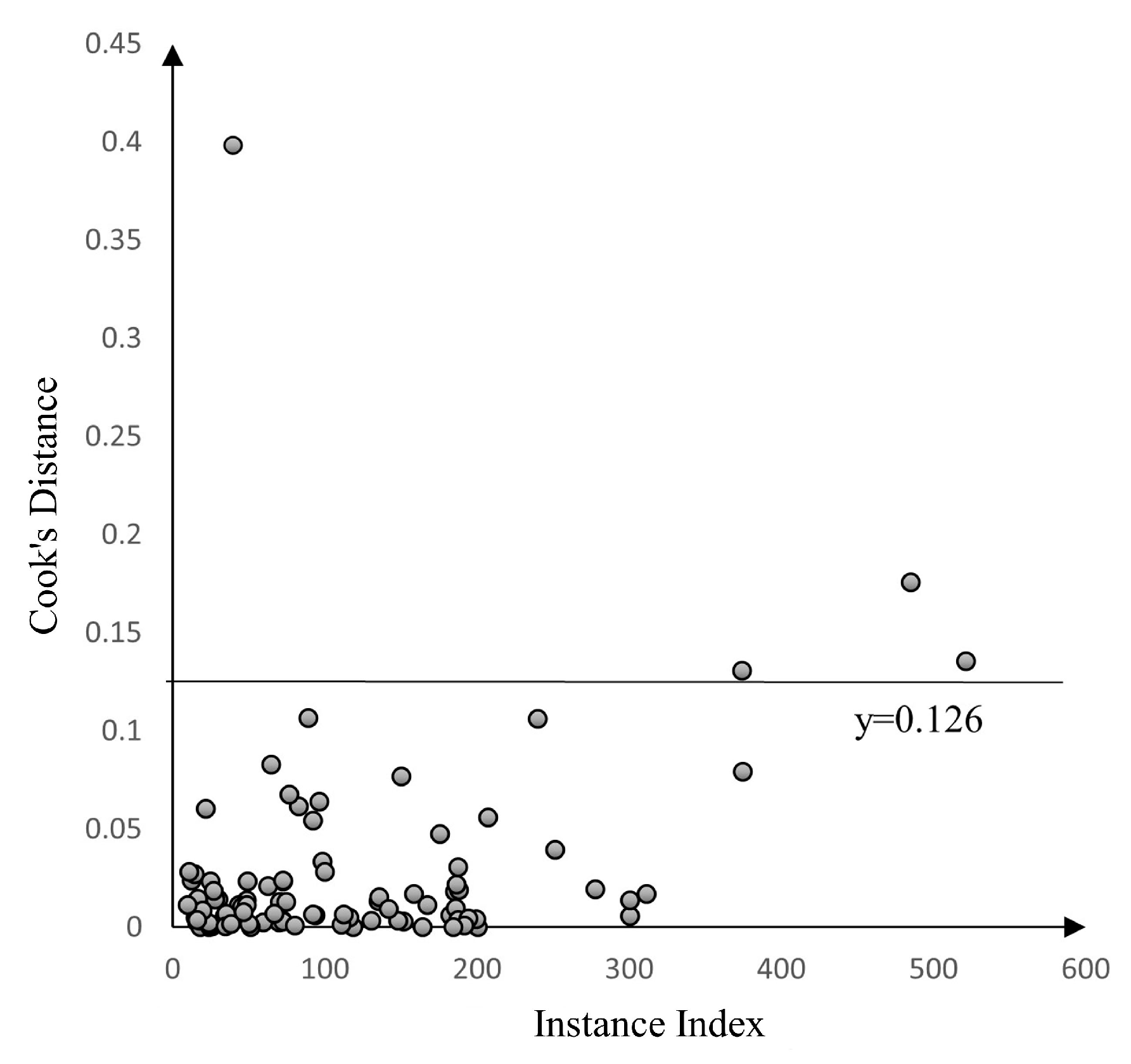
Through an analysis of multi-source data, an initial collection of 101 plot biomass datasets was obtained. Subsequent image verification identified discrepancies in 5 plots, attributed to changes in land-use types observed in GF-2 imagery, necessitating their exclusion. Further refinement involved the identification and removal of multivariate outliers using Cook’s distance method. The range of acceptable values was delineated using the average Cook’s distance (0.026) and twice the standard deviation of Cook’s distance (0.05). As illustrated in Figure 2, the solid line at y = 0.126 represents the upper threshold of acceptable values, leading to the removal of four outliers (Figure 2), resulting in 92 statistically representative plots suitable for model construction. In this study, the forest biomass of Linpan refers to the stand biomass, specifically the biomass contained within the tree layer of the stand under the same stand type. The fresh mass of stems, branches, and leaves was determined using the sectional cutting method, while root systems were excavated employing the random quartering technique [9]. Distinct methodologies were employed for calculating tree and bamboo biomass. Tree biomass was estimated using a regression model that correlates forest stock volume with forest biomass. The forest stock volume was determined using a binary volume formula specific to each tree species, based on measurements of tree height and diameter at breast height. This approach was developed by Huang et al. [9] for application in Sichuan Province. Bamboo biomass was calculated using a whole-plant biomass model, incorporating culm density and species-specific parameters for N. affinis [10].
Considering the intricate species composition within the Linpan regions of western Sichuan, vegetation was categorized into three distinct types: deciduous broadleaf Linpan, evergreen broadleaf Linpan, and bamboo Linpan. Nevertheless, the in situ plant communities demonstrated mixed-species characteristics. To address this complexity, a functional classification strategy was implemented, consolidating all plots under the category of mixed-type Linpan. Thus, the resulting dataset included 34 plots classified as deciduous broadleaf, 41 as evergreen broadleaf, 14 as bamboo, and 92 plots reclassified as mixed-type Linpan after functional consolidation (Table 1).

2.3. Research Methods

2.3.1. Feature Variable Extraction and Screening

Recent research on the inversion of forest biomass using remote sensing techniques extensively utilizes multi-dimensional spectral feature systems. These systems incorporate band information, vegetation indices, texture features, and backscattering coefficients as key factors for model inversion [11].
(1) Band Information (16 feature variables): This study involved the extraction of variables potentially influencing forest disk biomass from Sentinel-1 SAR data, multi-temporal Sentinel-2 multispectral data, and GF-2 multispectral data. Specifically, the extracted characteristic variables pertaining to single-band information from remotely sensed data include the VV and VH polarization data from Sentinel-1, as well as the blue, green, red, near-infrared, red-edge, and short-wave infrared bands from Sentinel-2, and the blue, green, red, and near-infrared bands from GF-2.
(2) Vegetation Indices (19 feature variables): Vegetation information is essential for representing vegetation in remote sensing image data. These indices are derived from the spectral differences observed in vegetation leaves and canopies [12], and are typically formulated by integrating the visible and near-infrared bands captured by remote sensing satellites. In this study, seven widely recognized vegetation index models—RVI, NDVI, DVI, GRVI, EVI, ARVI, and RBI—were computed utilizing the 12 characteristic variables of vegetation indices from Sentinel-2 data. Additionally, the spectral characteristics of the GF-2 data were incorporated, informed by existing research and applications of vegetation indices. The computation of these indices was performed using the BAND MATH module in ENVI 5.6.
(3) Texture Features (32 feature variables): Based on the GF-2 high-resolution data, the GF-2 panchromatic/multispectral images were extracted using the gray-level covariance matrix (GLCM) method. The extraction process utilized a 3 × 3 window and a step size of 1 × 1, resulting in the computation of eight texture statistical features: mean, variance, homogeneity, contrast, anisotropy, entropy, correlation, and second-order moments. To fully leverage the high resolution of the data and ensure no spectral bands were omitted, these eight GLCM variables were calculated and extracted for each of the four GF-2 high-resolution bands (blue, green, red, and near-infrared) [13,14].
(4) Phenological Characteristics (3 feature variables): The intra-annual variation in the NDVI in evergreen forests is relatively negligible [15]. A positive correlation exists between NDVI and temperature in Southwest China [16]. Consequently, the Sentinel-2 NDVI data (bands 4, 8) from 29 January 2023 was selected as the annual NDVI minimum (NDVIn), while the data from 5 July 2023 was chosen to represent the peak value of the growing season NDVI. This peak corresponds to the maximum NDVI value observed within a 96-day window before and after the NDVI maximum (NDVIx). The difference between these two values (NDVIx−n) is utilized to characterize the three climatic features as outlined in Formula (2):
N D V I x n = N D V I x N D V I n
In the given formula, a substantial difference in the NDVIx−n values suggests that the woodland is predominantly deciduous forest. Conversely, if the difference is minimal, it implies that the woodland is characterized by an evergreen forest. A mixed forest would exhibit characteristics that are intermediate between these two scenarios.
In this study, a total of 70 feature variables were acquired, categorized into band information, vegetation indices, texture features, and phenological characteristics. The systematic integration of multi-source data, including optical, SAR, and high-resolution datasets, encompassing multiple dimensions such as spectra, polarization, and texture, facilitated a comprehensive characterization of forest biomass dynamics [17,18]. The response intensity of these variables to biomass exhibited significant heterogeneity. To enhance model efficiency, a predictor optimization system was implemented. This system involved calculating the Pearson correlation coefficients between biomass and each feature variable, analyzing their correlation with Linpan biomass, and selecting feature variables with significant correlations for modeling. The Pearson correlation coefficient is mathematically characterized as the covariance (Cov) between variables “x” and “y”, normalized by the product of their respective standard deviations. This normalization process effectively removes any dependency on the scale of the variables (refer to Formulas (3) and (4)). Subsequent to the computation of the Pearson correlation coefficients, a two-tailed t-test was conducted to identify significantly correlated characteristic variables, with a significance threshold set at p ≤ 0.05. This threshold was employed to select predictor variables for the three distinct models used in the estimation of Linpan biomass.
C o v = i = 1 n x i x ¯ y i y ¯
r = C o r r x , y = C o v x , y δ x δ y = i = 1 n x i x ¯ y i y ¯ i = 1 n x i x ¯ 2 i = 1 n y i y ¯ 2

2.3.2. Model Construction and Accuracy Evaluation

Forest biomass inversion models were formulated by synthesizing remote sensing attributes with survey data. Two predictive frameworks were constructed: linear regression models, specifically multiple stepwise regression (MSR), and nonlinear models, including random forest (RF) and support vector machine (SVM). The specific modeling methods are as follows:
The MSR model was executed utilizing the IBM SPSS Statistics software (version 27, IBM Corp., Armonk, NY, USA) platform. Initially, biomass data along with various characteristic variables were imported into the system. Within the “Analysis” module, the “Linear Analysis” option under the “Regression” category was selected. The dependent and independent variables were explicitly defined, and a stepwise regression approach was employed for variable selection, culminating in the formulation of a predictive equation for Linpan biomass.
The SVM is a supervised machine learning technique commonly employed for addressing classification and regression tasks. The fundamental concept of SVM in the context of classification involves identifying a hyperplane within the feature space that effectively separates positive and negative samples while minimizing the rate of misclassification [19]. In this study, SVM was implemented using the scikit-learn (version 1.2.2) and NumPy (version 1.24.3) libraries in Python (version 3.9.16, Python Software Foundation, Wilmington, DE, USA), utilizing a polynomial kernel function. By adjusting the kernel degree and width parameter (gamma), and integrating the penalty coefficient (C) with kernel parameters optimized through cross-validation in libSVM (version 3.25), the optimal configuration was determined to be a degree of 2 and a gamma value of 0.99.
The RF algorithm constructs an ensemble of decision trees through a learning strategy that involves the generation of a “forest” of trees. This is achieved by employing bootstrap sampling to randomly extract n training subsets from the original dataset and by randomly selecting k feature variables for node splitting within each tree. Independent decision trees are then constructed based on these features, with each tree independently generating prediction outcomes. The final predictive model is determined by aggregating the outputs from all decision trees, thereby identifying the optimal model [20]. This study utilized the Python libraries scikit-learn and NumPy. The parameters, including the number of decision trees (n_estimators) and the maximum depth of each tree (max_depth), were fine-tuned using the random forest function library. The optimal parameters obtained were as follows: for deciduous broadleaved forest, n = 1000 and max_depth = 30; for evergreen broadleaved forest, n = 100 and max_depth = 30; and for bamboo forest, n = 1000 and max_depth = 50.
The efficacy of the three models was thoroughly evaluated using leave-one-out cross-validation, with performance metrics quantified by the coefficient of determination (R2) and root mean square error (RMSE) [21,22,23]. The mathematical formulations for R2 and RMSE are presented as follows:
R 2 = 1 y i y i ^ 2 y i y ¯ 2
R M S E = 1 N i = 1 N y i y i ^ 2
where y i represents the observed value, y i ^ denotes the estimated value, y ¯ is the mean of the observed values, and N signifies the total number of samples. A higher R2 value indicates a stronger correlation between the predicted and observed values, while a lower RMSE signifies improved predictive performance of the model.

2.3.3. Spatial Distribution Pattern Modeling of Linpan Biomass

To address the issue of vegetation diversity in the Linpan region, this study developed and implemented two methodological approaches—a normalized and a stratified forest biomass distribution pattern construction method—to construct models of spatial biomass distribution. A comparative analysis was performed to assess the differences in applicability of these approaches within Linpan ecosystems. In the normalized forest biomass distribution pattern construction method, a globally optimal model for mixed-type Linpan was consistently applied across the entire study area to generate a standardized biomass map across the study region. In contrast, the stratified biomass distribution pattern construction method involved the development of type-specific optimal models for deciduous broadleaf Linpan, evergreen broadleaf Linpan, and bamboo Linpan. Biomass values derived from corresponding Linpan types were integrated to produce a stratified biomass distribution pattern. This dual-pathway framework facilitates a systematic evaluation of model applicability under heterogeneous vegetation conditions while balancing computational efficiency with ecological accuracy.

3. Results

3.1. Screening of Feature Variables Based on Pearson Correlation

This study utilized Pearson correlation coefficients to assess the relationships between biomass and 70 feature variables across four types of Linpan. Variables deemed redundant were excluded based on significance thresholds, resulting in optimized modeling parameters. The principal findings were as follows:
(1) For mixed-type Linpan, Pearson correlation analyses identified 13 significant variables, including 4 with strong significance (p < 0.01): Sndvi48_1y (weak negative correlation, r = −0.269), b15_GF2_wen, Sndvix_n, and S1_VH (weak to moderate positive correlations, r = 0.269–0.338). An additional nine variables (e.g., ARVI, DVI) demonstrated moderate significance (p < 0.05), with only b1_GF2_wen and b17_GF2_wen showing positive correlations. Specific types of variables, such as S2_B1 for deciduous forest plots, are employed as supplementary predictive factors only when statistical significance is achieved (p < 0.05). For evergreen broadleaved trees, the sole characteristic variable that demonstrates a significant correlation with biomass is S1_VH. Table 2, Table 3, Table 4 and Table 5 present the results of the correlation analysis and the screening of modeling values for four types of forest plots. The selected variables included seven vegetation indices, five GF-2 texture features, and one Sentinel-1 polarization feature, highlighting the effectiveness of multi-source remote sensing parameters in estimating biomass.
(2) Deciduous Broadleaf Linpan: Five significant variables were identified (p < 0.05): b32_GF2_wen exhibited a negative correlation, while S2_B1, S2_B2, S2_B3, and S2_B5 demonstrated positive correlations (Table 3). Notably, 80% of these variables were derived from summer Sentinel-2 multispectral imagery, underscoring its effectiveness in biomass estimation for this vegetation type.
(3) Evergreen Broadleaf Linpan: Only S1_VH, sourced from Sentinel-1 radar data, displayed a strongly significant positive correlation (p < 0.01, r = 0.431) (Table 4).
(4) Bamboo Linpan: Three significant variables were identified: Sndvib78a showed a strong positive correlation (p < 0.01, r = 0.596), whereas b16_GF2_wen and S2_B1 exhibited strong negative correlations (p < 0.01, r = −0.557 and r = −0.617, respectively) (Table 5). Unlike other types, Sentinel-1 radar parameters did not demonstrate significant associations in this context.
Integration Strategy: Given the limited sample sizes for deciduous broadleaf, evergreen broadleaf, and bamboo Linpan, the 13 variables from mixed-type Linpan were utilized as baseline predictors. Type-specific variables (e.g., S2_B1 for deciduous Linpan) were incorporated as supplementary predictors for the respective models. Specific types of variables, such as S2_B1 for deciduous forest plots, are employed as supplementary predictive factors only when statistical significance is achieved (p < 0.05). For evergreen broadleaved trees, the sole characteristic variable that demonstrates a significant correlation with biomass is S1_VH. Table 2, Table 3, Table 4 and Table 5 present the results of the correlation analysis and the screening of modeling values for four types of forest plots.

3.2. Forest Biomass Inversion Model Construction

3.2.1. Mixed-Type Linpan

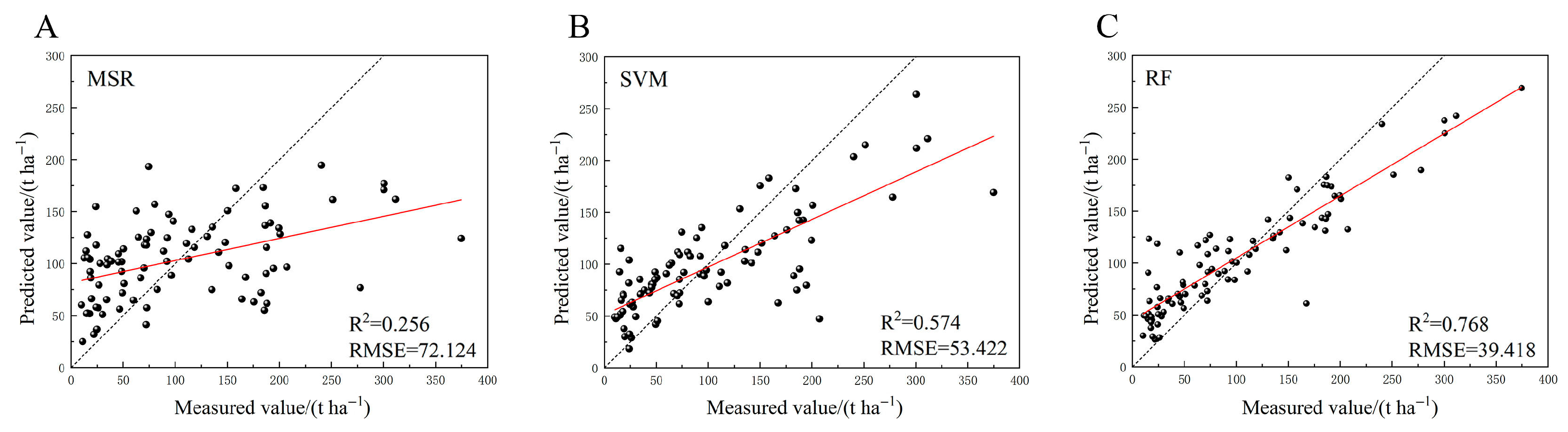
In this study, 13 predictor variables were applied to the biomass inversion performance of three models of the mixed-type Linpan—multiple stepwise regression (MSR), support vector machine (SVM), and random forest (RF). The statistical analysis indicated significant differences among the models: the coefficient of determination (R2) ranged from 0.256 to 0.768, while the root mean square error (RMSE) varied from 39.418 t ha−1 to 72.124 t ha−1 (Figure 3). An evaluation of the deviation between the fitted lines and the 1:1 diagonal, along with a comprehensive accuracy assessment, identified the RF model as the most effective. Its superior performance, indicated by the highest R2 and lowest RMSE values, demonstrates its high precision in estimating biomass within mixed-type Linpan ecosystems.

3.2.2. Deciduous Broadleaf Linpan

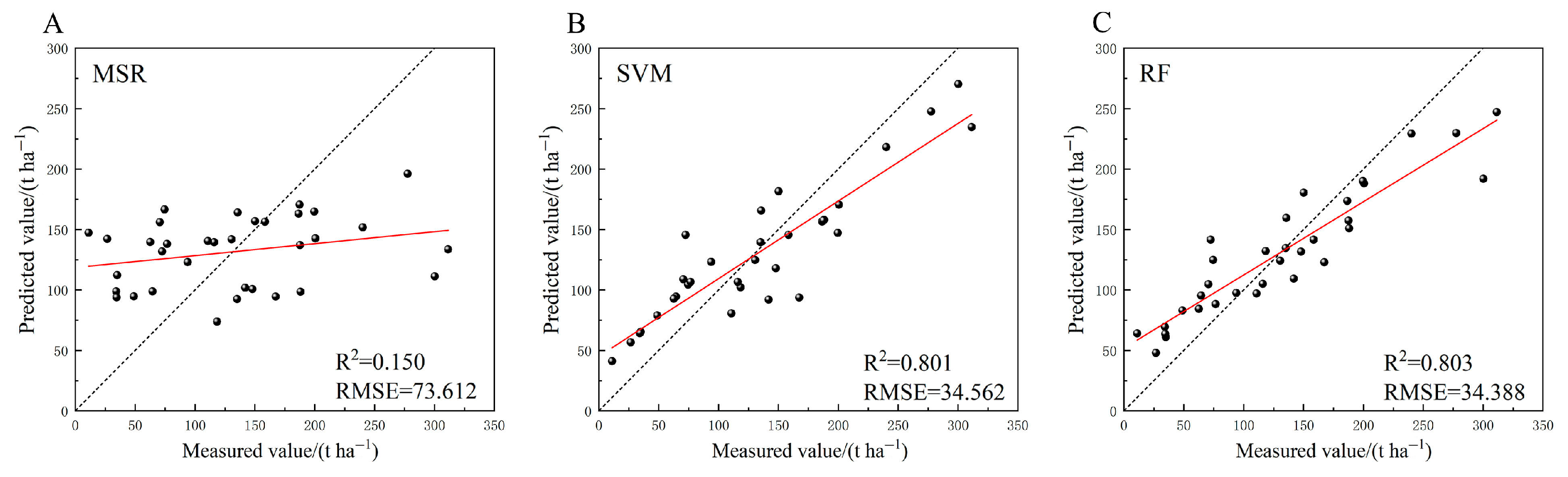
The RF model and the SVM model both yielded satisfactory inversion outcomes for this category (Figure 4), with the RF model demonstrating marginally superior performance compared to the SVM model. Specifically, the RF model attained an R2 of approximately 0.8 and an RMSE of approximately 34 t ha−1 (Figure 4B,C). In contrast, the MSR model displayed suboptimal performance, with an R2 value of less than 0.5 (Figure 4A).

3.2.3. Evergreen Broadleaf Linpan

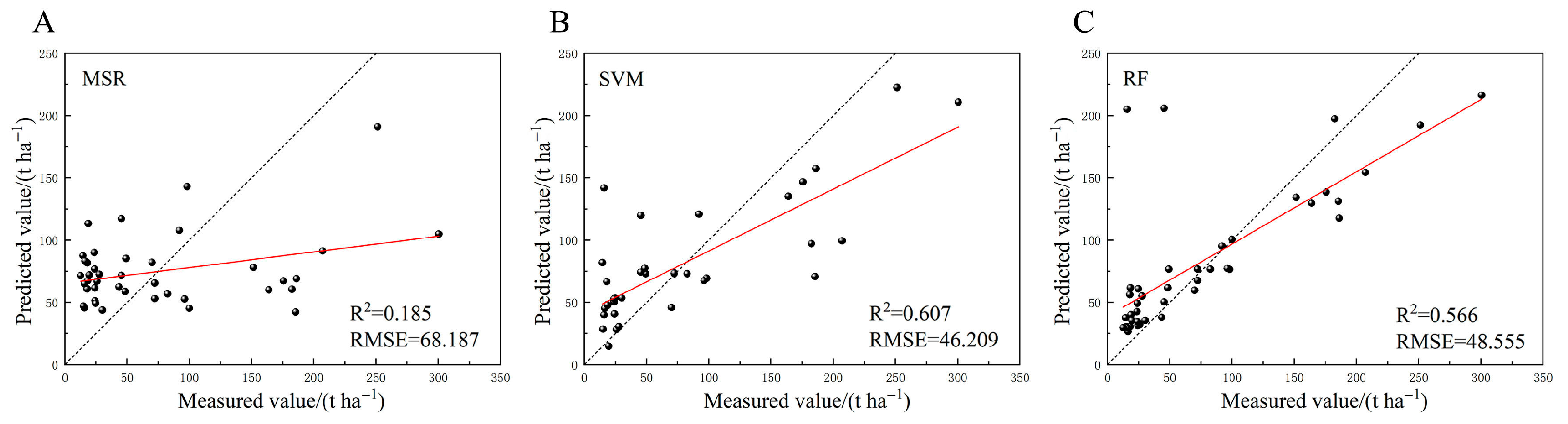
The MSR model exhibited the lowest accuracy, as evidenced by its fitted line being nearly parallel to the 1:1 diagonal, which indicated minimal predictive capability (Figure 5A). The SVM model demonstrated relatively high precision, with an R2 of 0.607 and an RMSE of 46.209 t ha−1. However, it systematically underestimated high-biomass samples while overestimating low-biomass samples (Figure 5B). The RF model displayed reduced accuracy, with an R2 of 0.566 and an RMSE of 48.555 t ha−1, and it occasionally produced extreme overestimations (Figure 5C).

3.2.4. Bamboo Linpan

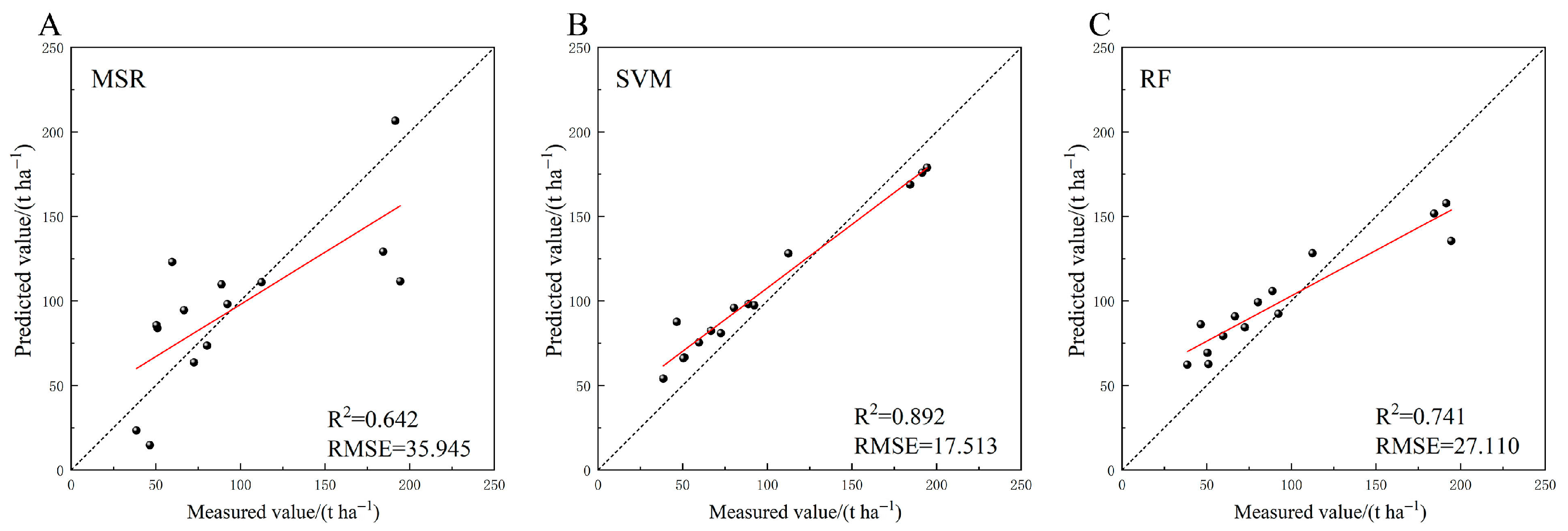
All three models demonstrated robust performance for bamboo Linpan (Figure 6), with R2 ranging from 0.642 to 0.892 and RMSE between 17.513 and 35.945 t ha−1 (Figure 6). The SVM model exhibited the highest goodness-of-fit, as evidenced by its regression line closely aligning with the 1:1 diagonal (Figure 6B). Although the RF and stepwise regression models were slightly less accurate than the SVM model, their prediction errors remained within acceptable limits, thereby affirming their practical applicability for estimating bamboo biomass (Figure 6A,C).

3.3. Spatial Distribution Patterns of Linpan Biomass

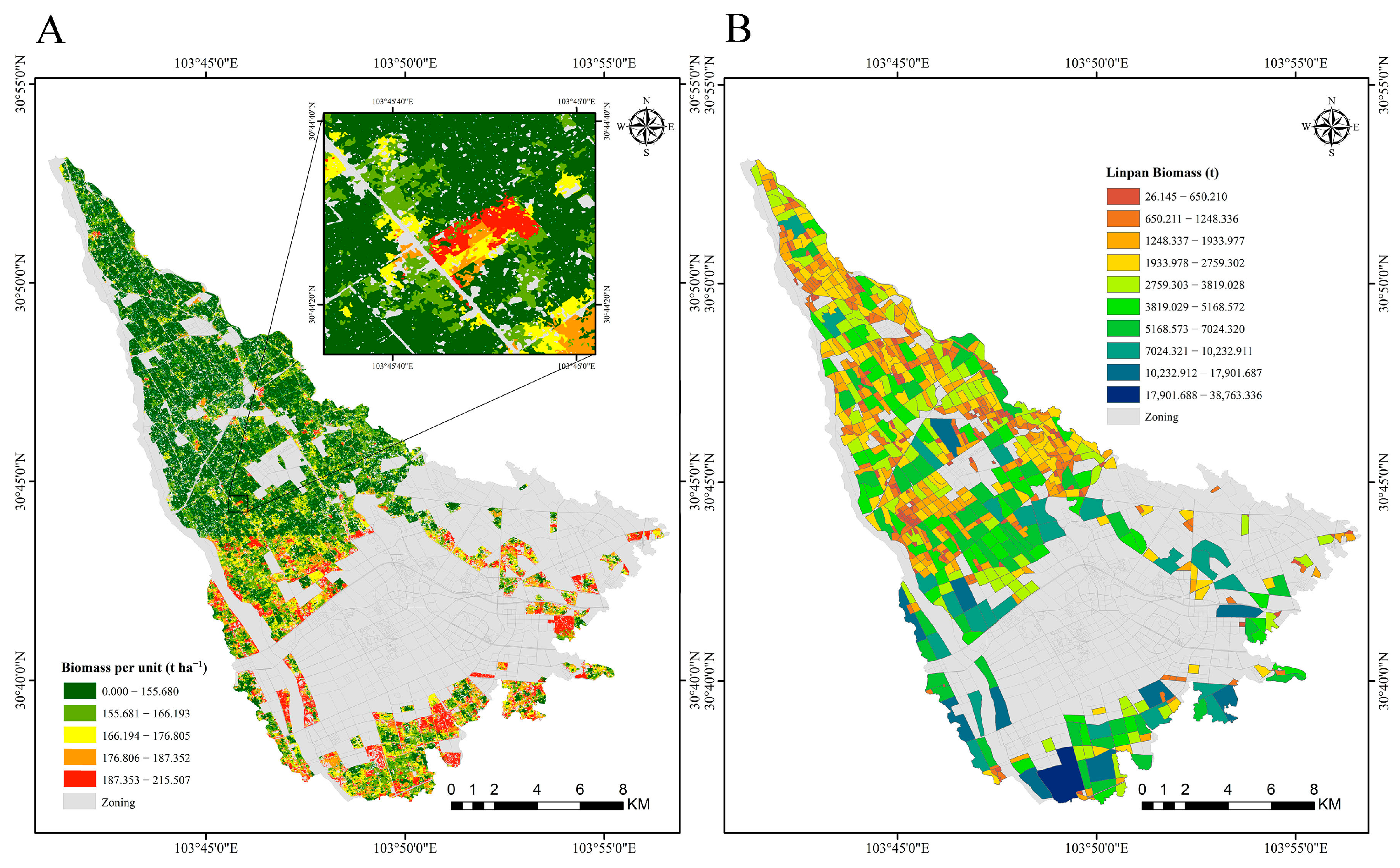
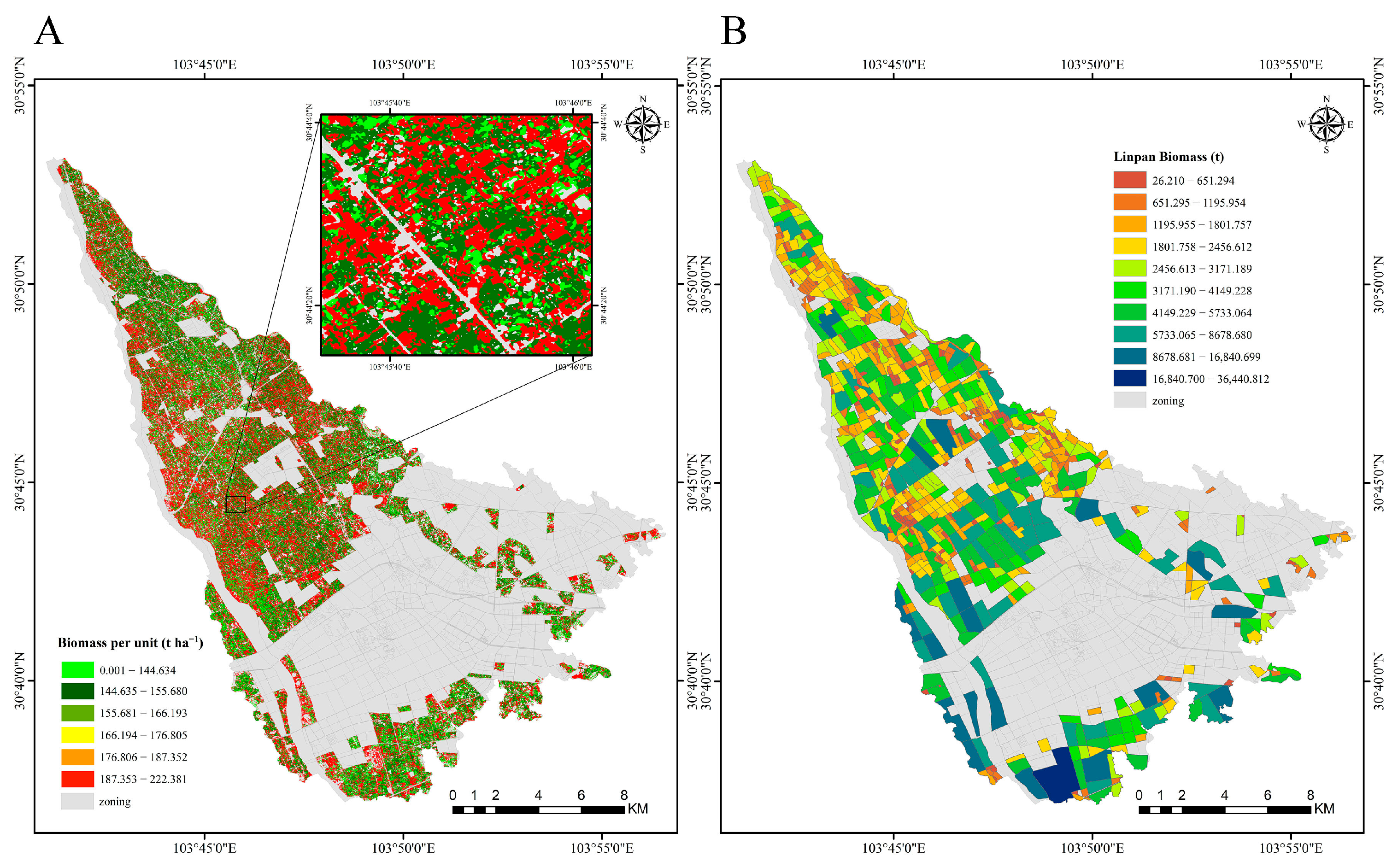
Figure 7 depicts the normalized distribution pattern of Linpan biomass, derived from the mixed-type Linpan model through regression analysis. Spatial analysis indicated a distinct “south-high, north-low” trend, with southern Linpan regions exhibiting higher biomass per unit area (Figure 7A) and higher biomass aggregation based on Linpan types (Figure 7B) compared to their northern counterparts. The mean biomass density across all Linpan types was approximately 161.97 t ha−1. Conversely, Figure 8 illustrates the stratified Linpan biomass distribution pattern, generated by integrating type-specific models (evergreen broadleaf, deciduous broadleaf, and bamboo Linpan) with RF-based Linpan classification results. The stratified method yielded an average biomass density of 151.68 t ha−1. The regions of high and low biomass demonstrated a balanced spatial distribution when analyzed using the stratified method. Concurrently, the spatial distribution trend closely corresponded with the “south-high, north-low” pattern of biomass distribution per unit area (Figure 8A) and the biomass aggregation based on Linpan types (Figure 8B), as observed through normalized methods (Figure 7). This concurrence offered dual confirmation of the spatial reliability of the findings. The slight variation in average biomass density observed between the two methodologies was likely attributable to the stratification model’s superior ability to account for ecological heterogeneity, especially in regions characterized by mixed vegetation structures. These findings underscore the significant function of southern Linpan as high-biomass reservoirs, thereby offering empirical evidence to inform targeted conservation strategies.

4. Discussion

4.1. Contributions of Multi-Source Remote Sensing Features to Biomass Estimation

This study utilized an integrative approach by employing Sentinel-1 SAR, Sentinel-2 multispectral, and GF-2 high-resolution data to extract a comprehensive set of 70 features, including spectral bands, vegetation indices, and texture metrics. The findings indicate that vegetation indices [24,25], such as the Normalized Difference Vegetation Index (NDVI), Ratio Vegetation Index (RVI), and Enhanced Vegetation Index (EVI), play a crucial role in biomass estimation due to their direct correlation with the spectral reflectance of forest canopies. This observation is consistent with the results reported by Lu et al. [26,27]. Furthermore, the pronounced correlation between Sentinel-1 VH polarization data and biomass underscores the sensitivity of radar data to vertical forest structures, which is particularly beneficial for biomass estimation in regions characterized by frequent cloud cover and precipitation, as corroborated by the studies of Solberg [28] and Naesset et al. [29]. The inclusion of GF-2 texture features, notably in the green band, was found to enhance model accuracy, thereby affirming their complementary role in biomass inversion, as supported by prior research [30,31]. Additionally, the observed significant correlation between phenological indices and biomass substantiates the hypothesis advanced by Yang [32] and Li et al. [33] that phenological traits are indicative of biomass dynamics.

4.2. Differential Impacts of Linpan Types on Model Accuracy

The types of Linpan vegetation had a substantial impact on the performance of the models. In the case of mixed-type Linpan, the random forest (RF) model demonstrated superior performance compared to the support vector machine (SVM) and multiple stepwise regression (MSR) models, which is attributed to its robustness in managing complex datasets with large sample sizes. In deciduous broadleaved forest plots, both the RF and SVM models exhibited strong predictive capabilities. The RF model (R2 = 0.803) demonstrated marginally superior performance compared to the SVM model, whereas the MSR model lagged significantly behind. This discrepancy may be attributed to the inability of a simple linear model to effectively capture the complex relationship between the biomass of deciduous broadleaved forest plots and the selected characteristic variables. Within evergreen broadleaf Linpan, although the SVM model yielded the most favorable outcomes, its accuracy was diminished (R2 = 0.566) due to pronounced canopy heterogeneity. Conversely, in bamboo Linpan, the SVM model exhibited exceptional performance (R2 = 0.892) as a result of the homogeneous characteristics of the samples, while the RF model and the MSR model also provided satisfactory precision.
The research findings demonstrate that the RF model and the SVM model generally surpass the MSR model in biomass estimation, as the latter inadequately addresses complex nonlinear relationships. Both the SVM model and the RF model effectively capture the nonlinear characteristics of stand biomass, with the advantage of the RF model being particularly pronounced in scenarios with high sample complexity. Overall, machine learning models, specifically the RF model and the SVM model, consistently outperform linear regression in modeling nonlinear relationships, corroborating the findings of Gleason et al. [34]. This highlights the superiority of nonlinear methodologies for biomass estimation in heterogeneous ecosystems [35,36,37]. Consequently, model selection should prioritize vegetation complexity and sample representativeness. However, since this study only used leave-one-out cross-validation, although it is computationally efficient, the potential spatial autocorrelation between adjacent plots may lead to an overly optimistic performance evaluation. The absence of spatial stratified cross-validation has thus constrained the accuracy of model precision assessment.

4.3. Biomass Estimation for Linpan in Western Sichuan

The spatial pattern of estimated biomass based on the normalized method (mean: 161.97 t ha−1) closely corresponded with field surveys, demonstrating a “south-high, north-low” distribution influenced by variations in species composition. The northern regions are predominantly occupied by Osmanthus fragrans and Ginkgo biloba, whereas the southern regions are characterized by the presence of Cinnamomum camphora, Phoebe hui, and Phoebe zhennan. Contrary to the widely accepted assumption that stratification guarantees higher accuracy, the enhanced performance of the normalized method may be attributed to its capacity to mitigate precision heterogeneity in type-specific models. The biomass estimate obtained in this study (161.97 t ha−1) is intermediate between the values reported for high-altitude forests in southwestern China [38] and mountain forest biomass for Sichuan [39], and it closely aligns with the regional assessments by Wu et al. [40]. The elevated biomass observed in the study area reflects Chengdu’s ecological conservation policies and the prevalence of near-mature to mature trees, particularly in the southern regions where vegetation growth is robust.

5. Conclusions

This study developed a comprehensive multi-source remote sensing framework by integrating Sentinel-1 SAR, Sentinel-2 multispectral, GF-2 panchromatic and multispectral, and field survey data to construct biomass estimation models using multiple stepwise regression (MSR), support vector machine (SVM), and random forest (RF) methodologies. The principal findings are as follows: (1) The vegetation type has a significant impact on the model accuracy, with bamboo Linpan exhibiting the highest precision (R2 = 0.892, RMSE = 17.513 t ha−1), followed by deciduous broadleaf (R2 = 0.803, RMSE = 34.388 t ha−1), mixed-type Linpan (R2 = 0.768, RMSE = 39.418 t ha−1), and evergreen broadleaf Linpan (R2 = 0.607, RMSE = 46.209 t ha−1). The homogeneity and adequacy of samples are crucial for model performance. (2) Machine learning models, specifically the RF and SVM models, demonstrated superior performance over linear regression in capturing nonlinear relationships, with the RF model showing particular efficacy in complex, heterogeneous ecosystems. (3) Spatial inversion analyses indicated an average biomass density of 161.97 t ha−1 in the Wenjiang District, characterized by a “south-high, north-low” distribution pattern. This spatial distribution provides a quantitative basis for regional ecological management strategies. This study develops an advanced technical framework for efficient biomass inversion and carbon stock monitoring within Linpan in western Sichuan by integrating multi-source remote sensing and machine learning. This approach provides innovative pathways for ecosystem management in alignment with China’s “Dual Carbon” strategy.

Author Contributions

Conceptualization, J.L. and G.C.; methodology, J.L. and M.Y.; software, Y.L. (Yuxuan Lin) and Y.L. (Yan Lu); investigation, Y.L. (Yuxuan Lin), Y.L. (Yan Lu) and M.Y.; writing—original draft preparation, Y.L. (Yan Lu); writing—review and editing, J.L., Y.L. (Yuxuan Lin), Y.L. (Yan Lu) and G.C.; supervision, G.C. All authors have read and agreed to the published version of the manuscript.

Funding

This research was funded by The World Bank loan project for the restoration of the forest ecosystem in the upper reaches of the Yangtze River (2019-510000-02-01-400761) and the National Natural Science Foundation of China (32201281).

Institutional Review Board Statement

Not applicable.

Informed Consent Statement

Not applicable.

Data Availability Statement

Data are available upon request to the authors.

Conflicts of Interest

The authors declare no conflicts of interest.

Abbreviations

The following abbreviations are used in this manuscript:
MSRMultiple Stepwise Regression
SVMSupport Vector Machine
RFRandom Forest
DBHDiameter at Breast Height
RVIRatio Vegetation Index
NDVINormalized Difference Vegetation Index
DVIDifference Vegetation Index
GRVIGreen–Red Vegetation Index
EVIEnhanced Vegetation Index
ARVIAtmospherically Resistant Vegetation Index
RBIRed–Blue Index

References

  1. Reichstein, M.; Carvalhais, N. Aspects of Forest Biomass in the Earth System: Its Role and Major Unknowns. Surv. Geophys. 2019, 40, 693–707. [Google Scholar] [CrossRef]
  2. Liu, Y.; Wang, L.; Lu, Y.; Zou, Q.; Yang, L.; He, Y.; Gao, W.; Li, Q. Identification and Optimization Methods for Delineating Ecological Red Lines in Sichuan Province of Southwest China. Ecol. Indic. 2023, 146, 109786. [Google Scholar] [CrossRef]
  3. Wu, S.; Wu, N.; Zhong, B. What Ecosystem Services Flowing from Linpan System—A Cultural Landscape in Chengdu Plain, Southwest China. Sustainability 2020, 12, 4122. [Google Scholar] [CrossRef]
  4. Godlee, J.L.; Ryan, C.M.; Bauman, D.; Bowers, S.J.; Carreiras, J.M.B.; Chisingui, A.V.; Cromsigt, J.P.G.M.; Druce, D.J.; Finckh, M.; Gonçalves, F.M.; et al. Structural diversity and tree density drives variation in the biodiversity-ecosystem function relationship of woodlands and savannas. New Phytol. 2021, 232, 579–594. [Google Scholar] [CrossRef] [PubMed]
  5. Pan, Y.; Birdsey, R.A.; Fang, J.; Houghton, R.; Kauppi, P.E.; Kurz, W.A.; Phillips, O.L.; Shvidenko, A.; Lewis, S.L.; Canadell, J.G.; et al. A Large and Persistent Carbon Sink in the World’s Forests. Science 2011, 333, 988–993. [Google Scholar] [CrossRef]
  6. Liu, Q.; Wang, Y.; Xu, P.; Peng, P. Value Estimate of Carbon Fixation and Oxygen of Linpan and Its Characteristics: A Case of Pixian, Chengdu Plain. Southwest China J. Agric. Sci. 2018, 31, 1732–1738. [Google Scholar] [CrossRef]
  7. Banskota, A.; Wynne, R.H.; Johnson, P.; Emessiene, B. Synergistic use of very high-frequency radar and discrete-return lidar for estimating biomass in temperate hardwood and mixed forests. Ann. For. Sci. 2011, 68, 347–356. [Google Scholar] [CrossRef]
  8. Amini, J.; Sumantyo, J.T.S. Employing a Method on SAR and Optical Images for Forest Biomass Estimation. IEEE Trans. Geosci. Remote Sens. 2009, 47, 4020–4026. [Google Scholar] [CrossRef]
  9. Huang, C.; Zhang, J.; Yang, W.; Tang, X. Spatiotemporal variation of carbon storage in forest vegetation in Sichuan Province. J. Appl. Ecol. 2007, 18, 2687–2692. [Google Scholar]
  10. Deng, Y.; Jiang, X.; Yang, D. A study on the biomass models and high-production silvicultural regime with sinocalamus affinis mcclure in Sichuan basin. J. Sichuan Agric. Univ. 1993, 11, 145–150. [Google Scholar]
  11. Xu, Y.; Qin, Y.; Li, B.; Li, J. Estimating vegetation aboveground biomass in Yellow River Delta coastal wetlands using Sentinel-1, Sentinel-2 and Landsat-8 imagery. Ecol. Inform. 2025, 87, 103096. [Google Scholar] [CrossRef]
  12. Wang, Q.; Moreno-Martinez, A.; Muñoz-Mari, J.; Campos-Taberner, M.; Camps-Valls, G. Estimation of Vegetation Traits with Kernel NDVI. ISPRS J. Photogramm. Remote Sens. 2023, 195, 408–417. [Google Scholar] [CrossRef]
  13. Eckert, S. Improved Forest Biomass and Carbon Estimations Using Texture Measures from WorldView-2 Satellite Data. Remote Sens. 2012, 4, 810–829. [Google Scholar] [CrossRef]
  14. Haralick, R.M.; Shanmugam, K.; Dinstein, I. Textural Features for Image Classification. IEEE Trans. Syst. Man Cybern. 1973, SMC-3, 610–621. [Google Scholar] [CrossRef]
  15. Nemani, R.; Running, S. Land Cover Characterization Using Multitemporal Red, Near-Ir, and Thermal-Ir Data from Noaa/Avhrr. Ecol. Appl. 1997, 7, 79–90. [Google Scholar] [CrossRef]
  16. Gao, J.; Jiao, K.; Wu, S. Investigating the Spatially Heterogeneous Relationships Between Climate Factors and NDVI in China During 1982 to 2013. J. Geogr. Sci. 2019, 29, 1597–1609. [Google Scholar] [CrossRef]
  17. Nie, Y.; Hu, Y.; Sa, R.; Fan, W. Inversion of Forest above Ground Biomass in Mountainous Region Based on PolSAR Data after Terrain Correction: A Case Study from Saihanba, China. Remote Sens. 2024, 16, 846. [Google Scholar] [CrossRef]
  18. Chang, J.G.; Kraatz, S.; Anderson, M.; Gao, F. Enhanced Polarimetric Radar Vegetation Index and Integration with Optical Index for Biomass Estimation in Grazing Lands Across the Contiguous United States. Remote Sens. 2024, 16, 4476. [Google Scholar] [CrossRef]
  19. Hearst, M.A.; Dumais, S.T. Support vector machines. IEEE Intell. Syst. Their Appl. 1998, 13, 18–28. [Google Scholar] [CrossRef]
  20. Tian, X.; Li, J.; Zhang, F.; Zhang, H.; Jiang, M. Forest Aboveground Biomass Estimation Using Multisource Remote Sensing Data and Deep Learning Algorithms: A Case Study over Hangzhou Area in China. Remote Sens. 2024, 16, 1074. [Google Scholar] [CrossRef]
  21. Zhao, D.; Yang, H.; Yang, G.; Yu, F.; Zhang, C.; Chen, R.; Tang, A.; Zhang, W.; Yang, C.; Xu, T. Estimation of Maize Biomass at Multi-Growing Stage Using Stem and Leaf Separation Strategies with 3D Radiative Transfer Model and CNN Transfer Learning. Remote Sens. 2024, 16, 3000. [Google Scholar] [CrossRef]
  22. Ma, J.; Zhang, W.; Ji, Y.; Huang, J.; Huang, G.; Wang, L. Total and component forest aboveground biomass inversion via LiDAR-derived features and machine learning algorithms. Front. Plant Sci. 2023, 14, 1258521. [Google Scholar] [CrossRef]
  23. Zhou, J.; Zan, M.; Zhai, L.; Yang, S.; Xue, C.; Li, R.; Wang, X. Remote sensing estimation of aboveground biomass of different forest types in Xinjiang based on machine learning. Sci. Rep. 2025, 15, 6187. [Google Scholar] [CrossRef] [PubMed]
  24. Macedo, F.L.; Nóbrega, H.; de Freitas, J.G.; Pinheiro de Carvalho, M.A. Assessment of Vegetation Indices Derived from UAV Imagery for Weed Detection in Vineyards. Remote Sens. 2025, 17, 1899. [Google Scholar] [CrossRef]
  25. Zhen, Z.; Chen, S.; Qin, W.; Yan, G.; Etchegorry, J.P.G.; Cao, L.; Murefu, M.; Li, J.; Han, B. Potentials and Limits of Vegetation Indices with BRDF Signatures for Soil-Noise Resistance and Estimation of Leaf Area Index. IEEE Trans. Geosci. Remote Sens. 2020, 58, 5092–5108. [Google Scholar] [CrossRef]
  26. Lu, D. Aboveground biomass estimation using Landsat TM data in the Brazilian Amazon. Int. J. Remote Sens. 2005, 26, 2509–2525. [Google Scholar] [CrossRef]
  27. Lu, D.; Mausel, P.; Brondízio, E.; Moran, E. Relationships between forest stand parameters and Landsat TM spectral responses in the Brazilian Amazon Basin. For. Ecol. Manag. 2004, 198, 149–167. [Google Scholar] [CrossRef]
  28. Solberg, S.; Astrup, R.; Gobakken, T.; Næsset, E.; Weydahl, D.J. Estimating spruce and pine biomass with interferometric X-band SAR. Remote Sens. Environ. 2010, 114, 2353–2360. [Google Scholar] [CrossRef]
  29. Næsset, E.; Gobakken, T.; Solberg, S.; Gregoire, T.G.; Nelson, R.; Ståhl, G.; Weydahl, D. Model-assisted regional forest biomass estimation using LiDAR and InSAR as auxiliary data: A case study from a boreal forest area. Remote Sens. Environ. 2011, 115, 3599–3614. [Google Scholar] [CrossRef]
  30. Kelsey, K.C.; Neff, J.C. Estimates of aboveground biomass from texture analysis of Landsat imagery. Remote Sens. 2014, 6, 6407–6422. [Google Scholar] [CrossRef]
  31. Nichol, J.E.; Sarker, M.L.R. Improved biomass estimation using the texture parameters of two high-resolution optical sensors. IEEE Trans. Geosci. Remote Sens. 2010, 49, 930–948. [Google Scholar] [CrossRef]
  32. Yang, P.; Long, J.; Lin, H.; Zhang, T.; Ye, Z.; Liu, Z. Mapping Forest Aboveground Biomass with Phenological Information Extracted from Remote Sensing Images in Subtropical Evergreen Broadleaf Forests. Remote Sens. 2025, 17, 1599. [Google Scholar] [CrossRef]
  33. Li, Q.; Lin, H.; Long, J.; Liu, Z.; Ye, Z.; Zheng, H.; Yang, P. Mapping forest stock volume using phenological features derived from time-serial sentinel-2 imagery in planted larch. Forests 2024, 15, 995. [Google Scholar] [CrossRef]
  34. Gleason, C.J.; Im, J. Forest Biomass Estimation from Airborne LiDAR Data Using Machine Learning Approaches. Remote Sens. Environ. 2012, 125, 80–91. [Google Scholar] [CrossRef]
  35. Guner, S.T.; Diamantopoulou, M.J.; Poudel, K.P.; Comez, A.; Ozcelik, R. Employing Artificial Neural Network for Effective Biomass Prediction: An Alternative Approach. Comput. Electron. Agric. 2022, 192, 160596. [Google Scholar] [CrossRef]
  36. Lu, D.; Chen, Q.; Wang, G.; Liu, L.; Li, G.; Moran, E. A Survey of Remote Sensing-Based Aboveground Biomass Estimation Methods in Forest Ecosystems. Int. J. Digit. Earth 2014, 9, 63–105. [Google Scholar] [CrossRef]
  37. Sun, Z.; Qian, W.; Huang, Q.; Lv, H.; Yu, D.; Ou, Q.; Lu, H.; Tang, X. Use Remote Sensing and Machine Learning to Study the Changes of Broad-Leaved Forest Biomass and Their Climate Driving Forces in Nature Reserves of Northern Subtropics. Remote Sens. 2022, 14, 1066. [Google Scholar] [CrossRef]
  38. Tang, J.; Liu, Y.; Li, L.; Liu, Y.; Wu, Y.; Xu, H.; Ou, G. Enhancing Aboveground Biomass Estimation for Three Pinus Forests in Yunnan, SW China, Using Landsat 8. Remote Sens. 2022, 14, 4589. [Google Scholar] [CrossRef]
  39. Li, T.; Zou, Y.; Liu, Y.; Luo, P.; Xiong, Q.; Lu, H.; Lai, C.; Axmacher, J.C. Mountain forest biomass dynamics and its drivers in southwestern China between 1979 and 2017. Ecol. Indic. 2022, 142, 109289. [Google Scholar] [CrossRef]
  40. Wu, P.; Ding, F.; Chen, J. Study on the Biomass and Productivity of Forest in Southwest China. Hubei Agric. Sci. 2012, 51, 1513–1518+1527. [Google Scholar] [CrossRef]
Figure 1. Distribution of sample sites for the Linpan survey in the study area.
Sustainability 17 07855 g001
Figure 2. Cook’s distance scatter plot.
Sustainability 17 07855 g002
Figure 3. Biomass model evaluations for mixed-type Linpan. (A) Multiple stepwise regression; (B) support vector machine; and (C) random forest. The solid line in the figure is the fitted line, and the dashed line represents the 1:1 diagonal line.
Sustainability 17 07855 g003
Figure 4. Biomass model evaluation for deciduous broadleaved Linpan. (A) Multiple stepwise regression; (B) support vector machine; and (C) random forest. The solid line in the figure is the fitted line, and the dashed line represents the 1:1 diagonal line.
Sustainability 17 07855 g004
Figure 5. Biomass model evaluations for evergreen broadleaf Linpan. (A) Multiple stepwise regression; (B) support vector machine; and (C) random forest. The solid line in the figure is the fitted line, and the dashed line represents the 1:1 diagonal line.
Sustainability 17 07855 g005
Figure 6. Biomass model evaluation for bamboo Linpan. (A) Multiple stepwise regression; (B) support vector machine; and (C) random forest. The solid line in the figure is the fitted line, and the dashed line represents the 1:1 diagonal line.
Sustainability 17 07855 g006
Figure 7. Distribution pattern of Linpan biomass based on the normalized biomass distribution pattern method. (A) Gradient distribution of biomass per unit area; (B) biomass aggregated at the Linpan scale.
Sustainability 17 07855 g007
Figure 8. Distribution pattern of Linpan biomass based on the stratified biomass distribution pattern method. (A) Gradient distribution of biomass per unit area; (B) biomass aggregated at the Linpan scale.
Sustainability 17 07855 g008
Table 1. Statistical parameters of sample plots.
Forest ParameterMaximumMinimumMean
Mean tree height (m)19.53.010.2
Mean DBH * (cm)30.03.814.8
Biomass (t ha−1)311.57.493.2
* DBH: Diameter at breast height.
Table 2. Modeling predictor selection results based on Pearson correlation analysis for mixed-type Linpan.
NumberVariable NamePearson Correlation (r)Significance (p 1)
1ARVI−0.235 *0.024
2DVI−0.226 *0.03
3GRVI−0.211 *0.043
4RVI−0.216 *0.038
5NDVI3_QY−0.237 *0.023
6b1_GF2_wen0.219 *0.036
7b14_GF2_wen−0.253 *0.015
8b15_GF2_wen0.269 **0.009
9b17_GF2_wen0.218 *0.037
10b32_GF2_wen−0.249 *0.017
11Sndvi48_1y−0.283 **0.006
12Sndvix_n0.338 **0.001
13S1_VH0.311 **0.003
1 0.05 ≤ p < 0.01 means significant, *; p ≤ 0.01 means highly significant, **.
Table 3. Modeling predictor selection results based on Pearson correlation analysis for deciduous broadleaf Linpan.
NumberVariable NamePearson Correlation (r)Significance (p 1)
1ARVI−0.0570.748
2DVI−0.1520.391
3GRVI−0.0920.606
4RVI−0.0790.655
5NDVI3_QY−0.0850.631
6b1_GF2_wen−0.0320.858
7b14_GF2_wen−0.1810.306
8b15_GF2_wen0.2110.23
9b17_GF2_wen−0.0540.763
10b32_GF2_wen−0.354 *0.04
11Sndvi48_1y−0.3220.063
12Sndvix_n0.1680.342
13S2_B10.388 *0.023
14S2_B20.388 *0.023
15S2_B30.362 *0.035
16S2_B50.366 *0.033
17S1_VH0.2820.107
1 p > 0.05 means not significant; 0.05 ≤ p < 0.01 means significant, *.
Table 4. Modeling predictor selection results based on Pearson correlation analysis for evergreen broadleaf Linpan.
NumberVariable NamePearson Correlation (r)Significance (p 1)
1ARVI7.00 × 10−40.9967
2DVI−0.030.8614
3GRVI−0.020.8953
4RVI0.0140.9312
5NDVI3_QY−0.030.8388
6b1_GF2_wen0.0380.8131
7b14_GF2_wen−0.1830.2515
8b15_GF2_wen0.21780.1713
9b17_GF2_wen0.02680.8678
10b32_GF2_wen0.02570.873
11Sndvi48_1y−0.2010.207
12Sndvix_n0.24840.117
13S1_VH0.431 **0.005
1 p > 0.05 means not significant; p ≤ 0.01 means highly significant, **.
Table 5. Modeling predictor selection results based on Pearson correlation analysis for bamboo Linpan.
NumberVariable NamePearson Correlation (r)Significance (p 1)
1Sndvib78a0.596 *0.025
2ARVI−0.20.492
3DVI−0.0910.756
4GRVI−0.080.787
5RVI−0.0930.753
6NDVI3_QY−0.1220.678
7b1_GF2_wen0.1070.715
8b14_GF2_wen−0.0530.857
9b15_GF2_wen−0.0080.979
10b16_GF2_wen−0.557 *0.038
11b17_GF2_wen0.250.388
12b32_GF2_wen−0.5210.056
13Sndvi48_1y0.170.561
14Sndvix_n0.0970.741
15S2_B1−0.617 *0.019
16S1_VH0.2950.306
1 p > 0.05 means not significant; 0.05 ≤ p < 0.01 means significant, *.
Disclaimer/Publisher’s Note: The statements, opinions and data contained in all publications are solely those of the individual author(s) and contributor(s) and not of MDPI and/or the editor(s). MDPI and/or the editor(s) disclaim responsibility for any injury to people or property resulting from any ideas, methods, instructions or products referred to in the content.