Article

Exploring Crisis and Conflict Management Through a Scenario Study of a Waste Incineration Project in Hangzhou, China


1
College of Emergency Management, Nanjing Tech University, Nanjing 211816, China
2
School of Management, Wuhan Institute of Technology, Wuhan 430205, China
3
School of Safety Science and Emergency Management, Wuhan University of Technology, Wuhan 430070, China
*
Authors to whom correspondence should be addressed.
Sustainability 2025, 17(17), 7846; https://doi.org/10.3390/su17177846
Submission received: 6 August 2025 / Revised: 26 August 2025 / Accepted: 29 August 2025 / Published: 31 August 2025

Abstract

Municipal solid waste (MSW) incineration projects often trigger “Not In My Backyard” (NIMBY) conflicts, which pose persistent crises to social development and sustainable governance. This study introduces a novel “reputation–interest” space model grounded in scenario–response theory to reframe NIMBY conflicts as processes of crisis transformation. We construct a multi-stakeholder indicator system and propose a crisis resilience degree model to capture both the risks and opportunities embedded in conflict dynamics. The application object is a waste incineration project in Hangzhou, China. The analysis reveals how NIMBY conflict can evolve from strong resistance to a neighbor–benefit effect. Empirical results show that the crisis resilience degree of the project evolved from 37.26% to 89.26%, from the initial strong resistance of the residents to the successful in situ landing, which improved the crisis resilience, recovering resilience from the crisis. The results provide actionable insights for policymakers to turn NIMBY conflicts into drivers of social trust and sustainable urban transformation.

1. Introduction

Social crisis governance could be considered a complex system involving multi-agent, multi-discipline, multi-field, and multi-stage components [1,2]. Typically, waste crisis is called “cancer of the earth” by scientists. Some scholars even pessimistically predict that the waste crisis will surpass the energy crisis as the most severe problem. The waste crisis still cannot be solved, even if the energy crisis can be [3]. The ecological environment destruction and social security events caused by the waste crisis are pressing practical problems and significant scientific challenges in urbanization [4]. Waste crisis management is a complex system engineering process involving multiple dimensions and numerous agents, requiring careful consideration, coordination of efforts, innovative management tools, and increased public awareness and participation [5]. One of the most prominent examples is the Not In My Back Yard (NIMBY) conflict related to municipal solid waste (MSW), a major obstacle for waste incineration enterprises to move forward with the project.
MSW, generally referring to the daily refuse generated from households, commerce, and institutions, has increased rapidly with urbanization and industrialization. The management of MSW poses not only environmental and technological challenges, but also social crises that threaten governance and community stability. A central manifestation of this problem is the NIMBY phenomenon. NIMBY originated from protests in Europe and the United States against the construction of public facilities in residential areas, first used in 1980 in the Christian Science Monitor [6]. NIMBY represents a dynamic and complex system problem involving multi-agent, multi-factor, multi-scale, and multi-channel components [7]. The relationships are intricate, indivisible, and challenging to comprehend and analyze [8]. NIMBY facilities exhibit obvious negative externalities, resulting in a severe imbalance in the distribution of costs and interests and causing disturbance to residential areas. In the case of MSW, NIMBY conflicts typically arise when residents resist the siting of incineration plants near their communities, reflecting uneven distributions of risks and benefits, as well as deep-seated issues of trust, participation, and social justice. These are crises that waste incineration enterprises must address to move forward with the project [9]. The public strongly opposes the construction of NIMBY facilities [10], which can potentially disrupt residential areas [11]. Negative stereotypes held by citizens are among the key factors contributing to NIMBY conflicts [12,13,14]; enterprise enhancing the aesthetics of facilities can help reduce the occurrence of NIMBY conflicts [15]. These conflicts have become a significant crisis for enterprises and local governments, often escalating into governance dilemmas that hinder sustainable urban development. The fundamental problem that motivates this study is how to transform such NIMBY crises from resistance and confrontation into opportunities for cooperation, trust-building, and low-carbon transition.
The governance of MSW–NIMBY conflicts is highly complex and challenging [16]. In China, the volume of MSW continues to grow, intensifying the so-called “waste siege” phenomenon. As demands for environmental quality rise, residents frequently oppose the construction of waste incineration facilities, citing concerns about direct emissions, potential health hazards, and subjective discomfort or taboos [17] Such opposition often follows a predictable pattern: once facility construction begins, residents mobilize resistance, sometimes forcing project suspension [14], while those living near operational plants may continue to express resentment and dissatisfaction [18]. Numerous incidents across the country demonstrate how MSW NIMBY conflicts obstruct the advancement of waste incineration projects [16,19]. At the core of these conflicts lies a divergence of social interests, which can escalate into collective resistance and broader governance crises [20,21]. Timely governmental responses play a vital role in diffusing NIMBY conflicts [22]. Importantly, waste incineration is not the only, nor necessarily the optimal, solution for MSW management in densely populated areas. Governments and enterprises also pursue alternatives such as source reduction, recycling and reuse, and sanitary landfilling, each with distinct environmental, economic, and social trade-offs. The persistence of NIMBY conflicts highlights the necessity of moving beyond a single-technology approach toward an integrated waste management strategy that balances multiple pathways. This broader perspective underscores the significance of exploring how crises around incineration facilities can be transformed into opportunities for building public trust, promoting circular economy practices, and advancing sustainable urban development.
This paper accurately understands the relationship between opportunity and crisis regarding waste incineration enterprise, persists in resolving the social crisis with an innovative attitude, and transforms “crisis” into “opportunity”, realizing the innovation of crisis management and social governance. Crises exhibit different characteristics at different stages over time. Therefore, it is crucial to adopt appropriate crisis response methods for each stage’s specific features to prevent crises, mitigate their impact, or even turn them into opportunities. The traditional crisis management model struggles to cope with the rapidly changing global environment. It is urgent to innovate the management model and enhance the effectiveness of national governance [23,24].
Compared with existing NIMBY conflict analysis models, the proposed “reputation–benefit” space model offers several unique advantages. Traditional cost–benefit models emphasize the distributive aspect of economic and social interests, yet often neglect the role of symbolic legitimacy in shaping public acceptance. Social legitimacy or trust-based frameworks, on the other hand, highlight reputation and public confidence but lack systematic treatment of material utility. Similarly, PSR-type models are useful for evaluating environmental pressures but tend to present static assessments that fail to capture the dynamic evolution of stakeholder interactions.
By integrating both reputation (symbolic legitimacy and trust) and interests (economic, social, health, and ecological benefits) into a two-dimensional spatial framework, the “reputation–interests” model not only bridges the gap between symbolic and material factors but also enables dynamic assessment of conflict trajectories. This integration allows for a more comprehensive and flexible evaluation of NIMBY conflicts, making the model particularly suitable for analyzing crisis resilience and guiding conflict transformation strategies.
This study further explored a proposed novel crisis management model to provide important enlightenment for policy-making and problem-solving guidance on MSW–NIMBY conflicts. The research addresses several research questions: First, it analyzes the crisis scenario space, as well as constructed MSW–NIMBY conflict crisis resilience and “reputation-interests” scenario-response space for multiple subjects. Second, it constructs the evaluation index system of crisis resilience degree of MSW–NIMBY conflict according to the “reputation–interests” space. Third, it establishes a crisis resilience degree model to comprehensively evaluate the crisis resilience process of Jiufeng Hangzhou waste incineration project.
The contents of this study include four parts: Section 2 reviews the relevant literature; Section 3 introduces the new crisis resilience model; Section 4 presents case analysis; Section 5 provides the discussions and conclusions.

2. Literature Review

2.1. The Concept of Crisis and Resilience

Crisis can be defined as a kind of situation state, which requires the decision-maker to make a quick decision on an unexpected threat in a limited time [25,26], or an uncertain situation with a severe threat [27,28]. It can stifle a decline in quality of life, wealth, or reputation [29]. Human responses to the environment can both create and reduce crises [30] and result in value loss [31]. Different ways of crisis presentation can significantly reshape how various stakeholders perceive and respond to conflicts [32]. A crisis, by definition, embodies both “danger” and “opportunity” [33,34], often described as a “turning point for better or worse” or a “decisive moment” when situations reach a critical phase [35]. Such turning points do not inevitably result in irreversible harm; rather, they carry inherent risks that may evolve toward either negative or positive directions [36,37]. From the perspective of local residents, crises surrounding MSW facilities are often interpreted as threats to health, equity, and environmental justice, leading to deprivation and inequality if mismanaged [38]. In contrast, governments and enterprises may frame the same crisis as an opportunity to strengthen governance capacity, enhance facility acceptance, and promote sustainable urban development [39]. By simulating scenarios of conflict escalation and resolution, these models help bring residents’ concerns and governmental strategies into closer alignment, transforming NIMBY conflicts from the “worst” trajectories of confrontation toward the “best” pathways of cooperation, trust-building, and mutual benefit, as well as responding to the crisis, stimulating the catalytic and strengthening effect, and realizing innovative transformation [40]. The crisis is ubiquitous, affecting human life, organizational practice, and individual and collective reputation. Meanwhile, it also creates opportunities for organizations in crisis to take innovative measures, then turn failure into success [41,42,43].
Resilience, originating in the West, denotes the property of an object to return to its original state after being deformed by an external force. Holling [44] defined resilience as the ability of a system to cope with exogenous shocks and to maintain its primary structures and functions in the event of a crisis. Norris [45] argued that resilience emphasizes the ability of people, communities, and societies to adapt to internal and external crises. Perrings [46] proposed a broader meaning of resilience as a measure of a system’s ability to withstand uncertain shocks. Various definitions emerged about resilience. Therefore, it is generally agreed that the conceptualization of resilience has undertaken three approaches: (1) resilience as a capability mechanism, (2) resilience as a developed process, and (3) resilience as an outcome [47].
Crisis (encompassing both danger and opportunity) is regarded as a facilitator that stimulates the need for resilience and, in the process, strengthens the organization or system’s capacity, while at the same time exposing the strengths and weaknesses of the resilience. How an organization or system strategically changes and allocates resources facing a crisis has a significant impact on organizational resilience [48,49]. The level of resilience directly affects the ability and effectiveness in responding to crisis [50], so that organizations with high levels of resilience are generally better able to anticipate, prevent, and mitigate potential crises, recover from losses, and even capitalize on new opportunities [51].
This paper defines crisis resilience: When the subject suffers from a crisis event, it contains the danger and opportunity brought by the dual role of endogenous and exogenous factors to stimulate the need for resilience to respond to the crisis event, and then turn the crisis into an opportunity. The crisis resilience is a dynamic process.

2.2. Scenario–Response for Crisis Resilience

The traditional “Prediction–Response” crisis management paradigm cannot meet the needs of modeling, analysis, management, and decision-making. A new “Scenario–Response” paradigm has emerged and has been widely recognized by the academic field [52,53]. In this paradigm, scenario refers to a structured, simulated representation of possible crisis developments under different environmental, social, and policy conditions, while response denotes the set of adaptive strategies and interventions designed to cope with or mitigate those scenarios. This approach allows researchers and decision-makers to construct multiple plausible futures, analyze potential risks and opportunities within each, and test the effectiveness of alternative response strategies before crises fully unfold. In the environmental domain, the Scenario–Response model has been applied to evaluate disaster risks such as floods, air pollution events, and waste management crises, where complex interactions among natural systems, human activities, and governance structures must be considered [54,55] based on modeling and computational experiments. Through computational experiments and simulation modeling, it enables the assessment of how crises evolve under different assumptions and helps identify critical thresholds, turning points, and resilience-enhancing strategies. In this way, the Scenario–Response paradigm not only improves the scientific basis for evaluating disasters and crises but also strengthens proactive decision-making for sustainable development and environmental governance.
“Scenario–response” originated from the US Air Force’s prediction of the opponent’s behavior in the Second World War [56] and has been successfully applied in many fields, such as the environment [57], as well as to evaluate emergency strategies and disaster risk [58,59]. Wang et al. [60] analyzed the scenario evolution mechanism of environmental emergencies with a multi-dimensional scenario space method. Scenario planning is increasingly used for long-term strategic planning and capacity building [61], which is a tool encompassing many different approaches to creating alternative visions of the future [62]. Scenario–Response has become a paradigm for analyzing complex crisis situations. Shan et al. [1] facilitated the construction of a collaborative multi-agent alliance in urban public crisis governance with evolutionary game theory. Klein et al. [63] provided a decision framework for improving cross-border area resilience with a scenario-based perspective. Rasoulkhani and Mostafavi [64] created a multi-agent simulation model to identify the effects of internal dynamics and external stressors on the resilience landscape of infrastructure systems. Li et al. [65] established a sustainable and resilient supplier management process agent-based scenario simulation for facilitating an intelligent and customized supplier management process in dynamic and complex environments, enhancing the sustainability and resilience. The scenario–response is applied to study crisis resilience, provide in-depth exploration of the role of various factors in the crisis coping process mechanism and interaction, and provide theoretical and practical support for enhancing the crisis resilience of organizations or individuals.

2.3. Crisis Resilience for Waste Incineration Enterprise

Crisis management is complex system engineering that makes immediate decisions under fuzzy, uncertain, and asymmetric information. Under the new background of a global risk society, how to turn crisis into opportunity is an issue of great importance that needs to be solved urgently [66]. The contemporary goal of crisis management is to minimize danger and maximize opportunity [67,68]. Through monitoring, early warning, pre-control, prevention, and other measures, possible crises can be prevented and existing crises can be handled, and crises can even be transformed into opportunities to maintain social harmony and national security [69]. Public crisis management must be combined with policies [70], and the governance results will affect social risk management [71].
It is imperative to correctly analyze the relationship between crises and opportunities to seek the innovation of risk management systems [72,73]. Facing the increasingly profound international financial crisis not only requires understanding the difficult economic situation fully but also seizing opportunities from the mutual transformation of international and domestic situations, thus achieving stable and rapid economic development and finding “opportunities” in the “crises” [74].

2.4. Crises Arising from Municipal Solid Waste Incineration

Waste incineration enterprises face three interrelated crises that highlight the core problem of this study. First, environmental pollution is a major concern. The incineration process produces flue gases containing hazardous substances and large amounts of greenhouse gases such as carbon dioxide, which negatively affect air quality and exacerbate climate change [75]. Heavy metals and toxic compounds in incineration residues may contaminate soil and water bodies, causing long-term ecological risks [76,77]. Secondly, social acceptability is frequently challenged. Incineration facilities generate noise, odors, and visual disturbances, directly influencing the quality of life and health perceptions of nearby residents, often leading to community discontent, resistance, and even organized protests [78,79]. Finally, sustainability pressures present an additional dilemma. Incineration contributes to carbon dioxide emissions, which contradict national and global commitments to renewable energy development and low-carbon economic transition [80,81]. These crises are not only technical but also socio-political, as they reflect divergent viewpoints between residents, governments, and enterprises.
Broadening public participation, enhancing transparency, and sharing both costs and benefits contribute to MSW–NIMBY conflict resolution [82]. Managing relationships between people, governments, and enterprise is also significant for resolving environmental risks [83]. Enterprises optimizing power generation technology can improve waste treatment efficiency and reduce pollution [84,85]. Solid waste management issues can be resolved by proposing newer waste collection mechanisms and transportation techniques [86].
Several scholars have examined the crisis management of waste incineration facilities from environmental, social, and policy perspectives, yet relatively few studies have addressed these issues through the lens of crisis resilience. Importantly, divergent viewpoints exist between stakeholders: supporters of municipal solid waste (MSW) incineration, often government agencies and enterprises, emphasize its role in reducing landfill dependence, generating energy, and meeting urgent urban waste treatment demands. In contrast, opponents, particularly local residents and community organizations, highlight risks of air pollution, toxic residues, noise, and declining property values, regarding incineration projects as threats to health and social equity. These opposing perspectives make MSW–NIMBY conflicts both highly complex and politically sensitive.
Against this backdrop, this study aims to build and apply a new crisis resilience management model to evaluate the dynamic evolution of MSW–NIMBY conflicts across different stages, measure the degree of resilience achieved in the management process, and identify critical risks and opportunities for transformation. Specifically, the research pursues three objectives: (1) to construct an indicator system capturing the reputation–interest dynamics among multiple stakeholders, (2) to apply the crisis resilience degree model to classify and assess stages of conflict development, and (3) to propose feasible resilience-enhancing strategies that transform conflict from resistance into cooperation.

3. Materials and Methods

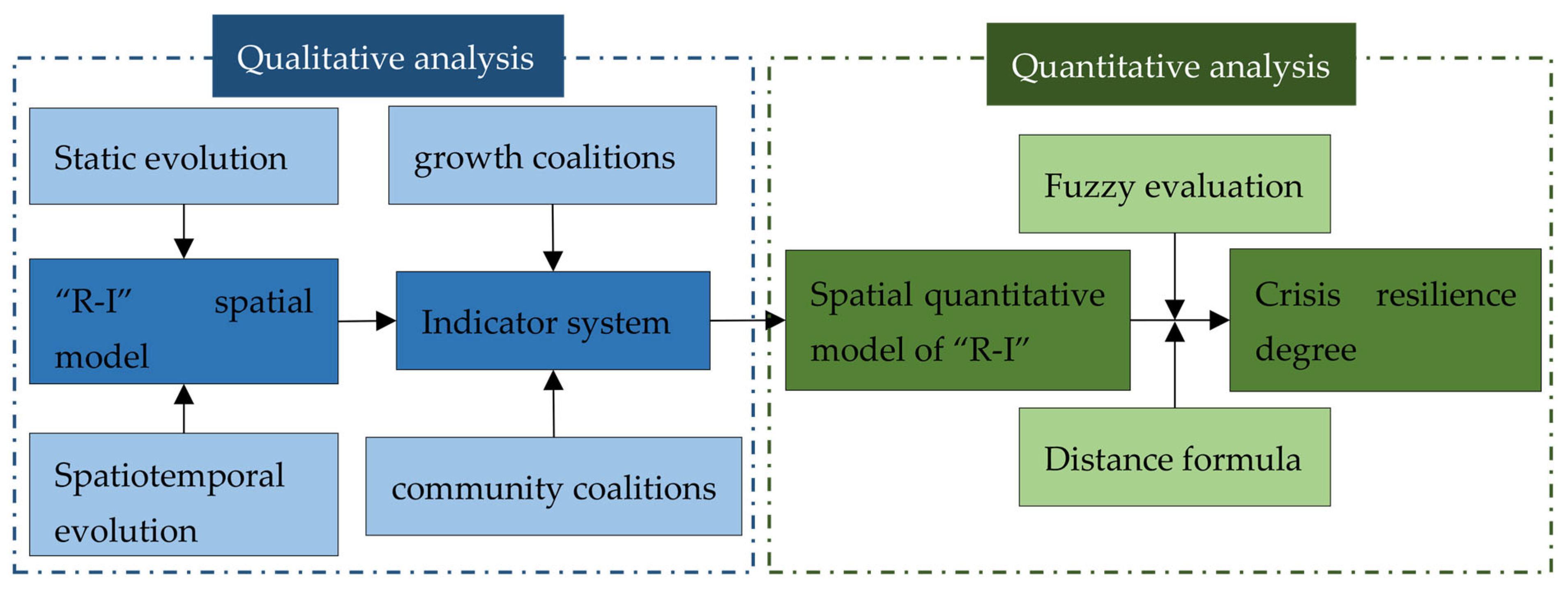
Waste incineration facilities are often regarded as a pivotal initiative for addressing the urban solid waste crisis, since they can reduce landfill dependency, optimize urban planning, enhance residents’ awareness of environmental protection, and stimulate investment in cleaner technologies. Nevertheless, the incineration process itself introduces new crises, including air pollution from flue gas emissions, toxic residues from slag and ash, and greenhouse gas contributions that contradict low-carbon development goals. These environmental risks not only fuel social opposition but also deepen distrust toward governmental decision-making, further escalating the NIMBY conflict and raising construction costs due to delays and protests. A crucial issue, therefore, is whether governments are preparing suitable incineration sites equipped with advanced chimney treatment systems and appropriate pollution control technologies, or whether projects are being located in inappropriate, densely populated areas without adequate safeguards. Accurately perceiving and addressing these contradictions between problem-solving and problem-creating functions of incineration is central to advancing the theoretical exploration of crisis resilience management in MSW governance. The model flowchart is shown in Figure 1.

3.1. Scenario Construction of Crisis Resilience of MSW NIMBY

The crisis Scenario–Response paradigm of MSW–NIMBY is based on the two-dimensional space of “reputation” and “interests” dimensions.
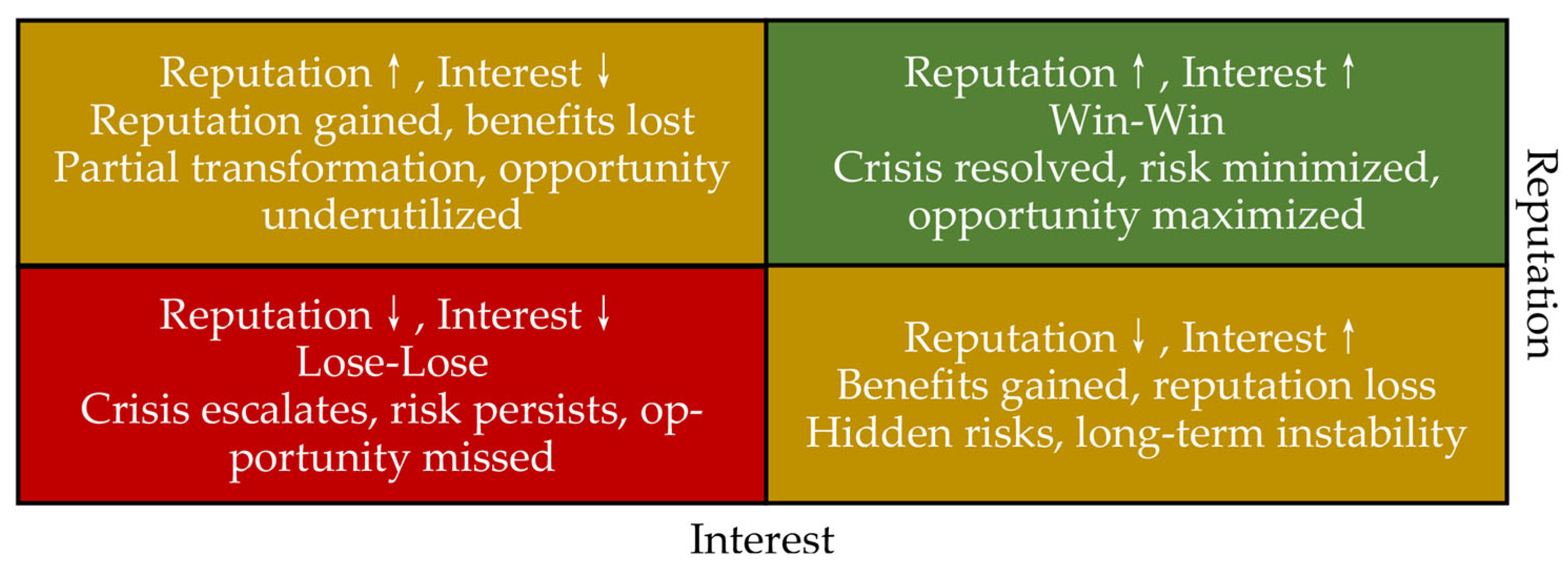
Reputation has been used synonymously with identity, image, prestige, goodwill, esteem, and standing [87], which is a valued resource and should be protected [88]. So, the “reputation” dimension also includes measures to protect reputation. Interests refer to the actual or potential, personal or collective benefits or gains, which can be material or immaterial, direct or indirect, reflecting expectations and needs. According to the actual scenario of crisis resilience, the multi-agent two-dimensional “R-I” space is built. According to different crisis scenarios of different subjects, the indicators reflected by “reputation” and “interests” and their existing forms are inconsistent. The “R-I” spatial model of crisis resilience scenario is shown in Figure 2.
According to the differences in core positions and interest demands within NIMBY conflicts, stakeholders can be broadly divided into growth coalitions, such as local governments and waste disposal enterprises, that support the construction of disposal facilities, and community coalitions, such as surrounding residents and related groups, that tend to oppose them [89]. The critical link between these coalitions lies in the interaction of reputation and interests. For governments and enterprises, maintaining a positive reputation is closely tied to gaining public trust and legitimacy; for communities, safeguarding health, property, and environmental quality is both a reputational and interest-driven concern. If incineration projects are promoted without effectively addressing pollutant emissions, stakeholders may gain short-term economic or political benefits but risk long-term reputational damage and intensified conflicts. Thus, balancing reputation and interest becomes essential to building resilient stakeholder relationships and reducing the risk of unresolved crises.
Quadrant I (Figure 2) represents the MSW–NIMBY facilities that have been successfully landed, which realizes a win–win scenario for government, enterprises, and relevant residents. For government, waste reduction, recycling, and harmless disposal capacity have been improved, and the relationship between government and residents has become harmonious. Furthermore, the economy, society, and environment reach comprehensive, coordinated, and sustainable development. A good business environment brings the enterprises satisfied economic and social benefits, and their reputation can be constantly improved. For relevant residents with reasonable compensation, the waste disposal project is heartfeltly recognized and accepted by relevant residents, and they will continuously benefit from it.
Quadrant II represents the gain of reputation but loss of interests. For the government to make the project successfully land, they would have to incur more costs by taking a series of measures to gain people’s support and satisfaction. For enterprises, they might keep their reputation at a high cost, such as spending high investment to introduce new technologies, reduce pollution emissions, and improve cleaning efficiency. For residents concerned, even if they have not received enough compensation, they finally accept the project’s construction.
Quadrant III represents the loss of both reputation and interests. After MSW–NIMBY conflicts, the government failed to respond in time to resolve the conflict. At the same time, the related residents resolutely oppose the project’s construction and resort to radical violence, resulting in tension between the government, enterprises, and related residents. Thus, the project must stop constructing because of the worsening economic, social, and environmental benefits.
Quadrant IV represents the loss of reputation but gain of interests. For the government, the project’s landing is regarded as the ultimate goal, while not considering the negative public opinion of the society results in a diminished reputation. For enterprises, economic benefits are pursued mindlessly, while the requirements for environmental ecologies are out of consideration. For relevant residents, additional benefits besides reasonable compensation are pursued on the condition of supporting the project’s construction.
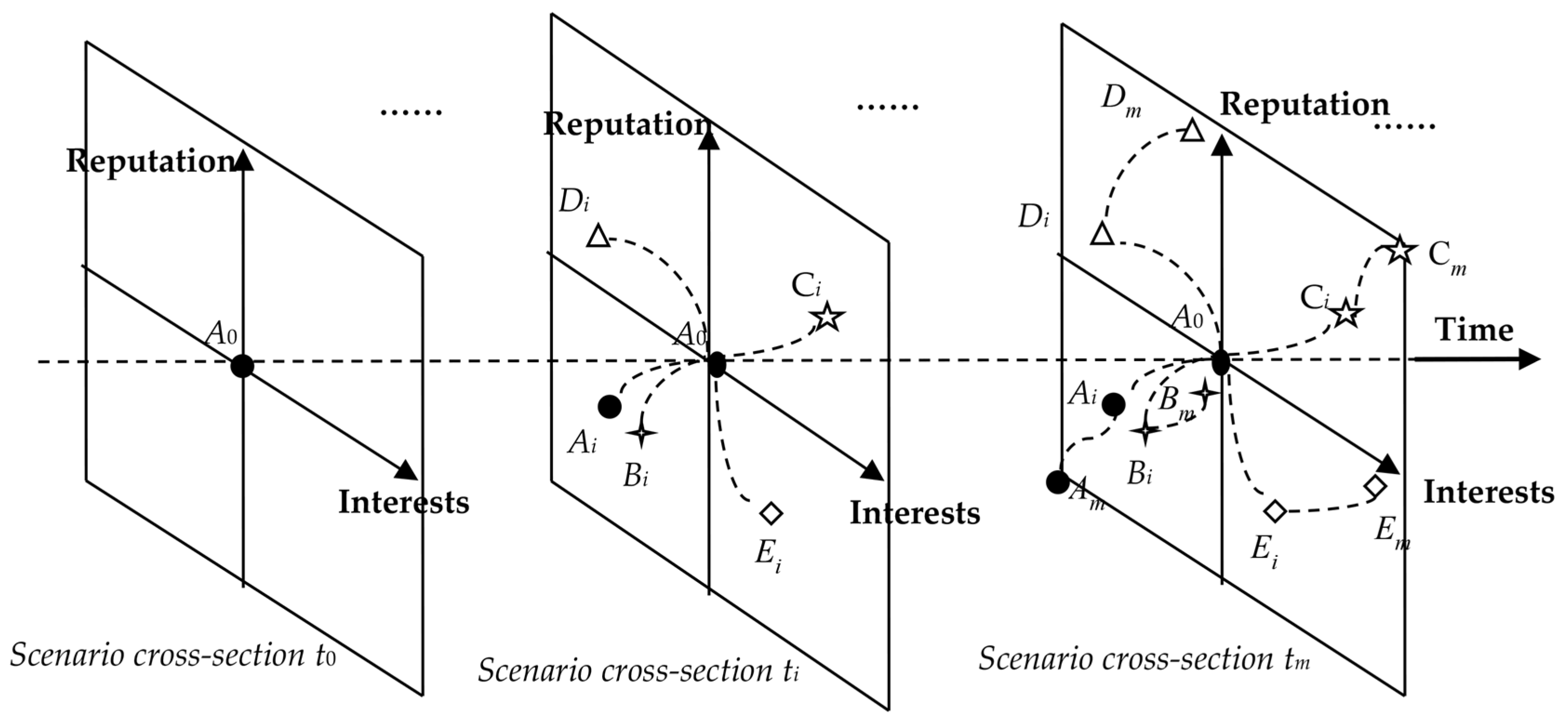
Figure 2 describes the static relationship of MSW–NIMBY crisis resilience paths in space, which provides an analytical framework to fully understand the current situation. However, the resilience of MSW–NIMBY crisis is a dynamic process, and the state of the situation will change with the passage of time and the evolution of the event. In order to be more in line with the evolution of the event, this study constructs a spatial–temporal evolution “R-I” spatial model of MSW–NIMBY crisis resilience, as shown in Figure 3.
A, B, C, D, and E represent any point in the reputation-interest model, representing the profit or loss about reputation and interest states. A0→Ai→Am, A0→Bi→Bm, A0→Ci→Cm, A0→Di→Dm, A0→Ei→Em represent the evolution of different crisis management paths over time. Figure 3 demonstrates these points’ possible evolutionary paths, which can occur under different scenarios. Among them, A0→Ai→Am and A0→Bi→Bm evolve in a state of loss in both reputation and interests, with the former ultimately evolving to an impoverished state and the latter evolving back to the starting point. When a NIMBY crisis occurs, if the subjects involved fail to respond in a timely manner or manage improperly, they will gradually lose reputation and interests, eventually leading to the maximum losses of reputation and interests; that is, the pessimistic locking of the crisis management path. The evolution process is A0→Ai→Am. Traditional crisis management mainly focuses on eliminating danger; that is, optimistic locking of the crisis management path. The evolution process is path A0→Bi→Bm. It means that once the traditional crisis management path chooses a certain mode, although there are other more optimized governance modes (such as the new model of crisis resilience management), the adopted governance model will prevent changes to the initial selection and maintain the status.
A0→Ci→Cm evolves in a state of gaining both reputation and interests and ultimately evolves to an excellent state, the optimal evolutionary path of breakthrough creation (double-optimal path). It is of great theoretical and practical significance to summarize the path creation in the past evolutionary path and explore the innovative path construction methods for the new model of crisis resilience management. Crisis resilience is to solve the crisis of reputation and interests, seize the key points of opportunity, turn the crisis into an opportunity, and strive to maximize the utility of reputation and interests, then achieve better state of system balance. In this process, participants adopt positive and constructive ideas when tackling crises and consider the long-term interests of multiple agents comprehensively. The ideal crisis resilience is to maximize the comprehensive utility of “reputation” and “interests” and transform passive response into active defense.
The better evolutionary path of progressive creation (single-optimal path) is to maximize one aspect of “reputation” or “interests”, which can be divided into two paths. A0→Di→Dm evolves in a state of gaining reputation but losing interests, whose goal is to obtain maximum reputation with minimum loss of interests. However, A0→Ei→Em evolves in a state of losing reputation but gaining interest, aiming to obtain maximum interests with minimum loss of reputation.

3.2. Construction of MSW NIMBY Indicator System Based on “R–I” Model

This paper constructs indicators from the dual dimensions of “reputation” and “interest”. The selection of these two dimensions is grounded in conflict management theory and social exchange theory, both of which emphasize that the persistence and escalation of collective conflicts are often driven by the tension between symbolic legitimacy and material utility [87,88,89].
Specifically, the “reputation” dimension captures the symbolic and relational aspects of crisis resilience. Reputation reflects not only the credibility of growth coalitions in promoting projects but also the degree of trust and confidence held by community coalitions. These indicators are chosen because reputation is a critical intangible asset in public conflicts: once it deteriorates, trust breaks down and collective action intensifies, directly shaping the trajectory of the conflict [87,88].
The “interest” dimension, by contrast, represents the substantive and distributive aspects of the conflict. Economic returns, social well-being, public health, and ecological quality are the most salient domains of interest typically raised in facility-related disputes. These indicators are selected because they directly embody the stakeholders’ core concerns: economic actors prioritize development benefits, communities emphasize social equity and health security, and policymakers face ecological sustainability constraints. Thus, they jointly constitute the practical foundation upon which conflict resolution strategies are negotiated [87,88].
By integrating both dimensions, the model highlights the interplay between symbolic legitimacy (reputation) and material utility (interests). This framework provides a theoretically consistent and empirically relevant basis for identifying the core contradictions of NIMBY-type conflicts and evaluating the pathways of crisis resilience.
Refering to relevant literature [3,5,9,10,12,13], based on the principles of scientific, comprehensive, representative, and feasible rules in constructing the indicator system and the “R–I” spatial model, using the “reputation” dimension and “interests” dimension in designing, the indicator system was obtained as shown in Table 1.
The four-level quantitative indicators are degree indicators, divided into optimization and deterioration scenario distributions. The range of state values is defined as low, relatively low, medium, relatively high, and high. The Delphi and expert scoring methods were applied to evaluate the utility of each indicator according to the actual conflict scenario. To ensure the robustness of the evaluation, semi-structured interviews were conducted, each involving one interviewer, one recorder, and one interviewee. Six experts were deliberately selected to provide diverse and representative perspectives: two government officials (Expert 1 and Expert 2) with direct involvement in environmental regulation and public affairs, two enterprise managers (Expert 3 and Expert 4) from waste incineration companies with practical experience in facility operation and community negotiation, and two academic scholars (Expert 5 and Expert 6) specializing in environmental policy and crisis management research.
The experts were chosen according to three main criteria: (1) at least 5 years of relevant professional or research experience; (2) direct engagement in waste management practices or policy; and (3) familiarity with the dynamics of NIMBY conflicts. Although the total number of experts is relatively modest, the balanced inclusion of governmental, industrial, and academic perspectives ensured sufficient representativeness and triangulation of viewpoints. Their combined expertise was, therefore, considered adequate to clarify, confirm, and validate the indicator system and study framework. Detailed information on the experts and the interview outline is provided in Appendix A (Table A1 and Table A2).
The definition of utility values of each indicator under the “R–I” optimization and deterioration scenarios is given in Table 2.
The indicator weight is determined by the method of adjacent target superiority degree. Based on the valid binary comparison method, which comprehensively considers all indicators in the indicator system, it overcomes the defect of repeated comparison caused by experts’ scoring in analytic hierarchy process, making the determination of weights more comprehensive, which was also in line with the logical thinking in the decision-making process. Finally, based on the domain experts’ knowledge and the scenario evolution pattern, the probability analysis of crisis resilience indicator of waste facilities NIMBY conflict was carried out.

3.3. Crisis Resilience Degree Model

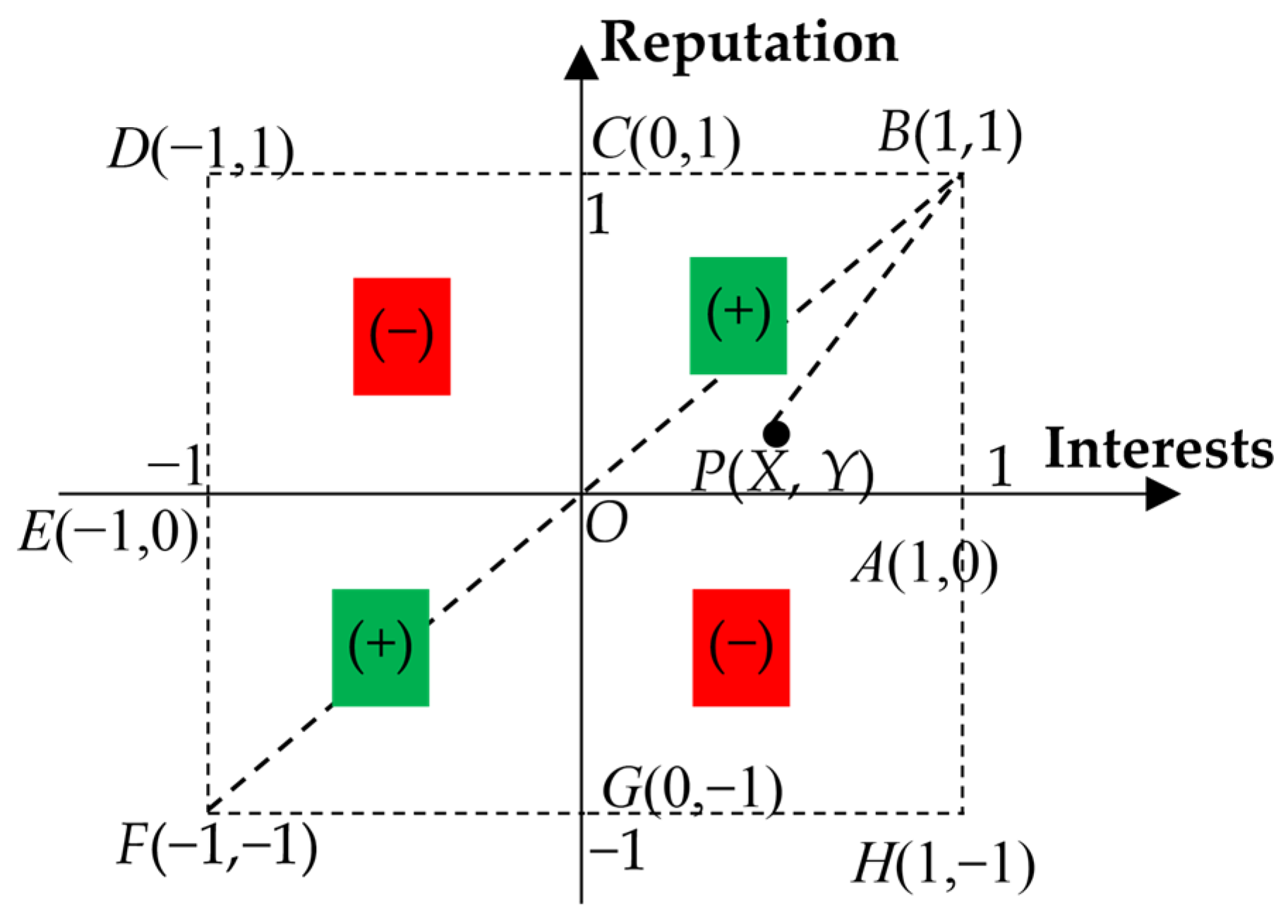
Crisis resilience degree is crisis resilience effect. Improving crisis resilience degree is the goal of crisis resilience management and project evaluation criterion. A higher crisis resilience degree means a better implementation effect of the crisis management project and a higher level of scientific decision-making. The crisis resilience evaluation effect requires the integration of qualitative and quantitative analysis of “Scenario–Response”. In the “R–I” spatial model, 2 × 2 crisis resilience “R–I” spatial quantitative model is established, as shown in Figure 4.
In Figure 4, any point P (X, Y) in the “R–I” spatial model has the integrated evaluation value of the model in the corresponding state (range as [−1, 1]). The dimensions of reputation and interests are based on “Scenario–Response” to construct scenario-specific evaluation indicators, respectively. The relationship between reputation and interests is not fixed but may vary across scenarios. In practice, they may reinforce one another (positive correlation) or exhibit trade-offs (negative correlation). To reflect this, the figure marks possible quadrants with symbols (+) and (–). (+) indicates a mutually reinforcing relationship, where improvements in reputation are accompanied by increases in interests (or simultaneous declines in both). (–), in contrast, suggests a conflictual relationship, where gains in one dimension may come at the expense of the other. To strengthen the explanatory power of the model, the extent and nature of this relationship, whether complementary, independent, or conflicting, should be explicitly analyzed in empirical applications.
The horizontal “interests” and vertical “reputation”, respectively, represent the utility integrated evaluation value (X, Y) in certainty decision and ( X ¯ , Y ¯ ) in uncertainty decision, which are calculated as Equations (1)–(4):
X = k = 1 m w 1 k x k
Y = k = 1 m w 2 k y k
X ¯ = k = 1 m w 1 k ( j = 1 n x k j p k j )
Y ¯ = k = 1 m w 2 k ( j = 1 n y k j p k j )
where w1k and w2k are the weights of the kth indicator under the dimensions of interests and reputation, respectively, xk, yk are the utility values of the kth indicator of interests and reputation under certainty decision, xkj, ykj are the jth probability utility values of the kth indicator of interests and reputation under uncertainty decision, and pkj is the probability value of the jth utility value of the kth indicator.
If the whole system gains reputation and interests, the coordinate axis is expressed as positive value, and the optimal value is 1. If it loses reputation and interests, the coordinate axis is negative, with the worst value being −1. Traditional crisis management only requires eliminating danger without losing reputation or interests reflected in the “R–I” spatial model. In comparison, crisis resilience management is not only to eliminate danger but also to seize the opportunity, which results in gain of reputation and profit reflected in the “R–I” spatial model.
Point O is the demarcation point between the first quadrant (gains reputation and interests, without danger, with opportunity) and the third quadrant (losses reputation and interests, with danger, without opportunity). If the opportunity can be seized, the point will move to the first quadrant; if not, the point will move to the third quadrant. The coordinate axes OE and OG are the dividing line between traditional crisis management and crisis resilience management. Point B is the most desirable for crisis resilience, while point F is the worst. At point B, both reputation and interest utility values are +1. In this state, without danger, with opportunity, the crisis resilience is perfectly achieved by gaining reputation and interests. Therefore, the crisis is fully resolved, and the crisis resilience degree is 100%. At point F, both reputation and interest utility values are −1. In this state, not only is the crisis resilience not carried out, but the danger of the event has also reached the maximum. As a result, the crisis resilience is not achieved at all, and the crisis resilience degree is 0%.
Any point P has different “interests” and “reputation” utility values in different crisis scenarios, and the gains and losses of the utility values are considered comprehensively. In this paper, we synthesize the utility values of MSW NIMBY crisis resilience into crisis resilience degree and comprehensively examine the direction and distance between the actual status quo and the ideal goal (point B). Spatial quantitative model of crisis resilience “R-I” and the theory of crisis resilience management optimal path define the crisis resilience degree of any point P (X, Y) in the model as follows:
T P = ( 1 d P B d F B ) × 100 %
dPB and dFB denote the distance of point B from point P and point F, respectively:
d F B = ( 1 ( 1 ) ) 2 + ( 1 ( 1 ) ) 2 = 8 = 2 2
The degree of crisis resilience at any point P in the certainty decision shown in Equation (5):
T P = ( 1 d P B d F B ) × 100 % = ( 1 ( 1 - X ) 2 + ( 1 - Y ) 2 2 2 ) × 100 %
The degree of crisis resilience at any point P in the uncertainty decision shown in Equation (6):
T P = ( 1 d P B d F B ) × 100 % = ( 1 ( 1 - X ¯ ) 2 + ( 1 - Y ¯ ) 2 2 2 ) × 100 %

3.4. Generalized Crisis Management “Octopus” Diagram

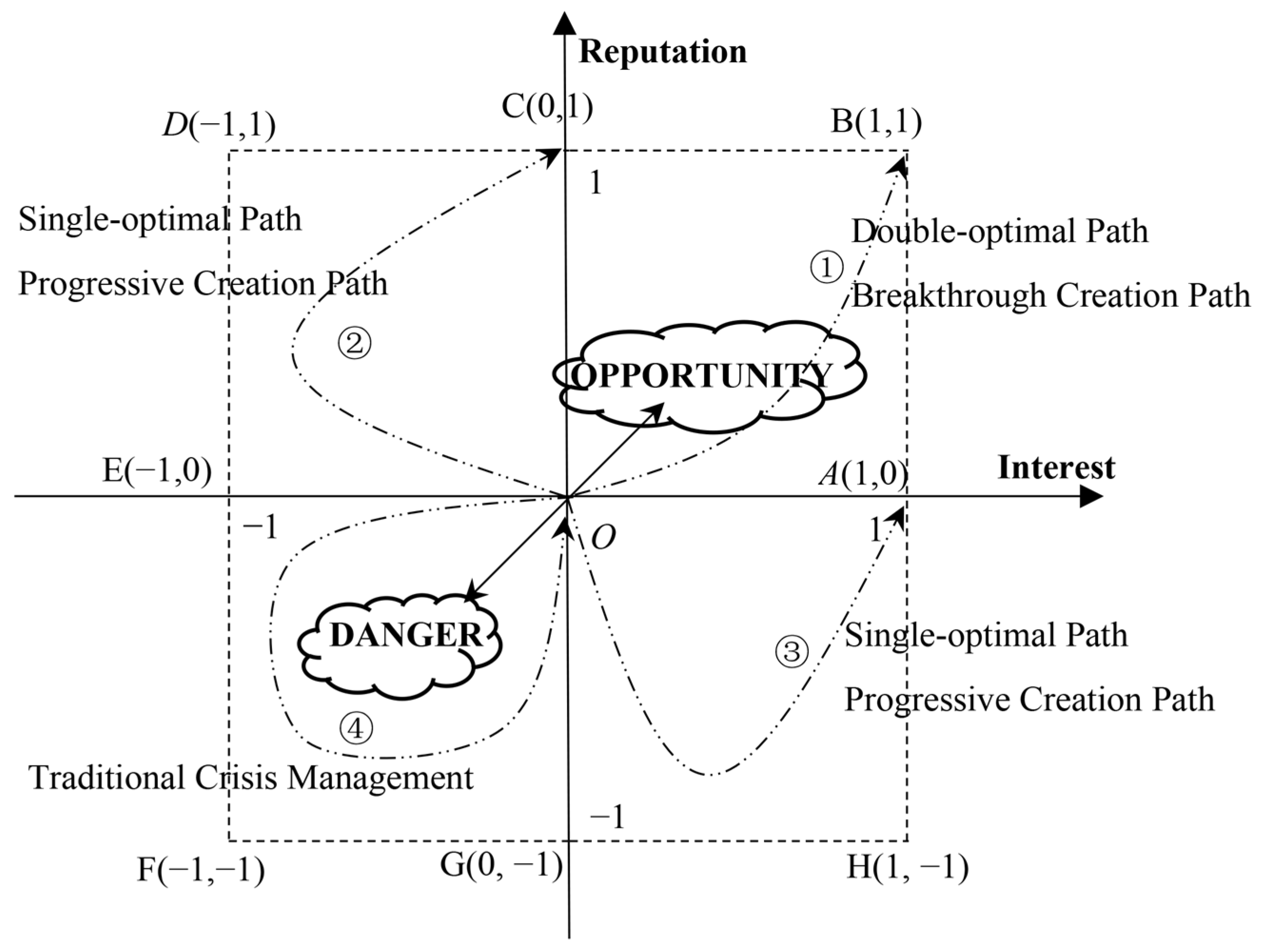
In summary, the crisis evolution path diagram is shown in Figure 5.
Figure 5 includes traditional crisis management and crisis resilience management. It is called the generalized crisis management “octopus” diagram, as the crisis evolution path resembles an octopus. The diagram reflects the relationship between the new model of crisis resilience management and traditional crisis management and highlights the innovation of crisis resilience management.
Point O is the point of minimum danger, while point B is the point of maximum opportunity. Traditional crisis management mainly focuses on eliminating danger and reducing losses to a low level. The ultimate ideal result is point O. Crisis resilience management concentrates on proactively discovering and seizing opportunities to minimize danger and maximize opportunities. The ultimate ideal result is point B.
Curves ①, ②, and ③ are the evolutionary paths of crisis resilience management. Curve ① is the breakthrough creation path gaining both reputation and interests. Curve ② is the progressive creation path that emphasizes reputation over interests to achieve maximum reputation utility value with minimum loss of interest, and curve ④ is the progressive creation path that highlights reputation over interest to achieve maximum interest utility value with minimum loss of reputation. Curve ④ is traditional crisis management’s evolutionary path, which only minimizes danger. The specific meanings are shown in Table 3.

4. Results and Discussion

4.1. Case Overview

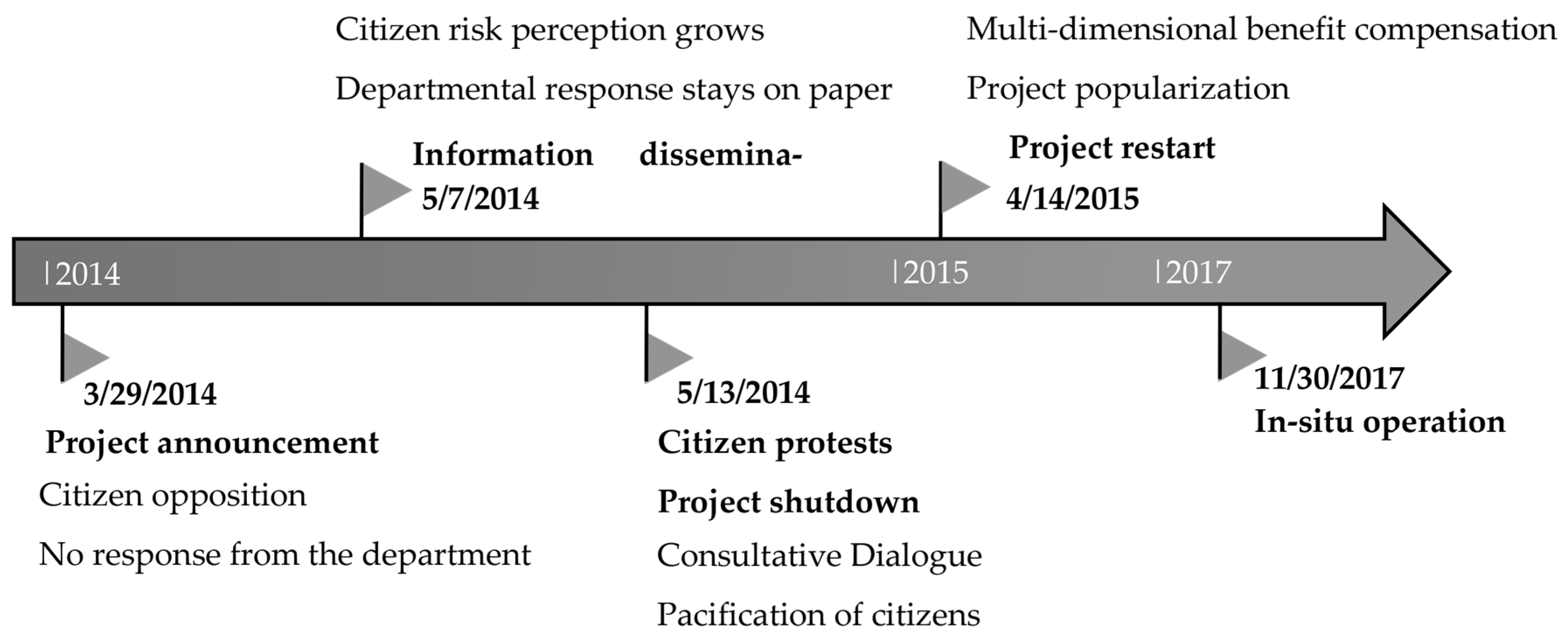
Jiufeng Hangzhou’s waste incineration project is selected as a case to study. There are two reasons: First, Hangzhou, as the capital city of Zhejiang Province, the central city of the Yangtze River Delta region, and a world-class modernized socialist cosmopolitan city, is a better reference for the management of NIMBY conflicts in other cities in China. Secondly, although the Jiufeng waste incineration project was caught in a strange circle of NIMBY conflict during the initial construction process, it was eventually built in situ through the joint efforts of all parties, which is a typical successful case of realizing NIMBY conflict crisis resilience. Figure 6 shows the timeline of NIMBY conflict management at the Jiufeng waste incineration project.
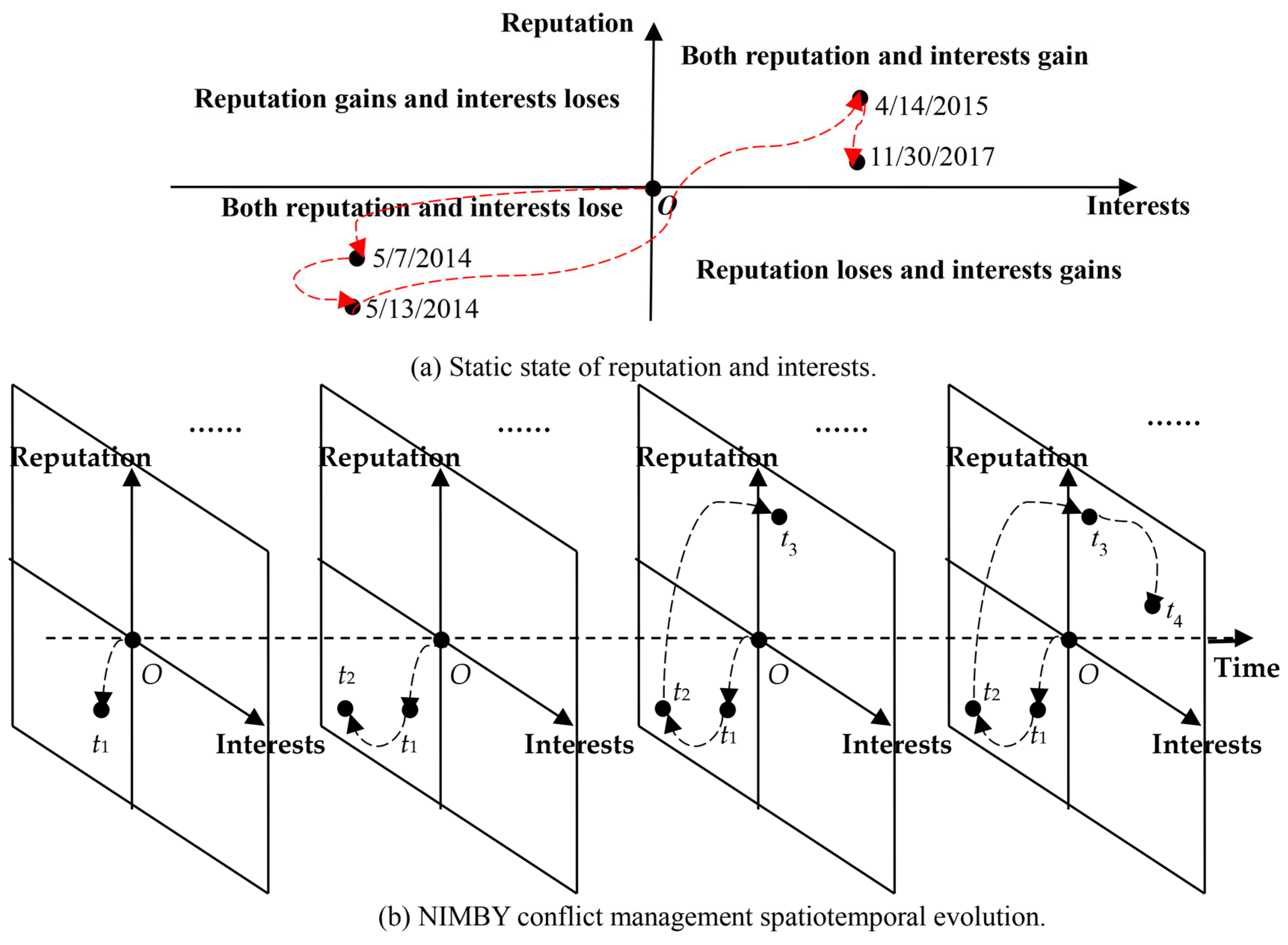
Assuming the starting point of the NIMBY conflict on 29 March, 2014, is placed at point O, Figure 7a presents the “R–I” space, visualizing the static states of reputation and interests at each key time point. Through Figure 7, we can conduct a gradual evaluation of how the relationship between reputation and interest evolves over the course of the conflict. Beginning from point O, t1 and t2 exhibit losses in both reputation and interests, indicating an early phase dominated by negative outcomes. From t2 to t3, the evolution emphasizes reputation over interests, showing a shift in stakeholder focus and strategic adjustments. By t3 and t4, both reputation and interests improve, reflecting a phase of opportunity capture and gradual conflict resolution. Finally, t4 marks the endpoint of the observed period, where the system has advanced toward optimization, though some distance from the ideal point remains, highlighting the space still available for further development in both reputation and interest dimensions.

4.2. Stage Indicator System Screening and Utility Values and Weights

Combining the occurrence and time change rules of comprehensive events, this study divided the evolution scenario into four stages: development, climax, decline, and end. Comprehensively, the knowledge of experts, evaluating the development scenarios according to each key time point, and establishing the indicator system of each development point and state scenarios distribution, is shown in Appendix A (Table A3).
According to the development characteristics of each stage, the experts use the three-point estimation method to determine the indicators’ utility value, and they use the superior membership degree of adjacent targets to determine the weight. (Due to limited space, the development stage is shown only in Table 4.)

4.3. Results Analysis

In summary, according to the Equations (3), (4), and (6), we can calculate the crisis resilience degree of NIMBY conflict management of Jiufeng waste incineration project, as shown in Table 5.
The research results show that the crisis resilience of the Jiufeng waste incineration NIMBY conflict initially had a limited effect, indicating losses during both the development and climax stages. At the development stage, both reputation and interest were negative but moderately correlated, reflecting early vulnerability. At the climax stage, both values declined sharply, yet the correlation strengthened as both suffered simultaneously. The project neither seized opportunities nor implemented strong “early and small” interventions to mitigate the MSW–NIMBY conflict, exacerbating the situation. Consequently, the crisis resilience degree dropped from 37.26% to 20.93%, failing to achieve effective resilience.
After the NIMBY conflict occurred, the Hangzhou Municipal Party Committee and Municipal Government responded promptly, actively seeking to transform the crisis into an opportunity. First, they clearly defined the goal of crisis resilience: ensuring smooth project progress while maintaining social harmony and stability. Second, they implemented a suite of targeted interventions, including timely public communication, multi-stakeholder consultations, and incremental technical improvements. These specific measures addressed both the reputation dimension (by restoring public trust through transparent communication) and the interest dimension (by negotiating compensation and incentives for affected parties), directly influencing the improvement of crisis resilience metrics.
As a result, the waste incineration project achieved strong outcomes during the decline and closing stages, with crisis resilience degrees reaching 82.51% and 89.16%, respectively. During the decline stage, reputation and interest both increased, showing a strong positive correlation and reflecting the success of coordinated stakeholder engagement. At the end stage, both indicators reached high positive values, with crisis resilience peaking, demonstrating the effectiveness of targeted interventions and the ability to capture opportunities even after early setbacks.
In summary, the Jiufeng project successfully balanced the demands of all stakeholders. The public attitude shifted from opposition to acceptance, and the project was completed on its original site, serving as a model of crisis resilience widely recognized in the industry. Key factors driving this success included early and continuous government intervention, transparent communication strategies, and adaptive technical measures. Nonetheless, the project still retained 10.84% optimization space from the theoretical maximum of 100% crisis resilience, suggesting room for further improvements in early warning mechanisms and preemptive risk mitigation strategies. This case illustrates that proactive decision-making, coupled with systematic attention to both reputation and interest dimensions, is crucial for achieving effective crisis resilience.
The scenario–response paradigm can effectively solve the dilemma that complex systems cannot be simulated, such as business management, strategic decision making, computer intelligence, and emergency management [90,91]. Based on this, this paper constructs a “reputation–interests” spatial model to further analyze the crisis evolution process of NIMBY conflict. In order to resolve the MSW–NIMBY conflict, promote the normal operation of the waste incineration project, and enable the enterprise to realize the crisis resilience, this paper firstly constructs a “reputation–interests” spatial model based on scenario–response [54,55] of the MSW–NIMBY conflict and analyzes its development paths from the dynamic spatial model, and summarizes five development paths, including two single-optimized crisis resilience paths (gain reputation or interests), one double-optimized crisis resilience path (gain both reputation and interests), one traditional crisis management path (pessimistic lock-in), and one non-interventionist crisis evolution path.
The evolution of the crisis will have different paths and outcomes [36,37]. When faced with a crisis, people and organizations can take different actions and responses, and these choices will directly affect the development and consequences of the crisis. Timely and effective crisis management and response measures can quickly resolve the crisis [41,43]; if the crisis is not properly handled, or there are improper response measures, the crisis may be further worsened, which may lead to greater losses [92].

5. Conclusions

This study develops a crisis resilience model grounded in the “R–I” space and path optimization, offering a systematic framework to both evaluate and enhance resilience management. Unlike existing approaches that often treat NIMBY conflicts descriptively or qualitatively, this model dissects the municipal solid waste (MSW) NIMBY conflict process into dynamic stages, pinpoints the key factors driving transformation, and operationalizes them through a spatial–quantitative structure. Applied to the Jiufeng waste incineration project, the model introduces a dual-dimensional evaluation index system based on stakeholder reputation and interests, enabling a more precise and continuous assessment of resilience over the project’s lifecycle. In doing so, it extends beyond static assessments to provide a dynamic, path-oriented tool that not only diagnoses resilience levels but also guides the optimization of conflict resolution strategies.
Empirical results show that through joint efforts of the enterprise, government, and residents, the project’s crisis resilience evolved from 37.26% to 89.26%, shifting from strong initial resistance to successful in situ implementation. This improvement was driven by technological innovation and public engagement by the enterprise, timely information disclosure and coordination by the government, and proactive understanding and support from residents.
Based on these findings, the following recommendations are proposed:
Enterprises: Prioritize safe, eco-friendly, and aesthetically integrated facility designs; use short-term measures like public facility tours, online demonstrations, and community engagement campaigns to improve perception.
Government: Strengthen interest coordination and credibility through transparent project demonstrations, site-selection consultations, and rapid-response communication channels to address concerns promptly.
Residents: Actively monitor projects, provide feedback, and protect rights legally; in the short term, participate in community forums and consultation meetings to influence decision-making.
While the current study focuses on the case of a waste incineration project, the proposed “R–I” spatial model of crisis resilience possesses broader applicability. NIMBY conflicts, whether related to landfill siting, chemical plants, renewable energy facilities, or large-scale infrastructure, typically share the same underlying contradiction between reputation and interest. By capturing both symbolic legitimacy and material utility, this model provides a generalizable analytical framework that can be adapted to diverse scenarios of public resistance. Future research may extend the application of this model to comparative studies across different types of NIMBY issues, thereby verifying its robustness and enhancing its explanatory power in guiding crisis transformation strategies. By linking local conflict dynamics with the universal governance challenges of waste management—such as public resistance, trust deficits, and uneven stakeholder interests—the model contributes not only to improving crisis management in China, but also to informing international debates on resilient and socially acceptable pathways of waste infrastructure development.
It should also be acknowledged that the proposed model has certain limitations. First, the current indicator system under the “reputation–interest” dimension is constructed primarily from theoretical deduction and case-specific evidence, which may limit its generalizability across broader social contexts. Second, the model relies on a static evaluation framework and does not fully capture the dynamic evolution of stakeholder interactions over time. Addressing these limitations will require future research to refine the indicator selection with more rigorous theoretical justification, integrate dynamic simulation approaches, and conduct cross-case comparisons to further validate and enhance the robustness of the model. Future work should integrate multi-source data into a comprehensive MSW conflict database to support an intelligent SaaS platform for crisis resilience evaluation, providing technical support for public facility planning and management.

Author Contributions

Conceptualization, L.F. and J.W.; methodology, L.F. and J.W.; software, Q.Y.; validation, L.F., J.W., and Q.Y.; formal analysis, L.F.; investigation, J.W.; resources, Q.Y.; data curation, L.F.; writing—original draft preparation, L.F. and J.W.; writing—review and editing, Q.Y. and J.W.; visualization, Q.Y.; supervision, L.F.; project administration, L.F. and Q.Y.; funding acquisition, L.F. and Q.Y. All authors have read and agreed to the published version of the manuscript.

Funding

This research was funded by the National Natural Science Foundation of China (Grant No. 72404128) and the National Natural Science Foundation of China (Grant No. 72374164).

Data Availability Statement

Data are contained within the article.

Conflicts of Interest

The authors declare no conflicts of interest.

Abbreviations

The following abbreviations are used in this manuscript:
NIMBYNot In My Back Yard
MSWmunicipal solid waste
RReputation
IInterests
GGrowth coalitions reputation
CCommunity coalitions confidence
EEconomic loss&gain
SSociety loss&gain
HHealth loss&gain
ECEcology loss&gain

Appendix A

Table A1. The information of the experts.
ExpertProfessional PositionService TimeEducation Level
Expert 1Senior manager22PhD
Expert 2Middle manager15PhD
Expert 3Senior manager20PhD
Expert 4Middle manager12PhD
Expert 5Senior academic professor30PhD
Expert 6Senior academic professor25PhD
Table A2. Outline of semi-structured interview.
Interview time:Interviewer location:Interviewer:
Interviewee:Interview recorder:
Interview aim:
The aim of the interview is to analyze the case, including indicator assignment.
Interview result is only used for academic research.
Outline of interview:
(1) Personal information, including age, professional position, service time, and education level.
(2) Which indicators are involved in each stage?
(3) What is the utility value of indicators in each stage? Including optimistic estimate, most likely estimate, and pessimistic estimate.
(4) What is the probability of occurrence of the utility value of indicators of each stage?
Table A3. Stage indicator and scenarios distribution.
StageSpacesThird Level IndicatorFour-Level Indicator Code (Distribution)
29 March, 2014
(Start point)
------
29 March, 2014–7 May, 2014
(Development)
RGRG1(Deterioration)
RG2(Deterioration)
RG4(Optimization)
RG5(Optimization)
RG7(Deterioration)
CRC1(Deterioration)
RC2(Deterioration)
RC3(Deterioration)
IEIE1(Deterioration)
IE2(Deterioration)
IE3(Deterioration)
SIS1(Optimization)
7 May, 2014–13 May, 2014
(Climax)
RGRG1(Deterioration)
RG2(Optimization)
RG4(Optimization)
RG5(Deterioration)
RG7(Deterioration)
CRC1(Deterioration)
RC2(Deterioration)
RC3(Deterioration)
IEIE1(Deterioration)
IE2(Deterioration)
IE3(Deterioration)
14 May, 2014–14 April, 2015
(Decline)
RGRG1(Optimization)
RG2(Optimization)
RG3(Optimization)
RG4(Optimization)
RG5(Optimization)
RG6(Optimization)
RG7(Optimization)
CRC1(Optimization)
RC2(Optimization)
RC3(Optimization)
IEIE1(Optimization)
IE2(Optimization)
IE3(Optimization)
SIS1(Optimization)
IS2(Optimization)
IS3(Optimization)
14 April, 2015–30 November, 2017
(End)
RGRG2(Optimization)
RG3(Optimization)
RG4(Optimization)
RG5(Optimization)
RG6(Optimization)
RG7(Optimization)
CRC1(Optimization)
RC2(Optimization)
RC3(Optimization)
IEIE1(Optimization)
IE2(Optimization)
IE3(Optimization)
SIS1(Optimization)
IS2(Optimization)
IS3(Optimization)
ECIEC1(Optimization)
IEC2(Optimization)
IEC3(Optimization)

References

  1. Shan, S.N.; Zhang, Z.C.; Ji, W.Y.; Wang, H. Analysis of collaborative urban public crisis governance in complex system: A multi-agent stochastic evolutionary game approach. Sustain. Cities. Soc. 2023, 91, 104418. [Google Scholar] [CrossRef]
  2. Logrosa, G.; Mata, M.A.; Lachica, Z.P.; Estaa, L.M.; Hassall, M. Integrating risk assessment and decision-making methods in analyzing the dynamics of COVID-19 epidemics in Davao city, Mindanao Island, Philippines. Risk Anal. 2022, 42, 105–125. [Google Scholar] [CrossRef] [PubMed]
  3. Zhu, X.; Xu, Y.; Zhen, G.; Lu, X.; Xu, S.; Zhang, J.; Gu, L.; Wen, H.; Liu, H.; Zhang, X.; et al. Effective multipurpose sewage sludge and food waste reduction strategies: A focus on recent advances and future perspectives. Chemosphere 2023, 311, 136670. [Google Scholar] [CrossRef] [PubMed]
  4. Gutberlet, J.; Bramryd, T. Reimagining urban waste management: Addressing social, climate, and resource challenges in modern cities. Cities 2025, 156, 105553. [Google Scholar] [CrossRef]
  5. Fu, L.; Yang, Q.; Liu, X.; Wang, Z. Three-stage model based evaluation of local residents’ acceptance towards waste-to-energy incineration project under construction: A Chinese perspective. Waste Manag. 2021, 121, 105–116. [Google Scholar] [CrossRef]
  6. Halstead, J.M.; Luloff, A.E.; Myers, S.D. An Examination of the Nimby Syndrome: Why Not in My Backyard? Community Dev. 1993, 24, 88–102. [Google Scholar] [CrossRef]
  7. Dunlap, R.E. Promoting a paradigm change reflections on early contributions to environmental sociology. Organ. Environ. 2008, 21, 478–487. [Google Scholar] [CrossRef]
  8. Khoo, S.M.; Rau, H. Movements, mobilities and the politics of hazardous waste. Environ. Polit. 2009, 18, 960–980. [Google Scholar] [CrossRef][Green Version]
  9. Wang, Y.; Tang, Y.; Zuo, J.; Bartsch, K. Exploring rumor combating behavior of social media on NIMBY conflict: Temporal modes, frameworks and strategies. Environ. Impact Assess. Rev. 2022, 96, 106839. [Google Scholar] [CrossRef]
  10. Shi, X.; Song, Z. The silent majority: Local residents’ environmental behavior and its influencing factors in coal mine area. J. Clean. Prod. 2019, 240, 118275. [Google Scholar] [CrossRef]
  11. Zhou, Y.; Chen, S.; Cui, Q. Is NIMBY inevitable? An empirical exploration of determinants of public attitudes towards unwanted facilities using nationally representative data in China. Appl. Econ. 2024, 56, 9339–9355. [Google Scholar] [CrossRef]
  12. Fu, H.; Niu, J.; Wu, Z.; Xue, P.; Sun, M.; Zhu, H.; Cheng, B. Influencing factors of stereotypes on wastewater treatment plants- case study of 9 wastewater treatment plants in Xi’an, China. Environ. Manag. 2022, 70, 526–535. [Google Scholar] [CrossRef] [PubMed]
  13. Bauwens, T.; Devine-Wright, P. Positive energies? An empirical study of community energy participation and attitudes to renewable energy. Energy Policy 2018, 118, 612–625. [Google Scholar] [CrossRef]
  14. Liu, Y.; Sun, C.; Xia, B.; Cui, C.; Coffey, V. Impact of community engagement on public acceptance towards waste-to-energy incineration projects: Empirical evidence from China. Waste Manag. 2018, 76, 431–442. [Google Scholar] [CrossRef] [PubMed]
  15. Lu, J.W.; Xie, Y.; Xu, B.; Huang, Y.; Zhang, J. From NIMBY to BIMBY: An evaluation of aesthetic appearance and social sustainability of MSW incineration plants in China. Waste Manag. 2019, 95, 325–333. [Google Scholar] [CrossRef]
  16. Jin, S.; Wang, Y.; Qian, X.; Zhou, J.; Nie, Y.; Qian, G. A signaling game approach of siting conflict mediation for the construction of waste incineration facilities under information asymmetry. J. Clean. Prod. 2022, 335, 130178. [Google Scholar] [CrossRef]
  17. Xie, Y.; Lin, B. A dynamic perspective on “not in my backyard” effects: Comparing public attitudes toward waste-to-energy power plants in first-tier cities of China from 2019 to 2024. J. Environ. Manag. 2025, 383, 125534. [Google Scholar] [CrossRef]
  18. Furuseth, O.J.; O’Callaghan, J. Community response to a municipal waste incinerator: NIMBY or neighbor? Landsc. Urban Plan. 1991, 21, 163–171. [Google Scholar] [CrossRef]
  19. Wen, H.; Li, S.; Hui, E.C.M.; Xiao, Y.; Liu, H. Externality impacts of “Not in My Backyard” facilities on property values: Evidence from the Hangzhou waste sorting and reduction complex projects. Habitat Int. 2022, 125, 102583. [Google Scholar] [CrossRef]
  20. Kulla, M.; Novotný, L.; Pregi, L.; Dvořák, P.; Martinát, S.; Klusáček, P.; Navrátil, J.; Krejčí, T.; Frantál, B. The good, the bad, and the nobody: Exploring diversity of perceptions of anaerobic digestion plants in Central and Eastern Europe. Energy Res. Soc. Sci. 2022, 89, 102644. [Google Scholar] [CrossRef]
  21. Liu, H.; Wang, S.; He, H.; Tan, L.; Chan, A.P. Nip risk in the bud: A system dynamic model to govern NIMBY conflict. Environ. Impact Assess. Rev. 2022, 97, 106916. [Google Scholar] [CrossRef]
  22. Wang, Y.; Zheng, L.; Zuo, J. Online rumor propagation of social media on NIMBY conflict: Temporal patterns, frameworks and rumor-mongers. Environ. Impact Assess. Rev. 2021, 91, 106647. [Google Scholar] [CrossRef]
  23. Ansell, C.; Sørensen, E.; Torfing, J. Public administration and politics meet turbulence: The search for robust governance responses. Public Adm. 2022, 101, 3–22. [Google Scholar] [CrossRef]
  24. Bertelsen, T.M.; Lindholst, A.C.; Hansen, M.B. Manager Characteristics and Early Innovation Adoption during Crises: The Case of COVID-19 Preventive Measures in Danish Eldercare. Public Manag. Rev. 2022, 25, 1755–1775. [Google Scholar] [CrossRef]
  25. Hermann, C.F. International Crises: Insights from Behavioral Research; Free Press: New York, NY, USA, 1972. [Google Scholar]
  26. Heath, R. Dealing with the complete crisis-the crisis management shell structure. Saf. Sci. 1998, 30, 139–150. [Google Scholar] [CrossRef]
  27. Gong, J.; Liang, Y.; Ramasubbu, N. Software-Vendor Diversification: A Source of Organizational Rigidity in Adversity? J. Manag. Inform. Syst. 2023, 40, 338–365. [Google Scholar] [CrossRef]
  28. Silva, A.L.P.; Prata, J.C.; Walker, T.R.; Duarte, A.C.; Ouyang, W.; Barcelò, D.; Rocha-Santos, T. Increased plastic pollution due to Covid-19 pandemic: Challenges and recommendations. Chem. Eng. J. 2021, 405, 126683. [Google Scholar] [CrossRef]
  29. Coombs, W.T. Protecting organization reputations during a crisis: The development and application of situational crisis communication theory. Corp. Reput. Rev. 2007, 10, 163–177. [Google Scholar] [CrossRef]
  30. Slovic, P. Perception of risk. Science 1987, 236, 280–285. [Google Scholar] [CrossRef]
  31. Tilman, A.R.; Krueger, E.H.; McManus, L.C.; Watson, J.R. Maintaining human wellbeing as socio-environmental systems undergo regime shifts. Ecol. Econ. 2024, 221, 108194. [Google Scholar] [CrossRef]
  32. Tversky, A.; Kahneman, D. The framing of decisions and the psychology of choice. Science 1981, 211, 453–458. [Google Scholar] [CrossRef] [PubMed]
  33. McMullan, C.K. Crisis: When does a molehill become a mountain. Disaster Prev. Manag. 1997, 6, 4–10. [Google Scholar] [CrossRef]
  34. Darling, J.R. Crisis management in international business: Keys to effective decision making. Leadersh. Org. Dev. J. 1994, 15, 3–8. [Google Scholar] [CrossRef]
  35. Davies, H.; Walters, M. Do all crises have to become disasters? Risk and risk mitigation. Disaster Prev. Manag. 1998, 7, 396–400. [Google Scholar] [CrossRef]
  36. Castro, P.; Gutierrez-Lopez, C.; Tascon, M.T.; Castañ, J.F. The impact of environmental performance on stock prices in the green and innovative context. J. Clean. Prod. 2021, 320, 128868. [Google Scholar] [CrossRef]
  37. Giakoumelou, A.; Salvi, A.; Bertinetti, G.S.; Micheli, A.P. 2008’s mistrust vs 2020’s panic: Can ESG hold your institutional investors? Manag. Decis. 2022, 60, 2770–2785. [Google Scholar] [CrossRef]
  38. Pelling, M.; Dill, K. Disaster politics: Tipping points for change in the adaptation of sociopolitical regimes. Prog. Hum. Geogr. 2010, 34, 21–37. [Google Scholar] [CrossRef]
  39. Loorbach, D.A.; Huffenreuter, R.L. Exploring the economic crisis from a transition management perspective. Environ. Innov. Soc. Trans. 2013, 6, 35–46. [Google Scholar] [CrossRef]
  40. Benessaiah, K.; Eakin, H. Crisis, transformation, and agency: Why are people going back-to-the-land in Greece? Sustain. Sci. 2021, 16, 1841–1858. [Google Scholar] [CrossRef]
  41. Sumukadas, N. Are you ready for your next product recall crisis? Lessons from operations and supply chain management. Bus. Horiz. 2021, 64, 211–221. [Google Scholar] [CrossRef]
  42. Kao, G.H.; Wang, S.W.; Farquhar, J.D. Modeling Airline Crisis Management Capability: Brand attitude, brand credibility and intention. J. Air Transp. Manag. 2020, 89, 101894. [Google Scholar] [CrossRef]
  43. Wut, T.M.; Xu, J.B.; Wong, S.M. Crisis management research (1985–2020) in the hospitality and tourism industry: A review and research agenda. Tourism Manag. 2021, 85, 104307. [Google Scholar] [CrossRef]
  44. Holling, C.S. Resilience and stability of ecological systems. Annu. Rev. Ecol. Syst. 1973, 4, 1–23. [Google Scholar] [CrossRef]
  45. Norris, F.H.; Stevens, S.P.; Pfefferbaum, B.; Wyche, K.F.; Pfefferbaum, R.L. Community resilience as a metaphor, theory, set of capacities, and strategy for disaster readiness. Am. J. Community Psychol. 2008, 41, 127–150. [Google Scholar] [CrossRef]
  46. Perrings, C. Resilience and sustainable development. Environ. Dev. Econ. 2006, 11, 417–427. [Google Scholar] [CrossRef]
  47. Duchek, S. Organizational resilience: A capability-based conceptualization. Bus. Res. 2020, 13, 215–246. [Google Scholar] [CrossRef]
  48. Maceika, A.; Bugajev, A.; Šostak, O.R. Enhancing organizational resilience: Sustainable development scenarios incorporating disaster impacts and AI tools. Sustainability 2024, 16, 1147. [Google Scholar] [CrossRef]
  49. Ghazi, K.M.; Salem, I.E.; Dar, H.; Elbaz, A.M. Leveraging strategic leadership for boosting operational resilience in hotels: The role of crisis response strategies and e-readiness. Int. J. Contemp. Hosp. Manag. 2024, 36, 3300–3323. [Google Scholar] [CrossRef]
  50. Vogus, T.J.; Sutcliffe, K.M. Organizational Resilience: Towards a Theory and Research Agenda. In Proceedings of the 2007 IEEE International Conference on Systems, Man and Cybernetics, Montreal, QC, Canada, 7–10 October 2007; pp. 3418–3422. [Google Scholar]
  51. Fares, J.; Sadaka, S.; EI Hokayem, J. Exploring entrepreneurship resilience capabilities during Armageddon: A qualitative study. Int. J. Entrep. Behav. Res. 2022, 28, 1868–1898. [Google Scholar] [CrossRef]
  52. Lazurko, A.; Schweizer, V.; Pintér, L.; Ferguson, D. Boundaries of the future: A framework for reflexive scenario practice in sustainability science. One Earth 2023, 6, 1703–1725. [Google Scholar] [CrossRef]
  53. Tonn, G.; Guikema, S.; Zaitchik, B. Simulating Behavioral Influences on Community Flood Risk under Future Climate Scenarios. Risk Anal. 2020, 40, 884–898. [Google Scholar] [CrossRef]
  54. Shi, L.; Yang, X.; Li, J.; Wu, J.; Sun, H. Scenario construction and deduction for railway emergency response decision-making based on network models. Inf. Sci. 2022, 588, 331–349. [Google Scholar] [CrossRef]
  55. Xie, X.; Huang, L.; Marson, S.M.; Wei, G. Emergency response process for sudden rainstorm and flooding: Scenario deduction and Bayesian network analysis using evidence theory and knowledge meta-theory. Nat. Hazards 2023, 117, 3307–3329. [Google Scholar] [CrossRef]
  56. Schwartz, P. The Art of the Long View: Planning for the Future in an Uncertain World; Currency: Strawberry Hills, NSW, Australia, 1996. [Google Scholar]
  57. Motlaghzadeh, K.; Eyni, A.; Behboudian, M.; Pourmoghim, P.; Ashrafi, S.; Kerachian, R.; Hipel, K.W. A multi-agent decision-making framework for evaluating water and environmental resources management scenarios under climate change. Sci. Total Environ. 2023, 864, 161060. [Google Scholar] [CrossRef] [PubMed]
  58. Sun, Y.; Wu, J.; Zhang, J.; Xiong, Y.; Liu, X.; Bai, Y. Scenario construction and vulnerability assessment of natural hazards-triggered power grid accidents. J. Saf. Sci. Resil. 2024, 5, 498–511. [Google Scholar] [CrossRef]
  59. Liu, J.; Cai, F.; Wang, W.; Zhu, H.; Teng, L.; Luo, X.; Chen, Y.; Hao, C. Research on scenario extrapolation and emergency decision-making for fire and explosion accidents at university laboratories based on BN-CBR. Reliab. Eng. Syst. Saf. 2025, 253, 110579. [Google Scholar] [CrossRef]
  60. Wang, D.; Wan, K.; Ma, W. Emergency decision-making model of environmental emergencies based on case-based reasoning method. J. Environ. Manag. 2020, 262, 110382. [Google Scholar] [CrossRef]
  61. Hao, H.; Wang, Y.; Chen, J. Empowering scenario planning with artificial intelligence: A perspective on building smart and resilient cities. Engineering 2024, 43, 272–283. [Google Scholar] [CrossRef]
  62. Peterson, G.D.; Cumming, G.S.; Carpenter, S.R. Scenario planning: A tool for conservation in an uncertain world. Conserv. Biol. 2003, 17, 358–366. [Google Scholar] [CrossRef]
  63. Klein, M.; Mahdavian, F.; Wiens, M.; Schultmann, F. A Multi-Agent System to Improve Resilience of Critical Infrastructure in Cross-Border Disasters. In Proceedings of the IFoU 2018: Reframing Urban Resilience Implementation: Aligning Sustainability and Resilience, Barcelona, Spain, 10–12 December 2018. [Google Scholar]
  64. Rasoulkhani, K.; Mostafavi, A. Resilience as an emergent property of human-infrastructure dynamics: A multi-agent simulation model for characterizing regime shifts and tipping point behaviors in infrastructure systems. PLoS ONE 2018, 13, e0207674. [Google Scholar] [CrossRef]
  65. Li, Y.L.; Tsang, Y.P.; Wu, C.H.; Lee, C.K.M. A multi-agent digital twin–enabled decision support system for sustainable and resilient supplier management. Comput. Ind. Eng. 2024, 187, 109838. [Google Scholar] [CrossRef]
  66. Yang, Q.; Yang, F.; Liu, X.; Wang, Z. Unconventional Crisis Identification and Pre-Control Based on Immunology; Science Press: Beijing, China, 2015. (In Chinese) [Google Scholar]
  67. Motevalli-Taher, F.; Paydar, M.M. Supply chain design to tackle coronavirus pandemic crisis by tourism management. Appl. Soft. Comput. 2021, 104, 107217. [Google Scholar] [CrossRef]
  68. Roshan, M.; Tavakkoli-Moghaddam, R.; Rahimi, Y. A two-stage approach to agile pharmaceutical supply chain management with product substitutability in crises. Comput. Chem. Eng. 2019, 127, 200–217. [Google Scholar] [CrossRef]
  69. Mousavi, S.; Sajadi, S.M.; Alemtabriz, A.; Najafi, S.E. Hybrid mathematical and simulation model for designing a hierarchical network of temporary medical centers in a disaster. J. Simul. 2022, 18, 119–135. [Google Scholar] [CrossRef]
  70. Yaşar Dinçer, F.C.; Yirmibeşoğlu, G.; Narin, M.; Saraç, F.E. Crisis Management and Sustainability in Tourism Industry: Obstacles and Recovery Strategies after the COVID-19 Crisis in Antalya, Türkiye. Sustainability 2024, 16, 5121. [Google Scholar] [CrossRef]
  71. Rezvani, S.M.; Silva, M.J.F.; de Almeida, N.M. Urban resilience index for critical infrastructure: A scenario-based approach to disaster risk reduction in road networks. Sustainability 2024, 16, 4143. [Google Scholar] [CrossRef]
  72. Wong, L.W.; Tan, G.W.H.; Ooi, K.B.; Lin, B.; Dwivedi, Y.K. Artificial intelligence-driven risk management for enhancing supply chain agility: A deep-learning-based dual-stage PLS-SEM-ANN analysis. Int. J. Prod. Res. 2024, 62, 5535–5555. [Google Scholar] [CrossRef]
  73. Thiebes, B.; Winkhardt-Enz, R. Challenges and opportunities using new modalities and technologies for multi-risk management. Nat. Hazards. 2022, 119, 1137–1140. [Google Scholar] [CrossRef]
  74. Lu, J.; Rodenburg, K.; Foti, L.; Pegoraro, A. Are firms with better sustainability performance more resilient during crises? Bus. Strateg. Environ. 2022, 31, 3354–3370. [Google Scholar] [CrossRef]
  75. Khan, M.S.; Mubeen, I.; Caimeng, Y.; Zhu, G.; Khalid, A.; Yan, M. Waste to energy incineration technology: Recent development under climate change scenarios. Waste Manag. Res. 2022, 40, 1708–1729. [Google Scholar] [CrossRef]
  76. Chen, M.; Oshita, K.; Takaoka, M.; Shiota, K. Co-incineration effect of sewage sludge and municipal solid waste on the behavior of heavy metals by phosphorus. Waste Manag. 2022, 152, 112–117. [Google Scholar] [CrossRef] [PubMed]
  77. Lan, D.Y.; Zhang, H.; Wu, T.W.; Lü, F.; Shao, L.M.; He, P.J. Repercussions of clinical waste co-incineration in municipal solid waste incinerator during COVID-19 pandemic. J. Hazard. Mater. 2022, 423, 127144. [Google Scholar] [CrossRef] [PubMed]
  78. Xu, M.; Lin, B. Accessing people’s attitudes towards garbage incineration power plants: Evidence from models correcting sample selection bias. Environ. Impact Assess. Rev. 2023, 99, 107034. [Google Scholar] [CrossRef]
  79. Zhang, L.; Liu, G.; Li, S.; Yang, L.; Chen, S. Model framework to quantify the effectiveness of garbage classification in reducing dioxin emissions. Sci. Total Environ. 2021, 814, 151941. [Google Scholar] [CrossRef]
  80. Weerdt, L.D.; Jaeger, S.D.; Compernolle, T.; Van Passel, S. How an incineration tax changes waste management practices among firms. Resour. Conserv. Recycl. 2022, 180, 106172. [Google Scholar] [CrossRef]
  81. Istrate, I.-R.; Galvez-Martos, J.-L.; Vazquez, D.; Guillén-Gosálbez, G.; Dufour, J. Prospective analysis of the optimal capacity, economics and carbon footprint of energy recovery from municipal solid waste incineration. Resour. Conserv. Recycl. 2023, 193, 106943. [Google Scholar] [CrossRef]
  82. Huang, X.D.; Yang, D.L.L. NIMBYism, waste incineration, and environmental governance in China. China Inf. 2020, 34, 342–360. [Google Scholar] [CrossRef]
  83. Owojori, O.M.; Erasmus, L.J. Public–private partnerships as catalysts for green infrastructure: A three-pronged analysis of economic, environmental, and institutional factors. Front. Sustain. Cities 2025, 7, 1591278. [Google Scholar] [CrossRef]
  84. Sanaye, S.; Imeni, M.; Yazdani, M. Clean production of power and heat for waste water treatment plant by integrating sewage sludge anaerobic digester and solid oxide fuel cell. Energ. Convers. Manag. 2023, 288, 117136. [Google Scholar] [CrossRef]
  85. Zafar, A.M.; Shahid, S.; Nawaz, M.I.; Mustafa, J.; Iftekhar, S.; Ahmed, I.; Souissi, S. Waste to energy feasibility, challenges, and perspective in municipal solid waste incineration and implementation: A case study for Pakistan. Chem. Eng. J. Adv. 2024, 18, 100595. [Google Scholar] [CrossRef]
  86. Khatri, K.L.; Muhammad, A.R.; Soomro, S.A.; Tunio, N.A.; Ali, M.M. Investigation of possible solid waste power potential for distributed generation development to overcome the power crises of Karachi city. Renew. Sust. Energ. Rev. 2021, 143, 110882. [Google Scholar] [CrossRef]
  87. Verčič, A.T.; Verčič, D.; Žnidar, K. Exploring academic reputation—Is it a multidimensional construct? Corp. Commun. 2016, 21, 160–176. [Google Scholar] [CrossRef]
  88. Coombs, W.T.; Holladay, S.J. Helping crisis managers protect reputational assets: Initial tests of the situational crisis communication theory. Manag. Commun. Q. 2002, 16, 165–186. [Google Scholar] [CrossRef]
  89. Jenna, D.; Joseph, W.H. YIMBY divided: A qualitative content analysis of YIMBY subreddit data. J. Urban Aff. 2022, 46, 1810–1836. [Google Scholar] [CrossRef]
  90. Carraminana, D.; Bernardos, A.M.; Besada, J.A.; Casar, J.R. Towards resilient cities: A hybrid simulation framework for risk mitigation through data-driven decision making. Simul. Model. Pract. Th. 2024, 133, 102924. [Google Scholar] [CrossRef]
  91. Pu, F.; Li, Z.; Wu, Y.; Ma, C.; Zhao, R. Recent Advances in Disaster Emergency Response Planning: Integrating Optimization, Machine Learning, and Simulation. Saf. Emerg. Sci. 2025, 1, 9590007. [Google Scholar] [CrossRef]
  92. Osendarp, S.; Akuoku, J.K.; Black, R.E.; Headey, D.; Ruel, M.; Scott, N.; Shekar, M.; Walker, N.; Flory, A.; Haddad, L.; et al. The COVID-19 crisis will exacerbate maternal and child undernutrition and child mortality in low-and middle-income countries. Nat. Food. 2021, 2, 476–484. [Google Scholar] [CrossRef]
Figure 1. Model flowchart.
Sustainability 17 07846 g001
Figure 2. “R-I” model of crisis resilience scenario.
Sustainability 17 07846 g002
Figure 3. Spatiotemporal evolution of “R–I” model of crisis resilience.
Sustainability 17 07846 g003
Figure 4. Spatial quantitative model of crisis resilience “R–I”. (+) indicates a mutually reinforcing relationship, (–) suggests a conflictual relationship.
Sustainability 17 07846 g004
Figure 5. Generalized crisis management “Octopus” diagram. ①, ②, ③ and ④ represent different path curves.
Sustainability 17 07846 g005
Figure 6. Timeline of NIMBY conflict management.
Sustainability 17 07846 g006
Figure 7. Static and dynamic spatiotemporal evolution of “R–I” Space.
Sustainability 17 07846 g007
Table 1. Indicator system for the “R–I” spatial of MSW NIMBY conflict.
General GoalSpacesThird Level IndicatorFour-Level Specific Quantitative IndicatorsCode
Crisis resilienceReputation
(R)
Growth coalitions
reputation
(G)
Procedure rationality of environmental assessment and social stability risk assessmentRG1
Rationality of communication channelsRG2
Procedure rationality of business operation and managementRG3
Procedure rationality of project information disclosureRG4
Scientificity of supervision methodsRG5
Scientificity of technical method of waste disposalRG6
Satisfaction of public decision-making effectRG7
Community coalitions confidence(C)Rationality of related citizens’ participation in deliberative democracyRC1
Scientificity of related citizens’ risk perceptionRC2
Satisfaction of related citizens to fulfill self-worthRC3
Interests
(I)
Economic loss and gain(E)Procedure rationality of multi-agent benefit distributionIE1
Scientificity of multi-agent benefit distribution methodIE2
Satisfaction of multi-agent benefit distribution effectIE3
Society loss and gain(S)Levels of waste reducing, recycling, and decontaminatingIS1
Improvement of adjacent facilitiesIS2
Increased value of employment opportunitiesIS3
Health loss and gain(H)Medical insurance for the health of community coalitionsIH1
Social security for the health of social coalitionIH2
Ecology loss and gain
(EC)
Quality of waste disposal and discharge IEC1
Air quality around waste disposal facilitiesIEC2
Green coverage around waste disposal facilitiesIEC3
Table 2. Definition of utility values.
OptimizationState value rangeLowRelatively lowmediumrelatively highhigh
Utility quantification value0~0.20.2~0.40.4~0.60.6~0.80.8~1
DeteriorationState value rangelowrelatively lowmediumrelatively highhigh
Utility quantification value0~−0.2−0.2~−0.4−0.4~−0.6−0.6~−0.8−0.8~−1
Table 3. The meanings of each curve.
CurveManagement TypeDevelopment FocusReputation SignificanceInterest SignificanceEvolutionary Path Description
Crisis ResilienceBreakthrough creationStrong ↑Strong ↑Simultaneously maximizes both reputation and interests, transforming high danger into high opportunity.
Crisis ResilienceProgressive creationStrong ↑Moderate ↓Emphasizes reputation growth while minimizing loss of interests, achieving maximum reputation utility with limited compromise.
Crisis ResilienceProgressive creationModerate ↓Strong ↑Emphasizes interest growth while minimizing loss of reputation, achieving maximum interest utility with limited compromise.
Traditional Crisis ManagementDanger minimizationWeak ↑Weak ↑Focuses solely on reducing danger, aiming to reach the minimal danger point (O) without seeking additional opportunities.
↑ indicates that the degree is increasing; ↓ indicates that the degree is decreasing.
Table 4. Indicators, utility values, and weights (development stage).
IndicatorsPossible States and Means of UtilityUtility Expected Value Weight
Mean of Optimistic EstimateMean of Most Likely EstimateMean of Pessimistic Estimate
RG1−0.23−0.48−0.59−0.4570.164
RG2−0.28−0.53−0.68−0.5130.148
RG40.480.310.130.3080.113
RG50.520.410.290.4080.075
RG7−0.27−0.49−0.61−0.4730.092
RC1−0.26−0.5−0.65−0.4850.071
RC2−0.29−0.54−0.69−0.5230.237
RC3−0.29−0.51−0.64−0.4950.1
IE1−0.21−0.44−0.58−0.4250.192
IE2−0.2−0.45−0.57−0.4280.205
IE3−0.22−0.45−0.58−0.4330.253
IS10.470.320.170.3200.35
Table 5. Crisis resilience degree and effect at each stage.
StagesDevelopmentClimaxDeclineEnd
Comprehensive Evaluation Value on Reputation Expectation−0.337−0.4420.6350.808
Comprehensive Evaluation Value on Interests Expectation−0.167−0.7260.6660.761
Crisis resilience Degree37.26%20.93%82.51%89.16%
Reputation–Interest CorrelationWeak PositiveStrong PositiveStrong PositiveStrong Positive
Disclaimer/Publisher’s Note: The statements, opinions and data contained in all publications are solely those of the individual author(s) and contributor(s) and not of MDPI and/or the editor(s). MDPI and/or the editor(s) disclaim responsibility for any injury to people or property resulting from any ideas, methods, instructions or products referred to in the content.