Enacting Sustainability Through Organizational Routines: A Grounded Theory of Capability–Institution Co-Structuring

Abstract
1. Introduction
2. Theoretical Foundations and Conceptual Gaps
2.1. Institutional Ambiguity in Transitional Governance Contexts
2.2. Sustainability Capabilities and the Limits of Strategic Perspectives
2.3. Organizational Routines as Enacted Practice
2.4. Theoretical Gaps and Positioning of This Study
3. Research Design
3.1. Methodological Foundations: Constructivist Grounded Theory
3.2. Research Setting and Data Sources
3.3. Data Analysis Procedures
3.4. Researcher Reflexivity and Ethical Considerations
3.5. Trustworthiness and Quality Criteria
4. Category Construction and Inter-Relational Logic
4.1. Analytical Framing
4.2. Coding Process and Category Development
4.2.1. Initial Coding: Extracting Action-Oriented Meaning from Raw Statements
4.2.2. Focused Coding: Conceptual Consolidation and Structural Clustering
4.2.3. Theoretical Category Development
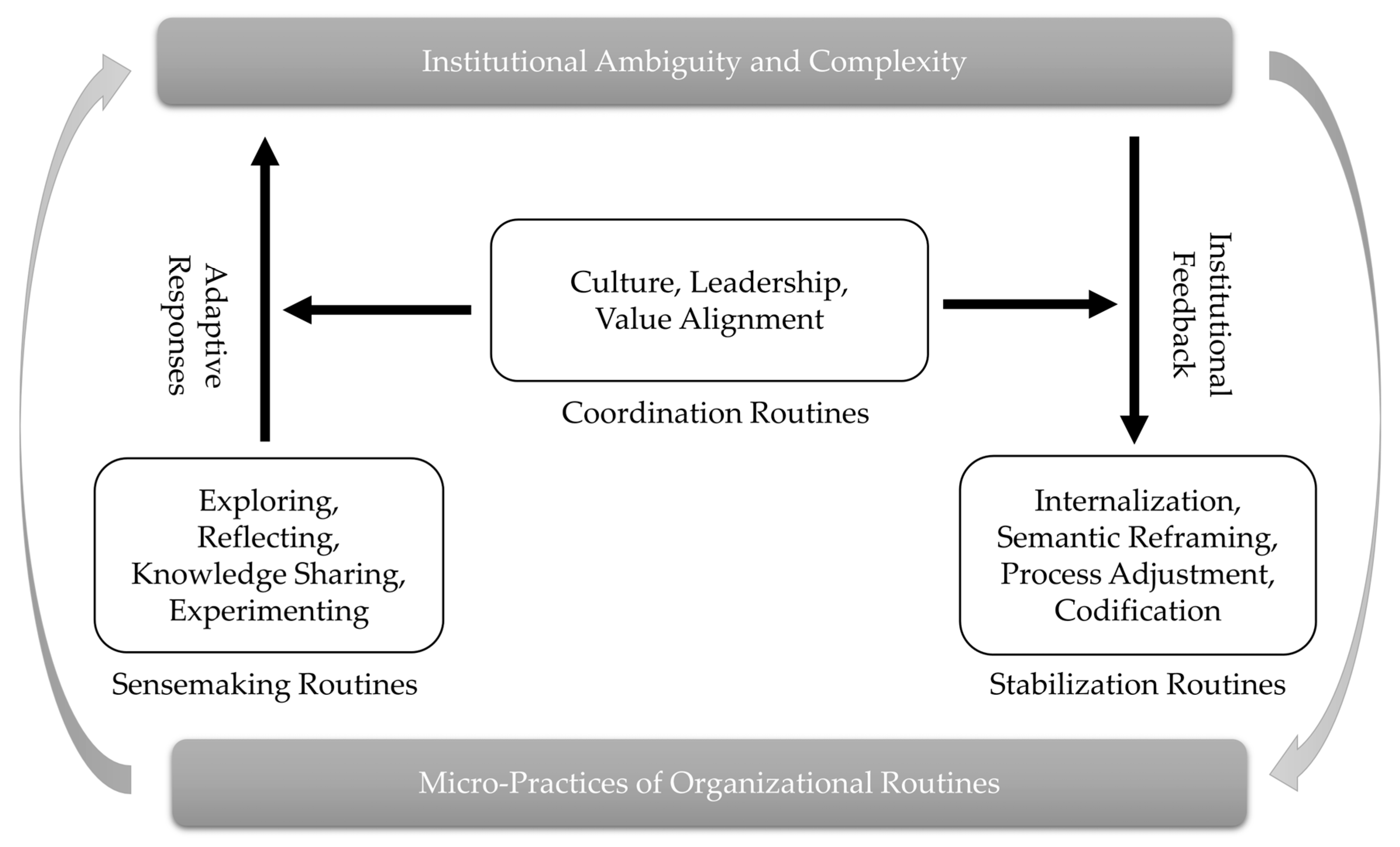
- Sensemaking Routines for Sustainability Translation capture how actors reinterpreted ambiguous sustainability directives into locally meaningful actions. This category includes institutional tempo adjustment, semantic resource translation, role bridging operations, and knowledge recoding, all reflecting adaptive efforts to align meanings, rhythms, and roles with situated operational realities.
- Stabilization Routines for Institutional Feedback denote how emergent practices were formalized and recursively integrated into organizational structures. Focused codes such as tool-interface adaptation, experiential translation, and practice-driven institutionalization illustrate how provisional responses evolved into recognizable formal routines.
- Coordination Routines for Capability Enactment reflect enabling conditions that mobilize actors and resources around sustainability goals. This category includes boundary coordination and balancing standardization and exceptions, highlighting informal mechanisms that foster sustained collective engagement and flexibility.
4.3. Interrelationship of Theoretical Categories
5. Towards the Routines-As-Practice Configuration for Sustainability Structuring
5.1. Configuring Sustainability Capabilities Through Routine Interplay Under Institutional Ambiguity
5.2. Proposition Development: Articulating the Logic of Routine-Driven Capability Emergence
- Nonlinearity of action triggering: Organizational routines are rarely activated by single antecedents; rather, they arise from interlocking conditions and may in turn retroactively redefine their own enabling contexts.
- Feedback-driven contextual reframing: Each enacted routine generates interpretive residues that alter the actor’s subsequent sensemaking and institutional expectations.
- Collaborative rhythm formation: Through symbolic alignment, semantic coupling, and role synchronization, actors produce situated yet provisional coordination logics that sustain sustainability practices.
5.2.1. Translating Ambiguity into Situated Practice: Sensemaking Routines and Exploratory Adaptation
- “At first, we just piloted carbon footprint calculations at a few branches. Once it proved feasible, headquarters adopted it and asked other departments to follow the same method” (TE, conducting pilot projects as exploratory adaptation);
- “Sometimes we look at how other sites do it, if it makes sense, we adopt it directly.” (TD, horizontal imitation to reduce interpretive uncertainty); and
- “No one told us to change the process at that time, but we felt that using outdated data to complete the reports was not accurate. So we decided to revalidate the data checks internally.” (UD, self-initiated reflection and experimentation to address perceived misalignment with sustainability data integrity).
5.2.2. Stabilizing Emergent Practices Through Re-Coding and Institutional Feedback
- “Initially, we revised our sustainability indicators every year. But once things stabilized across departments, we documented everything into a manual for newcomers.” (CG, stabilization through codification after cross-departmental convergence);
- “Some routines started from pilot projects, and once the leadership saw their value, they asked us to integrate them into the ISO framework.” (PT, practice-based institutionalization through policy alignment);
- “That whole data reporting workflow was only integrated into our platform after our team got comfortable with it. Then, we asked IT to formalize it into a system rule.” (UD, progressive integration from informal adoption to formal rule-setting); and
- “We allowed one or two sites to trial the new reporting standards. After confirming feasibility, it was written into the official procedures.” (ZU, pilot-based validation and subsequent codification of sustainability reporting practices)
5.2.3. Coordinating Across Interfaces: Routines for Relational Alignment and Organizational Cohesion
- “We want sustainability not just for KPIs but to represent our core values.” (TE, value framing to align symbolic and operational agendas);
- “Sustainability for us is not just about KPIs, it is a form of responsibility to customers. That is why when we proposed changes to packaging, we used brand trust as our leverage.” (PT, value anchoring as persuasive framing);
- “Our CEO encourages people to share failure cases and treats them as learning moments. That makes us more willing to try things, knowing we will not be penalized.” (TD, leadership support for experimentation as psychological anchoring); and
- “Here, it is quite normal to revise procedures during meetings. Senior management supports this. Rather than strictly following SOPs, it is better to adjust and report afterwards.” (ZU, culturally supported procedural flexibility)
5.2.4. Recursive Reinforcement and Capability Embedding: The Dynamic Closure of Routine Interplay
- “After we piloted the new reporting workflow, it went through multiple revisions. Once it stabilized, we integrated it into the IT system, but even then, we kept refining it based on team feedback.” (UD, iterative refinement across routine stages);
- “Leadership encouraged flexibility at first, but as the practices became widespread, they formalized it into SOPs. Now, any changes require cross-department approval, which actually made our processes more resilient.” (CG, recursive shift from improvisation to routinized governance);
- “The way we talk about sustainability evolved with every project. At first, it was just about compliance. Now, it is part of how we plan strategies, thanks to all the feedback loops.” (PT, recursive reframing shaping strategic discourse); and
- “In our R&D process, … many sustainability standards and technical testing procedures were initially developed through team tacit knowledge and iterative coordination. Over time, we systematized them and incorporated them into formal documents. Once the process was stable and validated, we turned it into an internal operating regulation that everyone could follow.” (CS, recursive shift by experiential codification and graduate adaptation in response to institutional uncertainty)
5.3. Integrating a Routine-Based Mid-Range Theory of Sustainability Capability Structuring
- Embedded processuality: Sustainability capabilities are not externally imposed but enacted through iterative, situated routines.
- Recursive adaptation: Routine categories inform, modify, and reinforce one another, enabling flexible yet coherent responses to shifting institutional conditions.
- Semantic-Material coupling: Sustainability practices are simultaneously symbolic and operational; their success depends on both institutional legitimacy and practical enactability.
- Institutional modulation: Organizations not only adapt to institutional complexity but actively shape and reconfigure it through routinized engagement and semantic framing.
- Sustainability is continuously enacted, not merely implemented. Capabilities are generated through the stabilization of interpretive patterns rather than through plans or mandates.
- Routines function as generative and symbolic mechanisms. Beyond technical repetition, routines embed meanings, manage uncertainty, and legitimize new behaviors.
- Institutional complexity is a productive stimulus. Far from being a hindrance, complexity catalyzes routine interplay, prompting reflexivity and innovation in sustainability practices.
5.4. Applicability and Boundary Conditions
5.4.1. Transferability to Other Institutional Contexts
5.4.2. Organizational Types and Governance Structures
5.4.3. Temporal and Strategic Conditions
5.4.4. Implications for Implementation and Strategic Design
6. Conclusions and Implications
6.1. Conclusions
6.2. Theoretical Contributions
6.3. Practical Implications
6.4. Limitations and Future Outlook
Author Contributions
Funding
Institutional Review Board Statement
Informed Consent Statement
Data Availability Statement
Acknowledgments
Conflicts of Interest
Appendix A

| Company Code | Industry Sector | Estimated Annual Revenue (USD) | Operational Regions | Key Features of Sustainability Practices |
|---|---|---|---|---|
| PT | Biotechnology | Several hundred million | East Asia, Southeast Asia | Emphasizes brand-value alignment; drives packaging reform through internal identity and engagement |
| TD | Technology Manufacturing | Over ten billion | Global | Leadership encourages sharing mistakes and promotes cross-departmental collaborative innovation |
| UD | Technology Manufacturing | Over ten billion | East Asia, Southeast Asia | Focuses on process precision, data quality, and proactive correction |
| CG | Retail and Distribution | Several billion | East Asia, Southeast Asia | Standardizes institutional documents and promotes development of operational manuals |
| TE | Retail | Over ten billion | East Asia, Southeast Asia | Initiated recycling procedures voluntarily, later institutionalized into formal systems |
| CS | Energy | Several billion | East Asia, Southeast Asia | Developed a sustainability project repository and codified training language |
| ZU | Agriculture (SME) | Several million | East Asia, Southeast Asia | Utilizes small-scale pilots and field experiments to drive policy updates |
| Interview Code | Position Title | Department Affiliation | Interview Duration (Minutes) |
|---|---|---|---|
| PT-01 | Special Assistant | CEO Office | 52 |
| PT-02 | Special Assistant | CEO Office | 55 |
| TD-03 | Project Manager | ESG Office | 48 |
| TD-04 | Senior Engineer | R&D | 51 |
| TD-05 | HRM Specialist | Human Resources | 53 |
| UD-06 | ESG Head | ESG Office | 54 |
| UD-07 | ESG Specialist | ESG Office | 56 |
| CG-08 | Special Assistant | Strategy Office | 60 |
| CG-09 | CSR Program Lead | Public Affairs | 59 |
| CG-10 | CSR Program Officer | Public Affairs | 55 |
| TE-11 | CSR Head | CSR Affairs | 52 |
| TE-12 | CSR Officer | CSR Affairs | 61 |
| CS-13 | ESG Committee Chair | ESG Office | 60 |
| CS-14 | HRM Specialist | HR Department | 58 |
| ZU-15 | Company Head | N/A | 63 |
| ZU-16 | Company Head | N/A | 55 |
| ZU-17 | Special Assistant | N/A | 57 |
| UD-18 | ESG Specialist | ESG Office | 54 |
| PT-19 | Special Assistant | CEO Office | 59 |
| CG-20 | CSR Program Officer | Public Affairs | 52 |
| TE-21 | CSR Officer | CSR Affairs | 48 |
|
|
|
|
|
| Theoretical Category | Focused Code | Initial Codes |
|---|---|---|
| Sensemaking Routines for Sustainability Translation | Exploring and Adaptation | Environmental changes interpreting, emerging knowledge absorbing, existing knowledge updating, horizontal imitating, try-and-error adaptation |
| Integration and Embedment | Cross-functional collaborating, knowledge sharing, resource reallocating, operational procedures (re)aligning, institutionalizing integration | |
| Experimentation and Innovation | Encouraging innovative thinking, conducting pilot projects, learning and delearning, exploring unmet market needs, emphasizing decision-making flexibility | |
| Reflection and Optimization | Conducting review and reflection, launching improvement initiatives, gathering feedback, implementing optimized strategies | |
| Stabilization Routines for Institutional Feedback | Internalization of Experience | Disseminating practical cases, establishing mechanisms for experiential learning, codifying experiential knowledge, conducting internal evaluations and feedback |
| Practice-Driven Institutionalization | Embedding sustainability values into operational norms, bottom-up institutionalization, cultivating employee participation to drive institutional change, strengthening internal communication, fostering multicultural inclusivity | |
| Dynamic Adjustment | Enhancing operational norms, adjusting performance metrics, reconfiguring employee training programs, encouraging anticipatory and adaptive behaviors | |
| Sustainability Momentum | Establishing mechanisms to circulate sustainability experiences, embedding sustainability values into narratives and shared meanings, reinforcing recurring behaviors for sustainability engagement, building infrastructures to support commitment | |
| Coordination Routines for Capability Enactment | Organizational Culture | Maintaining transparent internal communication, tolerating risk and failure, embedding recognition and incentive practices, promoting opportunities for employee participation, cultivating rituals for knowledge sharing, fostering creative thinking culture |
| Leadership Style | Facilitating open communication, inspiring commitment and energizing teams, support for experimentation and risk-taking, exercising foresight in decision-making, strategizing prioritization and discretionary authority | |
| Value Alignment | Aligning sustainability with brand values, articulating shared cultural principles, reinforcing mutual accountability, embedding ethical and social responsibility, drawing on sense of history and legacy |
| Focused Code | Initial Code | Raw Data | Condition | Action | Result |
|---|---|---|---|---|---|
| Experimentation and Innovation | Conducting pilot projects | We usually run a small pilot to see how people respond before making it part of the official process. | Uncertainty in how employees will react to new processes | Conducting pilot projects to test acceptance | Customized routines emerge based on employee responses |
| Internalization of Experience | Codifying experiential knowledge | We have recently turned cases into training materials that are now required for all new employees. | Need to formalize experiential knowledge for new employee onboarding | Turning past cases into manuals and training guides | Experiential knowledge becomes part of institutional learning systems |
| Exploring and Adaptation | Horizontal imitating | Sometimes we just look at what other plants do, and if it makes sense, we adopt it directly. | Lack of internal precedent or knowledge on sustainable procedures | Borrowing proven methods from peer factories | Cross-unit learning improves sustainability adaptation speed |
| Reflection and Optimization | Conducting review and reflection | Our manager encourages us to share failure cases; we hold meetings to discuss them without punishment. | Ambiguity around acceptable failure in sustainability practices | Creating open spaces to share failed experiences | Improved adaptive capacity and organizational learning |
| Dynamic Adjustment | Enhancing operational norms | We sometimes revise the standard operating procedures to match what actually works on the ground. | Gap between formal SOPs and practical frontline needs | Adjusting institutional procedures based on on-site experience | Formal processes reflect local practice realities |
| Integration and Embedment | Cross-functional collaborating | We now have a co-creation platform across departments to discuss sustainability proposals together. | Sustainability solutions require multi-department input | Launching cross-unit collaborative platforms | Greater integration across units for sustainable innovation |
| Practice-Driven Institutionalization | Bottom-up institutionalization | The process actually started in our department and later got adopted officially by headquarters. | New routines proven effective at the local level | Promoting grassroots-developed processes to the institutional level | Bottom-up practices become formalized routines |
| Value Alignment | Aligning sustainability with brand values | We want sustainability to be part of our core brand values, not just a KPI. | Tension between KPI-driven and value-driven sustainability | Reframing sustainability as part of brand identity | Internal motivation and cultural alignment around sustainability |
| Leadership Style | Support for experimentation and risk-taking | Our managers not only provide resources but also allow mistakes in experiments, which is crucial. | Uncertainty about top-down support for experimentation | Leaders allowing room for error and backing innovation | Higher psychological safety and willingness to innovate |
| Sustainability Momentum | Reinforcing recurring behaviors for sustainability engagement | At first, we only wanted to patch the process. But over time, every meeting changed how we understood the logic behind that sustainability metric…, it became part of our new rule. | Gradual reinterpretation of sustainability logic during recurring meetings | Incorporating revised understanding into formalized rules | Sustainability practices become routinized and embedded in organizational procedures |
| Organizational Culture | Tolerating risk and failure | It is quite normal to revise procedures during meetings… Rather than strictly following SOPs, it is better to adjust and report afterwards. | Procedural ambiguity and openness to frontline judgment | Allowing real-time procedural adjustments without penalty | Emergent flexibility in routines and reinforcement of adaptive norms |
References
- Bocken, N.M.P.; Short, S.W.; Rana, P.; Evans, S. A literature and practice review to develop sustainable business model archetypes. J. Clean. Prod. 2014, 65, 42–56. [Google Scholar] [CrossRef]
- Correggi, C.; Di Toma, P.; Ghinoi, S. Rethinking dynamic capabilities in light of sustainability: A bibliometric analysis. Bus. Strategy Environ. 2024, 33, 7990–8016. [Google Scholar] [CrossRef]
- Helfat, C.E.; Peteraf, M.A. The dynamic resource-based view: Capability lifecycles. Strateg. Manag. J. 2003, 24, 997–1010. [Google Scholar] [CrossRef]
- Menguc, B.; Auh, S.; Ozanne, L. The interactive effect of internal and external factors on a proactive environmental strategy and its influence on a firm’s performance. J. Bus. Ethics 2010, 94, 279–298. [Google Scholar] [CrossRef]
- Teece, D.J. Explicating dynamic capabilities: The nature and microfoundations of (sustainable) enterprise performance. Strateg. Manag. J. 2007, 28, 1319–1350. [Google Scholar] [CrossRef]
- Feldman, M.S.; Pentland, B.T. Reconceptualizing organizational routines as a source of flexibility and change. Adm. Sci. Q. 2003, 48, 94–118. [Google Scholar] [CrossRef]
- Howard-Grenville, J.A. The persistence of flexible organizational routines: The role of agency and organizational context. Organ. Sci. 2005, 16, 618–636. [Google Scholar] [CrossRef]
- Greenwood, R.; Raynard, M.; Kodeih, F.; Micelotta, E.R.; Lounsbury, M. Institutional complexity and organizational responses. Acad. Manag. Ann. 2011, 5, 317–371. [Google Scholar] [CrossRef]
- Smets, M.; Jarzabkowski, P.; Burke, G.T.; Spee, P. Reinsurance trading in Lloyd’s of London: Balancing conflicting-yet-complementary logics in practice. Acad. Manag. J. 2015, 58, 932–970. [Google Scholar] [CrossRef]
- Witt, M.A.; Redding, G. Asian business systems: Institutional comparison, clusters and implications for varieties of capitalism and business systems theory. Socio-Econ. Rev. 2013, 11, 265–300. [Google Scholar] [CrossRef]
- Scott, W.R. Institutions and Organizations: Ideas and Interests, 4th ed.; SAGE Publishing: Thousand Oaks, CA, USA, 2013. [Google Scholar]
- Kostova, T.; Roth, K.; Dacin, M.T. Institutional theory in the study of multinational corporations: A critique and new directions. Acad. Manag. Rev. 2008, 33, 994–1006. [Google Scholar] [CrossRef]
- Mousavi, S.; Bossink, B.; van Vliet, M. Dynamic capabilities and organizational routines for managing innovation towards sustainability. J. Clean. Prod. 2018, 203, 224–239. [Google Scholar] [CrossRef]
- Pluye, P.; Potvin, L.; Denis, J.L.; Pelletier, J. Program sustainability: Focus on organizational routines. Health Promot. Int. 2004, 19, 489–500. [Google Scholar] [CrossRef] [PubMed]
- Frezza, M.; White, K.E. Promoting sustainable workplace routines: The identity and practice interdependence model. Sustainability 2024, 16, 993. [Google Scholar] [CrossRef]
- Parmigiani, A.; Howard-Grenville, J. Routines revisited: Exploring the capabilities and practice perspectives. Acad. Manag. Ann. 2011, 5, 413–453. [Google Scholar] [CrossRef]
- Ademi, B.; Sætre, A.S.; Klungseth, N.J. Advancing the understanding of sustainable business models through organizational learning. Bus. Strategy Environ. 2024, 33, 5174–5194. [Google Scholar] [CrossRef]
- Martin, J.; Ellström, P.E.; Wallo, A.; Elg, M. Bridging the policy-practice gap: A dual challenge of organizational learning. Learn. Organ. Int. J. 2025, 32, 18–34. [Google Scholar] [CrossRef]
- Turner, S.F.; Rindova, V. A balancing act: How organizations pursue consistency in routine functioning in the face of ongoing change. Organ. Sci. 2012, 23, 24–46. [Google Scholar] [CrossRef]
- Charmaz, K. Constructing Grounded Theory, 2nd ed.; SAGE Publishing: Thousand Oaks, CA, USA, 2014. [Google Scholar]
- Thornberg, R. Informed grounded theory. Scand. J. Educ. Res. 2012, 56, 243–259. [Google Scholar] [CrossRef]
- Denzin, N.K.; Lincoln, Y.S. Introduction: The discipline and practice of qualitative research. In Strategies of Qualitative Inquiry, 3rd ed.; Denzin, N.K., Lincoln, Y.S., Eds.; SAGE Publishing: Thousand Oaks, CA, USA, 2008; pp. 1–43. [Google Scholar]
- Dey, I. Grounding categories. In The SAGE Handbook of Grounded Theory; Bryant, A., Charmaz, K., Eds.; SAGE Publishing: Thousand Oaks, CA, USA, 2007; pp. 167–190. [Google Scholar]
- Birks, M.; Mills, J. Grounded Theory: A Practical Guide, 2nd ed.; SAGE Publishing: Thousand Oaks, CA, USA, 2015. [Google Scholar]
- Corbin, J.; Strauss, A. Basics of Qualitative Research: Techniques and Procedures for Developing Grounded Theory, 4th ed.; SAGE Publishing: Thousand Oaks, CA, USA, 2014. [Google Scholar]
- Morse, J.M. Sampling in grounded theory. In The SAGE Handbook of Grounded Theory; Bryant, A., Charmaz, K., Eds.; SAGE Publishing: Thousand Oaks, CA, USA, 2007; pp. 229–244. [Google Scholar]
- Patton, M.Q. Qualitative Research & Evaluation Methods, 4th ed.; SAGE Publishing: Thousand Oaks, CA, USA, 2015. [Google Scholar]
- Eisenhardt, K.M. Building theories from case study research. Acad. Manag. Rev. 1989, 14, 532–550. [Google Scholar] [CrossRef]
- Yin, R.K. Case Study Research and Applications: Design and Methods, 6th ed.; SAGE Publishing: Thousand Oaks, CA, USA, 2018. [Google Scholar]
- Lincoln, Y.S.; Lynham, S.A.; Guba, E.G. Paradigmatic controversies, contradictions, and emerging confluences, revisited. In The SAGE Handbook of Qualitative Research; Denzin, N.K., Lincoln, Y.S., Eds.; SAGE Publishing: Thousand Oaks, CA, USA, 2011; pp. 97–128. [Google Scholar]

Disclaimer/Publisher’s Note: The statements, opinions and data contained in all publications are solely those of the individual author(s) and contributor(s) and not of MDPI and/or the editor(s). MDPI and/or the editor(s) disclaim responsibility for any injury to people or property resulting from any ideas, methods, instructions or products referred to in the content. |
© 2025 by the authors. Licensee MDPI, Basel, Switzerland. This article is an open access article distributed under the terms and conditions of the Creative Commons Attribution (CC BY) license (https://creativecommons.org/licenses/by/4.0/).
Share and Cite
Liao, T.-S.; Lu, H.-P. Enacting Sustainability Through Organizational Routines: A Grounded Theory of Capability–Institution Co-Structuring. Sustainability 2025, 17, 7841. https://doi.org/10.3390/su17177841
Liao T-S, Lu H-P. Enacting Sustainability Through Organizational Routines: A Grounded Theory of Capability–Institution Co-Structuring. Sustainability. 2025; 17(17):7841. https://doi.org/10.3390/su17177841
Chicago/Turabian StyleLiao, Tung-Shan, and Hsin-Pang Lu. 2025. "Enacting Sustainability Through Organizational Routines: A Grounded Theory of Capability–Institution Co-Structuring" Sustainability 17, no. 17: 7841. https://doi.org/10.3390/su17177841
APA StyleLiao, T.-S., & Lu, H.-P. (2025). Enacting Sustainability Through Organizational Routines: A Grounded Theory of Capability–Institution Co-Structuring. Sustainability, 17(17), 7841. https://doi.org/10.3390/su17177841