1. Introduction
Climate change represents a significant global challenge, having already inflicted numerous irreversible and severe consequences on ecosystems worldwide. According to the AR6 Synthesis Report published by the Intergovernmental Panel on Climate Change (IPCC) [
1], global surface temperatures have risen by 1.09 °C since the pre-industrial period (1850—1900), with approximately 1.07 °C of this increase attributed to human activities. Currently, an estimated 3.3 to 3.6 billion people live in environments highly vulnerable to climate change [
1]. These impacts, including sea ice shrinkage, glacier retreat, sea-level rise, extreme weather events, and food insecurity, have disrupted the balance and stability of ecosystems while constraining human societal development [
2].The risks associated with climate change continue to intensify, presenting increasingly complex and cross-sectoral challenges that are becoming more difficult to manage.
In response to climate change and the need to reduce greenhouse gas emissions, the development and utilization of renewable energy have become a cornerstone of global energy transitions. Renewable energy reached 30% of global electricity generation for the first time in 2023, with wind and solar power representing the fastest-growing sources [
3].
Most existing studies have concentrated on national-level aggregate trends or single-country case analyses, primarily focusing on energy structure transformation, policy effectiveness, or efficiency improvements. While these studies are informative, they often lack long-term, sector-level, and cross-country comparability. In recent years, multi-regional input-output (MRIO) models have been widely applied to estimate carbon footprints and trade-embedded emissions. However, systematic applications of MRIO models to explore the structural characteristics of renewable energy use remain limited.
To address this gap, this study utilizes the Eora MRIO database and its energy satellite accounts to analyze global renewable energy use from 2000 to 2021. By calculating sectoral renewable energy consumption intensities, we develop a multi-dimensional accounting framework that includes production-based, final production-based, consumption-based, and income-based perspectives. This enables a comprehensive assessment of renewable energy distribution across sectors, time, and accounting scopes, offering new insights into the global energy transition and related policy implications. Furthermore, significant regional and per capita disparities in renewable energy use persist across countries. Highlighting such disparities is crucial for promoting a more inclusive and equitable global energy transition.
This paper is organized as follows.
Section 2 is the literature review.
Section 3 provides the modeling process and data sources.
Section 4 develops the results and discussion based on the empirical analysis.
Section 5 restates specific conclusions and draws policy implications of profound significance.
2. Literature Review
In the global transition to renewable energy, disparities in usage across regions and individuals remain a significant challenge. These disparities, influenced by economic development, policy, infrastructure, and population size, can hinder equitable access to sustainable energy solutions. Understanding these disparities is essential not only for energy equity but also for designing targeted policies to address the needs of underserved regions and populations. This study explores renewable energy use from four perspectives: production-based, which focuses on the energy consumed within a country’s boundaries as a result of domestic production; consumption-based, which accounts for the energy embodied in the goods and services consumed by a country, including imports and excluding exports; final production-based, which looks at the energy used in producing final goods for consumption; and income-based, which examines the role of primary suppliers and their contribution to renewable energy consumption through income generation. While the importance of these perspectives is well acknowledged, few studies have comprehensively integrated them at a global level, especially to address both regional and personal disparities [
4].
The disparity of renewable energy has been conducted by some scholars in different perspectives. From the production-based accounting, Sinha [
5] has used the Theil’s second measure to investigate international renewable energy generation disparities from 1980—2011 in OECD countries. Li, et al. [
6] has used a club convergence algorithm to clarify 5 clubs with 78 economies to understand the renewable energy disparity across countries. From the consumption-based accounting perspective, Liu [
7] has established an agent-based model to analyze the energy consumption disparity in China. Li, Liu and Yang [
4] have used the Generalized Divisia Index Model to decompose the factors affecting the inequality of renewable energy use in China. But, the environmentally-extended input-output (EEIO) model has been used to illustrate the disparity of renewable energy use from four perspectives (e.g., production-, consumption-, final production- and the income-based accounting).
First, studies on energy from the perspective of production-based accounting have been introduced. Lan, et al. [
8] have assessed the long-term drivers affecting the diversified energy footprint from production in 186 countries from 1990 to 2010. Chen, et al. [
9] have used a multi-regional input-output (MRIO) model for province-sectors from a production-based perspective to illustrate the essential driving forces of energy use in China. Production-based accounting perspective provides a scientific foundation for production-side policymaking of energy, such as setting target regulations for energy production and improving energy usage efficiency. However, this production-based perspective is limited when addressing global renewable energy disparities because it neglects the impact of international trade.
And secondly, the consumption-based accounting approach has been introduced as an adjustment to the production-based framework, incorporating renewable energy use linked to the production of imports while excluding that associated with the production of exports [
10].The exploration of energy through a consumption-based perspective has been conducted at the global level (energy use by globalized economy [
11] and renewable energy use for supply chain greenness [
12]), at the country level (e.g., drivers of renewable energy in India [
13] and the embodied renewable energy flows in China’s international trade [
14]).
In a globalized world, the renewable energy used in the production within a country’s territory may differ significantly from the renewable energy required for final production and consumption. The production of final goods and services induces renewable energy use both domestically and internationally. Therefore, the perspective of final production-based accounting has been introduced in recent years to link renewable energy use to the activities involved in final production. It measures the renewable energy use in the global supply chain of final products. For example, Meng, et al. [
15] accounted for global energy use based on the final production perspective.
Economic activities are influenced not only by demand but also by supply, where primary suppliers play a critical role in driving production through product supply chain [
16,
17]. Primary suppliers, by providing primary inputs at the initial stage, enable downstream users to consume renewable energy through product sale chains [
18,
19]. As applications of the perspective of income-based, Zhai, et al. [
20] have developed a Three–Perspective Energy–Carbon Nexus (TP–ECN) model to evaluate CO
2 emissions in China. Li, et al. [
21] have used structural decomposition analysis from the income-based perspective to identify the socioeconomic drivers of energy-related PM2.5 emissions in the Jing–Jin–Ji region of China. Wen, et al. [
22] have used MRIO models to evaluate the results of the ‘dual control’ policies of energy consumption and carbon emissions in China. From the perspective of income-based accounting, revealing critical primary suppliers can help with supply side policymaking to promote the renewable energy use.
Relatively few researchers have conducted a comprehensive analysis of the regional and personal disparity of renewable energy use at the global level from these four perspectives. The perspective of production-based accounting considers the impact of a country’s production activities on renewable energy use. The perspective of consumption-based accounting measures renewable energy use by adding net exports to production-based renewable energy use. The perspective of final production-based accounting quantifies renewable energy use embodied in final products across the entire supply chain. Meanwhile, the perspective of income-based accounting evaluates the contribution of primary inputs to renewable energy use. Each accounting of these perspectives in this research provides distinct insights for policymaking and sustainability analysis for renewable energy use.
Based on the IOA literature review, here, we apply the EEIO model from four perspectives (production-, consumption-, final production- and the income-based consumption accounting) to analyze both regional and personal disparities of renewable energy use and the changes in temporal trends in its flow paths among sectors and countries based on the IOA literature review. Our overall aims are to quantify the renewable energy use at the country level from four perspectives and to understand how country disparities have changed over time (2000—2021). This information is directly relevant for EEIO analysis and can be indirectly used to analyze environmental issues. We assess the regional and personal disparities of renewable energy use through connecting the data of renewable energy with the time-series input-output table and discuss these results to support the equity of the renewable energy use.
4. Results and Discussion
4.1. Temporal Trends in Country’s Renewable Energy Use
Building on the research questions outlined in the introduction and the literature review, this section presents the results of our analysis, which aims to address the disparities in renewable energy use across countries and regions. By examining the data from four key perspectives—production-based, consumption-based, final production-based, and income-based accounting—we gain a more comprehensive understanding of the complex dynamics influencing global renewable energy transitions.
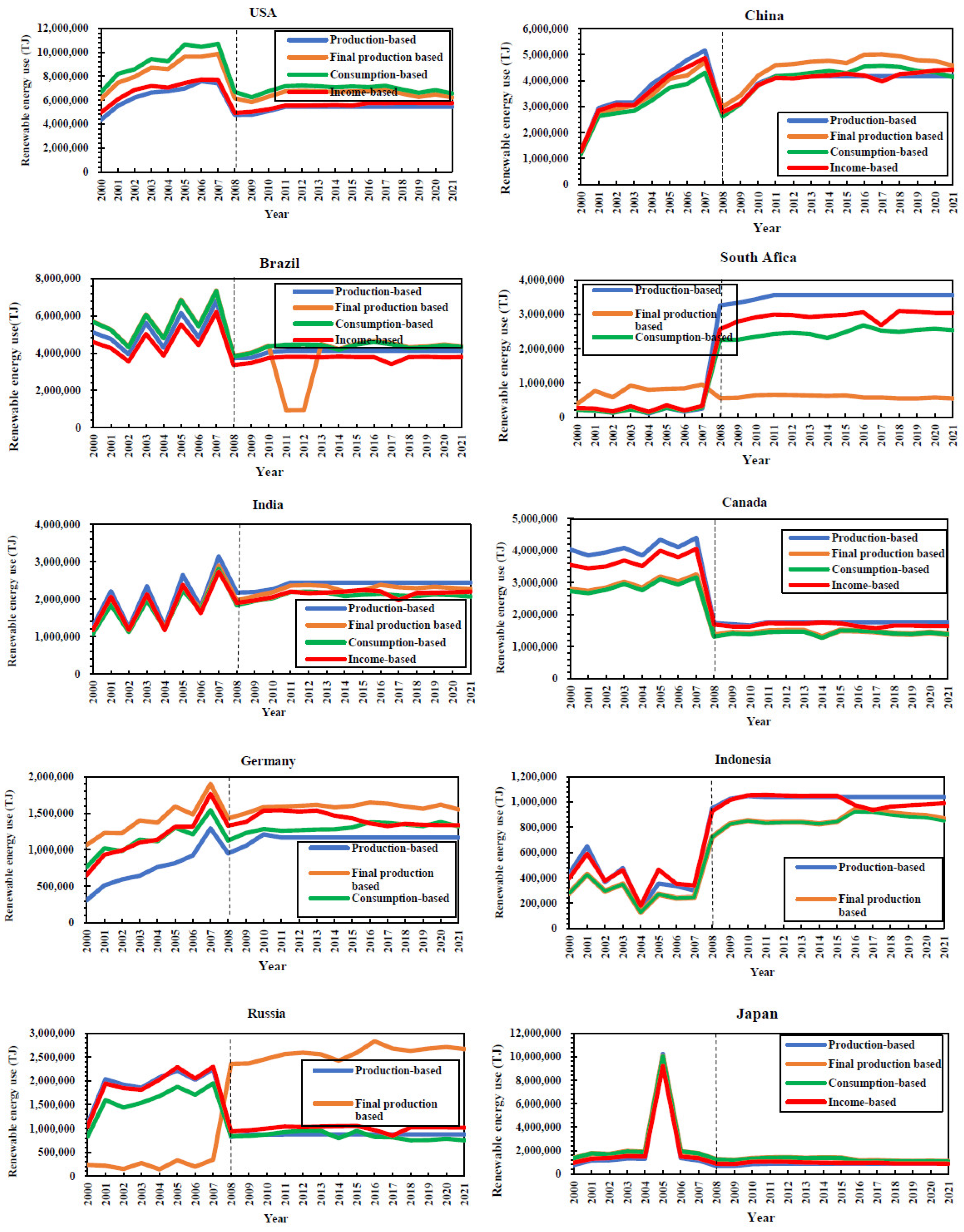
Figure A1 (see
Appendix A) shows the trend of renewable energy use across countries from 2000 to 2021. Renewable energy use of most developing countries kept growing during 2000–2021, mainly due to their increasing primary inputs (e.g., capital and labor forces) to promote economic development. Income-based renewable energy use in China, Indonesia, and India in 2021 increased by 246.12%, 148.75% and 87.01%, respectively, compared with 2000 (
Figure A1). This shows these developing countries are increasingly benefiting from both renewable energy use income and their role as providers of primary inputs.
In developing countries such as India and Brazil, the fluctuations of renewable energy use were significant before 2007, possibly due to insufficient infrastructure, fossil fuel price volatility, and a lack of continuous or sufficient policy support [
32]. It is worth noting that renewable energy use in most countries dropped after 2007, probably due to the influence of the global financial crisis. The global financial crisis had little impact on income-based renewable energy use in South Africa and Indonesia, reflecting its minimal effect on capital investments in these nations as a result of their strict capital control policies.
After the global financial crisis of 2008, developing countries—such as China, South Africa, Russia, and Indonesia—have shown an upward trend in renewable energy use, and their income-based renewable energy use in 2021 increased by 59.13%, 18.40%, 8.10%, and 6.72% from 2008 levels, respectively (
Figure A1). For example, for China, the growth in China’s renewable energy use is closely associated with the rapid expansion of the photovoltaic (PV) industry. As the world’s largest producer of solar panels, China has not only increased domestic solar deployment but also stimulated large-scale renewable energy consumption through its upstream manufacturing supply chains [
33]. Strategic initiatives such as the “Made in China 2025” plan and successive Five-Year Plans have prioritized renewable energy technologies, further accelerating the transformation of China’s energy structure [
34]. Additionally, the demands for energy security and environmental protection have driven China to further promote renewable energy development.
In the United States, renewable energy use remained the highest globally throughout the study period. This high level of consumption is partly driven by its advanced industrial infrastructure and consistent policy support. Notably, the development of shale gas since the mid-2000s has played a transformative role in reshaping the U.S. energy landscape, enabling the substitution of coal and other high-emission fuels with cleaner energy sources, thereby stimulating structural demand for renewables [
35]. Furthermore, the recent resurgence of domestic manufacturing—supported by policies such as the Inflation Reduction Act (IRA) and renewable energy tax credits—has contributed to a rise in energy demand from renewable sources in industrial and construction sectors [
36]. These industrial and policy linkages underline the strategic positioning of the United States in global renewable energy transitions [
37].
This indicates that countries exhibit varying levels of reliance on and different investment strategies for renewable energy in response to financial crises. Despite a deceleration in global investment growth, certain countries continue to actively advance the development of renewable energy. This highlights the pivotal role renewable energy plays in fostering economic growth [
38], particularly in emerging market economies such as China and India.
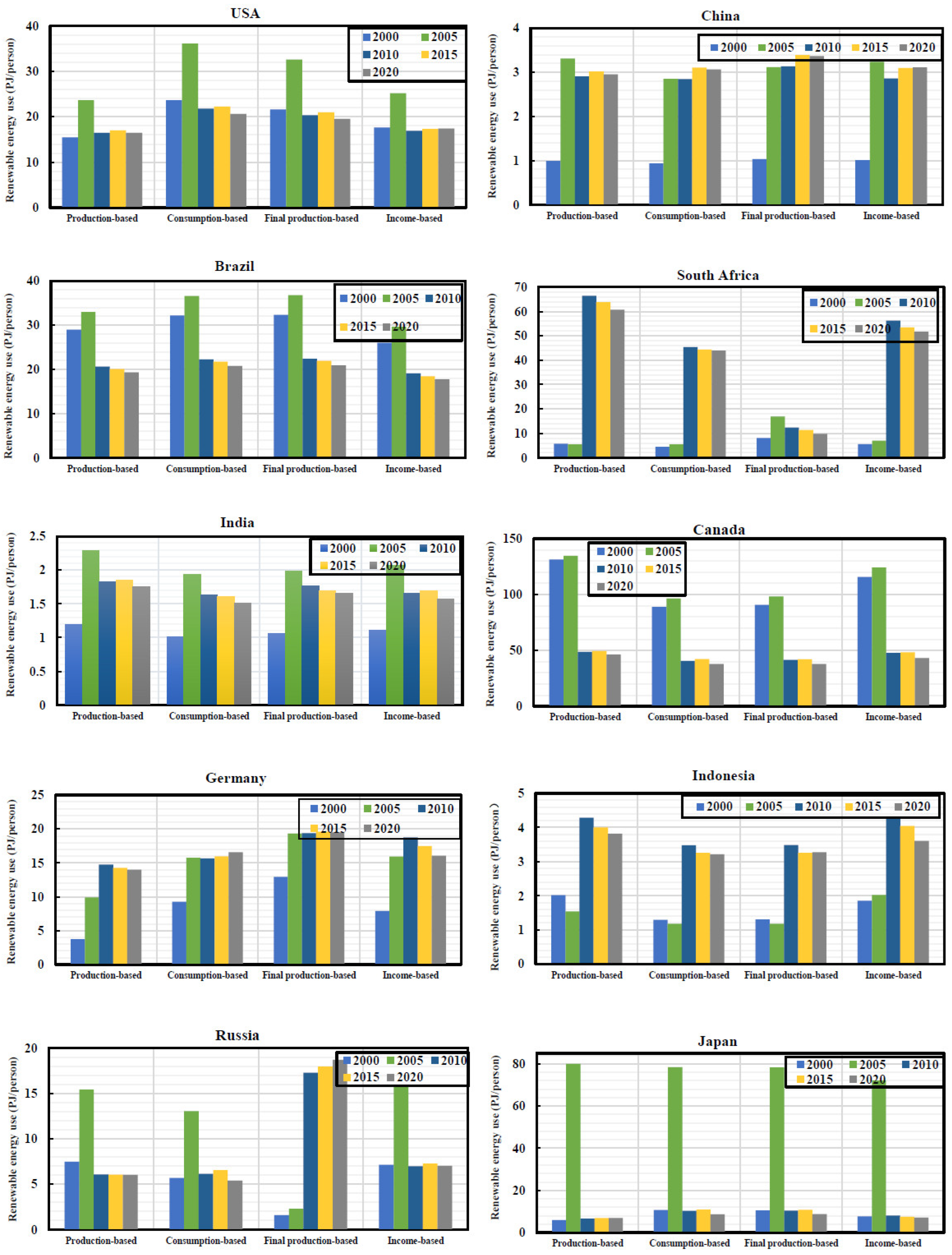
Figure A2 illustrates the temporal trends of per capita renewable energy use for the top ten countries every five years under four-perspectives accounting. As shown in
Figure A2, Canada consistently ranks at the selected top in terms of per capita renewable energy use, especially under the production-based accounting method, with values reaching nearly 160 PJ per person. This is primarily due to its abundant hydroelectric resources and low population density, which significantly amplify its per capita figures [
39]. In contrast, populous countries such as India, Indonesia, and China exhibit low per capita values across all accounting methods—typically below 5 PJ/person—reflecting the constraints imposed by large population sizes and less developed energy infrastructure.
In terms of temporal trends, countries demonstrate varied trajectories. Germany and India have shown steady growth in per capita renewable energy use, largely driven by national energy transition policies such as Germany’s Energiewende and India’s National Solar Mission [
40,
41]. China has also experienced moderate growth in production-based use in recent years, reflecting the rapid expansion of its wind and solar power capacity.
4.2. The Spatial Heterogeneity of Global Renewable Energy Use
4.2.1. Renewable Energy Use from the Perspective of Production-Based for Total and per Capita
As noted in the previous section, temporal trends provide valuable insights into how renewable energy use has developed over time in different regions. However, to fully understand the disparities, it is crucial to examine the spatial heterogeneity across countries. This section focuses on renewable energy use from different perspectives, highlighting the role of different regions in shaping global renewable energy consumption patterns.
The production perspective focuses on the renewable energy use associated with a country’s domestic production activities. This perspective is essential for understanding how industrial production contributes to renewable energy demand. In this section, we will analyze the total and per capita renewable energy use in 2021 from a production perspective, highlighting the disparities between countries based on their production activities.
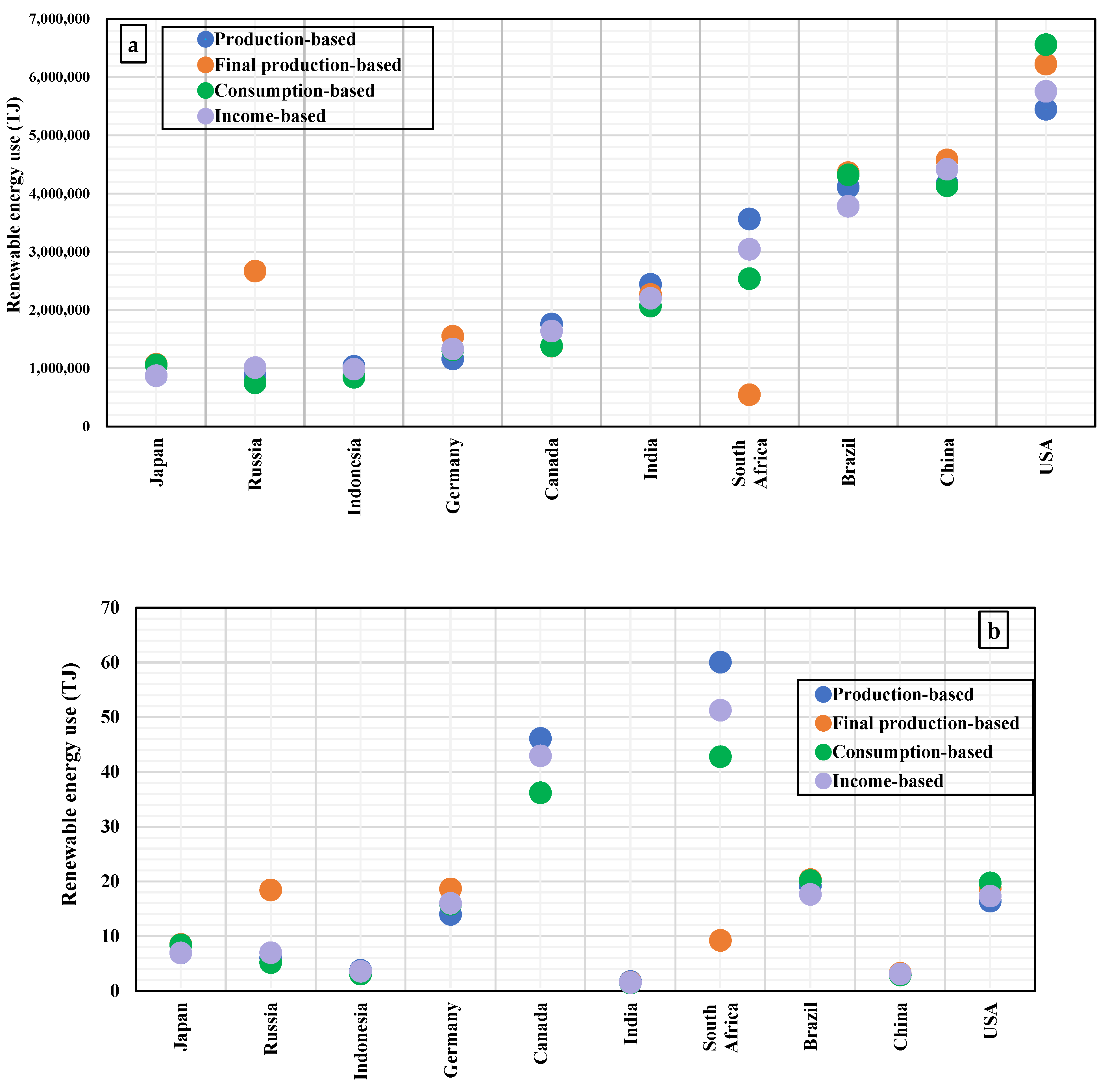
Among the top ten countries shown in the
Table 2 in 2021, the United States is the largest user of renewable energy, operating under a production-based accounting perspective, with renewable energy use totaling 5,451,701.95 TJ, followed by China, which ranks second with 4,172,289.25 TJ of renewable energy consumption. The significant difference in renewable energy utilization highlights the United States’ dominant role in advancing and implementing renewable energy technologies, shaped by supportive policies and strategic investments in the development of renewable energy [
37]. The United States (U.S.) leads in production-based renewable energy use largely because federal incentives—namely, the Production Tax Credit (PTC) and Investment Tax Credit (ITC)—have materially lowered project costs and accelerated deployment of wind and solar at utility scale [
42]. Empirical work also links large U.S. wind build-outs to these incentives, with significant local economic effects accompanying capacity additions [
43].
South Africa stands out with the highest consumption at 60.06 PJ/person, followed by Canada at 46.13 PJ/person. Countries with high per capita use, such as South Africa and Canada, may serve as benchmarks for expanding renewable energy accessibility, whereas countries with lower per capita usage should focus on enhancing infrastructure and policy measures to improve sustainability [
44].
4.2.2. Renewable Energy Use from the Perspective of Consumption-Based for Total and per Capita
From the perspective of consumption-based accounting, all the renewable energy uses are allocated to the final consumer of the products and service. This perspective is critical for understanding how a country’s consumption patterns influence its overall renewable energy demand. In this section, we will explore the total and per capita renewable energy use in 2021 from the consumption perspective, revealing the variations between countries. Similarly, the U.S. remains the largest user of renewable energy in 2021 (
Table 3), accounting to around 6,560,930.8 TJ, followed by China and Brazil, each surpassing 4,000,000 TJ. These findings indicate the significant renewable energy production capacity of these countries, largely driven by their industrial demands [
45] and government incentives [
46] supporting renewable energy integration. High consumption-based renewable energy use in China and Brazil is consistent with their roles as major clean-tech and low-carbon fuel producers. Other researchers have studied China’s policy-driven rise to dominance across the solar photovoltaic (PV) manufacturing chain (from polysilicon through modules), linking domestic demand with export-oriented supply chains [
47]. For Brazil, sugarcane ethanol remains central to transport fuels, with recent assessments indicating ethanol contributes roughly half of the gasoline–ethanol energy mix in typical years, reinforcing both domestic consumption and trade relevance [
48].
South Africa ranks first with 42.80 PJ/person spurred by government incentives and the Renewable Energy Independent Power Producer Procurement Programme (REIPPPP) [
49], followed by Canada reaching at 36.21 PJ/person due to its abundant hydropower re-sources [
50].In contrast, China, India, and Indonesia report the relative lowest per capita renewable energy use largely due to their fossil fuels (e.g., coal for China [
51] ) and large populations.
4.2.3. Renewable Energy Use from the Perspective of Final Production-Based for Total and per Capita
The perspective of final production-based focuses on renewable energy use associated with final products across the global supply chain. For a country that mainly serves as a producer of intermediate products, the renewable energy use allocated to it is supposed to be much less than that allocated to a producer of final goods. This perspective is especially important for understanding the renewable energy embodied in products that are exported or consumed domestically. In this section, we will analyze the total and per capita renewable energy use from the final production perspective in 2021, shedding light on the role of global supply chains.
From the perspective of final production-based, the U.S. leads in renewable energy production with 6,226,498.1 TJ, far surpassing other countries (
Table 4). Following the U.S. is China. This is due to their status as prominent global exporters. Brazil, India, and Germany also demonstrate considerable renewable energy usage, indicating substantial integration into their trade products. The above-mentioned information reflects the renewable energy use in final products across the global supply chain [
52]. Final production-based use captures renewable energy embodied in goods delivered to end users. Because China and the U.S. are manufacturing hubs for wind turbines, PV modules, and other clean-energy equipment, sizeable renewable energy is embodied in final goods even when consumed abroad—an effect documented in recent clean-tech supply-chain studies [
47].
As shown in
Table 4, Canada exhibits the highest per capita renewable energy consumption at 36.19 PJ/person, predominantly attributable to its extensive hydroelectric resources and comparatively small population [
53]. High-population nations such as China and India exhibit relatively lower per capita figures despite substantial total renewable energy use, as the similar volume of renewable resources is distributed among far larger populations [
54].
4.2.4. Renewable Energy Use from the Perspective of Income-Based for Total and per Capita
The perspective of income-based accounting focuses on a country’s role as a primary supplier of inputs in the production process, which influences both direct and indirect renewable energy consumption. This approach highlights the upstream economic activities that contribute to renewable energy use. Obviously, the U.S. and China are the global leaders, with a total use of 5,759,438.4 TJ and 4,422,647.8 TJ (
Table 5), respectively, far exceeding other countries. In this framework, countries (the U.S. and China) with relatively high gross domestic product (GDP) and strong international trade links emerge with substantial totals, as their income-driven consumption and investment patterns directly influence renewable energy use [
55]. Income-based renewable energy use aligns with investment capacity and upstream factor payments. In 2021, clean-energy investment reached roughly USD 380 billion in China and USD 215 billion in the U.S., supporting large-scale integration of wind and solar and reinforcing high income-based totals [
56].
In terms of per capita renewable energy use, South Africa exhibits the highest per capita use at 51.29 PJ/person, followed by Canada at 42.95 PJ/person. This indicates a significant contribution of renewable energy to these countries’ export-driven sectors relative to their populations. In contrast, populous countries such as China and India display much lower per capita figures, reflecting challenges in scaling renewable energy to match extensive population sizes and diverse economic activities.
4.2.5. Comparison of the Different Perspectives
In this section, we compare the renewable energy use across the four perspectives: production-based, consumption-based, final production-based, and income-based. This comparison highlights the varying roles that different countries play in the global renewable energy landscape.
Figure 1a presents the renewable energy use of ten countries in 2021 across four perspectives. Clearly, the U.S. is the largest renewable energy user across all four perspectives. The production-, consumption-, final production-, and income-based renewable energy use in 2021 amounted to 5,451,701.9 TJ, 6,560,930.8 TJ, 6,226,498.1 TJ, and 5,759,438.4 TJ, respectively.
Canada and South Africa demonstrated higher income-based renewable energy use. In Canada, income-based renewable energy use was 18.67% and 18.62% higher than the final production- and consumption-based figures, respectively. As a primary supplier of renewable energy, this reflects their substantial contribution to global energy transition processes [
57].
Conversely, the opposite trend is observed in resource-importing countries. In the U.S., income-based renewable energy use was 7.5% and 12.2% lower than the consumption- and final production-based figures in 2021, respectively. Similarly, Brazil’s income-based renewable energy use was 8.03%, 12.49%, and 13.27% lower than its production-, consumption-, and final production-based use, respectively, in 2021. These countries are major importers of resources and are positioned in the downstream stages of global supply chains. They play a more significant role as producers or final consumers rather than as primary suppliers in the global renewable energy market.
Renewable energy use is primarily domestic in nature, yet it is evident that some countries display a mismatch between renewable energy production and consumption. This misalignment is particularly apparent in countries with a large industrial base, where energy use is heavily concentrated in industrial and large-scale production sectors, such as manufacturing and heavy industries. This suggests that renewable energy is being primarily utilized by industrial sectors, which often require large amounts of energy for their operations, rather than benefiting ordinary consumers. The discrepancy becomes more significant in countries like the U.S., South Africa, and China, where renewable energy resources are abundant, but the distribution of these resources to everyday consumers remains limited [
58]. One potential reason for this phenomenon is the prioritization of industrial needs over household or residential consumption, reflecting the higher energy demands of large-scale production and export-driven economies [
59].
In
Figure 1b, we can observe that developed countries such as the U.S. and Canada tend to have higher per capita renewable energy use from all four perspectives in 2021, largely due to their advanced infrastructure, consumption patterns, and well-established energy production systems [
60]. Specifically, the high levels of industrialization, coupled with mature and diverse renewable energy systems, support their relatively high per capita renewable energy use. In general, developing countries like China, India, and Brazil display relatively lower per capita renewable energy use. Despite their large total renewable energy use, the vast population size in these countries dilutes the per capita figures, which remain comparatively low. This discrepancy highlights the challenge of achieving higher per capita renewable energy use in populous countries, where growth in energy consumption tends to be more distributed across a larger base of consumers.
4.3. Sectoral Contributions in Different Perspective
Building on the previous sections, which focused on the temporal and spatial aspects of renewable energy use, this section shifts its focus to sectoral contributions. By analyzing the renewable energy use across various sectors, we aim to uncover the driving forces behind global energy transitions, highlighting the industries that are most influential in determining renewable energy demand.
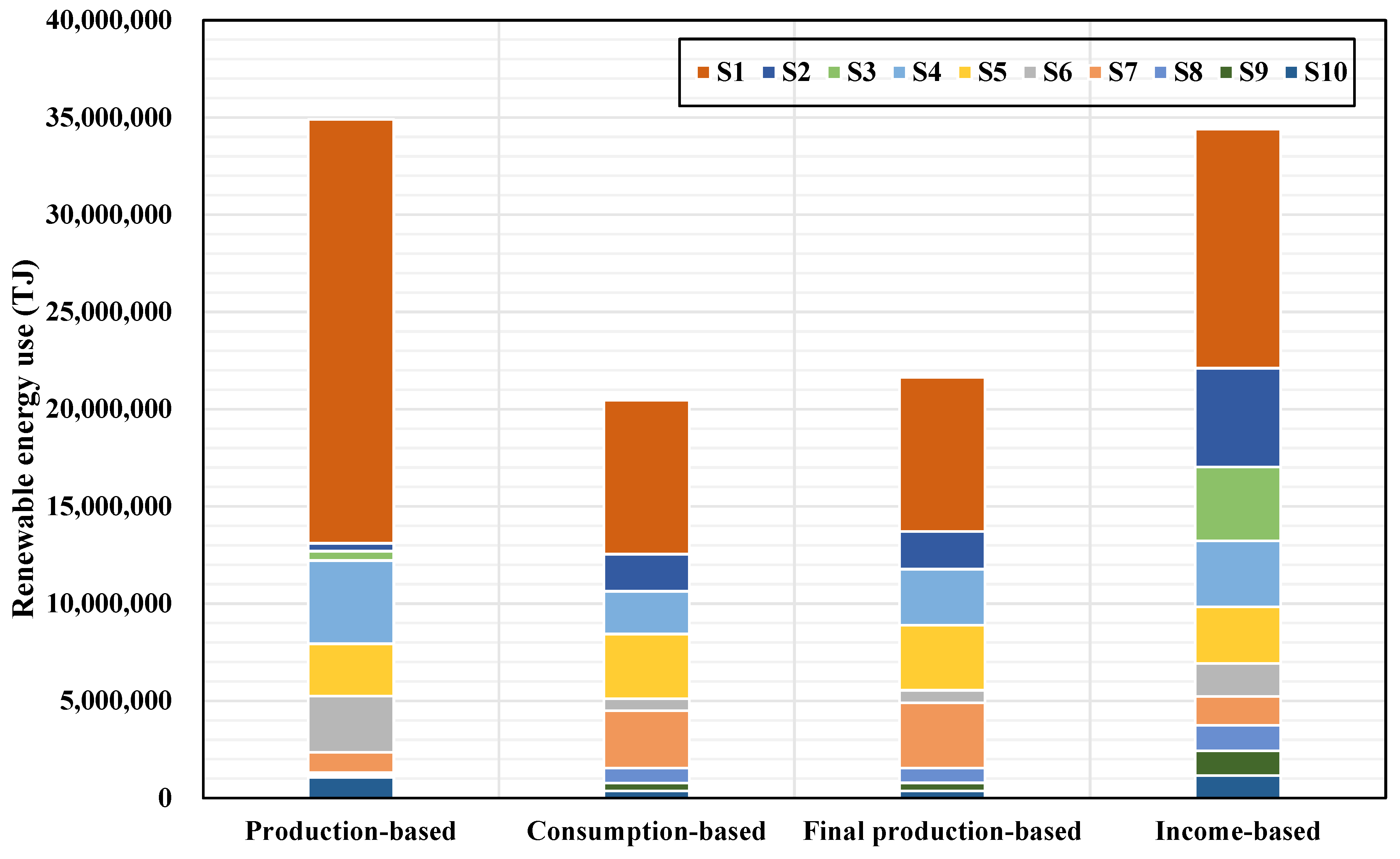
The sectoral contributions analysis (
Figure 2) shows that the top ten sectors in income-based renewable energy use in 2021 are mainly related to basic materials (i.e., agriculture, mining, metals, and electricity) and manufacturing-related services (i.e., financial and business, wholesale trade, transport, and other services). Basic materials and these services are essential to industrial production and drive substantial downstream renewable energy use. Additionally, these sectors are predominantly found in countries with high GDP, such as the U.S., China, India, Russia, and Brazil. Under the four-perspectives accounting, the electricity, gas, and water sector (S1) consistently emerges as the primary contributor to renewable energy use.
Figure 2.
Sectoral renewable energy use from four perspectives in 2021. The full names of the sectors are in
Table 6.
Figure 2.
Sectoral renewable energy use from four perspectives in 2021. The full names of the sectors are in
Table 6.
Table 6.
The full names of the sectors.
Table 6.
The full names of the sectors.
| Num | Sector |
|---|
| S1 | Electricity, Gas, and Water |
| S2 | Financial and Business |
| S3 | Mining and Quarrying |
| S4 | Petroleum, Chemical, and Non-Metallic Mineral Products |
| S5 | Transport |
| S6 | Wood and Paper |
| S7 | Electrical and Machinery |
| S8 | Retail Trade |
| S9 | Wholesale Trade |
| S10 | Metal Products |
Within the production-based accounting framework, this sector accounts for the highest share (about 60 percent), followed by the petroleum, chemical, and non-metallic mineral products sector (S4). This distribution highlights two underlying mechanisms. First, structural reliance of the electricity sector. The sector’s profound dependence on large-scale renewable energy systems (e.g., hydropower plants, photovoltaic stations) serves as the cornerstone for decarbonizing primary energy production, particularly in economies transitioning toward grid modernization and energy storage integration. Second, strategic transition of traditional high-carbon industries. The petroleum and chemical sector actively integrates renewable energy through hybrid energy strategies (e.g., biomass co-firing, green hydrogen pilot projects), driven by dual motivations—policy mandates (e.g., carbon pricing, sectoral emission reduction targets) and market adaptation (e.g., low-carbon supply chain requirements).
The diversified renewable energy use patterns under consumption- and final production-based accounting highlight demand-side drivers across key sectors. For example, the transport sector’s (S5) prominence likely stems from accelerated electric vehicle adoption (e.g., EU’s 2035 combustion-engine ban [
61] and biofuel mandates (e.g., Brazil’s ethanol blending policy [
62]), reflecting policy-driven shifts in end-use decarbonization. Notably, the petroleum, chemical, and non-metallic mineral products sector (S4) demonstrates a dual transition: proactive adoption of green hydrogen for ammonia synthesis and reactive compliance with supply chain decarbonization requirements (e.g., Walmart’s Project Gigaton). These examples underscore how market signals and regulatory frameworks jointly shape renewable penetration beyond production-centric approaches.
Under the income-based accounting framework, while the electricity, gas, and water sector (S1) retains its leading position, its reduced share compared to the production-based perspective alongside the rising prominence of the financial and business sector (S2)— reveals the growing significance of indirect economic activities in shaping renewable energy transitions. The financial sector’s contribution likely stems from its role in financing renewable projects (e.g., green bonds, ESG investments) or facilitating carbon credit markets, illustrating how capital allocation and market mechanisms indirectly amplify renewable adoption. This divergence highlights that energy transitions are not solely driven by direct production activities but are increasingly mediated by economic value chains and service-oriented leverage points.
5. Conclusions and Policy Implications
This study utilizes the environmentally extended multi-regional input–output (EEIO) model to systematically analyze global disparities in renewable energy use from four perspectives (production-based, consumption-based, final production-based, and income-based) over the period of 2000 to 2021. The findings reveal significant heterogeneity across countries and on a per capita basis in the global renewable energy landscape. First, substantial cross-country’s disparities in renewable energy use are observed across all four perspectives. In 2021, the United States emerged as the largest user of renewable energy in terms of total usage. Although several developing countries (such as China (around 4 PJ/person) and India (approximately 3 PJ/person)) have demonstrated rapid growth in total renewable energy use, their per capita figures remain notably lower than those of developed countries due to demographic dilution effects. Second, countries’ roles within the global supply chain vary, resulting in considerable differences in renewable energy attribution across accounting frameworks. Resource-exporting countries such as Canada and South Africa exhibit high renewable energy usage under the income-based perspective, underscoring their upstream position in global production networks. In contrast, resource-importing economies like the United States and Brazil show lower income-based figures, highlighting their roles as downstream producers or final consumers. Finally, the electricity, gas, and water supply sector consistently ranks as the largest contributor to renewable energy use, particularly under the production- and income-based accounting. Additionally, sectors such as transport, food and beverages, and financial services emerge as major contributors in the consumption and final production perspectives, highlighting the complex and distributed nature of energy demand across economies.
Starting from the above conclusions, four policy suggestions are offered to address regional and personal disparities and enhance equitable energy transitions. First, for resource-exporting countries such as Canada, it is crucial to enhance their role as reliable global suppliers of renewable energy. Governments should establish national-level green certification systems, such as a green hydrogen certification program, to ensure traceability and credibility in international markets. Canada’s Hydrogen Strategy [
63] already sets a framework for certification and cross-border cooperation, providing a replicable model for other exporters. Second, for resource-importing countries like the United States, the policy focus should be on ensuring equitable access to renewable energy across sectors and income groups. In the residential sector, means-tested subsidies and direct rebates can reduce the upfront costs of rooftop solar panels and heat pumps, especially for low- and middle-income households. The Inflation Reduction Act provides concrete examples, including tax credits and rebates, which can be expanded to additional clean technologies. Third, international coordination is essential to resolve mismatches between renewable energy production and consumption. The International Renewable Energy Agency [
64] has advanced proposals for harmonized renewable energy certificate (REC) systems, which could serve as the basis for a globally recognized platform. Such a platform would standardize certification, enhance credibility in cross-border renewable energy trade, and ensure equitable participation by both exporters and importers. Fourth, the financial sector must play a catalytic role in accelerating energy transitions. Policymakers should promote green financial instruments such as sovereign green bonds, ESG-linked loans, and blended finance platforms to mobilize private capital for renewable energy deployment. The European Green Bond Standard proposed by the European Commission provides a concrete regulatory framework that enhances transparency, comparability, and investor confidence, offering a model for other regions [
65]. Expanding voluntary carbon markets and linking them with renewable energy projects could further improve return-on-investment profiles and attract institutional investors.
Although this study provides a comprehensive analysis from multiple perspectives and closely aligns with its secondary research objectives, there are several important limitations that should be acknowledged. First, renewable energy was treated as a single category, without distinguishing among different sources such as wind, solar, or hydro, limiting insights into their distinct roles across regions and sectors. Second, the MRIO model assumes barrier-free trade between countries, without considering tariffs, non-tariff barriers, or other forms of trade restrictions. While these factors may significantly impact energy flows in reality, the MRIO model simplifies this assumption. Third, the MRIO model does not incorporate non-market factors such as geopolitical events or policy changes, which may play an important role in global energy supply chains.