


Abstract
The Akkuyu Nuclear Power Plant (NPP) is framed as a flagship of Türkiye’s national low-carbon transition. This study examines how domestic economic actors perceive the project’s socio-economic and environmental impacts, and how those perceptions align with—or diverge from—official assessments and the United Nations Sustainable Development Goals. Using a qualitative phenomenological approach, the research draws on 28 semi-structured interviews with members of the Silifke Chamber of Commerce and Industry Council. This lens captures how locally embedded businesses read the project’s risks and rewards in real time. Four themes stand out. First, respondents see a clear economic uptick—but one that feels time-bound and vulnerable to the project cycle. Second, many feel excluded from decision-making; as a result, their support remains conditional rather than open-ended. Third, participants describe environmental signals as ambiguous, paired with genuine ecological concern. Fourth, skepticism about governance intertwines with sovereignty anxieties, particularly around foreign ownership and control. Overall, while short-term economic benefits are widely acknowledged, support is tempered by procedural exclusion, environmental worry, and distrust of foreign control. Conceptually, the study contributes to energy-justice scholarship by elevating sovereignty as an additional dimension of justice and by highlighting the link between being shut out of processes and perceiving higher environmental risk. Policy implications follow directly: create robust, domestic communication channels; strengthen participatory governance so local actors have a real voice; and embed nuclear projects within regional development strategies so economic gains are durable and broadly shared.
1. Introduction
As the world energy system transition issue gathers steam, nuclear power has once again begun to loom as a core component of sustainable developmental scenarios. Nuclear power stations (NPPs) provide bulk-scale, low-carbon generation [1] which could be complementary to international climate agreements like the Paris Agreement and United Nations Sustainable Development Goals (SDGs) [2], and provide reliable (firm dispatchable) generation capacity to support variability in renewables, enhance system reliability, and lower system cost in deep decarbonisation scenarios [3]; moreover, life-cycle assessments always reveal low greenhouse gas emissions from nuclear generation [4].
But acceptability of nuclear power in society is contested, and social acceptability, governance, and perceived risk are primary determiners of deployment decisions [5]. Longitudinal data show that the Fukushima disaster decreased acceptability and that increased risk perceptions persisted in the long term [6]. Regional acceptability is further moderated by perceived benefits and drawbacks, institution trust, and procedural justice concerns—particularly around long-term storage of High-Level Radioactive Waste (HLRW) [7]. Cross-chain comparative risk analysis shows that even if severe accidents are a rare occurrence in chains of energy, their high-consequence nature prescribes safety and emergency response standards [8]. Fukushima lessons underscore the need to take into consideration external threats (e.g., earthquake and tsunami effects) and make corresponding updates to probabilistic assessments of risk and resilience efforts [9].
From a governance viewpoint, new energy justice literature provides a unifying vision of thinking about nuclear adoption in terms other than techno-economic performance. The distributive, procedural, and recognition justice trilogy necessitates a question of whose benefits and whose risks, whose decision and under what conditions, and whose identity and claims have been recognised; companion work emphases these aspects as mutually dependent and must become ingrained in “just transition” policy making [10,11,12,13]. Such conceptualisation has particular relevance to technologies, such as nuclear power, in which assets have long lifetimes and cross-boundary externalities increase issues of consent, representation, and risk allocation to an especial extent.
Apart from energy justice, risk sociology insights account for how risk is socially framed and culturally mediated, highlighting institutional trust, relations between expertise and lay knowledge, and social amplification of risk [14,15,16,17]. Additional views of complex systems dwell on how tightly coupled, high-hazard infrastructures create unique demands on governance [18]. Social resilience scholarship in addition reveals that participation, social capital, and transparent risk communication support communities’ ability to absorb disturbance and adapt [19,20,21,22]. In combination, these bodies of scholarship elucidate why perceived environmental risk and the legitimacy of foreign-owned nuclear projects are conditioned by procedural inclusion and trustworthy institutions, and thereby offer a connection between our energy-justice-focused lens and the Akkuyu case.
More recent work highlights similar governance and acceptance dynamics: trust-focused nuclear governance structures hold that fair sharing of technology and inclusive stakeholders are requirements for legitimacy in new economies [23]; qualitative research on high-level radioactive waste in Germany reveals social values and personal judgment heavily condition acceptance in excess of technical risk criteria [24]; qualitative data on uranium mining in Spain records how conflict, distrust, and perceived unevenly divided benefits fuel rejection in the absence of real engagement [25], and multicriterion assessments of coal-to-SMR substitution reveal environmental and economic upgrades in combination with contextually receptive operational and policy design [26]. In aggregate, they lend support to assessing nuclear projects in terms of justice-focused, participatory forms of governance—a framework which has direct relevance to the Akkuyu case studied in what follows.
Established consistent with a 2010 intergovernmental agreement with the Russian Federation, Akkuyu is developed on a build–own–operate basis in which the project company has controlling ownership and operating rights; the configuration delineates roles, risk, and long-term power purchase obligations in statute and ancillary agreements [27,28]. In full commission, the four VVER-1200 units (4800 MWe) will provide approximately 10% of Türkiye’s power, emphasizing system-level project importance [29]. Despite the fact that BOO arrangements can moderate up-front funding and delivery risks, analysts recognize they engender unique governance and sovereignty issues in relation to regulatory capability, transparency, local supply chain localization, and strategic command control allocation—concerns illustrated in contemporary scholarship on Rosatom’s external nuclear diplomacy [30]. These incentives provoke a context-adaptive examination of how national actor groups regard Akkuyu’s socio-economic and environmental implications. Although several technical analyses simulated atmospheric dispersion and deposition in hypothetical Akkuyu accidents and explored probable biota effects within the Mediterranean [31,32], in themselves, such analyses provide modest insight into stakeholders’ lived experience and governance concerns.
This study fills that gap in answering how local economic stakeholders in Mersin—i.e., officials of the Silifke Chamber of Commerce and Industry Council—perceive the socio-economic and environmental implications of the Akkuyu NPP, and how they correspond to energy-justice domains in a foreign-owned build–own–operate (BOO) facility. From 28 phenomenological, semi-structured interviews, the study integrates business, environmental, and governance perspectives. Empirically, it offers the first detailed description of that stakeholder segment; theoretically, it extends the energy-justice framework to outline sovereignty justice—regulatory autonomy, command of strategy, and transparency of data—separate but interacting as a dimension; methodologically, to show how phenomenological interview research can cross infrastructure governing and energy-justice scholarship. The analysis reveals that perceived environmental risk strengthens as procedural exclusion escalates, and perceived burdens and privileges get redistributed that way; and that interdependence across justice domains prevails. Policy implications include codifying regulatory independence and transparent access to information in BOO concessions, jointly designed participation and monitoring for emergency planning and high-level radioactive waste (HLRW) management, and local-content and skills-oriented policies to bolster legitimacy and long-term viability in emerging-economy nuclear transition.
2. Materials and Methods
2.1. Research Design
This study uses a qualitative phenomenological research design to explore local stakeholders’ perceptions of the socio-economic and environmental implications of the Akkuyu Nuclear Power Plant (NPP) in Türkiye. A phenomenological type of research is particularly well-suited to exposing the lived experience, localized issues, and subjective judgment of the individuals, who in one way or another, exercise direct or indirect influence due to a large-scale infrastructural project [33]. Contrast to aiming to achieve statistical generalization, the aims of the approach in the present instance encompass revealing underlying patterns of meaning-making, emotional experience, and community narrative inherent in the local landscape. Such an interpretive frame of mind makes possible the research to expose how stakeholders construct meaning around nuclear expansion, especially in relation to trust, governance, risk, and inclusion—frequently overlooked aspects in top-down sustainability appraisal.
2.2. Case Selection and Context
Akkuyu Nuclear Power Plant (NPP), which has been envisaged in the Mersin province of Türkiye, has been selected as the case area because of its national strategic nature, external ownership profile, and highly contentious sustainability profile. Being Türkiye’s first nuclear plant—carried out through a Build–Own–Operate (BOO) arrangement with Rosatom—Akkuyu has garnered popular concern in terms of not only its environmental and technical attributes but issues of energy sovereignty, regional equity, and long-term governing. Even though geographically located in the precinct of Gülnar district, its economic and infrastructural dynamics feed into, and cannot be dissociated from, the Silifke district, which happens to be an adjoining coastline host to much of the logistical, entrepreneurial, and service-oriented support of the plant. The diversified economy of Silifke—of agriculture, tourism, retail, and construction—renders much of the economy vulnerable to opportunities of, and spillovers from, the project.
Significantly, the Silifke Chamber of Commerce and Industry Council (SCCIC) serves as the official representative body not only of Silifke itself but of registered companies in Gülnar and in Aydıncık, the two geographically proximate districts to the plant. Such institutional coverage makes SCCIC the best legitimate and integral venue to gather local stakeholders’ insights. The council of SCCIC comprises major regional sectors’ representatives and thus offers an intrinsic view of how regional enterprise conceives the socio-economic and environmental consequence of the NPP. Owing to such reasons, data collection has been focused on SCCIC members whose positioning would offer insight into how Akkuyu NPP defines regional expectation of development, danger perceptions, and trust in governing structures.
2.3. Participant Sampling
A purposive sampling plan was adopted to include participants of direct institutional significance and knowledgeable views on the local repercussions of the Akkuyu Nuclear Power Plant (NPP) project. Such an approach corresponds to the phenomenological research design, which favors information-rich cases rather than statistical generalizability. The sample comprised all 28 of the elected representatives of the Silifke Chamber of Commerce and Industry Council (SCCIC), which represents the sole, officially mandated body representing businesses in Silifke, Gülnar, and Aydıncık—those administrative regions immediately impacted on the construction and future operation of the NPP. Due to the regional coverage of SCCIC and cross-industry representation, its representatives enjoy specific expertise to offer informed insights into economic, environmental, and governance aspects of the project. The SCCIC council has elected representatives from all of the Law No. 5174 (TOBB) professional categories; as such, the 28 interviewees span the main sectoral range of the district [34]. Council members were interviewed one-on-one after one of the regularly scheduled SCCIC general assemblies, which took place in May 2025. Such one-on-one interviews facilitated privacy and depth and, in addition, took advantage of the contemporaneity of the group debates on which they were conducted. The participants varied across a wide range of sectors, including construction, logistics, agriculture, tourism, retail, environmental consulting, civil engineering, and local advisory municipality services. All were in decision-making office in their respective sectors and enjoyed authoritative knowledge on local socio-economic relations and regional infrastructural advancements.
2.4. Data Collection
All the interviews were conducted face to face at the office of Silifke Chamber of Commerce and Industry Council (SCCIC) in May of 2025. The venue provided a comfortable but professional environment for the participants so that they were able to converse in a free and reflective mood. The time of interviews varied between 30 and 60 min to provide sufficient time for exploring participant experience.
A semi-structured interview schedule was created to allow for thematic consistency as well as conversational adaptability. The main areas of focus were:
- Perceived economic opportunities and risks associated with the Akkuyu NPP;
- Effects on local jobs, trade networks, and infrastructural development;
- Environmental concerns such as marine ecosystem vulnerability and seismic risk;
- State agency and external actor trust and legitimacy perceptions;
- Aspirations and expectations for long-term regional development and inclusion.
All the interviews were audio-recorded after taking informed consent and then transcribed word by word for analysis. The interviews were carried out in Turkish, which is the native language of the participants, and then converted to English to ease thematic coding. Due care was taken during the process of translation to retain the meaning, tone, and cultural connotations of the initial narrations
2.5. Data Analysis
A thematic analysis of the interview data followed the six-phase procedure described by Braun and Clarke (2006) [35]. The procedure included: (1) familiarization of the data through repeat readings, (2) generation of initial codes, (3) investigation of themes, (4) evaluation of themes, (5) naming and definition of themes, and (6) generation of the final report. All the transcripts were coded using NVivo 14 [36] qualitative data analysis software, which facilitated efficient, systematic, retrieval, and visualizing of emergent patterns. The coding itself was predominantly inductive, which let themes develop out of participant narrative in an organic, emergent way. Even so, the analysis was, in conceptual terms, guided by the key sustainability constructs—energy justice, stakeholder participation, inclusive development, and legitimacy of governance—those acting as sensitizing concepts and not as preconceived categories. Through taking on this hybrid methodology, the research achieved a balance between meaning emerging out of the participant and meaning emerging out of theoretical conceptualization, so ensuring richness emerging out of the empirical and coherence emerging out of analysis. Themes were ratified through peer debriefing and scrutinized for consistency in the lived experience reported across a range of sectors and roles. There were overall 432 open codes derived out of 28 interviews, which were then clustered into 4 major themes and 17 sub-themes. The NVivo 14 software facilitated the coding to be carried out, which facilitated node frequency analysis, co-occurrence map, and theme saturation check. For instance, institutional trust and procedural justice themes co-appeared together in well over 75% of transcripts, which evidenced the conceptual interdependence of the themes. Theme saturation was ascertained during the coding, and saturation was defined as the point at which there were zero new codes derived after three consecutive interviews (Guest, Bunce, & Johnson, 2006) [37]. The criterion ensured that the theme structure encompassed the entire range of views held in the dataset and eliminated unwarranted redundancy.
2.6. Trustworthiness, Triangulation, and Ethical Considerations
To preserve credibility, dependability, and confirmability, Lincoln and Guba’s (1985) criteria for qualitative validation were adopted [38]. Prolonged participant involvement, member checking of sampled transcripts/summaries to check factual accuracy, and peer debriefing during code and theme refinement to increase analytic rigor were employed. Moreover, Supplementary Document analysis was added to reinforce credibility. An authoritative, case-proximate corpus was purposively compiled (Akkuyu EIA/ÇED and revisions; NDK regulations, including the National Nuclear Emergency Plan (2019); SCCIC annual reports/sector bulletins) and coded deductively against the finalized codebook. Documents were then cross-checked against interview themes using a convergence–divergence checklist based on participation procedures, emergency planning transparency, local content schedule, and risk communication. This triangulation suggested convergence on emergency planning procedures/transparency and divergence on the perceived rate of localization promises. These measures were taken to expand the study’s trustworthiness without exaggerating its one-method core research design. Mersin University Social and Human Sciences Ethics Committee approved the study on 4 March 2025 (Approval No: 51). Detailed information of the study’s intention, scope, voluntary nature of participation, and data confidentiality were provided to all participants; written informed consent was sought before interviews. Audio files and transcripts were anonymized and safely stored in accordance with university data protection policies.
3. Results
This part provides phenomenological results obtained from in-depth, semi-structured interviews conducted with 28 representatives of the Silifke Chamber of Commerce and Industry Council (SCCIC). The analysis conformed to Moustakas’ transcendental phenomenological procedure: horizonalization, clustering of meaning units, textural and structural description, composite essence construction, and reflexivity.
The goal is to grasp the way local stakeholders and business leaders view the construction of the Akkuyu Nuclear Power Plant (NPP) as part of their socioeconomic and environmental landscape. The main four themes that were identified across stakeholder interviews were: (1) Economic Dynamism & Temporal Fragility, (2) Procedural Exclusion & Conditional Support, (3) Environmental Uncertainty & Risk Awareness, (4) Governance Mistrust & Sovereignty Issues. The coverage of the coding was wide, as every theme appeared in at least 20 of 28 transcripts. NVivo analysis, in addition, unveiled intense co-occurrence between distrust in central authorities and perceptions of environmental risk.
Table 1 shows the main four themes identified in the analysis of 28 semi-structured interviews, revealing their relative frequency and descriptive emphasis.
Table 1.
Frequency and Coverage of Core Themes Identified in Stakeholder Interviews.
As can be noted from Table 1, which illustrates the thematic distribution in stakeholder accounts, environmental risk and institutional trust were the most frequently mentioned issues, appearing in more than 85% of interviews. The high rate of co-occurrence of the two themes suggests a strong perceived interdependence between administrative credibility and ecological security. Although economic opportunities—such as job creation and local area investment—were universally endorsed, many interviewees were doubtful of the sustainability and local redistribution of such opportunities, particularly in the context of unclear and obscure territorial plans of development. Moreover, grievances relating to participation, such as exclusion from decision-making and limited access to project information, were pervasive and echo core principles of the energy justice paradigm. In general, the study reveals the necessity of participatory decision-making arrangements taking into account risk perception and procedural justice in nuclear energy transitions.
3.1. Thematic Categories and Meaning Structures
In this study, “economic dynamism” refers to the perceived short-term acceleration of local economic activity, investment, and employment opportunities directly associated with the Akkuyu NPP’s construction phase. By contrast, “temporal fragility” denotes the perceived instability or impermanence of these gains, reflecting stakeholder concerns that the economic boost may dissipate once construction activities conclude. These terms are used throughout the analysis to capture the dual nature of participants’ economic perceptions—optimistic in the immediate term but cautious about long-term sustainability. Through horizontalization and thematic clustering, four central themes emerged, representing recurrent patterns in participant narratives. The four core themes and their sub-dimensions are summarized in Table 2.
Table 2.
Thematic Breakdown with Sub-Categories and Quotes.
This table shows the theme and sub-theme coverage of the 28 semi-structured interviews. “Number of Interviews” shows the number of participants reporting on each theme, and “Percentage Coverage” shows the coverage of the whole sample. The results show high coverage of environmental risk and mistrust of governance themes, indicating widespread reporting of these issues across participants. The results are derived from the NVivo 14 thematic coding outputs based on the saturation standard of no new codes appearing after three successive interviews (Table 3).
Table 3.
Theme coverage by interview and code counts.
3.2. Interpretation of Thematic Categories
Economic Dynamism and Temporal Fragility: While many participants acknowledged short-term economic stimulation due to construction activities, they perceived these benefits as fleeting and concentrated among external contractors. The fragility of employment and inequality in distribution caused disappointment:
“The jobs came fast, but we’re not sure they’ll stay. They’re not ours in the long run.”(P9)
Procedural Exclusion and Conditional Support: Support for the project was not unconditional. Many participants felt excluded from project consultations, reinforcing a sense of marginalization. Support existed, but it was conditional on transparency and participation:
“We are business people. We believe in development. But we don’t want to be left out.”(P13)
Environmental Uncertainty and Risk Awareness: Participants expressed environmental concerns grounded in local knowledge and past seismic events. Many lacked access to technical information but maintained strong intuitive perceptions of ecological risk:
“We lack information on drills and preparedness; we need regular public updates and exercises.”(P21)
Governance Mistrust & Sovereignty Concerns: The strongest emotional responses came from perceptions of foreign control and lack of local representation. This theme was infused with sovereignty-based anxiety and deep mistrust toward decision-makers:
“I don’t trust the foreign operator; I’d prefer Turkish firms to run it.”(P5)
Thematic clusters were not only derived inductively but also supported by code frequency data extracted via NVivo 14. For example, the node “foreign ownership concern” appeared in 19 out of 28 interviews, while “exclusion from decision-making” was coded 34 times across participants, indicating high thematic saturation.
3.3. Visual Representation of Participant Narratives
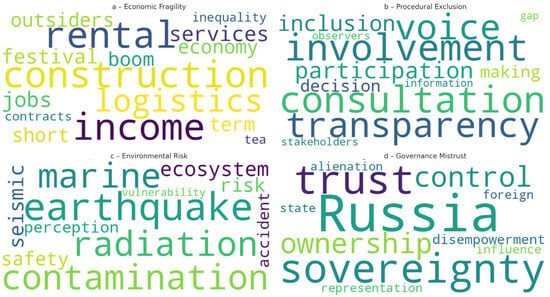
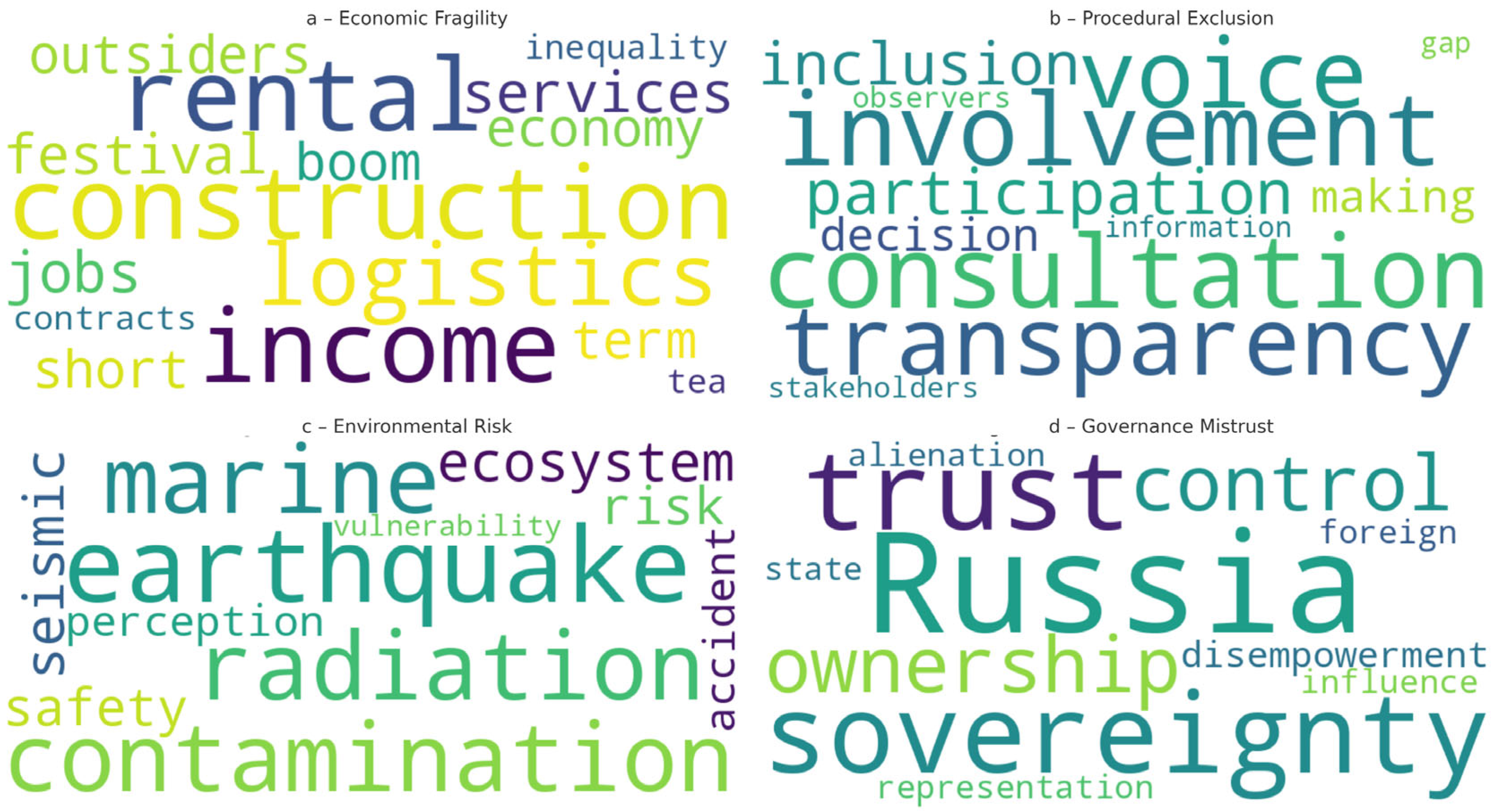
To enhance the lexical and thematic transparency of the findings, NVivo 14 software was used to generate word frequency visualizations and semantic clusters derived from the interview transcripts. This helped capture not only what participants said, but how frequently and in what thematic context key terms appeared. Figure 1 below illustrates four distinct word clouds, each corresponding to one of the core thematic domains:
Figure 1.
Word clouds organized by thematic cluster. Economic Fragility (a), Procedural Exclusion (b), Environmental Risk (c), Governance Mistrust (d).
Prominent terms such as “construction”, “earthquake”, “transparency”, “outsider”, and “sovereignty” reveal patterns of perceived uncertainty, institutional distance, and conditional support for the project.
To further support the lexical richness, Table 4 presents the top ten most frequent coded terms across all interviews. These frequencies provide empirical backing for the emergent themes and demonstrate saturation in concepts such as “earthquake,” “trust,” and “foreign ownership”.
Table 4.
Term frequencies and representative keywords by theme.
The table shows how key thematic concerns such as environmental risk (‘earthquake’, ‘contamination’), governance trust (‘sovereignty,’ ‘participation’), and perceived exclusion (‘outsider’, ‘contracts’) were lexically prominent across participant narratives. While the word clouds provide an accessible visual overview of lexical prominence, they have been supplemented with additional analytical materials to enhance academic rigor. Table 4 includes both term frequency counts and thematic frequency statistics. Furthermore, Table 5 presents the full coding framework, detailing each theme, its sub-themes, corresponding code counts, and interview coverage. Representative quotations for each theme are also included in Table 2 to ground the findings in participants’ lived experiences. This combined presentation strengthens the transparency and reproducibility of the thematic analysis.
Table 5.
Demographic Characteristics of Participants.
3.4. Interrelations Between Themes
The thematic categories identified in the analysis were not isolated; rather, they interacted dynamically, shaping how participants perceived the broader sustainability implications of the Akkuyu NPP. Several critical interdependencies emerged through NVivo node co-occurrence analysis, supported by participant narratives.
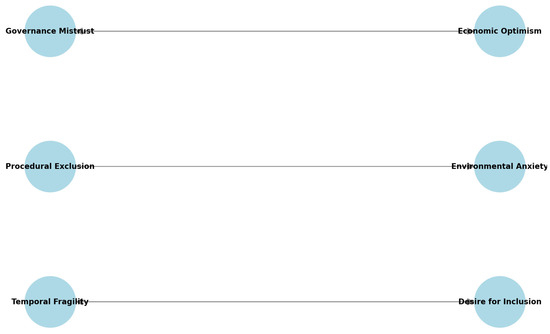
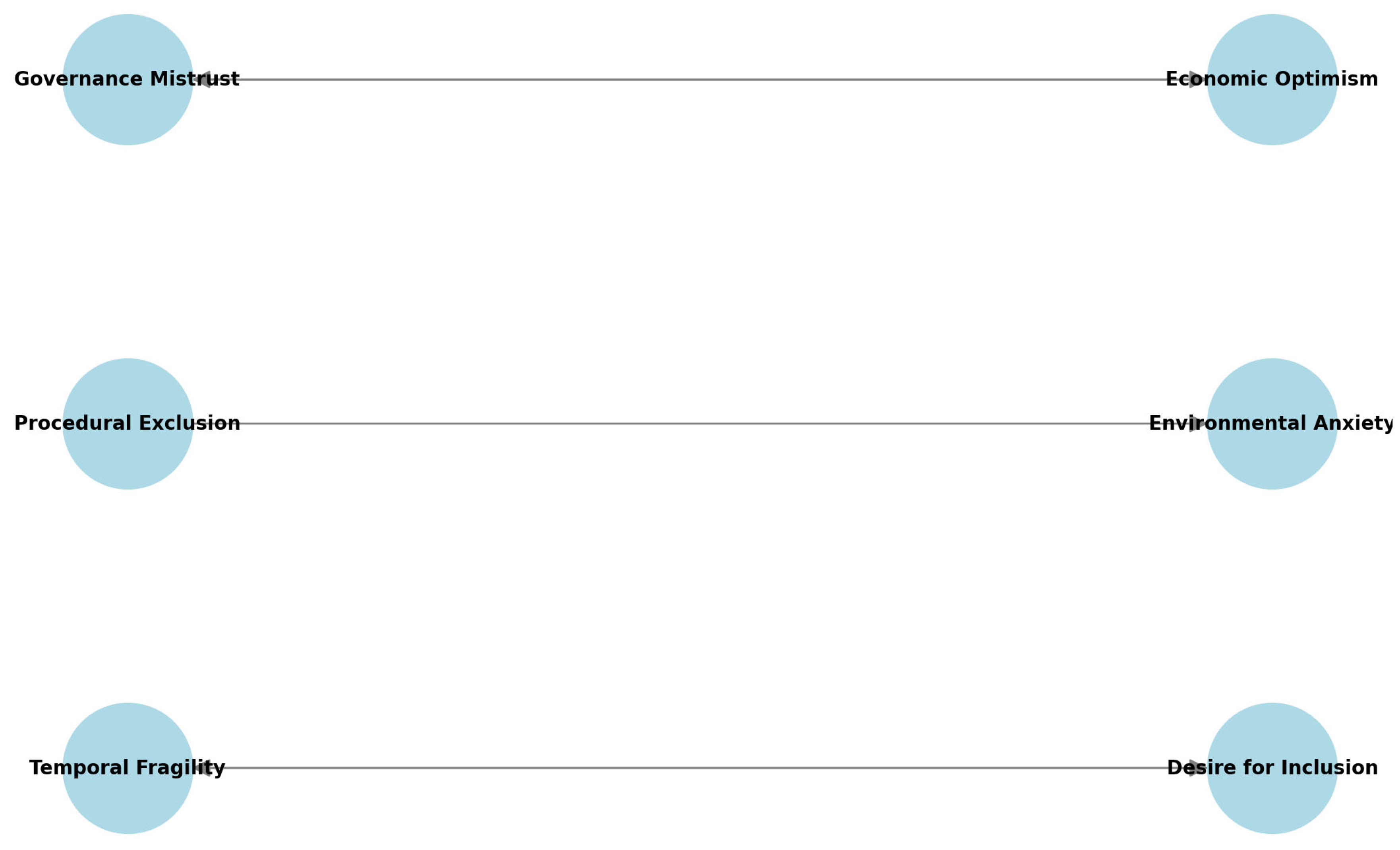
Figure 2 visually depicts these interrelations as paired conceptual tensions:
Figure 2.
Interactions between thematic constructs.
Governance Mistrust ↔ Economic Optimism: Mistrust in institutional actors, especially foreign operators, diminished the perceived legitimacy of promised economic benefits.
Procedural Exclusion → Environmental Anxiety: Lack of local consultation heightened ecological fears, as stakeholders felt uninformed and unprepared for potential risks.
Temporal Fragility ↔ Desire for Inclusion: The transient nature of economic gains intensified stakeholders’ calls for more durable involvement and participatory governance.
These relational patterns form a larger narrative structure: initial optimism about regional development is constrained by procedural ambiguity, governance skepticism, and unresolved environmental uncertainty.
3.5. Composite Essence of Experience
“Akkuyu is a source of promise and paradox—a stimulus for growth shadowed by the silence of exclusion, uncertainty, and invisibility.” This composite essence reflects the affective duality experienced by participants: economic anticipation intertwined with political disenfranchisement and ecological anxiety. As one participant noted: “We feel the movement, the money, the change—but not the control. It’s happening near us, not with us.”(P10)
3.6. Reflexivity Statement
The researcher used active epoché, putting aside assumptions of nuclear expansion. In examining the data, reflexive memos were set up in NVivo to put aside emerging biases. Further triangulation took place through comparing participant accounts to local chamber reports, policy briefings, and locality-specific economic data. The process iterated so that the configuration of coding and construction of themes remained based on participants’ everyday worlds and not researcher assumptions.
3.7. Minority Voices and Divergent Perspectives
While the dominant narrative across participants reflected conditional support laced with skepticism—especially around governance transparency and environmental risks—a minority expressed unconditional optimism toward the Akkuyu NPP. These divergent voices framed the project not as an imposition, but as a symbol of progress, modernization, and national autonomy.
As one participant articulated: “Nuclear means progress. We need this to stand independently.” (P8) Others echoed similar sentiments, particularly emphasizing:
Technological Autonomy: A belief that nuclear energy reduces dependency on fossil fuels and external energy imports.
Strategic Modernization: Viewing the plant as a national milestone toward industrial and scientific advancement.
Global Partnerships, Not Threats: Interpreting foreign ownership not as disempowerment, but as strategic collaboration.
For instance, P12 noted: “If we want to play in the global league, we must build with those who already know the game”. These voices, while fewer in number, serve as critical counter-narratives that remind us of the pluralism of local discourse. They highlight how identity, education, economic positioning, and political ideology may mediate the meaning people assign to large-scale infrastructure.
3.8. Contextual Framing and Participant Profile
As of the time of the study, the Silifke Chamber Council consisted of 28 members, including 1 council chair, 3 vice chairs, 7 board members, 1 clerk member, and other general members. This structure reflected both leadership positions and broader representation across the council. Of these members, 2 were women and 26 were men, indicating limited female representation and a male dominance in leadership roles. Participants represented a heterogeneous yet economically interdependent cross-section of Silifke’s regional business ecosystem, spanning agriculture (n = 6), tourism (n = 5), retail (n = 5), logistics (n = 4), construction (n = 4), fisheries (n = 2), and professional services (n = 2). This composition combined land-based and coastal economic interests, both sensitive to potential disruptions and opportunities created by infrastructure megaprojects such as the Akkuyu NPP. Ages ranged from 37 to 71 years, with a mean of 52.6, capturing a mix of seasoned business owners with decades of experience and younger entrepreneurs navigating emerging market conditions. A majority—approximately 85% (24 participants)—held either high school diplomas or university degrees, providing a moderate baseline for formal economic and policy literacy, though technical nuclear knowledge remained limited. Only 3 participants (about 11%) reported prior exposure to nuclear energy concepts or regulatory processes, underscoring a localized information gap and the importance of procedural transparency. This contextual profile, shaped by economic precarity, ecological dependency, and commerce embedded in community life, influenced how stakeholders constructed meaning around the NPP, with those engaged in agricultural or marine-based livelihoods more likely to voice ecological concerns and governance skepticism, and those in construction and logistics more inclined to express conditional economic optimism. Summary statistics for the demographic characteristics of the participants are presented in Table 5.
3.9. Thematic Synthesis and Essence Statement
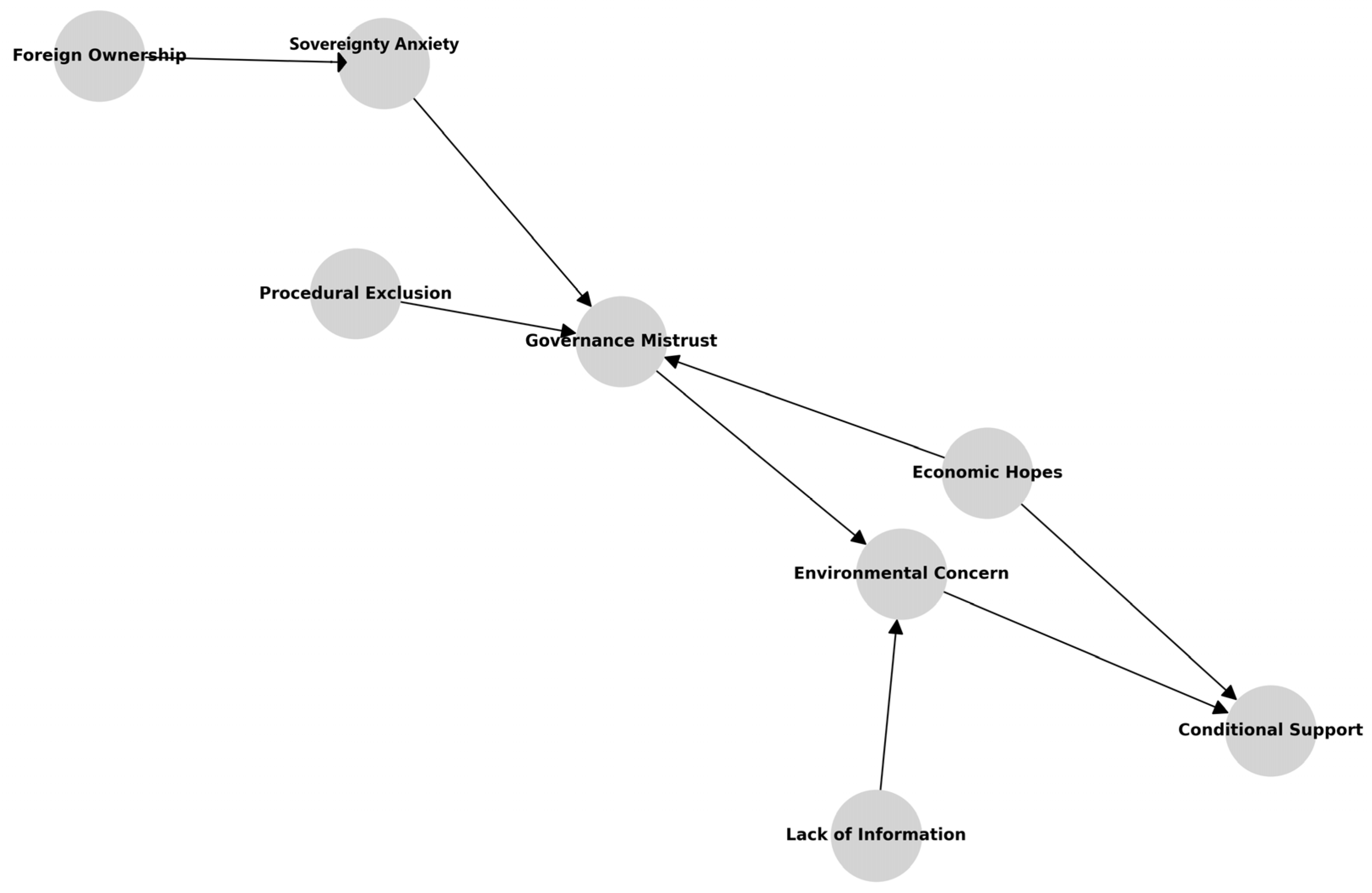
The thematic structure of the findings revealed interdependent, cyclical relationships rather than linear cause–effect chains. Participant narratives pointed to a dynamic interplay of economic aspirations, procedural frustrations, environmental fears, and governance anxieties. These interrelations formed a self-reinforcing loop, where optimism was often undermined by exclusion, and risk perceptions escalated in the absence of participatory governance.
The following dynamics summarize this interwoven pattern:
- Economic hopes → fueled early conditional support
- Procedural exclusion → weakened governance trust
- Lack of credible information → intensified environmental concern
- Foreign ownership → amplified sovereignty-related anxieties
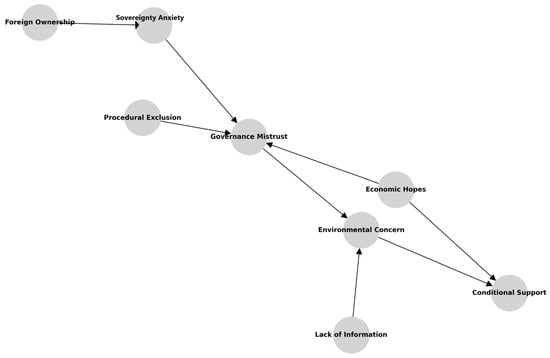
These dimensions were rarely experienced in isolation. For example, participants expressing ecological concern often simultaneously cited lack of consultation, which was linked to foreign decision-making and perceived regional disempowerment. To illustrate these dynamic interdependencies, Figure 3 presents a thematic network diagram. Arrows indicate directional relationships observed in participant narratives, with bidirectional links representing mutual reinforcement or feedback loops. This structure reflects how governance concerns, informational asymmetries, and economic expectations form a tightly interwoven experiential framework.
Figure 3.
Thematic Interrelations: Feedback and Tension Loops.
Emergent patterns from participant narratives show cyclical relationships among economic hopes, procedural exclusion, environmental risk, and sovereignty anxiety. These themes reinforce each other, shaping perceptions of the Akkuyu NPP through recursive experience and reflection.
Composite Essence Statement: “Akkuyu NPP is experienced as both promise and paradox—a project meant to empower but felt as imposed, delivering economic sparks yet stirring fears of social invisibility and ecological vulnerability.” This essence captures the central contradiction embedded in participants’ lived experiences: the NPP as both a potential driver of progress and a source of alienation. It reflects a regional narrative where infrastructure arrives with national significance but limited local ownership.
3.10. NVivo-Based Coding Results
The thematic analysis was conducted using NVivo 14, with a total of 432 open codes identified from 28 semi-structured interviews. These codes were then grouped into 17 sub-themes under 4 broader thematic categories. NVivo facilitated both frequency-based node analysis and co-occurrence mapping, helping to uncover semantic density and intersections across stakeholder narratives. All major themes achieved saturation, each being referenced in at least 20 interviews, confirming their relevance and prevalence.
Table 6 illustrates the distribution and intensity of themes emerging from the interview data. Environmental risk and governance distrust were the most frequently cited, each appearing in over 85% of participant narratives. These two themes often co-occurred, highlighting a perceived link between ecological safety and the credibility of institutions. Although economic benefits were acknowledged, skepticism about their sustainability and fair distribution was widespread, especially in relation to opaque territorial development planning. Participants also expressed feelings of exclusion, referencing lack of consultation and insufficient access to project information—concerns that align with core tenets of the energy justice framework. Lastly, sovereignty concerns—especially related to the Russian ownership model—were especially salient among business and governance actors, reflecting deeper socio-political anxieties tied to infrastructure governance. Findings suggest that in the absence of inclusive and transparent governance structures, even technically robust infrastructure projects may face long-term legitimacy deficits, limiting their strategic integration into regional development policies.
Table 6.
Full coding framework (themes → sub-themes → codebook).
4. Discussion
This research examined local economic stakeholders’—namely, Silifke Chamber of Commerce and Industry Council members’—views on the continued construction of the Akkuyu Nuclear Power Plant (NPP). The findings indicate a tense crossroads between economic expectation, procedural exclusion, environmental concern, and mistrust of governance. The results echo and expand on prior research in energy transitions, sustainable development, and stakeholder participation. All inferences are tied to the construction phase; extrapolation to the operational period is postponed to future longitudinal comparison.
4.1. Interpreting Economic Expectations Through Temporal Fragility
Akkuyu as economic catalyst from stakeholders’ viewpoint mirrors stakeholder attitude surveys in analogous cases, where business stakeholders talk of nuclear projects in terms of perceived risks and opportunities [39]. Their concern regarding sustainability, however, parallels Yamamoto and Greco [40], whose study found nuclear power stations to cause “economic enclaves” prone to boom–bust cycles. The study places emphasis on the point that in the absence of long-term developmental plans based on broad bases, short-term gains can exacerbate local inequity rather than remedy the situation. Documentary triangulation agreed on emergency-planning transparency as pinpointed by the stakeholders and disagrees on localization timelines, which were perceived as taking longer than timelines in the official plans.
4.2. Procedural Exclusion and Conditional Legitimacy
Participants’ demand for involvement—despite general support for modernization—reflects broader critiques of technocratic governance in energy transitions [41]. As also highlighted by Hastuti et al. [42], procedural justice is a critical but often neglected pillar of sustainability. Conditional support in this study demonstrates that legitimacy is not granted automatically; it is earned through dialogical inclusion and recognition. These findings challenge the common binary of “pro” or “anti” nuclear stances and instead suggest that support is contingent on perceived fairness and procedural integrity
4.3. Lived Experience and Environmental Risk Perception
Rather than scientific indicators, participants drew on embodied and local knowledge to assess environmental risk. Similar patterns are documented in Kaiga (India) and Fukushima (Japan), where environmental risk is experienced affectively and contextually [43,44]. Their fears—radiation, earthquakes, and marine degradation—demonstrate that technological confidence does not substitute for lived preparedness. Communication strategies must therefore move beyond technical briefings and incorporate experiential narratives to foster trust and resilience.
4.4. Sovereignty, Ownership, and Trust
A novel contribution of this study is to foreground sovereignty-related concerns in foreign-owned nuclear infrastructure. The fact that participants questioned whether Akkuyu “belongs to Türkiye” despite its location signals anxieties that external ownership and governance arrangements may constrain national and local self-determination. This resonates with the energy sovereignty literature, which frames the legitimacy of energy systems around safeguarding self-determination and participatory control for affected polities [45].
Sovereignty concerns do not only reflect geopolitical anxiety—they also index perceived exclusion, powerlessness, and alienation. The results therefore warrant conceptual recognition of sovereignty within the energy-justice framework. While prior studies often treat ownership under distributive or recognition justice, findings from Akkuyu indicate that foreign ownership is perceived as an autonomy issue—an “infrastructural sovereignty” dimension—shaping legitimacy beyond existing models. This salience is heightened in emerging economies where megaprojects are financed, owned, and operated by external actors. Comparable dynamics appear elsewhere: in the UK’s Hinkley Point C, debates over China General Nuclear’s stake prompted new national-security safeguards and a “special share” regime for future nuclear projects [46,47]. In the UAE’s Barakah program, scholarship underscores the centrality of direct public engagement and communication in shaping acceptance within a fast-paced newcomer build [48]. Post-Fukushima research in Japan shows how procedural exclusion and trust deficits amplify environmental risk perception [44] and related patterns are documented around India’s Kaiga site in analyses of public opposition and mobilization [49]. Taken together, these parallels suggest that procedural-justice deficits and sovereignty anxieties can co-produce heightened environmental concern across diverse political systems—reinforcing the case for integrating sovereignty into energy-justice analysis.
4.5. Theoretical Implications
This study affirms the value of transcendental phenomenology in capturing the lived contradictions of sustainability transitions. The coexistence of support and skepticism, benefit and marginalization, optimism and fear reflects what social theorists call “ambivalent modernities” [14]. Rather than treat these tensions as obstacles, future energy research should consider them as data points reflecting public intelligence and adaptive strategies. The results endorse a shift from “deficit models” of public understanding toward “relational models” that emphasize trust, voice, and shared meaning-making. Additionally, this study reveals a strong co-occurrence between procedural exclusion and environmental anxiety, as evidenced by both thematic coding and participant narratives. This relationship suggests that procedural justice should not be treated solely as an independent pillar; rather, deficits in procedural fairness can heighten perceptions of ecological risk, thereby influencing both recognition and distributive justice assessments. Incorporating these linkages into theoretical frameworks may offer a more holistic understanding of stakeholder responses to high-risk infrastructure projects.
4.6. Contribution to Sustainability Discourse
The findings contribute to contemporary sustainability debates by showing that stakeholder perceptions are contextual, dynamic, and institutionally structured; accordingly, assessments of large-scale energy infrastructure must complement environmental/economic metrics with justice-based, participatory governance frameworks [50,51]. In nuclear contexts specifically, perceived procedural fairness, transparency, and trust in authorities are strong predictors of acceptance for siting and waste-management decisions [52,53]. Thus, for nuclear power to contribute to a just transition, engagement should shift from one-way technical briefings to co-governance that embeds open safety and waste data, standing community oversight, and clear lines of accountability—recognizing place-based identities and capacities while building durable legitimacy [50,51,52,53]. In sum, the Akkuyu NPP is perceived not only as infrastructure but as a social condition, shaped by experiences of inclusion, information, identity, and agency. Its success or failure in the eyes of local communities may depend less on kilowatts generated and more on dialogues sustained.
While much of the written material assumes decarbonization contributions to energy security and regional development by new nuclear—and looks forward to growing acceptance as dividends are accrued—others caution centralised, opaque decision-making erodes legitimacy even as short-term economic benefits are smoothed. Our interviews reveal conditional, time-limited acceptance: short-term benefits are accepted by respondents but they hold procedural and sovereignty reservations which do not decline with repeated exposure to projects. This is not “NIMBY” classic but response to exclusion from rule-making and doubt about endurant risk governance. On this reading sovereignty justice intersects with—in place of rather than against—procedural and recognition justice by placing centre stage who holds key decisions and data under control by itself and particularly under BOO arrangements. Sectoral variation underpins bipolar economy of promise and fear; voice and control deficits contribute to accounting for permanently high risk perceptions even where opportunity is pervasive.
The case of Silifke Chamber of Commerce Assembly members illustrates this dynamic: respondents accept broadly speaking overall project significance for Türkiye and appreciate prospective benefits but they hold ongoing fears about its impacts as well. Significantly they pinpoint that no consultation or participation exercise has included their institution as a civil society stakeholder, reinforcing a larger sense that stakeholders at this level are excluded from decision-making to too little effect. These findings suggest that if such exercises at participation were actually undertaken acceptance of the project and its perceived legitimacy might considerably improve. In practice, the case advocates joint national–local governance with competent agenda-setting control; frequent, frank-language reporting of safety and environmental indicators subject to independent audit; SME development with special tourism and fisheries support and locally-focused procurement; publicly observed emergency drills and grievance opportunities with easy access; and BOO-project specific protection which delineates responsibility for waste, decommissioning, and emergency funding and establishes a joint forum of oversight with municipalities and chambers of commerce. As a package, they are designed to reclaim agency, temper perceived risk, and synchronize national energy goals with sustainable legitimacy and communal well-being at the local level.
5. Conclusions
This phenomenological research investigated the views of 28 Silifke Chamber of Commerce and Industry Council members on the Akkuyu Nuclear Power Plant in Türkiye. Four overarching themes were identified: (1) economic dynamism in the short term and temporal vulnerability, (2) exclusionary process and contingent support, (3) environmental ambivalence, and (4) trust in governance and issues of sovereignty. While participants recognized economic benefits during the construction phase, they questioned their long-term sustainability and fairness. Many cited limited involvement in decision-making, lack of transparent information, and heightened environmental and seismic risk perceptions—exacerbated by foreign ownership and operational control. These results highlight the necessity of energy infrastructural development that integrates technical and economic thinking with procedural and distributive justice. The Akkuyu example illustrates the active role of local stakeholders as interpreters of risk, legitimacy, and identity, and durable public support as contingent on transparency, inclusivity, and responsiveness to real-world experience.
5.1. Policy Implications
The study’s findings offer a clear policy roadmap for countries—Türkiye in particular—that aim to weave nuclear energy into long-term sustainability and energy security strategies. At the heart of that roadmap is procedural justice. National and regional authorities should move beyond box-ticking consultations and build genuinely transparent, participatory channels for community involvement. Local chambers, municipal councils, and civil society groups need formal seats at the table in oversight and planning for large infrastructure projects such as nuclear power plants. In Türkiye, this can be embedded by strengthening the Nuclear Regulatory Authority’s (NDK) stakeholder consultation procedures as outlined in the Regulation on Nuclear Safety and Radiation Protection.
A second theme is communication that meets people where they are. Participants repeatedly noted the absence of localized information hubs for Akkuyu. A dedicated, multilingual communication center could close this gap by offering real-time updates, emergency-preparedness training, and regular engagement forums. These centers should work in coordination with the NDK and be integrated into the National Nuclear Emergency Plan (2019) so that community outreach and emergency response standards reinforce one another.
Governance design also matters for public confidence, especially on questions of sovereignty. Foreign investment may be vital, but ownership and operational control must reflect national and local interests to avoid a sense of disempowerment. Policies that expand Turkish stakeholder representation in decision-making can help on this front. Concretely, such measures can be operationalized within the Build-Own-Operate (BOO) framework, subject to review by the Ministry of Energy and Natural Resources and aligned with the Nuclear Regulation Law No. 7381.
To translate national energy goals into everyday benefits, nuclear projects should be tied to regional development strategies. That means designing for long-term, inclusive gains in employment, procurement, and the service economy—not just short construction booms. Project procurement guidelines can include local hiring targets and incentives for local subcontractors, coordinated with the Ministry’s strategic energy investment plans, so that communities see durable economic value alongside national energy security.
Finally, effective public risk communication cannot rely on technical arguments alone. It must also engage with cultural narratives and lived experience. Storytelling, participatory media, and scenario-based workshops can bridge trust gaps and make abstract assurances tangible. These methods can be folded into the public participation components of Environmental Impact Assessment (EIA) processes required under Türkiye’s EIA Regulation.
By surfacing sovereignty as an emergent dimension of justice and showing how procedural exclusion can amplify environmental anxiety, the study advances energy-justice theory. It provides practical tools for assessing legitimacy and governance in large-scale, foreign-operated energy projects—insights that are as much about how decisions are made and communicated as they are about the technologies themselves.
5.2. Limitations and Future Research Directions
Limitations
This study deliberately focused on members of the Silifke Chamber of Commerce and Industry Council (SCCIC), the statutory voice of the local business community in the project’s immediate hinterland. In practice, firms based in the Silifke–Akkuyu catchment that enter the project’s supply chain register with the local chamber, which makes the SCCIC a natural gateway for capturing business-side perceptions. This lens produced rich insight into the socio-economic and governance views of formally registered enterprises. At the same time, it necessarily excludes non-members and informal actors—residents without registered firms, some cooperatives or associations—so the social diversity of perspectives is narrower than the reality on the ground. Future work should therefore adopt a broader, multi-stakeholder design that triangulates SCCIC viewpoints with those of residents, women’s associations, educators, local officials, environmental NGOs, fishing cooperatives, and youth groups.
The findings are also geographically specific. They reflect the history, social fabric, and political dynamics of this locale and should not be overgeneralized to other nuclear sites in Türkiye or abroad, where contexts can differ in consequential ways.
Timing and method shape interpretation as well. Interviews were conducted during the construction phase, when expectations and anxieties may look different from the operational period. Perceptions will likely shift as the plant comes online and national energy narratives evolve. To enhance credibility, the interviews were complemented by targeted document analysis; however, ethnographic observation and household surveys were not undertaken. As such, the results should be read as construction-stage perceptions and expectations rather than an assessment of plant operations. A follow-up wave during early operation is planned to trace continuity and change over time, and future research is envisaged as both multi-method and multi-stakeholder.
Looking ahead, several avenues merit attention. Comparative studies could juxtapose host and non-host communities’ views of the same project, or examine nuclear governance models across emerging economies to surface patterns and contrasts. Longitudinal designs that follow the same participants—especially through commissioning and critical events such as incidents or inspections—would clarify how attitudes evolve. Intersectional analyses can deepen understanding by exploring how gender, age, ethnicity, or class mediate stakeholder experience. And integrating qualitative, phenomenological insights with quantitative perception surveys would strengthen both the generalizability and policy relevance of future work.
Supplementary Materials
The following supporting information can be downloaded at: https://www.mdpi.com/article/10.3390/su17177821/s1, The semi-structured interview protocol and figures are available online at https://doi.org/10.6084/m9.figshare.29654807 accessed on 25 August 2025.
Funding
This research received no external funding.
Institutional Review Board Statement
This study was reviewed and approved by the Mersin University Social and Human Sciences Ethics Committee (Approval No: 51, dated 4 March 2025).
Informed Consent Statement
Informed consent was obtained in writing from all participants prior to their interviews, following a detailed explanation of the research purpose and confidentiality measures.
Data Availability Statement
The original contributions presented in the study are included in the article. Due to ethical restrictions and confidentiality agreements, interview transcripts are not publicly available.
Acknowledgments
The author serves as an academic advisor to the Silifke Chamber of Commerce and Industry. This relationship facilitated access to local stakeholders but had no influence on the design, execution, or interpretation of the study. This article was conceived, drafted, and revised by the author. No generative AI systems were used to write, rewrite, or expand the manuscript text; software use was limited to transcription, reference management, qualitative analysis (NVivo), and similarity checking. The author completed undergraduate education in English language and prepared the manuscript without external language-editing services.
Conflicts of Interest
The author declares no conflicts of interest.
References
- Kharecha, P.A.; Hansen, J.E. Prevented Mortality and Greenhouse Gas Emissions from Historical and Projected Nuclear Power. Environ. Sci. Technol. 2013, 47, 4889–4895. [Google Scholar] [CrossRef] [Scilit]
- Transforming Our World: The 2030 Agenda for Sustainable Development. Available online: https://sustainabledevelopment.un.org/post2015/transformingourworld/publication (accessed on 12 August 2025).
- Sepulveda, N.A.; Jenkins, J.D.; de Sisternes, F.J.; Lester, R.K. The Role of Firm Low-Carbon Electricity Resources in Deep Decarbonization of Power Generation. Joule 2018, 2, 2403–2420. [Google Scholar] [CrossRef] [Scilit]
- Warner, E.S.; Heath, G.A. Life Cycle Greenhouse Gas Emissions of Nuclear Electricity Generation. J. Ind. Ecol. 2012, 16, S73–S92. [Google Scholar] [CrossRef] [Scilit]
- IPCC. Climate Change 2022: Mitigation of Climate Change; Shukla, P.R., Skea, J., Reisinger, A.R., Eds.; IPCC: Geneva, Switzerland, 2022; ISBN 978-92-9169-160-9.
- Visschers, V.H.M.; Siegrist, M. How a Nuclear Power Plant Accident Influences Acceptance of Nuclear Power: Results of a Longitudinal Study before and after the Fukushima Disaster. Risk Anal 2013, 33, 333–347. [Google Scholar] [CrossRef] [Scilit]
- Sjöberg, L. Local Acceptance of a High-Level Nuclear Waste Repository. Risk Anal. 2004, 24, 737–749. [Google Scholar] [CrossRef] [Scilit]
- Burgherr, P.; Hirschberg, S. Comparative Risk Assessment of Severe Accidents in the Energy Sector. Energy Policy 2014, 74, S45–S56. [Google Scholar] [CrossRef] [Scilit]
- National Research Council. Lessons Learned from the Fukushima Nuclear Accident for Improving Safety of U.S. Nuclear Plants; The National Academies Press: Washington, DC, USA, 2014; ISBN 978-0-309-27253-7.
- Sovacool, B.K.; Dworkin, M.H. Energy Justice: Conceptual Insights and Practical Applications. Appl. Energy 2015, 142, 435–444. [Google Scholar] [CrossRef] [Scilit]
- Heffron, R.J.; McCauley, D. The Concept of Energy Justice across the Disciplines. Energy Policy 2017, 105, 658–667. [Google Scholar] [CrossRef] [Scilit]
- McCauley, D.; Heffron, R. Just Transition: Integrating Climate, Energy and Environmental Justice. Energy Policy 2018, 119, 1–7. [Google Scholar] [CrossRef] [Scilit]
- Astola, M.; Laes, E.; Bombaerts, G.; Ryszawska, B.; Rozwadowska, M.; Szymanski, P.; Ruess, A.; Nyborg, S.; Hansen, M. Community Heroes and Sleeping Members: Interdependency of the Tenets of Energy Justice. Sci. Eng. Ethics 2022, 28, 45. [Google Scholar] [CrossRef] [Scilit]
- Beck, U. Risk Society: Towards a New Modernity; SAGE Publications: London, UK, 1992; ISBN 978-0-8039-8346-5. [Google Scholar]
- Douglas, M.; Wildavsky, A. Risk and Culture: An Essay on the Selection of Technological and Environmental Dangers; University of California Press: Oakland, CA, USA, 1983; ISBN 978-0-520-90739-3. [Google Scholar]
- Kasperson, R.E.; Renn, O.; Slovic, P.; Brown, H.S.; Emel, J.; Goble, R.; Kasperson, J.X.; Ratick, S. The Social Amplification of Risk: A Conceptual Framework. Risk Anal. 1988, 8, 177–187. [Google Scholar] [CrossRef] [Scilit]
- Wynne, B. Misunderstood Misunderstanding: Social Identities and Public Uptake of Science. Public Underst. Sci. 1992, 1, 281–304. [Google Scholar] [CrossRef] [Scilit]
- Perrow, C. Normal Accidents: Living with High Risk Technologies; Princeton University Press: Princeton, NJ, USA, 1999; ISBN 978-0-691-00412-9. [Google Scholar]
- Adger, W.N. Social and Ecological Resilience: Are They Related? Prog. Hum. Geogr. 2000, 24, 347–364. [Google Scholar] [CrossRef] [Scilit]
- Norris, F.H.; Stevens, S.P.; Pfefferbaum, B.; Wyche, K.F.; Pfefferbaum, R.L. Community Resilience as a Metaphor, Theory, Set of Capacities, and Strategy for Disaster Readiness. Am. J. Community Psychol. 2008, 41, 127–150. [Google Scholar] [CrossRef] [Scilit] [PubMed]
- Cutter, S.L.; Barnes, L.; Berry, M.; Burton, C.; Evans, E.; Tate, E.; Webb, J. A Place-Based Model for Understanding Community Resilience to Natural Disasters. Glob. Environ. Change 2008, 18, 598–606. [Google Scholar] [CrossRef] [Scilit]
- Aldrich, D.P. Building Resilience: Social Capital in Post-Disaster Recovery; University of Chicago Press: Chicago, IL, USA, 2012; ISBN 978-0-226-01288-9. [Google Scholar]
- Qudrat-Ullah, H. The Q-NPT: Redefining Nuclear Energy Governance for Sustainability. Energies 2025, 18, 2784. [Google Scholar] [CrossRef] [Scilit]
- Drögemüller, C.; Seidl, R.; Walther, C. Social Values, Individual Judgments and Acceptance: The Case of High-Level Radioactive Waste in Germany. Sustainability 2025, 17, 5373. [Google Scholar] [CrossRef] [Scilit]
- Sánchez-Tabernero, G.; Muñoz-Sosa, C.; Hidalgo-Muñoz, A.R.; Galán, J.I.; Tabernero, C. Understanding the Causes of Social Acceptance and Rejection of a Uranium Mine Development Project in Northwestern Spain. Sustainability 2025, 17, 429. [Google Scholar] [CrossRef] [Scilit]
- Papazis, S.A. Nuclear–Thermal Power Generation: Multicriteria Optimization of the Economic Sustainability. Sustainability 2025, 17, 4781. [Google Scholar] [CrossRef] [Scilit]
- IAEA. Contracting and Ownership Approaches for New Nuclear Power Plants; International Atomic Energy Agency: Vienna, Austria, 2024; ISBN 978-92-0-118424-5. [Google Scholar]
- Agreement Between the Government of the Russian Federation and the Government of the Republic of Turkey on Cooperation in the Construction and Operation of the Akkuyu Nuclear Power Plant in the Republic of Turkey|ESCAP Policy Documents Management. Available online: https://policy.asiapacificenergy.org/node/2314 (accessed on 12 August 2025).
- Nuclear Energy Agency; Organization for Economic Co-Operation and Development. Effective Frameworks and Strategies for Financing Nuclear New Build; OECD Nuclear Energy Agency (NEA): Paris, France, 2024.
- Szulecki, K.; Overland, I. Russian Nuclear Energy Diplomacy and Its Implications for Energy Security in the Context of the War in Ukraine. Nat Energy 2023, 8, 413–421. [Google Scholar] [CrossRef] [Scilit]
- Bilgiç, E.; Gündüz, O. Dose and Risk Estimation of Cs-137 and I-131 Released from a Hypothetical Accident in Akkuyu Nuclear Power Plant. J. Environ. Radioact. 2020, 211, 106082. [Google Scholar] [CrossRef] [Scilit]
- Abbasi, A. Prediction of Radioactive Materials Distribution from a Hypothetical Accident in Akkuyu NPP. Res. Sq. 2023. [CrossRef] [Scilit]
- Moustakas, C. Phenomenological Research Methods; SAGE Publications: London, UK, 1994; ISBN 978-1-4833-8485-6. [Google Scholar]
- TOBB. Yayınları Türkiye Odalar ve Borsalar Birliği Ile Odalar ve Borsalar Kanunu (Kanun No. 5174); Afşaroğlu Matbaası: Ankara, Turkey, 2004; ISBN 978-9944-60-435-2. [Google Scholar]
- Braun, V.; Clarke, V. Using Thematic Analysis in Psychology. Qual. Res. Psychol. 2006, 3, 77–101. [Google Scholar] [CrossRef] [Scilit]
- Lumivero. NVivo 14 Software for Qualitative Data Analysis; Lumivero: Denver, CO, USA, 2023. [Google Scholar]
- Guest, G.; Bunce, A.; Johnson, L. How many interviews are enough? An experiment with data saturation and variability. Field Methods 2006, 18, 59–82. [Google Scholar] [CrossRef] [Scilit]
- Lincoln, Y.S.; Guba, E.G. Naturalistic Inquiry; Sage Publications: London, UK, 1985. [Google Scholar]
- Platje, J.; Will, M.; Paradowska, M.; van Dam, Y.K. Socioeconomic Paradigms and the Perception of System Risks: A Study of Attitudes towards Nuclear Power among Polish Business Students. Energies 2022, 15, 7313. [Google Scholar] [CrossRef] [Scilit]
- Yamamoto, D.; Greco, A. Cursed Forever? Exploring Socio-Economic Effects of Nuclear Power Plant Closures across Nine Communities in the United States. Energy Res. Soc. Sci. 2022, 92, 102766. [Google Scholar] [CrossRef] [Scilit]
- Stirling, A. “Opening Up” and “Closing Down”: Power, Participation, and Pluralism in the Social Appraisal of Technology. Sci. Technol. Hum. Values 2008, 33, 262–294. [Google Scholar] [CrossRef] [Scilit]
- Hastuti, T.; Widodo, S.; Krishyana, H.; Margono, F.; Akbar, H. Public Policy Perspectives on the Utilization of Nuclear Power Plants in Supporting Sustainable Development in Indonesia. Adv. Sci. Technol. 2022, 112, 155–162. [Google Scholar] [CrossRef] [Scilit]
- Mane, S.D.; Shanbag, R.; Madival, P. Social and Environmental Impact of Nuclear Power Plant: A Case Study of Kaiga Generating Station in Karwar, Karnataka, India. AIP Conf. Proc. 2018, 2039, 020053. [Google Scholar] [CrossRef] [Scilit]
- Sternsdorff-Cisterna, N. Food after Fukushima: Risk and Scientific Citizenship in Japan. Am. Anthropol. 2015, 117, 455–467. [Google Scholar] [CrossRef] [Scilit]
- Timmermann, C.; Noboa, E. Energy Sovereignty: A Values-Based Conceptual Analysis. Sci. Eng. Ethics 2022, 28, 54. [Google Scholar] [CrossRef] [Scilit]
- Government Confirms Hinkley Point C Project Following New Agreement in Principle with EDF. Available online: https://www.gov.uk/government/news/government-confirms-hinkley-point-c-project-following-new-agreement-in-principle-with-edf (accessed on 13 August 2025).
- Intelligence and Security Committee of Parliament. China; HH Associates Ltd.: Leatherhead, UK, 2023; ISBN 978-1-5286-4302. [Google Scholar]
- Baqi, A.; Abdeldayem, M.; Aldulaimi, S. Assessing the Role of Direct Public Engagement in Shaping the UAE Nuclear Energy Sustainability Image. Int. J. Organ. Anal. 2024, 32, 1669–1688. [Google Scholar] [CrossRef] [Scilit]
- Mishra, S. Social Acceptance of Nuclear Power in India. Air Power J. 2012, 7, 55–82. [Google Scholar]
- Van Uffelen, N.; Taebi, B.; Pesch, U. Revisiting the Energy Justice Framework: Doing Justice to Normative Uncertainties. Renew. Sustain. Energy Rev. 2024, 189, 113974. [Google Scholar] [CrossRef] [Scilit]
- Stark, A.; Gale, F.; Murphy-Gregory, H. Just Transitions’ Meanings: A Systematic Review. Soc. Nat. Resour. 2023, 36, 1277–1297. [Google Scholar] [CrossRef] [Scilit]
- Seidl, R.; Drögemüller, C. Procedural Fairness and Safety in the Acceptance of Nuclear Waste Disposal in Germany: An Empirical Study. J. Risk Res. 2024, 27, 969–985. [Google Scholar] [CrossRef] [Scilit]
- Yokoyama, M.; Ohnuma, S.; Osawa, H.; Ohtomo, S.; Hirose, Y. Public Acceptance of Nuclear Waste Disposal Sites: A Decision-Making Process Utilising the ‘Veil of Ignorance’ Concept. Humanit. Soc. Sci. Commun. 2023, 10, 623. [Google Scholar] [CrossRef] [Scilit]

Disclaimer/Publisher’s Note: The statements, opinions and data contained in all publications are solely those of the individual author(s) and contributor(s) and not of MDPI and/or the editor(s). MDPI and/or the editor(s) disclaim responsibility for any injury to people or property resulting from any ideas, methods, instructions or products referred to in the content. |
© 2025 by the author. Licensee MDPI, Basel, Switzerland. This article is an open access article distributed under the terms and conditions of the Creative Commons Attribution (CC BY) license (https://creativecommons.org/licenses/by/4.0/).