Global Challenges and National Responses: Indicators to Evaluate Public Policies for Mining Development in Chile in the Context of the Global Energy Transition
 , , , and
Abstract
1. Introduction
2. Theoretical Approach
- Mining governance and sustainability
- Economic development models and mining
- Public policy approaches to innovation in mining: visions and tensions
- The case of lithium
- Bottom–up indicators from what communities need
- Summary
3. Materials and Methods
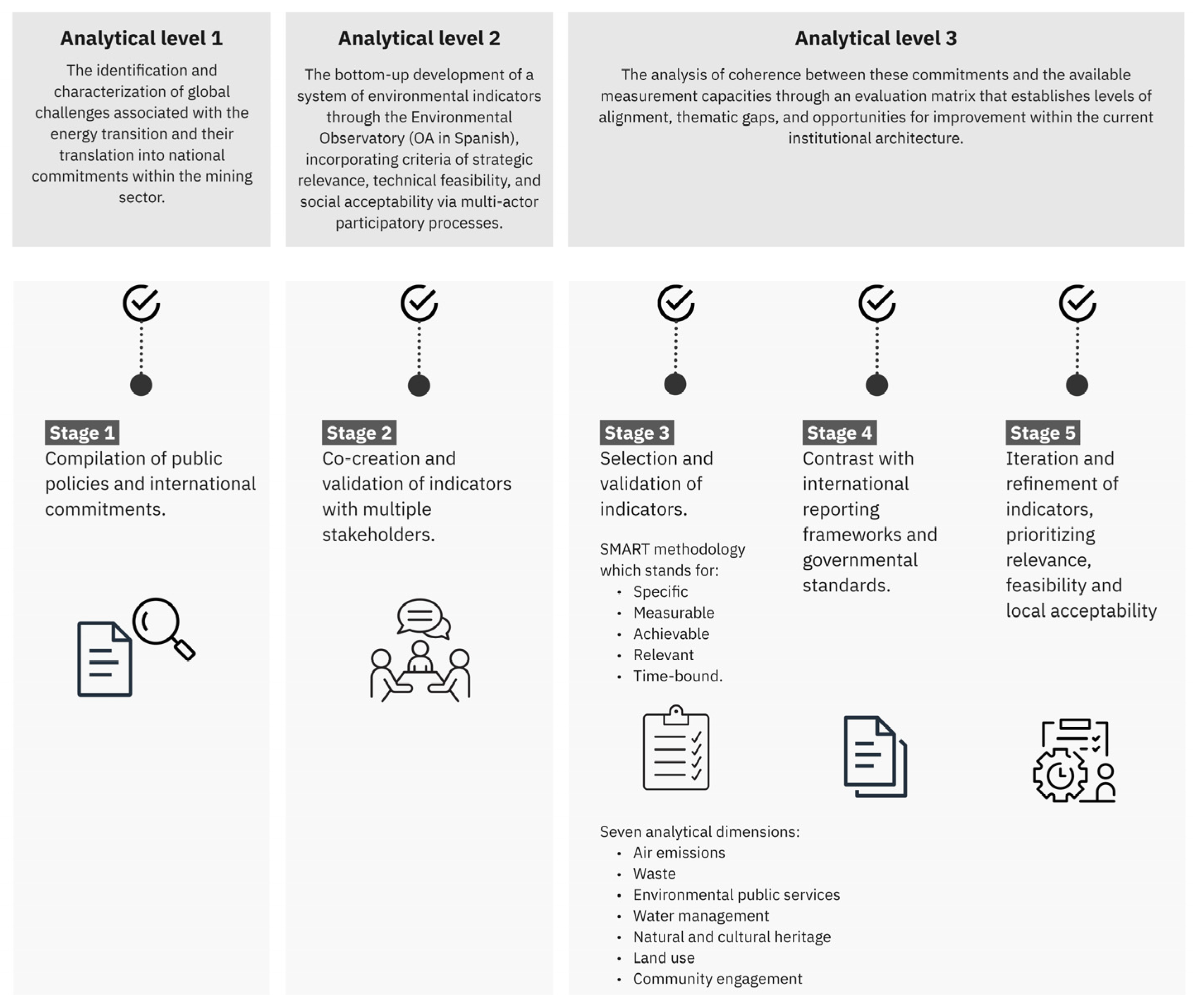
- The identification and characterization of global challenges associated with the energy transition and their translation into national commitments within the mining sector;
- The bottom–up development of a system of environmental indicators through the OA, incorporating criteria of strategic relevance, technical feasibility, and social acceptability via multi-actor participatory processes;
- The analysis of coherence between these commitments and the available measurement capacities through an evaluation matrix that establishes levels of alignment, thematic gaps, and opportunities for improvement within the current institutional architecture.
- Compilation of public policies and international commitments.
- Co-creation and validation of indicators with multiple stakeholders.
- Selection and validation of indicators.
- Contrast with international reporting frameworks and governmental standards.
- Iteration and refinement of indicators, prioritizing relevance, feasibility, and local acceptability.
- Commitment/Goal: A brief description of the specific commitment or goal.
- Scope: The category under which the commitment or goal is classified (e.g., water, energy, or emissions).
- OA Indicator: Denotes whether the commitment can be monitored using any of the 20 existing OA indicators.
- OA Indicator Name: Specifications of the available indicator on the OA platform.
- Coherence: Indicates whether the indicator fully or partially measures the commitment/goal, specifying potential gaps or limitations in information.
- Additional Comments: Identification of opportunities and proposals to enhance the indicator system and strengthen the strategic monitoring of environmental commitments in mining.
4. Results
4.1. Public Policy Analysis
4.2. Matrix Analysis
4.3. Environmental Observatory UC for Monitoring Environmental Commitments in Mining
4.4. Summary
5. Discussion
6. Conclusions
- Assessment of Research Questions
- RQ1: In what ways can Chile align its mining policy with carbon-neutral and sustainability goals?
- RQ2: Which indicators can effectively assess policy progress?
- Confirmation for the Working Hypothesis
- Identified Hurdles and Policy Implications
- Future Research
Supplementary Materials
Author Contributions
Funding
Institutional Review Board Statement
Informed Consent Statement
Data Availability Statement
Conflicts of Interest
References
- IPCC. Summary for Policymakers. In Climate Change 2022—Impacts, Adaptation and Vulnerability Contribution of Working Group II to the Sixth Assessment Report of the Intergovernmental Panel on Climate Change; Pörtner, H.-O., Roberts, D.C., Poloczanska, E.S., Mintenbeck, K., Tignor, M., Alegría, A., Craig, M., Langsdorf, S., Löschke, S., Möller, V., et al., Eds.; Cambridge University Press: New York, NY, USA, 2022; pp. 3–34. [Google Scholar] [CrossRef]
- Pörtner, H.O.; Roberts, D.C.; Masson-Delmotte, V.; Zhai, P.; Tignor, M.; Poloczanska, E.; Weyer, N.M. The Ocean and Cryosphere in a Changing Climate: Special Report of the Intergovernmental Panel on Climate Change; Cambridge University Press: Cambridge, UK, 2022. [Google Scholar] [CrossRef]
- Jander, V.; Vicuña, S.; Melo, O.; Lorca, Á. Adaptation to Climate Change in Basins within the Context of the Water-Energy-Food Nexus. J. Water Resour. Plan. Manag. 2023, 149, 04023060. [Google Scholar] [CrossRef]
- Bergamini, K.; Dextre, R.M. Exportación de la contaminación en Chile: Análisis de procedimientos sancionatorios de la Superintendencia del Medio Ambiente, 2013–2019. EURE 2022, 48, 1–27. [Google Scholar] [CrossRef]
- Madeira, C. A review of the future impact of climate change in Chile: Economic output and other outcomes. Mitig. Adapt. Strateg. Glob. Change 2022, 27, 56. [Google Scholar] [CrossRef]
- Vicuña, S.; Gil, M.; Melo, O.; Donoso, G.; Merino, P. Water option contracts for climate change adaptation in Santiago, Chile. Water Int. 2018, 43, 237–256. [Google Scholar] [CrossRef]
- Murguía, D.I.; Bringezu, S.; Schaldach, R. Global direct pressures on biodiversity by large-scale metal mining: Spatial distribution and implications for conservation. J. Environ. Manag. 2016, 180, 409–420. [Google Scholar] [CrossRef]
- Sonter, L.J.; Ali, S.H.; Watson, J.E.M. Mining and biodiversity: Key issues and research needs in conservation science. Proc. R. Soc. B Biol. Sci. 2018, 285, 20181926. [Google Scholar] [CrossRef]
- Northey, S.A.; Mudd, G.M.; Werner, T.T.; Jowitt, S.M.; Haque, N.; Yellishetty, M.; Weng, Z. The exposure of global base metal resources to water criticality, scarcity and climate change. Glob. Environ. Change 2017, 44, 109–124. [Google Scholar] [CrossRef]
- Gopinathan, P.; Subramani, T.; Barbosa, S.; Yuvaraj, D. Environmental impact and health risk assessment due to coal mining and utilization. Environ. Geochem. Health 2023, 45, 6915–6922. [Google Scholar] [CrossRef]
- Naciones Unidas. Informe de los Objetivos de Desarrollo Sostenible, Edición Especial; Ross, J., Ed.; United Nations: New York, NY, USA, 2023. [Google Scholar]
- IEA. The Role of Critical Minerals in Clean Energy Transitions. 2023. Available online: www.iea.org/topics/critical-minerals (accessed on 1 December 2024).
- de Minería, M. Faenas Chilenas. 2025. Available online: https://datos.gob.cl/dataset/faenas-en-chile/resource/4553d1f8-92fe-4007-9ce3-520db1540a64 (accessed on 10 March 2025).
- Ministerio de Medio Ambiente. Sistema de Información y Monitoreo de Biodiversidad. Available online: https://simbio.mma.gob.cl/ (accessed on 9 March 2025).
- Cameron, P.; Stanley, M. Oil, Gas, and Mining: A Sourcebook for Understanding the Extractive Industries; World Bank Publications: Washington, DC, USA, 2017. [Google Scholar] [CrossRef]
- Mura, M.; Castillo, I.; Torres, D.; Galleguillos Madrid, F.M.; Gálvez, E.; Gallegos, S.; Castillo, J.; Varas, M.; Jamett, I.; Toro, N. Global Overview of the Lithium Market and Opportunities for Chile. Resources 2025, 14, 33. [Google Scholar] [CrossRef]
- Gutiérrez, G.; Ruiz-León, D. Lithium in Chile: Present status and future outlook. Mater. Adv. 2024, 5, 7850–7861. [Google Scholar] [CrossRef]
- Carrara, S.; Bobba, S.; Blagoeva, D.; Alves Dias, P.; Cavalli, A.; Georgitzikis, K.; Grohol, M.; Itul, A.; Kuzov, T.; Latunussa, C.; et al. Supply Chain Analysis and Material Demand Forecast in Strategic Technologies and Sectors in the EU: A Foresight Study; Publications Office of the European Union: Luxemburg, 2023. [Google Scholar]
- IEA. Global Critical Minerals Outlook. 2024. Available online: www.iea.org (accessed on 1 June 2025).
- Galos, K.; Lewicka, E.; Burkowicz, A.; Guzik, K.; Kot-Niewiadomska, A.; Kamyk, J.; Szlugaj, J. Approach to identification and classification of the key, strategic and critical minerals important for the mineral security of Poland. Resour. Policy 2021, 70, 101900. [Google Scholar] [CrossRef]
- Hund, K.; Porta DLa Fabregas, T.P.; Laing, T.; Drexhage, J.; Climate-Smart Mining Facility. Minerals for Climate Action: The Mineral Intensity of the Clean Energy Transition; World Bank: Washington, DC, USA, 2020; Available online: www.worldbank.org (accessed on 5 July 2025).
- Wrobel-Daveau, J.C.; Nicoll, G.; Tetley, M.G.; Gréselle, B.; Perez-Diaz, L.; Davies, A.; Eglington, B.M. Plate tectonic modelling and the energy transition. Earth Sci. Rev. 2022, 234, 104227. [Google Scholar] [CrossRef]
- Londoño, J.A.B.; Franco Sepúlveda, G.; De la Barra Olivares, E. Strategic Minerals for Climate Change and the Energy Transition: The Mining Contribution of Colombia. Sustainability 2024, 16, 83. [Google Scholar] [CrossRef]
- SUBREI. Radiografia del Mercado del Litio. In Una perspectiva desde el Comercio Internacional; SUBREI: Santiago, Chile, 2023. [Google Scholar]
- Forget, M.; Bos, V. Harvesting lithium and sun in the Andes: Exploring energy justice and the new materialities of energy transitions. Energy Res. Soc. Sci. 2022, 87, 102477. [Google Scholar] [CrossRef]
- Frederiksen, T.; Banks, G. Can Mining Help Deliver the SDGs: Discourses, Risks and Prospects. J. Environ. Dev. 2023, 32, 83–106. [Google Scholar] [CrossRef]
- Carr-Wilson, S.; Pattanayak, S.K.; Weinthal, E. Critical mineral mining in the energy transition: A systematic review of environmental, social, and governance risks and opportunities. Energy Res. Soc. Sci. 2024, 116, 103672. [Google Scholar] [CrossRef]
- Bergamini, K.; Angel, P.; Mollenhauer, K.; Rugiero, V.; Medina, J.I.; Rodriguez, J. The Environmental Observatory for Mining Projects: A System of the Analysis of Public Environmental Management Information. In Intersections. Interdisciplinary Research on Architecture, Design, City and Territory; Springer Geography; Brilly, M., Hoalst-Pullen, N., Leitner, M., Patterson, M., Veress, M., Eds.; Springer Geography; Springer: Berlin/Heidelberg, Germany, 2025; pp. 99–115. [Google Scholar] [CrossRef]
- Franks, D.M.; Davis, R.; Bebbington, A.J.; Ali, S.H.; Kemp, D.; Scurrah, M. Conflict Translates Environmental and Social Risk Into Business Costs. Proc. Natl. Acad. Sci. USA 2014, 111, 7576–7581. [Google Scholar] [CrossRef]
- Naibbi, A.I.; Chindo, M. Mineral Resource Extractive Activities in Nigeria: Communities Also Matter! J. Geosci. Environ. Prot. 2020, 8, 212–229. [Google Scholar] [CrossRef]
- Bos, V.; Marie, F.; Gunzburger, Y. Lithium-based energy transition through Chilean and Australian miningscapes. Extr. Ind. Soc. 2024, 17, 101384. [Google Scholar] [CrossRef]
- Reyes-Tagle, G.; Ospina, L.; Andrian, L.; Chávez, A. Análisis del Marco de Gobernanza del Sector Minero en Los Países Andinos. 2024. Available online: http://www.iadb.org (accessed on 1 June 2025).
- Gobierno de Chile. Minería-2050. Política Nacional Minera. 2022. Available online: https://www.minmineria.cl/wp-content/uploads/2022/03/Mineri%CC%81a-2050-Poli%CC%81tica-Nacional-Minera-.pdf (accessed on 22 January 2025).
- Ministerio de Medio Ambiente. Estrategia Climática de Largo plazo de Chile. Camino a la Carbono Neutralidad y Resiliencia a más Tardar al 2050. 2021. Available online: https://cambioclimatico.mma.gob.cl/estrategia-climatica-de-largo-plazo-2050/descripcion-del-instrumento/ (accessed on 1 June 2025).
- Gobierno de Chile. Estrategia Nacional del Litio. Por Chile y su Gente. 2024. Available online: https://s3.amazonaws.com/gobcl-prod/public_files/Campa%C3%B1as/Litio-por-Chile/Estrategia-Nacional-del-litio-ES_14062023_2003.pdf (accessed on 24 September 2024).
- OECD/UN. Production Transformation Policy Review of Chile: Reaping the Benefits of New Frontiers; OECD Development Pathways; OECD, Ed.; OECD Publishing: Paris, France, 2018. [Google Scholar] [CrossRef]
- González Miranda, S. A Critique of Methodological Nationalism. Available online: https://doi.org/10.4067/S0719-26812014000300005 (accessed on 1 December 2014).
- Ducoing, C.; Peres-Cajías, J.; Badia-Miró, M.; Bergquist, A.K.; Contreras, C.; Ranestad, K.; Torregrosa, S. Natural resources curse in the long run? Bolivia, Chile and Peru in the Nordic countries’ mirror. Sustainability 2018, 10, 965. [Google Scholar] [CrossRef]
- Ávila-Fuenmayor, F. Neoliberalismo y Globalización: De la Racionalidad Técnica a la Relación Sujeto-Sujeto; Universidad Católica Cecilio Acosta: Maracaibo, Venezuela, 2005; Available online: https://www.redalyc.org/articulo.oa?id=170121560005 (accessed on 5 July 2025).
- Jenkins, R. La Apertura Comercial ¿ha Creado Paraísos de Contaminadores en América Latina? 2003. Available online: https://hdl.handle.net/11362/10897 (accessed on 2 December 2024).
- Ricardo, F.-D. Entre el Neoliberalismo y el Crecimiento con Equidad: Tres décadas de Política Económica en Chile, Tercera Edición., no. 900028083. Santiago, Chile. 2003. Available online: https://www.cepal.org/es/publicaciones/1782-neoliberalismo-crecimiento-equidad-tres-decadas-politica-economica-chile (accessed on 5 January 2025).
- World Bank. Climate-Smart Mining: Minerals for Climate Action. World Bank Group. Available online: https://www.worldbank.org/en/topic/extractiveindustries/brief/climate-smart-mining-minerals-for-climate-action?utm_source (accessed on 13 July 2025).
- COCHILCO. Proyección de la Producción de Cobre en Chile 2019–2030. Comisión Chilena del Cobre (COCHILCO). Available online: https://www.guiaminera.cl/informe-proyeccion-de-la-produccion-de-cobre-en-chile-2019-2030/ (accessed on 13 July 2025).
- COCHILCO. Anuario de Estadísticas del Cobre y Otros Minerales 2009–2019. Comisión Chilena del Cobre (COCHILCO). Available online: https://www.cochilco.cl/web/anuario-de-estadisticas-del-cobre-y-otros-minerales/ (accessed on 13 July 2025).
- Urteaga, E. Las teorías económicas del desarrollo sostenible. Cuad. Econ. 2009, 32, 113–161. [Google Scholar] [CrossRef][Green Version]
- Liu, Y.; Feng, C. Promoting renewable energy through national energy legislation. Energy Econ. 2023, 118, 106504. [Google Scholar] [CrossRef]
- Stef, N.; Ashta, A. Dynamics in environmental legislation. Int. Rev. Law. Econ. 2023, 76, 106170. [Google Scholar] [CrossRef]
- Acheampong, A.O.; Opoku, E.E.O.; Dogah, K.E. The political economy of energy transition: The role of globalization and governance in the adoption of clean cooking fuels and technologies. Technol. Forecast. Soc. Change 2023, 186, 122156. [Google Scholar] [CrossRef]
- Cao, D.; Peng, C.; Yang, G. The pressure of political promotion and renewable energy technological innovation: A spatial econometric analysis from China. Technol. Forecast. Soc. Change 2022, 183, 121888. [Google Scholar] [CrossRef]
- Appiah, M.; Ashraf, S.; Tiwari, A.K.; Gyamfi, B.A.; Onifade, S.T. Does financialization enhance renewable energy development in Sub-Saharan African countries? Energy Econ. 2023, 125, 106898. [Google Scholar] [CrossRef]
- Estevão, J.; Lopes, J.D. SDG7 and renewable energy consumption: The influence of energy sources. Technol. Forecast. Soc. Change 2024, 198, 123004. [Google Scholar] [CrossRef]
- Zhu, W.; Zhang, Y. Household Energy Clean Transition Mechanisms under Market Failures: A Government Financing Perspective. Sustainability 2024, 16, 5771. [Google Scholar] [CrossRef]
- Agnese, P.; Rios, F. Spillover Effects of Energy Transition Metals in Chile. Energy Econ. 2024, 134, 107589. Available online: www.iza.org (accessed on 1 March 2023). [CrossRef]
- ECLAC. Critical Minerals for the Energy Transition and Electromobility: Economic Development Opportunities and Socioenvironmental Challenges. Economic Commission for Latin America and the Caribbean. Available online: https://www.cepal.org/en/insights/critical-minerals-energy-transition-and-electromobility-economic-development-opportunities? (accessed on 5 July 2025).
- Chaminade, C.; Padilla Pérez, R. Papers in Innovation Studies the Challenge of Alignment and Barriers for the Design and Implementation of Science, Technology and Innovation Policies for Innovation Systems in Developing Countries. 2014. Available online: http://www.circle.lu.se/publications (accessed on 1 June 2025).
- Poveda Bonilla, R. Políticas Públicas Para la Innovación y la Agregación de Valor Del Litio en Chile. Documentos de Proyectos. Santiago, Chile. 2021. Available online: www.cepal.org/apps (accessed on 1 June 2025).
- Fundación Chile. Desde el cobre a la innovación. Roadmap Tecnológico 2015–2035. In Publicado en el marco del Programa Nacional de Minería Alta Ley; Impresiones, A., Ed.; Fundación Chile: Santiago, Chile, 2016. [Google Scholar]
- de Minería, M. Plan Sectorial de Cambio Climático para el sector Minería (PSCC). Resolución Exenta No 1531. Available online: https://participa.minmineria.gob.cl/projects/pscc-mineria (accessed on 30 January 2025).
- Vita, G.; Ivanova, D.; Dumitru, A.; García-Mira, R.; Carrus, G.; Stadler, K.; Krause, K.; Wood, R.; Hertwich, E.G. Happier with less? Members of European environmental grassroots initiatives reconcile lower carbon footprints with higher life satisfaction and income increases. Energy Res. Soc. Sci. 2020, 60, 101329. [Google Scholar] [CrossRef]
- Taylor, S.J.; Bogdan, R.; Marjorie, D. Introduction to Qualitative Research Methods: A Guidebook and Resources, 4th ed.; JohnWiley & Sons, Inc.: Hoboken, NJ, USA, 2016. [Google Scholar]
- Dumitru, A.; Lema-Blanco, I.; Kunze, I.; García-Mira, R. The Role of Social Learning in Transformative Social Innovations TRANSIT Working Paper #5. 2016. Available online: http://www.transitsocialinnovation.eu/ (accessed on 1 June 2025).
- Dall-Orsoletta, A.; Cunha, J.; Araújo, M.; Ferreira, P. A systematic review of social innovation and community energy transitions. Energy Res. Soc. Sci. 2022, 88, 102625. [Google Scholar] [CrossRef]
- Auer, M.R.; Zhang, Y.; Lee, P. The potential of microblogs for the study of public perceptions of climate change. Wiley Interdiscip. Rev. Clim. Change 2014, 5, 291–296. [Google Scholar] [CrossRef]
- Ghermandi, A.; Sinclair, M. Passive crowdsourcing of social media in environmental research: A systematic map. Glob. Environ. Change 2019, 55, 36–47. [Google Scholar] [CrossRef]
- Sovacool, B.K.; Andrews, N. Does transparency matter? Evaluating the governance impacts of the Extractive Industries Transparency Initiative (EITI) in Azerbaijan and Liberia. Resour. Policy 2015, 45, 183–192. [Google Scholar] [CrossRef]
- Tufte, E.R. The Visual Display of Quantitative Information, 2nd ed.; Graphics Press: Cheshire, CT, USA, 2001. [Google Scholar]
- Morseletto, P. Analysing the influence of visualisations in global environmental governance. Env. Sci. Policy 2017, 78, 40–48. [Google Scholar] [CrossRef]
- Nations, U. Global Sustainable Development Report 2015. Edition Advance Unedit Version. 2015. Available online: https://sustainabledevelopment.un.org/content/documents/1758GSDR%202015%20Advance%20Unedited%20Version.pdf (accessed on 1 February 2025).
- de Chile, G. Contribución Determinada a Nivel Nacional (NDC) de Chile. Santiago, Chile. 2020. Available online: https://mma.gob.cl/wp-content/uploads/2020/04/NDC_Chile_2020_espan%CC%83ol-1.pdf (accessed on 10 January 2025).
- de Chile, G. Estrategia Climática de Largo Plazo de Chile. Camino a la Carbono Neutralidad y Resiliencia a Más Tardar al 2050. Santiago, Chile, October 2021. Available online: https://cambioclimatico.mma.gob.cl/wp-content/uploads/2021/11/ECLP-LIVIANO (accessed on 11 December 2024).
- de Chile, G. Memorándum de Entendimiento Entre Chile y la Unión Europea Sobre Cooperación en Cadenas de Valor de Materias Primas Sostenibles. Diario Oficial de la República de Chile [Internet]. Available online: https://single-market-economy.ec.europa.eu/publications/memorandum-understanding-eu-chile-sustainable-raw-materials_en (accessed on 30 January 2025).
- de Minería, M. Estrategia Nacional para el Fortalecimiento de la Capacidad de Fundición y Refinería en Chile (FURE). Available online: https://participa.minmineria.gob.cl/projects/fure-estrategia-nacional (accessed on 30 January 2025).
- de Chile, G. Ley N° 21.591: Crea un Nuevo Royalty a la Gran Minería Del Cobre y Modifica Diversos Cuerpos Legales. Diario Oficial de la República de Chile [Internet]. Available online: https://www.bcn.cl/leychile/navegar?idNorma=1180772 (accessed on 30 January 2025).
- de Chile, G. Decreto 41 Aprueba Reglamento de la Ley de Cierre de Faenas e Instalaciones Mineras. Ley N°21.551. Available online: https://www.bcn.cl/leychile/navegar?idNorma=1045967&idVersion=2020-06-23&utm_source (accessed on 30 January 2025).
- Mollenhauer, K.; Del Rio, C.; Rodriguez, J.; Bergamini, K.; Rugiero, V.; Ignacio Medina, J. Multilevel Information Delivery Strategy (MIDS): A strategic design based model and method for equitable access to environmental information. In Proceedings of the Human Systems Engineering and Design (IHSED2024) Future Trends and Applications, AHFE International, Split, Croatia, 24–26 September 2024. [Google Scholar] [CrossRef]
- Bergamini, K.; Ángel, P.; Rugiero, V.; Medina, J.I.; Mollenhauer, K. Building Resilient Communities: The Environmental Observatory for Mining Projects and Climate Change Indicators. Sustainability 2023, 15, 6947. [Google Scholar] [CrossRef]
- Mollenhauer, K.; Del Rio, C.; Rodriguez, J.; Bianchi, D.; Riveros, S. Logical Design Matrix (LDM): How to operationalize systemic projectual design thinking in complex contexts. In Proceedings of the Human Systems Engineering and Design (IHSED 2023): Future Trends and Applications, AHFE International, Dubrovnik, Croatia, 27–29 September 2023. [Google Scholar] [CrossRef]
- Trischler, J.; Dietrich, T.; Rundle-Thiele, S. Co-design: From expert- to user-driven ideas in public service design. Public. Manag. Rev. 2019, 21, 1595–1619. [Google Scholar] [CrossRef]
- Vink, J.; Koskela-Huotari, K. Building Reflexivity Using Service Design Methods. J. Serv. Res. 2022, 25, 371–389. [Google Scholar] [CrossRef]
- Schomaker, M. Development of Environmental Indicators in UNEP. In Land Quality Indicators and Their Use in Sustainable Agriculture and Rural Development; Food and Agriculture Organization: Rome, Italy, 1997; pp. 35–36. [Google Scholar]
- de Chile, G. Plan Sectorial de Cambio Climático Para el Sector Minería. Propuesta de Anteproyecto. 2024. Available online: https://cambioclimatico.mma.gob.cl/wp-content/uploads/2024/09/2024.06.27_Plan_Cambio-Climatico-Mineria-ETICC.pdf (accessed on 6 January 2025).
- de Hacienda, M. Ley 21.591 Ley Sobre Royalty a la Minería. Santiago, Chile, January 2024. Available online: https://www.bcn.cl/leychile/navegar?idNorma=1194982 (accessed on 3 January 2025).
- Di Boscio, N. Sustainability and the agents of change. Miner. Econ. 2016, 29, 41–43. [Google Scholar] [CrossRef]
- Hodge, R.A. Development and Application of Water Quality Index (WQI) for the Evaluation of the Physico-Chemical Quality of Groundwater in Gold Mining Areas of Southeastern Senegal. J. Clean. Prod. 2025, 84, 27–33. [Google Scholar] [CrossRef]
- Godoy, B. Doing Lithium Business in Argentina. 2023. pp. 1–25. Available online: https://berettagodoy.com/wp-content/uploads/2023/03/Doing-lithium-business-in-Argentina.pdf? (accessed on 6 January 2025).



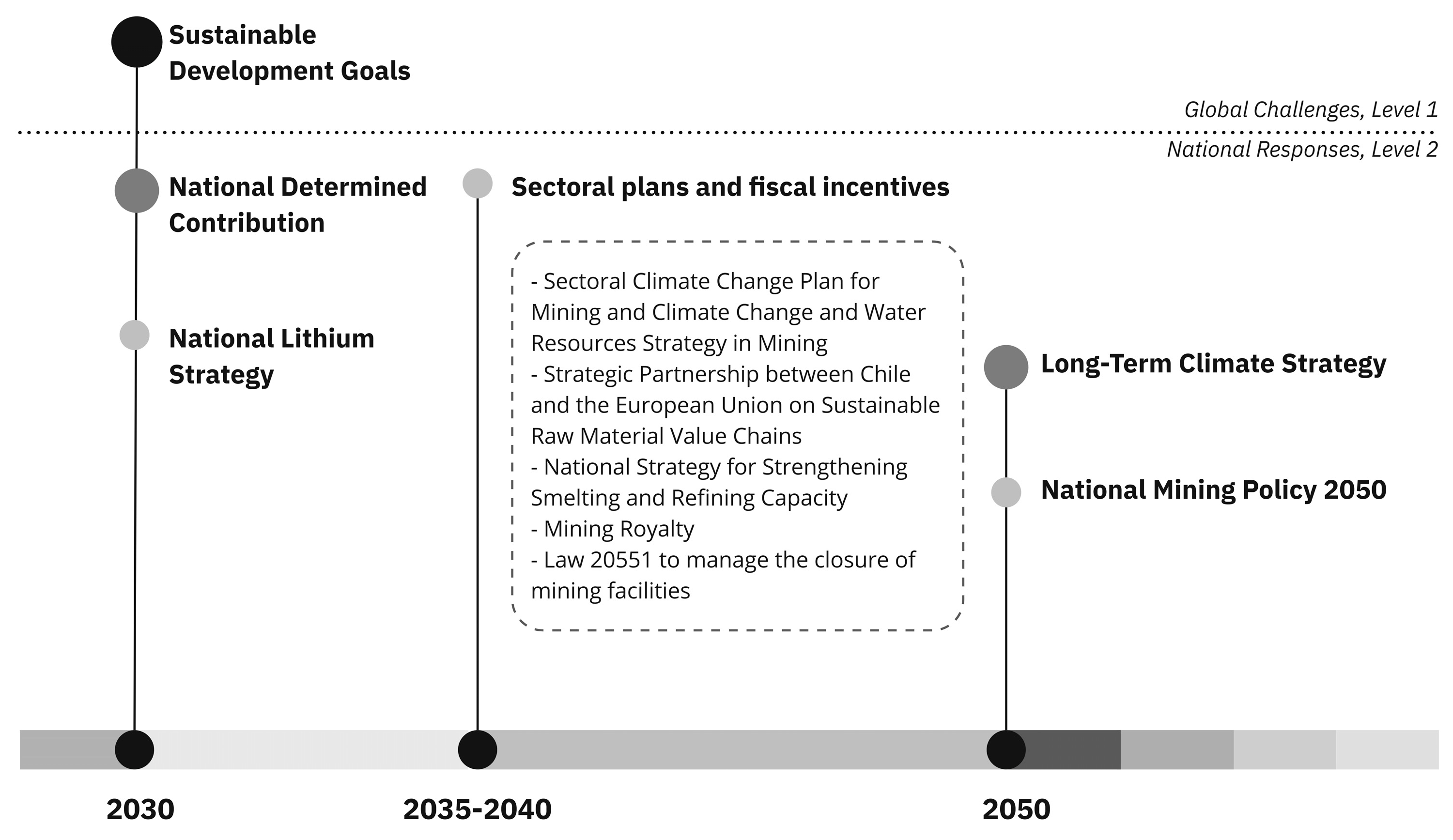
| Public Policy Instrument | Year | Organization |
|---|---|---|
| Sustainable Development Goals (SDGs) | 2015 | United Nations [68] |
| National Determined Contribution (NDC) | 2022 | Ministry of the Environment (ME) [69] |
| Long-Term Climate Strategies 2050 (LTCS) | 2021 | Ministry of the Environment (ME) [70] |
| National Mining Policy 2050 | 2022 | Ministry of Mining [33] |
| Sectoral Plan for Climate Change in Mining and Strategy for Climate Change and Water Resources in Mining | 2024 | Ministry of Mining [58] |
| Strategic partnership between Chile and the EU on sustainable raw material value chains | 2023 | Ministry of Foreign Affairs and Ministry of Mining [71] |
| National strategy for strengthening smelting and refining capacity | 2023 | Ministry of Mining [72] |
| Mining Royalty (Regulation 21.429) | 2023 | Ministry of Finance and Ministry of Mining [73] |
| National Lithium Strategy (2023) | 2023 | Ministry of Mining [35] |
| Regulation 20,551 to manage the closure of mining facilities | 2012 | National Geology and Mining Service [74] |
| Dimension | Indicator |
|---|---|
| Air emissions | Emissions of air pollutants |
| Greenhouse gas emissions | |
| Waste management | Hazardous waste |
| Scale and technology of tailings management | |
| Non-hazardous waste | |
| Environmental public service management | Environmental management activities in public services |
| Environmental compliance | |
| Timeframes for resolution of mining projects in the Environmental Impact Assessment System (SEIA in Chile) | |
| Projects submitted to the Environmental Impact Assessment System (SEIA) | |
| Water management | Discharge of water pollutants |
| Water rights for mining use | |
| Protection and conservation of natural and cultural heritage | Conservation areas or biodiversity protection zones |
| Areas of cultural heritage value | |
| Glaciers | |
| Indigenous communities | |
| Land use | Surface area disturbed by mining activities |
| Operational mining projects in the territory | |
| Mining projects with an approved closure plan | |
| Community engagement | Project-related conflicts |
| Socioeconomically vulnerable households |
| Commitment/Goal | Area | OA Indicator | OA Indicator Name | Coherence | Additional Comments |
|---|---|---|---|---|---|
| Reduce the percentage of continental freshwater used by the mining industry, limiting it to no more than 10% of total water usage by 2025 and further decrease this to 5% by 2040; this reduction should be achieved while promoting the use of alternative water sources that do not compete with human consumption. | Environmental | Yes | Water rights | Partial, due to data limitations | At present, there is no publicly available information regarding the specific volume of water used by individual mining projects. As an estimate, OA considers the continental water rights requested for mining activities. However, for effective monitoring, it is essential to have data on both continental and non-continental water use by mining projects, information that is currently unavailable from official public sources. |
| Public Policy | Description | Dimension | Relationship with OA Indicators | Specific Goal |
|---|---|---|---|---|
| Long-Term Climate Strategy 2050 [76] | Sectoral Objective 3 (Mining): goals related to tailings management:
|
|
|
|
|
|
|
| Key Environmental Commitments in the Mining Sector | |
|---|---|
| Sustainable Development Goals (SDG) [68] |
|
| National Determined Contribution [69] |
|
| National Mining Policy 2050 [33] |
|
| Long-Term Climate Strategy [70] |
|
| Sectoral Climate Change Plan for Mining and Climate Change and Water Resources Strategy in Mining [81] |
|
| Strategic Partnership between Chile and the European Union on Sustainable Raw Material Value Chains [71] |
|
| National Strategy for Strengthening Smelting and Refining Capacity [72] |
|
| Mining Royalty [82] |
|
| National Lithium Strategy [35] |
|
| Law 20551 to manage the closure of mining facilities [74] |
|
| Public Policy Instruments | % Representation of Indicators in Analyzed Instruments | |||||||||||
| Dimensions | Indicators | SDG 2030 Agenda | NDC | PNM 2050 | ECLP 2050 | Sectorial CC Plan for the Mining Sector | National Strategy smelting and refining | Partnership Chile–EU | Mining Royalty | National Lithium Strategy | Regulation 20.551 on the Closure of Mines | |
| Air emissions | Air pollutant emissions | 50% | ||||||||||
| Greenhouse gas emissions (GHG emissions) | ||||||||||||
| Waste management | Waste management | 30% | ||||||||||
| Tailings management and technology | ||||||||||||
| Non-hazardous waste | ||||||||||||
| Environmental public service management | Environmental management activities in public services | 30% | ||||||||||
| Environmental compliance | ||||||||||||
| Timelines for the resolution of mining projects in the SEIA | ||||||||||||
| Projects submitted to the SEIA | ||||||||||||
| Water management | Emissions of pollutants to water | 40% | ||||||||||
| Freshwater rights for mining use | ||||||||||||
| Protection and conservation of natural and cultural heritage. | Protected areas or biodiversity conservation areas | 50% | ||||||||||
| Areas of cultural heritage value | ||||||||||||
| Glaciers | ||||||||||||
| Indigenous communities | ||||||||||||
| Land use | Surface area disturbed by mining activities | 40% | ||||||||||
| Operational mining projects in the territory | ||||||||||||
| Mining projects with an approved closure plan | ||||||||||||
| Community engagement | Project-related conflicts | 20% | ||||||||||
| Socioeconomically vulnerable households | ||||||||||||
| Variable | Commitment | Reference Document | OA Indicator | Additional Comments |
|---|---|---|---|---|
| Reportability and responsible production | A standardized environmental monitoring and reporting system (carbon footprint, water use, and other indicators), with public and auditable data to ensure responsible production aligned with impact reduction goals and transparency in management. Develop a public platform that records compliance with environmental commitments and provides updated information on the state of the environment, enabling citizen verification and strengthening transparency and accountability. | PNM 2050 [33] ECLP 2050 [70]; SDG Agenda 2030 [68]; Strategic Partnership between Chile and the EU on Sustainable Raw Materials Value Chains [71]; National Strategy for Strengthening Smelting and Refining Capacity [72] | Cross-cutting, based on the operation of the platform | The Environmental Observatory (OA) enhances accountability by integrating and visualizing fragmented environmental data, thereby reducing information disparities among the public sector, private industry, and civil society. By employing collaboratively developed indicators and an accessible platform, it facilitates the monitoring of key metrics, the generation of verifiable reports, and the comparison of performance across temporal and geographical dimensions. Consequently, it bolsters transparency, accountability, and adherence to environmental commitments within the mining sector. |
| Water | To mitigate the reliance on continental freshwater resources, it is imperative to promote alternative sources such as desalination and recirculation. The objective is to ensure that the use of continental water does not exceed 10% by the year 2025 and is further reduced to 5% by 2040. This strategy should be implemented while fostering solutions that do not compete with human consumption. | PNM 2050 [33]; ECLP 2050 [70]; Sectoral Climate Change Plan for Mining and Climate Change and Water Resources Strategy in Mining [81] | Freshwater rights | Due to the absence of publicly accessible data regarding the actual volume of water used in mining activities, whether sourced from continental or desalinated supplies, the Environmental Observatory (OA) uses “freshwater rights requested” as a proxy indicator. This approach facilitates an estimation of the potential demand for continental water resources, although it does not accurately represent actual consumption nor account for the use of seawater. This emphasizes the need for more comprehensive data sources to accurately evaluate progress toward established targets. |
| Glaciers | To safeguard and conserve glaciers and high-altitude mountainous regions, it is imperative to ensure that mining activities do not compromise their stability or hydrological functions. It requires the implementation of monitoring plans and the establishment of specific regulations designed to prevent the degradation and retreat of these ice bodies. | SDG Agenda 2030 [68] PNM 2050 [33]. ECLP 2050 [70] | Distance to glaciers | Due to the absence of publicly available data on the direct effects of mining projects on glaciers, the Environmental Observatory (OA) employs the proximity of mining sites to glaciers as a proxy indicator. However, this measure fails to account for glacier stability or hydrological functions. Consequently, more comprehensive data collection and monitoring are necessary to accurately assess the actual impact and ensure adherence to protection commitments. Thus, the OA highlights a critical data gap essential to evaluate potential threats and protect these fragile ecosystems. |
| Protection of biodiversity and ecosystems | To mitigate the degradation of ecologically valuable areas, it is imperative to restore regions impacted by mining activities, enhance the resilience of terrestrial and marine ecosystems in response to climate change, and incorporate nature-based solutions into sectoral projects and planning. | SDG Agenda 2030 [68]. ECLP 2050 [70]; Sectoral Climate Change Plan for Mining and Climate Change and Water Resources Strategy in Mining [81]. National Lithium Strategy [35] | Distance to protected areas or biodiversity conservation areas | In the absence of empirical data regarding the actual impact on biodiversity, the Environmental Observatory employs the proximity of mining projects to protected areas or areas of special conservation interest as a proxy indicator. This measure does not accurately reflect actual degradation or restoration efforts; thus, additional information is required to precisely assess compliance with commitments. This metric emphasizes existing data gaps, highlighting the necessity for further monitoring and field studies. |
| Tailings | Rehabilitate or decommission abandoned mining sites, ensure compliance with safety standards for active tailings, promote advanced disposal technologies and subsequent soil restoration, and mitigate risks to ecosystems and communities. | PNM 2050 [33]. ECLP 2050 [70]. Law 20.551 to regulate the closure of mining facilities [74] | Magnitude and technology of tailings Mining projects with approved closure plans | The OA systematically documents the quantity of tailings based on their status—abandoned, active, or inactive—and their technological classification as conventional or non-conventional. It further estimates both the safety and volume of these tailings. Additionally, the OA identifies the number of mining projects that have received approval for closure plans. These two indicators serve as measures of compliance in the rehabilitation and risk mitigation of tailings, thereby enhancing the protection of ecosystems and communities. |
| Circular economy and responsible production | Encourage the reuse, recycling, and reduction of waste in mineral extraction and processing, promote the efficient use of inputs and minimize waste generation, in accordance with the objectives of responsible production and consumption for sustainable development. | PNM 2050 [33]; SDG Agenda 2030 [68]; Sectoral Climate Change Plan for Mining and Climate Change and Water Resources Strategy in Mining [58] | Hazardous waste Non-hazardous waste | The Environmental Observatory (OA) offers a comprehensive analysis of the volume and management practices of mining waste, thereby facilitating the evaluation of adherence to commitments regarding efficiency and waste reduction. |
| Air quality | To minimize atmospheric pollution in mining environments, it is essential to enforce stringent standards to control and monitor particulate matter, adopt cleaner energy sources, reduce diesel combustion, and implement local emission mitigation and management plans. | NDC [69] PNM 2050 [33]; ECLP 2050 [70] | Air pollutant emissions | The Environmental Observatory (EO) systematically documents air emissions from mining operations, thereby facilitating the assessment of local pollution mitigation efforts. |
| Greenhouse gas emissions | Ensure the maintenance of an emissions budget through 2030, not exceeding 1100 MtCO2eq, by establishing sector-specific targets for mining. Additionally, promote the systematic measurement of the carbon footprint in mining operations to facilitate the progressive reduction of emissions. | NDC [69]. ECLP 2050 [70]. Sectoral Climate Change Plan for Mining and Climate Change and Water Resources Strategy in Mining [58] | Greenhouse gas emissions | OA reports solely on CO2 emissions due to the absence of publicly available data on other greenhouse gases (GHGs) from mining operations, thereby constraining the comprehensive monitoring of the emissions budget. |
| Energy and decarbonization | To achieve carbon neutrality by 2050, it is imperative to expedite the adoption of clean energy and enhance energy efficiency, with particular emphasis on the electrification and substitution of fossil fuels in mining processes. | NDC [69]; ECLP 2050 [70]; Sectoral Climate Change Plan for Mining and Climate Change and Water Resources Strategy in Mining [58] | Not available | The OA lacks specific indicators for energy, as this dimension was not prioritized during the project’s co-creation process, thereby limiting the capacity for direct monitoring of progress towards achieving carbon neutrality. |
| Regulatory management and efficiency | The processing time for environmental and sectoral permits is reduced by addressing the challenges encountered by investment projects. The objective is to streamline processes without compromising the rigor of evaluation, thus ensuring the quality of information and safeguarding environmental and social aspects. | PNM 2050 [33]. ECLP 2050 [70]. Mining Royalty [73] | Deadlines for the resolution of mining projects in the Environmental Impact Assessment (SEIA) | The OA incorporates an indicator that facilitates the monitoring of the duration required for environmental processing, in that way providing evidence of potential obstacles and the efficiency of regulatory processes. |
| Environmental oversight and compliance | Enhance the capacity, scope, and frequency of environmental oversight and monitoring, encourage adherence to environmental obligations, and implement remediation or sanction measures when necessary. | PNM 2050 [33]; ECLP 2050 [70]; Mining Royalty [73]; Law 20.551 to regulate the closure of mining facilities [74] | Environmental management activities and environmental compliance | The OA oversees inspections, instances of non-compliance, fines, and sanctions related to mining projects. This oversight facilitates the monitoring of environmental compliance and enhances transparency in the management of remediation efforts and sanctions for environmental and health-related damages. |
| Participation and social responsibility | Facilitate the involvement of local and indigenous communities in the assessment of mining projects and environmental management. Ensure transparency when spreading information, conduct prior consultations, and implement accountability mechanisms to enhance social licenses and partnerships for sustainable development. | PNM 2050 [33]. SDG Agenda 2030 [68]. National Lithium Strategy [35] | Not available | While the OA does not explicitly assess community involvement in environmental evaluation and management, it includes sections that document management activities, including processes for active citizen participation, the promotion of engagement, and the provision of essential information for decision making. |
Disclaimer/Publisher’s Note: The statements, opinions and data contained in all publications are solely those of the individual author(s) and contributor(s) and not of MDPI and/or the editor(s). MDPI and/or the editor(s) disclaim responsibility for any injury to people or property resulting from any ideas, methods, instructions or products referred to in the content. |
© 2025 by the authors. Licensee MDPI, Basel, Switzerland. This article is an open access article distributed under the terms and conditions of the Creative Commons Attribution (CC BY) license (https://creativecommons.org/licenses/by/4.0/).
Share and Cite
Bergamini, K.; Rugiero, V.; Ángel, P.; Mollenhauer, K.; Alarcón, A.; Manríquez, G. Global Challenges and National Responses: Indicators to Evaluate Public Policies for Mining Development in Chile in the Context of the Global Energy Transition. Sustainability 2025, 17, 7814. https://doi.org/10.3390/su17177814
Bergamini K, Rugiero V, Ángel P, Mollenhauer K, Alarcón A, Manríquez G. Global Challenges and National Responses: Indicators to Evaluate Public Policies for Mining Development in Chile in the Context of the Global Energy Transition. Sustainability. 2025; 17(17):7814. https://doi.org/10.3390/su17177814
Chicago/Turabian StyleBergamini, Kay, Vanessa Rugiero, Piroska Ángel, Katherine Mollenhauer, Andrea Alarcón, and Gustavo Manríquez. 2025. "Global Challenges and National Responses: Indicators to Evaluate Public Policies for Mining Development in Chile in the Context of the Global Energy Transition" Sustainability 17, no. 17: 7814. https://doi.org/10.3390/su17177814
APA StyleBergamini, K., Rugiero, V., Ángel, P., Mollenhauer, K., Alarcón, A., & Manríquez, G. (2025). Global Challenges and National Responses: Indicators to Evaluate Public Policies for Mining Development in Chile in the Context of the Global Energy Transition. Sustainability, 17(17), 7814. https://doi.org/10.3390/su17177814