1. Introduction
The integration of Environmental, Social, and Governance (ESG) criteria into financial analysis represents a paradigm shift in assessing corporate value and risk. This transition is no longer a matter of debate but a market reality, underscored by the significant valuation impacts following ESG-related controversies, such as Volkswagen’s emissions scandal in 2015 and Meta’s Cambridge Analytica data breach in 2018 [
1]. As global standards evolve with the EU’s Corporate Sustainability Reporting Directive (CSRD) and the ISSB’s IFRS S1/S2, the focus is intensifying on timely, transparent, and verifiable event-based disclosures over static, annual ratings. This global momentum raises a critical question with profound implications for non-Western, export-driven economies: what is the relationship between the style and substance of ESG communication and market valuation? Is it a meaningful association, or is it perceived as symbolic “greenwashing”?
This question is particularly salient in Taiwan, which offers an ideal natural laboratory for testing whether how often firms communicate ESG information matters more than how positively they frame it [
2,
3]. Taiwan’s market is characterized by its pivotal role in global supply chains and a corporate landscape dominated by family-controlled firms, creating distinctive conditions for examining ESG communication effects [
4]. First, the island economy couples a state-led, phased-in mandate—spelled out in the Financial Supervisory Commission’s (FSC) Corporate Governance 3.0 roadmap and its 2023 IFRS S1/S2 adoption timetable—with a public, stock-exchange-administered evaluation that ranks every issuer on a 1–7 scale where nearly one-third of the score derives from “Promotion of Sustainable Development”. No comparable dual-track mechanism exists in the United States, where third-party raters (e.g., MSCI, Sustainalytics) operate outside the regulatory perimeter, nor in the EU, where scoring remains voluntary despite CSRD’s legal heft.
Second, Taiwan’s corporate landscape features family-controlled firms embedded in global supply chains—conditions that create parallels with, yet distinctions from, other advanced Asian markets. South Korea’s chaebol-dominated corporate sector and Singapore’s mandatory sustainability reporting regime highlight how different governance structures and regulatory environments may mediate ESG outcomes, but neither combines Taiwan’s unique dual-track regulatory approach with its particular ownership concentration. If disclosure cadence truly acts as an information signal, it should do so most clearly where reporting is both compulsory and reputationally policed, yet ownership structures remain highly concentrated. While our focus is on Taiwan, these cross-national comparisons underscore the broader relevance of examining whether consistent ESG communication carries tangible market consequences across different institutional contexts [
5].
Despite a burgeoning literature, existing ESG research suffers from two principal limitations that this study aims to address. First, the prevalent reliance on proprietary, low-frequency ESG ratings has been widely criticized for its methodological opacity and inability to capture market reactions to timely, firm-specific events [
6,
7]. Second, the growing body of work using textual analysis predominantly focuses on disclosure sentiment, operating on the assumption that positive tone is rewarded while negative tone is punished [
8]. This narrow focus overlooks a crucial alternative signaling mechanism: disclosure frequency. In environments characterized by information asymmetry, the very act and cadence of communication may serve as a powerful heuristic for investors to assess a firm’s transparency, legitimacy, and proactive risk management.
To address these gaps, this study pioneers a novel methodological approach. We employ a BERT-based model, specifically enhanced with the CKIP Lab’s Traditional Chinese knowledge base, to analyze the sentiment and frequency of ESG event announcements from Taiwanese listed companies between 2014 and 2023 [
9]. This domain-specific adaptation allows for an unprecedented level of accuracy in interpreting localized financial terminology and cultural context, overcoming the limitations of generic NLP models [
10,
11].
Our analysis yields a counterintuitive primary finding: the frequency of ESG disclosures emerges as a more robust predictor of cumulative abnormal returns (CARs) than the sentiment of those disclosures. This suggests that the market rewards the act of consistent communication, interpreting it as a signal of corporate legitimacy and proactive governance. We find this effect is highly heterogeneous across ESG pillars. In line with Legitimacy and Stakeholder theories, negative Social and Governance events—signals of breaches of the social contract or fiduciary duties—trigger the most severe and persistent market penalties. Conversely, a higher frequency of Environmental disclosures is met with a neutral-to-positive response, which we posit aligns with Signaling Theory: investors may interpret these as credible signals of a firm’s commitment to navigating long-term regulatory risks, particularly given the Taiwanese government’s green transition policies. Our findings also confirm that firm size and financial stability are significant moderators, with larger firms exhibiting greater capacity to absorb the market shocks from negative ESG news.
This study makes three distinct contributions to the literature. First, we advance the methodology of ESG analysis by demonstrating the superior efficacy of a linguistically and culturally adapted NLP model for a non-English context. Second, we challenge the conventional wisdom in sentiment-focused studies by providing strong evidence for the primacy of disclosure frequency, offering a new, theoretically grounded perspective on how markets process ESG information. Third, we provide granular, actionable insights for an under-researched capital market, revealing the specific ESG factors that are associated with value creation in Taiwan. These findings have critical implications for corporate managers crafting disclosure strategies and for investors seeking to refine their risk assessment models in Asian markets.
The remainder of this paper is organized as follows.
Section 2 provides a comprehensive literature review and develops our research hypotheses, grounding them in established theories of corporate disclosure and market behavior.
Section 3 details our methodology, including the event study framework, the BERT-based sentiment analysis approach, and our econometric models.
Section 4 presents our empirical results, including descriptive statistics, main regression findings, and robustness tests.
Section 5 discusses the implications of our findings for theory and practice, while
Section 6 concludes with limitations and directions for future research.
2. Literature Review and Hypotheses Proposed
2.1. Theoretical Framework: How Markets Interpret ESG Information
The financial impact of ESG disclosures is not uniform; it is interpreted by investors through several theoretical lenses that explain how non-financial information is processed and priced. This study primarily draws upon three foundational theories: Legitimacy Theory, Stakeholder Theory, and Signaling Theory. While each offers a distinct perspective, they are not mutually exclusive and often provide complementary insights into corporate behavior and market reactions to ESG information.
Legitimacy Theory posits that firms operate under a “social contract” with society. To maintain their legitimacy and ensure continued operation, companies must conform to societal norms, values, and expectations [
12]. Disclosures, therefore, are a primary tool for firms to demonstrate their adherence to this social contract. Negative ESG events, especially in the social and governance realms, represent a breach of this contract, threatening the firm’s legitimacy and leading to negative market repercussions as investors price in the risk of sanctions, regulatory scrutiny, or loss of public trust [
13,
14]. The theory suggests that firms will strategically use disclosures to manage public perceptions and secure their social license to operate, particularly when their legitimacy is challenged [
15].
This is complemented by Stakeholder Theory, which argues that a firm’s success depends on its ability to manage its relationships with a broad set of stakeholders, not just shareholders [
16]. These stakeholders include employees, customers, suppliers, communities, and regulators. Negative Social (S) or Governance (G) news directly harms key stakeholders, signaling potential disruptions to operations, supply chains, or revenue streams [
17]. The market, in turn, penalizes the firm for this increased stakeholder-related risk, recognizing that poor stakeholder relationships can translate into tangible financial costs, such as boycotts, lawsuits, or regulatory fines [
18,
19]. The overlap with Legitimacy Theory is evident here, as maintaining positive stakeholder relationships is crucial for a firm’s societal legitimacy.
Finally, Signaling Theory suggests that in an environment of information asymmetry, corporate disclosures act as signals to investors about unobservable firm qualities, such as management competence, long-term strategy, or commitment to sustainability [
20]. From this perspective, the act of disclosing can be as important as the content. Consistent, voluntary disclosure, even of neutral or mildly negative information, can signal transparency, proactive risk management, and a commitment to long-term value creation, thereby reducing the firm’s cost of capital [
9,
21]. This is particularly relevant for complex, forward-looking environmental issues, where proactive communication can differentiate a firm and attract sustainability-focused investors [
22]. Signaling Theory also explains why disclosure frequency might be a more potent signal than sentiment: a consistent rhythm of communication, regardless of immediate positive or negative framing, can signal reliability and a commitment to transparency, which are highly valued by investors in uncertain environments [
23].
These theories collectively provide a robust framework for understanding how markets interpret ESG information. Legitimacy and Stakeholder theories primarily explain the negative market reactions to breaches of social contracts or harm to stakeholders, particularly in the S and G pillars. Signaling Theory, on the other hand, offers insights into how proactive and consistent disclosure, especially in the E pillar, can be interpreted as a positive signal of long-term strategic foresight and risk management, even if the immediate content is not overtly positive. The interplay of these theories highlights the multifaceted nature of ESG impact on market performance, moving beyond a simplistic sentiment-driven view to encompass the strategic implications of disclosure patterns.
2.2. The Shift from Ratings to Real-Time Events and the Sentiment vs. Frequency Debate
Initial empirical research on ESG financial impact relied heavily on third-party ratings (e.g., MSCI, Sustainalytics). However, this approach has been challenged by a growing body of literature highlighting significant “rater divergence,” where different agencies provide conflicting assessments of the same firm due to opaque methodologies and subjective weighting schemes [
6]. Furthermore, these ratings are updated infrequently, making them ill-suited for capturing the market’s immediate reaction to breaking news. This has motivated a shift toward event-study methodologies that analyze the impact of discrete ESG news events on stock returns [
4].
A central debate within this stream of research concerns what aspect of the news drives market reactions. The dominant assumption has been that the sentiment (positive or negative tone) of the disclosure is the primary driver. Studies consistently find an asymmetric response, where negative news triggers a much stronger stock price decline than the positive lift from good news, a finding often attributed to investor loss aversion [
8,
17]. However, an emerging perspective, informed by Signaling and Legitimacy theories, questions the primacy of sentiment. It posits that the frequency of disclosures may be a more powerful signal. In this view, frequent communication on ESG topics, regardless of sentiment, signals that management is attentive and in control, thus reducing information asymmetry and enhancing firm legitimacy. Conversely, a sudden, negative event from a typically silent company could be penalized more harshly. This suggests a crucial, yet under-researched, question: is it the tone of the message or the rhythm of communication that matters more to investors?
Based on this debate, we propose our first two competing hypotheses:
H1. The sentiment of ESG news events is a significant determinant of a firm’s cumulative abnormal returns (CARs), with negative sentiment leading to negative CARs and positive sentiment leading to positive CARs.
H2. The frequency of ESG disclosures is more significantly associated with CARs than the sentiment expressed in those disclosures.
2.3. Temporal Evolution of ESG Market Impact
Investor perceptions of ESG disclosures have likely evolved over time as sustainability issues moved into the mainstream. In the early years of our sample (2014–2018), ESG reporting in Taiwan was relatively nascent, whereas by 2019–2023, both regulatory frameworks and investor awareness had intensified. Global evidence also suggests that mandatory ESG disclosure regulations can improve the information environment and influence market behavior. We therefore expect that market reactions to ESG events became more pronounced in the latter part of our study period. Formally, we hypothesize:
H3. Market reactions to ESG event disclosures are significantly stronger in the post-2019 period than in the pre-2019 period, reflecting heightened investor attention and regulatory scrutiny in recent years.
2.4. Differential Impacts of E, S, and G in the Taiwanese Context
The market does not view “ESG” as a monolith. The financial materiality and signaling content differ significantly across the three pillars, leading to varied market reactions:
Governance (G): Consistent with both Stakeholder and Legitimacy theories, governance failures (e.g., fraud, executive misconduct) are often found to trigger the most immediate and severe negative market reactions. Such events signal a fundamental breach of fiduciary duty and can directly threaten firm stability and shareholder value [
24,
25];
Social (S): Social issues (e.g., labor disputes, supply chain controversies, product safety) also elicit strong negative responses, as they threaten a firm’s brand reputation, customer loyalty, and operational continuity—its social license to operate. In an export-oriented economy like Taiwan, which is deeply integrated into global supply chains, negative social events can signal significant risk to international partners [
23];
Environmental (E): The impact of environmental news is more nuanced. While discrete negative events like industrial accidents cause sharp stock declines, the market reaction to proactive, positive E disclosures is often muted in the short term [
4]. However, from a Signaling Theory perspective, a consistent frequency of E-related disclosures may be interpreted positively by investors as a sign of long-term risk management and alignment with evolving policy (such as Taiwan’s push towards a green energy transition).
This leads to two additional hypotheses:
H4. The market reaction to ESG events is heterogeneous across pillars, with negative Social (S) and Governance (G) events triggering significantly more negative CARs than negative Environmental (E) events.
H5. Firm size and financial stability significantly moderate the market’s reaction to ESG events, with larger and more stable firms better able to mitigate the negative impact of adverse news.
H5 is grounded in Stakeholder Theory, as larger firms have greater resources to manage stakeholder expectations [
26,
27].
4. Empirical Findings and Analysis
This section presents the empirical results of our study. We begin with a descriptive analysis of market reactions using event study plots, followed by a detailed examination of cumulative abnormal returns (CARs) across different ESG pillars. Finally, we present the results of our multivariate regression models to formally test our hypotheses regarding the roles of sentiment, frequency, and firm-level characteristics.
4.1. Market Reaction to ESG Events: An Event Study Perspective
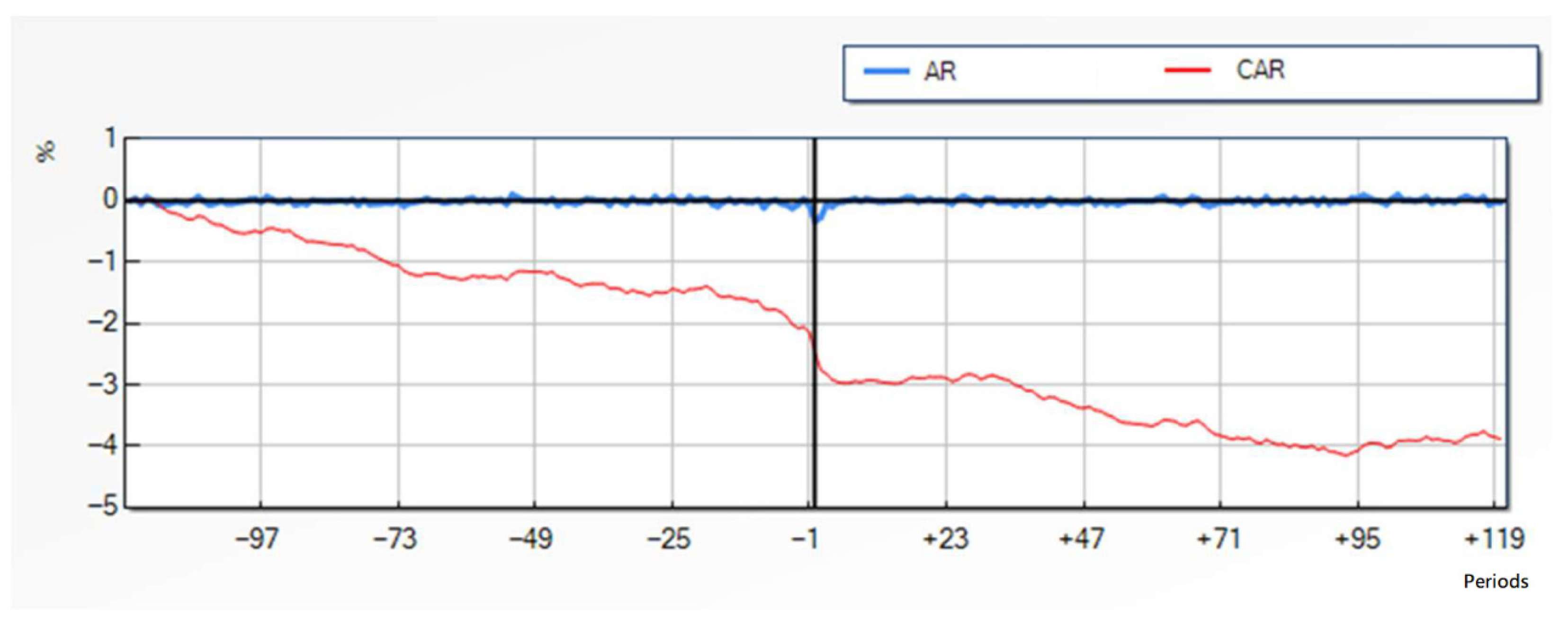
To provide an initial overview of the market’s response to ESG disclosures,
Figure 1 plots the average Abnormal Returns (AR) and Cumulative Abnormal Returns (CAR) for the full sample of 2576 events around the announcement date (T = 0).
Figure 1 plots the average Abnormal Return (AR) and the Cumulative Abnormal Return (CAR) for the full sample surrounding the event announcement date (T = 0). The graph reveals two distinct patterns. The average AR exhibits only minor fluctuations around the event day, which suggests that the market’s immediate, day-to-day reaction to ESG news is relatively muted. In contrast, the CAR reveals a clear and persistent downward trend following the ESG announcement. This pattern suggests that investors do not fully price the implications of ESG events instantaneously; rather, the information appears to be gradually assimilated over time, leading to a sustained negative valuation effect [
9,
25].
4.2. Differential Impact of Environmental, Social, and Governance Pillars
To test our hypothesis that the market reacts differently to the three ESG pillars (H4), we disaggregate the CAR analysis by event type.
Table 3 presents the CARs for the full sample and for each of the E, S, and G subsamples over various event windows up to 120 days post-announcement.
The results in
Table 3 reveal striking differences in market reactions, providing strong support for H4:
Environmental (E) Events: The market response to environmental news is markedly different. The initial impact is a negligible −0.11%. Remarkably, this mild negative effect reverses over time, with the CAR turning positive and reaching +0.89% by day 120. This unique pattern suggests that while the market may have a slight negative initial reaction to environmental disclosures (perhaps due to short-term compliance costs or risk signals), investors eventually interpret recurring environmental initiatives as a sign of proactive management and long-term strategic planning. This finding is consistent with the observations of [
33], who argue that transparency in sustainability initiatives can enhance firm value over time.
Social (S) Events: These events trigger the most significant and immediate negative impact. The CAR on the event day is about −0.53%, deepening to nearly −2.0% by day 120. This powerful negative reaction aligns with our theoretical framework, suggesting that investors heavily penalize firms for events that directly violate their social contract with stakeholders, such as labor disputes or product safety failures, which can cause severe reputational damage and operational risk.
Governance (G) Events: Governance-related news also results in a sustained negative trajectory, with a CAR of −0.28% on day 0 that deteriorates to approximately −2.38% by day 120. While the initial impact is less severe than for Social events, the long-term decline is the largest of the three pillars. This suggests that, although governance issues may be less sensational in the headlines, investors perceive them as having profound, long-term implications for firm stability and integrity, consistent with prior literature [
4,
25].
In sum, this descriptive analysis confirms that investors do not treat ESG as a monolithic concept. The immediate and severe penalties for S and G events, contrasted with the eventual positive re-rating for E events, underscore the importance of our disaggregated approach. However, this analysis does not control for other factors, which we turn to next.
4.3. Regression Analysis of CAR Determinants
To formally test our hypotheses and disentangle the effects of sentiment, frequency, and other firm characteristics, we conduct a series of multivariate regressions.
4.3.1. Full Sample Analysis
Table 4 presents the regression results for the full sample across five event windows (CAR1, CAR5, CAR20, CAR60, CAR120). The results provide clear evidence supporting our central hypotheses.
In brief, the regression coefficients indicate the following:
The Primacy of Frequency over Sentiment (H1 vs. H2): The Sentiment Score variable is statistically insignificant in the shortest windows (CAR1, CAR5) and only becomes weakly significant in some longer windows. This finding provides only partial, weak support for H1. In stark contrast, the Frequency variable is highly significant and negative across all but the very shortest window. A higher frequency of ESG announcements in a quarter is associated with significantly lower CARs. This provides strong support for H2, suggesting that investors may perceive a high volume of ESG disclosures not as a reassuring sign of transparency, but as an indicator of underlying problems and heightened risk. In our discussion, we will elaborate on this phenomenon, which we term “Disclosure Fatigue,” interpreting it as a rational market heuristic. The market appears to react more to the signal of “trouble” implied by frequent ESG-related announcements than to the nuanced tone of those announcements.
The Moderating Role of Firm Characteristics (H5): In line with H5, firm-level fundamentals play a critical role. Firm Size and ROE (profitability) are both associated with significantly more positive (or less negative) CARs across many windows. This indicates that larger, more profitable firms have the financial stability and resources to better mitigate the negative market impact of ESG events, confirming that strong fundamentals act as a buffer against ESG shock impacts.
Control variables and fixed effects behave as expected: for instance, the Year fixed effects show more negative CARs in later years (consistent with increasing scrutiny over time), and the industry effects are generally small.
4.3.2. Subgroup Analyses by ESG Pillar
To explore the nuances behind the full-sample results, we conduct separate regressions for each ESG pillar.
Environmental (E) Events (
Table 5): The results for E events are striking and unique. The
Frequency coefficient is consistently positive and highly significant across all windows. This is the opposite of the full-sample result and suggests that for environmental issues, frequent communication is rewarded by the market. Investors appear to interpret a steady stream of E-related news as a credible signal of proactive engagement with long-term sustainability trends, aligning with our Signaling Theory framework. This provides a powerful explanation for the positive long-term CAR trend observed in
Figure 1 and
Table 3.
Social (S) and Governance (G) Events (
Table 6 and
Table 7): For both S and G events, the
Frequency coefficient is consistently negative and significant in the medium- to long-term windows, mirroring the full-sample result. This confirms that for issues directly related to stakeholder relations and corporate integrity, a high volume of disclosures is perceived negatively by investors, likely as an indicator of persistent problems. For G events,
Firm Size is a strong positive predictor of CARs, suggesting that for governance matters, the market trusts larger firms more, perhaps due to more sophisticated board structures and internal controls.
4.3.3. Period-Specific Analysis (Pre- vs. Post-2019)
To test for temporal variations in market reactions (H3), we split the sample into two periods: 2014–2018 (early adoption) and 2019–2023 (mature phase). The results are presented in
Table 8 and
Table 9.
The analysis reveals a structural shift in how the market processes ESG information, providing strong support for H3. In the 2014–2018 period, the frequency of disclosures has a limited and sometimes even positive effect on CARs. However, in the 2019–2023 period, frequency has a consistently strong and negative impact on CARs. This demonstrates that as investor awareness and regulatory scrutiny intensified after 2019, the market became more skeptical and discerning. What might have been viewed as a positive signal of transparency in the early period is now interpreted as a negative signal of underlying risk in the more mature phase.
4.3.4. Robustness Checks: Two-Stage Least Squares (2SLS)
To address endogeneity concerns and strengthen the causal interpretation of our findings, we conduct two additional econometric analyses: a two-stage least squares (2SLS) instrumental variables approach and a difference-in-differences (DID) estimation in the next subsection. These robustness checks are essential for establishing the validity of our core hypothesis that ESG disclosure frequency affects market performance beyond mere correlation.
The primary endogeneity concern in our analysis stems from the potential that firms experiencing operational difficulties may simultaneously disclose more frequently and exhibit poor stock performance, creating a spurious correlation between disclosure frequency and cumulative abnormal returns (CARs). To address this concern, we employ a 2SLS instrumental variables approach, following established practices and instrumental variables setting in corporate finance and ESG literature [
18,
23,
24]. Our instrumental variable (
IV_Frequencyi) is the industry-year average disclosure frequency, excluding the focal firm. This instrument is constructed as:
where
i represents the focal firm,
j denotes the industry,
t indicates the time period, and
Nj,t is the number of firms in industry
j at time
t.
This instrumental variable satisfies both relevance and exclusion restrictions. The relevance condition is met because firms within the same industry often exhibit similar disclosure patterns due to regulatory requirements, industry norms, and competitive pressures [
24]. The exclusion restriction holds because industry-average disclosure frequency should not directly affect individual firm CARs beyond its influence through the firm’s own disclosure frequency, as it reflects sector-wide practices rather than firm-specific factors.
The 2SLS estimation proceeds in two distinct stages:
First Stage (Predicting Frequency):
This stage generates fitted values IV_Frequencyi that represent the exogenous component of disclosure frequency.
Second Stage (Main Regression):
Standard errors are heteroscedasticity-robust and clustered at the firm level to account for within-firm correlation.
Table 10 presents the second-stage results for the full sample (N = 2576). The instrumented frequency coefficient (
IV_Frequency) is consistently negative and statistically significant across all CAR windows, with magnitudes increasing over longer time horizons. Specifically, the coefficients range from −0.2266 for CAR1 to −2.1293 for CAR120, indicating that the negative relationship between disclosure frequency and market performance strengthens over time. Importantly, the sentiment score remains largely insignificant across most windows, reinforcing our core finding that disclosure frequency dominates sentiment as a predictor of market reactions (supporting H2). The control variables behave as expected: ROE consistently shows positive and significant coefficients, confirming that profitability mitigates negative ESG-related market reactions (supporting H5). The P/B ratio also exhibits positive coefficients in shorter windows, suggesting that growth-oriented firms may be better positioned to weather ESG-related market volatility.
4.3.5. Robustness Checks: Difference-in-Differences (DID) Analysis
To further assess the causal impact of high disclosure frequency, particularly in the context of Taiwan’s evolving ESG regulatory environment post-2019, we implement a DID framework [
34,
35]. This quasi-experimental design exploits the 2019 regulatory shift as a natural experiment, aligning with the Financial Supervisory Commission’s Sustainable Development Roadmap and the intensification of investor ESG scrutiny (supporting H3).
The treatment assignment is based on annual disclosure frequency relative to the sample mean (1.5703 from
Table 2). Firms are classified into the treatment group if their annual disclosure frequency exceeds the sample mean in any year from 2019 onward; otherwise, they constitute the control group. The pre-treatment period spans 2014–2018, while the post-treatment period covers 2019–2023.
The DID model specification is:
where
Treatment is a binary indicator for high-frequency firms,
Post is a binary indicator for the post-2019 period, and the
DID (
interaction) term captures the differential treatment effect.
Table 11 reports the DID results. The interaction term is negative across all windows, reaching statistical significance for CAR120, indicating that high-frequency firms experience incrementally worse long-term CARs post-2019. The post dummy is positive in shorter windows but turns negative in longer ones, reflecting evolving market skepticism. The treatment main effect is insignificant, suggesting no baseline difference pre-2019. These findings support H3 and reinforce the “disclosure fatigue” interpretation: in a more mature ESG market, frequent disclosures signal persistent risks, exacerbating negative returns. Robustness checks (e.g., using median frequency as the threshold) yield similar patterns, with negative DID coefficients for CAR1 and CAR120.
These two robustness checks confirm the stability of our findings. First, the 2SLS results remain qualitatively unchanged when excluding firms with only one observation per industry-year or when incorporating heteroscedasticity-robust standard errors. Second, repeating the DID analysis using the sample median disclosure frequency as the threshold yields similar negative coefficients, particularly for CAR1 and CAR120. These tests suggest that the observed negative relation between high disclosure frequency and subsequent stock returns is not driven by sample selection or model specification.
5. Discussion
Our empirical analysis yields a series of interconnected findings that contribute to a more nuanced understanding of how ESG information is processed in a non-Western, export-oriented capital market. In this section, we discuss the theoretical and practical implications of our key results, focusing on three central themes: the primacy of disclosure frequency over sentiment, the distinct market logic for each ESG pillar, and the evolving nature of ESG investing in Taiwan.
5.1. The Rhythm of Communication over the Tone: Disclosure Frequency as the Dominant Signal
The empirical results show a robust negative association between the frequency of S and G disclosures and CARs. We interpret this through Legitimacy and Signaling Theories. The central question is how to interpret this finding. This study proposes that frequency acts as a primary signal to investors. The study frames this phenomenon through the lens of Legitimacy and Signaling Theories. This view posits that, even controlling for the content of the news, investors use the sheer volume of disclosures as a heuristic. A high frequency of problem-related announcements acts as a powerful signal that the firm is facing persistent turmoil, leading investors to update their risk assessment and penalize the stock. In essence, the communication pattern itself contains information.
The most striking finding of this study is the robust evidence supporting the dominance of disclosure frequency over sentiment in driving cumulative abnormal returns. While our results provide only weak and inconsistent support for H1 (the impact of sentiment), they offer compelling support for H2. The sentiment of a corporate announcement, whether positive or negative, appears to be of secondary importance to investors. Instead, the frequency of ESG-related communication emerges as the primary information signal, though its interpretation is highly context-dependent.
This challenges a significant stream of the ESG literature that focuses on sentiment as the main transmission channel for market reactions [
8]. We interpret this finding through the lens of Legitimacy and Signaling Theories. In an environment of high information asymmetry, investors may treat a high volume of disclosures not as a sign of transparency, but as an indicator of underlying operational or governance turmoil.
For Social and Governance events, the negative association with disclosure frequency suggests a market reaction we term “Disclosure Fatigue”. We define it as a rational cognitive heuristic, distinct from investor apathy (emotional disengagement) or signaling noise (irrelevant information), focusing instead on volume as a proxy for risk persistence [
36]. It is crucial to clarify the precise meaning of this term within our framework. We do not use “fatigue” to imply an emotional or irrational investor response. Rather, we define it as a rational cognitive heuristic adopted by investors navigating environments of information overload and bounded rationality.
Specifically, when confronted with a high volume of disclosures on inherently negative topics (such as S and G failures), investors may rationally conclude that a detailed analysis of each individual event is inefficient. Instead, they may default to a simpler, powerful heuristic: the volume of signals serves as a proxy for the severity and persistence of underlying problems. This is a rational “where there’s smoke, there’s fire” assessment. Therefore, “Disclosure Fatigue” in this context describes the market’s tendency to penalize the cumulative risk signaled by the pattern of frequent communication, rather than a weariness from processing the information itself. This interpretation aligns with our finding that the market reacts more to the rhythm of communication than to the nuanced tone of each message. This aligns with our regression results, which show a consistently negative coefficient for frequency in the full sample and for the S and G subsamples, especially in the post-2019 period. This finding is theoretically grounded in Signaling Theory, where frequent signals indicate persistent issues rather than isolated events [
11,
37].
5.2. A Tale of Three Pillars: Deconstructing the Market’s Logic for E, S, and G
Our findings strongly support H4, demonstrating that the market does not treat ESG as one uniform category. The divergent reactions to each pillar reveal a sophisticated, multi-faceted risk assessment logic among investors in Taiwan.
The severe and persistent negative CARs following Social and Governance events confirm that breaches of the social contract and fiduciary duty are heavily punished. S and G issues often represent direct threats to a firm’s operational stability, brand reputation, and legal standing. For an economy like Taiwan’s, which is deeply embedded in global supply chains that are increasingly scrutinized for labor practices and ethical governance, these risks are particularly material [
23].
The most intriguing result is the unique market response to Environmental events. The negative coefficient for frequency in the main model disappears and reverses to become consistently positive in the E-pillar subsample. This finding provides textbook support for Signaling Theory in the ESG context. We posit that this reflects a different signaling mechanism: in a market with strong, top-down policy incentives (i.e., Taiwan’s green transition initiatives), investors interpret frequent E-disclosures not as a sign of trouble, but as a costly and therefore credible signal of a firm’s proactive engagement and strategic alignment with sustainability goals. The act of consistent communication itself becomes a valuable intangible asset, indicating long-term risk management capabilities. Frequent reporting on environmental initiatives may thus signal an ability to navigate regulatory changes and capitalize on the green economy, leading to potentially contributing to higher valuations over time [
33].
An alternative explanation for this positive effect, however, warrants consideration. It is plausible that, particularly within Taiwan’s strong pro-green policy environment (“Green Finance Action Plan”), Environmental disclosures inherently contain more substantive “good news” (e.g., receiving government subsidies, technological breakthroughs, securing green bonds) than their S or G counterparts. From this perspective, the positive market reaction could be driven by the intrinsic value of the news content itself, a factor which may not be fully captured by our sentiment score alone.
While we acknowledge the validity of this viewpoint, several factors suggest that the signaling mechanism of frequency remains a critical, independent component. First, our regression models consistently control for sentiment; therefore, the significant and positive coefficient for Frequency captures an effect that exists above and beyond the linguistic tone of the announcements. Second, many proactive E-disclosures detail long-term capital investments, such as building new green facilities or committing to ambitious R&D for energy efficiency. These actions often represent significant short-term costs rather than immediate profits. In such cases, the disclosure’s value lies not in immediate tangible gains, but in its function as a costly—and therefore credible—signal of a firm’s long-term strategic commitment. Thus, even if some E-disclosures are substantively positive, we argue that the very act and rhythm of frequent communication provide an additional, valuable layer of information that the market rewards, a finding highly consistent with Signaling Theory [
37].
5.3. The Evolution of ESG Maturity: A Market in Transition
The period-specific analysis provides compelling support for H3, revealing a structural shift in how the Taiwanese market prices ESG information. Before 2019, the market’s response to ESG disclosures was relatively muted, and a higher frequency of communication had a limited or even slightly positive effect. However, in the post-2019 period, coinciding with increased global and local regulatory focus on sustainability, the market became significantly more discerning and skeptical.
The consistently negative impact of disclosure frequency for S and G events only emerges in this later period. This suggests that the market has matured, moving from a phase of “learning” about ESG to a more advanced phase of “risk assessment”. In this mature phase, investors are more adept at looking beyond the surface-level sentiment of disclosures to infer underlying risks from the pattern of communication. This is a clear sign of evolving market efficiency with respect to non-financial information: as ESG reporting became more standardized and expected, investors adjusted their heuristics, treating frequent problem-related disclosures as red flags [
19].
5.4. The Enduring Importance of Fundamentals
Finally, our results consistently support H5, underscoring that firm fundamentals remain a critical moderator of ESG-related market reactions. Across nearly all models, firm size and profitability (ROE) serve as significant buffers, mitigating the adverse impact of negative ESG events. This finding is intuitive: larger, more profitable firms possess the financial resources, brand resilience, and managerial capacity to navigate ESG controversies more effectively than smaller, less stable counterparts. Even as ESG factors become increasingly material, investors evidently continue to evaluate them in conjunction with traditional measures of corporate financial health [
27].
The moderating effect of firm size is particularly pronounced for Governance events, where the market appears to place greater confidence in the established institutional structures of larger corporations. This may reflect the perception that large firms maintain more robust governance mechanisms (e.g., greater board independence, enhanced internal controls) to address and remediate issues when they arise [
25].
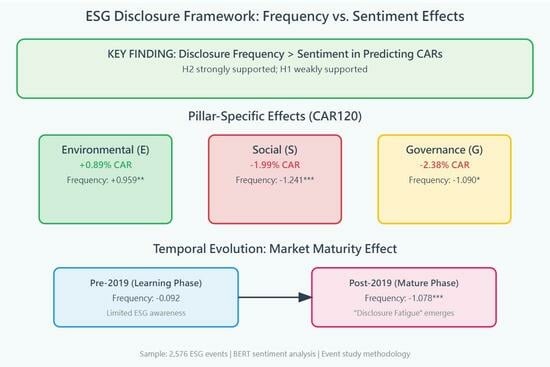
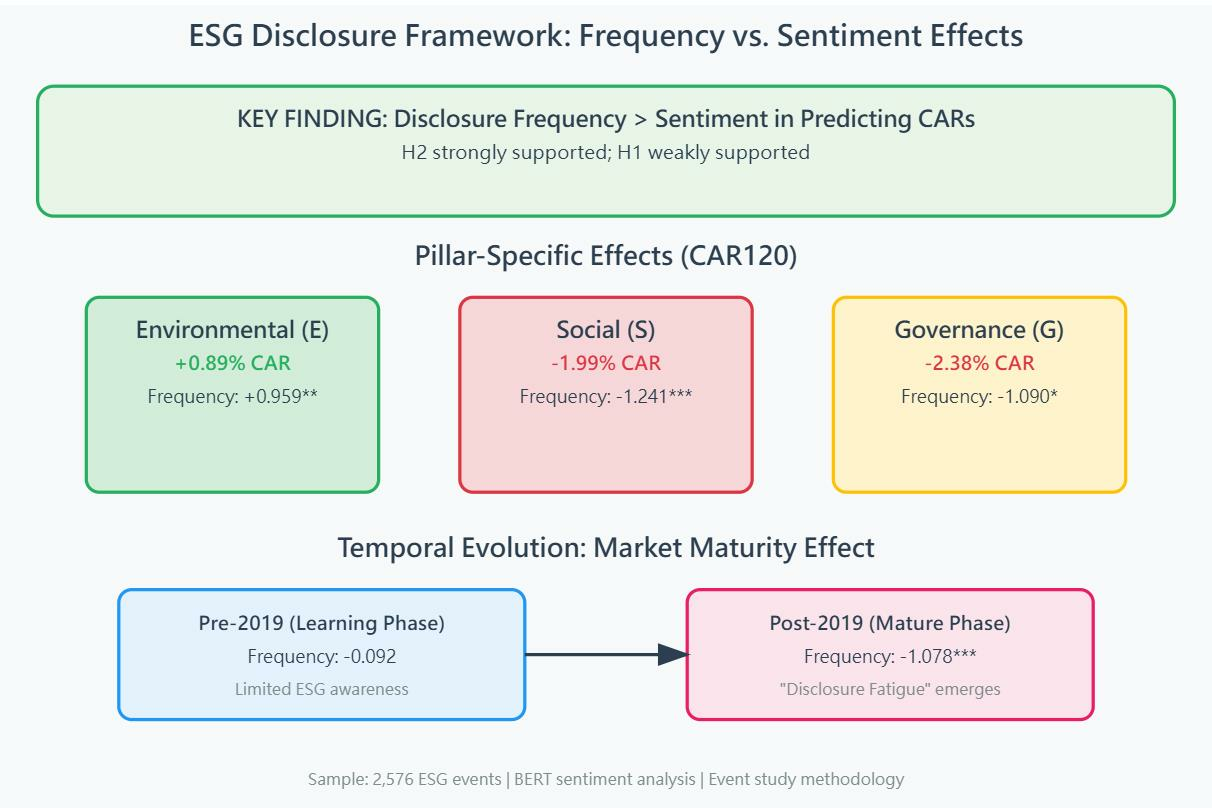
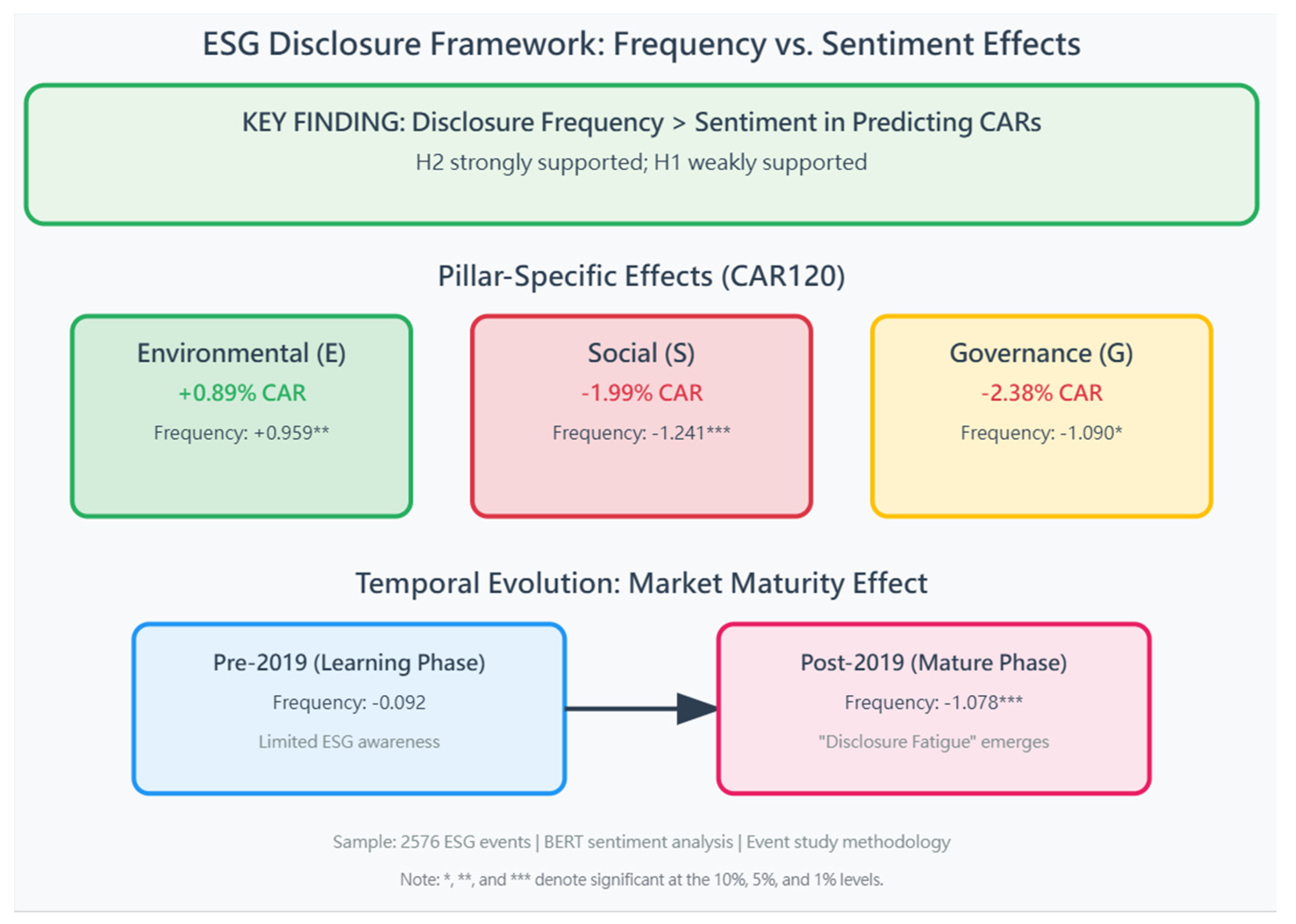
Figure 2 visually synthesizes the core findings of our empirical analysis. In summary, our analysis highlights three key findings: (a) the frequency of ESG communication may matter more to investors than its tone (H2 supported); (b) investors differentiate markedly between Environmental, Social, and Governance issues, rewarding frequent E-disclosures while penalizing frequent S and G-disclosures; and (c) market sensitivity to ESG communication has intensified over time as awareness has grown, particularly for firms that may already be perceived as risky or financially distressed.
Our empirical analysis yields interconnected findings contributing to a nuanced understanding of ESG information processing in non-Western, export-oriented capital markets. We focus on three central themes: the primacy of disclosure frequency over sentiment, distinct market logic for each ESG pillar, and the evolving nature of ESG investing in Taiwan.
Our findings align with and extend evidence from other markets. ESG controversies in South Korea lead to significant investor behavioral changes [
5,
38], with Governance failures amplified by chaebol contagion risks. Brazil shows positive ESG news generating gains while adverse developments cause declines [
31]. Singapore’s comply-or-explain framework since 2017 creates different transparency expectations [
37].
However, our frequency premium for Environmental disclosures appears particularly salient to Taiwan’s context. In the semiconductor industry, frequent Environmental disclosures signal proactive risk management essential for global supply chain compliance, gaining credibility through Taiwan’s “Net-Zero by 2050” and “Green Finance Action Plan” policies.
Therefore, while certain ESG market reactions demonstrate global consistency, disclosure pattern interpretation—particularly frequency—is embedded within local institutional frameworks. Effective ESG communication represents a complex interplay between information content and market-specific governance expectations.
6. Conclusions
This study set out to investigate the nuanced relationship between ESG event disclosures and sustainable value creation in Taiwan’s unique economic context. By employing a linguistically adapted BERT model, we move beyond traditional ratings and simplistic sentiment analyses to unpack the complex signals investors receive from corporate communications. Our findings reveal a sophisticated market logic that prioritizes the rhythm of communication over its tone, distinguishes sharply between the three ESG pillars, and has evolved significantly in its skepticism over the past decade.
Our primary contribution is the robust evidence that for Social and Governance issues, disclosure frequency, rather than sentiment, is a more powerful predictor of negative market reactions. We interpret this through the lens of our “Disclosure Fatigue” framework, wherein investors, acting under bounded rationality, perceive a high volume of announcements as a rational signal of underlying systemic risk—a finding that enriches both Signaling and Legitimacy theories. In stark contrast, we find that a high frequency of Environmental disclosures is rewarded by the market, suggesting that in a policy environment geared towards a green transition, such communication is viewed as a credible signal of proactive risk management and strategic alignment. These heterogeneous effects, combined with the clear structural shift in market sensitivity pre- and post-2019, provide a granular, dynamic, and theoretically grounded picture of how a key Asian market prices ESG information.
6.1. Practical Implications
Our findings offer several actionable implications for key stakeholders:
For corporate managers, our findings underscore the importance of a strategic approach to ESG communication. Simply disclosing more information is not always beneficial; the type and cadence of disclosure matter. Firms should prioritize proactive and consistent communication on environmental initiatives, as this signals long-term risk management and commitment to sustainability. Conversely, for social and governance issues, the focus should be on resolving underlying problems to reduce the need for frequent, potentially negative, disclosures. This research directly informs UN Sustainable Development Goal (SDG) 12 (Responsible Consumption and Production) by highlighting how transparent and effective corporate communication can foster sustainable business practices. Furthermore, by emphasizing the importance of robust governance and social responsibility, our findings contribute to SDG 16 (Peace, Justice, and Strong Institutions), promoting accountability and transparency in corporate conduct.
For investors, our study suggests refining risk assessment models to incorporate disclosure frequency as a key indicator. A high frequency of S and G disclosures, even if seemingly neutral, might warrant deeper scrutiny as a potential signal of underlying risks. Conversely, consistent E disclosures could indicate a resilient and forward-looking firm. These insights are particularly valuable for investors operating in Asian markets, where institutional contexts and information environments may differ from Western counterparts.
Our findings also offer a market-based perspective on the mechanisms that can support the achievement of the UN Sustainable Development Goals (SDGs). Specifically, the significant market penalty we identify for frequent Governance disclosures—our “Disclosure Fatigue” effect—acts as a powerful, market-driven disciplinary mechanism. By financially penalizing firms that signal persistent governance turmoil, investors create incentives for stronger, more transparent, and accountable corporate institutions, which is a core objective of SDG 16 (Strong Institutions). Concurrently, the “disclosure frequency premium” rewarded for proactive Environmental disclosures aligns directly with SDG 12 (Responsible Production). Our results provide evidence that capital markets are developing the sophistication to financially reward firms that consistently communicate their alignment with sustainable production practices and environmental risk management, thereby encouraging the very transparency that SDG 12 seeks to foster. Therefore, our study moves beyond a declarative statement by demonstrating tangible financial pathways through which market participants can contribute to these global sustainability objectives.
6.2. Limitations and Future Research
While this study provides significant insights, its limitations pave the way for important future research avenues.
Contextual Specificity: Our study is focused on Taiwan. While this provides a deep and valuable analysis of a key market, the findings’ generalizability is not guaranteed. Future research should conduct direct comparative studies between Taiwan and other markets with different corporate governance structures and regulatory environments. A comparison with South Korea, for instance, would be particularly insightful to examine how its chaebol-dominated structure mediates market reactions to ESG news compared to Taiwan’s more fragmented corporate landscape. Similarly, examining a highly regulated context like Singapore could reveal how mandatory disclosure rules influence investor responses [
37].
Methodological Refinement: While our use of a localized BERT model is a key strength, there are avenues for further advancement. Future studies should explore the application of domain-specific large language models like FinBERT, which are pre-trained on massive financial corpora. Fine-tuning a FinBERT model on Traditional Chinese financial texts could potentially capture the nuances of ESG disclosures with even greater precision than the general-purpose BERT used here, allowing for an even more powerful test of the limited role of sentiment that we observe. Additionally, despite our careful validation, automated sentiment analysis can still misclassify contextual nuances; improved NLP models or hybrid human–machine approaches could further enhance the reliability of sentiment measurements in ESG narratives [
13].
Frequency Definition: In this study, frequency is measured as the raw count of ESG announcements within a given quarter. While this approach is straightforward and effectively captures the “rhythm” of communication, it inherently treats all events as equal, thereby not distinguishing by their potential severity or materiality. For example, the market’s reaction mechanism is likely to differ significantly between a firm reporting a single, catastrophic governance failure and another firm reporting five minor, unrelated social infractions within the same period. Our current measure does not capture this critical dimension. Future research could develop more sophisticated, weighted frequency indices to address this limitation [
22].