Article

Simultaneous Arsenic and Fluoride Removal from Contaminated Water Using Powder Reagents of CaO, Ca(OH)2, and CaCO3 as Calcium-Based Adsorbents


Geological Survey of Japan, National Institute of Advanced Industrial Science and Technology (AIST), Central 7, 1-1-1 Higashi, Tsukuba 305-8567, Japan
*
Author to whom correspondence should be addressed.
Sustainability 2025, 17(17), 7718; https://doi.org/10.3390/su17177718
Submission received: 9 July 2025 / Revised: 23 August 2025 / Accepted: 25 August 2025 / Published: 27 August 2025
(This article belongs to the Special Issue Advances in Adsorption for the Removal of Emerging Contaminants)

Abstract

As and F contamination are a global problem, and their simultaneous contamination in groundwater is a frequent occurrence, necessitating strategies for their concurrent removal. This study evaluated the performance and potential applicability of Ca-based adsorbents (CaO, Ca(OH)2, and CaCO3) for simultaneous As–F removal. Removal tests were performed using synthetic contaminated water with an initial As concentration of 1 mg/L and initial F concentrations of 15–60 mg/L. The results showed that CaCO3 had difficulty removing As and F in contaminated water; in contrast, CaO and Ca(OH)2 achieved simultaneous As–F removal under certain conditions. Regardless of the presence or absence of F, the water purified using CaO and Ca(OH)2 met the As environmental standard (0.01 mg/L) for As(V) and As effluent standard (0.1 mg/L) for As(III). Meanwhile, with or without As, CaO- and Ca(OH)2-treated water met the F environmental standard (0.8 mg/L) at a concentration of 15 mg/L and F effluent standard (8 mg/L for non-marine areas) at 30 and 60 mg/L. In this study, where the initial As concentration was set to a constant value, the degree of mutual effects on As and F adsorption behavior differed depending on the combination of adsorbent addition and initial F concentrations.

1. Introduction

Groundwater is not only used for agriculture but also as drinking water in many countries worldwide. However, natural causes related to the geology and climate of a region as well as human activities can lead to groundwater pollution. In particular, groundwater contamination with As or F often occurs simultaneously [1,2]. Because the excessive intake of these contaminants can result in serious health problems, the World Health Organization (WHO) set values of 0.01 and 1.5 mg/L for As and F, respectively, in its guidelines for drinking water quality [3]. In Japan, the environmental standard value, equivalent to the drinking water quality standard, of As is 0.01 mg/L, which is the same as the WHO guideline value. However, that of F is set at a stricter value of 0.8 mg/L compared with the WHO guideline. Additionally, the effluent standard value for As is 0.1 mg/L, while that of F differs between marine (15 mg/L) and non-marine areas (8 mg/L).
Studies focused on the individual removal of As and F are extensive, and active research into their simultaneous removal has recently emerged, utilizing methods such as electrocoagulation and adsorption. Notably, when considering use in rural areas of economically disadvantaged developing countries, adsorption methods that use inexpensive adsorbents are preferred [4]. Alumina, Fe oxides, Mn oxides, Mg compounds, Zn oxide, and various biosorbents have been widely investigated for simultaneous As–F removal [5,6,7,8,9,10,11]. In addition, many studies using Ca compounds such as CaO, Ca(OH)2, and CaCO3 as adsorbents (or coagulants) for either As or F contamination mitigation have been reported [12,13,14,15,16,17,18,19,20,21,22,23,24,25,26]. However, although the use of natural limestone has been proposed [27], little research has focused on the simultaneous removal of As and F using Ca-based adsorbents. Owing to the advantages of Ca-based adsorbents compared with other adsorbents in terms of availability and economic efficiency in some cases, elucidating the performance of Ca compounds for simultaneous As–F removal is necessary for selecting an appropriate adsorbent, considering the characteristics of the contaminated water to be purified and location of the area.
Therefore, this study aimed to evaluate the feasibility of using CaO, Ca(OH)2, and CaCO3 for simultaneous As–F removal through basic tests. Pure powder reagents were used in this study as the Ca-based adsorbents without any special processing to evaluate their net removal performance. Because the characteristics of As vary depending on its valence, the simultaneous removal tests with F were conducted for both arsenate (As(V)) and arsenite (As(III)). For comparison, As–F and F (without As) removal tests were conducted under similar conditions. Incidentally, because As removal tests without F have already been conducted in a previous study, the data were quoted in this study. The main mechanism of As removal for Ca-based adsorbents is chemical adsorption on the surface of the adsorbents, because precipitation of calcium arsenate species does not occur when the As concentration is low [21,24,25]. The F removal mechanism for Ca-based adsorbents will involve not only adsorption on the surface of the adsorbents, but also precipitation of CaF2 due to reaction with Ca2+ leached from the adsorbents [12,13,14,15,16,17,18,19,20,22,23,26]. Additionally, Researchers have differing opinions as to whether the main mechanism for F removal is adsorption on the adsorbent or precipitation of CaF2. This is presumably due not only to differences in the type of Ca-based adsorbent, but also to differences in other test conditions (adsorbent addition concentration, initial F concentration, initial pH, temperature, etc.). In addition, when As and F coexist, they compete for adsorption sites, which will make their removal behavior more complex. In this study, by comparing the F removal and As removal performance of different Ca-based adsorbents under the same test conditions, the adsorption mechanisms of As and F will be examined, and the advantages and disadvantages of each will be further clarified.

2. Materials and Methods

2.1. Ca-Based Adsorbents

Commercial powder reagents of CaO, Ca(OH)2, and CaCO3 were used as the Ca-based adsorbents. Note that the reagents used in this study were purchased from FUJIFILM Wako Pure Chemical Corporation (Osaka, Japan) unless specified otherwise. The measured Ca content (αCa; %), reagent purity (obtained from αCa) (P; %), median particle size (Dp50; μm), and BET surface area (SBET; m2/g) are listed in Table 1. The data in Table 1 were obtained from a previous study [24]. The primary reason for the reagent purity not equaling 100% was the adsorbed water.

2.2. Simultaneous As–F Removal Tests

2.2.1. Synthetic As- and F-Contaminated Water Preparation

Powdered reagents of NaAsO2 and Na2HAsO4·7H2O were separately dissolved in deionized water to prepare stock solutions (2000 mg As/L) of As(III) and As(V), respectively. A sodium fluoride aqueous solution (F standard solution for ion chromatography (IC) analysis) was used as the stock solution of F. Synthetic As–F-contaminated water was prepared by mixing and diluting the aforementioned stock solutions in deionized water at predetermined ratios. The pH of the synthetic contaminated water was adjusted and fixed to approximately 7 using aqueous HNO3 and NaOH. The pH immediately after adjustments is referred to as the initial pH (pH0). Two studies [1,2] have tabulated As and F concentrations in groundwater at contaminated areas around the world. The highest As concentration reported in the studies was 73.6 mg/L in geothermal wells in Mexico [1], followed by 18 mg/L in Washington, DC, USA [1], but most As contamination was below 1 mg/L. Therefore, the initial As concentration (CAS0) in the synthetic contaminated water in this study was fixed at 1 mg/L. The highest F reported in the studies was 75.0 mg/L in the Central Ethiopian Rift, Ethiopia [2], followed by 63.0 mg/L in Badghis, Afghanistan [2], but most F contamination is below 20 mg/L. In this study, initially, the initial F concentration (CF0) in the synthetic contaminated water was set at 15 mg/L, assuming that F-contaminated water that meets the F-effluent standard in marine areas (15 mg/L) is purified to the F effluent standard in non-marine areas (8 mg/L) or the environmental standard value (0.8 mg/L). Next, the values of CF0 were set to 30 mg/L, which is double the value of 15 mg/L, and then double that to 60 mg/L.

2.2.2. Experimental Procedure

A series of tests was conducted with adsorbent addition concentration (WAd0/V, where WAd0 is the amount of adsorbent added, and V is the liquid volume (L)) as a parameter up to 60 g/L. A given amount of the adsorbent was placed in a TPX (polymethylpentene) beaker and 100 mL of the synthetic contaminated water was added. The rim of the beaker was sealed with Parafilm and the solution was stirred for 24 h (approximately 500 rpm, room temperature). In this study, to obtain reliable data, the reaction time was set to 24 h, which is considered to be a time when equilibrium is reached. The solution was then centrifuged, filtered (0.45 μm), and stored in a polypropylene bottle. The pH of the filtered solution was measured using a pH meter (LAQUA F-72, HORIBA, Ltd., Kyoto, Japan). The As, Ca, and F concentrations in the solutions were analyzed using inductively coupled plasma–mass spectrometry (ICP-MS; Agilent 7700X, Agilent Technologies, Inc., Hachioji, Japan), inductively coupled plasma–atomic emission spectrometry (ICP-AES; SII SPS3500DD, Thermo Fisher Scientific K.K., Tokyo, Japan), and IC (Thermo Scientific Dionex Integrion RFIC, Seiko Instruments Inc., Chiba, Japan).

2.2.3. Experimental Reproducibility

To confirm the reproducibility of the experiments, the simultaneous As–F removal tests were conducted thrice under specific conditions for each adsorbent. In particular, the characteristics of the synthetic As(V)–F-contaminated water used in the reproducibility experiments were CAS0 = 1.007 mg/L, CF0 = 14.98 mg/L, and pH0 = 6.86, and those of the synthetic As(III)–F-contaminated water were CAS0 = 1.047 mg/L, CF0 = 15.06 mg/L, and pH0 = 6.96. Anticipating that the amount of change in As and F would differ depending on the combination of the adsorbent type and As valence, the value of WAd0/V was set according to each condition (Table 2). The measured values of the residual As concentration in the treated water (CAS), residual F concentration (CF), leached Ca concentration (CCa), treated water pH (final pH, pHf), and standard errors are also listed in Table 2. These values indicate that the experimental reproducibility of this study was acceptable.

2.3. Sample Preparation for X-Ray Diffraction (XRD) Analysis

To examine the forms of As and F adsorbed by the Ca-based adsorbents, the following samples were prepared for XRD analysis.
(a)
Sample of unused Ca-based adsorbent;
(b)
Solid sample collected after adding Ca-based adsorbent (2 g/L) to deionized water;
(c)
Solid sample collected after adding Ca-based adsorbent (2 g/L) to As(V) solution (CAS0 = 10 mg/L and pH0 = 7);
(d)
Solid sample collected after adding Ca-based adsorbent (2 g/L) to As(III) solution (CAS0 = 10 mg/L and pH0 = 7);
(e)
Solid sample collected after adding Ca-based adsorbent (2 g/L) to F solution (CF0 = 60 mg/L and pH0 = 7);
(f)
Solid sample collected after adding Ca-based adsorbent (2 g/L) to F solution (CF0 = 60 mg/L and pH0 = 7) and washed with deionized water before drying.
Note that when preparing samples (b)–(e), the recovered solid-phase materials obtained by solid–liquid separation using suction filtration were not washed with water before the drying process owing to concerns that CaO and Ca(OH)2 might dissolve. However, the small amount of F in the residual liquid contained in the recovered material before drying was suspected to have reacted with the Ca component in the solid-phase residue during the drying process to form CaF2. To dispel this doubt, a new F-adsorbed CaCO3 sample was prepared by thoroughly washing the solid phase recovery material with deionized water before the drying process to eliminate the influence of the residual liquid containing F components. This sample was designated as (f).
The As(III), As(V), and F solutions used in samples (c)–(f) were prepared using the stock solutions described in Section 2.2.1. To prepare samples (b)–(f), 250 mL of the prepared solution (deionized water and As(III), As(V), or F solution) was placed into three different TPX beakers. Subsequently, 0.5 g of the Ca-based adsorbent was added to each beaker, followed by immediate stirring using a magnetic stirrer for 24 h. The samples were then subjected to solid–liquid separation via suction filtration (filter pore size: 0.45 μm). The collected solutions were combined into single containers, and the concentrations of As, Ca, and F in the collected solutions of samples (b)–(f) were determined using ICP-MS, ICP-AES and IC, respectively. The collected solid samples were dried overnight at 40 °C, and the crystalline phases of the prepared samples were identified using powder XRD (RINT-2500, Rigaku Co., Akishima, Japan) at the GSJ-Lab (AIST).

2.4. Sample Preparation for Scanning Electron Microscopy—Energy Dispersive X-Ray Spectroscopy (SEM-EDS) Analysis

To investigate the changes in Ca-based adsorbates and the presence of As and F in detail, among the samples prepared for XRD analysis, (a), (c), and (e) shown in Section 2.3, their morphologies were observed by SEM and elemental mappings were conducted by EDS. The powder samples dried overnight at 40 °C were attached onto carbon tape and subjected to SEM-EDS (JSM-6610LV, JEOL Ltd., Akishima, Japan) analysis after osmium coating (Neoc-Pro, Meiwafosis Co., Ltd., Shinjuku, Japan) at the GSJ-Lab (AIST). Elemental mappings were performed for C, Ca, O, and As or F. However, the mapping of C was omitted because it was strongly affected by the carbon tape to which the powder sample was immobilized.

2.5. Simultaneous As–F Removal Test with pH0

The test results in Section 2.2 suggest the significance of conducting additional simultaneous As–F removal tests with pHf as a parameter. However, instead of pHf, the removal tests were conducted with pH0 because pHf is difficult to adjust to the desired value in the presence of Ca-based adsorbents. Additionally, the simultaneous As–F removal tests with pH0 were conducted using only Ca(OH)2 because the F removal capacity of CaCO3 is extremely low, as will be discussed in Section 3.1.2, and the As(III) removal performance of CaO at high CF0 is less stable than that of Ca(OH)2, as will be discussed in Section 3.1.1. The preparation of the synthetic As–F-contaminated water and experimental procedure of the simultaneous removal tests with pH0 as a parameter in this section are similar to those in Section 2.2.1 and Section 2.2.2, with some differences. Specifically, the synthetic contaminated water (CAS0 = 1 mg/L, CF0 = 60 mg/L) was prepared by adding HNO3 or NaOH aqueous solutions in a specified ratio to adjust the pH0. Regarding the As in the synthetic contaminated water, both As(V) and As(III) were prepared, and the range of pH0 was 1.2–12.9. In a TPX beaker, 0.5 g of Ca(OH)2 was placed and 50 mL of the above synthetic contaminated water was added (WAd0/V = 10 g/L). The rim of the beaker was sealed with Parafilm and the solution was stirred for 24 h. The subsequent procedures were the same as those in the test in Section 2.2.2. Finally, pHf, CAS, CCa, and CF were measured.

3. Results

3.1. Simultaneous As–F Removal Tests with WAd0/V

3.1.1. Residual As Concentration in Treated Water

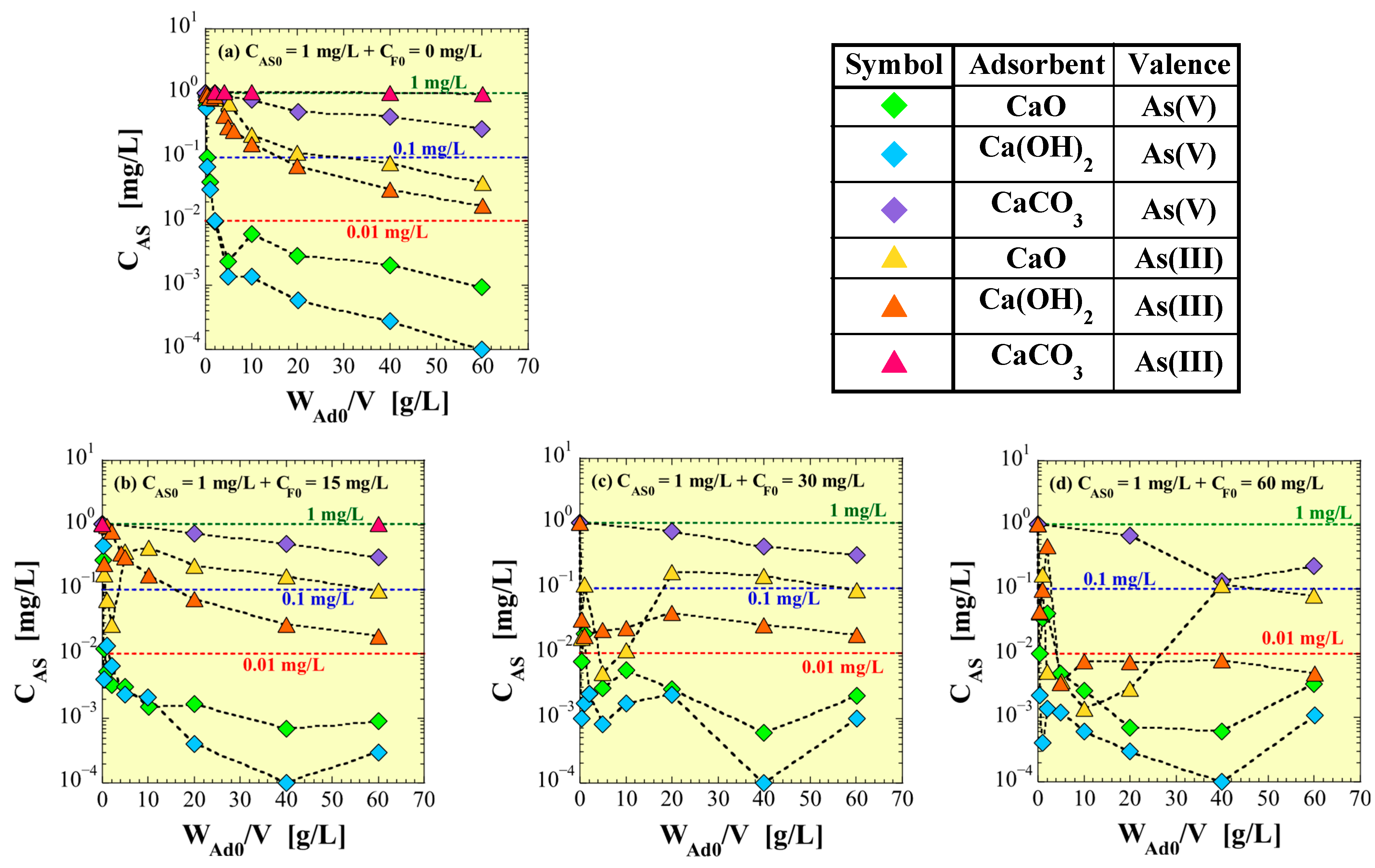
The CAS (mg/L) values obtained from the simultaneous As–F removal tests with WAd0/V as a parameter (Section 2.2) is shown in Figure 1. For comparison, the results of the F-free As removal tests (CAS0 = 1 mg/L + CF0 = 0 mg/L) obtained in the previous study of Sugita et al. [24] are shown in Figure 1a. Figure 1b, Figure 1c and Figure 1d show the plots for CF0 = 15, 30, and 60 mg/L, respectively. The Y-axis of these figures is in a logarithmic scale for ease of understanding. Additionally, the CAS measurements below the limit of quantification (<0.0001 mg/L) are plotted as 10−4 mg/L in the figures to correspond to the log scale display. For CaCO3, in the test with CAS(III)0 = 1 mg/L + CF0 = 15 mg/L, almost no As(III) was removed even at WAd0/V = 60 g/L (Figure 1b). Therefore, no other As(III) removal tests using CaCO3 were performed in the experimental series in Section 2.2.
In the simultaneous As(V)–F removal tests, CAS was in the order of Ca(OH)2 < CaO << CaCO3 overall, regardless of CF0. Additionally, for CaO and Ca(OH)2, the CAS value was at a minimum at approximately WAd0/V = 40 g/L, regardless of CF0. For CaCO3, CAS decreased with increasing WAd0/V when CF0 = 15 and 30 mg/L; however, at CF0 = 60 mg/L, CAS decreased overall with increasing WAd0/V, with the lowest at WAd0/V = 40 g/L. By adding CaO and Ca(OH)2, CAS could be lowered to below the environmental standard value for As in Japan (0.01 mg/L). In contrast, the As removal performance of CaCO3 was underwhelming, and under the test conditions, it could not even meet Japan’s effluent standard value for As.
In the simultaneous As(III)–F removal test, the behavior of CAS differed depending on the WAd0/V range. For both CaO and Ca(OH)2, regardless of CF0, CAS decreased with increasing WAd0/V in its low range, then increased rapidly. As WAd0/V was further increased, CAS decreased again, gradually in response to the increase in WAd0/V. The CAS value was higher for Ca(OH)2 than CaO in the low WAd0/V range, but higher for CaO than Ca(OH)2 in the relatively high range of WAd0/V. As mentioned above, the behavior of CAS in the simultaneous As(III)–F test was significantly affected by CF0. At CF0 = 15 mg/L, the effluent standard was met by adding 1–2 g/L WAd0/V or 60 g/L for CaO and 20–60 g/L for Ca(OH)2. At CF0 = 30 mg/L, the addition of CaO with 5 g/L WAd0/V made the CAS meet the As environmental standard value, but the excessive addition of CaO caused the CAS to exceed even the effluent standard value. Furthermore, Ca(OH)2 addition could only lower CAS to the effluent standard value. At CF0 = 60 mg/L, the addition of an appropriate amount of CaO or Ca(OH)2 allowed the CAS to meet the environmental standard value, but the excessive addition of CaO increased CAS to near the effluent standard value. Therefore, the As(III)-removal performance of CaO at high CF0 appeared to be less stable than that of Ca(OH)2.

3.1.2. Residual F Concentration in Treated Water

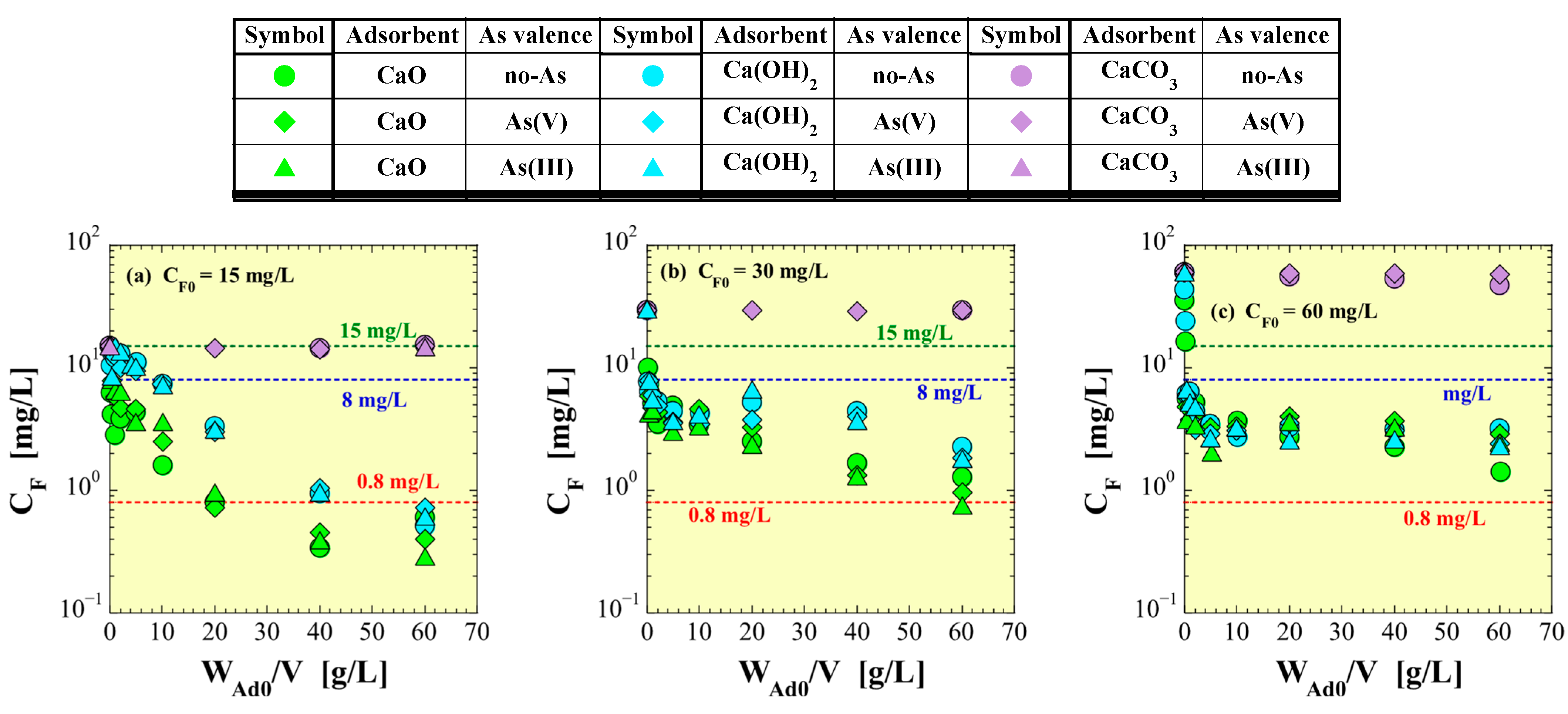
The CF (mg/L) values obtained from the simultaneous As–F removal tests with the WAd0/V parameter are shown in Figure 2. Similarly to that in Figure 1, the Y-axis of these figures is in logarithmic scale for ease of understanding. Figure 2a, Figure 2b and Figure 2c are plots for CF0 = 15, 30, and 60 mg/L, respectively. The results of the As-free F removal tests conducted for comparison are also shown in. As described in Section 3.1.1, the simultaneous As(III)-F removal test with CaCO3 was only performed with CAS(III)0 = 1 mg/L + CF0 = 15 mg/L and WAd0/V = 60 g/L.
CaCO3 was unable to remove F, regardless of the As valence and CF0. In contrast, the behavior of CF with the addition of CaO and Ca(OH)2 differed greatly depending on the CF0 value. At CF0 = 15 and 30 mg/L, the CF values were in the order of CaO < Ca(OH)2 << CaCO3, with an unclear difference in CF due to differences in the As valence. Even at CF0 = 60 mg/L, the difference in CF depending on the As valence was not clear, similar to the difference between CaO and Ca(OH)2.
At CF0 = 15 mg/L, the CF almost met the environmental standard value for F (0.8 mg/L) though the addition of >20 g/L CaO or by adding Ca(OH)2 at WAd0/V = 60 g/L. At CF0 = 30 mg/L, only the CF of CaO with WAd0/V = 60 g/L barely met the environmental standard, and the CF of Ca(OH)2 only met the effluent standard for non-marine areas (8 mg/L). At CF0 = 60 mg/L, the CF met the effluent standard for non-marine areas when >0.5 g/L of both CaO and Ca(OH)2 were added; however, the CF did not change significantly even when the amount was increased beyond this value.

3.1.3. Leached Ca Concentration in Treated Water

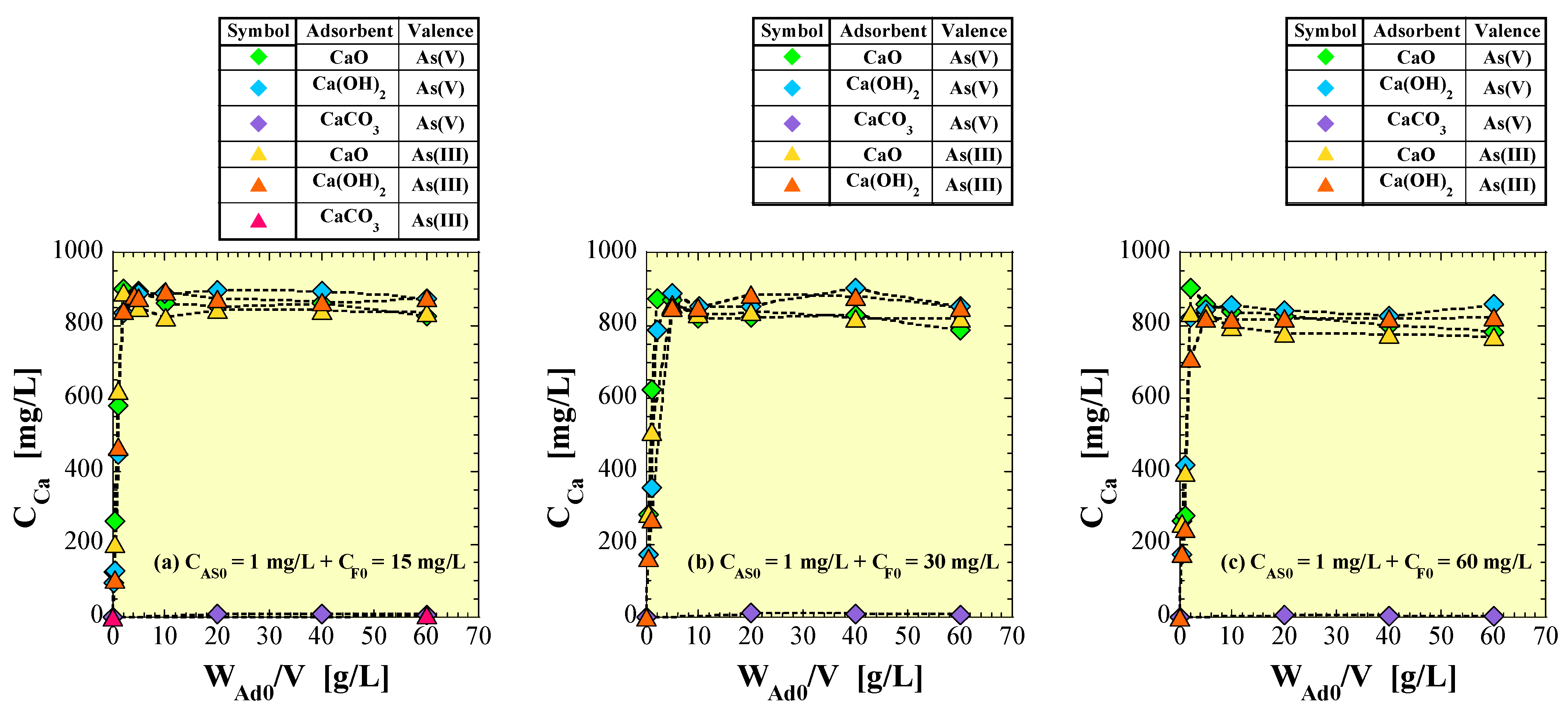
The CCa (mg/L) values obtained from the removal tests are shown in Figure 3. Figure 3a, Figure 3b and Figure 3c are plots for CF0 = 15, 30, and 60 mg/L, respectively. For both As(V) and As(III), the CCa of CaO and Ca(OH)2 increased with increasing WAd0/V up to 2 g/L, and no significant change was observed beyond this value. The CCa values at WAd0/V ≤ 2 g/L somewhat varied depending on the combination of the As valence and adsorbent type, and were in the range of 700–900 mg/L. The overall order was as follows: As(III)-CaO ≤ As(V)-CaO ≤ As(III)-Ca(OH)2 ≤ As(V)-Ca(OH)2. These results suggest that the adsorbent type has a greater influence on CCa than the As valence. Additionally, the effects of CF0 on CCa were not evident from the comparison of Figure 3a–c. It is considered that the CCa for CaO and Ca(OH)2 plateaued because they approached the solubility of Ca(OH)2 (806–920 mg/L) [28]. Additionally, the CCa for CaO tended to be slightly lower than that for Ca(OH)2, which is presumably because CaO was not completely converted to Ca(OH)2 through the hydration reaction. Meanwhile, the CCa values for CaCO3 were much lower than those for CaO and Ca(OH)2, ranging from 2.5 to 12 mg/L.

3.1.4. pH of Treated Water

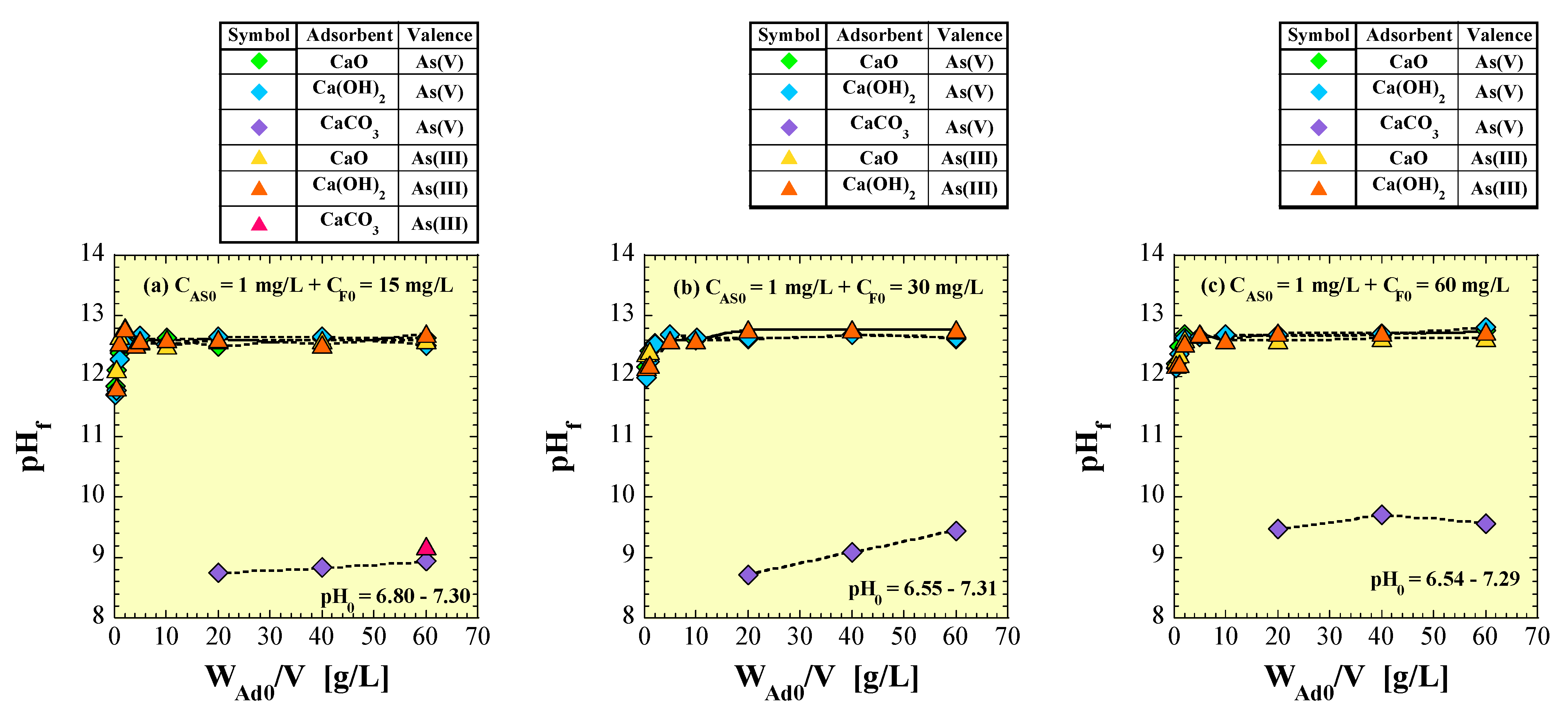
The pHf obtained from the simultaneous As–F removal tests with WAd0/V is shown in Figure 4. Figure 4a, Figure 4b and Figure 4c show the plots for CF0 = 15, 30, and 60 mg/L, respectively. The pHf values of CaCO3 were significantly lower than those of CaO and Ca(OH)2; however, the pHf values between CaO and Ca(OH)2 did not significantly differ. For both CaO and Ca(OH)2, the pHf increased with increasing WAd0/V in its extremely low range, but over certain values of WAd0/V, the pHf remained almost constant and showed no obvious difference depending on the As valence or CF0. The pHf for CaO and Ca(OH)2 increased to >12 even at low WAd0/V, whereas that for CaCO3 was between 8.7 and 9.7 under these test conditions. For CaCO3, the pHf tended to increase with increasing WAd0/V at CF0 = 15 and 30 mg/L, but no significant change was observed with increasing WAd0/V at CF0 = 60 mg/L. Overall, for CaCO3, the pHf tended to be higher as the CF0 increased and the effect of As valence on the pHf was minimal (Figure 4a).

3.2. XRD Analysis

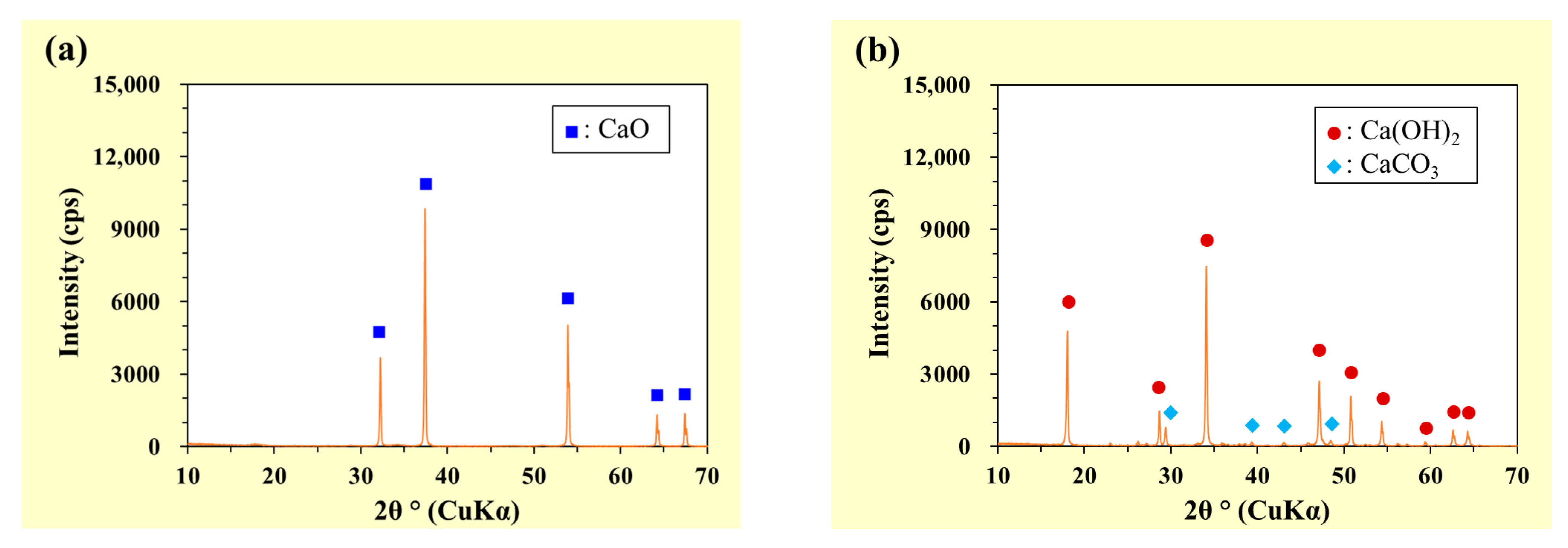
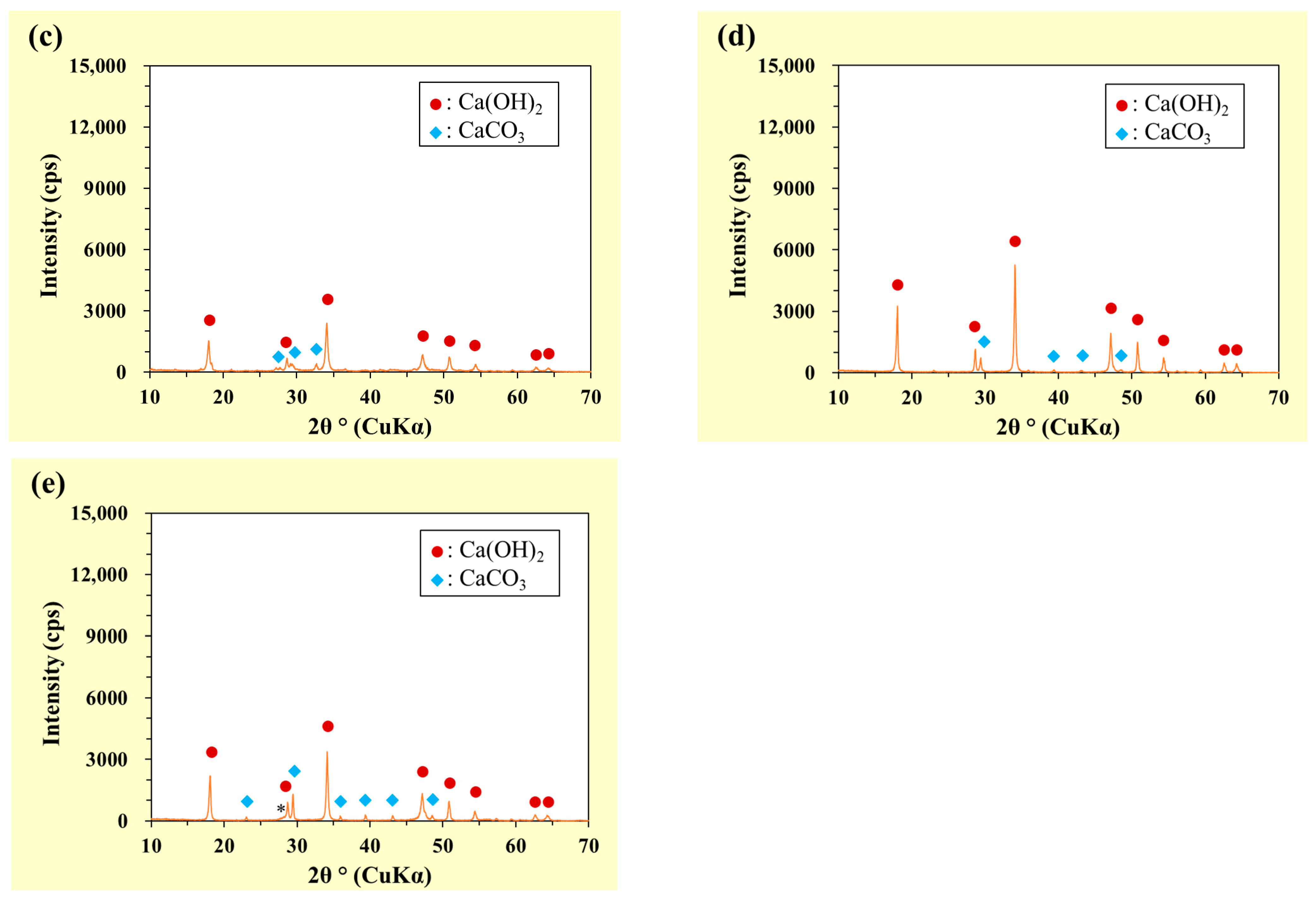
The XRD patterns of the original (unused) and hydrated CaO are shown in Figure 5a and Figure 5b, respectively. Figure 5a shows the diffraction pattern derived from the CaO crystal structure. In the hydrated CaO, the peaks attributed to CaO completely disappeared and were replaced with Ca(OH)2 diffraction peaks (Figure 5b). In addition, small peaks of CaCO3 originating from the crystal structure of calcite were observed along with the diffraction pattern of Ca(OH)2. Figure 5c, Figure 5d and Figure 5e show the XRD patterns of As(V)-adsorbed, As(III)-adsorbed, and F-adsorbed CaO, respectively. In all diffraction patterns, a small amount of CaCO3 accompanied the Ca(OH)2 diffraction peaks, as in the case of hydrated CaO (Figure 5b). The CaCO3 diffraction peaks were derived from the vaterite crystal structure, which was only in the As(V)-adsorbed CaO (Figure 5c), whereas the other diffraction peaks were attributed to calcite (Figure 5d,e). No characteristic diffraction peaks originated from calcium arsenate, calcium arsenite, or calcium fluoride species. However, an unidentified indistinct peak was observed in the F-adsorbed CaO, as indicated by the asterisk (Figure 5e).
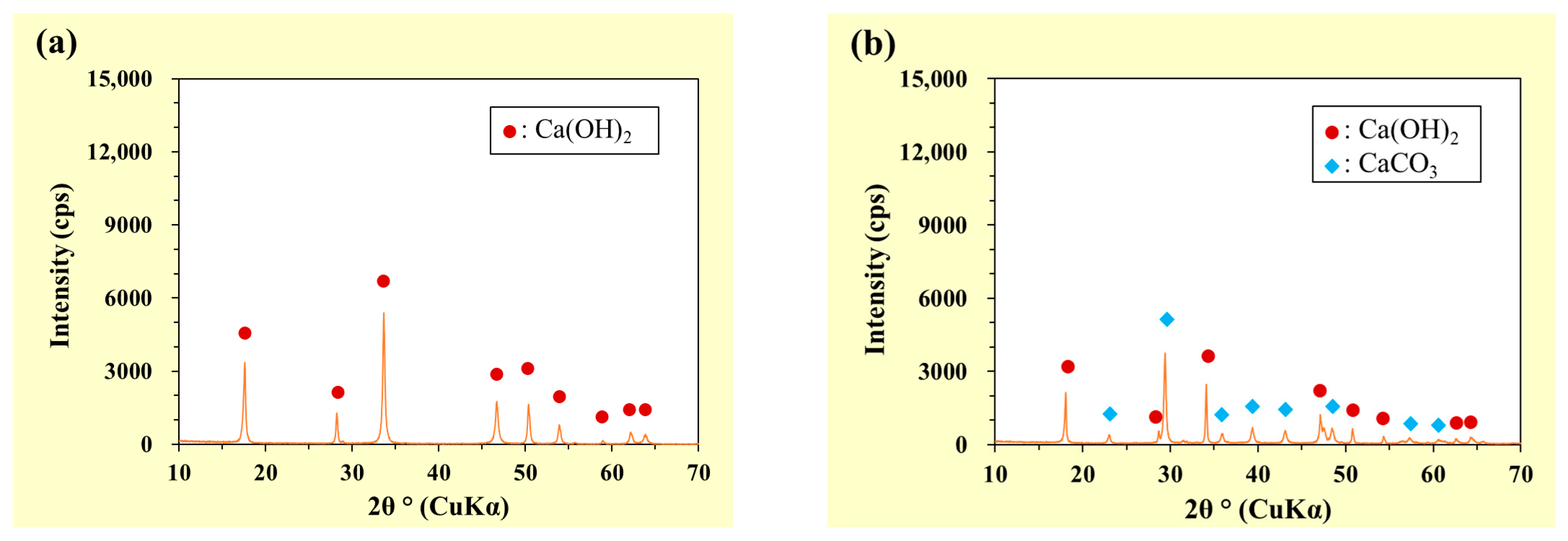
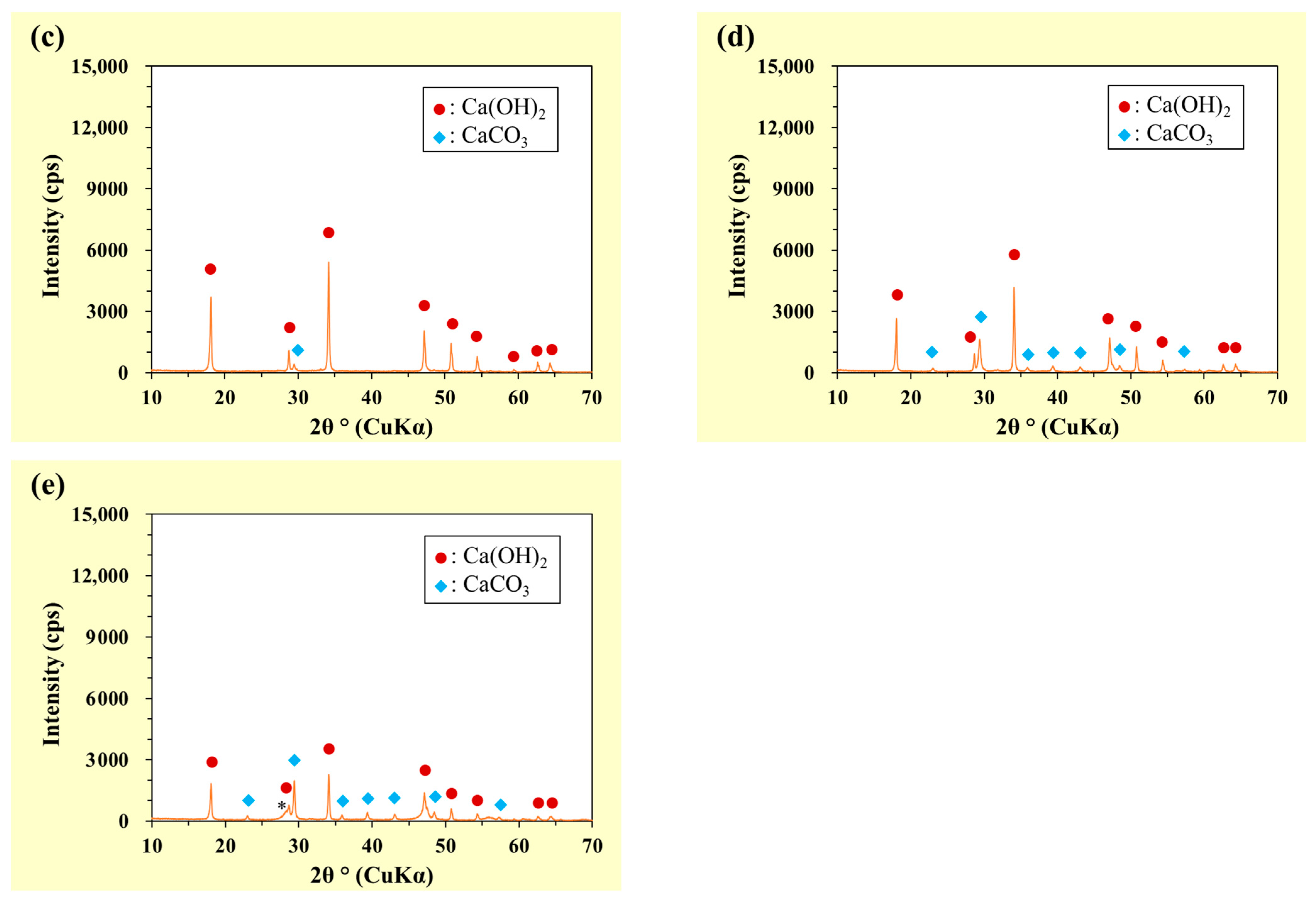
Figure 6a and Figure 6b show the XRD patterns of original and hydrated Ca(OH)2, respectively. The diffraction pattern of original Ca(OH)2 showed Ca(OH)2 crystal peaks (Figure 6a). In the hydrated Ca(OH)2, the presence of a certain amount of CaCO3 (calcite) was detected (Figure 6b). Figure 6c, Figure 6d and Figure 7e show the XRD patterns of the As(V)-adsorbed, As(III)-adsorbed, and F-adsorbed Ca(OH)2, respectively. The peak intensities of CaCO3 differed; particularly the in As(V)-adsorbed Ca(OH)2 (Figure 6c), the peak attributable to CaCO3 was smaller and the Ca(OH)2 peak intensities were higher than those in the other samples (Figure 6d,e). Clear peaks corresponding to Ca and As or F salts were not detected in these samples. Meanwhile, similar to the F-adsorbed CaO, an unidentified peak was identified in the F-adsorbed Ca(OH)2 (Figure 6e).
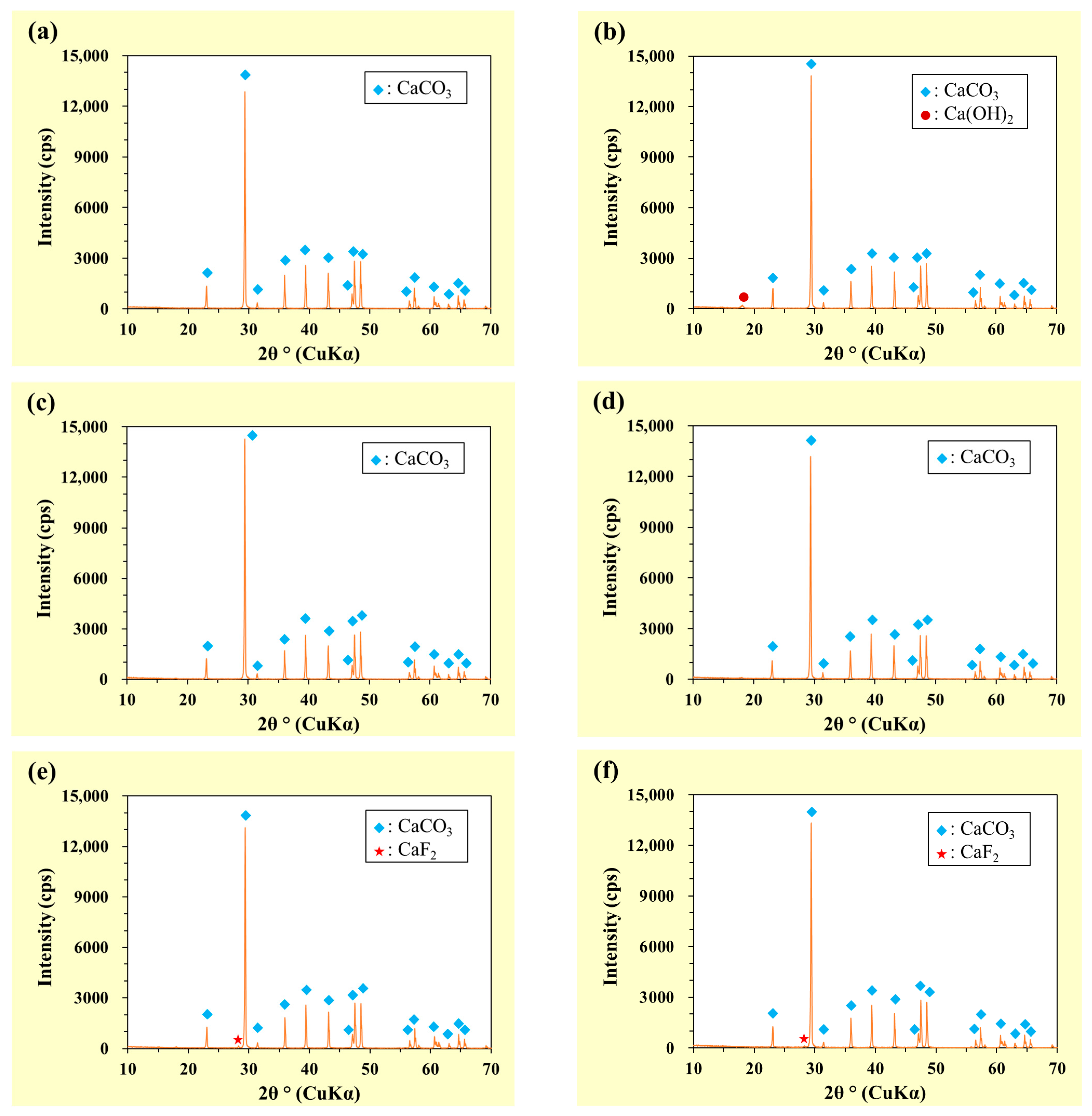
Figure 7a, Figure 7b, Figure 7c, Figure 7d and Figure 7e show the XRD patterns of the original, hydrated, As(V)-adsorbed, As(III)-adsorbed, and F-adsorbed CaCO3, respectively. The diffraction pattern of the original CaCO3 was consistent with that of calcite crystal (Figure 7a). In the case of hydrated CaCO3, the diffraction peaks of CaCO3 showed almost no changes, although a slightly small peak attributed to Ca(OH)2 was observed (Figure 7b). The diffraction patterns of As(V)-adsorbed and As(III)-adsorbed CaCO3 were practically unchanged from those of the original CaCO3 (Figure 7c,d). For the F-adsorbed CaCO3 (Figure 7e), the diffraction pattern of CaCO3 was almost the same, but a small peak was observed at 2θ = 28.3°; this was identified as the diffraction peak of CaF2. Figure 7f shows the XRD pattern of the F-adsorbed CaCO3 washed with deionized water before drying. The presence of a small peak corresponding to CaF2 was similarly detected. The positions of the CaF2 peaks observed in Figure 7e,f were consistent with the positions of the unidentified peak observed in the F-adsorbed CaO and F-adsorbed Ca(OH)2 (Figure 5e and Figure 6e, respectively).

3.3. Morphological Observation on Ca-Based Adsorbents

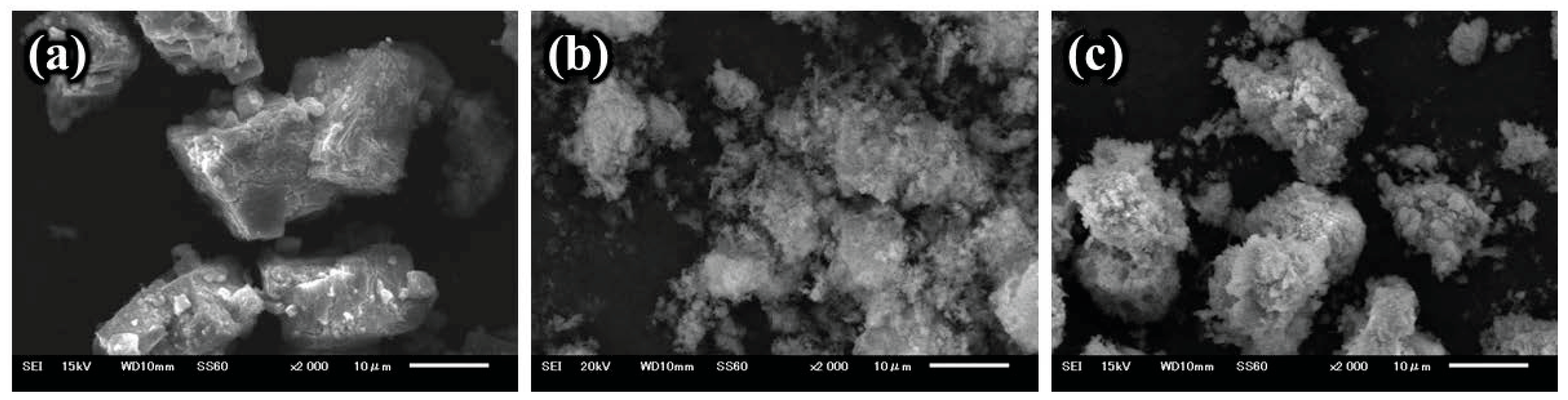
The SEM images of the original, As(V)-adsorbed, and F-adsorbed CaO are shown in Figure 8a, Figure 8b and Figure 8c, respectively.
As shown in Figure 8a, the original CaO has a cuboid shape with a relatively smooth surface. As shown in Figure 8b,c, both the As(V)-adsorbed and F-adsorbed CaO consist of fine particles scattered. From the XRD results for both (Section 3.2), the fine particles are concluded to be mainly Ca(OH)2.
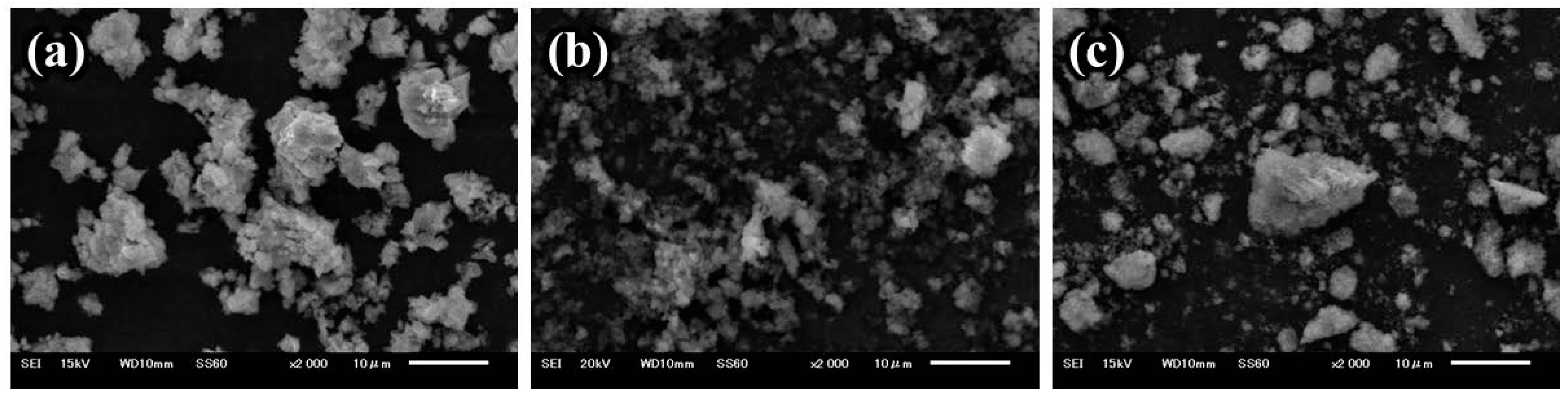
The SEM images of the original, As(V)-adsorbed, and F-adsorbed Ca(OH)2 are shown in Figure 9a, Figure 9b and Figure 9c, respectively.
As shown in Figure 9a, the original Ca(OH)2 has smaller particles than original CaO (Figure 8a), and some of them are aggregated. As shown in Figure 9b, the As(V)-adsorbed Ca(OH)2 contains many small particles similar to those seen in the original Ca(OH)2, but relatively few large aggregates. As shown in Figure 9c, the F-adsorbed Ca(OH)2 has a different appearance from both the original Ca(OH)2 (Figure 9a) and As(V)-adsorbed Ca(OH)2 (Figure 9b) and appears to be coagulated rather than aggregated.
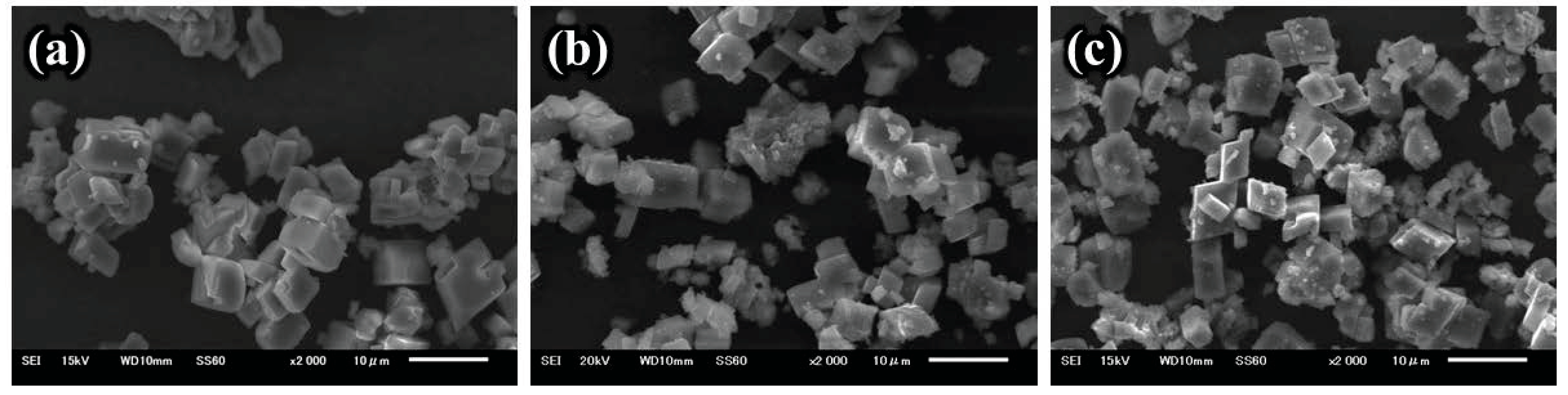
The SEM images of the original, As(V)-adsorbed, and F-adsorbed CaCO3 are shown in Figure 10a, Figure 10b and Figure 10c, respectively.
As shown in Figure 10a, the original CaCO3 has a shape that resembles a pile of nearly cubic particles. As shown in Figure 10b,c, both the As(V)-adsorbed and F-adsorbed CaCO3 have almost the same appearance as the original CaCO3, but the F-adsorbed CaCO3 has many fine particles (several hundred nanometer size) attached to its surface. From the XRD results for the F-adsorbed CaCO3 (Section 3.2), the fine particles are concluded to be CaF2.

3.4. Elemental Mappings (EM) on Ca-Base Adsorbents

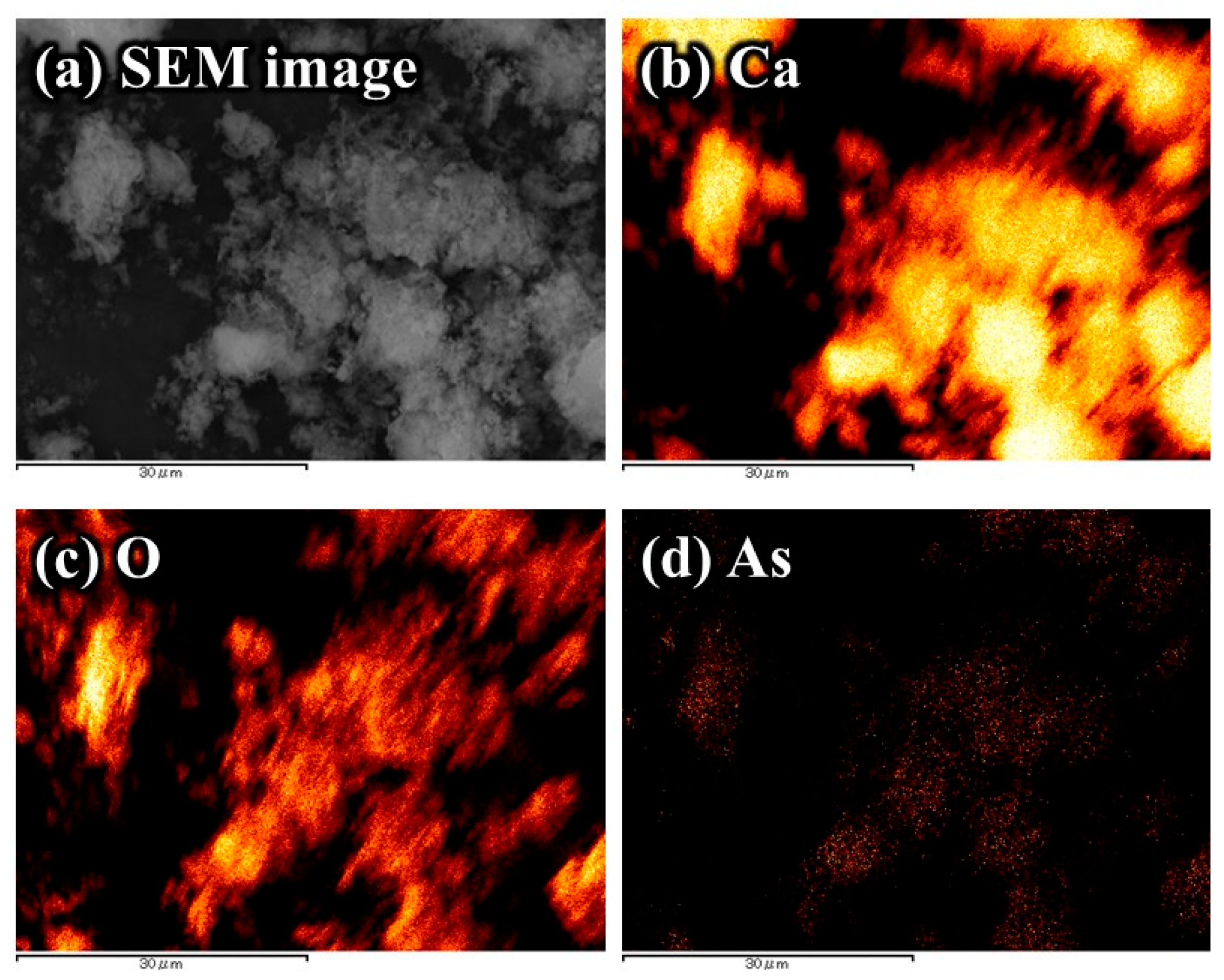
The SEM image and elemental mappings (EM) of Ca, O, and As on the As(V)-adsorbed CaO are shown in Figure 11a, Figure 11b, Figure 11c and Figure 11d, respectively.
As shown in Figure 11, the elemental distributions of Ca, O, and As are almost identical, and it can be confirmed that As is uniformly distributed on the surface of CaO (actually, mainly Ca(OH)2 formed from CaO).
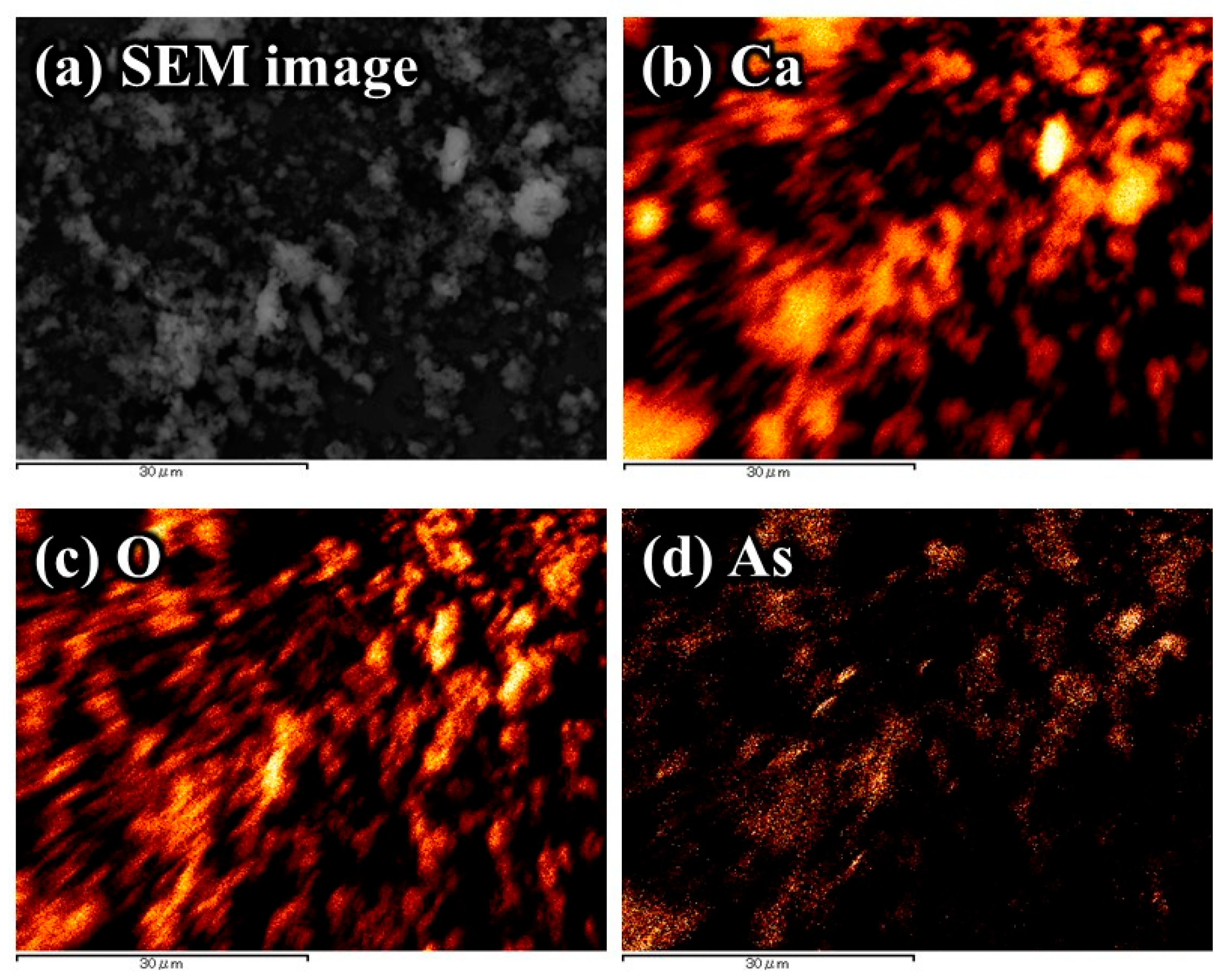
The SEM image and elemental mappings of Ca, O, and As on the As(V)-adsorbed Ca(OH)2 are shown in Figure 12a, Figure 12b, Figure 12c and Figure 12d, respectively.
As shown in Figure 12, similar to As(V)-adsorbed CaO, the elemental distributions of Ca, O, and As are almost identical, and it can be confirmed that As is uniformly distributed on the surface of Ca(OH)2 (actually, partially CaCO3 formed from Ca(OH)2).
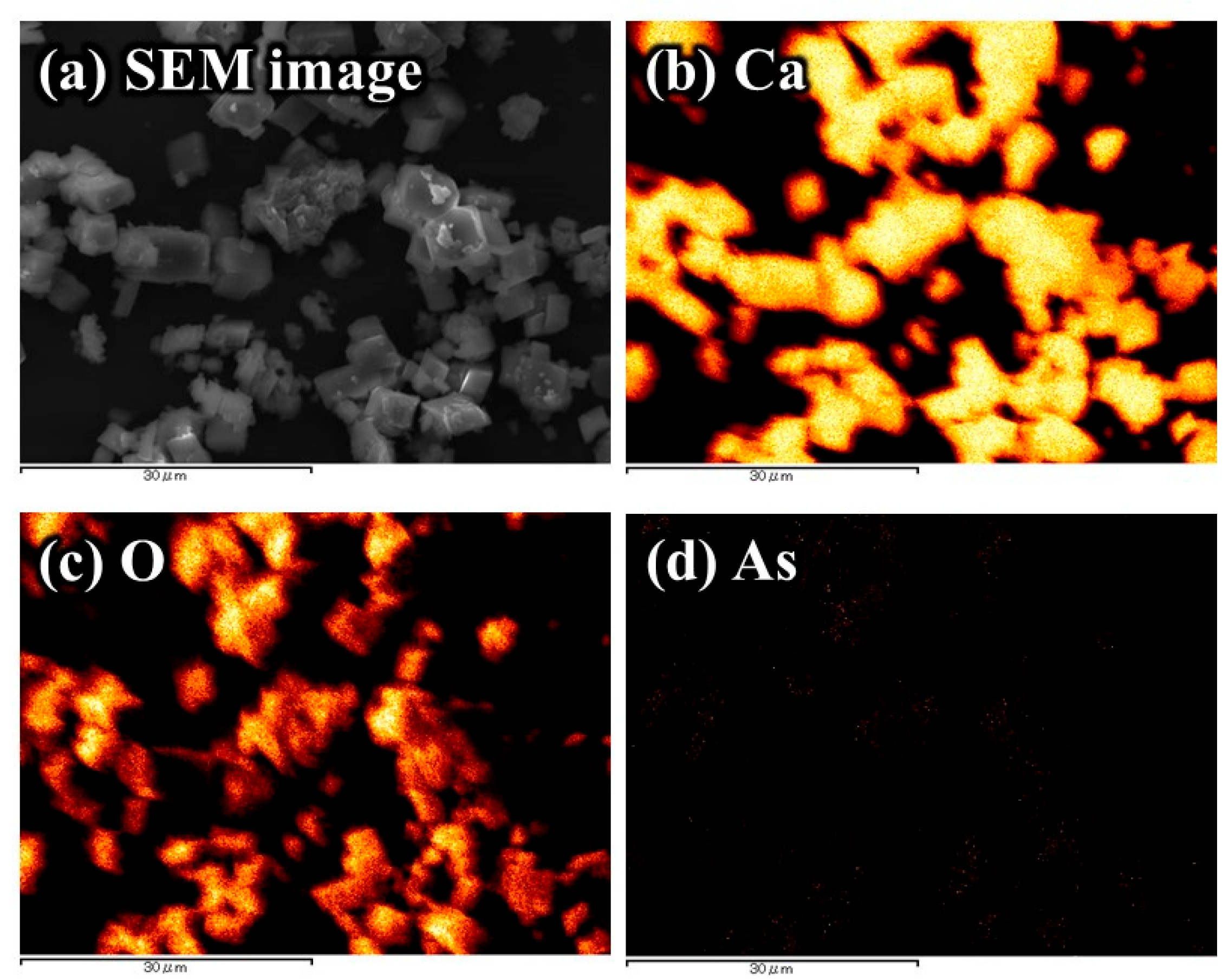
The SEM image and elemental mappings of Ca, O, and As on the As(V)-adsorbed CaCO3 are shown in Figure 13a, Figure 13b, Figure 13c and Figure 13d, respectively.
For the As(V)-adsorbed CaCO3, the energy intensity of the characteristic X-ray of As is weak and it is difficult to detect because the As content of As(V)-adsorbed CaCO3 is extremely low, but As can be confirmed to be uniformly distributed on the surface of CaCO3.
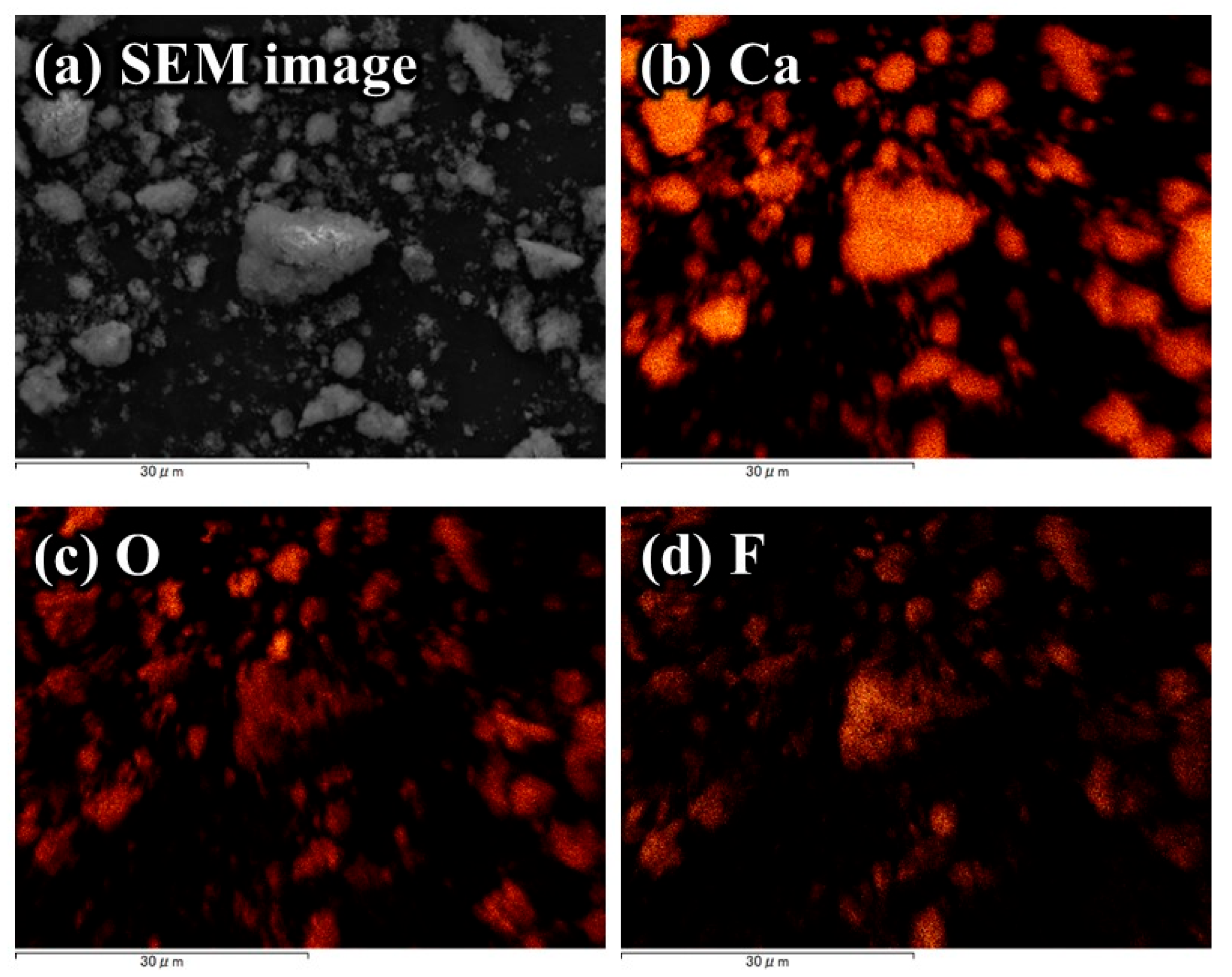
The SEM image and elemental mappings of Ca, O, and F on the F-adsorbed CaO are shown in Figure 14a, Figure 14b, Figure 14c and Figure 14d, respectively.
As shown in Figure 14, focusing on the particles in the center of each image, the elemental distributions of Ca, O, and F are almost identical, and it seems reasonable to consider that F is uniformly adsorbed on the surface of CaO (actually, mainly Ca(OH)2 formed from CaO). While F was not detected from some of the F-adsorbed CaO particles in the image, but this is thought to be due to the weak X-ray intensity of F.
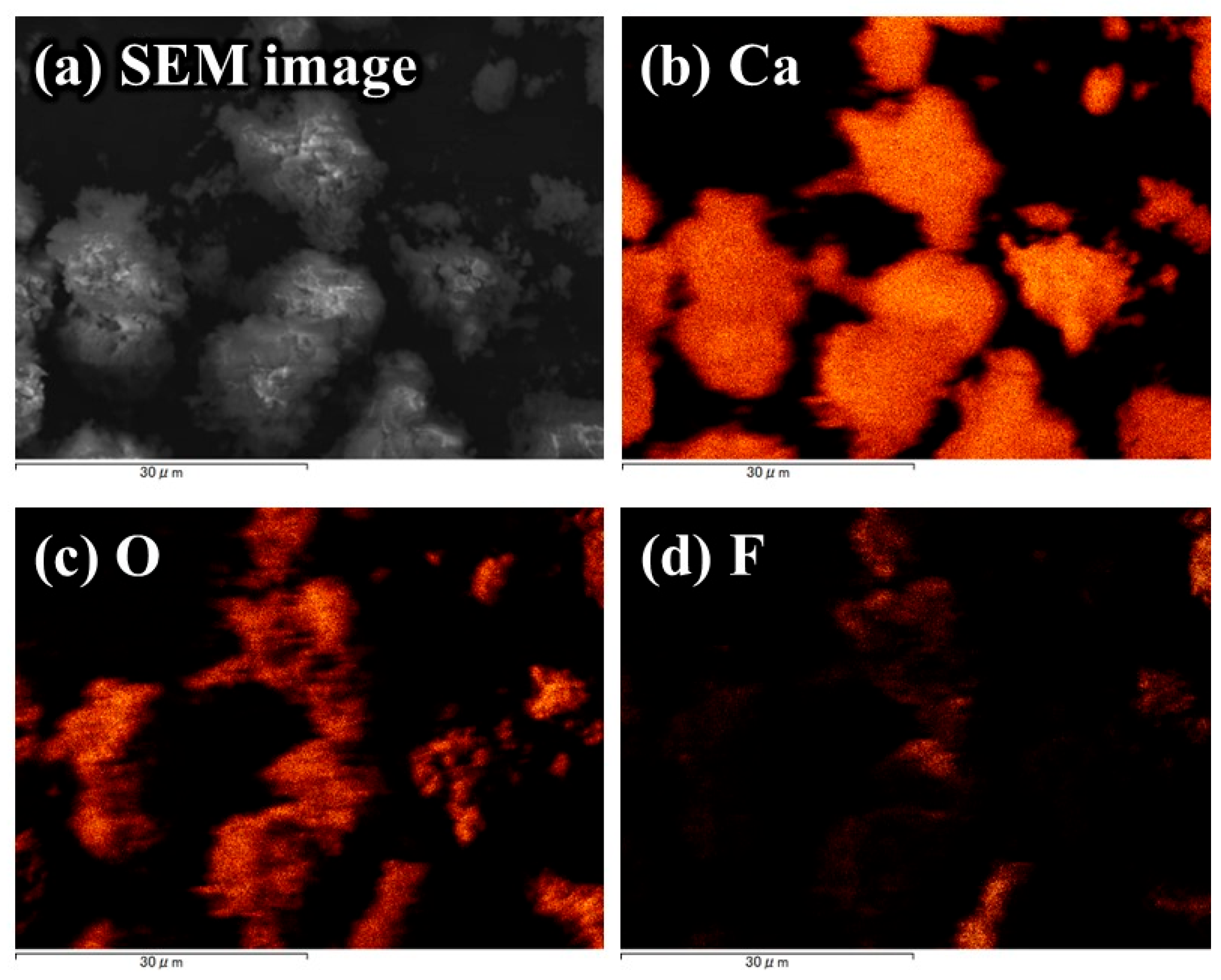
The SEM image and elemental mappings of Ca, O, and F on the F-adsorbed Ca(OH)2 are shown in Figure 15a, Figure 15b, Figure 15c and Figure 15d, respectively.
As shown in Figure 15, the elemental distributions of Ca, O, and F are almost identical, and it can be confirmed that F is uniformly adsorbed on the surface of Ca(OH)2.
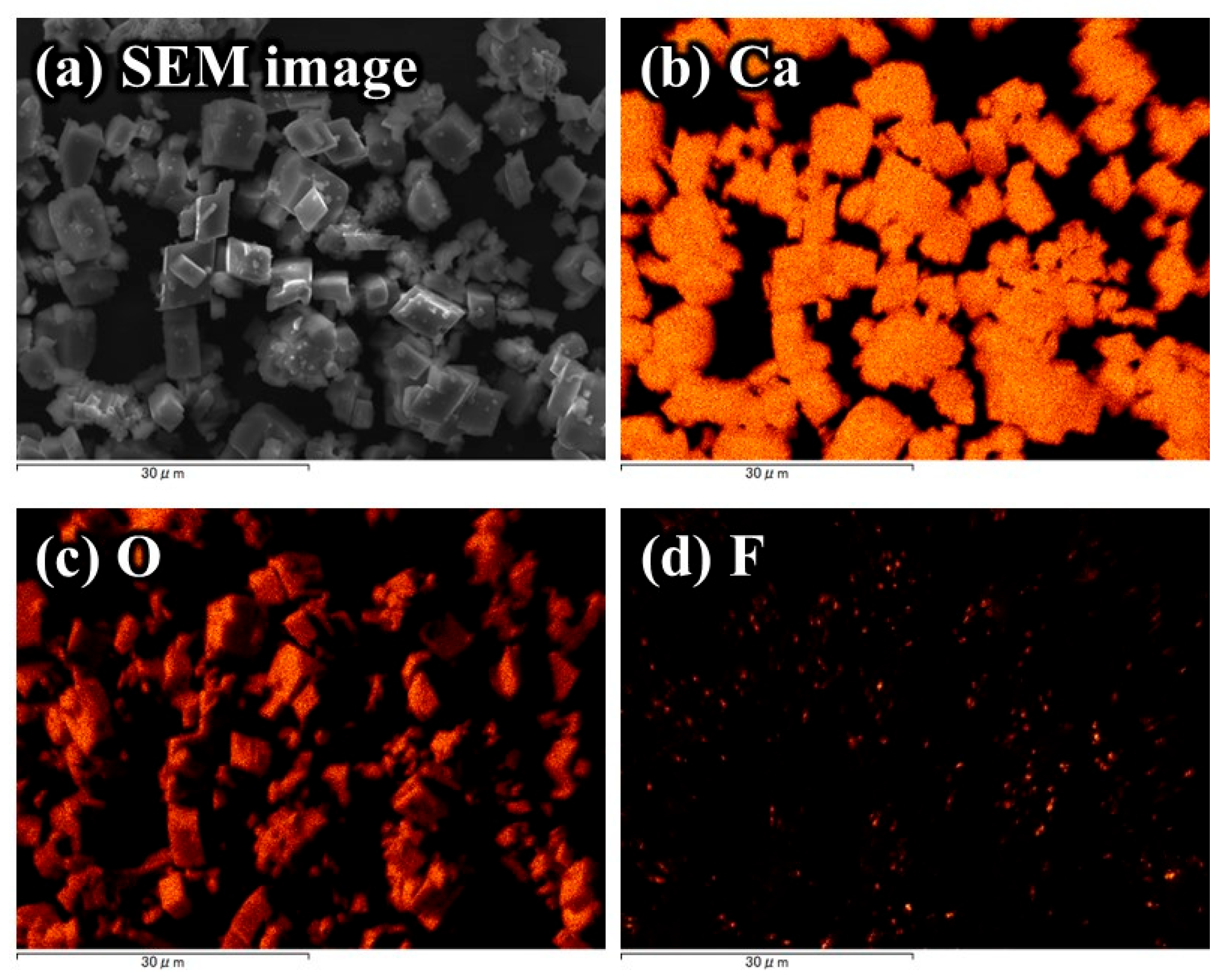
The SEM image and elemental mappings of Ca, O, and F on the F-adsorbed CaCO3 are shown in Figure 16a, Figure 16b, Figure 16c and Figure 16d, respectively.
As shown in Figure 16d, although the F content in F-adsorbed CaCO3 is extremely low, F has been detected on the surface of F-adsorbed CaCO3. Compared to the F-adsorbed CaO and Ca(OH)2, the distribution of F is scattered rather than uniform. Therefore, it is inferred that the detected F was not directly adsorbed on the CaCO3 surface, but was generated as fine CaF2 particles, as described in Section 3.3, and attached unevenly to the CaCO3 surface.

3.5. Simultaneous As–F Removal Tests with pH0

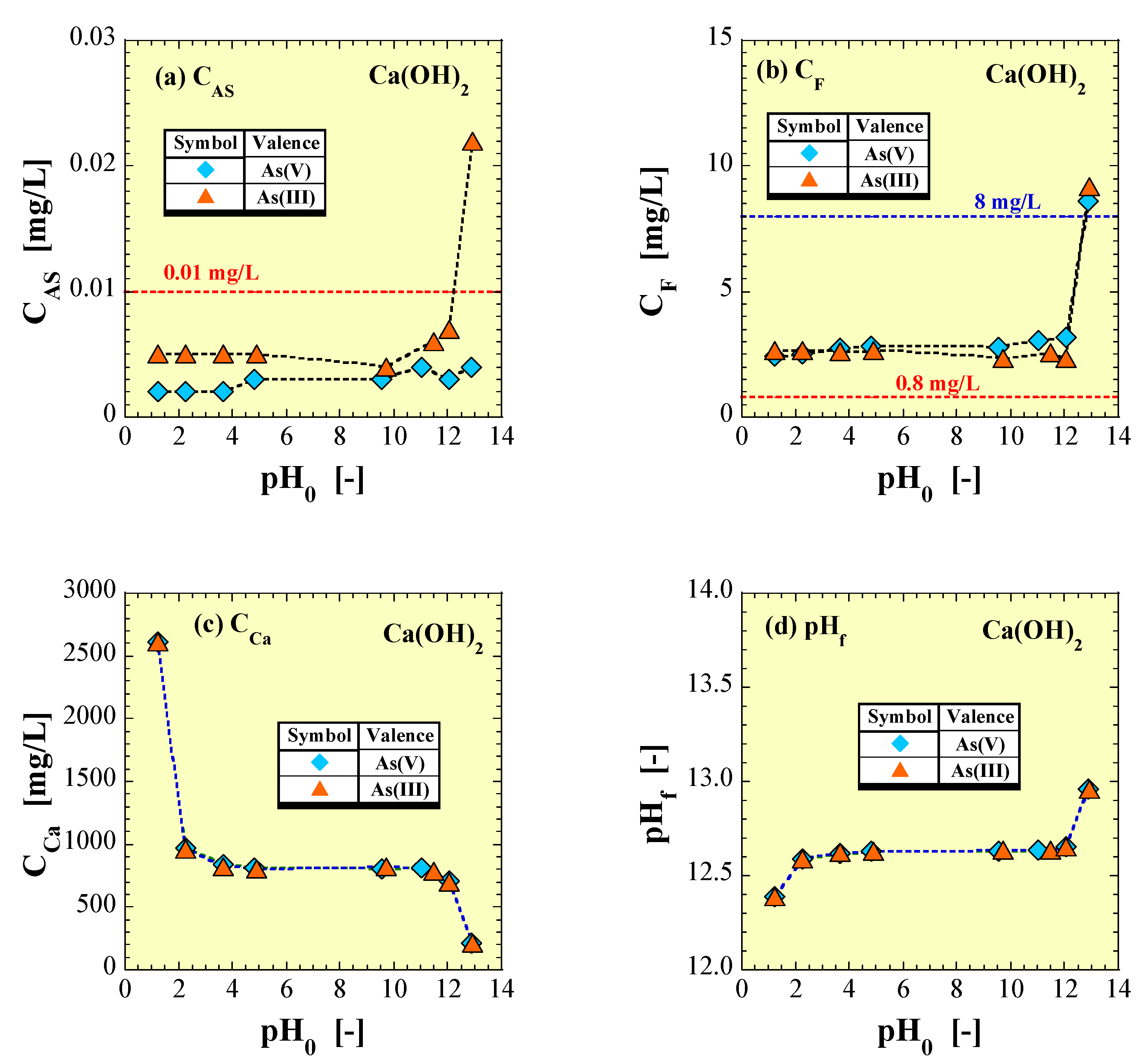
The type of adsorbent used in the tests with the pH0 parameter was Ca(OH)2, WAd0/V = 10 g/L, and the composition of the contaminated water was CAS0 = 1 mg/L + CF0 = 60 mg/L; both As(V) and As(III) were tested. Figure 17a, Figure 17b, Figure 17c and Figure 17d show the CAS, CF, CCa, and pHf values obtained in the removal tests with pH0 as a parameter, plotted against pH0, respectively.
As shown in Figure 17a, except for pH0 = 12.9 for As(III), CAS is below the environmental standard value for As (0.01 mg/L) in the tested pH0 range of 1.24–12.1 for both As(V) and As(III). In contrast, the CAS value at pH0 = 12.9 for As(III) exceeded 0.02 mg/L, failing to meet the environmental standard value. Additionally, the As(V) CAS was lower than that of As(III) at the same pH0. Except for As(III) at pH0 = 12.9, the variation in CAS due to differences in pH0 for both As(V) and As(III) was small but appeared to increase gradually with increasing pH0 overall.
For both As(V) and As(III) in the tested range of pH0 (1.2–12.1), except for pH0 = 12.9 (Figure 17b), the values of CF exceeded the environmental standard value for F (0.8 mg/L) but were below the effluent standard value (8 mg/L for non-marine areas). Overall, the variation in CF with respect to pH0 in the tested range did not significantly differ for both As(V) and As(III). However, within this pH0 range, the difference between the CF for As(V) and As(III) showed no clear difference in the acidic pH range, whereas in the alkaline pH range, the CF for As(V) was slightly higher than that for As(III). At pH0 = 12.9, the CF for As(III) was slightly higher than that for As(V).
As shown in Figure 17c, for both As(V) and As(III), the CCa does not change significantly in the pH0 range of 3.8–11.5, but it increases rapidly when pH0 is below that range and decreases rapidly when pH0 is above that range. Notably, the CCa was not dependent on the As valence. Furthermore, the pHf did not change significantly in the pH0 range of 2.3–12.1 (Figure 17d), but the pHf decreased when the pH0 was below that range and increased when the pH0 was above that range. The behavior of pHf with respect to pH0 appeared to be roughly the opposite of that of CCa, but similar to CCa, pHf was not dependent on the As valence.

4. Discussion

4.1. As Removal Ratio

The As removal ratio (RAS; %) was calculated as follows:
RAS = (CAS0CAS)/CAS0 × 100.
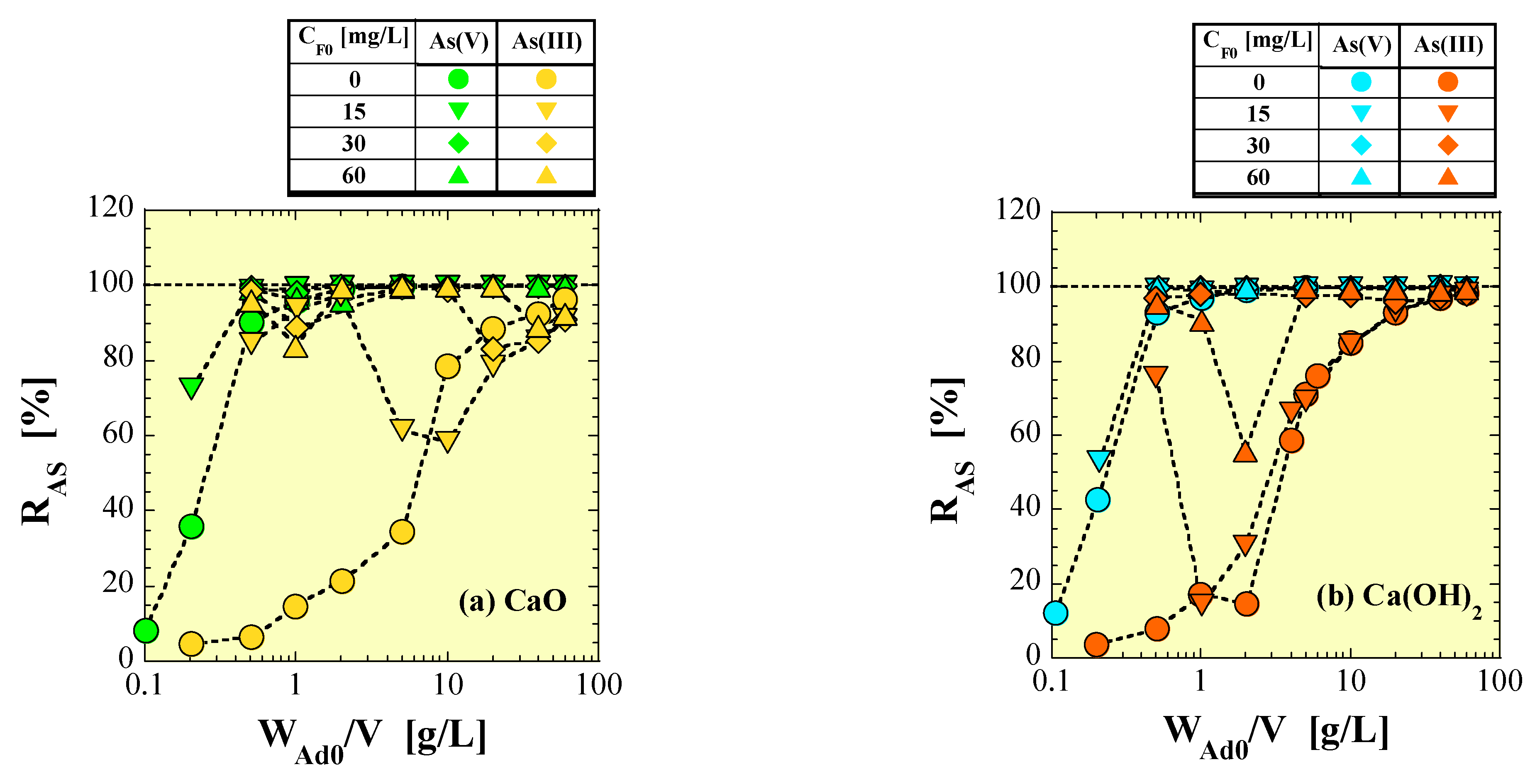
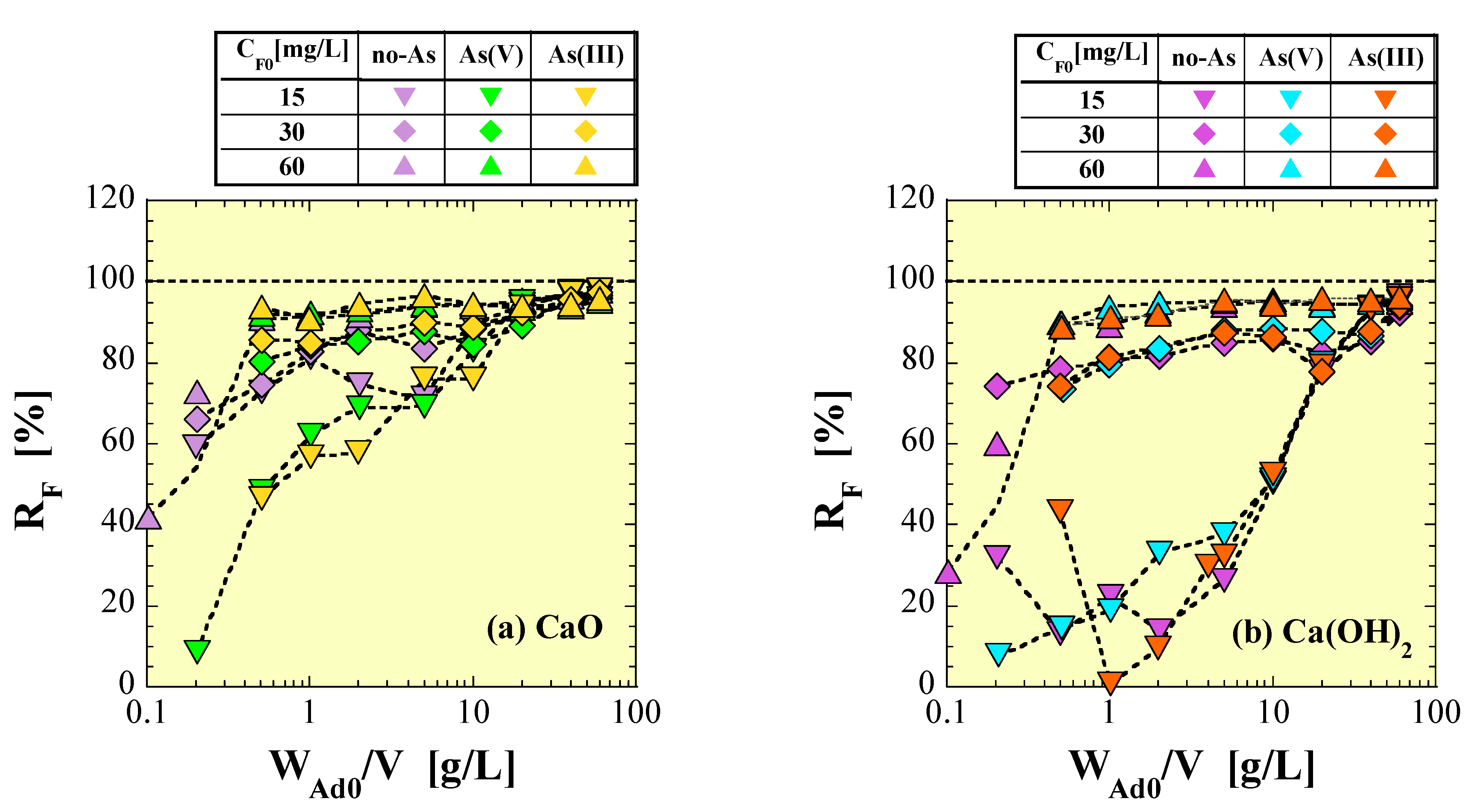
Figure 18 shows the RAS obtained from Equation (1) plotted against WAd0/V using the data in the simultaneous As–F removal tests with the WAd0/V parameter. Figure 18a and Figure 18b show the results for CaO and Ca(OH)2, respectively. The X-axis is in the log scale for ease of understanding. The figure for CaCO3 was omitted because it hardly removed As from the contaminated water. For additional reference, the results of the F-free As removal tests (CAS0 = 1 mg/L + CF0 = 0 mg/L) obtained in the previous study [24] are shown in these figures.
The RAS of As(V) increased with increasing WAd0/V, regardless of CF0, and reached nearly 100% at WAd0/V ≥ 0.5 g/L for both CaO and Ca(OH)2 within the test range (CAS0 = 1 mg/L, CF0 = 15–60 mg/L). Meanwhile, for both CaO and Ca(OH)2, the RAS of As(III) increased with increasing WAd0/V in the absence of F but showed unique behavior against WAd0/V in its presence. In the lower WAd0/V range, the RAS of As(III) was higher with F present. However, the RAS of As(III) decreased when the WAd0/V exceeded a certain value, except for Ca(OH)2 at CF0 = 30 mg/L and subsequently increased again when the WAd0/V was further increased. The WAd0/V value during the shift from the decrease to increase tended to be higher with a greater CF0. In addition, the temporary drop in RAS tended to be greater when CF0 was lower. In the higher range of WAd0/V, the RAS of As(III) at CF0 = 0 and 15 mg/L did not significantly differ.

4.2. F Removal Ratio

The F removal ratio, RF (%), was calculated as follows:
RF = (CF0CF)/CF0 × 100
The RF obtained from Equation (2) is plotted against WAd0/V in Figure 19. Figure 19a and Figure 19b show the results for CaO and Ca(OH)2, respectively. The X-axis is shown in the log scale for ease of understanding. Similarly to that in Figure 18, the figure for CaCO3 was omitted because CaCO3 could hardly remove the contaminants in the simultaneous As–F removal tests. The results of the As-free F removal tests conducted for comparison are also shown in these figures.
For both CaO and Ca(OH)2, the RF at CF0 = 60 mg/L exceeded 90% at WAd0/V = 0.5 g/L, but at CF0 = 15 mg/L, the RF did not reach 90% even at WAd0/V = 10 g/L, requiring 20 g/L WAd0/V to achieve it. Except for a few datapoints, RF generally increased with increasing WAd0/V. Additionally, for both CaO and Ca(OH)2, RF increased with increasing CF0. Furthermore, RF tended to be slightly higher for CaO than for Ca(OH)2, but no clear differences in RF were observed with or without the presence of As and on the As valence.

4.3. As and F Adsorption Amounts per Unit Mass of Adsorbent

In previous studies using Mg-based adsorbents [8,9], the adsorption amount was evaluated considering the leaching of Mg components from the adsorbents. Similarly, in this study using Ca-based adsorbents, the amounts of adsorbed As (QAS) and F (QF) per unit mass of the adsorbent were calculated using the following procedure, which accounted for the leaching of Ca components from the adsorbent.
The initial Ca amount, WCa0 (g), was determined using αCa (Table 1):
WCa0 = (αCa/100) WAd0
The amount of Ca remaining as a solid phase, WCaf (g), 24 h after adding the adsorbent was then calculated as follows:
WCaf = WCa0 − (CCa/1000) V
Because the unit of CCa is mg/L, it was divided by 1000 to express the unit in grams. Assuming that the residual ratio of Ca is equal to that of the adsorbent, the adsorbent residual ratio γ can be expressed by the following equation:
γ = WCaf/WCa0 × 100
The concentration of the adsorbent remaining as a solid phase after 24 h, WAdf/V (g/L), was determined as follows:
WAdf/V = (γ/100) WAd0/V
Finally, QAS (mg/g) and QF (mg/g) were determined using the following equations:
QAS = (CAS0CAS)/(WAdf/V)
QF = (CF0CF)/(WAdf/V)

4.4. Adsorption Efficiencies of As and F

For CaO and Ca(OH)2, the correlations between the QAS and QF and the CAS and CF obtained in this study were examined, and then it was confirmed that they did not fit either the Langmuir or Freundlich adsorption model. For CaCO3, fitting to the adsorption models was not verified due to a lack of data.
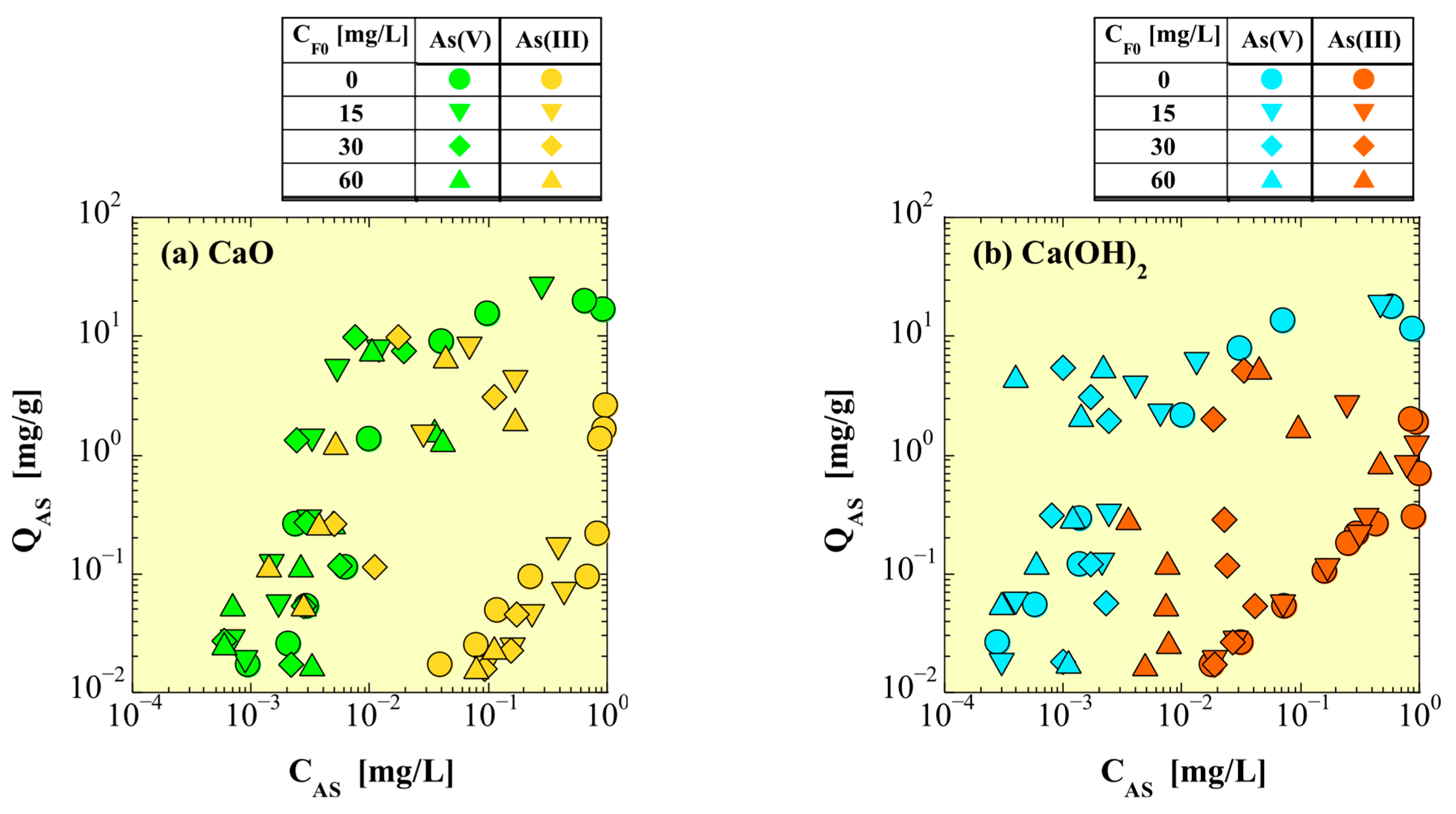
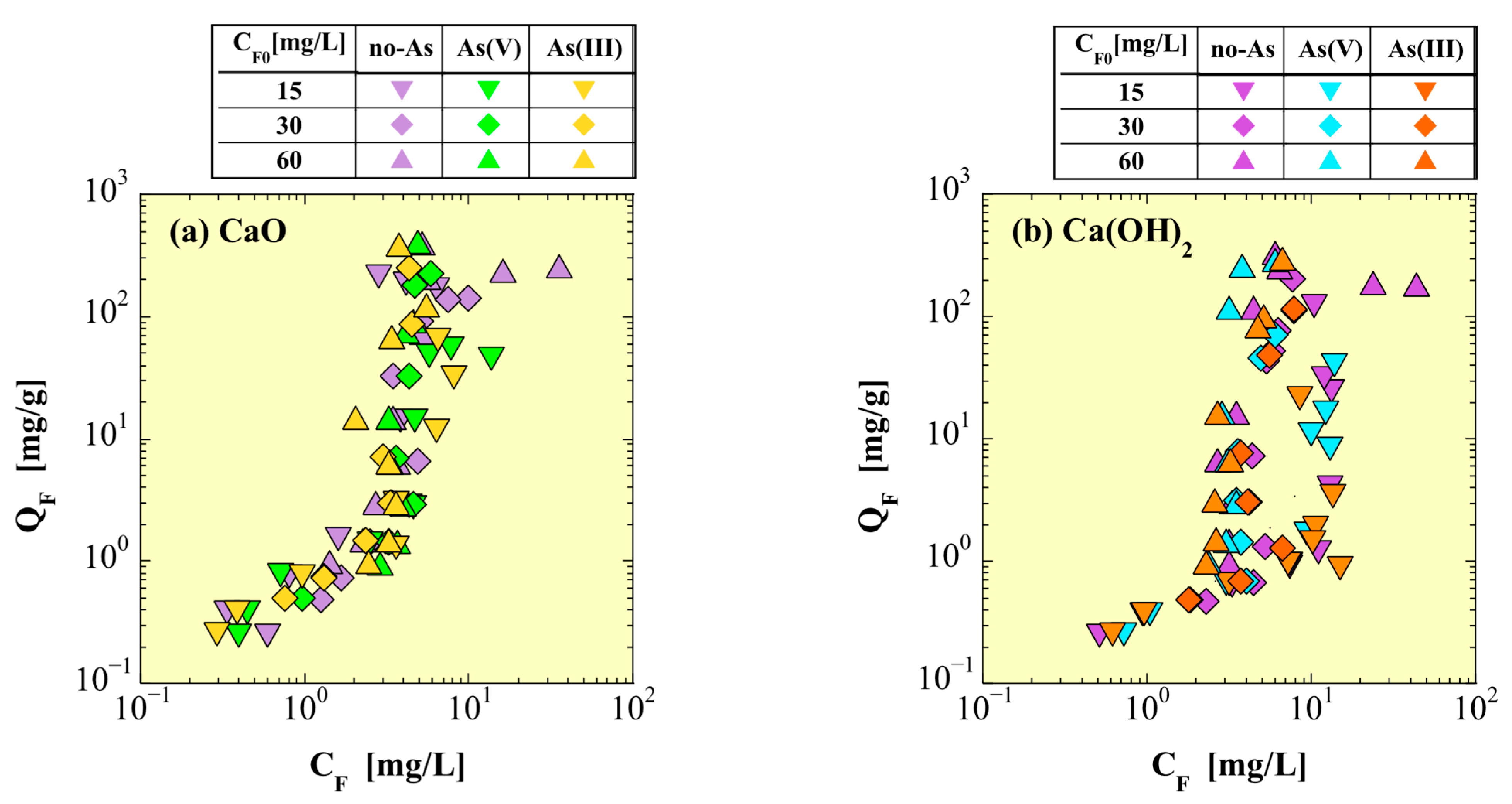
The QAS and QF also represent the adsorption efficiencies of As and F, respectively. The double-logarithmic plots of QAS and QF against CAS and CF are shown in Figure 20 and Figure 21, respectively. Figure 20a and Figure 21a correspond to CaO, and Figure 20b and Figure 21b correspond to Ca(OH)2. Incidentally, these figures are also commonly used to verify fit to the Freundlich model.
Figure 20a,b show that, overall, the correlation between QAs with CAS for CaO is similar to that for Ca(OH)2. For both CaO and Ca(OH)2, some of the plots for QAS of As(III) were highly dispersed, but overall, for both As(V) and As(III), the QAS increased with increasing CAS, and the QAS tended to plateau when the CAS reached a certain value. From Figure 20a,b, the effects of CF0 on QAS are found to be small for As(V) but is difficult to estimate for As(III) because some plots of QAS for As(III) were dispersed.
From Figure 21a,b, no clear difference in F-adsorption behavior due to As valence was observed for both CaO and Ca(OH)2, but the correlation between QF and CF is found to be somewhat different between CaO and Ca(OH)2. For CaO, regardless of CF0, the QF increases with increasing CF in the low CF range (<2–3 mg/L), but the QF rises sharply when the CF exceeds that range (Figure 20a). For Ca(OH)2, the CF at which QF begins to rise sharply is found to differ depending on CF0 (Figure 20b). The QF begins to rise sharply at CF ≃ 10 mg/L for CF0 = 15 mg/L, and at CF ≃ 2–3 mg/L for CF0 = 30 and 60 mg/L.
In previous studies, various adsorbents have been tested for removing simultaneous As-F, and the results have been reported. Table 3 shows the maximum adsorption efficiencies of As and F, QAS-MAX (mg/g) and QF-MAX (mg/g), and main experimental conditions reported in the representative previous studies [5,6,7,8,9,10,11]. This table lists Langmuir values, which was calculated by applying the Langmuir model, and experimental values, but there are some cases where only one of the values was reported. It should also be noted that even in studies on simultaneous As-F removal, many studies report the QAS-MAX and QF-MAX obtained in single removal tests for As and F. For comparison, the results of this study are also shown in Table 3. However, for Ca-based adsorbents, it should be noted that the amount of remaining solids in the solution is somewhat less than the dosage, because some of the constituent components of the adsorbent are leached out.
Focusing on the QAS-MAX of As(V) in Table 3, the CaO (25.3 mg/g) is comparable to the ZnO nanoparticles coated rice husk bio adsorbent (28.23 mg/g) with the highest value, and the Ca(OH)2 (17.6 mg/g) is the next highest. Among the QAS-MAX of As(III) in Table 3, the Langmuir value for MgO (14.8 mg/g) is the highest, but the experimental value of 1.03 mg/g should be used as the value for MgO, because the Langmuir value was less accurate [10]. Therefore, the highest QAS-MAX of As(III) may be CaO (7.82 mg/g), followed by Ca(OH)2 (2.51 mg/g). Among the QF-MAX in Table 3, CaO and Ca(OH)2 have overwhelmingly higher values than the other adsorbents. The QAS-MAX of As(III) and QF-MAX for CaCO3 are both the lowest among those in Table 3. From these results, when the QAS-MAX and QF-MAX are used as indicators, the CaO and Ca(OH)2 can be evaluated as being extremely excellent adsorbents for simultaneous As-F removal.

4.5. Mutual Effects on Adsorption Behavior of As and F

The As and F adsorption data obtained in this study were not well fitted to the Langmuir and Freundlich adsorption models. Therefore, the mutual effects on the As and F adsorption behavior when they coexisted were examined from a different perspective.
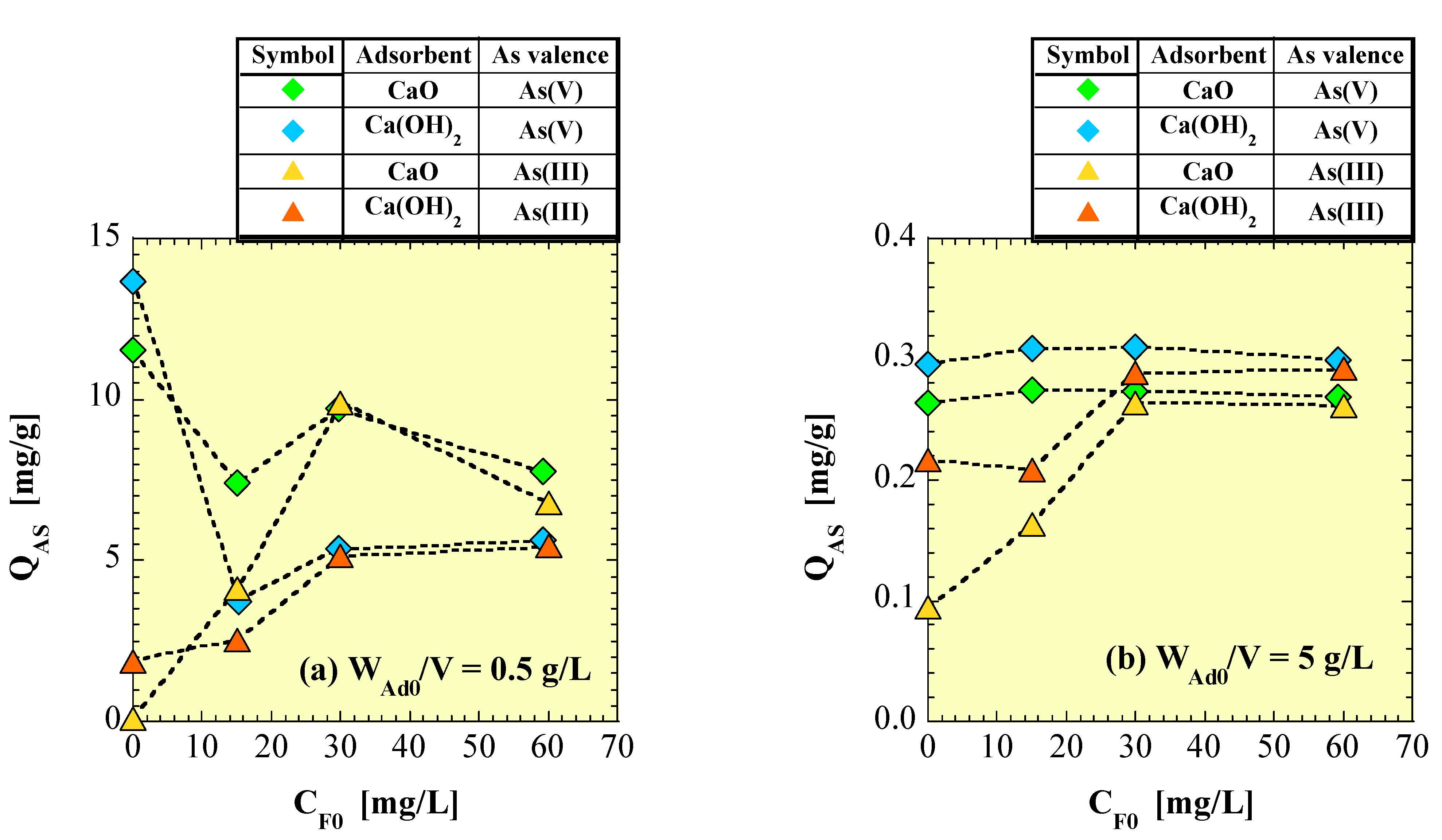
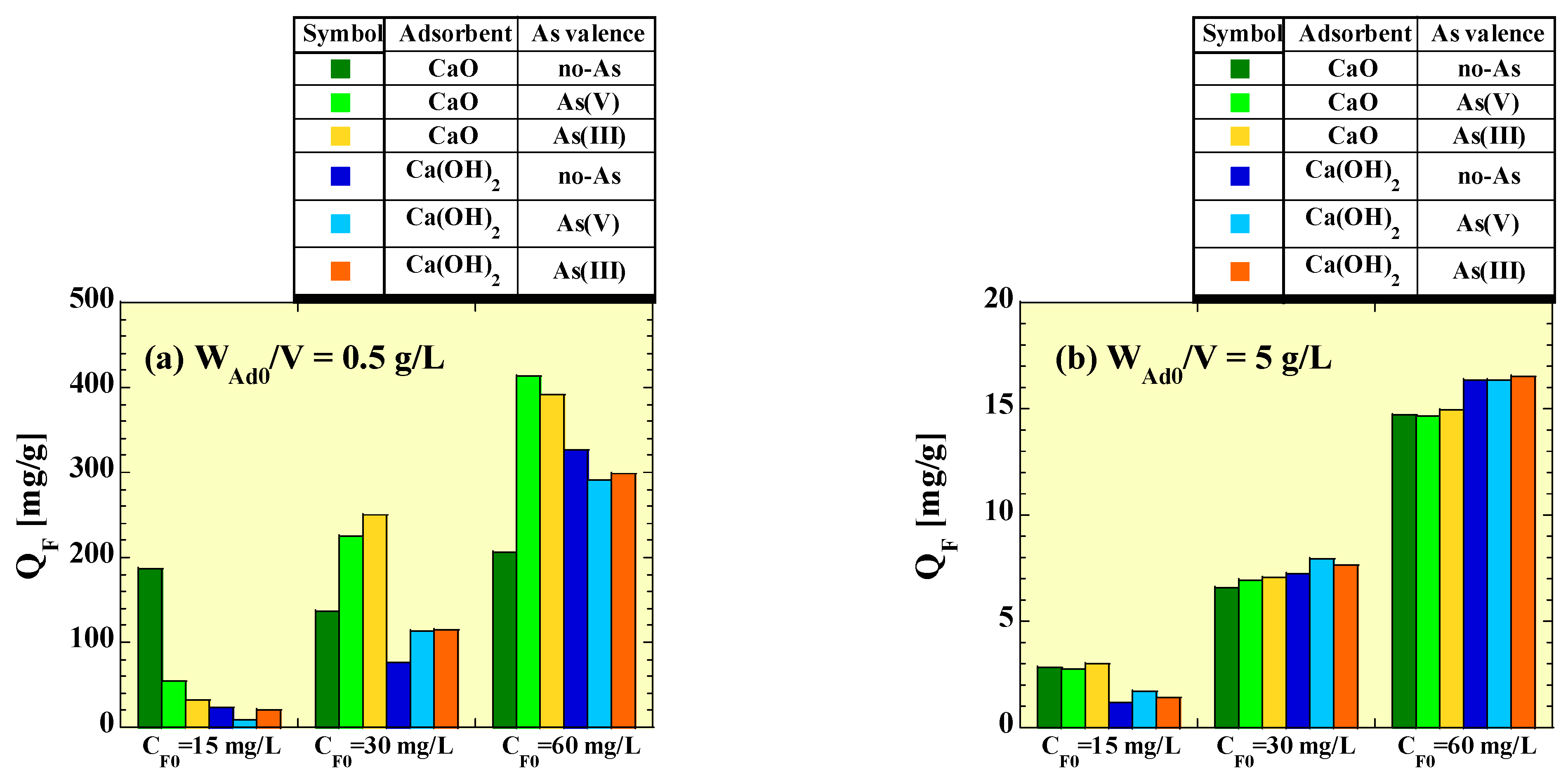
This section examined the difference in the mutual effects on As and F adsorption behavior depending on the combination of WAd0/V and CF0. First, focusing on the difference in the magnitude relationship of WAd0/V, the QAS for each combination of CaO or Ca(OH)2 with As(V) or As(III) was plotted against CF0 (Figure 22). Figure 22a and Figure 22b are at WAd0/V = 0.5 and 5 g/L, respectively. For both CaO and Ca(OH)2, the QAS of As(V) was higher without F than with F when WAd0/V was lower (0.5 g/L); in contrast, it was not considerably affected by the presence or absence of F at the higher WAd0/V (5 g/L).
The QAS of As(III) tended to be higher with F present for both Ca and Ca(OH)2, regardless of whether WAd0/V was low or high. These results suggest that the adsorption of As(V) decreases due to competitive adsorption with F at a low WAd0/V. In contrast, competitive adsorption did not have an apparent effect when the WAd0/V was high because the number of adsorption sites available was sufficient. The effect of coprecipitation with CaF2 is believed to be greater than that of competitive adsorption with F because the QAS of As(III) increased in the presence of F regardless of the WAd0/V.
Subsequently, the effects of the presence or absence of As and differences in As valence on the adsorption behavior of F for each CF0 were compared at both higher and lower WAd0/V. Graphs of the QF for the combinations of CaO or Ca(OH)2 with no-As, As(V), and As(III) against CF0 are shown in Figure 23. Figure 23a and Figure 23b correspond to WAd0/V at 0.5 and 5 g/L, respectively.
When WAd0/V was low, the presence or absence of As or difference in the As valence did not significantly affect the QF for Ca(OH)2. For CaO, the effects of As on QF varied depending on the value of CF0. At CF0 = 15 mg/L, the QF was higher without As. At CF0 = 30 and 60 mg/L, the QF was higher with As present. In contrast, the difference owing to the difference in As valence was not clear. Therefore, for CaO, when CF0 = 15 mg/L, F becomes strongly affected by competitive adsorption with As(V) or As(III), resulting in a decrease in QF; however, when CF0 is 30 mg/L ≤ CF0, the presence of As promotes the adsorption of F. Meanwhile, for both CaO and Ca(OH)2, at a high WAd0/V, the presence or absence of As or difference in the As valence does not affect QF for any CF0. Therefore, similar to the case of the As adsorption described above, the effect of competitive adsorption was not apparent because the number of adsorption sites available when WAd0/V was high was sufficient.

4.6. Removal Mechanism of As and F in Ca-Based Adsorbents

The QAS or QF for Ca compounds adsorbed with As(V), As(III), and F prepared for XRD analysis are shown in Table 4. The QAS and QF were calculated from the changes in the amounts of As, F, and Ca dissolved in the solution before and after the adsorption test, assuming that the composition of the adsorbent after the test did not change from the original composition of the adsorbent. However, in reality, CaO completely converts into Ca(OH)2 and trace amounts of CaCO3, and Ca(OH)2 are partially converted into CaCO3 as described in Section 3.2.
The QAS values of CaO and Ca(OH)2 adsorbed with As(V) and As(III) were considerably high, but no arsenate or arsenite peaks were observed in their XRD patterns. This suggests that the mechanism of As removal from the liquid phase by the Ca-based adsorbent is not due to the reaction of Ca2+ leached from the Ca-based adsorbents with As(V) or As(III) to generate calcium arsenate or calcium arsenite species, but instead owing to the direct adsorption of As(V) or As(III) on the Ca-based adsorbents [24]. Additionally, the results of the EM on the As(V)-adsorbed Ca-based adsorbents (Figure 11, Figure 12 and Figure 13) also support the suggestion.
The QF of F-adsorbed CaCO3 was only 0.03 mg/g, but the peaks of CaF2 were small but visible in the XRD patterns (Figure 7e,f). These results indicate that a miniscule fraction of F in the liquid phase was not directly adsorbed on CaCO3 but was migrated from the liquid phase via reaction with Ca2+ leached from CaCO3 to produce highly crystalline CaF2. Budyanto et al. (2015) argued that the main mechanism of F removal by CaCO3 at CF0 ≥ 40 mg/L is the surface precipitation of CaF2 [14]. Wong and Stenstrom (2017) suggested that the precipitated CaF2 would be physically adsorbed on CaCO3, based on the Dubinin-Radushkevich isotherm [17]. The results of EM on F-adsorbed CaCO3 (Figure 16) also support the adsorption of precipitated CaF2 onto the CaCO3 surface.
Additionally, for both CaO and Ca(OH)2, F in the liquid phase likely reacted with Ca2+ leached from each Ca-based adsorbent to generate CaF2. In some previous studies, XRD analysis for CaO and Ca(OH)2 after F removal tests showed strong peaks indicating the precipitation of CaF2 [18,26]. In the XRD patterns (Figure 5e and Figure 6e), the broad peaks potentially attributed to CaF2 overlapped with other peaks and were not distinct. This suggests that more F was directly adsorbed as anionic or coordination-bonded low-crystalline species on CaO or Ca(OH)2 than generated as crystalline CaF2. Additionally, the results of the EM on the F-adsorbed CaO and Ca(OH)2 (Figure 14 and Figure 15) also support the suggestion.

4.7. Effects of pH0 on Simultaneous As–F Removal

As described in Section 3.1.2, in the simultaneous As–F removal tests with CF0 = 60 mg/L for CaO or Ca(OH)2, the CF values generally decreased with increasing WAd0/V; however, above a certain WAd0/V value, CF did not decrease further and almost plateaued. Conversely, pHf and CCa generally increased with increasing WAd0/V, but above a certain WAd0/V value no further increase occurred. This indicated that pHf and CCa were rate-limited by the solubility of Ca(OH)2. If CCa and CF were rate-limited by the solubility of CaF2, sufficient Ca2+ should have been in the solution such that the F forms CaF2 and CF further decreased, which did not happen. Therefore, the main mechanism for the removal of F by the addition of the Ca-based adsorbent is adsorption through ligand exchange with the OH groups in the Ca-based adsorbent.
This applies not only to the Ca(OH)2-based adsorbent but also to the CaO-based adsorbent because CaO is ultimately converted to Ca(OH)2 through hydration. Minor ligand exchange was believed to occur between the carbonate groups in the CaCO3-based adsorbent and F. One way to confirm the above inferences is to conduct simultaneous As–F removal tests with pHf as a parameter. However, even if acid is added at the final stage of the tests for purpose of changing the pHf, the acid would likely react with the Ca-based adsorbent remaining as a solid phase and be neutralized.
Subsequently, the simultaneous As–F removal tests with pH0 instead of pHf as a parameter, that is, the tests to verify how the CAS and CF value changes depending on the width of pH fluctuation, were conducted. In the tests, lowering pH0 was expected to also lower pHf, resulting in improved F removal performance. However, in reality, lowering the pH0 did not lower the pHf nor improved the F removal performance. This is because WAd0/V (=10 g/L) was set in anticipation of a sufficient amount of solid Ca(OH)2 remaining in the treated water, and the amounts of Ca2+ and OH corresponding to the solubility of Ca(OH)2 were leached from the Ca(OH)2. The pHf at pH0 = 1.2 was lower than those at other pH0 values, but both CAS and CF at pH0 = 1.2 were almost the same as those at pH0 = 2.3–12.1. In contrast, the CCa at pH0 = 1.2 was significantly higher than that at other pH0, increasing the risk of a higher burden on secondary Ca treatment. Furthermore, adding acid to the treated water before removing the residual solid Ca(OH)2 will not lower the pH because the residual solid Ca(OH)2 will react with and neutralize the added acid (as if acting as a pH buffer).
In contrast, neutralizing the pH by adding acid after removing solid Ca(OH)2 from the treated water then adding fresh Ca(OH)2 is considered effective. For example, the CF at pH0 = 1.2–12.1 (Figure 17b) was <3.2 mg/L, and the neutralized solution of treated water after removal of the residual solid Ca(OH)2 may be considered to correspond to F-contaminated water with CF0 = 3.2 mg/L. Based on Figure 2a, F-contaminated water with CF0 ≤ 15 mg/L can easily meet the environmental standard value (CF = 0.8 mg/L) through the addition of Ca-based adsorbent.

4.8. Solubility Product of Ca(OH)2

In the test with pH0 parameter using Ca(OH)2 (Figure 17c), a higher CCa was obtained at lower pH0 and a lower CCa at higher pH0. Additionally, the behavior of pHf against pH0 was the opposite of that of CCa (Figure 17d). Therefore, the solubility product of Ca(OH)2 was examined using the data of CCa and pHf.
In general, the solubility product KSP of Ca(OH)2 is expressed by the solubility product equation (Equation (10)) corresponding to the following reaction equation (Equation (9)).
Ca(OH)2 ⇆ Ca2+ + 2OH
[Ca2+][OH]2/[Ca(OH)2] = KSP
In all of the tests with the pH0 parameter, [Ca(OH)2] = 1 because the WAd0/V was 10 g/L and the sufficient amounts of Ca(OH)2 remained in solution as a solid phase. That is, [Ca2+][OH]2 = KSP.
The hydroxide ion concentration in the treated water, [OH]f (M), was then calculated based on pHf.
[OH]f = 10(pHf−14)
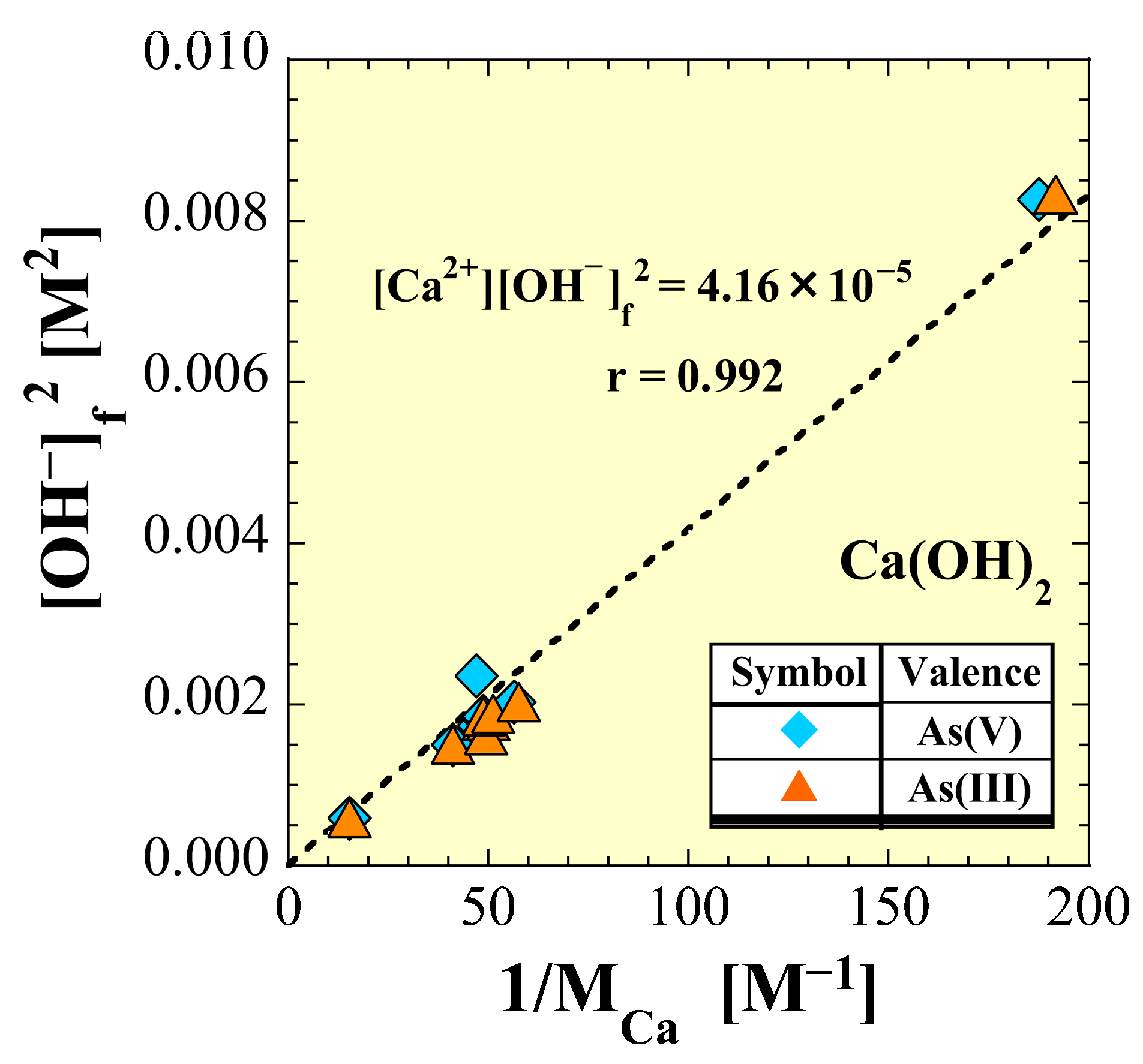
The values of CCa (mg/L) were converted to molar units of MCa (M) using the atomic weight of Ca = 40.08. The plots of [OH]f2 against 1/MCa are shown in Figure 24.
The plots fell on a straight line according to Equation (10). The slope of the approximately straight line determined from these plots corresponded to KSP, and KSP = 4.16 × 10⁻⁵ and r = 0.992 were obtained. A value of 5.5 × 10⁻⁶ has been generally used as the KSP value for Ca(OH)2 [29]. In this study, the KSP obtained was approximately one order of magnitude larger than the reference value. Owing to differences in the measurement methods (including variations in measuring instruments) and the fact that the solution used in this study was not pure water, the results are unlikely to match the reference value, which is the KSP for Ca(OH)2 in pure water. However, as is evident from Figure 24, the relationship of the solubility product equation is valid. Furthermore, the main reaction in the experimental system was the reaction equation, and the effect of other components was considered to be negligible.

4.9. Comprehensive Evaluation

This study revealed that in the simultaneous removal of As–F by Ca-based adsorbents, the mutual effects on the adsorption behavior of As and F differed depending on the combination of WAd0/V and CF0. Although tests with CAS0 as the parameter were not conducted in this study, the mutual effects are expected to differ depending on the combination of WAd0/V and CF0, even for different values of CAS0. Nevertheless, the mutual effects are considered to be almost negligible when the WAd0/V is sufficiently high (e.g., 5 g/L). Rather, a key limitation in simultaneous As–F removal using Ca-based adsorbents is that, even if WAd0/V is increased beyond a certain value, the ligand substitution reaction between F in the solution and the OH groups on the adsorbent surface will not proceed because of the high solution pH.
Therefore, for contaminated water with a relatively high F concentration (CF0 > 15 mg/L), a single adsorption treatment will not be able to purify F to meet the environmental standard level (0.8 mg/L). However, in most cases, this single adsorption treatment will easily achieve CF < 8 mg/L (effluent standard level). Therefore, if the contaminated water remaining after recovering the residue with As and F is neutralized and a second cycle of adsorption treatment is performed, the environmental standard F value can be met. For As(III), the As environmental standard (0.01 mg/L) was met using Ca(OH)2 for the contaminated water with CAS0 = 1 mg/L and CF0 = 60 mg/L; however, the water could not be purified to meet the As environmental standard in many other cases. However, similar to that for F mentioned above, performing a second adsorption treatment can enable the environmental standards for As(III) to be fully met.
A comparison of the Ca-based adsorbents evaluated in this study with the Mg-based adsorbents tested in previous studies [9,10] showed that the As(V), As(III), and F removal performances of CaO and Ca(OH)2 were superior to that of MgCO3, but inferior to those of MgO and Mg(OH)2. Additionally, in the contaminated water under the test conditions in this study, a single adsorption treatment with a Ca-based adsorbent was hardly able to meet the environmental standards for As and F. Nevertheless, this treatment enables water to satisfy the As and F effluent standards. Therefore, CaO and Ca(OH)2 are considered suitable for wastewater treatment. In particular, locally available limestone or similar materials can be used to produce the CaO or Ca(OH)2 adsorbents, thereby reducing the treatment costs. Furthermore, the test condition in this study was at CAS0 = 1 mg/L, which is a relatively high level for natural arsenic contamination. At CAS0 = 0.1 mg/L, even Ca-based adsorbents are expected to be able to fully purify As-contaminated water to satisfy the As environmental standard value of 0.01 mg/L.
For the spent Ca-based adsorbents that have adsorbed As and F, it is necessary to consider recycling them, converting them into cement-based materials, or disposing of them in landfills. For the regeneration, because As and F are strongly chemically bonded with the Ca component on the adsorbents or form CaF2, it is highly likely that sufficient desorption effect will not be obtained even by cleaning with a strong alkaline solution such as a concentrated NaOH aqueous solution [17,18]. To use the spent adsorbents as cement-based materials, it is necessary to conduct leaching tests under various anticipated conditions in advance to confirm that there will be no serious leaching of As or F. The most realistic option is likely to be landfill disposal. A previous study [30] has also examined the effects of soil, etc., on spent Ca-based adsorbents that have adsorbed As, and similar risk assessments should be conducted in the future for the spent adsorbents that have simultaneously adsorbed As and F.

5. Conclusions

This study evaluated the removal performance of Ca-based adsorbents (powder reagents of CaO, Ca(OH)2, and CaCO3) for simultaneous As and F removal. In the tests using synthetic contaminated water under concentrations of CAS0 = 1 mg/L and CF0 = 15–60 mg/L, CaCO3 was found to hardly remove As and F, whereas CaO and Ca(OH)2 showed promise as adsorbents under a certain range of conditions. CaO and Ca(OH)2 were able to purify the As(V)-contaminated water to below the environmental standard value of 0.01 mg/L, regardless of the presence or absence of F. For As(III), CaO and Ca(OH)2 treated the contaminated water to meet the As effluent standard of 0.1 mg/L; however, they were unable to purify As(III) to the As environmental standard value in many cases. Nevertheless, at CF0 = 60 mg/L, Ca(OH)2 was able to purify both As(III)- and As(V)-contaminated water to the environmental standard value. CaO had a range where the environmental standard value for As can be satisfied at low WAd0/V, but as WAd0/V increased, the As removal rate decreased and the environmental standard value could no longer be satisfied. For F, at CF0 = 15 mg/L, regardless of the presence or absence of As, CaO and Ca(OH)2 were able to purify the contaminated water to below the F-environmental standard value of 0.8 mg/L. However, although the F-effluent standard of 8 mg/L for non-marine area was met at CF0 = 30 and 60 mg/L, the water could not be purified to meet the F-environmental standard level. Therefore, to meet the environmental standards for both As and F, two cycles of treatment are necessary. That is, after a single adsorption treatment with the Ca-based adsorbents, the residues containing As and F would be removed and the treated water neutralized, and a second adsorption treatment would be performed. Incidentally, the use of Ca-based adsorbents for wastewater treatment is recommended because a single adsorption treatment can meet the wastewater standards for both As and F.

Author Contributions

Conceptualization, H.S.; methodology, H.S., T.S. and J.H.; formal analysis, H.S. and K.M.; investigation, H.S. and K.M.; resources, H.S., K.M. and J.H.; data curation, H.S. and K.M.; writing—original draft preparation, H.S. and K.M.; writing—review and editing, H.S., K.M., T.S. and J.H.; supervision, J.H.; project administration, H.S.; funding acquisition, J.H., T.S. and H.S. All authors have read and agreed to the published version of the manuscript.

Funding

This study received no external funding.

Institutional Review Board Statement

Not applicable.

Informed Consent Statement

Not applicable.

Data Availability Statement

Data supporting the findings of this study are available from the corresponding author upon reasonable request.

Acknowledgments

We are deeply grateful to Terumi Oguma for her assistance with the experiments.

Conflicts of Interest

The authors declare no conflicts of interest.

References

  1. Kumar, M.; Goswami, R.; Patel, A.K.; Srivastava, M.; Das, N. Scenario, perspectives and mechanism of arsenic and fluoride Co-occurrence in the groundwater: A review. Chemosphere 2020, 249, 126126. [Google Scholar] [CrossRef]
  2. Jha, P.K.; Tripathi, P. Arsenic and fluoride contamination in groundwater: A review of global scenarios with special reference to India. Groundw. Sustain. Dev. 2021, 13, 100576. [Google Scholar] [CrossRef]
  3. World Health Organization (WHO). Guidelines for Drinking-Water Quality, Fourth Edition Incorporating the First and Second Addenda. 2022 (Electronic Version). Available online: https://www.who.int/publications/i/item/9789240045064 (accessed on 20 May 2025).
  4. Neisan, R.S.; Saady, N.M.C.; Bazan, C.; Zendehboudi, S.; Al-nayili, A.; Abbassi, B.; Chatterjee, P. Arsenic removal by adsorbents from water for small communities’ decentralized systems: Performance, characterization, and effective parameters. Clean Technol. 2023, 5, 352–402. [Google Scholar] [CrossRef]
  5. Kazi, T.G.; Brahman, K.D.; Baig, J.A.; Afridi, H.I. A new efficient indigenous material for simultaneous removal of fluoride and inorganic arsenic species from groundwater. J. Hazard. Mater. 2018, 357, 159–167. [Google Scholar] [CrossRef]
  6. Khamkure, S.; Bustos-Terrones, V.; Benitez-Avila, N.J.; Cabello-Lugo, M.F.; Gamero-Melo, P.; Garrido-Hoyos, S.E.; Esparza-Schulz, J.M. Effect of Fe3O4 nanoparticles on magnetic xerogel composites for enhanced removal of fluoride and arsenic from aqueous solution. Water Sci. Eng. 2022, 15, 305–317. [Google Scholar] [CrossRef]
  7. Raj, S.K.; Sharma, V.; Yadav, A.; Indurkar, P.D.; Kulshrestha, V. Nano-alumina wrapped carbon microspheres for ultrahigh elimination of pentavalent arsenic and fluoride from potable water. J. Ind. Eng. Chem. 2023, 117, 402–413. [Google Scholar] [CrossRef]
  8. Tolkou, A.K.; Trikkaliotis, D.G.; Kyzas, G.Z.; Katsoyiannis, I.A.; Deliyanni, E.A. Simultaneous removal of As(III) and fluoride ions from water using manganese oxide supported on graphene nanostructures (GO-MnO2). Sustainability 2023, 15, 1179. [Google Scholar] [CrossRef]
  9. Sugita, H.; Morimoto, K.; Saito, T.; Hara, J. Simultaneous removal of arsenate and fluoride using magnesium-based adsorbents. Sustainability 2024, 16, 1774. [Google Scholar] [CrossRef]
  10. Sugita, H.; Morimoto, K.; Saito, T.; Hara, J. Removal performance and adsorption behavior on Mg-based adsorbents in As(III) and F simultaneous removal as in comparison with As(V). Geochem. Explor. Environ. Anal. 2024, 24, geochem2024-022. [Google Scholar] [CrossRef]
  11. Hussain, M.I.; Rahman, N.A.; Dutta, H.; Dutta, D.; Dutta, R.R. ZnO nanoparticles coated rice husk bio adsorbent for the removal of arsenic, phosphate and fluoride from contaminated water samples. Next Sustain. 2025, 5, 100129. [Google Scholar] [CrossRef]
  12. Islam, M.; Patel, R.K. Evaluation of removal efficiency of fluoride from aqueous solution using quick lime. J. Hazard. Mater. 2007, 143, 303–310. [Google Scholar] [CrossRef] [PubMed]
  13. Patel, G.; Pal, U.; Menon, S. Removal of fluoride from aqueous solution by CaO nanoparticles. Sep. Sci. Technol. 2009, 44, 2806–2826. [Google Scholar] [CrossRef]
  14. Budyanto, S.; Kuo, Y.-L.; Liu, J.C. Adsorption and precipitation of fluoride on calcite nanoparticles: A spectroscopic study. Sep. Purif. Technol. 2015, 150, 325–331. [Google Scholar] [CrossRef]
  15. Du, Y.; Qiong Lu, Q.; Chen, H.; Du, Y.; Du, D. A novel strategy for arsenic removal from dirty acid wastewater via CaCO3-Ca(OH)2-Fe(III) processing. J. Water Process Eng. 2016, 12, 41–46. [Google Scholar] [CrossRef]
  16. García-Sánchez, J.J.; Solache-Ríos, M.; Martínez-Miranda, V.; Rodriguez-Torres, I. Removal of fluoride ions by calcium hydroxide-modified iron oxides. Desalin. Water Treat. 2017, 94, 31–39. [Google Scholar] [CrossRef]
  17. Wong, E.Y.; Stenstrom, M.K. Onsite defluoridation system for drinking water treatment using calcium carbonate. J. Environ. Manag. 2018, 216, 270–274. [Google Scholar] [CrossRef]
  18. Chaudhary, M.; Maiti, A. Defluoridation by highly efficient calcium hydroxide nanorods from synthetic and industrial wastewater. Colloids Surf. A Physicochem. Eng. Asp. 2019, 561, 79–88. [Google Scholar] [CrossRef]
  19. Jayaweera, M.; Sudasinghe, M.; Gunawardana, B.; Peiris, A.; Manatunge, J. Use of CaO loaded mesoporous alumina for defluoridation of Potable Groundwater Containing Elevated Calcium Levels. Environments 2019, 6, 66. [Google Scholar] [CrossRef]
  20. Wang, L.; Zhang, Y.; Sun, N.; Sun, W.; Hu, Y.; Tang, H. Precipitation methods using calcium-containing ores for fluoride removal in wastewater. Minerals 2019, 9, 511. [Google Scholar] [CrossRef]
  21. Zhang, T.; Zhao, Y.; Bai, H.; Wang, W.; Zhang, Q. Enhanced arsenic removal from water and easy handling of the precipitate sludge by using FeSO4 with CaCO3 to Ca(OH)2. Chemosphere 2019, 231, 134–139. [Google Scholar] [CrossRef]
  22. Shao, S.; Ma, B.; Chen, Y.; Zhang, W.; Wang, C. Behavior and mechanism of fluoride removal from aqueous solutions by using synthesized CaSO4⋅2H2O nanorods. Chem. Eng. J. 2021, 426, 131364. [Google Scholar] [CrossRef]
  23. Chen, W.; Wu, Y.; Xie, Z.; Li, Y.; Tang, W.; Yu, J. Calcium hydroxide recycled from waste eggshell resources for the effective recovery of fluoride from wastewater. RSC Adv. 2022, 12, 28264–28278. [Google Scholar] [CrossRef]
  24. Sugita, H.; Oguma, T.; Hara, J. Kawabe Comparison of arsenic acid and arsenous acid removal performance of CaO and Ca(OH)2. In Proceedings of the 15th JGS Symposium on Environmental Geotechnics, Kumamoto, Japan, 15–16 November 2023; pp. 1–8. [Google Scholar]
  25. Poudel, P.; Parajuli, D.L.; Sharma, S.; Baral, J.; Pokhrel, M.R.; Poudel, B.R. Removal of Arsenic(V) from wastewater using calcined eggshells as a cost-effective adsorbent. Heliyon 2025, 11, e42505. [Google Scholar] [CrossRef]
  26. Ni, J.; Ma, D.; Zhang, Y.-X.; Jia, Y. Efficient removal of fluoride from water by CaO/Ca12Al14O33/Ca5Al6O14 composites: Performance and mechanism. J. Mol. Struct. 2025, 1320, 139771. [Google Scholar] [CrossRef]
  27. Juárez-Aparicio, F.; Morales-Arredondo, J.I.; Hernández, M.A.A. Simultaneous removal of fluoride and arsenic from drinking groundwater using limestones from Bajío Guanajuatense, Mexico. Arab. J. Geosci. 2024, 17, 109. [Google Scholar] [CrossRef]
  28. The Chemical Society of Japan (CSJ). Kagaku Binran (Handbook of Chemistry), Pure Chemistry II, 4th ed.; Maruzen: Tokyo, Japan, 1993; pp. 162–168. ISBN 4-621-03870-2. [Google Scholar]
  29. Freiser, H.; Fernando, Q. Ion Heikou; Fujinaga, T.; Sekido, E., Translators; Kagaku-dojin: Tokyo, Japan, 1967; p. 250. ISBN 4-7598-0026-3. [Google Scholar]
  30. Sugita, H.; Morimoto, K.; Saito, T.; Hara, J. Effects of soils on environmental stability of spent Mg-based and Ca-based Adsorbents containing arsenite. Sustainability 2024, 16, 4008. [Google Scholar] [CrossRef]
Figure 1. Changes in the residual As concentration in treated water with adsorbent addition concentration under various CF0: (a) 0 mg/L, (b) 15 mg/L, (c) 30 mg/L, and (d) 60 mg/L. The data in Figure 1a are taken from Sugita et al. [24].
Sustainability 17 07718 g001
Figure 2. Changes in the residual F concentration in treated water with adsorbent addition concentration under various CF0: (a) 15 mg/L, (b) 30 mg/L, and (c) 60 mg/L.
Sustainability 17 07718 g002
Figure 3. Changes in the leached Ca concentration in treated water with adsorbent addition concentration under various CF0: (a) 15 mg/L, (b) 30 mg/L, and (c) 60 mg/L.
Sustainability 17 07718 g003
Figure 4. Changes in the pH of treated water with adsorbent addition concentration under various CF0: (a) 15 mg/L, (b) 30 mg/L, and (c) 60 mg/L.
Sustainability 17 07718 g004
Figure 5. Powder X-ray diffraction (XRD) patterns for CaO: (a) original, (b) hydrated, (c) As(V)-adsorbed, (d) As(III)-adsorbed, and (e) F-adsorbed CaO. The asterisk (*) indicates an unidentified indistinct peak.
Sustainability 17 07718 g005aSustainability 17 07718 g005b
Figure 6. Powder XRD patterns for Ca(OH)2: (a) original (b) hydrated, (c) As(V)-adsorbed, (d) As(III)-adsorbed, and (e) F-adsorbed. The asterisk (*) indicates an unidentified indistinct peak.
Sustainability 17 07718 g006aSustainability 17 07718 g006b
Figure 7. Powder XRD patterns for CaCO3: (a) original, (b) hydrated, (c) As(V)-adsorbed, (d) As(III)-adsorbed, (e) F-adsorbed, and (f) F-adsorbed and washed with deionized water.
Sustainability 17 07718 g007
Figure 8. SEM images for CaO: (a) original, (b) As(V)-adsorbed, and (c) F-adsorbed CaO.
Sustainability 17 07718 g008
Figure 9. SEM images for Ca(OH)2: (a) original, (b) As(V)-adsorbed, and (c) F-adsorbed Ca(OH)2.
Sustainability 17 07718 g009
Figure 10. SEM images for CaCO3: (a) original, (b) As(V)-adsorbed, and (c) F-adsorbed CaCO3.
Sustainability 17 07718 g010
Figure 11. EM on As(V)-adsorbed CaO: (a) SEM image, (b) Ca, (c) O, and (d) As.
Sustainability 17 07718 g011
Figure 12. EM on As(V)-adsorbed Ca(OH)2: (a) SEM image, (b) Ca, (c) O, and (d) As.
Sustainability 17 07718 g012
Figure 13. EM on As(V)-adsorbed CaCO3: (a) SEM image, (b) Ca, (c) O, and (d) As.
Sustainability 17 07718 g013
Figure 14. EM on F-adsorbed CaO: (a) SEM image, (b) Ca, (c) O, and (d) F.
Sustainability 17 07718 g014
Figure 15. EM on F-adsorbed Ca(OH)2: (a) SEM image, (b) Ca, (c) O, and (d) F.
Sustainability 17 07718 g015
Figure 16. EM on F-adsorbed CaCO3: (a) SEM image, (b) Ca, (c) O, and (d) F.
Sustainability 17 07718 g016
Figure 17. Changes in the (a) CAS, (b) CF, (c) CCa and (d) pHf. with respect to pH0. Experimental conditions: WAd0/V of Ca(OH)2 = 10 g/L, and CAS0 = 1 mg/L + CF0 = 60 mg/L.
Sustainability 17 07718 g017
Figure 18. Plots of the As removal ratio versus adsorbent addition concentration: (a) CaO and (b) Ca(OH)2. The data at CF0 = 0 mg/L were taken from Sugita et al. [24].
Sustainability 17 07718 g018
Figure 19. Plots of the F removal ratio versus adsorbent addition concentration: (a) CaO and (b) Ca(OH)2.
Sustainability 17 07718 g019
Figure 20. Double-logarithmic plots of QAS against CAS: (a) CaO and (b) Ca(OH)2. The data at CF0 = 0 mg/L were taken from Sugita et al. [24].
Sustainability 17 07718 g020
Figure 21. Double-logarithmic plots of QF against CF: (a) CaO and (b) Ca(OH)2.
Sustainability 17 07718 g021
Figure 22. Effects of CF0 and As valence on QAS at a WAd0/V of (a) 0.5 g/L and (b) 5 g/L.
Sustainability 17 07718 g022
Figure 23. Effects of CF0 and As valence on QF at a WAd0/V of (a) 0.5 g/L and (b) 5 g/L.
Sustainability 17 07718 g023
Figure 24. Plots of [OH]f2 versus 1/MCa.
Sustainability 17 07718 g024
Table 1. Characteristics of the Ca-based adsorbents used in this study.
No.AdsorbentDp50 (μm)SBET (m2/g)αCa (%)P (%)
(1)CaO19.62.771.299.6
(2)Ca(OH)241.714.353.598.9
(3)CaCO315.40.839.799.1
Data from Sugita et al. [24]. αCa: Ca content, Dp50: median particle size, P: reagent purity, and SBET: BET surface area.
Table 2. Mean values and standard errors obtained from three replicated experiments.
AdsorbentAs ValenceWAd0/V (g/L)CAS (mg/L)CF (mg/L)CCa (mg/L)pHf
CaOAs(V)0.504 ± 0.0010.012 ± 0.0037.83 ± 0.39262 ± 512.10 ± 0.06
Ca(OH)2As(V)0.506 ± 0.0010.040 ± 0.00413.1 ± 0.6127 ± 311.76 ± 0.07
CaCO3As(V)60.01 ± 0.000.313 ± 0.03115.0 ± 0.16.14 ± 0.338.95 ± 0.24
CaOAs(III)40.02 ± 0.000.158 ± 0.0020.39 ± 0.01839 ±312.60 ± 0.00
Ca(OH)2As(III)20.03 ± 0.000.071 ± 0.0013.16 ± 0.02873 ± 212.62 ± 0.00
CaCO3As(III)60.00 ± 0.001.042 ± 0.00114.9 ± 0.16.39 ± 0.059.18 ± 0.02
CAS: residual As concentration, CCa: leached Ca concentration, CF: residual F concentration, pHf: treated water pH, and WAd0/V: adsorbent addition concentration.
Table 3. QAS-MAX, QF-MAX, and main experimental conditions reported in previous studies.
Target SubstancesAdsorbentQAS-MAX (mg/g)QF-MAX (mg/g)Citation
* As(III), FBiosorbent based on Cucumis pubescensLangmuir value: 0.357 μmol/g
(=0.0267 mg/g).
Experimental value: 0.0256 mg/g at CAS0 = 0.3 mg/L, WAd0/V ≤ 5 g/L.
Langmuir value: 0.160 mmol/g
(=3.04 g/g).
Experimental value: 2.95 mg/g at CAS0 = 16 mg/L, WAd0/V ≤ 5 g/L.
[5]
* As(V), FLangmuir value: 1.09 μmol/g
(=0.0817 mg/g)
Experimental value: 0.0755 mg/g at CAS0 = 0.4 mg/L, WAd0/V ≤ 5 g/L.
* As(V), FFe3O4 magnetic xerogel compositesLangmuir value: 3.2 mg/g.
Experimental conditions:
CAS0 = 0.05–500 mg/L, WAd0/V = 0.1–1 g/L.
Langmuir value: 202.9 mg/g.
Experimental value: 39.44 mg/g at CF0 = 2–30 mg/L, WAd0/V = 0.1 g/L.
[6]
* As(V), FNano-Al2O3 wrapped carbon microspheresExperimental value: 12.4 mg/g at CAS0 = 1 mg/L, WAd0/V = 0.1 g/L. 68 mg/g at CAS0 = 10 mg/L, WAd0/V = 0.1 g/L.Experimental value: 90.4 mg/g at CF0 = 1 mg/L, WAd0/V = 0.1 g/L. 371.1 mg/g at CF0 = 10 mg/L, WAd0/V = 0.1 g/L.[7]
* As(V), FZnO nanoparticles coated rice husk bio adsorbentLangmuir value: 28.23 mg/g.
Experimental conditions: CAS0 = 100 mg/L, WAd0/V = 0.5–4 g/L.
Langmuir value: 174 mg/g.
Experimental conditions: CF0 = 100 mg/L, WAd0/V = 0.5–4 g/L.
[11]
As(III) + FMnO2 supported on graphene nanostructuresLangmuir value: 0.00252 mg/g.
Experimental conditions:
CAS0 = 0.025–0.5 mg/L + CF0 = 10 mg/L, WAd0/V = 2 g/L.
Langmuir value: 0.142 mg/g.
Experimental conditions: CAS0 = 0.1 mg/L + CF0 = 2–100 mg/L, WAd0/V = 2 g/L.
[8]
As(V) + FMgOLangmuir value: 8.69 mg/g.
Experimental value: 5.79 mg/g at CAS0 = 1 mg/L + CF0 = 15 mg/L, WAd0/V = 0.1 g/L.
Langmuir value: 33.1 mg/g.
Experimental value: 36.6 mg/g at CAS0 = 1 mg/L + CF0 = 60 mg/L, WAd0/V = 0.5 g/L.
[9]
Mg(OH)2Not fit Langmuir model.
Experimental value: 5.22 mg/g at CAS0 = 1 mg/L + CF0 = 15 mg/L, WAd0/V = 0.1 g/L.
Langmuir value: 5.84 mg/g.
Experimental value: 19.0 mg/g at CAS0 = 1 mg/L + CF0 = 60 mg/L, WAd0/V = 0.2 g/L.
MgCO3Not fit Langmuir model.
Experimental value: 5.79 mg/g at CAS0 = 1 mg/L + CF0 = 15 mg/L, WAd0/V = 2 g/L.
Langmuir value: 1.74 mg/g.
Experimental value: 2.24 mg/g at CAS0 = 1 mg/L + CF0 = 60 mg/L, WAd0/V = 5 g/L.
As(III) + FMgOLangmuir value: 14.8 mg/g.
Experimental value: 1.03 mg/g at CAS0 = 1 mg/L + CF0 = 15 mg/L, WAd0/V = 0.5 g/L.
Langmuir value: 35.2 mg/g.
Experimental value: 53.0 mg/g at CAS0 = 1 mg/L + CF0 = 60 mg/L, WAd0/V = 1 g/L.
[10]
Mg(OH)2Not fit Langmuir model.
Experimental value: 0.86 mg/g at CAS0 = 1 mg/L + CF0 = 15 mg/L, WAd0/V = 1 g/L
Langmuir value: 6.02 mg/g.
Experimental value: 12.3 mg/g at CAS0 = 1 mg/L + CF0 = 60 mg/L, WAd0/V = 1 g/L.
MgCO3Not fit Langmuir model.
Experimental value: 0.0019 mg/g at CAS0 = 1 mg/L + CF0 = 15 mg/L, WAd0/V = 60 g/L
Langmuir value: 3.97 mg/g.
Experimental value: 2.81 mg/g at CAS0 = 1 mg/L + CF0 = 60 mg/L, WAd0/V = 10 g/L.
As(V) + FCaONot fit Langmuir model.
Experimental value: 25.3 mg/L at CAS0 = 1 mg/L + CF0 = 15 mg/L, WAd0/V = 0.2 g/L.
Not fit Langmuir model.
Experimental value: 413 mg/L at CAS0 = 1 mg/L + CF0 = 60 mg/L, WAd0/V = 0.5 g/L.
This work
Ca(OH)2Not fit Langmuir model.
Experimental value: 17.6 mg/g at CAS0 = 1 mg/L + CF0 = 15 mg/L, WAd0/V = 0.2 g/L.
Not fit Langmuir model.
Experimental value: 291 mg/L at CAS0 = 1 mg/L + CF0 = 60 mg/L, WAd0/V = 0.5 g/L.
CaCO3Lack of data for Langmuir model.
Experimental value: 0.0149 mg/g at CAS0 = 1 mg/L + CF0 = 15 mg/L, WAd0/V = 20 g/L.
Lack of data for Langmuir model.
Experimental value: 0.031 mg/g at CAS0 = 1 mg/L + CF0 = 60 mg/L, WAd0/V = 60 g/L.
As(III) + FCaONot fit Langmuir model.
Experimental value: 7.82 mg/g at CAS0 = 1 mg/L + CF0 = 15 mg/L, WAd0/V = 0.5 g/L.
Not fit Langmuir model.
Experimental value: 392 mg/g at CAS0 = 1 mg/L + CF0 = 60 mg/L, WAd0/V = 0.5 g/L.
This work
Ca(OH)2Not fit Langmuir model.
Experimental value: 2.51 mg/g at CAS0 = 1 mg/L + CF0 = 15 mg/L, WAd0/V = 0.5 g/L.
Not fit Langmuir model.
Experimental value: 299 mg/g at CAS0 = 1 mg/L + CF0 = 60 mg/L, WAd0/V = 0.5 g/L.
CaCO3Lack of data for Langmuir model.
Experimental value: 0.0001 mg/g at CAS0 = 1 mg/L + CF0 = 15 mg/L, WAd0/V = 60 g/L.
Lack of data for Langmuir model.
Experimental value: 0.0025 mg/g at CAS0 = 1 mg/L + CF0 = 15 mg/L, WAd0/V = 60 g/L.
* In reality, the data is not for simultaneous removal, but for single removal tests.
Table 4. Values of QAS or QF for Ca compounds adsorbed with As(V), As(III), and F for XRD analysis.
Corresponding XRD Pattern No.AdsorbentAdsorbed
Substance
QAS
(mg/g)
QF
(mg/g)
Figure 5cCaOAs(V)12.9-
Figure 6cCa(OH)2As(V)21.9-
Figure 7cCaCO3As(V)0.08-
Figure 5dCaOAs(III)10.7-
Figure 6dCa(OH)2As(III)20.5-
Figure 7dCaCO3As(III)0.15-
Figure 5eCaOF-66.1
Figure 6eCa(OH)2F-174
Figure 7eCaCO3F-0.03
Disclaimer/Publisher’s Note: The statements, opinions and data contained in all publications are solely those of the individual author(s) and contributor(s) and not of MDPI and/or the editor(s). MDPI and/or the editor(s) disclaim responsibility for any injury to people or property resulting from any ideas, methods, instructions or products referred to in the content.