Article

Contribution of Traffic Emissions to PM2.5 Concentrations at Bus Stops in Denver, Colorado
1
Department of Urban and Regional Planning, University of Colorado Denver, Denver, CO 80202, USA
2
CU Population Center, University of Colorado Boulder, Boulder, CO 80309, USA
3
Institute for a Sustainable Environment, Clarkson University, Potsdam, NY 13699, USA
4
Department of Public Health Sciences, University of Rochester School of Medicine and Dentistry, Rochester, NY 14642, USA
5
Department of Mechanical Engineering, Colorado State University, Fort Collins, CO 80523, USA
6
U.S. Geological Survey, Geosciences and Environmental Change Science Center, Lakewood, CO 20192, USA
7
Regional Transportation District (RTD), Denver, CO 80202, USA
8
Department of Geography and Environmental Sciences, University of Colorado Denver, Denver, CO 80202, USA
9
Department of Environmental Health, Boston University School of Public Health, Boston, MA 02118, USA
*
Author to whom correspondence should be addressed.
These authors contributed equally to this work.
Sustainability 2025, 17(17), 7707; https://doi.org/10.3390/su17177707
Submission received: 7 July 2025 / Revised: 15 August 2025 / Accepted: 22 August 2025 / Published: 27 August 2025
(This article belongs to the Special Issue Air Pollution and Sustainability)

Abstract

Individuals are routinely exposed to traffic-related air pollution on their commutes, which has significant health impacts. Mitigating exposure to traffic-related pollution is a key urban sustainability concern. In Denver, Colorado, low-income Americans are more likely to rely on buses and spend time waiting at bus stops. Evaluating the contribution of traffic emissions at bus stops can provide important information on risks experienced by these populations. We measured PM2.5 constituents at eight bus stops and one background reference site in Denver, in the summer of 2023. Source profiles, including gasoline emissions from traffic, were estimated using Positive Matrix Factorization (PMF) analysis of PM2.5 constituents collected at a Chemical Speciation Network site in our study region. The contributions of the different sources at each bus stop were estimated by regressing the vector of species concentrations at each site (dependent variable) on the source-profile matrix from the PMF analysis (independent variables). Traffic-related emissions (~2.5–6.6 μg/m3) and secondary organics (~3–5 μg/m3) contributed to PM2.5 at the bus stops in our dataset. The highest traffic-related emissions-derived PM2.5 concentrations were observed at bus stops near local sources: a gas station and a car wash. The contribution of traffic-related emissions was lower at the background site (~1 μg/m3).

1. Introduction

Traffic is a significant source of fine particulate matter concentrations (PM2.5) in urban environments [1]. Traffic-related air pollutants (TRAPs) is a broad term that refers to the mixture of vehicle exhaust, secondary pollutants formed in the atmosphere, evaporative emissions from automobiles, and non-combustion emissions from tire wear and road dust. Exposure to TRAPs has been linked with a range of adverse health outcomes, including cardiorespiratory effects and dementia [1,2,3]. Individuals are routinely exposed to TRAPs as a result of daily activities such as commuting [4,5] and by living near major roads [6]. Reducing TRAP concentrations is a key concern of urban sustainability.
Bus stops are microenvironments where individuals spend time while waiting for buses. In Denver, Colorado, as in many other cities in the U.S., low-income residents are more likely to rely on buses [7]. Evaluating the contribution of traffic emissions at bus stops can provide important information on risks experienced by these populations and can inform fleet electrification policies. For example, in Denver, the Regional Transportation District (RTD) has plans to transition its bus fleet from diesel to cleaner alternatives (battery-electric and/or hydrogen) as part of its Fleet and Facilities Transition Plan [8]. A key question for RTD is which routes to electrify first. Accordingly, in this study, we measured weekly concentrations of PM2.5 components at several bus stops in Denver. We present a methodology for evaluating the contribution of traffic emissions to PM2.5 concentrations at Denver bus stops using these measurements.
Previous studies have evaluated the sources of PM2.5 in Denver in a limited number of locations [9,10,11,12,13,14,15]. A detailed summary of this research is provided in Section S1 of the Supplementary Materials (SM). Most of these studies were based on data collected from a few stationary monitors in residential locations and found that organic compounds dominated (~70–80%) PM2.5 concentrations in Denver, indicating a regional origin. Traffic represented a small but important source of PM2.5. Except for one study, which conducted a source apportionment of personal PM exposure [12], none of the other studies focused on understanding the impact of sources at locations where people spend time and are exposed to high pollution concentrations, such as bus stops. We attempt to fill in these gaps by examining the contribution of diesel emissions to PM2.5 concentrations at multiple bus stops in Denver, CO. A key barrier to measuring particulate matter (PM) composition at bus stops is the cost of instrumentation. We overcame this challenge by using a low-cost aerosol sampler in this study, described in detail in the Section 2.2.

2. Data and Methods

2.1. Bus Stop Locations

The bus stop locations at which we conducted our measurements were selected from a list provided by the Denver Regional Transportation District (RTD). This list was then used to select sites with high daily ridership (an average of 60 individuals per day at each stop) and with infrastructure owned by RTD to allow for the installation of the samplers. We then randomly selected locations representing areas of different land cover (percent tree canopy) and demographic usage (median income of the enveloping census tract) [16,17,18]. From these locations, we removed any bus stops without a suitable signpost for attaching the samplers. After removing sites located on the same blocks, we chose 8 bus stop locations to monitor in the study.

2.2. Ultrasonic Personal Aerosol Samplers

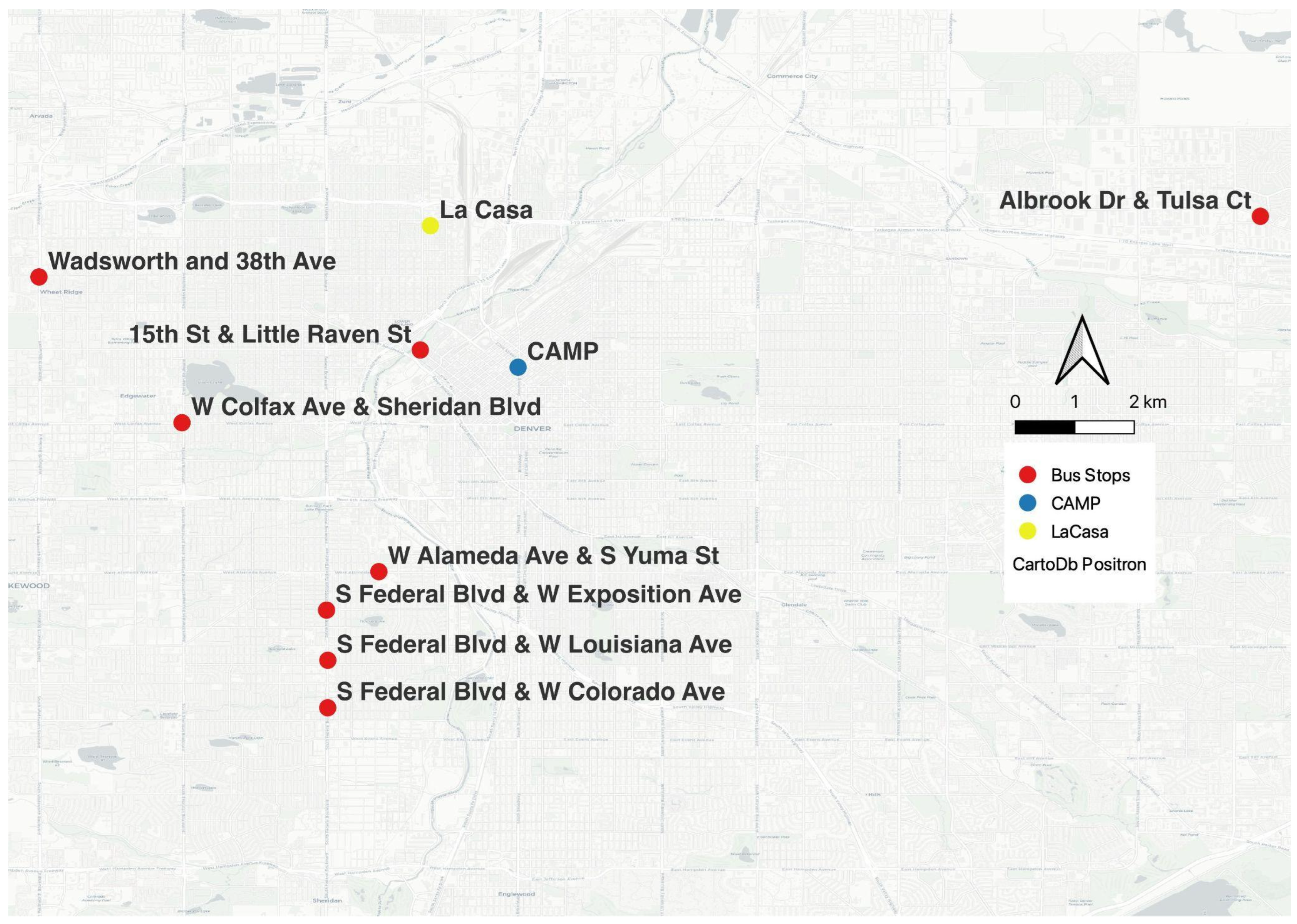
We deployed 8 ultrasonic personal aerosol samplers (UPAS) at 8 different bus stops and one reference site, called CAMP (11 samples at 9 locations in all) in Denver, CO, for a week at a time between 28 July and 19 August 2023, to measure the chemical composition of PM2.5 (Figure 1). Volckens et al. (2017) [19] developed the low-cost UPAS (lightweight: ~220 g; compact: 128 × 70 × 23 mm; quiet: <55 dB) to overcome these limitations, combining a pump (~25 kHz), size-selective inlet, filter sampler, and mass-flow control system. A key advantage of the UPAS for this study is its use of a Li-ion battery and solar panels as an energy source. More details about the UPAS design can be found elsewhere [19,20,21].
We affixed the UPAS filters on poles on the sidewalk near each bus stop at a height of 6 ft (Figure S4.1). The UPAS is a time-integrated filter sampler that utilizes an ultrasonic piezoelectric pump to drive flow. The UPAS devices were fitted with a cyclone to collect only particles with diameters < 2.5 μm. All the UPAS samplers used 37 mm polytetrafluoroethylene (PTFE) membrane filters, as PTFE filters are less subject to gravimetric biases from relative humidity and static charge. Each filter was static-discharged and pre-weighed to the nearest microgram on an analytical microbalance following a 24 h equilibration period in a particle-free environment at controlled temperature (21 ± 3 °C) and relative humidity (35 ± 5%). Each filter was then stored in an air-tight cassette, labeled, and transported to/from Colorado State University (CSU) [22].
At the beginning of the weekly sampling period at each bus stop, we inserted the filter into the UPAS device. UPAS devices are controlled using a CSU-designed app that pairs all UPAS devices to a smartphone via Bluetooth. The app facilitates remote start/stop of each unit, setting of flow rate, and data logging to a removable SD card. Logged UPAS data included device flow rate at a 30 s resolution and battery charge. At the end of the sampling week, we removed the filter from each UPAS device and returned it to Colorado State University (CSU) for analysis. We inserted a new filter into the UPAS to measure PM composition for the subsequent week.
The CSU laboratory measured PM2.5 concentrations for each sample by subtracting the filter pre-weight from the filter post-weight to measure the total weight of aerosol collected, and then dividing this number by the total volume of air sampled (average flow rate × sampling duration). The composition of the aerosol collected was then analyzed. More details are provided in the subsequent section. We also paired each UPAS sampling filter with a field-blank filter that did not have any air drawn through it during deployment. For each of these filters, the CSU laboratory measured the difference between post-weight and pre-weight. The limit of detection in the gravimetric analysis of the filters was defined as the mean mass change for the blank filter plus three times the standard deviation of that change, as previous research using the UPAs has done [22]. None of the PM2.5 measurements in our study were below the detection limit.

2.3. Determination of Particulate Matter Composition

A high-throughput robotic system (AIRLIFT [21]) designed and deployed at CSU was used to analyze the samples collected on 37 mm Teflon filters. Briefly, the filters were weighed with an analytical microbalance with a resolution of 1 μg to estimate PM2.5 levels. The AIRLIFT system was then used to estimate black carbon (BC) concentrations using a Magee Scientific SootScan (OT21 Magee Scientific, Berkeley, CA, USA) instrument via an optical technique that measures the transmission and absorption of light at 880 nm.
Concentrations of elements (Na, Mg, Al, Si, P, S, Cl, K, Ca, Ti, Cr, Mn, Fe, Ni, Cu, Zn, Ga, As, Se, Sr, Zr, Pb, Cd, In, Sn, Sb, Te, I) were measured using X-ray fluorescence (XRF) at CSU for each filter. Uncertainties in the concentration of different elements from the XRF analysis are related to their elemental properties, the mass areal density of the element present in each sample, and the matrix effects of the combination of elements [23]. Due to high concentrations of F being present in the blank filters, we excluded this species from our analysis. The laboratory also noted that Na and Cl were found in high quantities and were found to be highly variable between filters. The XRF technique yielded the μg/cm2 of each element present on each filter. We calculated the concentration of each element using Equation (1):
M a s s   C o n c e n t r a t i o n   ( μ g / m 3 )   = π × d i a m e t e r   ( m ) 2 4 × C o n c e n t r a t i o n   f r o m   X R F   ( μ g / m 2 ) f l o w   r a t e   ( m 3 / d a y )   ×   s a m p l i n g   t i m e   ( d a y )
where the diameter of each filter was 37 mm (37 × 10−3 m). Each UPAS device reported the average flow rate, which was ~0.95 L/min (1.368 m3/day) in our study; the sampling time was 7 days, except in cases where the UPAS shut down before the end of the week due to power issues. Table 1 provides the start and end times of each UPAS measurement.
We derived sulfate concentrations from the filter samples using a well-established methodology that assumes that all elemental sulfur is present in the form of ammonium sulfate (NH4)2SO4 [24]. The multiplicative molar conversion factor (mcf) for sulfur to ammonium sulfate is determined by multiplying the molecular mass of the ammonium sulfate molecule by the measured mass of sulfate, which is 4.125. In brief, we derived sulfate concentrations as 4.125 × sulfur concentrations.

2.4. U.S. EPA’s Chemical Speciation Network (CSN): La Casa Site in Denver, Colorado

As part of the U.S. EPA’s Chemical Speciation Network (CSN), long-term chemical speciation for PM2.5 is monitored nationwide. Analyses are performed in central facilities using uniform procedures applied to all samples. In this study, data from 2023 were retrieved from the La Casa site (Figure 1) in the general sampling area used to make the UPAS measurements. Composition measurements were made every three days, and we retrieved a total of 121 days’ worth of measurements at this site. Details of the sampling, data handling, analyses, and quality assurance have been extensively reported elsewhere [25]. Samples were collected every third day and analyzed for elemental carbon (EC) and organic carbon (OC) by thermo-optical analysis, major inorganic ions (Na+, K+, NH4+, NO3, SO42−) by ion chromatography, and elements with atomic number ≥ 11 by energy-dispersive X-Ray fluorescence (EDXRF) ([25] and references therein to EPA’s standard operating procedures and quality control documents). The carbonaceous fraction analyses were made using thermal optical reflectance (TOR) following the IMPROVE protocol. All data and their associated uncertainties and method detection limits (MDLs) are available from https://views.cira.colostate.edu/fed/, accessed on 20 August 2025.

2.5. Source Apportionment Analysis at the La Casa Site

Positive Matrix Factorization (PMF) is a weighted least-squares approach based on a receptor-only multivariate factor analytic model to solve bilinear deconvolution problems [26,27]. PMF inputs were prepared following previous research [28]. The U.S. Environmental Protection Agency Positive Matrix Factorization (EPA-PMF) software, version 5.0, was used [29]. Regulatory values of PM2.5 concentrations were used as the total variable in our analysis. Displacement (DISP) and bootstrap (BS, n = 100) analyses were used to investigate the profile uncertainties of the resulting solutions [27]. The DISP analysis provides an estimate of the rotational uncertainty in the resolved profiles. In contrast, the BS analysis provides an estimate of the effect of measurement uncertainties on the resolved profiles.
We assessed between 6 and 9 factors in the PMF analysis. The number of factors selected for each site depended on the quality of fits, as described by the distributions of scaled residuals, the convergence stability over 50 random starts, the interpretability of the resulting profiles, and the output of the BS diagnostics [30]. Since the performance of PMF is strongly dependent on estimated uncertainties, the uncertainties of species were further adjusted based on their signal-to-noise (S/N) ratio to avoid the influence of a noisy single species in the analysis. Species with an S/N ratio < 0.5 (‘bad’) were excluded, while the uncertainties for the species with S/N values in the range 0.5–1 (‘weak’) were increased by a factor of three. The PM2.5 (‘Total Variable’) mass uncertainty was set at four times the respective measurement values.

2.6. Combining the Positive Matrix Factorization (PMF) Results with the UPAS Measured Concentrations

Given the limited measurements during the UPAS field campaign, we did not run a PMF analysis on this dataset. Instead, we evaluated the contributions of the different factors/sources identified from running the PMF analysis at the La Casa site, at each site sampled with the UPAS devices. The common species between the Denver CSN site and the UPAS analyses were BC, Na, Cl, Al, Si, K, Ca, Mn, Fe, SO42−, and Zn (Table 1). The BC measured using the UPAS devices corresponded to the parameters EC1 + EC2 measured at the CSN site. We regressed the vector of the common elements from our filters (dependent variable) against the matrix of profiles extracted from the PMF analysis (independent variables) at each UPAS site to determine the contribution of different factors at each of our sampled locations. Equation (2) represents the model we used.
M e a s u r e d   C o m m o n   E l e m e n t i = j = 1 N β i j × C o m m o n   E l e m e n t i j + ϵ i j
where M e a s u r e d   C o m m o n   E l e m e n t i represents the mass concentration of the ith common species, Na, Cl, Al, Si, K, Ca, Mn, Fe, SO42− BC, and Zn, measured using the UPAS device. C o m m o n   E l e m e n t i j represents the fractional abundance (source profile) of the C o m m o n   E l e m e n t i in PMF Factorj. β i j represents the coefficients of interest or the mass contribution that source j makes at the bus stop (units: μg/m3). ϵ i j represents the residual from the regression model.
We ran stepwise regression models at each site, starting with all factors identified from the PMF analysis. If one or more factors were insignificant in our analyses, we reran the regression after removing the factor with the lowest t-score, and so on until only significant factors were retained. After performing these steps, we removed factors with coefficients < 0, even if they were significant, since it is physically impossible for a source to have a negative contribution to PM2.5 concentrations at a site. We report significant factors identified at the different sites and their contributions to PM2.5.
Due to the limited data, we retained constituent concentrations < detection limit (DL) in the main regression analyses. In supplementary analyses, we restricted the dataset used for the regression analyses to concentrations of PM components > DL to evaluate the robustness of our results. We used measured BC concentrations to qualitatively determine whether high BC concentrations occurred at sites with high contributions from traffic emissions, as expected.
Key assumptions embedded in this approach are:
(1)
The number of sources or source categories is less than or equal to the number of species considered, the chemical species do not react with each other, the source profiles identified from PMF are linearly independent of each other, and measurement uncertainties are random, uncorrelated, and normally distributed. All the assumptions captured in (1) hold in our specific study.
(2)
All sources with potential for contributing to the receptor have been identified and their emissions characterized. This assumption is likely to hold in our study, given the proximity (<10 km) of the bus stop locations and the La Casa CSN site (Figure 1).
(3)
The compositions of source emissions are constant over the period of ambient and source sampling at the bus stops. Although we have no way of testing this assumption, it is unlikely that the composition of emissions from key sources would change over a single year.
All statistical analyses were carried out using R 4.4.2. We assumed statistical significance for coefficients at the 95th percentile confidence interval (i.e., p-values associated with t coefficients < 0.05).

3. Results

Table 1 provides information on the concentrations of PM2.5 components at different bus stop locations in Denver, CO. We note that on four occasions, on cloudy days, the battery died, and the UPAS devices stopped working before the end of the week (Table 1).

3.1. Source Apportionment Analysis at the La Casa Site

Eight common anthropogenic sources were identified at the La Casa site: secondary sulfate (SS), secondary nitrate (SN), spark-ignition vehicle emissions (GAS), diesel vehicle emissions (DIE), road dust (RD), biomass burning (BB), organic particle (OP)-rich aerosol, and road salt (RS) (Table 2). Note that tire and brake wear are components of road dust. We distinguished between biomass burning and vehicle emissions based on the characteristics of each factor. For example, BB emissions are characterized by low elemental carbon and high organic carbon. Gasoline emissions are characterized by high elemental carbon and moderate organic carbon. Moreover, gasoline emissions have low K concentrations, unlike biomass burning. The OP-rich factor has previously been thought to represent aged secondary organic aerosol and distant large biomass burning events, such as wildfires. PMF provided good fits to the measured concentrations with relatively high coefficients of determination: ~73% for total PM2.5; >90% for Al, NH4+, Ca, Fe, NO3, K, Si, Na+, and SO42−; moderate coefficients ranging between 40 and 60% for EC, OP, and OC; and weak coefficients of determination (~30%) for Cl and Mn. Diagnostics from the displacement (DISP) and bootstrap analyses are included in Section S2 of the SM.
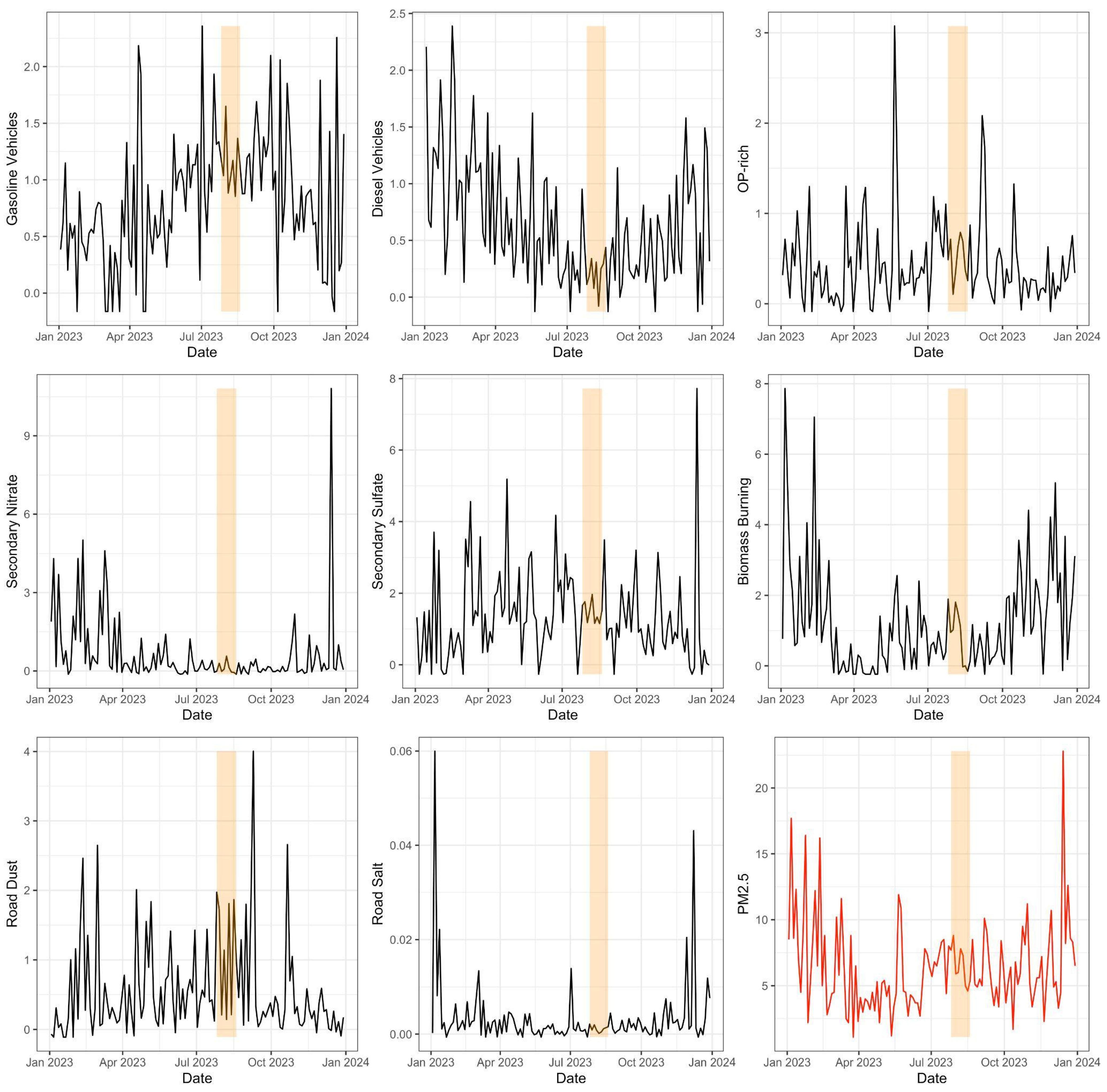
Plots of the contributions of the different sources over 2023 are provided in Figure 2. SS, BB, GAS, SN, DIE, RD, OP-rich aerosol, and RS contributed 23.7%, 21.3%, 14.5%, 11.4%, 11.3%, 9.9%, 7.7%, and 0.06% to total PM2.5 concentrations at the La Casa site, respectively. We note that several sources exhibited seasonal variation. RS mainly peaks in the winter when salt is used to prevent ice from developing on roads. The formation of particle NO3 from gaseous ammonia and nitric acid is favored at lower temperatures and higher humidity, which is likely why SN is low in the summertime. Overall, we observed higher PM2.5 concentrations in the winter than in the summer at the La Casa site, likely related to strong temperature inversions in the winter and potentially increased BB (biomass burning) (Figure 2).
Each row in Table 1 corresponds to the dependent variable vector used in the site-specific regressions displayed in Equation (2). The matrix of source profiles (% of species in different factors) depicted in Table 2 corresponds to the independent variables in Equation (2).

3.2. Evaluating the Contributions of Different Sources at the UPAS Sampling Sites

All UPAS sampling locations (except for the regulatory site, CAMP; Figure 1) were at busy bus stops. Since the contribution of RS and SN was ~0 in July and August 2023, when the UPAS sampling occurred (Figure 2), we did not include these sources in our regression analyses. Results from regressing the fractional abundance of a given species in each factor (dependent variable) against the common chemical species identified in our sample are displayed in Table 3. The coefficients provided in Table 3 represent the contribution of a given source to overall PM2.5 concentrations at each UPAS site.
The model fit from each site-specific regression had an R2 > 0.70, except at CAMP between 4 August and 11 August 2023 (R2 = 0.35) and between 11 August and 19 August 2023 (R2 = 0.22), and W Alameda and S Yuma St (R2 = 0.50) (Table 3). The high R2 values support our assumption that the sources identified at the La Casa site are representative of those at the bus stops. The significance of the gasoline emission factor or source observed indicates that traffic emissions are a major source of PM2.5 at all sites. Specifically, at all bus stop locations (excluding CAMP), gasoline emissions contributed ~3–6.6 μg/m3, or 45–65%, of PM2.5 concentrations. Secondary sulfates contributed to the remaining PM2.5 concentrations and ranged between 3 and 5 μg/m3 at all sites. The highest contribution of gasoline emissions occurred at Wadsworth and 38th Ave ~6.6 μg/m3 and at Albrook Dr and Tulsa Ct ~5.0 μg/m3. The relatively high BC (a marker of incomplete combustion and traffic emissions) concentrations relative to PM2.5 concentrations at the bus stop locations support our findings of the substantial contribution of traffic emissions to overall PM2.5 concentrations (Table 1).
When repeating our analysis using only PM component concentrations that were >DL (Table S3.1), we observed similar results at all sites, except at W Alameda and S Yuma Street, compared to those observed in the main analysis. Traffic emissions did not appear to significantly contribute to PM2.5 concentrations at W Alameda Ave and S Yuma Street (Table 3). However, when restricting elements to those with concentrations > DL, we observed that traffic contributed ~ 53% of PM2.5 concentrations measured at the site, and the model fit was good (R2 = 0.82) (Table S3.1).
The sources identified from the PMF analysis did not explain 65% and 78% of the variance in PM2.5 concentrations at the reference CAMP site between 28 July and 4 August 2023, and between 4 August and 11 August 2023 (Table 3). Indeed, none of the source factors were significant at a 95% confidence interval at the CAMP site between 11 August and 19 August 2023. This could be because a unique PM2.5 source was active close to this site during this period. We also note that concentrations of all PM2.5 constituents are an order of magnitude lower than at other sites (Table 1). Given the low model fit at CAMP during these periods, the results have high uncertainties. Gasoline emissions, however, were a significant contributor to PM2.5 concentrations at the CAMP site between 4 August and 11 August 2023 (Table 3), and the model fit observed during this period was good. This suggests that more traffic was present during this period than in the subsequent ones at this site.

4. Discussion

Like other studies conducted in Denver, we found that PM2.5 from secondary aerosol (sulfates) substantially contributes to PM2.5 concentrations at the different bus stops [9,10,11,12,13,14,15]. Previous studies have found that secondary organic aerosol represents as much as 80% of PM2.5 measured in Denver [9,14], with traffic accounting for the remaining ~20–30%. As sharp gradients in PM concentrations are typically observed near roadways [31,32,33], we unsurprisingly observed that traffic emissions contribute substantially more, ~45–65%, to PM2.5 concentrations at near-road bus stop locations (Table 3). The lowest PM2.5 concentrations were observed at the CAMP site compared to bus stops, as it is not near a busy road, and located on the second floor of a building ~ 10m away from the road, buffered by some green space (Figure S4.2; Table 1).
The contribution of secondary organic aerosol at each bus stop was uniform across all sites (3–5 μg/m3). However, we did observe some differences in the contribution of gasoline emissions at bus stops, with substantially higher PM2.5 concentrations from traffic (6.6 μg/m3) at Wadsworth and 38th Ave. The high concentrations observed are likely due to a major gas station located at the intersection. Traffic emissions also contributed substantially at Albrook Dr and Tulsa Ct (5.0 μg/m3). A busy car wash is present at this intersection, which attracts a lot of traffic and is likely the reason for the high PM2.5 concentrations observed at this site (Table 3).
The Regional Transportation District (RTD)’s bus fleet runs on diesel. However, we did not observe significant contributions of diesel to PM2.5 concentrations at any of the bus stops during our campaign. This result could be because RTD buses represent a small fraction of the vehicle mix on the streets where the bus stops in our limited sample were located. Our results suggest that mitigating overall traffic by providing more public transit options is an effective way to reduce PM2.5 concentrations at all bus stops in Denver.
Low-income, minority Denver residents are much more likely to use the bus and spend time at bus stops than high-income, White residents, who are more likely to travel by car [7]. Our study showed that these vulnerable populations experienced high BC concentrations (>1.5 μg/m3) from gasoline emissions when waiting at bus stops. Prior research has shown that exposure to traffic-related pollution tends to be higher when taking the bus than when using cars with controlled ventilation settings [34,35,36]. Therefore, it is likely that the mode of transportation is a key driver of inequities in exposure to traffic-related PM2.5 concentrations in Denver. More research is needed to assess how effective transportation is as a driver of exposure inequalities compared to other drivers, such as residential segregation. Given the serious health impacts of exposure to traffic-related emissions and given that low-income and minority Americans are more susceptible to the health risks of pollution [37], steps need to be taken to mitigate high BC concentrations at bus stops. For example, previous studies have shown that building enclosed bus stops with air purifiers has resulted in substantial decreases in traffic-related pollution concentrations [38,39]. RTD can consider implementing such mitigation measures. We also found that higher PM2.5 concentrations from gasoline emissions were observed at bus stops close to key sources such as gas stations, putting commuters who spend time at these stops at greater health risks. Our work highlights the importance of mitigating such sources by either relocating bus stops away from such sources or prioritizing the implementation of air purification at these bus stop locations.
This study has several limitations. Although we monitored PM2.5 components at only a small number of bus stops in this study, our results suggest that gasoline emissions are an important contributor to PM2.5 concentrations at bus stops in Denver. We only measured concentrations of PM2.5 components in a single season. Future research should extend our datasets to other times of the year where meteorological conditions may be different, which might impact the relative contributions of regional and local emissions to PM2.5 concentrations. The measurements of the PM constituents from the UPAS filters have several uncertainties. The Cl measurements from the UPAS are known to be highly variable. These uncertainties can impact our results. However, our findings were robust to dropping measurements of PM components < DL (most of which were Cl values). Finally, although the La Casa site was in our study region (Figure 1), the chemical characteristics of the sources affecting the UPAS measurements at bus stops may be different. However, this possibility is unlikely since all our sites were within 10 km of the La Casa site, and there were no obvious local sources. Importantly, the goal of this study was to identify the contribution of traffic emissions to PM2.5, a key concern in the field of urban sustainability, and that was one of the factors we were able to identify at the La Casa site.

Supplementary Materials

The following supporting information can be downloaded at https://www.mdpi.com/article/10.3390/su17177707/s1, Section S1: Summary of Previous Source Apportionment Research in Denver, CO. Section S2: Bootstrap Diagnostics from the PMF analysis. Table S2.1: Mapping of Bootstrap factors to base factors where number of bootstrap runs: 100, min correlation R-value: 0.6. Table S2.2: Variability in factor strengths based on bootstrap. Table S3.1: Contribution of each source/factor (95% CI) obtained from the PMF analysis to PM2.5 concentrations. The % contribution of each factor to total PM2.5 concentrations is also provided. Contributions were derived from regressing the vector of concentrations of the common species collected on the UPAS filters (dependent variable) against the matrix of source profiles (independent variables) at each site, using Equation (2) to determine the contribution of different factors at our sampled locations. The coefficient of determination (R2), or goodness of fit of each regression model, is also noted. Only concentrations of PM components > detection limit were used in these regression analyses. Figure S4.1: Image of a UPAS device deployed at a bus stop in Denver, CO. Figure S4.2: CAMP regulatory site in Denver, CO. References [40] are cited in the Supplementary Materials.

Author Contributions

Conceptualization, All authors; Methodology, P.d., P.H., P.C.I. and J.V.; Validation, P.H.; Formal analysis, P.d.; Investigation, P.d.; Resources, P.d. and P.C.I.; Data curation, P.d., C.L., B.G., B.C., R.M., S.P. and J.V.; Writing—original draft, P.d.; Writing—review & editing, all authors.; Supervision, P.d. and P.C.I.; Project administration, P.d. and C.G.J.; Funding acquisition, P.d. and P.C.I. All authors have read and agreed to the published version of the manuscript.

Funding

This study was funded by a NASA ROSES award EEJ21-0064.

Institutional Review Board Statement

Not applicable.

Informed Consent Statement

Not applicable.

Data Availability Statement

All data are provided within the article and the Supplementary Materials.

Acknowledgments

We are grateful to Marianthi Kioumourtzoglou for insightful comments on a draft of this article. Any use of trade, fiem, or product names is for descriptive pruposes only and does not imply endorsement by the U.S. government.

Conflicts of Interest

The authors declare no conflict of interest.

References

  1. Matz, C.J.; Egyed, M.; Hocking, R.; Seenundun, S.; Charman, N.; Edmonds, N. Human Health Effects of Traffic-Related Air Pollution (TRAP): A Scoping Review Protocol. Syst. Rev. 2019, 8, 223. [Google Scholar] [CrossRef]
  2. Debelu, D.; Mengistu, D.A.; Aschalew, A.; Mengistie, B.; Deriba, W. Global Public Health Implications of Traffic Related Air Pollution: Systematic Review. Environ. Health Insights 2024, 18, 11786302241272403. [Google Scholar] [CrossRef]
  3. Boogaard, H.; Patton, A.P.; Atkinson, R.W.; Brook, J.R.; Chang, H.H.; Crouse, D.L.; Fussell, J.C.; Hoek, G.; Hoffmann, B.; Kappeler, R.; et al. Long-Term Exposure to Traffic-Related Air Pollution and Selected Health Outcomes: A Systematic Review and Meta-Analysis. Environ. Int. 2022, 164, 107262. [Google Scholar] [CrossRef] [PubMed]
  4. Dons, E.; Panis, L.I.; Van Poppel, M.; Theunis, J.; Willems, H.; Torfs, R.; Wets, G. Impact of Time–Activity Patterns on Personal Exposure to Black Carbon. Atmos. Environ. 2011, 45, 3594–3602. [Google Scholar] [CrossRef]
  5. Borghi, F.; Spinazzè, A.; Fanti, G.; Campagnolo, D.; Rovelli, S.; Keller, M.; Cattaneo, A.; Cavallo, D.M. Commuters’ Personal Exposure Assessment and Evaluation of Inhaled Dose to Different Atmospheric Pollutants. Int. J. Environ. Res. Public Health 2020, 17, 3357. [Google Scholar] [CrossRef]
  6. Patton, A.P.; Perkins, J.; Zamore, W.; Levy, J.I.; Brugge, D.; Durant, J.L. Spatial and Temporal Differences in Traffic-Related Air Pollution in Three Urban Neighborhoods near an Interstate Highway. Atmos. Environ. 2014, 99, 309–321. [Google Scholar] [CrossRef] [PubMed]
  7. Bardaka, E.; Hersey, J. Comparing the Travel Behavior of Affordable and Market-Rate Housing Residents in the Transit-Rich Neighborhoods of Denver, CO. Travel Behav. Soc. 2019, 15, 74–87. [Google Scholar] [CrossRef]
  8. Facilities and Fleet Transition Plan. Available online: https://www.rtd-denver.com/about-rtd/projects/facilities-and-fleet-transition-plan (accessed on 6 June 2025).
  9. Vedal, S.; Hannigan, M.P.; Dutton, S.J.; Miller, S.L.; Milford, J.B.; Rabinovitch, N.; Kim, S.-Y.; Sheppard, L. The Denver Aerosol Sources and Health (DASH) Study: Overview and Early Findings. Atmos. Environ. 2009, 43, 1666–1673. [Google Scholar] [CrossRef]
  10. Kim, S.-Y.; Dutton, S.J.; Sheppard, L.; Hannigan, M.P.; Miller, S.L.; Milford, J.B.; Peel, J.L.; Vedal, S. The Short-Term Association of Selected Components of Fine Particulate Matter and Mortality in the Denver Aerosol Sources and Health (DASH) Study. Environ. Health 2015, 14, 49. [Google Scholar] [CrossRef]
  11. Dutton, S.J.; Vedal, S.; Piedrahita, R.; Milford, J.B.; Miller, S.L.; Hannigan, M.P. Source Apportionment Using Positive Matrix Factorization on Daily Measurements of Inorganic and Organic Speciated PM2.5. Atmos. Environ. 2010, 44, 2731–2741. [Google Scholar] [CrossRef]
  12. Zhao, W.; Hopke, P.K.; Gelfand, E.W.; Rabinovitch, N. Use of an Expanded Receptor Model for Personal Exposure Analysis in Schoolchildren with Asthma. Atmos. Environ. 2007, 41, 4084–4096. [Google Scholar] [CrossRef]
  13. Clements, N.; Eav, J.; Xie, M.; Hannigan, M.P.; Miller, S.L.; Navidi, W.; Peel, J.L.; Schauer, J.J.; Shafer, M.M.; Milford, J.B. Concentrations and Source Insights for Trace Elements in Fine and Coarse Particulate Matter. Atmos. Environ. 2014, 89, 373–381. [Google Scholar] [CrossRef]
  14. Valerino, M.J.; Johnson, J.J.; Izumi, J.; Orozco, D.; Hoff, R.M.; Delgado, R.; Hennigan, C.J. Sources and Composition of PM2.5 in the Colorado Front Range during the DISCOVER-AQ Study. J. Geophys. Res. Atmos. 2017, 122, 566–582. [Google Scholar] [CrossRef]
  15. Afshar-Mohajer, N.; Shaban, M. Source Tracing of PM2.5 in a Metropolitan Area Using a Low-Cost Air Quality Monitoring Network: Case Study of Denver, Colorado, USA. Atmosphere 2024, 15, 797. [Google Scholar] [CrossRef]
  16. Dumelle, M.; Kincaid, T.; Olsen, A.R.; Weber, M. Spsurvey: Spatial Sampling Design and Analysis in R. J. Stat. Softw. 2023, 105, 1–29. [Google Scholar] [CrossRef] [PubMed]
  17. Regional Data Catalog. Available online: https://data.drcog.org/ (accessed on 16 March 2025).
  18. Harris, C. The 2020 Census; United States Census Bureau: Suitland, MD, USA, 2021.
  19. Volckens, J.; Quinn, C.; Leith, D.; Mehaffy, J.; Henry, C.S.; Miller-Lionberg, D. Development and Evaluation of an Ultrasonic Personal Aerosol Sampler. Indoor Air 2017, 27, 409–416. [Google Scholar] [CrossRef]
  20. Leith, D.; L’Orange, C.; Mehaffy, J.; Volckens, J. Design and Performance of UPAS Inlets for Respirable and Thoracic Mass Sampling. J. Occup. Environ. Hyg. 2020, 17, 274–282. [Google Scholar] [CrossRef]
  21. L’Orange, C.; Neymark, G.; Carter, E.; Volckens, J. A High-Throughput, Robotic System for Analysis of Aerosol Sampling Filters. Aerosol Air Qual. Res. 2021, 21, 210037. [Google Scholar] [CrossRef]
  22. Afshar-Mohajer, N.; Foos, R.; Ramachandran, G.; Volckens, J. Field Evaluation of the Ultrasonic Personal Aerosol Sampler (UPAS) for Respirable Dust Exposure in a Taconite Mine. Ann. Work Expo. Health 2021, 65, 127–135. [Google Scholar] [CrossRef]
  23. Rousseau, R.M. Detection Limit and Estimate of Uncertainty of Analytical XRF Results. Rigaku J. 2001, 18, 33–47. [Google Scholar]
  24. Alfeus, A.; Molnar, P.; Boman, J.; Hopke, P.K.; Wichmann, J. PM2.5 in Cape Town, South Africa: Chemical Characterization and Source Apportionment Using Dispersion-Normalised Positive Matrix Factorization. Atmos. Pollut. Res. 2024, 15, 102025. [Google Scholar] [CrossRef]
  25. Solomon, P.A.; Crumpler, D.; Flanagan, J.B.; Jayanty, R.K.M.; Rickman, E.E.; McDade, C.E. U.S. National PM2.5 Chemical Speciation Monitoring Networks—CSN and IMPROVE: Description of Networks. J. Air Waste Manag. Assoc. 2014, 64, 1410–1438. [Google Scholar] [CrossRef] [PubMed]
  26. Paatero, P. Least Squares Formulation of Robust Non-Negative Factor Analysis. Chemom. Intell. Lab. Syst. 1997, 37, 23–35. [Google Scholar] [CrossRef]
  27. Paatero, P.; Eberly, S.; Brown, S.G.; Norris, G.A. Methods for Estimating Uncertainty in Factor Analytic Solutions. Atmos. Meas. Tech. 2014, 7, 781–797. [Google Scholar] [CrossRef]
  28. Polissar, A.V.; Hopke, P.K.; Paatero, P.; Malm, W.C.; Sisler, J.F. Atmospheric Aerosol over Alaska: 2. Elemental Composition and Sources. J. Geophys. Res. Atmos. 1998, 103, 19045–19057. [Google Scholar] [CrossRef]
  29. Norris, G. Epa Positive Matrix Factorization (Pmf) 3.0 Fundamentals & User Guide; U.S. Environmental Protection Agency: Washington, DC, USA, 2008. Available online: https://www.epa.gov/air-research/positive-matrix-factorization-model-environmental-data-analyses (accessed on 6 July 2025).
  30. Brown, S.G.; Eberly, S.; Paatero, P.; Norris, G.A. Methods for Estimating Uncertainty in PMF Solutions: Examples with Ambient Air and Water Quality Data and Guidance on Reporting PMF Results. Sci. Total Environ. 2015, 518–519, 626–635. [Google Scholar] [CrossRef]
  31. Kinney, P.L.; Aggarwal, M.; Northridge, M.E.; Janssen, N.A.; Shepard, P. Airborne Concentrations of PM(2.5) and Diesel Exhaust Particles on Harlem Sidewalks: A Community-Based Pilot Study. Environ. Health Perspect. 2000, 108, 213–218. [Google Scholar] [CrossRef]
  32. Mukherjee, A.; McCarthy, M.C.; Brown, S.G.; Huang, S.; Landsberg, K.; Eisinger, D.S. Influence of Roadway Emissions on Near-Road PM2.5: Monitoring Data Analysis and Implications. Transp. Res. Part D Transp. Environ. 2020, 86, 102442. [Google Scholar] [CrossRef]
  33. Apte, J.S.; Messier, K.P.; Gani, S.; Brauer, M.; Kirchstetter, T.W.; Lunden, M.M.; Marshall, J.D.; Portier, C.J.; Vermeulen, R.C.H.; Hamburg, S.P. High-Resolution Air Pollution Mapping with Google Street View Cars: Exploiting Big Data. Environ. Sci. Technol. 2017, 51, 6999–7008. [Google Scholar] [CrossRef]
  34. Cepeda, M.; Schoufour, J.; Freak-Poli, R.; Koolhaas, C.M.; Dhana, K.; Bramer, W.M.; Franco, O.H. Levels of Ambient Air Pollution According to Mode of Transport: A Systematic Review. Lancet Public Health 2017, 2, e23–e34. [Google Scholar] [CrossRef]
  35. deSouza, P.; Lu, R.; Kinney, P.; Zheng, S. Exposures to Multiple Air Pollutants While Commuting: Evidence from Zhengzhou, China. Atmos. Environ. 2020, 247, 118168. [Google Scholar] [CrossRef]
  36. Good, N.; Mölter, A.; Ackerson, C.; Bachand, A.; Carpenter, T.; Clark, M.L.; Fedak, K.M.; Kayne, A.; Koehler, K.; Moore, B.; et al. The Fort Collins Commuter Study: Impact of Route Type and Transport Mode on Personal Exposure to Multiple Air Pollutants. J. Expo. Sci. Environ. Epidemiol. 2016, 26, 397–404. [Google Scholar] [CrossRef] [PubMed]
  37. Jbaily, A.; Zhou, X.; Liu, J.; Lee, T.-H.; Verguet, S.; Dominici, F. Air pollution exposure disparities across US population and income groups. Nature 2022, 601, 228–233. [Google Scholar] [CrossRef]
  38. Yoo, Y.; Kim, J.; Lee, J.; Cho, H. Air Quality Improvement at Urban Bus Stops: Optimal Air Purification Placement Using CFD. Sustain. Cities Soc. 2024, 117, 105937. [Google Scholar] [CrossRef]
  39. Yoo, Y.; Kim, J.; Ga, S.; Lim, J.; Kim, J.; Cho, H. Computational Fluid Dynamics-Based Optimal Installation Strategy of Air Purification System to Minimize NOX Exposure inside a Public Bus Stop. Environ. Int. 2022, 169, 107507. [Google Scholar] [CrossRef]
  40. Clements, N.; Piedrahita, R.; Ortega, J.; Peel, J.L.; Hannigan, M.; Miller, S.L.; Milford, J.B. Characterization and Nonparametric Regression of Rural and Urban Coarse Particulate Matter Mass Concentrations in Northeastern Colorado. Aerosol Sci. Technol. 2012, 46, 108–123. [Google Scholar] [CrossRef]
Figure 1. Location of UPAS measuring sites (bus stops and the regulatory CAMP site) as well as the La Casa regulatory site, which is part of the U.S. EPA Chemical Speciation Network.
Sustainability 17 07707 g001
Figure 2. Contributions of each factor (μg/m3) identified at the La Casa Site to total PM2.5 concentrations over time. The period over which we had UPAS measurements is highlighted in orange.
Sustainability 17 07707 g002
Table 1. Start and end dates of monitoring for each UPAS filter sample, and concentrations recorded for the common species of interest. BC concentrations recorded at each site are also listed. DL: detection limit. All samples were collected in 2023.
Common Elements Used in Regression Analysis (μg/m3)
Bus Stop LocationStartEndNaAlSiClKCaMnFeSO42−BC (μg/m3)
15th St and Little Raven St28 July
17:50
4 August
18:51
0.0990.340.91<DL0.170.320.00570.432.541.46
Albrook Dr and Tulsa Ct28 July
22:00
2 August
05:43
0.300.862.54<DL0.450.780.00980.783.362.16
S Federal Blvd and W Louisiana Ave28 July
18:30
4 August
18:33
0.0860.280.76<DL0.140.240.00820.662.432.43
CAMP (regulatory site)28 July 17:104 August
16:27
0.0480.200.64<DL0.140.280.00470.312.111.55
CAMP (regulatory site)4 August
16:30
11 August 15:250.00390.00330.14<DL0.0180.0460.00030.0440.150.66
S Federal Blvd and W Colorado Ave4 August
18:00
11 August
19:18
0.0750.270.82<DL0.1720.320.00730.652.461.47
W Alameda Ave and S Yuma St4 August
18:40
5 August
23:47
0.0890.120.85<DL0.1400.19 < DL0.362.261.86
W Colfax Ave and Sheridan Blvd11 August 18:1018 August 17:220.0670.140.47<DL0.1340.180.0030.252.332.13
CAMP
(regulatory site)
11 August
15:30
19 August
16:28
<DL0.00410.061<DL0.0070.034<DL0.0160.010.32
Wadsworth and 38th Ave11 August
19:30
18 August
17:22
0.191.053.120.240.530.9320.0171.082.662.50
S Federal Blvd and W Exposition Ave11 August
16:30
18 August
17:22
0.0710.250.75<DL0.170.300.0070.632.371.66
Table 2. Factor profiles as conc. of species in μg/m3 (% of species present in factor). Common species used in the regression analyses are highlighted in gray. BC is estimated as the sum of EC1 and EC2.
Gasoline VehiclesDiesel VehiclesOP-RichSecondary NitrateSecondary SulphateBiomass BurningRoad DustRoad Salt
Factor 1Factor 2Factor 3Factor 4Factor 5Factor 6Factor 7Factor 8
Total Variable0.82
(14.5%)
0.64
(11.3%)
0.43
(7.7%)
0.64
(11.4%)
1.33
(23.7%)
1.20
(21.3%)
0.55
(9.9%)
0.0032
(0.06%)
Al0.0054
(7.3%)
0
(0%)
0
(0%)
0.00052
(0.7%)
0.0066
(8.9%)
0.00092
(1.2%)
0.058
(77.6%)
0.0032
(4.4%)
NH4+0
(0%)
0
(0%)
0
(0%)
0.17
(75.5%)
0.053
(24.1%)
0
(0%)
0.00081
(0.4%)
0
(0%)
CA0.017
(20.4%)
0.0025
(2.9%)
0.0027
(3.2%)
0.0014
(1.6%)
0.0016
(1.9%)
0.0036
(4.2%)
0.053
(61.5%)
0.0036
(4.2%)
EC1 TOR (REV) = EC1 TOR − OP0.13
(27.1%)
0
(0%)
0.035
(7.6%)
0.075
(16.1%)
0.024
(5.1%)
0.21
(44.2%)
0
(0%)
0
(0%)
EC2 TOR0.046
(37.5%)
0.051
(41.4%)
0.012
(9.4%)
0
(0%)
0.013
(10.6%)
0
(0%)
0.0014
(1.1%)
0
(0%)
OP TOR0
(0%)
0.0059
(3.1%)
0.12
(64.3%)
0.011
(5.9%)
0.051
(26.6%)
0
(0%)
0
(0%)
0
(0%)
Cl0.00031
(6.4%)
0
(0%)
0
(0%)
0
(0%)
0
(0%)
0.0018
(36.5%)
0.0025
(52.4%)
0.00023
(4.7%)
OC1 TOR0
(0%)
0.0065
(23.3%)
0
(0%)
0
(0%)
0.0045
(16.0%)
0.016
(56.5%)
0
(0%)
0.0012
(4.2%)
OC2 TOR0.19
(35.6%)
0.024
(4.6%)
0.12
(22.8%)
0.040
(7.6%)
0.049
(9.3%)
0.090
(17.1%)
0.0084
(1.6%)
0.0081
(1.5%)
OC3 TOR0.24
(40.2%)
0
(0%)
0.18
(29.5%)
0.048
(7.9%)
0
(0%)
0.099
(16.4%)
0.031
(5.1%)
0.0057
(0.9%)
OC4 TOR0.12
(41.3%)
0.043
(15.3%)
0.023
(8.1%)
0.010
(3.6%)
0.030
(10.9%)
0.049
(17.4%)
0.0085
(3.0%)
0.00078
(0.3%)
Fe0.026
(20.8%)
0.0045
(3.6%)
0
(0%)
0.0047
(3.7%)
0.0045
(3.6%)
0.025
(20.4%)
0.055
(44.4%)
0.0044
(3.5%)
Mn0.000329
(17.2%)
0.000225
(11.7%)
0.000137
(7.2%)
0.000069
(3.6%)
0
(0%)
0.00011
(5.7%)
0.00090
(46.7%)
0.00015
(7.9%)
NO30
(0%)
0.50
(39.4%)
0
(0%)
0.66
(51.8%)
0
(0%)
0.11
(8.6%)
0
(0%)
0.0025
(0.2%)
K0
(0%)
0
(0%)
0.011
(20.2%)
0
(0%)
0.0072
(13.3%)
0.014
(25.2%)
0.022
(41.3%)
0
(0%)
Si0.032
(14.5%)
0
(0%)
0.013
(6.0%)
0
(0%)
0.010
(4.6%)
0
(0%)
0.16
(71.6%)
0.0072
(3.3%)
Na+0
(0%)
0.0016
(3.6%)
0.0019
(4.4%)
0.0030
(6.8%)
0.0011
(2.5%)
0
(0%)
0
(0%)
0.036
(82.6%)
SO40.033
(6.4%)
0.077
(15.2%)
0
(0%)
0.014
(2.8%)
0.33
(65.3%)
0.0022
(0.4%)
0.028
(5.4%)
0.022
(4.4%)
Zn0.0018
(22.1%)
0.0010
(12.7%)
0
(0%)
0.00070
(8.8%)
0.00023
(2.9%)
0.0026
(33.2%)
0.0013
(16.4%)
0.00030
(3.8%)
Table 3. Contribution of each source/factor (95% CI) to PM2.5 concentrations obtained from the PMF analysis. The % contribution of each factor to total PM2.5 concentrations is also provided. Contributions were derived from regressing the vector of concentrations of the common species collected on the UPAS filters (dependent variable) against the matrix of source profiles (independent variables) at each site, using Equation (2) to determine the contribution of different factors at our sampled locations. The coefficient of determination (R2), or goodness of fit of each regression model, is also noted. The contribution of Secondary Nitrate (Factor 4) and Road Salt (Factor 8) were negligible during UPAS operation and were not used in the regression analyses. These columns were greyed out.
Bus Stop Name/LocationGasoline Vehicles
Factor 1
(μg/m3)
Gasoline Vehicles
Factor 1 (% Contribution to PM2.5)
Diesel Vehicles
Factor 2
(μg/m3)
OP-Rich
Factor 3
(μg/m3)
Secondary Nitrate
Factor 4
(μg/m3)
Secondary Sulfate
Factor 5
(μg/m3)
Secondary Sulfate
Factor 5 (% Contribution to PM2.5)
Biomass Burning
Factor 6
(μg/m3)
Road Dust
Factor 7
(μg/m3)
Road Salt
Factor 8
(μg/m3)
W Colfax Ave and Sheridan Blvd
(R2 = 0.74)
2.8
(0.2, 5.4)
46.7%-- 3.2
(1.4, 5.1)
53.3%---
CAMP
28 July–4 August
(R2 = 0.83)
2.4
(0.6, 4.2)
45.3%-- 2.9
(1.7, 4.2)
54.7%--
CAMP
4 August–11 August
(R2 = 0.35)
1.0
(0.1, 1.8)
100%-- ----
CAMP
11 August–19 August
(R2 = 0.22)
0.4 (p = 0.08)
(−0.1, 0.9)
100%-- ----
15th St and Little Raven St
(R2 = 0.88)
2.5
(0.8, 4.2)
41.0%-- 3.6
(2.4, 4.8)
59.0%--
S Federal Blvd and W Colorado Ave
(R2 = 0.89)
2.6
(1.0, 4.3)
42.6%-- 3.5
(2.3, 4.6)
57.4%--
Wadsworth and 38th Ave
(R2 = 0.72)
6.6
(2.4, 10.8)
64.1%-- 3.7
(0.7, 6.7)
35.9%-
Albrook Dr and Tulsa Ct
(R2 = 0.79)
5.0
(1.5, 8.6)
51.0% 4.8
(2.3, 7.3)
49.0%
S Federal Blvd and W Louisiana Ave
(R2 = 0.77)
3.8
(1.1, 6.5)
53.5%-- 3.3
(1.4, 5.3)
46.4%--
W Alameda Ave and S Yuma St
(R2 = 0.50)
- -- 3.6
(1.1, 6.1)
100%--
S Federal Blvd and W Exposition Ave
(R2 = 0.86)
2.8
(1.0, 4.7)
45.9%-- 3.3
(2.0, 4.6)
54.1%--
Disclaimer/Publisher’s Note: The statements, opinions and data contained in all publications are solely those of the individual author(s) and contributor(s) and not of MDPI and/or the editor(s). MDPI and/or the editor(s) disclaim responsibility for any injury to people or property resulting from any ideas, methods, instructions or products referred to in the content.