1. Introduction
Faced with intensifying climate change, ecological degradation and economic instability, governments are under increasing pressure to shift towards sustainable development models. The global urgency to act is reinforced by recent data from the World Meteorological Organisation [
1] and Climate Watch [
2], which highlight the concentration of climate impacts and environmental losses in a small number of high-emitting nations. This context has positioned the green transition not only as a mitigation imperative but also as a strategic opportunity for economic transformation and long-term resilience.
Green innovation (defined as the development and implementation of technologies that reduce environmental impacts and increase resource efficiency) has emerged as a central pillar of sustainability-oriented strategies [
3,
4]. Countries that invest in green R&D, renewable energy infrastructure and innovation capacity are seen as being better positioned to compete in emerging global markets shaped by environmental concerns [
5,
6]. At the same time, the circular economy, the European Green Deal and other systemic frameworks have sought to align industrial competitiveness with climate goals [
7,
8].
Despite this progress, significant gaps remain in understanding the macroeconomic effects of green innovation. Much of the existing literature focuses on firm-level competitiveness, technology diffusion, or environmental performance [
9,
10,
11,
12,
13,
14]. Few studies have investigated how national innovation strategies interact with export dynamics and resilience in countries with varying sustainability profiles [
15,
16]. Furthermore, the short-term consequences of investment in renewable energy (such as high costs, regulatory delays and system inefficiencies) are often overlooked in macroeconomic analyses [
17,
18].
This article addresses this gap by exploring how national green innovation and renewable energy strategies influence economic competitiveness and sustainable development outcomes. The central research question is the following: How do national green innovation and renewable energy strategies affect competitiveness and economic resilience in the transition to sustainability?
To answer this question, 14 countries are analysed, divided between the most sustainability-oriented economies and the most fossil fuel-based economies, using multiple linear regression models. Three hypotheses are tested regarding the effects of green innovation and investment on competitiveness, export performance and resilience to economic shocks. Despite the limited sample size, this exploratory study integrates macroeconomic and sustainability metrics in a comparative framework, contributing to ongoing debates.
The study aims to make three main contributions to the literature. First, it adopts a comparative macroeconomic perspective that integrates green innovation indicators (R&D expenditure, adjusted net savings, and renewable energy consumption) with measures of trade competitiveness, applied simultaneously to sustainability-oriented and fossil fuel-dependent economies. This dual-profile approach remains largely unexplored in existing research, which typically focuses on advanced or emerging economies in isolation. Second, it identifies and quantifies the role of adjusted net savings as a robust indicator of both growth and competitiveness, thereby linking environmental accounting to economic performance metrics. Third, the findings will challenge the prevailing assumption that investment in renewable energy consistently improves competitiveness in the short term, highlighting instead transition costs, institutional readiness, and technological maturity as decisive mediators. This combined picture offers a more nuanced understanding of how green innovation strategies influence national competitiveness during sustainability transitions.
The remainder of this article is structured as follows:
Section 2 presents a review of the literature on green innovation, national competitiveness and sustainability transitions.
Section 3 describes the methodology and data used.
Section 4 presents empirical results, followed by a discussion in
Section 5.
Section 6 concludes with policy implications and directions for future research, while
Section 7 presents the conclusions.
2. Literature Review
The literature on green innovation and national competitiveness has grown significantly in recent decades, reflecting the growing urgency of ecological transitions and the strategic importance of sustainability-oriented investments. This literature review section provides a critical overview of existing research on (
Section 2.1) the conceptual evolution of green innovation, (
Section 2.2) the relationship between innovation and national competitiveness, and (
Section 2.3) the role of sustainability transitions as systemic enablers of resilience.
2.1. Green Innovation: Definitions and Dimensions
Green innovation refers to the development and implementation of technologies, processes, or practices that reduce environmental damage while increasing resource efficiency [
19,
20]. Green innovation encompasses both incremental technological improvements and systemic changes in production and consumption patterns [
21]. Studies based on Schumpeter’s (1942) [
22] laid the foundations for innovation theory, while more recent work has extended these ideas to the domain of sustainability [
23,
24].
Empirical studies have linked green innovation to improved environmental outcomes, energy efficiency, and reductions in carbon emissions [
25,
26]. However, the economic benefits of green innovation (particularly at the macroeconomic level) are less uniformly documented, with some studies highlighting trade-offs, delays, and policy-related barriers [
27,
28].
2.2. Green Innovation and National Competitiveness
The relationship between green innovation and competitiveness has been analysed in various fields, including trade, business performance and macroeconomic indicators [
9,
29]. Countries that invest in clean technologies and sustainability-oriented industries have demonstrated comparative advantages in global markets, particularly in the export of environmental goods [
30,
31,
32].
However, competitiveness is a multidimensional concept that depends not only on technological progress but also on institutional factors such as the quality of governance, regulatory coherence and investment in human capital [
33,
34]. The transition to a competitive green economy, therefore, requires more than R&D as it requires policy alignment, stakeholder engagement and financial mobilisation [
35].
While several studies find a positive correlation between green investment and competitiveness [
36,
37], others note that, in the short term, countries may suffer losses in productivity or competitiveness due to high infrastructure costs, policy misalignment, or lack of absorption capacity [
38,
39].
2.3. Sustainability Transitions and Systemic Resilience
Sustainability transitions refer to long-term multidimensional transformations towards environmentally sustainable and socially inclusive systems [
40,
41]. These transitions are typically characterised by complexity, uncertainty and high initial costs, but offer the potential for greater resilience to environmental and economic shocks [
42,
43].
The concept of resilience in this context refers to the ability of economies to absorb, adapt to and recover from external shocks, including climate change, energy price shocks or global health crises [
44,
45]. In this sense, Chen et al. [
46] defend that green innovation can contribute to resilience by promoting more diversified, low-carbon and technologically advanced economic structures.
Despite this potential, evidence on the immediate effects of green innovation on increasing resilience is mixed. Several studies point to delays in the return on green investments and difficulties in integrating renewable energies into existing industrial structures [
47,
48].
To clarify the conceptual boundaries of the study,
Table 1 compares definitions and applications of the key constructs examined: green innovation, green competitiveness, and sustainability transition.
2.4. Research Gaps
Although many studies highlight the strategic value of green innovation and its potential to reshape global competitiveness, few have examined this relationship through a comparative macroeconomic lens that integrates innovation, renewable energy, and export performance. Furthermore, empirical research tends to focus on dynamics at the firm level or policy frameworks, rather than analysing interactions at the national level between innovation, trade and resilience.
This article seeks to fill this gap by combining green innovation indicators (e.g., R&D, net savings), economic outcomes (e.g., competitiveness indices) and sustainability dimensions in a cross-sectional comparative framework. In doing so, it contributes to a more integrated understanding of how innovation-driven sustainability strategies can influence national competitiveness, both in advanced economies and in fossil fuel-based economies.
The study aims to answer the following hypotheses:
Hypothesis 1. Investment in green innovation increases national competitiveness in global markets.
Empirical studies suggest that environmentally oriented innovation contributes to tangible economic benefits, including job creation in green industries and a better position in the international market [
24,
45,
50]. The adoption of sustainability practices is increasingly recognised as a pillar of national economic stability [
51,
52].
On the other hand, several studies indicate that investment in renewable energy is associated with long-term economic growth, giving nations a competitive advantage in international markets over those that rely on traditional energy sources such as fossil fuels.
Hypothesis 2. Economies that prioritise investment in renewable energy achieve faster growth and greater global competitiveness compared to fossil fuel-based economies.
The ecological transition has emerged as a multidimensional driver of competitiveness, with investments in renewable energy correlated with increased global market influence and resilience to shocks [
11,
53]. Countries that adopt renewable technologies exhibit greater adaptability and lower vulnerability to resource volatility and climate impacts [
43,
44].
Finally, the adoption of green and sustainable strategies has been shown to promote business resilience, which, in turn, has been identified as a key factor in economic recovery in crisis scenarios, thus promoting greater long-term stability. However, a study based on a measurable and empirically traceable dependent variable is needed to confirm the relationship.
Hypothesis 3. Innovative green economies show greater resilience and faster recovery from global economic shocks than fossil fuel-based economies.
The ability of green economies to absorb and adapt to systemic shocks has become a critical research topic. Sustainability-oriented strategies have been linked to higher levels of organisational resilience and adaptability to crisis [
39,
54]. However, empirical validation is needed to determine whether macroeconomic recovery indicators—such as GDP growth after the shock—consistently reflect this advantage. Measuring economic resilience requires traceable and quantifiable indicators, especially considering the high upfront costs and delayed returns associated with ecological transitions [
41].
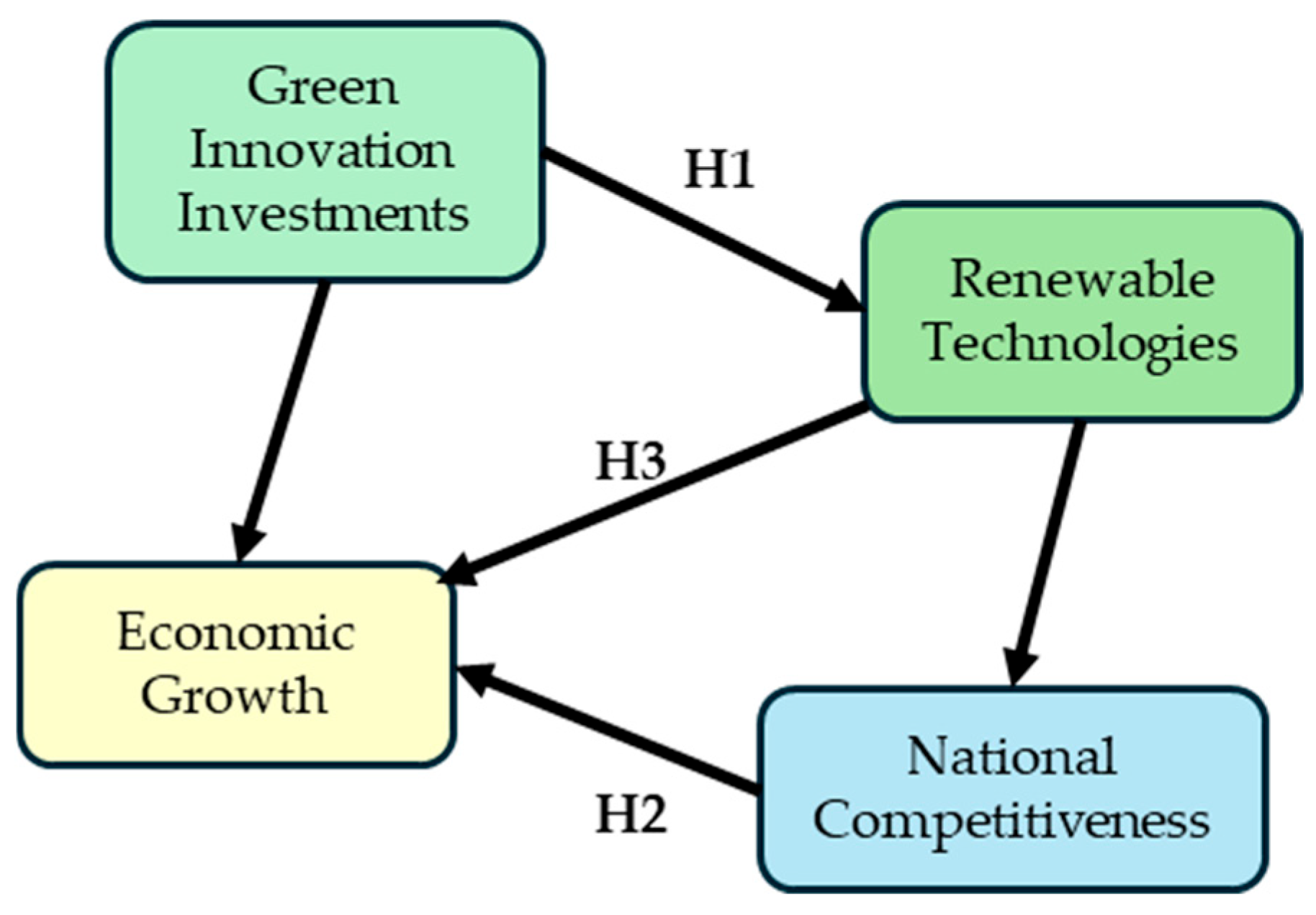
Based on the hypotheses established, this study proposes an analytical model to investigate the interactions between the main factors identified.
Figure 1 provides a simplified illustration of the relationships between the key elements highlighted in the literature and the hypotheses to be assessed during the study.
4. Results
This section presents the results of the multiple regression models developed to test the three hypotheses relating to ecological innovation, investment in renewable energy and national competitiveness. Given the exploratory nature of the study and the small sample size (N = 14), the results are interpreted with caution. The explanatory power (R2), statistical significance (p-values) and directionality of the coefficients are used to assess the strength and consistency of the relationships.
Hypothesis 1. Investment in green innovation enhances national competitiveness in global markets.
The first model assessed the relationship between R&D expenditure and the number of green patents filed. While the coefficient was positive (B = 1.072), the result was not statistically significant (
p = 0.140), suggesting a weak direct link (
Table 2).
In contrast, the second model showed that R&D expenditure significantly predicted the share of environmental goods in total exports (B = 4.378,
p < 0.001), explaining 71.9% of the variance (R
2 = 0.719). This indicates a strong contribution of innovation investment to environmentally oriented trade competitiveness (
Table 3).
The global competitiveness model initially included a broader set of predictors, including institutional and composite indices. However, given the small sample size, the model was simplified based on diagnostics of multicollinearity (Variance Inflation Factor), correlation structure, and predictor relevance. Although the model retains moderate explanatory power (R
2 = 0.652), the lack of statistically significant coefficients highlights the challenge of modelling complex sustainability interactions in small sample contexts (
Table 4).
Despite the model’s moderate explanatory power (R
2 = 0.652), none of the coefficients reached conventional levels of statistical significance. This result reflects the complexity of modelling interrelated sustainability factors in small samples, where variance is limited and multicollinearity is common. The insignificance of the predictors may also suggest that the effects of green innovation and renewable energy on competitiveness are highly context-dependent and mediated by institutional or structural factors. This reinforces the argument that ecological transitions are not linear processes and may require more nuanced and multilevel modelling frameworks [
40]. The results are consistent with previous studies showing that the outcomes of green innovation policies depend on institutional coordination and the maturity of green technology ecosystems [
41,
48]. Thus,
Table 4 highlights the need to combine quantitative indicators with institutional diagnostics when assessing sustainability transitions.
Hypothesis 2. Economies that prioritise renewable energy investments achieve faster growth and higher global competitiveness compared to fossil-fuel-based economies.
To test this hypothesis, adjusted net savings (with and without particulate emission damage) were used as proxies for renewable energy investments. The results showed that adjusted net savings excluding pollution costs positively affected GDP per capita growth (B = 7.564,
p < 0.001), while inclusion of pollution costs led to a negative effect (B = −7.473,
p < 0.001). Together, the variables explained 19% of growth variation (R
2 = 0.190) (
Table 5). The observed negative association between renewable energy consumption and sustainable competitiveness may reflect transitional challenges such as high initial infrastructure costs, inefficiencies in early adoption stages, or systemic institutional lag in integrating renewables into productive systems. These results underscore the importance of policy coherence, institutional readiness, and technology maturity as mediators of green transition outcomes, particularly in the short term.
Similarly, these variables explained 27.5% of the variance in the Global Competitiveness Index (R
2 = 0.275). Net savings excluding particulate emissions had a strong positive impact (B = 26.251,
p < 0.001), while including emissions resulted in a strong negative association (B = −26.392,
p < 0.001). These findings reinforce that cleaner investment portfolios contribute to growth and competitiveness, while environmental degradation undermines economic performance (
Table 6).
The findings of this analysis underscore the positive relationship between adjusted net savings (excluding particulate emission damage) and GDP per capita growth, thereby corroborating the conclusions of Djellouli et al. [
48]. This underscores the notion that investments in renewable energy are conducive to economic growth while concurrently reducing reliance on fossil fuels. The significant negative relationship for adjusted net savings including particulate emissions corroborates prior research [
3,
12,
48], indicating that environmental costs diminish competitiveness and economic performance.
It is noteworthy that while renewable energy fosters long-term growth, its short-term implementation costs may be a contributing factor to the observed complexity in global competitiveness analysis. Countries with a higher reliance on fossil fuels often exhibit competitive advantages due to established infrastructures, as noted by Wang et al. [
62].
Hypothesis 3. Green-innovative economies exhibit greater resilience and faster recovery from global economic shocks than fossil-based counterparts.
The third hypothesis examined the predictive capacity of renewable energy consumption and alternative/nuclear energy use on GDP growth and global sustainable competitiveness. Neither variable significantly predicted GDP growth, with coefficients near zero (
p > 0.5). For sustainable competitiveness, renewable energy consumption was negatively associated (B = −0.604,
p = 0.001), while nuclear/alternative energy showed a non-significant positive trend (
Table 7).
The negative coefficient of renewable energy consumption, although not statistically significant in this model, contradicts previous assumptions about its role in increasing competitiveness. This result can be explained by transition costs, energy intermittency, and policy inconsistency during the early stages of decarbonisation [
47,
48]. It is also in line with the findings of Hermundsdottir and Aspelund [
20], who point out that the benefits of innovation may be delayed or uneven depending on the context.
When additional controls (Sustainable Innovation Index, trade balance) were added, model significance was preserved (F = 9.724,
p < 0.001), but explanatory power remained moderate (R
2 = 0.565). These findings suggest that green innovation does not guarantee short-term economic resilience and may even impose transitional costs that hinder immediate competitiveness gains (
Table 8).
The regression analysis for GDP per capita growth shows that the variables related to green innovation (such as renewable energy consumption and alternative and nuclear energy) do not significantly predict economic growth. However, the analysis for Global Sustainable Competitiveness reveals that renewable energy consumption has a significant negative impact, suggesting that increased renewable energy usage might be associated with reduced global competitiveness. This finding is at odds with the conclusions drawn by Hermundsdottir and Aspelund [
20] that green innovation enhances resilience. The observed negative association between renewable energy consumption and sustainable competitiveness may reflect transitional challenges such as high initial infrastructure costs, inefficiencies in early adoption stages, or systemic institutional lag in integrating renewables into productive systems. The significant negative relationship between renewable energy and sustainable competitiveness in
Table 8 deserves special attention. This reinforces that renewable energy, without supporting institutional and infrastructural systems, may fail to deliver short-term resilience benefits [
44]. The result corroborates a growing body of literature that warns against assuming linear benefits from green transition efforts, especially when analysed in isolation [
38,
41].
In contrast, alternative and nuclear energy have a non-significant positive relationship with competitiveness. The Sustainable Innovation Index does not contribute significantly to either model, indicating that other factors may be more influential in predicting both economic growth and global competitiveness.
In summary, the results suggest that while some sustainability investments generate measurable benefits in terms of competitiveness (e.g., R&D, green savings), others (notably renewable energy) may impose short-term performance penalties unless they are mediated by adequate governance and absorption capacity. These patterns deserve further exploration in the discussion that follows.
5. Discussion
The empirical results of this study provide mixed support for the proposed hypotheses. R&D expenditure and adjusted net savings show strong positive associations with competitiveness and sustainability outcomes, in line with previous research [
23,
25]. On the one hand, these results underscore the strategic importance of long-term investment in innovation. On the other hand, they reveal savings-oriented economic planning in support of environmental goods exports and national resilience.
However, contrary to expectations and existing assumptions, renewable energy consumption exhibited a negative association with indicators of competitiveness. This finding aligns with the transition cost hypothesis discussed by Hermundsdottir and Aspelund [
20] and Wang et al. [
62], which emphasise the role of high upfront infrastructure costs, intermittency challenges, and policy misalignment during early adoption stages. Similar transitional drawbacks are identified in Djellouli et al. [
48] for African economies and in Aydin and Degirmenci [
11] for EU countries. The present results suggest that without adequate governance frameworks, technological maturity, and grid integration capacity, renewable energy investment may not yield immediate competitive advantages. This underscores the importance of coupling renewable deployment with institutional reforms and targeted policy support to accelerate benefits.
These findings suggest that the benefits of adopting renewable energy are not automatic or immediate. Instead, they depend on factors such as policy alignment, technological maturity, and institutional capacity. In countries with weak governance or insufficient infrastructure, investments in renewable energy may not generate short-term competitiveness gains, despite their long-term benefits.
The disconnect between Hypothesis 3 and the empirical results further illustrates the need for caution in interpreting direct linear relationships between energy transition and resilience. While green energy may eventually increase systemic stability, the transition entails systemic shocks, economic costs, and institutional trade-offs [
41,
43].
Furthermore, the results indicate the importance of integrating multidimensional measures of sustainability and economic performance. Indicators such as adjusted net savings capture both environmental and economic dynamics, offering a more robust picture of resilience than conventional GDP metrics. This supports recent calls to incorporate ecological accounting into national planning [
33].
Finally, the relatively stronger performance of countries with coherent green strategies and innovation frameworks reinforces the importance of coordination across sectors, institutions, and policy levels. Fragmented or reactive approaches are less likely to generate competitiveness or sustainability dividends.
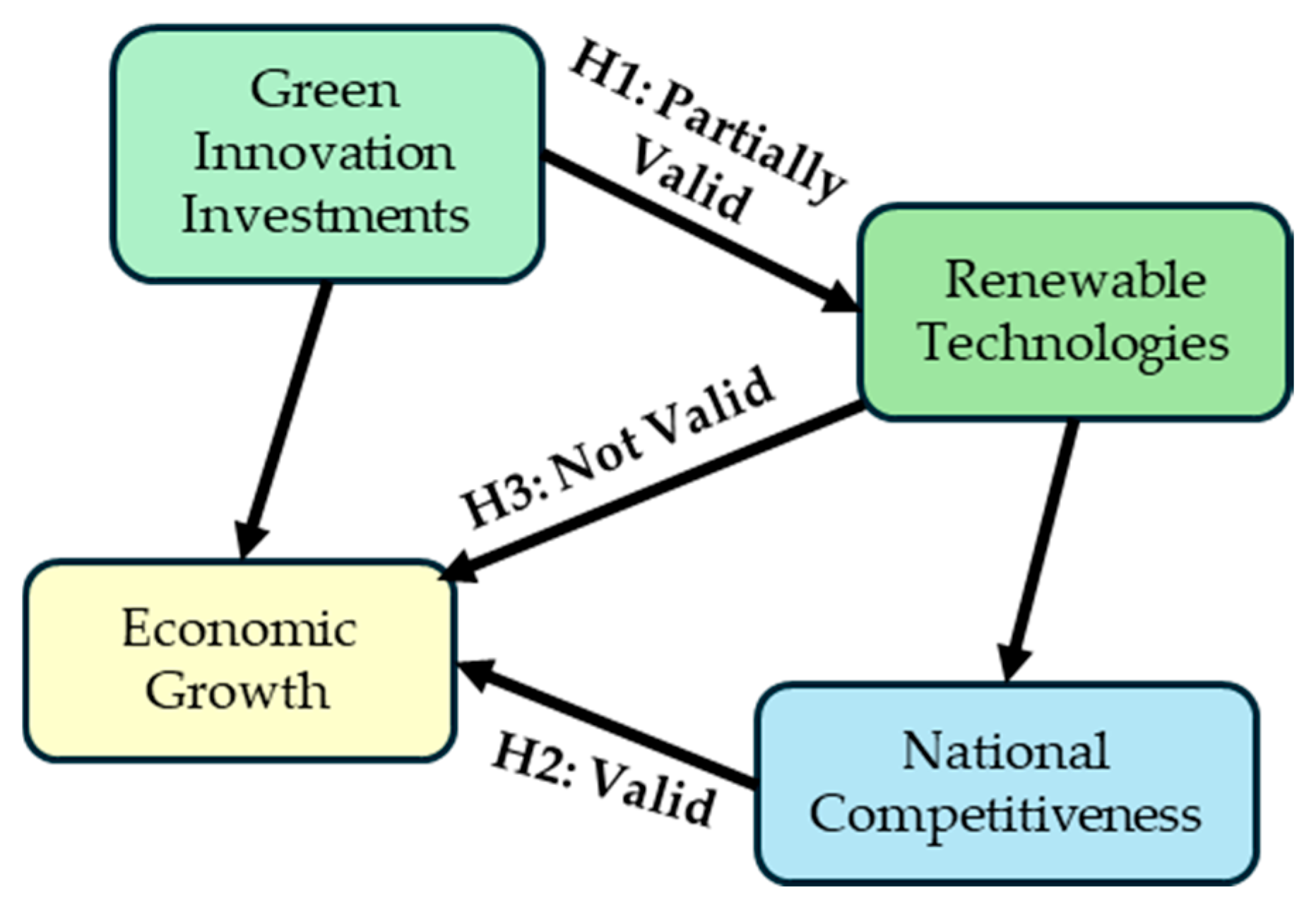
The results partially support H1, confirming the positive impact of R&D on green exports, but not on innovation output (patents). H2 is strongly supported by the role of adjusted net savings in explaining both GDP per capita and competitiveness. However, H3 is not supported, as renewable energy consumption does not significantly predict resilience-related outcomes. These results reveal the non-linearity and complexity of transition dynamics, reinforcing the need for multidimensional indicators and temporal analysis (
Table 9).
To transform these empirical insights into effective strategies,
Table 10 summarises the main findings of the study, together with strategic recommendations. This summary supports the formulation of evidence-based strategies to promote green competitiveness and the green transition.
Consequently, and by the evaluation of the results obtained, it is possible to incorporate the conclusions relating to the hypotheses studied (
Figure 2) into the research model:
6. Policy Implications and Future Research
The study has several implications for policymakers seeking to promote green competitiveness while managing the complexities of sustainability transitions.
First, policies should be designed to accommodate short-term trade-offs and transition costs. Governments should recognise that investments in renewable energy may not immediately improve competitiveness in the early stages. As such, policies should include transitional support, targeted subsidies and infrastructure planning that minimises economic disruption.
Second, investment in R&D remains a key pillar of competitiveness. Policies that encourage long-term innovation (especially in clean technologies, energy storage, and eco-efficient production) can help countries secure commercial advantages and build resilience.
Third, governments should strengthen institutional capacity to implement and monitor sustainability-oriented policies. This includes investing in regulatory quality, governance systems, and public–private collaboration platforms. Countries that align green innovation with export strategies and financial systems tend to perform better on competitiveness indices.
Fourth, the adoption of broader sustainability metrics (such as adjusted net savings) should be encouraged in national planning and policy evaluation. These indicators provide a more integrated perspective than GDP or carbon emissions alone.
Finally, strategies should be tailored to each country’s level of readiness. For countries in the early stages of transition, the focus should be on removing barriers to the adoption of green innovation. For more advanced economies, efforts can shift to scaling up successful models, exporting clean technologies, and incorporating circularity principles across all sectors.
For future research, studies should prioritise longitudinal and panel data projects to capture the dynamic nature of green transitions. In addition, comparative studies with larger samples and more granular data would help validate the relationships found here. The integration of institutional, behavioural, and regional variables could also offer deeper insight into what enables sustainable and competitive transformation.
7. Conclusions
This article analyses the relationship between national green innovation strategies and economic competitiveness in 14 countries with distinct and conflicting sustainability profiles. By combining indicators of R&D, renewable energy and sustainability savings with measures of export performance and resilience, the study offered an exploratory assessment of how innovation-oriented policies shape economic outcomes.
The results suggest that while R&D and adjusted net savings are positively associated with competitiveness, the effects of renewable energy investment are less direct. The negative association between renewable energy consumption and competitiveness highlights the importance of managing the transition carefully and recognising potential short-term losses. These results emphasise the need for integrated strategies that align innovation, policy and economic planning.
Although the study is limited by its cross-sectional design and small sample size, it contributes to a growing body of literature calling for a multidimensional understanding of sustainability transitions. It also points to the value of comparative frameworks that distinguish countries at different stages of green development.
In conclusion, the study demonstrates that not all green strategies deliver immediate economic benefits. While R&D expenditure and adjusted net savings consistently increase competitiveness, renewable energy consumption may involve short-term trade-offs unless accompanied by strong institutional capacity and technological readiness. policymakers should, therefore, design transition strategies that balance ambition and adaptability, integrating innovation policies, fiscal incentives and infrastructure planning. Such integrated approaches are more likely to ensure that green innovation functions not only as an engine of growth but also as a basis for long-term economic resilience.