Article

Can Registration System Reform Promote Corporate Sustainability? Evidence from China’s ESG Practices

1
School of Business, Qingdao University of Technology, Qingdao 266520, China
2
School of Economics and Management, China University of Petroleum (East China), Qingdao 266580, China
*
Authors to whom correspondence should be addressed.
Sustainability 2025, 17(17), 7624; https://doi.org/10.3390/su17177624
Submission received: 4 August 2025 / Revised: 21 August 2025 / Accepted: 22 August 2025 / Published: 23 August 2025

Abstract

The registration system reform (RSR) represents a landmark innovation in China’s IPO system, aiming to promote a more transparent, competitive, and sustainable market. Exploiting the staggered implementation of RSR as a quasi-natural experiment, we employ a difference-in-differences (DID) model using a sample of Chinese A-share IPO firms from 2016 to 2022 to investigate its impact on corporate sustainability, as proxied by environmental, social, and governance (ESG) performance. Our findings indicate that RSR significantly enhances corporate ESG performance, especially the governance (G) performance. Mechanism analysis suggests that market competition, investor rationality, and sponsor reputation are potential channels through which the reform facilitates corporate sustainability. Furthermore, the above relationship is more pronounced in regions with a higher degree of marketization, among non-state-owned enterprises, and those with weaker profitability. Moreover, the reform not only exhibits long-term effects but also demonstrates positive spillover effects on peer firms originally listed under the approval-based system. Overall, our study extends the understanding of how capital market institutional reforms promote corporate sustainability in the era of the digital economy and provides valuable insights for regulators to standardize and enhance RSR, thereby establishing a resilient and sustainable financial ecosystem.

1. Introduction

Corporate sustainability has emerged as a strategic imperative in the contemporary global economy, driven by enhanced stakeholder awareness, heightened regulatory requirements, and intensified market competition [1,2]. In response, companies are increasingly expected to integrate comprehensive environmental, social, and governance (hereafter ESG) practices into their operations and strategic management to achieve sustained competitiveness [1,3]. While the rapid wave of digital transformation accelerates market transparency [4,5] and reshapes competitive dynamics across industries [6,7], institutional factors remain fundamental and prominent in shaping corporate incentives toward sustainability [8]. Among these institutional factors, reforms within capital market regulatory frameworks are particularly critical, as they influence the criteria through which firms gain access to essential financial resources and support from market participants, such as investors [9,10,11,12].
China’s registration system reform (hereafter RSR), a fundamental transformation from the government-controlled approval-based IPO system to a market-oriented registration-based IPO system, represents one of the most significant institutional innovations in recent years [13]. Under this reform, security regulators delegate decision-making authority concerning firms’ IPO eligibility from the government to market participants [9]. This transformation means that instead of regulators assessing firms’ investment value and profitability potential, investors, sponsors, and other stakeholders must independently evaluate the disclosed information to judge firms’ long-term operational capabilities and investment worthiness [10]. This reallocation of decision-making authority from the government to the market is intended to reinforce the capital market’s decisive role in resource allocation and promote a more transparent, inclusive, and sustainable capital market ecosystem [9,14], aligning closely with corporate sustainability principles, which emphasize transparency, effective governance, and responsible business practices beyond mere financial performance.
In this regard, whether RSR can achieve its expected policy implications and contribute to both market efficiency and sustainable development is worthy of investigation. Although existing studies have extensively explored the effects of RSR on traditional financial dimensions, such as information disclosure quality [15,16,17], investment and financing efficiency [18,19], technology innovation [14], and allocation effectiveness of the capital market [20,21,22], the non-financial implications of this reform, particularly its impact on corporate sustainability, have received limited attention in this stream of literature, with a few exceptions [10]. To fill this gap, this study investigates whether and through which RSR influences corporate ESG performance. Exploring these questions not only enhances theoretical understanding of RSR and its sustainability implications but also provides empirical insights for regulators seeking to balance market development with environmental and social objectives.
Specifically, we employ the staggered implementation of RSR across Chinese stock exchanges as a quasi-natural experiment, and compare ESG performance between firms listed under the registration system on the ChiNext and those listed under the traditional approval-based system on the Main Boards of the Shanghai Stock Exchange (hereafter SSE) and Shenzhen Stock Exchange (hereafter SZSE) from 2016 to 2022. Our findings suggest that ESG performance among firms listed under the registration system significantly exceeds those under the approval-based system, indicating that RSR effectively enhances corporate ESG performance, with a particularly significant impact on the governance (G) performance. To confirm the validity of these findings, we conduct several robustness tests, including considering consistent measurements of ESG performance, controlling for the effect of ESG disclosure, controlling for province and firm fixed effects, considering an alternative regression model, and excluding low-carbon firms. We also employ the instrumental variable analysis (IV) and the PSM-DID model to address potential endogeneity concerns. Mechanism analyses reveal that RSR promotes corporate ESG performance mainly by intensifying market competition, increasing investor rationality, and enhancing sponsor reputation. Further heterogeneity analyses reveal that the effect of the reform varies by regional marketization level, ownership structure, and firm profitability. In addition, the reform demonstrates not only long-term effects but also positive spillover effects on peer firms listed under the approval-based system.
Our study contributes to the literature in several ways. First, our study contributes to the growing literature on ESG by identifying institutional determinants of corporate sustainability. The effects of non-institutional factors such as firm size [1], board and manager characteristics [3,23], market competition [24], tax incentives [25], and investor attention [26] on corporate sustainability have been well documented in prior studies. With the rapid development of digital technologies, such as big data, blockchain, and artificial intelligence, the digital transformation has increasingly emerged as a critical non-institutional facilitator of corporate sustainability [27,28,29]. Although some recent studies have examined the sustainability implications of institutional factors, such as environmental regulation [12], green finance reform [11], and judicial reform [30], the role of capital market institutional reforms remains underexplored. Compared with non-institutional factors, institutional factors play a more fundamental role by shaping the underlying rules and constraints within which firms operate [31]. Our study introduces a novel institutional perspective by demonstrating that market-oriented regulatory reforms, specifically RSR, can significantly shape corporate sustainability behavior. This insight enriches the understanding of how institutional factors facilitate ESG practices and supports the broader policy agenda of promoting sustainable development through regulatory innovation.
Second, we extend research on the evaluation of RSR beyond traditional financial perspectives by examining its effect on corporate sustainability. Prior studies have shown that RSR facilitates information disclosure quality [15,16,17], enhances investment efficiency [18], promotes technology innovation [14], reduces the cost of equity capital [22], mitigates asset mispricing [32], and improves capital market efficiency [20,21]. These studies mainly focus on the financial implications of RSR, while the non-financial consequences, particularly those related to sustainability, remain limited [10]. Therefore, by investigating whether and how RSR influences firms’ ESG performance, our study transfers the focus from financial to non-financial dimensions, providing a more comprehensive assessment of the reform’s effectiveness and long-term policy implications.
Third, our study provides new insights into the rare and mixed findings on the relationship between RSR and corporate sustainability. To our best knowledge, Jiang et al. [10] are the first to investigate the effect of RSR on corporate sustainability, arguing that RSR may induce ESG greenwashing behaviors. In contrast, our findings suggest that RSR generally enhances corporate ESG performance, and these positive effects are persistent rather than temporary. This discrepancy may be due to differences in the sample selection of our studies. Specifically, Jiang et al. [10] employ IPO firms from the Main Board of SZSE as the control group, whereas our study adopts a broader control group that includes those from the Main Boards of SSE and SZSE. Therefore, by selecting a more comprehensive sample, our study may mitigate board-specific biases and provide a robust empirical foundation for identifying the net effects of RSR on corporate sustainability.

2. Literature Review and Hypotheses Development

2.1. RSR and Corporate Sustainability

ESG represents an investment philosophy and corporate evaluation framework that integrates environmental (E), social (S), and governance (G) dimensions, extending beyond traditional financial performance. It enables investors to identify firms that not only maximize shareholder value but also fulfill social responsibilities and demonstrate strong potential for sustainable development [1,3].
RSR represents a fundamental shift from an approval-based system, which emphasized firms’ historical profitability, toward a market-oriented mechanism that stresses sustainable operation capacity. This regulatory transformation lowers IPO entry barriers, allowing firms with diverse financial profitability, including those not yet profitable, to access capital markets. Such orientation is inherently consistent with the core principles of ESG, which emphasize resilience, long-term value creation, and alignment with sustainable development goals. Therefore, improving ESG performance is both a strategic imperative for firms seeking competitiveness and resilience and an external requirement to align with China’s broader policy agenda of high-quality and sustainable capital market development.
From a theoretical perspective, several mechanisms support the expectation that RSR will enhance corporate ESG performance. First, based on signaling theory, firms under RSR face heightened pressure to differentiate themselves in a more competitive, market-driven environment [10]. By strengthening ESG practices, firms can credibly signal their commitment to long-term value creation, risk management, and responsible corporate behavior [1,3], thereby attracting investors and intermediaries. Second, drawing on stakeholder theory, ESG provides a channel for firms to address the needs of diverse stakeholders, including investors, consumers, suppliers, and regulators [33], securing legitimacy and building trust in a less government-controlled market. Third, according to resource dependence theory, ESG engagement helps firms reduce financing constraints [34], gain access to capital [35], and build reputational assets, all of which are essential for survival and competitiveness in an intensified market environment following RSR. Taken together, these arguments suggest that RSR creates institutional conditions that encourage firms to adopt stronger ESG practices as a means to secure resources, legitimacy, and long-term competitiveness.
Hypothesis H1.
RSR can enhance corporate sustainability.
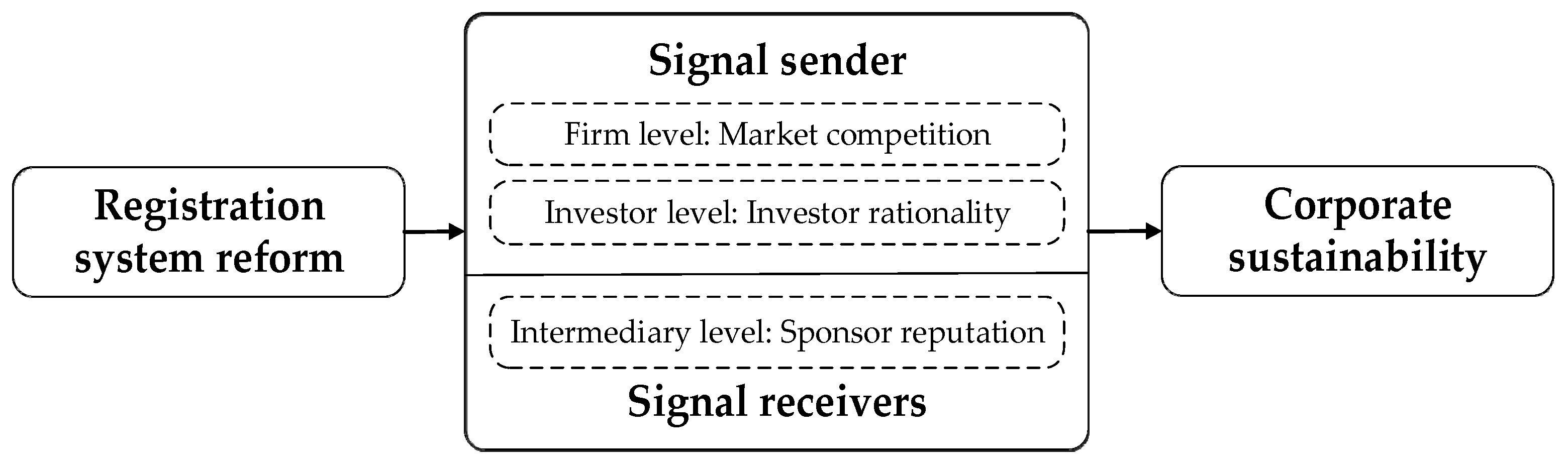
RSR emphasizes transferring decision-making authority from the government to market participants, thereby reinforcing the market’s decisive role in resource allocation [9]. Within this market-oriented institutional framework, new challenges arise for market participants, namely, how firms establish sustainable competitive advantages, how investors identify firms with long-term growth potential, and how sponsors ensure the quality and credibility of IPO firms. According to signaling theory, ESG performance, serving as a credible signal of a firm’s commitment to long-term value creation, social responsibilities, and sustainability goals [1,3], provides investors, sponsors, and other stakeholders with an expanded basis for evaluating firm quality beyond traditional financial indicators. Therefore, based on such theory, this study investigates the potential channels through which RSR enhances ESG performance from three perspectives: the signal sender (firms) and the signal receivers (investors and sponsors). The framework is presented in Figure 1.

2.2. RSR, Market Competition, and Corporate Sustainability

From the firm’s perspective, the expansion of IPO access under RSR intensifies market competition, and firms thereby enhance their ESG performance to differentiate themselves and gain competitive advantages. Unlike the approval-based system, which emphasizes historical profitability, RSR highlights firms’ going-concern ability and introduces more inclusive, market-driven, and diversified listing standards, thereby allowing even unprofitable firms to go public. Consequently, firms face heightened pressure to differentiate themselves in a more competitive environment [10]. Engaging in ESG practices can help firms gain and sustain such an advantage [24,35]. Specifically, according to stakeholder theory, fulfilling ESG responsibilities allows firms to satisfy the needs of diverse stakeholders, thereby gaining consumer loyalty and supplier trust [33], reducing operational costs [36], and enhancing firm performance [37,38]. In addition, ESG disclosure, serving as a form of supplementary information, may mitigate information asymmetry between firms and stakeholders, such as investors, creditors, and suppliers [1]. Hence, according to resource dependence theory, ESG performance can lower financing costs [34], increase access to trade credit [35], and attract government subsidies [33] and tax incentives [25], thereby alleviating firms’ financial constraints [38]. Furthermore, the mitigation of financing constraints contributes to greater R&D investment, enhancing firms’ technological innovation capacity and creating competitive barriers [39]. Overall, through improved financial performance, reduced financing constraints, and strengthened innovation capacity, firms with better ESG performance are more likely to succeed in a competitive market [24]. In other words, by lowering market entry barriers and intensifying competition, RSR incentivizes firms to adopt more robust ESG practices as a source of competitive advantage.
Hypothesis H2.
RSR can enhance corporate sustainability by intensifying the market competition.

2.3. RSR, Investor Rationality, and Corporate Sustainability

From the perspective of investors, RSR transfers listing authority from regulators to the market, requiring investors to make more independent and forward-looking evaluations of firm value [10]. This shift encourages the adoption of broader investment criteria that extend beyond short-term financial metrics, with ESG performance emerging as a key non-financial signal of long-term sustainability. Prior studies demonstrate that firms with enhanced ESG performance exhibit higher operational efficiency [36], lower financial and agency risks [34,38], and greater resilience to external shocks [35,40]. Moreover, ESG transparency significantly reduces information asymmetry, limits managerial opportunism [41], and lowers the risk of adverse market events such as stock price crashes [42]. Therefore, based on signaling theory, firms with better ESG performance are more likely to gain investors’ favor, while those with weaker ESG performance may be excluded from investment portfolios [26]. In summary, RSR promotes a more rational and sustainability-aware investment environment in which ESG performance becomes a critical channel through which firms signal long-term value, thereby motivating firms to enhance their ESG performance.
Hypothesis H3.
RSR can enhance corporate sustainability by increasing investor rationality.

2.4. RSR, Sponsor Reputation, and Corporate Sustainability

From the perspective of sponsors, RSR reinforces the gatekeeping responsibilities of intermediary institutions. Reputable sponsors, aiming to safeguard their reputations and reduce regulatory risks, are more likely to select clients with superior ESG performance, thus exerting external pressure on firms to enhance their sustainability. Specifically, RSR introduces heightened accountability mechanisms, such as the sponsor co-investment policy and stricter penalties for misconduct. These arrangements align sponsor incentives with those of investors and increase their exposure to reputational and regulatory risk, motivating them to conduct more rigorous due diligence to protect co-investment returns and avoid reputational damage [43,44]. Drawing on reputation theory, firms with better ESG performance signal a commitment to responsible corporate values and less opportunistic behavior, thereby enhancing their social legitimacy and narrowing the reputational gap with sponsors [35]. This improves the likelihood of receiving sponsor support during the IPO process. Moreover, ESG practices are consistent with China’s national priorities on green, low-carbon, and sustainable development. Accordingly, firms that actively engage in ESG practices are more likely to gain regulatory trust [33], strengthen organizational legitimacy [33], and mitigate financial and legal risks [34,38], thus benefiting from a form of reputational and operational insurance [35]. In sum, RSR amplifies sponsors’ incentives to prioritize ESG-aligned firms, indirectly encouraging broader ESG engagement among IPO firms as they seek sponsor endorsement and successful market access.
Hypothesis H4.
RSR can enhance corporate sustainability by enhancing the sponsor’s reputation.

3. Research Design

3.1. Data and Sample

Given that RSR was piloted in 2018 and fully implemented in 2023, our study employs IPO firms listed on the ChiNext and Main Boards of SSE and SZSE between 2016 and 2022 as the initial sample. After excluding firms in the financial industry, and designated as ST, PT, or delisted, and deleting observations with missing data, the final sample consists of 5942 observations. To mitigate the influence of outliers, all continuous variables are winsorized at the 1% level on both tails. ESG performance data are obtained from the Wind database, while financial data are sourced from the CSMAR database. The data were processed using Stata 18.

3.2. Regression Model

The pilot RSR was first introduced with the announcement of the SSE STAR Market on 5 November 2018. Its practical implementation began on 13 June 2019, when the STAR Market officially launched. This reform gradually expanded in scope, with the ChiNext adopting the registration system on 24 August 2020. In contrast, the Main Boards of both the SSE and SZSE and the SME maintained the traditional approval-based system until they transitioned to the registration system on 17 February 2023. Therefore, before the full implementation of RSR in 2023, both the ChiNext and Main Boards of the SSE and SZSE experienced a prolonged period of institutional coexistence, during which the approval-based system and registration system operated in parallel. This staggered reform timeline provides a valuable quasi-natural experimental setting for empirical investigation. Following Mao et al. [17], we exploit this setting by employing a staggered difference-in-differences (DID) model, as specified in Model (1).
E S G i , t = α 0 + α 1 T R E A T i + α 2 P O S T t + α 3 D I D i , t + α i C o n t r o l s i , t + I n d u s t r y i + Y e a r t + ε i , t
where the dependent variable ESG is the proxy for corporate ESG performance. TREAT is a treatment indicator that equals 1 if the firm is listed on the ChiNext, and 0 otherwise. POST is a time indicator that equals 1 if the IPO occurred after the implementation of RSR, and 0 otherwise. The key variable of interest is DID, which is defined as the interaction term between TREAT and POST, capturing the causal effect of the RSR by comparing ESG performance between the treatment group and the control group. A significantly positive coefficient on DID would provide evidence of the positive impact of RSR on corporate sustainability. To ensure the robustness of the estimates, standard errors are clustered at the firm level. Notably, the baseline regression employs a pooled OLS model. Given that ESG is an ordinal integer ranging from 1 to 9, we re-estimate Model (1) using a multivariate ordered logistic regression in the robustness tests.

3.3. Measurement of ESG Performance

There are multiple measurements for corporate ESG performance. Some studies employ ESG rating data from institutions such as Bloomberg and SynTao Green Finance; however, these ratings do not cover all A-share listed firms. Since 2009, the Sino-Securities Index has evaluated the ESG performance of securities issuers, including all A-share listed companies. Due to its comprehensive scope and enhanced accuracy, the index has gained widespread recognition in academic research. Therefore, following Zhang and Zhang [26], we employ the ESG rating issued by Sino-Securities Index as a proxy for corporate ESG performance (ESG). The rating system comprises nine levels—C, CC, CCC, B, BB, BBB, A, AA, and AAA—which are assigned values from 1 to 9 in ascending order to measure ESG. For robustness tests, we further address potential internal and external consistency issues in these ESG ratings.

3.4. Measurement of Control Variables

Following Jiang et al. [10] and Chen et al. [19], we include various control variables to control for their potential effects on corporate ESG performance, including firm size (SIZE), firm age (AGE), profitability (ROE), growth (TOBINQ), operational efficiency (ATO), duality of chairman and CEO (DUAL), shareholdings of controlling stockholders (TOP), board size (BOD), and proportion of independent directors (INDEP). The definitions of all variables are presented in Table 1.

4. Empirical Analyses

4.1. Descriptive Statistics

Table 2 presents the descriptive statistics for the main variables. The mean value of ESG is 4.366, ranging from 1 to 7, indicating substantial variation in ESG performance across sample firms. The mean value of the DID is 0.106, suggesting that 10.6% of IPO firms in our sample adopted the registration system. Overall, the descriptive statistics align well with prior studies [19,26]. Furthermore, variance inflation factor (VIF) diagnostics indicate no multicollinearity concerns, as all VIF values are well below the threshold of 10.

4.2. Baseline Results

Table 3 presents the baseline results. Columns (1) and (2) show estimates without and with control variables, respectively. The coefficients of DID are 0.105 and 0.113, both statistically significant at the 1% level, indicating that the ESG performance of IPO firms listed on ChiNext improved significantly relative to those listed on the Main Boards of SSE and SZSE after the implementation of RSR, supporting the hypothesis H1. In terms of economic significance, the reform is associated with an approximate 3.83% (4.12%) increase in ESG performance, suggesting that the registration system’s focus on firms’ going-concern capabilities complements the ESG framework’s emphasis on sustainability, thereby positively contributing to corporate sustainability. Overall, these findings not only echo those in prior studies highlighting the effectiveness of RSR [13,14,16,19,32] but also provide new empirical evidence for a more comprehensive assessment of the policy implications of RSR from the non-financial perspectives [10].

4.3. Parallel Trend Test

Following Mo et al. [45], we conduct a parallel trend test by replacing the POST with several time-relative dummy variables. Specifically, PRE1 to PRE4 represent the one to four years before the reform, CURRENT denotes the year of reform implementation, and POST1 and POST2 represent one and two years after implementation. As shown in Table 4, the coefficients of PRE4, PRE3, PRE2, and CURRENT are statistically insignificant, while those of POST1 and POST2 are significantly positive at the 1% level. This confirms no significant differences in ESG trends between ChiNext and Main Board firms before reform implementation, thus validating the parallel trend assumption. Furthermore, the positive impact of RSR on corporate sustainability appears with a certain time lag, consistent with the view that ESG practice represents a commitment to long-term value creation and sustainability goals [1,3].

4.4. Placebo Test

To mitigate potential biases arising from data randomness and model specification, we conduct a placebo test following Kong et al. [46]. Specifically, we randomly assign firms to the treatment group and select the treatment year, repeating this procedure 500 times. Kernel density plots based on placebo regression coefficients and corresponding p-values are shown in Figure 2. The baseline regression coefficient differs substantially from the placebo distribution, with the majority of placebo p-values exceeding 0.1. These results confirm that our main findings are unlikely to be driven by random factors.

4.5. Robustness Tests

4.5.1. Considering Consistency of ESG Ratings

ESG rating agencies may revise their evaluation standards and methodologies over time, potentially leading to changes in historical ratings and threatening the robustness of empirical results. To address this concern, we follow Song et al. [47] and employ the industry-year adjusted ESG performance (ADJ_ESG) to eliminate systematic bias arising from rating revisions. As shown in Column (1) of Table 5, the coefficient of DID remains significantly positive at the 10% level, confirming the robustness of our results against internal rating consistency issues.
Moreover, heterogeneity among rating agencies concerning ESG evaluation criteria, transparency, and independence may also bias the results. To address this external rating consistency issue, we construct a variable for consensus ESG performance (ALL_ESG) following Song et al. [47], which combines ratings from multiple agencies (Sino-Securities Index, SynTao Green Finance, Bloomberg, and MSCI). Specifically, we rank each firm’s ESG ratings within each agency by year, convert the rankings into percentile scores ranging from 0 to 1, and then compute the average of these normalized scores as the consensus ESG performance (ALL_ESG). The results, reported in Column (2) of Table 5, confirm that our findings are robust to potential inconsistencies across rating agencies.

4.5.2. Controlling for ESG Disclosure Effects

ESG disclosure significantly influences corporate ESG performance [48]. However, disclosure requirements vary across stock exchanges and listing boards, which may in turn affect firms’ ESG performance. For example, SZSE required SZSE 100 Index companies to publish CSR reports from 2010. The 2015 Guidelines for the Standardized Operation of SMEs Listed on the SZSE mandated that firms experiencing major environmental pollution incidents disclose relevant details promptly. To control for these disclosure differences, we exclude SZSE 100 Index firms and those in heavily polluting industries. The robust results shown in Column (3) of Table 5 indicate that our main findings are not materially driven by differences in ESG disclosure requirements.

4.5.3. Controlling for Region Fixed Effects

To mitigate the risk that the observed impact of RSR on corporate ESG performance is merely a reflection of regional disparities in economic conditions or policy environments, we include province-level fixed effects in Model (1). Results presented in Column (4) of Table 5 remain robust, supporting the validity of our findings after controlling for regional heterogeneity.

4.5.4. Controlling for Firm Fixed Effects

Following Chen et al. [19], we reconstruct the DID model by incorporating firm fixed effects and time fixed effects, as specified in Model (2). As reported in Column (5) of Table 5, the coefficient of DID remains significantly positive at the 1% level, confirming the robustness of our findings.
E S G i , t = β 0 + β 1 D I D i , t + β i C o n t r o l s i , t + F i r m i + Y e a r t + ε i , t

4.5.5. Considering Alternative Model Specification

The baseline regression employs a pooled OLS model, while the dependent variable, ESG, is an ordinal integer ranging from 1 to 9. To address potential estimation bias arising from model misspecification, we follow Wu et al. [48] and re-estimate Model (1) using a multivariate ordered logistic regression. As shown in Column (6) of Table 5, the main result is still robust.

4.5.6. Excluding Low-Carbon Firms

Given the ChiNext’s focus on advanced manufacturing, digital economy, and low-carbon industries, firms in these industries often achieve higher ESG ratings due to superior environmental and sustainability performance. Therefore, we exclude firms identified as low-carbon enterprises, specifically, those listed in the official green manufacturing enterprise catalog, and re-estimate Model (1). As shown in Column (7) of Table 5, the coefficient of DID remains significantly positive, suggesting that the positive effect of the RSR on ESG performance is not exclusively attributable to the presence of low-carbon firms.

4.5.7. Using Alternative Time Windows

Considering that the COVID-19 pandemic and the unique macroeconomic conditions during 2020–2021 may have influenced firms’ ESG performance, we excluded observations from these two years and re-estimated the Model (1)model. The results in Column (8) of Table 5 show that the coefficient of DID remains consistent in both sign and statistical significance with the baseline results. This indicates that our conclusions are not sensitive to the choice of time window and remain robust under alternative sample periods.

4.6. Endogeneity Tests

4.6.1. Propensity Score Matching Analysis (PSM)

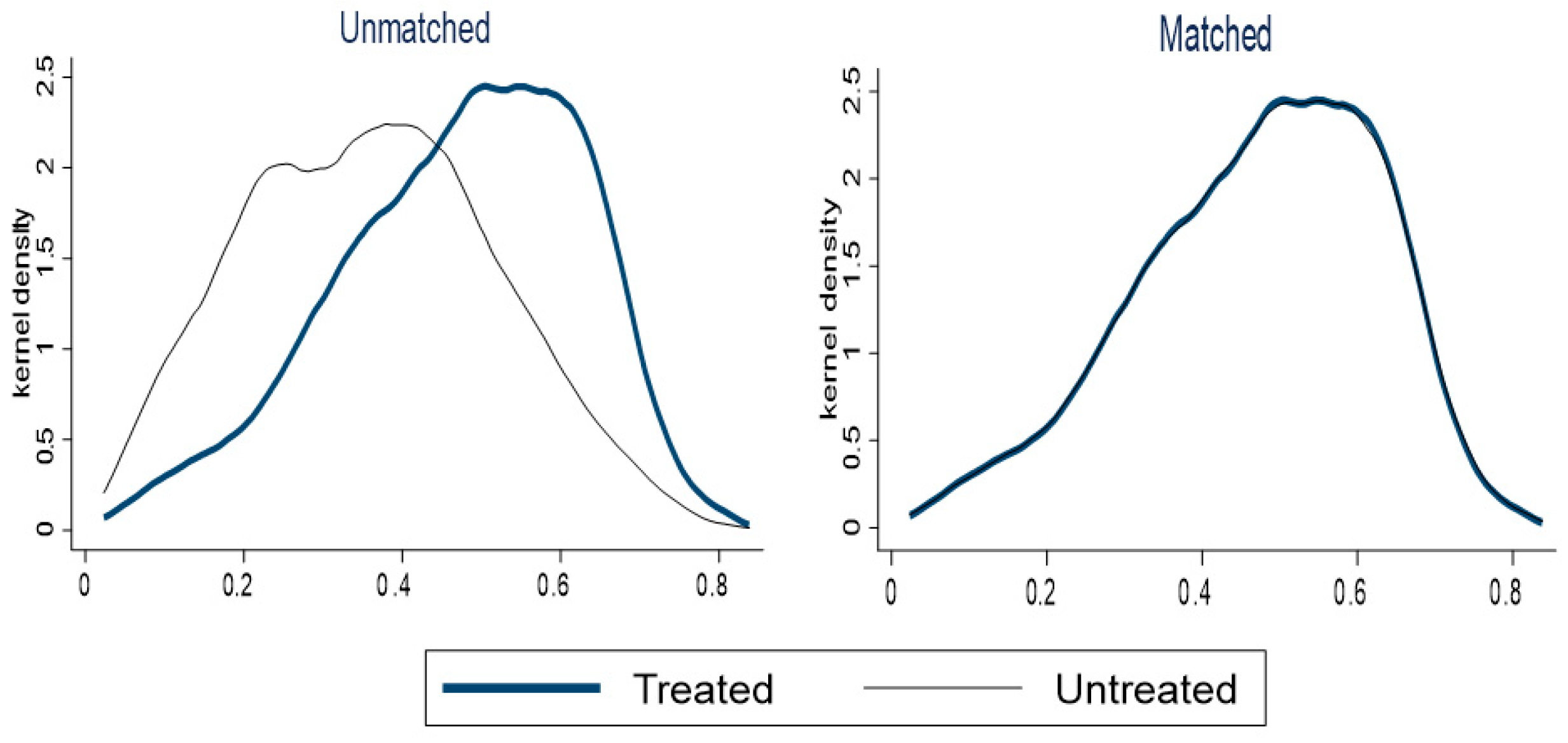
Unobserved differences between ChiNext and Main Boards may introduce sample selection bias, potentially leading to endogeneity. To address this concern, we follow Kong et al. [46] and construct a propensity score matching difference-in-differences (PSM-DID) model. We conduct a 1:1 nearest-neighbor matching with a caliper of 0.001 between the treatment and control groups, using all control variables in Model (1). Considering the limited sample size, matching was performed with replacement to improve the matching rate and reduce excessive sample loss. As shown in Table A1 of Appendix A, the standardized differences for all covariates are below 10% after matching, and the corresponding p-values exceed 0.1, indicating satisfactory covariate balance. Figure A1 of Appendix A further illustrates that most matched samples fall within the region of common support, thereby satisfying the common support assumption. Then, we re-estimate Model (1) using the matched sample. The results, reported in Column (1) of Table 6, confirm that the main findings are robust and that potential endogeneity arising from sample selection bias has been effectively mitigated.

4.6.2. Instrument Variable Analysis (IV)

Potential reverse causality may exist between RSR and corporate ESG performance, whereby firms with better ESG performance may be more inclined to list on the ChiNext under the registration system. To address this concern, we adopt an instrumental variable (IV) analysis following Mao et al. [17]. Specifically, we construct an instrumental variable (TECH) based on firms identified as “high-tech enterprises” but not classified as “comprehensive resource utilization enterprises”. In terms of relevance, high-tech enterprises typically exhibit strong innovation capacity and growth potential, making them more attractive to regulators and investors and thus more likely to be listed on the ChiNext through the registration system. This ensures a strong correlation between the instrument and the likelihood of RSR-based IPOs. In terms of exogeneity, the designation of a high-tech enterprise is determined primarily at the early stage of firm development and reflects technological and innovative capacity rather than subsequent ESG practices. Hence, the high-tech attribute affects ESG only indirectly by increasing the probability of registration-based IPOs, without exerting a direct impact on ESG performance. Moreover, comprehensive resource utilization enterprises usually benefit from preferential national policies related to energy conservation and environmental protection. Such incentives may directly improve their environmental or sustainability performance, thereby creating a direct relationship with ESG performance. To avoid this issue, we exclude resource utilization enterprises from the instrument. Column (2) of Table 6 reports the first-stage regression results. The coefficient of TECH is significantly positive at the 1% level, and the corresponding Wald F-statistic for the weak instrument test is 29, far exceeding the conventional threshold of 10, thereby confirming the strength and relevance of the instrument. Column (3) of Table 6 presents the second-stage regression results. The coefficient of DID remains significantly positive at the 1% level, suggesting that even after addressing potential reverse causality, the positive impact of RSR on corporate ESG performance remains robust.

5. Mechanism Analyses

Having established the positive impact of RSR on corporate ESG performance, we attempt to provide further evidence by investigating the possible channels through which RSR facilitates this relationship. Following Wu et al. [48], we extend the baseline model by introducing interaction terms between the RSR indicator and three moderating variables: market competition (HHI), investor rationality (IR), and sponsor reputation (SR), as specified in Models (3) to (5). These interaction-based models enable us to identify whether and how the mechanism promotes or weakens the effect of RSR on ESG performance, with the sign and significance of the interaction term indicating the direction and strength of the effect. It also helps mitigate omitted variable bias by simultaneously controlling for the main effects of both RSR and the mechanism variable. Furthermore, this approach is coordinated with the DID framework and allows for a straightforward interpretation of policy effects across heterogeneous contexts.
E S G i , t = γ 0 + γ 1 D I D i , t × H H I i , t + γ 2 T R E A T i × H H I i , t + γ 3 P O S T t × H H I i , t + γ 4 D I D i , t + γ 5 T R E A T i + γ 6 P O S T t + γ 7 H H I i , t + γ i C o n t r o l s i , t + I n d u s t r y i + Y e a r t + ε i , t
E S G i , t = θ 0 + θ 1 D I D i , t × I R i , t + θ 2 T R E A T i × I R i , t + θ 3 P O S T t × I R i , t + θ 4 D I D i , t + θ 5 T R E A T i + θ 6 P O S T t + θ 7 I R i , t + θ i C o n t r o l s i , t + I n d u s t r y i + Y e a r t + ε i , t
E S G i , t = μ 0 + μ 1 D I D i , t × S R i , t + μ 2 T R E A T i × S R i , t + μ 3 P O S T t × S R i , t + μ 4 D I D i , t + μ 5 T R E A T i + μ 6 P O S T t + μ 7 S R i , t + μ i C o n t r o l s i , t + I n d u s t r y i + Y e a r t + ε i , t
In these models, the Herfindahl–Hirschman Index (HHI) serves as a proxy for market competition, where a lower HHI reflects a more competitive industry environment. Investor rationality (IR) is measured by the average daily turnover rate of tradable shares, with lower turnover suggesting more rational, long-term investment behavior. Sponsor reputation (SR) is proxied by the sponsor’s ranking based on total underwriting volume, with higher rankings indicating stronger reputational capital. Table 7 reports the results of the mechanism analyses. Across all specifications, the coefficient of DID remains positive and statistically significant at least at the 5% level, reinforcing the robustness of our main findings. The coefficients of DID × HHI, DID × IR are both significantly negative at the 1% level, while that of DID × SR is significantly positive at the 1% level, indicating that the positive effect of RSR on ESG performance is more pronounced in firms with heightened market competition, those attracting more rational investors, and those supported by more reputable sponsors.
Overall, these findings are consistent with our theoretical expectations and further support the hypotheses H2 to H4. At the firm level, the reform intensifies market competition, motivating firms to enhance their ESG performance to gain a competitive advantage. At the investor level, the RSR transfers the power of selection to the market, encouraging more rational investment decisions. Investors may increasingly rely on ESG criteria to identify high-quality firms, thereby exerting external pressure on companies to enhance their ESG performance. At the intermediary level, reputable sponsors under the registration system are incentivized to protect their reputations and reduce regulatory risks by selecting IPO firms with better ESG performance. As a result, firms may proactively strengthen their ESG practices to secure sponsor support.

6. Further Analyses

To further support our main findings, we conduct heterogeneity analyses from the perspectives of marketization level, ownership structure, and corporate profitability. In addition, we decompose the ESG performance into its three underlying dimensions, including environmental (E), social (S), and governance (G), to examine whether the impact of RSR varies across different dimensions. Furthermore, we also explore the persistence of the reform’s effect and assess the presence of potential spillover effects on non-treated firms.

6.1. Heterogeneity Analyses

6.1.1. Analysis of Marketization

RSR shifts the power of determining “which firms can go public” largely to the market. As a result, corporate ESG performance becomes a critical criterion used by various market participants, such as investors and intermediaries, to identify high-quality firms. In regions with a higher degree of marketization, the market plays a more prominent role in resource allocation. Firms in these regions are more motivated to enhance their ESG performance to attract attention and support from market participants. Therefore, the impact of the RSR on ESG performance is expected to be more pronounced in these regions. In contrast, in less marketized regions where government intervention in the market remains substantial, improvements in ESG performance may not yield comparable benefits, thereby weakening the effectiveness of the reform.
We divide the sample into two groups using the annual median of the marketization index: a high-marketization group (MAKT = 1) and a low-marketization group (MAKT = 0). We then estimate Model (1) separately for each group. As shown in Columns (1) and (2) of Table 8, the coefficient of DID is significantly positive in the high-marketization group but statistically insignificant in the low-marketization group. These results suggest that the effect of the RSR on corporate ESG performance exhibits significant regional heterogeneity, with the reform being more effective in market-driven environments.

6.1.2. Analysis of Ownership Structure

While RSR broadens access to capital markets, it also intensifies market competition. Non-state-owned enterprises (hereafter non-SOEs), characterized by a higher degree of market orientation, face greater competitive pressure and are therefore more incentivized to enhance their ESG performance to secure external resources and establish a competitive advantage. Moreover, with limited government intervention, non-SOEs are more likely to be influenced by the preferences of investors and intermediaries, who increasingly rely on ESG performance in their decision-making processes. In contrast, state-owned enterprises (hereafter SOEs) typically operate in relatively less competitive environments and benefit from implicit government support, which weakens their motivation to improve ESG performance to attract market-based recognition or support. Furthermore, SOEs’ strategic objectives are often aligned with policy mandates rather than purely market-driven considerations, which may further dilute the reform’s impact on their ESG practices.
We divide the sample according to ownership structure into SOEs (SOE = 1) and non-SOEs (SOE = 0) and re-estimate Model (1) for each subgroup. As reported in Columns (3) and (4) of Table 8, the coefficient of DID is significantly positive only for non-SOEs, while it is statistically insignificant for SOEs. These findings align with our expectations and indicate that the positive impact of the RSR on ESG performance is primarily concentrated among non-state-owned enterprises.

6.1.3. Analysis of Corporate Profitability

As discussed above, RSR increases competitive pressure among firms. For companies with weaker profitability, it becomes more difficult to attract investors or gain a competitive advantage based solely on financial performance. Consequently, these firms may have stronger incentives to improve their ESG performance to draw stakeholder attention. Furthermore, low-profitability firms typically have lower initial ESG investments, leaving greater improvement space for ESG performance, and thus may experience more pronounced benefits from the reform. In contrast, highly profitable firms, due to their better financial positions, may have already developed stronger ESG foundations before the reform. As such, the marginal effect of RSR on these firms’ ESG performance could be relatively limited.
We employ return on total assets as a proxy for profitability and divide the sample into high-profitability (PROF = 1) and low-profitability (PROF = 0) groups based on the annual median of return on assets. We then re-estimate Model (1) for each subgroup. As shown in Columns (5) and (6) of Table 8, the coefficient of DID is significantly positive only in the low-profitability group, while it is insignificant in the high-profitability group. These results are consistent with our expectations and further support the heterogeneity of the reform’s impact across firms with different financial profiles.

6.2. Effects of RSR on E, S, G Performance

To further investigate whether the effects of the RSR vary across different dimensions of ESG performance, we replace the dependent variable in Model (1) with E, S, and G, and conduct separate regressions for each dimension. The results, reported in Table 9, indicate that the coefficient of DID is significantly positive only in the regression for the governance performance, while those for the environmental and social performance are statistically insignificant. These findings suggest that the improvement in overall ESG performance driven by RSR is primarily attributable to enhancements in the governance dimension. This result highlights the critical role of RSR in promoting transparency in information disclosure and strengthening corporate governance structures. From the perspective of signaling theory, these findings are unsurprising. Governance practices, such as board independence, internal controls, and audit quality, serve as credible and immediately observable signals that firms can use to reduce information asymmetry and demonstrate reliability to investors and intermediaries under the market-oriented RSR framework. In contrast, improvements in environmental and social performance often require longer time horizons and more substantial resource commitments, making them less effective as short-term signals. A possible explanation, therefore, is that firms respond first to governance-related requirements, which directly align with the regulatory focus of the registration system on disclosure and compliance, while progress in the environmental and social dimensions is likely to emerge more gradually.

6.3. Long-Term Effects of RSR

Our main findings have shown that RSR significantly enhances corporate ESG performance. A natural follow-up question is whether this positive effect is merely short-term or persists beyond the IPO stage. To explore this question, we re-estimate Model (1) by introducing one- and two-period lags of the DID. Columns (1) and (2) of Table 10 suggest that the coefficients of DID lagged by one and two periods are 0.155 and 0.093, respectively, both statistically significant at the 1% and 10% levels. These findings indicate that the positive impact of RSR on ESG performance persists after firms go public. Firms listed under the registration system do not compromise ESG practices in pursuit of short-term profits post-listing. Instead, the sustained improvement in ESG performance implies the continued influence of market-motivated mechanisms, further supporting the hypothesis H2. Moreover, our findings also highlight the ongoing monitoring and disciplining roles played by investors and sponsors in enforcing corporate sustainability under the registration reform, further supporting the hypotheses H3 and H4.

6.4. Spillover Effects of RSR

We further investigate whether its policy effects spill over to peer firms that were listed under the approval system within the same industry. This analysis offers additional insights into the broader impact of RSR on the capital market environment. Given that RSR-listed firms emerged at different times across industries, the timing of potential policy exposure varies across firms. To account for this variation, we follow Wu et al. [49], using IPO firms on the ChiNext and Main Boards from 2009 to 2017 as the sample, while retaining their observations from 2018 to 2022. We construct a staggered DID model, as specified in Model (6), to estimate the spillover effects of RSR. The independent variable, RSI, equals 1 if a firm operates in an industry where at least one peer firm was listed via the registration system, and the observation year is the same as or later than that peer’s IPO year; otherwise, RSI is set to 0.
E S G i , t = ρ 0 + ρ 1 R S I i , t + ρ i C o n t r o l s i , t + F i r m i + Y e a r t + ε i , t
Columns (1) and (2) of Table 11 present the results of the spillover effect for ChiNext firms listed under the approval system. The coefficients of RSI are 0.109 and 0.092, respectively, both statistically significant at the 5% and 10% levels, indicating positive spillover effects of RSR on these firms’ ESG performance. In contrast, Columns (3) and (4) report results of the spillover effect for Main Boards approval-based firms. Here, the coefficients of RSI are −0.116 and −0.111, both significant at the 1% level, suggesting negative spillovers.
These divergent results across boards may be attributed to differences in firm characteristics. Firms on the ChiNext are typically more innovative and agile, making them better positioned to respond to market signals and adopt ESG practices in line with RSR-driven expectations. This responsiveness may promote a broader ESG-oriented culture across the ChiNext. In contrast, Main Board firms tend to be larger and more mature, potentially rendering them less flexible in making short-term ESG adjustments, thereby dampening the positive spillover effects of the reform. Moreover, the negative spillover effect observed for Main Board firms may stem from relative benchmarking pressure. Specifically, as ChiNext firms improve their ESG practices under the RSR, investors and regulators may raise their expectations for Main Board firms. However, constrained by the approval-based system and different disclosure standards, Main Board firms may appear to underperform by comparison, resulting in a negative relative evaluation of their ESG performance.

7. Conclusions and Implications

7.1. Conclusions and Discussion

In the context of rapid digital transformation, reshaping global market dynamics and industrial competition, corporate sustainability has emerged as a critical determinant of firms’ long-term competitive advantage. RSR, representing a significant market-oriented regulatory innovation, has significantly altered capital market conditions, creating a more transparent and competitive environment that facilitates sustainable corporate practices. While prior research has primarily focused on the reform’s effects on financial dimensions, such as information disclosure [16] and market efficiency [32], its implications for non-financial performance, particularly corporate sustainability, remain underexplored [10]. This study fills this gap by leveraging a quasi-natural experimental setting to investigate how RSR affects corporate ESG performance in China.
Our study suggests that firms listed under the RSR on the ChiNext exhibit significantly higher ESG performance than those listed under the traditional approval system on the Main Board. This effect is particularly pronounced in the governance (G) dimension, highlighting the reform’s role in improving information transparency, corporate governance, and sustainability. Then, we identify three critical mechanisms through which RSR enhances corporate sustainability, including intensified market competition, increased investor rationality, and stronger sponsor reputation, indicating that market forces and reputational incentives jointly strengthen the ESG practices of IPO firms under the registration system. Heterogeneity analyses reveal that the impact of RSR on ESG performance is more pronounced among firms located in regions with higher degrees of marketization, non-state-owned enterprises, and firms with lower profitability, highlighting the importance of local institutional environments and firm characteristics in shaping the effectiveness of capital market reforms. Furthermore, RSR exhibits a long-term effect on ESG performance even after the IPO. Moreover, the reform also generates positive spillover effects among peer firms within the same industry that are still listed under the traditional approval system, particularly in the ChiNext. The long-term and spillover effects suggest a broader influence of RSR on the overall market culture and sustainability orientation.
Overall, these findings provide robust evidence that RSR can serve not only financial efficiency goals but also sustainability-oriented development by encouraging firms to enhance their ESG practices. By doing so, this study contributes to the literature in two important ways. First, it highlights the role of institutional reforms as a fundamental driver of corporate sustainability, thereby enriching both the ESG and regulatory governance literature. Second, it extends the evaluation of capital market reforms beyond traditional financial outcomes to encompass non-financial dimensions, thus providing a more comprehensive understanding of reform effectiveness.

7.2. Policy Implications

Our study offers several important implications for policymakers, regulators, and market participants: First, the sustained and spillover effects of the registration system suggest that granting greater autonomy to the market in selecting listing firms can stimulate competition, improve ESG practices, and ultimately contribute to high-quality economic development. Thus, further deepening of the registration system is warranted. Second, the reform’s effect on corporate sustainability is more significant in regions with higher marketization levels, implying that regional institutional environments moderate the effectiveness of national capital market reforms. Therefore, governments in less developed western regions should focus on improving the local business environment to fully leverage capital market reforms in support of sustainable development. Third, the shift from a regulatory screening to a market-based selection mechanism requires investors to move beyond traditional financial indicators when assessing firm quality. ESG performance is emerging as a critical signal of long-term value and risk. Regulators should support this transition by establishing a standardized ESG disclosure and evaluation framework, promoting a positive feedback loop between corporate disclosure and investor decision-making.

7.3. Future Research Prospects

While this study provides valuable insights into the impact of RSR on corporate sustainability, several prospects remain for future research. First, future research could investigate whether similar reforms in other emerging or developed markets yield comparable sustainability benefits, contributing to the global discourse on IPO regulation and corporate ESG practices. Second, more granular data on firm-level ESG practices, such as green investments, employee engagement, or board composition, would enable a deeper understanding of how RSR influences specific ESG practices and internal decision-making processes. Third, the role of managerial cognition, investor sentiment, and cultural values in mediating the ESG response to RSR presents promising prospects for interdisciplinary research, blending finance, psychology, and sustainability studies.

7.4. Research Limitations

First, although this study employs a quasi-natural experiment of the staggered implementation of RSR and adopts multiple robustness tests to mitigate endogeneity concerns, the potential influence of unobserved institutional or firm-specific factors cannot be completely ruled out. Future research may employ richer identification strategies or cross-country comparisons to further validate the causal inference. Second, the measurement of corporate ESG performance relies on third-party ESG rating data, which may be subject to methodological biases or inconsistencies across rating providers. While this study adopts the Sino-Securities Index ESG rating, future research could incorporate multiple ESG databases or explore firm-level disclosures to obtain a more comprehensive and reliable evaluation of corporate sustainability practices.


Author Contributions

Conceptualization, Y.L. and R.L.; methodology, R.L.; software, R.L.; validation, J.H.; formal analysis, J.H. and Y.L.; investigation, R.L.; resources, Y.X.; data curation, R.L.; writing—original draft preparation, J.H.; writing—review and editing, Y.X. and Y.L.; visualization, R.L.; supervision, Y.X.; project administration, Y.X.; funding acquisition, Y.L. All authors have read and agreed to the published version of the manuscript.

Funding

This research was funded by the Humanities and Social Sciences Program of the Ministry of Education, grant number 23YJC630123.

Institutional Review Board Statement

Not applicable.

Informed Consent Statement

Not applicable.

Data Availability Statement

The data can be requested from the corresponding author upon reasonable request.

Conflicts of Interest

The authors declare no conflicts of interest.

Appendix A

Table A1. The results of the balance tests of PSM.
VariablesMeanBias (%)Reduct |Bias| (%)t-Test
TreatedControltp
SIZEUnmatched21.29321.757−55.796.6−20.570.000
Matched21.30621.322−1.9−0.740.458
AGEUnmatched2.6632.693−8.476.3−3.170.002
Matched2.6692.6622.00.680.499
ROEUnmatched0.0890.097−13.781.7−5.150.000
Matched0.0890.090−2.5−0.870.387
TOBINQUnmatched2.1961.89826.181.79.980.000
Matched2.1392.194−4.8−1.520.128
ATOUnmatched0.5500.673−39.098.5−14.390.000
Matched0.5530.555−0.6−0.240.813
DUALUnmatched0.5080.537−5.864.2−2.190.028
Matched0.5090.4982.10.710.480
TOPUnmatched0.3260.386−44.699.1−16.570.000
Matched0.3270.3270.40.140.885
INDEPUnmatched0.3560.3552.373.30.860.392
Matched0.3560.356−0.6−0.210.835
BODUnmatched2.2912.308−8.496.8−3.180.001
Matched2.2932.2920.30.090.926
Figure A1. Distribution of propensity score.
Sustainability 17 07624 g0a1

References

  1. Drempetic, S.; Klein, C.; Zwergel, B. The Influence of Firm Size on the ESG Score: Corporate Sustainability Ratings Under Review. J. Bus. Ethics 2020, 167, 333–360. [Google Scholar] [CrossRef]
  2. Zhou, G.; Liu, L.; Luo, S. Sustainable Development, ESG Performance and Company Market Value: Mediating Effect of Financial Performance. Bus. Strategy Environ. 2022, 31, 3371–3387. [Google Scholar] [CrossRef]
  3. Burke, J.J. Do Boards Take Environmental, Social, and Governance Issues Seriously? Evidence from Media Coverage and CEO Dismissals. J. Bus. Ethics 2022, 176, 647–671. [Google Scholar] [CrossRef]
  4. Lou, Z.; Li, M.; Shan, Y.G.; Ye, A. Does Corporate Digitalisation Moderate Real Earnings Management? Account. Financ. 2024, 64, 4157–4196. [Google Scholar] [CrossRef]
  5. He, S.; Sheng, X. Does Bank Digitalisation Reduce Corporate Agency Costs? Evidence from China. Account. Financ. 2025, 65, 1987–2012. [Google Scholar] [CrossRef]
  6. Chen, L. Does Data Assetisation Improve Corporate Liquidity and Corporate Growth? Evidence from “Hidden Champion” SMEs in China. Borsa Istanb. Rev. 2024, 24, 1205–1226. [Google Scholar] [CrossRef]
  7. Xiao, Y. Relationship between Data Elements, Industry Concentration, and Firms’ Breakthrough Innovation. Finance Res. Lett. 2025, 72, 106503. [Google Scholar] [CrossRef]
  8. Wang, J. Digital Transformation, Environmental Regulation and Enterprises’ ESG Performance: Evidence from China. Corp. Soc. Responsib. Environ. Manag. 2025, 32, 1567–1582. [Google Scholar] [CrossRef]
  9. Aleti, S.; Bollerslev, T. News and Asset Pricing: A High-Frequency Anatomy of the SDF. Rev. Financ. Stud. 2025, 38, 712–759. [Google Scholar] [CrossRef]
  10. Jiang, C.; Xu, J.; Xu, Q.; Fu, W. Can We Rest Easy under the Registration-Based IPO Reform? Evidence from the Chinese Growth Enterprise Market. Econ. Anal. Policy 2024, 83, 990–1006. [Google Scholar] [CrossRef]
  11. Gao, D.; Zhou, X.; Wan, J. Unlocking Sustainability Potential: The Impact of Green Finance Reform on Corporate ESG Performance. Corp. Soc. Responsib. Environ. Manag. 2024, 31, 4211–4226. [Google Scholar] [CrossRef]
  12. Wang, Y.; Wang, H.; Xue, S. Greening of Tax System and Corporate ESG Performance: A Quasi-natural Experiment Based on the Environmental Protection Tax Law. J. Financ. Econ. 2022, 48, 47–62. (In Chinese) [Google Scholar] [CrossRef]
  13. Wu, X.; Zhang, D.; Wu, Z. Registration System Reform and Initial Public Offering Ownership Preference: Evidence from China. China J. Account. Res. 2024, 17, 100343. [Google Scholar] [CrossRef]
  14. Cheng, F.; Kang, Y.; Huang, J. Registration System Reform and Enterprise Innovation: Evidence from a Quasi-Natural Experiment of the Registration-Based IPO System Reform Pilot in China. Sustainability 2024, 16, 7761. [Google Scholar] [CrossRef]
  15. Huang, J.; Chen, L.; Chen, X. Registration-based IPO System Reform of Sci-tech Innovation Board and Earnings Management. Account. Res. 2023, 2, 42–51. (In Chinese) [Google Scholar]
  16. Wu, X.; Shen, Y.; Sun, Y. Can the Registration System Reform Improve the Disclosure Quality?—Evidence from the ChiNext Board. J. Contemp. Account. Econ. 2024, 20, 100426. [Google Scholar] [CrossRef]
  17. Mao, J.; Wu, H.; Xu, Y. The Impact of Registration System Reform on the “Performance Deterioration” of IPO Companies: A Quasi-natural Experiment. Foreign Econ. Manag. 2024, 46, 35–49. (In Chinese) [Google Scholar] [CrossRef]
  18. Liu, R.; Li, D. Spillover Effects of the Registration System Reform from an Investment Perspective. J. Financ. Res. 2022, 508, 170–188. (In Chinese) [Google Scholar]
  19. Chen, Y.; Zhao, P.; Fan, Y.; Li, X. The Impact of the Registration System Reform on Firms’ Cross-Country Investment: Empirical Evidence from China. Int. Rev. Econ. Financ. 2025, 103, 104440. [Google Scholar] [CrossRef]
  20. Lai, L.; Lan, C.; Qin, M. Can Market-oriented Reform Improve Pricing Efficiency in China?—Evidence from Registration-based IPO System. J. Manag. World 2022, 38, 172–184. (In Chinese) [Google Scholar] [CrossRef]
  21. Wu, X.; Zhang, C. The Impact of Registration System Reform on the Pricing Efficiency of Capital Markets: A Perspective from IPO Underpricing Rates. Nankai Bus. Rev. 2024, 27, 246–258. (In Chinese) [Google Scholar]
  22. Li, Q.; He, L.; Gou, X.; Ren, Y. The Registration-Based IPO Reform and the Cost of Equity Capital: Evidence from China. Financ. Res. Lett. 2024, 67, 105790. [Google Scholar] [CrossRef]
  23. Wang, A.; Saqib, A. How Entrepreneurship Drives ESG Performance: The Roles of Data Assetization and Financing Constraints. Finance Res. Lett. 2025, 82, 107630. [Google Scholar] [CrossRef]
  24. Flammer, C. Does Product Market Competition Foster Corporate Social Responsibility? Evidence from Trade Liberalization. Strateg. Manag. J. 2015, 36, 1469–1485. [Google Scholar] [CrossRef]
  25. Zhang, X.; Jiang, Q.; Cifuentes-Faura, J.; Hu, X.; Li, Y. Do Tax Incentives Matter in Promoting Corporate ESG Performance toward Sustainable Development? Bus. Strategy Environ. 2025, 34, 57–69. [Google Scholar] [CrossRef]
  26. Zhang, Z.; Zhang, L. Investor Attention and Corporate ESG Performance. Financ. Res. Lett. 2024, 60, 104887. [Google Scholar] [CrossRef]
  27. Xu, Q.; Li, X.; Guo, F. Digital Transformation and Environmental Performance: Evidence from Chinese Resource-based Enterprises. Corp. Soc. Responsib. Environ. Manag. 2023, 30, 1816–1840. [Google Scholar] [CrossRef]
  28. Wang, B.; Khan, I.; Ge, C.; Naz, H. Digital Transformation of Enterprises Promotes Green Technology Innovation—The Regulated Mediation Model. Technol. Forecast. Soc. Change 2024, 209, 123812. [Google Scholar] [CrossRef]
  29. Fang, M.; Nie, H.; Shen, X. Can Enterprise Digitization Improve ESG Performance? Econ. Model. 2023, 118, 106101. [Google Scholar] [CrossRef]
  30. Xue, Y.; He, S. Judicial Reforms and Corporate Governance: The Contribution of Circuit Courts to ESG Performance Improvement. Financ. Res. Lett. 2024, 66, 105683. [Google Scholar] [CrossRef]
  31. Zhou, X. Collusion among Local Governments: The Institutional Logic of a Government Behavior. Sociol. Stud. 2008, 6, 1–21. (In Chinese) [Google Scholar] [CrossRef]
  32. Cao, X.; Zeng, X. Can Registration System Reform Mitigate Asset Mispricing? Finance Res. Lett. 2025, 83, 107683. [Google Scholar] [CrossRef]
  33. Tan, J.; Huang, R.; Zhang, J. ESG Performance and Corporate Risk: An Explanation from a Resource Acquisition Perspective. J. Manag. Sci. 2022, 35, 3–18. (In Chinese) [Google Scholar]
  34. Guo, K.; Bian, Y.; Zhang, D.; Ji, Q. ESG Performance and Corporate External Financing in China: The Role of Rating Disagreement. Res. Int. Bus. Financ. 2024, 69, 102236. [Google Scholar] [CrossRef]
  35. Li, Z.; Feng, L. Corporate ESG Performance and Commercial Credit Acquisition. J. Financ. Econ. 2022, 48, 151–165. (In Chinese) [Google Scholar] [CrossRef]
  36. Houston, J.F.; Shan, H. Corporate ESG Profiles and Banking Relationships. Rev. Financ. Stud. 2022, 35, 3373–3417. [Google Scholar] [CrossRef]
  37. Barnett, M.L.; Salomon, R.M. Does It Pay to Be Really Good? Addressing the Shape of the Relationship between Social and Financial Performance. Strateg. Manag. J. 2012, 33, 1304–1320. [Google Scholar] [CrossRef]
  38. Zhang, D.; Lucey, B.M. Sustainable Behaviors and Firm Performance: The Role of Financial Constraints’ Alleviation. Econ. Anal. Policy 2022, 74, 220–233. [Google Scholar] [CrossRef]
  39. Tang, H. The Effect of ESG Performance on Corporate Innovation in China: The Mediating Role of Financial Constraints and Agency Cost. Sustainability 2022, 14, 3769. [Google Scholar] [CrossRef]
  40. Liu, J.; Xu, Y. The Impact of ESG Investment on Corporate Resilience. J. Audit Econ. 2024, 39, 54–64. (In Chinese) [Google Scholar]
  41. Rezaee, Z.; Tuo, L. Are the Quantity and Quality of Sustainability Disclosures Associated with the Innate and Discretionary Earnings Quality? J. Bus. Ethics 2019, 155, 763–786. [Google Scholar] [CrossRef]
  42. Li, Y. ESG Rating Disagreements and Stock Price Crash Risk: Can Distraction, Regional Digital Economy and Corporate Intelligence Maturity Play Important Roles? Asian J. Account. Res. 2025, 10, 126–149. [Google Scholar] [CrossRef]
  43. Chen, Y.; Song, S. A Good Name is More Desirable than Great Riches: The Consequence of Penalty Shock on Underwriter Reputation. China Econ. Q. 2018, 17, 431–448. (In Chinese) [Google Scholar] [CrossRef]
  44. Chen, J. Co-investment System, Underwriting Fees and IPO Earnings Management. Secur. Mark. Herald 2022, 9, 37–48. (In Chinese) [Google Scholar]
  45. Mo, G.; Liu, Z.; Zhang, W.; Tan, C. Has the Reform of Registration-based System Eased the Financing Constraints of Small and Medium-sized Enterprise? Evidence from Quasi-natural Experiment of Pilot Reforms. South China Financ. 2023, 5, 55–69. (In Chinese) [Google Scholar]
  46. Kong, D.; Ji, M.; Liu, C.; Xiong, M. Effects of the Registration-Based IPO System Reform on the Structure and Quality of Listed firms. Secur. Mark. Herald 2024. ahead-of-print. Available online: https://link.cnki.net/urlid/44.1343.F.20240108.2132.002 (accessed on 1 August 2025). (In Chinese).
  47. Song, Y.; Wu, H.; Ma, Y. Does ESG Performance Affect Audit Pricing? Evidence from China. Int. Rev. Financ. Anal. 2023, 90, 102890. [Google Scholar] [CrossRef]
  48. Wu, L.; Liu, S.; Qi, L.; Lin, D. Mandatory Disclosure and Corporate ESG Performance: Evidence from China’s “Explanation for Nondisclosure” Requirement. Corp. Soc. Responsib. Environ. Manag. 2025, 32, 176–191. [Google Scholar] [CrossRef]
  49. Wu, C.; Rao, P.; Yue, H. Spillover Effects of the Registration System: Evidence from Stock Price Synchronization. J. Manag. World 2022, 38, 177–202. (In Chinese) [Google Scholar] [CrossRef]
Figure 1. Research framework.
Sustainability 17 07624 g001
Figure 2. Figure of the placebo test. Note: The placebo test is conducted by randomly assigning firms to the treatment group and randomly selecting the treatment period. This procedure is repeated 500 times to generate the distribution of placebo coefficients, which is then compared with the baseline estimate. The black hollow circles represent the p-values, the black curve represents the kernel density distribution, the vertical dashed line denotes the true regression coefficient, and the horizontal dashed line indicates the p-value of 0.1.
Sustainability 17 07624 g002
Table 1. Variable definition.
VariableDefinition
ESGESG rating issued by Sino-Securities Index, with assigned values of 1 to 9.
TREATA dummy variable that equals 1 if the firm is listed on the ChiNext, and 0 otherwise.
POSTA dummy variable that equals 1 if the IPO occurred after the implementation of RSR, and 0 otherwise.
DIDThe interaction term between TREAT and POST.
SIZEThe natural logarithm of total assets.
AGEThe natural logarithm of firm age.
ROEReturn on equity, calculated as net income divided by equity.
TOBINQThe market value divided by the total assets.
ATOThe sales divided by total assets.
DUALA dummy variable that equals 1 if the CEO is also the chairman, and 0 otherwise.
TOPThe proportion of shares held by the controlling stockholders.
BODThe natural logarithm of directors on the board.
INDEPThe proportion of independent directors on the board.
Table 2. Descriptive statistics: N = 5942.
VariableMeanMedianSDMinMax
ESG4.3664.0000.8421.0007.000
DID0.1060.0000.3070.0001.000
TREAT0.3980.0000.4900.0001.000
POST0.1800.0000.3840.0001.000
SIZE21.56021.4200.89220.07024.750
AGE2.6782.7080.3621.7923.434
ROE0.0890.0890.076−0.2480.295
TOBINQ2.0141.6441.1411.0157.966
ATO0.6210.5590.3310.1222.069
DUAL0.5261.0000.4990.0001.000
TOP0.3610.3430.1430.1040.759
BOD2.2952.3030.2171.7922.833
INDEP0.3550.3330.0660.2500.545
Table 3. Baseline results.
Variables(1)(2)
ESGESG
DID0.105 ***0.113 ***
(0.030)(0.025)
TREAT−0.115 ***−0.071 **
(0.036)(0.031)
POST0.042 *0.021
(0.023)(0.024)
SIZE 0.097 ***
(0.013)
AGE 0.069 **
(0.026)
ROE 1.211 ***
(0.195)
TOBINQ −0.022 ***
(0.007)
ATO −0.103 *
(0.057)
DUAL 0.004
(0.021)
TOP −0.027
(0.040)
INDEP 0.881 ***
(0.079)
BOD −0.194 ***
(0.036)
Constant4.393 ***2.238 ***
(0.013)(0.317)
Industry FEYesYes
Year FEYesYes
Adjusted R20.0270.055
AIC14,642.3714,480.22
BIC14,662.4414,560.50
N59425942
Note: Robust standard errors clustered at the firm level are reported in parentheses. ***, **, and * indicate significance at 1%, 5%, and 10% levels, respectively.
Table 4. The results of the parallel trend test.
Variables(1)
ESG
TREAT−0.127 ***
(0.037)
PRE4−0.063
(0.096)
PRE30.039
(0.057)
PRE20.076
(0.054)
CURRENT0.010
(0.049)
POST10.195 ***
(0.045)
POST20.204 ***
(0.044)
SIZE0.058 ***
(0.013)
AGE0.074 ***
(0.026)
ROE1.202 ***
(0.186)
TOBINQ−0.045 ***
(0.013)
ATO−0.145 ***
(0.037)
DUAL0.006
(0.013)
TOP−0.016
(0.062)
INDEP0.669 ***
(0.131)
BOD−0.181 ***
(0.042)
Constant3.215 ***
(0.300)
Industry FEYes
Year FEYes
Adjusted R20.066
N5942
Note: Robust standard errors clustered at the firm level are reported in parentheses. *** indicate significance at 1% levels.
Table 5. The results of robustness tests.
Variables(1)(2)(3)(4)(5)(6)(7)(8)
ADJ_ESGALL_ESGESGESGESGESGESGESG
DID0.077 *0.023 ***0.135 ***0.114 ***0.854 ***0.286 ***0.162 ***0.149 ***
(0.038)(0.002)(0.029)(0.034)(0.188)(0.105)(0.033)(0.037)
TREAT−0.095 **0.002−0.111 ***−0.071 −0.079−0.100 ***−0.103 ***
(0.034)(0.002)(0.031)(0.041) (0.062)(0.030)(0.026)
POST0.058 **−0.0040.0360.021 −0.0210.036−0.025
(0.025)(0.003)(0.025)(0.019) (0.082)(0.020)(0.062)
SIZE0.052 ***0.066 ***0.072 ***0.101 ***0.0690.207 ***0.098 ***0.070 ***
(0.013)(0.003)(0.014)(0.014)(0.043)(0.035)(0.014)(0.016)
AGE0.108 ***0.0030.073 **0.069 ***2.104 ***0.230 ***0.075 **0.055 *
(0.022)(0.006)(0.032)(0.023)(0.327)(0.070)(0.027)(0.028)
ROE2.790 ***0.058 ***0.768 ***0.712 ***0.1911.737 ***0.755 ***1.282 ***
(0.482)(0.011)(0.090)(0.098)(0.145)(0.210)(0.064)(0.340)
TOBINQ−0.0390.019 ***−0.014 **−0.008−0.010 **−0.007−0.008−0.049 **
(0.025)(0.001)(0.006)(0.005)(0.004)(0.020)(0.005)(0.021)
ATO−0.212 ***−0.013 *−0.046−0.073−0.100−0.117 *−0.049−0.116 *
(0.068)(0.006)(0.041)(0.043)(0.078)(0.066)(0.045)(0.055)
DUAL−0.006−0.004 **−0.009−0.004−0.063−0.0050.0070.001
(0.008)(0.002)(0.018)(0.021)(0.048)(0.050)(0.024)(0.015)
TOP0.192 ***0.028 **−0.059−0.001−0.239−0.1900.022−0.076
(0.047)(0.011)(0.043)(0.046)(0.225)(0.181)(0.044)(0.052)
INDEP1.339 ***0.039 **0.820 ***0.826 ***0.454 ***2.115 ***0.850 ***0.764 ***
(0.149)(0.013)(0.107)(0.081)(0.135)(0.367)(0.077)(0.077)
BOD−0.060−0.016 ***−0.194 ***−0.196 ***−0.077−0.550 ***−0.191 ***−0.221 ***
(0.040)(0.005)(0.041)(0.032)(0.059)(0.116)(0.036)(0.038)
Constant−1.802 ***−1.294 ***2.823 ***2.173 ***−3.526 *** 2.165 ***3.075 ***
(0.260)(0.067)(0.365)(0.291)(0.682) (0.350)(0.424)
Region FENoNoNoYesNoNoNoNo
Industry FEYesYesYesYesYesYesYesYes
Year FEYesYesYesYesYesYesYesYes
Firm FENoNoNoNoYesNoNoNo
Adjusted R20.0410.4070.0550.0760.4920.0180.0630.051
N59425820498059425942594254973648
Note: Robust standard errors clustered at the firm level are reported in parentheses. ***, **, and * indicate significance at 1%, 5%, and 10% levels, respectively. Columns (1) and (2) represent the results of considering the consistency of ESG ratings, including both internal and external rating issues. Column (3) represents the result of controlling for ESG disclosure effects. Columns (4) and (5) represent the results of controlling for region and firm fixed effects. Column (6) represents the result of considering an alternative model specification. Column (7) represents the result of excluding low-carbon firms. Column (8) represents the result of excluding observations in 2020 and 2021.
Table 6. The results of endogeneity tests.
Variables(1)(2)(3)
ESGDIDESG
TECH 0.010 ***
(0.002)
DID0.115 *** 4.675 ***
(0.029) (0.512)
TREAT−0.080 **0.194 ***−0.929 ***
(0.033)(0.013)(0.104)
POST0.0360.530 ***−2.407 ***
(0.028)(0.035)(0.379)
SIZE0.100 ***−0.0000.086 ***
(0.012)(0.002)(0.017)
AGE0.066 **−0.0070.123 **
(0.026)(0.006)(0.058)
ROE1.289 ***−0.0080.811 ***
(0.354)(0.007)(0.058)
TOBINQ−0.021 **−0.007 ***0.030 ***
(0.008)(0.001)(0.007)
ATO−0.094−0.0200.054
(0.054)(0.018)(0.099)
DUAL0.0050.004−0.024 *
(0.023)(0.006)(0.014)
TOP−0.072 *0.085 ***−0.486 ***
(0.038)(0.025)(0.115)
INDEP0.791 ***−0.044 ***1.085 ***
(0.088)(0.012)(0.119)
BOD−0.203 ***0.012 ***−0.265 ***
(0.033)(0.004)(0.051)
Constant2.238 ***−0.0823.117 ***
(0.268)(0.062)(0.265)
Industry FEYesYesYes
Year FEYesYesYes
Adjusted R20.0550.6280.056
N565759425942
Note: Robust standard errors clustered at the firm level are reported in parentheses. ***, **, and * indicate significance at 1%, 5%, and 10% levels, respectively. Column (1) represents the result of the PSM-DID model. Columns (2) and (3) represent the result of IV analysis, including the first and second regression stages.
Table 7. The results of the mechanism analyses.
Variables(1)(2)(3)
ESGESGESG
DID0.156 ***0.177 ***0.080 **
(0.057)(0.007)(0.036)
DID × HHI−5.118 ***
(1.442)
TREAT × HHI0.559 ***
(0.182)
POST × HHI0.223
(0.226)
HHI−0.148
(0.110)
DID × IR −0.099 ***
(0.014)
TREAT × IR −0.003 *
(0.001)
POST × IR −0.001
(0.002)
IR −0.004
(0.006)
DID × SR 0.293 ***
(0.065)
TREAT × SR −0.152 *
(0.075)
POST × SR −0.303 ***
(0.037)
SR 0.237 ***
(0.031)
TREAT−0.056 **−0.090 *−0.081 **
(0.025)(0.040)(0.035)
POST0.032−0.0760.049 **
(0.043)(0.049)(0.018)
SIZE0.124 ***0.056 ***0.094 ***
(0.016)(0.008)(0.013)
AGE0.177 ***0.083 *0.074 ***
(0.050)(0.031)(0.024)
ROE1.142 ***3.211 ***0.750 ***
(0.248)(0.516)(0.080)
TOBINQ−0.020 *−0.132 **−0.006
(0.011)(0.043)(0.004)
ATO−0.122 ***−0.220 **−0.056
(0.039)(0.075)(0.040)
DUAL0.0080.0040.006
(0.020)(0.013)(0.021)
TOP0.069−0.140−0.038
(0.094)(0.077)(0.039)
INDEP0.961 ***1.528 ***0.877 ***
(0.199)(0.133)(0.085)
BOD−0.284 ***−0.150 **−0.191 ***
(0.084)(0.053)(0.035)
Constant1.543 ***2.955 ***2.301 ***
(0.403)(0.181)(0.311)
Industry FEYesYesYes
Year FEYesYesYes
Adjusted R20.0540.0580.060
N594259425942
Note: Robust standard errors clustered at the firm level are reported in parentheses. ***, **, and * indicate significance at 1%, 5%, and 10% levels, respectively. Columns (1) to (3) represent the results of mechanism analyses, including market competition mechanism, investor rationality mechanism, and sponsor reputation mechanism.
Table 8. The results of heterogeneity tests.
Variables(1)(2)(3)(4)(5)(6)
MAKT = 1MAKT = 0SOE = 0SOE = 1PROF = 0PROF = 1
ESGESGESGESGESGESG
DID0.157 **0.0590.089 ***0.3360.150 ***0.057
(0.054)(0.073)(0.023)(0.210)(0.043)(0.073)
TREAT−0.066−0.081 **−0.073 **0.018−0.088 **−0.044
(0.039)(0.037)(0.031)(0.110)(0.037)(0.038)
POST0.0440.0080.059 *−0.258 **0.065−0.051
(0.072)(0.055)(0.031)(0.102)(0.060)(0.057)
SIZE0.118 ***0.078 ***0.099 ***0.093 *0.088 ***0.110 ***
(0.023)(0.019)(0.015)(0.047)(0.011)(0.024)
AGE0.063 *0.068 *0.087 ***−0.0460.104 **0.085
(0.031)(0.041)(0.023)(0.115)(0.037)(0.052)
ROE1.015 ***1.365 ***0.729 ***1.319 ***2.354 ***−0.119
(0.315)(0.221)(0.094)(0.234)(0.612)(0.446)
TOBINQ−0.036 *−0.011−0.010 *0.022−0.054 **−0.052 ***
(0.019)(0.013)(0.005)(0.017)(0.024)(0.020)
ATO−0.130−0.095 **−0.057−0.067−0.067−0.205 ***
(0.105)(0.047)(0.055)(0.181)(0.090)(0.065)
DUAL0.027−0.0150.0000.0290.009−0.002
(0.019)(0.030)(0.021)(0.225)(0.023)(0.030)
TOP−0.1470.098−0.1120.640 ***−0.029−0.052
(0.088)(0.107)(0.085)(0.159)(0.085)(0.122)
INDEP1.118 ***0.593 ***0.861 ***1.036 **0.782 ***0.994 ***
(0.119)(0.222)(0.101)(0.344)(0.147)(0.224)
BOD−0.188 ***−0.199 ***−0.265 ***0.423 *−0.124−0.272 ***
(0.037)(0.072)(0.022)(0.205)(0.081)(0.086)
Constant1.796 ***2.708 ***2.340 ***0.6782.116 ***2.436 ***
(0.473)(0.452)(0.338)(1.159)(0.350)(0.546)
Industry FEYesYesYesYesYesYes
Year FEYesYesYesYesYesYes
Adjusted R20.0690.0720.0600.2020.0570.060
N28603082545548729762966
Empirical p-values0.040 **0.060 *0.000 ***
Note: Robust standard errors clustered at the firm level are reported in parentheses. ***, **, and * indicate significance at 1%, 5%, and 10% levels, respectively. Columns (1) and (2) represent the results of marketization heterogeneity. Columns (3) and (4) represent the results of ownership structure heterogeneity. Columns (5) and (6) represent the results of profitability heterogeneity. Empirical p-values are calculated using bootstrapping with 1000 repetitions.
Table 9. The results of the effects on E, S, and G performance.
Variables(1)(2)(3)
ESG
DID−0.110−0.1090.298 ***
(0.129)(0.073)(0.044)
TREAT−0.0060.036−0.185 ***
(0.028)(0.034)(0.031)
POST0.049−0.130 ***0.219 ***
(0.063)(0.039)(0.039)
SIZE0.224 ***0.288 ***−0.072 ***
(0.017)(0.035)(0.018)
AGE−0.0230.1500.120 **
(0.062)(0.093)(0.050)
ROE0.0212.003 ***1.324 ***
(0.054)(0.545)(0.041)
TOBINQ−0.036 ***−0.065 *0.031 ***
(0.007)(0.032)(0.008)
ATO0.095 **−0.021−0.149 **
(0.042)(0.115)(0.049)
DUAL0.051 *−0.044−0.005
(0.024)(0.034)(0.021)
TOP−0.119−0.740 ***0.481 ***
(0.146)(0.171)(0.076)
INDEP0.174 *1.097 ***1.347 ***
(0.089)(0.162)(0.086)
BOD−0.1090.037−0.236 ***
(0.066)(0.053)(0.028)
Constant−2.606 ***−1.885 *6.654 ***
(0.592)(1.007)(0.455)
Industry FEYesYesYes
Year FEYesYesYes
Adjusted R20.0470.0980.129
N594259425942
Note: Robust standard errors clustered at the firm level are reported in parentheses. ***, **, and * indicate significance at 1%, 5%, and 10% levels, respectively. Columns (1) to (3) represent the results of the effects of RSR on E, S, and G performance.
Table 10. The results of the long-term effects of RSR.
Variables(1)(2)
ESGESG
DID10.155 ***
(0.025)
TREAT1−0.054
(0.037)
POST10.010
(0.037)
DID2 0.093 *
(0.049)
TREAT2 −0.038
(0.049)
POST2 0.085
(0.096)
SIZE0.115 ***0.124 ***
(0.013)(0.014)
AGE0.069 **0.053
(0.030)(0.032)
ROE1.067 ***1.329 ***
(0.169)(0.215)
TOBINQ−0.0020.023
(0.007)(0.016)
ATO−0.083−0.094
(0.063)(0.066)
DUAL0.002−0.003
(0.031)(0.029)
TOP−0.050−0.050
(0.048)(0.070)
INDEP0.948 ***0.889 ***
(0.097)(0.092)
BOD−0.176 ***−0.132 ***
(0.034)(0.042)
Constant1.707 ***1.394 ***
(0.334)(0.378)
Industry FEYesYes
Year FEYesYes
Adjusted R20.0530.050
N43793090
Note: Robust standard errors clustered at the firm level are reported in parentheses. ***, **, and * indicate significance at 1%, 5%, and 10% levels, respectively. Column (1) represents the effects of RSR lagged by one period on ESG performance. Column (2) represents the effects of RSR lagged by two periods on ESG performance.
Table 11. The results of the spillover effects of RSR.
VariablesSpillover Effect for Approval-Based Firms in ChiNextSpillover Effect for Approval-Based Firms in the Main Boards
(1)(2)(3)(4)
ESGESGESGESG
RSI0.109 **0.092 *−0.116 ***−0.111 ***
(0.053)(0.054)(0.018)(0.041)
AGE 1.788 *** −0.176
(0.508) (0.497)
LEV −0.476 * −0.751 ***
(0.248) (0.170)
ATO −0.135 0.077
(0.221) (0.091)
ROE 0.285 −0.125
(0.213) (0.101)
TOBINQ −0.033 0.026
(0.047) (0.018)
DUAL −0.089 * 0.040
(0.052) (0.046)
BAL 0.010 −0.044
(0.109) (0.075)
TOP −0.425 −0.225
(0.735) (0.456)
Constant3.991 ***−0.7154.177 ***5.002 ***
(0.021)(1.493)(0.006)(1.445)
Firm FEYesYesYesYes
Year FEYesYesYesYes
Adjusted R20.5330.5360.5490.552
N3324332454845484
Note: Robust standard errors clustered at the firm level are reported in parentheses. ***, **, and * indicate significance at 1%, 5%, and 10% levels, respectively. Columns (1) and (2) represent the spillover effects of RSR for approval-based firms in ChiNext. Columns (3) and (4) represent those of RSR for approval-based firms in the Main Boards.
Disclaimer/Publisher’s Note: The statements, opinions and data contained in all publications are solely those of the individual author(s) and contributor(s) and not of MDPI and/or the editor(s). MDPI and/or the editor(s) disclaim responsibility for any injury to people or property resulting from any ideas, methods, instructions or products referred to in the content.