Article

Gas Extraction and Earthquakes in the Netherlands: Drawing Lessons from the Response to Ongoing Social Conflict and Tensions


Department of Social Psychology, Kennisplatform Leefbaar en Kansrijk Groningen, University of Groningen, 9712 TS Groningen, The Netherlands
*
Author to whom correspondence should be addressed.
Sustainability 2025, 17(17), 7612; https://doi.org/10.3390/su17177612
Submission received: 27 June 2025 / Revised: 12 August 2025 / Accepted: 20 August 2025 / Published: 23 August 2025

Abstract

Since the onset of gas extraction in Groningen province, the Netherlands, more than 1700 earthquakes have taken place. This has resulted in damage to properties and safety issues for almost 28,000 buildings. As a result, an extensive reinforcement and damage repair operation started, due to which, many residents were temporarily relocated. Although the need for compensation and restoration was recognized from 2012, recent years are characterized by unclear and shifting responsibilities, bureaucratic complexities, and evolving compensation standards, leading to disparity and a further escalation of social impacts. This paper examines developments in the case from 2015 onwards, when the last overview article on this case was published. We observe that even after a decade of compensation efforts, many residents experience loss of trust in the government and endure chronic stress that impacts their well-being, family dynamics, and overall quality of life. We analyze the government-led mitigation and compensation system that in essence fails to address the grievances of local people. Even after broad recognition of the flawed system, the parliament did not fundamentally change it. In nine lessons, we underscore the global imperative for robust social impact assessments, ongoing social monitoring, and well-coordinated compensation frameworks. This is not only crucial to address socio-ecological distress, but also to build more accountable and sustainable institutional responses to future extraction endeavors.

1. Introduction

Mining activities can have far-reaching impacts, that can be both positive as well as adverse [1,2]. If not managed well, socio-ecological consequences can worsen. According to Lodhia [1], the urge for mining companies to operate in a sustainable manner is increasing. In the Netherlands, where, in 1959, the largest gas field of Europe was discovered, the socio-ecological impacts developed gradually and were managed poorly. Decades after the start of the industrial gas extraction in 1963 from the Groningen gas field by the NAM (Nederlandse Aardolie Maatschappij, Dutch Oil Company, Assen, the Netherlands), the negative social impacts are severe. Since the start of gas extraction, over 1680 earthquakes have been reported in the province of Groningen [3]. Even though the earthquakes are relatively low in magnitude, their impacts on the built environment and society as a whole are high. The earthquakes occur in a densely populated area and, due to high frequency over an extended period of time, result in damage to houses, farms, and other buildings affecting thousands of households and businesses. This is exacerbated as the earthquakes are not part of the traditional hazardscape, and no regulations were initially in place to mitigate potential consequences [4]. At first, the NAM and the Dutch government did not respond to the issues at hand. They denied that the gas extraction caused earthquakes and subsequent damage. This worsened the impacts experienced by residents. When the acknowledgement of the problem finally came, the NAM and government response resulted in subsequent social impacts through a highly technocratic compensation process [5,6,7,8,9].
In the Groningen gas extraction case, it became increasingly clear that the NAM and the Dutch government are heavily entwined. They setup an untransparent and closed public–private partnership with the international energy companies Shell and Exxonmobil, called Partnership Groningen (Maatschap Groningen). In this partnership, the Dutch government had a significant financial interest in the gas revenues [9]. The gas extraction has generated an overall EUR 363 billion profit for the central government until 2023 [3]. While, on paper, the richest province of the country or even Europe, the region hardly profited from the extraction. However, the gas revenues did add substantially to the government budget which was mainly invested in the Randstad (central-west of the Netherlands). The welfare state, as well as large infrastructure projects (for example, the Rotterdam harbor and Schiphol airport) were financed by gas revenues [3]. The field has also been a central energy source for Northwestern Europe, with Belgium, Germany, France, Italy, and the United Kingdom connected to the common network [10].
The response of the government to the gas extraction issues was seen as highly insufficient. The Dutch government and the NAM apologized several times for not taking the safety of residents into consideration (e.g., Minister Henk Kamp, EZK, in 2015; NAM Director Gerald Schotman, in 2015; Prime Minister Mark Rutte, in 2019 and 2023). Additionally, Minister Wiebes referred to the government response as “government failure of un-Dutch proportions” [3] (p. 77). In 2019, the parliament unanimously voted to start a parliamentary inquiry—the strongest mechanism the parliament has for investigating the role of the government in certain issues—about the role of the government and other stakeholders like the NAM in the gas extraction. Due to the public hearings of the parliamentary inquiry (June–October 2022), more details came to the surface about the close relationship between the gas industry and the government [3]. In 69 public hearings, government officials, company staff, scientists, residents, and engineers were individually heard under oath. During the inquiry, there was special attention to the question why the gas extraction was increased in 2013 after one of the strongest earthquakes thus far in Huizinge (M = 3.6).
In this paper we explain how and why there is continuance of political turmoil and further escalation of the impacts experienced by residents from 2014. The previous overview article [4,9] was written before the full-scale mitigation took place and before the parliamentary inquiry was conducted. Now, we know much more about the history of the public–private partnership, about risk management and key decisions. It was shown, for example, that from 2015, costs escalated quickly, making the business case not viable anymore [11]. It is time to update the previous academic work on this topic. The insights of this paper urge a rethinking of the disruptive impact of extractive industries and its damage if not handled well. The insights can be relevant for the broader scientific debates relating to sacrifice zones [12], the resource curse [13], and sustainability in mining activities [1]. Additionally, the paper shows that when not handling social impacts, the financial fallout can be substantial. In Groningen, an estimated EUR 10 billion are spent in direct costs so far, and an estimated EUR 12 billion are to be spent for compensation efforts [14]. Moreover, it involved a costly decision to leave about 500 BCM in the field.
The structure of the paper is as follows. After explaining our methodology and the context of gas extraction in the north of the Netherlands, we analyze the governance of the case, which involved the setup of several agencies to aid the grand compensation and property reinforcement operation. Thereafter, we investigate how shifting scientific standards and models for compensation led to furtherance of social impacts experienced by residents. We show that up to 2025, the rise of this ‘institutional spaghetti’ has not yet resulted in a human-centered and efficient resolution to property damage and related social impacts [7]. We provide an overview of the most important decisions and mitigation efforts in the Groningen case—like ceasing the gas extraction altogether and pushing for an energy transition—while highlighting the social impacts gas extraction has had. Finally, we place this paper in a broader context of industrial activities and draw lessons for the future. This paper and its lessons from the Groningen case are highly relevant to researchers, practitioners, government and company staff involved in extractive industries, as well as in other projects that have negative social impacts. It shows the risks of an extreme dependency between state and industrial partners and how this eventually led to a loss of social license to operate.

2. Methodology

This paper is based on the work of an interdisciplinary research group. Since its founding in 2018, this group has had a key role in monitoring the social impact of gas extraction in the province of Groningen and independently disseminating knowledge about the Groningen case. The research group executes scientific studies and is in constant contact with all stakeholders, while bringing together insights from science and practice. The group is supported by an advisory group (with representatives from government, the regulator, science and civil society) to validate and enrich its work.
Given that the latest overview article on this case stems from 2015 [9], this paper uses this year as a starting point of describing key decisions in the case and giving an overview of the most important developments. Following the approach of Van der Voort and Vanclay, this paper adopts a qualitative case study design, combining a multiple-methods approach with content analysis of a broad range of secondary sources. The aim of the content analysis was on the one hand, to give an historical overview of the key decisions and developments since 2015, and on the other hand, to distil the most important social impacts and lessons for the future.
More specifically, the content of this paper is resulting from the four literature overviews that the research group published on the (scientific) knowledge developments and insights relating to social impacts of the gas-induced earthquakes and soil subsidence in the province of Groningen [1,2,3,4]. These literature reviews include all scientific and gray literature from a specific time period, including academic papers, institutional reports of agencies involved in the matter, and analysis of news items. The dominant themes include the following: (1) experiences of damage and reinforcement, safety, and restoring relations; (2) health and well-being; (3) governance, policy, and communication; (4) identity, image, cultural heritage, and landscape; (5) economy, the housing market, and investment needs; and (6) livability and the living environment. These themes are distilled from the Social Impact Assessment literature, in which the most common social impacts are aggregated in these six themes (see [15]). These themes represent the various types of losses, such as direct and indirect losses, and socio-economic externalities. For the purpose of this paper, we described the most salient social impacts. Together, the literature reviews provide a database covering around 350 unique sources, starting from around 2015.
Secondly, we analyzed additional international, national, and regional news coverage, using open-ended search strategies on platforms like Google and Nexis Uni, using keywords in both Dutch and English (e.g., “gas extraction,” “earthquakes,” “NAM,” “reinforcement”). The academic literature was located through similar keyword searches on Google Scholar and SmartCat. We also examined reports from other research groups, civil society organizations, and relevant governmental institutions, especially those responsible for damage assessment and safety. Special attention was given to the hearings and final report of the parliamentary inquiry [3]. The report gave a historical account of 60 years of gas extraction, and served as the basis for the lessons learnt, presented at the end of the paper.
Together, the insights from the literature reviews and the additional primary data collection gave a rich comprehensive understanding of the case. No formal interviews were conducted for the purpose of writing this paper. However, the researchers’ continuous contact with residents and all other relevant stakeholders did shape the contextual understanding and the insights and conclusions made by the authors in this paper. We acknowledge that the embeddedness of the work of the research group allows for a unique position in understanding the complexity of this still evolving case; hence, it may influence the replicability of the methodology.

3. Extractive Industries in the North of Netherlands

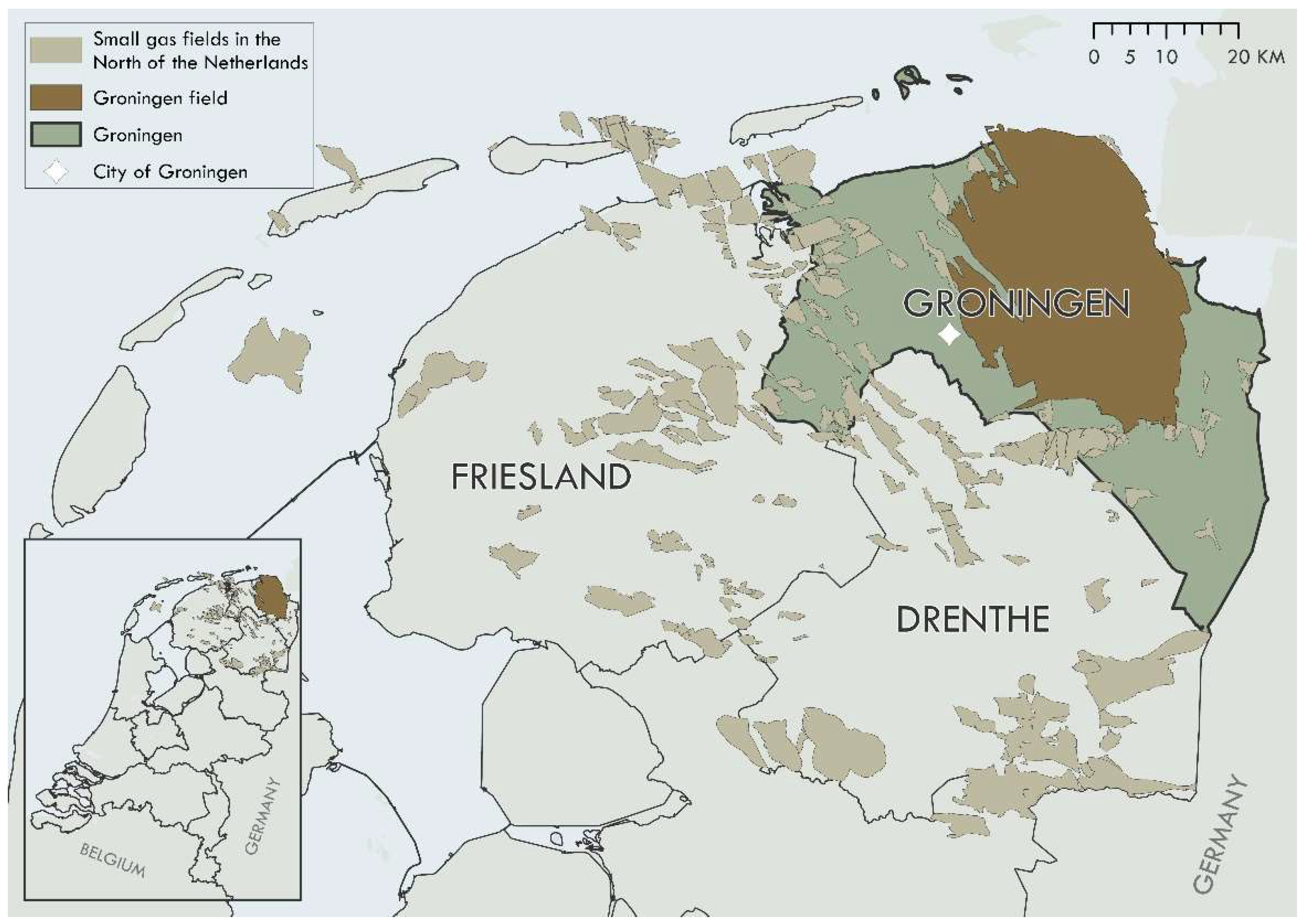
The province of Groningen is one out of 12 provinces in the Netherlands, located in the northeast of the country, bordering the province of Friesland to the west, the province of Drenthe to the south, and Germany to the east. The capital city of the province is also named Groningen (see Figure 1). On the 1st of January 2025, the province had 603,256 inhabitants [16], with approximately 244,807 people living in the capital municipality of the province [16]. In the province, 410,000 inhabitants live on a postal code with recognized damage from the earthquakes [17]. The province of Groningen is not the only province affected; Friesland and Drenthe are also experiencing (light) damage from the earthquakes [18]. These three provinces lag behind the rest of the country socio-economically [19], while the north-east of Groningen in particular is one of the most underprivileged regions of the Netherlands [20]. The impacts are most significantly felt in the province of Groningen, hence our focus on this area. The parliamentary inquiry report also recognized that the province of Groningen was used as a region where extraction with its burdens takes place but the benefits of the energy sector are consumed and invested elsewhere [3], confirming Groningen can be seen as a sacrifice zone of the Netherlands.

3.1. Natural Gas in the North of the Netherlands

Underground activities in the subsoil may cause negative social impacts [1]. In Groningen, the induced earthquakes are a result of pressure loss and equalization due to 60 years of gas extraction. When the field was discovered, the reservoir pressure was initially 347 bar [21]. In 2022, the pressure dropped to 55 bar in the southern part of the field. Another consequence of the gas extraction is soil subsidence. In 2018, the level of subsidence at the center of the field was 37 cm in total, and it is estimated that the level of subsidence will reach 44 cm by 2050, and 46 cm by 2080 [22]. As the gas extraction is lowered and even stopped, earthquakes continue to occur due to pressure changes [23]. According to the regulator, the State Supervisor of the Mines (Staatstoezicht op de Mijnen, SodM), this process of pressure equalization may take decades, and thus, the earthquakes may also continue for this long [23].
The province of Groningen is of significant importance in the gas and energy industry in Europe. The publicly released estimate is that the Groningen field consisted of 2.800 billion cubic meters of gas [21], of which 2246 billion cubic meters have been extracted [3]. Besides the Groningen gas field, the province counts several smaller gas fields (kleine velden). These smaller fields remain open after extraction from the Groningen field ceased on the 1 October 2023 [24], but the social license to operate is limited. Recently (in 2025), the new Ministry of Climate and Green Growth (Ministerie van Klimaat en Groene Groei, 2024) decided to extend NAM’s permit for the gas field in Warffum until 2032 [25]. However, residents appealed the decision at the Council of State (Raad van State, the highest general administrative court of the country) and the Dutch Upper House voted against granting the permit in June 2025.
In total, the Netherlands has 200 small fields (kleine velden) located in the province of Groningen, neighboring provinces, and in the North Sea. The NAM has an extraction license for 175 of these smaller gas fields [26]. Additionally, the NAM has a license to drill for oil in Schoonebeek (Drenthe) and has been doing so since 1947. Interestingly, the experience of residents with NAM has been quite different than in the province of Groningen, as the support for the oil production in Schoonebeek was quite high [27]. Other energy and mineral production activities in the north of the Netherlands include salt mining, diesel, oil, nitrogen, brine, and geothermal energy production [21].

3.2. Future of the Energy Sector in the North of Netherlands

As a response to the problems related to gas extraction and as an answer to the findings of the parliamentary inquiry where the economic disadvantage of Groningen was highlighted, the government pushes the province to remain the energy province of the Netherlands and become a pioneer province for the energy transition (hydrogen, wind, and solar energy) [14].
Secret documents that came out in an Open Government Act (Wet Open Overheid) showed that between 2017 and 2019, conversations took place between highly placed officials and Shell. In exchange for control over the damage protocol, the regional government promised to lobby to give Shell and NAM a role in converting gas to more sustainable energy sources. They agreed Shell would invest EUR 100 million in the green transition. Ambitions were high to give Groningen a central role in green hydrogen production. In 2024, only EUR 1 million has been invested [28].

4. Stakeholders and Governance—Mitigation and Restoration

A multitude of agencies, organizations, and consultation structures have been established as a response to the issues around gas extraction in order to solve material and immaterial damage caused by the earthquakes. These agencies are responsible for multiple compensation schemes, procedures around safety, insulation of houses as compensation, and placement of temporary houses. Thousands of people are employed in each of these agencies or subcontractors. For years, civil society organizations and researchers have already pointed out that the system that has been setup does not meet the needs of residents [29]. Moreover, because of the constant changes in the system, it is hard for residents to navigate in it. The recent parliamentary inquiry recognized this as well.
A reason for this constant system change is that the government took over the responsibility for the damage repair and reinforcement of houses, and settled the bill with the NAM [30]. In legal terms, a shift took place between the handling of damage and safety under private law to public law [31]. The reason for this was that the NAM was not considered impartial in assessing damage and safety. The parliamentary inquiry commission concluded that they depended their decisions too much on financial reasoning [3]. It was believed the government would do a better job as it would leverage the power differences for residents.
This constantly changing governance structure is often referred to as a type of ‘institutional spaghetti’ where the bureaucratic tendency of the government diminishes the legitimacy of the government and agencies involved [7]. According to Schmidt et al. [7], an institutional crisis is defined as a steep and continuous decline in legitimacy of the policy sector. This type of crisis calls for an urgent response, which is echoed by the regulator SodM, but so far, this has not been implemented even though the government itself also continues to recognize the failure of its own role [3,32]. We observe that over the years, the lack of urgency and the failure to compensate for all losses at once led to an unsuccessful, unclear, and costly mitigation strategy.

4.1. Three Main Pillars

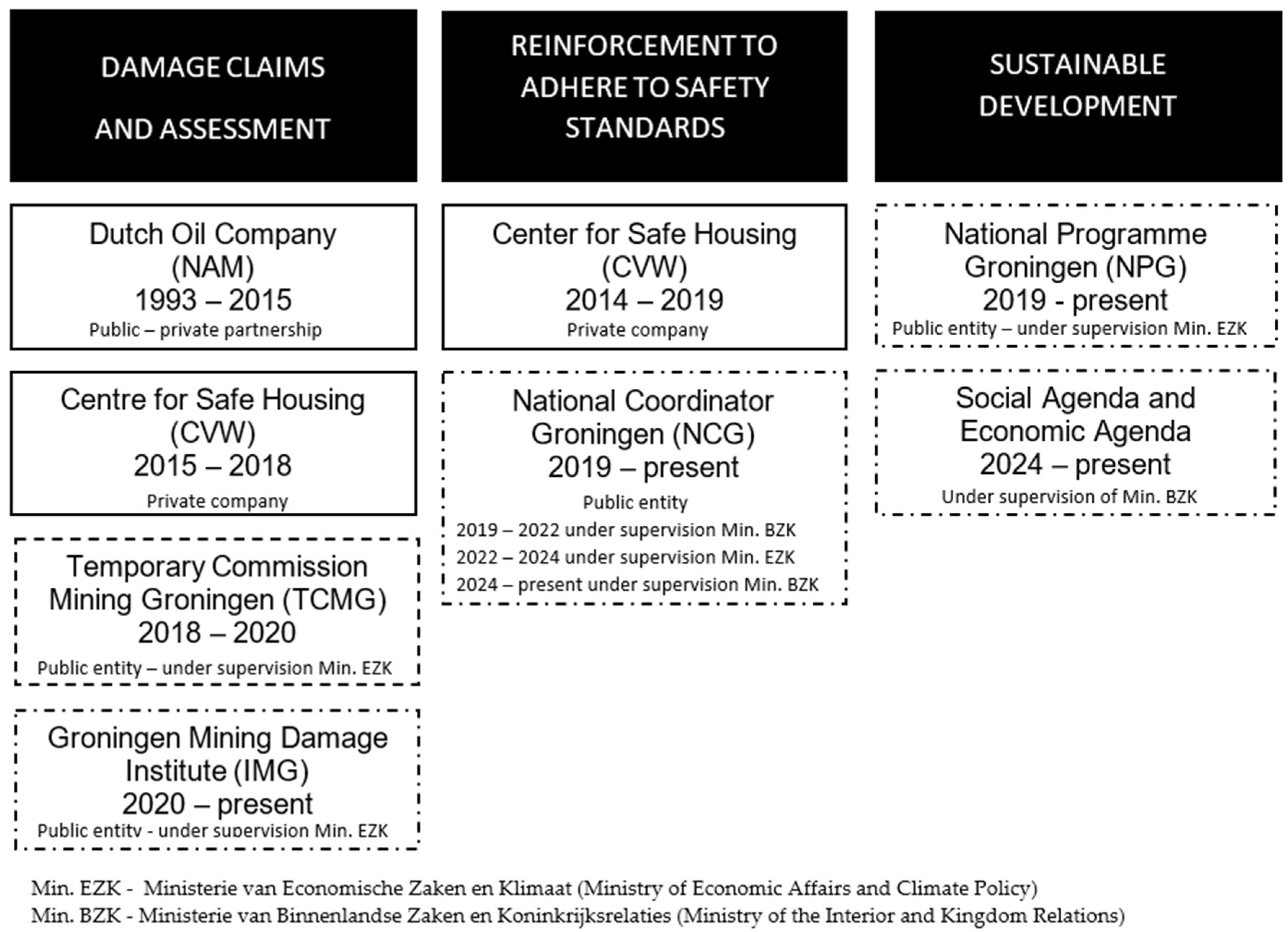
In essence, the Groningen gas extraction case is structured around three main pillars (see Figure 2) [30]:
  • Damage claims and assessment;
  • Reinforcement to adhere to safety standards;
  • Sustainable development.
Figure 2 gives an overview of the three main pillars and the institutional changes over time (ministries responsible and their tasks) with changes in private and public responsibility. In practice, this means that residents deal with separate institutes concerning measures to their house. Also, depending on political decisions, different government officials are responsible. Below, we discuss the roles of these agencies in more detail.

4.1.1. Damage Claims and Assessment

Over the years there have been several shifts in responsibility for damage claims (e.g., cracks in walls), which has shifted away from the private sector (the NAM and later the Centre for Safe Housing (Centrum voor Veilig Wonen, CVW)) to the public sector (Dutch government). At first, the NAM was responsible for the damage assessments which were conducted by external experts. Nevertheless, the objectivity of the NAM in the damage compensation process was questioned by residents and later the government itself [3]. Therefore, the CVW was established as a separate organization to settle claims and provide funds for building reinforcement and reparation independent from the NAM. However, citizens soon started disputing CVW independence and protested at CVW’s headquarters in 2018, as a result of the company claiming a EUR 2.5 million profit over 2017—money, which, according to them, should have been spent on repairing their homes [33]. After four years, a decrease in activities, and an increase in complaints, CVW’s performance was monitored under public control (precursor of Nationaal Coördinator Groningen, NCG) and in the end, their contract was not renewed [33,34]. At the time of its dissolution, most of the employees were transferred to the NCG and the TCMG (see below) [35]. More recently, the parliamentary inquiry (2023) disclosed previously inaccessible documents of the CVW. These documents revealed the company was not impartial and had a company policy of cutting costs by financially rewarding employees in denying the causal link between earthquakes and damage; however, this is still denied by CVW and the NAM [3] (pp. 763, 919, 951).
Subsequently, the Temporary Commission Mining Groningen (Tijdelijke Commissie Mijnbouwschade Groningen, TCMG) was established under a public regime. The TCMG had no ties to the NAM and worked with independent contractors and damage assessors, materializing the shift from private to public law and responsibilities [31]. The TCMG was meant to be a temporary engineering and inspection institute that would provide an efficient way of handling damage settlements until sufficient policy was in place to make this institute permanent. When TCMG took over responsibility for the damage claims, 6000 cases were still not dealt with by the private regime (NAM). The NAM gave a final offer to these residents, which was deemed insufficient by two thirds of the claimants [3] (p. 1225). The Mining Damage Institute (Instituut Mijnbouwschade Groningen, IMG) was established in July 2020. Note that the word, temporary (tijdelijk) is absent in this new title. The responsibilities of IMG include providing reimbursements for damage claims due to soil subsidence or earthquakes, decreases in house value, and other types of immaterial damage such as psychological sufferings [36]. Up until mid-2023, IMG used a tool to measure ground movement (trillingstool) for calculating the severity of the vibrations at a given address (millimeters per second) to determine whether the damage was caused by earthquakes. Both TCMG and now IMG operate as an independent administrative body; hence, they do not fall under direct authority of a ministry.
As different actors were responsible under private and public regimes (subsequently NAM, CVW, TCMG, and IMG), it is difficult to obtain a clear picture of the total number of damage claims. The institutional changes were a great point of irritation for residents, as they could not keep up with the changes, but also because the bureaucracy had a negative impact on health, feelings of safety, and trust [37]. It is important to note that from the end of 2015 onwards, after pressure from societal organizations, a reversed burden of proof has been applicable in Groningen. This means that citizens no longer have to prove mining damage comes from the gas extraction and subsequent earthquakes. Rather, the NAM has to prove that other factors are causing the damage. This change was legally formalized in 2016 in the Mining Law [38].
Up until 21 July 2025, 279,302 damage claims were submitted [39]. Even if gas extraction is ceased completely, pressure equalization may take decades [23] and thus, a continuation in the number of damage claims can be expected. In 2025, IMG has a workforce of over 1000 people.

4.1.2. Reinforcement to Adhere to Safety Standards

The NCG was founded in 2015 with the task of improving the safety and the quality-of-life of the people in Groningen. The NCG worked as an overhead manager for government projects and fund-directing related to the Groningen gas extraction and its consequences. They adopted an integral approach aimed at creating solutions for the whole region. The NCG replaced CVW’s role in the reinforcement of buildings. However, since 2019 the role of NCG has changed. Today, NCG cooperates with the five Groningen municipalities (Gemeente Eemsdelta, Gemeente Midden-Groningen, Gemeente Het Hogeland, Gemeente Oldambt, and Gemeente Groningen) in the earthquake zone, the province of Groningen and the central government. It is the main body responsible for reinforcement of houses and other buildings [40]. At the moment, in 2025, NCG has 1050 staff.
Under the tasks of the NCG falls assessing and executing the reinforcement measures. The NCG is responsible for assessing the 27,750 addresses (including houses, schools, and farms) in order to see whether they are in need of reinforcement measures [41]. This ‘scope’ comes from the original building assessments from 2015 (‘batches’), outcomes of the Hazard Risk Assessment (HRA) (now replaced by the Seismic Damage and Risk Assessment model (SDRA) (see Section 5), additional buildings from model enrichments, as well as buildings submitted by municipalities or residents through specific procedures [42]. Some of these buildings need measures that are so far reaching that it is cheaper and more efficient to demolish and rebuild. Hundreds of houses of the province have disappeared, meaning a loss of cultural heritage [43]. By the end of April 2025, 63.5% of the 27,750 addresses are safe according to the safety standards, while for 7758 addresses, a reinforcement plan is currently being drafted, or construction has already started [41].
The process of reinforcement means that residents have to leave their house temporarily. For this purpose, temporary houses (wisselwoningen) are built. These are relatively simple homes built on the fringes of villages and cities, where residents have to live while their house is being reinforced or demolished and rebuilt. Depending on the severity of needed construction, residents spend between a few months to a few years in temporary housing. So far, more than 1350 temporary homes have been built. The NCG expects the number of temporary houses to grow to 1500 or more, depending on the demand [41].
The reinforcement operation is marked by the different pilots and batches that were setup over time (see [5]). This means that certain houses and objects are assessed at a specific moment in time with specific safety norms, rules, degrees of participation of residents, financial rules, timeframes, possibilities for including personal wishes, and different stakeholders involved. Residents were always promised they would receive a house of the same quality as the one they had. However, in a lot of cases, this promise is not kept because of financial constraint and because agencies involved and residents see ’the same quality’ differently. It happens that, when the NCG and residents do not agree on the cost, residents feel they need to accommodate to speed up the process and pay some of the cost themselves. During the parliamentary hearings, it was also revealed that the NAM has pressured the government to seek to reinforce as few houses as possible to cut costs [3].

4.1.3. Sustainable Development

There are several ways in which the government has been seeking to compensate the province as it was left behind. First of all, there is the National Programme Groningen (Nationaal Programma Groningen, NPG) established in 2020. The NPG is the de facto treasurer of different development projects in the entire province of Groningen. Their EUR 1.15 billion budget for 10 years is invested in multiple projects dealing with city and town development, building renovation, and other activities aimed at improving the quality-of-life in Groningen and the participation of citizens (e.g., Programma bewonersinitiatieven and Toukomst) [44]. Recently the focus of the NPG shifted to big groundbreaking economic development projects (e.g., hydrogen, agriculture, circular economy).
More recently, as a response of the cabinet to the parliamentary inquiry, a 50-point plan was presented for all three pillars (Figure 2). The package is called ‘Nij begun’ (in Groninger dialect, meaning new beginning, referring to a shift in how the government treats the region) and it assures an intergenerational commitment to the region as the measures cover a time range of 30 years. Nij begun includes two new programs to improve social and economic issues in the region: the Social Agenda and the Economic Agenda [14].

4.2. Governance of the Groningen Case

The number of government stakeholders involved in the Groningen gas extraction case is large. Over the years, in the Groningen case, the responsibility has periodically switched between different ministries, causing changes in the way damage claims and reinforcement are carried out. In 2019, the Ministry of the Interior and Kingdom Relations got involved in the reinforcement of properties as this ministry has knowledge on citizen participation and planning. In 2023, the Ministry of Economic Affairs and Climate Policy was fully responsible for the progress in Groningen (Figure 2). And now, due to a new cabinet (Schoof I, which has fallen in June 2025), in 2024, the responsibilities are partially back under the Ministry of the Interior and Kingdom Relations. We observe that these governance changes create a lack of stability. Furthermore, there is a loss of knowledge due to new government officials and civil servants who are not always familiar with the case. Below, some of the other governance arrangements are discussed.
The regulator SodM has been responsible for supervising extraction of natural resources in the Netherlands since 1810. Thus, SodM monitors whether the mining activities are in compliance with law and regulations. At the same time, the role of SodM in relation to governmental bodies is twofold. Since 2019, it serves as an advisory body on mining activities to the Ministry of Economic Affairs and Climate Policy [45], but at the same time, the Ministry of Economic Affairs and Climate Policy is the supervisory body to the SodM [23]. The division of tasks and responsibilities between the bodies has shown to be unclear in the Groningen gas extraction case. This entwined and difficult position of SodM was explained during the public hearings of the parliamentary inquiry. Researchers of the institute and the director general explained how their advice on lowering the gas extraction in 2012 and their warning about safety were not abided by. Additionally, they referred to the lack of capacity they experienced in overseeing the Groningen case. Therefore, they depended very much on the knowledge of the NAM. Additionally, SodM suffered from the entwined relation (in some periods) between the gas companies and the government [3]. As a response to the parliamentary inquiry, SodM is increasingly critical to granting permits while it includes the social perspective more in decisions on mining.
Municipalities in the province of Groningen affected by the gas extraction have been increasingly involved in the processes around mitigation and planning [46]. Since 2019, they develop, research, and propose plans for reinforcement of buildings as well as town and city development [47]. Additionally, the municipalities seek more ways to involve citizens in the planning and decision-making processes around renovation and development, as they are the first point of contact for residents.
Many organizations where the government is (partially) responsible for operations have not been presented in this paper, as the list would simply grow too large. Examples of these are the Economic Board Groningen, which seeks to enhance employment opportunities and general business investment in the Groningen area, and the Commissie Bijzondere Situaties (Special Cases Committee) which supports people who are not able to deal with the procedures themselves as they are dealing with cumulative impacts (like severe financial distress or health issues).
In the context of the social impacts of gas extraction, it has become hard to speak of one ‘government’. The various government stakeholders involved do not necessarily always trust one another, do not communicate effectively between themselves and sometimes lack oversight [5,8]. This leads not only to a lack of trust between them, but also decreases people’s trust in the government [37,46,48]. Longitudinal research by Dückers et al. [29] showed that the trust residents have in the parties involved is negatively impacted by the gas extraction and consequently damages their experience with these institutions. Additionally, the setup of the damage repair and safety operation in Groningen led to a dispute between the state and ExxonMobil and Shell. Currently, there is an arbitration procedure between the parties over the costs of the operation [49].

4.3. Citizen Initiatives and Organization(s)

Over time, many citizens felt like they had to act on the increasing amount of earthquakes and poor management. The first citizen-led organization that had its main focus on people’s rights was founded in 2009: the Groninger Bodem Beweging (GBB, Groninger Ground Movement). The mission of GBB is to unify citizens who are concerned about the consequences of the gas extraction and to counterbalance the Dutch government’s policies [50].
Another influential citizen organization is the Groninger Gasberaad (GGB, Groningen Gas Council). The Gasberaad is an overarching associated collective of several organizations and institutes from many sectors who meet regularly and advise on policy for, among others, the ministries and the NCG, so the regulations reflect the citizen’s interest and needs [50]. Some of the associates include representatives from cultural heritage groups, business partnerships, regional development groups, agri- and horticultural organizations, local business owners, and housing corporations.
Founded by the GBB and the GGB, is the organization known as Stut-en-Steun founded in 2016 [51]. The name refers to the many scaffolded houses (stutten) and the support (steun) the organization offers. The organization provides free (legal) support for people who need assistance with damage claims and the reinforcement (e.g., when citizens do not agree with the assessment reports, this organization helps with writing a formal response).
If citizens have complaints on damage claims and building reinforcement, they file their complaints through the Onafhankelijke Raadsman, and from January 2022 the National Ombudsman. This entity has the responsibility to handle the complaints and find solutions for citizens [52]. Moreover, the National Ombudsman seeks to improve the public policies in the gas extraction case [53]. Recently, the Ombudsman concluded that the Dutch cabinet structurally ignored advice and rights of citizens, including in the gas extraction case [54]. The fragmented governance structure, along with a lack of coordination and continuity between actors, created conditions in which technical expertise became a substitute for political accountability. As a result, scientific models and assessments gained disproportionate influence in shaping decisions about safety, compensation, and reinforcement. As Postmes et al. [11] argue, this dynamic contributed to a creation of a technocratic system in which scientific knowledge is selectively created and used to justify policy decisions. The following section explores the role of science in the Groningen case and examines the implications of relying on technocratic solutions.

5. The Role of Science

In the Groningen gas extraction case, the use of scientific insights has been controversial for several reasons (see [11]). First of all, as the parliamentary inquiry now also confirms, the knowledge about the Groningen field was deliberately kept limited so extraction could continue. The knowledge that was present was in the hands of the NAM, resulting in a situation where the government relied on the NAM’s knowledge, as independent knowledge was not accessible [3]. This includes scientific research on past tectonic and soil subsidence data, ongoing monitoring of the field, and future predictions. Moreover, insights on social issues were scarce [55]. Transparency regarding what was or was not known about the field and the consequences of extraction was lacking. Second of all, independent researchers warning about the possible severity of the earthquakes were not taken seriously [9]. Thirdly, at a later stage in the case, the scientific insights on the impact on people were pushed away in policymaking. This resulted in a closed-off technical and bureaucratic approach to the issues at hand in which financial considerations were prioritized. The parliamentary committee found the use of science in Groningen to be “objectionable” (laakbaar). They describe that science confirms, on one hand, the interest of the industry while downplaying risks, and on the other hand, independent science that challenges the established research paradigm, that is not taken seriously ([3], p. 79). These claims are echoed by the work of Jasanoff [56], who criticizes corporate involvement in science, as corporate actors often shape the questions asked, how evidence is interpreted, and what counts as legitimate knowledge.
The technocratic approach to safety and compensation is visible in the way the Hazard and Risk Assessment model (HRA) was developed and used. In 2018, this model was developed for creating a safety profile of buildings; since 2021, it has been publicly managed and taken over by TNO. The model is now called the Seismic Damage and Risk Assessment model (SDRA). The model “provides an expectation of the future seismicity, seismic ground motions, building damage, and the safety risk for residents” [57] (p. 5). As input, the model uses these parameters: KNMI data on the number of earthquakes, NAM data on location of the fault lines, NAM data on expected gas production, NAM data on pressure in the reservoir, the yearly gas use based on the average temperature, and the building characteristics provided by the Ministry of EZK [58]. One of the outcomes of the model is the number of addresses that are possibly unsafe according to the national safety standard. It is also used to prioritize the addresses that need to be inspected (high to low risk). Thus, the addresses in the output of this model still need inspection, for which the cost varies between EUR 52,000 and EUR 130,000 per house [59]. Once the report of the inspection is there, it is decided whether the house needs reinforcement measures or is in need of demolishing (and eventually, this also influences the amount of financial compensation received).
The HRA/SDRA model has been criticized for several reasons. Before the introduction of this model, in 2015, an area-focused approach was used. Based on this approach, buildings in the core earthquake area had priority for reinforcement measures to adhere to safety standards. In 2018, this model-driven approach was adopted, where outcomes of the models were used to determine which buildings need new measures and have priority. The introduction of the HRA/SDRA model was yet another change in policy, resulting in activities across the entire province (within the NCG ‘scope’) without taking into account the most affected area. Also, buildings that needed instant structural support (like beams in order for walls not to collapse) were, in some cases, not part of the model’s outcome. This made people question the effectiveness and trustworthiness of the model [6]. Furthermore, the model is run yearly with newly measured parameters from the gas field. Based on different yearly runs of the model, the number of addresses that need to be inspected changes, and some addresses go from the label ‘unsafe’ to ‘safe’ (and vice versa) without having had any damage repair or reinforcement measures completed. From 2020, there is a possibility for residents whose houses are not included in the NCG ‘scope’ to request a safety assessment. Finally, the model is criticized as it is yet another policy change that leads to delay, inexplicable outcomes, inequality, and arbitrariness [60].

6. Overview of the Most Important Decisions and Developments Mitigating Social Impacts Since 2015

As shown in this paper, the Groningen case is ever changing and complex. Since the publication of Van der Voort & Vanclay [9], several changes have been made in the governance and the policies to mitigate the social impacts. Below, we give an overview of the main developments in a timeline (Table 1).
The overview shows a snapshot of the evolution of the Groningen gas extraction case. Since 2015, the case has been characterized by denial, conflict, dialogue, negotiation, recognition, change, and consensus finding. The effects of the earthquakes and related policies are still ongoing, in a context where trust of residents is severely affected and eroded. The developments show how the public perception of gas extraction changed, putting severe pressure on the public–private partnership.
Reflecting on the various mitigation strategies in Groningen, we observe that the three most common goals for successful mitigation (reducing negative social impacts; creating positive social impacts; and assisting the results of the project), are not met [66]. In fact, over time, the social license to operate was lost, the field closed, and the cost to compensate for the poor management of the gas extraction in terms of money rose above EUR 22 billion. Loxton et al. [66] identify several prerequisites for successful mitigation and highlight the care with which the strategies should be designed to be effective. Additionally, they stress the importance of identifying and acting upon potential risks of projects early on to avoid escalation of social issues (see also [2]). In Groningen, the choice of not identifying and responding directly to the earthquakes and safety issues resulted in ad hoc choices over a long period of time that were sub-optimal, such as the decision to create two agencies to address damage and safety separately. Furthermore, the continuous shifts in responsibilities, the institutional instability, and corporate interest caused distrust and confusion among residents, as explained in more detail below.

7. The Social Impacts Caused by the Gas Extraction Induced Earthquakes and the Government-Led Compensation Process

Since the last overview paper was published about social impacts of gas extraction in Groningen in 2015 [9], the social impacts have evolved substantially. As this case has already been ongoing for a long time, it is hard to classify the different orders of impacts and disentangle the causal relations between them. The SIA literature classifies social impacts into first-, second-, third-, and higher-order impacts, each level rooted in the previous one [2]. First-order impacts are caused directly by a project and tend not to be as significant as the higher-order ones, making the prediction of social impact difficult [67]. The gas extraction has been an ongoing issue, whereas the different order impacts circularly influence and amplify each other over time.
Van der Voort and Vanclay [9] already stressed that a social and environmental assessment is needed for the Groningen project to regain its legitimacy and social license to operate. Furthermore, they argued that a Social Impact Management Plan (SIMP) and Impacts and Benefits Agreement (IBA) needed to be developed to monitor and adaptively manage the rising social impact. However, to this day, such an assessment has not been publicly undertaken, thus causing the higher-order impacts to further develop, build on each other, and multiply. Since the field was closed in 2024, a social license to operate for the NAM for this field is no longer needed; however, the social impacts are still ongoing under the responsibility of the Dutch government, and the reputation of NAM suffered substantially, affecting the acceptance of other projects [68].
Below, we discuss the multitude of impacts and consequences of the gas extraction, distilled from the Social Impact Assessment (SIA) literature (SIA is the process of predicting, mitigating, and managing social impacts related to consequences of planned interventions [2]. These assessments analyze possible consequences of such projects and seek ways to reduce and mitigate their impact [9,67,69]. In ongoing projects, SIA could also be applied to monitor social impacts. The Groningen gas field was opened for commercial gas production before the development of tools to conduct environmental and social impact assessment). We start by explaining the most significant social impacts at the moment caused by bureaucracy, followed by health issues and finally, loss of social cohesion and inequality.

7.1. Bureaucracy

Recent studies [29,37,70] demonstrate that the most significant impact of the gas extraction is the bureaucratic system residents have to abide by. This includes all the procedures that have been setup to deal with the damage claims, the reinforcement operation, and compensation measures. Based on the literature [5,8,29], residents mention several issues regarding the bureaucracy including the following:
  • Having to deal with different institutions regarding the state of their house that do not efficiently collaborate and share information;
  • Constantly changing rules and norms that are meant to ensure safety and give residents more say, but they often create more confusion;
  • Little ability to participate in, or have control over the necessary processes to safeguard a damage-free and safe home;
  • Struggling with the experience of power imbalance as residents often still need to advocate their case in face of these organizations;
  • Experiencing unfair treatment, including different treatment between people, leading to conflict;
  • Disappointment and anger over promises not being kept in terms of unclearness, planning, long waiting times;
  • Losing trust in the responsible institutions.
Overall, as stated by Stroebe et al. [71], the reinforcement operation is poorly understood by residents. One of the reasons for this is the technical approach taken by the government and agencies. This approach does not reflect the needs and wishes of residents. The parliamentary inquiry concluded that a holistic, integrated approach at both the household (combining damage repair, reinforcement, and insulation) and institutional level is needed [3]. However, the two main institutions (mostly) still operate as separate entities.

7.2. Health Impacts

Research by Gronings Perspectief (a multiannual study, using a random representative sample, drawn from a resident panel) repeatedly provides evidence that the induced earthquakes and the linked bureaucracy causes negative health consequences over time. Based on the literature [37,48,70,71], the health impacts residents are experiencing are
  • Stress related symptoms such as palpitations, lightheadedness, irritability, and fatigue;
  • Chronic stress;
  • Negative impacts on mental health;
  • Family life is affected by time-consuming processes, and discussions regarding safety and (recurring) damage.
In the municipalities in the gas extraction area, youth report feeling less happy [72]. Additionally, their health is lower compared to youth elsewhere, and children rate their lives lower than elsewhere in the Netherlands [73]. A qualitative study with adolescents growing up in the gas extraction area found that adolescents have similar health issues as adults [74,75]. Professionals working in the reinforcement operation also report feeling powerless in helping residents and unable to provide proper information to them [76]. Gronings Perspectief also concluded that those who experienced a multitude of earthquakes with repeated damage are most at risk and have poorer health [37]. Reinforcement processes also have a negative impact on health. After reinforcement is completed, residents’ health improve; however, so far, it does not go back to the base level [29].

7.3. Social Cohesion and Inequality

The immense reinforcement operation and, to a lesser extent, the damage claims and repairs, are threatening the social cohesion in neighborhoods and villages [71,77]. Up until 2018, Gronings Perspectief saw an increase in social connectedness [71]. As stated, social cohesion is very important to improve the resilience of residents, especially in a chronic disaster like the one in the province of Groningen [7]. After 2018, different reasons are found as to why social cohesion decreased. Based on the literature [29,71,77], several reasons are given to explain the decrease in social cohesion:
  • The individual approach can damage relations in the neighborhood as there is a disparity between the extent to which people are compensated (both in the reinforcement as well as damage compensation);
  • Time and effort that is needed to go through the process of reinforcement and damage repair are considerable, taking up time that otherwise might have been spent on activities in the neighborhood;
  • As residents temporarily need to leave their homes and move to temporary housing; this also affects cohesion.
The effect of the reinforcement operation does work out differently in villages. In some cases, it might bring people closer together as projects are taken up jointly, such as the reinforcement of communal buildings. Moreover, the issues around inequality do not only occur on the regional level. As the parliamentary inquiry concluded, people of the province of Groningen feel left behind and feel as if they do not matter to the rest of the Netherlands [3].
To conclude, we observe that the type of impact changes over time, and we see that the first-order impacts are no longer the main concern of residents. Since higher-order impacts often cause more harm than first-order impacts, an ongoing monitoring and adaptive management process is of greater importance than predicting all impacts before the start of a project [2]. Even if, in the future, the earthquakes stop (which may take decades), this does not mean that other impacts will immediately be resolved.

8. Gas Extraction in a Broader Context

Even though gas extraction in Groningen has permanently stopped, there is no solution in sight for the problems at hand. This has two main reasons. First, the uncompleted execution of the reinforcement operation and ongoing influx of damage claims, and second, the public debate on energy supply.
The completion of the reinforcement operation was planned for 2028 but since then has been contested and postponed. (In April 2024, the State Secretary for Mining promised to deliver a detailed analysis from the NCG on the feasibility of completing the Groningen housing reinforcements by 2028 [78]). In 2025, a new deadline was set; the director of the NCG confirmed that the deadline of 2028 is not feasible and will be closer to 2031/2032 [79]. The reasons for this are the shortage of personnel but also because of the insulation measures that are now also part of the reinforcement operation [14]. SodM has been pointing out for several years that the speed at which the operation takes place needs acceleration. Recently, SodM concluded that the operation had to go three times faster to be able to complete in time [80]. Here, we observe the contradicting interests among parties. NCG pushes for better quality of the process to alleviate residents, and the regulator pushes for speed to adhere to safety standards while improving residents’ health. These different approaches reflect larger differences in perspectives on safety and well-being, and show the complexity of this case.
We observe that even though the parliamentary inquiry stresses the importance of a holistic integrated approach to reinforcement, damage repair, and sustainability/insulation, the same bureaucratic setup of multiple institutions remains in place [3]. This makes it highly unlikely that easy solutions are found to the bureaucracy at hand, and the different social impacts residents experience. Within Dutch society, the focus on setting up a complex system to deal with issues is not new. This type of system failure, where the issues at hand are not solved but rather subjected to harsh control mechanisms while the social effects fester and worsen, is also to be observed in other Dutch conflicts [81]. This is striking, given the social welfare approach the Dutch society is known for.
Additionally, the public debate about the gas field is continuous due to geopolitical forces, possible energy shortages, and political changes. Geopolitically, the Groningen field has been of great importance for Northern Europe. In 2022, pressure increased to keep the field open due to the Russia–Ukraine war and imposed sanctions on Russia, which led Europe to have an energy crisis. Due to the political unrest, the question of energy security still plays a role in the debate of the extraction from the smaller gas fields in Groningen.
The closure of the Groningen field has also made the transition from fossil fuels to renewable energy more prominent in the region and the rest of the Netherlands. The existing gas infrastructure sets in motion a faster energy transition as the infrastructure no longer serves gas production; however, it does provide new opportunities for storage and transportation of other energy sources. The province of Groningen, is now coined ‘the hydrogen capital’, with Shell as one of the main players in this transition [82]. Even in the response of the cabinet to the parliamentary inquiry, Nij begun, hydrogen was put in a central position to ensure economic perspective for the region. So far, the energy transition has led to a fear of entering into the same kind of issues, given that the same companies are involved [83]. Internationally, this seems to be a consistent issue where (former) fossil fuel companies invest in greener energy sources while keeping the same way of working [84].
Looking towards the future, a way in which potential new problems around gas extraction and mining could be avoided and improved is the renewal of the Dutch mining law. This law was criticized by the parliamentary inquiry for not representing the needs of residents. Following up on that, the Mining Law is to be revised in the coming years [8]. Below, we will expand on the lessons that are relevant for this revision and future responses to issues around extractive industries.

9. Lessons Learnt and Concluding Remarks

The gas extraction has severely damaged relations among and between the main stakeholders (residents, industry, government, the regulator, and science). Additionally, it has many social impacts over time that could have been avoided had there been an appropriate response. The problem is (made to be) technically complex, financially costly, and with great judicial and global implications. The questions arise: How was it possible for this case to escalate as it did in the social welfare state of the Netherlands? How was it possible that the Dutch government started to act like a corporation and forgot its duty to protect the public?
The lessons we can draw from this case are relevant for a broader international context. Most of the literature on mining and extractivism focuses on countries in the Global South, whereas the mechanisms and lessons from how social conflicts over natural resources unfold in countries in the Global North, are not as widely written about. Even though some of these lessons may seem self-evident, they were not implemented in the Dutch context. Thus, we find it necessary to draw attention to them for other mining activities and the energy transition.
Based on our own findings and analysis of the conclusions of the parliamentary inquiry committee, we list the main lessons, relevant for an international public and for future energy projects:
  • Within the neoliberal model, governments increasingly withdraw from their public duty; hence, governments are inclined to act and increasingly collaborate in a corporate way, forgetting the duty to the public they have. As shown in the parliamentary inquiry, this resulted in an entangled relationship between the government and the NAM, with the international shareholders Shell and Exxon setting the agenda. The government has a duty of care to its residents, which it has significantly failed to fulfil. The government depended too much on the revenues from gas extraction, a situation that left little room for independent decision-making in dealing with social impacts and the ability of the government to act in the interest of the public.
  • Within any mining project, there is a need for an independent regulator that is enabled to carry out its public role. The Groningen case showed that, especially around the tipping point of this case, the role of the regulator was not sufficiently independent. The regulator needs to have sufficient knowledge and mandate to intervene when necessary. When the regulator does not have a mandate to intervene in case of safety issues, the credibility of the operator is also at stake. This is what happened in Groningen: as the NAM lost its social license to operate and the costs of repair rose, the field closed while there still was gas to be won. The NAM also lost its core extraction activity, and the Netherlands lost a core energy source. Therefore, a well-equipped regulator with a clear mandate is vital for mining activities to continue.
  • Clear and independent knowledge production is needed for appropriate decision-making processes. Aiming to downplay the potential risk and its impacts, knowledge development about the Groningen gas field was, for a long time, concentrated within a small number of (industry) parties that set the research agenda. There was no safety culture present beyond the regulatory compliance, little focus on understanding the societal impacts, and there was no space for critical voices from the scientific community. The government and operator heavily relied on information from the industry. To prevent such situations in future mining projects, scientific knowledge needs to be independent, open, and transparent. Moreover, as recognized in the post-normal science and the concept of co-production, it is important to recognize how facts and values are deeply intertwined, especially in uncertain contexts [56]. Science and society cannot be treated as separate from each other; therefore, knowledge should be collaboratively created and validated to ensure all perspectives (including those of affected residents) are meaningfully included.
  • The tendency of mining companies to mainly have a technical, quantitative approach to risk assessment is a common practice that simplifies reality; however, mining activities take place in areas where both the living and built environment of people are affected. Therefore, understanding the social impacts of mining projects is necessary and should be integrated into standard business procedures. In Groningen, academic insights on the social impacts were actively ignored and trivialized, eventually leading to the loss of a social license to operate [3]. When making policy by mainly using models and predictions, one loses track of the complete context and reality outside the models.
  • Within any new energy projects, roles and responsibilities of different actors involved need to be clear from the start, so responsibilities are known in case of damage or safety issues. The NAM and later the Dutch government, set up a technical and bureaucratic governance system for damage claims and reinforcement with shifting responsibilities, unclear protocols, and many institutions responsible for sub-parts of the problem. An integrated holistic approach that simplifies the damage claims and reinforcement process for residents (by, e.g., having one institute responsible instead of three) with a focus on well-being is needed.
  • Regarding citizen participation and communication, residents of mining areas are often passive bystanders to these activities. They are communicated to but not communicated with. As the impacts of the earthquakes and often other mining activities touch upon the very core of people’s lives, like their home, safety, surroundings, and family life, there is a need for companies and government to design procedures in co-creation with residents, where meaningful participation and stakeholder engagement procedures are key.
  • In mining and energy projects, there is overestimation of the capacity to mitigate social problems through money. In the Netherlands, once things are escalating, there is a tendency to organize solutions by setting up quasi-independent organizations that distribute money to the residents and yet keep business as usual without addressing the core issues. Mitigation was dominated by financial, technological, and legal issues. This approach is limited in both scope and effect. What should be center to the discussion while designing mitigation measures—residents—ceased to be represented in any way. Many complications arose and spiraled out of control as a result of compensation measures that were technocratically designed and very costly to execute. Mitigation was not working and things became costly very quickly. Technocratically designed transactional compensation measures fail to account for relational, emotional, and moral dimensions of the inflicted harm. When moral harm is (attempted to be) reduced to economic value, affected communities are further alienated. Money cannot restore a lost sense of safety, undo years of stress, rebuild trust in institutions, or repair the social cohesion of communities. A lesson is that mitigating impacts through money is not the end solution for damage done by mining activities; a relational repair is key, and financial compensation is only a part of it.
  • The precautionary principle is globally acknowledged as an important guide to make decisions about uncertainty in risk management and protecting people against (irreversible) harm. The precautionary principle was not implemented well in Groningen; it was long presumed that no harm was being done. This mindset put many residents of the province in danger, as the approach to safety strongly leaned on statistical models and probability calculations. In Groningen, this meant that calculating the risk of collapse of buildings resulted in the neglect of actual hazards and incidents that affect residents directly (e.g., models ignored the escalation of damage). Risks that are not related to actual collapse of buildings but that had very real impacts on those residents were ignored (e.g., the continued damage to infrastructure, the paralysis of the housing market, the knock-on effects of failures to mitigate both damage and physical safety risks). This shows the need for a broader understanding of safety while implementing the precautionary principle.
  • Internationally, there are different steps to be taken to be able to extract resources; these depend on national legislation and international standards and expectations, including in terms of social performance [85]. In the Netherlands, we see different developments in licensing and legislation of mining activities, in response to the Groningen case. In 2018, the Dutch mining law was revised and an article was added to consider social disruption in determining the amount of gas that could be extracted from the Groningen field [86]. (With the Groningen gas field closing, this article in the mining law has become obsolete. Now, by law, social disruption and unrest are not taken into account in any mining activities when deciding on permits for the extraction of raw materials) After the parliamentary inquiry, adjustments are being made to the entire mining law and licensing. Within the licensing process, the Dutch government changed its approach from ‘yes, provided that’ to ‘no, unless’, indicating a clear shift in power dynamics about how operating licenses are granted to companies. Additionally, operating licenses will no longer be indefinite. Several ideas of a full Social Impact Assessment and its steps are being followed, like dialogue, aftercare, and closure plans [87]. However, a full introduction of SIA in the Dutch mining law as an obligatory step is still absent. A lesson is that governments and operators should learn from past mistakes and take them as an opportunity to improve their social performance for future mining activities.
The Groningen case can be seen as an opportunity to learn from past mistakes and use the experiences to reduce risks and consequences of such cases in the future. It shows the risks of an extreme dependency between state and industrial partners and how this led to a loss of social license to operate and eventually, while not agreeing on the cost for repair, a costly arbitration procedure between state and operator. To strengthen the knowledge on the response to induced earthquakes resulting from industrial (gas) extraction, it would be highly valuable to conduct a comparative analysis between other areas that are affected by this, such as Oklahoma, USA [88]. Notably, this would lead to an interesting comparison between countries where the social welfare state approach is adopted and one where this is not.
Following the parliamentary inquiry, a list of recommendations for the responsible government agencies was created. These recommendations are also in line with what this article recognizes as issues and possible solutions. However, in Nij begun, no fundamental change has been planned for simplifying the bureaucratic system residents need to comply with, as this is said to be too complex and time-consuming in hindsight. Therefore, we are yet to see how and whether the so-called ‘debt of honour’ the Dutch government uses as a concept to express their dedication to the created issues in the region (ereschuld, meaning the moral obligation to solve the issues), to Groningen, can be redeemed. Being illustrative of the many interests in the case, as we are finalizing this article in August 2025, there is still debate on the continuation of the extraction from the smaller fields. The Dutch Upper Houses voted against the decision of the minister, whereas the minister ignored this and continued to plead for the continuation of the extraction permits in Warffum and Grijpskerk - we are yet to see how this case will continue to unfold.

Author Contributions

Conceptualization, N.B.; Methodology, N.B. and E.V.; Validation, E.V.; Investigation, N.B. and E.V.; Data curation, N.B.; Writing—original draft, N.B. and E.V.; Writing—review & editing, N.B. All authors have read and agreed to the published version of the manuscript.

Funding

The authors are affiliated with the Knowledge Platform (Kennisplatform Leefbaar en Kansrijk Groningen), funded by the Netherlands Ministry of Economic Affairs and Climate and by local government in Groningen.

Institutional Review Board Statement

Not applicable.

Informed Consent Statement

Not applicable.

Data Availability Statement

Data is contained within the article.

Acknowledgments

We would like to thank Tom Postmes, Lidewij van der Ploeg, Sanne Hupkes and the team of the Knowledge Platform for proof reading the article. Also, we want to thank the reviewers for their valuable contributions and feedback.

Conflicts of Interest

The authors declare no conflict of interest.

Abbreviations

CVWCentrum Veilig Wonen
Centre for Safe Housing
EZKMinisterie van Economische Zaken en Klimaat
Ministry of Economic Affairs and Climate Policy
GBBGroningen Bodem Beweging
Groningen Ground Movement
IMGInstituut Mijnbouwschade Groningen
Groningen Mining Damage Institute
NAMNederlandse Aardolie Maatschappij
Dutch Oil Company
NCGNationaal Coördinator Groningen

References

  1. Lodhia, S.K. (Ed.) Mining and Sustainable Development: Current Issues; Routledge: London, UK, 2018; ISBN 978-1-315-12139-0. [Google Scholar]
  2. Esteves, A.M.; Franks, D.; Vanclay, F. Social Impact Assessment: The State of the Art. Impact Assess. Proj. Apprais. 2012, 30, 34–42. [Google Scholar] [CrossRef]
  3. Tweede Kamer. Rapport Parlementaire Enquêtecommissie Aardgaswinning Groningen. 2023. Available online: https://www.tweedekamer.nl/Groningen/rapport (accessed on 15 June 2025).
  4. Bakema, M.; Parra, C.; McCann, P. Analyzing the Social Lead-Up to a Human-Induced Disaster: The Gas Extraction-Earthquake Nexus in Groningen, The Netherlands. Sustainability 2018, 10, 3621. [Google Scholar] [CrossRef]
  5. Busscher, N.; Postmes, T.; Hupkes, S. Advies Kennisplatform Leefbaar en Kansrijk Groningen: Het Verbeteren van de Participatie van Bewoners in Het Gaswinningsgebied. In Perspectief van Bewoners in de Versterking; Kennisplatform Leefbaar en Kansrijk Groningen: Groningen, The Netherlands, 2021. [Google Scholar]
  6. Derksen, W.; Gebben, M. Groningen en de Bevingen: Hoe Kennis Beleid Nauwelijks Beter Maakt; Boom Bestuurskunde: The Hague, The Netherlands, 2022; ISBN 978-94-6236-256-7. [Google Scholar]
  7. Schmidt, A.; Boersma, K.; Groenewegen, P. Management Strategies in Response to an Institutional Crisis: The Case of Earthquakes in the Netherlands. Public Adm. 2018, 96, 513–527. [Google Scholar] [CrossRef]
  8. Schreuder, W.E.; Busscher, N.; Postmes, T. Inzicht in Impact. De Maatschappelijke Gevolgen van de Gaswinning en Denkrichtingen Voor de Toekomst; Kennisplatform Leefbaar en Kansrijk Groningen, Rijksuniversiteit Groningen: Groningen, The Netherlands, 2023; ISBN 978-90-90-37857-2. [Google Scholar]
  9. Van Der Voort, N.; Vanclay, F. Social Impacts of Earthquakes Caused by Gas Extraction in the Province of Groningen, The Netherlands. Environ. Impact Assess. Rev. 2015, 50, 1–15. [Google Scholar] [CrossRef]
  10. Patrahau, I.; van Geuns, L. Gas Supply Security in the Netherlands: Geopolitical and Environmental Dilemmas; HCSS Geo-Economics: The Hague, The Netherlands, 2021. [Google Scholar]
  11. Postmes, T.; Busscher, N.; Hupkes, S.; De Julio, A.; Vojvodic, E. The Groningen Gas Field: The Role of Science in a Slow-Onset Disaster. In Climate Change and Safety in High-Risk Industries; Bieder, C., Grote, G., Weyer, J., Eds.; Springer Nature: Cham, Switzerland, 2024; pp. 63–75. ISBN 978-3-031-56995-1. [Google Scholar]
  12. Valenzuela-Fuentes, K.; Alarcón-Barrueto, E.; Torres-Salinas, R. From Resistance to Creation: Socio-Environmental Activism in Chile’s “Sacrifice Zones”. Sustainability 2021, 13, 3481. [Google Scholar] [CrossRef]
  13. Stevens, P.; Glada Lahn, G.; Kooroshy, J. The Resource Curse Revisited; Chatham House: London, UK, 2015. [Google Scholar]
  14. Rijksoverheid. Kamerbrief over Nij Begun: Op Weg Naar Erkenning, Herstel en Perspectief; Rijksoverheid: The Hague, The Netherlands, 2023. [Google Scholar]
  15. Vanclay, F. Conceptualising Social Impacts. Environ. Impact Assess. Rev. 2002, 22, 183–211. [Google Scholar] [CrossRef]
  16. StatLine. StatLine-Regionale Kerncijfers Nederland. Available online: https://opendata.cbs.nl/statline/#/CBS/nl/dataset/70072ned/table?ts=1748597813851 (accessed on 30 May 2025).
  17. Postmes, T.; Stroebe, K.; Richardson, J.; LeKander, B.; Greven, F.; Broer, J. Gevolgen van Bodembeweging Voor Groningers: Ervaren Veiligheid, Gezondheid en Toekomstperspectief 2016–2017; Heymans Institute, University of Groningen: Groningen, The Netherlands, 2018. [Google Scholar]
  18. Scherpenzeel, A.; Rozema, M.; Kanis, B. Gaswinningsproblematiek Raakt Ook Drenthe: Schade en Psychosociale Impact Voorbij de Provinciegrens; Nivel: Utrecht, The Netherlands, 2024. [Google Scholar]
  19. Bijl, R.; Boelhouwer, J.; Wennekers, A. De Sociale Staat van Nederland 2017; Sociaal en Cultureel Planbureau: Den Haag, The Netherlands, 2017; ISBN 978-90-377-0847-9. [Google Scholar]
  20. Milikowski, F. Een Klein Land Met Verre Uithoeken. Ongelijke Kansen in Veranderend Nederland; Atlas Contact: Amsterdam, The Netherlands, 2020; ISBN 978-90-467-0788-3. [Google Scholar]
  21. NLOG. Dutch Oil and Gas Portal Groningen Gasfield|NLOG. Available online: https://www.nlog.nl/en/groningen-gasfield (accessed on 15 June 2025).
  22. Commissie Bodemdaling. Status Rapport 2020 en Prognose Tot Het Jaar 2080. Bodemdaling Door Aardgaswinning in Groningen, Friesland en Het Noorden van Drenthe; Commissie Bodemdaling: Haren, The Netherlands, 2020. [Google Scholar]
  23. SodM. Voortgang van de Versterkingsopgave en de Afbouw van de Gaswinning (‘21-’22)-Rapport-Staatstoezicht op de Mijnen. Available online: https://www.sodm.nl/documenten/rapporten/2022/06/23/voortgang-van-de-versterkingsopgave-en-de-afbouw-van-de-gaswinning--21-22 (accessed on 15 June 2025).
  24. NOS. Nederland Gaat Voor Het Eerst in 60 Jaar de Winter in Zonder Gronings Gas. Available online: https://nos.nl/collectie/13902/artikel/2492111 (accessed on 15 June 2025).
  25. NAM. Definitief Besluit: Gaswinning Warffum tot 2032|Nederlandse Aardolie Maatschappij. Available online: https://www.nam.nl/nieuws/2025/definitief-besluit-gaswinning-warffum.html (accessed on 18 July 2025).
  26. NAM. Winningsplannen Kleine Velden. Available online: https://www.nam.nl/gas-en-olie/aardgas-uit-kleine-velden/belang-van-aardgas-uit-kleine-velden.html (accessed on 18 July 2025).
  27. Veenker, R.; Vanclay, F. What Did NAM Do to Get a Social Licence to Operate? The Social Impact History of the Schoonebeek Oilfield in the Netherlands. Extr. Ind. Soc. 2021, 8, 100888. [Google Scholar] [CrossRef]
  28. Schohaus, B.; van Beek, B.; Mast, J.; de Buck, M.; Beunder, A. Shell Beloofde Groningen Ooit Een ‘Groene’ Toekomst. Available online: https://www.ftm.nl/artikelen/shell-beloofde-groningen-groene-toekomst (accessed on 21 July 2025).
  29. Dückers, M.; Kanis, B.; van der Molen, J.; Gerbecks, J.; Boendermaker, M.; Berends, S.; Stroebe, K. De Psychosociale Impact van de Gaswinningsproblematiek op Bewoners in 2021 en 2022: Eindrapport Gronings Perspectief Fase 3; Rijksuniversiteit Groningen: Groningen, The Netherlands, 2023. [Google Scholar]
  30. Hupkes, S.; Adams, W.J.; Busscher, N.; Postmes, T. Inzicht in Impact. De Gevolgen van Gaswinning Voor de Bewoners van Groningen; Kennisplatform Leefbaar en Kansrijk Groningen, Rijksuniversiteit Groningen: Groningen, The Netherlands, 2021. [Google Scholar]
  31. Bröring, H. Geprangde Gedupeerden Biedt Publieke Regie Hun Verlossing? In Gaswinning, Aardbevingen en Wat Nu? Rijksuniversiteit Groningen, Groninger Universiteitsfonds (GUF): Groningen, The Netherlands, 2018; pp. 16–25. ISBN 978-94-034-1468-3. [Google Scholar]
  32. SodM. SodM: Crisisaanpak Versterking Nodig Voor de Veiligheid van de Groningers-Nieuwsbericht-Staatstoezicht op de Mijnen. Available online: https://www.sodm.nl/actueel/nieuws/2019/05/28/advies-groningen-gasveld-n.a.v.-aardbeving-westerwijtwerd-van-22-mei-2019 (accessed on 21 July 2025).
  33. Onafhankelijke Raadsman. Klachten over de Afhandeling Aardbevingsschade in Groningen: Jaarrapportage 2015. 2016. Available online: https://www.nationaleombudsman.nl/system/files/bijlage/Jaarrapportage-Onafhankelijke-Raadsman-2015.pdf (accessed on 19 August 2025).
  34. Onafhankelijke Raadsman. Klachten over de Afhandeling van Schade en Versterking Als Gevolg van Gaswinning in Groningen: Jaarrapportage 2018. 2019. Available online: https://www.nationaleombudsman.nl/system/files/bijlage/Jaarrapportage-Onafhankelijke-Raadsman-2018.pdf (accessed on 19 August 2025).
  35. van Hofslot, G. Doek Valt Voor Omstreden Centrum Veilig Wonen Appingedam. Available online: https://dvhn.nl/groningen/Doek-valt-voor-omstreden-Centrum-Veilig-Wonen-Appingedam-24621662.html (accessed on 18 July 2025).
  36. Instituut Mijnbouwschade Groningen. De Organisatie van Het IMG. Available online: https://www.schadedoormijnbouw.nl/over-organisatie-en-bezwaaradviescommissie/de-organisatie-van-het-img (accessed on 18 July 2025).
  37. Stroebe, K.; Kanis, B.; Boendermaker, M.; de Jong, M.; Dückers, M. De Psychosociale Impact van Schade en Versterking: Stand van Zaken 2021; Rijksuniversiteit Groningen: Groningen, The Netherlands, 2022. [Google Scholar]
  38. Tweede Kamer der Staten-Generaal. Mijnbouwwet Gewijzigd. Available online: https://www.tweedekamer.nl/kamerstukken/plenaire_verslagen/kamer_in_het_kort/mijnbouwwet-gewijzigd (accessed on 22 July 2025).
  39. Instituut Mijnbouwschade Groningen. Online Dashboard. Available online: https://www.schadedoormijnbouw.nl/dashboard (accessed on 23 July 2025).
  40. Nationaal Coördinator Groningen. Nationaal Coördinator Groningen. Available online: https://www.nationaalcoordinatorgroningen.nl/ (accessed on 23 July 2025).
  41. Nationaal Coördinator Groningen. Versterkingsopgave Rapportage April 2025; Nationaal Coördinator Groningen: Groningen, The Netherlands, 2025; Available online: https://www.nationaalcoordinatorgroningen.nl/versterken/versterking-resultaten (accessed on 15 June 2025).
  42. Adviescollege Veiligheid Groningen. Adviesrapport. Veiligheid van de Gebouwen Buiten de Scope van de Versterkingsoperatie; Rijksoverheid: The Hague, The Netherlands, 2023. [Google Scholar]
  43. Het Verdwenen Groningen. Available online: https://hetverdwenengroningen.nl/ (accessed on 18 July 2025).
  44. Nationaal Programma Groningen. Wat is en Doet Het Nationaal Programma Groningen? Nationaal Programma Groningen: Groningen, The Netherlands, 2022. [Google Scholar]
  45. SodM. SodM Adviseert Gelijkmatige en Nog Lagere Productie Groningenveld-Nieuwsbericht-Staatstoezicht op de Mijnen. Available online: https://www.sodm.nl/actueel/nieuws/2016/06/24/sodm-adviseert-gelijkmatige-en-nog-lagere-productie-groningenveld (accessed on 21 July 2025).
  46. Stroebe, K.; Postmes, T.; Kanis, B.; Richardson, J.; Bovenhoff, M.; Schoutens, L.; Broer, J.; Greven, F. Gaswinning en Versterking: De Sociale Impact Voor Groningers; Gronings Perspectief, Heymans Instituut, Rijksuniversiteit Groningen: Groningen, The Netherlands, 2019. [Google Scholar]
  47. Rijksoverheid. Publieke Aansturing Versterkingsoperatie Groningen. Available online: https://rijksoverheid.sitearchief.nl/#archive (accessed on 22 July 2025).
  48. Stroebe, K.; Postmes, T.; Boendermaker, M.; Kanis, B.; Richardson, J. De Sociale Impact van Gaswinning in Groningen. Stand van Zaken, Meting Juni 2018; Gronings Perspectief, Heymans Instituut, Rijksuniversiteit Groningen: Groningen, The Netherlands, 2018. [Google Scholar]
  49. Nederlands Arbitrage Instituut NAI 5174. Arbitraal Vonnis Betreffende Het Verzoek van Eiseressen tot Het Treffen van Voorlopige Voorzieningen. Available online: https://www.tweedekamer.nl/kamerstukken/detail?id=2025D09303&did=2025D09303 (accessed on 8 June 2025).
  50. Groninger Bodem Beweging (GBB). Geschiedenis; Groninger Bodem Beweging: Loppersum, The Netherlands, 2025. [Google Scholar]
  51. Stut-en-Steun. (Be)Grip en Ondersteuning–Onafhankelijk en Gratis; Stut-en-Steun: Loppersum, The Netherlands, 2020. [Google Scholar]
  52. Hertogh, M. Ombudsman and Counter-Democracy: Gas Quakes in the Netherlands and the Democratic Role of the National Ombudsman. In The Ombudsman in the Modern State; Groves, M., Stuhmcke, A., Eds.; Hart Publishing/Bloomsbury Publishing Plc.: Oxford, UK; New York, NY, USA, 2022; pp. 247–265. ISBN 978-1-5099-4324-1. [Google Scholar]
  53. Nationale Ombudsman. Over de Nationale Ombudsman. Available online: https://www.nationaleombudsman.nl/over-de-nationale-ombudsman (accessed on 18 July 2025).
  54. Nationale Ombudsman. Jaarverslag 2024: Zet de Burger Centraal. Available online: https://www.nationaleombudsman.nl/nieuws/nieuwsbericht/2025/jaarverslag-2024-zet-de-burger-centraal (accessed on 18 July 2025).
  55. Onderzoeksraad voor Veiligheid. Aardbevingsrisico’s in Groningen. Onderzoek Naar de rol van Veiligheid van Burgers in de Besluitvorming over de Gaswinning (1959–2014); Onderzoeksraad voor Veiligheid: Den Haag, The Netherlands, 2015. [Google Scholar]
  56. Jasanoff, S. (Ed.) States of Knowledge: The Co-Production of Science and Social Order; Routledge: London, UK, 2010; ISBN 978-0-415-33361-0. [Google Scholar]
  57. TNO Publiek. Publieke Seismische Dreigings—En Risicoanalyse Groningen Gasveld 2023. TNO 2023 R10682; TNO Publiek: Groningen, The Netherlands, 2023. [Google Scholar]
  58. NLOG. Dutch Oil and Gas Portal Publieke SDRA Groningen|NLOG. Available online: https://www.nlog.nl/publieke-sdra-groningen (accessed on 21 July 2025).
  59. Algemene Rekenkamer. Resultaten Verantwoordingsonderzoek 2021 Ministerie van Economische Zaken en Klimaat-Rapport-Algemene Rekenkamer. Available online: https://www.rekenkamer.nl/publicaties/rapporten/2022/05/18/resultaten-verantwoordingsonderzoek-2021-ministerie-van-economische-zaken-en-klimaat (accessed on 22 July 2025).
  60. Stroebe, K.; Postmes, T.; Richardson, J.; Kanis, B.; de Jong, M.; Boendermaker, M.; Schoutens, L. De Sociale Impact van de Gaswinning in Groningen Meting Maart 2020; Heymans Institute, University of Groningen: Groningen, The Netherlands, 2020. [Google Scholar]
  61. Task Force Monitoring. L-Gas Market L-Gas Market Conversion Review-Winter Report 2022; Rijksoverheid: The Hague, The Netherlands, 2022. [Google Scholar]
  62. Economische Zaken. Mijnbouwwet. 2002. Available online: https://zoek.officielebekendmakingen.nl/stb-2002-542.html (accessed on 15 June 2025).
  63. Klimaat. Wet Sluiting Groningenveld Gaat per 19 April 2024 in-Nieuwsbericht-Rijksoverheid.nl. Available online: https://www.rijksoverheid.nl/actueel/nieuws/2024/04/18/wet-sluiting-groningenveld-gaat-per-19-april-in (accessed on 24 July 2025).
  64. NOS. Woordenstrijd om Formulering “Geen Gronings Gas” in Coalitieakkoord. Available online: https://nos.nl/artikel/2536867 (accessed on 24 July 2025).
  65. Senaat Steunt Einde Gaswinning Groningen. Available online: https://www.eerstekamer.nl/nieuws/20240416/senaat_steunt_einde_gaswinning (accessed on 24 July 2025).
  66. Loxton, E.A.; Schirmer, J.; Kanowski, P. Designing, Implementing and Monitoring Social Impact Mitigation Strategies: Lessons from Forest Industry Structural Adjustment Packages. Environ. Impact Assess. Rev. 2013, 42, 105–115. [Google Scholar] [CrossRef]
  67. Vanclay, F. Developments in Social Impact Assessment: An Introduction to a Collection of Seminal Research Papers. In Developments in Social Impact Assessment; Vanclay, F., Ed.; Edward Elgar Publishing: Cheltenham, UK, 2014; pp. XV–XXXIX. ISBN 978-1-78254-719-8. [Google Scholar]
  68. Theelen, D. Hartenkreet van Actievoerders om Gaswinning Warffum: “Respect voor Groningers”; RTV Noord: Groningen, The Netherlands, 2025. [Google Scholar]
  69. Vanclay, F.; Esteves, A.M. New Directions in Social Impact Assessment: Conceptual and Methodological Advances; Edward Elgar Publishing: Cheltenham, UK, 2011; ISBN 978-1-78100-119-6. [Google Scholar]
  70. Kanis, B.; D’Amore, C.; van der Molen, J.; Berends, S.; Rozema, M.; Scherpenzeel, A.; Scheffelaar, J.; Boendermaker, M.; Dückers, M. De Psychosociale Impact van de Gaswinningsproblematiek op Bewoners in 2023: Gronings Perspectief Fase 4; Rijksuniversiteit: Groningen, The Netherlands, 2024. [Google Scholar]
  71. Stroebe, K.; Postmes, T.; Kanis, B.; de Jong, M.; Schoutens, L.; Adams, W.; Boendermaker, M. Eindrapport Gronings Perspectief Fase 2: Stand van Zaken, Februari 2021; Rijksuniversiteit: Groningen, The Netherlands, 2021. [Google Scholar]
  72. Kinderombudsman. Reactie Kinderombudsman op plan van aanpak bevorderen mentaal welzijn bewoners aardbevingsgebied Groningen 2022. Available online: https://www.kinderombudsman.nl/publicaties/brief-aan-staatssecretaris-over-toekomstperspectief-groningen (accessed on 15 June 2025).
  73. RIVM. StatLine-Gezondheidsmonitor Jeugd 2019; Regio. Available online: https://statline.rivm.nl/#/RIVM/nl/dataset/50077NED/table?ts=1653399193919 (accessed on 21 December 2022).
  74. Zijlstra, E.; Cuijpers, M.; ten Brummelaar, M.; Post, W.; van Balkom, I.; Flapper, B. Een Veilig Huis, Een Veilig Thuis?: Een Kwalitatief Onderzoek Naar Het Welbevinden en de Leefomgeving van Kinderen en Jongeren in Het Gronings Gaswinningsgebied; Rijksuniversiteit: Groningen, The Netherlands, 2019. [Google Scholar]
  75. Zijlstra, E.A.; ten Brummelaar, M.D.C.; Cuijpers, M.S.; Post, W.J.; van Balkom, I.D.C.; Seddighi, H. A Safe Home? A Qualitative Study into the Experiences of Adolescents Growing Up in the Dutch Area Impacted by Earthquakes Induced by Gas Extraction. Int. J. Environ. Res. Public Health 2022, 19, 4716. [Google Scholar] [CrossRef] [PubMed]
  76. Bovenhoff, M.; Schoutens, L.; Stroebe, K.; Postmes, T. Voortgang en Voetangels in Het Gaswinningdossier: Professionals over Een Complex Systeem; Rijksuniversiteit: Groningen, The Netherlands, 2021. [Google Scholar]
  77. Pot, H.; Van der Sluis, C.C.; Sportel, S.L.; Sas, V.M.; Bulder, E.A.M. Versterken “Met Gezond Boerenverstand” Onderzoek Naar de Effecten van de ‘Versnelde Versterkingsprocedure’ in Het Kader van Experiment Krewerd op de Veerkracht van Bewoners; Hanzehogeschool Groningen: Lectoraat Leefomgeving in Transitie: Groningen, The Netherlands, 2021. [Google Scholar]
  78. Eerste Kamer der Staten-Generaal. Toezegging Delen Analyse “Nationaal Coördinator Groningen”-Rapport Haalbaarheid 2028-Doelstelling (36.441) (T03869). Available online: https://www.eerstekamer.nl/toezegging/delen_analyse_ncg_rapport (accessed on 24 July 2025).
  79. RTV Noord. Versterkingsoperatie Duurt Drie of Vier Jaar Langer. Available online: https://www.rtvnoord.nl/politiek/1273365/versterkingsoperatie-duurt-drie-of-vier-jaar-langer (accessed on 21 July 2025).
  80. SodM. Voortgang van de Versterkingsopgave en de Afbouw van de Gaswinning (‘22-’23)-Rapport-Staatstoezicht op de Mijnen. Available online: https://www.sodm.nl/documenten/rapporten/2023/07/03/voortgang-van-de-versterkingsopgave-en-de-afbouw-van-de-gaswinning--22-23 (accessed on 21 July 2025).
  81. Bouwmeester, M. System Failure in the Digital Welfare State: Exploring Parliamentary and Judicial Control in the Dutch Childcare Benefits Scandal. Recht Der Werkelijkh. 2023, 44, 13–37. [Google Scholar] [CrossRef]
  82. Groningen Verwelkomt Deelnemers Internationaal Energie-Symposium. Available online: https://www.groningerondernemerscourant.nl/nieuws/groningen-verwelkomt-deelnemers-internationaal-energie-symposium (accessed on 18 July 2025).
  83. Cuppen, E.; Ejderyan, O.; Pesch, U.; Spruit, S.; van de Grift, E.; Correljé, A.; Taebi, B. When Controversies Cascade: Analysing the Dynamics of Public Engagement and Conflict in the Netherlands and Switzerland through “Controversy Spillover”. Energy Res. Soc. Sci. 2020, 68, 101593. [Google Scholar] [CrossRef]
  84. Swampa, M.; Viale, E. Maldesarrollo: La Argentina del Extractivismo y el Despojo, 1st ed.; Katz Editores: Buenos Aires, Argentina, 2014; ISBN 978-84-15917-13-7. [Google Scholar]
  85. Vanclay, F.; Hanna, P. Conceptualizing Company Response to Community Protest: Principles to Achieve a Social License to Operate. Land 2019, 8, 101. [Google Scholar] [CrossRef]
  86. Mijnbouwwet (Article 52d). Available online: https://wetten.overheid.nl/BWBR0014168/2017-01-01 (accessed on 24 July 2025).
  87. Rijksoverheid. Kamerbrief over contourennota aanpassing Mijnbouwwet 2023. Available online: https://www.rijksoverheid.nl/documenten/kamerstukken/2023/01/20/contourennota-aanpassing-mijnbouwwet (accessed on 15 June 2025).
  88. Ritchie, L.A.; Long, M.; Leon-Corwin, M.; Gill, D.A. Citizen Perceptions of Fracking-Related Earthquakes: Exploring the Roles of Institutional Failures and Resource Loss in Oklahoma, United States. Energy Res. Soc. Sci. 2021, 80, 102235. [Google Scholar] [CrossRef]
Figure 1. Map of the Netherlands showing the province of Groningen and the gas fields (Groningen gas field and smaller gas fields). Source: authors.
Sustainability 17 07612 g001
Figure 2. Overview of the three pillars and the main agencies and ministries involved, making a distinction between private and public responsibility.
Sustainability 17 07612 g002
Table 1. Timeline of the main developments in the Groningen case since 2015.
YearDevelopmentExplanation
2016Introduction of “Bewijsvermoeden” (Evidentiary presumption).To improve the legal situation of residents, there was a judicial change in proving the causality between mining damage and earthquakes. This means citizens no longer have to prove mining damage results from the gas extraction; rather, the burden of proof lies with the NAM (until 2020). NAM needs to prove that damage to houses comes from another source. This ‘evidentiary presumption’ was passed over to the government, since it is under a public regime (2020), executed by IMG.
IMG however, was criticized for not fully applying this as they delimited areas of applicability (roughly the area around the Groningen gas field and the gas storage Norg) in combination with the use of the trillingstool. In April 2023, it was decided that this tool was redundant.
2018Announcement—Decision to stop gas extractionTo reduce safety risks caused by induced earthquakes, the government decided to cease gas production from the Groningen gas field by 2030. This would be made possible by installation of a nitrogen factory to mix imported high-calorific gas to low-caloric Groningen gas. Additionally, several efforts were made to have importing countries cut their use of Groninger gas. The process of closing the field was eventually accelerated to 2023.
The announcement put in motion several decisions: a new damage protocol was developed, and the reinforcement was temporarily put on hold.
The closure of the field was facilitated by building a nitrogen factory in Zuidbroek for converting imported high-calorific gas to low-calorific gas (Groningen gas) [61]. After several delays, the factory was taken into use in 2023.
Mining Law—Balancing supply and societal disruptionA change in the Dutch mining law, that applies only to the Groningen gas field, has been introduced, stating societal disruption needs to be taken into account when determining the amount of gas that is going to be extracted. This change implies a shift from solely looking at security of supply to balancing supply and societal impact (a chapter was added to the Dutch mining law [62] to specify special rules for the Groningen gas field. Of particular interest for this paper is Article 52d that stated that the Minister had to take into account the possible social unrest in drafting the operational strategy for the field).
2019Announcement—Parliamentary inquiryThe House of Representatives unanimously adopted the motion to conduct a parliamentary inquiry to investigate the controversies and establish facts about all developments considering gas extraction in the Groningen gas field (a parliamentary inquiry is the highest instrument in place the parliament has at its disposal to investigate the state’s role in a specific case. In this process, extensive research is being conducted, as well as hearings under oath. The goal is truth seeking over developments in the case over a period of approximately 60 years while hearing ministers, public servants, researchers, residents, and others involved).
Announcement—New compensation models and measuresSeveral new compensation measures and forms of support for residents were announced:
-
Compensation for immaterial damage (smartengeld). This is a financial compensation for the pain, grief, and general burden that residents are going through (ranging from EUR 1500 to 5000).
-
Financial compensation for house value depreciation (ranging from −2.7% to −18.4% of the value of immovable property, depending on the zip code).
-
Professional support for (mental) health and general support for residents.
Execution of these new measures created an unclear divide between residents, as some were eligible for them, and others were not. Additionally, these measures were burdensome to apply for.
2020From private law to a public law system and responsibilityA transition from handling damage claims under private law (with NAM being responsible) to handling under public law with the Dutch government responsible, first temporarily through TCMG and later permanently through IMG.
2022Shift in responsibilityIn January 2022, EZK became solely responsible for the handling of the Groningen gas extraction case and the repairs. This meant that the Ministry of Internal Affairs was no longer responsible for the reinforcement operation.
State Secretary for MiningHans Vijlbrief has been appointed as the State Secretary for Mining responsible for decisions regarding the Groningen gas field. This is a new position within the Dutch government.
Discussion regarding field closure is reopenedThe geopolitical pressure, due to rising energy demands following the Russian–Ukraine war and sanctions on Russia, reopened the discussion to produce more gas from the Groningen gas field. However, since closure of production is irreversible, an operational strategy to work toward closure of the field while producing a minimum amount of gas was adopted.
Hearings—Parliamentary inquiryPublic hearings under oath of summoned witnesses and experts important for the Groningen case started in June 2022. In total, 631,500 digital documents were inspected and 68 persons were questioned including the Prime Minister Rutte.
2023Report on results of the Parliamentary Committee of Inquiry into Natural Gas Extraction in Groningen: Groningers before GasBased on the hearings from witnesses and experts and additional documentation, a report has been made in which the results of the parliamentary inquiry were presented in February 2023 [3].
Nij begun (New Beginning)In April 2023, the cabinet drafted a response with a 50-point plan Nij begun that included measures on smoothening the reinforcement operation, the damage repair, and the prospects for the region [14]. The Dutch cabinet expressed a moral obligation to solving the gas-related issues and committed to investing 30 years in the region. Moreover, Groningen would be a region without gas extraction.
2024Law signed to closure the Groningen gas field In April 2024, Hans Vijlbrief signed the law that closed the Groningen gas field [63]. This was also the start of a 10–15-year decommissioning project to close and clean up hundreds of wells and pipelines.
2025Ongoing debate on small gas fieldsEven after the statement was made that in the province of Groningen there would be no more gas extraction, there is an ongoing debate on whether the extraction of the smaller fields should continue or not, considering energy security [64,65].
Disclaimer/Publisher’s Note: The statements, opinions and data contained in all publications are solely those of the individual author(s) and contributor(s) and not of MDPI and/or the editor(s). MDPI and/or the editor(s) disclaim responsibility for any injury to people or property resulting from any ideas, methods, instructions or products referred to in the content.