A Systematic Review of Households’ Fecal Sludge Management Situation to Identify Gaps and Improve Services: A Case of Kigali City, Rwanda


Abstract
1. Introduction
2. Methodology
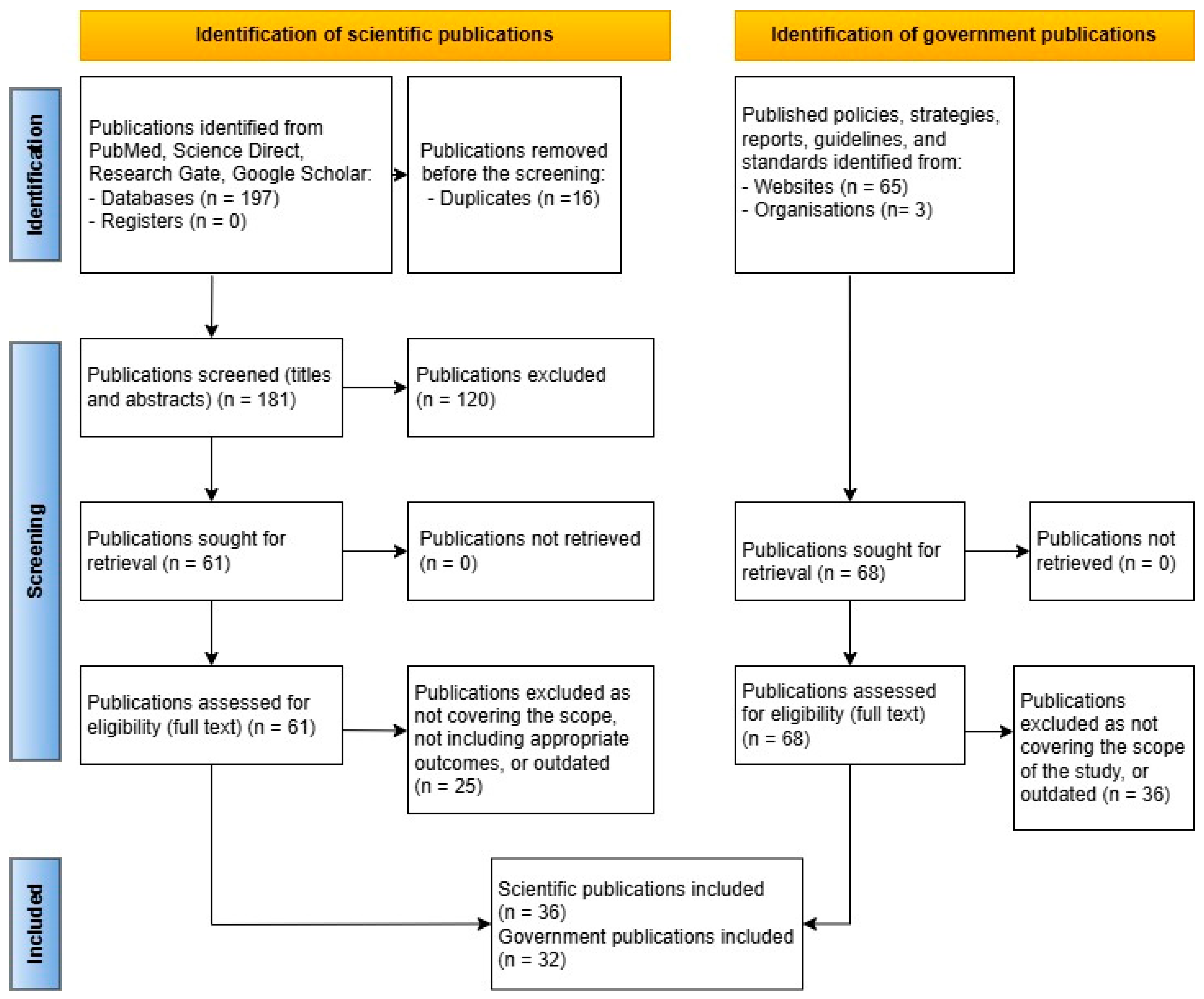
2.1. Literature Search and Screening
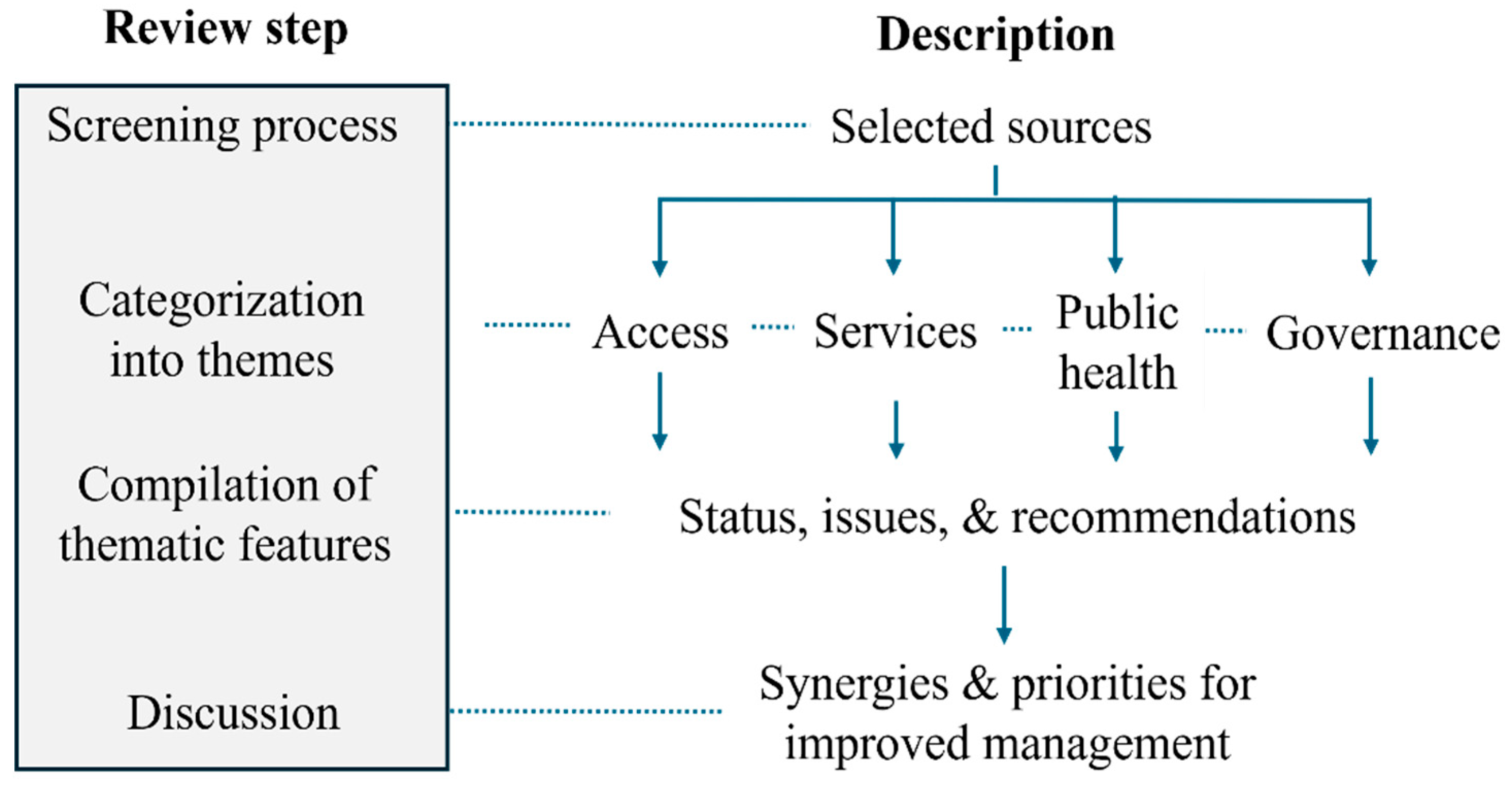
2.2. Information Extraction and Analysis
2.3. Quality and Bias Assessment
3. Results
3.1. Access to Sanitation in Kigali
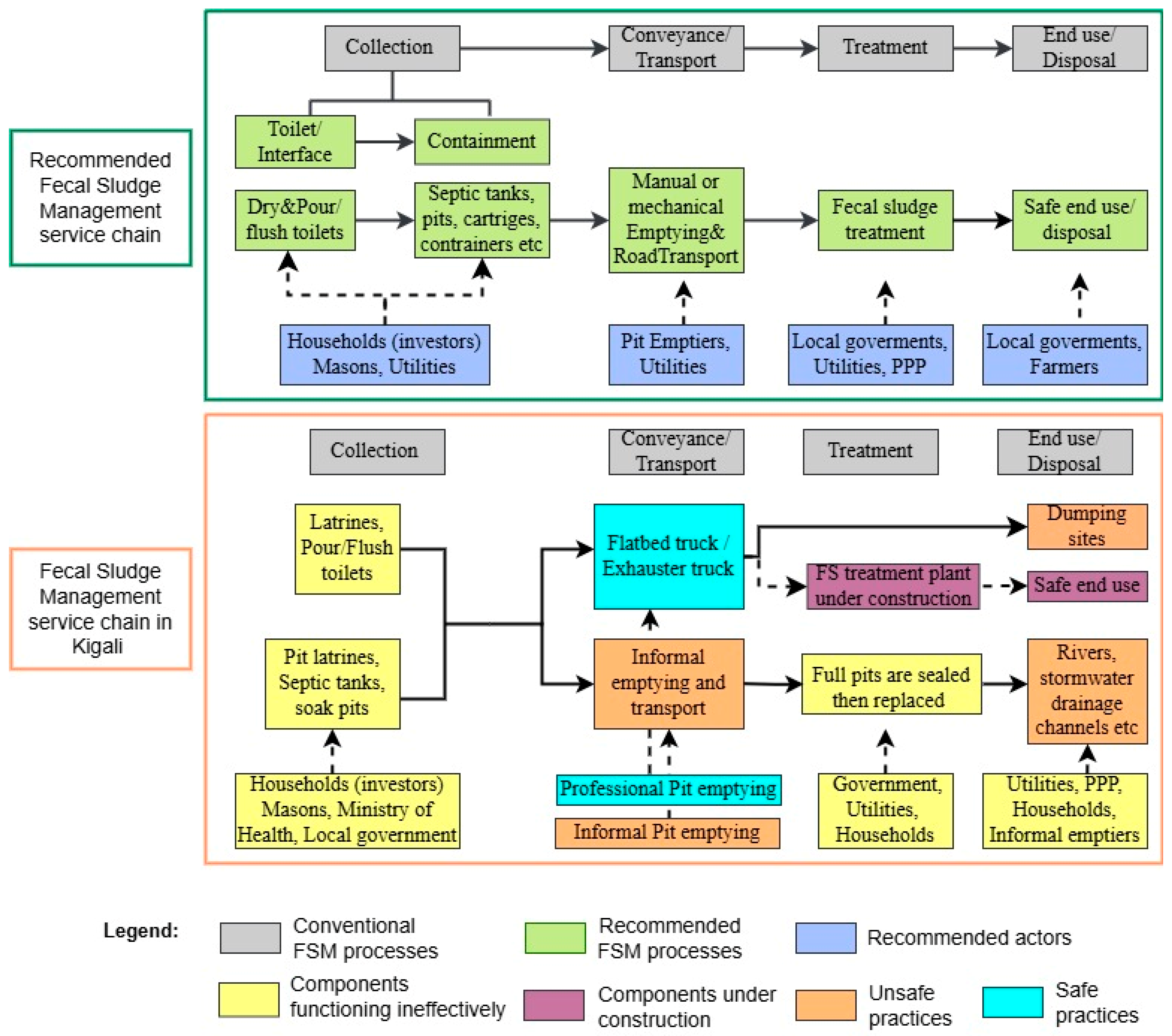
3.2. Fecal Sludge Management Service in Kigali
3.3. Public Health Related to Sanitation in Kigali
3.4. Sanitation Governance in Rwanda and Kigali
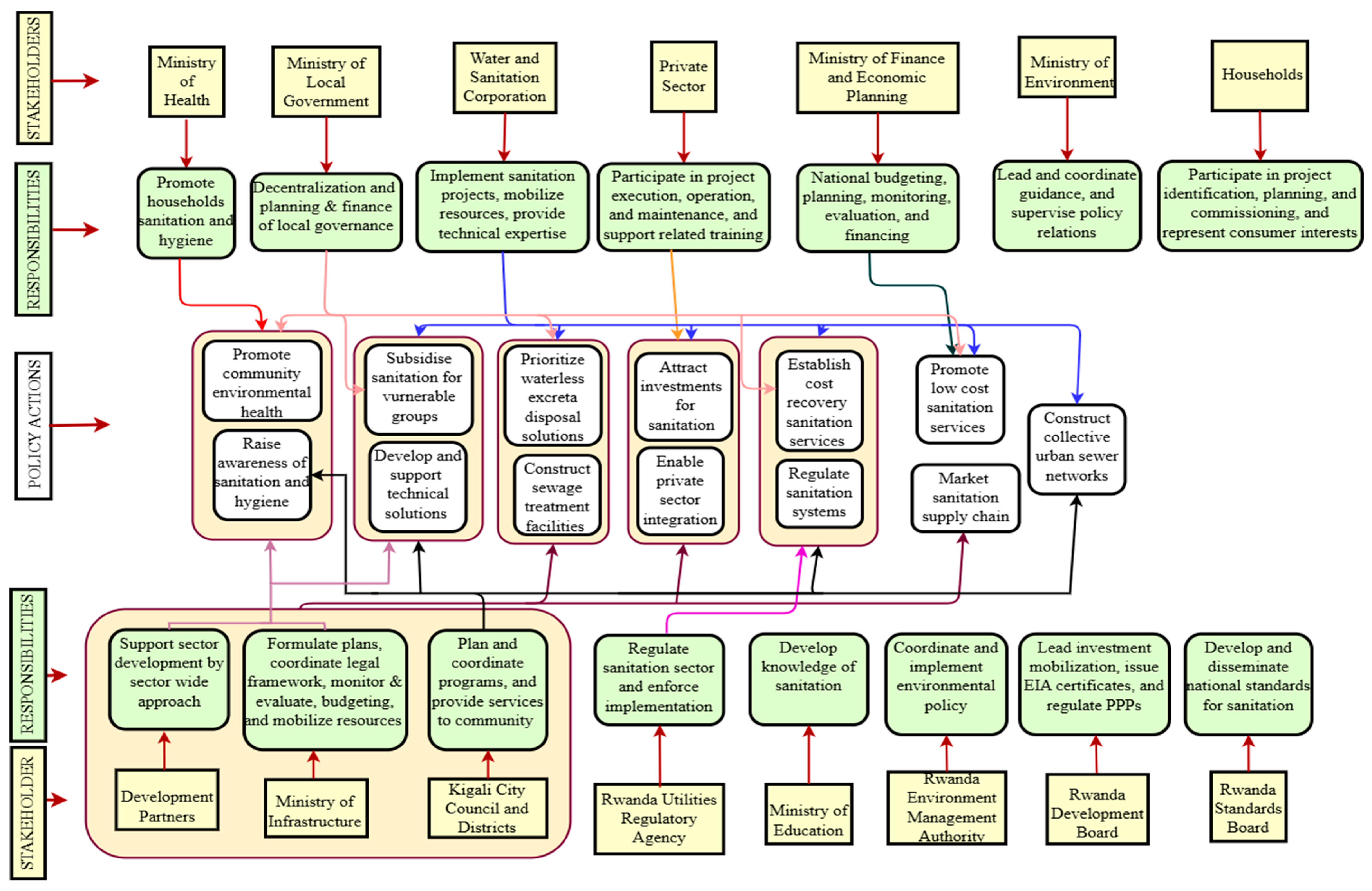
3.4.1. Institutional Framework
3.4.2. Regulatory Framework
4. Discussion
4.1. Key Challenges
4.2. Comparison with Other Studies in African Cities
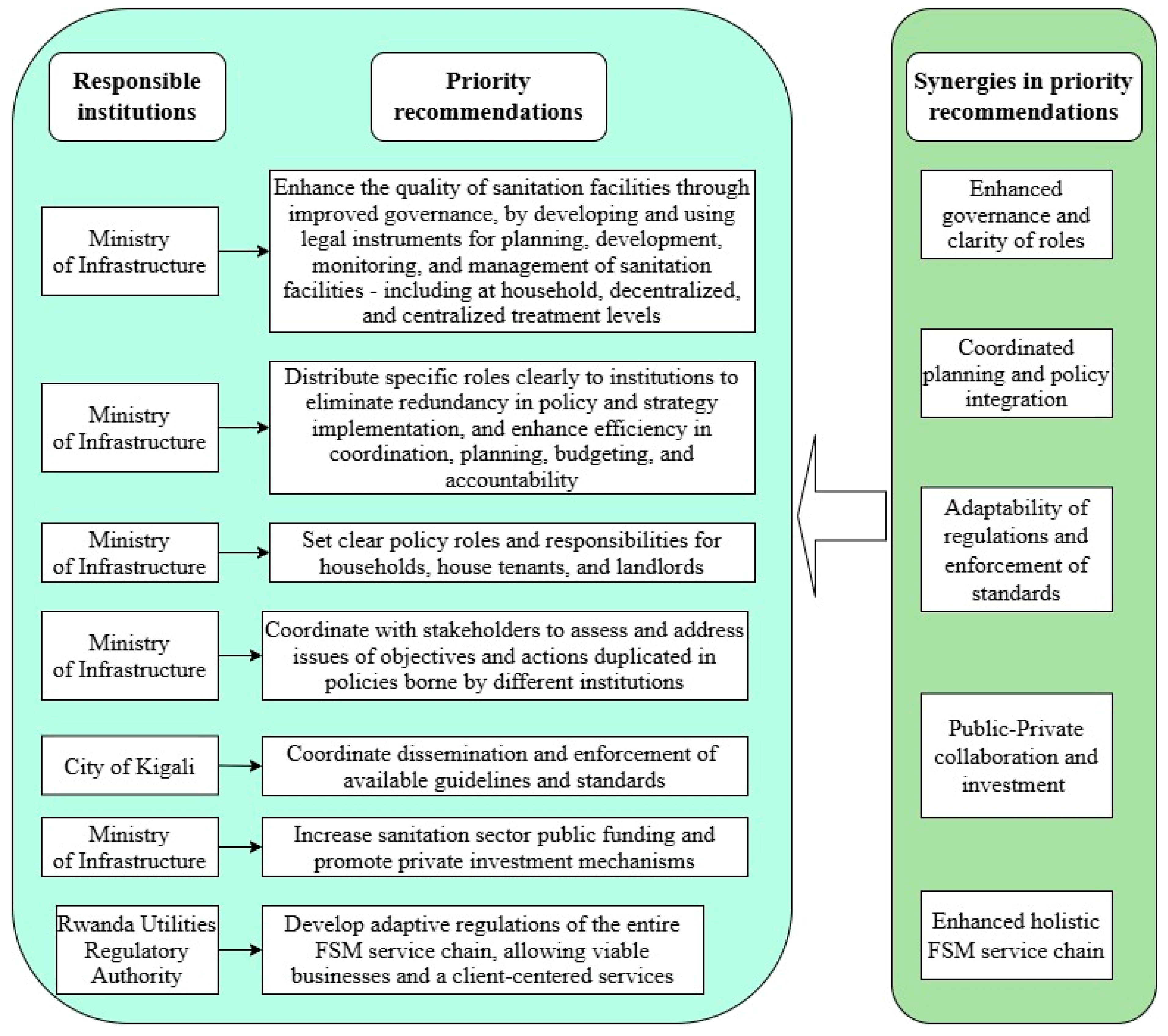
4.3. Recommendations for FSM in Kigali
4.4. Limitations and Future Research
5. Conclusions
Supplementary Materials
Author Contributions
Funding
Institutional Review Board Statement
Informed Consent Statement
Data Availability Statement
Conflicts of Interest
Abbreviations
| FSM | Fecal Sludge Management |
| OST | Onsite Sanitation Technologies |
| SDG | Sustainable Development Goal |
| JMP | Joint Monitoring Programme (for Water Supply, Sanitation and Hygiene) |
| DWWS | Decentralized Wastewater Systems |
| FS | Fecal Sludge |
| WASH | Water, Sanitation, and Hygiene |
| NTD | Neglected Tropical Disease |
| STH | Soil-Transmitted Helminthiasis |
| IPIs | Intestinal Parasite Infections |
| MININFRA | Ministry of Infrastructure |
| WASAC | Water and Sanitation Corporation |
| CoK | City of Kigali |
| DPs | Development Partners |
| RURA | Rwanda Utilities Regulatory Authority |
| RS | Rwanda Standards |
| RBS | Rwanda Standards Board |
| ESAWAS | Eastern and Southern Africa Water and Sanitation Regulators Association |
| OAG | Office of the Auditor General |
| NST | National Strategy for Transformation |
| RPHC | Rwanda Population and Housing Census |
| EICV | Enquête Intégrale sur les Conditions de Vie des Ménages |
| GESI | Gender Equality and Social Inclusion |
| SHF | Sanitation and Hygiene Fund |
Appendix A. Included Scientific Publications

| Title | Year | Scope (Access, Services, Governance, Public Health) | Reference |
|---|---|---|---|
| Sanitation for Sustainable Development in Informal Settlements in Kigali City, Rwanda: A Synthesis of the Evidence to Inform Policy and Practice Institute of Policy Analysis and Research-Rwanda (IPAR-Rwanda) Journal of Waste Management and Disposal | 2021 | Access Services Governance | [21] |
| What makes Eastern African households living in urban informal settlements dissatisfied with their toilets? | 2021 | Access Services | [15] |
| Assessing the Sustainability of Decentralized Wastewater Treatment Systems in Rwanda | 2018 | Access Services | [36] |
| Kigali Urban Sanitation Study Final report; volume 1: synthesis report | 2017 | Access Services | [17] |
| Enabling the sustainable Fecal Sludge Management service delivery chain-A case study of dense settlements in Kigali, Rwanda. | 2017 | Services Governance | [16] |
| Governance of Urban Sanitation in Kampala and Kigali | 2017 | Governance | [14] |
| The impact of hygiene and localized treatment on the quality of drinking water in Masaka, Rwanda | 2014 | Access | [40] |
| Challenges to achieving sustainable sanitation in informal settlements of Kigali, Rwanda | 2013 | Access Services | [42] |
| Developing formal pit-latrine emptying businesses for hard-to-serve customers: resources, methods, and pricing structures | 2023 | Services Governance | [45] |
| Time and motion assessment of pit-emptying operations in Kigali, Rwanda | 2022 | Services | [23] |
| Towards improving faecal sludge management in Kigali, Rwanda | 2022 | Services | [53] |
| Impact associated with the lack of sewerage and treatment systems, a source of emerging contaminants in urban water resources. A review case study of Kigali city Rwanda | 2022 | Services | [44] |
| The Current State and Future Prospects of Water and Sanitation Services in East Africa: The Case of Rwanda | 2022 | Services Governance | [58] |
| Costs and Willingness to Pay for Pit Latrine Emptying Services in Kigali, Rwanda | 2019 | Services | [22] |
| Occupational exposure to endotoxin along a municipal scale fecal sludge collection and resource recovery process in Kigali, Rwanda | 2019 | Services Public health | [48] |
| Risk of adenovirus and cryptosporidium ingestion to sanitation workers in a municipal-scale non-sewered sanitation process: A case study from Kigali, Rwanda | 2021 | Services Public health | [57] |
| Improving Faecal Sludge Management System for Sustainable Sanitation, Rwanda | 2018 | Services Governance | [20] |
| Assessment of leachate effects on groundwater and soil from Nduba landfill in Kigali, Rwanda | 2017 | Services | [49] |
| Liquid Wastes Treatment and Disposal in Rwanda | 2017 | Services | [19] |
| Comparative assessment of sanitation and hygiene policies and institutional frameworks in Rwanda, Uganda and Tanzania | 2016 | Governance | [13] |
| Assessing the National Sanitation Policy in Rwanda | 2018 | Governance | [33] |
| Socioeconomic and demographic forecasters of upgraded water and sanitation facilities admittance in Rwanda | 2020 | Access Governance | [82] |
| Linking sanitation policy to service delivery in Rwanda and Uganda: From words to action | 2019 | Governance | [75] |
| Sanitation markets in urban informal settlements of East Africa | 2015 | Services Governance | [12] |
| Adoption and use of SATO pan for health promotion in Kigali, Rwanda | 2024 | Access | [43] |
| Caregiver knowledge on the prevention of intestinal infection for children under 5 | 2024 | Public health | [72] |
| Cross-subsidies are a viable option to fund formal pit latrine emptying services: Evidence from Kigali, Rwanda | 2024 | Services | [56] |
| Determinants of Willingness to Pay for Fecal Sludge Management Services and Knowledge Gaps: A Scoping Review | 2024 | Services | [55] |
| The Effect of Water Shortage on Households Well-being in Kigali City: A Case Study of Kicukiro District (2019–2022) | 2024 | Services | [73] |
| Evaluation of nutrients removal and typologies for successful operation and maintenance for hybrid natural pond treating municipal wastewater in Kigali | 2022 | Services | [38] |
| Evaluation of organic matters removal and key factors in the clogging process for a hybrid natural pond treating municipal wastewater in Kigali | 2022 | Services | [37] |
| Relationship Between Household Water Sanitation and Hygiene Behaviors and Diarrhea in Rwanda, 2010-2020 | 2024 | Public Health | [65] |
| Legal Frameworks for Actualization of the Right to Sanitation in Informal Settlements of East Africa | 2022 | Governance | [80] |
| Leveraging a multisectoral approach to understand the determinants of childhood stunting in Rwanda: a systematic review and meta-analysis | 2024 | Public Health | [67] |
| Performance of households’ pit latrines compared to RS ISO 24521 standards: a case of Kigali City, Rwanda. | 2024 | Access | [41] |
| Prevalence and Factors Associated with Intestinal Helminthiases and Schistosomiasis Among Preschool–Aged Children in Rwanda | 2024 | Public Health | [71] |
| Regulating sanitation services in sub-Saharan Africa: An overview of the regulation of emptying and transport of faecal sludge in 20 cities and its implementation | 2021 | Services Governance | [81] |
| Shigella and Enterotoxigenic Escherichia coli have replaced rotavirus as the main causes of childhood diarrhea in Rwanda after 10 years of rotavirus vaccination | 2024 | Public Health | [66] |
| Urban Waste Management in Post-Genocide Rwanda: An Empirical Survey of the City of Kigali | 2022 | Services Governance | [50] |
| Critical Water, Sanitation and Hygiene (WASH) Challenges in Rwanda | 2022 | Services Governance | [34] |
Appendix B. Quality Assessment of Publications
| Title | Author | Year | Representativeness of the Sample | Sample Size | Non-Respondents | Ascertainment of the Exposure | Comparability | Assessment of Outcome | Total Score |
|---|---|---|---|---|---|---|---|---|---|
| Adoption and use of SATO pan for Health promotion in Kigali, Rwanda [43] | Rutambuka, T.;, Kunto, T.W. | 2024 | Selected group of users/convenience sample | Not justified | Proportion of target sample recruited attains pre-specified target or basic | No description of the measurement tool | Data/results not adjusted for all relevant confounders/risk factors/information not provided. | Unblinded assessment using objective validated methods | 7 |
| Assessing the Sustainability of Decentralized Wastewater Treatment Systems in Rwanda [36] | Kazora, A.S.; Mourad, K.A. | 2018 | Truly representative of the average in the target population | Justified and satisfactory | Proportion of target sample recruited attains pre-specified target or basic | No description of the measurement tool | Data/results not adjusted for all relevant confounders/risk factors/information not provided. | Written self-report | 7 |
| Assessment of Leachate Effects on Groundwater and Soil from Nduba Land Fill in Kigali Rwanda [49] | Tumwizere, R.P.; Hategekimana, F.; Niyibizi, A.; Senthil, G.K.; | 2017 | Selected group of users/convenience sample | No information provided | No information provided | No description of the measurement tool | Data/results not adjusted for all relevant confounders/risk factors/information not provided. | Written self-report | 6 |
| Caregivers Knowledge, Attitudes, and Practices Regarding Intestinal Parasite Prevention in Children under 5 years of Age in Masaka Sector, Kigali [72] | Ntezimana, J.N.; Muragire, R.; Umuhoza, N.; Dushime, D.; Ishimwe, C.; Byiringiro, O.; Wabzire, P.F.; Iradukunda, P.I.; Okesina, A.A. | 2024 | Truly representative of the average in the target population | Justified and satisfactory | Proportion of target sample recruited attains pre-specified target or basic | Validated data collection tools | Data/results not adjusted for all relevant confounders/risk factors/information not provided. | Unblinded assessment using objective validated methods | 7 |
| Challenges to achieving sustainable sanitation in informal settlements of Kigali, Rwanda [42] | Tsinda, A.; Abbot,.;, Pedley, C.;, Kadogo, J.;Chenoweth, K. J | 2013 | Truly representative of the average in the target population | Justified and satisfactory | Proportion of target sample recruited attains pre-specified target or basic | Validated data collection tools | Data/results not adjusted for all relevant confounders/risk factors/information not provided. | Independent blind assessment using objective validated methods | 8 |
| Costs and Willingness to Pay for Pit Latrine Emptying Services in Kigali, Rwanda [22] | Burt, Z.; Sklar, R.; Murray, A. | 2019 | Truly representative of the average in the target population | Justified and satisfactory | Proportion of target sample recruited attains pre-specified target or basic | Validated data collection tools | Data/results not adjusted for all relevant confounders/risk factors/information not provided. | Independent blind assessment using objective validated methods | 9 |
| Cross subsidies are a viable option to fund formal pit latrine emptying services: evidence from Kigali, Rwanda [56] | Wilcox, W.; Kuria, N.; Rutayisira, B.; Sklar, S.; Bartram, J.; Evans, B. | 2024 | Selected group of users/convenience sample | Justified and satisfactory | Proportion of target sample recruited attains pre-specified target or basic | No validated data collection tools, but the tool is available or described | Data/results not adjusted for all relevant confounders/risk factors/information not provided. | Unblinded assessment using objective validated methods | 8 |
| Developing formal pit-latrine emptying businesses for hard-to-serve customers: resources, methods, and pricing structures [45] | Wilcox, J.; Rutayisire, B.; Kuria, N.; Evans, B.; Bartram, J.; Sklar, R. | 2022 | Somewhat representative of the average in the target group | Justified and satisfactory | No information provided | Validated data collection tools | Data/results not adjusted for all relevant confounders/risk factors/information not provided. | Used non-standard or non-validated methods with gold standard | 7 |
| The effect of water shortage on households well being in Kigali city: A case study of Kicukiro District [73] | Jallah, R.S.; Sibomana, E.; Habarurema, S.G. | 2024 | Truly representative of the average in the target population | Justified and satisfactory | Proportion of target sample recruited attains pre-specified target or basic | No validated data collection tools, but the tool is available or described | Data/results not adjusted for all relevant confounders/risk factors/information not provided. | Independent blind assessment using objective validated methods | 7 |
| Enabling the Sustainable Fecal Sludge Management Service Delivery chain-A case study of Dense Settlements in Kigali, Rwanda [16] | Akumuntu, J.B; when, U.; Mulenga, M.; Brdjanovic, D. | 2017 | Selected group of users/convenience sample | Not justified | Proportion of target sample recruited attains pre-specified target or basic | No description of the measurement tool | Data/results not adjusted for all relevant confounders/risk factors/information not provided. | Independent blind assessment using objective validated methods | 7 |
| Evaluation of nutrients removal and typologies for successful operation and maintenance for hybrid natural pond treating municipal wastewater in Kigali [38] | Tuyisenge, E.;, Semoko, B.C.; Gashugi, E. | 2022 | Somewhat representative of the average in the target group | Not justified | Proportion of target sample recruited attains pre-specified target or basic | No validated data collection tools, but the tool is available or described | Data/results not adjusted for all relevant confounders/risk factors/information not provided. | Written self-report | 7 |
| Evaluation of organic matters removal and key factors in the clogging for an hybrid natural pond in Kigali [37] | Hitimana, F.; Semoko, B.C.; Gashugi, E. | 2022 | Somewhat representative of the average in the target group | Not justified | Proportion of target sample recruited attains pre-specified target or basic | No validated data collection tools, but the tool is available or described | Data/results not adjusted for all relevant confounders/risk factors/information not provided. | Written self-report | 7 |
| Governance of Urban Sanitation in Kampala and Kigali [14] | Suidman, S.; Oosterveer, P.;Vliet, B.V. | 2017 | Selected group of users/convenience sample | No information provided | No information provided | No validated data collection tools, but the tool is available or described | Data/results not adjusted for all relevant confounders/risk factors/information not provided. | Written self-report | 6 |
| Improving Faecal Sludge Management System for Sustainable Sanitation, Rwanda [20] | Kazora, A.S.; Bizuhoraho, T.; Mourad, K.A. | 2018 | Selected group of users/convenience sample | No information provided | No information provided | Validated data collection tools | Data/results not adjusted for all relevant confounders/risk factors/information not provided. | Used non-standard or non-validated methods with gold standard | 5 |
| Kigali Urban Sanitation Study Final report; Volume 1—Synthesis report [17] | Ross, I.; Pinfold, J. | 2017 | Truly representative of the average in the target population | Justified and satisfactory | Proportion of target sample recruited attains pre-specified target or basic | No description of the measurement tool | Data/results not adjusted for all relevant confounders/risk factors/information not provided. | Written self-report | 7 |
| Legal frameworks for actualization of right to sanitation in informal settlements of East Africa [80] | Adogo, J.M.; Malcolm, R. | 2022 | Truly representative of the average in the target population | Justified and satisfactory | Proportion of target sample recruited attains pre-specified target or basic | No validated data collection tools, but the tool is available or described | Data/results not adjusted for all relevant confounders/risk factors/information not provided. | Written self-report | 9 |
| Occupational exposure to endotoxin along a municipal scale fecal sludge collection and resource recovery process in Kigali, Rwanda [48] | Sklar, R.; Zhou, Z.; Zalay, M.; Muspratt, A.; Hammond, S.K. | 2019 | Somewhat representative of the average in the target group | Justified and satisfactory | Proportion of target sample recruited attains pre-specified target or basic | Validated data collection tools | Data/results not adjusted for all relevant confounders/risk factors/information not provided. | Unblinded assessment using objective validated methods | 8 |
| Performance of households pit latrines compared to RS ISO 24521 standards: a case of Kigali City [41] | Murebwayire, M.L.; Nhapi, I.; Garba, U.W.; Nilsson, E. Muhirwa, E. | 2024 | Truly representative of the average in the target population | Justified and satisfactory | Proportion of target sample recruited attains pre-specified target or basic | No validated data collection tools, but the tool is available or described | Data/results not adjusted for all relevant confounders/risk factors/information not provided. | Independent blind assessment using objective validated methods | 8 |
| Prevalence and Factors Associated with Intestinal Helminthiases and Schistosomiasis Among Preschool Aged Children in Rwanda [71] | Muhawenamahoro, V.; Nyandwi, E.; Elehamer, N.M.; Nkurunziza, E.; Mucyo, T.N.; Nshimiyimana, T.; Habtu, M.F.; Rujeni, N | 2024 | Selected group of users/convenience sample | Justified and satisfactory | Proportion of target sample recruited attains pre-specified target or basic | No validated data collection tools, but the tool is available or described | Data/results not adjusted for all relevant confounders/risk factors/information not provided. | Unblinded assessment using objective validated methods | 7 |
| Regulating sanitation services in Sub-Saharan Africa: An overview of the regulation of emptying and transport of faecal sludge in 20 cities and its implementation [81] | Lerebours, A.; Scott, R.; Sansom, K.; Kayaga, K | 2021 | Somewhat representative of the average in the target group | Justified and satisfactory | Proportion of target sample recruited attains pre-specified target or basic | No validated data collection tools, but the tool is available or described | Data/results not adjusted for all relevant confounders/risk factors/information not provided. | Unblinded assessment using objective validated methods | 7 |
| Relationship Between Household Water Sanitation and Hygiene Behaviours and Diarrhoea in Rwanda, 2010-2020 [65] | Ntakarutimana, A.;Tschida, P. | 2024 | Truly representative of the average in the target population | Justified and satisfactory | Proportion of target sample recruited attains pre-specified target or basic | No validated data collection tools, but the tool is available or described | Data/results not adjusted for all relevant confounders/risk factors/information not provided. | Independent blind assessment using objective validated methods | 7 |
| Risk of adenovirus and cryptosporidium ingestion to sanitation workers in a municipal scale non-sewered sanitation process: A case study from Kigali, Rwanda [57] | Sklar, R.; Zhou, Z.; Ndayisaba, W.; Muspratt, A.; Fuhrmeister, E.R.; Nelson, K.; Katharine H.S. | 2021 | Somewhat representative of the average in the target group | Justified and satisfactory | Proportion of target sample recruited attains pre-specified target or basic | Validated data collection tools | Data/results not adjusted for all relevant confounders/risk factors/information not provided. | Unblinded assessment using objective validated methods | 8 |
| Sanitation markets in urban informal settlements of East Africa [12] | Tsinda, A.; Abbott, P.; Chenoweth, J. | 2015 | Truly representative of the average in the target population | Justified and satisfactory | Proportion of target sample recruited attains pre-specified target or basic | Validated data collection tools | Data/results adjusted for relevant predictors/risk factors/confounders, e.g., age, socio-economic, regulation framework, urban planning, etc. | Independent blind assessment using objective validated methods | 8 |
| Shigella and Enterotoxigenic Escherichia coli Have Replaced Rotavirus as Main Causes of Childhood Diarrhea in Rwanda After 10 Years of Rotavirus Vaccination [66] | Munyemana, J.B.. Kabayiza, J.C.; Nilsson, S.; Andersson, M.E.;Lindh, M. | 2024 | Selected group of users/convenience sample | Justified and satisfactory | Proportion of target sample recruited attains pre-specified target or basic | No validated data collection tools, but the tool is available or described | Data/results not adjusted for all relevant confounders/risk factors/information not provided. | Independent blind assessment using objective validated methods | 8 |
| Socioeconomic and demographic forecasters of upgraded water and sanitation facilities admittance in Rwanda [82] | Bikorimana, G.; Shengmin, S. | 2020 | Truly representative of the average in the target population | Justified and satisfactory | Proportion of target sample recruited attains pre-specified target or basic | No validated data collection tools, but the tool is available or described | Data/results adjusted for relevant predictors/risk factors/confounders, e.g., age, socio-economic, regulation framework, urban planning, etc. | Used non-standard or non-validated methods with gold standard | 7 |
| The impact of hygiene and localized treatment on the quality of drinking water in Masaka, Rwanda [40] | Uwimpuhwe, M.; Reddy, P.; Barratt, G.; Bux, F. | 2014 | Truly representative of the average in the target population | Justified and satisfactory | Proportion of target sample recruited attains pre-specified target or basic | Validated data collection tools | Data/results not adjusted for all relevant confounders/risk factors/information not provided. | Independent blind assessment using objective validated methods | 8 |
| Time and motion assessment of pit-emptying operations in Kigali, Rwanda [23] | Rutayisire, B.; Wolter, D.; Kuria, N.; Sklar, R. | 2022 | Somewhat representative of the average in the target group | Justified and satisfactory | Proportion of target sample recruited attains pre-specified target or basic | Validated data collection tools | Data/results not adjusted for all relevant confounders/risk factors/information not provided. | Written self-report | 8 |
| Urban Waste Management in Post-Genocide Rwanda: An Empirical Survey of the City of Kigali [50] | Squire, J.NT. Nkurunziza, J. | 2022 | Somewhat representative of the average in the target group | Justified and satisfactory | Proportion of target sample recruited attains pre-specified target or basic | No validated data collection tools, but the tool is available or described | Data/results not adjusted for all relevant confounders/risk factors/information not provided. | Written self-report | 6 |
| What makes Eastern African households living in urban informal settlements dissatisfied with their toilets? [15] | Tsinda, A.; Abbott, P.; Chenoweth, J. | 2021 | Truly representing oft he average in target population | Justified and satisfactory | Proportion of target sample recruited attains pre-specified target or basic | Validated data collection tools | Data/results not adjusted for all relevant confounders/risk factors/information not provided | Independent blind assessment using objective validated methods | 9 |
| Title | Author | Year | The Source of the Opinion Clearly Identified? | The Source of Opinion Have Standing in the Field of Expertise? | Interests of the Relevant Population Are the Central Focus of the Opinion? | Opinion Demonstrate a Logically Defended Argument to Support the Conclusions Drawn? | Reference to the Extant Literature? | Any Incongruence with the Literature/Sources Logically Defended? | Total Score |
|---|---|---|---|---|---|---|---|---|---|
| Comparative assessment of sanitation and hygiene policies and institutional frameworks in Rwanda, Uganda, and Tanzania [13] | Ekane, N.; Weitz, N.; Nykvist, B.; Nordqvist, P.; Noel, S. | 2016 | Yes | Yes | Unclear | Unclear | Yes | Unclear | 6 |
| Critical WASH Challenges in Rwanda [13] | Tsinda, A.; Abbott, P. | 2022 | Yes | Yes | Yes | Yes | Yes | Yes | 9 |
| Determinants of Willingness to Pay for Fecal Sludge Management Services and Knowledge Gaps: A Scoping Review [55]. | Tomoi, H.; MacLeod, C.; Moriyasu, T.; Simiyu, S.; Ross, I.; Cumming, O.; Braun, L. | 2024 | Unclear | Yes | Yes | Yes | Unclear | Yes | 9 |
| Impact associated with the lack of sewerage and treatment systems is a source of emerging contaminants in urban water resources. Review the case stusy of Kigali city, Rwanda [44] | Bavumiragira et al. | 2022 | Yes | Yes | Yes | Unclear | No | No | 2 |
| Leveraging a multisectoral approach to understand the determinants of childhood stunting in Rwanda: a systematic review and meta-analysis [67] | Kalinda, C.; Qambayot, M.A.; Ishimwe, S.M.C.; Regnier, D.; Bazimya, D.; Uwizeyimana, T.; Desie, S.; Rudert, C.; Gebremariam, A.; Brennan, E.; et al. | 2024 | Unclear | Yes | Yes | Yes | Unclear | Yes | 9 |
| Linking sanitation policy to service delivery in Rwanda and Uganda: From words to action [75] | Ekane, N.; Kjellén, M.; Westlund, H.; Ntakarutimana, A.; Mwesige, D. | 2020 | Yes | Yes | Unclear | Unclear | Yes | Yes | 7 |
| Sanitation for Sustainable development in Informal Settlements Kigali City Rwanda [21] | Gahima, E.; Bizuhoraho, T | 2021 | Yes | Yes | No | Unclear | No | No | 3 |
| Water & Sanitation Services in East Africa [58] | Twagirayezu, G.; Cheng, H.; Nizeyimana, I.; Irumva, O. | 2022 | Yes | Yes | Unclear | Unclear | Yes | Yes | 8 |
| Towards Improving Faecal Sludge Management in Kigali, Rwanda [53] | Nzitonda, J | 2022 | Yes | Yes | Unclear | Unclear | Yes | Yes | 6 |
| Liquid wastes treatment and disposal in Rwanda [19] | Alice, U.; Nestor, U.; Donath, N.; Narcisse, N. | 2017 | Unclear | Unclear | yes | Unclear | yes | Unclear | 4 |
| Assessing the National Sanitation Policy [33] | Kazora, A.S.; Mourad, K.A. | 2018 | yes | yes | yes | yes | yes | Yes | 9 |
References
- WHO. Guidelines on Sanitation and Health. 2018. Available online: https://www.who.int/publications/i/item/9789241514705 (accessed on 28 May 2024).
- JMP. Progress on Household Drinking Water, Sanitation and Hygiene 2000–2022 Special Focus on Gender, the WHO/UNICEF Joint Monitoring Programme for Water Supply, Sanitation and Hygiene. 2023. Available online: https://washdata.org (accessed on 28 May 2024).
- Strande, L.; Ronteltap, M.; Brdjanovic, D. Faecal Sludge Management: Systems Approach for Implementation and Operation; IWA Publishing: London, UK, 2014. [Google Scholar] [CrossRef]
- Chandana, N.; Rao, B. A critical review on sludge management from onsite sanitation systems: A knowledge to be revised in the current situation. Environ. Res. 2022, 203, 111812. [Google Scholar] [CrossRef]
- Munamati, M.; Nhapi, I.; Misi, S.N. Types and distribution of improved sanitation technologies in sub-Saharan Africa. J. Water Sanit. Hyg. Dev. 2017, 7, 260–271. [Google Scholar] [CrossRef]
- Lerebours, A.; Scott, R.; Sansom, K.; Kayaga, S. Barriers and Enablers to the Regulation of Sanitation Services: A Framework for Emptying and Transport Services in Sub-Saharan African Cities. Front. Environ. Sci. 2022, 10, 869403. [Google Scholar] [CrossRef]
- NISR. Characheristics of Households and Housing, Fifth Population and Housing Census, Rwanda. 2023. Available online: https://statistics.gov.rw/sites/default/files/documents/2025-02/RPHC5%20Thematic%20Report_Housing%20and%20Households%20Characteristics.pdf (accessed on 27 May 2024).
- UNICEF and WHO. State of the World’s Sanitation: An Urgent Call to Transform Sanitation for Better Health, Economies and Societies; UNICEF and WHO: New York, NY, USA, 2020. Available online: https://www.unicef.org/reports/state-worlds-sanitation-2020 (accessed on 27 May 2024).
- Strande, L.; Evans, B.; von Sperling, M.; Bartram, J.; Harada, H.; Nakagiri, A.; Nguyen, V.A. Urban Sanitation: New Terminology for Globally Relevant Solutions? Environ. Sci. Technol. 2023, 57, 15771–15779. [Google Scholar] [CrossRef] [PubMed]
- Torre, A.; Vázquez-Rowe, I.; Parodi, E.; Kahhat, R. Wastewater treatment decentralization: Is this the right direc-tion for megacities in the Global South? Sci. Total Environ. 2021, 778, 146277. [Google Scholar] [CrossRef]
- Igarashi, J.; Evans, B.; Sleigh, A.; Tarkash, D.N.; Kennedy, R.; Rosenberg, R.; Zakaria, F. Does ‘Low Cost’ Urban Sanitation Exist? Lessons from a Global Data Set. Environ. Sci. Technol. 2023, 57, 17237–17245. [Google Scholar] [CrossRef]
- Tsinda, A.; Abbott, P.; Chenoweth, J. Sanitation markets in urban informal settlements of East Africa. Habitat Int. 2015, 49, 21–29. [Google Scholar] [CrossRef]
- Ekane, N.; Weitz, N.; Nykvist, B.; Nordqvist, P.; Noel, S. Comparative Assessment of Sanitation and Hygiene Policies and Institutional Frameworks in Rwanda, Uganda and Tanzania. 2016. Available online: https://www.sei-international.org (accessed on 28 May 2024).
- Suidman, S.; Oosterveer, P.; Van Vliet, B. Governance of Urban Sanitation in Kampala and Kigali; Wageningen University: Wageningen, The Netherlands, 2017. [Google Scholar]
- Tsinda, A.; Abbott, P.; Chenoweth, J. What makes Eastern African households living in urban informal settlements dissatisfied with their toilets? SSRN Electron. J. 2021, 39, 13–23. [Google Scholar] [CrossRef]
- Akumuntu, J.B.; Wehn, U.; Mulenga, M.; Brdjanovic, D. Enabling the sustainable Faecal Sludge Management service delivery chain-A case study of dense settlements in Kigali, Rwanda. Int. J. Hyg. Environ. Health 2017, 220, 960–973. [Google Scholar] [CrossRef]
- Ross, I.; Pinfold, J. Kigali Urban Sanitation Study Final Report—Volume 1: Synthesis Report. 2017. Available online: https://www.researchgate.net/publication/330934150_Kigali_Urban_Sanitation_Study_-_Synthesis_Report (accessed on 28 May 2024). [CrossRef]
- MININFRA. Water and Sanitation 2023/2024 Backward–Looking Joint Sector Review (BLJSR) Report. Ministry of Infrastructure, Republic of Rwanda. 2024. Available online: https://www.minecofin.gov.rw/index.php?eID=dumpFile&t=f&f=113396&token=1bb595739aee22df7c00652ba1501e48d61192a8 (accessed on 28 May 2024).
- Alice, U.; Ming, Y.; Nestor, U.; Donath, N.; Narcisse, N. Liquid Wastes Treatment and Disposal in Rwanda. J. Pollut. Eff. Control. 2017, 5, 197. [Google Scholar] [CrossRef]
- Shyaka, A.; Bizuhoraho, T.; Mourad, K.A. Improving Faecal Sludge Management System for Sustainable Sanitation, Rwanda. SciFed Biotech Bioeng. J. 2018, 1, 1–10. Available online: https://lucris.lub.lu.se/ws/portalfiles/portal/53407941/Sludge.pdf (accessed on 28 May 2024).
- Gahima, E.; Bizuhoraho, T. Sanitation for Sustainable Development in Informal Settlements in Kigali City, Rwanda: A Synthesis of the Evidence to Inform Policy and Practice Institute of Policy Analysis and Research-Rwanda (IPAR-Rwanda). J. Waste Manag. Dispos. 2021, 4, 1–12. Available online: https://www.scholarena.com (accessed on 28 May 2024).
- Burt, Z.; Sklar, R.; Murray, A. Costs and Willingness to Pay for Pit Latrine Emptying Services in Kigali, Rwanda. Int. J. Environ. Res. Public Health 2019, 16, 4738. [Google Scholar] [CrossRef] [PubMed]
- Rutayisire, B.; Wolter, D.; Kuria, N.; Sklar, R. Time and motion assessment of pit-emptying operations in Kigali, Rwanda. J. Water Sanit. Hyg. Dev. 2022, 12, 16–22. [Google Scholar] [CrossRef]
- WASAC. Rwanda Sustainable Water Supply and Sanitation Program (RSWSSP)_KIGALI CENTRALIZED SEWAGE SYSTEM (KCSS). 2019. Available online: https://www.scribd.com/document/538531401/Kigali-Centralised-Sewage-System (accessed on 15 December 2024).
- WHO. Burden of Disease Attributable to Unsafe Drinking-Water, Sanitation and Hygiene. 2019. Available online: https://www.who.int/publications/i/item/9789240075610 (accessed on 15 December 2024).
- Page, M.J.; McKenzie, J.E.; Bossuyt, P.M.; Boutron, I.; Hoffmann, T.C.; Mulrow, C.D.; Shamseer, L.; Tetzlaff, J.M.; Akl, E.A.; Brennan, S.E.; et al. The PRISMA 2020 statement: An updated guideline for reporting systematic reviews. BMJ Publ. Group 2021, 372, n71. [Google Scholar] [CrossRef]
- Sandelowski, M.; Borroso, J. Handbook for Synthesizing Qualitative Research; Spring: New York, NY, USA, 2007. [Google Scholar]
- McAllum, K.; Fox, S.; Simpson, M.; Unson, C. A comparative tale of two methods: How thematic and narrative analyses author the data story differently. Commun. Res. Pract. 2019, 5, 358–375. [Google Scholar] [CrossRef]
- Wells, G.A.; Shea, B.; O'Connell, D.; Peterson, J.; Welch, V.; Losos, M.; Tugwell, P. The Newcastle-Ottawa Scale (NOS) for Assessing the Quality of Nonrandomized Studies in Meta-Analysis. 2011. Available online: https://www.ohri.ca/programs/clinical_epidemiology/oxford.asp (accessed on 30 December 2024).
- Aromataris, E.; Lockwood, C.; Porritt, K.; Pilla, B.; Jordan, Z. JBI Manual for Evidence Synthesis. 2024. Available online: https://synthesismanual.jbi.global (accessed on 27 May 2024).
- NISR. Utilities and Amenities Thematic Report. NISR: Kigali, Rwanda, 2016. Available online: http://www.statistics.gov.rw (accessed on 27 May 2024).
- NISR. Integrated Household Living Conditions Survey. Thematic Report—Utilities and Amenities; National Institute of Statistics for Rwanda Republic of Rwanda: Kigali, Rwanda, 2018.
- Kazora, A.S.; Mourad, K.A. Assessing the National Sanitation Policy in Rwanda. Rev. Environ. Earth Sci. 2018, 5, 55–63. [Google Scholar] [CrossRef]
- Tsinda, A.; Abbott, P. Critical Water, Sanitation and Hygiene (WASH) Challenges in Rwanda. 2018. Available online: https://aura.abdn.ac.uk/bitstream/handle/2164/21398/CGD_WP_Sanitation_WASH.pdf?sequence=1 (accessed on 27 May 2024).
- MININFRA & UNICEF. Sustainable WASH Finance Strategy; MININFRA & UNICEF: Kigali, Rwanda, 2022.
- Kazora, A.S.; Mourad, K.A. Assessing the Sustainability of Decentralized Wastewater Treatment Systems in Rwanda. Sustainability 2018, 10, 4617. [Google Scholar] [CrossRef]
- Hitimana, F. Evaluation of Organic Matters Removal and Key Factors in the Clogging Process for a Hybrid Natural Pond Treating Municipal Wastewater in Kigali. Master’s Thesis, University of Rwanda Archives, Kigali, Rwanda, 2022. [Google Scholar]
- Tuyisenge, E. Evaluation of Nutrients Removal and Typologies for Successful Operation and Maintenance for Hybrid Natural Pond Treating Municipal Wastewater in Kigali. Ph.D. Thesis, University of Rwanda Archives, Kigali, Rwanda, 2022. [Google Scholar]
- Ilmu, S.T. Public Policy Implementation: A Theoretical Review. J. Birokrasi Dan Pemerintah. Drh. 2023, 5, 10–18. [Google Scholar]
- Uwimpuhwe, M.; Reddy, P.; Barratt, G.; Bux, F. The impact of hygiene and localised treatment on the quality of drinking water in Masaka, Rwanda. J. Environ. Sci. Health Part A 2014, 49, 434–440. [Google Scholar] [CrossRef]
- Murebwayire, M.L.; Nilsson, E.; Garba, U.W.; Nhapi, I. Performance of Households’ Pit Latrines Compared to RS ISO 24521 Standards: A case of Kigali City, Rwanda. 2024. Available online: https://wedc-knowledge.lboro.ac.uk/my-wedc/submissions/24/published/8bdde8dd88da0adf0b0588f8a3157b2c.pdf (accessed on 27 May 2024).
- Tsinda, A.; Abbott, P.; Pedley, S.; Charles, K.; Adogo, J.; Okurut, K.; Chenoweth, J. Challenges to achieving sustainable sanitation in informal settlements of Kigali, Rwanda. Int. J. Environ. Res. Public Health 2013, 10, 6939–6954. [Google Scholar] [CrossRef] [PubMed]
- Rutambuka, T.; Wibowo, K.A. Adoption and use of SATO pan for health promotion in Kigali, Rwanda. PRofesi Humas 2024, 9, 115–135. [Google Scholar] [CrossRef]
- Bavumiragira, J.P.; Kipkrui, E.; Ndizeye, Y.; Uyisaba, P.; Bazambanza, A. Impact associated with the lack of sewerage and treatment systems, a source of emerging contaminants in urban water resources. A review case study of Kigali city Rwanda. Int. J. Sci. Res. Publ. 2022, 12, 340–350. [Google Scholar] [CrossRef]
- Wilcox, J.; Rutayisire, B.; Kuria, N.; Evans, B.; Bartram, J.; Sklar, R. Developing formal pit-latrine emptying businesses for hard-to-serve customers: Resources, methods, and pricing structures. J. Water Sanit. Hyg. Dev. 2023, 13, 941–951. [Google Scholar] [CrossRef]
- ESAWAS Regulators Association. Guidelines for Inclusive Urban Sanitation Service Provision (Incorporating Non-Sewered Sanitation Services), 2020. Available online: https://wasreb.go.ke/wp-content/uploads/2023/08/Guidelines-for-Inclusive-Urban-Sanitation-Service-Provision.pdf (accessed on 28 May 2024).
- WHO. SANITATION SAFETY PLANNING Step-by-Step Risk Management for Safely Managed Sanitation Systems. 2022. Available online: http://apps.who.int/bookorders (accessed on 28 May 2024).
- Sklar, R.; Zhou, Z.; Zalay, M.; Muspratt, A.; Hammond, S.K. Occupational exposure to endotoxin along a municipal scale fecal sludge collection and resource recovery process in Kigali, Rwanda. Int. J. Environ. Res. Public Health 2019, 16, 4740. [Google Scholar] [CrossRef]
- Patrick, T.R.; Hategekimana, F.; Aphrodice, N.; Kumaran, G.S. Assessment of leachate effects on groundwater and soil from nduba land fill in Kigali, Rwanda. Int. J. Eng. Res. Afr. 2017, 33, 68–75. [Google Scholar] [CrossRef]
- Squire, J.N.T.; Nkurunziza, J. Urban Waste Management in Post-Genocide Rwanda: An Empirical Survey of the City of Kigali. J. Asian Afr. Stud. 2022, 57, 760–772. [Google Scholar] [CrossRef]
- OAG. Performance Audit Report on Management of Solid and Liquid (Sewage) Waste in City of Kigali. 2016. Available online: https://www.oag.gov.rw/fileadmin/user_upload/Performance_Reports/MANAGEMENT_OF_SOLID_AND_LIQUID__SEWAGE__IN_CITY_OF_KIGALI.pdf (accessed on 15 December 2024).
- GGGI. Sustainably Managing Hazardous and Municipal Solid Waste Management in Rwanda. 2022. Available online: https://gggi.org/sustainably-managing-hazardous-and-municipal-solid-waste-management-in-rwanda/ (accessed on 28 May 2024).
- Nzitonda, J. Towards Improving Faecal Sludge Management in Kigali, Rwanda. RURA. 2022. Available online: https://iwa-network.org/wp-content/uploads/2022/08/9-Towards-improving-faecal-sludge-management-in-Kigali-Rwanda.pdf (accessed on 13 December 2024).
- Simiyu, S.; Swillin, M.g; Cairncross, S. Decision-making on shared sanitation in the informal settlements of Kisumu, Kenya. Int. J. Environ. Health Res. 2017, 27, 377–393. [Google Scholar] [CrossRef]
- Tomoi, H.; MacLeod, C.; Moriyasu, T.; Simiyu, S.; Ross, I.; Cumming, O.; Braun, L. Determinants of Willingness to Pay for Fecal Sludge Management Services and Knowledge Gaps: A Scoping Review. Environ. Sci. Technol. 2024, 58, 1908–1920. [Google Scholar] [CrossRef]
- Wilcox, J.; Kuria, N.; Rutayisire, B.; Sklar, R.; Bartram, J.; Evans, B. Cross-subsidies are a viable option to fund formal pit latrine emptying services: Evidence from Kigali, Rwanda. PLoS ONE 2024, 19, e0307471. [Google Scholar] [CrossRef] [PubMed]
- Sklar, R.; Zhou, Z.; Ndayisaba, W.; Muspratt, A.; Fuhrmeister, E.R.; Nelson, K.; Hammond, S.K. Risk of adenovirus and cryptosporidium ingestion to sanitation workers in a municipal scale non-sewered sanitation process: A case study from kigali, Rwanda. J. Water Sanit. Hyg. Dev. 2021, 11, 570–578. [Google Scholar] [CrossRef]
- Twagirayezu, G.; Cheng, H.; Nizeyimana, I.; Irumva, O. The Current State and Future Prospects of Water and Sanitation Services in East Africa: The Case of Rwanda. Pol. J. Environ. Stud. 2022, 32, 821–832. [Google Scholar] [CrossRef] [PubMed]
- WHO. Ending the Neglect to Attain the Sustainable Development Goals: A Road Map for Neglected Tropical Diseases 2021–2030. 2021. Available online: https://www.who.int/publications/i/item/9789240052932 (accessed on 25 May 2025).
- WHO. Neglected Tropical Diseases. 2025. Available online: https://www.who.int/news-room/questions-and-answers/item/neglected-tropical-diseases (accessed on 25 May 2025).
- RBC. Rwanda Malaria and Neglected Tropical Diseases Annual Report 2023/2024. 2024. Available online: https://www.rbc.gov.rw/fileadmin/user_upload/report_2024/malaria_2025/MOPDD_Annual_Report_FY2023-2024.pdf (accessed on 4 June 2024).
- NISR. Rwanda Demographic and Health Survey 2010 [FR259], Kigali, 2012. Available online: https://dhsprogram.com/pubs/pdf/FR370/FR370.pdf (accessed on 30 May 2024).
- NISR. Rwanda Demographic and Health Survey, 2014–2015: Final Report. National Institute of Statistics of Rwanda, Ministry of Finance and Economic Planning: Ministry of Health. The DHS Program, ICF International. 2016. Available online: https://dhsprogram.com/pubs/pdf/FR316/FR316.pdf (accessed on 30 May 2024).
- National Institute of Statistics of Rwanda (NISR), Ministry of Health of Rwanda (MOH), and ICF. Rwanda Demographic and Health Survey 2019-2020 Final Report. Kigali, Rwanda, and Rockville, Maryland, USA: NISR and ICF. 2021. Available online: https://www.statistics.gov.rw/data-sources/surveys/Demographic-and-Health-Survey/demographic-and-health-survey-201920 (accessed on 28 May 2024).
- Ntakarutimana, A.; Tschida, P. Relationship Between Household Water Sanitation and Hygiene Behaviors and Diarrhea in Rwanda, 2010–2020. J. Soc. Behav. Health Sci. 2024, 2024, 312–331. [Google Scholar] [CrossRef]
- Munyemana, J.B.; Kabayiza, J.C.; Nilsson, S.; Andersson, M.E.; Lindh, M. Shigella and Enterotoxigenic Escherichia coli have replaced rotavirus as main causes of childhood diarrhea in Rwanda after 10 years of rotavirus vaccination. J. Infect. Dis. 2024, 230, e1176–e1180. [Google Scholar] [CrossRef]
- Kalinda, C.; Qambayot, M.A.; Ishimwe, S.M.C.; Regnier, D.; Bazimya, D.; Uwizeyimana, T.; Desie, S.; Rudert, C.; Gebremariam, A.; Brennan, E.; et al. Leveraging multisectoral approach to understand the determinants of childhood stunting in Rwanda: A systematic review and meta-analysis. Syst. Rev. 2024, 13, 16. [Google Scholar] [CrossRef]
- Checkley, W.; Buckley, G.; Gilman, R.H.; Assis, A.M.; Guerrant, R.L.; Morris, S.S.; Mølbak, K.; Valentiner-Branth, P.; Lanata, C.F.; Black, R.E.; et al. Multi-country analysis of the effects of diarrhoea on childhood stunting. Int. J. Epidemiol. 2008, 37, 816–830. [Google Scholar] [CrossRef] [PubMed]
- Firmansyah, R.R.T.; Murti, B.; Prasetya, H. A Meta-Analisis of Correlation between Diarrhea and Stunting in Children Under Five. J. Epidemiol. Public Health 2023, 8, 88–97. [Google Scholar] [CrossRef]
- Adenina, S.; Tamzil, N.S. Management of Diarrhea in Children and its relation to Stunting. Healthy Tadulako J. 2024, 10, 70–78. [Google Scholar] [CrossRef]
- Muhawenamahoro, V.; Nyandwi, E.; Elehamer, N.M.; Nkurunziza, E.; Mucyo, T.N.; Nshimiyimana, T.; Habtu, M.F.; Rujeni, N. Prevalence and Factors Associated with Intestinal Helminthiases and Schistosomiasis Among Preschool—Aged Children in Rwanda. Preprints, 2024. [CrossRef]
- Ntezimana, J.N.; Muragire, R.; Umuhoza, N.; Dushime, D.; Ishimwe, C.; Byiringiro, O.; Wawire, P.F.; Iradukunda, R.P.; Ayodeji, O.A. Caregiver Knowledge on Prevention of Intestinal Infection for Under 5; Rwanda Public Health Bulletin: Kigali, Rwanda, 2024. [Google Scholar]
- Jallah, R.S.; Sibomana, E.; Habarurema, S.G. The Effect of Water Shortage on Households Well-being in Kigali City: A Case Study of Kicukiro District (2019–2022). J. Agric. Environ. Sci. 2024, 8, 51–69. [Google Scholar] [CrossRef]
- MININFRA. National Water and Sanitation Policy. Ministry of Infrastructure. 2023. Republic of Rwanda. Available online: https://www.mininfra.gov.rw/index.php?eID=dumpFile&t=f&f=93300&token=b5e6a9432df6bd9c46f607218d70699909842d20 (accessed on 28 May 2024).
- Ekane, N.; Kjellén, M.; Westlund, H.; Ntakarutimana, A.; Mwesige, D. Linking sanitation policy to service delivery in Rwanda and Uganda: From words to action. Dev. Policy Rev. 2019, 38, 344–365. [Google Scholar] [CrossRef]
- RS ISO 24521; Guidelines for Management of Basic On-Site Domestic Wastewater Services. Rwanda Standards Board: Kigali, Rwanda, 2019.
- RS ISO 30500; Non-sewered Sanitation Systems-Prefabricated Integrated Treatment Units-General Safety and Performance Requirement for Design and Testing. Rwanda Standards Board: Kigali, Rwanda, 2019.
- Government of Rwanda. National Strategy for Transformation (NST) I (2017–2024). 2017. Available online: https://unfccc.int/files/secretariat/regional_collaboration_centres/rcc_kampala/application/pdf/day1_module2_ppt2_overview_of_the_mitigation_component_of_rwandas_ndc.pdf (accessed on 30 May 2024).
- Government of Rwanda. National Strategy for Transformation (NST) II (2024–2029). 2024. Available online: https://www.minecofin.gov.rw/index.php?eID=dumpFile&t=f&f=112650&token=cb55b3319372c3f73528c46433b587ef72e8d4eb (accessed on 25 May 2024).
- Adogo, J.M. Legal Frameworks for Actualization of the Right to Sanitation in Informal Settlements of East Africa. Ph.D. Thesis, University of Surrey, Guildford, UK, 2022. [Google Scholar]
- Lerebours, A.; Scott, R.; Sansom, K.; Kayaga, S. Regulating sanitation services in sub-saharan africa: An overview of the regulation of emptying and transport of faecal sludge in 20 cities and its implementation. Util. Policy 2021, 73, 101315. [Google Scholar] [CrossRef]
- Bikorimana, G.; Shengmin, S. Socioeconomic and demographic forecasters of upgraded water and sanitation facilities admittance in Rwanda. Int. J. Soc. Econ. 2020, 47, 190–206. [Google Scholar] [CrossRef]
- Heijnen, M.; Cumming, O.; Peletz, R.; Chan, G.K.S.; Brown, J.; Baker, K.; Clasen, T. Shared sanitation versus individual household latrines: A systematic review of health outcomes. PLoS ONE 2014, 9, e93300. [Google Scholar] [CrossRef]
- Dickin, S.; Schuster-Wallace, C.S.; Qadir, M.; Pizzacalla, K. A review of health risks and pathways for exposure to wastewater use in Agriculture. Environ. Health Perspect. 2016, 124, 900–909. [Google Scholar] [CrossRef]
- WHO, FAO, WHOA. Technical Brief on Water, Sanitation, Hygiene and Wastewater Management to Prevent In-fections and Reduce the Spread of Antimicrobial Resistance. 2020. Available online: https://www.who.int/publications/i/item/9789240006416 (accessed on 26 May 2024).
- Nteziyaremeye, F. Reaching Safely Managed Sanitation Through the Construction of Decentralized Fecal Sludge Treatment Plants for Small Cities in Rwanda. Water for People. 2023. Available online: https://thewashroom.waterforpeople.org/resources/safely-managed-sanitation-in-rwanda/ (accessed on 15 August 2024).
- Ekane, N.; Barquet, K.; Rosemarin, A. Resources and Risks: Perceptions on the Application of Sewage Sludge on Agricultural Land in Sweden, a Case Study. Front. Sustain. Food Syst. 2021, 5, 647780. [Google Scholar] [CrossRef]
- Khan, A.R.; Khandaker, S. A critical insight into policy implementation and implementation performance. Public Policy Adm. 2016, 15, 538–548. [Google Scholar] [CrossRef]
- Nakagiri, A.; Niwagaba, C.B.; Nyenje, P.M.; Kulabako, R.N.; Tumuhairwe, J.B.; Kansiime, F. Are pit latrines in urban areas of Sub-Saharan Africa performing? A review of usage, filling, insects and odour nuisances. BMC Public Health 2016, 16, 120. [Google Scholar] [CrossRef]
- Peal, A.; Evans, B.; Ahilan, S.; Ban, R.; Blackett, I.; Hawkins, P.; Schoebitz, L.; Scott, R.; Sleigh, A.; Strande, L.; et al. Estimating Safely Managed Sanitation in Urban Areas: Lessons Learned from a Global Implementation of Excre-ta-Flow Diagrams. Front. Environ. Sci. 2020, 8, 1. [Google Scholar] [CrossRef]
- Gambrill, M.; Gilsdorf, R.J.; Kotwal, N. Citywide Inclusive Sanitation—Business as Unusual: Shifting the Para-digm by Shifting Minds. Frontiers in Environmental Science, 7. Front. Environ. Sci. 2020, 7, 201. [Google Scholar] [CrossRef]
- SHF. Sanitation Economy Estimates: Kenya 2022. The Sanitation and Hygiene Fund. 2023. Available online: https://www.shfund.org/sites/default/files/2024-04/KENYA_REPORT_1%20%281%29_v1.pdf (accessed on 26 May 2024).


| Source | EICV4 * 4 2014 (%) | EICV5 * 5 2017 (%) | RPHC ** 2022 (%) | |
|---|---|---|---|---|
| Facility | ||||
| Improved flush toilet/WC system | Flush toilet/WC system | 8.5 | 8.5 | 15 |
| Pit latrine with constructed floor slab | 84.7 | 85.2 | 81.7 | |
| Unimproved pit latrine without a constructed floor slab | Pit latrine without a constructed floor slab | 5.8 | 3.6 | 2 |
| Other or no toilet | 1.0 | 1.9 | 1.2 | |
| Total | 100 | 100 | 100 | |
| Improved facility not shared with other households (Flush toilet or Pit latrine) | 42.2 | 41.7 | 48 | |
| District | Nyarugenge | Gasabo | Kicukiro | Total | |
|---|---|---|---|---|---|
| Feature | |||||
| Flush toilet or WC system – Not shared (%) | 9.1 | 11 | 20.5 | 13.2 | |
| Flush toilet or WC system – Shared (%) | 1.8 | 1.6 | 2.1 | 1.8 | |
| Pit latrine with constructed floor slab – Not shared (%) | 30.4 | 39.8 | 29 | 34.8 | |
| Pit Latrine with constructed floor slab – Shared (%) | 55.5 | 44 | 45.5 | 46.9 | |
| Pit latrine without constructed floor slab —Not shared (%) | 1.5 | 1.8 | 0.7 | 1.4 | |
| Pit latrine without a constructed slab – Shared (%) | 0.8 | 0.6 | 0.6 | 0.6 | |
| Others/no toilet (%) | 1 | 1.2 | 1.6 | 1.2 | |
| Total (%) | 100 | 100 | 100 | 100 | |
| Population | 374,319 | 879,505 | 491,731 | 3,002,699 | |
| Sanitation Indicators in Rwanda | SDG 6 Ladder for Sanitation Services | |
|---|---|---|
| No data | Safely managed | Use of an improved facility that is exclusive to a single household, where excreta is either safely handled on-site or transported and treated elsewhere. |
| Use of a flush toilet/WC system not shared with other households | Basic | Use of an improved facility that is exclusive to a single household |
| Use of a pit latrine with a constructed floor slab, not shared with other households | ||
| Use of a flush toilet/WC system shared with other households | Limited | Use of an improved facility that is shared with other households |
| Use of a pit latrine with a constructed floor slab, shared with other households | ||
| Use of a pit latrine without a constructed floor slab, not shared with other households | Unimproved | Use of a pit latrine without a slab or platform, hanging latrine, or bucket latrine |
| Use of a pit latrine without a constructed slab, shared with other households | Open Defecation | Defecating in fields, forests, bushes, open bodies of water, beaches, or other open places, or with solid wastes |
| Others/no toilet | ||
| Recommendation | Source |
|---|---|
| Increase awareness of proper fecal disposal by educating communities on sanitation behavior change | [15,18,19,41,42] |
| Promote a diversified customer-centered supply chain for household sanitation facilities and financing mechanisms | [12,18,41,43] |
| Increase investment in sanitation infrastructure and promote decentralized sanitation technologies | [21,42,44] |
| Promote contextualized, low-cost, and easy-to-maintain and empty sanitation technologies, particularly in informal settlements | [15,17] |
| Enhance urban housing development that facilitates sustainable wastewater management | [21] |
| Develop sustainable legal instruments for planning, development, monitoring, and management of wastewater treatment systems | [36] |
| Develop self-enforcing mechanisms for implementation of legal instruments | [17] |
| Improve governance on the development and implementation of quality sanitation facilities to increase the quality of access coverage | [14,18] |
| Recommendation | Source |
|---|---|
| Review emptying services regulations to make services affordable and facilitate adaptations of emptying techniques, by supporting the development of equitable tariffs, including cross subsidies and flexible payment schemes, and implementation of occupational safety and health protection for sanitation workers | [22,45,48,51,53,55,56,57] |
| Develop citywide wastewater treatment options and accelerate the construction of planned centralized wastewater treatment facilities | [18,21,49,50,51] |
| Improve solid waste management services in densely populated settlements, and enhance community awareness | [21,23,44,45,51] |
| Enhance data collection to support a citywide cross-subsidy framework, through assessments to understand customer demography and barriers and motivations to adopt alternative sanitation solutions, | [13,43,45,53,58] |
| Improve the operation and management of ponds and other decentralized wastewater systems, with permanent skilled staff and sustainable service payment schemes | [37,38,55] |
| Promote and facilitate stakeholder engagement, including practitioners and the private sector, to enhance their capacity for a collective effort to improve FSM services | [18,53,58] |
| Advocate for increased funding for the sanitation sector | [13,21,58] |
| Establish an enabling environment that facilitates sustainable service and equitable delivery at each stage of the FSM chain | [16,17,20] |
| Improve the quality of containment and diversify sanitation solutions that are affordable, sustainable, and serviceable | [41,43] |
| Integrate environmental protection in FSM | [51] |
| Recommendation | Source |
|---|---|
| Increase educational and behavioral change interventions that extend beyond infrastructure availability, especially in areas with poor sanitation and hygiene, to mitigate negative health outcomes | [65,71,72,73] |
| Improve access to WASH services to mitigate infections from variant pathogens causing diarrhea, and enforce protection of wetlands from human pollutant activities | [66,71] |
| Develop and promote holistic approaches to WASH services and environmental health that consider the broad impact on households beyond water availability | [34,73] |
| Invest in improved environmental health and improved policies for factors underlying stunting; including sanitation; to reduce the burden of diarrhea-causing pathogens | [67] |
| Invest in understanding the inhibitors of sustainable household WASH services and practices, as well as other moderating factors that affect household WASH behavior change and childhood diarrhea | [65] |
| Name of Publication (Year)/Leading Institution | Key Features Related to Sanitation |
|---|---|
| Laws | |
| Constitution of the Republic of Rwanda (2023)/Prime Ministry | Law that gives citizens the right to a clean environment and a duty to protect, safeguard, and promote the environment |
| Law N° 48/2018 of 13 August 2018 on Environment (2018)/Prime Ministry | Law that determines the procedures for the conservation and promotion of the environment, including liquid and solid waste management |
| Law N° 10/2012 Government urban planning and building in Rwanda (2012)/Prime Ministry | Law that seeks to protect the physical environment, improve water drainage across roads, and protect water resources from pollution. Stipulates that sewage must be collected in treatment factories for purification |
| National Strategies | |
| Rwanda Vision 2050 (2020)/Ministry of Finance and Economic Planning | Strategy to achieve high-quality standards of living and safely managed sanitation services; 80% by 2035 and 100% by 2050 |
| National Strategy for Transformation I (2017–2024) (2017)/Ministry of Finance and Economic Planning | Strategy to raise improved sanitation access to 100% (by 2024), by investments in standards for household toilets, centralized sewerage and sludge treatment in Kigali, semi-centralized systems in settlements, upgrading sewerage in estates, and modern landfills for waste management. |
| Transformation II (2024-2029) (2024)/Ministry of Finance and Economic Planning | The Kigali Centralized sewerage system will be completed. Households and communities will be mobilized to continuously adopt safe and modern sanitation practices; tailor-made sanitation solutions for different households will be promoted. |
| Regulations | |
| Regulations on Decentralized Wastewater Treatment Systems (2016)/Rwanda Utilities Regulatory Authority | Regulates the operational components of decentralized wastewater treatment systems, including licensing for service providers, pre-design and design criteria, system location, sewage installation standards, acceptance of work, discharge levels, and O&M requirements. |
| Policies | |
| National Water and Sanitation Policy (2023)/Ministry of Infrastructure | Policy on ensuring sustainable, reliable, and affordable access to safe sanitation for all, by promoting basic household sanitation, capacity of the private sector, mixed use of financing, enabling environment for sewered and non-sewered sanitation, and sanitation facilities for wastewater and fecal sludge. |
| National Policy on Environment and Climate Change (2019)/Ministry of Environment | Policy on creation of a clean and resilient environment, by circular economy, private sector investment in sanitation technologies and infrastructure, and resource recovery. |
| Health Sector Policy (2015)/Ministry of Health | Policy on improving disease control, by hygiene promotion, enhanced health determinants, and decentralized hygiene inspection. |
| National Urbanization Policy (2015)/Ministry of Infrastructure | Policy on improving urban infrastructure for quality of life and equity, by liquid waste removal and treatment, solid waste management, technology use, hygiene promotion, and protection of environmentally sensitive areas. |
| Decentralization policy (2012)/Ministry of Local Government | Policy on promoting transparency and accountability for local service delivery through citizen participation in planning. |
| Sectoral strategies | |
| Sustainable Water, Sanitation and Hygiene Finance Strategy (2022)/Ministry of Infrastructure | Strategy supporting stakeholders in the WASH sector to finance activities to reach Vision 2025, NST1, and SDG sanitation targets, including options to reduce costs and mobilize additional funding. |
| City Development Strategy (2018) and Kigali Master plan (2020)/Kigali City | Strategy for construction of sewage treatment plants; a centralized sewerage system in Kigali (starting in 2025) and a fecal sludge treatment plant to replace the current dumping site (started in 2023). |
| Urbanization and Rural Settlement Sector Strategic Plan (2018)/Ministry of Infrastructure | Strategy to achieve human settlements with access to infrastructure, utility services, upgraded and prevented informal settlement, high quality of water, good sanitary conditions, and proper waste management. |
| Standards | |
| Rwanda Standards (RS) ISO 24521: Guidelines for management of basic on-site domestic wastewater services [76] | Standards on onsite domestic services related to public safety, occupational health and safety, environment protection, and sustainable development. Covers components, planning and construction, management, O&M, and sustainability. |
| Rwanda Standards ISO 30500: Non-sewered sanitation systems- prefabricated integrated treatment units- General safety and performance requirement for design and testing [77] | Standards for non-sewered sanitation systems, including user requirements, design capacity and lifetime, performance and operational conditions, sanitation system components, operation and management, and technical and mechanical requirements. |
| Guidelines | |
| Practical guidelines on the construction of emptiable latrines for low-income communities in the city of Kigali (2023)/City of Kigali | Guidelines for technical and financial details on types of latrines, to guide households in choosing emptiable and cost-effective latrines. |
| Guidelines for Inclusive Urban Sanitation Service Provision (Incorporating Non-Sewered Sanitation Services) (2020)/Eastern and Southern Africa Water and Sanitation Regulators Association | Guidelines outlining sanitation technologies regarding applicability, design criteria, and O&M requirements, including proposal of minimum standards and indicators for operational components. |
| Guidelines for Fecal Sludge Management (FSM) (2020)/Rwanda Utilities Regulatory Authority | Guidelines for stakeholder responsibilities, minimum design criteria, and O&M, as well as guidance on administrative components and minimum standards for operational components. |
| Instruction for Latrine Construction 2018 (2018)/Ministry of Health | Guidelines for the construction of a solid latrine slab, including instructions on the construction and use of a basic latrine. |
| Booklet of latrines and hygiene technologies (2018)/Ministry of Infrastructure | Guidelines for selecting criteria for toilets and technical standards for latrines and septic tanks, including construction materials and estimated costs. |
| Recommendations | Source |
|---|---|
| Enhance the enforcement of regulations and laws to accelerate improved services | [13,15,16,17,33,41,43,55] |
| Set clearly defined responsibilities and roles for institutions to improve coordination and efficiency while promoting autonomy in decision-making for institutions and reducing fragmentation of responsibilities | [13,16,17,33,50] |
| Improve the integration of WASH in strategy development, implementation, and service delivery | [21,35,55,82] |
| Prioritize sanitation and improve sector funding mechanisms to match the ambitious policy actions | [16,54,75] |
| Enhance regulation to attract private funding by incorporating supportive incentives and pro-poor mechanisms | [80,81,82] |
| Improve governance on the development and implementation of quality sanitation facilities to improve the quality of access coverage | [14,41] |
| Develop, invest in, and regulate a supply chain to generate innovative pathways that are economically, socially, and environmentally sustainable, promoting safe treatment and disposal, as well as waste minimization and recycling | [12,50] |
Disclaimer/Publisher’s Note: The statements, opinions and data contained in all publications are solely those of the individual author(s) and contributor(s) and not of MDPI and/or the editor(s). MDPI and/or the editor(s) disclaim responsibility for any injury to people or property resulting from any ideas, methods, instructions or products referred to in the content. |
© 2025 by the authors. Licensee MDPI, Basel, Switzerland. This article is an open access article distributed under the terms and conditions of the Creative Commons Attribution (CC BY) license (https://creativecommons.org/licenses/by/4.0/).
Share and Cite
Murebwayire, M.L.; Nilsson, E.; Nhapi, I.; Wali, U.G. A Systematic Review of Households’ Fecal Sludge Management Situation to Identify Gaps and Improve Services: A Case of Kigali City, Rwanda. Sustainability 2025, 17, 7588. https://doi.org/10.3390/su17177588
Murebwayire ML, Nilsson E, Nhapi I, Wali UG. A Systematic Review of Households’ Fecal Sludge Management Situation to Identify Gaps and Improve Services: A Case of Kigali City, Rwanda. Sustainability. 2025; 17(17):7588. https://doi.org/10.3390/su17177588
Chicago/Turabian StyleMurebwayire, Marie Leonce, Erik Nilsson, Innocent Nhapi, and Umaru Garba Wali. 2025. "A Systematic Review of Households’ Fecal Sludge Management Situation to Identify Gaps and Improve Services: A Case of Kigali City, Rwanda" Sustainability 17, no. 17: 7588. https://doi.org/10.3390/su17177588
APA StyleMurebwayire, M. L., Nilsson, E., Nhapi, I., & Wali, U. G. (2025). A Systematic Review of Households’ Fecal Sludge Management Situation to Identify Gaps and Improve Services: A Case of Kigali City, Rwanda. Sustainability, 17(17), 7588. https://doi.org/10.3390/su17177588