Article

The Cost-Effectiveness of Renewable Energy Sources in the European Union’s Ecological Economic Framework


by
Rafał Wyszomierski
1,
Piotr Bórawski
2,*,
Aneta Bełdycka-Bórawska
2,
Agnieszka Brelik
3,
Marcin Wysokiński
4 and
Magdalena Wiluk
4
1
International Academy of Applied Sciences in Łomża, Studencka 19, 18-402 Łomża, Poland
2
Department of Agrotechnology and Agribusiness, Faculty of Agriculture and Forestry, University of Warmia and Mazury in Olsztyn, 10-719 Olsztyn, Poland
3
Department of European and Regional Studies, Faculty of Economics, West Pomerania University of Technology in Szczecin, 70-310 Szczecin, Poland
4
Institute of Economics and Finance, Warsaw University of Life Sciences, 02-787 Warsaw, Poland
*
Author to whom correspondence should be addressed.
Sustainability 2025, 17(10), 4715; https://doi.org/10.3390/su17104715
Submission received: 26 March 2025 / Revised: 16 May 2025 / Accepted: 18 May 2025 / Published: 20 May 2025

Abstract

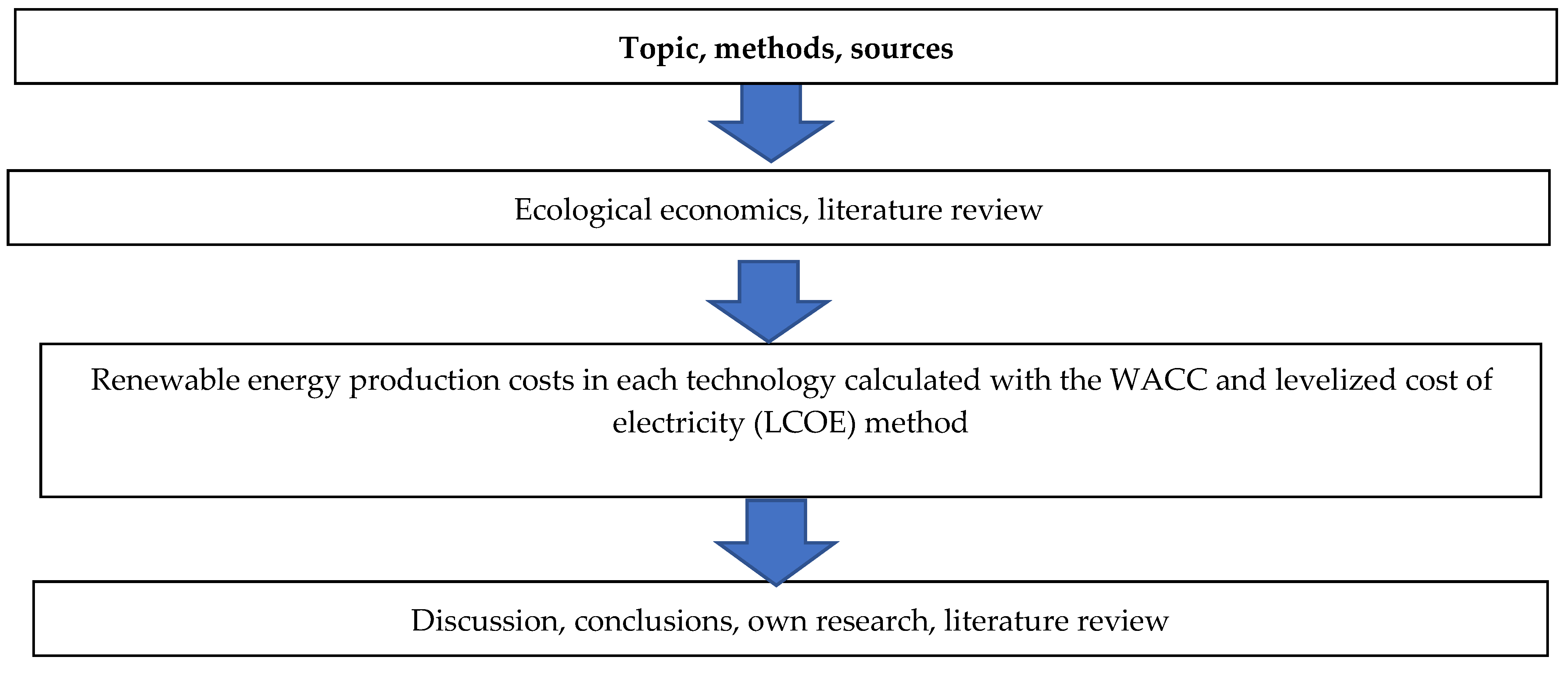
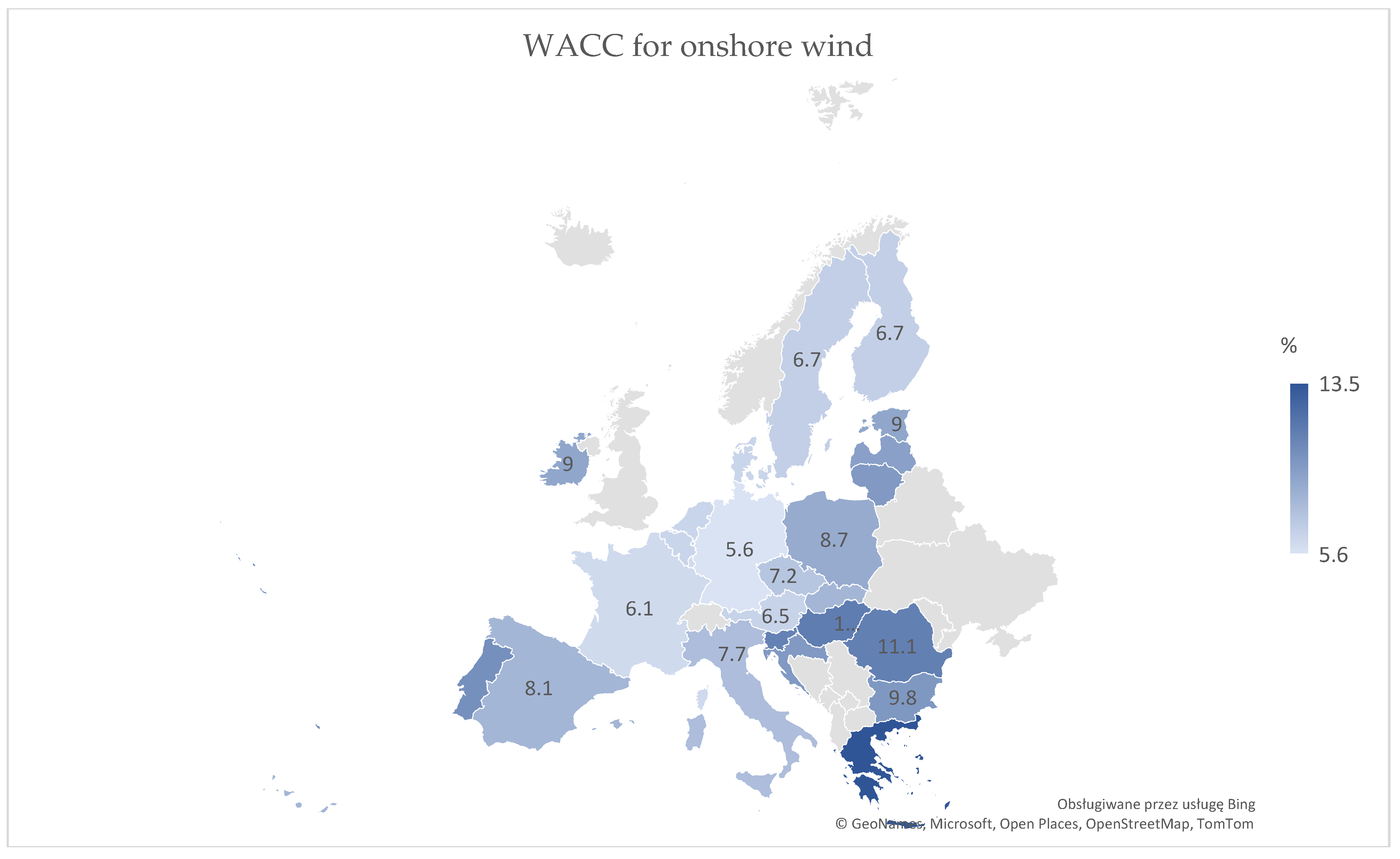
Evaluating the competitiveness of electricity is the most important issue. The main aim of this study was to determine the cost-effectiveness of renewable energy production in the European Union (EU) using the levelized cost competitiveness of renewable energy sources. The weighted average cost of capital (WACC) for onshore wind was calculated for European (EU) countries. The levelized cost of electricity (LCOE) approach was used to evaluate the energy costs of renewable energy sources. Energy production costs were compared across different technologies. The capital expenditures associated with solar PV are expected to decrease from USD 810/kW in 2021 to USD 360/kW in 2050. The power factor will remain stable at 14% during the analyzed period. Fuel, CO2, and operation and maintenance (O&M) costs will be maintained at USD 10/MWh at all three time points of the analysis (2021, 2030, and 2050), whereas the LCOE will decrease from USD 50/MWh in 2021 to USD 25/MWh in 2050. The capital expenditures associated with onshore wind energy will decrease from USD 1590/kW in 2021 to USD 1410/kW in 2050. The power factor will increase from 29% to 30%, and fuel, CO2, and O&M costs will reach USD 15/MWh in all three years. The LCOE will decrease from USD 55/MWh in 2021 to USD 45/MWh in 2050. In offshore wind projects, capital expenditures are expected to decrease considerably from USD 3040/kW in 2021 to USD 1320/kW in 2050.
Keywords: renewable energy sources; levelized cost of electricity; LCOE method; WACC; cost competitiveness renewable energy sources; levelized cost of electricity; LCOE method; WACC; cost competitiveness