Review

Top-Down or Bottom-Up? Space Syntax vs. Agent-Based Modelling in Exploring Urban Complexity and Crime Dynamics


by
Federico Mara
* and
Valerio Cutini
Department of Energy, Systems Territory and Construction Engineering, University of Pisa, Largo Lucio Lazzarino, 56122 Pisa, Italy
*
Author to whom correspondence should be addressed.
Sustainability 2025, 17(10), 4682; https://doi.org/10.3390/su17104682
Submission received: 23 April 2025 / Revised: 9 May 2025 / Accepted: 12 May 2025 / Published: 20 May 2025

Abstract

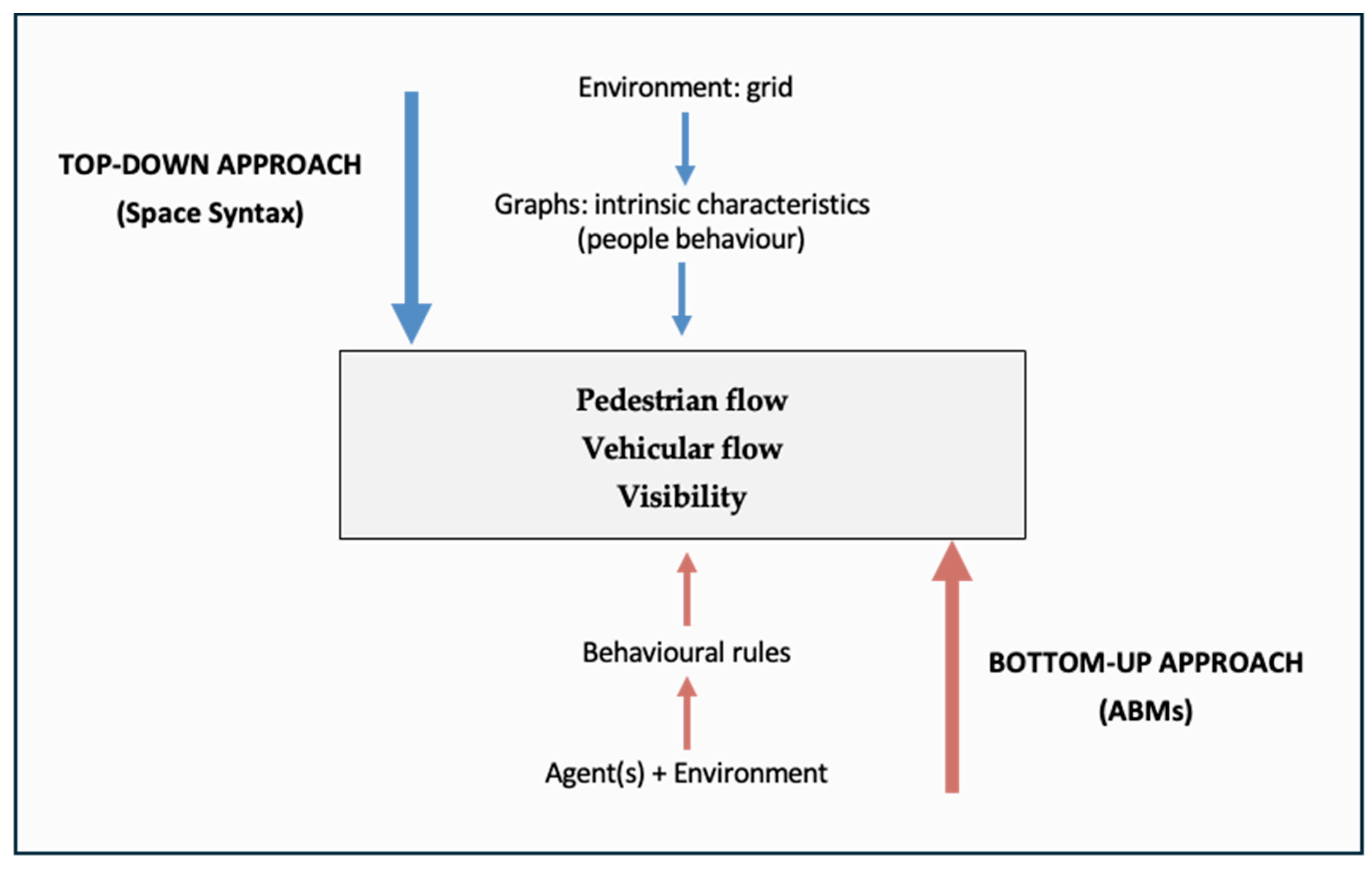
Understanding the complexity of urban systems remains a significant challenge for researchers and practitioners in urban planning and governance. Cities function as multifaceted systems composed of interconnected subsystems with nonlinear interactions, making the design of effective interventions to enhance sustainability and liveability particularly challenging. Spatial modelling has gained prominence in recent decades, fuelled by advances in digital technologies and the advent of digital twins as decision support tools. To fully harness these innovations, it is essential to grasp their underlying principles, strengths, and limitations, and to select the most suitable modelling approach for specific applications. This paper examines two contrasting spatial modelling paradigms: top-down and bottom-up. Specifically, it focuses on Space Syntax and Agent-Based Modelling as representative tools of each approach, analyzing their potential applications in urban planning. This discussion delves into the effectiveness of the proposed methodologies in analyzing crime dynamics—selected as a representative application field—at the micro-urban scale. It highlights the insights each approach offers, emphasizing their contributions to understanding the spatial and environmental factors influencing crime patterns. Finally, this paper explores the potential for integrating these methodologies to develop hybrid models that capture both spatial structure and emergent behaviours, offering enhanced support for sustainable urban policies and planning.
Keywords: spatial modelling; top-down approach; bottom-up approach; space syntax; agent-based modelling; urban planning; crime spatial modelling; top-down approach; bottom-up approach; space syntax; agent-based modelling; urban planning; crime