Promoting Emergency Medical Service Infrastructure Equality to Reduce Road Crash Fatalities

Abstract
1. Introduction
2. Literature Review
3. Data Collection and Processing
3.1. Crash Victim Data
3.2. Road Network and Travel Time
3.3. EMS Infrastructure
3.3.1. EMS Stations
3.3.2. EMS Hospitals
3.3.3. EMS Helicopters
3.3.4. Heliports for Helicopter EMS
4. Methodologies
- Select key indicators affecting crash fatalities using the random forest technique;
- Identify statistically significant variables from a geographically weighted binary logit regression model;
- Quantify the impacts of EMS predictors on crash fatalities and the time thresholds;
- Select the locations affected by EMS time-related predictors on crash fatalities;
- Determine the accessibility of the EMS infrastructure within the EMS time thresholds using network-based service area analysis;
- Perform an equality analysis for the existing EMS infrastructure and make recommendations.
4.1. Selection of Key Predictors
4.2. Geographically Weighted Binary Logit Regression
4.3. Network Analysis
5. Model Results
6. Discussion
7. Conclusions
- (1)
- The GWBLR outperformed a traditional BLR to identify the local impacts of risk factors on crash fatalities;
- (2)
- Aggregated EMS response time ranging from 16 to 20 min and transport time ranging from 11 to 15 min were likely to significantly increase the probabilities of crash fatalities;
- (3)
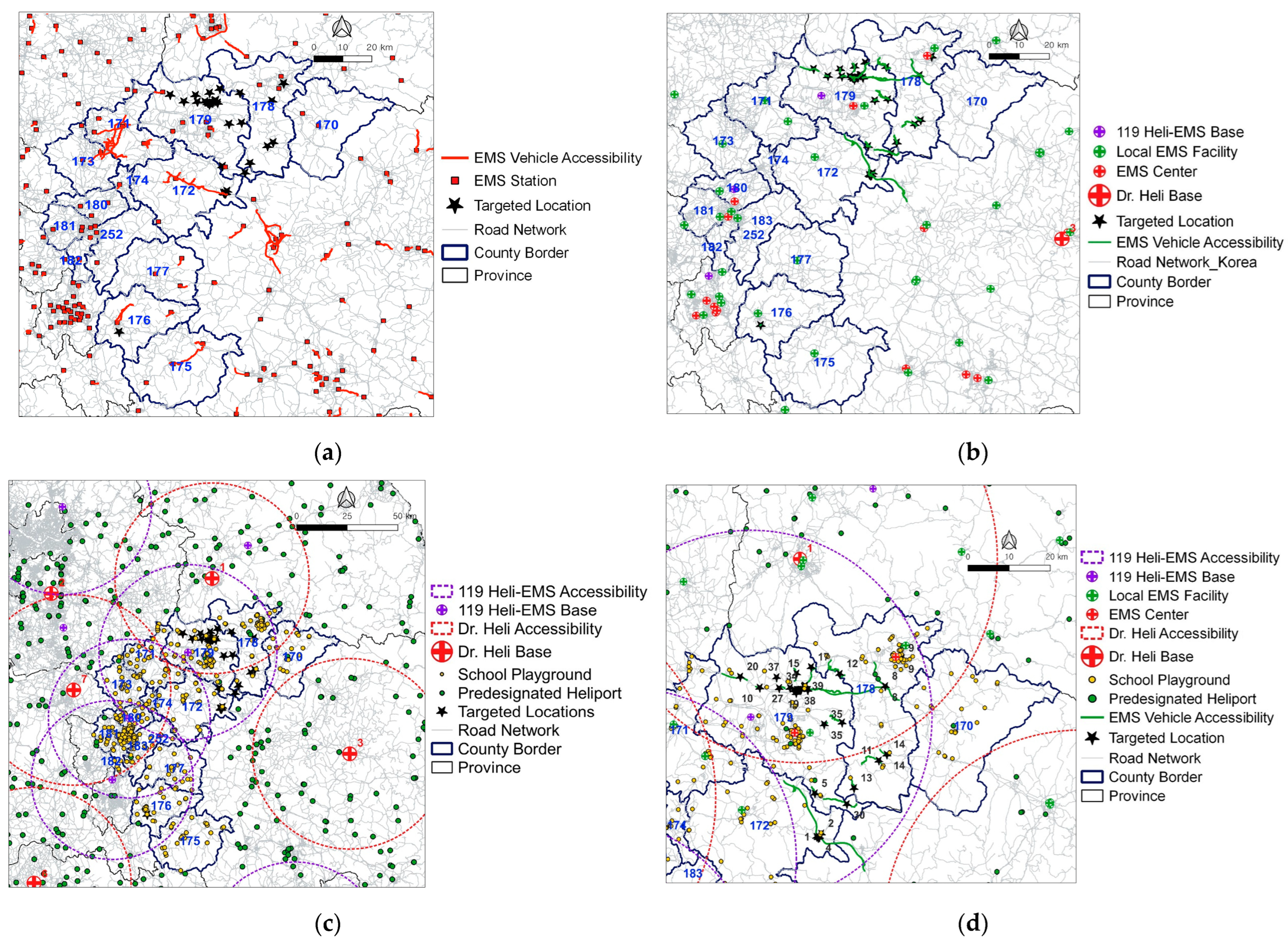
- The fatality-prone locations targeted for EMS infrastructure expansion were distributed in the northeastern and western areas of the CB province;
- (4)
- EMS stations should be further supported for particularly rural principal roads in the northern areas of CB province;
- (5)
- The KNFA plan for 119 heli-EMS to support KMHW-affiliated EMS helicopters is proper for severe emergency patient transport;
- (6)
- The use of school playground as sub-heliports is a cost-effective alternative for transporting severe emergency patients;
- (7)
- More heliports are recommended, especially in the northeastern districts of Choongju City.
Author Contributions
Funding
Institutional Review Board Statement
Informed Consent Statement
Data Availability Statement
Conflicts of Interest
References
- Shahriari, M.; Bozorgi-Amiri, A.; Tavakoli, S.; Yousefi-Babadi, A. Bi-objective approach for placing ground and air ambulance base and helipad locations in order to optimize EMS response. Am. J. Emerg. Med. 2017, 35, 1873–1881. [Google Scholar] [CrossRef]
- Li, M.; Kwan, M.; Chen, J.; Wang, J.; Yin, J.; Yu, D. Measuring emergency medical service (EMS) accessibility with the effect of city dynamics in a 100-year pluvial flood scenario. Cities 2021, 117, 103314. [Google Scholar] [CrossRef]
- Xiong, Q.; Liu, Y.; Xing, L.; Wang, L.; Ding, Y.; Liu, Y. Measuring spatio-temporal disparity of location-based accessibility to emergency medical services. Health Place 2022, 74, 102766. [Google Scholar] [CrossRef] [PubMed]
- Shi, Y.; Yao, Y.; Wen, Q.; Xi, J.; Li, H.; Wang, Q. A spatial accessibility assessment of urban tourist attractions emergency response in Shanghai. Int. J. Disaster Risk Reduct. 2022, 74, 102919. [Google Scholar] [CrossRef]
- Tsang, M.; Scott, D. An integrated approach to modeling the impact of floods on emergency services: A case study of Calgary, Alberta. J. Transp. Geogr. 2020, 86, 102774. [Google Scholar] [CrossRef]
- Wu, Y.; Chen, S. Traffic resilience modeling for post-earthquake emergency medical response and planning considering disrupted infrastructure and dislocated residents. Int. J. Disaster Risk Reduct. 2023, 93, 103754. [Google Scholar] [CrossRef]
- Noda, Y.; Hagiwara, T.; Hirasawa, M.; Hara, H. Influence of accessibility to emergency medical services on fatality rate in Hokkaido, Japan. Transp. Res. Rec. 2014, 2451, 28–35. [Google Scholar] [CrossRef]
- Wang, J.; Du, F.; Huang, J.; Liu, Y. Access to hospitals: Potential vs. observed. Cities 2020, 100, 102671. [Google Scholar] [CrossRef]
- Cao, Q.; Li, Z.; Tao, P.; Zhao, Y. Reallocation of Heterogeneous Sensors on Road Networks for Traffic Accident Detection. IEEE Trans. Instrum. Meas. 2023, 72, 1006911. [Google Scholar] [CrossRef]
- Status of Korean Road Network in 2022, Korean Statistical Information Service (KOSIS). Available online: https://kosis.kr/statHtml/statHtml.do?orgId=116&tblId=DT_MLTM_962&conn_path=I3 (accessed on 14 July 2023).
- 2022 Statistical Year Book of Emergency Services, Korea National Fire Agency (KNFA). Available online: https://www.nfa.go.kr/nfa/releaseinformation/statisticalinformation/main/?boardId=bbs_0000000000000019&mode=view&cntId=45&category=&pageIdx=1&searchCondition=all&searchKeyword=%ED%86%B5%EA%B3%84%EC%97%B0%EB%B3%B4 (accessed on 14 July 2023).
- Jung, S.; Qin, X.; Oh, C. Systemwide Impacts of Emergency Medical Services Resources on Freeway Crash Severity. Transp. Res. Rec. 2016, 2582, 51–60. [Google Scholar] [CrossRef]
- The Fourth Emergency Medical Master Plan: 2023 to 2027, Korea Ministry of Health and Welfare (KMHW). Available online: https://eiec.kdi.re.kr/policy/callDownload.do?num=235274&filenum=2&dtime=20230208171245 (accessed on 14 July 2023).
- 2022 Statistical Yearbook of Emergency Medical Service, Korea Ministry of Health and Welfare (KMHW). Available online: https://e-medis.nemc.or.kr/portal/compose/publicationPage.do (accessed on 8 December 2023).
- 2021 Statistical Year Book of Emergency Services, Korea National Fire Agency (KNFA). Available online: https://www.nfa.go.kr/nfa/releaseinformation/statisticalinformation/main/?boardId=bbs_0000000000000019&mode=view&cntId=34&category=&pageIdx=1&searchCondition=all&searchKeyword=%ED%86%B5%EA%B3%84%EC%97%B0%EB%B3%B4 (accessed on 14 July 2023).
- Policy Issue Report 2020: Social-Economical Analysis of Fire Fighting Activities, Korea Research Institute for Local Administration (KRILA). Available online: https://www.krila.re.kr/download/report/kor/1566 (accessed on 14 July 2023).
- Habib, M.; Olajide, B.; Terashima, M.; Campbell, S. Relationship between Neighborhood. Characteristics and Demand for Emergency Health Service Vehicles: A Poisson Hurdle Regression Modeling Approach. Transp. Res. Rec. 2018, 2672, 80–91. [Google Scholar] [CrossRef]
- Amorim, M.; Ferreira, S.; Couto, A. Road safety and the urban emergency medical service (uEMS): Strategy station location. J. Transp. Health 2017, 6, 60–72. [Google Scholar] [CrossRef]
- Karrison, T.; Schumm, P.; Kocherginsky, M.; Thisted, R.; Dirschl, D.; Rogers, S. Effects of driving distance and transport time on mortality among Level I and II traumas occurring in a metropolitan area. J. Trauma Acute Care Surg. 2018, 85, 756–765. [Google Scholar] [CrossRef] [PubMed]
- Brown, J.B.; Leeper, C.M.; Sperry, J.L.; Peitzman, A.B.; Billiar, T.R.; Gaines, B.A.; Gestring, M.L. Helicopters and injured kids: Improved survival with scene air medical transport in the pediatric trauma population. J. Trauma Acute Care Surg. 2016, 80, 702–710. [Google Scholar] [CrossRef] [PubMed]
- Chang, J.C.; Huang, H.H.; Chang, S.H.; Chen, Y.R.; Fan, J.S.; Chen, Y.C.; Yen, D.H.T. Clinical predictors of outcomes in patients undergoing emergency air medical transport from Kinmen to Taiwan. Medicine 2017, 96, e8440. [Google Scholar] [CrossRef] [PubMed]
- Chen, X.; Gestring, M.; Rosengart, M.; Peitzman, A.; Billiar, T.; Sperry, J.; Brown, J. Logistics of air medical transport: When and where does helicopter transport reduce prehospital time for trauma? J. Trauma Acute Care Surg. 2018, 85, 174–181. [Google Scholar] [CrossRef] [PubMed]
- Connor, R.; Hillson, S.; Krawelski, J. Competition, professional synergism, and the geographic distribution of rural physicians. Med. Care 1995, 33, 1067–1078. [Google Scholar] [CrossRef]
- Amed, S.; Adams, A.; Islam, R.; Hasan, H.; Panciera, R. Impact of traffic variability on geographic accessibility to 24/7 emergency healthcare for the urban poor: A GIS study in Dhaka, Bangladesh. PLoS ONE 2019, 14, e0222488. [Google Scholar] [CrossRef]
- Haynes, R.; Bentham, G.; Lovett, A.; Gale, S. Effects of distances to hospital and GP surgery on hospital inpatient episodes, controlling for needs and provision. Soc. Sci. Med. 1999, 49, 425–433. [Google Scholar] [CrossRef]
- Gyimah, S.; Takyi, B.; Addai, I. Challenges to the reproductive health needs of African women: On religion and maternal health utilization in Ghana. Soc. Sci. Med. 2006, 62, 2930–2944. [Google Scholar] [CrossRef]
- Cho, J.; Yoon, Y. GIS-based Analysis on Vulnerability of Ambulance Response Coverage to Traffic Condition: A Case Study of Seoul. In Proceedings of the IEEE 18th International Conference on Intelligent Transportation Systems 2015, Gran Canaria, Spain, 15–18 September 2015; INSPEC Accession Number 15572801. pp. 1402–1407. [Google Scholar]
- Schuurman, N.; Fiedler, R.; Grzybowski, S.; Grund, D. Defining rational hospital catchments for non-urban areas based on travel-time. Int. J. Health Geogr. 2006, 5, 5. [Google Scholar] [CrossRef] [PubMed]
- Ye, H.; Kim, H. Measuring Spatial Health Disparity Using a Network-Based Accessibility Index Method in a GIS Environment: A Case Study of Hillsborough County, Florida. Int. J. Geospat. Environ. Res. 2014, 1, 2. [Google Scholar]
- Guagliardo, M.; Ronzio, C.; Cheung, I.; Chacko, E.; Joseph, J. Physician accessibility: An urban case study of pediatric providers. Health Place 2004, 10, 273–283. [Google Scholar] [CrossRef]
- Cheng, Y.; Wang, J.; Rosenberg, M. Spatial access to residential care resources in Beijing, China. Int. J. Health Geogr. 2012, 11, 32. [Google Scholar] [CrossRef]
- Dolejš, M.; Purchard, J.; Javořć, A. Generating a spatial coverage plan for the emergency medical service on a regional scale: Empirical versus random forest modelling approach. J. Transp. Geogr. 2020, 89, 102889. [Google Scholar] [CrossRef]
- Li, X.; Hu, Q.; Gregg, A. An integrated spatio-temporal analysis of emergency medical service response characteristics for stroke events across Alabama. J. Transp. Health 2021, 20, 101018. [Google Scholar] [CrossRef]
- Jagtenberg, C.; Vollebergh, M.; Uleberg, O.; Røislien, J. Introducing fairness in Norwegian air ambulance base location planning. Scand. J. Trauma Resusc. Emerg. Med. 2021, 29, 50. [Google Scholar] [CrossRef]
- Standard Road Network in 2021, Korea National Transportation Information Center (KNTIC). Available online: https://www.its.go.kr/nodelink/nodelinkRef (accessed on 1 July 2023).
- Public Data Portal (PDP) Average Taxi Speed Data in 2021. Available online: https://www.data.go.kr/en/index.do (accessed on 1 July 2023).
- The Status of 119 Safety Centers in 2021, KNFA. Available online: https://www.nfa.go.kr/nfa/releaseinformation/0011/0001/ (accessed on 1 July 2023).
- National Emergency Medical Portal (NEMP): EMS Hospital Data in 2021. Available online: https://www.e-gen.or.kr/intro/intro.do;jsessionid=F2F11070D9F0E4EC93674D860DAD0C8E.egenlb (accessed on 1 July 2023).
- KMHW Air Ambulance Operation Guideline. 2016. Available online: https://www.mohw.go.kr/ (accessed on 14 July 2023).
- Jung, S.; Qin, X. Impacts of augmenting heliports with school playgrounds on air medical transport time. J. Transp. Saf. Secur. 2022, 14, 46–66. [Google Scholar] [CrossRef]
- KMHW The cross-ministerial regulation for joint operation of EMS helicopter. 2019. Available online: https://www.law.go.kr/LSW/admRulLsInfoP.do?admRulSeq=2200000076777 (accessed on 1 July 2023).
- Korean Educational Statistics Service (KESS): List of Educational Facilities in 2021. Available online: https://kess.kedi.re.kr/index (accessed on 1 July 2023).
- Zhai, X.; Huang, H.; Sze, H.; Song, Z.; Hon, K. Diagnostic analysis of the effects of weather condition on pedestrian crash severity. Accid. Anal. Prev. 2019, 122, 318–324. [Google Scholar] [CrossRef]
- Jung, S.; Qin, X. Identifying the Local Impacts of Speed-Related Factors on Tunnel Entrance Crash Severity. Transp. Res. Rec. 2023, 2679, 730–742. [Google Scholar] [CrossRef]
- Liu, J.; Khattak, A.; Chen, C.; Wan, D.; Ma, J.; Hu, J. Revisiting Hit-and-Run Crashes: A Geo-Spatial Modeling Method. Transp. Res. Rec. 2018, 2672, 81–92. [Google Scholar] [CrossRef]
- Jung, S.; Qin, X.; Noyce, D. Rainfall effect on single-vehicle crash severities using polychotomous response models. Accid. Anal. Prev. 2010, 42, 213–224. [Google Scholar] [CrossRef] [PubMed]
- Nakaya, T.; Charlton, M.; Yao, J. GWR4.09 User Manual; GWR 4 Development Team. 2016. Available online: https://gwr.maynoothuniversity.ie/wp-content/uploads/2013/04/GWR4_Manual.pdf (accessed on 12 December 2023).
- Brodsky, H. Emergency medical service rescue time in fatal road accidents. Transp. Res. Rec. 1990, 1270, 89–96. [Google Scholar]
- Shang, Q.; Guo, X.; Li, J.; Wang, T. Post-earthquake health care service accessibility assessment framework and its application in a medium-sized city. Reliab. Eng. Syst. Saf. 2022, 228, 108782. [Google Scholar] [CrossRef]
- Campbell, J. International Trauma Life Support for Emergency Care Providers, 8th ed.; Pearson: New York, NY, USA, 2018. [Google Scholar]
- Ministry of Land, Infrastructure and Transportation (MLIT) E-National Index: Population Trends in Urban Areas in 2022. Available online: https://www.index.go.kr/unity/potal/main/EachDtlPageDetail.do?idx_cd=1200 (accessed on 1 July 2023).



| Variable (Unit) | Variable Categories | % of Total Sample Size N (N = 568) |
|---|---|---|
| Response variable | ||
| Medical treatment consequence | Fatality | 5.6 |
| Survival | 94.4 | |
| Explanatory variable | ||
| Victim | ||
| Age (years) | Younger than 25 | 16.0 |
| 25 to 64 | 71.1 | |
| Older than 64 | 12.9 | |
| Gender | Male | 59.3 |
| Female | 40.7 | |
| Position seated | Driver | 56.7 |
| Front passenger | 21.5 | |
| Back | 21.8 | |
| Seatbelt | Worn | 70.0 |
| Not worn | 30.0 | |
| Vehicle | ||
| Victim’s vehicle type | Passenger car | 52.6 |
| SUV/van | 30.6 | |
| Truck | 16.8 | |
| Counterpart vehicle | Passenger car | 29.8 |
| SUV/Van | 13.0 | |
| Truck | 13.6 | |
| Trailer/bus | 13.6 | |
| Fixed objects | 18.5 | |
| Rollover | 11.5 | |
| Front airbag | Deployed | 19.4 |
| Not deployed | 80.6 | |
| Side airbag | Deployed | 5.3 |
| Not deployed | 94.7 | |
| Roadway and Crash | ||
| Functional class of road | Expressway | 17.6 |
| National highway | 13.4 | |
| Rural principal road | 13.6 | |
| Urban road | 55.4 | |
| Collision type | Single vehicle involved | 12.5 |
| Head-on | 25.9 | |
| Angle | 47.9 | |
| Rear-end | 13.7 | |
| Primary cause of crash | Driving under alcohol effect | 11.6 |
| Drowsy driving | 6.2 | |
| Centerline violation | 6.3 | |
| Signal/speed/parking violations | 12.4 | |
| Careless driving | 53.2 | |
| Vehicle defects | 3.3 | |
| Roadway conditions | 7.0 | |
| Weather | Clear | 72.4 |
| Cloudy | 6.3 | |
| Rain/snow/fog | 21.3 | |
| Temporal factors | ||
| Season | Spring (March to May) | 28.5 |
| Summer (June to August) | 27.6 | |
| Autumn (September to November) | 23.6 | |
| Winter (December to February) | 20.3 | |
| Sunlight | Night | 33.5 |
| Daytime | 66.5 | |
| Hour of the day | 20:00 to 05:59 | 27.1 |
| 6:00 to 8:59 | 18.1 | |
| 9:00 to 13:59 | 23.8 | |
| 14:00 to 16:59 | 17.6 | |
| 17:00 to 19:59 | 13.4 | |
| EMS time | ||
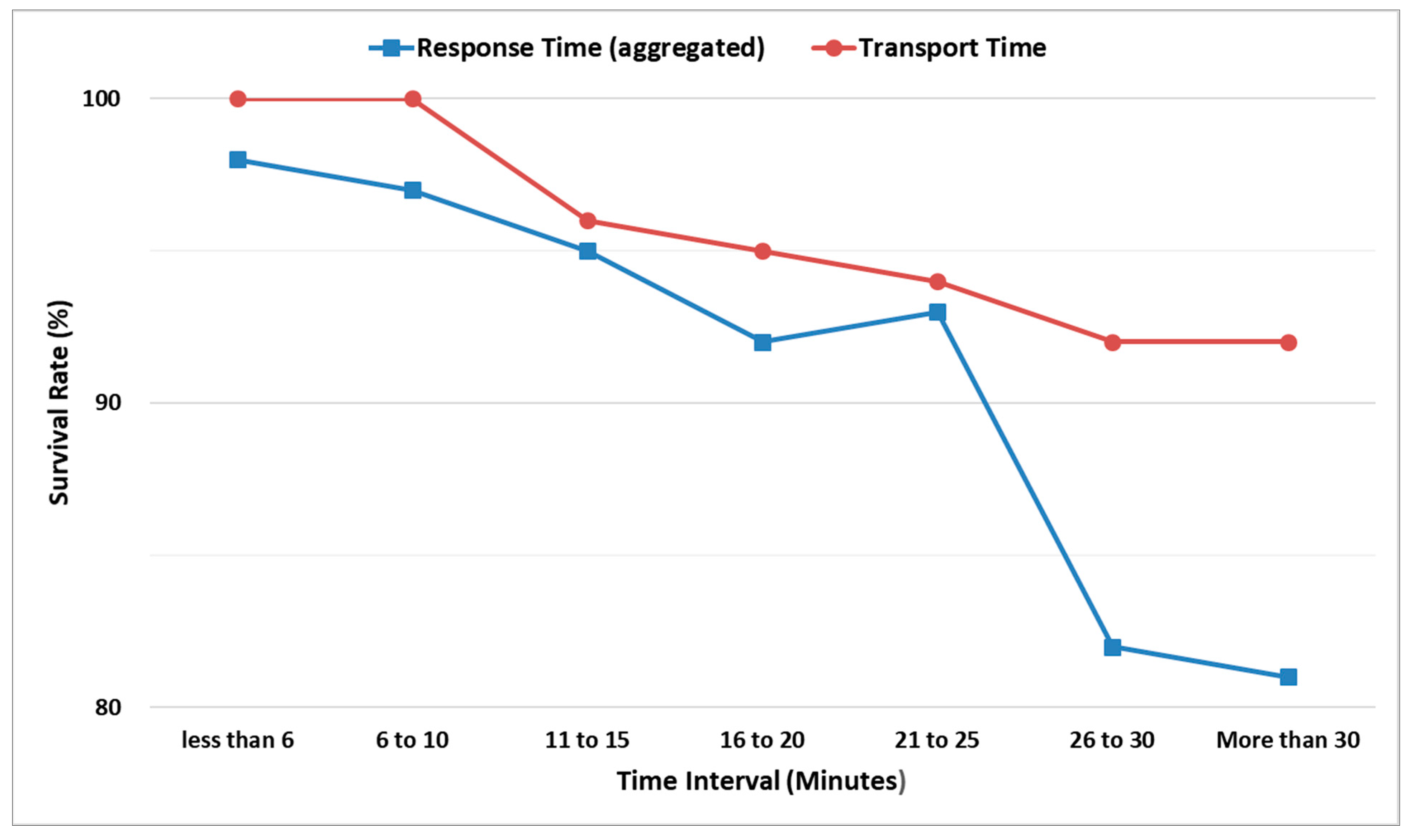
| EMS vehicle’s response time aggregated by the on-scene time (min) | Less than 6 | 7.9 |
| 6 to 10 | 35.2 | |
| 11 to 15 | 22.4 | |
| 16 to 20 | 19.0 | |
| 21 to 25 | 9.7 | |
| More than 25 | 5.8 | |
| EMS vehicle’s transport time (min) | Less than 11 | 8.1 |
| 11 to 15 | 21.8 | |
| 16 to 20 | 14.8 | |
| 21 to 25 | 12.0 | |
| 26 to 30 | 12.9 | |
| More than 30 | 30.5 | |
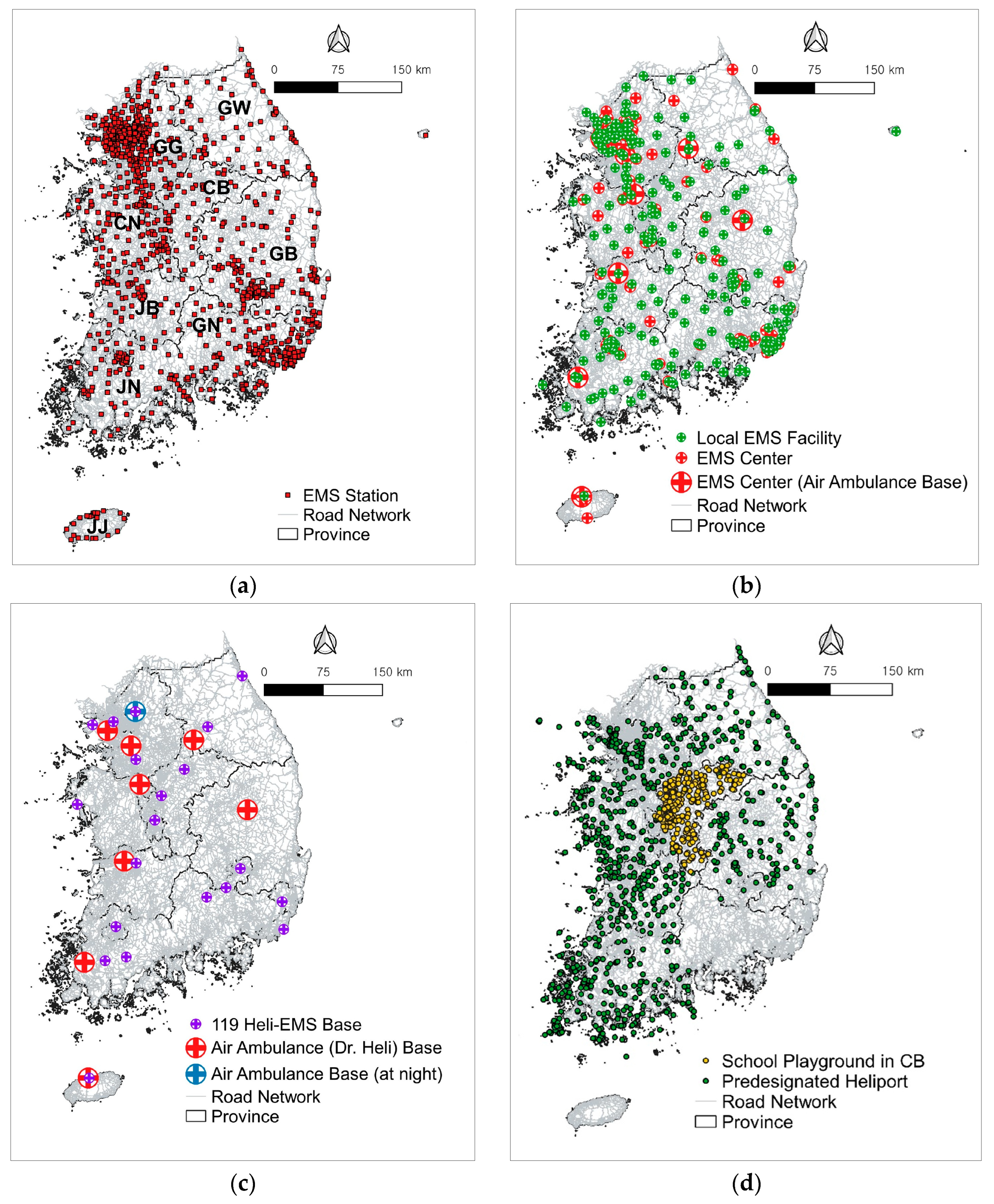
| Category of HEMS (Affiliation) | Helicopter Base (City) | Model (Manufacturer) | Overall Length 1 (m) | Ave./Max. 2 Cruise Speed (km/h) | Operation Radius (km) | Night Operation Applicable |
|---|---|---|---|---|---|---|
| Dr. Heli (KMHW) | CN (Cheonan) | AW109 (Leonardo) | 11.5 | 285/311 | 70~250 | n.a. |
| GB (Andong) | AW109 | 11.5 | 285/311 | |||
| GW (Wonju) | AW109 | 11.5 | 285/311 | |||
| JB (Iksan) | AW109 | 11.5 | 285/311 | |||
| GG (Suwon) | AW169 (Leonardo) | 11.5 | 268/297 | |||
| GG (Incheon) | AW169 | 12.2 | 268/297 | |||
| JN (Mokpo) | AW169 | 12.2 | 268/297 | |||
| JJ (Jeju) | Light Civil Helicopter (KAI) | 12.7 | 265/265 | |||
| Dr. Heli (KNFA) | GG (Namyangju) | H225 (Airbus) | 19.5 | 262/324 | 250~400 | applicable |
| 119 Heli-EMS (KNFA) | CB (Choongju) | H225 | 19.5 | 262/324 | ||
| GB (Daegu) | H225 | 19.5 | 262/324 | |||
| GG (Seoul) | AW189 (Leonardo) | 14.6 | 287/313 | |||
| GW (Yangyang) | AW139 (Leonardo) | 16.6 | 277/310 | |||
| GW (Hwingsung) | AW139 | 16.6 | 277/310 | |||
| GG (Incheon) | AW139 | 16.6 | 277/310 | |||
| GG (Yongin) | AW139 | 16.6 | 277/310 | |||
| CN (Taean) | AW139 | 16.6 | 277/310 | |||
| GN (Busan) | AW139 | 16.6 | 277/310 | |||
| JN (Youngam) | AW139 | 16.6 | 277/310 | |||
| CB (Cheongju) | BK117C (Kawasaki) | 13.3 | 240/276 | |||
| CN (Daejeon) | BK117C | 13.3 | 240/276 | |||
| JB (Wanju) | BK117B2 (Kawasaki) | 13.0 | 267/278 | |||
| JN (Gwangju) | BK117B2 | 13.0 | 267/278 | |||
| GB (Daegu) | AW169 (Leonardo) | 14.6 | 268/297 | |||
| GN (Ulsan) | KA-32T (KumAPE) | 15.9 | 200/230 | |||
| GN (Hapcheon) | KUH-1EM (KAI 3) | 19.0 | 278/290 | |||
| JN (Hwasoon) | KUH-1EM | 19.0 | 278/290 | |||
| JJ (Jeju) | KUH-1EM | 19.0 | 278/290 |
| GWBLR | BLR | ||||||||
|---|---|---|---|---|---|---|---|---|---|
| Parameter | Mean β | Min. β | Q1. β | Q2. β | Q3. β | Max. β | Max. |z| | Β (SE) | p-Value |
| Intercept | −3.461 | −3.932 | −3.565 | −3.453 | −3.311 | −3.186 | 9.908 | −3.727 (0.368) | 0.001 |
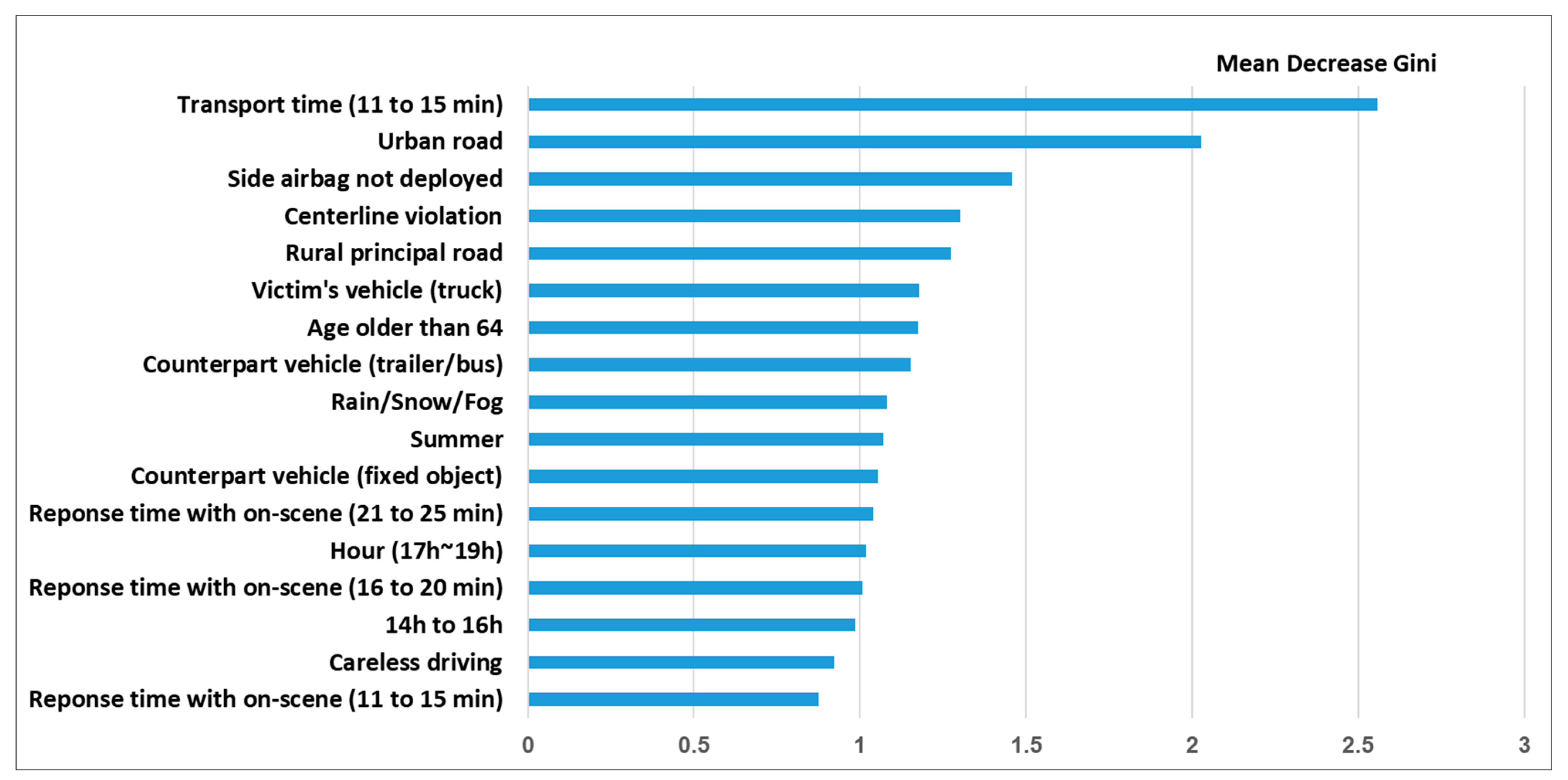
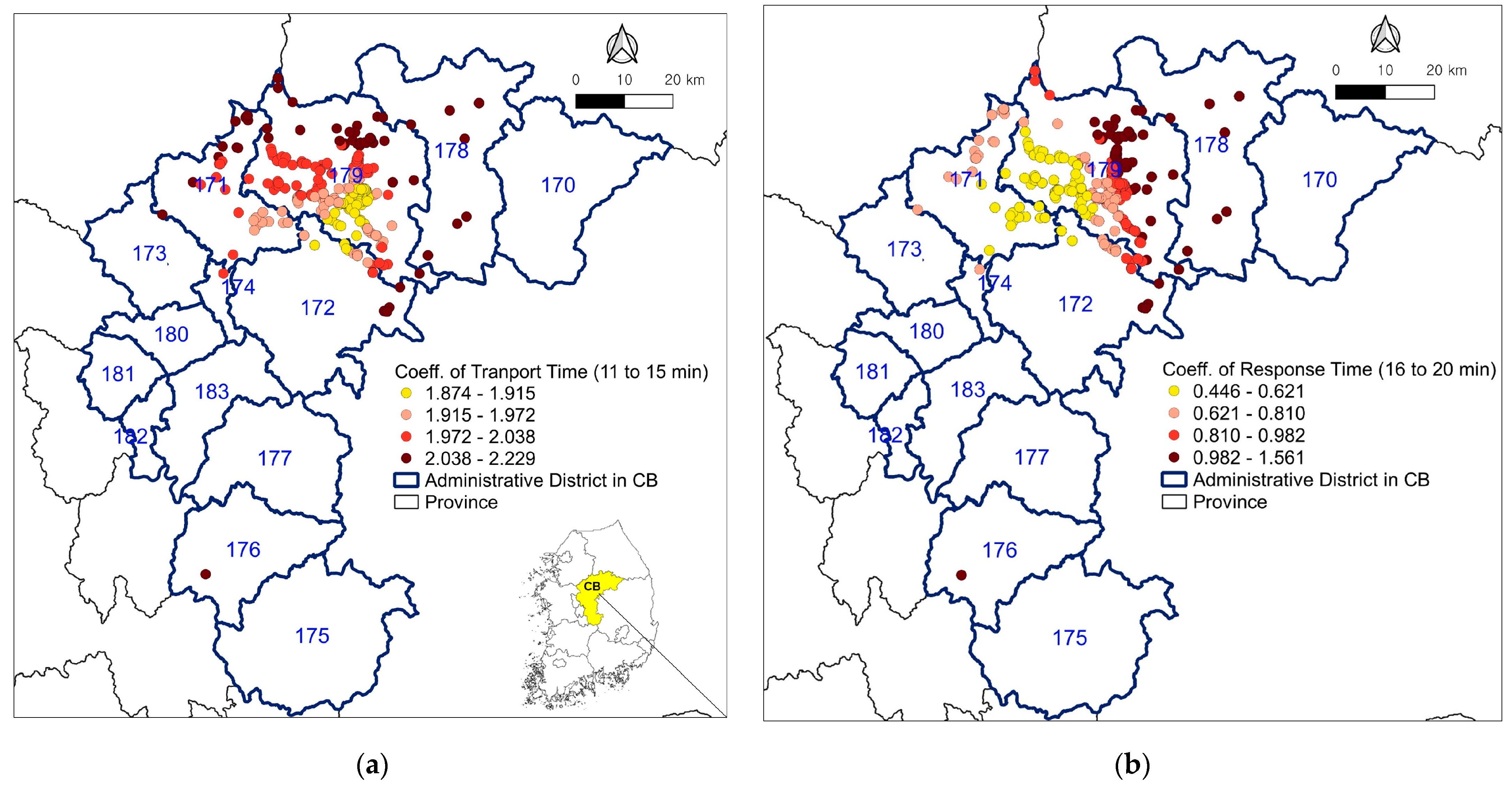
| Transport time (11 to 15 min) | 1.987 | 1.874 | 1.915 | 1.972 | 2.038 | 2.228 | 5.191 | 2.222 (0.427) | 0.001 |
| Response time aggregated by on-scene time (16 to 20 min) | 0.840 | 0.446 | 0.621 | 0.810 | 0.982 | 1.561 | 3.777 | 1.230 (0.399) | 0.002 |
| Centerline violation | 1.513 | 1.463 | 1.500 | 1.515 | 1.525 | 1.563 | 2.450 | 1.536 (0.628) | 0.014 |
| Urban road | −1.465 | −1.823 | −1.671 | −1.501 | −1.322 | −0.837 | 3.352 | −0.972 (0.421) | 0.021 |
| Deviance (intercept-only) | 246.251 | 246.251 | |||||||
| Deviance (fitted) | 195.293 | 204.463 | |||||||
| AIC | 210.088 | 214.570 | |||||||
| Pseudo R2 | 0.207 | 0.170 | |||||||
Disclaimer/Publisher’s Note: The statements, opinions and data contained in all publications are solely those of the individual author(s) and contributor(s) and not of MDPI and/or the editor(s). MDPI and/or the editor(s) disclaim responsibility for any injury to people or property resulting from any ideas, methods, instructions or products referred to in the content. |
© 2024 by the authors. Licensee MDPI, Basel, Switzerland. This article is an open access article distributed under the terms and conditions of the Creative Commons Attribution (CC BY) license (https://creativecommons.org/licenses/by/4.0/).
Share and Cite
Jung, S.; Qin, X. Promoting Emergency Medical Service Infrastructure Equality to Reduce Road Crash Fatalities. Sustainability 2024, 16, 1000. https://doi.org/10.3390/su16031000
Jung S, Qin X. Promoting Emergency Medical Service Infrastructure Equality to Reduce Road Crash Fatalities. Sustainability. 2024; 16(3):1000. https://doi.org/10.3390/su16031000
Chicago/Turabian StyleJung, Soyoung, and Xiao Qin. 2024. "Promoting Emergency Medical Service Infrastructure Equality to Reduce Road Crash Fatalities" Sustainability 16, no. 3: 1000. https://doi.org/10.3390/su16031000
APA StyleJung, S., & Qin, X. (2024). Promoting Emergency Medical Service Infrastructure Equality to Reduce Road Crash Fatalities. Sustainability, 16(3), 1000. https://doi.org/10.3390/su16031000