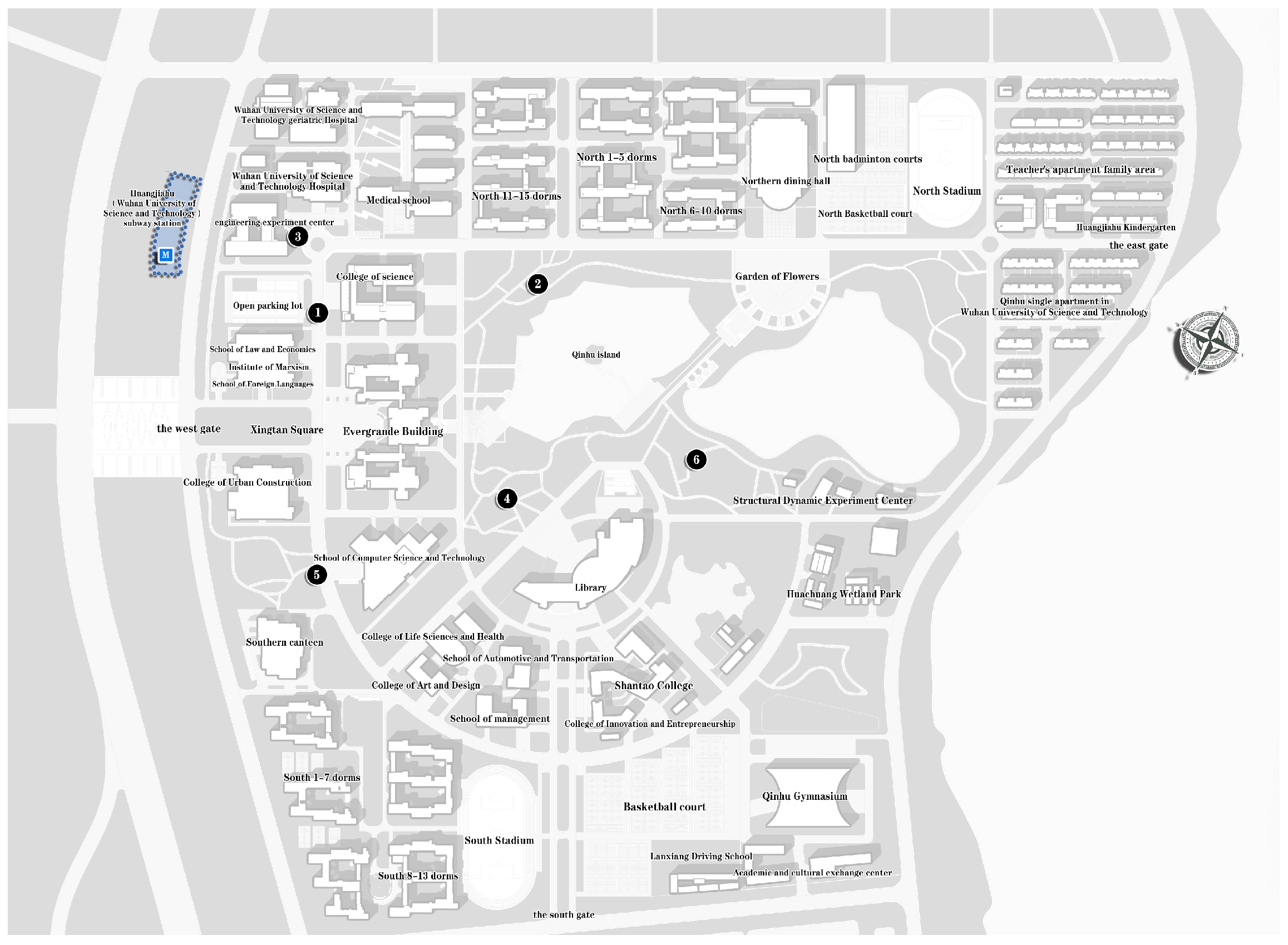
The Optimization of a Slow-Walking System in a Higher Education Campus—Taking the Huangjiahu Campus of Wuhan University of Science and Technology as an Example


Abstract
Share and Cite
Xia, X.; Yan, H.; Qin, Y.; Li, T. The Optimization of a Slow-Walking System in a Higher Education Campus—Taking the Huangjiahu Campus of Wuhan University of Science and Technology as an Example. Sustainability 2024, 16, 8591. https://doi.org/10.3390/su16198591
Xia X, Yan H, Qin Y, Li T. The Optimization of a Slow-Walking System in a Higher Education Campus—Taking the Huangjiahu Campus of Wuhan University of Science and Technology as an Example. Sustainability. 2024; 16(19):8591. https://doi.org/10.3390/su16198591
Chicago/Turabian StyleXia, Xiaotang, Hong Yan, Yuting Qin, and Tingyang Li. 2024. "The Optimization of a Slow-Walking System in a Higher Education Campus—Taking the Huangjiahu Campus of Wuhan University of Science and Technology as an Example" Sustainability 16, no. 19: 8591. https://doi.org/10.3390/su16198591
APA StyleXia, X., Yan, H., Qin, Y., & Li, T. (2024). The Optimization of a Slow-Walking System in a Higher Education Campus—Taking the Huangjiahu Campus of Wuhan University of Science and Technology as an Example. Sustainability, 16(19), 8591. https://doi.org/10.3390/su16198591