Article

Comparison of Carbon Storage in Forested and Non-Forested Soils in Tropical Wetlands of Caimanera, Colombia, and Llano, Mexico


by
Gastón Ballut-Dajud
1,2,†,
Luis Carlos Sandoval Herazo
2,†,
Ingris María Osorio-Martínez
3,
Wendy Báez-García
4,
José Luis Marín-Muñiz
5,* and
Erick Arturo Betanzo Torres
2,*,†
1
Departamento de Ingeniería Civil, Universidad de Sucre, Carrera 28 No 5-267 Puerta Roja, Sincelejo 700003, Colombia
2
Wetlands and Environmental Sustainability Laboratory, Division of Graduate Studies and Research, Tecnológico Nacional de Mexico/Instituto Tecnológico Superior de Misantla, Km 1.8 Carretera a Loma del Cojolite, Misantla 93821, Mexico
3
Facultad de Ingeniería, Departamento de Ingeniería Ambiental, Universidad de Córdoba, Calle 25A No 3D—W16, Las Viñas Neighborhood, Monteria 230002, Colombia
4
Tecnológico Nacional de México, Centro Nacional de Investigación y Desarrollo Tecnológico, Interior Internado Palmira s/n, Colonia Palmira, Cuernavaca 62490, Mexico
5
Academy of Sustainable Regional Development, El Colegio de Veracruz, Xalapa 91000, Mexico
*
Authors to whom correspondence should be addressed.
These authors contributed equally to this work.
Sustainability 2024, 16(12), 4966; https://doi.org/10.3390/su16124966
Submission received: 4 May 2024 / Revised: 6 June 2024 / Accepted: 7 June 2024 / Published: 11 June 2024
(This article belongs to the Special Issue Soil Carbon Sequestration and Greenhouse Gas Emission)

Abstract

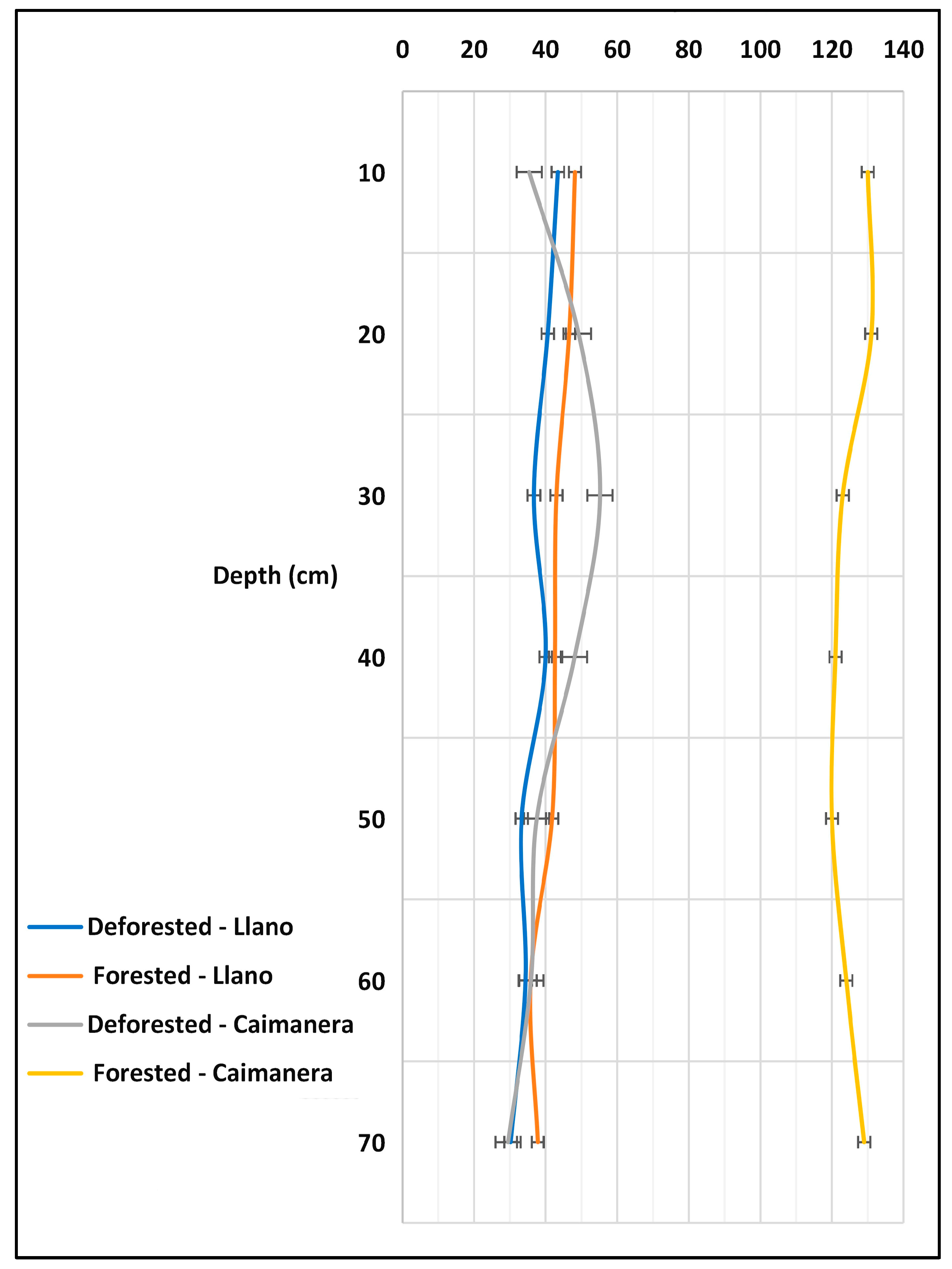
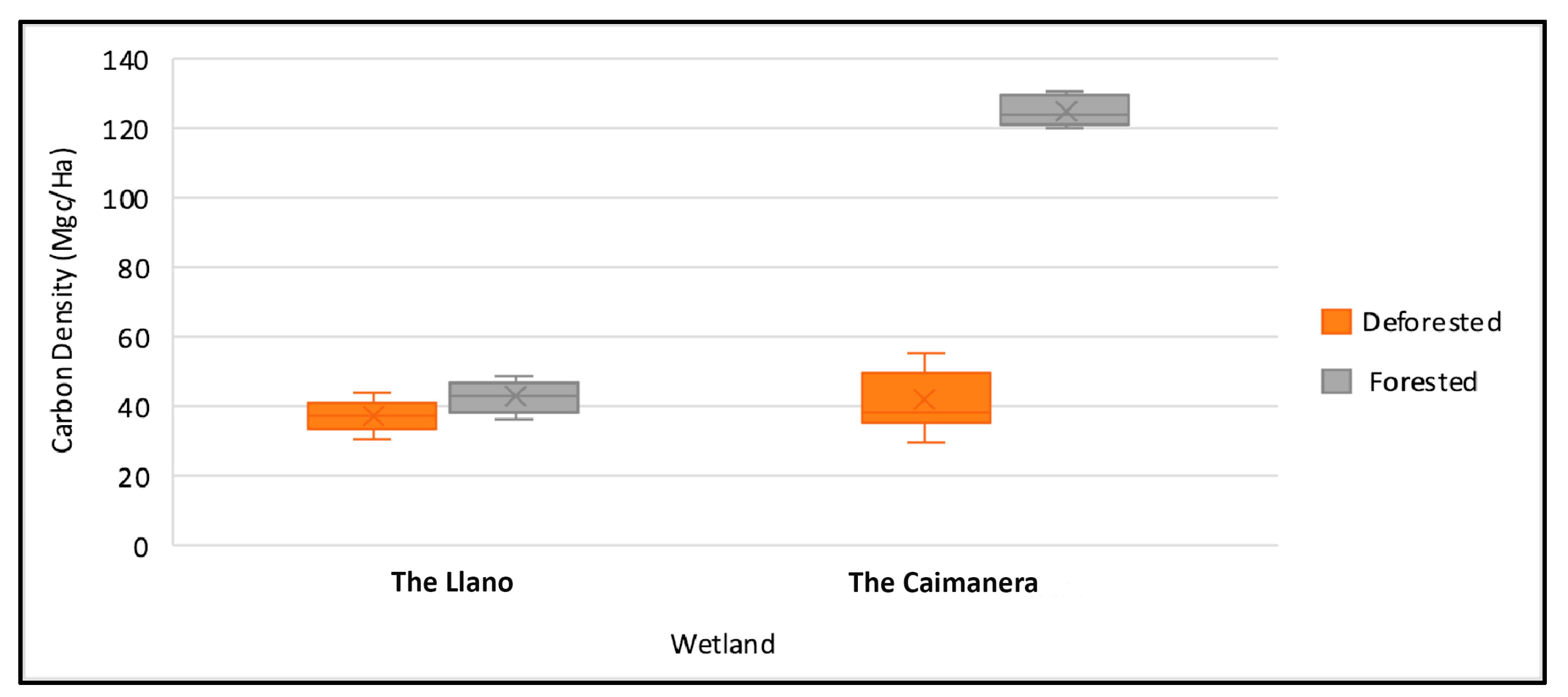
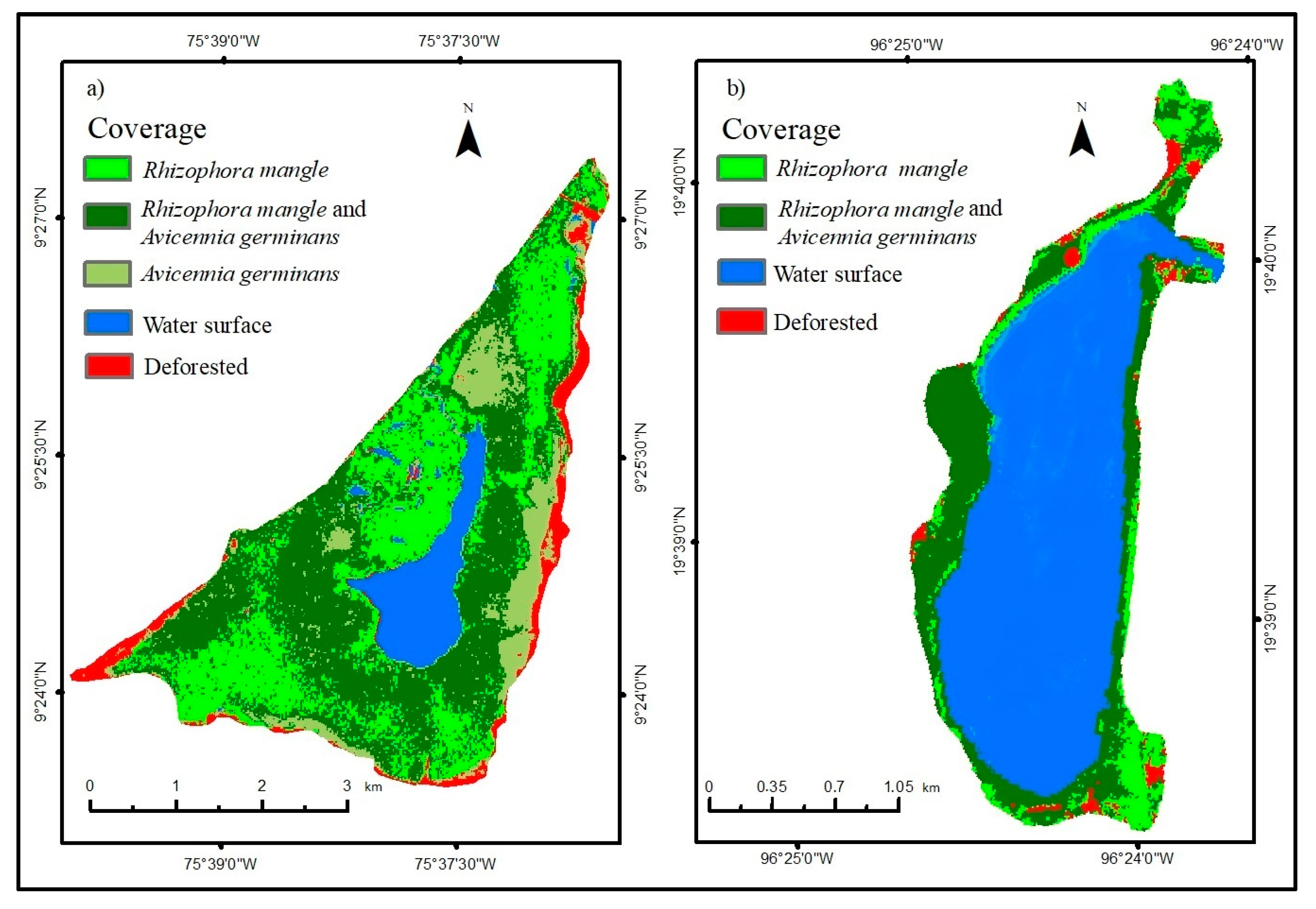
Mangrove forests are considered to be the most productive ecosystems on the planet due to the multiple ecosystem services they offer, both environmental economic, and social; however, their area in recent years has been decreasing due to anthropogenic activities such as urbanization and deforestation. These activities alter the normal cycle of carbon stored in sediments, which is considered their main function to counteract climate change. Therefore, the objective of this research was to compare the carbon storage capacity and coverage in forested and non-forested sites of two tropical wetlands located in Colombia (the Caimanera) and Mexico (the Llano). Methodologically, we began by identifying the coverages and determining the area in the wetlands with Sentinel-2A satellite images and a supervised classification; subsequently, soil cores were extracted in all the coverages to a depth of 70 cm and the apparent density (AD), the percentage of organic carbon (OC), and the density of carbon in the soil were determined. For analysis of the variables, a trend graph was constructed between carbon density and depth with descriptive statistics, using one-way ANOVA to establish which coverage and wetland were the most significant concerning carbon storage. The results of the supervised classification showed that Rhizophora mangle and Avicennia germinans are the dominant species, also finding deforested areas in both wetlands. The one-way ANOVA statistical test indicated that the Caimanera, with the percentage of organic carbon (18.4 ± 1.19%), is 1.57 times greater than of the Llano mangrove swamp with (11.7 ± 0.748 MgC/ha). Through the trend graph, it was observed that the carbon density of the forested area of the Caimanera ranged from 120 to 140 MgC/ha, which is higher than in the deforested areas of the same wetland between 40 and 60 MgC/ha, and the homologous areas of the Llano wetland. The results suggest that deforested areas are sources of greenhouse gas emissions because they contain less carbon than forested areas. Therefore, it is concluded that the Caimanera and the Llano wetlands have the same mangrove species and that the average organic carbon stored in their soil is below the average of other mangrove forest soils in the American continent; it is recommended that the findings of this work be considered for the carbon balances by continent and the characterization of mangrove species according to their carbon storage capacity.
Keywords: wetland mapping; carbon sink; wetland landscape and functions; climate action wetland mapping; carbon sink; wetland landscape and functions; climate action