Abstract
Community forestry is a strategy in which communities are, to some degree, responsible for managing the forests, using a more participatory approach to replace the traditional top-down model. Various forms of policies and governance have been developed to balance goals to ensure the community’s socioeconomic resilience and the landscape’s biological sustainability. The reinvestment of community forest (CF) income back into forest regeneration is not well documented, and there is a lack of research comparing forest income to the costs associated with forest regeneration. This research examines how changes in timber income and forest-regeneration costs affected CF social and ecological viability. We conducted expert elicitation interviews for CFs (n = 33) under three zones of management in Chitwan, Nepal (Zone 1: buffer zone, Zone 2: forest corridor, and Zone 3: community forest). To examine how CFs differ financially, we asked questions regarding timber income and forest-regeneration expenditures and then posed 22 questions regarding socioeconomic and biological aspects of the CF. Finally, a Kruskal–Wallis rank-sum test was performed to determine whether there were statistically significant differences in perceptions between groups, including zone, timber income (high, medium, low), and forest-regeneration expenditures (high, medium, low). The amount of income from timber had a substantial impact on the communities’ biological benefits and financial stability. Lower timber-income areas were thought to be less economically stable, lack the resources to enforce rules and regulations necessary to meet the CF’s socioeconomic or biological goals, and place more significant restrictions on the amount of wood members can harvest from the forest. Communities that spent less money on forest regeneration reported poorer levels of forest regeneration, economic sustainability, and community rights. Our research shows that community-forest user groups in the Chitwan district have a significant income and expenditure gap between their forests’ biological and socioeconomic advantages and resilience.
1. Introduction
Community forests (CF) are widely regarded as the primary mechanism for strengthening community-management capacity in communal areas and promoting local economic development in an environmentally friendly way [1]. The primary objective of this mechanism of forest management is to create an environment where residents can work cooperatively to sustainably extract the forest’s resources while preserving the area’s biodiversity and environment [2]. Assessments of CF have been hindered by a lack of research connecting CF to socioeconomic or biological sustainability and a lack of measures for achieving good governance [3].
Community forestry has existed for 30 years in Nepal, and during that time, it has faced the challenge of establishing institutions that manage common property resources effectively. In the 1990s, the government decided to shift from centralized forest management to community-forest user-group (CFUG) initiatives [4,5]. The CFUG is responsible for establishing rules and regulations for managing the forest, ensuring compliance with these rules and regulations, collecting revenues generated from forest-management activities, and allocating the revenues back to the community in the form of benefits and services [6]. The government has given community-forest, leasehold, and collaborative-forestry organizations (CFUGs) control over 2.4 million acres of land in Nepal, or about 38% of the country’s total forest area [7]. Although CF management normally occurs at the local level, a national legal and institutional framework provides monitoring and governance of the forests and facilitates the formulation of sustainable forest-management plans [8]. CFUGs, according to the Third Revised Guidelines for the Community Forestry Development Program (2014), should invest at least 25% of their income in forest conservation and sustainable use and another 40% in community development [9]. Numerous studies that examined the income and spending of CFUGs for pro-poor advocacy discovered that, on average, they did spend a sizeable portion (40–80%) of their funds on neighborhood improvement initiatives and that the objectives for rural development derived from CFUG governance were being achieved [10,11,12,13]. Nevertheless, studies have highlighted social disparities, inequities, and biases against poorer CFUG members from benefiting from CFs [14,15,16], despite the evidence that suggests that poverty-reduction strategies also reduce dependency on the environment [17]. Redistribution of CFUG income is contentious and poorly documented due to a lack of research on income and expenditure patterns.
Communities do not always perceive CF regulations as a coherent national policy and view them through the lens of the provincial policies that regulate the sustainable management of each CF. This perceived lack of coherence can be an obstacle to implementing government policies at the local level because they make it difficult for the stakeholders to understand the objectives of the policies and the benefits that they can provide to the community. The buffer-zone community forests (BZCFs) are part of protected areas that receive a portion of the National Park revenues for distribution to local communities. For BZCFs, there is a lack of specific policy or regulatory guidelines, followed by a mismatch between the practices and rules of the buffer zone, the BZCFs, and the protected areas, where management and authority are frequently viewed as discretionary among several institutions [18].
Each CF establishes its policies and extraction rules in consultation with the Department of Forestry state forest technicians, or for BZCFs, the National Park’s overall direction. Numerous factors influence the income and investment patterns of CFs, including the number of households, the size of the forest, the species composition, the diversity and productivity of the forest, the availability of markets, the rural–urban context, the community’s reliance on forest resources, and the innovation of the CFUG in developing and marketing its products [8,13]. The CF program’s biological and socioeconomic objectives may be more challenging to achieve, given the variability of income sources derived from the forest. Factors like the presence of high-value timber species as well as CFUG age and size have been found to have a significant impact on the distribution of profits and funding for public services in CFs [19], as well as the rigidity of the management regime [20]. Even among CFUGs located in the same districts, there is a substantial disparity in income [13,21]. There is also increasing pressure for forest products such as timber and firewood as populations in certain areas increase, where conflicts between sustainable management of the forest and community demands have arisen. The lack of research comparing forest income to forest regeneration thus renders it challenging to study these variations on the ground, and it is unclear how much of the CFUG’s earnings are reinvested into forest regeneration or restoration.
Numerous scientific studies have demonstrated that CFs can enhance forest conditions through sustainable forest management [22,23,24,25,26,27,28,29,30] and have found that household-level income from CFs is sustainable [31]. Recently, there have been sustainability assessments conducted among CFUGS in Nepal, including the 3L causative-benchmarking model that can help assess how well the CFs can meet performance targets by evaluating how three “layers” of public-policy goals, socioeconomic theories, and criteria and indicators interact [8]. Several studies have employed social cost–benefit analysis to calculate the long-term financial effects of forestry policies among diverse CFUG members [32,33,34,35]. Internationally, forestry-management sustainability assessments have been conducted, such as forest certifications that aim to improve governance [36,37,38,39]. The local ecological and social contexts make it hard to evaluate sustainable forest-management indicators in Nepal because of specific issues like inequitable benefit sharing, cultural diversity, and income inequality that are often not considered in evaluations [15].
Research on the relationship between forest income and costs of forest regeneration is scant, and there is little evidence documenting how much CFUG income is reinvested in forest products. In this context, the goal of this research is to understand the sustainability of CFs; specifically, we aim to examine whether there are links between CF finance and perceptions of biological and socioeconomic sustainability. To fill this research gap, we conducted expert elicitation interviews with CF administrators responsible for implementing the rules and managing finances. We used the Standardized Protocol for Evaluating Community Conservation Success (SPECC) to evaluate the CF’s ability to meet biological and socioeconomic objectives [40]. SPECC surveys may shed light on the benefits and resilience of CFs between varying levels of timber income and forest-restoration expenditures. We analyzed data from three forest-management zones in the district of Chitwan, timber income (low, medium, high), and forest-regeneration income (low, medium, high) on perceptions of biological and socioeconomic factors influencing CFs. We sought to understand whether there were significant differences in socioecological perceptions among CFUGs with different levels of income and expenditures.
2. Materials and Methods
2.1. Community Forest Governance in Nepal
The Nepali government introduced the Forest Nationalization Act of 1957, which transferred forest ownership from landlords to the government [16]. However, this law was largely unsuccessful because it restricted local people’s access to forest resources, causing widespread protests and forest degradation [41]. After several iterations of unsuccessful Forest Acts, the government decided to decentralize government control of forests, transitioning to CFUG programs. The decentralization was finalized and implemented under the Master Plan for Forestry Sector in 1989 and Nepal’s Forest Act 1993 [4,5]. This divided the management of all the forests and corridors outside the protected areas under five regimes, including leasehold forest, community forest, religious forest, protected forest, and government-managed forest [5]. By 2020, approximately 38% of Nepal’s forests had been transferred to community-based regimes, primarily under community forest, leasehold, and collaborative forestry management. As a result, ~22,226 CFUGs manage 2.4 million hectares of forest, which have involved around 2.91 million households [7]. The decentralization of forests in the protected areas of the Terai arose from an amendment called the Buffer Zone Act of 1993 to the 1973 National Parks and Wildlife Conservation Act, where the buffer zone was formerly owned by the Department of Forestry [42]. The forest areas adjacent to Royal Chitwan National Park were then divided into state-owned forests, buffer-zone forests, and buffer-zone community forests (BZCF), which receive a share of the park’s revenue for sustainable forest management [43]. The CFUG program has made substantial progress in achieving its objectives, generating significant impacts on forest management, livelihood improvements, and community improvement. According to a recent study, CFUGs have achieved reduced deforestation and forest degradation in their direct management areas [25].
The Nepali constitution gave national-forest rights to provincial governments to adapt national policies to their conditions and needs. The provinces are still subordinate to the national government in policies but not operations [8]. Democratically formed CFUGs can register with any Division Forest Offices (DFOs) housed within provincial ministries responsible for forest and environmental management. A CFUG is made up of a group of households, ranging from a few hundred to a few thousand; these households register with the corresponding DFO and then vote to establish an executive committee. The executive committee is then responsible for making rules about the extraction and distribution of forest products [41]. It is required that DFO technicians help CFUGs create a 5–10-year forest-management plan (FMP) that inventories forest resources for sustainable management. The guideline for the required inventory was issued in 2000, called “Guideline for Inventory of Community Forestry,” which is thought to contribute to a large power gap between forest bureaucrats and CF users [41,43]. More recently, the 2015 Nepali Constitution elected three layers of government (federal, provincial, and local), and the Forest Act of 2019 has been redistributing forest-governance authority across federal, provincial, and local governments. This act delegates CFUG autonomy to provincial governments and gives local governments more power to govern [41].
2.2. Study Area
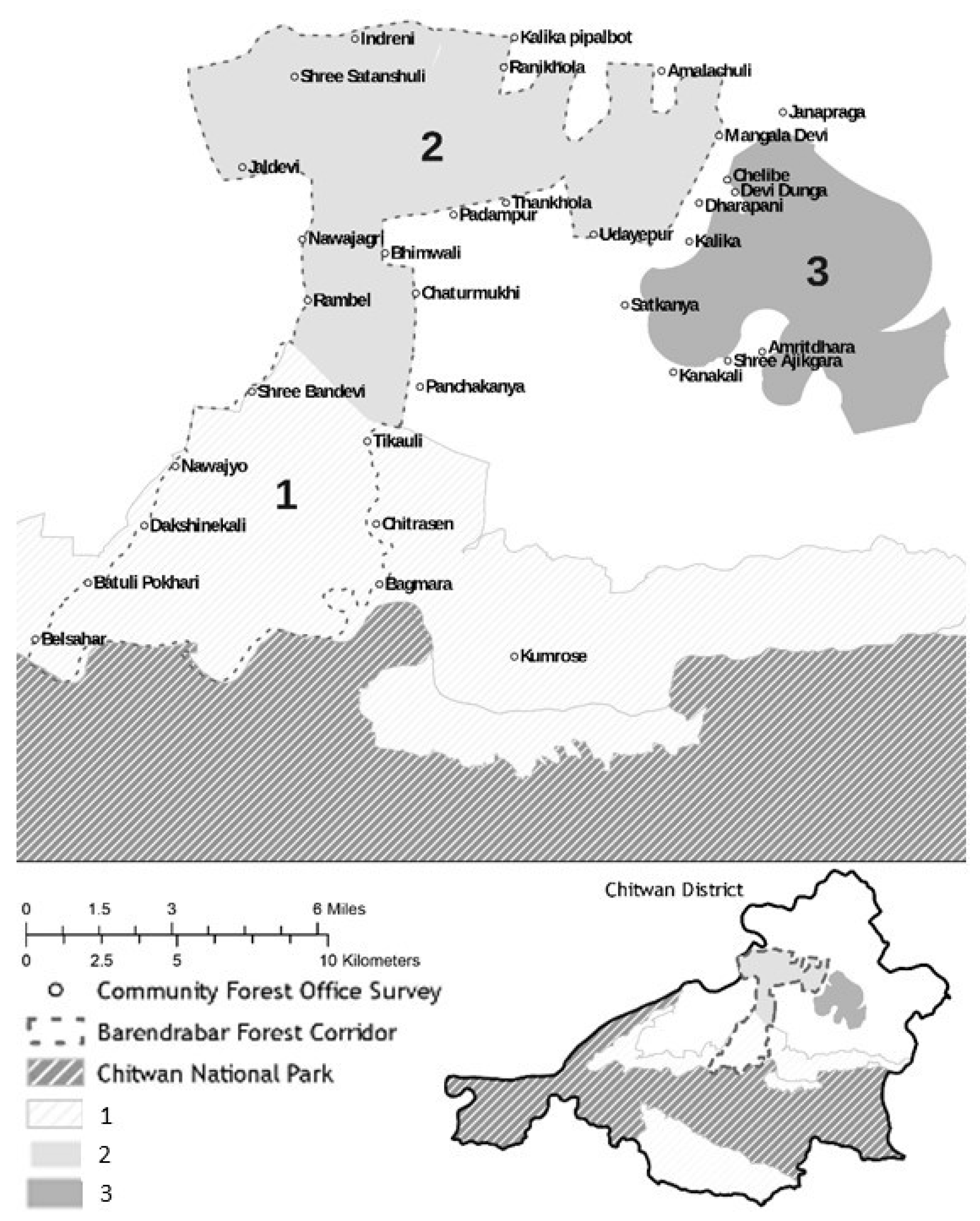
Chitwan District is located in the mid-western region of Nepal. We were able to sample 33 CFs within three zones (Figure 1). Zone 1 covers the buffer-zone community forests managed by the Department of National Parks and Wildlife Conservation, mainly within the Barandabhar Forest Corridor and Tiger Rhino Conservation Area (n = 9). Zone 2 covers community forests within the northern area of the Barandabhar Forest Corridor and Tiger Rhino Conservation Area managed by the Department of Forestry, which is entirely outside of the buffer zone (n = 14). Zone 3 is community forest managed solely by the Department of Forestry (n = 10), outside of the buffer zone and Barandabhar Forest Corridor (Appendix A Table A1). The forests are primarily sal (Shorea robustea) and mixed sal forests.
Figure 1.
Map showing the location of the three zones (Zone 1: buffer zone, Zone 2: forest corridor, and Zone 3: community forest) within our study area near the Chitwan National Park.
Chitwan National Park (CNP) covers an area of about 932 km2, making it one of the largest national parks in Asia. It was declared a UNESCO World Heritage Site in 1984 due to its outstanding biodiversity and cultural significance. The Chitwan District Buffer Zone is a protected area of around 750 km2 in the northern part of Chitwan National Park. The buffer zone protects the area’s natural resources from unwanted encroachment and encourages environmentally friendly and culturally respectful tourism. A substantial portion of the CNP’s park revenue is allocated to the buffer-zone communities and user groups [44]. The buffer zone also allows the local communities to benefit from community forestry, providing employment and income for local people. In this study, we evaluated a 66 km2 section of the Baghmara buffer zone (Zone 1), which is located in the northern portion of the CNP buffer zone.
The Barandabhar Forest Corridor is a 161 km2 forested area between the Chitwan National Park buffer zone and the Mahabharata mountain range. Since the 1950s, the area had been subjected to widespread deforestation, rapid population growth, and unprecedented development pressure. The Barandabhar forest corridor includes part of the CNP buffer zone (Zone 1) and a large area north of the buffer zone that we designate as Zone 2 (a 91 km2 subset of the forest corridor that is outside of the buffer zone). This area was designated as a Tiger Rhino Conservation Area by the National Trust for Nature Conservation, which was funded by the Global Environment Facility and supported by the United Nations Development Programme [42]. Animals of several endangered species, such as the Bengal tiger (Panthera Tigris) and the one-horned rhinoceros (Rhinoceros unicornus), inhabit the study area.
The final zone of our study was outside of the Baghmara buffer zone and the Barandabhar Forest Corridor, a separate CF area (Zone 3) is a 55 km2 area and was a former recipient of Reducing Emissions from Deforestation and Forest Degradation (REDD+) funding. The REDD+ program was started by the United Nations Framework Convention on Climate Change in an area called the Kayer Khola watershed. In the watershed, CF offices were formerly paid from 2006–2014 for REDD+ payments for ecosystem services to halt forest degradation and improve carbon stocks [34,45,46,47,48]. Several CFUGs received seed grants to launch and implement pilot projects in exchange for reducing deforestation and forest degradation. This was funded by the Government of Norway and supported by three influential non-governmental organizations (NGOs)—the International Centre for Integrated Mountain Development (ICIMOD), the Asia Network for Sustainable Agriculture and Bioresources (ANSAB), and the Federation of Community Forestry Users, Nepal [44].
These three zones, which encompass CFs under different management structures and funding sources, were included in our study to identify potential reasons that would affect the timber income and forest-regeneration expenditures, which would be significant indicators of meeting biological- and socioeconomic-sustainability goals. We also wanted to see how the timber income and forest-regeneration spending may differ between these management zones and whether there were significant differences in their perceptions of meeting sustainability objectives.
2.3. Questionnaire Design and Survey Administration
As stated earlier, the goal of this study was to assess whether and how CF income affects social and environmental sustainability—particularly whether and how forest-regeneration expenditures may be linked to CF income. Our methods are based on the evaluation criteria Standardized Protocol for Evaluating Community Conservation Success (SPECC), incorporating a comprehensive analysis of socioeconomic and biological benefits and resilience [40]. These evaluation criteria were reworded, and supplementary questions were added to address forest regeneration, organizational involvement, member benefits, and desired outcomes that were specific to our research questions and focused on community forestry. Local researchers developed a set of locally identified indicators and criteria to assess sustainable CF management, which were also considered to meet our goals [49]. During our SPECC interviews, we asked broad exploratory questions to comprehend the effects of forest management on member benefits and outcomes, outside organizations collaborating with the CF, socioecological perceptions, financial arrangements, and forest-product extraction.
Fieldwork took place from April to June 2022 and involved interviewing the CF offices (Appendix A Table A1), which were interviewed with 22 questions. The questions sought information about timber income, forest-regeneration finances, and socioecological perceptions in four main categories: biological benefits, biological resilience, socioeconomic benefits, and socioeconomic resilience, as well as linkages among socioeconomic and biological factors (Appendix A Table A2: questions and Appendix A Table A3: responses). Interviews were conducted with the local administrative staff and took roughly one hour to complete.
2.4. Analysis
The Kruskal–Wallis rank-sum test was used to analyze potential differences in each zone (Zone 1, Zone 2, Zone 3), different levels of timber income (low, medium, high), and forest regeneration (low, medium, high). This test does not require assumptions regarding the normal distribution of the data and, thus, was appropriate for this research. Bar graphs were used to show how perceptions of sustainability differ between zones, varying levels of forest-regeneration spending, and timber income.
In our study, 33 CFs from three separate zones were located within our study area (Zone 1: buffer zone, Zone 2: forest corridor, Zone 3: community forest). The CF office administrative groups reported their income from timber and the amount spent on forest regeneration, which were grouped into three groups (low, medium, and high) for analysis. Forest-regeneration spending was grouped into three bins within increments of NPR 150,000, which also divided the CFUG observations relatively evenly into “low” (NPR 0–150,000, 14 CFUGs), “medium” (NPR 150,000–300,000, 7 CFUGs), and “high” (NPR 300,000–2,625,000, 10 CFUGs). Timber income was grouped into three bins with increments of NPR ~1,000,000, seeking to divide the CFUG observations relatively evenly into “low” (NPR 80,000–1,200,000, 14 CFUGs), “medium” (NPR 1,200,000–2,000,000, 10 CFUGs), and ”high” (NPR 2,000,000–14,300,000, 9 CFUGs). The Kruskal–Wallis test was performed using the stats package in the R program.
3. Results
Within our study area, 33 CF offices were examined, and the responses to our questions ranged widely (Table 1). The CFUGs were formed between 1983 and 2011 with an average of ~1200 households (Zone 1: buffer zone, 1385; Zone 2: forest corridor, 1502; Zone 3: CF zone, 599). Responses to questions about perceptions were ranked with a Likert scale (1–4) (Appendix A Table A3); other responses mainly consisted of only two responses and were simplified from a Likert scale to binary (0, 1).
Table 1.
Distribution of data among the variables in the analysis.
When the CF offices were asked about the services and benefits, they offer to their members, they revealed that all or most of them offer alternative livelihoods (n = 33), paid employees (n = 30), environmental knowledge (n = 29), and funding (n = 26) (Table 2).
Table 2.
Community forests indicated that they offer various services to their members.
The CF offices identified an improved environment (n = 31) and increased family self-sufficiency (n = 31) as the primary outcomes they would like to see for their members (Table 3). Over half of the CF offices reported additional noteworthy benefits, such as better adult opportunities (education, training, and livelihood) (n = 25), community support (n = 23), public awareness (n = 23), and improved opportunities for children (n = 19).
Table 3.
The reported outcomes that the community forest wants to see for its members.
Within the three separate zones of our programs, over 90% of the CF offices indicated that they had received funding from a conservation program. Four NGOs operate in the area, including the World Wildlife Fund (WWF), The National Trust for Nature Conservation (NTNC), the Federation of Community Forestry Users Nepal (FECOFUN), and The International Center for Integrated Mountain Development (ICIMOD) (Table 4). Several local government offices provided conservation efforts related to funding for the CF offices, mainly within our study’s Zone 2: forest corridor zone. The local funding sources include the District Division Forest office, Municipal office, Bharatpur Metropolitan office, Chitwan Province office, and Barandabhar committee.
Table 4.
Community-forest offices in collaboration with local government offices and various NGOs within the three zones of our study area. Table values represent the number of community forests that collaborated with each group.
The NGOs in the study area mainly operate programs targeting conservation education, climate-change education, biogas-plant installation, training workshops for women’s empowerment, briquette-making training, and animal-husbandry loans (Table 5).
Table 5.
Projects that local NGOs have developed.
We explored how CF sustainability might vary across the zones because previous research highlighted an inconsistency between CFUGs. Characteristics might also vary by the amount of spending each CF carried out on regeneration activities and the CF’s timber income. The Kruskal–Wallis rank-sum test results for zone, timber income, and forest-regeneration spending revealed information about the complex dynamics of socioecological perceptions on CF management (Table 6).
Table 6.
Results for the zone, timber income, and regeneration spending of the Kruskal–Wallis rank-sum test. Bold indicates significant p-values and underline indicates marginally significant p-values at the α = 0.05 level.
3.1. Zones
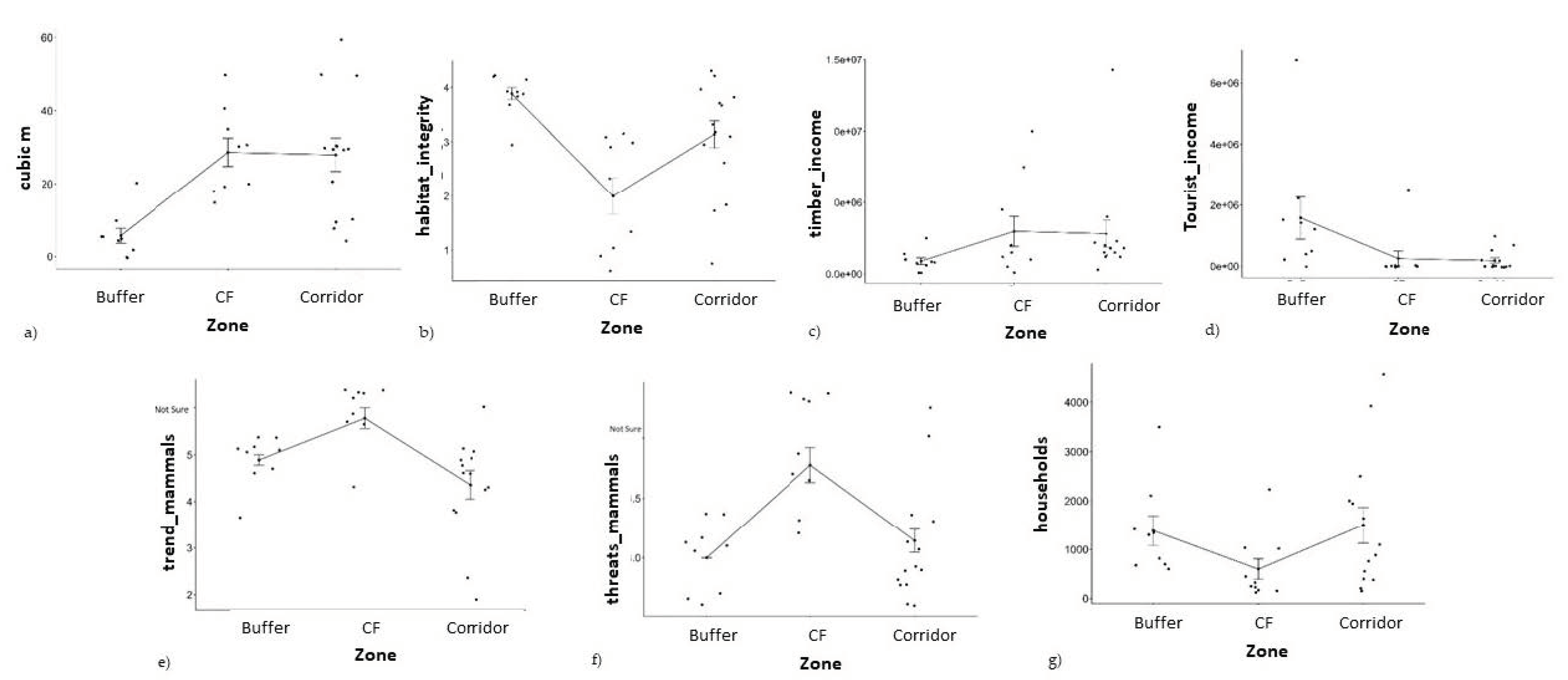
There were significant differences in the number of households, extraction rules, and finances between the different zones (Table 6, Figure 2). In the comparative analysis of the zones, Zone 1: buffer zone had the lowest timber income, Zone 3: CF had a medium level, and Zone 2: forest corridor had the highest average mean timber income. The CFUG community members were not permitted to take as much timber out of Zone 1 for building purposes, and the CF offices extracted a lower timber income but a significantly higher income from tourism.
Figure 2.
The plotted results from the significant variables from the Kruskal-Wallace rank sum test for Zone, including 95% confidence intervals, (a) allowable cubic meters of wood extracted by members, (b) habitat integrity/diversity, (c) timber income, (d) tourist income, (e) trend in mammals, (f) trend in threats, (g) number of households.
Zone 1 generally reported high biological diversity, whereas Zone 3 had a lower perceived level of diversity and an overall perceived lack of rare, vulnerable, or functionally diverse species. As a result, the perception of habitat integrity was significantly different between the two zones. Additionally, Zone 1 and Zone 2 reported stable or increasing mammal populations and a reduction in the severity of threats to mammals. In contrast, Zone 3 reported a lack of knowledge regarding the trend of mammal populations and threats to mammal populations. Finally, Zone 2 was shown to have slightly more organizations involved in the CFUGs, mainly from government involvement (p = 0.062), when compared to the other two zones.
3.2. CFUG Income and Expenditures
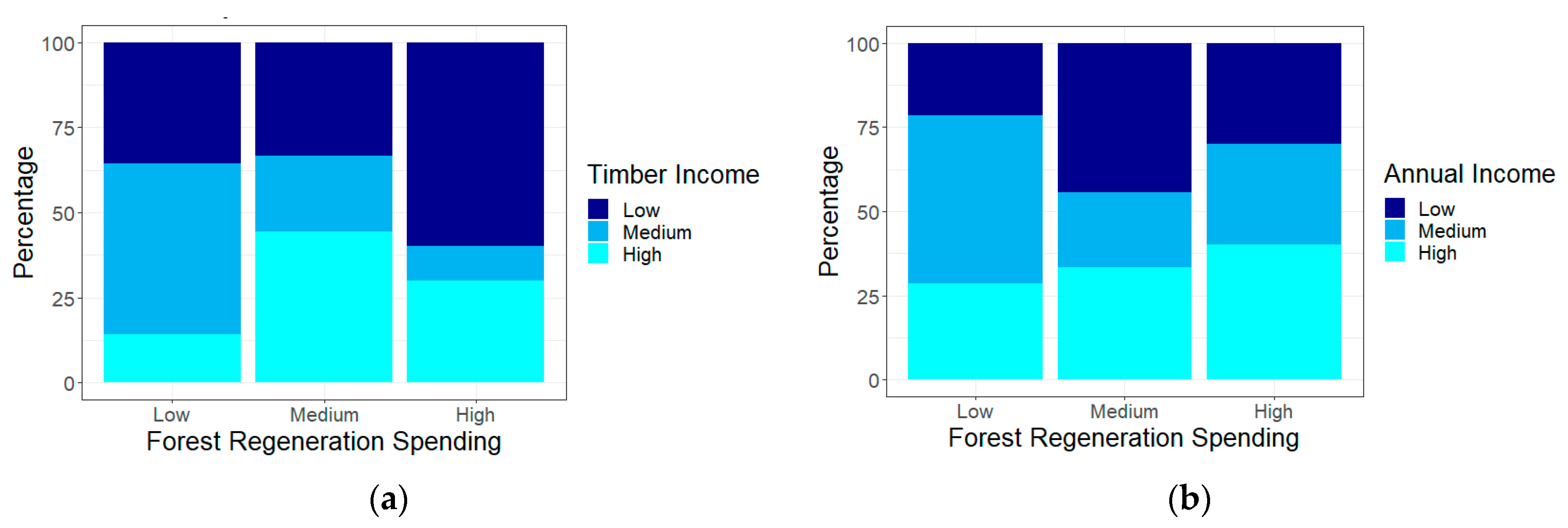
Timber income was the most prominent income source for the CFUGs, which accounted for 78% of the annual income for our sample of 33 CFUGs. Tourism was also a prominent income source, comprising 15% of income sources. Our data showed that the CFs were spending around 15% of their total annual income (timber, tourism, and other sources combined) on forest regeneration. There was a significant difference in areas of forest-regeneration expenditure in areas with different levels of total annual income (p-value of 0.01293) (Figure 3). The forest-regeneration expenditures did not differ significantly between zones, but they did differ significantly between communities with different timber incomes (Table 6). This pattern may be explained by the fact that many CFs earn more money from tourism than from timber sales, as in Zone 1. Although a significant portion of CFs with low spending on forest regeneration also had low income, nearly 25% of areas with medium and high spending on forest regeneration came from regions with low timber income. Similarly, 25% of areas with low spending on forest regeneration came from forests earning high income from forest products. CFs that earn money from timber did not necessarily spend on forest regeneration. However, there are instances where CFs earn a significant amount of money from timber annually but only spend a small amount on forest regeneration. Previous studies have noted that wood is generally first sold to CFUG members, and then if there is a surplus it is sold to external users and markets; that some CFUGs are only able to fulfill their internal demand; and that the annual income is reduced by selling materials at a reduced price to their members compared to market prices [8].
Figure 3.
The proportion of community forests with (a) timber income and (b) annual income within the three categories of high, medium, and low spending on forest regeneration.
3.3. Timber Income
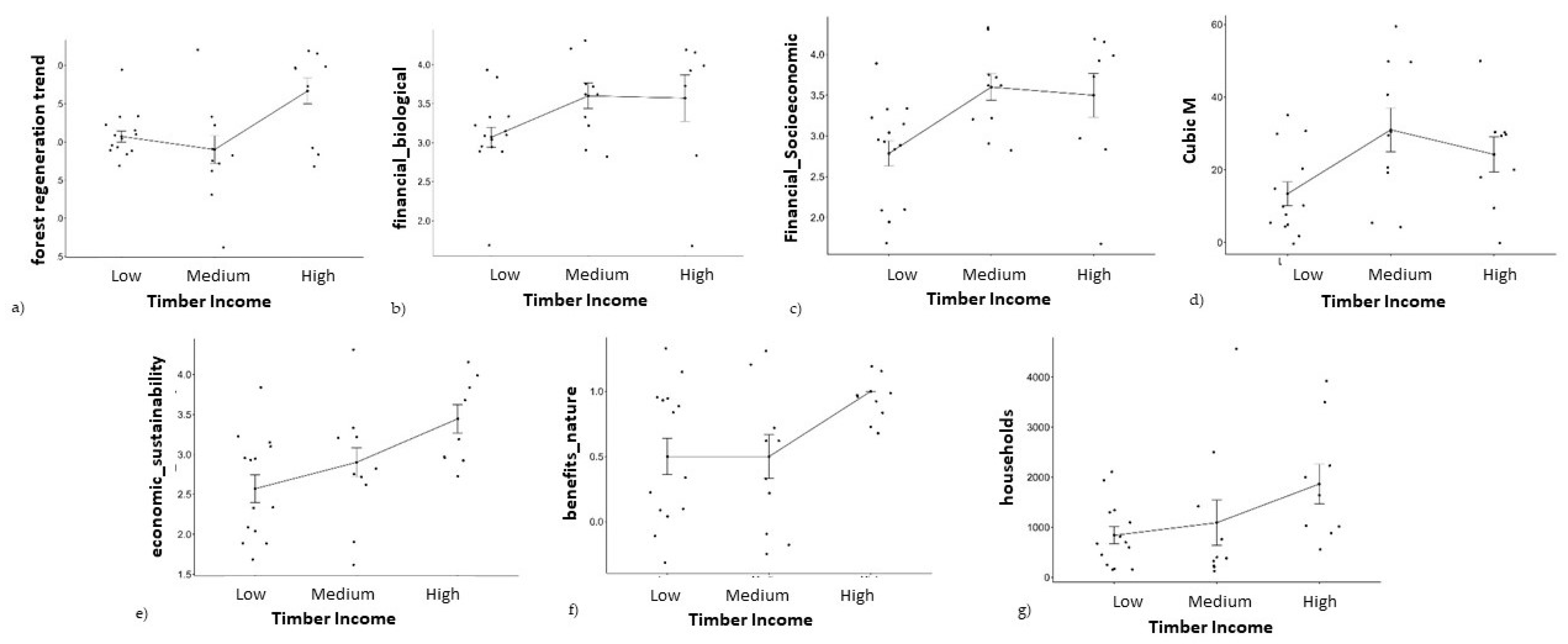
Comparing areas by timber income showed that high timber-income areas had significantly more households enrolled than low timber-income areas (Table 6, Figure 4). Low timber-income areas, with fewer households, resulted in significantly insufficient financial means to enforce the community’s forest-management rules and regulations to meet biological and socioeconomic objectives and poorer economic sustainability overall. Low timber-income areas also had insufficient funds to cover half of their expenses, and their short-lived income sources were unlikely to meet the residents’ needs within the next three years. A large proportion of CFs with low timber income also reported that they were unaware of the local mammal-population trend and thought there were low benefits to birds, small mammals, insects, and mammal populations compared to perceptions from higher-income areas. Although many of these low timber-income CFs reported an increasing number of large mammals, there was no significant difference from other CFs that mainly reported a stable number of large mammals. As a result, regions with lower timber income had less ability to support the biological or socioeconomic capacities of their CFs.
Figure 4.
The plotted results from the significant variables from the Kruskal-Wallace rank sum test for timber income, including 95% confidence intervals, (a) forest regeneration trend, (b) having the financial resources for biological rules and regulations, (c) having the financial resources to meet the socio-economic rules and regulations, (d) cubic meters of wood members are allowed to take from the forest, (e) having economic sustainability, (f) benefit to nature beyond large mammals, (g) number of households.
3.4. Forest-Regeneration Spending
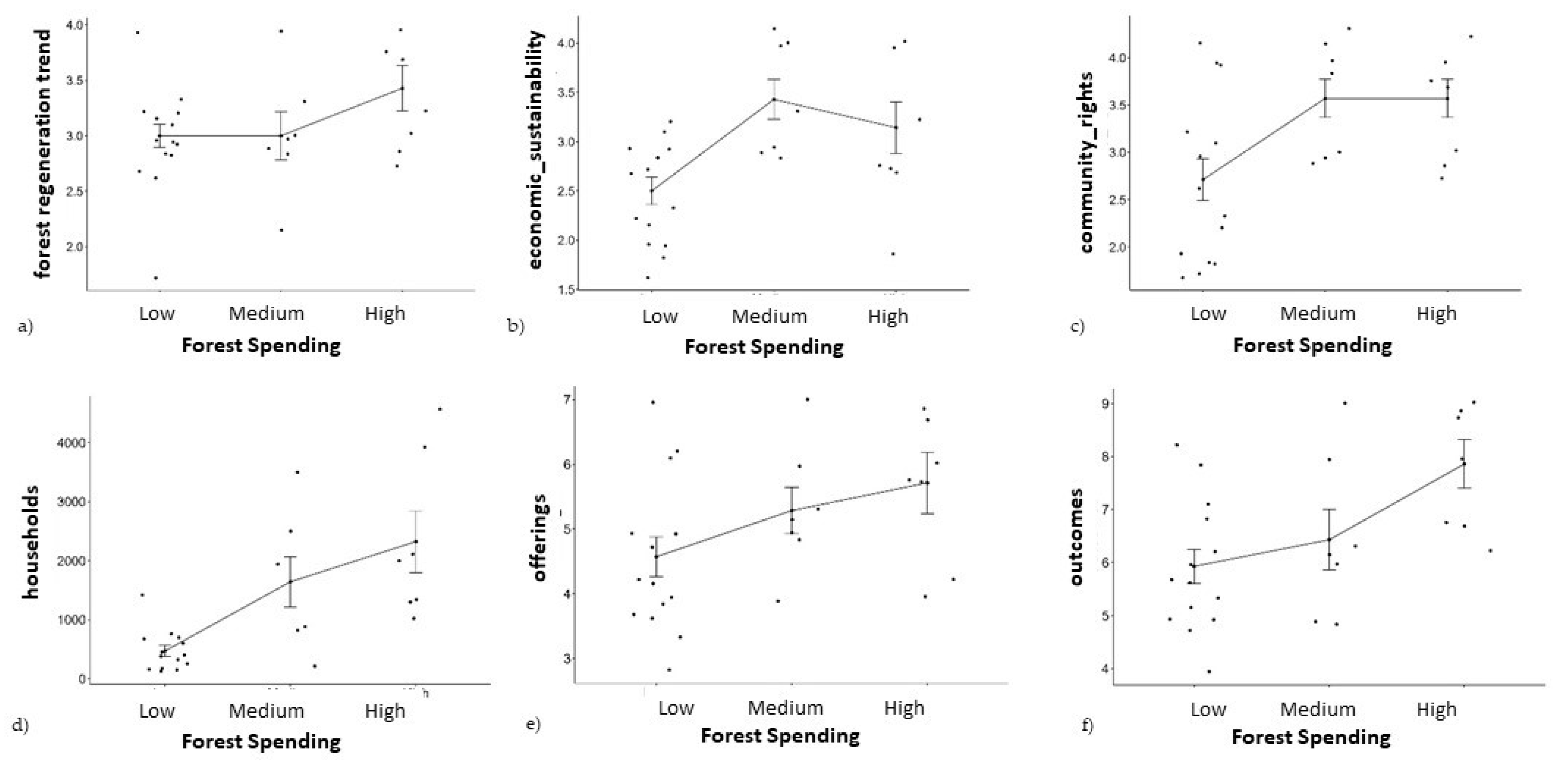
CFs with lower levels of forest-regeneration spending were also shown to perceive lower levels of forest regeneration (Table 6, Figure 5). With short-lived income sources and more than half of the CFUG needs unmet, the areas with lower spending on forest regeneration were thought to lack economic sustainability. These CFUGs also expressed more significant levels of long-term uncertainty about community empowerment or about having it only in theory or on paper and had far fewer households involved as members. Consequently, the areas with low amounts of forest-regeneration expenditure were associated with fewer member benefits overall, and there was a significant difference in the number of outcomes.
Figure 5.
The plotted results from the significant variables from the Kruskal-Wallace rank sum test for forest regeneration spending, including 95% confidence intervals, (a) forest regeneration trends, (b) economic sustainability, (c) community empowerment and land tenure rights, (d) number of households, (e) member benefits, (f) number of outcomes.
4. Discussion
CF projects aim to preserve biological diversity, promote sustainable forest-resource management, and create economic possibilities for rural communities. Nevertheless, standardized evaluations and assessments that link income and expenditures related to forest products to socioecological sustainability outcomes are lacking. Our analysis of the CF system in the Chitwan district, which is well known for long-term conservation successes [50,51,52,53], found significant differences in perceptions of biological and socioeconomic benefits and resilience between the three distinct zones of the Chitwan district, as well as between CFs with varying levels of timber income and forest-regeneration expenditures. In line with previous studies that have attempted to standardize the evaluation of community-based conservation (SPECC) [40], we attempted to couple the SPECC evaluation with information on funding and expenditures to learn how these views differ based on financial factors critical to the success of the programs. These surveys allowed us to establish a general relationship between diminished perceptions of financial and biological stability in local communities and decreased timber income and forest-regeneration expenditures. Overall, meeting the biological and socioeconomic goals of the CFs was often perceived to be unrealistic in situations with low timber income. Similarly, areas with low forest-regeneration spending were also found not to perceive long-term economic sustainability or forest regeneration. The results of cascading forest-management policies and regulations can have a direct impact on the sustainability of CFs in cases where their income is low and they have no external sources of income, where taxation reforms or benefit-sharing mechanisms among CFs may result in raising the sustainability standards across the CFs within the district.
Since our study site included CFs under zones with various management structures, we sought to determine whether these management designations (Zone 1: buffer zone, Zone 2: forest corridor, or Zone 3: CF) may lead to significant differences among CFs. From these results, we can see that the CFs located in Zones 1 and 2 (both in the Barandrabar Forest Corridor) contributed to higher perceived habitat integrity and more knowledge of the status of mammals compared to the zone outside of the corridor (Zone 3: CF). This is possibly due to the higher awareness of and the general focus on wildlife-conservation goals in these areas. As discussed previously, the forest corridor was established to enhance migrations of animals such as the Bengal tiger and the one-horned rhinoceros, both endangered species of great concern nationally and internationally. Zone 3, on the contrary, is not frequented by these species, and the environmental goals are aimed more toward reforestation and overall biodiversity.
Areas that had low timber income were perceived to have a lack of biological and socioeconomic resilience. The lower resilience was indicated by responses of having insufficient financial resources to enforce rules and regulations to meet both biological and socioeconomic objectives and having instability in terms of economic self-sufficiency with many short-lived income sources and no external funding. In these CFUGs, the forest-regeneration trend was generally perceived as lower, and there were fewer perceived benefits to birds, small mammals, and insects. Additionally, areas with low timber income also had more rules where the members were permitted less wood from the forest for construction purposes.
Our study did not attempt to dissect the causes of low timber income relative to other community forests in the study but sought to clearly understand how low timber income may be associated with perceptions about biological and socioeconomic factors. Previous studies have suggested that the CFUG forest-management plan may lead to a lack of resources and, thus, low economic benefits for CFUGs. However, often the forest management plan is a response to deforestation and climate change, where policies emphasizing forest protection and restoration caused nearby communities’ traditional use of forests to be more heavily managed by the DFO where there are constraints on the capacity of the CFUG [54]. Although studies have highlighted that highly restrictive resource-extraction restrictions prevent CFUGs from fully capitalizing on forest resources according to sustainable forest-management principles or reaching production efficiency [8]. Other studies also expressed this sentiment, claiming excessive collection restriction and underutilization of overstocked woodland, which contributes to little regeneration, poorly planned silviculture, and a lack of knowledge about forest management [15]. While evaluating the need for CFUGs, whose primary source of income is forest products, to increase their income and increase their investment in pro-poor projects, the risk of overharvesting forests or sacrificing old-growth conservation areas must be taken into consideration [10]. Another study that looked into these discrepancies found that the DFO inventory guidelines are not very scientific, lead to frequently fabricated results, and significantly impact the centralization of management over CFs by forest bureaucracy [43]. Furthermore, financial accounting and record keeping had generally low technical efficiency. The top-down governance of the CFs can cause discrepancies between community needs and government-implemented rules. This is especially true for CFs in Zone 2 and Zone 3 that cannot rely on tourism, the other major income source for most CFUGs.
Our research showed that regions with lower spending levels on forest regeneration were perceived to have significantly lower levels, on average, of economic resilience and forest-regeneration trends. The CFs, on average, were not spending a standardized amount on forest regeneration, as recommended by various governmental guidelines. Our study suggests that the inequality in annual income and, thus, forest-regeneration spending may be related to disparities in resilience and generating socioeconomic benefits for members, although we cannot make causal claims. Previous studies have highlighted the intra-CFUG power disparities between elite members of the communities and poorer households [15,32,33]. In our study, we found a significant disparity among CFUG organizations within the same district. Since there is no adequate taxation through district- or provincial-level pooling or redistribution of CF resources, our study revealed that can be a significant disparity in member benefits, and the perceptions of biological benefits and resilience, and socioeconomic resilience between CFUGs.
There were similar levels of NGO and governmental-organization involvement in CFs regardless of timber income and regeneration expenditures. More governmental organizations were involved in the Zone 2 area, mainly from the municipality and district forest offices. This analysis revealed CFs with revenue and expense gaps, which may encourage local governments and outside stakeholders to direct their support to CFs unable to meet their current needs. Current taxation systems may supplement the CFUGs’ inability to enforce socioeconomic and biological rules or have safety nets to ensure long-term economic sustainability. In the future, researchers may look at how single community-based forest offices may be governed by more than one province, municipality, or rural municipality to learn more about how CFs set boundaries and share resources. It remains unclear how municipal, provincial, and federal governments, along with CFUGs, would divide CF resources, forest-management costs, and CF-generated benefits.
Furthermore, little is known regarding the financial effects of CF, advantages received by different households, and overall income generated and distributed [16]. Previous studies on community-development funding have found that high-income CFUGs primarily funded public services and infrastructure and that funding of public services was minuscule compared to private gains to member households [19]. Since we found a wide range in income and expenditures among CFs, future studies may seek to understand more details about the division of income from the timber-income sources and how that income may be supplemented by NGO and governmental organizations or redistributed through taxation systems.
5. Conclusions
In developing countries, deforestation has been a significant cause of poverty in rural areas, and the unsustainable management of forested areas has led to significant damage to biodiversity and wildlife. Although forest management involves the integration of economic and environmental considerations, the implementation of sustainable forest-management practices is a complex challenge facing governments around the world. In recent years, many governments have established regulatory frameworks to reduce the negative impacts of forest exploitation while promoting economic development and environmental conservation through CF programs. In Nepal’s Terai landscape of Chitwan, evidence of the financing potential of community forestry to meet socioeconomic and biological goals was uncovered through an exploratory analysis of the income and forest-expenditure patterns of 33 randomly sampled CFUGs. This analysis revealed significant inequalities in income, benefits, outcomes, forest-regeneration spending, and perceptions towards socioeconomic and biological benefits and resilience among CFs in the three distinct zones of the Chitwan district, levels of timber income (low, medium, and high), and levels of forest-regeneration spending (low, medium, high). The analysis uncovered revenue and expense gaps in CFs, which may encourage local governments and external stakeholders to direct their future efforts toward tax-reform programs. This research indicates that a lack of financial resources may prevent some CFUGs from implementing a sustainable forest-management plan. Our research indicates that disparities in timber income and, consequently, expenditures on forest regeneration may be linked to differences in members’ resilience and socioeconomic benefits. In this context, governments and local communities are increasingly looking for more sustainable ways to manage the forests on their territories and maximize the economic benefits of their forest resources while minimizing these operations’ social and environmental impacts. This study demonstrates that CF timber sales and forest-regeneration spending have cascading impacts on long-term economic sustainability, the ability to meet financial objectives, and perceptions of socioeconomic and biological resilience, which requires careful consideration for implementing CF programs.
Author Contributions
Conceptualization, E.B.; methodology, E.B., S.Y., Y.T.L. and L.A.; formal analysis, E.B.; investigation, S.L.; writing—original draft preparation, E.B.; writing—review and editing, Y.T.L., K.F., S.M., B.A. and D.S.D.; supervision, L.A.; funding acquisition, L.A. All authors have read and agreed to the published version of the manuscript.
Funding
The National Science Foundation funded this research under the Dynamics of Coupled Natural and Human Systems program (BCS-1826839). This research also received financial and research support from San Diego State University.
Institutional Review Board Statement
The study was conducted in accordance with the Declaration of Helsinki and provided exempt verification by the Institutional Review Board of San Diego State University (protocol code HS-2022-0034 and 4/22/22).
Informed Consent Statement
Informed consent was obtained from all subjects involved in the study.
Data Availability Statement
Data are available upon reasonable request.
Acknowledgments
We are grateful to the National Trust for Resource Conservation Chitwan Nepal for assisting with the logistics of this study.
Conflicts of Interest
The authors declare no conflict of interest.
Appendix A
Table A1.
Names of the community forests surveyed in our study.
Table A1.
Names of the community forests surveyed in our study.
| Community Forest | Zone |
|---|---|
| Kumrose | Zone 1: buffer zone |
| Bagmara | Zone 1: buffer zone |
| Chitrasen | Zone 1: buffer zone |
| Shree Bandevi Buffer Zone | Zone 1: buffer zone |
| Nawajyoti | Zone 1: buffer zone |
| Dakshinekali | Zone 1: buffer zone |
| Batuli Pokhari | Zone 1: buffer zone |
| Belsahar | Zone 1: buffer zone |
| Tikauli | Zone 1: buffer zone |
| Shree Ajikgare | Zone 3: CF |
| Amritdhara | Zone 3: CF |
| Janapragati | Zone 3: CF |
| Dharapani | Zone 3: CF |
| Kalika | Zone 3: CF |
| Devi Dunga | Zone 3: CF |
| Chelibeti | Zone 3: CF |
| Satkanya | Zone 3: CF |
| Kanakali | Zone 3: CF |
| Mangala Devi | Zone 3: CF |
| Bhimwali | Zone 2: forest corridor |
| Udayepur | Zone 2: forest corridor |
| Jaldevi | Zone 2: forest corridor |
| Shree Satanshuli | Zone 2: forest corridor |
| Rambel | Zone 2: forest corridor |
| Nawajagriti | Zone 2: forest corridor |
| Thankhola | Zone 2: forest corridor |
| Padampur | Zone 2: forest corridor |
| Chaturmukhi | Zone 2: forest corridor |
| Panchkanya | Zone 2: forest corridor |
| Ranikhola | Zone 2: forest corridor |
| Kalika Pipalbot | Zone 2: forest corridor |
| Amalachuli | Zone 2: forest corridor |
| Indreni | Zone 2: forest corridor |
Table A2.
Questions that were used in the survey of CFUGs related to member benefits, outcomes, organizations, extraction rules, biological benefits, biological resilience, socioeconomic benefits, socioeconomic resilience, and linkage mechanisms.
Table A2.
Questions that were used in the survey of CFUGs related to member benefits, outcomes, organizations, extraction rules, biological benefits, biological resilience, socioeconomic benefits, socioeconomic resilience, and linkage mechanisms.
| Survey Questions | |
|---|---|
| Member Benefits and Outcomes | |
| member_benefits | What does the community-forest program offer its members? |
| outcomes | What outcomes would the community-forest program like to see for its members? |
| Projects and Organizations | |
| projects | Which projects have been completed under this program? |
| NGO_orgs | Which organizations does the community work with? |
| government_orgs | Does the community work with any other organizations? |
| total_orgs | Total number of organizations (NGO_orgs and government_orgs) |
| Extraction Rules | |
| firewood_collection | Approximately how many times are members allowed to go into the forest and collect firewood? |
| timber_collection | How many cubic meters (or another appropriate unit) of wood for construction is the community allowed to harvest from the forest? |
| Community-Forest Finance | |
| timber_income | Approximately how much income per year is generated for the community-forest office from timber sales? |
| tourist_income | Roughly how much income per year is derived from tourist activities in the community forest? |
| forestregeneration_spending | How much funding is allocated for forest-regeneration activities? |
| Biological Benefits | |
| benefits_nature | Are there any benefits to nature beyond the protection of large iconic mammals? |
| habitat_quality | How degraded is the habitat and what is the habitat-quality trend, indicated by native-vegetation cover, biotic and hydrologic integrity, degree of human modification, and percentage of invasive species? |
| trend_mammals | What is the trend of mammals in the zone in terms of population? |
| Biological Resilience | |
| forest_regeneration | What is the trend of forest regeneration the zone? |
| habitat_integrity | How diverse is the habitat’s wildlife species? |
| connectivity | What is the connectivity or viability the habitat for biodiversity? |
| finance_biological | Does the community have the necessary financial resources to enforce the rules and regulations required to achieve biological goals? |
| threats_mammals | What is the trend of threats to mammals in the zone? |
| Socioeconomic Benefits | |
| cultural_diversity | Has the project acknowledged, respected, and supported unique cultural diversity within the area since its initiation or in the previous five to 10 years? |
| capacity_building | In the last five years, has the zone increased capacity among members of the community, e.g., via education, training, provision of advanced tools, or technology, establishing decision-making or problem-solving processes? |
| Socioeconomic Resilience | |
| community_rights | How empowered is the local community in terms of legal recognition of land-title and resource-management powers? |
| benefit_equitability | How are the benefits of the zone distributed across the project area’s population? |
| social_capital | Is there sufficient personnel to effectively explore, acknowledge, and mitigate vulnerabilities, and how well are challenges resolved when they occur? |
| finance_socioeconomic | Does the community have the necessary financial resources to enforce the rules and regulations required to achieve socioeconomic goals? |
| economic_sustainability | How dependent is the zone on external financial support in the short and long term? |
| Linkage Mechanisms | |
| interdependence | Do the local communities perceive that socioeconomic and biological benefits are interdependent? |
| invest_conservation | Are the socioeconomic gains (monetary profit, time, or knowledge gains) derived from the project invested in conservation, for example by increasing protective measures or the area under protection? |
| ecological_awareness | How knowledgeable are local people or communities about their natural environment and the importance of conservation? |
Table A3.
Options for answering survey questions, much like a Likert scale but tailored to each type of inquiry.
Table A3.
Options for answering survey questions, much like a Likert scale but tailored to each type of inquiry.
| Member Benefits, Outcomes, and Organizations | |
|---|---|
| member_benefits | |
| Funding | |
| In-kind resources | |
| Paid staff | |
| Volunteer and volunteer staff | |
| Data resources | |
| Info/feedback | |
| Expertise about the environment | |
| Community connections | |
| Facilitation/ leadership | |
| Advocacy | |
| Alternative-livelihood programs | |
| outcomes | |
| Improved environment | |
| Improved resource sharing | |
| Increased knowledge sharing | |
| New sources of data | |
| Community support | |
| Public awareness | |
| Policy, law, and/or regulation | |
| Improved environmental outcomes | |
| Improved communication among members | |
| Improved opportunities for adults (education, trainings, livelihood) | |
| Improved opportunities for teenagers (education, trainings, livelihood) | |
| Improved opportunities for children (education) | |
| Improved communication with agencies and organizations concerned with the community | |
| Increased family economic self-sufficiency | |
| Additional coordination and referral for other community resources | |
| NGO_orgs | |
| World Wildlife Fund (WWF) | |
| The National Trust for Nature Conservation (NTNC) | |
| Federation of Community Forestry Users Nepal (FECOFUN) | |
| The International Center for Integrated Mountain Development (ICIMOD) | |
| Asian Network for Sustainable Agricultural and Bioresources (ANSAB) | |
| Other | |
| projects | |
| Biogas-plant installation | |
| Training workshop for women’s empowerment | |
| Conservation education | |
| Climate-change education | |
| Briquette-making training | |
| Animal-husbandry loans | |
| Other | |
| Community Forest Finance | |
| timber_income | Reported annual timber income from the office |
| tourist_income | Reported annual tourist income from the office |
| forest_regenerationspending | Reported annual forest-regeneration spending from the office |
| Extraction Rules | |
| firewood_collection | How many days of the year the community is able to collect firewood |
| timber_collection | How much wood in cubic m the members are able to harvest annually |
| Biological Benefits | |
| benefits_nature | |
| 1 | Harmful effects on birds, insects, or small mammals |
| 2 | No benefits to nature beyond large mammals (no benefits for birds, insects, or small mammals) |
| 3 | Weak or few beneficial effects to birds, insects, or small mammals |
| 4 | Strong or many benefits for birds, small mammals, or insects |
| 5 | I do not know |
| habitat_quality | |
| 1 | More than half of the habitat is degraded and not improving. |
| 2 | Less than half of the habitat is degraded and not improving. |
| 3 | Half of the habitat is degraded but improving. |
| 4 | Some of the habitat is degraded and stable or improving. |
| 5 | I do not know |
| trend_mammals | |
| 1 | Eliminated from the area previously |
| 2 | Declining severely since last assessment |
| 3 | Declining but less severely than last assessment |
| 4 | Stable |
| 5 | Increasing |
| 6 | I do not know |
| Biological Resilience | |
| forest_regeneration | |
| 1 | Poor |
| 2 | Fair |
| 3 | Good |
| 4 | Excellent |
| 5 | I do not know |
| habitat_integrity | |
| 1 | Minimal diversity |
| 2 | Low diversity and lack specific rare, vulnerable, or functionally unique taxa |
| 3 | Medium diversity, including specific rare, vulnerable, or functionally unique taxa |
| 4 | High diversity |
| 5 | I do not know |
| connectivity | |
| 1 | Habitat is isolated or highly fragmented with immediate threats to survival |
| 2 | Habitat is isolated or highly fragmented and short-term threats to survival |
| 3 | Some connectivity and has some protection |
| 4 | Highly connected over a large area and long-term protection |
| 5 | I do not know |
| finance_biological | |
| 1 | No legal resources to enforce the rules and regulations |
| 2 | Some but insufficient legal resources to enforce the rules and regulations |
| 3 | Sometimes, but not always, has the necessary legal resources to enforce the rules and regulations |
| 4 | The community consistently has the necessary legal resources to enforce the rules and regulations. |
| 5 | I do not know |
| threats_mammals | |
| 1 | The management addresses few potential threats. |
| 2 | The management addresses some potential threats. |
| 3 | The management addresses many potential threats. |
| 4 | The management addresses the vast majority of all potential threats. |
| 5 | I do not know |
| Socioeconomic Benefits | |
| cultural_diversity | |
| 1 | Imposition of external values in disregard for local and/or traditional norms, beliefs, and knowledge |
| 2 | Some but not all aspects of the zone are guided by the local and/or traditional norms, beliefs, and knowledge . |
| 3 | Most but not all aspects of the zone are guided by or compatible with the local and/or traditional norms, beliefs, and knowledge of all locally represented cultures. |
| 4 | All aspects of the zone are guided by or compatible with the local and/or traditional norms, beliefs, and knowledge of all locally represented cultures. |
| 5 | I do not know |
| capacity_building | |
| 1 | No capacity building has occurred. |
| 2 | Some capacity building has occurred but benefits are centered on the select individuals and do not reach the wider zone community. |
| 3 | A lot of capacity-building benefits for some individuals that have received training/education/tools without community-wide benefits |
| 4 | A lot of capacity building with both individual benefits for most and community-wide benefits |
| 5 | I do not know |
| Socioeconomic Resilience | |
| community_rights | |
| 1 | Absence of community empowerment |
| 2 | Community empowerment on paper |
| 3 | Community empowerment but long-term uncertainty |
| 4 | Strong local or community empowerment |
| 5 | I do not know |
| benefit_equitability | |
| 1 | Benefits reach only a select, already-advantaged sub-group of the local community. |
| 2 | Benefits reach only select sub-groups of the local community but not necessarily the most advantaged. |
| 3 | Benefits reach many sub-groups of the local community but not the traditionally disadvantaged. |
| 4 | Benefits reach all sub-groups of the local community, including traditionally disadvantaged groups. |
| 5 | I do not know |
| social_capital | |
| 1 | No acknowledgement of challenges and no or inappropriate response when challenges arise |
| 2 | Awareness and some preventative action, resulting in a failure to minimize damage |
| 3 | Repeated occurrence of responses insufficient to minimize damage |
| 4 | Appropriate, timely, and sufficient actions taken to minimize damage |
| 5 | I do not know |
| finance_socioeconomic | |
| 1 | No financial resources to enforce the rules and regulations |
| 2 | Some but, in most cases, insufficient financial resources to enforce the rules and regulations |
| 3 | Often, but not always, has the necessary financial resources to enforce the rules and regulations |
| 4 | Consistently has the necessary financial resources to enforce the rules and regulations |
| 5 | I do not know |
| economic_sustainability | |
| 1 | Completely dependent on external funding support with all of its financial needs being met externally and no prospect for financial self-sufficiency within the next three years |
| 2 | Less than half of its needs without external funding support and/or financial self-sufficiency is dependent on a short-lived source of income likely to become insufficient within the next three years. |
| 3 | More than half of its needs and/or self-sufficiency is likely to be achieved within the next three years |
| 4 | Enough funds to cover zone expenses and ideally a surplus, and will remain so for the next three years or more |
| 5 | I do not know |
| Linkage Mechanisms | |
| interdependence | |
| 1 | Biological benefits and socioeconomic benefits are not interdependent. |
| 2 | A minority of biological and socioeconomic benefits are linked artificially (e.g., because external technical or financial support for socioeconomic benefits has been made contingent on reaching or maintaining specific biological outcomes). |
| 3 | All biological and socioeconomic benefits are linked artificially. |
| 4 | The majority of biological and socioeconomic benefits are physically linked, with one unable to succeed without the other, e.g., because income generation is dependent on a thriving, healthy environment and successful protection of the target taxon or habitat (e.g., eco-tourism, carbon-credit payments, etc.). |
| 5 | I do not know |
| invest_conservation | |
| 1 | Socioeconomic gains derived from the zone are not being invested in the maintenance or improvement of conservation. |
| 2 | Few socioeconomic gains derived from the zone are being invested in the maintenance or improvement of conservation. |
| 3 | Several socioeconomic gains derived from the zone are being invested in the maintenance or improvement of conservation. |
| 4 | Several socioeconomic gains derived from the zone are being invested in the maintenance or improvement of conservation. |
| 5 | I do not know |
| ecological_awareness | |
| 1 | No understanding about protecting the environment |
| 2 | Some but no thorough understanding, not actively protecting the environment |
| 3 | Some but no thorough understanding, and recognizes the importance of protecting the environment |
| 4 | Knowledgeable about protecting the environment |
| 5 | I do not know |
References
- Charnley, S.; Poe, M.R. Community Forestry in Theory and Practice: Where Are We Now? Annu. Rev. Anthropol. 2007, 36, 301–336. [Google Scholar] [CrossRef]
- Nepal, S.; Spiteri, A. Linking Livelihoods and Conservation: An Examination of Local Residents’ Perceived Linkages between Conservation and Livelihood Benefits around Nepal’s Chitwan National Park. Environ. Manag. 2011, 47, 727–738. [Google Scholar] [CrossRef] [PubMed]
- Maryudi, A.; Devkota, R.R.; Schusser, C.; Yufanyi, C.; Salla, M.; Aurenhammer, H.; Rotchanaphatharawit, R.; Krott, M. Back to Basics: Considerations in Evaluating the Outcomes of Community Forestry. For. Policy Econ. 2012, 14, 1–5. [Google Scholar] [CrossRef]
- Nepal Ministry of Forests and Soil Conservation. Master Plan for the Forestry Sector: Nepal-Summary of the Programmes; Nepal Ministry of Forests and Soil Conservation: Babarmahal, Nepal, 1988. [Google Scholar]
- DoF Nepal. Proceedings of a National Workshop Mainstreaming Biodiversity and Ecosystem Services into Community Forestry in Nepal; Department of Forests: Kathmandu, Nepal, 2016. [Google Scholar]
- Sharma, B.P.; Lawry, S.; Paudel, N.S.; McLain, R.; Adhikary, A.; Banjade, M.R. Operationalizing a Framework for Assessing the Enabling Environment for Community Forest Enterprises: A Case Study from Nepal. Small-Scale For. 2020, 19, 83–106. [Google Scholar] [CrossRef]
- DoF Hamro Ban. Fiscal Year 2016/17. Department of Forests and Soil Conservation: Kathmandu Nepal. Ministry of Forests and Environment 2018. Available online: https://dofsc.gov.np//public/uploads/files/1593881017Hamro%20ban_2073.pdf (accessed on 1 May 2020).
- Acharya, K.; Talpă, N.; Hălălișan, A.F.; Popa, B. The Way Forward for Community Forestry in Nepal: Analysis of Performance against National Forestry Goals. Forests 2022, 13, 726. [Google Scholar] [CrossRef]
- GoN. Community Forestry Program Development Guidelin, 3rd ed.; Community Forest Division, Department of Forest: Kathmandu, Nepal, 2014; Available online: http://d2ouvy59p0dg6k.cloudfront.net/downloads/community_forest_development_directive_2.pdf (accessed on 1 May 2020).
- Pokharel, R.K. Pro-Poor Programs Financed Through Nepal’s Community Forestry Funds: Does Income Matter? Mt. Res. Dev. 2009, 29, 67–74. [Google Scholar] [CrossRef]
- Nirmal, K.; Shrestha, R.K.; Acharya, S.G.; Ansari, A.S. Maoist Conflict, Community Forestry and Livelihoods: Pro-Poor Innovations in Forest Management in Nepal. J. For. Livelihood 2009, 8, 93–100. [Google Scholar] [CrossRef]
- Chhetri, B.B.K.; Johnsen, F.H.; Konoshima, M.; Yoshimoto, A. Community Forestry in the Hills of Nepal: Determinants of User Participation in Forest Management. For. Policy Econ. 2013, 30, 6–13. [Google Scholar] [CrossRef]
- Bhandari, P.K.C.; Bhusal, P.; Paudel, G.; Upadhyaya, C.P.; Khanal Chhetri, B.B. Importance of Community Forestry Funds for Rural Development in Nepal. Resources 2019, 8, 85. [Google Scholar] [CrossRef]
- Lund, J.F.; Baral, K.; Bhandari, N.S.; Chhetri, B.B.K.; Larsen, H.O.; Nielsen, Ø.J.; Puri, L.; Rutt, R.L.; Treue, T. Who Benefits from Taxation of Forest Products in Nepal’s Community Forests? For. Policy Econ. 2014, 38, 119–125. [Google Scholar] [CrossRef]
- Dahal, D.S.; Cao, S. Sustainability Assessment of Community Forestry Practices in Nepal: Literature Review and Recommendations to Improve Community Management. Proc. Natl. Acad. Sci. India Sect. B Biol. Sci. 2017, 87, 1–11. [Google Scholar] [CrossRef]
- Dahal, G.R.; Pokharel, B.K.; Khanal, D.R.; Pokhrel, P.R. Why Does Tenure Security Matter in Community Forestry? A Critical Reflection from Nepal. J. For. Livelihood 2017, 15, 15–26. [Google Scholar] [CrossRef]
- Walelign, S.Z.; Jiao, X. Dynamics of Rural Livelihoods and Environmental Reliance: Empirical Evidence from Nepal. For. Policy Econ. 2017, 83, 199–209. [Google Scholar] [CrossRef]
- Thing, S.J.; Poudel, B.S. Buffer Zone Community Forestry in Nepal: Examining Tenure and Management Outcomes. J. For. Livelihood 2017, 15, 57–70. [Google Scholar] [CrossRef]
- Chhetri, B.B.K.; Lund, J.F.; Nielsen, Ø.J. The Public Finance Potential of Community Forestry in Nepal. Ecol. Econ. 2012, 73, 113–121. [Google Scholar] [CrossRef]
- Pokharel, R.K. Factors Influencing the Management Regime of Nepal’s Community Forestry. For. Policy Econ. 2012, 17, 13–17. [Google Scholar] [CrossRef]
- Chettri, N.; Aryal, K.; Thapa, S.; Uddin, K.; Kandel, P.; Karki, S. Contribution of Ecosystem Services to Rural Livelihoods in a Changing Landscape: A Case Study from the Eastern Himalaya. Land Use Policy 2021, 109, 105643. [Google Scholar] [CrossRef]
- Bhusal, P.; Paudel, N.S.; Adhikary, A.; Karki, J.; Bhandari, K. Halting Forest Encroachment in Terai: What Role for Community Forestry? J. For. Livelihood 2018, 16, 15–36. [Google Scholar] [CrossRef]
- Baral, S.; Gautam, A.P.; Vacik, H. Ecological and Economical Sustainability Assessment of Community Forest Management in Nepal: A Reality Check. J. Sustain. For. 2018, 37, 820–841. [Google Scholar] [CrossRef]
- Poudyal, B.H.; Maraseni, T.; Cockfield, G. Impacts of Forest Management on Tree Species Richness and Composition: Assessment of Forest Management Regimes in Tarai Landscape Nepal. Appl. Geogr. 2019, 111, 102078. [Google Scholar] [CrossRef]
- Dai, J.; Roberts, D.A.; Stow, D.A.; An, L.; Zhao, Q. Green Vegetation Cover Has Steadily Increased since Establishment of Community Forests in Western Chitwan, Nepal. Remote Sens. 2020, 12, 4071. [Google Scholar] [CrossRef]
- Agarwal, S.; Sairorkham, B.; Sakitram, P.; Lambin, E.F. Effectiveness of Community Forests for Forest Conservation in Nan Province, Thailand. J. Land Use Sci. 2022, 17, 307–323. [Google Scholar] [CrossRef]
- Ahmad, B.; Wang, Y.; Hao, J.; Liu, Y.; Bohnett, E.; Zhang, K. Optimizing Stand Structure for Trade-Offs between Overstory Timber Production and Understory Plant Diversity: A Case-Study of a Larch Plantation in Northwest China. Land Degrad Dev. 2018, 29, 2998–3008. [Google Scholar] [CrossRef]
- Ahmad, B.; Wang, Y.; Hao, J.; Liu, Y.; Bohnett, E.; Zhang, K. Variation of Carbon Density Components with Overstory Structure of Larch Plantations in Northwest China and Its Implication for Optimal Forest Management. For. Ecol. Manag. 2021, 496, 119399. [Google Scholar] [CrossRef]
- Bohnett, E.; Goossens, B.; Bakar, M.S.A.; Abidin, T.R.; Lim, H.-Y.; Hulse, D.; Ahmad, B.; Hoctor, T.; Gardner, P. Examining Diversity of Terrestrial Mammal Communities across Forest Reserves in Sabah, Borneo. Biodivers Conserv. 2022, 31, 1709–1734. [Google Scholar] [CrossRef]
- Fandjinou, K.; Zhang, K.; Folega, F.; Mukete, B.; Yang, X.; Wala, K.; Akpagana, K.; Bohnett, E. Assessment of the Protected Areas Strategy in Togo under Sustainable Management: The Case Study of Oti-Keran, Togodo, and Abdoulaye Faunal Reserve. Open J. Ecol. 2020, 10, 141–159. [Google Scholar] [CrossRef]
- Meilby, H.; Smith-Hall, C.; Byg, A.; Larsen, H.O.; Nielsen, Ø.J.; Puri, L.; Rayamajhi, S. Are Forest Incomes Sustainable? Firewood and Timber Extraction and Productivity in Community Managed Forests in Nepal. World Dev. 2014, 64, S113–S124. [Google Scholar] [CrossRef]
- KC, A.; Koirala, I.; Adhikari, N. Cost-Benefit Analysis of a Community Forest in Nepal. J. Sustain. For. 2015, 34, 199–213. [Google Scholar] [CrossRef]
- Parajuli, R.; Lamichhane, D.; Joshi, O. Does Nepal’s Community Forestry Program Improve the Rural Household Economy? A Cost–Benefit Analysis of Community Forestry User Groups in Kaski and Syangja Districts of Nepal. J. For. Res. 2015, 20, 475–483. [Google Scholar] [CrossRef]
- Sharma, B.P.; Shyamsundar, P.; Nepal, M.; Pattanayak, S.K.; Karky, B.S. Costs, Cobenefits, and Community Responses to REDD+: A Case Study from Nepal. Ecol. Soc. 2017, 22, art34. [Google Scholar] [CrossRef]
- Paudel, G.; Bhusal, P.; Kimengsi, J.N. Determining the Costs and Benefits of Scientific Forest Management in Nepal. For. Policy Econ. 2021, 126, 102426. [Google Scholar] [CrossRef]
- Overdevest, C. Comparing Forest Certification Schemes: The Case of Ratcheting Standards in the Forest Sector. Socio-Econ. Rev. 2010, 8, 47–76. [Google Scholar] [CrossRef]
- Lewin, A.; Mo, K.; Scheyvens, H.; Gabai, S. Forest Certification: More Than a Market-Based Tool, Experiences from the Asia Pacific Region. Sustainability 2019, 11, 2600. [Google Scholar] [CrossRef]
- Loveridge, R.; Sallu, S.M.; Pfeifer, M.; Oldekop, J.A.; Mgaya, M.; da Silva, D.A.; Latham, J.; Platts, P.J.; Marshall, A.R. Certified Community Forests Positively Impact Human Wellbeing and Conservation Effectiveness and Improve the Performance of Nearby National Protected Areas. Conserv. Lett. 2021, 14, e12831. [Google Scholar] [CrossRef]
- Meidinger, E.E. Forest Certification as a Global Civil Society Regulatory Institution; University at Buffalo School of Law: Buffalo, NY, USA, 2003; p. 25. [Google Scholar]
- Brichieri-Colombi, T.A.; McPherson, J.M.; Sheppard, D.J.; Mason, J.J.; Moehrenschlager, A. Standardizing the Evaluation of Community-based Conservation Success. Ecol. Appl. 2018, 28, 1963–1981. [Google Scholar] [CrossRef]
- Ojha, H.; Hall, A. Transformation as System Innovation: Insights from Nepal’s Five Decades of Community Forestry Development. Innov. Dev. 2021, 13, 109–131. [Google Scholar] [CrossRef]
- Jones, S. Tigers, Trees and Tharu: An Analysis of Community Forestry in the Buffer Zone of the Royal Chitwan National Park, Nepal. Geoforum 2007, 38, 558–575. [Google Scholar] [CrossRef]
- Baral, S.; Meilby, H.; Khanal Chettri, B.B.; Basnyat, B.; Rayamajhi, S.; Awale, S. Politics of Getting the Numbers Right: Community Forest Inventory of Nepal. For. Policy Econ. 2018, 91, 19–26. [Google Scholar] [CrossRef]
- Dhakal, B.; Thapa, B. Buffer Zone Management Issues in Chitwan National Park, Nepal: A Case Study of Kolhuwa Village Development Committee. Parks Int. J. Protect. Areas Conserv. 2015, 21, 63–72. [Google Scholar] [CrossRef]
- Maraseni, T.N.; Neupane, P.R.; Lopez-Casero, F.; Cadman, T. An Assessment of the Impacts of the REDD+ Pilot Project on Community Forests User Groups (CFUGs) and Their Community Forests in Nepal. J. Environ. Manag. 2014, 136, 37–46. [Google Scholar] [CrossRef]
- Pandey, S.S.; Cockfield, G.; Maraseni, T.N. Dynamics of Carbon and Biodiversity under REDD+ Regime: A Case from Nepal. Environ. Sci. Policy 2014, 38, 272–281. [Google Scholar] [CrossRef]
- Paudel, N.S.; Vedeld, P.O.; Khatri, D.B. Prospects and Challenges of Tenure and Forest Governance Reform in the Context of REDD+ Initiatives in Nepal. For. Policy Econ. 2015, 52, 1–8. [Google Scholar] [CrossRef]
- Shrestha, S.; Shrestha, U.B. Beyond Money: Does REDD+ Payment Enhance Household’s Participation in Forest Governance and Management in Nepal’s Community Forests? For. Policy Econ. 2017, 80, 63–70. [Google Scholar] [CrossRef]
- Pokharel, R.K.; Tiwari, K.R. Locally Identified Criteria, Indicators and Verifiers for Evaluating Sustainable Community Based Forestry: A Case from Nepal. Banko 2018, 28, 37–47. [Google Scholar] [CrossRef]
- Aryal, A.; Acharya, K.P.; Shrestha, U.B.; Dhakal, M.; Raubenhiemer, D.; Wright, W. Global Lessons from Successful Rhinoceros Conservation in Nepal: Rhinoceros Conservation. Conserv. Biol. 2017, 31, 1494–1497. [Google Scholar] [CrossRef]
- Lamichhane, B.R.; Pokheral, C.P.; Poudel, S.; Adhikari, D.; Giri, S.R.; Bhattarai, S.; Bhatta, T.R.; Pickles, R.; Amin, R.; Acharya, K.P.; et al. Rapid Recovery of Tigers Panthera Tigris in Parsa Wildlife Reserve, Nepal. Oryx 2018, 52, 16–24. [Google Scholar] [CrossRef]
- Ghimire, P. Conservation Status of Greater One-Horned Rhinoceros (Rhinoceros Unicornis) in Nepal: A Review of Current Efforts and Challenges. Grassroots J. Nat. Resour. 2020, 3, 1–14. [Google Scholar] [CrossRef]
- An, L.; Bohnett, E.; Battle, C.; Dai, J.; Lewison, R.; Jankowski, P.; Carter, N.; Ghimire, D.; Dhakal, M.; Karki, J.; et al. Sex-Specific Habitat Suitability Modeling for Panthera Tigris in Chitwan National Park, Nepal: Broader Conservation Implications. Sustainability 2021, 13, 13885. [Google Scholar] [CrossRef]
- Paudel, N.S.; Bhusal, P.; Thompson, P.; Sultana, P.; Adhikary, A.; Bhandari, K. Transforming Forest Conflicts: Learning from North-South Conflicts over Community Forests in Terai Region of Nepal. J. For. Livelihood 2018, 16, 1–14. [Google Scholar] [CrossRef]
Disclaimer/Publisher’s Note: The statements, opinions and data contained in all publications are solely those of the individual author(s) and contributor(s) and not of MDPI and/or the editor(s). MDPI and/or the editor(s) disclaim responsibility for any injury to people or property resulting from any ideas, methods, instructions or products referred to in the content. |
© 2023 by the authors. Licensee MDPI, Basel, Switzerland. This article is an open access article distributed under the terms and conditions of the Creative Commons Attribution (CC BY) license (https://creativecommons.org/licenses/by/4.0/).