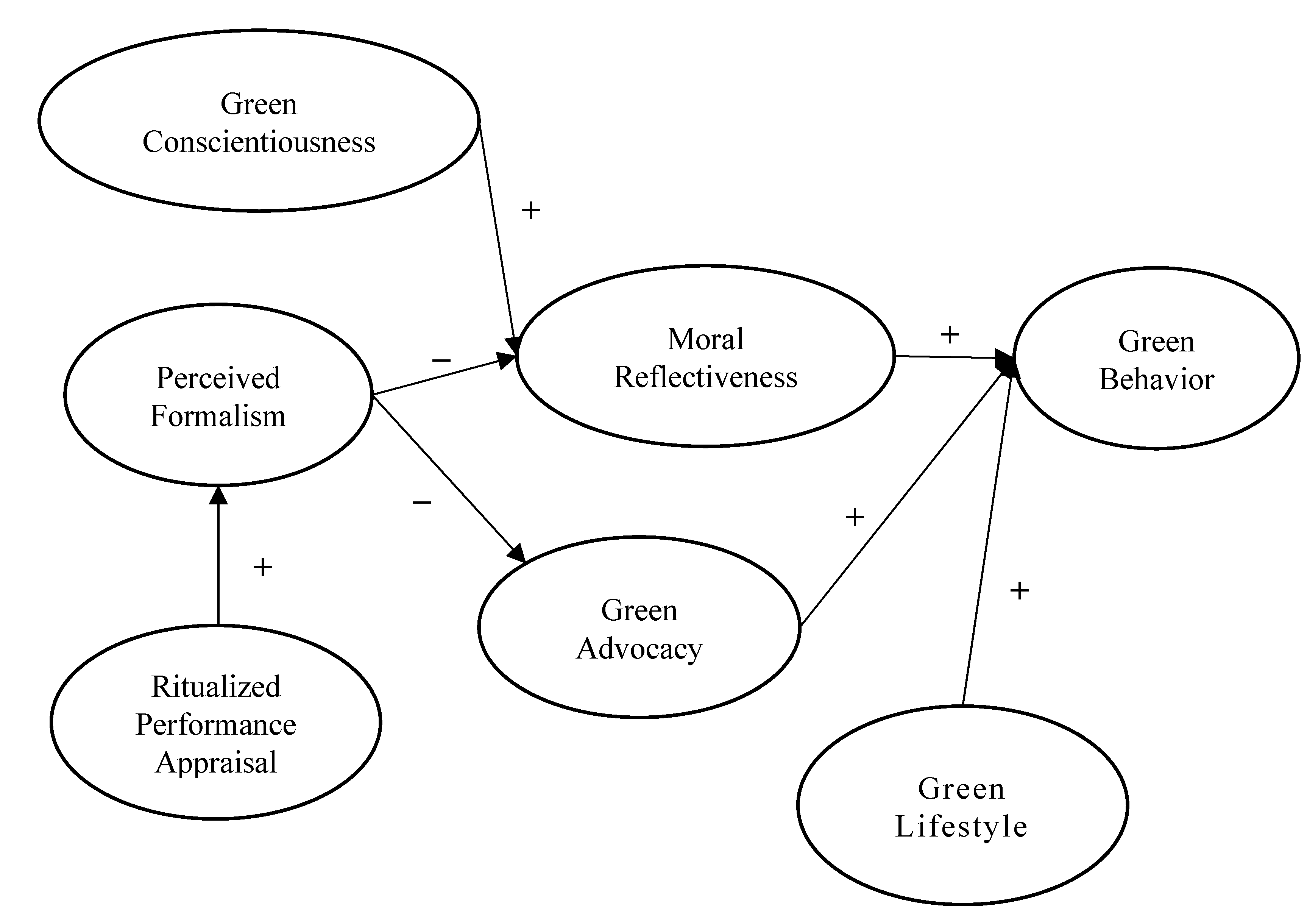
Causal Model Analysis of the Effects of Civil Servants’ Perceived Formalism, Green Conscientiousness, and Moral Reflectiveness on Green Behavior

Abstract
Share and Cite
Wu, T.-L.; Liu, H.-T. Causal Model Analysis of the Effects of Civil Servants’ Perceived Formalism, Green Conscientiousness, and Moral Reflectiveness on Green Behavior. Sustainability 2023, 15, 5772. https://doi.org/10.3390/su15075772
Wu T-L, Liu H-T. Causal Model Analysis of the Effects of Civil Servants’ Perceived Formalism, Green Conscientiousness, and Moral Reflectiveness on Green Behavior. Sustainability. 2023; 15(7):5772. https://doi.org/10.3390/su15075772
Chicago/Turabian StyleWu, Tsung-Lin, and Hsiang-Te Liu. 2023. "Causal Model Analysis of the Effects of Civil Servants’ Perceived Formalism, Green Conscientiousness, and Moral Reflectiveness on Green Behavior" Sustainability 15, no. 7: 5772. https://doi.org/10.3390/su15075772
APA StyleWu, T.-L., & Liu, H.-T. (2023). Causal Model Analysis of the Effects of Civil Servants’ Perceived Formalism, Green Conscientiousness, and Moral Reflectiveness on Green Behavior. Sustainability, 15(7), 5772. https://doi.org/10.3390/su15075772