The Role of ADAS While Driving in Complex Road Contexts: Support or Overload for Drivers?





Abstract
1. Introduction
- −
- Subjective measurements (questionnaires);
- −
- Performance measures (primary and secondary);
- −
- Physiological measurements.
Research Gap
2. Materials and Methods
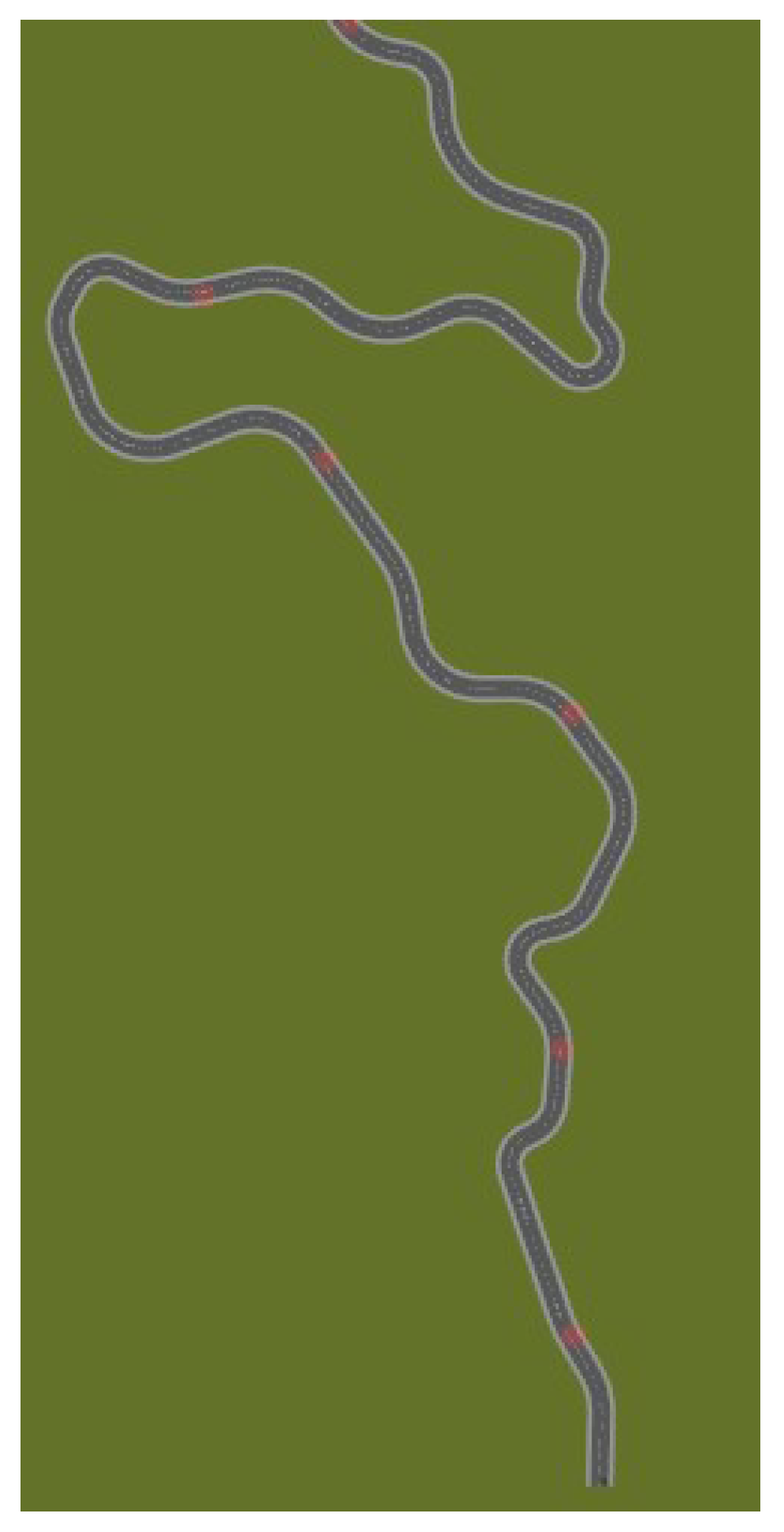
2.1. General Description of the Experiment
- −
- Repeatability and homogeneity of light, weather, and traffic conditions;
- −
- Safety of users involved in testing (including other vehicles);
- −
- Ability to accurately represent situations that can hardly be found in reality (in this case, the presence of a particular flow of cyclists);
- −
- Complete and accurate vehicle telemetry;
- −
- Possibility to equip the driver with non-invasive instrumentation (biometric sensors), which, in real driving conditions, could cause sanctions by the authorities.
- (1)
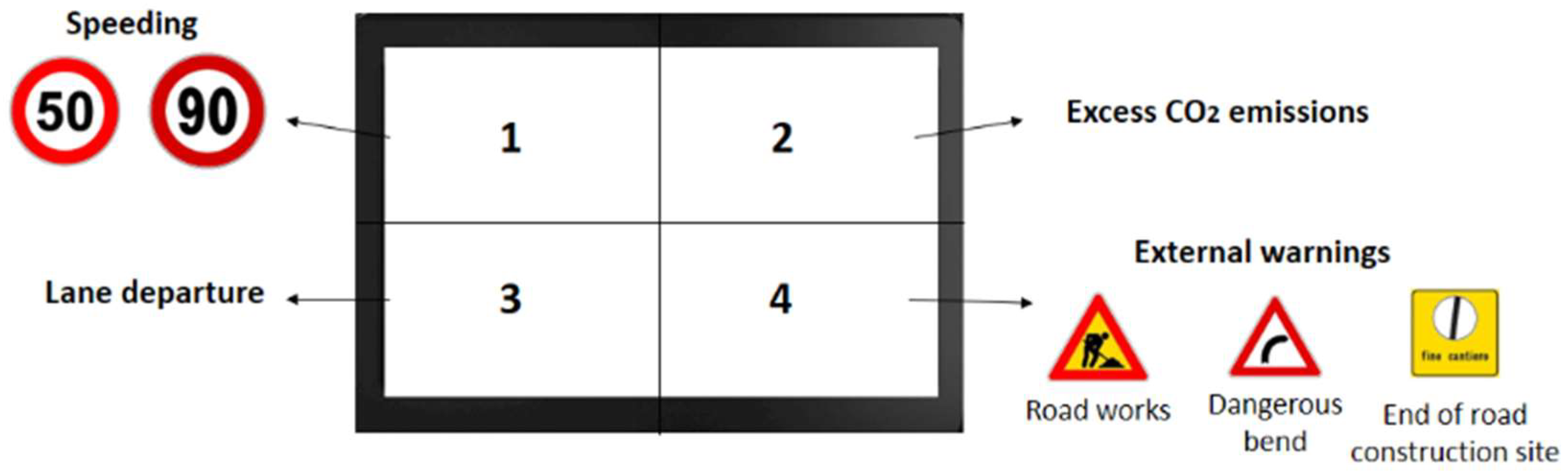
- Control condition, no traffic. Users will acquire all the necessary information from the external context and vertical signage. There will be no traffic of any kind.
- (2)
- Control condition, with traffic (cyclists). Users will acquire all the necessary information from the external context and the vertical signage. The traffic, as mentioned, will consist of groups of 3 cyclists at a time that will induce users to make the passing maneuver.
- (3)
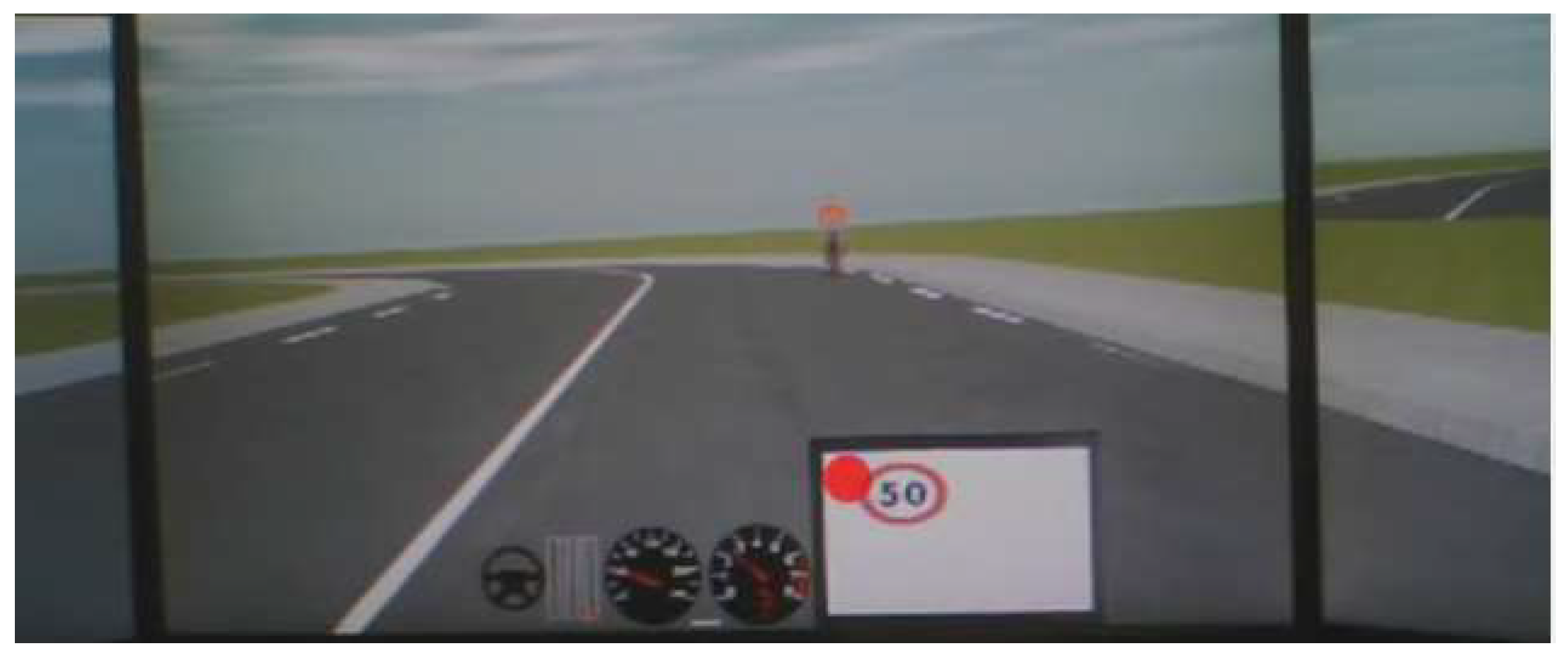
- Smart condition, no traffic. Users will acquire all the necessary information from the external context and from the OBU present inside the vehicle. There will be no traffic of any kind.
- (4)
- Smart condition, with traffic (cyclists). Users will acquire all the necessary information from the external context and from the OBU present inside the vehicle. The traffic, as mentioned, will consist of groups of 3 cyclists at a time that will induce users to make the passing maneuver.
2.2. The Driving Simulator at University of Messina
- −
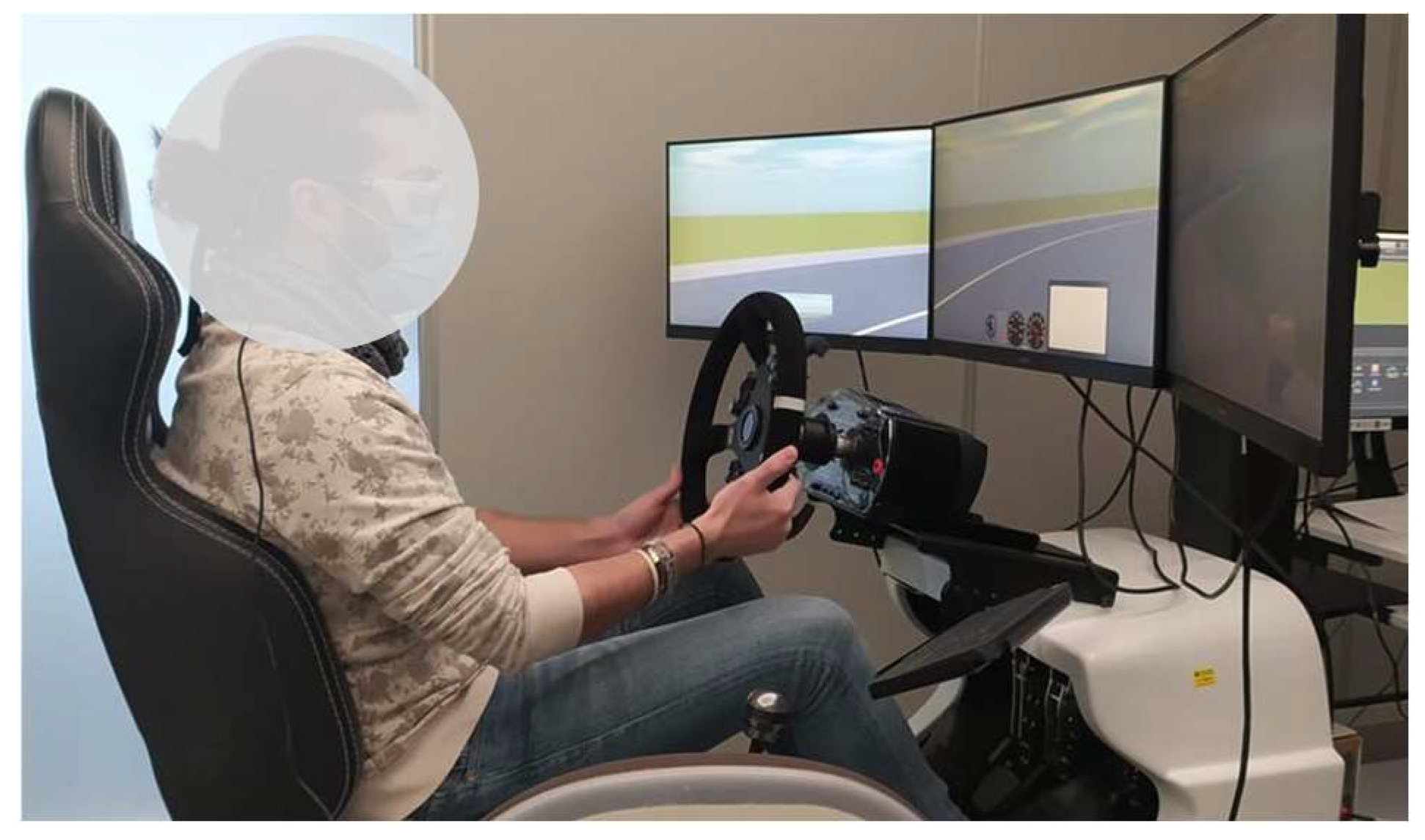
- A hardware characterized by three 29-inch full HD screens, a steering wheel characterized by a force feedback sensor to simulate the rolling motion of wheels and shocks, and sound effects reproduced through several speakers and subwoofers;
- −
- A software named SCANeR studio, used to design tracks, generate the environmental context, and run trials;
- −
- Data collected with a frequency of 10 Hz;
- −
- A family car (Citroen C3) powered by an 80 hp gas engine, with six manual gears and automatic clutch.
2.3. The Drivers’ Sample
2.4. The Eye Tracker
2.5. Questionnaire NASA TLX
2.6. One-Way ANOVA
- −
- Driving condition (2 levels: Control and Smart);
- −
- Traffic (2 levels: no cyclists, with cyclists)
- −
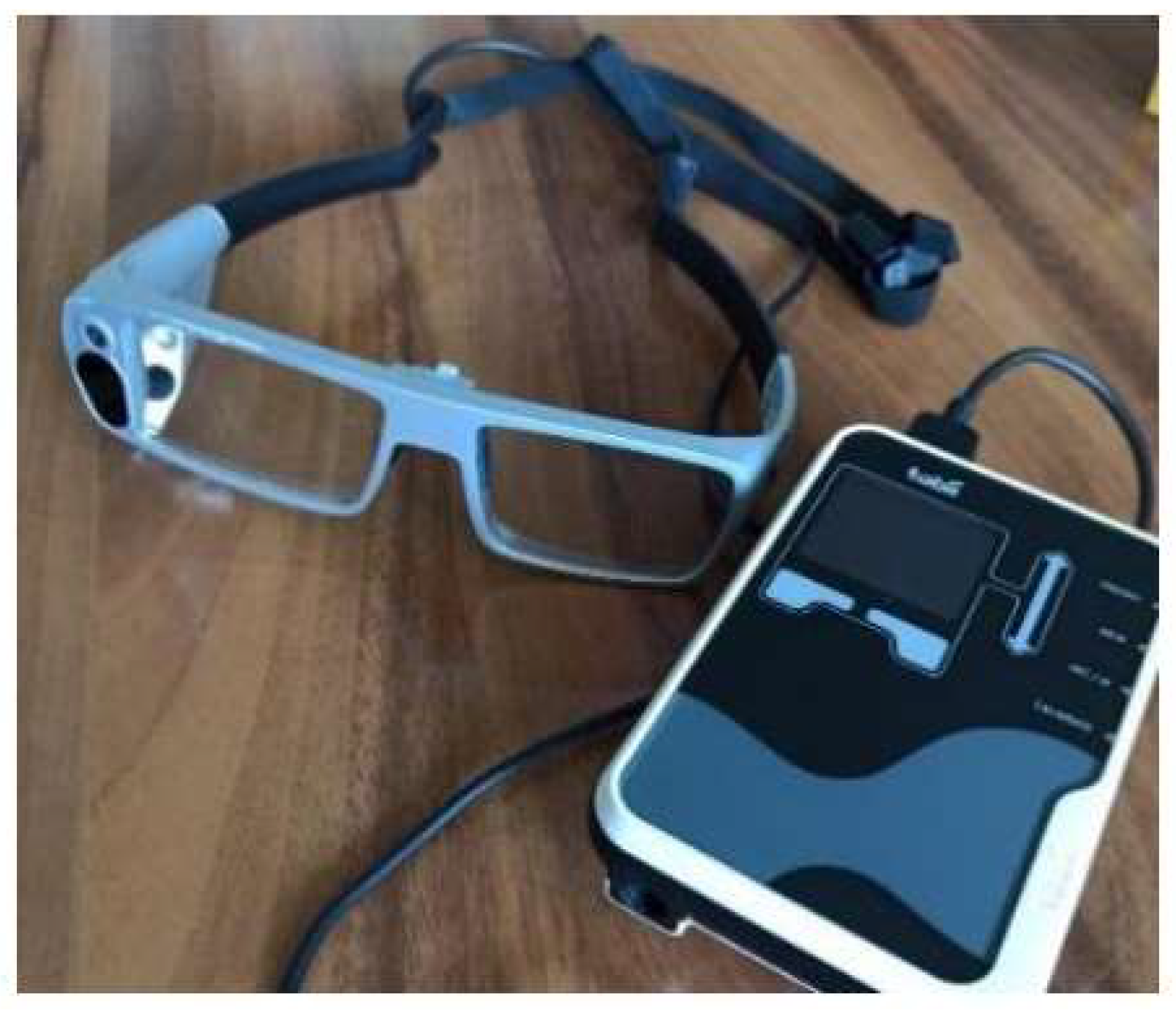
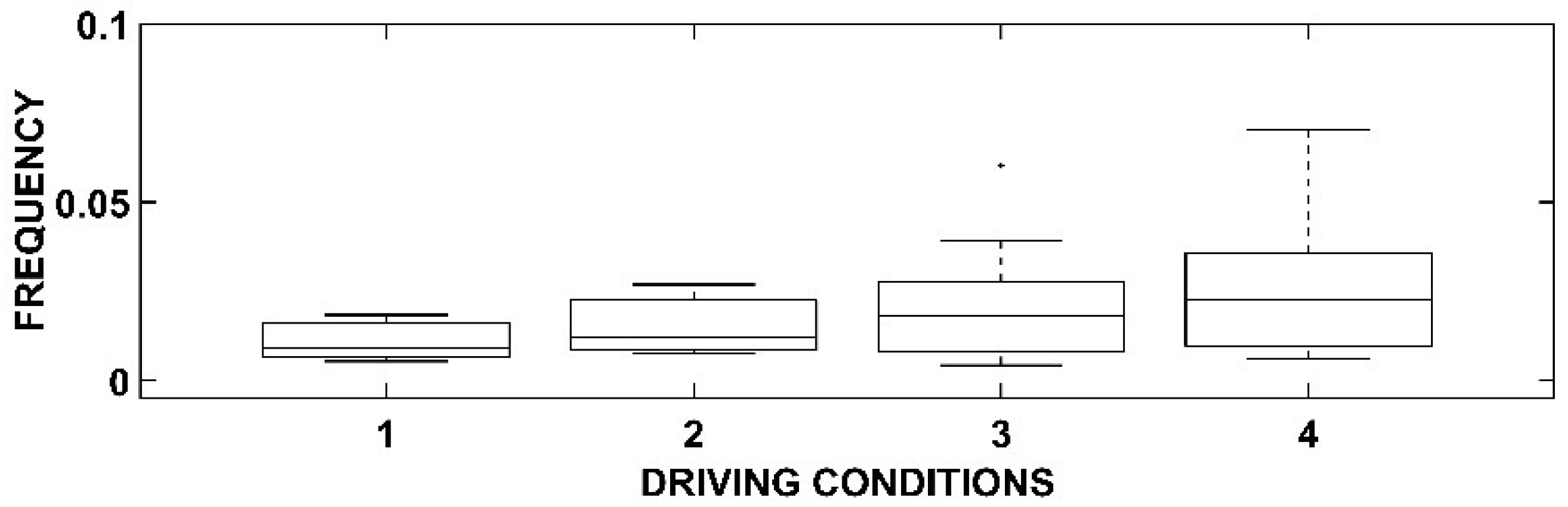
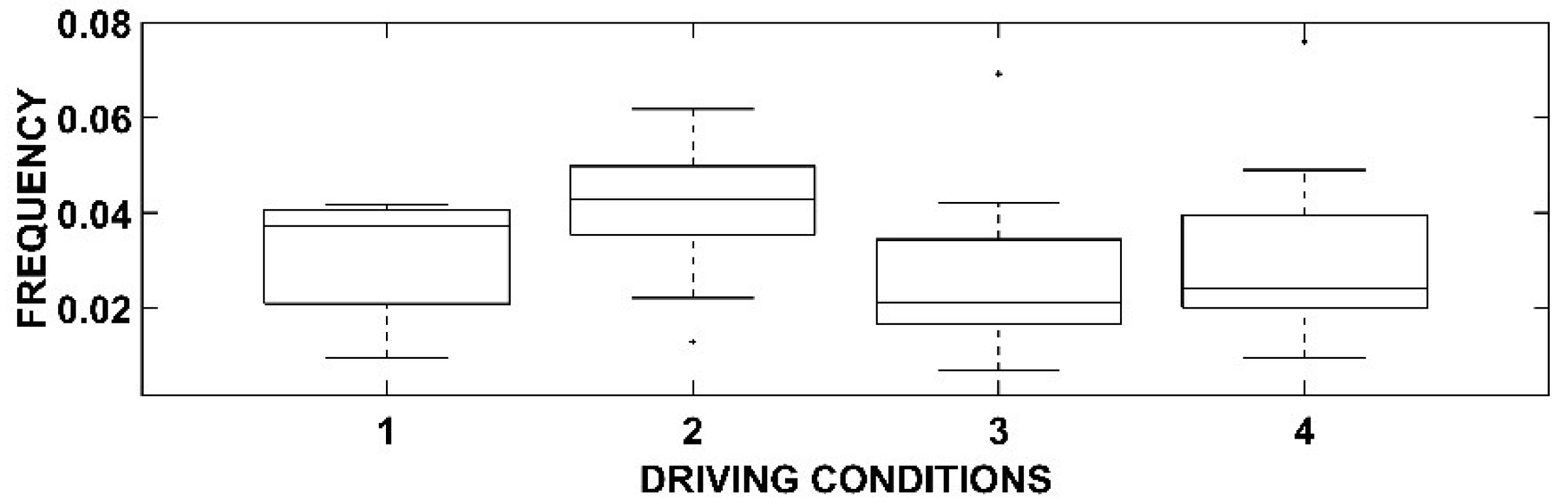
- Driver’s Visual Acquisition (DVA): represents the percentage of time the driver does not gaze at the road to acquire information from road signs. It was assessed by calculating the ratio of two times f and t, where f is the time of fixation necessary for a driver to acquire information on signs and t is the travel time of the same user. In this trial, the DVA has been calculated for two types of vertical signal (dangerous curve and speed limit), distinguishing the four conditions already illustrated.
- −
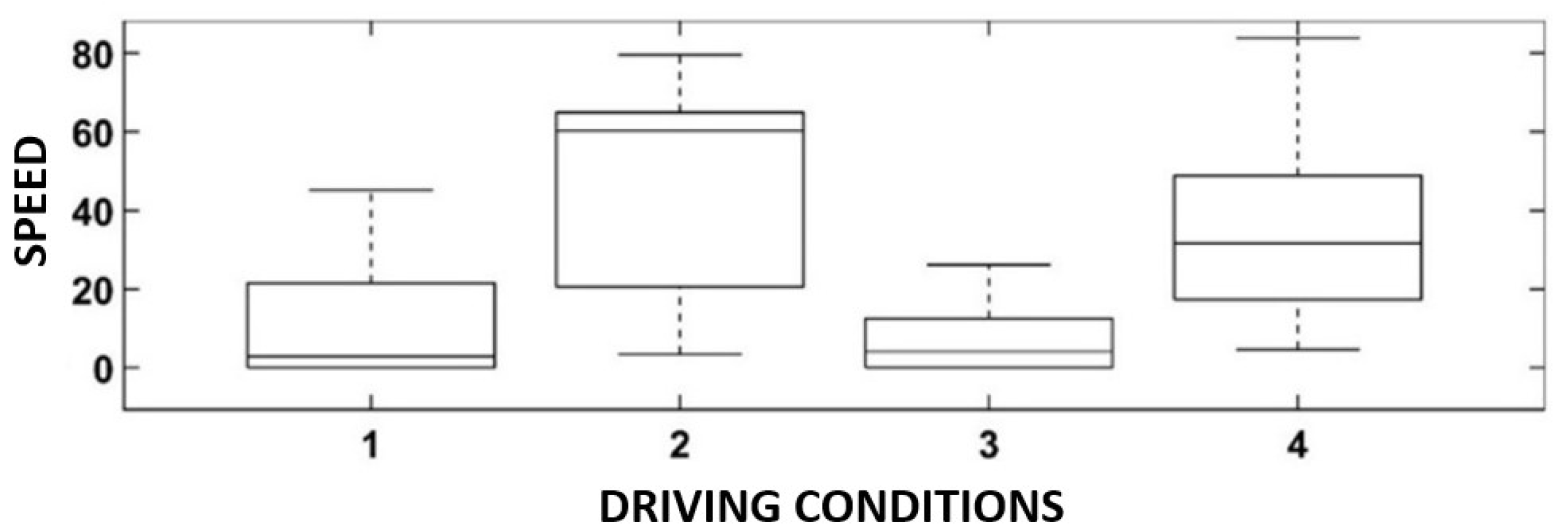
- Speed Violation (SV): indicates the speed of the vehicle.
- −
- Overall Workload (OW): The NASA TLX questionnaire was administered to each user at the end of the guide in control conditions and at the end of the guide in smart conditions.
- −
- The dependent variable must be measured at the continuous level.
- −
- The two within-subjects’ factors (i.e., two independent variables) should consist of at least two related groups that indicate that the same subjects are present in both groups.
- −
- The observations are independent, without relationship between the observations in each group or between the groups themselves.
- −
- Absence of significant outliers.
- −
- Tests for normality by means of residuals.
- −
- Verification that the sphericity, i.e., the variances of the differences between all combinations of related groups, were equal. When these conditions are violated, the Mauchly tests for sphericity can be performed, adjusting the analysis by a correction criterion, such as the Greenhouse–Geisser method.
3. Results and Discussion
3.1. One-Way ANOVA with Dependent Variable DVA50
3.2. One-Way ANOVA with Dependent Variable DVAdang
3.3. One-Way ANOVA with Dependent Variable Speed Violation
3.4. One-Way ANOVA with Dependent Variable Overall Workload
4. Conclusions
Author Contributions
Funding
Institutional Review Board Statement
Informed Consent Statement
Data Availability Statement
Conflicts of Interest
References
- Jazayeri, A.; Martinez, J.R.B.; Loeb, H.S.; Yang, C.C. The Impact of driver distraction and secondary tasks with and without other co-occurring driving behaviors on the level of road traffic crashes. Accid. Anal. Prev. 2021, 153, 106010. [Google Scholar] [CrossRef] [Scilit]
- Bowden, V.K.; Loft, S.; Wilson, M.D.; Howard, J.; Visser, T.A. The long road home from distraction: Investigating the time-course of distraction recovery in driving. Accid. Anal. Prev. 2019, 124, 23–32. [Google Scholar] [CrossRef] [Scilit]
- Lansdown, T.C.; Kovanda, E.J.; Spence, L. Student driver propensity to engage with distractions–a self-report survey. Transp. Res. Part F Traffic Psychol. Behav. 2021, 81, 650–660. [Google Scholar] [CrossRef] [Scilit]
- NHTSA. Distracted Driving in Fatal Crashes Research Note; NHTSA: Washington, DC, USA, 2017. [Google Scholar]
- NHTSA. Distracted Driving (DOT HS 812 700). 2020. Available online: https://www.nhtsa.gov/risky-driving/distracted-driving (accessed on 10 June 2022).
- Briggs, G.F.; Hole, G.J.; Land, M.F. Emotionally involving telephone conversations lead to driver error and visual tunnelling. Transp. Res. Part F Traffic Psychol. Behav. 2011, 14, 313–323. [Google Scholar] [CrossRef] [Scilit]
- Chen, H.; Chiuhsiang, J. The effects of various naturalistic conversations on driving performances during simulated driving. In Ergonomics for All: Celebrating PPCOE’s 20 Years of Excellence; Wang, A., Ed.; CRC Press: Kaohsiung, Taiwan, 2011. [Google Scholar]
- Chen, H.-Y.W.; Hoekstra-Atwood, L.; Donmez, B. Voluntary- and Involuntary-Distraction Engagement: An Exploratory Study of Individual Differences. Hum. Factors J. Hum. Factors Ergon. Soc. 2018, 60, 575–588. [Google Scholar] [CrossRef] [Scilit]
- D’Addario, P.; Donmez, B. The effect of cognitive distraction on perception-response time to unexpected abrupt and gradually onset roadway hazards. Accid. Anal. Prev. 2019, 127, 177–185. [Google Scholar] [CrossRef] [Scilit]
- Kuo, J.; Lenné, M.G.; Mulhall, M.; Sletten, T.; Anderson, C.; Howard, M.; Rajaratnam, S.; Magee, M.; Collins, A. Continuous monitoring of visual distraction and drowsiness in shift-workers during naturalistic driving. Saf. Sci. 2019, 119, 112–116. [Google Scholar] [CrossRef] [Scilit]
- Ali, Y.; Sharma, A.; Haque, M.; Zheng, Z.; Saifuzzaman, M. The impact of the connected environment on driving behavior and safety: A driving simulator study. Accid. Anal. Prev. 2020, 144, 105643. [Google Scholar] [CrossRef] [Scilit]
- Fernández-Isabel, A.; Fuentes-Fernández, R.; de Diego, I.M. Modeling multi-agent systems to simulate sensor-based Smart Roads. Simul. Model. Pr. Theory 2020, 99, 101994. [Google Scholar] [CrossRef] [Scilit]
- Birrel, S.; Fowkes, M. Glance behaviours when using an in-vehicle smart driving aid: A real-world, on-road driving study. Transp. Res. Part F Traffic Psychol. Behav. 2014, 22, 113–125. [Google Scholar] [CrossRef] [Scilit]
- Ma, J.; Gong, Z.; Tan, J.; Zhang, Q.; Zuo, Y. Assessing the driving distraction effect of vehicle HMI displays using data mining techniques. Transp. Res. Part F Traffic Psychol. Behav. 2020, 69, 235–250. [Google Scholar] [CrossRef] [Scilit]
- Dumitru, A.I.; Girbacia, T.; Boboc, R.G.; Postelnicu, C.-C.; Mogan, G.-L. Effects of smartphone based advanced driver assistance system on distracted driving behavior: A simulator study. Comput. Hum. Behav. 2018, 83, 1–7. [Google Scholar] [CrossRef] [Scilit]
- Gazder, U.; Al-Malki, V.; Alam, M. Risks of Using Smart Devices for Drivers. In 2nd Smart Cities Symposium; University of Bahrain: Zallaq, Bahrain, 2019. [Google Scholar]
- Pellegrino, O. An analysis of the effect of roadway design on driver’s workload. Balt. J. Road Bridge Eng. 2009, 4, 45–53. [Google Scholar] [CrossRef] [Scilit]
- Pellegrino, O. Prediction of driver’s workload by means of fuzzy techniques. Balt. J. Road Bridg. Eng. 2012, 7, 120–128. [Google Scholar] [CrossRef] [Scilit]
- Bosurgi, G.; D’Andrea, A.; Pellegrino, O. What variables affect to a greater extent the driver’s vision while driving? Transport 2013, 28, 331–340. [Google Scholar] [CrossRef] [Scilit]
- Kircher, K.; Fors, C.; Ahlstrom, C. Continuous versus intermittent presentation of visual eco-driving advice. Transp. Res. Part F Traffic Psychol. Behav. 2014, 24, 27–38. [Google Scholar] [CrossRef] [Scilit]
- Bosurgi, G.; D’Andrea, A.; Pellegrino, O. Prediction of Drivers’ Visual Strategy Using an Analytical Model. J. Transp. Saf. Secur. 2015, 7, 153–173. [Google Scholar] [CrossRef] [Scilit]
- Bongiorno, N.; Bosurgi, G.; Pellegrino, O.; Sollazzo, G. How is the Driver’s Workload Influenced by the Road Environment? Procedia Eng. 2017, 187, 5–13. [Google Scholar] [CrossRef] [Scilit]
- Risteska, M.; Kanaan, D.; Donmez, B.; Chen, H.-Y.W. The effect of driving demands on distraction engagement and glance behaviors: Results from naturalistic data. Saf. Sci. 2021, 136, 105123. [Google Scholar] [CrossRef] [Scilit]
- O’Donnell, R.D.; Eggemeier, F.T. Workload assessment methodology. In Handbook of Perception and Human Performance, Vol 2, Cognitive Processes and Performance, 1st ed.; Boff, K.R., Kaufman, L., Thomas, J.P., Eds.; Wiley: New York, NY, USA, 1986; pp. 42:1–42:9. ISBN 0471885444. [Google Scholar]
- Paxion, J.; Galy, E.; Berthelon, C. Overload depending on driving experience and situation complexity: Which strategies faced with a pedestrian crossing? Appl. Ergon. 2015, 51, 343–349. [Google Scholar] [CrossRef] [Scilit]
- Bosurgi, G.; Bongiorno, N.; Pellegrino, O. A Nonlinear Model to Predict Drivers’ Track Paths Along a Curve. Int. J. Civ. Eng. 2016, 14, 271–280. [Google Scholar] [CrossRef] [Scilit]
- Li, P.; Merat, N.; Zheng, Z.; Markkula, G.; Li, Y.; Wang, Y. Does cognitive distraction improve or degrade lane keeping performance? Analysis of time-to-line crossing safety margins. Transp. Res. Part F Traffic Psychol. Behav. 2018, 57, 48–58. [Google Scholar] [CrossRef] [Scilit]
- Aidman, E.; Chadunow, C.; Johnson, K.; Reece, J. Real-time driver drowsiness feedback improves driver alertness and self-reported driving performance. Accid. Anal. Prev. 2015, 81, 8–13. [Google Scholar] [CrossRef] [Scilit]
- Farah, H.; Polus, A.; Bekhor, S.; Toledo, T. Study of passing gap acceptance behavior using a driving simulator. Adv. Transp. Studies. Int. J. 2007, 2007, 9–16. [Google Scholar]
- Malhotra, N.; Charlton, S.; Starkey, N.; Masters, R. Driving speed choice: The role of conscious monitoring and control (reinvestment) when driving. Transp. Res. Part F Traffic Psychol. Behav. 2018, 57, 115–128. [Google Scholar] [CrossRef] [Scilit]
- Gaspar, J.G.; Ward, N.; Neider, M.B.; Crowell, J.; Carbonari, R.; Kaczmarski, H.; Ringer, R.V.; Johnson, A.P.; Kramer, A.F.; Loschky, L.C. Measuring the Useful Field of View During Simulated Driving With Gaze-Contingent Displays. Hum. Factors J. Hum. Factors Ergon. Soc. 2016, 58, 630–641. [Google Scholar] [CrossRef] [Scilit]
- Kim, S.; Hong, J.-H.; Li, K.A.; Forlizzi, J.; Dey, A.K. Route Guidance Modality for Elder Driver Navigation. In International Conference on Pervasive Computing; Springer: Berlin, Germany, 2012. [Google Scholar]
- Wang, Y.; Ning, W.; Zhang, S.; Yu, H.; Cen, H.; Wang, S. Architecture and key terminal technologies of 5G-based internet of vehicles. Comput. Electr. Eng. 2021, 95, 107430. [Google Scholar] [CrossRef] [Scilit]
- Kamrani, M.; Concas, S.; Kourtellis, A.; Rabbani, M.; Kummetha, V.C.; Dokur, O. Drivers’ reactions to connected vehicle forward collision warnings: Leveraging real-world data from the THEA CV pilot. Transp. Res. Part F Traffic Psychol. Behav. 2023, 92, 108–120. [Google Scholar] [CrossRef] [Scilit]
- Yang, J.; Chen, T.; Payne, B.; Guo, P.; Zhang, Y.; Guo, J. Generating routes for autonomous driving in vehicle-to-infrastructure communications. Digit. Commun. Netw. 2020, 6, 444–451. [Google Scholar] [CrossRef] [Scilit]
- Santa, J.; Bernal-Escobedo, L.; Sanchez-Iborra, R. On-board unit to connect personal mobility vehicles to the IoT. Procedia Comput. Sci. 2020, 175, 173–180. [Google Scholar] [CrossRef] [Scilit]
- Marra, S. Functional Aspects of Smart Roads and their Impact on Driving Behaviour for Improving Road Safety . Ph.D. Thesis, University of Messina, Messina, Italy, 2022. (In Italian) [Google Scholar]





| Source | SS | df | MS | F | Prob > F |
|---|---|---|---|---|---|
| DVA50 | 0.00619 | 3 | 0.00206 | 2.01 | 0.1246 |
| Error | 0.05352 | 52 | 0.00103 | ||
| Total | 0.05971 | 55 |
| Source | SS | df | MS | F | Prob > F |
|---|---|---|---|---|---|
| DVAdang | 0.00271 | 3 | 0.0009 | 2.56 | 0.0651 |
| Error | 0.01837 | 52 | 0.0003 | ||
| Total | 0.02108 | 55 |
| Source | SS | df | MS | F | Prob > F |
|---|---|---|---|---|---|
| SV | 15,704.7 | 3 | 5234.89 | 12.62 | <0.0001 |
| Error | 21,574.7 | 52 | 414.9 | ||
| Total | 37,279.4 | 55 |
| Source | SS | df | MS | F | Prob > F |
|---|---|---|---|---|---|
| Overall Workload | 46.29 | 1 | 46.29 | 0.17 | 0.681 |
| Error | 6939.70 | 26 | 266.91 | ||
| Total | 6985.98 | 27 |
Disclaimer/Publisher’s Note: The statements, opinions and data contained in all publications are solely those of the individual author(s) and contributor(s) and not of MDPI and/or the editor(s). MDPI and/or the editor(s) disclaim responsibility for any injury to people or property resulting from any ideas, methods, instructions or products referred to in the content. |
© 2023 by the authors. Licensee MDPI, Basel, Switzerland. This article is an open access article distributed under the terms and conditions of the Creative Commons Attribution (CC BY) license (https://creativecommons.org/licenses/by/4.0/).
Share and Cite
Bosurgi, G.; Pellegrino, O.; Ruggeri, A.; Sollazzo, G. The Role of ADAS While Driving in Complex Road Contexts: Support or Overload for Drivers? Sustainability 2023, 15, 1334. https://doi.org/10.3390/su15021334
Bosurgi G, Pellegrino O, Ruggeri A, Sollazzo G. The Role of ADAS While Driving in Complex Road Contexts: Support or Overload for Drivers? Sustainability. 2023; 15(2):1334. https://doi.org/10.3390/su15021334
Chicago/Turabian StyleBosurgi, Gaetano, Orazio Pellegrino, Alessia Ruggeri, and Giuseppe Sollazzo. 2023. "The Role of ADAS While Driving in Complex Road Contexts: Support or Overload for Drivers?" Sustainability 15, no. 2: 1334. https://doi.org/10.3390/su15021334
APA StyleBosurgi, G., Pellegrino, O., Ruggeri, A., & Sollazzo, G. (2023). The Role of ADAS While Driving in Complex Road Contexts: Support or Overload for Drivers? Sustainability, 15(2), 1334. https://doi.org/10.3390/su15021334