Article

Invasive Ageratina adenophora (Asteraceae) in Agroecosystems of Kumaun Himalaya, India: A Threat to Plant Diversity and Sustainable Crop Yield

Department of Botany, D.S.B. Campus, Kumaun University, Nainital 263002, Uttarakhand, India
*
Author to whom correspondence should be addressed.
Sustainability 2023, 15(14), 10748; https://doi.org/10.3390/su151410748
Submission received: 29 April 2023 / Revised: 29 June 2023 / Accepted: 6 July 2023 / Published: 8 July 2023
(This article belongs to the Special Issue Forest Ecosystem: Structure and Functioning)

Abstract

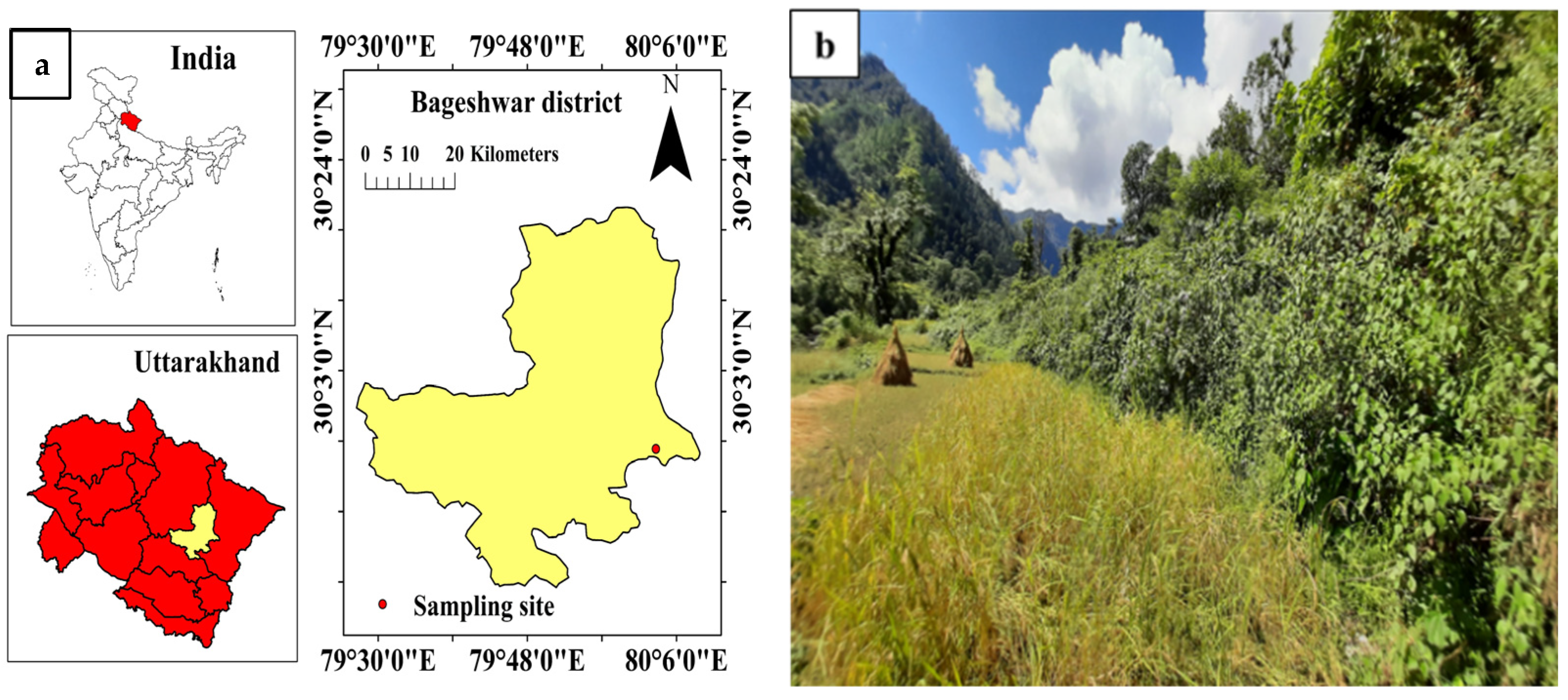
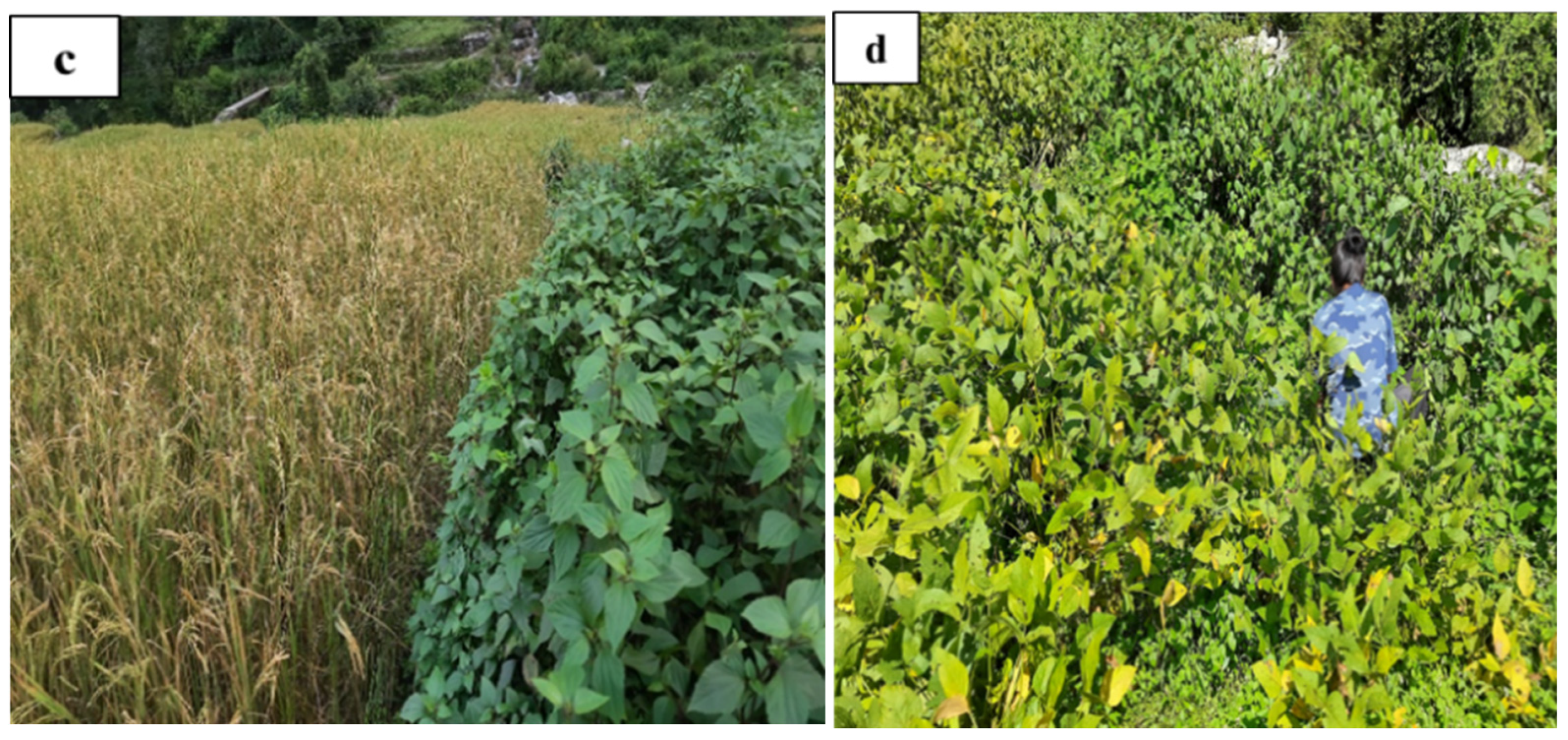
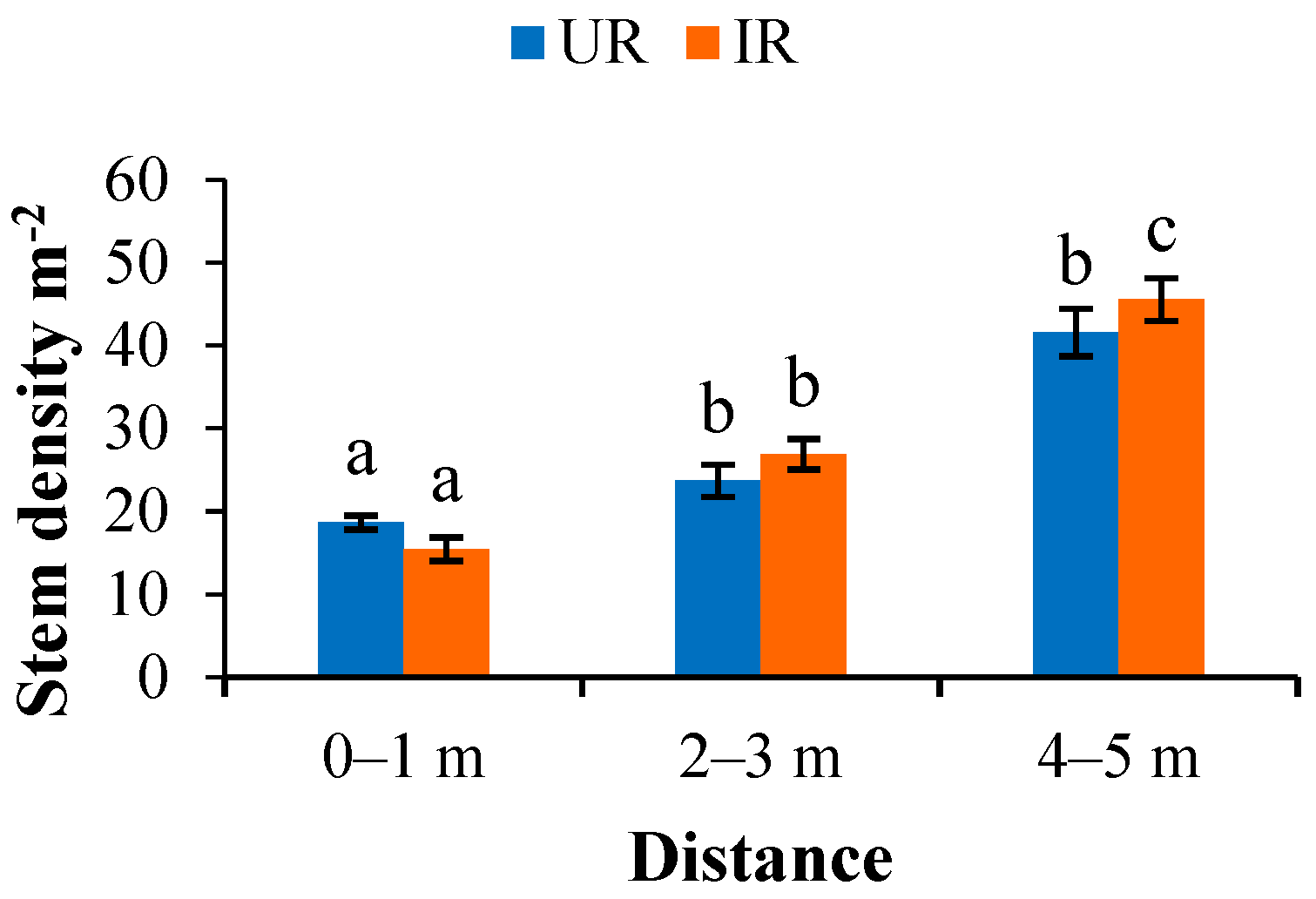
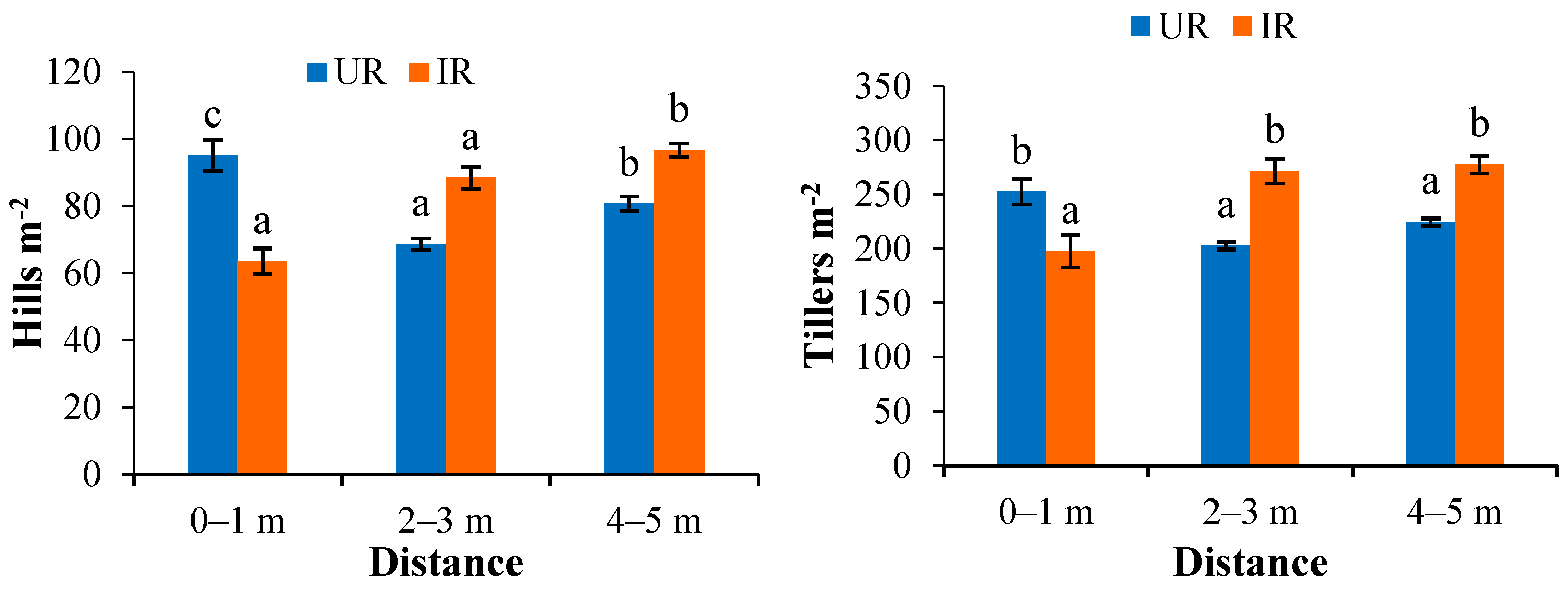
Invasive plant species pose a serious threat to agricultural yield, although how the threat varies with the distance of crops from invasive plants remains unclear. Therefore, utilizing this viewpoint, objectives were formulated to quantify differences in the native vegetation and performance of crops growing near A. adenophora–invaded (treatment plots) and uninvaded ridges (control plots) in the terraced agricultural fields of Kumaun Central Himalaya. Morphological and yield parameters of two crops, viz. rice (Oryza sativa L.) and soybean (Glycine max L.), were assessed systematically by laying parallel transects from the ridge of the field up to 5 m towards the centre of the field in three equal distance intervals of 1 m in the order: 0–1 m, 2–3 m, and 4–5 m. Crofton weed showed 95–100% crown cover throughout invaded ridges/risers of terraced fields, with stem densities of 134–208 ind. m−2 and an average basal area of 0.15 cm2. The total mean density of herbs (other than A. adenophora) in invaded ridges/risers decreased by 38–85% compared to uninvaded ridges, but species richness increased by 31–37%. Soil nutrient availability was high across invaded ridges/risers as well as crop fields. The average irradiance level near uninvaded ridges was 19.6 ± 1.80%, and near invaded ridges, it was 1.8 ± 0.31%. Compared to straw, root, and grain yields obtained at the farthest distance, the yield of rice near uninvaded ridges was reduced by 27%, 19%, and 33%, while near invaded ridges, it was reduced by 37%, 39%, and 43%, respectively; the yield of soybean near uninvaded ridges declined by 62%, 66%, and 42%, while near invaded ridges, it decreased by 59%, 69%, and 47%, respectively. Compared to the values obtained at the farthest distance, the harvest index (HI) of rice near ridges was reduced by 7% and 13%, while the HI of soybean increased by 15 and 10% across uninvaded and invaded field ridges, respectively. The findings indicated that the Crofton weed could suppress field crops and could form a single dominant population in the invaded area, causing a serious threat to the plant community, its diversity, and the yield of the native agroecosystem in the foreseeable future if timely management actions would not be taken.
Keywords: Ageratina adenophora; allelopathy; competition; invasion; terraced fields; yield Ageratina adenophora; allelopathy; competition; invasion; terraced fields; yield