What Does the Concept of Resilience in Tourism Mean in the Time of COVID-19? Results of a Bibliometric Analysis


Abstract
1. Introduction
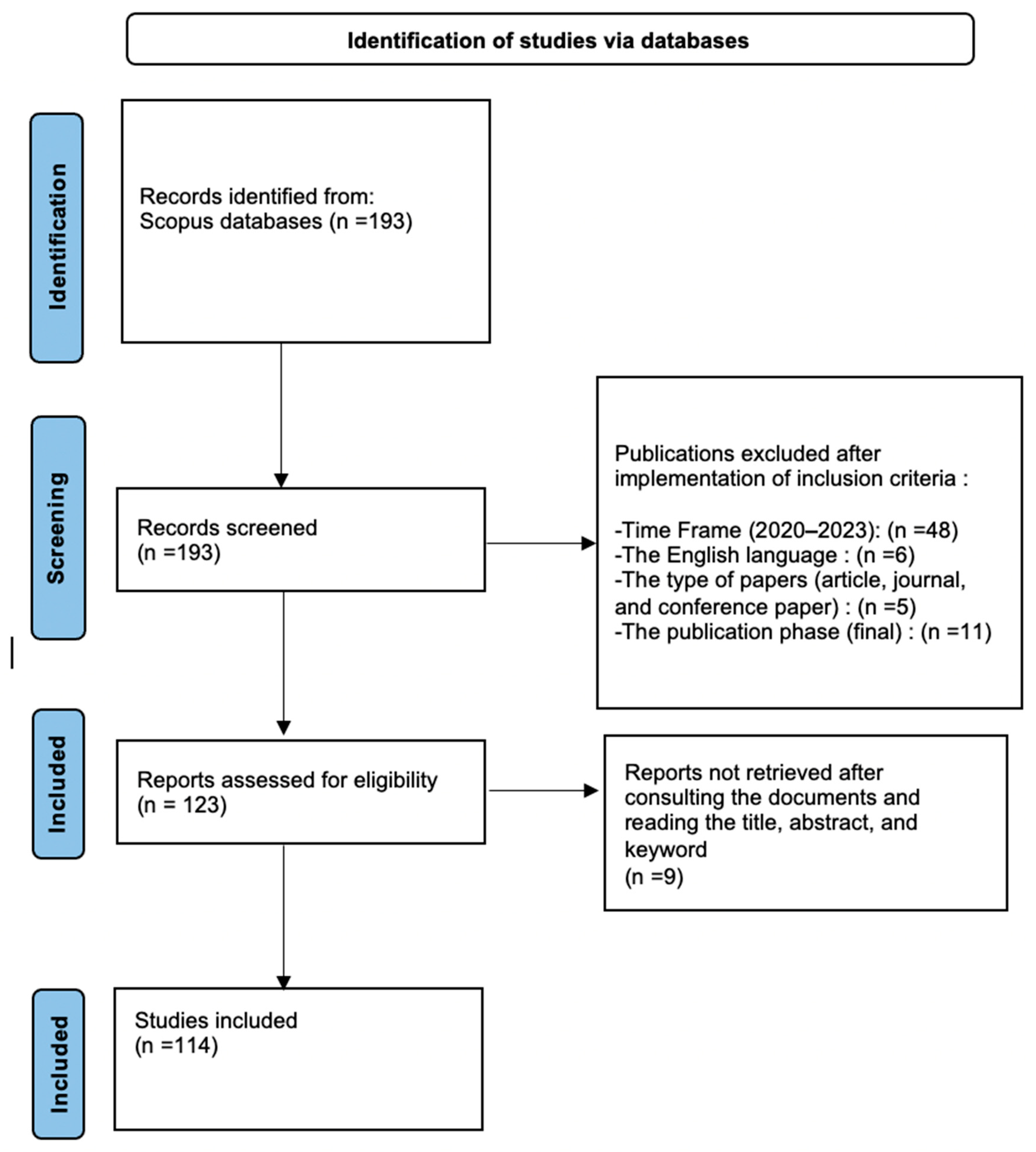
2. Materials and Methods
3. Results
3.1. Summary Information
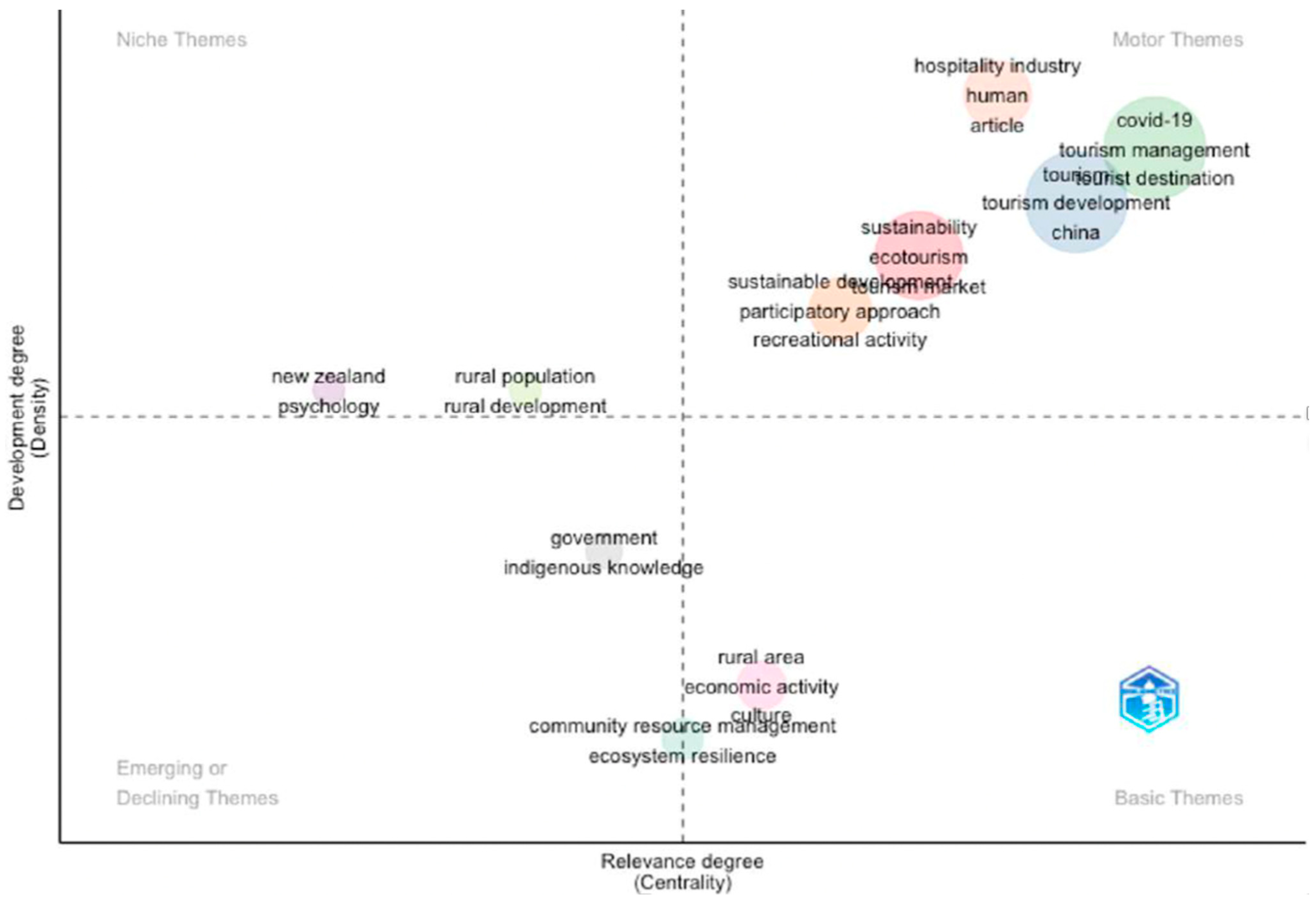
3.2. Analysis of Keyword Occurrences
3.3. Analysis of Contributing Journals
3.4. Analysis of the Most Cited Publications
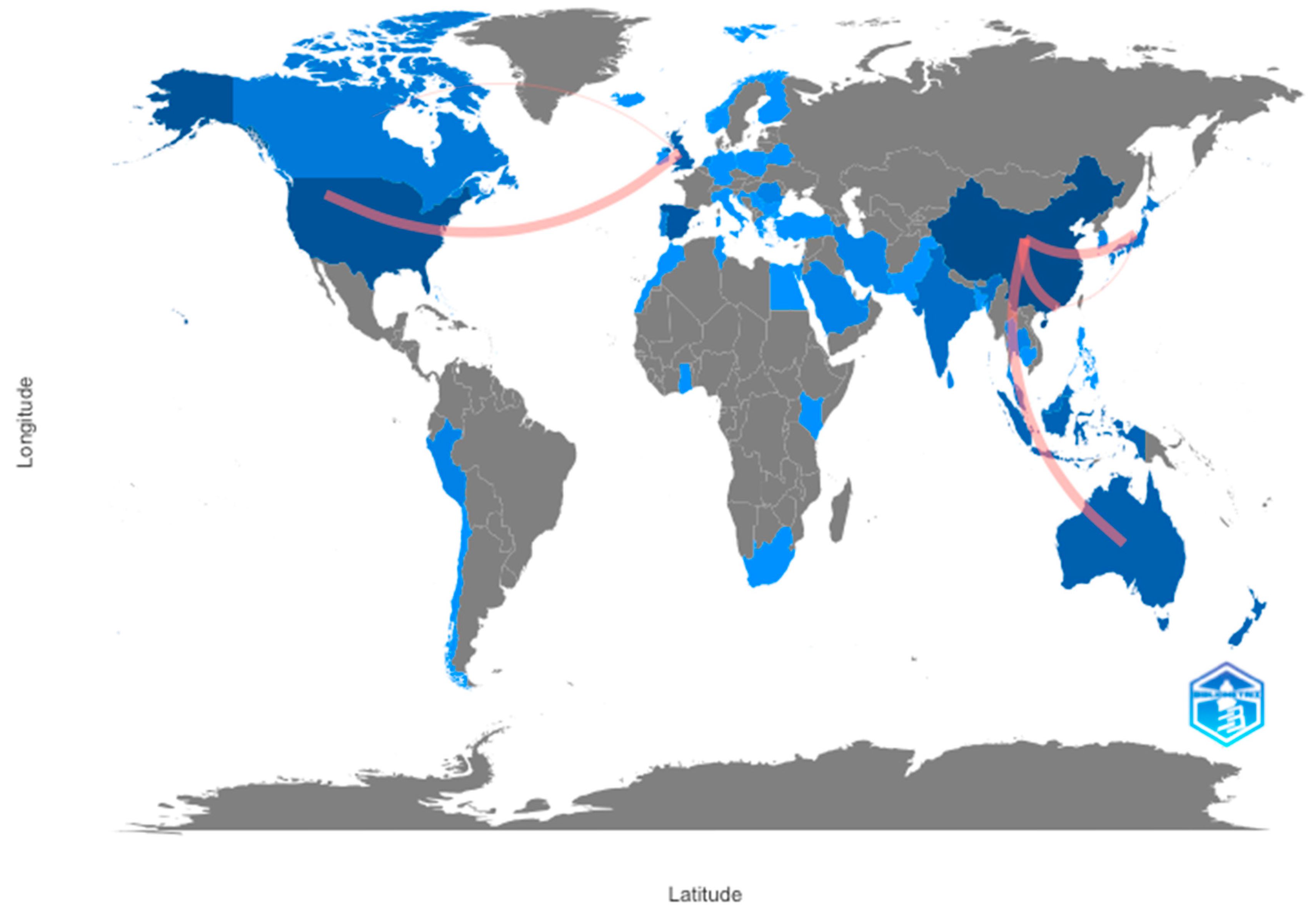
3.5. The Most Prolific Authors and Countries
4. Discussion
5. Research Topics with the Highest Acuity
5.1. Integrating Sustainable Management into Tourism Resilience
5.2. Livelihood Resilience
5.3. Community Resilience
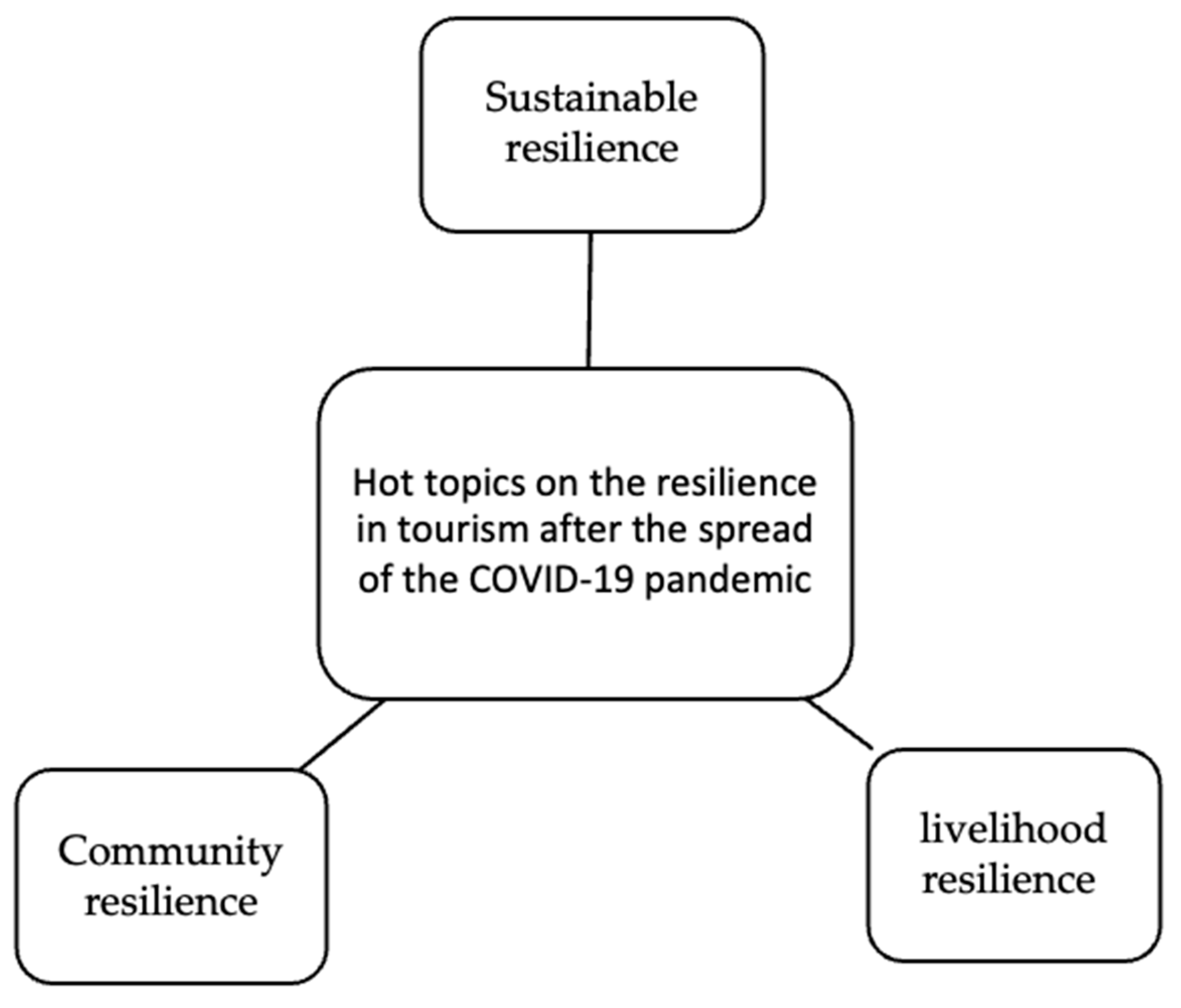
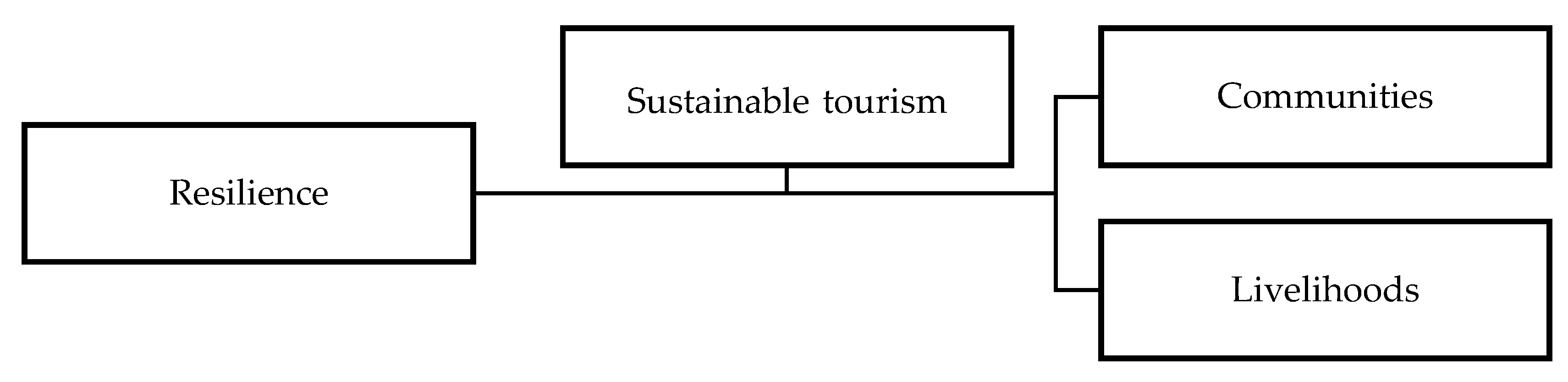
5.4. Model Framework That Connects the Themes That Can Be Tested in Further Research
6. Conclusions, Limitations, and Perspectives for Further Research
Author Contributions
Funding
Institutional Review Board Statement
Informed Consent Statement
Data Availability Statement
Conflicts of Interest
References
- Pham, T.; Nugroho, A. Tourism-Induced Poverty Impacts of COVID-19 in Indonesia. Ann. Tour. Res. Empir. Insights 2022, 3, 100069. [Google Scholar] [CrossRef]
- Okafor, L.; Khalid, U.; Gopalan, S. COVID-19 Economic Policy Response, Resilience and Tourism Recovery. Ann. Tour. Res. Empir. Insights 2022, 3, 100073. [Google Scholar] [CrossRef]
- Osorio, P.; Cadarso, M.Á.; Tobarra, M.Á.; García-Alaminos, Á. Carbon Footprint of Tourism in Spain: COVID-19 Impact and a Look Forward to Recovery. Struct. Change Econ. Dyn. 2023, 65, 303–318. [Google Scholar] [CrossRef] [PubMed]
- Liu, Y.; Cheng, X.; Liao, S.S.; Yang, F. The Impact of COVID-19 on the Tourism and Hospitality Industry: Evidence from International Stock Markets. N. Am. J. Econ. Financ. 2023, 64, 101875. [Google Scholar] [CrossRef]
- Wickramasinghe, K.; Naranpanawa, A. Tourism and COVID-19: An Economy-Wide Assessment. J. Hosp. Tour. Manag. 2023, 55, 131–138. [Google Scholar] [CrossRef]
- Aguiar-Quintana, T.; Román, C.; Gubisch, P.M.M. The Post-COVID-19 Tourism Recovery Led by Crisis-Resistant Tourists: Surf Tourism Preferences in the Canary Islands. Tour. Manag. Perspect. 2022, 44, 101041. [Google Scholar] [CrossRef]
- Dias, Á.L.; Cunha, I.; Pereira, L.; Costa, R.L.; Gonçalves, R. Revisiting Small- and Medium-Sized Enterprises’ Innovation and Resilience during COVID-19: The Tourism Sector. J. Open Innov. Technol. Mark. Complex. 2022, 8, 11. [Google Scholar] [CrossRef]
- Tomej, K.; Bilynets, I.; Koval, O. Tourism Business Resilience in the Time of War. Ann. Tour. Res. 2023, 99, 103547. [Google Scholar] [CrossRef]
- Soliku, O.; Kyiire, B.; Mahama, A.; Kubio, C. Tourism amid COVID-19 Pandemic: Impacts and Implications for Building Resilience in the Eco-Tourism Sector in Ghana’s Savannah Region. Heliyon 2021, 7, e07892. [Google Scholar] [CrossRef]
- Prayag, G. Tourism Resilience in the ‘New Normal’: Beyond Jingle and Jangle Fallacies? J. Hosp. Tour. Manag. 2023, 54, 513–520. [Google Scholar] [CrossRef]
- Proag, V. The Concept of Vulnerability and Resilience. Procedia Econ. Financ. 2014, 18, 369–376. [Google Scholar] [CrossRef]
- Doorn, N.; Gardoni, P.; Murphy, C. A Multidisciplinary Definition and Evaluation of Resilience: The Role of Social Justice in Defining Resilience. Sustain. Resilient Infrastruct. 2019, 4, 112–123. [Google Scholar] [CrossRef]
- Ntounis, N.; Parker, C.; Skinner, H.; Steadman, C.; Warnaby, G. Tourism and Hospitality Industry Resilience during the COVID-19 Pandemic: Evidence from England. Curr. Issues Tour. 2022, 25, 46–59. [Google Scholar] [CrossRef]
- Tasnim, Z.; Shareef, M.A.; Dwivedi, Y.K.; Kumar, U.; Kumar, V.; Malik, F.T.; Raman, R. Tourism Sustainability during COVID-19: Developing Value Chain Resilience. Oper. Manag. Res. 2023, 16, 391–407. [Google Scholar] [CrossRef]
- Wided, R. Achieving Sustainable Tourism with Dynamic Capabilities and Resilience Factors: A Post Disaster Perspective Case of the Tourism Industry in Saudi Arabia. Cogent Soc. Sci. 2022, 8, 2060539. [Google Scholar] [CrossRef]
- Pyke, J.; Lindsay-Smith, G.; Gamage, A.; Shaikh, S.; Nguyen, V.K.; de Lacy, T.; Porter, C. Building Destination Resilience to Multiple Crises to Secure Tourism’s Future. Asia Pac. J. Tour. Res. 2021, 26, 1225–1243. [Google Scholar] [CrossRef]
- Gaki, E.; Koufodontis, N.I. Regional tourism resilience and recovery in times of crises. Geoj. Tour. Geosites 2022, 40, 259–266. [Google Scholar] [CrossRef]
- Setthachotsombut, N.; Sua-iam, G. The Resilience Development for the Entrepreneurs Tourism Sector (RDETS) from the 2019 Coronavirus Crisis in Thailand. Afr. J. Hosp. Tour. Leis. 2020, 9, 1–14. [Google Scholar]
- Delaplace, M.; Kadri, B.; Levet-Labry, E.; Safaa, L. Risques, Résilience et Pérennité Des Destinations Touristiques: Une Introduction. Études Caribéennes 2018, 2. [Google Scholar] [CrossRef]
- Wieczorek-Kosmala, M. A Study of the Tourism Industry’s Cash-Driven Resilience Capabilities for Responding to the COVID-19 Shock. Tour. Manag. 2022, 88, 104396. [Google Scholar] [CrossRef]
- Kaushal, V.; Srivastava, S. Hospitality and tourism industry amid COVID-19 pandemic: Perspectives on challenges and learnings from India. Int. J. Hosp. Manag. 2021, 92, 102707. [Google Scholar] [CrossRef] [PubMed]
- Buultjens, J.; Ratnayake, I.; Gnanapala, A.C. Sri Lankan Tourism Development and Implications for Resilience. In Tourism and Resilience; CABI: Wallingford, UK, 2017; pp. 83–95. [Google Scholar] [CrossRef]
- Wut, T.M.; Xu, J.; Wong, S.-m. Crisis Management Research (1985–2020) in the Hospitality and Tourism Industry: A Review and Research Agenda. Tour. Manag. 2021, 85, 104307. [Google Scholar] [CrossRef] [PubMed]
- Li, L.; Yang, Z.; Dang, Z.; Meng, C.; Huang, J.; Meng, H.; Wang, D.; Chen, G.; Zhang, J.; Peng, H.; et al. Propagation Analysis and Prediction of the COVID-19. Infect. Dis. Model. 2020, 5, 282–292. [Google Scholar] [CrossRef] [PubMed]
- Utkarsh; Sigala, M. A Bibliometric Review of Research on COVID-19 and Tourism: Reflections for Moving Forward. Tour. Manag. Perspect. 2021, 40, 100912. [Google Scholar] [CrossRef]
- Binh Nguyen, P.M.; Pham, X.L.; To Truong, G.N. A Bibliometric Analysis of Research on Tourism Content Marketing: Background Knowledge and Thematic Evolution. Heliyon 2023, 9, e13487. [Google Scholar] [CrossRef]
- Palácios, H.; de Almeida, M.H.; Sousa, M.J. A Bibliometric Analysis of Trust in the Field of Hospitality and Tourism. Int. J. Hosp. Manag. 2021, 95, 102944. [Google Scholar] [CrossRef]
- Wang, T.; Yang, Z.; Chen, X.; Han, F. Bibliometric Analysis and Literature Review of Tourism Destination Resilience Research. Int. J. Environ. Res. Public Health 2022, 19, 5562. [Google Scholar] [CrossRef]
- Sharma, G.D.; Thomas, A.; Paul, J. Reviving Tourism Industry Post-COVID-19: A Resilience-Based Framework. Tour. Manag. Perspect. 2021, 37, 100786. [Google Scholar] [CrossRef]
- Casado-Aranda, L.A.; Sánchez-Fernández, J.; Bastidas-Manzano, A.B. Tourism Research after the COVID-19 Outbreak: Insights for More Sustainable, Local and Smart Cities. Sustain. Cities Soc. 2021, 73, 103126. [Google Scholar] [CrossRef]
- Menon, D.; Gunasekar, S.; Dixit, S.K.; Das, P.; Mandal, S. Present and Prospective Research Themes for Tourism and Hospitality Education Post-COVID19: A Bibliometric Analysis. J. Hosp. Leis. Sport Tour. Educ. 2022, 30, 100360. [Google Scholar] [CrossRef]
- Faruk, M.; Rahman, M.; Hasan, S. How Digital Marketing Evolved over Time: A Bibliometric Analysis on Scopus Database. Heliyon 2021, 7, e08603. [Google Scholar] [CrossRef]
- Ying, H.; Zhang, X.; He, T.; Feng, Q.; Wang, R.; Yang, L.; Duan, J. A Bibliometric Analysis of Research on Heart Failure Comorbid with Depression from 2002 to 2021. Heliyon 2023, 9, e13054. [Google Scholar] [CrossRef]
- Booth, P.; Chaperon, S.A.; Kennell, J.S.; Morrison, A.M. Entrepreneurship in Island Contexts: A Systematic Review of the Tourism and Hospitality Literature. Int. J. Hosp. Manag. 2020, 85, 102438. [Google Scholar] [CrossRef]
- Benckendorff, P.; Zehrer, A. A network analysis of tourism research. Ann. Tour. Res. 2013, 43, 121–149. [Google Scholar] [CrossRef]
- Wijesinghe, S.N.R.; Mura, P.; Bouchon, F. Tourism Knowledge and Neocolonialism—A Systematic Critical Review of the Literature. Curr. Issues Tour. 2017, 22, 1263–1279. [Google Scholar] [CrossRef]
- Agapito, D. The Senses in Tourism Design: A Bibliometric Review. Ann. Tour. Res. 2020, 83, 102934. [Google Scholar] [CrossRef]
- Page, M.J.; McKenzie, J.E.; Bossuyt, P.M.; Boutron, I.; Hoffmann, T.C.; Mulrow, C.D.; Shamseer, L.; Tetzlaff, J.M.; Akl, E.A.; Brennan, S.E.; et al. The PRISMA 2020 Statement: An Updated Guideline for Reporting Systematic Reviews. Int. J. Surg. 2021, 88, 105906. [Google Scholar] [CrossRef]
- Hossain, S.; Batcha, M.S.; Atoum, I.; Ahmad, N.; Al-Shehri, A. Bibliometric Analysis of the Scientific Research on Sustainability in the Impact of Social Media on Higher Education during the COVID-19 Pandemic. Sustainability 2022, 14, 16388. [Google Scholar] [CrossRef]
- Setiawan, D. Sopiah system literature review occupational stress: An overview analysis bibliometrics. J. Manag. Account. Gen. Financ. Int. Econ. Issues 2022, 2, 343–356. [Google Scholar]
- Omotehinwa, T.O. Examining the Developments in Scheduling Algorithms Research: A Bibliometric Approach. Heliyon 2022, 8, e09510. [Google Scholar] [CrossRef]
- van Eck, N.J.; Waltman, L. Software Survey: VOSviewer, a Computer Program for Bibliometric Mapping. Scientometrics 2009, 84, 523–538. [Google Scholar] [CrossRef] [PubMed]
- Umar, M.; Ahmad, R.; Radics, R. Tourism Supply Chains: Issues and Resilience Strategies during the Global Pandemic. Australas. J. Disaster Trauma Stud. 2022, 26, 167–178. [Google Scholar]
- Papademetriou, C.; Ragazou, K.; Garefalakis, A.; Passas, I. Green Human Resource Management: Mapping the Research Trends for Sustainable and Agile Human Resources in SMEs. Sustainability 2023, 15, 5636. [Google Scholar] [CrossRef]
- Koh, E. The end of over-tourism? Opportunities in a post-Covid-19 world. Int. J. Tour. Cities 2020, 6, 1015–1023. [Google Scholar] [CrossRef]
- Sobaih, A.E.E.; Elshaer, I.; Hasanein, A.M.; Abdelaziz, A.S. Responses to COVID-19: The Role of Performance in the Relationship between Small Hospitality Enterprises’ Resilience and Sustainable Tourism Development. Int. J. Hosp. Manag. 2021, 94, 102824. [Google Scholar] [CrossRef]
- Prayag, G.; Spector, S.; Orchiston, C.; Chowdhury, M. Psychological Resilience, Organizational Resilience and Life Satisfaction in Tourism Firms: Insights from the Canterbury Earthquakes. Curr. Issues Tour. 2020, 23, 1216–1233. [Google Scholar] [CrossRef]
- King, C.; Iba, W.; Clifton, J. Reimagining Resilience: COVID-19 and Marine Tourism in Indonesia. Curr. Issues Tour. 2021, 24, 2784–2800. [Google Scholar] [CrossRef]
- Traskevich, A.; Fontanari, M. Tourism Potentials in Post-COVID19: The Concept of Destination Resilience for Advanced Sustainable Management in Tourism. Tour. Plan. Dev. 2023, 20, 12–36. [Google Scholar] [CrossRef]
- Pham, L.D.Q.; Coles, T.; Ritchie, B.W.; Wang, J. Building Business Resilience to External Shocks: Conceptualising the Role of Social Networks to Small Tourism & Hospitality Businesses. J. Hosp. Tour. Manag. 2021, 48, 210–219. [Google Scholar] [CrossRef]
- Okafor, L.E.; Khalid, U.; Burzynska, K. Does the Level of a Country’s Resilience Moderate the Link between the Tourism Industry and the Economic Policy Response to the COVID-19 Pandemic? Curr. Issues Tour. 2022, 25, 303–318. [Google Scholar] [CrossRef]
- Ngin, C.; Chhom, C.; Neef, A. Climate Change Impacts and Disaster Resilience among Micro Businesses in the Tourism and Hospitality Sector: The Case of Kratie, Cambodia. Environ. Res. 2020, 186, 109557. [Google Scholar] [CrossRef]
- Chan, C.-S.; Nozu, K.; Zhou, Q. Tourism Stakeholder Perspective for Disaster-Management Process and Resilience: The Case of the 2018 Hokkaido Eastern Iburi Earthquake in Japan. Sustainability 2020, 12, 7882. [Google Scholar] [CrossRef]
- Karunarathne, A.C.I.D.; Ranasinghe, J.P.R.C.; Sammani, U.G.O.; Perera, K.J.T. Impact of the COVID-19 Pandemic on Tourism Operations and Resilience: Stakeholders’ Perspective in Sri Lanka. Worldw. Hosp. Tour. 2021, 13, 369–382. [Google Scholar] [CrossRef]
- Estiri, M.; Heidary Dahooie, J.; Skare, M. COVID-19 Crisis and Resilience of Tourism SME’s: A Focus on Policy Responses. Econ. Res.-Ekon. Istraz. 2022, 35, 5556–5580. [Google Scholar] [CrossRef]
- Jalil, M.F.; Ali, A.; Ahmed, Z.; Kamarulzaman, R. The Mediating Effect of Coping Strategies Between Psychological Capital and Small Tourism Organization Resilience: Insights From the COVID-19 Pandemic, Malaysia. Front. Psychol. 2021, 12, 766528. [Google Scholar] [CrossRef]
- Duro, J.; Perez-Laborda, A.; Fernandez, M. Territorial Tourism Resilience in the COVID-19 Summer. Ann. Tour. Res. Empir. Insights 2022, 3, 100039. [Google Scholar] [CrossRef]
- Holland, K.K.; Larson, L.R.; Powell, R.B.; Holland, W.H.; Allen, L.; Nabaala, M.; Tome, S.; Seno, S.; Nampushi, J. Impacts of Tourism on Support for Conservation, Local Livelihoods, and Community Resilience around Maasai Mara National Reserve, Kenya. J. Sustain. Tour. 2022, 30, 2526–2548. [Google Scholar] [CrossRef]
- Yiu, C.-Y.; Cheung, K.-S. Urban Zoning for Sustainable Tourism: A Continuum of Accommodation to Enhance City Resilience. Sustainability 2021, 13, 7317. [Google Scholar] [CrossRef]
- Boto-García, D.; Mayor, M. Domestic Tourism and the Resilience of Hotel Demand. Ann. Tour. Res. 2022, 93, 103352. [Google Scholar] [CrossRef]
- McLeod, M.; Dodds, R.; Butler, R. Introduction to Special Issue on Island Tourism Resilience. Tour. Geogr. 2021, 23, 361–370. [Google Scholar] [CrossRef]
- Bai, H.; Ran, W. Analysis of the Vulnerability and Resilience of the Tourism Supply Chain under the Uncertain Environment of COVID-19: Case Study Based on Lijiang. Sustainability 2022, 14, 2571. [Google Scholar] [CrossRef]
- Altshuler, A.; Schmidt, J. Why Does Resilience Matter? Global Implications for the Tourism Industry in the Context of COVID-19. Worldw. Hosp. Tour. 2021, 13, 431–436. [Google Scholar] [CrossRef]
- Cahyanto, I.P.; Liu-Lastres, B.; Edwards, C. Developing a Resilience-Based Adaptive Co-Management Framework: Public Sectors’ Insights on the Role of Tourism. J. Policy Res. Tour. Leis. Events 2021, 13, 204–221. [Google Scholar] [CrossRef]
- Jiménez-Medina, P.; Artal-Tur, A.; Sánchez-Casado, N. Tourism Business, Place Identity, Sustainable Development, and Urban Resilience: A Focus on the Sociocultural Dimension. Int. Reg. Sci. Rev. 2021, 44, 170–199. [Google Scholar] [CrossRef]
- Della Corte, V.; Del Gaudio, G.; Sepe, F.; Luongo, S. Destination Resilience and Innovation for Advanced Sustainable Tourism Management: A Bibliometric Analysis. Sustainability 2021, 13, 12632. [Google Scholar] [CrossRef]
- Lin, Q.; Wen, J.J. Family Business, Resilience, and Ethnic Tourism in Yunnan, China. Sustainability 2021, 13, 11799. [Google Scholar] [CrossRef]
- Bertella, G. Discussing Tourism during a Crisis: Resilient Reactions and Learning Paths towards Sustainable Futures. Scand. J. Hosp. Tour. 2022, 22, 144–160. [Google Scholar] [CrossRef]
- Lee, G.; Anat, T.; Shahar, S. Urban Resilience as a Mitigating Factor against Economically Driven Out-Migration during COVID-19: The Case of Eilat, a Tourism-Based City. Cities 2022, 125, 103636. [Google Scholar] [CrossRef]
- Chan, C.-S.; Nozu, K.; Zhou, Q. Building Destination Resilience in the Tourism Disaster Management Process from the Past Experiences: The Case of the 2018 Hokkaido Eastern Iburi Earthquake in Japan. Tour. Recreat. Res. 2022, 47, 527–543. [Google Scholar] [CrossRef]
- Martínez-Carazo, E.-M.; Santamarina-Campos, V.; De-Miguel-Molina, M. Creative Mural Landscapes, Building Communities and Resilience in Uruguayan Tourism. Sustainability 2021, 13, 5953. [Google Scholar] [CrossRef]
- Ho, G.K.S.; Lam, C.; Law, R. Conceptual Framework of Strategic Leadership and Organizational Resilience for the Hospitality and Tourism Industry for Coping with Environmental Uncertainty. J. Hosp. Tour. Insights 2023, 6, 835–852. [Google Scholar] [CrossRef]
- Ketter, E. Bouncing Back or Bouncing Forward? Tourism Destinations’ Crisis Resilience and Crisis Management Tactics. Eur. J. Tour. Res. 2022, 31, 3103. [Google Scholar] [CrossRef]
- Lindsay-Smith, G.; Pyke, J.; Gamage, A.; Nguyen, V.; de Lacy, T. Tourism Operator Mental Health and Its Relationship with SME Organisational Resilience during Disasters. Tour. Manag. Perspect. 2022, 42, 100961. [Google Scholar] [CrossRef]
- Koo, I.; Anjam, M.; Zaman, U. Hell Is Empty, and All the Devils Are Here: Nexus between Toxic Leadership, Crisis Communication, and Resilience in COVID-19 Tourism. Sustainability 2022, 14, 10825. [Google Scholar] [CrossRef]
- Álvarez, B.M.; Cortes-Vazquez, J.A. “May the Smoke Keep Coming out the Fireplace”: Moral Connections between Rural Tourism and Socio-Ecological Resilience in the EUME Region, Galicia. Sustainability 2020, 12, 4602. [Google Scholar] [CrossRef]
- Partanen, M. Social Innovations for Resilience—Local Tourism Actor Perspectives in Kemi, Finland. Tour. Plan. Dev. 2022, 19, 143–163. [Google Scholar] [CrossRef]
- Shi, W.; Gong, Y.; Wang, L.; Nikolova, N. Heterogeneity of Inbound Tourism Driven by Exchange Rate Fluctuations: Implications for Tourism Business Recovery and Resilience in Australia. Curr. Issues Tour. 2023, 26, 450–467. [Google Scholar] [CrossRef]
- Zhang, J. Spatial Effects of Tourism Development on Economic Resilience: An Empirical Study of Wenchuan Earthquake Based on Dynamic Spatial Durbin Model. Nat. Hazards 2023, 115, 309–329. [Google Scholar] [CrossRef]
- Añasco, C.P.; Monteclaro, H.M.; Catedrilla, L.C.; Lizada, J.C.; Baylon, C.C. Measuring Small Island Disaster Resilience Towards Sustainable Coastal and Fisheries Tourism: The Case of Guimaras, Philippines. Hum. Ecol. 2021, 49, 467–479. [Google Scholar] [CrossRef]
- Taylor, P.; Frost, W.; Frost, J. Building Resilient Local Tourism Systems: Insights from New Zealand’s Premier Cycling Attractions. Asia Pac. J. Tour. Res. 2022, 27, 457–472. [Google Scholar] [CrossRef]
- Cengiz, C.; Cengiz, B.; Smardon, R.C. A Bridge between Coastal Resilience and Tourism-Recreation: Multifunctional Benefit of Boardwalk Design for Sustainable Development in the Western Black Sea Region, Turkey. Water 2022, 14, 1434. [Google Scholar] [CrossRef]
- Giang, T.H.T.; Caldicott, R.W. Developing Resilience for Small Island Tourism Planning: A Qualitative Design Infusing the Sustainability Trilogy with Three Streams of Resilience Thinking. J. Mar. Isl. Cult. 2022, 11, 128–157. [Google Scholar] [CrossRef]
- Mazilu, M.; Niță, A.; Drăguleasa, I.-A. Resilience of Romanian Tourism to Economic Crises and COVID-19 Pandemic. WSEAS Trans. Bus. Econ. 2023, 20, 328–341. [Google Scholar] [CrossRef]
- Sholeha, A.W.; Sumarmi; Utaya, S.; Bachri, S. Making Cities Resilient 2030 Assessment for Tourism Cities: An Analytical Study of Local Government Capacity at Batu City, Indonesia. Environ. Res. Eng. Manag. 2022, 78, 77–96. [Google Scholar] [CrossRef]
- Wibowo, M. Modeling the Potential of Tsunami Hazard in Labuan Bajo Towards A Disaster-Resilient Tourism Area. Indones. J. Geogr. 2022, 54, 83–91. [Google Scholar] [CrossRef]
- Widianingsih, I.; Abdillah, A.; Herawati, E.; Dewi, A.U.; Miftah, A.Z.; Adikancana, Q.M.; Pratama, M.N.; Sasmono, S. Sport Tourism, Regional Development, and Urban Resilience: A Focus on Regional Economic Development in Lake Toba District, North Sumatra, Indonesia. Sustainability 2023, 15, 5960. [Google Scholar] [CrossRef]
- Zakaria, R.; Zineb, T. Predicting the resilience of the tourism industry after the COVID-19 health epidemic. J. Theor. Appl. Inf. Technol. 2023, 101, 2271–2292. [Google Scholar]
- Bangwayo-Skeete, P.F.; Skeete, R.W. Modelling Tourism Resilience in Small Island States: A Tale of Two Countries. Tour. Geogr. 2021, 23, 436–457. [Google Scholar] [CrossRef]
- Chen, F.; Xu, H.; Lew, A.A. Livelihood Resilience in Tourism Communities: The Role of Human Agency. J. Sustain. Tour. 2020, 28, 606–624. [Google Scholar] [CrossRef]
- Heslinga, J.; Groote, P.; Vanclay, F. Towards Resilient Regions: Policy Recommendations for Stimulating Synergy between Tourism and Landscape. Land 2020, 9, 44. [Google Scholar] [CrossRef]
- Adams, K.M.; Choe, J.; Mostafanezhad, M.; Phi, G.T. (Post-) Pandemic Tourism Resiliency: Southeast Asian Lives and Livelihoods in Limbo. Tour. Geogr. 2021, 23, 915–936. [Google Scholar] [CrossRef]
- Torres, P.; Augusto, M. Attention to Social Issues and CEO Duality as Enablers of Resilience to Exogenous Shocks in the Tourism Industry. Tour. Manag. 2021, 87, 104400. [Google Scholar] [CrossRef]
- Watson, P.; Deller, S. Tourism and Economic Resilience. Tour. Econ. 2022, 28, 1193–1215. [Google Scholar] [CrossRef]
- Ibanescu, B.-C.; Eva, M.; Gheorghiu, A. Questioning the Role of Tourism as an Engine for Resilience: The Role of Accessibility and Economic Performance. Sustainability 2020, 12, 5527. [Google Scholar] [CrossRef]
- Pocinho, M.; Garcês, S.; de Jesus, S.N. Wellbeing and Resilience in Tourism: A Systematic Literature Review During COVID-19. Front. Psychol. 2022, 12, 748947. [Google Scholar] [CrossRef]
- Burnett, M.; Johnston, T. Brexit Anticipated Economic Shock on Ireland’s Planning for Hospitality and Tourism: Resilience, Volatility and Exposure. Tour. Rev. 2020, 75, 595–606. [Google Scholar] [CrossRef]
- Bui, P.L.; Tzu-Ling Chen, C.; Wickens, E. Tourism Industry Resilience Issues in Urban Areas during COVID-19. Int. J. Tour. Cities 2021, 7, 861–879. [Google Scholar] [CrossRef]
- Usher, L.E.; Yusuf, J.-E.; Covi, M. Assessing Tourism Business Resilience in Virginia Beach. Int. J. Tour. Cities 2020, 6, 397–414. [Google Scholar] [CrossRef]
- Božović, T.; Blešić, I.; Knežević, M.N.; Đeri, L.; Pivac, T. Resilience of Tourism Employees to Changes Caused by COVID-19 Pandemic. J. Geogr. Inst. Jovan Cvijic SASA 2021, 71, 181–194. [Google Scholar] [CrossRef]
- Shekari, F.; Ziaee, M.; Faghihi, A.; Jomehpour, M. Nomadic Livelihood Resilience through Tourism. Ann. Tour. Res. Empir. Insights 2022, 3, 100034. [Google Scholar] [CrossRef]
- Yang, X.; Zhang, D.; Liu, L.; Niu, J.; Zhang, X.; Wang, X. Development Trajectory for the Temporal and Spatial Evolution of the Resilience of Regional Tourism Environmental Systems in 14 Cities of Gansu Province, China. Environ. Sci. Pollut. Res. 2021, 28, 65094–65115. [Google Scholar] [CrossRef] [PubMed]
- Yang, E.; Smith, J.W. The Spatial and Temporal Resilience of the Tourism and Outdoor Recreation Industries in the United States throughout the COVID-19 Pandemic. Tour. Manag. 2023, 95, 104661. [Google Scholar] [CrossRef]
- Cui, W.; Chen, J.; Xue, T.; Shen, H. The Economic Resilience Cycle Evolution and Spatial-Temporal Difference of Tourism Industry in Guangdong-Hong Kong-Macao Greater Bay Area from 2000 to 2019. Sustainability 2021, 13, 12092. [Google Scholar] [CrossRef]
- Amoamo, M. Brexit–Threat or Opportunity? Resilience and Tourism in Britain’s Island Territories. Tour. Geogr. 2021, 23, 501–526. [Google Scholar] [CrossRef]
- Blanco-Romero, A.; Blázquez-Salom, M. Inland Territorial and Tourism Resilience in a Polarized World. In Smart Innovation, Systems and Technologies; Springer: Berlin/Heidelberg, Germany, 2021; Volume 178, pp. 1886–1896. [Google Scholar] [CrossRef]
- Feng, L.; Guo, J.; Liu, Y. Research Methodology for Tourism Destination Resilience and Analysis of Its Spatiotemporal Dynamics in the Post-Epidemic Period. J. Resour. Ecol. 2021, 12, 682–692. [Google Scholar] [CrossRef]
- Mondal, S.; Samaddar, K. Future of Sharing Economy and Its Resilience Post Pandemic: A Study on Indian Travel and Tourism Industry. Manag. Environ. Qual. Int. J. 2022, 33, 1591–1610. [Google Scholar] [CrossRef]
- Chen, X.; Li, B. Rethinking Cultural Creativity and Tourism Resilience in the Post-Pandemic Era in Chinese Traditional Villages. Sustainability 2022, 14, 12371. [Google Scholar] [CrossRef]
- Huda, M. Digital Marketplace for Tourism Resilience in the Pandemic Age: Voices from Budget Hotel Customers. Int. J. Organ. Anal. 2023, 31, 149–167. [Google Scholar] [CrossRef]
- Mandal, S.; Vishnu, S.; Roshini, M. Do Alliance Capabilities Matter in Tourism Dynamic Capabilities Development? An Examination through Agility and Resilience Lens. Int. J. Bus. Excell. 2021, 25, 370–390. [Google Scholar] [CrossRef]
- Utami, W. Resilience of Cultural Landscape Heritage Study in Spatial Tourism Context. In Proceedings of the IOP Conference Series: Earth and Environmental Science, Changchun, China, 21–23 August 2020; Institute of Physics Publishing: Bristol, UK, 2020; Volume 402. [Google Scholar]
- Munasinghe, S.; Powell, L.; Herath, H.M.; Frey, R.A. Lessons for Resilience Building in Tourism and Hospitality: The Case of New Zealand. Worldw. Hosp. Tour. 2022, 14, 604–609. [Google Scholar] [CrossRef]
- Setiadi, A.; Rudwiarti, L.A.; Priscilia, F.; Wardhani, M.K. City Tourism Branding Resilience during the COVID-19 Pandemic in Yogyakarta, Indonesia. Spatium 2021, 1–8. [Google Scholar] [CrossRef]
- Silva, F.; Lopes, T.; Silva, M. The Resilience of Tourism Recreation Companies in a Pandemic Context: The Case of Canyoning in the Azores. Soc. Sci. 2022, 11, 558. [Google Scholar] [CrossRef]
- Yang, S.; Guo, W. Research on China’s Tourism Public Services Development from the Perspective of Spatial–Temporal Interactions and Based on Resilience Theory. Sustainability 2023, 15, 4. [Google Scholar] [CrossRef]
- Yu, J.; Zhang, Y.; Zhang, Y.; Jiang, Y. Spatial and Temporal Changes and Influencing Factors of Tourism Resilience in China’s Provinces under the Impact of COVID-19. J. Resour. Ecol. 2023, 14, 217–229. [Google Scholar] [CrossRef]
- Damanik, F.K.; Ulinnuha, H.; Sonia, C.R. Nurhalisa Digitalization for Tourism Resiliency (Case Study: Labuan Bajo). In Lecture Notes in Networks and Systems; Springer: Berlin/Heidelberg, Germany, 2023; Volume 621, pp. 756–765. [Google Scholar] [CrossRef]
- Zhang, P.; Huang, Y.; Pan, S.; Chen, W.; Zhong, H.; Xu, N.; Zhong, M. Does Resilience Exist in China’s Tourism Economy? From the Perspectives of Resistance and Recoverability. Sustainability 2022, 14, 10641. [Google Scholar] [CrossRef]
- Dang, P.; Ren, L.; Li, J. Livelihood Resilience or Policy Attraction? Factors Determining Households’ Willingness to Participate in Rural Tourism in Western China. Int. J. Environ. Res. Public Health 2022, 19, 7224. [Google Scholar] [CrossRef]
- Hu, H.; Xu, K. Visualizing the Development of Research on Tourism Resilience with Mixed Methods. SAGE Open 2022, 12. [Google Scholar] [CrossRef]
- Rauzi, E.N.; Aulia, F. Designing resilient coastal tourism facilities based on landscape characteristics and local wisdom. Plan. Malays. 2022, 20, 1–13. [Google Scholar] [CrossRef]
- Shi, Y.; Zhang, J.; Cui, X.; Zhang, G. Evaluating Sustainability of Tourism Projects in Rural Land Development Base on a Resilience Model. Land 2022, 11, 2245. [Google Scholar] [CrossRef]
- Xiao, Y.; Liu, S.; Zuo, J.; Yin, N.; Wu, J.; Xie, W. Farmer Households’ Livelihood Resilience in Ethnic Tourism Villages: A Case Study of the Wuling Mountain Area, China. Sustainability 2023, 15, 662. [Google Scholar] [CrossRef]
- Musavengane, R.; Kloppers, R. Social Capital: An Investment towards Community Resilience in the Collaborative Natural Resources Management of Community-Based Tourism Schemes. Tour. Manag. Perspect. 2020, 34, 100654. [Google Scholar] [CrossRef]
- Bui, H.T.; Jones, T.E.; Weaver, D.B.; Le, A. The Adaptive Resilience of Living Cultural Heritage in a Tourism Destination. J. Sustain. Tour. 2020, 28, 1022–1040. [Google Scholar] [CrossRef]
- Gabriel-Campos, E.; Werner-Masters, K.; Cordova-Buiza, F.; Paucar-Caceres, A. Community Eco-Tourism in Rural Peru: Resilience and Adaptive Capacities to the COVID-19 Pandemic and Climate Change. J. Hosp. Tour. Manag. 2021, 48, 416–427. [Google Scholar] [CrossRef]
- Noorashid, N.; Chin, W.L. Coping with COVID-19: The Resilience and Transformation of Community-Based Tourism in Brunei Darussalam. Sustainability 2021, 13, 8618. [Google Scholar] [CrossRef]
- Jang, S.; Kim, J. Remedying Airbnb COVID-19 Disruption through Tourism Clusters and Community Resilience. J. Bus. Res. 2022, 139, 529–542. [Google Scholar] [CrossRef] [PubMed]
- Yang, E.; Kim, J.; Pennington-Gray, L.; Ash, K. Does Tourism Matter in Measuring Community Resilience? Ann. Tour. Res. 2021, 89, 103222. [Google Scholar] [CrossRef]
- Pilquimán-Vera, M.; Cabrera-Campos, G.; Tenorio-Pangui, P. Experiences of Resilience and Mapuche Community Based Tourism in the Pre-Cordilleran Territories of Panguipulli, Southern Chile. Sustainability 2020, 12, 817. [Google Scholar] [CrossRef]
- Espeso-Molinero, P.; Pastor-Alfonso, M.J. Governance, Community Resilience, and Indigenous Tourism in Nahá, Mexico. Sustainability 2020, 12, 5973. [Google Scholar] [CrossRef]
- Ruiz-Ballesteros, E.; del Campo Tejedor, A. Community-Based Tourism as a Factor in Socio-Ecological Resilience. Economic Diversification and Community Participation in Floreana (Galapagos). Sustainability 2020, 12, 4724. [Google Scholar] [CrossRef]
- Cirer-Costa, J.C. Economic and Social Resilience Accounts for the Recovery of Ibiza’s Tourism Sector. Tour. Geogr. 2021, 23, 479–500. [Google Scholar] [CrossRef]
- Cáceres-Feria, R.; Hernández-Ramírez, M.; Ruiz-Ballesteros, E. Depopulation, Community-Based Tourism, and Community Resilience in Southwest Spain. J. Rural Stud. 2021, 88, 108–116. [Google Scholar] [CrossRef]
- Wakil, M.A.; Sun, Y.; Chan, E.H.W. Co-Flourishing: Intertwining Community Resilience and Tourism Development in Destination Communities. Tour. Manag. Perspect. 2021, 38, 100803. [Google Scholar] [CrossRef]
- Gascón, J.; Mamani, K.S. Community-Based Tourism, Peasant Agriculture and Resilience in the Face of COVID-19 in Peru. J. Agrar. Change 2022, 22, 362–377. [Google Scholar] [CrossRef]
- Weis, K.; Chambers, C.; Holladay, P.J. Social-Ecological Resilience and Community-Based Tourism in the Commonwealth of Dominica. Tour. Geogr. 2021, 23, 458–478. [Google Scholar] [CrossRef]
- Jang, S.; Kim, J.; Lee, Y.-J.A. Intertemporal Tourism Clusters and Community Resilience. Prof. Geogr. 2021, 73, 567–572. [Google Scholar] [CrossRef]
- Yang, E.; Kim, J.; Hwang, C.S. The Spatial Moderating Effect of Environmental Pollution on the Relationship between Tourism and Community Resilience. Tour. Manag. 2022, 93, 104554. [Google Scholar] [CrossRef]
- Díaz-Aguilar, A.L.; Escalera-Reyes, J. Family Relations and Socio-Ecological Resilience within Locally-Based Tourism: The Case of El Castillo (Nicaragua). Sustainability 2020, 12, 5886. [Google Scholar] [CrossRef]
- Kim, C.; Kim, J. Spatial Spillovers of Sport Industry Clusters and Community Resilience: Bridging a Spatial Lens to Building a Smart Tourism City. Inf. Process. Manag. 2023, 60, 103266. [Google Scholar] [CrossRef]
- Martínez Yáñez, C. The ICOMOS Draft International Charter for Cultural Heritage Tourism (2021): Reinforcing Cultural Heritage Protection and Community Resilience Through Responsible and Sustainable Tourism Management. New Approaches to Global Policies, Challenges and Issues. In Lecture Notes in Networks and Systems; Springer: Berlin/Heidelberg, Germany, 2022; Volume 482, pp. 2361–2370. [Google Scholar] [CrossRef]
- Zhang, J.; Shen, L.; Liu, L.; Qi, X.; Liang, C. Tackling Comprehensive Evaluation of Tourism Community Resilience: A Probabilistic Hesitant Linguistic Group Decision Making Approach. Land 2022, 11, 1652. [Google Scholar] [CrossRef]
- Prayag, G. Time for Reset? COVID-19 and Tourism Resilience. Tour. Rev. Int. 2020, 24, 179–184. [Google Scholar] [CrossRef]
- Navarro-Drazich, D.; Lorenzo, C. Sensitivity and Vulnerability of International Tourism by Covid Crisis: South America in Context. Res. Glob. 2021, 3, 100042. [Google Scholar] [CrossRef]
- Barbhuiya, M.R.; Chatterjee, D. Vulnerability and Resilience of the Tourism Sector in India: Effects of Natural Disasters and Internal Conflict. Tour. Manag. Perspect. 2020, 33, 100616. [Google Scholar] [CrossRef]
- Xu, Z.; Wang, X.; Wang, X.; Skare, M. A Comprehensive Bibliometric Analysis of Entrepreneurship and Crisis Literature Published from 1984 to 2020. J. Bus. Res. 2021, 135, 304–318. [Google Scholar] [CrossRef]
- Fox, M.F.; Faver, C.A. Independence and Cooperation in Research. J. High. Educ. 2016, 55, 347–359. [Google Scholar] [CrossRef]
- Dauphiné, A.; Provitolo, D. Resilience: A Concept for Risk Management. Ann. Geogr. 2007, 116, 115–125. [Google Scholar] [CrossRef]
- Qamar, A.H. Conceptualizing Social Resilience in the Context of Migrants’ Lived Experiences. Geoforum 2023, 139, 103680. [Google Scholar] [CrossRef]
- Paeffgen, T. Organisational Resilience during COVID-19 Times: A Bibliometric Literature Review. Sustainability 2023, 15, 367. [Google Scholar] [CrossRef]
- Chambers, R.; Conway, G.R. Sustainable Rural Livelihoods: Practical Concepts for the 21st Century; IDS Discussion Paper; Institute of Development Studies: Falmer, UK, 1992; p. 296. [Google Scholar]
- Wu, M.Y.; Pearce, P.L. Host Tourism Aspirations as a Point of Departure for the Sustainable Livelihoods Approach. J. Sustain. Tour. 2014, 22, 440–460. [Google Scholar] [CrossRef]
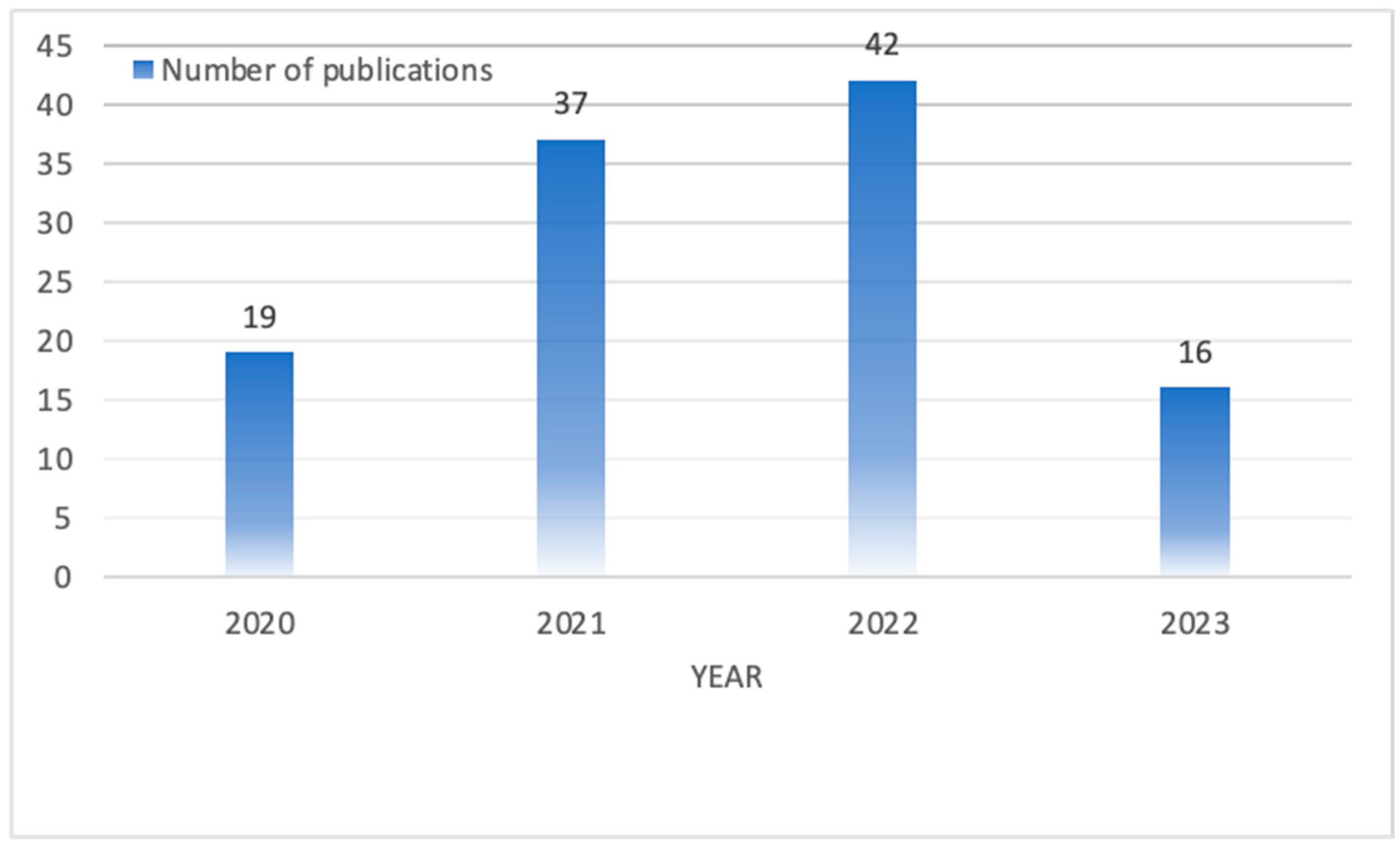




| Description | Results |
|---|---|
| Period | From 2020 to 2023 (Until 25 April 2023) |
| Number of publications | 114 |
| Sources (Journals) | 62 |
| Authors | 319 |
| Average number of citations per document | 12.29 |
| References | 7428 |
| Keywords plus | 378 |
| Author keywords | 432 |
| Authors of single-author documents | 13 |
| Single-author documents | 14 |
| Co-authors per document | 3.01 |
| Index of international cooperation | 30.7 |
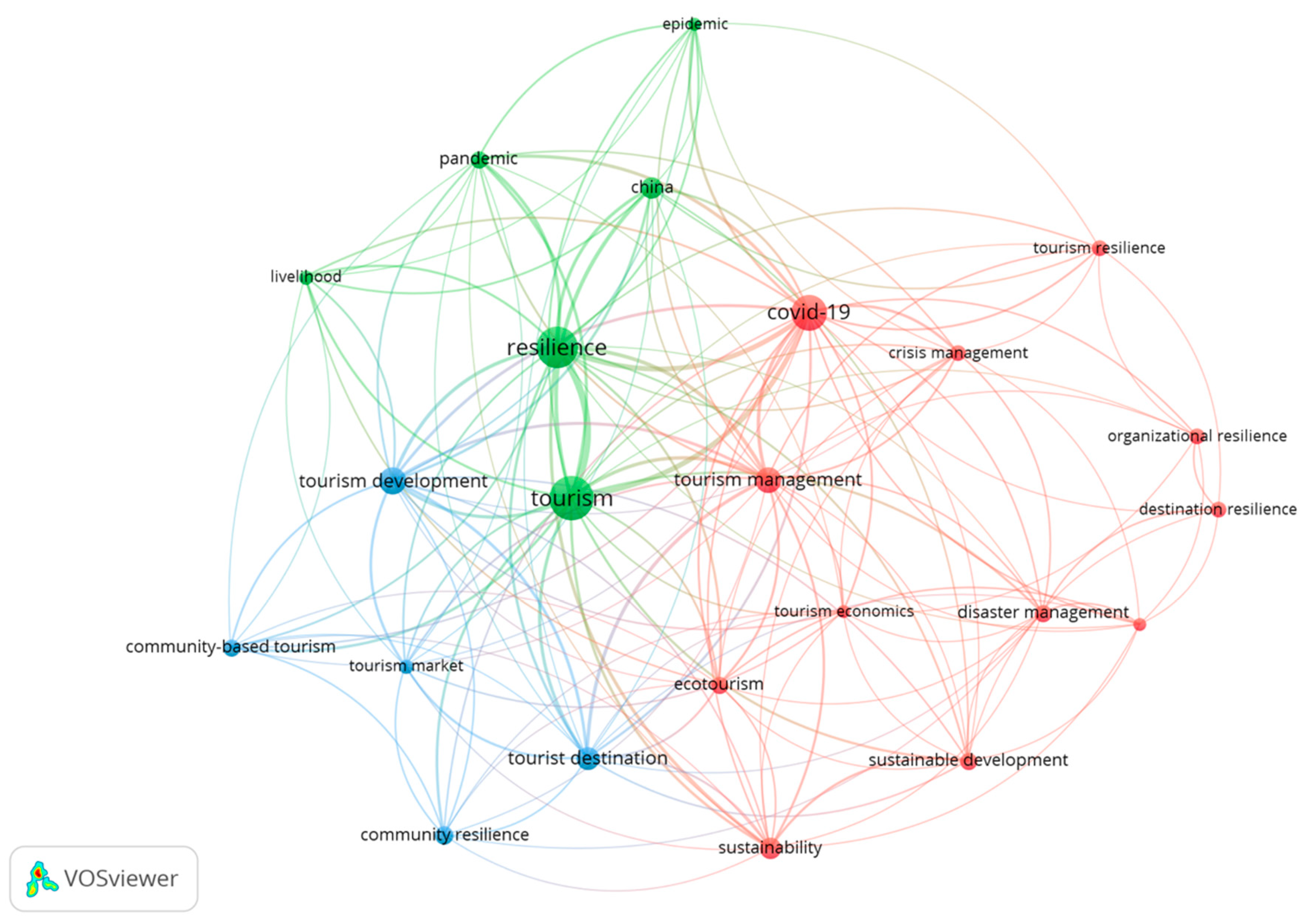
| Clusters | Theme | Articles Included | Keywords | Occurrence | The Strength of Links |
|---|---|---|---|---|---|
| Cluster 1: red | Sustainable resilience | [45,46,47,48,49], [9,50,51,52,53,54], [55,56,57,58,59,60], [14,15,61,62,63,64,65], [16,18,66,67,68,69,70], [10,71,72,73,74,75,76], [17,77,78,79,80,81,82], [83,84,85,86,87] | COVID-19 | 35 | 99 |
| tourism management | 18 | 71 | |||
| sustainability | 13 | 37 | |||
| sustainable development | 9 | 24 | |||
| ecotourism | 8 | 29 | |||
| disaster management | 8 | 21 | |||
| tourism resilience | 7 | 14 | |||
| organizational resilience | 7 | 9 | |||
| destination resilience | 7 | 8 | |||
| crisis management | 7 | 23 | |||
| tourism economics | 5 | 19 | |||
| sustainable tourism | 5 | 14 | |||
| Cluster 2 green | livelihood resilience | [20,21,88,89] [90,91,92,93,94], [95,96,97,98,99], [2,100,101,102,103], [28,104,105,106], [107,108,109,110], [111,112,113,114], [43,115,116], [117,118,119,120], [121,122,123,124] | tourism | 53 | 128 |
| resilience | 48 | 154 | |||
| China | 13 | 38 | |||
| pandemic | 9 | 37 | |||
| epidemic | 5 | 23 | |||
| livelihood | 6 | 23 | |||
| Cluster 3 blue | Community resilience | [125,126,127,128,129], [130,131,132,133], [134,135,136,137], [138,139,140,141,142], [143,144]. | tourism development | 20 | 64 |
| tourist destination | 14 | 51 | |||
| community resilience | 10 | 20 | |||
| community-based tourism | 9 | 21 | |||
| tourism market | 6 | 27 |
| Title of the Journal | Percentage of Contribution | h_Index | m_Index | Citations | Quartille | Publisher |
|---|---|---|---|---|---|---|
| SUSTAINABILITY (SWITZERLAND) | 16% | 7 | 1.75 | 106 | Q1 | MDPI |
| TOURISM GEOGRAPHIES | 5% | 4 | 1.33 | 52 | Q2 | Taylor & Francis Group |
| CURRENT ISSUES IN TOURISM | 4% | 4 | 1.25 | 252 | Q1 | Current Issues in Tourism |
| TOURISM MANAGEMENT | 3% | 3 | 1.00 | 42 | Q1 | Elsevier |
| TOURISM MANAGEMENT PERSPECTIVES | 3% | 3 | 0.75 | 351 | Q2 | Elsevier |
| ANNALS OF TOURISM RESEARCH EMPIRICAL INSIGHTS | 2% | 3 | 1.50 | 16 | Q1 | Elsevier |
| JOURNAL OF HOSPITALITY AND TOURISM MANAGEMENT | 2% | 2 | 1.00 | 54 | Q1 | Elsevier |
| JOURNAL OF SUSTAINABLE TOURISM | 2% | 3 | 0.75 | 57 | Q1 | Taylor & Francis Group |
| LAND | 2% | 1 | 3.90 | 15 | Q3 | MDPI |
| WORLDWIDE HOSPITALITY AND TOURISM THEMES | 2% | 2 | 0.66 | 17 | Q3 | Emerald Group Publishing Ltd. |
| Publication (Type of Publication) | Title of the Journal | Year of Publication | Citations | Citations per Year: | Total Normalized Citations | Reference |
|---|---|---|---|---|---|---|
| Reviving tourism industry post-COVID-19: A resilience-based framework (article) | Tourism Management Perspectives | 2021 | 314 | 104.67 | 15.70 | [45] |
| Responses to COVID-19: The role of performance in the relationship between small hospitality enterprises’ resilience and sustainable tourism development (article) | International Journal of Hospitality Management | 2021 | 122 | 40.67 | 6.10 | [46] |
| Psychological resilience, organizational resilience and life satisfaction in tourism firms: insights from the Canterbury earthquakes (article) | Current Issues in Tourism | 2020 | 89 | 22.25 | 4.43 | [47] |
| Time for Reset? COVID-19 and Tourism Resilience (article) | Tourism Review International | 2020 | 83 | 20.75 | 4.13 | [145] |
| Tourism and Hospitality industry resilience during the COVID-19 pandemic: Evidence from England (article) | Current Issues in Tourism | 2022 | 67 | 33.50 | 11.97 | [21] |
| Social capital: An investment towards community resilience in the collaborative natural resources management of community-based tourism schemes (article) | Tourism Management Perspectives | 2020 | 36 | 9.00 | 1.79 | [125] |
| The adaptive resilience of living cultural heritage in a tourism destination (article) | Journal of Sustainable Tourism | 2020 | 33 | 8.25 | 1.64 | [126] |
| Reimagining resilience: COVID-19 and marine tourism in Indonesia (article) | Current Issues in Tourism | 2020 | 31 | 10.33 | 1.55 | [48] |
| Community eco-tourism in rural Peru: Resilience and adaptive capacities to the COVID-19 pandemic and climate change (article) | Journal of Hospitality and Tourism Management | 2021 | 29 | 9.67 | 1.45 | [127] |
| Tourism Potentials in Post-COVID19: The Concept of Destination Resilience for Advanced Sustainable Management in Tourism (article) | Tourism Planning & Development | 2023 | 25 | 25.00 | 9.09 | [49] |
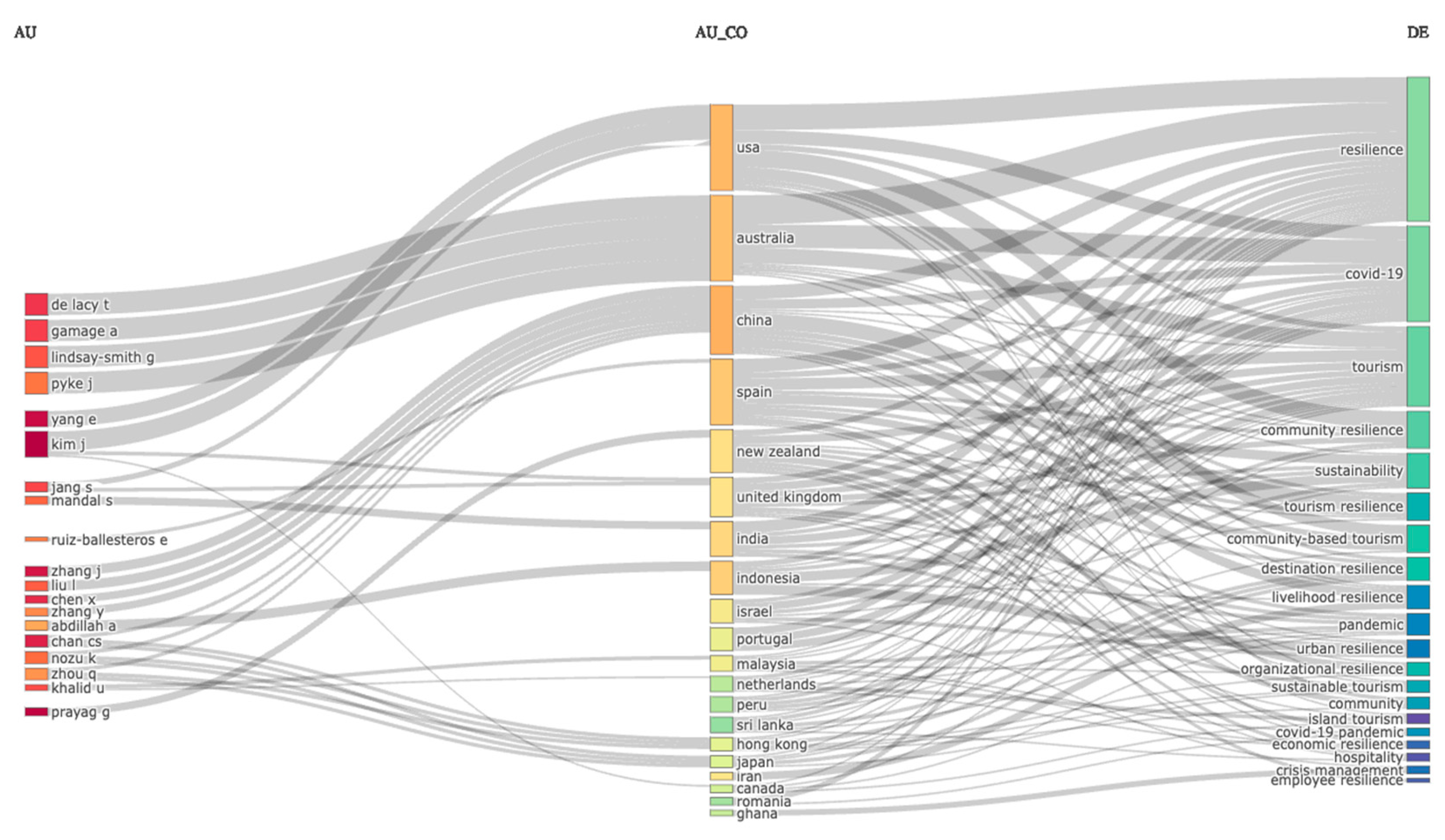
| Authors | Articles | Co-Written Articles |
|---|---|---|
| Kim | 5 | 1.92 |
| Prayag | 3 | 2.25 |
| Yang | 3 | 1.08 |
| Zhang | 3 | 1.45 |
| Chan | 2 | 0.67 |
| Chen | 2 | 0.75 |
| De Lacy | 2 | 0.34 |
| Gamage | 2 | 0.34 |
| Jang | 2 | 0.83 |
| Khalid | 2 | 0.67 |
| Countries | Articles |
|---|---|
| CHINA | 21 |
| UNITED STATES | 17 |
| SPAIN | 13 |
| UNITED KINGDIM | 9 |
| AUSTRALIA | 9 |
| INDONISIA | 8 |
| NEW ZELAND | 8 |
| MALAYSIA | 5 |
| INDONISIA | 5 |
| INDIA | 5 |
Disclaimer/Publisher’s Note: The statements, opinions and data contained in all publications are solely those of the individual author(s) and contributor(s) and not of MDPI and/or the editor(s). MDPI and/or the editor(s) disclaim responsibility for any injury to people or property resulting from any ideas, methods, instructions or products referred to in the content. |
© 2023 by the authors. Licensee MDPI, Basel, Switzerland. This article is an open access article distributed under the terms and conditions of the Creative Commons Attribution (CC BY) license (https://creativecommons.org/licenses/by/4.0/).
Share and Cite
Lamhour, O.; Safaa, L.; Perkumienė, D. What Does the Concept of Resilience in Tourism Mean in the Time of COVID-19? Results of a Bibliometric Analysis. Sustainability 2023, 15, 9797. https://doi.org/10.3390/su15129797
Lamhour O, Safaa L, Perkumienė D. What Does the Concept of Resilience in Tourism Mean in the Time of COVID-19? Results of a Bibliometric Analysis. Sustainability. 2023; 15(12):9797. https://doi.org/10.3390/su15129797
Chicago/Turabian StyleLamhour, Oumaima, Larbi Safaa, and Dalia Perkumienė. 2023. "What Does the Concept of Resilience in Tourism Mean in the Time of COVID-19? Results of a Bibliometric Analysis" Sustainability 15, no. 12: 9797. https://doi.org/10.3390/su15129797
APA StyleLamhour, O., Safaa, L., & Perkumienė, D. (2023). What Does the Concept of Resilience in Tourism Mean in the Time of COVID-19? Results of a Bibliometric Analysis. Sustainability, 15(12), 9797. https://doi.org/10.3390/su15129797