


Built Environment and Wellbeing—Standards, Multi-Criteria Evaluation Methods, Certifications
Abstract
:1. Introduction
2. Methods
3. Discussion
3.1. IEQ Evaluation According to Social Sustainability in WELL V2 Pilot Q1
3.2. Social IEQ Evaluation in LEED v4.1 O + M
3.3. Social IEQ Evaluation in BREEAM In-Use v6
4. Baukultur Criteria in the Declaration of Innsbruck vs. Evaluation Methods
5. Conclusions
Funding
Institutional Review Board Statement
Informed Consent Statement
Conflicts of Interest
References
- Dorizas, P.V.; De Groote, M.; Volt, J. The Inner Value of a Building—Linking Indoor Environmental Quality and Energy Performance in Building Regulation; Buildings Performance Institute Europe (BPIE): Bruxelles, Belgium, 2018; pp. 154–196. [Google Scholar]
- BS EN 16798-1:2019; Energy Performance of Buildings—Part 1: Indoor Environmental Input Parameters for Design and Assessment of Energy Performance of Buildings Addressing Indoor Air Quality, Thermal Environment, Lighting and Acoustics; BSI: London, UK, 2019.
- De Giuli, V.; Da Pos, O.; De Carli, M. Indoor Environmental Quality and pupil perception in Italian primary schools. Build. Environ. 2012, 34, 549–561. [Google Scholar] [CrossRef]
- De Dear, R.J.; Brager, G.S. Developing an adaptive model of thermal comfort and preference. ASHRAE Trans. 1998, 104, 145–167. [Google Scholar]
- Frontczak, M.; Wargocki, P. Literature survey on how different factors influence human comfort in indoor environments. Build. Environ. 2011, 46, 922–937. [Google Scholar] [CrossRef]
- Fanger, P.O. What is IAQ? Indoor Air 2006, 16, 47–56. [Google Scholar] [CrossRef] [PubMed]
- Norman, D. The Design of Everyday Things: Revised and Expanded Edition; Basic Books: New York, NY, USA, 2013; p. 8. [Google Scholar]
- Acampa, G. Linee guida delle politiche europee: Requisiti qualitativi e criteri di valutazione dell’architettura. SIEV Valori Valutazioni 2019, 23, 47–56. [Google Scholar]
- Reed, R.; Wilkinson, S.; Bilos, A.; Schulte. A comparison of international sustainable building tools. In Proceedings of the 17th Annual Pacific Rim Real Estate Conference, Gold Coast, Australia, 16–19 January 2011. [Google Scholar]
- Attaianese, E.; Acierno, A. La progettazione ambientale per l’inclusione sociale: Il ruolo dei protocolli di certificazione ambientale. TECHNE J. Technol. Archit. Environ. 2017, 14, 76–87. [Google Scholar]
- International WELL Building Institute. WELL Building Standard: WELL Certification v2™ Pilot. 2020. Available online: https://v2.wellcertified.com/v/en/overview (accessed on 25 November 2021).
- Altomonte, S.; Schiavon, S.; Kent, M.G.; Brager, G. Indoor environmental quality and occupant satisfaction in green-certified buildings. Build. Res. Inf. 2017, 47, 255–274. [Google Scholar] [CrossRef] [Green Version]
- Guldager Jensen, K.; Birgisdottir, H. (Eds.) Guide to Sustainable Building Certifications; Statens Byggeforskningsinstitut, SBi: Aalborg, Denmark, 2018; pp. 154–196. [Google Scholar]
- International WELL Building Institute. People + Planet Applying LEED and The WELL Building Standard. Strategies for Interiors, New Buildings and Existing Buildings Seeking Dual Certification. LEED Crosswalk. 2020. Available online: https://a.storyblok.com/f/52232/x/202a35bb61/leed-crosswalk-with-q4-2020-addenda.pdf (accessed on 1 December 2021).
- U.S. Green Building Council. LEED v4.1 Operations and Maintenance. 2019. Available online: https://www.usgbc.org/resources/leed-v41-om-beta-guide (accessed on 1 December 2021).
- Building Research Establishment. BREEAM In-Use International Technical Manual: Residential V6.0. 2020. Available online: https://byggalliansen.no/wp-content/uploads/2020/10/SD243_BREEAM-In-Use-International_Residential-Technical-Manual-V6.pdf (accessed on 3 November 2021).
- Architect’s Council of Europe (ACE). Statement Presented on 4 May 2019 in Innsbruck (Austria) on the Occasion of the ACE Conference “How to Achieve Quality in the Built Environment: Quality Assurance Tools and Systems”. 2019. Available online: https://www.ace-cae.eu/fileadmin/New_Upload/_15_EU_Project/Creative_Europe/Conference_Quality_2019/Inn_Stat_EN_FINAL.pdf (accessed on 3 November 2021).
- ASHRAE/ANSI Standard 55-2013; Thermal Environmental Conditions for Human Occupancy; American Society of Heating, Refrigerating, and Air-Conditioning Engineers: Atlanta, GA, USA, 2013.
- BS EN ISO 7730:2005; Ergonomics of the Thermal Environment–Analytical Determination and Interpretation of Thermal Comfort Using Calculation of the PMV and PPD Indices and Local Thermal Comfort Criteria; BSI: London, UK, 2005.
- BS EN 15251:2007; Indoor Environmental Parameters for Design and Assessment of Energy Performance of Buildings, Addressing Indoor Air Quality, Thermal Environment, Lighting and Acoustics; BSI: London, UK, 2007.
- BS EN 12464-1:2011; Light and Lighting; Lighting of Work Places—Indoor Work Places; BSI: London, UK, 2011.
- 8995-1:2002 (CIE S 008/E: 2001); Lighting of Work Places—Part 1: Indoor; International Organization for Standardization (ISO): Geneva, Switzerland, 2002.
- ANSI/ASHRAE Standard 62.2-2016; Ventilation for Acceptable Indoor Air Quality in Residential Buildings; American National Standards Institute: New York, NY, USA, 2016.
- BS EN 16247-2:2014; Energy Audits—Part 2: Buildings; BSI: London, UK, 2014.
- ISO 11665-4:2012; Measurement of Radioactivity in the Environment—Air: Radon-222—Part 4: Integrated Measurement Methods for Determining Average Activity Concentration Using Passive Sampling and Delayed Analysis; International Organization for Standardization (ISO): Geneva, Switzerland, 2012.
- European Ministers of Culture. Davos Declaration Towards a High-Quality Baukultur for Europe, Office Fédéral de la Culture Section Patrimoine Culturel et Monuments Historiques. 2018. Available online: https://davosdeclaration2018.ch/media/Brochure_Declaration-de-Davos-2018_WEB_2.pdf (accessed on 1 December 2021).
- Niglio, O. Baukultur e la Dichiarazione di Davos 2018. Per un Dialogo tra Culture. EDA, Esempi di Architettura. 2018. Available online: http://www.esempidiarchitettura.it/sito/journal_pdf/PDF%202018/55.%20Niglio_Baukultur_EdA_2018_2.pdf (accessed on 1 December 2021).
- Rebuild Italia. Green Building: Valori e Tendenze. Ricerca Promossa da Rebuild Italia e Condotta in Collaborazione con CBRE ITALIA e GBCI EUROPE. 2018. Available online: https://www.rebuilditalia.it/it/MS/green-building-valori-e-tendenze/ (accessed on 3 November 2021).
- Bentivegna, V. Gli aspetti relazionali della qualità dell’opera di architettura. SIEV Valori Valutazioni 2019, 23, 23–29. [Google Scholar]
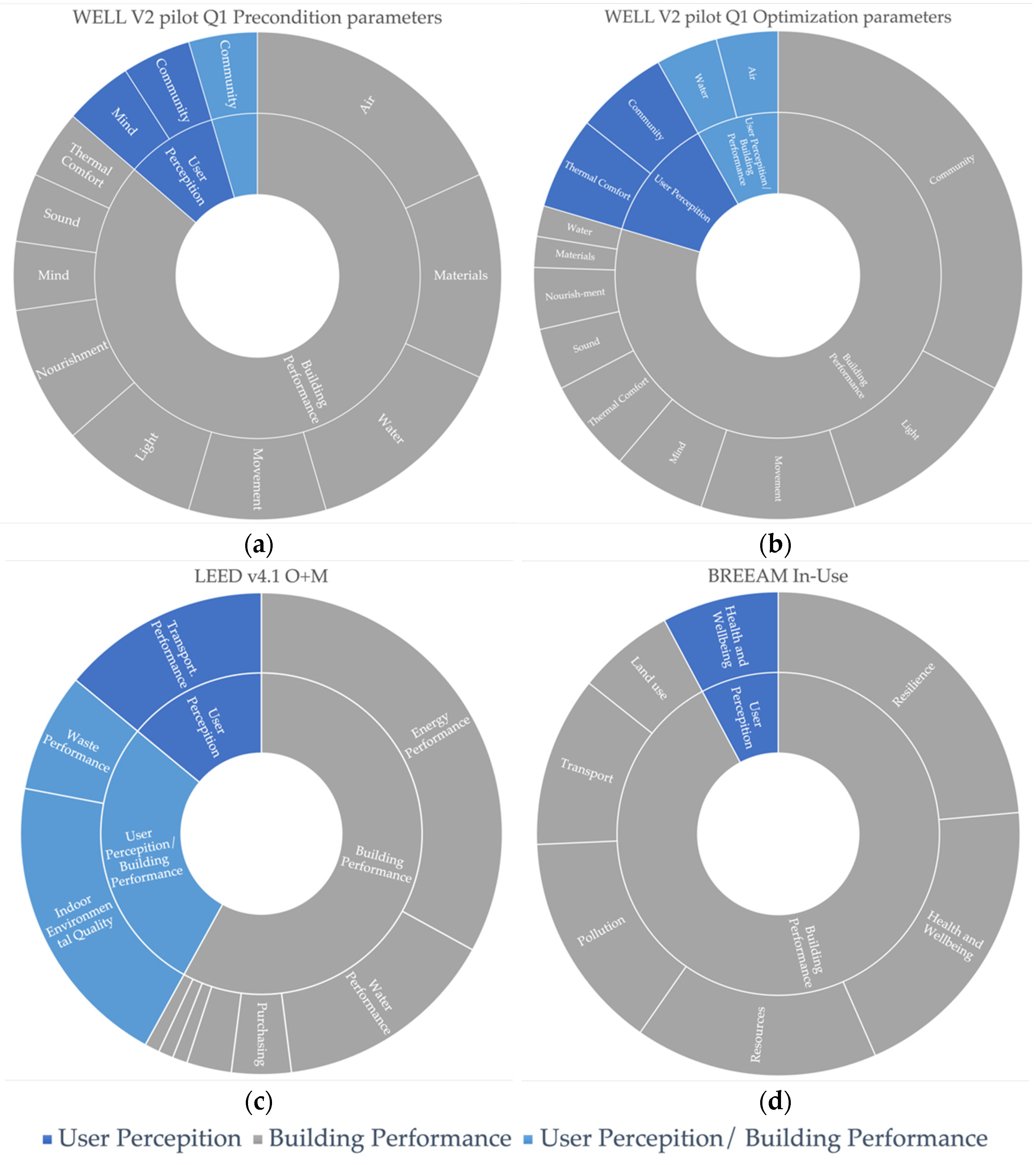

| Env. Cat. | WELL Issue | AIM | Assessment Criteria | PB/UP * |
|---|---|---|---|---|
| Air | A01 Fundamental Air Quality | Ensure a basic level of indoor air quality that contributes to users’ health and well-being. | Monitoring of fundamental Air Parameters (Particulate matter, organic and inorganic gases, radon) | BP |
| A02 Smoke-Free Environment | Deter smoking, minimize occupant exposure to second-hand smoke and reduce smoke pollution. | Prohibition of smoking and e-cigarettes in indoor spaces and on all decks, patios, balconies, rooftops and outdoor galleries. | BP | |
| A03 Ventilation Effectiveness | Prevent indoor air quality issues through the provision of adequate ventilation. | Use of mechanical or natural ventilation in compliance with: EN 15251:2007 [19] or ASHRAE 62.2-2016 [23]. | BP | |
| A04 Construction Pollution Management | Minimize the introduction of construction-related pollutants into indoor air and protect building products from degradation. | Verification the indoor air quality protect strategies during building renovation such as envelope protection, moisture and dust management, filter replacement, air flush, etc. | BP | |
| Water | W01 Fundamental Water Quality | Limit the presence of sediment and water-borne bacteria levels in water for human contact. | Performance Test of turbidity and coliforms. The water contaminants are monitored at least once per year. | BP |
| W02 Water Contaminants | Provide access to drinking water that complies with health-based limits on contaminants. | Performance Test of dissolved metal, organic pollutant, herbicide and pesticide, fertilizer, water additive. The water contaminants are monitored once per year. | BP | |
| W03 Legionella Control | Establish an effective management program that prevents or adequately controls the risk of exposure to Legionella bacteria. | Verification of the presence of a Legionella Management Plan. | BP | |
| Nourishment | N01 Fruits and Vegetables | Promote the consumption of fruits and vegetables by making fruits and vegetables easily accessible. | Photographic Verification if fruits and vegetables are sold or provided on a daily basis within project boundary. | BP |
| N02 Nutritional Transparency | Help individuals make informed food consumption choices through nutritional labeling and information. | Clear display of nutritional information and Ingredient (per meal or item) at point-of-decision on packaging. | BP | |
| Light | L01 Light Exposure and Education | Provide access to indoor light exposure and light education. | Verification by Architectural Drawing if spatial daylight autonomy is achieved for at least 30% of the space. Transparent envelope glazing area should be less than 7% of the floor area. Visible light transmittance (VLT) of envelope glazing is greater than 40%. | BP |
| L02 Visual Lighting Design | Provide visual comfort and enhance acuity for all users through electric lighting. | Verification of the compliance of all indoor and outdoor spaces with illuminance recommendations specified in: EN 12464-1: 2011 [20], ISO 8995-1:2002 [21]. | BP | |
| Movement | V01 Active Buildings and Communities | To promote movement, physical activity and active living through the design of built spaces. | Verification of the presence of physical activity spaces and equipment. | BP |
| V02 Visual and Physical Ergonomics | Reduce physical strain and injury, improve ergonomic comfort and workplace safety and general well-being through ergonomic design and education. | Verification of user-appropriateness of education, workstations and type of work being carried out in the space. | BP | |
| Thermal Comfort | T01 Thermal Performance | Ensure that the majority of building users find the thermal environment acceptable. | Verification of the compliance of the heating system with minimum temperature requirements from ASHRAE 55:2013 [17], ISO 7730:2005 [18] or EN 15251:2007 [19]. | BP |
| Sound | S01 Sound Mapping | Incorporate strategic planning and mitigation required to prevent general issues of acoustical disturbance from both externally and internally generated noise. | Provision of an architectural drawing that indicates the projected background noise level (dBA or NC) and the acoustical performance of walls. | BP |
| Materials | X01 Fundamental Material Precautions | Reduce or eliminate human exposure to building materials known to be hazardous. | Verification of the absence of asbestos, mercury and lead in materials. | BP |
| X02 Hazardous Material Abatement | Reduce or eliminate human exposure to hazardous material ingredient by products from renovation, repair or demolition work. | Verification of the presence of asbestos, polychlorinated biphenyl and lead risk management strategies. | BP | |
| X03 Exterior Materials and Structures | Mitigate environmental contamination and associated hazards resulting from treated outdoor structures and wood-plastic materials. | Examination of the quantity of lead in any synthetic grass and paints. | BP | |
| Mind | M01 Mental Health Promotion | Promote mental health and well-being through a commitment to mental health education, programming and initiatives. | Verification of the presence of educational materials or measures (survey and focus group) to support the mental health of users. | UP |
| M02 Access to Nature | Support occupant well-being by incorporating the natural environment through interior and exterior design. | Verification of the integration and encouragement of occupant access to nature within the project boundary | BP | |
| Community | C01 Health and Well-Being Awareness | Promote a deeper understanding of factors that impact human health and well-being. | Verification of the provision of a digital and/or physical library of health and wellness educational materials to all occupants | BP |
| C02 Integrative Design | Facilitate a collaborative development process and ensure adherence to collective well-being goals. | Verification of the engagement of stakeholders upon point of registration in project planning, of the incorporation of cultural celebration in common spaces, and of the presence of a document detailing project’s health-oriented mission produced in consultation with stakeholders. | BP/UP | |
| C03 Occupant Survey | Establish minimum standards for the evaluation of experience and self-reported health and well-being of building occupants. | Feedback collection from building users on their health and well-being and on topics related to WELL. | UP |
| Env. Cat. | WELL Issue | Assessment Criteria | Weight | PB or UP * |
|---|---|---|---|---|
| Air | A08 Air Quality Monitoring and Awareness | Monitoring of indoor air quality issues as well as information and education of individuals through educational training and a digital or physical library that includes data on the impact of indoor air quality on human health. | 2% | BP/UP |
| Water | W05 Water Quality Consistency | Testing of water quality parameters; the results are made available to occupants through visual displays, prominently located near sources of drinking water and on a website accessible to occupants. | 2% | BP/UP |
| W09 β Onsite Non-Potable Water Reuse | Provision of visual signals for occupants, to help them distinguish potable from non-potable water as well as informative displays to highlight safety features and conservation goals of the non-potable water system. | 1% | BP | |
| Nourishment | N07 Nutrition Education | Individual nutrition consultations by certified nutrition professionals on a quarterly basis, at minimum. Educational materials that promote healthy eating and nutrition. | 1% | BP |
| N12 Food Production | Training or educational opportunities for regular occupants (e.g., gardening workshops, plant harvesting guidelines). Provision of planting supplies, watering system and gardening tools. | 1% | BP | |
| Light | L04 Glare Control | Shading control by the occupants, where all shades can be raised either manual or automatically. | 3% | BP |
| L08 Occupant Control of Lighting Environments | Tunable and automated light systems, to meet the circadian and visual requirements of the occupants. Regular occupants’ control of light levels, color temperature and color of electric light in their immediate environment. | 3% | BP | |
| Movement | V06 Physical Activity Opportunities | Age- and ability-appropriate physical activity/exercise opportunities, led by a qualified professional, are offered, either in-person or virtually at no cost. | 2% | BP |
| V08 Physical Activity Spaces and Equipment | Presence of a dedicated physical activity space (green space, recreational field or court, fitness center, play space geared toward children) per dwelling unit. | 2% | BP | |
| V09 Exterior Active Design | Projects provide an outdoor plaza or similar open-air space or a walking path or trail that can be used year-round and contains seating, provides access to daylight. | 1% | BP | |
| Thermal Comfort | T02 Enhanced Thermal Performance | Implementation of a post occupancy survey at least twice a year. The survey includes an assessment of overall satisfaction with thermal performance and identification of thermal comfort-related issues. | 3% | UP |
| T03 Thermal Zoning | Control over temperature by all regular occupants through either thermostats located in each thermal zone or digital interface on pc or smartphone. | 2% | BP | |
| T06 Thermal Comfort Monitoring | Real-time display of dry-bulb temperature and relative humidity is made available to occupants through one monitor screen or website or phone application. | 1% | BP | |
| Materials | X14 Material Transparency | Provision of a digital or physical library to occupants on compliant products as part of the resource library required. The library is prominently displayed and easily accessible to occupants. | 1% | BP |
| X15 Contact Reduction | Establishment and communication of rules and expectations for the usage and cleaning of shared tools and devices for all regular occupants. | 2% | BP | |
| Mind | M07 Restorative Spaces | Presence of a designated indoor or outdoor space within the project boundary that is exclusively for contemplation, relaxation and restoration, with a minimum of 7 m2 per regular occupant. | 2% | BP |
| M09 Enhanced Access to Nature | Access to proximate nature that incorporates nature through interior and exterior design, nature views. | 1% | BP | |
| Community | C04 Enhanced Occupant Survey | Annual Stakeholder interviews, focus groups and/or observation annually to discuss building features and wellness initiatives and their impacts on occupant health and well-being. | 3% | UP |
| C07 Community Immunity | Information on how the project facilitates vaccine availability is regularly provided to occupants. Regular occupants are encouraged and educated to receive the vaccine. | 2% | BP | |
| C11 Civic Engagement | Communication of reminders to residents, to vote in local and national elections, including instructions on how to determine their voting station. | 1% | BP | |
| C13 Accessibility and Universal Design | Space optimization with universal design requirements to meet occupant needs related to: safety, developmental and intellectual health, wayfinding, inclusion, technology. | 3% | BP | |
| C15 Emergency Preparedness | Presence of an emergency management plan in the case of emergency situations within the building or surrounding community and educational resources are made available to all regular occupants. | 3% | BP | |
| C16 Community Access and Engagement | Shared, flexible public space for use by the surrounding community, and to offer programming that engages local individuals in managing or utilizing the space in diverse ways. | 1% | BP | |
| C17 Housing Equity | Designation of affordable housing units and housing cost reduction for low-income tenants. | 3% | BP | |
| C18 Emergency Resilience and Recovery | Availability of an outdoor or indoor space for emergency responders and presence of a shelter-in-place plan for emergencies in case occupants cannot leave the building. Projects located in a region with heightened risk of infectious respiratory disease transmission require proof of vaccination and face masks worn indoors. | 3% | BP |
| Env. Cat. | LEED Issue | AIM | Assessment Criteria | Weight | PB/UP * |
|---|---|---|---|---|---|
| Location and Transp. (14%) | LT Transport. Performance | Reduce pollution and land development effects from transportation. | Regular occupants’ survey regarding their two-way commutes over one work week. The survey must be carried out at least once per year. | 14% | UP |
| Water Effic. (15%) | WE Water Performance | Support water management and reduce water consumption. | Permanent installation of water meters that measure the total potable water use. Measurement of total potable water use on a monthly basis for twelve consecutive months. | 15% | BP |
| Energy and Atmosphere (34%) | EA. 1 Energy Efficiency Best Management Practices | Promote continuity of information to ensure that energy-efficient operating strategies are maintained. | Energy audit to verify that the operations and maintenance plan meet the requirements of the ASHRAE preliminary energy use analysis or EN 16247-2:2014 [24]. | Required | BP |
| EA.2 Fundamental Refrigerant Management | Reduce stratospheric ozone depletion. | Confirmation that no CFC-based refrigerants are included in any new mechanical cooling and that comprehensive phase-out plan for CFC-based refrigerants is in place. Confirmation that refrigerant leakage rate has been met. | Required | BP | |
| EA.3 Energy Performance | Support energy management and reduce environmental and economic harms associated with excessive energy use. | Permanent installation of energy meters or submeters for the measurement of total building energy consumption. Measurement of greenhouse gas emissions and source energy for twelve consecutive months. | 33% | BP | |
| EA.4 Enhanced Refrigerant Management | Eliminate ozone depletion and minimize direct contributions to climate change. | Option 1: Verification of the absence of refrigerants or of the use of low-impact refrigerants. Option 2: Calculation of the impact of refrigerants used in heating, ventilating, air-conditioning, and refrigeration equipment. | 1% | BP | |
| Materials and Resources (12%) | MR.1 Purchasing Policy | Reduce the environmental harm from purchased materials and products. | Establishment of an environmentally preferable purchasing (EPP) policy for materials and products purchased for the project during regular operations. | Required | BP |
| MR.2 Facility Maintenance and Renov. Policy | Reduce the environmental harms with purchased and disposed materials. | Establishment of a facility maintenance and renovation policy to be implemented at the discretion of building owners, operators, or tenants. | Required | BP | |
| MR.3 Waste Performance | Track and reduce the waste that is generated by building occupants. | Selection of storage locations for recyclable materials. Measurement of the total weight of waste that is generated, and the total weight that is diverted from landfills and incineration facilities for full year. | 8% | BP/UP | |
| MR.4 Purchasing | Reduce environmental harm from materials and products used and disposed. | Tracking of all ongoing consumable and building materials purchases, to verify if they are recycled, rechargeable, Bio-based, and if they have any certifications such as EPD. | 4% | BP | |
| Indoor Environmental Quality (24%) | EQ. 1 Minimum Indoor Air Quality | Contribute to the building occupants’ comfort and well-being. | Mechanical or natural ventilation of spaces. Measurement of the quantity of outdoor air delivered and of exhaust ventilation rates. | Required | BP |
| EQ.2 Environmental Tobacco Smoke Control | Prevent building occupants’ exposure to environmental tobacco smoke. | Activation of a no-smoking policy, smoking ban in the building or compartmentalization of smoking areas. | Required | BP | |
| EQ.3 Green Cleaning Policy | Reduce levels of chemical, biological, and particulate contaminants. | Activation of a green cleaning policy or a Certified Cleaning Service for the green cleaning procedures, materials, and services that are within the project and site management’s control. | Required | BP | |
| EQ.4 Indoor Environmental Quality Performance | Assess how well the building is performing in terms of indoor air quality and comfort. | Occupant satisfaction survey and/or indoor air quality evaluation. Indoor air measurements in representative locations. | 20% | UP/BP | |
| EQ.5 Green Cleaning | Reduce levels of chemical, biological, and particulate, by implementing effective cleaning procedures. | Routine inspection and monitoring of the facility’s green cleaning policy to verify that the defined strategies are being used and to identify areas in need of improvement. | 3% | BP | |
| EQ.6 Integrated Pest Management | Minimize pest problems and exposure to pesticides. | Implementation of an integrated pest management (IPM) plan or a Certified IPM service for the building and grounds within the project boundary. | 1% | BP | |
| Innovation (1%) | IN Innovation | Encourage projects to achieve exceptional or innovative performance. | Presence of a LEED AP in the project team as a main participant. Achievement of significant environmental performance using a strategy that is not addressed in the rating system. | 1% | BP |
| Env. Cat. | BREEAM Issue | AIM | Assessment Criteria | Weight | PB/UP * |
|---|---|---|---|---|---|
| Health and Wellbeing (17%) | Hea 01 Daylighting | Ensure residents have access to good levels of daylight. | Evaluation of the glazed area to room area ratio, in comparison with minimum performance requirements for the asset’s latitude. | 5.7% | BP |
| Hea 02 Avoiding overheating from solar gain | Recognise and encourage external shading features. | Photographic evidence of external shading features on all windows where there is a risk of overheating. | 5.7% | BP | |
| Hea 03 Internal and external lighting levels | Ensure appropriate lighting to residents. | Measuriment (lux) of the light falling on a surface using calibrated illuminance meters with a photocell that is both colour/spectrally and cosine corrected. | 11.4% | UP | |
| Hea 05 Minimize flicker from lighting systems | Minimise the impact of flicker on asset users. | Visual inspection and verification of technical specifications for the installed lighting. | 5.7% | UP | |
| Hea 06 View out | To evaluate the quality of the external view. | Visual inspection of the adequateness of the view out of the rooms (8 m distant from the surrounding wall, etc.) and a view of a natural outdoor environment. | 11.4% | UP | |
| Hea 07 User comfort control, and maintenance | To recognise the ventilation systems that are easy to control. | Verification of the presence of control tools (manual or automatic) for the ventilation system, regarding ventilation rate and temperature level, and humidity sensors. | 8.6% | BP | |
| Hea 08 Ventilation system air intakes and exhausts | To ensure that the asset’s ventilation system minimizes external sources of air pollution. | Compliance verification of the location of the air intakes with either EU or ANSI/ASHRAE standards; alternatively, verification of minimum 10 m horizontal distance from the pollution sources of other buildings. | 5.7% | BP | |
| Hea 09 Carbon dioxide sensors | Monitor internal conditions to ensure that a healthy indoor environment is provided. | Verification of the presence of sensors that monitor the levels of carbon dioxide in indoor air, of their connection to the ventilation system and of the alert system for the excess of dioxide levels beyond the recommended set point. | 5.7% | BP | |
| Hea 10 Carbon monoxide detection | Protect users from harmful levels of carbon monoxide. | Verification of the presence of a carbon monoxide detection system for the containment of combustion appliances. | 5.7% | BP | |
| Hea 11 Indoor and/or outdoor space | Recognize the provision of outdoor recreational space, promoting community activity. | Verification of the area of recreational indoor and outdoor spaces for residents (min. 25 m2) and private terraces (min. 4 m2 per apartment) | 17.1% | BP | |
| Hea 12 Inclusive design | Recognize and encourage assets that are inclusive for all residents. | Verification of the presence of at least 50% accessibility features. The indicators regard: access, horizontal and vertical circulation, sanitary accommodation, orientation, wayfinding, assistive technologies, inclusive spaces. | 11.4% | BP | |
| Hea 13 Radon risk management | Assess radon exposure risk. | Radon test performance according to ISO 11,665 standard [25] series. | 5.7% | BP | |
| Transport (7%) | Tra 01 Alternative modes of transport | Verify the sustainable transport measures in the proximity of the site. | Verification of the number of compliant electric charging points and of compliant cycle storage facilities. | 39.1% | BP |
| Tra 02 Proximity to public transport | Ensure thar public transport is available to building occupants. | Measurement of the distance of public transport nodes via safe pedestrian routes. | 34.8% | BP | |
| Tra 03 Proximity to amenities | Ensure building users have access to local amenities. | Measurement of the distance of amenities via safe pedestrian routes. | 17.4 | BP | |
| Tra 04 Cyclist safety | Encourage safe access around the site and outdoor space. | Verification of the presence of safe pedestrian routes from the cycle storage to the entrance of the asset. | 8.7 | BP | |
| Resources (10,5%) | Rsc 01 Condition survey | Encourage planned maintenance. | Verification of the implementation of a condition survey within the last 5 years and of the detected defects. | 38.8 | BP |
| Rsc 02 Reuse and recycling facilities | Facilitate the reuse and recycling of waste from the asset. | Verification of the availability of suitable facilities for waste storage from the asset near or within the building and suitable neighbourhood recycling. | 38.8 | BP | |
| Rsc 03 Resources inventory | Enable asset owners from the value of resources. | Verification of the implementation of a resource inventory in a building information model within the last 5 years. | 22.4 | BP | |
| Resilience (14.5%) | Rsl 01 Flood risk assessment | Encourage the identification of flood risk and implement mitigation measures. | Verification of the implementation of a flood risk assessment (FRA) by a relevant authority and acknowledgement of the flood risk level assigned to the asset. | 26.3 | BP |
| Rsl 02 Surface water run-off impact mitigation | Avoid rainfall discharge to public sewers, minimizing on-site flooding. | Verification of the measures to minimise the rate of surface water runoff (Drainage; Permeable surfaces; Infiltration trenches; Green or Blue roofs; etc.) | 10.5 | BP | |
| Rsl 03 Natural hazard risk assessment | Identify natural hazards and recover capacity. | Verification of the implementation of a risk assessment on current natural hazards by a relevant authority. | 21.1% | BP | |
| Rsl 04 Durable and resilient features | Protect exposed elements of the building from pedestrian traffic and external vehicular collision. | Verification of the presence of suitable protection measures (hard-wearing and easily washable floor finishes; bollards, barriers or raised kerbs; robust external wall construction, up to 2 m high). | 21.1% | BP | |
| Rsl 05 Alarm systems | Ensure that alarm systems can prevent damage to property within the asset. | Verification of the presence of fire and intruder alarm systems and of their certification according to a National or International standard. | 21.1% | BP | |
| Land use (4%) | Lue 01 Planted area | Encourage planted areas within the adjacent lot of the asset. | Calculation of the green area footprint and of the percentage of plantations (green walls included). | 57.1% | BP |
| Pollution (9%) | Pol 02 Chemical storage | Reduce the impact of a chemical leak by minimising impact of the building. | Verification of the storage of all hazardous chemicals in areas with containment capacity ≥110% of the chemicals stored. | 12.5% | BP |
| Pol 03 Local air quality | Reduce local air pollution by using no or low-emission heating and hot water systems in the asset. | Comparison of the emissions of nitrogen oxides, particulate matter or volatile organic compounds of the asset’s heating and hot water systems with the limit values (mg/kWh). | 25% | BP | |
| Pol 05 Refrigerant leak detection systems | Reduce level of greenhouse gas by refrigerants leakage. | Verification of the presence of an automated refrigerant leak detection system in place for all equipment. | 25% | BP |
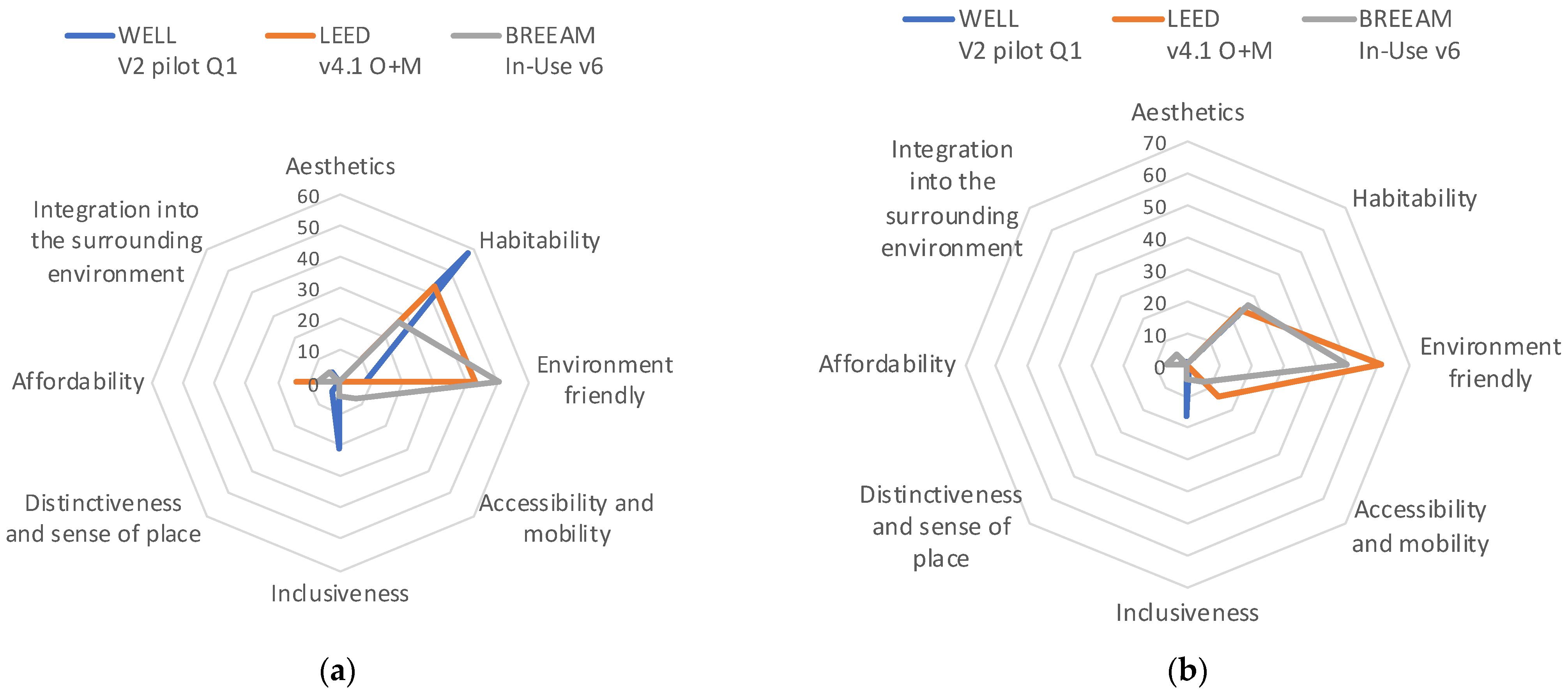
| Criteria | Description | WELL V2 Pilot Q1 | LEED v4.1 O + M | BREEAM In-Use v6 |
|---|---|---|---|---|
| Aesthetics | The place has an artistic dimension; buildings and cities must be beautiful and exciting. | - | - | - |
| Habitability | The place has technical characteristics that make it safe, healthy and comfortable. It is well-maintained and provides a feeling of safety. | A01; A02; A03; A08; W01; W02; W03; W05; W09; N01; N02; N07; N12; L01; L02; L04; L08; T01; T02; T03; T06; S01; X01; X02; X14; X15; C18 | EQ.1; EQ.2; EQ.3; EQ.4; EQ.5; EQ.6 | Hea 01; Hea 02; Hea 03; Hea 05; Hea 06; Hea 07; Hea 08; Hea 09; Hea 10; Hea 13; Rls 01; Rls 02; Rls03; Rls 04; Rls 05 |
| Environment friendly | The place is designed to be low-carbon, energy-efficient and resilient to climate change throughout its life-cycle. | A04; X03 | WE; EA.1; EA.2; EA.3; EA.4; MR.1; MR.3; MR.4 | Rsc 02; Pol 01; Pol 02; Pol 03; Pol 04; Pol 05; Ene 01–18; Wat 01–10 |
| Accessibility and mobility | It is easy to move using public or soft transports (walking, cycling). The distribution of volumes and spaces is straightforward. | V09 | LT | Tra 01; Tra 02; Tra 03; Tra 04 |
| Inclusiveness | The place is designed for all: everyone, regardless of age, gender and ethnicity must feel welcome. | V01; V02; V06; V08; M01; M07; C01; C03; C04; C07; C11; C13; C15; C16 | - | Hea 11; Hea 12 |
| Distinctiveness and sense of place | The place is specific, fitting the local context, has distinctive characteristics and a sense of place. | C02 | IN | - |
| Affordability | There is a strong compatibility of the programme with the place and the budget of the user. | C17 | MR.2 | Rsc 01; Rsc 03 |
| Integration into the surrounding environment | The place is integrated into its built, natural and cultural environment in a harmonious and coherent manner. | M02; M09 | - | Lue 01; Lue 02 |
Publisher’s Note: MDPI stays neutral with regard to jurisdictional claims in published maps and institutional affiliations. |
© 2022 by the author. Licensee MDPI, Basel, Switzerland. This article is an open access article distributed under the terms and conditions of the Creative Commons Attribution (CC BY) license (https://creativecommons.org/licenses/by/4.0/).
Share and Cite
Nicolini, E. Built Environment and Wellbeing—Standards, Multi-Criteria Evaluation Methods, Certifications. Sustainability 2022, 14, 4754. https://doi.org/10.3390/su14084754
Nicolini E. Built Environment and Wellbeing—Standards, Multi-Criteria Evaluation Methods, Certifications. Sustainability. 2022; 14(8):4754. https://doi.org/10.3390/su14084754
Chicago/Turabian StyleNicolini, Elvira. 2022. "Built Environment and Wellbeing—Standards, Multi-Criteria Evaluation Methods, Certifications" Sustainability 14, no. 8: 4754. https://doi.org/10.3390/su14084754
APA StyleNicolini, E. (2022). Built Environment and Wellbeing—Standards, Multi-Criteria Evaluation Methods, Certifications. Sustainability, 14(8), 4754. https://doi.org/10.3390/su14084754

