


Abstract
Building Information Modelling (BIM) for life cycle sustainability assessment is an emerging development considered valuable given its importance in enhancing the environmentally friendly performance of buildings by delivering eco-efficient structures. However, despite its benefits, adoption is low. Thus, this study examines the key drivers of a building’s BIM-based life cycle sustainability assessment. An interpretive structural modelling approach and Matrice d’Impacts croises-multipication applique a classement (MICMAC) analysis were adopted for this study. Nineteen key drivers were categorized into a seven-level ISM model, which revealed that the successful implementation of the driving factors for BIM-based LCSA would increase its adoption and encourage users to be proactive in exploring solutions, exerting best efforts, and advancing its usage. The primary drivers, such as organizational readiness, personal willingness to use, procurement methods, and organizational structure, amongst others, are crucial for discussing BIM-based LCSA adoption strategies and making guidelines and design decisions to guide the process. This paper therefore contributes to the growing discussion on BIM from the viewpoint of an assessment of a building’s life cycle sustainability. The study concludes that organizational, governmental, and institutional support, as well as capacity development, are essential to driving BIM-Based LCSA.
1. Introduction
The significant contributions of the construction sector to the global economy make it critical in enabling resilient and responsive socio-economic growth necessary for human survival. The construction industry, which on average contributes 5 to 10% of worldwide direct and indirect employment and 5 to 15% of global GDP, has the potential to accomplish much more when its systems, processes, and workflows are improved to create sustainable infrastructures [1,2]. Significant among the factors limiting the potential of the built environment to do more in driving socio-economic growth is the negative impact on the environment of its whole life cycle process. As stated by Van Eldik et al. [1], the integration of BIM into the life cycle assessment process is rarely implemented in infrastructure projects, which is critical given how it limits the realization of sustainable development. However, an understanding of what drives the integration of BIM with LCSA is currently lacking, an absence which inhibits the goal of achieving sustainable infrastructure delivery. The whole life cycle of infrastructure delivery is material-consuming. Bianchi et al. [2] state that buildings consume 40% of total world energy, 60 percent of the world’s energy, 25 percent of its water, and 40 percent of all resources produced, while creating approximately a third of the planet’s greenhouse gas emissions. Due to limited resources, various obstacles and difficulties prevent organizations from adopting a BIM approach to life cycle sustainability assessment, although the use of digital technology is expected to result in enhanced sustainable development. Understanding the dynamics that influence the adoption of BIM-based LCSA is crucial for its more effective adoption. The growing interest in the digital transformation of firms in the built environment raises the question of what factors motivate firms to digitalize sustainability assessment through Building Information Modelling (BIM). Thus, this study utilizes an interpretive structural modelling approach to examine and understand the critical forces that drive BIM-based life cycle sustainability assessment in the built environment. The results will be vitally useful in guiding government and institutional policy decisions on the key considerations for prioritizing a BIM-based life cycle sustainability assessment adoption framework.
2. Background to Study
The decision-making process for infrastructure projects is increasingly focusing on sustainability. Globally, sustainable development is understood to mean balancing the requirements of the present with those of the coming generations [3,4]. This has become more critical given the projection by Bianchi et al. [1] that the global material footprint will double by 2060 if the current traditional infrastructure delivery approaches are not made sustainable [3]. This means the construction industry must reshape existing systems, processes, and thinking towards sustainable approaches. While the developed world directs the strategy, developing countries must not only catch up with the times but also actively progress towards mitigating their built environments’ material footprints. The least able to mitigate and survive the effects of climate change-related conditions are developing nations that have large environmental degradation effects [4,5,6]. Onososen and Musonda [7] have argued that environmental considerations are not prioritized in developing countries such as South Africa and Nigeria, which are heavily influenced by the choice of materials for construction, traditional approaches to construction, cultural factors, and weak institutions. A life cycle assessment (LCA) in the construction industry assesses the environmental effects of construction, taking into consideration all impacts from raw material extraction to transportation, building conceptualization, demolition, and disposal of hazardous materials [8,9]. Due to flawed C&DW quantification and insufficient information on building materials and components, the construction industry makes decisions about reuse and recycling that are ineffective [10,11]. Economic development, social development, and environmental protection are the three interrelated pillars of sustainable development on a global scale [1].
2.1. Life Cycle Sustainability Assessment (LCSA)
Planning and integrating design decisions alongside environmental considerations influences and enables the delivery of sustainable infrastructure. More people are using life cycle assessment (LCA) as a quantitative method for evaluating environmental impact [12,13,14]. LCA evaluates the environmental impact of a product, process, or system throughout its entire lifecycle per ISO 14040. Its benefits have been stated in extant studies [11], and the integration of Building Information Modelling is increasingly overcoming its limitations. This encourages its use as a strategy for reducing operational and embodied energy usage during the life cycle stages of a structure. As identified by Soust-Verdaguer et al. [11], combining BIM with LCA was founded on the automatic or semiautomatic collection of the Bill of Material Quantities from the BIM model that was connected to the building life cycle environmental data. In order to enable the editing of building materials and element dimensions in BIM software while automatically providing insight into the environmental effects of the adjustments, the authors created a BIM-based LCA technique. Life cycle analysis (LCA) is now a widely accepted methodology for assessing the performance of a material, product, or building [12,15]. Its application is directed toward ensuring buildings perform well environmentally [2,16]. Based on the sustainability model, LCA was developed as a life cycle sustainability evaluation that takes into account environmental, social, and economic concerns (LCSA). Consequently, the LCSA combines the social life cycle assessment (SLCA) and life cycle cost (LCC). It is challenging to incorporate social factors, building materials, embodied energy, operational energy, and construction and demolition waste into design indices. Integrating the potential of building information modelling (BIM) to drive the process significantly enables the realization of sustainable building in the built environment. Bianchi et al. [1] adopted the use of AHP in a multicriteria decision-making (MCDM) system which utilized AHP to present the decision-making process on integrating LCA and LCSA in alternative building systems by evaluating social interest housing (SIH).
2.2. Integrating Life Cycle Sustainability Assessment(LCSA) and Building Information Modeling (BIM)
Depending on the use it is being put to, BIM is today recognized as both a technique and a technology [13]. BIM is a design technology that makes it easier to use LCSA in the construction industry [15,17]. Despite the potential advantages, gathering the data required for a sustainability evaluation using BIM has not been done very frequently. Right now, BIM is mostly used to support LEED evaluation in the categories of energy and environment, materials, and resources [15]. Given the substantial amount of intricate and time-consuming information required for the process, using BIM has become necessary [1,8]. Crippa et al. [8] mentions that calculating a building’s specific carbon footprint is difficult, and most studies are cradle-to-gate. Only a few cover every stage of the building life cycle, from the extraction of raw materials through transportation, preuse, use, and final disposal. The manual approach in LCA further compounds this problem as it is repetitive and often draws little interest from companies to engage in LCA assessments. This has necessitated the need to integrate BIM in the LCA process, given its ability to allow the incorporation of project-related data into a model, and to represent this data virtually in a collaborative environment. There is still a dearth of research taking into account all facets of sustainability despite the recent trend of employing BIM for sustainability [15]. Combining BIM tools with the LCA technique is viewed as a crucial step in supporting designers in their decision-making processes in the construction industry in terms of the sustainability of building projects. As stated by Bianchi et al. [1], the utilization of resources or plug-ins within the BIM modeling tool itself results in the most advanced level of BIM and LCA integration. The limitations of BIM-LCA tools include the required wide range of data in early-stage design models [9]. Carvalho [15] mentions that existing BIM software still has concerns with sustainability, and exchange format files require more development. Moreover, the established tools and plug-ins are limited in their extension since the BIM-LCA framework lacks a clear data structure [18,19]. With building sustainability predicted to become more integrated as BIM becomes more mature, this study aims to advance the required developments. Crippa et al. [8] developed a methodology for using building information modeling (BIM) and life cycle assessment (LCA) tools to get embodied carbon data. Santos et al. [13] also established a framework to reduce human error and time spent on sustainability studies of the model, simplifying the identification of the construction’s life cycle consequences on the environment and economy and the interoperability of generated solutions. BIM can be integrated with LCSA on three levels to achieve/improve sustainability: (i) LCI data quantification using BIM, (ii) BIM-based environmental information management, and (iii) the development of an automated process based on LCI data and software [20]. According to some studies, BIM integrated with LCSA might be classified as being at the operational stage, which begins the modeling process by optimizing the energy analysis based on the building geometry. The second stage, known as the preoperational stage or “embodied phase,” entails the production and collecting of building materials. This requires the use of LCI databases and size/number databases to compute the embodied energy in architectural pieces (for upstream data) [20].
2.3. Drivers of BIM-Based Life Cycle Sustainability Assessment (LCSA)
The enormous advantages of BIM-based life cycle sustainability assessment (LCSA) make research into its motivators essential. When BIM parametric models are combined with LCSA, designers, architects, engineers, and managers may produce solutions while the project is still in progress, making it more efficient and sustainable [8]. Moreover, a BIM-LCA method can be used in the early stages of a project to take the carbon footprint of the building materials into consideration, as well as to make use of BIM tools to calculate both the energy required and the CO2 emitted during the operating phase of the structures. Government, enterprises, and researchers must therefore pay critical attention to its drivers to obtain practical insights on efforts to promote its adoption. Crippa et al. [8] mention that the actual application of BIM-based life cycle sustainability assessment (LCSA) is becoming a priority for clients and organizations and that the process’s underlying principles are crucial. BIM-based LCA is useful for refurbishing projects in determining the most environmentally friendly scenarios among design possibilities [21,22]. BIM and LCA together are a practical instrument for evaluating the environmental effects of the AEC sector. However, the most challenging components of finishing such investigations are the lack of standardized methodologies and problems with data transfer [21,23]. Table 1 below presents the drivers of BIM-based life cycle sustainability assessment identified in the literature and confirmed by experts.
Table 1.
Drivers of BIM-based life cycle sustainability assessment.
Therefore, this work improves strategies for ensuring infrastructure is provided, run, or repurposed in an environmentally and resource-efficient way. To achieve this, an examination of existing and new projects from a sustainability perspective through integrating BIM with LCSA is encouraged by identifying critical drivers to promote the system. The study is laid out as follows; Section 1 highlights the purpose and goal of this work. The definitions and concepts pertaining to LCSA are explained in Section 2. The research methodology is described in Section 3, and the findings are reported in Section 4. Section 5 offers a discussion and Section 6 concludes the study.
3. Methods
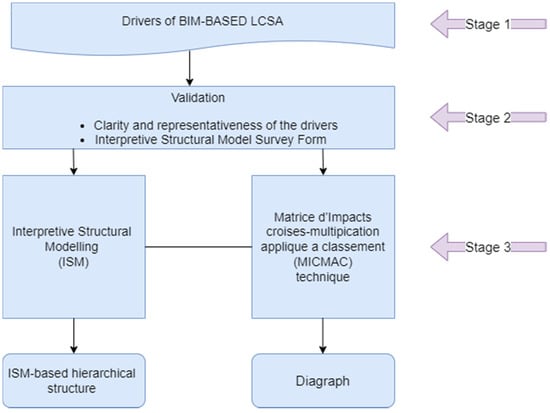
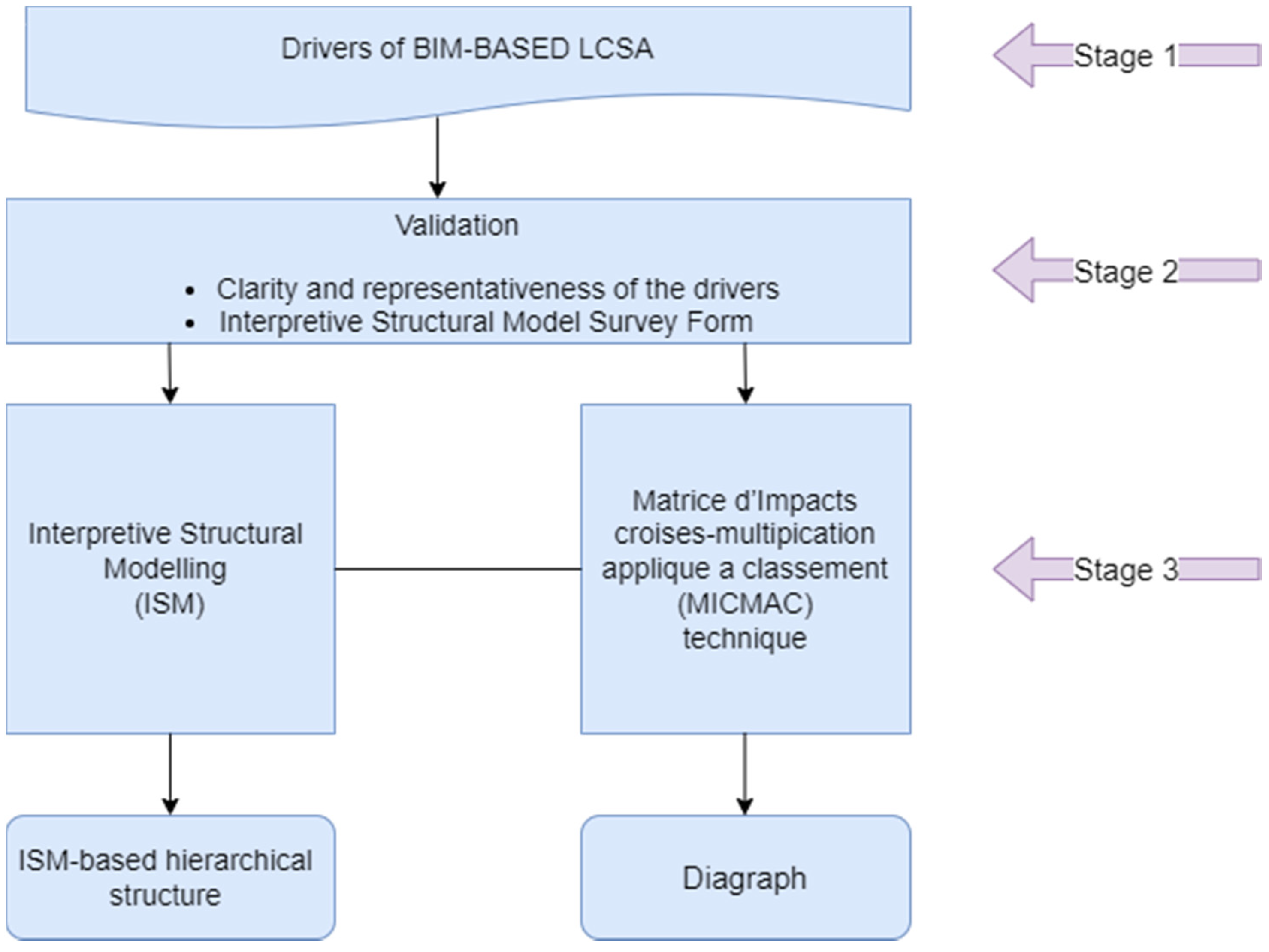
The study engaged in a three-stage process to achieve its objectives. This is presented in Figure 1.
Figure 1.
Research approach for the study as adapted from [40].
Stage 1: The first step of the methodological approach was the identification of the drivers of BIM-based LCSA through a review of extant BIM-based LCSA studies using publications from Scopus, Web of Science, and Google Scholar databases. As stated by Onososen and Musonda [35], Scopus is reputable for its wide coverage, while Web of science has more catalogues of important journals than other databases [36,56]. A critical review approach, which focused on the drivers of BIM-based LCSA identified in the extant publications, incorporated documents from journals, conferences, and book chapters to eliminate bias.
Stage 2: The drivers identified from the literature review process were presented for validation and representativeness in a group discussion with researchers in the life cycle sustainability assessment domain with extensive professional and research experience. The inputs from the discussion were adopted to improve the final ISM survey form.
Stage 3: The interpretive structural modeling (ISM) technique was applied in this work as a resolution strategy. This technique, which was first put forth by J. Warfield in 1973, is useful for handling complicated problems. It makes it possible for individuals or groups to create a map of the intricate connections between the numerous components present in a complex scenario. ISM was developed by Warfield [37] to explain the contextual relationships amongst variables towards ensuring effective systems improvement and implementation. Thus, as stated by Mor et al. [38], the approach requires knowledge and experience from experts in examining complex scenarios and breaking them into multiple subsystems. Furthermore, it was advanced by Warfield [37] to investigate complicated socio-economic systems. It can be used as a scientific technique to identify contextual interfaces between quantifiable components connected to the subject or problem under investigation. As the approach targets quality rather than the number of responses, as small as two knowledgeable and experienced participants are frequently needed [6,57,58]. The approach is group-discussion-oriented and especially adequate for research areas with few experts [40]. Its usage in construction is attributed to its systematic thinking approach and ability to transform ambiguous system models into well-defined models [6,43,59,60,61,62]. Many famous institutions, including NASA, have used it globally. To provide a way for organizing complex problems, ISM combines three modeling languages: words, digraphs, and discrete mathematics. ISM is especially helpful and interpretative since it allows group members who are working on the study to decide whether and how the variables are related [41].
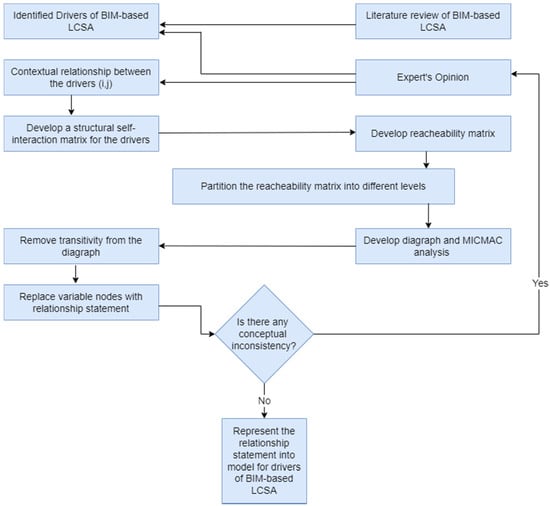
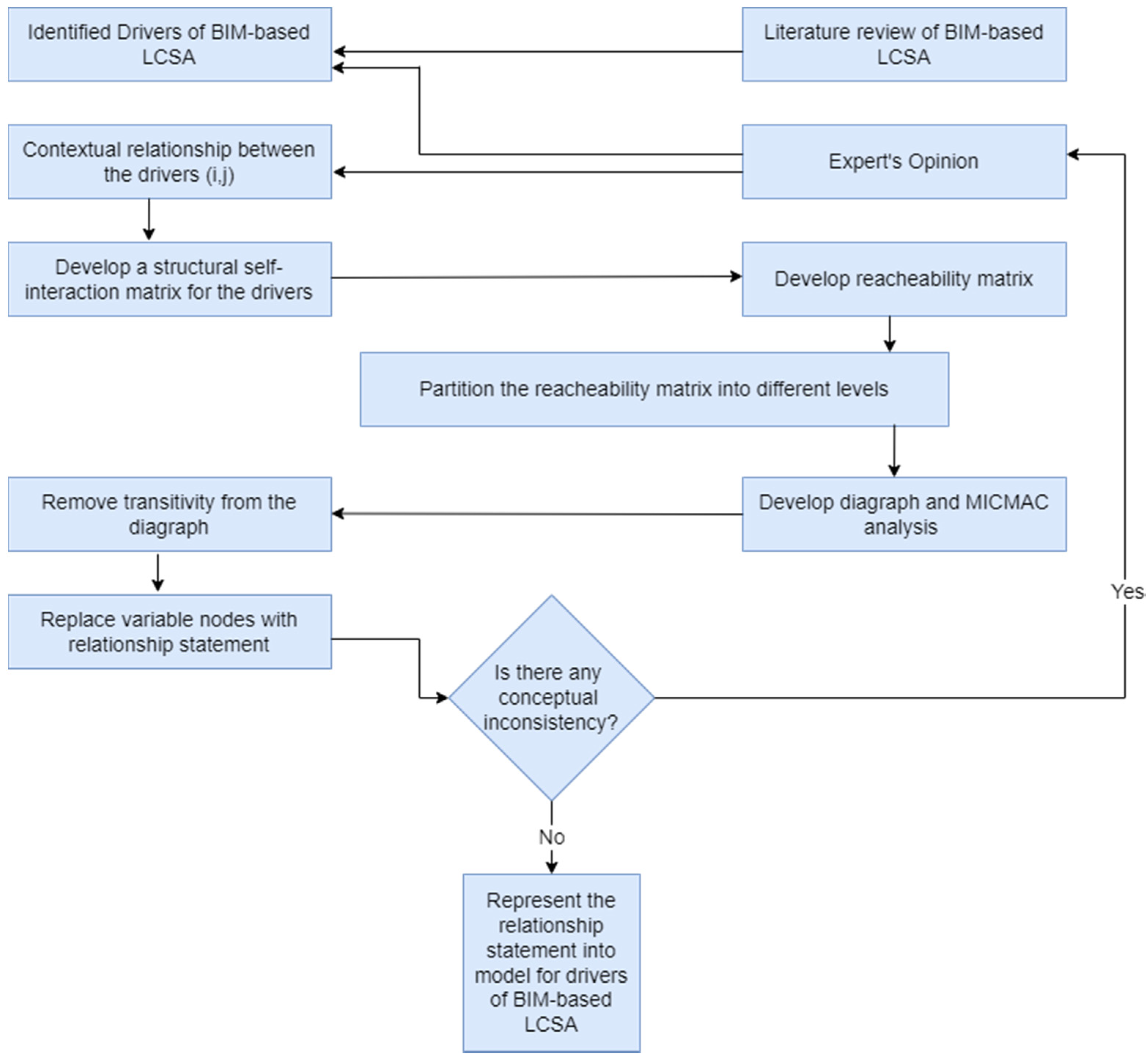
Mathiyazhagan [42] argues that a significant weakness in the ISM technique, which was taken into account during the survey process, is the limitations of expert response to their experiences. Another weakness is having difficult discussions decided upon by majority opinion. The ISM approach starts by identifying variables (drivers of BIM-based LCSA). The variables are then used to form a self-interacting structural matrix. This allowed for contextual interactions between the system’s components. The SSIM’s goal is to develop a preliminary reachability matrix. Checking the matrix for transitive linkages results in the creation of the final reachability matrix. Suppose that element X and element Y are connected, and element Y is connected to element Z. Then element X needs to be connected to element Z. Dividing the reachability matrix into separate hierarchical tiers was performed next. Identifying the driving and reliant power of drivers of BIM-based LCSA followed next. The reachability matrix’s contextual interactions were used to build the digraph.
The transitive associations are cut off by substituting the element nodes with statements to turn the directed digraph into an ISM model as shown in Figure 2. The conceptual inconsistency of the model is reviewed and modified if necessary.
Figure 2.
The study’s Interpretive Structural Modeling (ISM) methodology as adapted from [56].
3.1. MICMAC Analysis
Dupperrin and Gobet [43] developed Matrice d’Impacts croisés multiplication appliquée á un classement (MICMAC), which is known as Cross-Impact Matrix Multiplication Applied to Classification. It entails building a graph to group the variables under examination based on their driving and dependent power. The driving power is the horizontal sum (row-wise) of the relationship to and from a specific driver “i”, whereas the dependent power is the vertical total (columnwise) of that relationship to and from a particular driver “j” [43,63]. The analysis includes variables from the independent, dependent, autonomous, and linking categories.
3.2. Approach to Interpretive Structural Modeling
Structural Self-Interaction Matrix (SSIM)
The variables (drivers) were first identified through an extensive literature review. They were then combined based on the conclusions of group discussions with three researchers with post-PhD experience in BIM-based LCSA studies and finalized into 19 key drivers. Specific criteria were then applied to elicit the opinion of experts on the key 19 drivers. The distribution of experts is presented in Table 2. Experts’ selection criteria included: Firstly, industry expertise with more than ten years of construction experience and extensive experience using BIM in LCSA implementation. Secondly, experts in the design of BIM tool and database development were identified as respondents. Thirdly, participants were confirmed to have a wealth of expertise working in both the public and private sectors. According to past studies, this approach was appropriate [43,61,63,64].
Table 2.
Experts’ distribution.
Twenty respondents were identified and administered the self-structural interaction matrix (SSIM) through a snowball approach. Due to the nature of the SSIM, the survey forms were created as fillable forms and distributed to the experts via emails with follow-up emails and calls to ensure understanding.
Fourteen responses were received with a continental spread across North America, Europe, and Africa to ensure a comprehensive opinion was articulated and to eliminate bias to ensure the ability to generalize. Not all responses were received; as indicated in studies such as [56,58], the ISM approach is technical and requires time and additional explanation from the researchers, thus producing fewer respondents. Based on prior research validation of the ISM approach being sufficient with low respondents, particularly for studies with fewer specialists, the responses were declared fit for analysis [42]. Studies such as Mathiyazhagan et al. [42] used 10 responses to investigate the barriers to implementing green supply chain management. A crucial strength of ISM is that it emphasizes expertise and depth of responses rather than quantity due to its power in researching complex systems, allowing it to be widely adopted in research. Hence, Shen et al. [45] based their study on the responses of 7 identified experts. In benchmarking the interactions among performance indicators in the supply chain, Mor et al. [38] based their findings on responses from 11 experts. The team of experts that discuss, check, and oversee the ISM model is crucial to its validity; hence, in modelling cost overrun in building construction, Shahab [46] pointed out that perspectives from 5 experts were sufficient to give quality insights to the ISM model. This is further supported and similarly adopted in Azevedo et al. [47]. They further pointed out that, although there may still be additional professionals in the sector, difficulty in contacting them all can be appreciated. Obi et al. [48] adopted six experts in studying BIM for deconstruction, and 13 experts were adopted in a study by Bridget and Chan [49] in examining project risk dynamics in Sino-Africa public infrastructure delivery. Therefore, there is no set standard for the number of experts to be employed, and the ISM technique does not require a large number of respondents because it places a lot of emphasis on the respondents’ expertise and experience with the topic being studied. [30,49,50,62]. Given that the chosen experts are all from respected institutions, it is believed that their perspectives would be useful for this study. Furthermore, after the experts’ responses, the research team thoroughly examined the feedback data and made the necessary updates to the data. Due to its logic and analytical rigour, the ISM generates trustworthy results even with few experts [44,49].
The respondents with experience in BIM-based LCSA were asked for their viewpoints and ideas on the interrelationship between the drivers, “i” and “j,” as shown by the four symbols, “V, A, X, and O,” which signify their respective roles in the system:
- (1)
- V: Driver i aids in influencing driver j, but j does not affect driver i.
- (2)
- A: Driver j aids in influencing driver i while j is unaffected by driver i.
- (3)
- X: Driver i aids in influencing driver j, and vice versa.
- (4)
- O: Drivers i and j are not connected.
The criterion, “the minority gives way to the majority” was used to combine the data after it had been collected, as mentioned in [64,65]. The matrix of structural self-interaction is shown in Table 3.
Table 3.
Structural Self-Interaction Matrix (SSIM).
4. Results
Table 3 displays the survey responses as a Structural Self-Interaction Matrix (SSIM), and Table 4 displays the drivers’ initial reachability matrix as derived from the SSIM.
Table 4.
Initial reachability matrix of the drivers derived from the SSIM.
4.1. Initial Reachability Matrix
The results are combined and then turned into the ISM’s initial reachability matrix, as presented in Table 4, using the guidelines outlined below.
If the cell (i, j) is V, then cell (i, j) entry is 1 and cell (j, i) entry is 0.
If the cell (i, j) is A, then cell (i, j) entry is 0 and cell (j, i) entry is 1.
If the cell (i, j) is X, then cell (i, j) entry is 1 and cell (j, i) entry is 1.
If the cell (i, j) is O, then cell (i, j) entry is 0 and cell (j, i) entry is 0.
4.2. Final Drivers Reachability Matrix Extracted from the SSIM
The initial reachability matrix is tested for transitivity using the ISM approach, which assumes that if A is equal to B and B is equal to C, then A will also be equal to C, to generate the final reachability matrix.
def transitivity (matrix):
result = “ ”
length = len (matrix)
for i in range (0, length):
for row in range (0, length):
for col in range (0, length):
matrix [row] [col] = matrix [row] [col] or (matrix [row] [i] and matrix [i] [col])
result += (“\n W” + str (i) +” is:\n”+ str(matrix).replace (“],”,“]\n”) + “\n”)
result += (“\n Final Reachability Matrix is\n” + str(matrix).replace(“],”, “]\n”))
print (result)
return result
The Python function above was used to examine the transitivity of the initial reachability matrix to produce the final reachability matrix as shown in Table 5. This was preferred to the manual approach using loop statements which is error-prone and time-consuming [43].
Table 5.
Final reachability matrix of the drivers derived from the SSIM.
4.3. Hierarchical Structure of the Drivers Derived from the SSIM Is Presented in Table 6
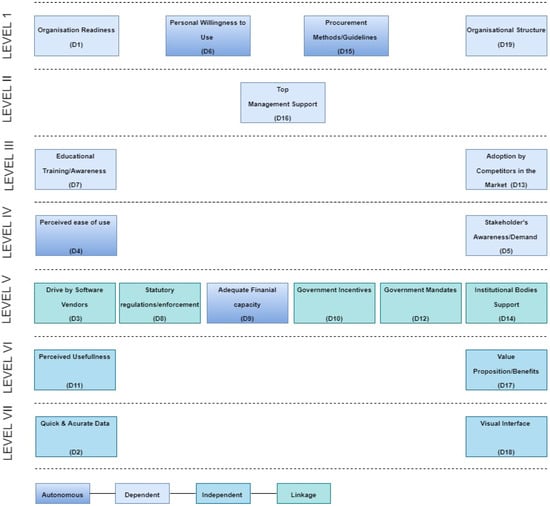
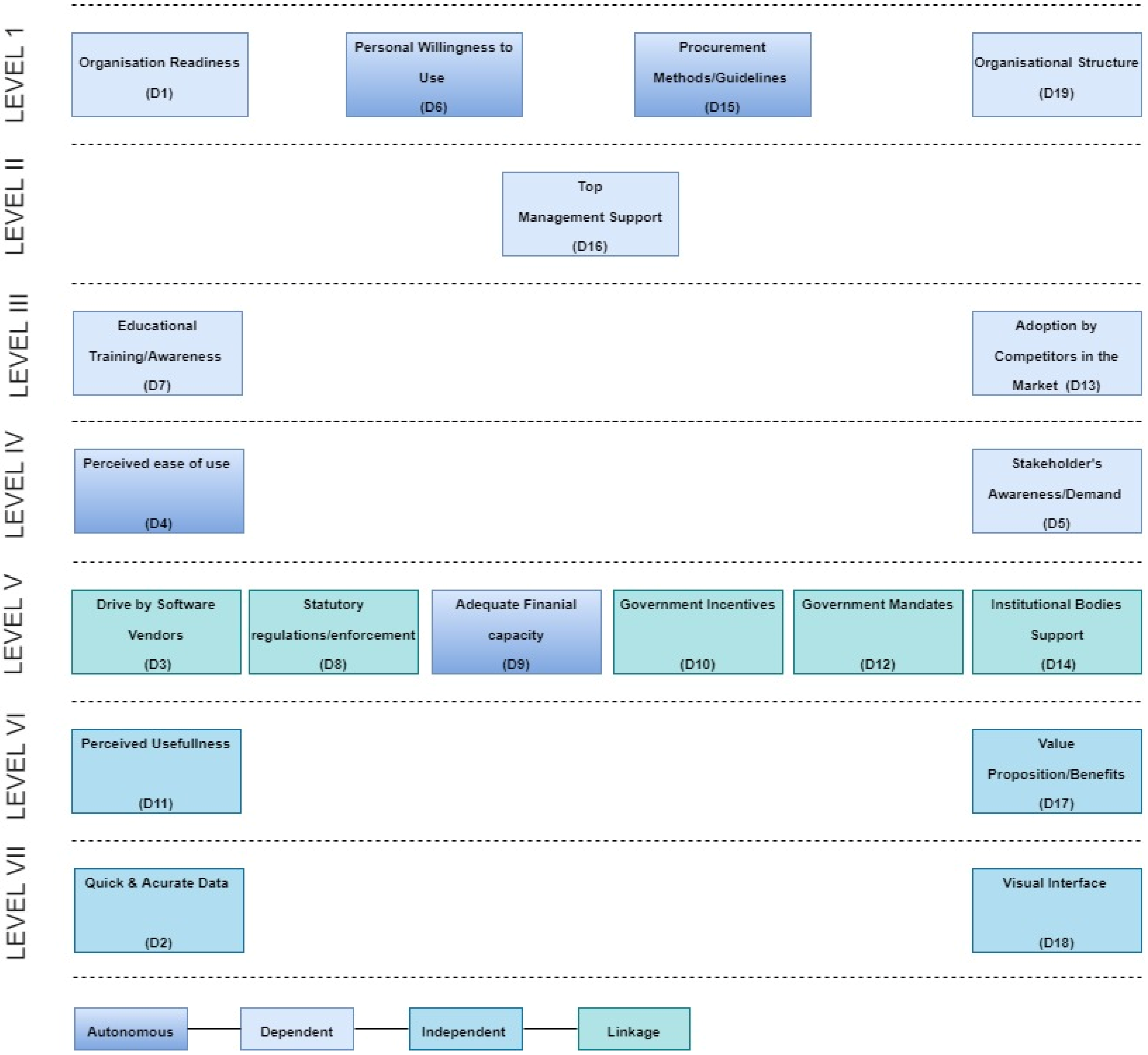
The final reachability matrix is used to identify the reachability set, antecedent set, and intersection set for each driver to divide them into different tiers. A driver’s reachability set comprises the driver and any other drivers having a value of 1 in the corresponding row. The driver and other drivers are the antecedent set and are defined with a value of 1 in the corresponding column. The drivers shared by the reachability and antecedent sets make up the intersection set. The reachability set, antecedent set, and intersections are shown in Table 6. In partitioning the drivers into levels, drivers that share the same intersection set and reachability set are categorized in the same level. Table 7 presents the first level of the hierarchical structure of the drivers using the final reachability matrix. Drivers D1, D6, D15, and D19 were classified as level I drivers since they share the same reachability and intersection set.
Table 7.
Level I of the hierarchical structure of the drivers using the final reachability matrix.
Table 6.
Levels of the drivers from the final reachability matrix.
Table 8 and Table 9 present the second and third levels of the hierarchical structure of the drivers using the final reachability matrix. The reachability set, antecedent set, and intersection are once more identified once partitioned drivers have been eliminated from the iteration.
Table 8.
Level II of the hierarchical structure of the drivers using the final reachability matrix.
Table 9.
Level III of the hierarchical structure of the drivers using the final reachability matrix.
Table 10 and Table 11 presents the fourth and fifth levels of the hierarchical structure of the drivers using the final reachability matrix. The reachability set, antecedent set, and intersection are once more identified once partitioned drivers have been eliminated from the iteration.
Table 10.
Level IV of the hierarchical structure of the drivers using the final reachability matrix.
Table 11.
Level V of the hierarchical structure of the drivers using the final reachability matrix.
Table 12 and Table 13 present the sixth and seventh levels of the hierarchical structure of the drivers using the final reachability matrix. The reachability set, antecedent set, and intersection are once more identified once partitioned drivers have been eliminated from the iteration.
Table 12.
Level VI of the hierarchical structure of the drivers using the final reachability matrix.
Table 13.
Level VII of the hierarchical structure of the drivers using the final reachability matrix.
The partitioned ISM models are presented in a hierarchical structure in Figure 3.
Figure 3.
Interpretive structural model (ISM) for BIM-based life cycle sustainability assessment drivers.
4.4. Matrice d’Impacts Croises-Multipication Applique a Classement (MICMAC) ANALYSIS
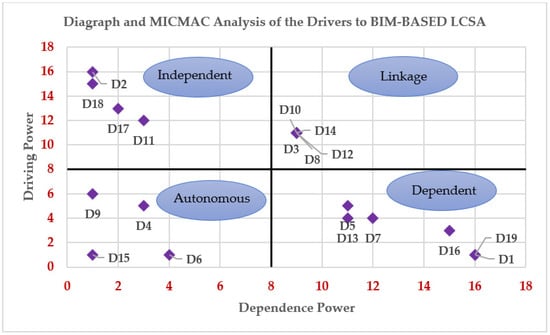
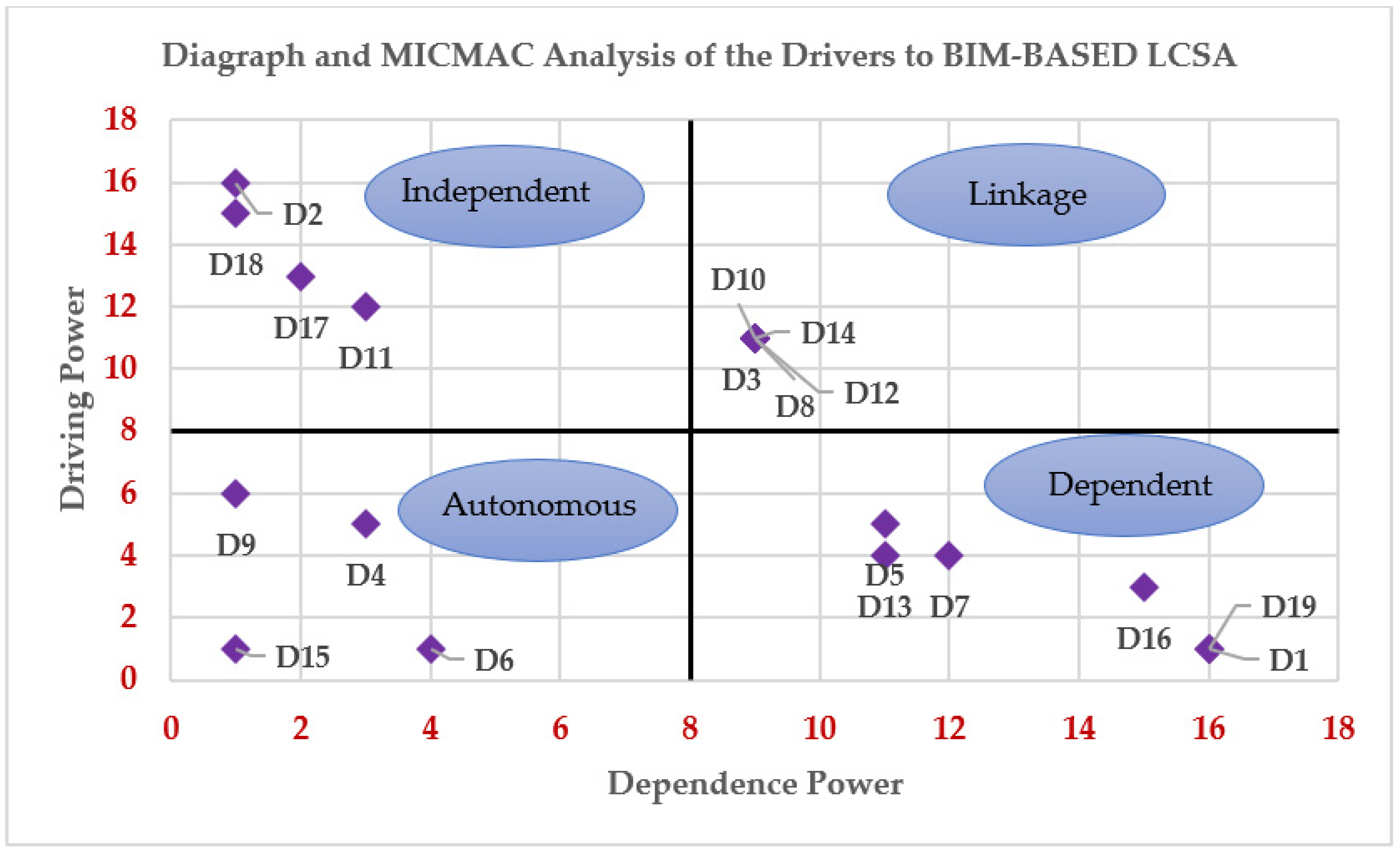
The MICMAC analysis was performed utilizing the driving force and dependence power for each driver. For variables employing the final reachability matrix table, the driving power is the sum of all the values in the column, and the dependence power is the sum of all the values in the row. This is presented below in Table 14. The digraph is plotted using the driving force and dependency power which are classified into four groups, as illustrated in Figure 4.
Table 14.
Dependence and driving power of the drivers.
Figure 4.
Diagraph and MICMAC analysis of the drivers of BIM-based life cycle sustainability assessment.
Autonomous Drivers: These are drivers with weak driving power and weak dependence power. They are disconnected from the main system and have few links. These drivers are “Adequate financial capacity”, “Perceived ease of use”, “Procurement methods/guidelines”, and “Perceived willingness to use”.
Dependent Drivers: These are drivers with weak driving power but strong dependence power. They are dependent on other drivers and can be addressed by addressing related drivers. These drivers are “Stakeholders’ awareness/demand”, “Adoption by competitors in the market”, “Educational training/awareness”, “Top management support”, “Organizational structure”, and “Organization readiness”.
Independent Drivers: These are drivers with strong driving power but weak dependence power. These are considered the most important drivers. They are “Quick and accurate data”, “Visual interface”, “Value proposition/benefits”, and “Perceived usefulness”.
Linkage category: These are drivers with both strong driving power and dependence power. These drivers affect other drivers and have feedback on themselves. They are “Government incentives”, “Institutional bodies support”, “Government mandates”, “Drive by software vendors”, and “Statutory regulations/enforcement”.
5. Discussion
There has been growing interest in and usage of Building Information Modelling (BIM) over the years to enhance information management in infrastructure delivery. Recent efforts to drive digital transformation in the industry have further brought its importance to the fore, alongside its critical value towards the life cycle sustainability of infrastructure. What is important, however, is extending the value of managing project information across the life cycle of infrastructure delivery. Growing global sustainability challenges and their impact on safe human existence has required that the built environment integrates BIM into the life cycle assessment process, which is critical given how it enhances the realization of sustainable development.
Questions have been raised about the effectiveness of government efforts/approaches/mandates in driving BIM adoption. There has been little agreement on appropriate approaches to push BIM adoption, but discussions have identified understanding what drives the system as critical to successful adoption efforts/policy. In this paper, the overarching aim was to examine what drives BIM-based life cycle sustainability assessment adoption. An extensive literature review and discussion with BIM-based life cycle sustainability experts were used to identify and synthesize 19 major drivers. Following this, the drivers’ dynamics and relationships were tested using the interpretive structural modelling (ISM) approach. The process involved seven iterations in decomposing the variables into subsystems for easy understanding and identification of its hierarchal structure.
The structure is quite revealing in several ways. First, the most important drivers partitioned in level I were identified as “Organization readiness”, “Personal willingness to use”, “Procurement methods/guidelines”, and “Organizational structure”. Interestingly, the findings support [43,65,66,67,68,69] which have similarly identified organization readiness as critical, given that adoption cannot be achieved if the synchronization and coordination of people, processes, systems, and performance measurement within the organization are not in place. The grouping of personal willingness to use and organizational structure further strengthens the position as it emphasizes the extent to which organizational members are psychologically and behaviorally prepared to implement BIM-based LCSA systems, and the availability of appropriate systems to support the adoption within the organization is highly critical to achieving successful implementation. Undoubtedly, this demonstrates that organizational readiness to adopt BIM-based LCSA depends on efforts to ensure organizational members value the system and the extent to which they are favorably disposed to available resources, task demands, guidelines, and the organizational structure. Therefore, when organizational readiness is well established, users will be proactive in exploring the solutions, exerting best efforts, and advancing its usage. Comparing the results shown in level I with similar studies such as [43] where organizational readiness and personal willingness to use are on different levels, it is worth noting that this is a reflection of the participants’ opinions, and it provides an area for further development of the presented framework based on larger groups of participants.
Top management support was identified as a level II driver in the ISM model. This finding is consistent with [69,70], which identified management support as invaluable in achieving adoption. That this comes after level I further validates the hierarchical structure of the model. It is imperative to mention that management support goes beyond only allocating budgets for adopting the system but also requires a people-centered direction, including achieving user buy-in, capacity development, addressing users’ concerns, devoting time to reviewing plans, constantly measuring output, and resolving challenges, which are as important.
Level III involves the training/awareness driver and adoption by competitors in the market. These findings further support the idea of developing the capacity to empower employees as central to enhancing trust in the system, justifying the cost of investment, achieving required results, and eliminating aversion to the system [27,71,72]. However, training must not just be presented as a mere activity on a checklist but be rethought on how it can deliver critical value to employees. Perceived ease of use and stakeholders’ awareness/demand, as indicated in level IV, are important and follow directly from level III on the idea that when training/awareness is well deployed, perception of use is influenced. An implication of awareness is the enhanced value/benefits acknowledged by stakeholders. These two variables are very crucial.
Level V drivers consist of software vendors driving the adoption, statutory regulations, adequate financial capacity, government incentives, government mandates, and institutional bodies’ support. As stated by Saka and Chan [30], effective technology transfer requires collaborative interaction between the technology, the people, the firm, and the external environment. They are therefore important drivers; financial capacity is instrumental to determine how much of a solution is adopted, an essential factor for SMEs. Furthermore, while different silos and actors can implement independently, government support and incentives offer more motivation in driving adoption.
Perceived usefulness and value proposition/benefits were categorized in level VI in the ISM model. These results match those observed in earlier studies [73,74,75,76]. The drivers are in the low tier, signifying that much is not regarded on the benefits of adopting the systems and their perceived usefulness. This is a critical challenge in driving adoption efforts and reveals the need to document projects using BIM-based LCSA and showcase the values and benefits. Practical demonstrations and showcasing the value can enhance the perceived usefulness and value of adopting BIM-based LCSA.
Quick and accurate data and the visual interface are important drivers classified in level VII. Previous studies have stated that wrong results or inaccurate data from the automatic calculation in designers’ workflow can affect the system’s adoption [25,35,77]. It is therefore suggested that emerging advances in visualization, machine learning, and artificial intelligence be integrated with as-built BIM models with the required information for LCA that does not exist yet [25,76,77,78].
Although this study is based on a small sample of participants, the findings have vital implications for policy making, government, industry, and academia. Sometimes, government and policy makers are positively predisposed to adopting emerging sustainable systems and technologies to enhance infrastructure delivery but are limited by the inability to identify priority areas. This study helps to clarify priority areas in a hierarchical structure for policy implementation.
Emerging studies have argued the effectiveness of mandating policy decisions, especially concerning digital systems. The driving framework presented demystifies the mandatory approach and suggests an approach that eliminates the adverse perceptions of BIM-based LCSA and an approach to secure all stakeholders’ buy-in. It provides, and is valuable as, a scientific and methodological evidential support to benchmark implementation strategies and organizational decision making.
The findings provide new understanding and insights to industry players/supply chain ecosystems on priority areas to direct organizational plans. The presented hierarchical framework can reduce risk and wastefulness in government and organizational investment in adopting emerging sustainable approaches. This is in the face of recent reports reflecting low outcomes from integrating digital transformation with organizational systems. This has alluded to the error of prioritizing digital technologies rather than people-centered adoption pathways. The framework is valuable for clarifying “where to from here” in adopting BIM-based LCSA.
5.1. Implications for Academic Research
The delay in technology adoption is partly ascribed to the requirements of having the right imperatives in place, which must be balanced with much-needed knowledge support. Our research demonstrates several factors that influence BIM-based LCSA, supporting the need to comprehend the forces that motivate a digital orientation. Thus, the presented framework presents insight for further studies on how to achieve successful implementation of BIM-based LCSA. This further helps to characterize and situate the need for training and learning efforts by academic institutions.
5.2. Implications for Firms and Organizations
A change in how we carry out projects and increased use of technology in the procedures are necessary for the construction industry to sustain growth and productivity. Digitalization of the built environment can lead to the necessary industry transformation, but executives are recently at a loss on “how to approach digital transformation”, “what to avoid”, and the “cost-benefit of investment”. Thus, for better firm and organizational adoption, presenting critical drivers such as organizational readiness, organizational structure, and personal willingness to use demonstrates to firms the need to emphasize a people-centered adoption in which reskilling and capacity development is prioritized as against solely investing in the procurement of technology.
5.3. Implications for Policy Makers
A deeper knowledge of the factors influencing digital adoption will help policy makers create initiatives to promote it. The presented framework advises policy makers to take into account many dynamics that influence the use of Building Information Modelling (BIM) in life cycle sustainability. For instance, level I reveals that stakeholder buy-in is vital, including the need to ensure capacity development. Level II further emphasizes the role stakeholder buy-in plays in driving digital adoption. The government may take into account initiatives that could improve process digitalization given that process digitalization is one of the factors determining digital adoption. This is further supported by the presence of procurement methods/guidelines as a key driver in level I. Giving incentives to encourage adoption while taking organizations’ financial capacities into account is essential. This is what level IV highlights in also showing that statutory regulations can assure firms about changing policies, which is key in enhancing positive disposition to adoption.
Limitations and Future Research
Two limitations of the study suggest areas for further investigation. First, the small number of respondents which characterizes the interpretive structural modelling approach restricts the generalizability of findings. However, the small sample is well justified and supported in similar studies. Secondly, the snowball approach and the limited number of countries restrict the study’s context. However, the experts’ selection criteria were rigorous and based on experience and knowledge of the study domain. Moreover, the identified drivers were selected based on expert opinion and their importance in previous studies.
6. Conclusions
The adoption of BIM-based LCSA is still nascent but offers immense potential through integrating data from Building Information Models into life cycle sustainability assessment. Towards ensuring sustainable development, this measure impacts throughout the life cycle of the building. This study presented a hierarchical model of the major drivers of adopting BIM-based LCSA. Through seven levels of critical drivers, the study revealed the differences in the importance of 19 drivers and their implications for practice. By using BIM-based LCSA experts to identify the relationship between the drivers and MICMAC analysis to categorize the drivers into four categories, the study advances the need to synchronize and coordinate people, processes, and systems within the organization in place. Further important findings were the value of top management support and the need to develop the capacity of employees and demonstrate/showcase the value of BIM-based LCSA to secure much-needed stakeholder buy-in to drive adoption.
This study is essential in dissecting how to appropriately drive the adoption of BIM-based LCSA, given executives’ present opinion of the benefits of investment in digital transformation not meeting the heavy investment required. Studies have attributed this to wrong approaches to adopting digital systems such as BIM-based LCSA. Thus, this study fills that gap by offering perspectives that consider factors influencing successful adoption.
Author Contributions
Conceptualization, A.O.; methodology, A.O.; software, M.M.T.; validation, I.M.; formal analysis, A.O.; investigation, A.O.; resources, I.M.; data curation, M.M.T.; writing—original draft preparation, A.O.; writing—review and editing, A.O.; visualization, M.M.T.; supervision, I.M.; project administration, I.M.; funding acquisition, I.M. All authors have read and agreed to the published version of the manuscript.
Funding
This research was funded by the National Research Foundation (NRF), grant number 129953.
Informed Consent Statement
Informed consent was obtained from all subjects involved in the study.
Data Availability Statement
Not applicable.
Acknowledgments
The work is part of collaborative research at the Centre of Applied Research and Innovation in the Built Environment (CARINBE), University of Johannesburg.
Conflicts of Interest
The authors declare no conflict of interest.
References
- van Eldik, M.A.; Vahdatikhaki, F.; dos Santos, J.M.O.; Visser, M.; Doree, A. BIM-Based Environmental Impact Assessment for Infrastructure Design Projects. Autom. Constr. 2020, 120, 103379. [Google Scholar] [CrossRef] [Scilit]
- Bianchi, P.F.; Yepes, V.; Vitorio, P.C.; Kripka, M. Study of Alternatives for the Design of Sustainable Low-Income Housing in Brazil. Sustainability 2021, 13, 4757. [Google Scholar] [CrossRef] [Scilit]
- Sameer, H.; Bringezu, S. Building Information Modelling Application of Material, Water, and Climate Footprint Analysis. Build. Res. Inf. 2021, 49, 593–612. [Google Scholar] [CrossRef] [Scilit]
- Asare, K.A.B.; Ruikar, K.D.; Zanni, M.; Soetanto, R. BIM-Based LCA and Energy Analysis for Optimised Sustainable Building Design in Ghana. SN Appl. Sci. 2020, 2, 1855. [Google Scholar] [CrossRef] [Scilit]
- Han, D.; Kalantari, M.; Rajabifard, A. Building Information Modeling (BIM) for Construction and Demolition Waste Management in Australia: A Research Agenda. Sustainability 2021, 13, 12983. [Google Scholar] [CrossRef] [Scilit]
- Lu, Y.; Wu, Z.; Chang, R.; Li, Y. Building Information Modeling (BIM) for Green Buildings: A Critical Review and Future Directions. Autom. Constr. 2017, 83, 134–148. [Google Scholar] [CrossRef] [Scilit]
- Onososen, A.; Musonda, I. Barriers to BIM-Based Life Cycle Sustainability Assessment for Buildings: An Interpretive Structural Modelling Approach. Buildings 2022, 12, 324. [Google Scholar] [CrossRef] [Scilit]
- Crippa, J.; Boeing, L.C.; Caparelli, A.P.; de Mello Maron, M.D.; Scheer, S.; Araujo, A.M.F.; Bem, D. A BIM–LCA Integration Technique to Embodied Carbon Estimation Applied on Wall Systems in Brazil. Built Environ. Proj. Asset Manag. 2018, 8, 491–503. [Google Scholar] [CrossRef] [Scilit]
- Llatas, C.; Soust-Verdaguer, B.; Passer, A. Implementing Life Cycle Sustainability Assessment during Design Stages in Building Information Modelling: From Systematic Literature Review to a Methodological Approach. Build. Environ. 2020, 182, 107164. [Google Scholar] [CrossRef] [Scilit]
- Obrecht, T.P.; Röck, M.; Hoxha, E.; Passer, A. BIM and LCA Integration: A Systematic Literature Review. Sustainability 2020, 12, 5534. [Google Scholar] [CrossRef] [Scilit]
- Soust-Verdaguer, B.; Llatas, C.; Moya, L. Comparative BIM-Based Life Cycle Assessment of Uruguayan Timber and Concrete-Masonry Single-Family Houses in Design Stage. J. Clean. Prod. 2020, 277, 121958. [Google Scholar] [CrossRef] [Scilit]
- Marrero, M.; Wojtasiewicz, M.; Martínez-Rocamora, A.; Solís-Guzmán, J.; Alba-Rodríguez, M.D. BIM-LCA Integration for the Environmental Impact Assessment of the Urbanization Process. Sustainability 2020, 12, 4196. [Google Scholar] [CrossRef] [Scilit]
- Santos, R.; Costa, A.A.; Silvestre, J.D.; Vandenbergh, T.; Pyl, L. BIM-Based Life Cycle Assessment and Life Cycle Costing of an Office Building in Western Europe. Build. Environ. 2020, 169, 106568. [Google Scholar] [CrossRef] [Scilit]
- Peng, C. Calculation of a Building’s Life Cycle Carbon Emissions Based on Ecotect and Building Information Modeling. J. Clean. Prod. 2016, 112, 453–465. [Google Scholar] [CrossRef] [Scilit]
- Carvalho, J.P.; Bragança, L.; Mateus, R. Optimising Building Sustainability Assessment Using BIM. Autom. Constr. 2019, 102, 170–182. [Google Scholar] [CrossRef] [Scilit]
- Soust-Verdaguer, B.; Llatas, C.; García-Martínez, A. Critical Review of Bim-Based LCA Method to Buildings. Energy Build. 2017, 136, 110–120. [Google Scholar] [CrossRef] [Scilit]
- Santos, R.; Costa, A.A.; Silvestre, J.D.; Pyl, L. Integration of LCA and LCC Analysis within a BIM-Based Environment. Autom. Constr. 2019, 103, 127–149. [Google Scholar] [CrossRef] [Scilit]
- Alwan, Z.; Greenwood, D.; Gledson, B. Rapid LEED Evaluation Performed with BIM Based Sustainability Analysis on a Virtual Construction Project. Constr. Innov. 2015, 15, 134–150. [Google Scholar] [CrossRef] [Scilit]
- Pour Rahimian, F.; Chavdarova, V.; Oliver, S.; Chamo, F. OpenBIM-Tango Integrated Virtual Showroom for Offsite Manufactured Production of Self-Build Housing. Autom. Constr. 2019, 102, 1–16. [Google Scholar] [CrossRef] [Scilit]
- Xue, K.; Uzzal Hossain, M.; Liu, M.; Ma, M.; Zhang, Y.; Hu, M.; Chen, X.; Cao, G. Bim Integrated Lca for Promoting Circular Economy towards Sustainable Construction: An Analytical Review. Sustainability 2021, 13, 1310. [Google Scholar] [CrossRef] [Scilit]
- Panteli, C.; Kylili, A.; Fokaides, P.A. Building Information Modelling Applications in Smart Buildings: From Design to Commissioning and beyond A Critical Review. J. Clean. Prod. 2020, 265, 121766. [Google Scholar] [CrossRef] [Scilit]
- Schneider-Marin, P.; Winkelkotte, A.; Lang, W. Integrating Environmental and Economic Perspectives in Building Design. Sustainability 2022, 14, 4637. [Google Scholar] [CrossRef] [Scilit]
- Zanni, M.-A.; Soetanto, R.; Ruikar, K. Exploring the Potential of BIM-integrated Sustainability Assessment in AEC. In Sustainable Building Conference; Coventry University: Coventry, UK, 2013. [Google Scholar]
- Backes, J.G. Application of Life Cycle Sustainability Assessment in the Construction Sector: A Systematic Literature Review. Processes 2021, 9, 1248. [Google Scholar] [CrossRef] [Scilit]
- Tagliabue, L.C.; Cecconi, F.R.; Maltese, S.; Rinaldi, S.; Luigi, A.; Ciribini, C.; Flammini, A. Leveraging Digital Twin for Sustainability Assessment of an Educational Building. Sustainability 2021, 13, 480. [Google Scholar] [CrossRef] [Scilit]
- Figueiredo, K.; Pierott, R.; Hammad, A.W.A.; Haddad, A. Sustainable Material Choice for Construction Projects: A Life Cycle Sustainability Assessment Framework Based on BIM and Fuzzy-AHP. Build. Environ. 2021, 196, 107805. [Google Scholar] [CrossRef] [Scilit]
- Ansah, M.; Chen, X.; Yang, H.; Lu, L.; Lam, P.T. A Review and Outlook for Integrated BIM Application in Green Building Assessment. Sustain. Cities Soc. 2019, 48, 101576. [Google Scholar] [CrossRef] [Scilit]
- Dawood, M.H. BIM Based Optimal Life Cycle Cost of Sustainable House Framework. In Proceedings of the 2016 3rd MEC International Conference on Big Data and Smart City, Muscat, Oman, 15–16 March 2016; IEEE: Piscataway, NJ, USA, 2016; pp. 1–5. [Google Scholar]
- Ansah, M.K.; Chen, X.; Yang, H.; Lu, L.; Lam, P.T.I. Developing an Automated BIM-Based Life Cycle Assessment Approach for Modularly Designed High-Rise Buildings. Environ. Impact Assess. Rev. 2021, 90, 106618. [Google Scholar] [CrossRef] [Scilit]
- Saka, A.B.; Chan, D.W.M.; Siu, F.M.F. Drivers of Sustainable Adoption of Building Information Modelling (BIM) in the Nigerian Construction Small and Medium-Sized Enterprises (SMEs). Sustainability 2020, 12, 3710. [Google Scholar] [CrossRef] [Scilit]
- Al Sehrawy, A.; Amoudi, O.; Tong, M.; Callaghan, N. A Review of the Challenges to Integrating BIM and Building Sustainability Assessment. In AIP Conference Proceedings; AIP Publishing LLC: Melville, NY, USA, 2021; p. 020005. [Google Scholar]
- Kwok, J.; Wong, W.; Zhou, J. Enhancing Environmental Sustainability over Building Life Cycles through Green BIM: A Review. Autom. Constr. 2015, 57, 156–165. [Google Scholar] [CrossRef] [Scilit]
- Vite, C.; Morbiducci, R. Optimizing the Sustainable Aspects of the Design Process through Building Information Modeling. Sustainability 2021, 13, 3041. [Google Scholar] [CrossRef] [Scilit]
- Zimmermann, R.K.; Bruhn, S.; Birgisdóttir, H. Bim-Based Life Cycle Assessment of Buildings—An Investigation of Industry Practice and Needs. Sustainability 2021, 13, 5455. [Google Scholar] [CrossRef] [Scilit]
- Onososen, A.O.; Musonda, I. Research Focus for Construction Robotics and Human-Robot Teams towards Resilience in Construction: Scientometric Review. J. Eng. Des. Technol. 2022. ahead of print. [Google Scholar] [CrossRef] [Scilit]
- Nguyen Van, T.; Nguyen Quoc, T. Research Trends on Machine Learning in Construction Management: A Scientometric Analysis. J. Appl. Sci. Technol. Trends 2021, 2, 96–104. [Google Scholar] [CrossRef] [Scilit]
- Warfield, J. Developing Interconnection Matrices in Structural Modeling. IEEE Trans. Syst. Man Cybern. 1974, 1, 81–87. [Google Scholar] [CrossRef] [Scilit]
- Mor, R.S.; Bhardwaj, A.; Singh, S. Benchmarking the Interactions among Performance Indicators in Dairy Supply Chain: An ISM Approach. Benchmarking 2018, 25, 3858–3881. [Google Scholar] [CrossRef] [Scilit]
- Ravi, V.; Shankar, R. Analysis of Interactions among the Barriers of Reverse Logistics. Technol. Forecast. Soc. Chang. 2005, 72, 1011–1029. [Google Scholar] [CrossRef] [Scilit]
- Saka, A.B.; Chan, D.W.M. Profound Barriers to Building Information Modelling (BIM) Adoption in Construction Small and Medium-Sized Enterprises (SMEs): An Interpretive Structural Modelling Approach. Constr. Innov. 2020, 20, 261–284. [Google Scholar] [CrossRef] [Scilit]
- Ansari, M.F.; Kharb, R.K.; Luthra, S.; Shimmi, S.L.; Chatterji, S. Analysis of Barriers to Implement Solar Power Installations in India Using Interpretive Structural Modeling Technique. Renew. Sustain. Energy Rev. 2013, 27, 163–174. [Google Scholar] [CrossRef] [Scilit]
- Mathiyazhagan, K.; Govindan, K.; NoorulHaq, A.; Geng, Y. An ISM Approach for the Barrier Analysis in Implementing Green Supply Chain Management. J. Clean. Prod. 2013, 47, 283–297. [Google Scholar] [CrossRef] [Scilit]
- Duperrin, J.C.; Godet, M. Methode de Hierrchisation Des Elements d’un Systeme [Methodology for Prioritising Elements from a System]. Rapp. Econ. Du CEA 1973, 1, 49–51. [Google Scholar]
- Shoar, S.; Chileshe, N. Exploring the Causes of Design Changes in Building Construction Projects: An Interpretive Structural Modeling Approach. Sustainability 2021, 13, 9578. [Google Scholar] [CrossRef] [Scilit]
- Shen, L.; Song, X.; Wu, Y.; Liao, S.; Zhang, X. Interpretive Structural Modeling Based Factor Analysis on the Implementation of Emission Trading System in the Chinese Building Sector. J. Clean. Prod. 2016, 127, 214–227. [Google Scholar] [CrossRef] [Scilit]
- Shoar, S.; Yiu, T.W.; Payan, S.; Parchamijalal, M. Modeling Cost Overrun in Building Construction Projects Using the Interpretive Structural Modeling Approach: A Developing Country Perspective. Eng. Constr. Archit. Manag. 2021. ahead of print. [Google Scholar] [CrossRef] [Scilit]
- Azevedo, S.; Carvalho, H.; Cruz-Machado, V. Using Interpretive Structural Modelling to Identify and Rank Performance Measures: An Application in the Automotive Supply Chain. Balt. J. Manag. 2013, 8, 208–230. [Google Scholar] [CrossRef] [Scilit]
- Obi, L.; Awuzie, B.; Obi, C.; Omotayo, T.S.; Oke, A.; Osobajo, O. Bim for Deconstruction: An Interpretive Structural Model of Factors Influencing Implementation. Buildings 2021, 11, 227. [Google Scholar] [CrossRef] [Scilit]
- Eshun, B.T.B.; Chan, A.P.C. An Evaluation of Project Risk Dynamics in Sino-Africa Public Infrastructure Delivery; a Causal Loop and Interpretive Structural Modelling Approach (ISM-CLD). Sustainability 2021, 13, 10822. [Google Scholar] [CrossRef] [Scilit]
- Wuni, I.Y.; Shen, G.Q.P. Holistic Review and Conceptual Framework for the Drivers of Offsite Construction: A Total Interpretive Structural Modelling Approach. Buildings 2019, 9, 117. [Google Scholar] [CrossRef] [Scilit]
- Pradhananga, P.; Elzomor, M.; Santi Kasabdji, G. Barriers and Drivers to the Adoption of Sustainable Construction Practices in Developing Countries: A Case Study of Venezuela. J. Archit. Eng. 2021, 27, 05021005. [Google Scholar] [CrossRef] [Scilit]
- Tjebane, M.M.; Musonda, I.; Okoro, C. Organisational Factors of Artificial Intelligence Adoption in the South African Construction Industry. Front. Built Environ. 2022, 8, 823998. [Google Scholar] [CrossRef] [Scilit]
- Onososen, A.; Osanyin, O.; Adeyemo, M. Drivers and Barriers to the Implementation of Green Building Development. PM World J. 2019, 9, 1–15. [Google Scholar]
- Babatunde, S.O.; Udeaja, C.; Adekunle, A.O. Barriers to BIM Implementation and Ways Forward to Improve Its Adoption in the Nigerian AEC Firms. Int. J. Build. Pathol. Adapt. 2021, 39, 48–71. [Google Scholar] [CrossRef] [Scilit]
- Pan, M.; Pan, W. Understanding the Determinants of Construction Robot Adoption: Perspective of Building Contractors. J. Constr. Eng. Manag. 2020, 146, 04020040. [Google Scholar] [CrossRef] [Scilit]
- Harding, K.G.; Friedrich, E.; Jordaan, H.; le Roux, B.; Notten, P.; Russo, V.; Suppen-Reynaga, N.; van der Laan, M.; Goga, T. Status and Prospects of Life Cycle Assessments and Carbon and Water Footprinting Studies in South Africa. Int. J. Life Cycle Assess. 2021, 26, 26–49. [Google Scholar] [CrossRef] [Scilit]
- Ohno, I.; Ohno, K. Dynamic Capacity Development: What Africa Can Learn from Industrial Policy Formulation in East Asia. In Good Growth and Governance in Africa: Rethinking Development Strategies; Oxford University Press: Oxford, UK, 2012. [Google Scholar] [CrossRef] [Scilit]
- Ghaffarianhoseini, A.; Tookey, J.; Ghaffarianhoseini, A.; Naismith, N.; Azhar, S.; Efimova, O.; Raahemifar, K. Building Information Modelling (BIM) Uptake: Clear Benefits, Understanding Its Implementation, Risks and Challenges. Renew. Sustain. Energy Rev. 2017, 75, 1046–1053. [Google Scholar] [CrossRef] [Scilit]
- Onososen, A.; Musonda, I. Perceived Benefits of Automation and Artificial Intelligence in the AEC Sector: An Interpretive Structural Modeling Approach. Front. Built Environ. 2022, 8, 61. [Google Scholar] [CrossRef] [Scilit]
- Hollberg, A.; Genova, G.; Habert, G. Evaluation of BIM-Based LCA Results for Building Design. Autom. Constr. 2020, 109, 102972. [Google Scholar] [CrossRef] [Scilit]
- Goulding, J.S.; Rahimian, F.P.; Wang, X. Virtual Reality-Based Cloud BIM Platform for Integrated AEC Projects. J. Inf. Technol. Constr. 2014, 19, 308–325. [Google Scholar] [CrossRef] [Scilit]
- Chong, H.Y.; Lee, C.Y.; Wang, X. A Mixed Review of the Adoption of Building Information Modelling (BIM) for Sustainability. J. Clean. Prod. 2017, 142, 4114–4126. [Google Scholar] [CrossRef] [Scilit]
- Ni, G.; Li, H.; Jin, T.; Hu, H.; Zhang, Z. Analysis of Factors Influencing the Job Satisfaction of New Generation of Construction Workers in China: A Study Based on DEMATEL and ISM. Buildings 2022, 12, 609. [Google Scholar] [CrossRef] [Scilit]
- Khan, A.; Yu, R.; Liu, T.; Guan, H.; Oh, E. Drivers towards Adopting Modular Integrated Construction for Affordable Sustainable Housing: A Total Interpretive Structural Modelling (TISM) Method. Buildings 2022, 12, 637. [Google Scholar] [CrossRef] [Scilit]
- Olowa, T.; Witt, E.; Morganti, C.; Teittinen, T.; Lill, I. Defining a BIM-Enabled Learning Environment—An Adaptive Structuration Theory Perspective. Buildings 2022, 12, 292. [Google Scholar] [CrossRef] [Scilit]
- Onososen, A.O.; Musonda, I.; Ramabodu, M. Construction Robotics and Human—Robot Teams Research Methods. Buildings 2022, 12, 1192. [Google Scholar] [CrossRef] [Scilit]
- Aghimien, D.; Aigbavboa, C. Unravelling the Risks of Construction Digitalisation in Developing Countries Construction. Constr. Innov. 2021, 21, 456–475. [Google Scholar] [CrossRef] [Scilit]
- Maas, G.; Van Gassel, F. The Influence of Automation and Robotics on the Performance Construction. Autom. Constr. 2005, 14, 435–441. [Google Scholar] [CrossRef] [Scilit]
- Chen, X.; Chang-Richards, A.Y.; Pelosi, A.; Jia, Y.; Shen, X.; Siddiqui, M.K.; Yang, N. Implementation of Technologies in the Construction Industry: A Systematic Review. Eng. Constr. Archit. Manag. 2021. [Google Scholar] [CrossRef] [Scilit]
- Ahuja, R.; Sawhney, A.; Arif, M. Developing Organizational Capabilities to Deliver Lean and Green Project Outcomes Using BIM. Eng. Constr. Archit. Manag. 2018, 25, 1255–1276. [Google Scholar] [CrossRef] [Scilit]
- Zhang, Y.; Wang, H.; Gao, W.; Wang, F.; Zhou, N.; Kammen, D.M.; Ying, X. A Survey of the Status and Challenges of Green Building Development in Various Countries. Sustainability 2019, 11, 5385. [Google Scholar] [CrossRef] [Scilit]
- Khattra, S.K.; Rai, H.S.; Singh, J. Towards Automated Structural Stability Design of Buildings—A BIM-Based Solution. Buildings 2022, 12, 451. [Google Scholar] [CrossRef] [Scilit]
- Hurmekoski, E.; Jonsson, R.; Nord, T. Context, Drivers, and Future Potential for Wood-Frame Multi-Story Construction in Europe. Technol. Forecast. Soc. Change 2015, 99, 181–196. [Google Scholar] [CrossRef] [Scilit]
- Musonda, I.; Okoro, C. Assessment of Current and Future Critical Skills in the South African Construction Industry. High. Educ. Ski. Work. Learn. 2021. ahead-of-print. [Google Scholar] [CrossRef] [Scilit]
- King, N.; Bechthold, M.; Kane, A.; Michalatos, P. Robotic Tile Placement: Tools, Techniques and Feasibility. Autom. Constr. 2014, 39, 161–166. [Google Scholar] [CrossRef] [Scilit]
- Jrade, A.; Jalaei, F. Integrating Building Information Modeling (BIM) with Sustainability to Design Building Projects at the Conceptual Stage. Build. Simul. 2013, 6, 429–444. [Google Scholar] [CrossRef] [Scilit]
- Tahmasebinia, F.; Jiang, R.; Sepasgozar, S.; Wei, J.; Ding, Y.; Ma, H. Implementation of BIM Energy Analysis and Monte Carlo Simulation for Estimating Building Energy Performance Based on Regression Approach: A Case Study. Buildings 2022, 12, 449. [Google Scholar] [CrossRef] [Scilit]
- Vuong, Q.H.; Ho, M.T.; Vuong, T.T.; La, V.P.; Nghiem, K.C.P.; Tran, B.X.; Giang, H.H.; Giang, T.V.; Latkin, C.; Nguyen, H.K.T.; et al. Artificial Intelligence vs. Natural Stupidity: Evaluating Ai Readiness for the Vietnamese Medical Information System. J. Clin. Med. 2019, 8, 168. [Google Scholar] [CrossRef] [Scilit] [PubMed]

Publisher’s Note: MDPI stays neutral with regard to jurisdictional claims in published maps and institutional affiliations. |
© 2022 by the authors. Licensee MDPI, Basel, Switzerland. This article is an open access article distributed under the terms and conditions of the Creative Commons Attribution (CC BY) license (https://creativecommons.org/licenses/by/4.0/).