Dimensioning of Cycle Lanes Based on the Assessment of Comfort for Cyclists

Abstract
1. Introduction
2. Literature Review
3. Level of Service for Cyclists
- maximum traffic flow next to the cycling infrastructure;
- road width, speed limit, and percentage of freight traffic;
- condition of the cycling infrastructure surface;
- width of the cycling infrastructure.
- 15 min traffic volume :
- average daily traffic
- directional factor
- peak to daily factor
- PHF peak hour factor
- number of lines for motorized traffic
- effect of speed
- permitted speed for motorized traffic
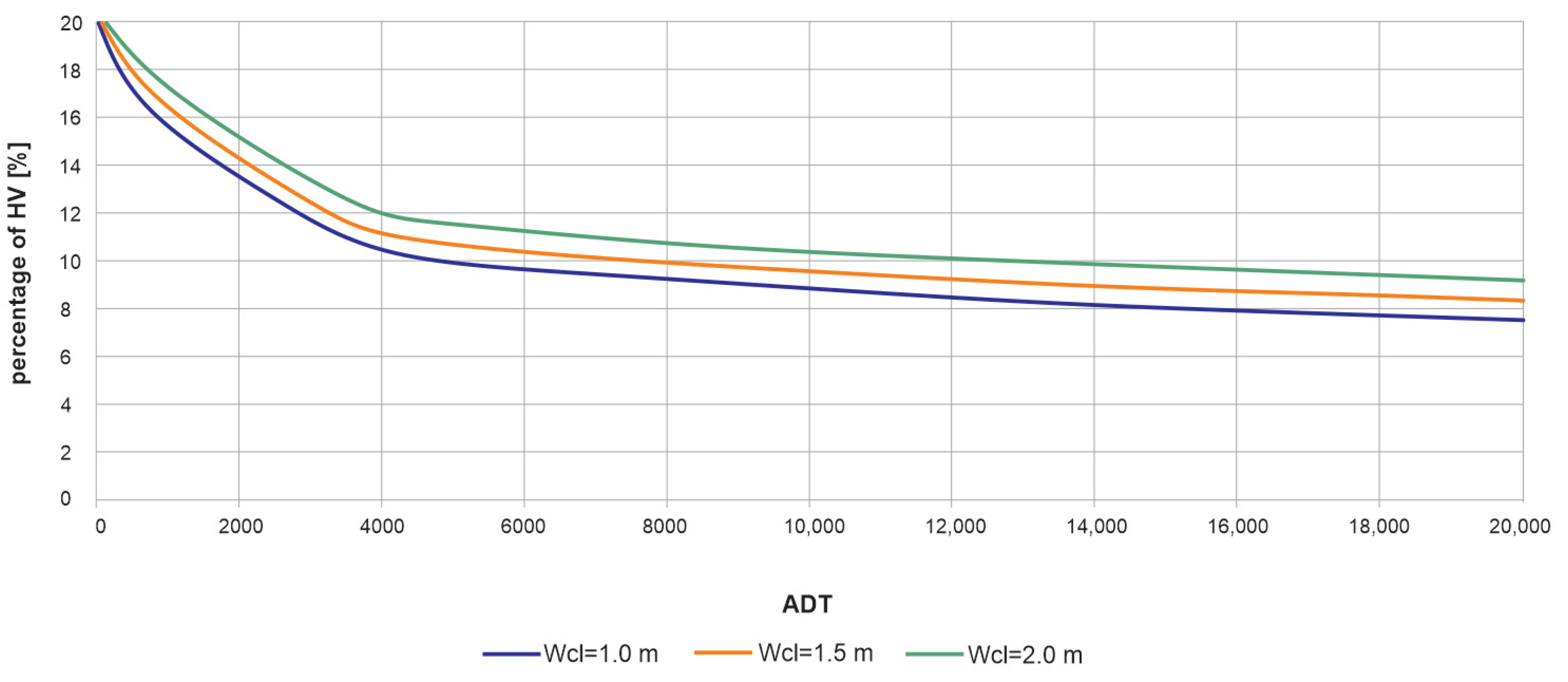
- percentage of heavy vehicles (trucks and buses)
- five-point pavement surface condition rating of FHWA
- average width of cycle lane
- average width of lane for motorized traffic
- average effective width of lane for motorized traffic
- , if
4. Planning and Designing of Cycling Infrastructure: The Slovenia Case Study
4.1. Types of Cycling Infrastructure
4.2. Criteria for Selecting the Type of Cycling Infrastructure
4.3. Methodology
4.4. Results
5. Conclusions and Future Work
Author Contributions
Funding
Conflicts of Interest
References
- AVP. Pregled Stanja Varnosti Kolesarjev v Obdobju 2015–2019. 2020. Available online: https://www.avp-rs.si/wp-content/uploads/2021/05/analiza-kolesarji-2016-2020-in-do-30--4--2021.pdf (accessed on 13 April 2022).
- Saunders, L.E.; Green, J.M.; Petticrew, M.P.; Steinbach, R.; Roberts, H. What Are the Health Benefits of Active Travel? A Systematic Review of Trials and Cohort Studies. PLoS ONE 2013, 8, e69912. [Google Scholar] [CrossRef] [Scilit] [PubMed]
- Celis-Morales, C.A.; Lyall, D.M.; Welsh, P.; Anderson, J.; Steell, L.; Guo, Y.; Maldonado, R.; Mackay, D.F.; Pell, J.P.; Sattar, N.; et al. Association between active commuting and incident cardiovascular disease, cancer, and mortality: Prospective cohort study. BMJ Clin. Res. Ed. 2017, 357, j1456. [Google Scholar] [CrossRef] [Scilit] [PubMed]
- Mora, R.; Truffello, R.; Oyarzún, G. Equity and accessibility of cycling infrastructure: An analysis of Santiago de Chile. J. Transp. Geogr. 2021, 91, 102964. [Google Scholar] [CrossRef] [Scilit]
- Mytton, O.T.; Panter, J.; Ogilvie, D. Longitudinal associations of active commuting with wellbeing and sickness absence. Prev. Med. 2016, 84, 19–26. [Google Scholar] [CrossRef] [Scilit] [PubMed]
- TFL. Walking & Cycling: The economic benefits. Act. Travel TFL 2012, 66, 37–39. [Google Scholar]
- Sener, I.N.; Eluru, N.; Bhat, C.R. An analysis of bicycle route choice preferences in Texas, US. Transportation 2009, 36, 511–539. [Google Scholar] [CrossRef] [Scilit]
- Chen, P.; Shen, Q.; Childress, S. A GPS data-based analysis of built environment influences on bicyclist route preferences. Int. J. Sustain. Transp. 2018, 12, 218–231. [Google Scholar] [CrossRef] [Scilit]
- Skov-Petersen, H.; Barkow, B.; Lundhede, T.; Jacobsen, J.B. How do cyclists make their way?––A GPS-based revealed preference study in Copenhagen. Int. J. Geogr. Inf. Sci. 2018, 32, 1469–1484. [Google Scholar] [CrossRef] [Scilit]
- Dozza, M.; Schindler, R.; Bianchi-Piccinini, G.; Karlsson, J. How do drivers overtake cyclists? Accid. Anal. Prev. 2016, 88, 29–36. [Google Scholar] [CrossRef] [Scilit]
- Misra, A.; Watkins, K. Modeling Cyclist Route Choice using Revealed Preference Data: An Age and Gender Perspective. Transp. Res. Rec. J. Transp. Res. Board 2018, 2672, 145–154. [Google Scholar] [CrossRef] [Scilit]
- Zimmermann, M.; Mai, T.; Frejinger, E. Bike route choice modeling using GPS data without choice sets of paths. Transp. Res. Part C Emerg. Technol. 2017, 75, 183–196. [Google Scholar] [CrossRef] [Scilit]
- Scott, D.M.; Lu, W.; Brown, M.J. Route choice of bike share users: Leveraging GPS data to derive choice sets. J. Transp. Geogr. 2020, 90, 102903. [Google Scholar] [CrossRef] [Scilit]
- Winters, M.; Teschke, K.; Grant, M.; Setton, E.M.; Brauer, M. How far out of the way will we travel? Built environment influences on route selection for bicycle and car travel. Transp. Res. Rec. J. Transp. Res. Board 2010, 2190, 1–10. [Google Scholar] [CrossRef] [Scilit]
- Rossetti, T.; Guevara, C.A.; Galilea, P.; Hurtubia, R. Modeling safety as a perceptual latent variable to assess cycling infrastructure. Transp. Res. Part A Policy Pract. 2018, 111, 252–265. [Google Scholar] [CrossRef] [Scilit]
- Teixeira, I.P.; da Silva, A.N.R.; Schwanen, T.; Manzato, G.G.; Dörrzapf, L.; Zeile, P.; Dekoninck, L.; Botteldooren, D. Does cycling infrastructure reduce stress biomarkers in commuting cyclists? A comparison of five European cities. J. Transp. Geogr. 2020, 88, 102830. [Google Scholar] [CrossRef] [Scilit]
- Berghoefer, F.L.; Vollrath, M. Cyclists’ perception of cycling infrastructure––A Repertory Grid approach. Transp. Res. Part F Traffic Psychol. Behav. 2022, 87, 249–263. [Google Scholar] [CrossRef] [Scilit]
- Hardinghaus, M.; Papantoniou, P. Evaluating Cyclists’ Route Preferences with Respect to Infrastructure. Sustainability 2020, 12, 3375. [Google Scholar] [CrossRef] [Scilit]
- Makarova, I.; Boyko, A.; Almetova, Z. Decision-making on development of cycling infrastructure through safety assessment at design and operation stages. Transp. Res. Procedia 2020, 50, 397–404. [Google Scholar] [CrossRef] [Scilit]
- Veillette, M.-P.; Grisé, E.; El-Geneidy, A. Does One Bicycle Facility Type Fit All? Evaluating the Stated Usage of Different Types of Bicycle Facilities among Cyclists in Quebec City, Canada. Transp. Res. Rec. J. Transp. Res. Board 2019, 2673, 650–663. [Google Scholar] [CrossRef] [Scilit]
- Ton, D.; Cats, O.; Duives, D.; Hoogendoorn, S. How Do People Cycle in Amsterdam, Netherlands?: Estimating Cyclists’ Route Choice Determinants with GPS Data from an Urban Area. Transp. Res. Rec. J. Transp. Res. Board 2017, 2662, 75–82. [Google Scholar] [CrossRef] [Scilit]
- Desjardins, E.; Apatu, E.; Razavi, S.D.; Higgins, C.D.; Scott, D.M.; Páez, A. “Going through a little bit of growing pains”: A qualitative study of the factors that influence the route choice of regular bicyclists in a developing cycling city. Transp. Res. Part F Traffic Psychol. Behav. 2021, 81, 431–444. [Google Scholar] [CrossRef] [Scilit]
- Stewart, K.; McHale, A. Cycle lanes: Their effect on driver passing distances in urban areas. Transport 2014, 29, 307–316. [Google Scholar] [CrossRef] [Scilit]
- Pérez-Zuriaga, A.M.; Moll, S.; López, G.; García, A. Driver Behavior When Overtaking Cyclists Riding in Different Group Configurations on Two-Lane Rural Roads. Int. J. Environ. Res. Public Health 2021, 18, 12797. [Google Scholar] [CrossRef] [Scilit]
- Beck, B.; Chong, D.; Olivier, J.; Perkins, M.; Tsay, A.; Rushford, A.; Li, L.; Cameron, P.; Fry, R.; Johnson, M. How much space do drivers provide when passing cyclists? Understanding the impact of motor vehicle and infrastructure characteristics on passing distance. Accid. Anal. Prev. 2019, 128, 253–260. [Google Scholar] [CrossRef] [Scilit]
- Thorslund, B.; Lindström, A.; Käck, A. Interaction between cyclists, motor vehicles and infrastructure: A simulator study on cyclist strategy and behaviour at intersections. Rethinking transport. In Proceedings of the 8th Transport Research Arena TRA 2020, Helsingfors, Finland, 27–30 April 2020. [Google Scholar]
- Akar, G.; Clifton, K.J. Influence of Individual Perceptions and Bicycle Infrastructure on Decision to Bike. Transp. Res. Rec. J. Transp. Res. Board 2009, 2140, 165–172. [Google Scholar] [CrossRef] [Scilit]
- Broach, J.; Dill, J.; Gliebe, J. Where do cyclists ride? A route choice model developed with revealed preference GPS data. Transp. Res. Part A Policy Pract. 2012, 46, 1730–1740. [Google Scholar] [CrossRef] [Scilit]
- Dill, J. Bicycling for Transportation and Health: The Role of Infrastructure. J. Public Health Policy 2009, 30, S95–S110. [Google Scholar] [CrossRef] [Scilit]
- Nawrath, M.; Kowarik, I.; Fischer, L.K. The influence of green streets on cycling behavior in European cities. Landsc. Urban Plan. 2019, 190, 103598. [Google Scholar] [CrossRef] [Scilit]
- Vedel, S.E.; Jacobsen, J.B.; Skov-Petersen, H. Bicyclists’ preferences for route characteristics and crowding in Copenhagen––A choice experiment study of commuters. Transp. Res. Part A Policy Pract. 2017, 100, 53–64. [Google Scholar] [CrossRef] [Scilit]
- Landis, B.W.; Vattikuti, V.R.; Brannick, M.T. Real-Time Human Perceptions: Toward a Bicycle Level of Service. Transp. Res. Rec. J. Transp. Res. Board 1997, 1578, 119–126. [Google Scholar] [CrossRef] [Scilit]
- Huff, K.; Liggett, R. The Highway Capacity Manual’s Method for Calculating Bicycle and Pedestrian Levels of Service: The Ultimate White Paper. Available online: http://www.lewis.ucla.edu/wp-content/uploads/sites/2/2014/09/hcm-bicycle-and-pedestrian-level-of-service-the-ultimate-white-paper.pdf (accessed on 26 April 2022).
- Transportation Research Board: Highway Capacity Manual. National Research Council; Transportation Research Board: Washington, DC, USA, 2010.
- Lubitz, W.D.; Rubie, B. Wind Loads on Cyclists Due to Passing Vehicles. In Proceedings of the Canadian Society for Mechanical Engineering (CSME) International Congress, Toronto, ON, Canada, 27–30 May 2018; pp. 1–5. Available online: https://yorkspace.library.yorku.ca/xmlui/handle/10315/35213 (accessed on 3 May 2022).
- Wiseman, Y. Take a Picture of Your Tire! In Proceedings of the IEEE Conference on Vehicular Electronics and Safety (IEEE ICVES-2010), Qingdao, China, 15–17 July 2010; pp. 151–156. [Google Scholar]


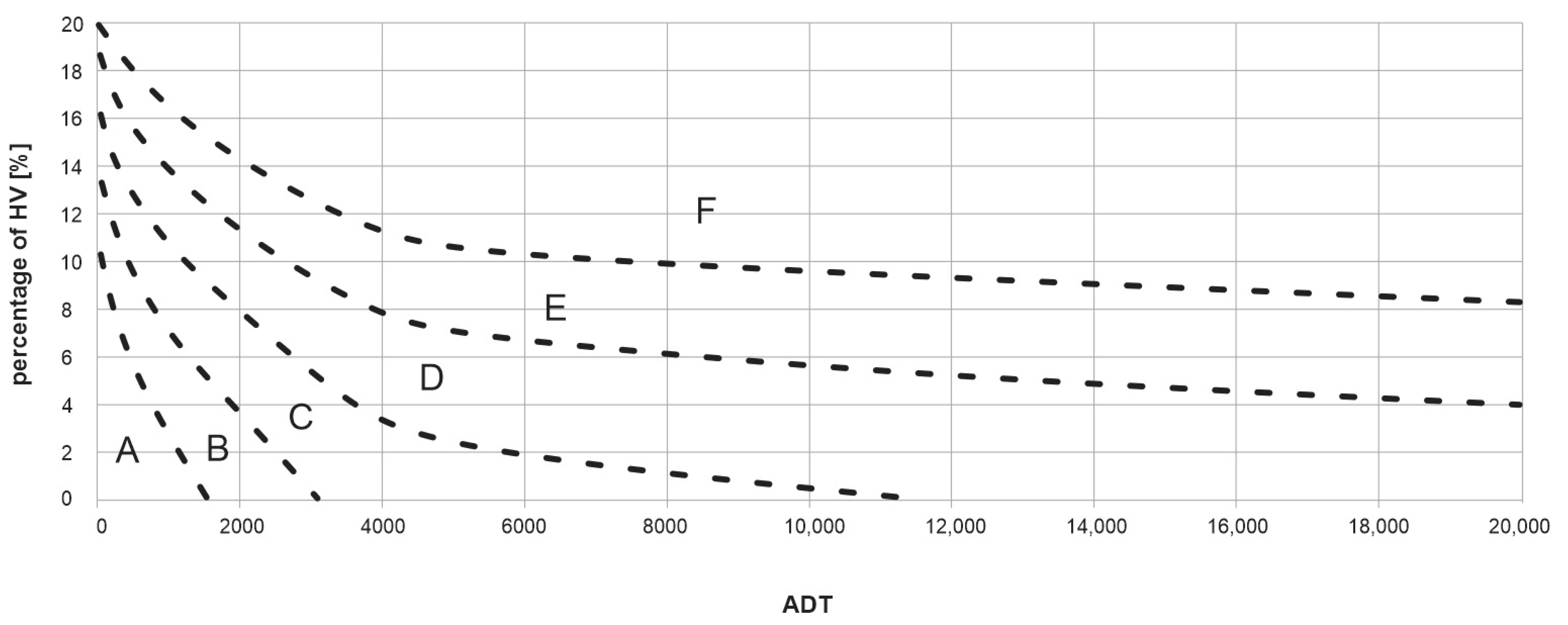



| Service Categories | BLOS |
|---|---|
| A | ≤1.5 |
| B | >1.5 and ≤2.5 |
| C | >2.5 and ≤3.5 |
| D | >3.5 and ≤4.5 |
| E | >4.5 and ≤5.5 |
| F | >5.5 |
| Type of Cycling Infrastructure | Advantages | Disadvantages |
|---|---|---|
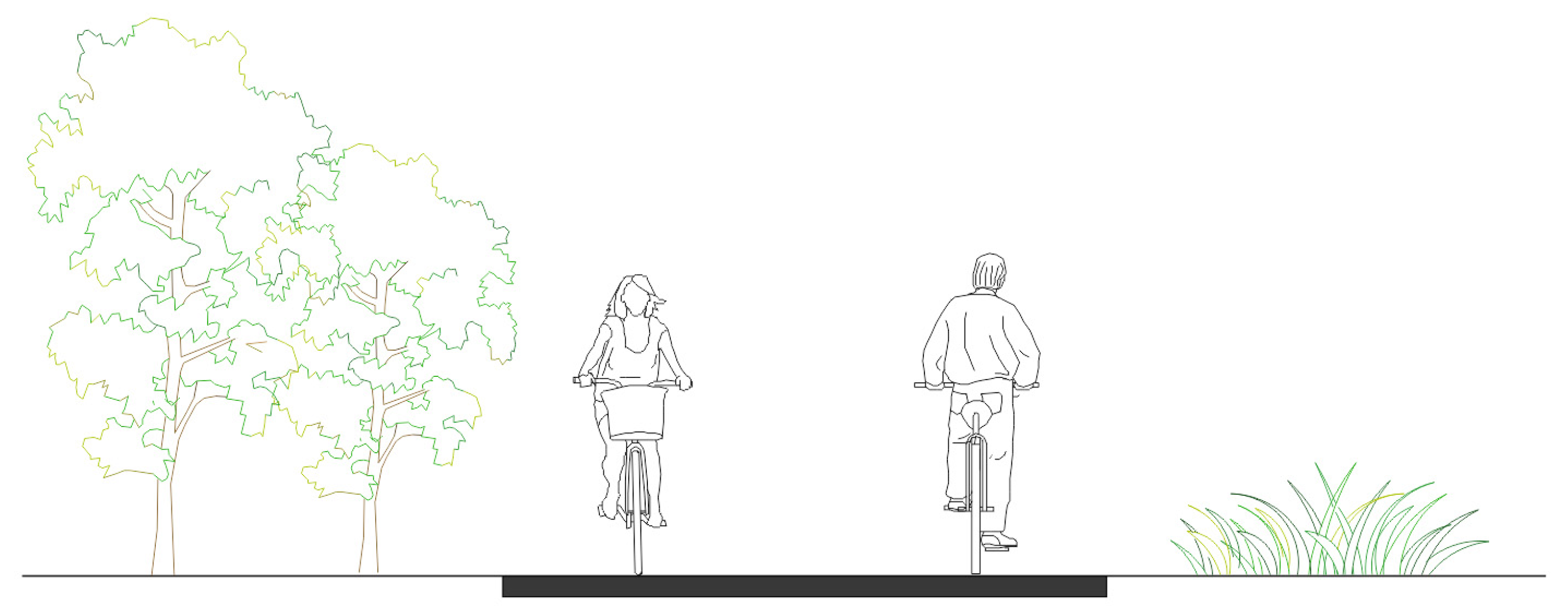
| cycle path | away from traffic greater connectivity high safety and comfort | require a lot of space expensive |
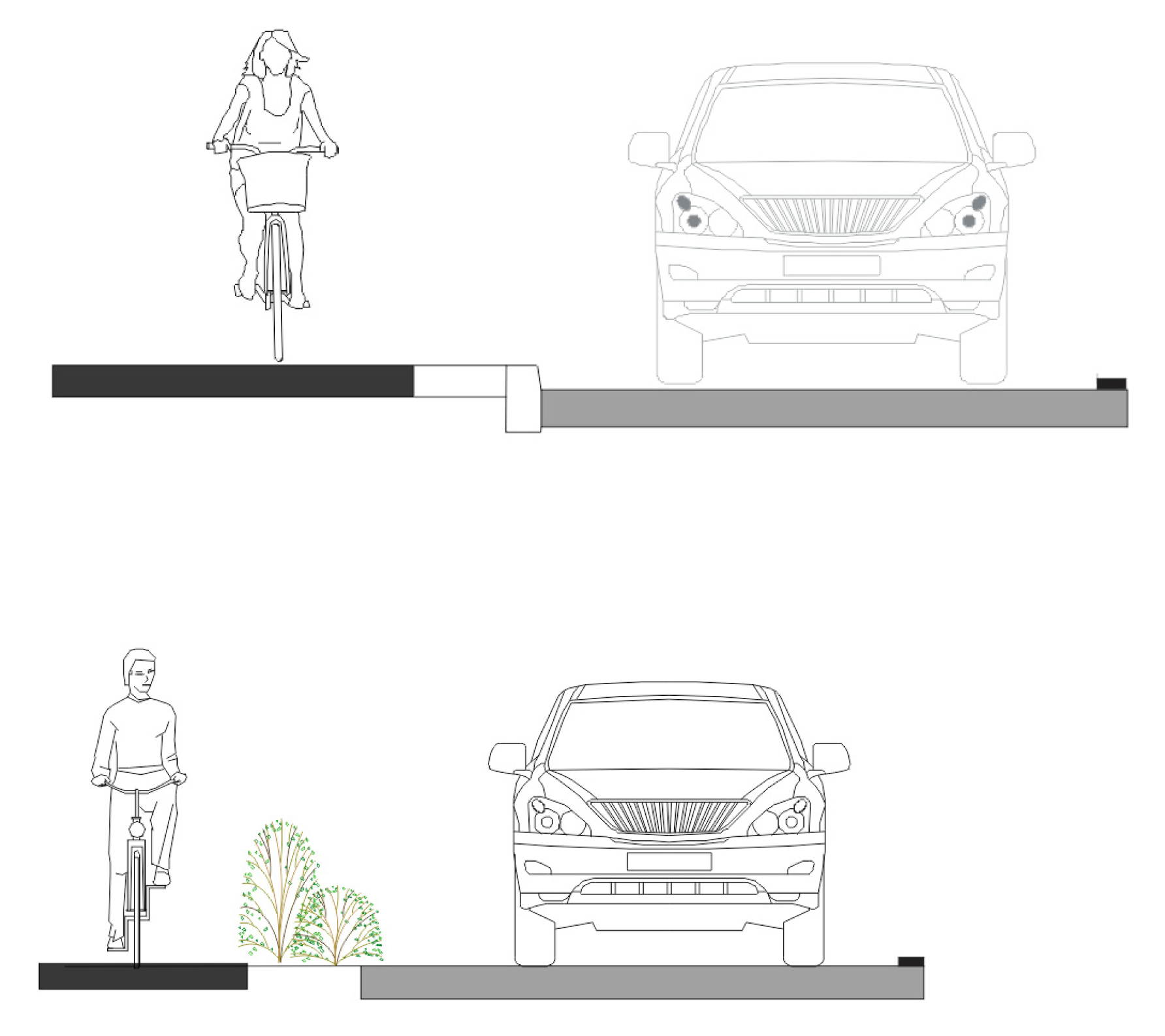
| cycle track | physical separation from traffic high level of traffic safety easier overtaking of other cyclists | a high level of risk due to accesses to building and right-turn movement of vehicles, and higher speeds of road users and thus less attention to cyclists higher demand for space financially demanding |
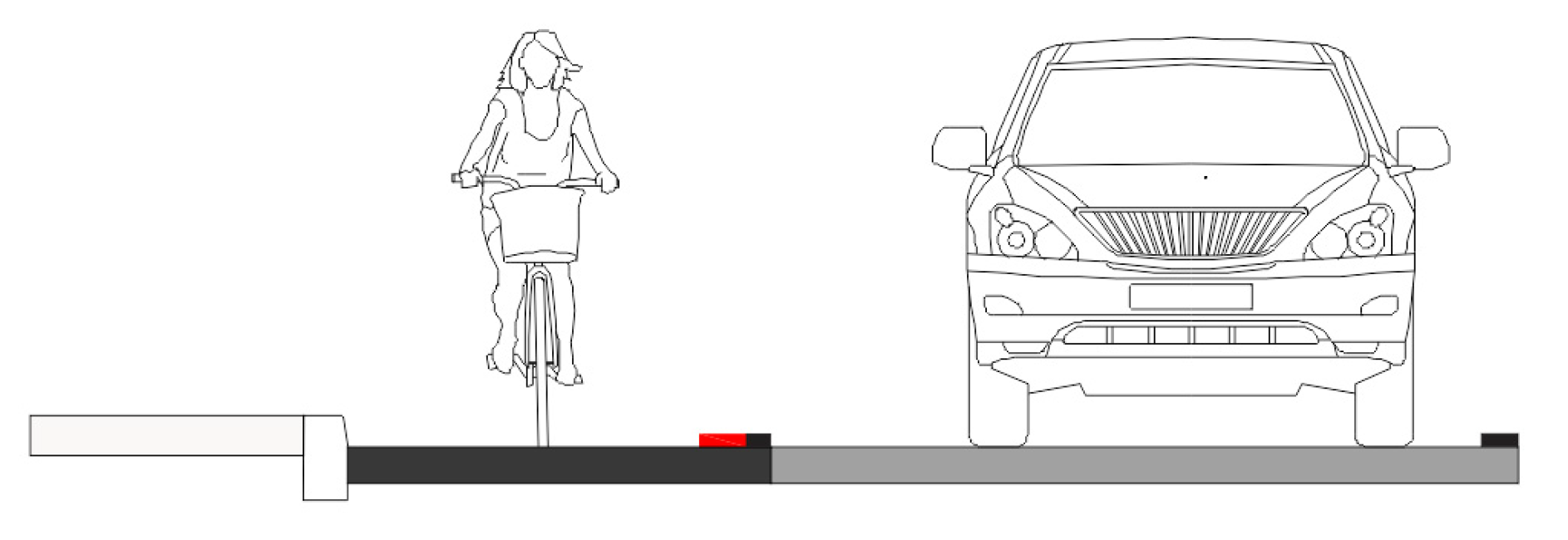
| cycle lane | financially more sustainable solution requires less space than the construction of a cycle path or track increased visibility of cyclists at intersections and thus greater safety (proper solutions are required) easy and fast implementation | no physical separation from vehicles gives drivers the feeling that they do not need to keep special attention on cyclists |
| advised safety lane | easy and fast implementation financially favorable solution | increased risk for cyclists cyclists have less chance of overtaking |
| sharrow | no need for additional space more spatially and financially favorable solution | increased risk for cyclists cyclists obstruct motor traffic cyclists have less chance of overtaking |
| cycle lanes on sidewalks | requires less space | increased potential for conflicts between pedestrians and cyclists greater risk for vulnerable road users, e.g., children and elderly |
Publisher’s Note: MDPI stays neutral with regard to jurisdictional claims in published maps and institutional affiliations. |
© 2022 by the authors. Licensee MDPI, Basel, Switzerland. This article is an open access article distributed under the terms and conditions of the Creative Commons Attribution (CC BY) license (https://creativecommons.org/licenses/by/4.0/).
Share and Cite
Šemrov, D.; Rijavec, R.; Lipar, P. Dimensioning of Cycle Lanes Based on the Assessment of Comfort for Cyclists. Sustainability 2022, 14, 10172. https://doi.org/10.3390/su141610172
Šemrov D, Rijavec R, Lipar P. Dimensioning of Cycle Lanes Based on the Assessment of Comfort for Cyclists. Sustainability. 2022; 14(16):10172. https://doi.org/10.3390/su141610172
Chicago/Turabian StyleŠemrov, Darja, Robert Rijavec, and Peter Lipar. 2022. "Dimensioning of Cycle Lanes Based on the Assessment of Comfort for Cyclists" Sustainability 14, no. 16: 10172. https://doi.org/10.3390/su141610172
APA StyleŠemrov, D., Rijavec, R., & Lipar, P. (2022). Dimensioning of Cycle Lanes Based on the Assessment of Comfort for Cyclists. Sustainability, 14(16), 10172. https://doi.org/10.3390/su141610172