Definitions Matter: Dynamic Policy Framing of the Arts in Boston’s Sustainable Cultural Development

Abstract
1. Introduction
1.1. Background
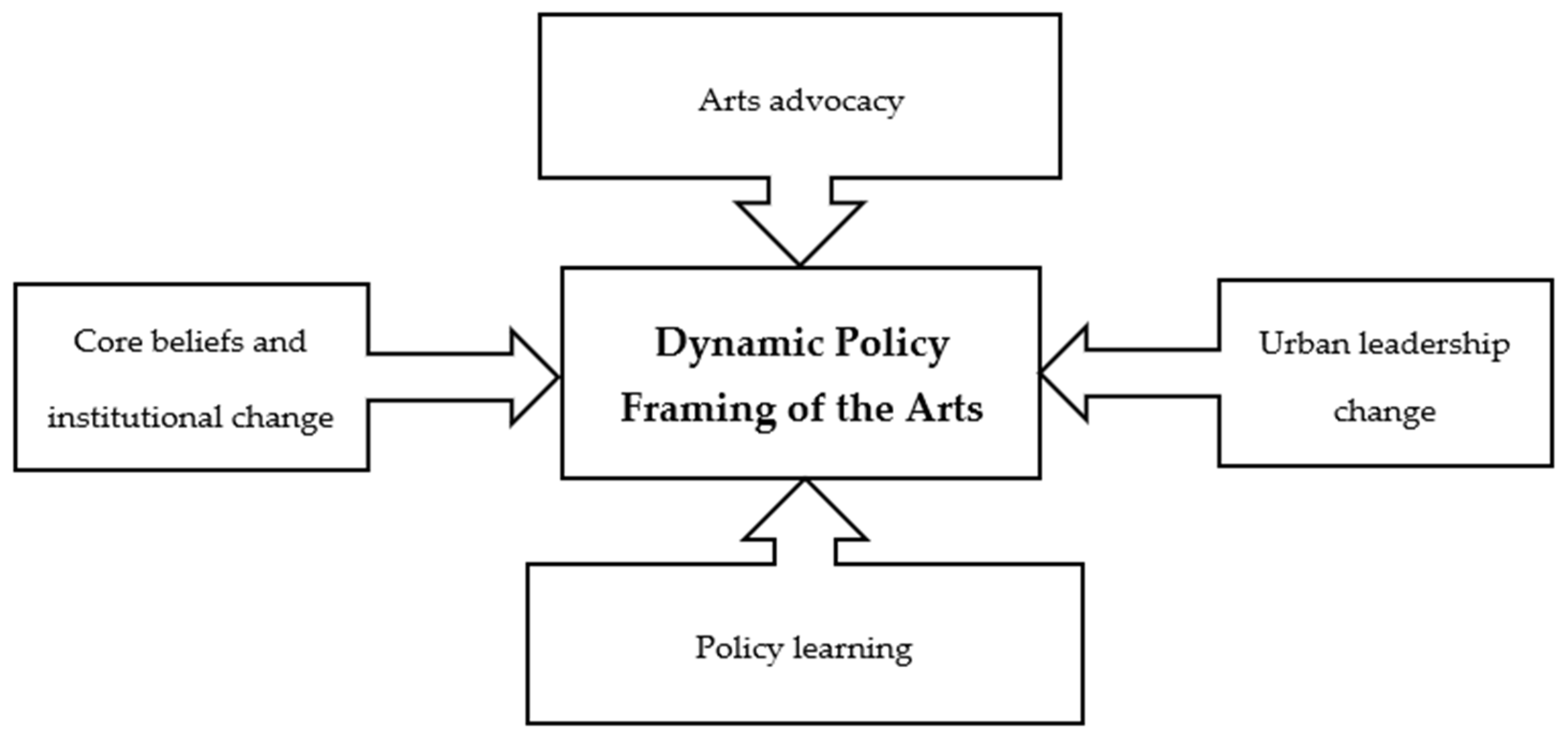
1.2. Analytical Framework
2. Method and Data
2.1. Method
2.2. Case Justification
2.3. Data
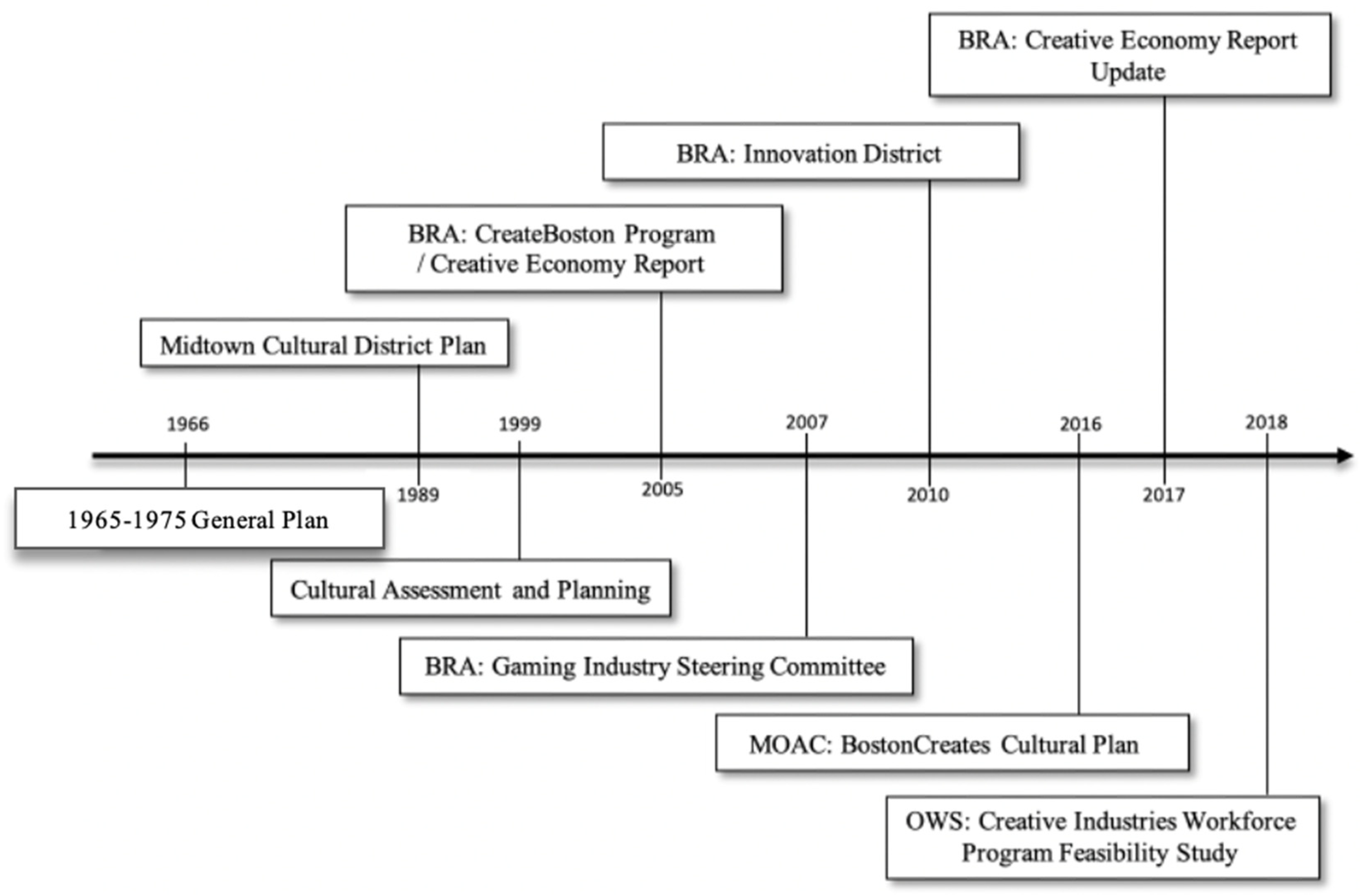
3. Results: A Case Study of the Dynamic Policy Framing of the Arts in Four Stages of Boston’s Sustainable Cultural Development
3.1. Stage One: From Private Philanthropy Patronage to Institutionalization of Government Support for the Arts
3.1.1. The Private Philanthropy Patronage Model
Boston’s [cultural capitalists] retreated from the public sector to [build] a system of non-profit organizations that permitted them to maintain some control over the community even as they lost their command of the political institutions.[47] (p. 40)
3.1.2. Institutionalization of Government Support for the Arts
[T]he institutionalized expenditure of funds provided by the federal government…was hallowed by the intention of providing artistic experience to hospitals, urban ghettos, rural regions, community centers, and various agencies of welfare.[56]
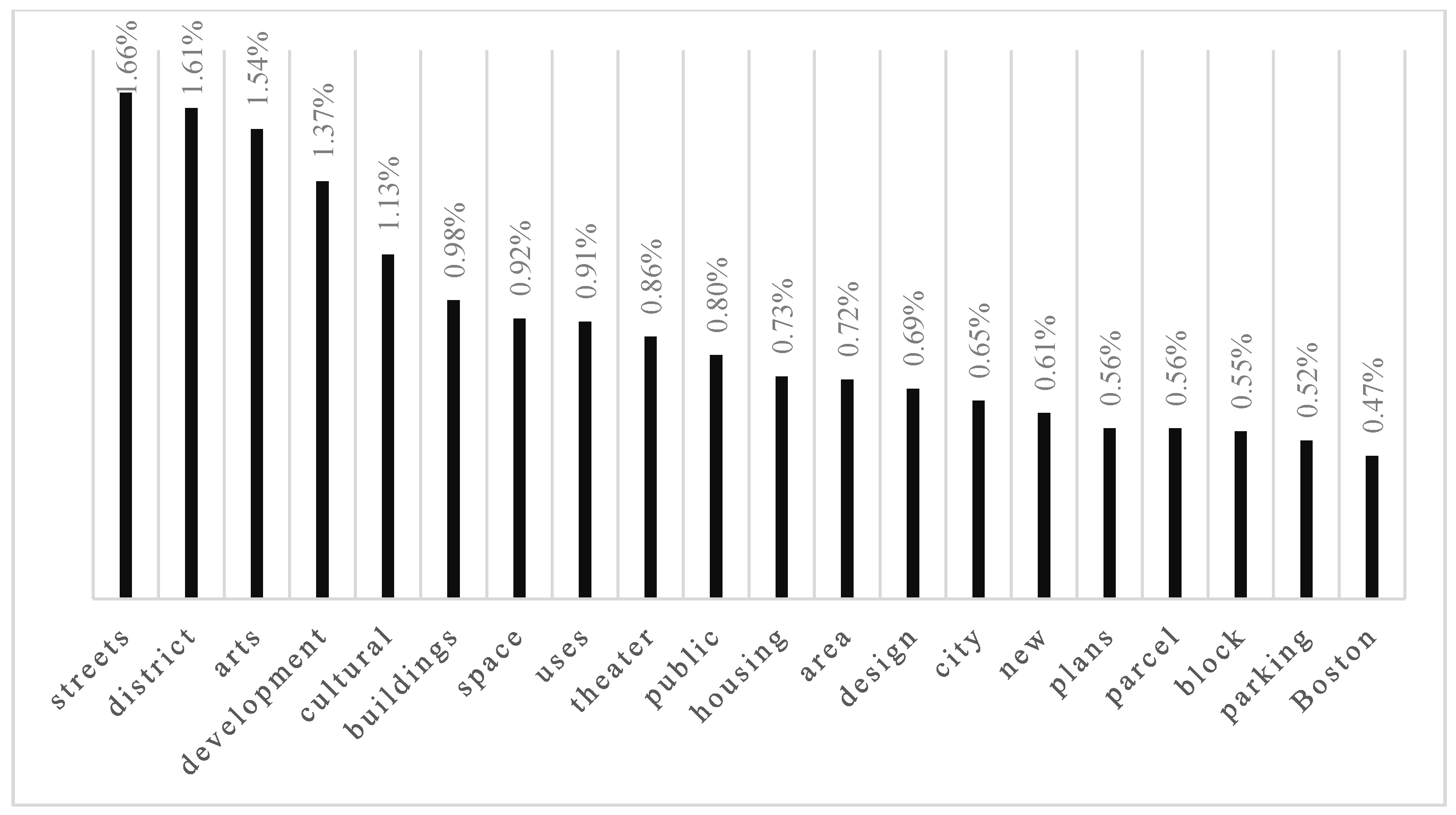
3.2. Stage Two: 1989 Midtown Cultural District Plan: Arts-Included Urban Revitalization
3.3. Stage Three: Multi-Level Positioning of the Creative Arts in Economic Competitiveness
In order for us to gain a competitive edge in the [video games industry], we must lay the foundation that will increase the game development presence through business attraction and expansion…We must rebrand Boston as a digital media epicenter.[66]
3.4. Stage Four: Framing the Creative Arts for Building Creative Capital and Creative Community
3.5. Comparisons
4. Discussion: Key Factors Affecting the Dynamic Policy Framing of the Arts in Boston
4.1. Arts Advocacy Coalition (AAC): Adapting Justifications and Enhancing Recognition
4.2. Policy Learning and Transfer: Supportive Inputs from Civil Society and Media
[improve] one’s understanding of the state of variables defined as important by one’s belief system…[refine] one’s understanding of logical and causal relationships internal to a belief system…[identify] and respond challenges to one’s belief system.[70] (pp. 672–674)
4.3. Cultural Institutional Change: Seeking More Legitimacy Power
4.4. Urban Leadership Change: Wielding the Political Will for the Arts
5. Conclusions and Implications
Author Contributions
Funding
Institutional Review Board Statement
Informed Consent Statement
Data Availability Statement
Conflicts of Interest
References
- Duxbury, N.; Kangas, A.; De Beukelaer, C. Cultural policies for sustainable development: Four strategic paths. Int. J. Cult. Policy 2017, 23, 214–230. [Google Scholar] [CrossRef] [Scilit]
- Perry, B.; Ager, L.; Sitas, R. Cultural heritage entanglements: Festivals as integrative sites for sustainable urban development. Int. J. Herit. Stud. 2019, 26, 603–618. [Google Scholar] [CrossRef] [Scilit]
- Giliberto, F.; Labadi, S. Harnessing cultural heritage for sustainable development: An analysis of three internationally funded projects in MENA Countries. Int. J. Herit. Stud. 2021, 1–14. [Google Scholar] [CrossRef] [Scilit]
- Throsby, D. Tourism, heritage and cultural sustainability: Three ‘Golden Rules’. In Cultural Tourism and Sustainable Local Development; Girard, L.F., Nijkamp, P., Eds.; Routledge: London, UK, 2016; pp. 13–30. [Google Scholar]
- Dessein, J.; Battaglini, E.; Horlings, L. Cultural Sustainability and Regional Development: Theories and Practices of Territorialization; Routledge: London, UK, 2017. [Google Scholar]
- Nicodemus, A.G. Fuzzy vibrancy: Creative placemaking as ascendant US cultural policy. Cult. Trends 2013, 22, 213–222. [Google Scholar] [CrossRef] [Scilit]
- Soini, K.; Birkeland, I. Exploring the scientific discourse on cultural sustainability. Geoforum 2014, 51, 213–223. [Google Scholar] [CrossRef] [Scilit]
- Štreimikienė, D.; Kačerauskas, T. The creative economy and sustainable development: The Baltic States. Sustain. Dev. 2020, 28, 1632–1641. [Google Scholar] [CrossRef] [Scilit]
- Kaymas, S. Geography… is it your destiny? Culturally sustainable development and creative industries nexus in the case of Turkey. Eur. Plan. Stud. 2020, 28, 2040–2059. [Google Scholar] [CrossRef] [Scilit]
- Kaymas, S. Is development possible without cultural policies? Rethinking creative industries and sustainable development in the case of Turkey. Creat. Ind. J. 2020, 13, 72–92. [Google Scholar] [CrossRef] [Scilit]
- Krätke, S. The Creative Capital of Cities: Interactive Knowledge Creation and the Urbanization Economies of Innovation; John Wiley & Sons: Hoboken, NJ, USA, 2012; pp. 37–91. [Google Scholar]
- Musterd, S.; Murie, A. The idea of the creative or knowledge-based city. In Making Competitive Cities; Musterd, S., Murie, A., Eds.; John Wiley & Sons: Hoboken, NJ, USA, 2011; pp. 17–32. [Google Scholar]
- Throsby, D. The Economics of Cultural Policy; Cambridge University Press: Cambridge, MA, USA, 2010; pp. 131–145. [Google Scholar]
- Li, X. Cultural creative economy and urban competitiveness: How one matters to the other. J. Urban Aff. 2020, 42, 1164–1179. [Google Scholar] [CrossRef] [Scilit]
- Hawkes, J. The Fourth Pillar of Sustainability: Culture’s Essential Role in Public Planning; Common Ground P/L: Melbourne, Australia, 2001; pp. 11–26. [Google Scholar]
- Wiktor-Mach, D. What role for culture in the age of sustainable development? UNESCO’s advocacy in the 2030 Agenda negotiations. Int. J. Cult. Policy 2020, 26, 312–327. [Google Scholar] [CrossRef] [Scilit]
- Loach, K.; Rowley, J.; Griffiths, J. Cultural sustainability as a strategy for the survival of museums and libraries. Int. J. Cult. Policy 2017, 23, 186–198. [Google Scholar] [CrossRef] [Scilit]
- Wu, Y.C.; Lin, S.W. Integrated approach for exploring critical elements that affect sustainable development of cultural and creative industries. J. Bus. Econ. Manag. 2021, 22, 596–615. [Google Scholar] [CrossRef] [Scilit]
- Loach, K.; Rowley, J. Cultural sustainability: A perspective from independent libraries in the United Kingdom and the United States. J. Librariansh. Inf. Sci. 2021. [Google Scholar] [CrossRef] [Scilit]
- Kong, L. Improbable art: The creative economy and sustainable cluster development in a Hong Kong industrial district. Eurasian Geogr. Econ. 2012, 53, 182–196. [Google Scholar] [CrossRef] [Scilit]
- Jackson, M.R.; Kabwasa-Green, F.; Herranz, J. Cultural Vitality in Communities: Interpretation and Indicators; Urban Institute: Washington, DC, USA, 2006. [Google Scholar]
- Throsby, D. Culturally sustainable development: Theoretical concept or practical policy instrument? Int. J. Cult. Policy 2017, 23, 133–147. [Google Scholar] [CrossRef] [Scilit]
- Cherbo, J.M.; Vogel, H.; Wyszomirski, M.J. Towards an arts and creative sector. In Understanding the Arts and Creative Sector in the United States; Cherbo, J.M., Stewart, R.A., Wyszomirski, M.J., Eds.; Rutgers University Press: New Brunswick, NJ, USA; London, UK, 2008; pp. 9–27. [Google Scholar]
- Pralle, S.B. Venue shopping, political strategy, and policy change: The internationalization of Canadian forest advocacy. J. Public Policy 2003, 23, 233–260. [Google Scholar] [CrossRef] [Scilit]
- Baumgartner, F.R.; Jones, B.D. Agendas and Instability in American Politics; University of Chicago Press: Chicago, IL, USA, 2009; pp. 25–38. [Google Scholar]
- Cochrane, A. Understanding Urban Policy: A Critical Approach; Blackwell: Malden, MA, USA, 2007; pp. 104–119. [Google Scholar]
- Whitt, J.A. Mozart in the metropolis: The arts coalition and the urban growth machine. Urban Aff. Q. 1987, 23, 15–36. [Google Scholar] [CrossRef] [Scilit]
- Bianchini, F. Remaking European cities: The role of cultural policies. In Cultural Policy and Urban Regeneration: The West European Experience; Bianchini, F., Parkinson, M., Eds.; Manchester University Press: Manchester, UK, 1993; pp. 1–20. [Google Scholar]
- Strom, E. Let’s put on a show! Performing arts and urban revitalization in Newark, New Jersey. J. Urban Aff. 1999, 21, 423–435. [Google Scholar] [CrossRef] [Scilit]
- Landry, C. The Creative City: A Toolkit for Urban Innovators; Routledge: London, UK, 2002; pp. 79–104. [Google Scholar]
- Evans, G. Cultural Planning: An Urban Renaissance? Routledge: London, UK, 2002; pp. 19–44. [Google Scholar]
- Evans, G. Hard-branding the cultural city—From Prado to Prada. Int. J. Urban Reg. Res. 2003, 27, 417–440. [Google Scholar] [CrossRef] [Scilit]
- Florida, R. The Rise of the Creative Class, 2nd ed.; Basic books: New York, NY, USA, 2012; pp. 35–62. [Google Scholar]
- Markusen, A. Cultural planning and the creative city. In Proceedings of the Annual American Collegiate Schools of Planning Meetings, Ft. Worth, TX, USA, 12 November 2006. [Google Scholar]
- Grodach, C. Before and after the creative city: The politics of urban cultural policy in Austin, Texas. J. Urban Aff. 2012, 34, 81–97. [Google Scholar] [CrossRef] [Scilit]
- DCMS. Creative Industries Mapping Document; Department of Culture, Media and Sports: London, UK, 1998; pp. 1–11. [Google Scholar]
- Scott, A.J. Cultural economy and the creative field of the city. Geogr. Ann. Ser. B Hum. Geogr. 2010, 92, 115–130. [Google Scholar] [CrossRef] [Scilit]
- Dwyer, M.C. Reinvesting in Arts Education: Winning America’s Future through Creative Schools; President’s Committee on the Arts and the Humanities: Washington, DC, USA, 2011; pp. 7–26. [Google Scholar]
- McCarthy, K.F.; Ondaatje, E.H.; Zakaras, L.; Brooks, A. Gifts of the Muse: Reframing the Debate about the Benefits of the Arts; Rand Corporation: Santa Monica, CA, USA, 2004; pp. 7–20. [Google Scholar]
- Moore, M.H.; Moore, G.W. Creating Public Value Through State Art Agencies; Arts Midwest: Minneapolis, MN, USA, 2005; pp. 21–36. [Google Scholar]
- Sabatier, P.A. An advocacy coalition framework of policy change and the role of policy-oriented learning therein. Policy Sci. 1988, 21, 129–168. [Google Scholar] [CrossRef] [Scilit]
- True, J.L.; Jones, B.D.; Baumgartner, F.R. Punctuated equilibrium theory: Explaining stability and change in public policy. In Theories of the Policy Process; Sabatier, P.A., Ed.; Westview Press: Boulder, CO, USA, 2007; pp. 155–188. [Google Scholar]
- Moyson, S.; Scholten, P.; Weible, C.M. Policy learning and policy change: Theorizing their relations from different perspectives. Policy Soc. 2017, 36, 161–177. [Google Scholar] [CrossRef] [Scilit]
- Mintrom, M. Policy entrepreneurs and the diffusion of innovation. Am. J. Political Sci. 1997, 41, 738–770. [Google Scholar] [CrossRef] [Scilit]
- Yin, R.K. Case Study Research: Design and Methods, 6th ed.; Sage Publications: Southend Oaks, CA, USA, 2018; pp. 31–115. [Google Scholar]
- Blatter, J.; Haverland, M. Case studies and (causal-) process tracing. In Comparative Policy Studies: Conceptual and Methodological Challenges; Engeli, I., Allison, C.R., Allison, C.R., Eds.; Springer: Berlin, Germany, 2014; pp. 59–83. [Google Scholar]
- DiMaggio, P. Cultural entrepreneurship in nineteenth-century Boston: The creation of an organizational base for high culture in America. Media Cult. Soc. 1982, 4, 33–50. [Google Scholar] [CrossRef] [Scilit]
- Taper, B. The Arts in Boston; Harvard University Press: Cambridge, MA, USA, 1970; pp. 1–17. [Google Scholar]
- City of Boston. Boston Creates Cultural Plan; The Office of Arts and Culture: Boston, MA, USA, 2016; pp. 6–13. [Google Scholar]
- Hall, P.D. Family Structure and Class Consolidation among the Boston Brahmins. Ph.D. Thesis, Stony Brook University, New York, NY, USA, 1973. [Google Scholar]
- DiMaggio, P.; Useem, M. Social class and arts consumption: The origins and consequences of class differences in expo exposure. Theory Soc. 1978, 5, 141–161. [Google Scholar]
- DiMaggio, P. Constructing an organizational field as a professional project: U.S art museums, 1920–1940. In The New Institutionalism in Organizational Analysis; DiMaggio, P., Powell, W., Eds.; University of Chicago Press: Chicago, IL, USA, 1991; pp. 267–292. [Google Scholar]
- BRA. Culture and Performing Arts Facility Development Program: Policy Guidelines and Recommendations; BRA Research Department: Boston, MA, USA, 1973; pp. 2–13. [Google Scholar]
- Baumol, W.J.; Bowen, W.G. Performing Arts: The Economic Dilemma; Twentieth Century Fund: New York, NY, USA, 1966; pp. 161–180. [Google Scholar]
- Lowell, J.F. State Arts Agencies 1965–2003: Whose Interests to Serve? Rand Corp: Santa Monica, CA, USA, 2004. [Google Scholar]
- Berman, R. Art vs. the Arts. Commentary. Available online: https://www.commentary.org/articles/ronald-berman-4/art-vs-the-arts/ (accessed on 2 July 2021).
- McLaughlin, J. Boston’s Office of Arts given federal grant. The Boston Globe, 17 December 1986.
- Boston Redevelopment Authority (BRA). 1965/1975 General Plan for the City of Boston and the Regional Core; BRA: Boston, MA, USA, 1966; pp. 79–90. [Google Scholar]
- Schabert, T. Boston Politics: The Creativity of Power; Walter de Gruyter: Berlin, Germany; New York, NY, USA, 2010; Volume 4. [Google Scholar]
- Gupta, V.K. The Use of Zoning Mechanisms for Growth Management: Downtown Boston in the 1980’s. Ph.D. Thesis, Massachusetts Institute of Technology, Cambridge, MA, USA, 1988. [Google Scholar]
- City of Boston. Midtown Cultural District Plan: Plan to Manage Growth; Boston Redevelopment Authority and the Office of Arts & Humanities: Boston, MA, USA, 1989; pp. 1–30. [Google Scholar]
- Wyszomirski, M.J. The local creative economy in the United States of America. In The Cultural Economy; Anheier, H.K., Isar, Y.R., Eds.; Sage Publications: Los Angeles, CA, USA; London, UK, 2008; pp. 199–212. [Google Scholar]
- New England Council (NEC). The Creative Economy Initiative: The Role of Arts and Culture in New England’s Economic Competitiveness; Mt. Auburn Associates: Boston, MA, USA, 2000; pp. 1–20. [Google Scholar]
- New England Foundation for the Arts (NEFA). New England’s Creative Economy: Nonprofit Sector Impact; Colgan, C., Ed.; Planning Decisions, Inc.: Boston, MA, USA; The Marine Center for Creativity: Pittsburgh, PA, USA, 2011. [Google Scholar]
- BRA. Boston’s Creative Economy. 2005. Available online: http://www.bostonplans.org/getattachment/34534358-012d-4cb5-ada2-97a029761028 (accessed on 15 October 2021).
- The CreateBoston Team. Powering Up: Boston’s Digital Game Industry; Boston Redevelopment Authority: Boston, MA, USA, 2010; pp. 2–3. [Google Scholar]
- McLaughlin, J. Money for the arts still falling short in Boston. The Boston Globe, 15 April 1984.
- ArtsMarket. Cultural Assessment and Planning Report; Office of Cultural Affairs: Boston, MA, USA, 2000; pp. 25–41. [Google Scholar]
- The Boston Foundation. Funding For Cultural Organizations in Boston and Nine Other Metropolitan Areas; Nelson, S: Boston, MA, USA, 2003. [Google Scholar]
- Sabatier, P.A. Knowledge, policy-oriented learning, and policy change: An advocacy coalition framework. Knowledge 1987, 8, 649–692. [Google Scholar] [CrossRef] [Scilit]
- Bennett, C.J.; Howlett, M. The lessons of learning: Reconciling theories of policy learning and policy change. Policy Sci. 1992, 25, 275–294. [Google Scholar] [CrossRef] [Scilit]
- Mahoney, J.; Thelen, K. A theory of gradual institutional change. In Explaining Institutional Change: Ambiguity, Agency, and Power; Mahoney, J., Thelen, K., Eds.; Cambridge University Press: Cambridge, MA, USA, 2010; pp. 1–37. [Google Scholar]
- Wyszomirski, M.J. Shaping a triple-bottom line for nonprofit arts organizations: Micro-, macro-, and meta-policy influences. Cult. Trends 2013, 22, 156–166. [Google Scholar]
- Dreier, P. Ray Flynn’s legacy: American cities and the progressive agenda. Natl. Civ. Rev. 1993, 82, 380–403. [Google Scholar] [CrossRef] [Scilit]
- City of Boston. A Plan to Manage Growth; Boston Redevelopment Authority: Boston, MA, USA, 1987; pp. 10–25. [Google Scholar]
- Menino, T.M.; Beatty, J. Mayor For a New America; Houghton Mifflin Harcourt: Boston, MA, USA, 2014; pp. 117–172. [Google Scholar]



| Arts-Included Urban Revitalization | Creative Economy Initiative | City-Wide Cultural Planning | |
|---|---|---|---|
| Scale | Community-based | Regional, state and city level | City-wide |
| Emerging Time | 1960s–1980s | 2000s | 2010s |
| Sectoral Components of the Arts | Primarily theaters and museums | Fine arts, media, design, etc. | Fine arts, media, design, and cultural heritage. |
| Organizational Structure of the Arts | Legacy nonprofit cultural institutions | Cultural nonprofits, commercial creative businesses, and individual artists. | Small and medium-sized nonprofit arts organizations, commercial creative businesses, and individual artists. |
| Policy Framing of the Arts | Catalysts for intra-urban revitalization | Creative arts industry for economic competitiveness. | Core element of creative capital and cultural identity. |
| Actors in Cultural Policy Learning Process | Examples | |
|---|---|---|
| Knowledge Producers or Providers | Research Institutes | Umass Donahue Institute, Umass Center for Social Policy |
| Consultancy Firms | TDC, The Planning Group, WolfBrown, Mt. Auburn Associates | |
| Individual Researchers, Consultants or Scholars | Gregory H. Wassall, Professor in Economics, NU Douglas DeNatale, Cultural Logic, Inc. Richard Florida | |
| Peer Cities or Best Practices | Chicago, San Jose, Austin | |
| Local, Regional or National Arts Intermediaries | NEFA, The Boston Foundation, Boston Performing Arts Research Coalition, The Barr Foundation, Arts/Boston | |
| Conveyors | Media | The Boston Globe, The Boston Herald, etc. |
| Conferences, Networks, Initiatives | The United States Mayors’ Conference, Greater Boston Creative Economy Network, Creative Economy Initiative, Americans for the Arts, etc. | |
| Individual Agent | Julie Burros, former director of cultural planning in city of Chicago | |
| Advocacy Organizations | Arts & Business Council of Boston, MASSCreative, etc. | |
| Individual Arts Organization | BSO, MFA, Boston Ballet, ICA, etc. | |
| Receivers or Active Learners | Individual Government Official | Mayor, Arts Commissioner, BRA director, etc. |
| Government Agency | Mayor’s Office of Arts and Culture, Boston Planning and Development Agency, etc. | |
| Advisory Council/ad hoc Task Force | CreateBoston Advisory Committee, Mayor’s Transition Team on Arts and Culture | |
| Research Document | Organization | Evidence |
|---|---|---|
| The Creative Economy Initiative | New England Council, 2000 | Make new justifications; Build new policy image |
| Funding for Cultural Organizations in Boston and Nine Metropolitan Areas | The Boston Foundation, 2003 | Seek for political support |
| New England Creative Economy: The Nonprofit Sector Impact | NEFA, 2011 | Make new justifications |
| The Arts Factor | ArtsBoston, 2014 | Make new Justifications |
| Culture Track’ 14: Focus on Boston | LaPlaca Cohen, 2014 | Make new Justifications |
| How Boston and Other American Cities Support and Sustain the Arts | The Boston Foundation, 2015 | Seek for political support |
| Raymond Flynn (1984–1993) | Thomas Menino (1993–2014) | Marty Walsh (2014–2021) | |
|---|---|---|---|
| Party | Democratic | Democratic | Democratic |
| Political Will for the Arts | Medium | Low | High |
| Creative Economy Initiative | No | Yes | Yes |
| City-wide Cultural Plan | No | No | Yes |
| Cabinet-level Office of Arts/Culture | No | No | Yes |
| Vision for Arts and Cultural Sector | Urban revitalization | Innovation, Creative Economy | Creative Capital, Creative Workforce |
| Role | Balanced-Growth “Progressive” | Growth “Autocrat” | Growth “Democratic” |
Publisher’s Note: MDPI stays neutral with regard to jurisdictional claims in published maps and institutional affiliations. |
© 2021 by the authors. Licensee MDPI, Basel, Switzerland. This article is an open access article distributed under the terms and conditions of the Creative Commons Attribution (CC BY) license (https://creativecommons.org/licenses/by/4.0/).
Share and Cite
Li, X.; Wyszomirski, M.; Zhu, B. Definitions Matter: Dynamic Policy Framing of the Arts in Boston’s Sustainable Cultural Development. Sustainability 2021, 13, 13661. https://doi.org/10.3390/su132413661
Li X, Wyszomirski M, Zhu B. Definitions Matter: Dynamic Policy Framing of the Arts in Boston’s Sustainable Cultural Development. Sustainability. 2021; 13(24):13661. https://doi.org/10.3390/su132413661
Chicago/Turabian StyleLi, Xuefei, Margaret Wyszomirski, and Biyun Zhu. 2021. "Definitions Matter: Dynamic Policy Framing of the Arts in Boston’s Sustainable Cultural Development" Sustainability 13, no. 24: 13661. https://doi.org/10.3390/su132413661
APA StyleLi, X., Wyszomirski, M., & Zhu, B. (2021). Definitions Matter: Dynamic Policy Framing of the Arts in Boston’s Sustainable Cultural Development. Sustainability, 13(24), 13661. https://doi.org/10.3390/su132413661