Applicability of Membranes in Protective Face Masks and Comparison of Reusable and Disposable Face Masks with Life Cycle Assessment



Abstract
1. Introduction
1.1. COVID-19 Pandemic in the World
1.2. Face Mask
1.3. Different Types of Masks
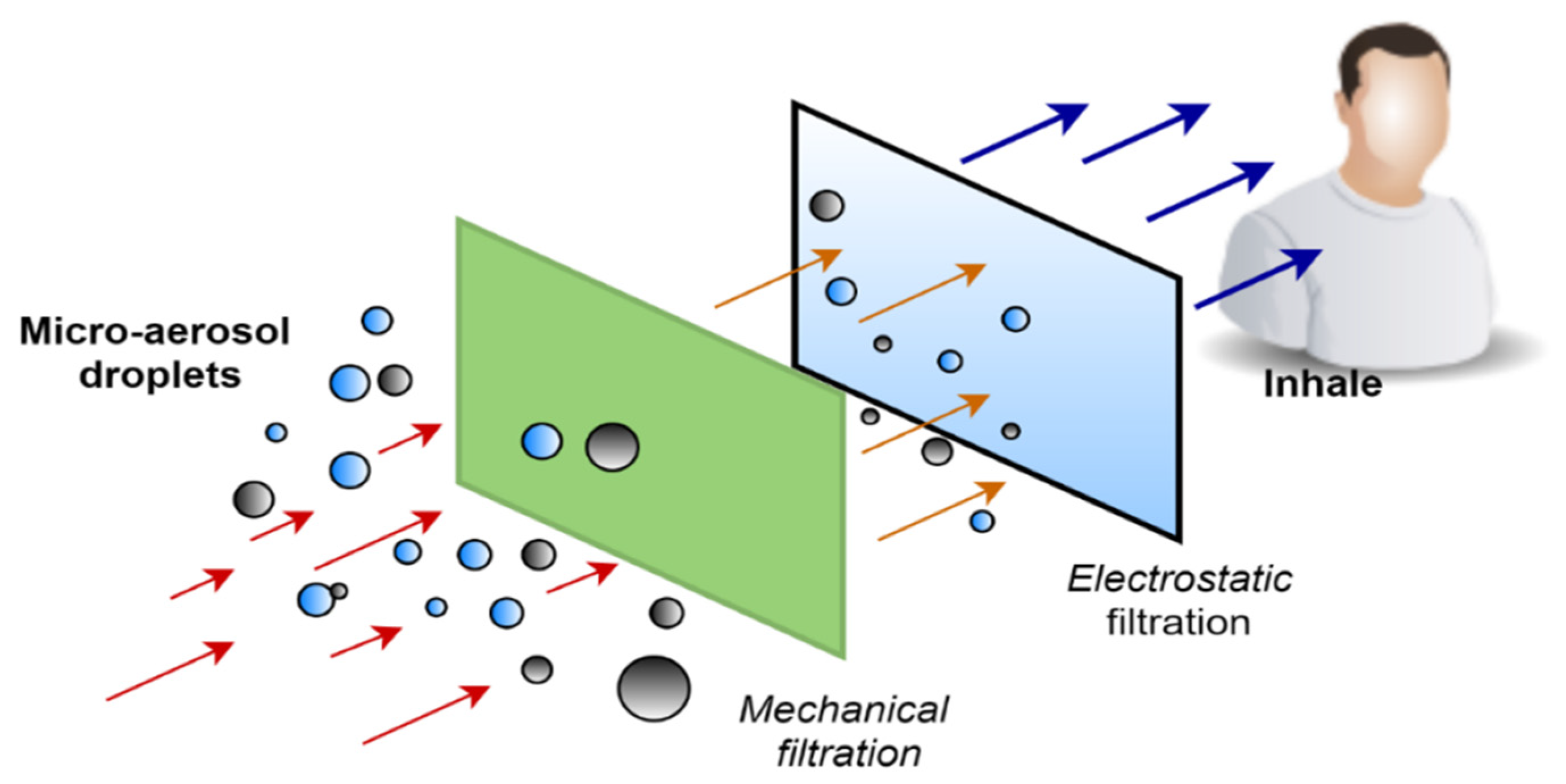
1.3.1. Simple Face Mask
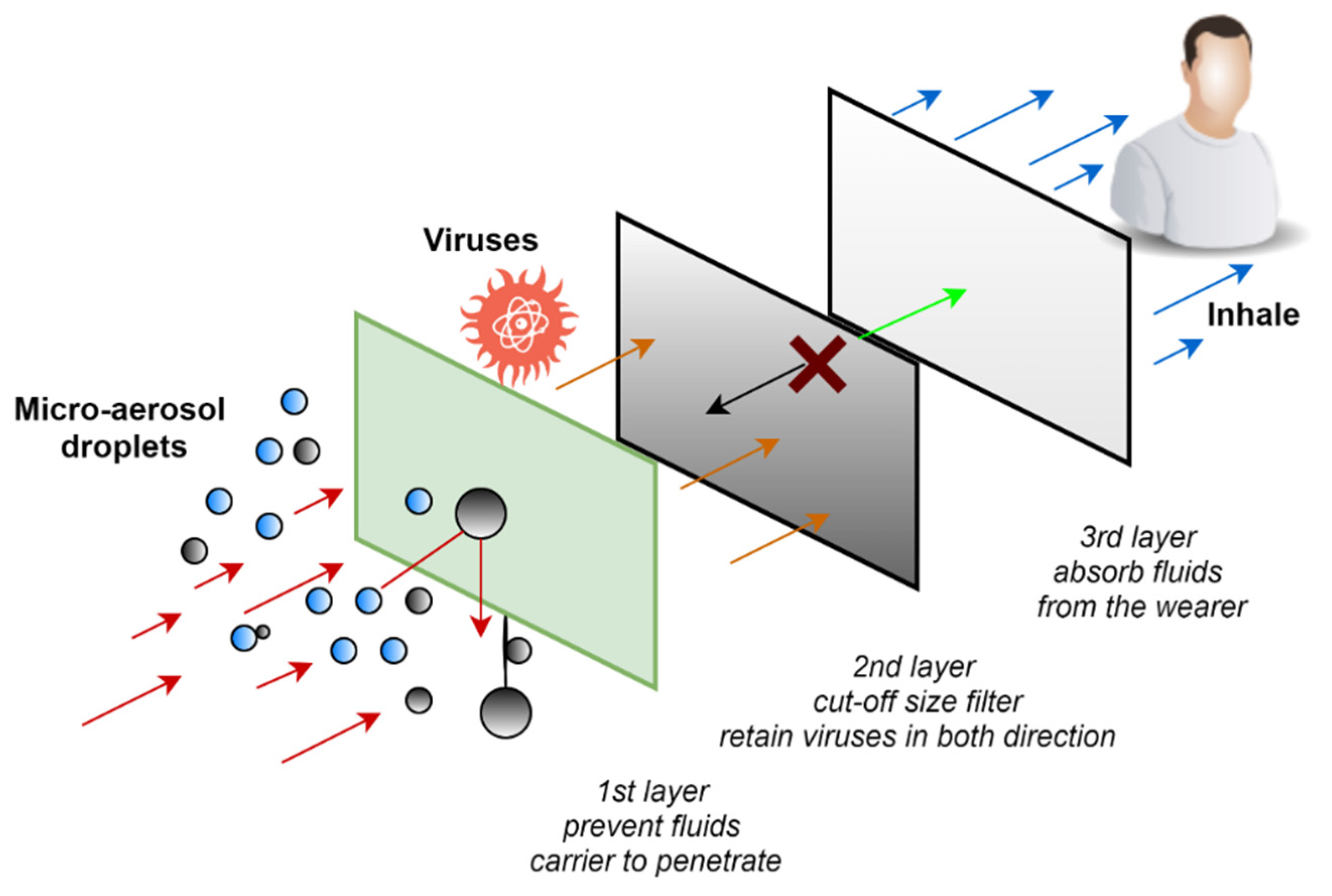
1.3.2. Surgical Mask
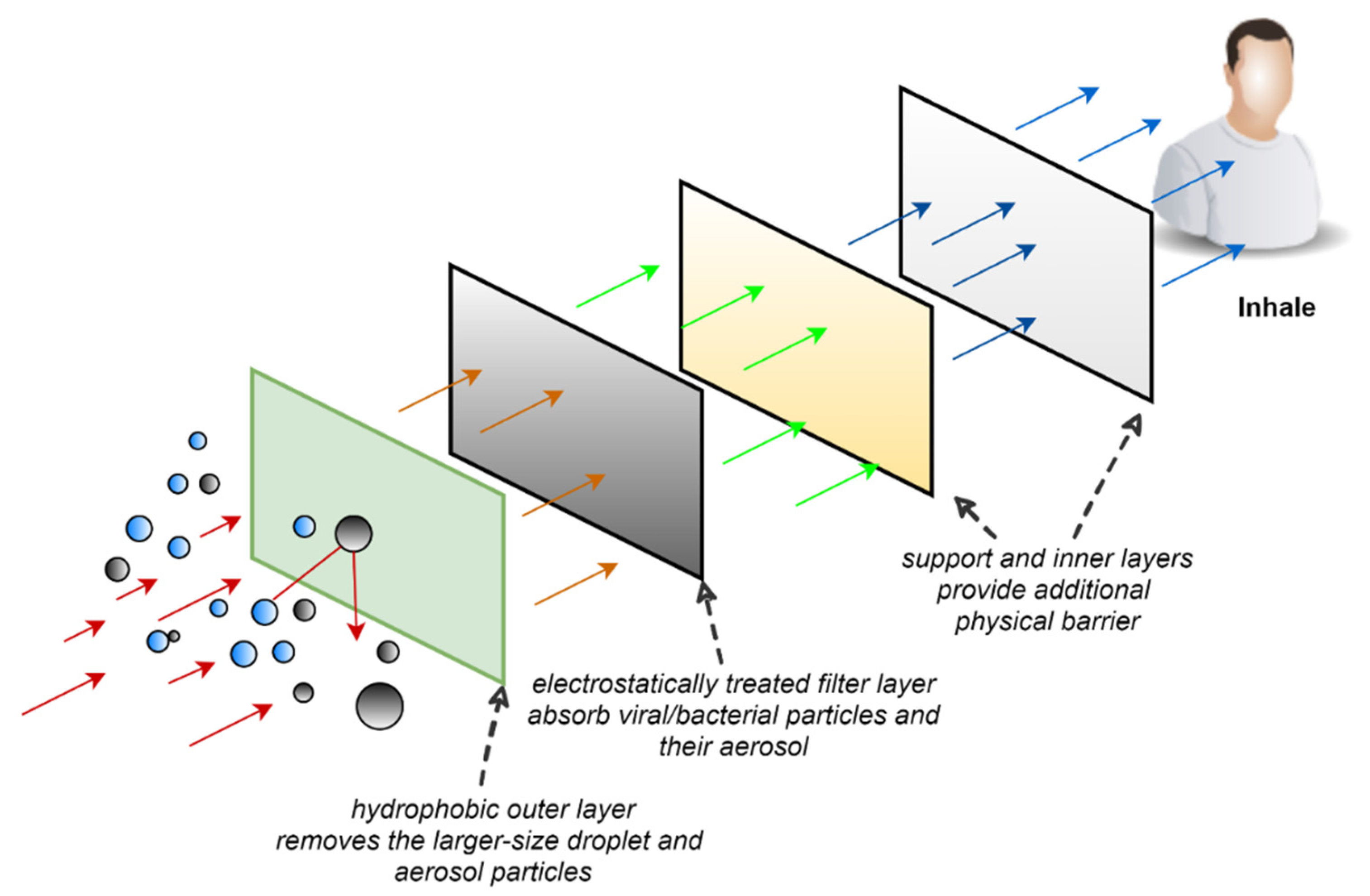
1.3.3. Filtering Facepiece Respirators
1.3.4. Comparison of Face Masks
2. Materials and Methods
2.1. Goal and Scope
2.2. Inventory Analysis
2.3. Life Cycle Impact Assessment
3. Results
4. Future Perspective in Mask Development
5. Conclusions
Author Contributions
Funding
Institutional Review Board Statement
Informed Consent Statement
Data Availability Statement
Acknowledgments
Conflicts of Interest
References
- WHO. WHO Coronavirus (COVID-19) Dashboard. Available online: https://covid19.who.int (accessed on 10 October 2021).
- Chua, M.H.; Cheng, W.; Goh, S.S.; Kong, J.; Li, B.; Lim, J.Y.C.; Mao, L.; Wang, S.; Xue, K.; Yang, L.; et al. Face Masks in the New COVID-19 Normal: Materials, Testing, and Perspectives. Research 2020, 2020, 7286735. [Google Scholar] [CrossRef] [Scilit]
- Chowdhury, H.; Chowdhury, T.; Sait, S.M. Estimating marine plastic pollution from COVID-19 face masks in coastal regions. Mar. Pollut. Bull. 2021, 168, 112419. [Google Scholar] [CrossRef] [Scilit]
- Tcharkhtchi, A.; Abbasnezhad, N.; Zarbini Seydani, M.; Zirak, N.; Farzaneh, S.; Shirinbayan, M. An overview of filtration efficiency through the masks: Mechanisms of the aerosols penetration. Bioact. Mater. 2021, 6, 106–122. [Google Scholar] [CrossRef] [Scilit] [PubMed]
- Bar-On, Y.M.; Flamholz, A.; Phillips, R.; Milo, R. SARS-CoV-2 (COVID-19) by the numbers. Elife 2020, 9, e57309. [Google Scholar] [CrossRef] [Scilit]
- Hinds, W.C. Filtration. In Aerosol Technology: Properties, Behavior, and Measurement of Airborne Particles, 2nd ed.; John Wiley & Sons: New York, NY, USA, 1999; pp. 182–205. [Google Scholar]
- Dunnett, S. Filtration Mechanisms. Aerosol Sci. 2013, 89–117. [Google Scholar] [CrossRef] [Scilit]
- Bayersdorfer, J.; Giboney, S.; Martin, R.; Moore, A.; Bartles, R. Novel Manufacturing of Simple Masks in Response to International Shortages: Bacterial and Particulate Filtration Efficiency Testing. Am. J. Infect. Control. 2020, 48, 1543–1545. [Google Scholar] [CrossRef] [Scilit] [PubMed]
- Konda, A.; Prakash, A.; Moss, G.; Schmoldt, M.; Grant, G.; Guha, S. Aerosol Filtration Efficiency of Common Fabrics Used in Respiratory Cloth Masks. ACS Nano 2020, 14, 6339–6347. [Google Scholar] [CrossRef] [Scilit] [PubMed]
- Prata, J.; Patricio Silva, A.L.; Duarte, A.; Rocha-Santos, T. Disposable over Reusable Face Masks: Public Safety or Environmental Disaster? Environments 2021, 8, 31. [Google Scholar] [CrossRef] [Scilit]
- Adyel, T.M. Accumulation of plastic waste during COVID-19. Science 2020, 369, 1314. [Google Scholar]
- Fadare, O.O.; Okoffo, E.D. Covid-19 face masks: A potential source of microplastic fibers in the environment. Sci. Total Environ. 2020, 737, 140279. [Google Scholar] [CrossRef] [Scilit]
- Selvaranjan, K.; Navaratnam, S.; Rajeev, P.; Ravintherakumaran, N. Environmental challenges induced by extensive use of face masks during COVID-19: A review and potential solutions. Environ. Chall. 2021, 3, 100039. [Google Scholar] [CrossRef] [Scilit]
- Klemeš, J.J.; Fan, Y.V.; Jiang, P. The energy and environmental footprints of COVID-19 fighting measures—PPE, disinfection, supply chains. Energy 2020, 211, 118701. [Google Scholar] [CrossRef] [Scilit]
- Wang, Z.; Guy, C.; Ng, K.T.; An, C. A New Challenge for the Management and Disposal of Personal Protective Equipment Waste during the COVID-19 Pandemic. Sustainability 2021, 13, 7034. [Google Scholar] [CrossRef] [Scilit]
- Oginni, O. COVID-19 disposable face masks: A precursor for synthesis of valuable bioproducts. Environ. Sci. Pollut. Res. Int. 2021, 28, 1–3. [Google Scholar] [CrossRef] [Scilit]
- Silva, A.L.P.; Prata, J.C.; Duarte, A.C.; Soares, A.M.V.M.; Barceló, D.; Rocha-Santos, T. Microplastics in landfill leachates: The need for reconnaissance studies and remediation technologies. Case Stud. Chem. Environ. Eng. 2021, 3, 100072. [Google Scholar] [CrossRef] [Scilit]
- Jeong, J.; Choi, J. Adverse outcome pathways potentially related to hazard identification of microplastics based on toxicity mechanisms. Chemosphere 2019, 231, 249–255. [Google Scholar] [CrossRef] [Scilit]
- Jambeck, J.; Geyer, R.; Wilcox, C.; Siegler, T.; Perryman, M.; Andrady, A.; Narayan, R.; Law, K. Marine pollution. Plastic waste inputs from land into the ocean. Science 2015, 347, 768–771. [Google Scholar] [CrossRef] [Scilit]
- Ayse, L.A.; Ambrose-Dempster, E.; Aparsi, T.D.; Bawn, M.; Arredondo, M.C.; Chau, C.; Chandler, K.; Dobrijevic, D.; Hailes, H.; Lettieri, P.; et al. The environmental dangers of employing single-use face masks as part of a COVID-19 exit strategy. UCL Open Environ. Prepr. 2020. Available online: https://ucl.scienceopen.com (accessed on 10 August 2021).
- Rizan, C.; Reed, M.; Bhutta, M. Environmental impact of Personal Protective Equipment supplied to health and social care services in England in the first six months of the COVID-19 pandemic. J. R. Soc. Med. 2020, 9, 20198911. [Google Scholar]
- Rengasamy, S.; Eimer, B.; Shaffer, R.E. Simple Respiratory Protection—Evaluation of the Filtration Performance of Cloth Masks and Common Fabric Materials Against 20–1000 nm Size Particles. Ann. Occup. Hyg. 2010, 54, 789–798. [Google Scholar]
- Shutler, T.M.A.N. How to Sew a Fabric Face Mask. The New York Times, 31 March 2020.
- Lepelletier, D.; Grandbastien, B.; Romano-Bertrand, S.; Aho, S.; Chidiac, C.; Géhanno, J.F.; Chauvin, F. What face mask for what use in the context of the COVID-19 pandemic? The French guidelines. J. Hosp. Infect. 2020, 105, 414–418. [Google Scholar] [CrossRef] [Scilit]
- Yao, B.-G.; Wang, Y.-X.; Ye, X.-Y.; Zhang, F.; Peng, Y.-L. Impact of structural features on dynamic breathing resistance of healthcare face mask. Sci. Total Environ. 2019, 689, 743–753. [Google Scholar] [CrossRef] [Scilit] [PubMed]
- Lee, S.-A.; Hwang, D.-C.; Li, H.-Y.; Tsai, C.-F.; Chen, C.-W.; Chen, J.-K. Particle Size-Selective Assessment of Protection of European Standard FFP Respirators and Surgical Masks against Particles-Tested with Human Subjects. J. Healthc. Eng. 2016, 2016, 8572493. [Google Scholar] [CrossRef] [Scilit] [PubMed]
- Lepelletier, D.; Keita-Perse, O.; Parneix, P.; Baron, R.; Glélé, L.S.A.; Grandbastien, B. Respiratory protective equipment at work: Good practices for filtering facepiece (FFP) mask. Eur. J. Clin. Microbiol. Infect. Dis. 2019, 38, 2193–2195. [Google Scholar] [CrossRef] [Scilit]
- Das, S.; Sarkar, S.; Das, A.; Das, S.; Chakraborty, P.; Sarkar, J. A comprehensive review of various categories of face masks resistant to Covid-19. Clin. Epidemiol. Glob. Health 2021, 12, 100835. [Google Scholar] [CrossRef] [Scilit]
- Liao, M.; Liu, H.; Wang, X.; Hu, X.; Huang, Y.; Liu, X.; Brenan, K.; Mecha, J.; Nirmalan, M.; Lu, J. A Technical Review of Face Mask Wearing in Preventing Respiratory COVID-19 Transmission. Curr. Opin. Colloid Interface Sci. 2021, 52, 101417. [Google Scholar] [CrossRef] [Scilit]
- Dharmaraj, S.; Ashokkumar, V.; Hariharan, S.; Manibharathi, A.; Show, P.L.; Chong, C.T.; Ngamcharussrivichai, C. The COVID-19 pandemic face mask waste: A blooming threat to the marine environment. Chemosphere 2021, 272, 129601. [Google Scholar] [CrossRef] [Scilit]
- Hasan, N.A.; Heal, R.D.; Bashar, A.; Haque, M.M. Face masks: Protecting the wearer but neglecting the aquatic environment?—A perspective from Bangladesh. Environ. Chall. 2021, 4, 100126. [Google Scholar] [CrossRef] [Scilit]
- Wrisberg, N.; Haes, H.; Triebswetter, U.; Eder, P.; Clift, R. Analytical Tools for Environmental Design and Management in a Systems Perspective: The Combined Use of Analytical Tools; Springer: Berlin/Heidelberg, Germany, 2002. [Google Scholar]
- Aziz, N.I.H.A.; Hanafiah, M.M. Application of life cycle assessment for desalination: Progress, challenges and future directions. Environ. Pollut. 2021, 268, 115948. [Google Scholar] [CrossRef] [Scilit]
- Bare, J.C.; Hofstetter, P.; Pennington, D.W.; de Haes, H.A.U. Midpoints versus endpoints: The sacrifices and benefits. Int. J. Life Cycle Assess. 2000, 5, 319. [Google Scholar] [CrossRef] [Scilit]
- Hauschild, M.Z.; Huijbregts, M.A.J. Introducing Life Cycle Impact Assessment. In Life Cycle Impact Assessment; Hauschild, M.Z., Huijbregts, M.A.J., Eds.; Springer: Dordrecht, Netherlands, 2015; pp. 1–16. [Google Scholar]
- Simapro. Available online: https://simapro.com/ (accessed on 10 August 2021).
- Rodríguez, N.B.; Formentini, G.; Favi, C.; Marconi, M. Environmental implication of personal protection equipment in the pandemic era: LCA comparison of face masks typologies. Procedia CIRP 2021, 98, 306–311. [Google Scholar] [CrossRef] [Scilit] [PubMed]
- Statista Inc. Energy Consumption in Italy in 2020, by Source. Available online: https://www.statista.com/ (accessed on 1 November 2021).
- Jolliet, O.; Margni, M.; Charles, R.; Humbert, S.; Payet, J.; Rebitzer, G.; Rosenbaum, R. IMPACT 2002+: A new life cycle assessment methodology. Int. J. Life Cycle Assess. 2003, 8, 324–330. [Google Scholar] [CrossRef] [Scilit]
- Huijbregts, M.; Steinmann, Z.; Elshout, P.; Stam, G.; Verones, F.; Vieira, M.; Zijp, M.; Hollander, A.; Zelm, R. ReCiPe2016: A harmonised life cycle impact assessment method at midpoint and endpoint level. Int. J. Life Cycle Assess. 2016, 22, 138–147. [Google Scholar] [CrossRef] [Scilit]
- Hischier, R.; Weidema, B.; Althaus, H.-J.; Bauer, C.; Doka, G.; Dones, R.; Frischknecht, R.; Hellweg, S.; Humbert, S.; Jungbluth, N.; et al. Implementation of Life Cycle Impact Assessment Methods. Final. Rep. Ecoinvent 2010, 2, v2. [Google Scholar]
- Fernández-Arribas, J.; Moreno, T.; Bartrolí, R.; Eljarrat, E. COVID-19 face masks: A new source of human and environmental exposure to organophosphate esters. Environ. Int. 2021, 154, 106654. [Google Scholar] [CrossRef] [Scilit] [PubMed]
- Graulich, K.; Köhler, A.; Löw, C.; Sutter, J.; Watson, D.; Mehlhart, G.; Egebæk, K.R.; Bilsen, V.; Bley, F.; Manshoven, S.; et al. Impact of COVID-19 on Single-Use Plastics and the Environment in Europe; European Environment Agency: Boeretang, Belgium, 22 June 2021. [Google Scholar]
- Liu, F.; Li, M.; Shao, W.; Yue, W.; Hu, B.; Weng, K.; Chen, Y.; Liao, X.; He, J. Preparation of a polyurethane electret nanofiber membrane and its air-filtration performance. J. Colloid Interface Sci. 2019, 557, 318–327. [Google Scholar] [CrossRef] [Scilit]
- Bai, Y.; Han, C.B.; He, C.; Gu, G.Q.; Nie, J.H.; Shao, J.J.; Xiao, T.X.; Deng, C.R.; Wang, Z.L. Washable Multilayer Triboelectric Air Filter for Efficient Particulate Matter PM2.5 Removal. Adv. Funct. Mater. 2018, 28, 1706680. [Google Scholar] [CrossRef] [Scilit]
- Lai, Y.-C.; Deng, J.; Zhang, S.L.; Niu, S.; Guo, H.; Wang, Z.L. Single-Thread-Based Wearable and Highly Stretchable Triboelectric Nanogenerators and Their Applications in Cloth-Based Self-Powered Human-Interactive and Biomedical Sensing. Adv. Funct. Mater. 2017, 27, 1604462. [Google Scholar] [CrossRef] [Scilit]
- Hao, Z.; Wu, J.; Wang, C.; Liu, J. Electrospun Polyimide/Metal-Organic Framework Nanofibrous Membrane with Superior Thermal Stability for Efficient PM2.5 Capture. ACS Appl. Mater. Interfaces 2019, 11, 11904–11909. [Google Scholar] [CrossRef] [Scilit] [PubMed]
- Koo, W.-T.; Jang, J.-S.; Qiao, S.; Hwang, W.; Jha, G.; Penner, R.M.; Kim, I.-D. Hierarchical Metal–Organic Framework-Assembled Membrane Filter for Efficient Removal of Particulate Matter. ACS Appl. Mater. Interfaces 2018, 10, 19957–19963. [Google Scholar] [CrossRef] [Scilit]
- Chen, Y.; Zhang, S.; Cao, S.; Li, S.; Chen, F.; Yuan, S.; Xu, C.; Zhou, J.; Feng, X.; Ma, X.; et al. Roll-to-Roll Production of Metal-Organic Framework Coatings for Particulate Matter Removal. Adv. Mater. 2017, 29, 1606221. [Google Scholar] [CrossRef] [Scilit]
- Li, Q.; Xu, Y.; Wei, H.; Wang, X. An electrospun polycarbonate nanofibrous membrane for high efficiency particulate matter filtration. RSC Adv. 2016, 6, 65275–65281. [Google Scholar]
- Yang, X.; Pu, Y.; Zhang, Y.; Liu, X.; Li, J.; Yuan, D.; Ning, X. Multifunctional composite membrane based on BaTiO3@PU/PSA nanofibers for high-efficiency PM2.5 removal. J. Hazard. Mater. 2020, 391, 122254. [Google Scholar] [CrossRef] [Scilit] [PubMed]
- Gao, X.; Li, Z.-K.; Xue, J.; Qian, Y.; Zhang, L.-Z.; Caro, J.; Wang, H. Titanium carbide Ti3C2Tx (MXene) enhanced PAN nanofiber membrane for air purification. J. Membr. Sci. 2019, 586, 162–169. [Google Scholar] [CrossRef] [Scilit]
- Zhong, H.; Zhu, Z.; Lin, J.; Cheung, C.F.; Lu, V.L.; Yan, F.; Chan, C.-Y.; Li, G. Reusable and Recyclable Graphene Masks with Outstanding Superhydrophobic and Photothermal Performances. ACS Nano 2020, 14, 6213–6221. [Google Scholar] [CrossRef] [Scilit]
- Lin, Y.-C.; Chen, C.-P. Thermoregulation and thermal sensation in response to wearing tight-fitting respirators and exercising in hot-and-humid indoor environment. Build. Environ. 2019, 160, 106158. [Google Scholar] [CrossRef] [Scilit]
- Güder, F.; Ainla, A.; Redston, J.; Mosadegh, B.; Glavan, A.; Martin, T.J.; Whitesides, G.M. Paper-Based Electrical Respiration Sensor. Angew. Chem. Int. Ed. 2016, 55, 5727–5732. [Google Scholar] [CrossRef] [Scilit] [PubMed]
- Cherrie, J.W.; Wang, S.; Mueller, W.; Wendelboe-Nelson, C.; Loh, M. In-mask temperature and humidity can validate respirator wear-time and indicate lung health status. J. Expo. Sci. Environ. Epidemiol. 2019, 29, 578–583. [Google Scholar] [CrossRef] [Scilit]
- Williams, C.M.; Abdulwhhab, M.; Birring, S.S.; De Kock, E.; Garton, N.J.; Townsend, E.; Pareek, M.; Al-Taie, A.; Pan, J.; Ganatra, R.; et al. Exhaled Mycobacterium tuberculosis output and detection of subclinical disease by face-mask sampling: Prospective observational studies. Lancet Infect. Dis. 2020, 20, 607–617. [Google Scholar] [CrossRef] [Scilit]
- Gorrasi, G.; Sorrentino, A.; Lichtfouse, E. Back to plastic pollution in COVID times. Environ. Chem. Lett. 2021, 19, 1–4. [Google Scholar] [CrossRef] [Scilit]
- Babaahmadi, V.; Amid, H.; Naeimirad, M.; Ramakrishna, S. Biodegradable and multifunctional surgical face masks: A brief review on demands during COVID-19 pandemic, recent developments, and future perspectives. Sci. Total Environ. 2021, 798, 149233. [Google Scholar] [CrossRef] [Scilit]
- Oyu Tsogtbayar, C.Y. The Decontamination of Mask and Reuse: Evidence Review. Korean J. Public Health 2020, 57, 17–24. [Google Scholar] [CrossRef] [Scilit]
- Ma, Q.X.; Shan, H.; Zhang, C.M.; Zhang, H.L.; Li, G.M.; Yang, R.M.; Chen, J.M. Decontamination of face masks with steam for mask reuse in fighting the pandemic COVID-19: Experimental supports. J. Med. Virol. 2020, 92, 1971–1974. [Google Scholar] [CrossRef] [Scilit] [PubMed]





| Mask Type | Filtration Efficiency for 0.3 μm Particles | Inward Leakage |
|---|---|---|
| FFP1 | At least 80% | <22% |
| FFP2 | At least 94% | <8% |
| FFP3 | At least 99% | <2% |
| Layer of Mask | Function, Assignment | Material |
|---|---|---|
| Outer layer | - Hydrophobic, dust-proof - Physical separation barrier on bacteria and virus | - Polyester fiber - Spun-bonded non-woven cloth - Graphene layer |
| Filter | - For the absorption of bacteria, viruses, and particles (PM2.5) - Electrostatic adsorption, a physical separation barrier | - Polypropylene-based melt-blown fibric material - Nano melt-blown non-woven cloth - Nano bionic spider web fibric film - Polyimide (aerogel membrane) - Teflon - Inorganic nanoparticles fiber membrane |
| Support | Structural support layer | Polyeste fibre net |
| Inner | - Skin-friendly inner layer | - Cotton-linen - Modified polypropylene non-woven cloth |
| Types of Masks | Cloth Mask | Surgical Mask | Respirators |
|---|---|---|---|
| Testing and approval | None | Europe: EN 14683 China: YY 0469 USA: ASTM F2100 | Europe: EN 149:2001 China: GB 2626-2006 USA: NIOSH (42CFR 84) |
| Intended usage, purpose | Protect others from the wearer’s respiratory emissions, not fluid | Fluid resistant and protects the wearer from large droplets | Reduces wearer’s exposure to airborne particles (small particle aerosols and large fluid) |
| Breathability | Breathable | Breathable | Difficult |
| Materials | - Cotton - Filter paper - Nylon | - 1st layer: Hydrophobic Non-Woven - 2nd layer: Melt blown filter - 3rd layer: soft absorbent non-woven | - 1st layer: Polyester fiber, Spun-bonded non-woven cloth, Graphene - 2nd layer: Polypropylene-based melt-blown fibric material, Nano melt-blown non-woven cloth, Nano bionic spider web fibric film, Polyimide (aerogel membrane), Teflon, Inorganic nanoparticles fiber membrane - 3rd layer: Polyeste fibre net - 4th layer: Cotton-linen, Modified polypropylene non-woven cloth |
| Leakage | Throughout cloth | Through mask edges | Minimal leakage |
| Face seal fit | Loose-fitting | Loose-fitting | Tight-fitting |
| Filtration | Low level filtration (50–90%) | Moderate level filtration (About 90%) | High/excellent level filtration (80–99%, maybe even 99.97% with N100 for 0.3 μm) |
| Durability | Moderate | Low | High |
| Limitation of usage | Reusable/ Washable | Disposable | Discard after each use, but can be used up to 5-times |
| Cost | Low-cost (0–0.59 USD/unit) | Medium cost (0.05–0.29 USD/unit) | High cost (0.18–13 USD/unit) |
| Mask Type | Material | Value | Unit | Lifespan | Mask Required [Millions] | |
|---|---|---|---|---|---|---|
| Cloth mask | Polypropylene (filter) | 2.70 | g | 50 washes | 280 | |
| Polyester (filter) | 2.70 | g | ||||
| Cotton (bands) | 1.00 | g | ||||
| Manual washing (per wash) | soap | 2.60 | g | |||
| water | 2.50 | L | ||||
| Electricity consumption | 3.42 × 10⁻² | kWh | ||||
| Surgical mask | Polypropylene (filter) | 1.28 | g | 4h | 12,240 | |
| Polyester (filter) | 1.28 | g | ||||
| Aluminium (nose adapter) | 0.44 | g | ||||
| Cotton (bands) | 0.02 | g | ||||
| Electricity consumption | 7.92 × 10⁻⁴ | kWh | ||||
| FFP2 with valve | Synthesis rubber (bands) | 3.00 | g | 8h | 6120 | |
| Polypropylene (filter) | 5.00 | g | ||||
| Aluminium (nose adapter) | 0.95 | g | ||||
| Polyurethane foam (nose protection) | 0.05 | g | ||||
| Polypropylene (valve) | 5.00 | g | ||||
| Electricity consumption | 5.56 × 10⁻⁴ | kWh | ||||
| FFP2 without valve | Synthesis rubber (bands) | 3.00 | g | 8h | 6120 | |
| Polypropylene (filter) | 5.00 | g | ||||
| Aluminium (nose adapter) | 0.95 | g | ||||
| Electricity consumption | 5.56 × 10⁻⁴ | kWh | ||||
| Damage Category | Unit | FFP2 with Valve | FFP2 without Valve | Surgical Mask | Cloth Mask |
|---|---|---|---|---|---|
| Human health | DALY | 125 | 85.2 | 65.5 | 68.5 |
| Ecosystem quality | PDF × m2 × years | 1.28 × 10⁷ | 1.14 × 10⁷ | 3.19 × 10⁷ | 1.45 × 10⁷ |
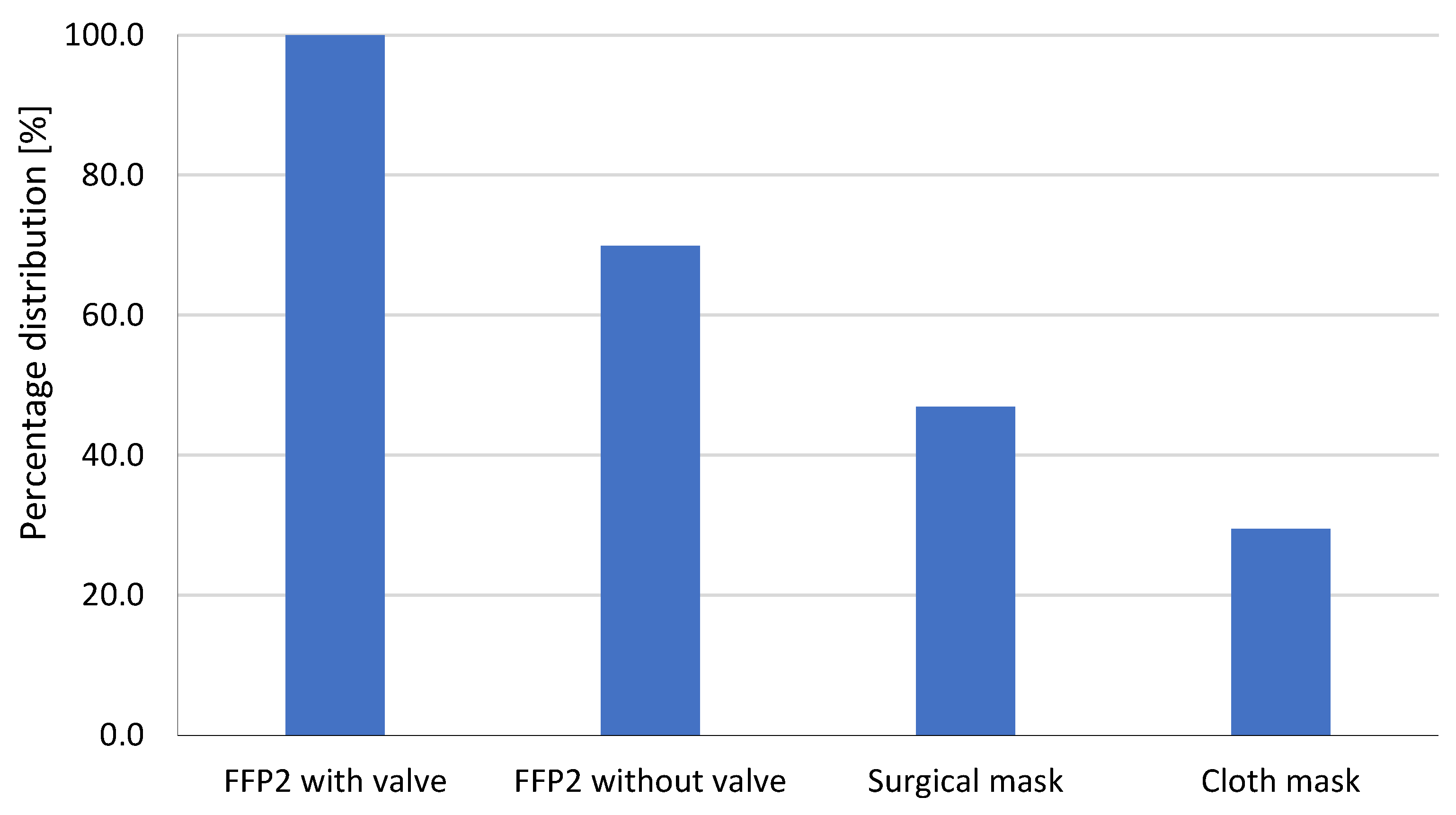
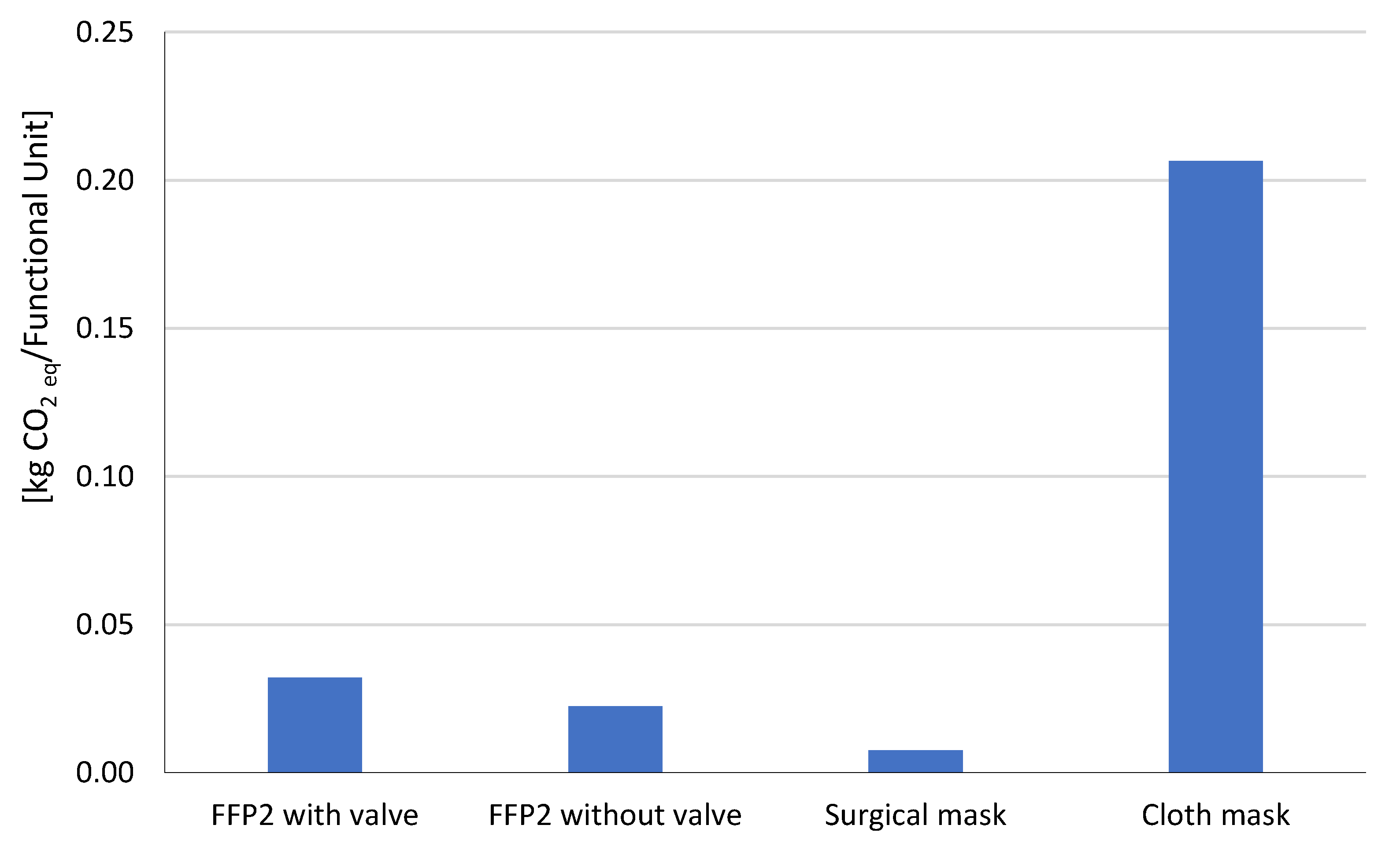
| Climate change | kg CO2 eq | 1.75 × 10⁸ | 1.26 × 10⁸ | 8.43 × 10⁷ | 5.36 × 10⁷ |
| Resources | MJ primary | 6.65 × 10⁹ | 4.36 × 10⁹ | 2.51 × 10⁹ | 9.78 × 10⁸ |
| Damage Category | Unit | FFP2 with Valve | FFP2 without Valve | Surgical Mask | Cloth Mask |
|---|---|---|---|---|---|
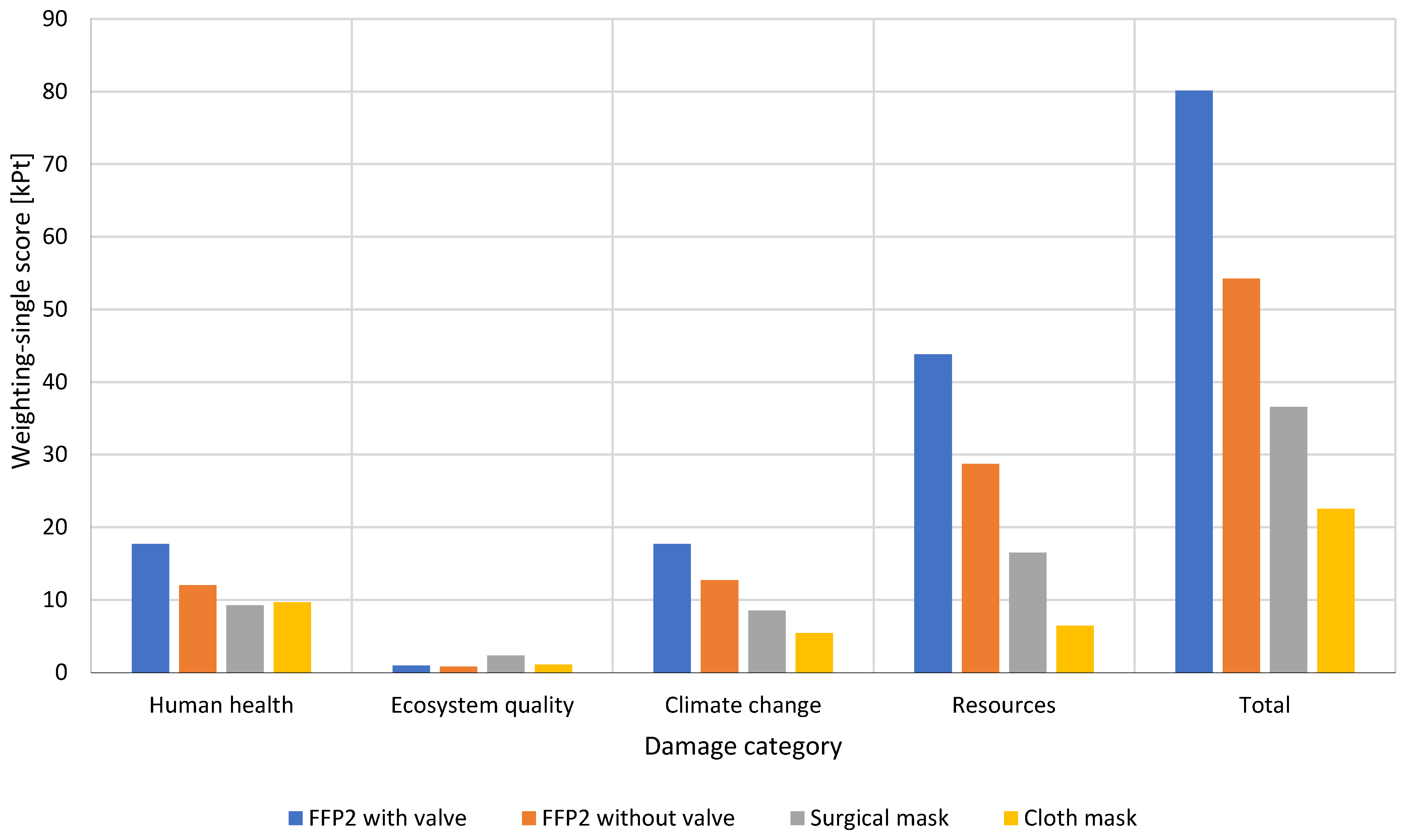
| Human health | kPt | 17.7 | 12 | 9.24 | 9.65 |
| Ecosystem quality | kPt | 0.933 | 0.833 | 2.33 | 1.06 |
| Climate change | kPt | 17.7 | 12.7 | 8.51 | 5.41 |
| Resources | kPt | 43.8 | 28.7 | 16.5 | 6.44 |
| Total | kPt | 80.133 | 54.233 | 36.58 | 22.56 |
| Damage Category | Unit | FFP2 with Valve | FFP2 without Valve | Surgical Mask | Cloth Mask |
|---|---|---|---|---|---|
| IPCC GWP 100a | kg CO2 eq | 1.96 × 10⁸ | 1.37 × 10⁸ | 9.20 × 10⁷ | 5.78 × 10⁷ |
| Damage Category | Unit | FFP2 with Valve | FFP2 without Valve | Surgical Mask | Cloth Mask |
|---|---|---|---|---|---|
| Human health | DALY | 377 | 253 | 190 | 169 |
| Ecosystem quality | Species × years | 0.817 | 0.553 | 0.503 | 0.518 |
| Resources | USD2013 | 4.44 × 10⁷ | 3.44 × 10⁷ | 1.80 × 10⁷ | 4.59 × 10⁶ |
| Impact Category | Unit | FFP2 with Valve | FFP2 without Valve | Surgical Mask | Cloth Mask |
|---|---|---|---|---|---|
| Carcinogens | kg C2H3Cl eq | 2.39 × 10⁶ | 2.38 × 10⁶ | 8.96 × 10⁵ | 6.3 × 10⁶ |
| Non-carcinogens | kg C2H3Cl eq | 2.51 × 10⁶ | 1.11 × 10⁶ | 1.61 × 10⁶ | 1.07 × 10⁶ |
| Respiratory inorganics | kg PM2.5 eq | 1.59 × 10⁵ | 1.07 × 10⁵ | 8.32 × 10⁴ | 6.81 × 10⁴ |
| Ionizing radiation | Bq C-14 eq | 1.1 × 10⁹ | 1.1 × 10⁹ | 7.56 × 10⁸ | 6.02 × 10⁸ |
| Ozone layer depletion | kg CFC-11 eq | 16.4 | 16.1 | 21.4 | 22.6 |
| Respiratory organics | kg C2H4 eq | 1.42 × 10⁵ | 1.04 × 10⁵ | 3.88 × 10⁴ | 1.73 × 10⁴ |
| Aquatic ecotoxicity | kg TEG water | 1.59 × 10¹⁰ | 7.14 × 10⁹ | 8.02 × 10⁹ | 4.38 × 10⁹ |
| Terrestrial ecotoxicity | kg TEG soil | 1.04 × 10⁹ | 1.03 × 10⁹ | 2.06 × 10⁹ | 1.14 × 10⁹ |
| Terrestrial acid/nutri | kg SO2 eq | 2.69 × 10⁶ | 1.94 × 10⁶ | 1.7 × 10⁶ | 1.06 × 10⁶ |
| Land occupation | m2 organic arable | 8.41 × 10⁵ | 8.18 × 10⁵ | 1.24 × 10⁷ | 3.81 × 10⁶ |
| Aquatic acidification | kg SO2 eq | 9.43 × 10⁵ | 6.17 × 10⁵ | 5.29 × 10⁵ | 3.26 × 10⁵ |
| Aquatic eutrophication | kg PO4 eq P-lim | 1.49 × 10⁴ | 1.45 × 10⁴ | 1.3 × 10⁴ | 3.27 × 10⁴ |
| Global warming | kg CO2 eq | 1.75 × 10⁸ | 1.26 × 10⁸ | 8.43 × 10⁷ | 5.36 × 10⁷ |
| Non-renewable energy | MJ primary | 6.64 × 10⁹ | 4.35 × 10⁹ | 2.5 × 10⁹ | 9.75 × 10⁸ |
| Mineral extraction | MJ surplus | 1.06 × 10⁷ | 1.06 × 10⁷ | 8.84 × 10⁶ | 3.36 × 10⁶ |
Publisher’s Note: MDPI stays neutral with regard to jurisdictional claims in published maps and institutional affiliations. |
© 2021 by the authors. Licensee MDPI, Basel, Switzerland. This article is an open access article distributed under the terms and conditions of the Creative Commons Attribution (CC BY) license (https://creativecommons.org/licenses/by/4.0/).
Share and Cite
Do Thi, H.T.; Mizsey, P.; Toth, A.J. Applicability of Membranes in Protective Face Masks and Comparison of Reusable and Disposable Face Masks with Life Cycle Assessment. Sustainability 2021, 13, 12574. https://doi.org/10.3390/su132212574
Do Thi HT, Mizsey P, Toth AJ. Applicability of Membranes in Protective Face Masks and Comparison of Reusable and Disposable Face Masks with Life Cycle Assessment. Sustainability. 2021; 13(22):12574. https://doi.org/10.3390/su132212574
Chicago/Turabian StyleDo Thi, Huyen Trang, Peter Mizsey, and Andras Jozsef Toth. 2021. "Applicability of Membranes in Protective Face Masks and Comparison of Reusable and Disposable Face Masks with Life Cycle Assessment" Sustainability 13, no. 22: 12574. https://doi.org/10.3390/su132212574
APA StyleDo Thi, H. T., Mizsey, P., & Toth, A. J. (2021). Applicability of Membranes in Protective Face Masks and Comparison of Reusable and Disposable Face Masks with Life Cycle Assessment. Sustainability, 13(22), 12574. https://doi.org/10.3390/su132212574