Article

Cashless Transactions: A Study on Intention and Adoption of e-Wallets

by
Marvello Yang
1,
Abdullah Al Mamun
2,*,
Muhammad Mohiuddin
3,
Noorshella Che Nawi
4 and
Noor Raihani Zainol
4
1
Department of Management, Faculty Economic and Bussiness, Widya Dharma University Pontianak, Kota Pontianak 78243, Indonesia
2
Faculty of Business and Management, UCSI University, Kuala Lumpur 56000, Malaysia
3
Faculty of Business Administration, Laval University, Quebec, QC 2325, Canada
4
Faculty of Entrepreneurship and Business, Universiti Malaysia Kelantan, Kota Bharu 16100, Malaysia
*
Author to whom correspondence should be addressed.
Sustainability 2021, 13(2), 831; https://doi.org/10.3390/su13020831
Submission received: 1 January 2021 / Revised: 11 January 2021 / Accepted: 13 January 2021 / Published: 15 January 2021
(This article belongs to the Section Economic and Business Aspects of Sustainability)

Abstract

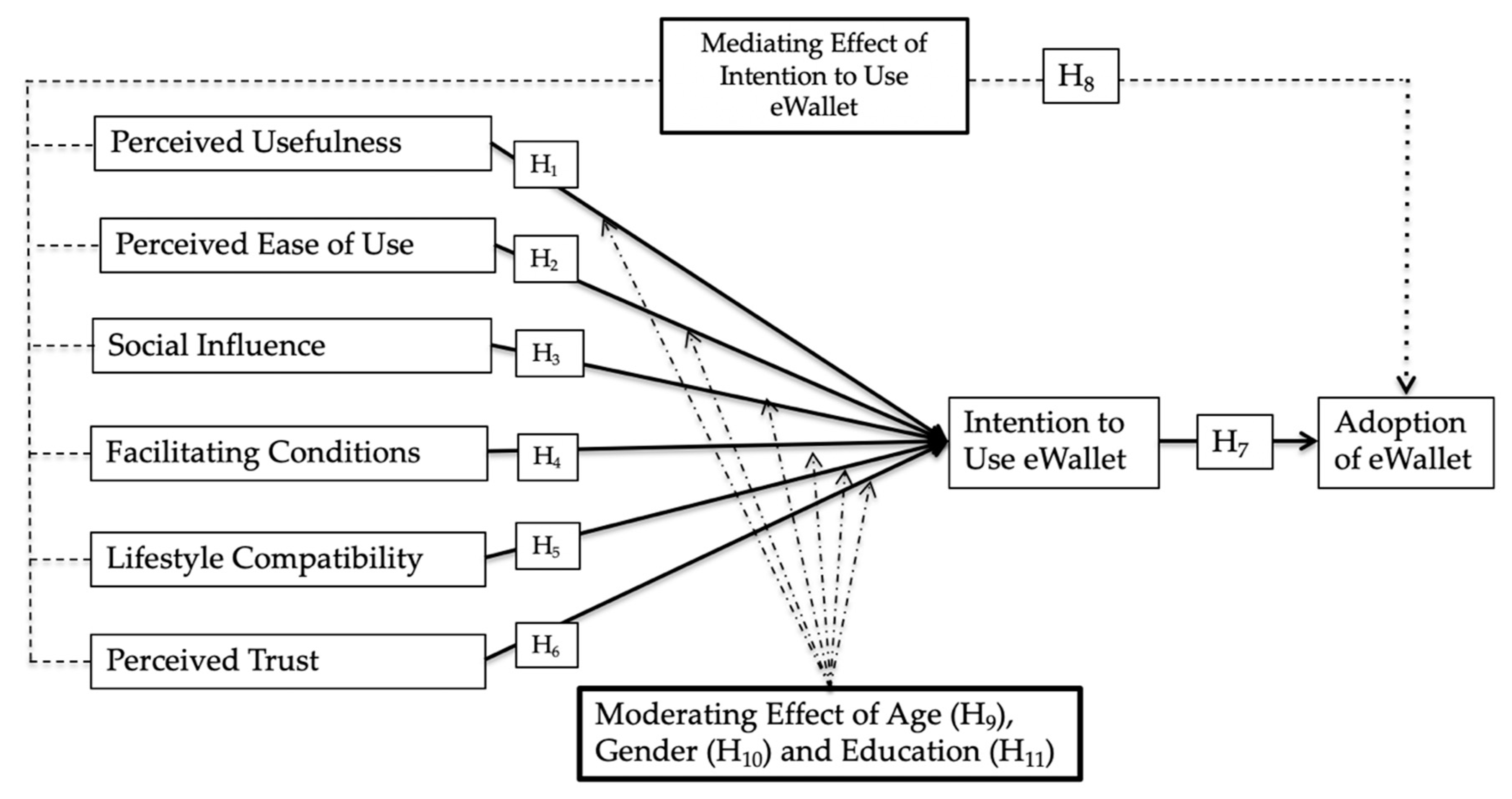
This study explored the effect of perceived usefulness, perceived ease of use, social influence, facilitating condition, lifestyle compatibility, and perceived trust on both the intention to use an e-wallet and the adoption of an e-wallet among adults by using the unified theory of acceptance and use of technology (UTAUT). This quantitative study adopted a cross-sectional research design to gather data from 501 respondents using a Google Form. The collected data were analyzed using partial least square structural equation modelling (PLS-SEM). As a result, perceived usefulness, perceived ease of use, social influence, lifestyle compatibility, and perceived trust displayed a significant positive effect on both intentions to use an e-wallet and adoption of an e-wallet. This study evidenced the mediating effect of the intention to use an e-wallet on the correlations between the predictors and adoption of an e-wallet. Both the age and gender of the respondents moderated the effect of lifestyle compatibility on intention to use an e-wallet. The study outcomes serve to inform managers and policy makers to devise effective strategies that capture consumers’ intention to use and experience of using an e-wallet in the midst of a turbulent market. Ultimately, such carefully sculpted policies may promote the digital platform and web-based application, apart from encouraging higher rates of e-wallet adoption in developing countries.
Keywords: perceived usefulness; perceived ease of use; social influence; facilitating condition; compatibility; perceived trust; intention; adoption; e-wallet perceived usefulness; perceived ease of use; social influence; facilitating condition; compatibility; perceived trust; intention; adoption; e-wallet