Review

Long-Term Sustainability Approach in Road Traffic Noise Wall Design


Department for Transportation Engineering, Faculty of Civil Engineering, University of Zagreb, 10000 Zagreb, Croatia
*
Authors to whom correspondence should be addressed.
Sustainability 2021, 13(2), 536; https://doi.org/10.3390/su13020536
Submission received: 20 November 2020 / Revised: 12 December 2020 / Accepted: 6 January 2021 / Published: 8 January 2021
(This article belongs to the Collection Emerging Technologies and Sustainable Road Safety)

Abstract

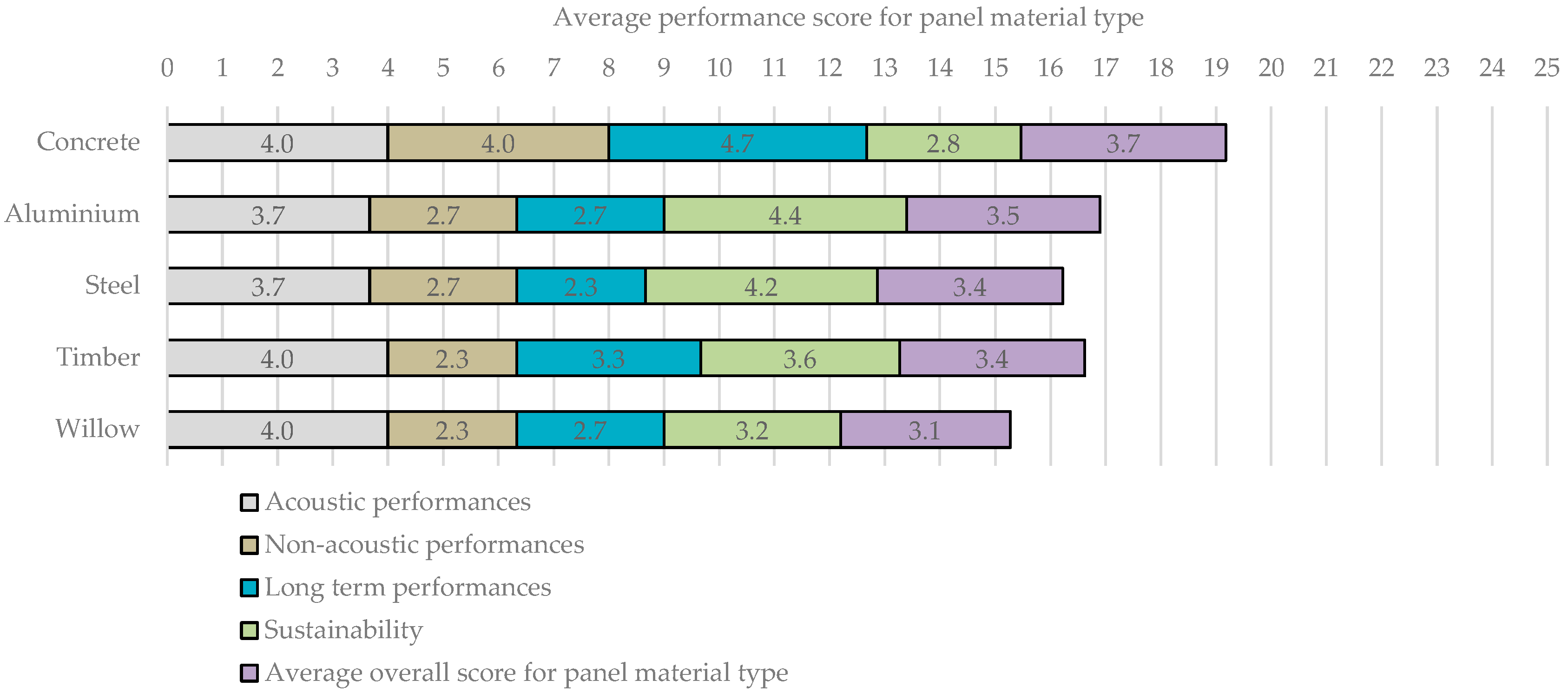
Despite the long-term experience in the application of noise walls, the uncertainty in wall panel service life efficiency is almost equal between panels built from established and new materials, which are—because of the desire to increase the sustainability of noise walls—developing at an ever-faster pace. The presented meta-analysis of data collected during a systematic review of concrete, metal, and wood panels’ acoustic and non-acoustic characteristics, long term performance, and cradle-to-gate sustainability aims to reduce this uncertainty and support the process of noise wall design and management by shifting the emphasis in decision making from construction costs to the long-term sustainability of the road traffic noise mitigation project. The multi-criterial analysis showed that when choosing a panel, preference should be given to those using lightweight concrete materials. A further comprehensive cradle-to-grave assessment of lightweight concrete panels with expanded clay and recycled tire rubber aggregates, which was performed to fill a knowledge gap observed in the literature and identify opportunities for the improvement of lightweight concrete sustainability, showed that the main environmental impacts of these panels are due to their production processes and that the way to reduce such impacts is to use panels made with aggregates from secondary raw materials.
Keywords: systematic review; meta-analysis; wall panel; material; multi-criterial analysis; lightweight aggregate; cradle-to-grave systematic review; meta-analysis; wall panel; material; multi-criterial analysis; lightweight aggregate; cradle-to-grave